Energy is one of the most important ideas in all of science, but it is also one of the easiest to notice in everyday life. It is there when a car starts moving, when the Sun warms your skin, when food gives your body fuel, when a phone battery powers a screen, and when water spins a turbine to make electricity. In physics, energy is usually described as the capacity to do work, and it appears in many forms that can change from one type to another.
That simple idea reaches far beyond the classroom. Energy shapes transport, cooking, heating, health, industry, climate, and even the way living things survive. It is not a thing you can always see, but it is always at work. A moving object has one kind of energy. A stretched rubber band has another. A battery stores energy in chemical form. Light carries energy across space. Food contains energy that your body can use.
Table of Contents
What Energy Means in Simple Words
The easiest way to understand energy is to think of it as the ability to make something happen. That something might be movement, heat, light, sound, electricity, or a chemical change. In scientific language, energy is a quantity that can be transferred and transformed, and in an isolated system the total amount stays constant even though its form may change.
Another simple way to say it is this. Energy is what lets change occur. A windmill turns because moving air transfers energy to its blades. A lamp glows because electrical energy becomes light and heat. A person runs because the body converts energy from food into motion and warmth. These are different examples of the same basic idea.
In science, it helps to remember that energy is not always a visible object. It is often a property of an object or system. A ball in motion has kinetic energy. A raised book has potential energy because of its position. A hot cup of tea has thermal energy. A battery, a spring, and a piece of fuel all store energy in different ways.
Why Energy Matters So Much
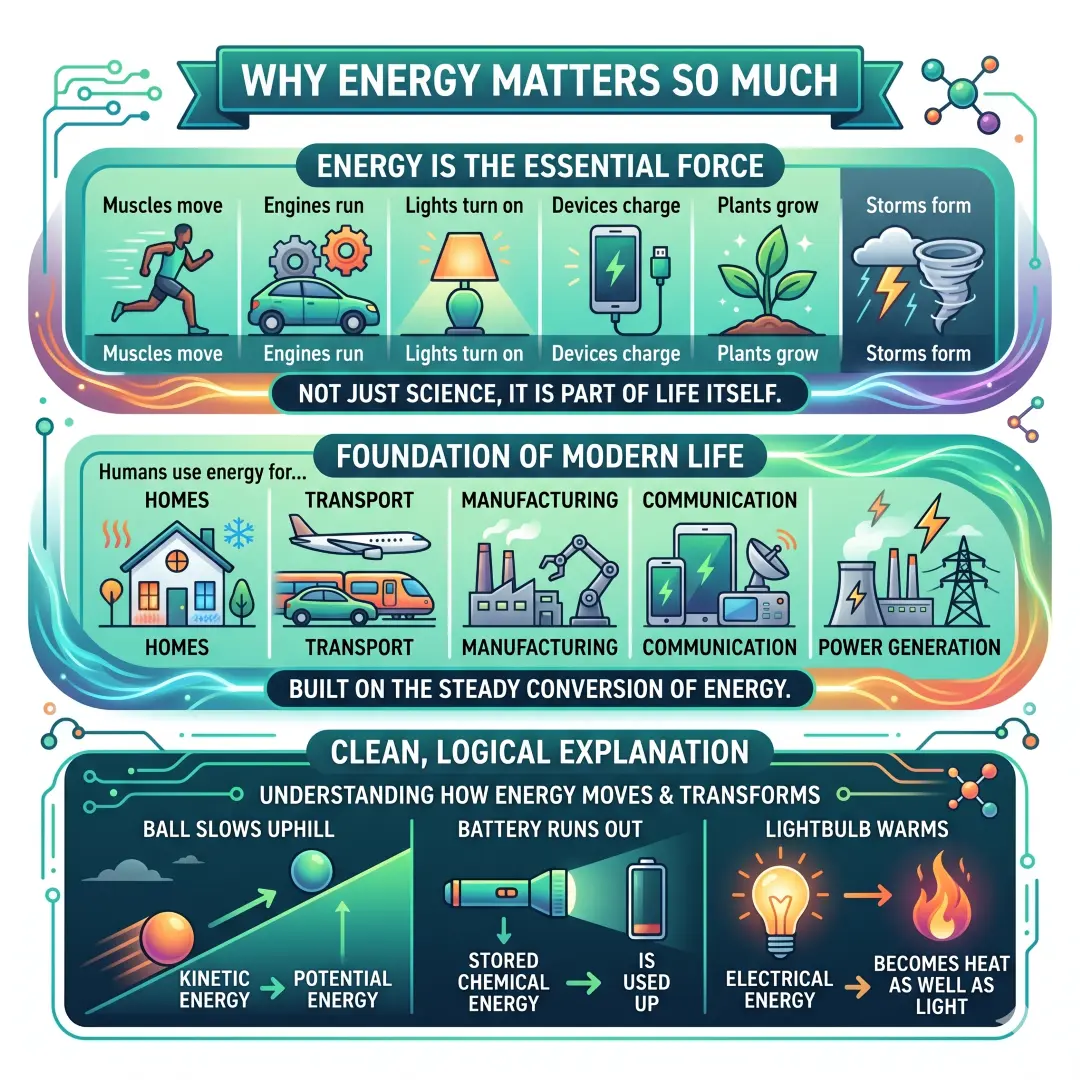
Without energy, nothing changes. No muscles move. No engines run. No lights turn on. No devices charge. No plants grow. No storms form. Energy is not just part of science, it is part of life itself. Humans use energy for homes, transport, manufacturing, heating, cooling, communication, and power generation. Modern life is built on the steady conversion of energy from one form into another.
Energy also matters because it helps explain the world in a clean, logical way. Once you understand how energy moves and transforms, many things that once felt mysterious become easier to follow. Why does a ball slow down when it rolls uphill? Because kinetic energy is being converted into potential energy. Why does a battery eventually run out? Because its stored chemical energy has been used up. Why does a lightbulb warm up? Because some electrical energy becomes heat as well as light.
The Main Forms of Energy
Energy comes in many forms, and these forms often overlap in real life. Physics does not treat them as separate worlds. Instead, it treats them as different ways energy can show up in a system. Some forms are easy to see, like motion and heat. Others are less visible, like chemical storage inside food or electric potential in a battery.
Table 1. Major Forms of Energy
| Form of energy | Simple meaning | Common example | Why it matters |
|---|---|---|---|
| Kinetic energy | Energy of motion | A moving car, a rolling ball, flowing water | Shows that anything moving carries energy |
| Potential energy | Stored energy due to position or condition | A book on a shelf, water behind a dam, a drawn bow | Explains how energy can be stored before it is released |
| Mechanical energy | The combined energy of motion and position in many systems | A swinging pendulum, a roller coaster | Helps describe machines and moving objects as one system |
| Thermal energy | Energy related to temperature and the motion of particles | Hot water, warm air, a heated pan | Helps explain heat transfer and warming |
| Chemical energy | Energy stored in chemical bonds | Food, fuel, batteries | Powers living things, vehicles, and many devices |
| Electrical energy | Energy carried by moving electric charges or electric fields | A charging phone, a circuit, a lightning bolt | Makes modern technology possible |
| Radiant energy | Energy carried by electromagnetic waves | Sunlight, radio waves, visible light | Travels through space and reaches Earth from the Sun |
| Nuclear energy | Energy stored in the nucleus of atoms | Nuclear power plants, radioactive decay in Earth’s interior | Releases very large amounts of energy from matter |
| Sound energy | Energy carried by vibrating matter and pressure waves | A speaker, thunder, a ringing bell | Lets us hear and measure vibrations |
| Elastic energy | Stored energy in stretched or compressed materials | A spring, a stretched rubber band | Useful in tools, toys, and engineering systems |
How Energy Changes Form
One of the most important ideas in science is that energy can be transferred and transformed. It does not stay locked in one form forever. A moving bicycle can slow down and turn motion into heat through friction. A plant can convert sunlight into chemical energy. A generator can turn mechanical motion into electricity. A car engine can convert fuel into motion, heat, and sound..
This is why energy is often described as the universal “currency” of physical processes. It moves from one place to another, and it also changes appearance. A battery does not create light by magic. It stores chemical energy, and when a circuit is completed that energy becomes electrical energy, which then becomes light, heat, and sometimes sound.
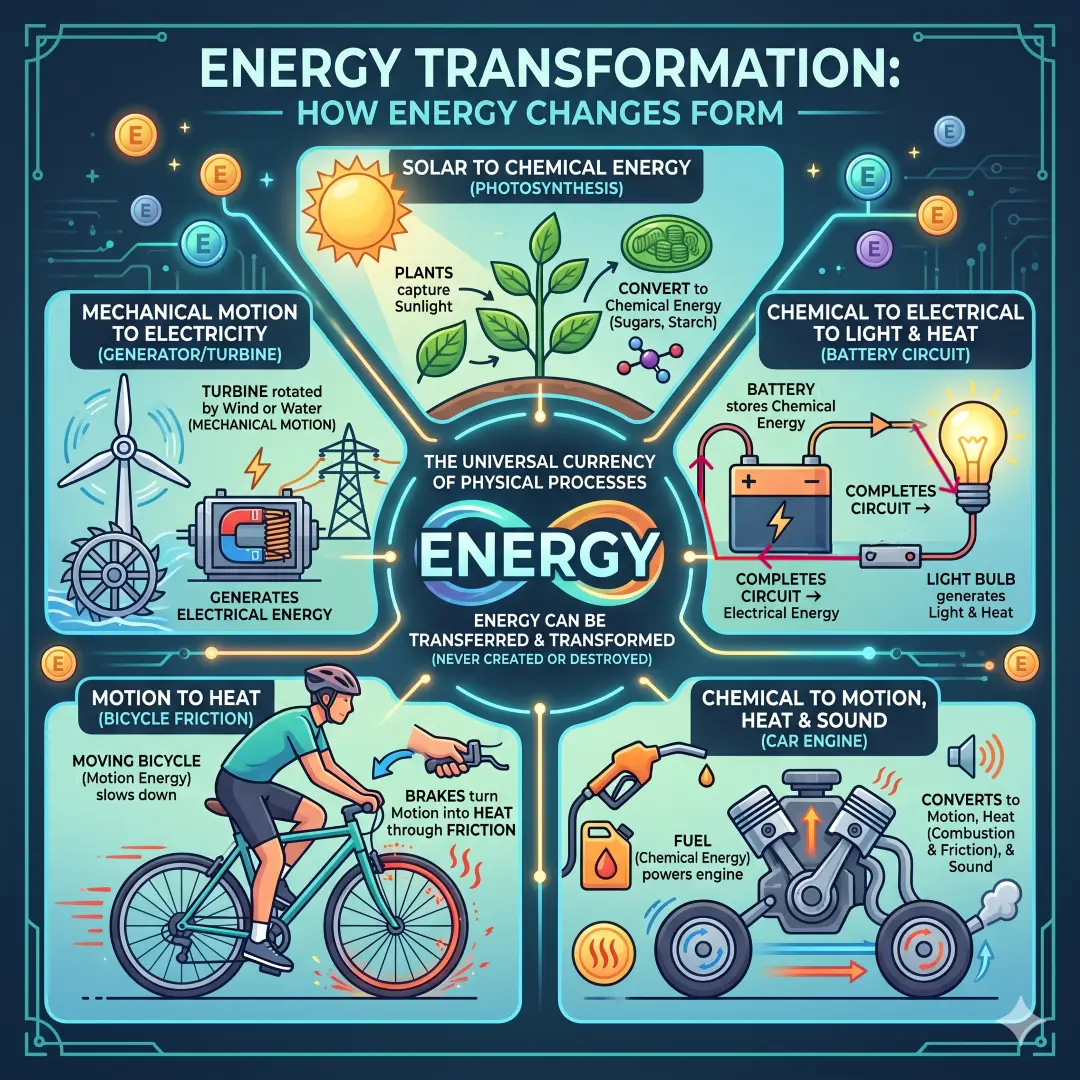
A useful way to think about energy change is to imagine a waterfall. Water high above the ground has potential energy because of its position. As it falls, that stored energy becomes kinetic energy. If the falling water turns a turbine, part of that motion becomes electrical energy. One system, many forms, one continuous change.
The Law of Conservation of Energy
The law of conservation of energy says that energy cannot be created or destroyed, only changed from one form into another. In an isolated system, the total amount remains constant. That is one of the most famous and useful ideas in all of physics.
This does not mean energy never changes. It changes all the time. It just means the total does not vanish. If a ball falls, its gravitational potential energy decreases while its kinetic energy increases. If a car brakes, its motion energy becomes heat in the brake pads and tires. If a person eats food, the body converts chemical energy into movement, body heat, and stored tissue. The form changes, but energy is still accounted for.
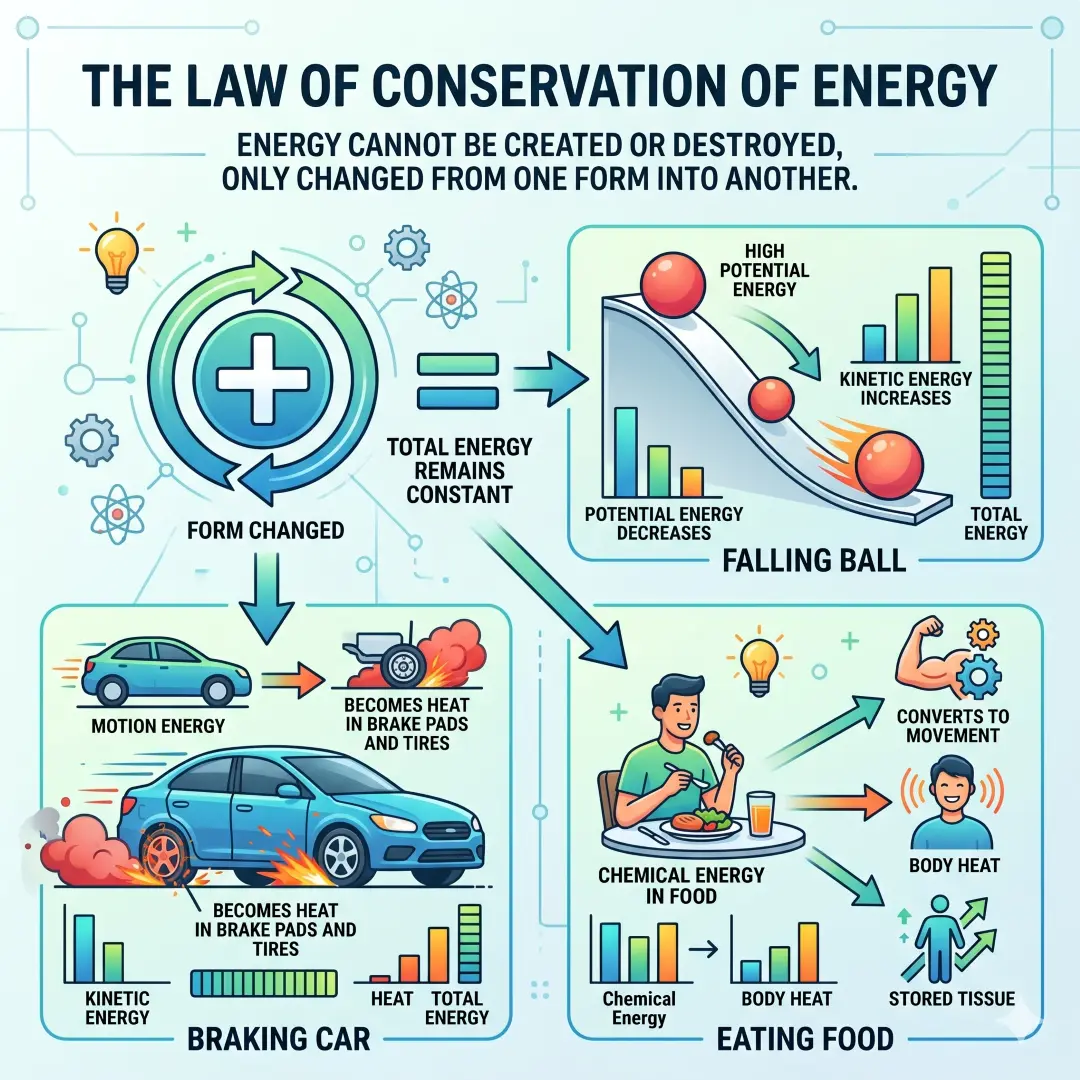
This law is powerful because it gives scientists a way to track what happens in a system. Whether the system is a playground swing, a power station, or the human body, energy accounting helps explain what is happening and where the energy went.
Energy in Motion and Work
In physics, work is closely tied to energy. When a force causes an object to move, energy is transferred. That is why a person pushing a box, lifting a backpack, or pedaling a bicycle is doing physical work in the scientific sense. The transfer of energy is what connects the push to the change in motion or position.
This connection helps explain kinetic energy and potential energy very clearly. When you lift a rock, you add energy to the system as gravitational potential energy. When you drop it, gravity turns that stored energy into kinetic energy as it falls. The same pattern appears in a child on a swing, a thrown ball, or a roller coaster climbing and dropping along the track.
A simple way to remember it is this. Motion often means energy is being used right now. Position or condition often means energy is being stored for later. That is not the whole story, but it is a good starting point for understanding almost any energy example.
Energy Sources in the Real World
People get energy from many sources. Some are renewable, which means they can be replenished naturally on a short timescale. Others are nonrenewable, which means they are finite and take very long periods to form. In everyday life, these sources are used to make electricity, heat homes, move vehicles, and support industry.
Table 2. Common Energy Sources and How They Are Used
| Source | Renewable or nonrenewable | What it provides | Typical use |
|---|---|---|---|
| Solar | Renewable | Energy from sunlight | Electricity, heating, solar panels |
| Wind | Renewable | Energy from moving air | Electricity through turbines |
| Hydropower | Renewable | Energy from flowing water | Electricity from dams and turbines |
| Geothermal | Renewable | Heat from inside Earth | Electricity and direct heating |
| Biomass | Renewable | Energy from plant and organic material | Heat, electricity, transportation fuels |
| Coal | Nonrenewable | Stored chemical energy in ancient carbon-rich material | Electricity and industrial heat |
| Oil | Nonrenewable | Stored chemical energy in petroleum | Transportation fuels and manufacturing |
| Natural gas | Nonrenewable | Stored chemical energy in fossil gas | Heating, electricity, industry |
| Nuclear fuel | Nonrenewable | Energy from atomic nuclei | Electricity in nuclear power plants |
Renewable energy sources like solar, wind, hydropower, geothermal, and biomass are important because they can be replenished naturally. Nonrenewable sources like coal, oil, natural gas, and uranium are limited. This difference matters when people plan for the future of energy supply.
Electricity Is Not the Same as Energy, But It Carries Energy
A common mistake is to treat electricity and energy as if they mean the same thing. They do not. Electricity is one way energy is transferred or delivered. It can come from many sources, including natural gas, coal, nuclear power, wind, hydropower, and solar energy.
You can think of electricity as a messenger. It delivers energy to lights, appliances, machines, and charging devices. When a solar panel turns sunlight into electrical energy, or when a turbine spins a generator, or when a battery releases stored chemical energy into a circuit, energy is being moved into a useful form.
This is why power systems are so important. They connect energy resources to real human needs. A home needs light, heating, cooling, and communication. A factory needs motion, pressure, heat, and control. A city needs all of that at scale. Electricity makes those links possible.
Energy in the Human Body
Your body is a remarkable energy system. It gets energy from food, mainly from carbohydrates, fats, proteins, and, in some contexts, alcohol. That energy is used for movement, body temperature, growth, repair, and basic life functions. Food energy is usually measured in calories on nutrition labels.
In nutrition, the word calorie means a unit of energy. On food labels, the calorie usually refers to the kilocalorie, which is 1,000 small calories. This is why food “Calories” are written with a capital C in many contexts. The body does not just store or burn food for movement. It uses energy continuously, even when you are resting, to support breathing, circulation, and many other functions.
Food energy is not identical to mechanical energy, but the body converts it into useful forms. You walk, think, digest, regulate temperature, and build tissue because energy from food is being transformed inside you. That is one reason energy is such a practical idea. It links physics, biology, and health in one concept.
How Energy Is Measured
Energy needs a unit, and the standard SI unit is the joule. A joule is the preferred SI unit of heat, energy, or work. It is a very small amount of energy in everyday terms, which is why larger units are often used in homes, food, and power systems.
A few other energy units are also common. The calorie appears in food and nutrition. The kilowatt-hour is widely used for electricity bills. The British thermal unit, or Btu, is common in heating and cooling. These units all measure energy, but they are used in different settings.
Table 3. Common Energy Units
| Unit | What it measures | Where you see it | Helpful fact |
|---|---|---|---|
| Joule (J) | Energy, heat, or work | Physics, engineering, science | The SI unit of energy |
| Calorie (cal) | Energy | Chemistry, some science contexts | A small calorie is part of the older heat-energy system |
| Kilocalorie (kcal) | Food energy | Nutrition labels, diet discussions | 1 kilocalorie equals 1,000 calories |
| Calorie with capital C | Food energy | Food labels and nutrition advice | Often used to mean kilocalorie |
| Kilowatt-hour (kWh) | Electrical energy use | Electricity bills, appliances | Common in household power measurement |
| British thermal unit (Btu) | Heat energy | Heating and cooling, energy conversion tables | Used in building and fuel contexts |
| Electron volt (eV) | Very small energy | Atomic and particle physics | Used for tiny scales in physics |
It also helps to know that power is related to how quickly energy is transferred or used. A strong power source can move a lot of energy in a short time, while a weaker one moves less. That is why watts matter when talking about appliances and machines.
Everyday Examples of Energy
Energy is easier to understand when you connect it to ordinary life. Here are some familiar examples.
- A battery stores chemical energy and releases it as electrical energy in a device.
- A lamp turns electrical energy into light and heat.
- A rolling ball has kinetic energy because it is moving.
- A book on a shelf has potential energy because of its position.
- A cooking stove turns fuel or electricity into heat.
- Food gives the human body energy for motion, heat, and life processes.
- Sunlight carries radiant energy that can warm Earth and support life.
- Flowing water can turn turbines and help generate electricity.
These examples may look different, but the same basic idea sits underneath all of them. Energy is being stored, moved, converted, or used.
Energy Conversion in Daily Life
Energy conversion happens constantly. That is one of the most interesting things about it. Nothing in nature stays in one neat box. Heat can become motion. Motion can become electricity. Light can become chemical energy. Chemical energy can become heat and motion.
Table 4. Common Energy Conversions
| Situation | Energy in | Energy out | What is happening |
|---|---|---|---|
| Phone charging | Electrical energy | Chemical energy in the battery | Electricity stores energy for later use |
| Battery running a torch | Chemical energy | Electrical energy, light, heat | Stored energy becomes useful output |
| A moving bicycle braking | Kinetic energy | Heat energy | Friction slows motion and warms parts |
| Sunlight on a solar panel | Radiant energy | Electrical energy | Sunlight is converted directly to power |
| A hydropower dam | Gravitational potential and kinetic energy | Electrical energy | Falling or flowing water spins turbines |
| A car engine | Chemical energy in fuel | Motion, heat, sound | Fuel is burned and converted into movement |
| A human sprint | Chemical energy from food | Motion and body heat | Muscles transform food energy into activity |
| A toaster | Electrical energy | Heat energy | Current heats the metal element |
A Closer Look at Kinetic and Potential Energy
Two of the most useful energy ideas are kinetic energy and potential energy. Kinetic energy is energy of motion. The faster an object moves, the more kinetic energy it has, and mass also matters. A heavy truck moving slowly can have a lot of kinetic energy, while a small ball moving fast can also have plenty.
Potential energy is stored energy. It often depends on position, shape, or arrangement. A lifted weight has gravitational potential energy. A compressed spring has elastic potential energy. A charged battery has chemical potential energy. The energy is waiting to be used, but it is already there.
These two forms work together in many systems. A roller coaster climbs a hill and builds potential energy. Then it drops and turns that stored energy into motion. A bow is pulled back, storing elastic energy, then released to launch an arrow. A swinging child moves back and forth between kinetic and potential energy.
Energy and the Environment
Energy is not just a science topic. It is also an environmental one. The sources people choose affect the air, land, water, and long-term energy supply. That is why the world talks so much about renewable energy, nonrenewable energy, and the mix of sources used for electricity and transportation.
Renewable sources such as solar, wind, hydropower, geothermal, and biomass can be replenished naturally. Nonrenewable sources such as coal, oil, natural gas, and uranium exist in limited amounts and take much longer to form. This difference affects planning, costs, and policy decisions.
Energy decisions are also economic decisions. They influence bills, jobs, industry, and the infrastructure a country builds. A city with strong solar resources may think differently from one with strong hydro resources or one that relies heavily on fossil fuels. Energy is local, but its effects are global.
Common Misunderstandings About Energy
A lot of confusion around energy comes from everyday language. Here are a few points worth clearing up.
- Energy is not the same as power. Energy is the amount used or transferred, while power is how fast that happens.
- Electricity is not the only form of energy. It is one form and one carrier, but not the whole picture.
- Heat and temperature are related, but not identical. Heat is energy transfer, while temperature describes how hot something is.
- Food calories are units of energy. They are not a measure of food quality by themselves.
- Energy does not disappear. It changes form and moves between systems.
These distinctions sound small, but they matter a lot. A clear understanding of energy makes science easier to read and everyday life easier to interpret.
Why the Word Energy Feels So Big
The word energy is used in physics, biology, nutrition, engineering, climate science, and even daily speech. That is because it describes a basic truth that shows up everywhere. Things can move, warm up, cool down, stretch, compress, glow, vibrate, or change chemical structure. Energy helps explain all of it in a single language.
It is also a practical word. When someone asks how much energy a machine uses, they are asking about cost and efficiency. When someone asks how much energy food contains, they are asking about nutrition and body function. When a country asks where its energy will come from, it is asking about security, environment, and development. One word, many layers.
A Simple Way to Remember Energy
Here is a clean way to remember the idea:
- Energy can be stored.
- Energy can move.
- Energy can change form.
- Energy can be measured.
- Energy is never truly lost, only transformed.
That short list covers most of the important ground. From the Sun to the human body, from batteries to wind turbines, from food to fireworks, the same principle appears again and again.
Final Thoughts
So, what is energy? In the simplest scientific sense, it is the capacity to do work. In real life, it is the force behind motion, heat, light, electricity, growth, and change. It can be stored in a battery, carried by sunlight, released by food, or converted by machines. It can move through systems and change form without ever being destroyed.
Once you start looking for it, energy is everywhere. In a running child. In a glowing bulb. In a full battery. In a warm kitchen. In a spinning turbine. In a meal that keeps a person going through the day. It is one of the simplest ideas in science, and also one of the deepest.
Article References and Sources
- Energy Conversion Overview
- Law of Conservation of Energy
- Kinetic Energy Explained
- Work, Energy, and Physics Concepts
- Potential Energy of a System
- Power and Energy Relationship
- Scientific Definition of Work
- Energy Basics and Electricity
- Electricity Production and Energy Sources
- Electromagnetic Energy (NASA Science)
- Energy Forms and Transformations (NASA)
- Energy Education and Renewable Sources (U.S. DOE)
- Energy Information and Systems (U.S. Department of Energy)
- Hydropower Resource Assessment
- Calories and Nutrition Facts (Food Energy)
- Human Energy Metabolism (NCBI Resource)
- Joule and Energy Units (NIST)
- Energy Units and Conversions (NIST Publication)
- Electron Volt and Energy Constants
Also, Read these Articles in Detail
- Physics and Its Fundamentals With Good Explanations
- Matter, Motion, and Energy: The Core Ideas of Physics
- What Is Matter? The Physical Substance of the Universe
- What Is Motion? A Guide to Motion in Physics and Daily Life
- What Is Energy? The Invisible Power Behind Everyday Life
- Kinetic Energy Explained in Simple Language
- Potential Energy: Definition, Types, Formula, and Examples
- Thermal Energy: Heat, Temperature, and Transfer
- Mechanical Energy: Definition, Formula, and Examples
- Chemical Energy: Definition, Science, and Examples
- Electrical Energy: Definition, Works, and Why It Matters
- Radiant Energy: Meaning, Sources, Examples, and Uses
- Nuclear Energy: Definition, How It Works, and Why It Matters
- Sound Energy: Definition, Science, and Examples
- Elastic Energy: Definition, Elasticity, Example, and Facts
Frequently Asked Questions
FAQ 1. What Is Energy in Simple Words?
Energy is the ability to make something happen. That is the easiest way to understand it. When something moves, warms up, shines, grows, or changes, energy is involved. It can be stored, transferred, or changed into another form.
Think about everyday life. A person eating breakfast gets energy from food. A phone uses energy from a battery. A fan uses electrical energy to spin. The Sun sends energy to Earth as light and heat. None of these examples look the same, but they all involve the same basic idea.
In science, energy is not just a vague feeling. It is a real quantity that can be measured. It tells us how much change can happen in a system. A moving car has energy. A stretched rubber band has energy. A hot bowl of soup has energy. Even a book resting on a shelf has energy because of its position.
What makes energy so important is that it appears everywhere. It is part of physics, biology, chemistry, nutrition, and engineering. It helps explain how machines work, how the body functions, and how the world stays active. Without energy, nothing would move, grow, or operate. It is one of the most basic ideas in science, and also one of the most useful.
FAQ 2. Why Is Energy Important in Everyday Life?
Energy is important because life depends on it. Every small task you do, from walking to speaking to thinking, uses energy in some form. Your body needs energy to breathe, keep warm, digest food, and move your muscles. Your home needs energy for lights, fans, cooking, cooling, and charging devices. Cities need energy for transport, industry, communication, and water systems.
And it does not stop there. Energy is also what keeps nature working. Plants use sunlight to grow. Rivers move with energy from gravity. Wind carries energy across the land. Storms, tides, and even earthquakes involve energy in different ways. So when people talk about energy, they are talking about something that touches almost every part of life.
Energy also matters because it affects comfort, health, and money. A family may pay electricity bills depending on how much energy they use. A hospital depends on reliable power to keep machines running. A school needs energy for lighting, computers, and ventilation. A country needs energy to support jobs and development. In other words, energy is not a luxury. It is part of daily living.
That is why understanding energy is so useful. Once you see how much it shapes ordinary life, the concept stops feeling abstract. It becomes practical, real, and easy to notice all around you.
FAQ 3. What Are the Main Forms of Energy?
There are several major forms of energy, and each one shows up in different situations. The most common forms are kinetic energy, potential energy, thermal energy, chemical energy, electrical energy, radiant energy, sound energy, elastic energy, and nuclear energy.
- Kinetic energy is the energy of motion. A moving car, a flying bird, or a rolling ball all have kinetic energy.
- Potential energy is stored energy. A book on a shelf, water behind a dam, or a stretched spring has potential energy because of its position or condition.
- Thermal energy is related to heat and the movement of tiny particles inside matter. A hot stove or boiling water contains thermal energy.
- Chemical energy is stored in the bonds of atoms and molecules. Food, fuel, and batteries all hold chemical energy.
- Electrical energy comes from moving electric charges. It powers lights, appliances, and electronics.
- Radiant energy travels in waves, like sunlight, radio waves, and visible light.
- Sound energy moves through vibrations in matter. When you hear music or thunder, sound energy is involved.
- Elastic energy is stored when something is stretched or compressed, like a rubber band or spring.
- Nuclear energy is stored in the center of atoms. It is released in nuclear reactions and in the Sun.
These forms may sound separate, but they are closely connected. Energy often changes from one form to another. That is why one system can look very different while still following the same energy rules.
FAQ 4. What Is the Difference Between Kinetic Energy and Potential Energy?
Kinetic energy and potential energy are two of the most important types of energy in science. The difference is simple. Kinetic energy is energy of motion, while potential energy is stored energy based on position, condition, or arrangement.
If a bicycle is moving, it has kinetic energy. If that same bicycle is parked at the top of a hill, it has potential energy because of its height. If a ball is thrown into the air, it has both. As it rises, some of its kinetic energy changes into potential energy. As it falls, the stored energy changes back into motion.
This back and forth happens all the time in the real world. A roller coaster is a great example. At the top of a hill, it has lots of potential energy. As it drops, that energy turns into speed. A swinging child on a swing does the same thing. At the highest points, potential energy is greater. At the lowest point, kinetic energy is greatest.
The same idea applies to springs, bows, dams, and even batteries. A stretched spring stores energy. A charged battery stores energy. A raised object stores energy. The energy is not gone. It is waiting to be used.
Understanding these two forms helps make physics much easier. Once you can spot motion and stored energy, you can explain many events without guessing. It is one of the clearest ways to read what is happening in the physical world.
FAQ 5. How Does Energy Change From One Form to Another?
Energy changes form all the time. This is one of the most useful ideas in science. Energy does not usually stay in a single form. Instead, it moves through systems and becomes something else. A battery turns stored chemical energy into electrical energy. A lightbulb turns electrical energy into light and heat. A person turns food energy into motion and body heat.
This is called energy transformation. It means one form of energy is converted into another form. A car engine is a common example. Fuel contains chemical energy. Inside the engine, that energy becomes heat, motion, and sound. A solar panel works differently. It takes radiant energy from sunlight and changes it into electricity. A hydropower dam uses moving water to produce electrical energy.
This idea is everywhere. When you hit a drum, your hand gives motion energy to the drumhead, and the drum produces sound energy. When you use a toaster, electrical energy becomes thermal energy. When a plant grows, it turns solar energy into chemical energy through photosynthesis.
The key point is this. Energy is never just sitting still in one perfect box. It is always moving, shifting, or being transferred. That is why energy is so important for understanding both nature and technology. Once you learn to follow the change from one form to another, many things in science start making sense very quickly.
FAQ 6. What Does the Law of Conservation of Energy Mean?
The law of conservation of energy says that energy cannot be created or destroyed. It can only be transferred or transformed from one form to another. That is one of the most famous rules in science, and it appears in almost every branch of physics.
This does not mean energy disappears. It means the total amount stays the same in a closed system. For example, when a ball rolls down a hill, it loses potential energy and gains kinetic energy. The total energy is still there. It just looks different. When brakes stop a car, the car’s motion energy does not vanish. It becomes heat in the brake pads and surrounding parts.
The same principle works in homes, machines, and the human body. A lamp does not create energy. It converts electrical energy into light and heat. Food does not create new energy inside the body. The body changes the energy stored in food into movement, warmth, and life processes.
This law is powerful because it helps explain what happens in real systems. Scientists use it to study engines, power plants, weather patterns, chemical reactions, and even living things. It gives structure to the way we think about change.
So when someone asks where energy goes, the answer is usually not that it disappears. It changes form, moves somewhere else, or spreads out into the environment. That is the heart of the law.
FAQ 7. How Is Energy Measured?
Energy is measured in different units, depending on the situation. The standard scientific unit is the joule. In science, the joule is the main unit used to measure energy, work, and heat. But in everyday life, other units are common too.
For food, people often use calories. On nutrition labels, the word Calorie usually means kilocalorie, which is 1,000 small calories. That is the unit you see when reading food energy. For electricity bills, the most common unit is the kilowatt-hour, or kWh. In heating and cooling, the British thermal unit, or Btu, is also used.
These units all measure energy, but they are used in different places. A science teacher may talk about joules. A diet chart may list calories. A power company may talk about kilowatt-hours. An engineer may use a mix of units depending on the job.
This may sound confusing at first, but the idea is simple. Different systems need different units because energy can appear in many settings. A tiny amount of energy at the atomic level is very different from the energy used to power a home. That is why the measurement system changes with scale.
Learning these units makes energy easier to understand. It also helps when reading labels, bills, and science texts. Once you know the meaning of the units, the numbers become much more useful.
FAQ 8. What Is the Difference Between Energy and Power?
Energy and power are closely related, but they are not the same. Energy is the amount of work that can be done or has been done. Power is how fast that energy is used or transferred.
A simple example helps. Two people may lift the same box to the same height. They use the same amount of energy overall. But one person may do it faster. That person is using more power. So power is about speed, while energy is about total amount.
This matters in everyday life. A powerful engine can do work quickly. A higher-watt appliance uses energy at a faster rate. A strong charger can deliver energy to a phone more quickly than a weak one. A person sprinting uses power at a higher rate than someone walking slowly.
People often mix them up because both words sound similar in conversation. But science keeps them separate for a reason. If you want to know how much resource was used, you ask about energy. If you want to know how quickly it was used, you ask about power.
That distinction is useful in homes, factories, transportation, and even the human body. It helps explain why two devices can use the same energy but feel very different in performance. It also explains why some systems are efficient and others waste time or fuel.
FAQ 9. Why Is Energy Important for the Human Body?
The human body cannot function without energy. Every breath, heartbeat, muscle movement, and cell activity depends on it. The body gets energy from food, especially from carbohydrates, fats, and proteins. This energy is then used for movement, growth, repair, thinking, and temperature control.
Food energy is often measured in calories. When you eat, your body breaks food down and turns it into usable energy. Some of that energy is used right away. Some is stored for later. That is why a meal can help you get through the day, support exercise, and keep your organs working even when you are resting.
Energy is also vital for the brain. Thinking, concentrating, remembering, and even sleeping all depend on energy use in the body. The brain may not move like a muscle, but it uses a lot of energy. That is one reason eating well and resting properly matter so much.
The body is also constantly balancing energy use. If you are active, you need more. If you are resting, you still need some. If you eat more energy than you use, the body stores the extra. If you use more than you take in, the body draws on stored reserves.
So when people talk about health, they are also talking about energy balance. Good nutrition, movement, sleep, and hydration all help the body manage energy well. It is not just about calories. It is about how the whole system works together.
FAQ 10. How Does Energy Affect the Environment and the Future?
Energy has a huge effect on the environment and on the future of human society. The way people produce and use energy shapes air quality, water use, land use, and climate. That is why energy choices matter so much.
Some energy sources are renewable, such as solar, wind, hydropower, geothermal, and biomass. These sources can be replenished naturally. Others are nonrenewable, such as coal, oil, natural gas, and nuclear fuel. These are limited and must be managed carefully. The balance between these sources affects long-term sustainability.
The future of energy is closely tied to efficiency and cleaner technology. Using less energy for the same result is one of the smartest ways to reduce waste. Better insulation, efficient appliances, smarter transport, and improved power systems can make a big difference. At the same time, renewable sources can help lower dependence on fuels that pollute more or run out over time.
Energy policy also matters. Countries make decisions about power plants, grids, storage, transport, and industry based on cost, reliability, and environmental impact. These choices affect jobs, public health, and economic stability. So energy is not only a science topic. It is also a social and global one.
Looking ahead, the goal is not just to use energy. The goal is to use it wisely. That means understanding where it comes from, how it changes, how much is wasted, and how it can support life without damaging the world too much. Energy will always be part of human progress. The real question is how responsibly we use it.
