

India’s Fundamental Rights are the constitutional promises that protect human dignity, freedom, equality, and legal fairness. They sit in Part III of the Constitution, mainly across Articles 12 to 35, and they are meant to protect people from unfair treatment by the State. Some of these rights apply to all persons, while others are specifically for citizens. That distinction matters, because it shows that the Constitution was written not only as a legal document, but as a shield for everyday life.
In simple words, Fundamental Rights are the rights that make a democracy feel real. Without them, freedom can become a slogan. With them, a person can speak, move, believe, study, work, and seek justice with constitutional backing. That is why these rights are often described as one of the strongest parts of India’s constitutional structure, and why courts have repeatedly treated them as central to the rule of law and human dignity.
Table of Contents
What Fundamental Rights really mean
Fundamental Rights are not just a list of ideals. They are legally enforceable protections. The Constitution says that laws inconsistent with Fundamental Rights are void to the extent of inconsistency, and it also gives people the right to move the Supreme Court for enforcement of these rights. In other words, these are not decorative promises. They are real rights with real remedies.
The idea behind these rights is simple. A society is healthier when power has limits. Governments must be able to govern, but they cannot treat people as if rights are optional. That is why Article 12 defines the State broadly, including the Government and Parliament of India, the Governments and Legislatures of the States, and local or other authorities under the control of the Government of India. This wide definition helps ensure that public power stays accountable.
Where these rights appear in the Constitution
The Constitution places Fundamental Rights in Part III. The structure is neat and purposeful. It begins with general provisions, then moves through the major rights groups, and finally ends with constitutional remedies. This arrangement is not accidental. It shows that rights, equality, liberty, and remedies are all part of one constitutional chain.
Here is the basic map in a simple form.
| Part III Group | Articles | Simple meaning |
|---|---|---|
| General | 12 to 13 | Defines the State and says laws against Fundamental Rights can be void. |
| Right to Equality | 14 to 18 | Equality before law, no discrimination, equal public employment, abolition of untouchability, and abolition of titles. |
| Right to Freedom | 19 to 22 | Speech, assembly, movement, residence, profession, protection in criminal matters, life and liberty, education, and protection from arbitrary arrest. |
| Right against Exploitation | 23 to 24 | Stops trafficking, forced labour, and hazardous child labour. |
| Right to Freedom of Religion | 25 to 28 | Freedom of conscience and religious practice, with public order, morality, and health as limits. |
| Cultural and Educational Rights | 29 to 30 | Protects minority culture and minority educational institutions. |
| Right to Constitutional Remedies | 32 | Lets people go to the Supreme Court for enforcement of rights. |
Why Fundamental Rights matter so much
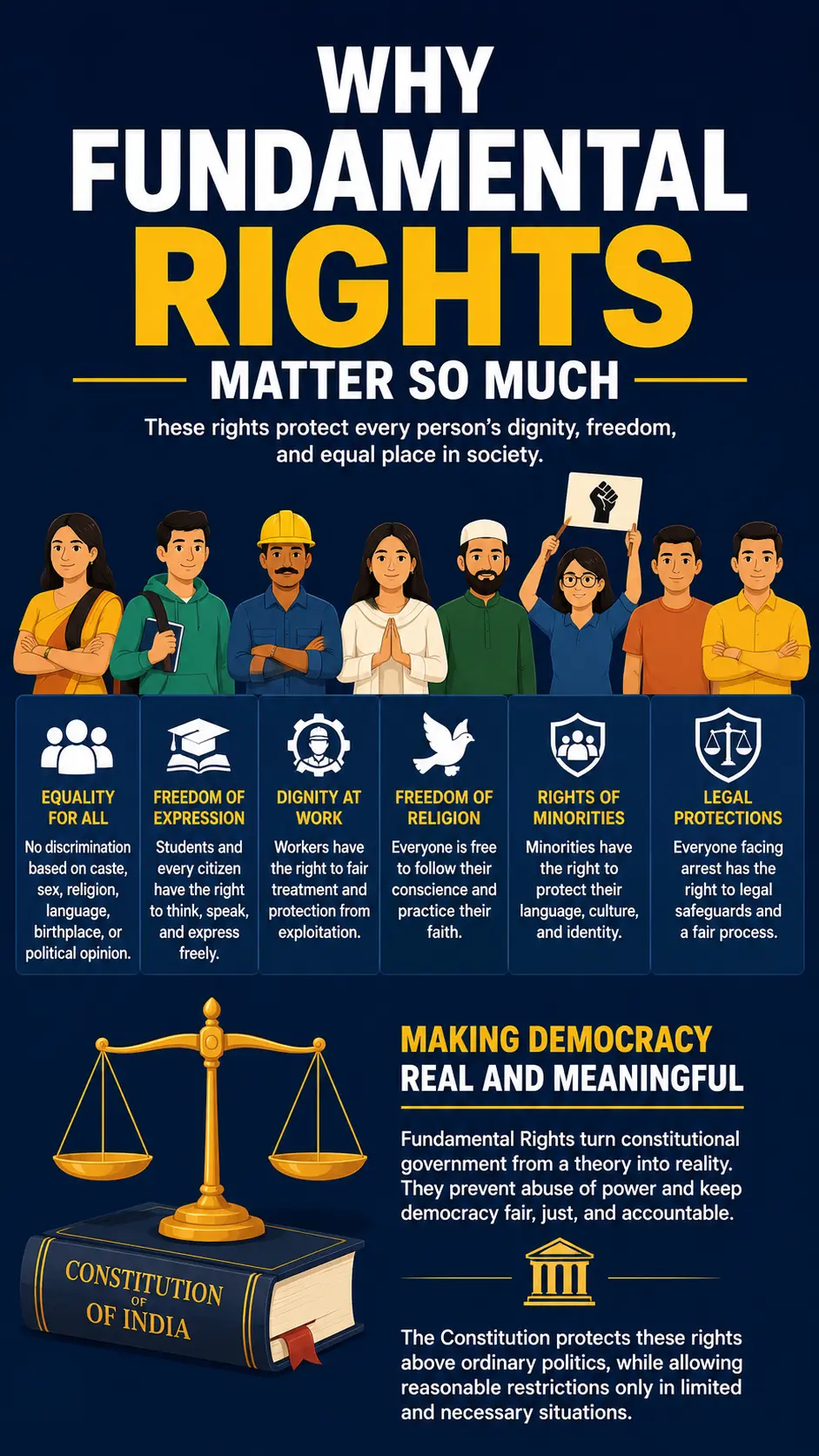
These rights matter because they protect ordinary life from ordinary abuse. A person should not be denied dignity because of caste, sex, religion, language, birthplace, or political opinion. A student should not be forced into silence. A worker should not be treated as disposable. A believer should be free to follow conscience. A minority should be able to protect its identity. A person facing arrest should have legal safeguards. That is the real-world purpose of Fundamental Rights.
They also matter because they make constitutional government more than a theory. A democracy without enforceable rights can drift into convenience, bias, and power without restraint. The Constitution avoids that by placing these rights above ordinary politics, while still allowing reasonable restrictions in limited situations.
The first layer: general provisions
Article 12 is important because it tells us who counts as the State for Fundamental Rights purposes. This matters a lot in practice. When someone challenges a public authority, a government body, or a local authority, the question often begins here. The Constitution deliberately uses an inclusive definition, so constitutional protections do not stop at the doors of central government.
Article 13 is just as important. It says laws that conflict with Fundamental Rights are void to the extent of the conflict. That means rights do not sit below ordinary laws. Ordinary laws have to respect the Constitution, not the other way around. In a constitutional democracy, that is a very big deal.
Right to Equality, the foundation of fair treatment
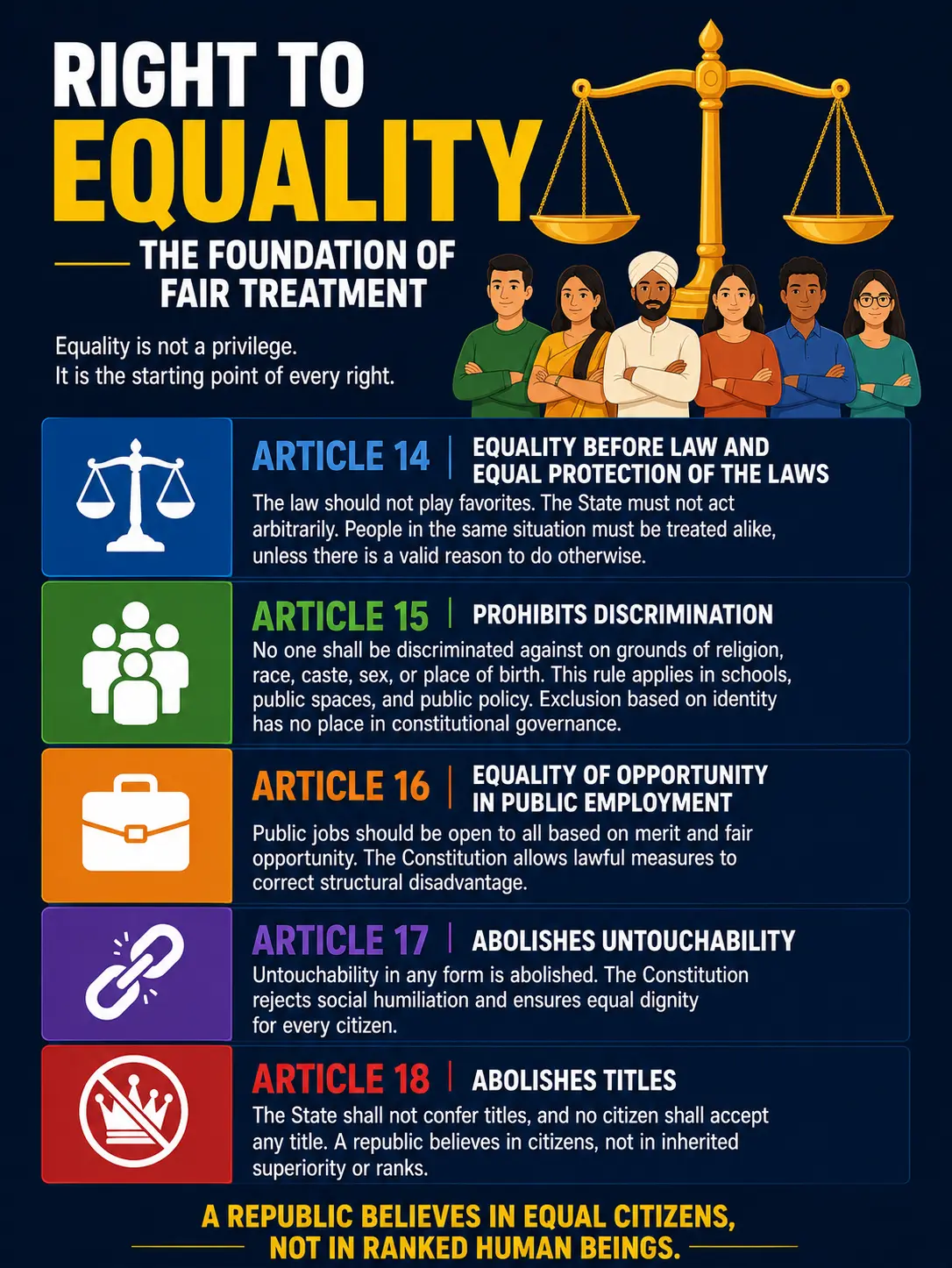
The Right to Equality is one of the most recognizable parts of India’s constitutional promise. It runs from Article 14 to Article 18. Its purpose is easy to understand. People should not be treated as unequal simply because they belong to different social groups. Equal treatment is not a luxury in a democracy. It is the starting point.
Article 14 guarantees equality before law and equal protection of the laws. This means the law should not play favorites, and the State should not act in an arbitrary way. If two people are in the same situation, the law should treat them in a similar way unless there is a valid reason to do otherwise.
Article 15 prohibits discrimination on grounds of religion, race, caste, sex, or place of birth. This is one of the clearest anti-discrimination rules in the Constitution. It matters in schools, public spaces, and public policy. It tells the State that exclusion based on identity has no place in constitutional governance.
Article 16 gives equality of opportunity in matters of public employment. Public jobs, in principle, should not be reserved for the privileged by default. The idea is simple. Merit and fair opportunity should guide recruitment, while the Constitution still allows lawful measures to correct structural disadvantage.
Article 17 abolishes untouchability, and Article 18 abolishes titles. These two provisions carry a deep moral message. The Constitution rejects social humiliation and inherited superiority. A republic is supposed to have citizens, not ranked human beings.
Example of equality in everyday life
Imagine a government office that refuses to process an application because of a person’s caste or religion. That would collide directly with Article 15 and the broader equality principle under Article 14. Or imagine a public employer who gives jobs only through favoritism. Article 16 exists to challenge exactly that kind of unfairness.
Right to Freedom, the heart of personal liberty
The Right to Freedom runs from Article 19 to Article 22, and it is one of the most lived parts of the Constitution. It protects speech, movement, association, residence, profession, criminal fairness, and personal liberty. In real life, these are the rights that shape a person’s daily independence.

Article 19 gives citizens the right to freedom of speech and expression, to assemble peaceably and without arms, to form associations or unions, to move freely throughout India, to reside and settle anywhere in India, and to practise any profession or carry on any occupation, trade or business. These rights sound broad because they are broad. A democracy needs space for voices, movement, work, and organization.
But Article 19 is not absolute. The Constitution itself allows reasonable restrictions for specific reasons such as sovereignty and integrity of India, security of the State, public order, decency, morality, defamation, contempt of court, and incitement to an offence. That balance matters. Freedom is protected, but freedom is not the same as a license to harm public order or other constitutional interests.
Article 20 protects people in criminal matters. It bars ex post facto punishment, double jeopardy, and self-incrimination. These protections are central to fairness. A criminal justice system should punish only according to law, and it should not compel a person to destroy themselves by forced testimony.
Article 21 says no person shall be deprived of life or personal liberty except according to procedure established by law. This is one of the most powerful sentences in the Constitution. Over time, courts have read it in a deeper way, insisting that the procedure must be fair, just, and reasonable, not arbitrary or oppressive. That judicial development has made Article 21 a living and expanding source of rights.
Article 21A adds the Right to education for children aged six to fourteen years, with the State required to provide free and compulsory education in the manner prescribed by law. This is a major constitutional step because education is not just a social benefit. It is a gateway to dignity, opportunity, and informed citizenship.
Article 22 protects against arrest and detention in certain cases. It requires the arrested person to be informed of the grounds of arrest as soon as possible, to consult and be defended by a legal practitioner of choice, and to be produced before the nearest magistrate within twenty-four hours. These rules are meant to stop power from becoming raw force.
A simple way to think about Article 21
If the Constitution is a house, Article 21 is one of its strongest pillars. Courts have repeatedly expanded its practical reach, and official legal material notes that judicial interpretation has widened the scope of Fundamental Rights, especially Article 21, beyond the original text in some areas. That is why the right to life today is understood in a richer way than mere survival. It touches dignity, fairness, and humane treatment.
Right against Exploitation, the Constitution’s protection for the vulnerable
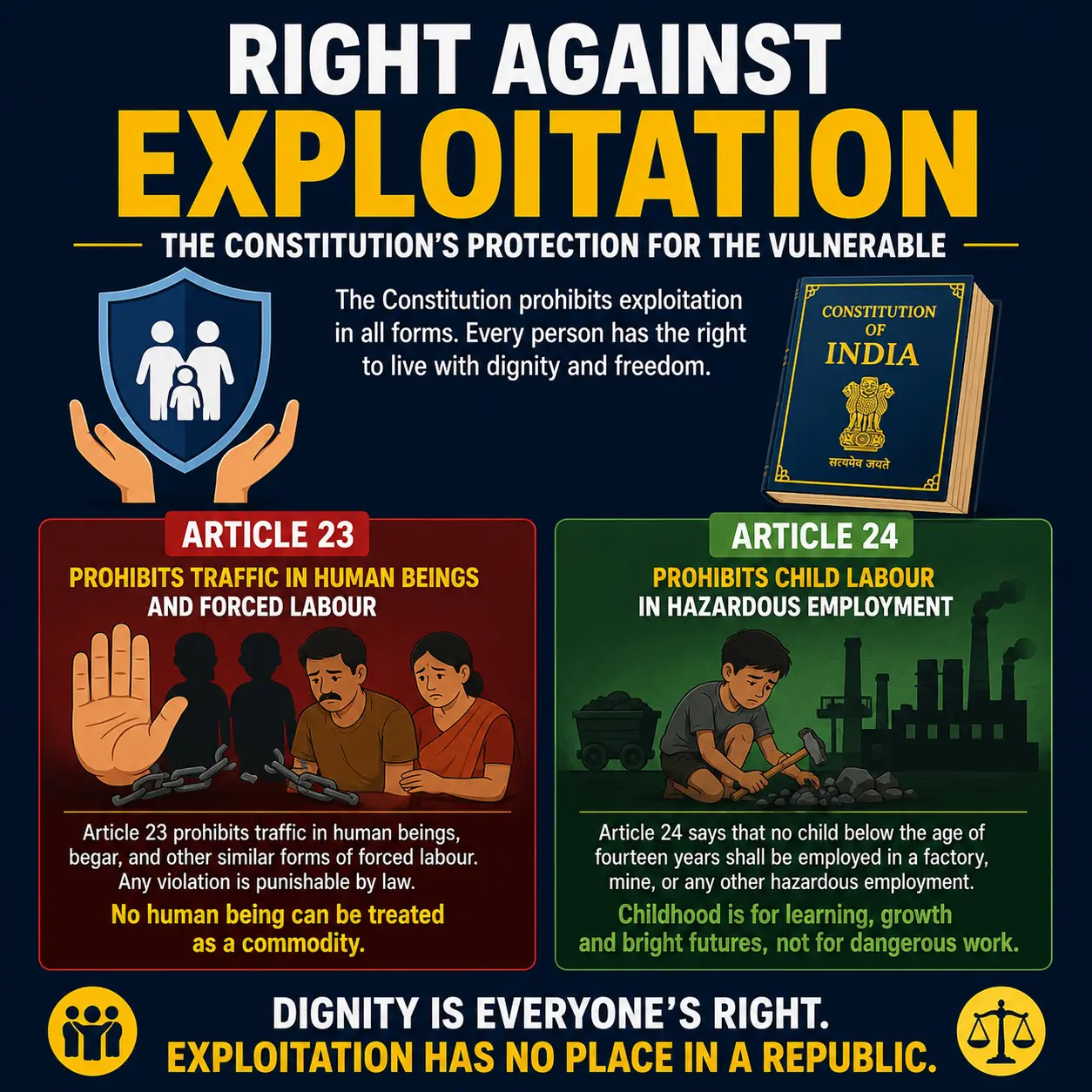
The Right against Exploitation appears in Articles 23 and 24. It is small in length, but huge in moral force. It tells the State that human beings cannot be reduced to commodities, and children cannot be treated as cheap labour in dangerous work.
Article 23 prohibits traffic in human beings, begar, and other similar forms of forced labour. It also says that any violation is punishable by law. This article speaks directly to abuse, coercion, and hidden exploitation. It is one of the Constitution’s clearest statements that freedom without protection can be hollow.
Article 24 says that no child below the age of fourteen years shall be employed in a factory, mine, or any other hazardous employment. This is a simple rule with a deep purpose. Childhood should not be consumed by dangerous work. It should be a protected space for growth, health, and learning.
Example of exploitation rights in real life
If a worker is forced to work with no real freedom to leave, that can raise Article 23 concerns. If a child is sent to hazardous work in a mine or factory, Article 24 is directly relevant. These are not abstract concepts. They are safeguards for real people in real situations.
Right to Freedom of Religion, a constitutional guarantee of conscience
The Constitution protects religion in Articles 25 to 28. The idea is not to privilege one faith over another. The idea is to protect freedom of conscience and let people profess, practise, and propagate religion, subject to lawful limits tied to public order, morality, and health.

Article 25 gives all persons the right to freedom of conscience and the right freely to profess, practise, and propagate religion, subject to public order, morality, health, and the other provisions of Part III. That wording matters. The Constitution protects religious liberty, but it also keeps room for social peace and constitutional balance.
Article 26 protects the freedom to manage religious affairs. Article 27 says no person shall be compelled to pay taxes for the promotion of any particular religion. Article 28 protects people in certain educational settings from being forced into religious instruction or worship without consent. Together, these articles make religious freedom practical rather than symbolic.
Cultural and Educational Rights, the protection of identity and minority institutions
India is not one culture in a narrow sense. It is many languages, many histories, many traditions, and many communities living under one Constitution. That is why Articles 29 and 30 matter so much. They protect cultural identity and minority educational rights.

Article 29 protects the right of any section of citizens with a distinct language, script, or culture to conserve it. It also says no citizen can be denied admission into a State-maintained or State-aided educational institution on grounds only of religion, race, caste, language, or any of them. This is a direct constitutional answer to exclusion.
Article 30 gives minorities, whether based on religion or language, the right to establish and administer educational institutions of their choice. This is not a small right. It helps communities preserve identity while participating fully in national life. The Constitution also protects this right against discriminatory aid decisions.
Why this part matters globally
Many countries struggle with the question of how to protect diversity without weakening unity. India’s answer is constitutional accommodation. It does not force everyone into sameness. Instead, it tries to keep diversity within a common legal frame. That is one reason the cultural and educational rights chapter is so important.
The right to constitutional remedies, the part that makes everything real
A right without a remedy is often just a hope. That is why Article 32 is so important. It gives a person the right to move the Supreme Court for enforcement of Fundamental Rights, and it authorizes the Court to issue writs such as habeas corpus, mandamus, prohibition, quo warranto, and certiorari. This is the enforcement engine of Part III.
The Constitution also permits High Courts to issue writs for enforcement of rights under Article 226. This means constitutional remedies are not locked into one doorway. They are available through more than one judicial route, which makes rights protection more practical.
Here is a practical table of the main writs.
| Writ | What it does | Simple example |
|---|---|---|
| Habeas corpus | Requires a detained person to be brought before the court. | Used when someone is believed to be unlawfully detained. |
| Mandamus | Orders a public authority to perform a legal duty. | Used when an office refuses to do something required by law. |
| Prohibition | Stops a lower court or authority from acting beyond power. | Used when a body is proceeding without jurisdiction. |
| Quo warranto | Questions by what authority a person holds a public office. | Used when appointment legality is challenged. |
| Certiorari | Quashes an order of a lower court or body for legal error. | Used when a decision is legally flawed. |
What makes these rights stronger than ordinary promises
One reason Fundamental Rights matter so much is that they sit within the basic structure idea. The Supreme Court’s constitutional reasoning in Kesavananda Bharati is widely treated as a turning point, and later official legal material notes that the debate over the basic features of the Constitution continues, while the Court has also treated many rights, especially under Article 21, as expanding through interpretation. The result is a Constitution that can grow without losing its core identity.
Another reason is that Part III is not isolated from the rest of the Constitution. It stands beside Directive Principles of State Policy in Part IV, which are not enforceable by courts but are described as fundamental in the governance of the country. The Constitution also places Fundamental Duties in Part IVA, showing that rights, responsibilities, and public purpose are meant to work together.
| Constitutional part | Nature | Main idea |
|---|---|---|
| Part III, Fundamental Rights | Enforceable by courts. | Protects the individual against State abuse and unfairness. |
| Part IV, Directive Principles | Not enforceable by courts, but fundamental in governance. | Guides the State toward welfare, justice, health, education, and social order. |
| Part IVA, Fundamental Duties | Duties of citizens. | Encourages constitutional respect, unity, environment, scientific temper, and public responsibility. |
How Fundamental Rights work in daily life
These rights often sound formal until you place them next to ordinary life. Then they become obvious.
A student speaking in a classroom relies on freedom of expression. A worker changing jobs relies on the right to move freely and carry on a profession. A family seeking fair treatment in public services relies on equality before law. A person arrested by the police relies on Article 22. A child in a poor home relies on Article 21A. A minority school relies on Article 30. A person seeking justice from an unlawful detention relies on Article 32.
That is the beauty of constitutional rights. They are not only for lawyers, judges, or politicians. They touch the daily rhythm of ordinary people. They matter in school, on the road, at work, in a courtroom, in a police station, and in the digital public square.
Reasonable restrictions, because freedom and order must coexist
A lot of people hear the word right and assume it means unlimited freedom. The Constitution does not work that way. India’s Fundamental Rights are strong, but they are not blind to social reality. The text itself allows restrictions in appropriate places, especially under Article 19 and Article 25, where public order, morality, health, and other constitutional interests may justify limits.
This does not weaken the rights. It actually strengthens them. Why? Because a right that ignores the rights of others or the survival of society soon stops being a right and becomes a conflict. The Constitution avoids that by building balance into the system.
A note on the right to property
The Constitution originally included the Right to Property in Part III, but that chapter changed over time. The present Constitution shows Article 300A under Chapter IV of Part XII, which says no person shall be deprived of property save by authority of law. The earlier Chapter IV. Right to Property in Part III was omitted by the Forty-fourth Amendment. That is a useful reminder that constitutional law is living law, not frozen text.
Fundamental Rights and the modern understanding of dignity
One of the most important shifts in Indian constitutional thought is the move from a narrow reading of liberty to a dignity-centered reading. Official legal material notes that courts have expanded the scope of Fundamental Rights, especially Article 21, through interpretation. Supreme Court reasoning also shows that the law must be right, just, and fair, not arbitrary, fanciful, or oppressive. That is why the right to life today is understood as more than mere physical survival.
This broader reading helps explain why new social questions often end up being read through old constitutional language. Pollution, privacy, health, education, dignity, and fair treatment can all connect back to the same constitutional core. The Constitution remains stable, but its meaning endures.
The simplest summary you can keep in mind
If you want a very brief mental picture, think of it this way.
- Equality says no one should be treated as inferior.
- Freedom says the State should not unnecessarily silence or trap you.
- Against exploitation says people cannot be used or abused.
- Religion says conscience must remain free.
- Culture and education say minority identity deserves protection.
- Remedies say a right should have a way to be enforced.
That is the heart of Fundamental Rights in India.
They are not just legal phrases in a constitutional book. They are the bridge between power and justice. They remind the State that people are not subjects to be managed at will. They are citizens and persons with dignity, freedom, and lawful claims. And that is why, even after decades of constitutional change, these rights still sit at the center of Indian democracy.
Article References
- The Constitution of India (Official PDF)
- Fundamental Rights: Department of Legal Affairs (PDF)
- Fundamental Rights in India: Government of India Overview
- Part III: Fundamental Rights Overview
- Article 21: Protection of Life and Personal Liberty
- Article 12: Definition of State
- Part III of the Constitution (Government PDF)
Frequently Asked Questions
FAQ 1. What are Fundamental Rights in India?
Fundamental Rights are the basic constitutional protections that help people live with dignity, freedom, and equality. In India, they are placed in Part III of the Constitution and are mainly found in Articles 12 to 35. These rights are called “fundamental” because they are essential to a healthy democracy, and because they can be enforced through the courts when they are violated. They are not just moral ideas. They are legal rights with constitutional force.
In simple language, these rights stop power from becoming careless or unfair. They protect a person from discrimination, arbitrary arrest, forced labour, unfair public action, and many other forms of abuse. They also give people the freedom to speak, move, believe, learn, and seek justice. That is why Fundamental Rights are often seen as the heart of constitutional freedom in India.
FAQ 2. Why are Fundamental Rights so important?
Fundamental Rights matter because they make democracy real in daily life. A country can have elections, laws, and public offices, but without enforceable rights, ordinary people can still be treated unfairly. These rights create limits on the State and give citizens a way to challenge abuse, bias, and unreasonable action. That is a major reason they hold such a central place in the Constitution.
They also protect human dignity. Equality before law, freedom of expression, religious liberty, protection from exploitation, and the right to constitutional remedies are not small legal details. They shape how a person studies, works, travels, speaks, worships, and seeks justice. Courts have also treated Article 21 as a powerful source of dignity and liberty, which shows how deeply these rights connect with real life.
FAQ 3. Which articles cover Fundamental Rights in India?
The main constitutional chapter on Fundamental Rights runs from Article 12 to Article 35. These articles are grouped into six broad rights areas. They begin with general provisions like the definition of the State and the effect of laws inconsistent with Fundamental Rights, and then move through equality, freedom, religion, cultural and educational rights, and constitutional remedies.
Here is the basic structure in a simple way:
- Articles 12 to 13 cover general provisions
- Articles 14 to 18 cover the Right to Equality
- Articles 19 to 22 cover the Right to Freedom
- Articles 23 to 24 cover the Right against Exploitation
- Articles 25 to 28 cover the Right to Freedom of Religion
- Articles 29 to 30 cover the Cultural and Educational Rights
- Articles 32 to 35 deal with the Right to Constitutional Remedies and related matters
FAQ 4. Who can enjoy Fundamental Rights in India?
Some Fundamental Rights are available to all persons, while others are available only to citizens. This distinction is very important. Rights like equality before law, protection of life and personal liberty, and freedom of religion are broadly available to all persons. Rights like freedom of speech, freedom of movement, and freedom to practise a profession under Article 19 are specifically for citizens.
That means the Constitution gives a wider blanket of protection to everyone within Indian territory, while also reserving some political and civic freedoms for citizens alone. This design is deliberate. It protects human beings as persons, and it also recognizes the special constitutional status of citizenship.
FAQ 5. What is the Right to Equality?
The Right to Equality is covered by Articles 14 to 18. It means that the law should not treat people unfairly just because of who they are. Article 14 promises equality before law and equal protection of the laws. Article 15 prohibits discrimination on grounds such as religion, race, caste, sex, or place of birth. Article 16 provides equality of opportunity in public employment.
This right also includes deeper social reform. Article 17 abolishes untouchability, and Article 18 abolishes titles. Together, these provisions show that equality in India is not only about legal formality. It is also about rejecting social humiliation, inherited privilege, and systems that rank people by birth. That is one of the Constitution’s strongest moral messages.
FAQ 6. What does Article 21 mean?
Article 21 says that no person shall be deprived of life or personal liberty except according to procedure established by law. This is one of the most famous and powerful constitutional provisions in India. At a basic level, it protects a person from unlawful state action. At a deeper level, courts have treated it as a source of dignity, fairness, and humane treatment.
Over time, Article 21 has been read very broadly. Legal material on the Constitution notes that the Supreme Court has implied rights such as protection against torture through interpretation of Article 21. That shows how this provision has grown beyond a narrow reading. It now stands as a central constitutional safeguard for the quality of human life itself.
FAQ 7. Can Fundamental Rights be restricted?
Yes, some Fundamental Rights can be restricted, but only in ways the Constitution permits. This is especially clear in Article 19, where freedoms such as speech, movement, assembly, and profession are subject to reasonable restrictions. The Constitution allows limits for reasons like public order, security of the State, decency, morality, defamation, and incitement to an offence.
The same balance appears in Article 25 on religious freedom, which is subject to public order, morality, and health. So the Constitution does not treat freedom as an unlimited license. It tries to protect liberty while also protecting society from harm, chaos, and abuse. That balance is one of the reasons the rights framework is workable in real life.
FAQ 8. What is the Right to Constitutional Remedies?
The Right to Constitutional Remedies is mainly linked to Article 32. It is the right to move the Supreme Court when Fundamental Rights are violated. This is a very special right because it makes the other rights enforceable. Without a remedy, a right can feel weak. With a remedy, it becomes a real shield.
The Supreme Court can issue writs such as habeas corpus, mandamus, prohibition, quo warranto, and certiorari for enforcement of rights. Article 226 also empowers High Courts to issue writs. Together, these provisions give people a strong legal path when public authorities act unlawfully. That is why Article 32 is often described as the constitutional safety valve of Part III.
FAQ 9. What are the six Fundamental Rights?
India’s Constitution traditionally groups Fundamental Rights into six major categories. These are Right to Equality, Right to Freedom, Right against Exploitation, Right to Freedom of Religion, Cultural and Educational Rights, and Right to Constitutional Remedies. This structure helps students, lawyers, and general readers practically understand the Constitution.
In simple terms, the six rights cover the main areas of constitutional life:
- Equality protects against unfair classification and discrimination
- Freedom protects speech, movement, work, and liberty
- Exploitation protects against trafficking, forced labour, and child labour
- Religion protects conscience and faith
- Culture and education protect minority identity and institutions
- Remedies let people ask courts to enforce all the above rights
FAQ 10. How do Fundamental Rights help in daily life?
Fundamental Rights affect ordinary life more than many people realize. A student speaking freely in class relies on freedom of expression. A worker changing jobs relies on freedom of profession. A person stopped by police relies on Article 22 protections. A child getting free schooling relies on Article 21A. A person facing discrimination relies on Articles 14 and 15. A family seeking fair treatment from public authorities can invoke constitutional equality.
They also matter when things go wrong. If someone is detained unlawfully, the person can seek habeas corpus. If a public office refuses to do its legal duty, mandamus may help. If a lower authority acts beyond power, prohibition or certiorari may matter. So these rights are not only about grand constitutional theory. They are practical tools for real life, real conflict, and real justice.
FAQ 11. What is the difference between Fundamental Rights and ordinary legal rights in India?
Fundamental Rights are different from ordinary legal rights because they come directly from the Constitution of India. They sit in Part III, mainly in Articles 12 to 35, and they carry constitutional force. That means they are not just policy ideas or ordinary statutory benefits. They are higher-level rights that the State must respect, and courts can enforce them when they are violated. Ordinary legal rights, by contrast, usually come from regular laws made by Parliament or State legislatures, and those laws can be changed more easily.
This difference matters in daily life. If an ordinary law is changed, the right under that law may also change. But if a government action violates a Fundamental Right, the issue becomes constitutional. The Constitution also says that laws inconsistent with Fundamental Rights can be void to the extent of the inconsistency. That is why these rights sit above ordinary law in the legal hierarchy. They are meant to protect the person against unfair power, not just to guide good administration.
FAQ 12. Why are Fundamental Rights called the heart of the Constitution?
They are often described in such strong language because they protect the basic conditions of a free and dignified life. The Constitution’s own structure shows this clearly. Part III gathers the rights that safeguard equality, freedom, religious liberty, minority protection, and constitutional remedies. That is not a minor section of the Constitution. It is one of its central foundations. Official legal material also describes the Constitution, the Fundamental Rights, and the Directive Principles as part of the basic structure of the nation’s polity.
In practical terms, these rights matter because they stop the State from acting as if a person has no voice. Equality before law, freedom of speech, protection of life and personal liberty, and the right to constitutional remedies are the kinds of rights that make democracy feel real instead of decorative. Courts have also treated Article 21 as a living protection that can grow through interpretation, which shows how deeply these rights are tied to dignity and justice.
FAQ 13. What does Article 12 mean in simple language?
Article 12 tells us what counts as the State for the purpose of Fundamental Rights. It includes the Government and Parliament of India, the Government and Legislatures of the States, and all local authorities and other authorities under the control of the Government of India. This definition is important because Fundamental Rights are usually enforceable against the State, so the Constitution first has to tell us who the State is.
In simple language, Article 12 is the doorway to enforcement. It helps a person know whether a public body, government office, municipality, or other authority can be held responsible under Part III. Without this definition, Fundamental Rights would be harder to apply in real life. With it, the Constitution reaches deeper into public administration and public power. That is one reason Article 12 may look short, but it has a very large legal effect.
FAQ 14. What does Article 13 do, and why is it important?
Article 13 is the constitutional rule that protects Fundamental Rights from being weakened by ordinary law. It says that laws that are inconsistent with or in derogation of Fundamental Rights are void to the extent of that inconsistency. It also deals with laws in force before the Constitution and says they remain valid only so far as they do not conflict with Part III. That makes Article 13 a very strong shield for constitutional rights.
This matters because it places the Constitution above ordinary law. A legislature can make laws, but it cannot make laws that cancel the Constitution’s core guarantees. If it tries, courts can step in and examine the conflict. In that sense, Article 13 helps keep the legal system honest. It reminds everyone that democratic power is real, but not unlimited. It must work within constitutional boundaries.
FAQ 15. What is the meaning of equality under the Indian Constitution?
Equality under the Indian Constitution means that people should not be treated unfairly because of identity or status. The Right to Equality runs from Articles 14 to 18. It includes equality before law, equal protection of the laws, protection from discrimination, equality in public employment, abolition of untouchability, and abolition of titles. Taken together, these provisions aim to build a society where law does not favor some people simply because of birth or social power.
The idea of equality is not just legal. It is social and moral too. Article 15 stops discrimination based on religion, race, caste, sex, or place of birth. Article 16 insists on fair opportunity in government jobs. Article 17 abolishes untouchability, and Article 18 rejects titles that create social hierarchy. So equality in India is not a single rule. It is a full constitutional attitude against unfair privilege and human humiliation.
FAQ 16. What is the Right to Freedom, and what does it cover?
The Right to Freedom is one of the most practical parts of the Constitution. It appears in Articles 19 to 22 and protects key personal liberties such as speech and expression, assembly, association, movement, residence, and profession. It also includes protection in criminal matters and safeguards against arbitrary arrest and detention. These rights help a person live, work, speak, and participate in society with real independence.
But freedom under the Constitution is not absolute. Article 19 itself allows reasonable restrictions for reasons like public order, security of the State, decency, morality, defamation, and incitement to an offence. That balance is very important. The Constitution wants citizens to be free, but it also wants society to remain orderly and safe. So the right to freedom is broad, but it is not careless. It has structure, limits, and constitutional responsibility.
FAQ 17. What is Article 21, and why do people speak so much about it?
Article 21 is one of the most powerful constitutional provisions in India. It says no person shall be deprived of life or personal liberty except according to procedure established by law. On paper, that sounds simple. In practice, it has become one of the deepest sources of individual protection in Indian constitutional law. Courts have repeatedly treated it as central to human dignity, fairness, and liberty.
Over time, legal interpretation has widened the meaning of life and personal liberty far beyond mere survival. Official legal material notes that courts have given Article 21 a broader meaning through interpretation, and that this expansion has become an important part of constitutional development. That is why Article 21 is often read as a living right. It can protect against arbitrary state action, but it also supports a more humane understanding of what it means to live with dignity.
FAQ 18. What does the Right against Exploitation protect?
The Right against Exploitation is found in Articles 23 and 24. It protects people from being treated as objects of labor, trade, or abuse. Article 23 prohibits traffic in human beings, begar, and other similar forms of forced labour. Article 24 bans the employment of children below 14 years in factories, mines, or other hazardous work. These two articles send a very clear constitutional message that human beings cannot be used and discarded like tools.
This right matters because exploitation can hide behind poverty, pressure, dependency, or social weakness. A person may not always have the strength to refuse abuse, which is exactly why the Constitution steps in. The State is expected to stop forced labour and protect children from dangerous work. So these articles are not only legal safeguards. They are also a statement about the kind of society India wants to be, one that rejects human trafficking and child exploitation at the root.
FAQ 19. What are the Cultural and Educational Rights in India?
The Cultural and Educational Rights are covered by Articles 29 and 30. They protect the identity of communities, especially minorities, and they help preserve language, script, and culture. Article 29 says that any section of citizens having a distinct language, script, or culture has the right to conserve it. It also protects citizens from being denied admission into State-maintained or State-aided educational institutions on grounds only of religion, race, caste, language, or any of them.
Article 30 gives minorities, whether based on religion or language, the right to establish and administer educational institutions of their choice. This is a very important right in a country as diverse as India. It helps minority communities preserve identity while taking part fully in national life. The Constitution does not force cultural sameness. Instead, it tries to protect diversity within a common legal framework. That is one of the most thoughtful features of Part III.
FAQ 20. What is the most practical way to understand Fundamental Rights as a whole?
The easiest way to understand Fundamental Rights is to see them as a system, not as isolated rules. Equality protects people from unfair treatment. Freedom protects their voice and movement. Protection against exploitation defends the weak from abuse. Religious freedom protects conscience. Cultural and educational rights protect identity and minority institutions. Constitutional remedies give people a way to enforce everything else. Together, these rights form the constitutional safety net of India.
A very simple way to remember them is this. If the State is unfair, Article 14 matters. If discrimination appears, Articles 15 and 16 matter. If speech or movement is threatened, Article 19 matters. If liberty is at risk, Article 21 matters. If exploitation happens, Articles 23 and 24 matter. If faith or culture is under pressure, Articles 25 to 30 matter. And if all else fails, Article 32 gives the right to move the Supreme Court. That is why Fundamental Rights are not just parts of the Constitution. They are the constitutional language of dignity, fairness, and freedom.
