

Fundamental Rights are the basic protections that the Constitution of India gives to people so they can live with dignity, freedom, equality, and legal security. They sit in Part III of the Constitution, from Articles 12 to 35, and they are not just ideals on paper. They are enforceable rights, which means a person can go to court when these rights are violated. The Supreme Court has also said that the Constitution gives these rights real force and gives the judiciary power to protect them.
These rights matter because they place clear limits on the power of the State. In constitutional terms, the word State is broad. It includes the Government of India, Parliament, the government and legislature of each State, and local or other authorities under the control of the Government of India. That wide definition is important because it shows that fundamental rights are meant to protect people not only from the central government, but also from many public authorities that affect daily life.
At the same time, Fundamental Rights are not unlimited. Some of them are subject to reasonable restrictions in the interests of public order, morality, security, sovereignty, and similar concerns. So the Constitution does two things at once. It protects freedom, and it also keeps that freedom balanced with the larger needs of society. That balance is one of the reasons India’s constitutional design is so important and so widely studied.
Table of Contents
The simple meaning of Fundamental Rights
In everyday language, Fundamental Rights are the rights you should be able to count on if you live in India. They include the right to be treated fairly, the right to speak, the right to move freely, the right to follow a religion, the right to education, the right to live with dignity, and the right to ask a court for help when those rights are violated. The constitutional text also makes clear that many of these rights are available to all persons, not only citizens, while some are reserved specifically for citizens.
This is why Fundamental Rights are often described as the legal backbone of personal liberty, equality, and constitutional democracy. They make the Constitution something practical, not merely symbolic. They protect the ordinary person standing in front of a police station, a classroom, a workplace, a market, a courtroom, or a government office.

Where Fundamental Rights are found in the Constitution
The Constitution places Fundamental Rights in Part III, mainly across Articles 12 to 35. The text groups them into broad heads such as Right to Equality, Right to Freedom, Right against Exploitation, Right to Freedom of Religion, Cultural and Educational Rights, and Right to Constitutional Remedies. Article 13 is especially important because it says laws that are inconsistent with Fundamental Rights are void to the extent of that inconsistency.
That structure is not accidental. It shows a clear order. First comes the idea of who counts as the State under Article 12. Then comes Article 13, which tells the State that it cannot make laws that cut down Fundamental Rights. Then come the rights themselves. Finally, Article 32 gives people a direct route to the Supreme Court for enforcement.
A big picture table of Fundamental Rights
| Category | Main Articles | What it protects | Who can usually claim it | Simple example |
|---|---|---|---|---|
| Right to Equality | Articles 14 to 18 | Equality before law, non-discrimination, equal opportunity, end of untouchability, end of titles | Article 14 applies to all persons, while some parts like Article 15 and Article 16 focus on citizens | A public authority cannot treat people differently just because of caste or religion. |
| Right to Freedom | Articles 19 to 22 | Speech, assembly, association, movement, residence, profession, protection in criminal matters, life and personal liberty, education, protection from arbitrary arrest | Some rights are for citizens, while Article 21 and parts of Article 22 protect all persons | A person cannot be deprived of life or personal liberty except by lawful procedure. |
| Right against Exploitation | Articles 23 to 24 | Prohibits trafficking, forced labour, and child labour in factories and similar work | All persons are protected | No one may be forced to work without consent or treated as a victim of trafficking. |
| Right to Freedom of Religion | Articles 25 to 28 | Freedom of conscience, profession, practice, and propagation of religion, along with limits on religious instruction in certain institutions | All persons | A person can follow a religion, subject to public order, morality, health, and other constitutional limits. |
| Cultural and Educational Rights | Articles 29 to 30 | Protection of minority language, script, culture, and the right of minorities to establish and administer educational institutions | Mainly minorities and communities with a distinct culture or language | A minority educational institution can be established and managed by the minority community. |
| Right to Constitutional Remedies | Article 32 | The right to move the Supreme Court for enforcement of Fundamental Rights, including writs | All persons whose rights are violated | A person may ask the Supreme Court for habeas corpus, mandamus, prohibition, quo warranto, or certiorari. |
Why Fundamental Rights are so important
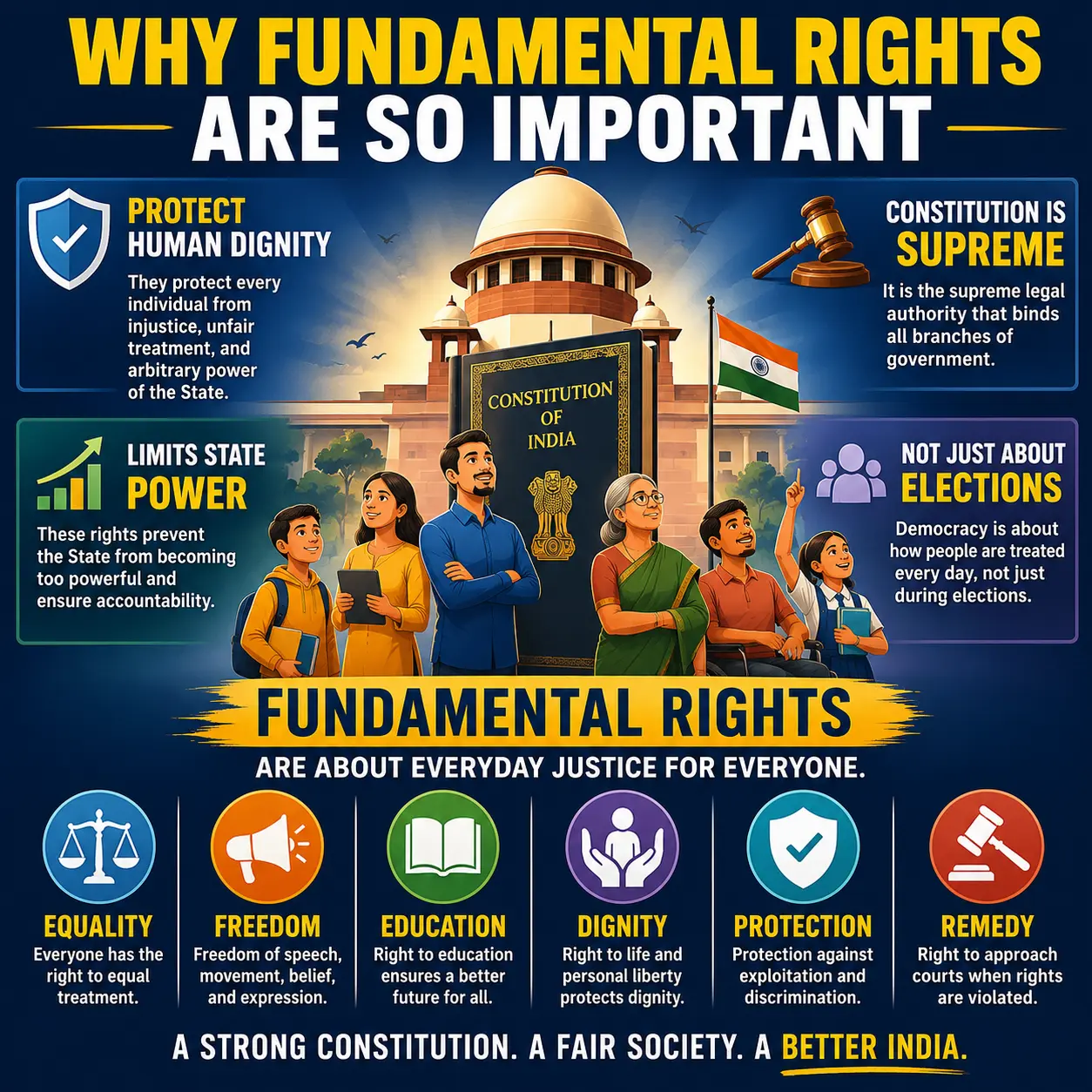
Fundamental Rights are important because they protect human dignity in real life. Without them, a person could be silenced, discriminated against, detained unfairly, or denied education and equal opportunity. These rights are one of the main ways the Constitution turns the idea of the rule of law into something people can actually use. The Supreme Court has also described the Constitution as the supreme legal authority that binds all branches of government and empowers the judiciary to invalidate unconstitutional action.
They also create a moral and legal floor for the country. A democracy is not only about elections. It is also about how people are treated between elections. Fundamental Rights make sure the State does not become too powerful and that individuals are not left helpless. In that sense, they are about much more than legal theory. They are about everyday justice.
Right to Equality: the promise that law should not play favorites
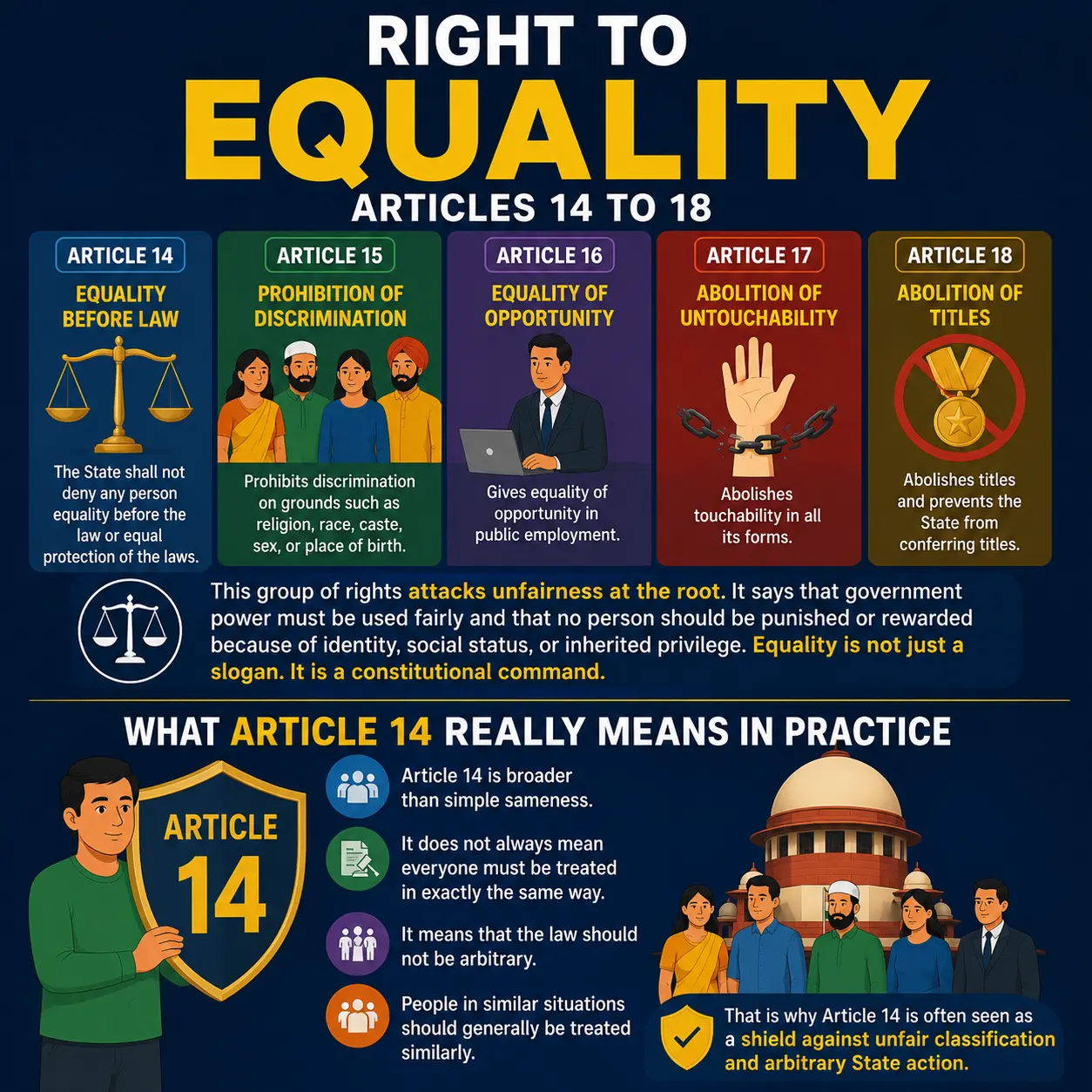
The Right to Equality runs through Articles 14 to 18. Article 14 says the State shall not deny any person equality before the law or the equal protection of the laws. Article 15 prohibits discrimination on grounds such as religion, race, caste, sex, or place of birth. Article 16 gives equality of opportunity in public employment. Article 17 abolishes untouchability. Article 18 abolishes titles.
This group of rights is one of the most powerful parts of the Constitution because it attacks unfairness at the root. It says that government power must be used fairly. It also means that a person should not be punished or rewarded simply because of identity, social status, or inherited privilege. Equality here is not just a slogan. It is a constitutional command.
What Article 14 really means in practice
Article 14 is broader than simple sameness. It does not always mean everyone must be treated in the same way. It means that the law should not be arbitrary and that people in similar situations should generally be treated similarly. That is why Article 14 is often seen as a shield against unfair classification and arbitrary State action.
Examples of equality in action
- A government office cannot reject an application only because the applicant belongs to a particular caste.
- A public employer cannot reserve a post for someone without legal basis.
- Untouchability, in any form, is constitutionally prohibited.
- Titles that create social ranking are not part of the constitutional ideal of equality.
Right to Freedom: the space where personal liberty lives
The Right to Freedom is one of the most visible and practical groups of rights in the Constitution. It covers freedom of speech and expression, peaceful assembly, association, movement, residence, and occupation, trade, or business under Article 19. It also includes protection in respect of conviction for offences under Article 20, protection of life and personal liberty under Article 21, the right to education under Article 21A, and protection against arrest and detention in certain cases under Article 22.
This category matters because it touches daily life so directly. It protects the right to speak, the right to travel, the right to work, the right to live without unlawful detention, and the right to be treated with dignity by the State. When people talk about liberty in constitutional law, this is the part they usually mean.

A closer look at Article 19
Article 19 gives citizens important freedoms, including:
- Freedom of speech and expression
- Freedom to assemble peaceably and without arms
- Freedom to form associations or unions
- Freedom to move freely throughout India
- Freedom to reside and settle in any part of India
- Freedom to practise any profession or carry on any occupation, trade, or business
But these freedoms are not absolute. The Constitution itself allows reasonable restrictions in certain interests such as sovereignty and integrity of India, security of the State, public order, decency, morality, defamation, and contempt of court. That built-in balance is crucial. It reflects the idea that freedom must exist, but it must also coexist with social order and the rights of others.
A practical example
A person may have the right to speak freely, but that does not mean the Constitution protects incitement to violence, defamation, or speech that legally falls within the permitted restrictions. So the right is real, but it works within a constitutional framework, not outside it.
Article 21: the heart of human dignity
Few constitutional provisions are as important as Article 21. It says that no person shall be deprived of life or personal liberty except according to procedure established by law. That short sentence has become one of the strongest foundations of Indian constitutional law. The Ministry of Law and Justice notes that the Supreme Court has, through judicial interpretation, expanded the scope of Fundamental Rights, especially Article 21, to include more civil and political protections.
That matters because life in constitutional law is not just survival. It is life with dignity. In modern legal thinking, personal liberty includes much more than freedom from physical restraint. It is tied to fairness, dignity, and meaningful human existence. The Court’s interpretation has made Article 21 central to many areas of public life.
Examples of the larger idea behind Article 21
Article 21 has become associated with issues such as:
- Dignity
- Fair procedure
- Personal security
- Protection from arbitrary State action
- Access to basic life conditions in many constitutional debates
The exact scope of Article 21 has grown through judicial decisions over time. That is one reason it is often described as the living heart of the Constitution.

Article 21A and the right to education
Article 21A guarantees free and compulsory education to all children of the age of six to fourteen years, in the manner the State may determine by law. This is a powerful example of how the Constitution can turn a social need into an enforceable right. Education is not treated as a luxury. It is treated as a constitutional necessity for childhood development and democratic citizenship.
This right has enormous practical value. Without education, the promise of equality and freedom becomes weak. With education, a child has a better chance to understand rights, use opportunities, and participate fully in society. That is why Article 21A fits naturally with the broader constitutional promise of dignity and equality.
Protection against arrest and detention
Article 22 protects people against arbitrary arrest and detention in certain cases. It requires that an arrested person be informed of the grounds of arrest as soon as possible and be allowed to consult and be defended by a legal practitioner of choice. This is a very human right. It protects the person at the moment when State power is most direct and most frightening.
The practical value of this right is easy to understand. A person who is arrested should not be left in the dark. Lawful procedure matters, because liberty without procedure is fragile. Article 22 is one of the strongest examples of the Constitution’s commitment to due process-like protection in the Indian context.
Right against Exploitation: the Constitution says human beings are not to be used
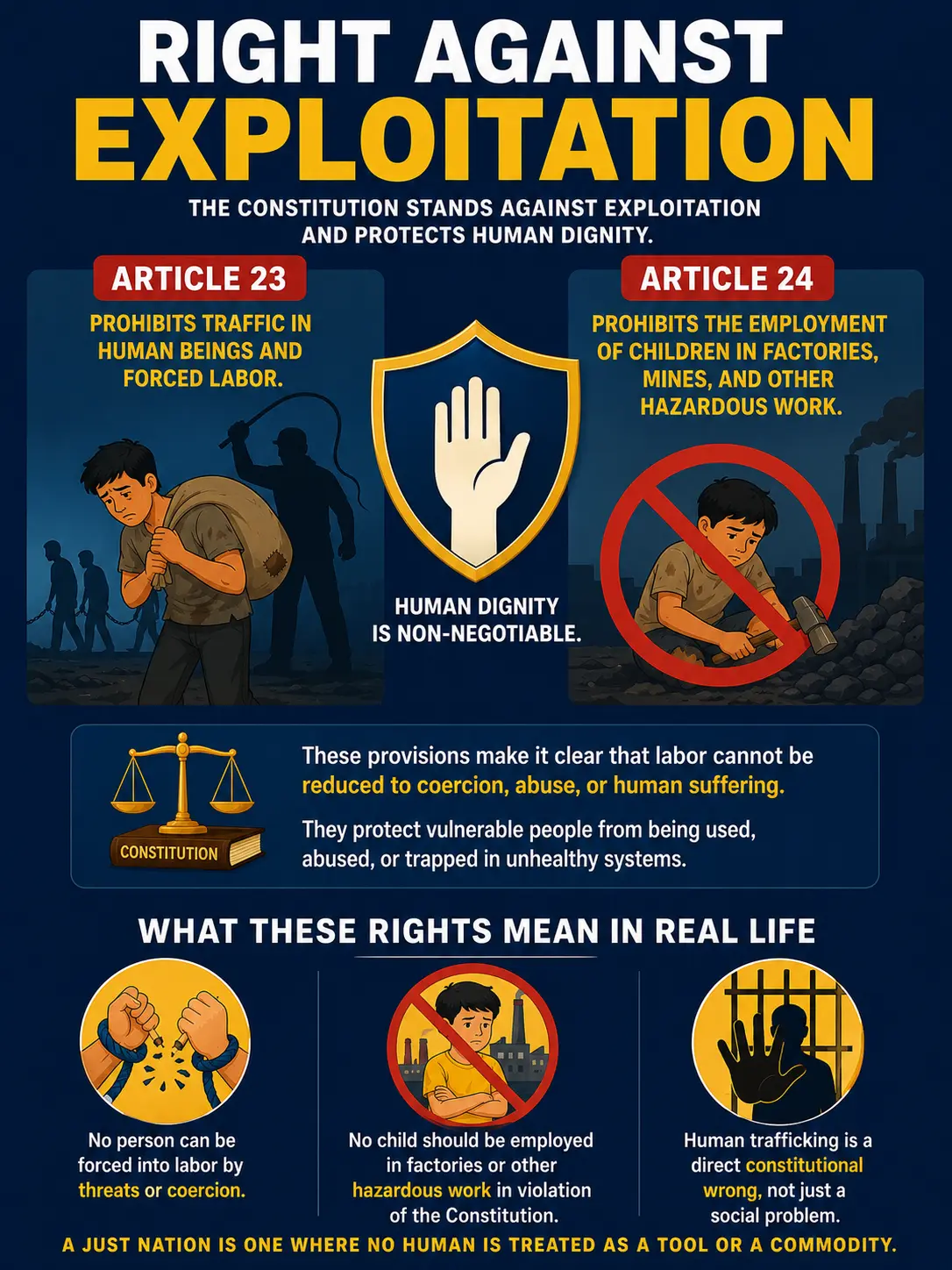
The Right against Exploitation, under Articles 23 and 24, is among the clearest moral statements in the Constitution. Article 23 prohibits traffic in human beings and forced labour. Article 24 prohibits the employment of children in factories, mines, and other hazardous work. These provisions make it clear that labor cannot be reduced to coercion, abuse, or human suffering.
This part of the Constitution is deeply practical. It addresses exploitation in the economy, in trafficking networks, and in child labor. It is a reminder that constitutional rights are not only about speech and elections. They are also about protecting vulnerable people from being used, abused, or trapped in unhealthy systems.
What these rights mean in real life
- No person can be forced into labor by threats or coercion.
- No child should be employed in factories or other hazardous work in violation of the Constitution.
- Human trafficking is a direct constitutional wrong, not just a social problem.
Right to Freedom of Religion
The Right to Freedom of Religion appears in Articles 25 to 28. Article 25 protects freedom of conscience and the right to freely profess, practice, and propagate religion, subject to public order, morality, health, and the other provisions of the Constitution. Article 26 protects the freedom to manage religious affairs. Article 27 bars tax use for promoting any particular religion. Article 28 deals with religious instruction and worship in certain educational institutions.
This is one of the Constitution’s most delicate and important areas because India is religiously diverse. The Constitution does not force uniformity in belief. Instead, it protects choice, subject to constitutional limits. That means the State cannot casually interfere with belief, worship, or religious organization. At the same time, religious freedom does not override public order or other constitutional guarantees.
A very important balance
The Constitution protects religion, but it does not allow religion to become a license for harm or disorder. That is why Article 25 itself includes limits. In a diverse society, that balance is essential. It allows people to live by conscience while keeping the larger legal order intact.
Cultural and Educational Rights: protection for identity and minority life
Articles 29 and 30 protect cultural and educational interests. Article 29 protects the interests of any section of citizens having a distinct language, script, or culture. It also protects admission to State-aided educational institutions from discrimination on certain grounds. Article 30 gives minorities, whether based on religion or language, the right to establish and administer educational institutions of their choice.
These rights matter because India is not a single-language or single-culture country. It is a country of many identities. The Constitution does not ask minorities to disappear into the majority. It gives them room to preserve what makes them distinct. That is a major reason Indian constitutionalism is seen as both democratic and pluralist.

Examples
- A community can protect its language and culture.
- Minorities can establish and manage schools in accordance with constitutional rules.
- A citizen should not be denied admission to a State-aided institution only because of religion, race, caste, language, or related identity.
Right to Constitutional Remedies: the right that makes all the other rights real
Article 32 is often called the heart and soul of the Constitution in constitutional discussions because it gives people the right to move the Supreme Court for enforcement of Fundamental Rights. The Article specifically empowers the Supreme Court to issue directions, orders, or writs, including habeas corpus, mandamus, prohibition, quo warranto, and certiorari. The Supreme Court’s own jurisdiction page confirms this enforcement role.
This is the reason Fundamental Rights are enforceable and not merely decorative. A right is only truly powerful when there is a remedy for violation. Article 32 turns constitutional promise into legal action.
What the writs mean in simple language
- Habeas corpus means a court can ask that a detained person be brought before it so the detention can be examined.
- Mandamus means a court can order a public authority to perform a duty it is legally bound to perform.
- Prohibition stops a lower court or authority from acting beyond its legal power.
- Quo warranto asks by what authority a person holds a public office.
- Certiorari allows a higher court to review and correct certain legal errors of lower bodies.
The role of High Courts
The Constitution also gives the High Courts, under Article 226, the power to issue writs for the enforcement of Fundamental Rights and for other purposes. So the system does not rely only on the Supreme Court. It also gives people a powerful remedy at the High Court level.
A practical table of the six broad groups
| Broad Right | Core Constitutional Idea | Why it matters to ordinary life | Key legal tone |
|---|---|---|---|
| Equality | People should be treated fairly and without unlawful discrimination. | Jobs, school admissions, public services, and police treatment should not depend on identity. | Anti-discrimination and anti-arbitrariness |
| Freedom | People should have room to speak, move, work, and live freely. | You can protest peacefully, travel, run a business, and protect personal liberty. | Liberty with reasonable restrictions |
| Protection from exploitation | Human beings must not be trafficked, forced, or abused for labor. | Protects workers and children from coercion and abuse. | Dignity and anti-abuse |
| Religion | The State should not control belief and worship unfairly. | People can follow conscience and practice religion within constitutional limits. | Freedom with public order limits |
| Culture and education | Communities can protect language, script, culture, and minority institutions. | Helps minority groups preserve identity and educational choice. | Pluralism and diversity |
| Remedies | Rights must be enforceable in court. | A violated right is not just a complaint. It is a legal claim. | Judicial enforcement |
Who can claim which Fundamental Rights?
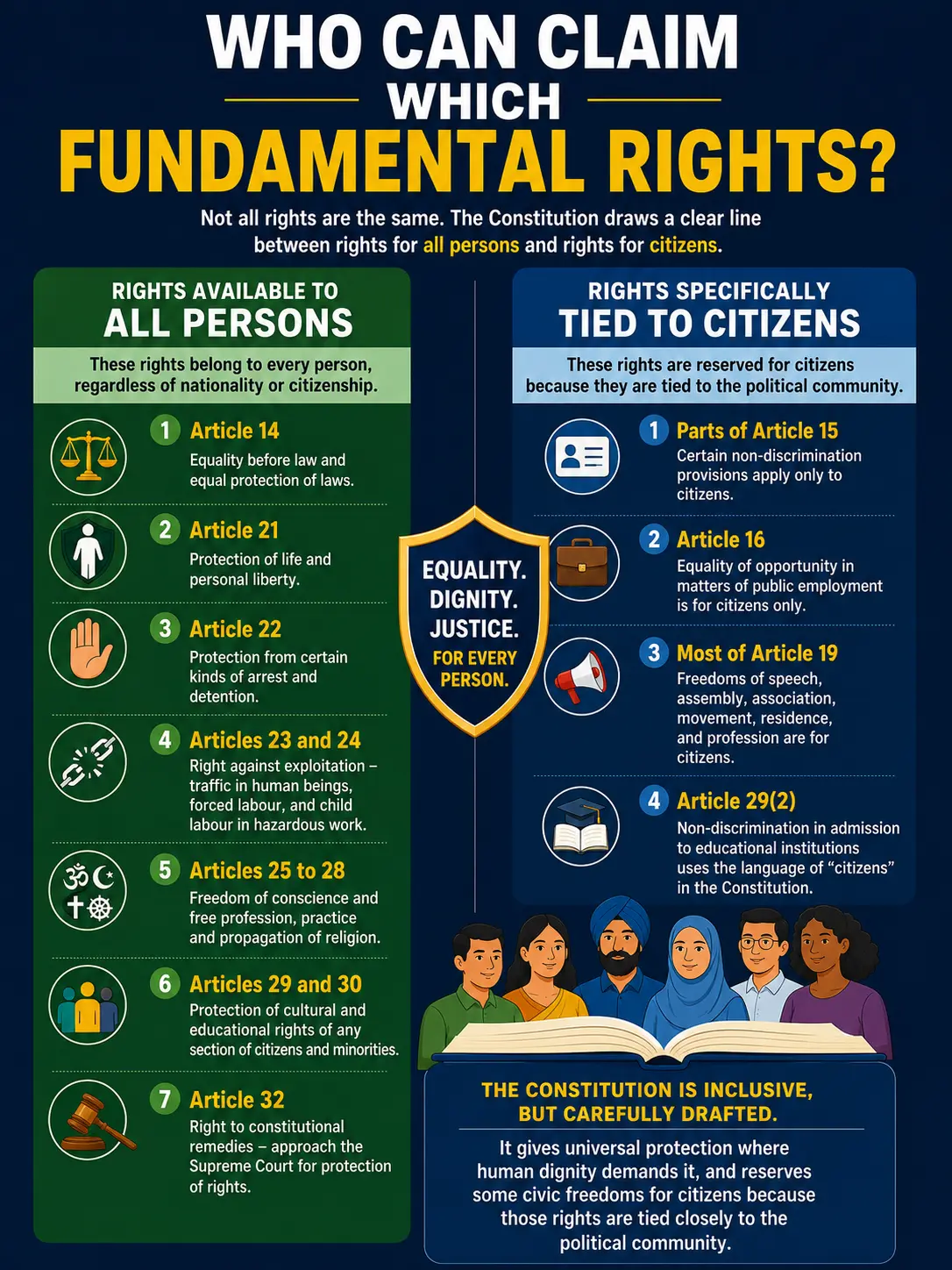
One of the most interesting things about Fundamental Rights is that they do not all work the same way. Some rights are available to all persons, including foreigners and non-citizens. Others are available only to citizens. The Constitution itself draws this line.
Rights generally available to all persons
These include:
- Article 14 on equality before law
- Article 21 on life and personal liberty
- Article 22 in its protection from certain kinds of arrest and detention
- Articles 23 and 24 on exploitation
- Articles 25 to 28 on religious freedom
- Articles 29 and 30 on cultural and educational rights
- Article 32 on constitutional remedies
Rights specifically tied to citizens
These include:
- Parts of Article 15
- Article 16 on public employment
- Most of Article 19 freedoms
- Article 29(2) in its non-discrimination rule for admission to educational institutions, which uses the language of citizens in the constitutional text
This distinction is important because it shows the Constitution is inclusive, but also carefully drafted. It gives universal protection where human dignity demands it, and it reserves some civic freedoms for citizens because those rights are tied closely to the political community.
How Fundamental Rights are limited
A right can be fundamental and still not be unlimited. The Constitution itself contains built-in restrictions. In Article 19, those restrictions are explicitly written into the text. Freedom of speech can be restricted for reasons such as security, public order, morality, defamation, and contempt of court. Freedom of association, movement, residence, and profession can also be limited in legally defined ways.
This is not a weakness. It is what makes the system workable. A society needs both liberty and order. Without liberty, people suffer under power. Without order, liberty can turn destructive. The Constitution tries to keep both in view.
Examples of constitutional limits
- Speech may be regulated when it threatens public order or national security.
- Movement may be restricted in some situations for public interest or tribal protection.
- Profession and trade may be regulated through qualifications or public interest rules.
What happened to the Right to Property?
This is a common question. In the original constitutional design, the property right was treated as a Fundamental Right, but that is no longer the case. The Constitution now places Article 300A in a different part, saying that no person shall be deprived of property save by authority of law. The text of Article 31 is marked as omitted in Part III, and the old Right to Property heading is also omitted.
That means property still has constitutional protection, but it is not a Fundamental Right in the same way as the rights in Part III. This change reflects the constitutional evolution of India over time.
Fundamental Rights, Directive Principles, and Fundamental Duties
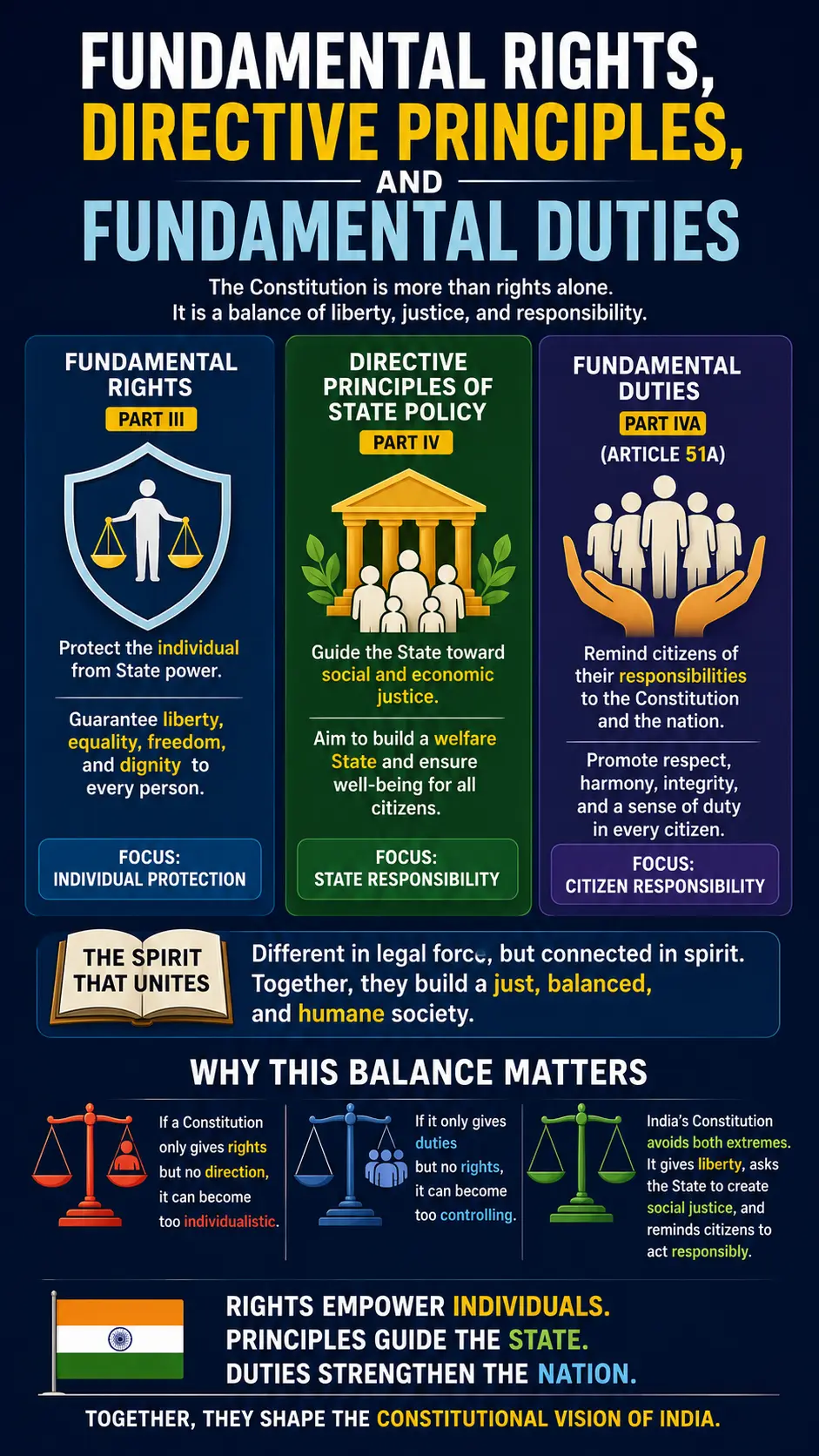
The Constitution is not built on Fundamental Rights alone. It also includes Directive Principles of State Policy in Part IV and Fundamental Duties in Article 51A under Part IVA. The Directive Principles guide the State toward social and economic justice, while Fundamental Duties remind citizens of their responsibilities to the Constitution and to the nation.
These parts are different in legal force, but they are connected in spirit. Rights protect the individual. Directive Principles push the State toward welfare. Duties remind citizens that a healthy constitutional order needs responsible behavior too. The Ministry of Law and Justice chapter on Fundamental Rights notes the continuing importance of this constitutional balance.
Why this balance matters
If a Constitution only gives rights but no direction, it can become too individualistic. If it only gives duties but no rights, it can become too controlling. India’s Constitution tries to avoid both extremes. It gives liberty, asks the State to create social justice, and reminds citizens to act responsibly.
A comparison table that many readers find useful
| Feature | Fundamental Rights | Directive Principles | Fundamental Duties |
|---|---|---|---|
| Part of Constitution | Part III | Part IV | Part IVA |
| Legal nature | Enforceable in court | Not directly enforceable in the same way | Not usually court-enforceable in the same way |
| Main purpose | Protect individual liberty and equality | Guide the State toward welfare and justice | Encourage responsible citizenship |
| Who is mainly addressed | Individuals and citizens | The State | Citizens |
| Example | Article 21 protects life and personal liberty | Article 47 guides public health policy | Article 51A asks citizens to respect the Constitution |
How Fundamental Rights have evolved over time
Fundamental Rights are not frozen in time. The Constitution has been amended, and the courts have interpreted rights in a living way. The legal affairs chapter from the Government of India notes that the Supreme Court has expanded the scope of Fundamental Rights, especially Article 21, through judicial interpretation. The same chapter also discusses the continuing importance of the basic structure idea in constitutional law.
This evolution matters because social life changes. New technologies, new public issues, and new forms of State power create fresh constitutional questions. A strong constitutional system must be stable, but it must also remain alive to the changing world. That is one reason the Indian Constitution remains such an influential document.
A few concrete everyday examples
1. A student facing discrimination
If a student is treated unfairly because of caste, religion, or place of birth in a State-controlled setting, the student may raise issues under the Right to Equality. The Constitution does not allow the State to normalize such discrimination.
2. A journalist or citizen speaking publicly
A person can speak freely under Article 19(1)(a), but the Constitution also permits reasonable restrictions. So the right to speak is protected, yet not without legal limits.
3. A person held without lawful basis
When liberty is threatened, Article 21 and Article 22 become crucial. The Constitution requires lawful procedure and important safeguards.
4. A child being pushed into hazardous work
That problem directly raises Article 24. The Constitution prohibits child employment in harmful work.
5. A religious minority managing its school
That situation connects to Article 30, which gives minorities the right to establish and administer educational institutions of their choice.
Why Fundamental Rights matter to the world, not just to India
The Indian model is globally interesting because it combines equality, liberty, religious pluralism, minority protection, and judicial remedies in one constitutional framework. Many countries protect rights, but India’s Constitution is notable for the way it connects civil liberty with social justice and a large, diverse democratic society.
That is why the topic remains relevant to readers around the world. You do not need to be an Indian citizen to understand the value of the idea. If a constitution protects the person against arbitrary power, gives space for identity, and provides a remedy in court, it offers a lesson that travels well beyond national borders.
The deeper idea behind Fundamental Rights
The deeper idea is simple, even if the legal structure is detailed. A person is not just a subject of the State. A person has dignity, identity, conscience, and legal worth. The Constitution recognizes that and turns it into enforceable law. That is what makes Fundamental Rights one of the most beautiful and important parts of the Indian constitutional order.
So when people ask, “What are Fundamental Rights under the Indian Constitution?”, the best answer is this. They are the constitutional promises that protect fairness, freedom, dignity, minority identity, and legal remedy. They are the rights that make democracy humane. And they are the rights that remind the State that power exists to serve people, not to swallow them.
Article Sources and References
- The Constitution of India (Official Constitutional Text)
Used for Articles 12–35, Fundamental Rights, Article 21A, Article 32, and other constitutional provisions. (India Code) - Part III – Fundamental Rights (Articles 12–35)
Official text covering the definition of the State, Fundamental Rights, and constitutional protections. (Ministry of External Affairs) - Constitution of India: Legislative Department, Government of India
Official government resource containing the Constitution and constitutional amendments. (legislative.gov.in) - Supreme Court of India: Constitutional Jurisdiction
Referenced for Article 32, writ jurisdiction, and enforcement of Fundamental Rights. (Supreme Court of India) - Supreme Court of India: Constitution and Judicial Authority
Referenced for constitutional interpretation and the binding nature of Supreme Court decisions. (Supreme Court of India) - Constitution of India: Part III Archive
Referenced for the classification and structure of Fundamental Rights under Articles 12–35. (Constitution of India) - Article 32 and Constitutional Remedies
Referenced for discussion on constitutional remedies and the right to approach the Supreme Court directly. (Indian Kanoon) - NCERT: Rights in the Indian Constitution
Referenced for the significance, purpose, and constitutional role of Fundamental Rights. (ncert.nic.in) - Fundamental Rights and Constitutional Framework
Referenced for constitutional philosophy, democratic values, and the protection of citizens’ rights. (Constitution of India) - Supreme Court of India: History and Constitutional Role
Referenced for information regarding the Supreme Court’s constitutional position and authority. (Supreme Court of India) - Fundamental Rights in India (Articles 12–35)
Referenced for categorization of the six Fundamental Rights under Part III. (Next IAS) - Fundamental Rights and Constitutional Enforcement
Referenced for explanations regarding enforceability and constitutional protection of rights. (Testbook)
Frequently Asked Questions
FAQ 1. What are Fundamental Rights under the Indian Constitution?
Fundamental Rights are the basic legal rights that the Constitution of India gives to people so they can live with dignity, freedom, equality, and safety. These rights are written in Part III of the Constitution, mainly from Articles 12 to 35. They are called “fundamental” because they are not ordinary rights. They are the core rights that support democratic life.
These rights matter because they protect people from unfair power. They stop the government from acting in an arbitrary way. They also create a legal standard that courts can use to check whether the State has acted properly or not. That is why these rights are not only moral ideas. They are enforceable in court.
In simple words, Fundamental Rights are the Constitution’s promise that a person should not be treated badly just because of caste, religion, gender, language, opinion, or social position. They also protect personal liberty, religious freedom, education, and access to justice. So when people ask what these rights really are, the easiest answer is this. They are the rights that help make democracy real in daily life.
Some of the best-known rights include:
- Right to Equality
- Right to Freedom
- Right against Exploitation
- Right to Freedom of Religion
- Cultural and Educational Rights
- Right to Constitutional Remedies
These are not just legal terms. They affect real life. They protect students, workers, religious communities, citizens, and ordinary people who need fair treatment from the State. And that is what makes them so important.
FAQ 2. How many Fundamental Rights are there in the Indian Constitution?
There are six broad groups of Fundamental Rights in the Indian Constitution. They are arranged in a clear way so people can understand them better. Each group covers a different area of life, but together they create a strong constitutional shield.
The six broad groups are:
- Right to Equality
- Right to Freedom
- Right against Exploitation
- Right to Freedom of Religion
- Cultural and Educational Rights
- Right to Constitutional Remedies
These groups cover a very wide range of situations. Some protect people from discrimination. Some protect speech, movement, and personal liberty. Some protect religious practice. Some protect minorities and their educational institutions. And one of them gives people the power to go to court when their rights are violated.
It helps to think of them like layers of protection. The first layer says that people should be treated equally. The second layer protects freedom in daily life. The third layer stops abuse and forced labor. The fourth layer protects conscience and religion. The fifth layer protects culture and education. The sixth layer gives a remedy when things go wrong.
So although there are many articles inside Part III, the rights are usually understood in these six main groups. That structure makes the Constitution easier to study and easier to use in real life.
FAQ 3. Why are Fundamental Rights so important in a democracy?
Fundamental Rights are important because democracy is not only about voting. It is also about how people are treated every day. A country can hold elections and still fail people if it does not protect freedom, equality, and dignity. That is why Fundamental Rights are one of the strongest foundations of a democratic system.
They matter for several reasons.
First, they protect the individual against misuse of State power. A government can be powerful, but it cannot be free to do anything it wants. The Constitution places limits on that power.
Second, they create fairness. People should not be treated differently just because of identity, background, or belief. Rights make that principle legal, not just emotional.
Third, they support personal growth. A person needs freedom of speech, movement, religion, and education to build a meaningful life.
Fourth, they make justice possible. If a right is violated, the person can approach the court. That makes the Constitution effective, not decorative.
Fifth, they protect social peace. When people know the rules are fair, confidence in society increases. Rights reduce fear and arbitrary treatment.
So in a real sense, Fundamental Rights are not extra benefits. They are the constitutional minimum for human dignity. Without them, democracy becomes weak. With them, democracy becomes alive.
FAQ 4. What is the Right to Equality and why does it matter?
The Right to Equality is one of the most important parts of the Indian Constitution. It is covered mainly by Articles 14 to 18. This right says that the law should treat people fairly and that the State should not discriminate without good reason.
Here is what it includes:
- Article 14 gives equality before law and equal protection of laws
- Article 15 prohibits discrimination on grounds such as religion, race, caste, sex, or place of birth
- Article 16 gives equality of opportunity in public employment
- Article 17 abolishes untouchability
- Article 18 abolishes titles
This right matters because it attacks unfairness at the root. It stops the State from favoring one kind of person and ignoring another. It also means that a person should not be denied a public benefit, public job, or legal protection just because of identity.
A simple example makes this clear. If two people are equally qualified for a public post, the government cannot choose one and reject the other purely on discriminatory grounds. That would go against equality. Another example is untouchability. The Constitution does not merely discourage it. It abolishes it.
The broader idea behind equality is that the law should not be a tool of privilege. It should be a tool of fairness. And that is why the Right to Equality sits at the very heart of constitutional democracy.
FAQ 5. What does the Right to Freedom actually protect?
The Right to Freedom protects the basic space a person needs to live freely and independently. It is found mainly in Articles 19 to 22, and it includes several important freedoms that shape everyday life.
These freedoms include:
- Freedom of speech and expression
- Freedom to assemble peacefully
- Freedom to form associations or unions
- Freedom to move freely throughout India
- Freedom to reside and settle in any part of India
- Freedom to practise any profession or carry on any occupation, trade, or business
- Protection in respect of conviction for offences
- Protection of life and personal liberty
- Right to education
- Protection against arrest and detention in certain cases
This right is essential because freedom is not one single thing. It is a set of different freedoms that together create a meaningful life. A person should be able to speak, travel, work, and live without unnecessary interference.
But these rights are not absolute. The Constitution allows reasonable restrictions in some cases. For example, speech can be restricted for public order, defamation, morality, or national security. That balance is important. It protects freedom while also protecting society.
A practical way to understand this right is to imagine ordinary life. A student speaks in public. A worker joins a union. A trader starts a business. A family moves to another part of the country. A person challenges unlawful detention. All of these actions are connected to the Right to Freedom.
So this right is not abstract. It is deeply personal. It supports both dignity and independence.
FAQ 6. What is Article 21 and why is it considered so powerful?
Article 21 is one of the strongest provisions in the Indian Constitution. It says that no person shall be deprived of life or personal liberty except according to procedure established by law. At first glance, it looks like a short and simple sentence. But its importance is enormous.
This article matters because it protects the most basic things a human being has. Life and liberty are not small rights. They are the foundation of all other rights. Without them, no other freedom is secure.
Over time, courts have interpreted Article 21 in a broad and meaningful way. It is not limited to physical survival. It is linked to dignity, fairness, and a decent human existence. That is why people often say Article 21 is the heart of the Constitution.
Its strength comes from a few ideas:
- The State cannot take away life or liberty without lawful procedure
- The procedure must be fair, not arbitrary
- Human dignity is part of the constitutional meaning of life
- The right protects real people in real situations
This article becomes important in cases involving arrest, detention, unsafe living conditions, unfair treatment, and other serious violations. It is also one of the best examples of how the Constitution grows through interpretation while staying faithful to its purpose.
So when people talk about constitutional rights in India, Article 21 is always central. It is not just a legal rule. It is a statement that human life must be treated with dignity.
FAQ 7. What is the Right against Exploitation?
The Right against Exploitation is found in Articles 23 and 24 of the Indian Constitution. This right is meant to protect people from being used unfairly, forced into labor, or treated like objects instead of human beings.
It includes two very important protections:
- Article 23 prohibits traffic in human beings and forced labour
- Article 24 prohibits the employment of children in factories, mines, and other hazardous work
This is a powerful part of the Constitution because exploitation can happen in hidden ways. A person may be tricked, pressured, threatened, or trapped into work they did not freely agree to. Children may be pushed into dangerous work instead of going to school. These problems are not only social issues. They are constitutional concerns.
The right exists because a society cannot call itself just if it allows human beings to be exploited for profit or power. A person is not a machine. A child is not cheap labor. The Constitution says this clearly.
Some practical examples include:
- A worker being forced to work against their will
- A child being employed in dangerous factory work
- A person being trafficked across regions for labor or abuse
This right is especially important in countries with inequality and poverty. It reminds the State that freedom from exploitation is part of dignity. And dignity is one of the main ideas behind the whole Constitution.
FAQ 8. What are Cultural and Educational Rights?
Cultural and Educational Rights are protected mainly by Articles 29 and 30 of the Indian Constitution. These rights are very important in a diverse country like India, where many communities have different languages, scripts, traditions, and identities.
Article 29 protects the interests of any section of citizens having a distinct language, script, or culture. It also prevents unfair discrimination in access to certain educational institutions. Article 30 gives minorities the right to establish and administer educational institutions of their choice.
These rights matter because culture is not a small thing. Language, tradition, and education are deeply tied to identity. If a community loses its cultural space, it can lose a part of itself. The Constitution understands this and gives protection.
These rights also show that India does not try to force one cultural model on everyone. It allows diversity to exist within unity. That is one of the most beautiful parts of the constitutional system.
Examples of these rights in action include:
- A minority community setting up an educational institution
- A group protecting its language and script
- A student not being unfairly denied admission on prohibited grounds
So Cultural and Educational Rights are not just about schools. They are about preserving identity, dignity, and pluralism. They make it possible for different communities to live with confidence inside one constitutional framework.
FAQ 9. What is the Right to Constitutional Remedies?
The Right to Constitutional Remedies is provided under Article 32. It is one of the most important rights in the entire Constitution because it makes all the other rights meaningful. Without a remedy, a right can become weak. With a remedy, a right becomes real.
This right gives a person the ability to move the Supreme Court directly when a Fundamental Right is violated. The Court can then issue different kinds of writs, including:
- Habeas corpus
- Mandamus
- Prohibition
- Quo warranto
- Certiorari
Each writ has its own legal purpose, but the main idea is simple. If a Fundamental Right is broken, the Constitution provides a path to justice.
This is why Article 32 is often called the enforcement section of the Constitution. It ensures that rights are not just words in a legal book. They are enforceable promises.
A simple example helps here. If a person is unlawfully detained, they may seek legal relief. If a public authority fails to perform a duty, the court may step in. If a lower authority acts beyond its power, the court can correct it.
So Article 32 is the bridge between rights and justice. It is one of the strongest reasons the Indian Constitution works as a living legal system.
FAQ 10. Are Fundamental Rights absolute, or can they be limited?
Fundamental Rights are not absolute. That means they are very important, but they can still be limited in certain situations. The Constitution itself allows this. The reason is simple. A democracy needs both freedom and order. One cannot exist well without the other.
For example, Article 19 freedoms come with reasonable restrictions. Speech can be limited for public order, defamation, morality, security, and similar reasons. Movement, association, and profession can also be regulated by law.
This does not mean the rights are weak. It means they are balanced. The Constitution protects people, but it also protects society from chaos, abuse, and harm. The law tries to keep those two needs in harmony.
The idea of limitation also shows that the Constitution is practical. It does not assume people will always use freedom wisely. It recognizes that rights must operate in a real society, not in an imaginary one. So the law sets boundaries where needed.
At the same time, those boundaries cannot be arbitrary. They must be legal and reasonable. The State cannot simply claim a restriction and expect people to accept it. Courts can examine whether the restriction is justified.
That is the real beauty of the system. Fundamental Rights are strong, but they are also responsible. They protect freedom without destroying the legal order that makes freedom possible in the first place.
