Kinetic energy is one of the most important ideas in physics, and it shows up everywhere in daily life. A moving car has it. A rolling ball has it. A flying bird has it. A river rushing downhill has it. Even tiny particles inside matter have it. In simple words, kinetic energy is the energy an object has because it is moving. It depends on both mass and speed, and when speed increases, kinetic energy rises very fast because speed is squared in the formula.
This makes kinetic energy easy to understand at a basic level, but also rich enough to explain huge parts of science and engineering. It helps explain motion, collisions, machines, transportation, sports, weather, and even the behavior of gases. It is also closely tied to work, force, and energy transfer.
Table of Contents
What Is Kinetic Energy?
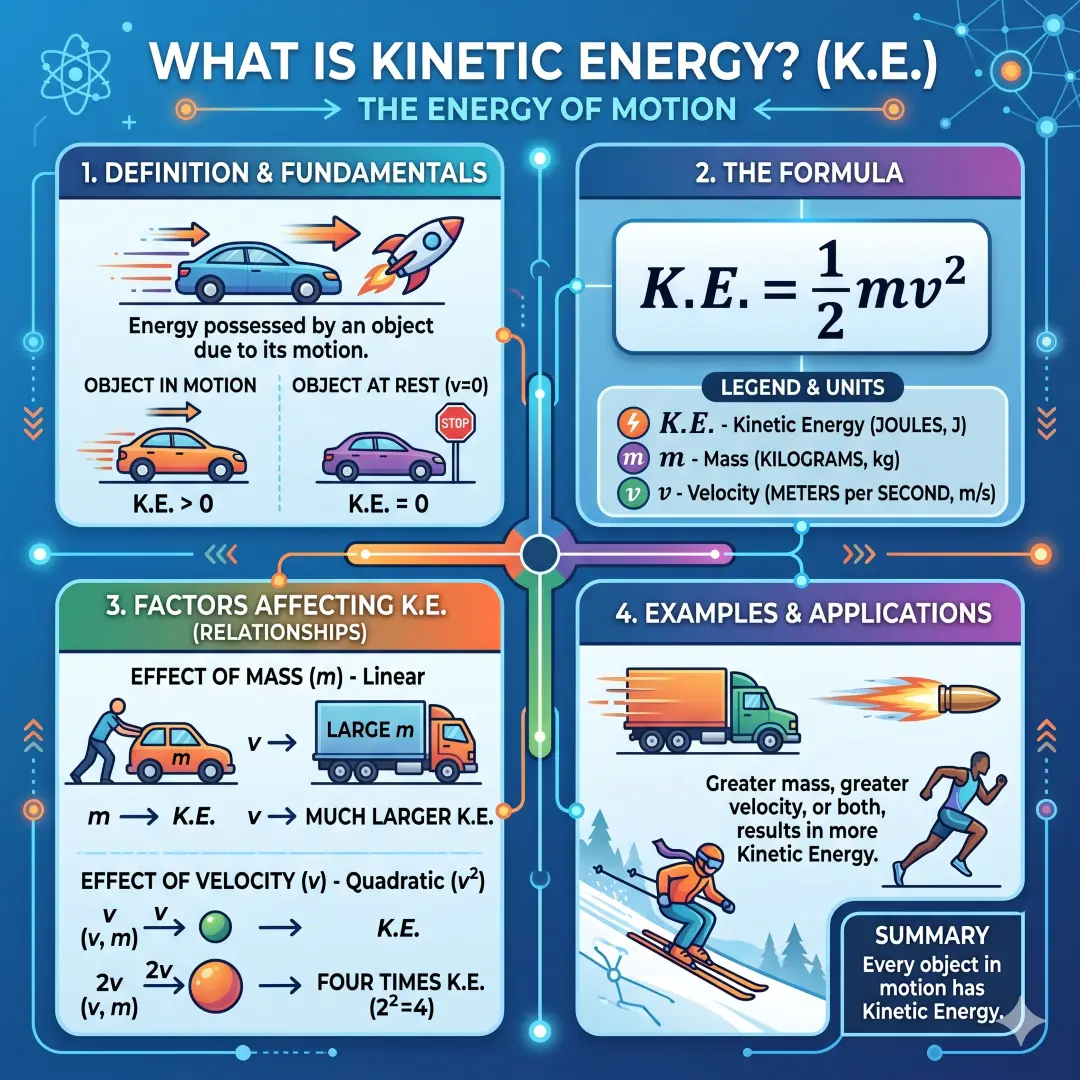
Kinetic energy is the energy of motion. If something is moving, it has kinetic energy. If it is not moving, then its kinetic energy is zero in that reference frame. In physics, the most common form is translational kinetic energy, which is the energy of an object moving from one place to another. A moving object has more kinetic energy when it is heavier, faster, or both.
That simple idea explains a lot. A fast motorcycle can have much more kinetic energy than a slow bicycle. A truck moving slowly may still have more kinetic energy than a small ball moving quickly, because the truck’s mass is far larger. This is why moving large objects is a major engineering challenge and why stopping distance matters so much in traffic safety. The basic relationship between mass, velocity, and kinetic energy is central to classical mechanics.
The Kinetic Energy Formula
The standard formula for translational kinetic energy is:
KE = 1/2 mv²
Where:
- KE means kinetic energy
- m means mass
- v means velocity
This formula tells us that kinetic energy grows in direct proportion to mass, but grows with the square of velocity. That square matters a lot. If speed doubles, kinetic energy becomes four times larger. If speed triples, kinetic energy becomes nine times larger. That is why a little extra speed can make a huge difference in how much energy a moving object carries.
Why is the speed term squared?
Speed has a much stronger effect than mass. If you keep the mass the same and make an object twice as fast, its kinetic energy does not just double. It becomes four times larger. This is one of the most important facts in physics because it explains why high-speed motion is so powerful and sometimes so dangerous.
Units of Kinetic Energy
The SI unit of kinetic energy is the joule, written as J. The joule is the preferred SI unit of heat, energy, and work. In base units, one joule is equivalent to kg·m²/s². That means kinetic energy can always be expressed in the same unit as other forms of energy.
This is useful because energy can take many forms, but the unit stays the same. Whether we talk about motion, heat, or electrical energy, the joule gives us a common way to measure and compare them.
A Simple Way to Think About Kinetic Energy
A moving object can be thought of as carrying the ability to do work. The faster and heavier it is, the more energy it carries. If that object hits something, pushes something, lifts something, or slows down, some of its kinetic energy can be transferred into another form. That is why moving water can turn turbines, moving air can push blades, and moving cars can cause damage in collisions.
You can also think of kinetic energy as the energy needed to stop something that is already moving. A bus moving at highway speed is much harder to stop than a bicycle because it has much more kinetic energy. That extra energy has to go somewhere, usually into brakes, heat, sound, and deformation during stopping.
What Factors Affect Kinetic Energy?
Two main factors control kinetic energy:
- Mass
- Velocity
1. Mass
If the mass increases and the speed stays the same, the kinetic energy increases. A heavier object moving at the same speed carries more kinetic energy than a lighter one.
2. Velocity
If velocity increases, kinetic energy rises sharply because of the square in the formula. This is the main reason speed limits matter so much in road safety. Even a moderate rise in speed can produce a big jump in kinetic energy.
3. Both together
Mass and speed work together. A small object can still have a lot of kinetic energy if it is moving extremely fast. A large object can also have huge kinetic energy even if it is moving slowly.
Table 1. Kinetic Energy Formula and Key Ideas
| Concept | Meaning | Simple Example | Why It Matters |
|---|---|---|---|
| Kinetic energy | Energy of motion | A moving car | Tells us how much energy motion carries |
| Mass | Amount of matter in an object | A truck has more mass than a ball | More mass usually means more kinetic energy |
| Velocity | Speed in a given direction | 20 m/s is faster than 10 m/s | Faster motion means much more kinetic energy |
| Square of velocity | Speed is multiplied by itself | Doubling speed makes KE 4 times larger | Explains why speed is so influential |
| Joule | SI unit of energy | 1 J | Lets us measure energy in a standard way |
| Formula | KE = 1/2 mv² | Used in physics calculations | Helps calculate energy exactly |
Everyday Examples of Kinetic Energy
Kinetic energy is not just a classroom idea. It is present in ordinary life all the time. A few easy examples are:
- A walking person has kinetic energy.
- A speeding bullet has kinetic energy.
- A moving bicycle wheel has kinetic energy.
- A river flowing downhill has kinetic energy.
- A falling object has kinetic energy as it speeds up.
- Light can also be described as carrying energy, and motion is still the broad idea connecting many forms of energy in physics.
The same idea appears in nature and technology. Wind turbines use the kinetic energy of air. Hydroelectric systems use the kinetic energy of moving water. Sports equipment and vehicles all deal with kinetic energy every day, whether we notice it or not.
Table 2. Everyday Objects and Approximate Kinetic Energy
| Object | Mass | Speed | Approximate Kinetic Energy | What the Example Shows |
|---|---|---|---|---|
| Tennis ball | 0.06 kg | 20 m/s | 12 J | A small mass can still have motion energy |
| Football | 0.43 kg | 25 m/s | 134 J | Speed makes a big difference |
| Bowling ball | 7 kg | 8 m/s | 224 J | A bigger mass raises energy quickly |
| Child running | 30 kg | 3 m/s | 135 J | Human motion also carries energy |
| Bicycle with rider | 80 kg | 5 m/s | 1,000 J | Even moderate speed creates noticeable energy |
| Car | 1,500 kg | 20 m/s | 300,000 J | Mass plus speed can create very large energy |
| Truck | 8,000 kg | 15 m/s | 900,000 J | Heavy moving vehicles carry enormous energy |
These values are calculated from KE = 1/2 mv². The table makes one thing obvious very quickly. Once an object becomes heavy or fast, kinetic energy climbs fast, too. That is why transportation, braking systems, and crash safety are such serious engineering topics.
Types of Kinetic Energy
Kinetic energy can appear in different forms depending on the kind of motion involved. In a system of particles, the energy may be translational, rotational, or vibrational. A system may even have several of these at the same time.
1. Translational kinetic energy
This is the energy of straight-line motion or general motion from one place to another. A thrown ball, a moving train, and a flying bird all have translational kinetic energy.
2. Rotational kinetic energy
This is the energy of spinning motion. A spinning wheel, a turning fan blade, and a rotating planet all have rotational kinetic energy. For rotating objects, energy depends on how mass is distributed and how fast the object spins.
3. Vibrational kinetic energy
This is the energy linked to vibration. Atoms and molecules can vibrate, and those vibrations are part of the motion inside matter. In chemistry and thermodynamics, this helps explain how energy moves within substances.
4. Internal or thermal motion
Random motion of particles inside a substance also carries kinetic energy. In gases, this is a major part of what we connect with temperature and heat behavior.
Table 3. Main Forms of Kinetic Energy
| Form | What It Means | Everyday Example | Key Idea |
|---|---|---|---|
| Translational | Motion from one place to another | A car on a road | Straight-line or general movement |
| Rotational | Spinning around an axis | Ceiling fan | Depends on spin and mass distribution |
| Vibrational | Repeated back-and-forth motion | Vibration in molecules | Important in molecular behavior |
| Thermal or internal | Random microscopic motion | Gas particles in a container | Linked to temperature and heat |
Kinetic Energy and Work
Work in physics means energy transferred when a force acts through a distance. When net work is done on an object, its speed changes, and its kinetic energy changes too. This is one of the most useful ideas in mechanics, often called the work-energy theorem.
If a force speeds something up, kinetic energy increases. If a force slows something down, kinetic energy decreases. This is exactly what happens when:
- A car engine accelerates a vehicle
- The brakes slow down a bicycle
- A bat hits a ball
- Gravity accelerates a falling object
This connection between work and kinetic energy is one of the cleanest links in all of physics. It explains how motion starts, how motion changes, and how energy moves from one form to another.
How Kinetic Energy Changes With Speed
The square relationship in the kinetic energy formula often surprises people. Here is the practical meaning:
- If speed becomes 2 times larger, kinetic energy becomes 4 times larger.
- If speed becomes 3 times larger, kinetic energy becomes 9 times larger.
- If speed becomes half, kinetic energy becomes one-quarter.
This matters in real life more than people realize. A small increase in speed can dramatically increase the energy in a moving body. That is why a little extra driving speed can lead to a much more severe crash, and why athletes, engineers, and safety designers pay close attention to motion.
Kinetic Energy vs Potential Energy
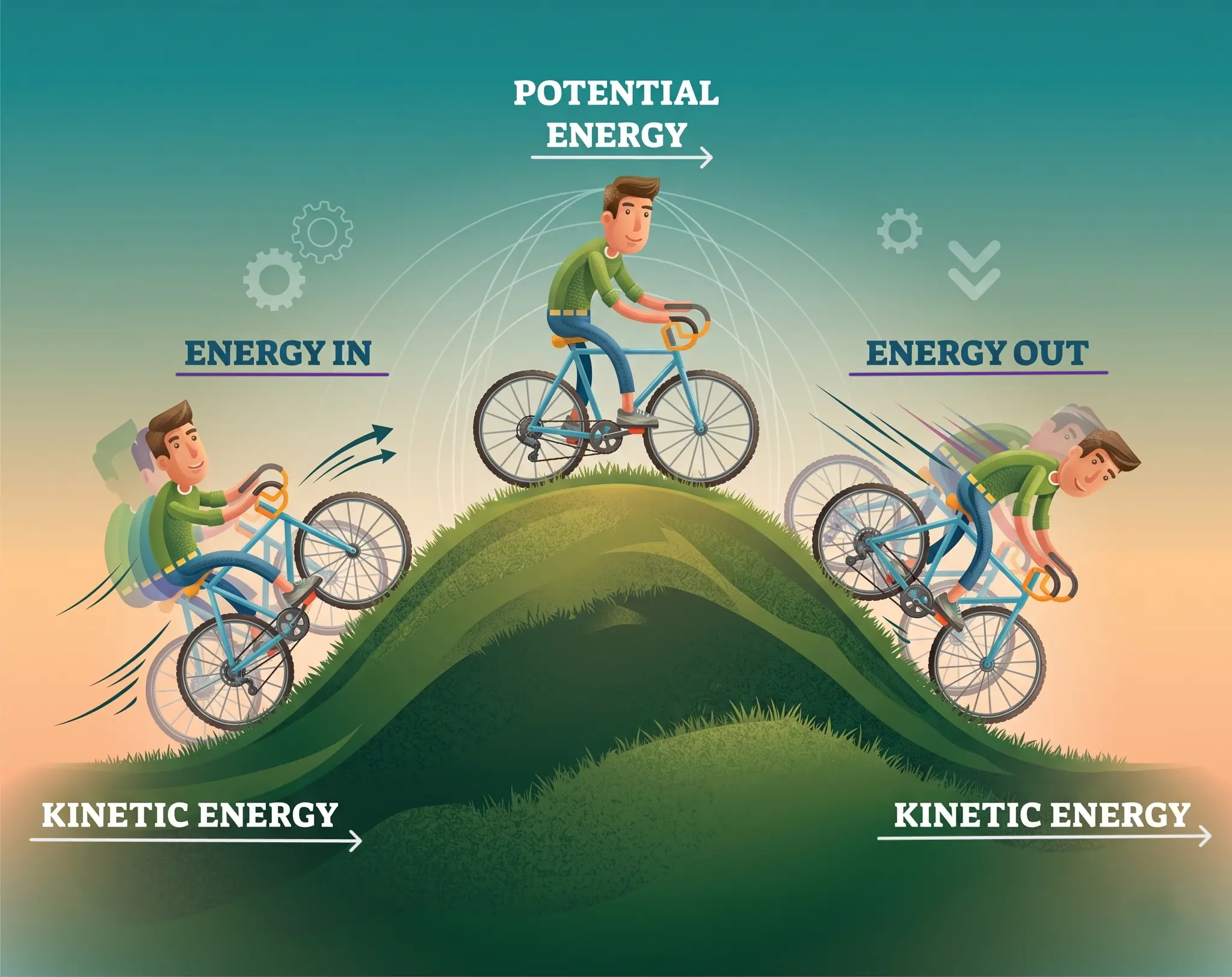
Kinetic energy is the energy of motion. Potential energy is stored energy because of position, shape, or condition. The two are closely related, and they often transform into each other. A raised object has gravitational potential energy. As it falls, that potential energy turns into kinetic energy.
Table 4. Kinetic Energy and Potential Energy Compared
| Feature | Kinetic Energy | Potential Energy |
|---|---|---|
| Basic meaning | Energy of motion | Stored energy |
| Main cause | Object is moving | Object has position or condition |
| Example | Moving car | Book on a shelf |
| Formula type | KE = 1/2 mv² | Often mgh for gravitational potential energy |
| Depends on speed? | Yes, strongly | No, not directly |
| Depends on height? | No | Yes, often |
| Can it transform into the other? | Yes | Yes |
| Common situation | Rolling, flying, falling | Raised, stretched, compressed |
The important idea is that energy does not simply disappear. It changes form. This is part of the broader conservation of energy principle. In a closed system, the total energy remains constant even though the form changes.
Kinetic Energy in Collisions
When objects collide, kinetic energy becomes very important. In an elastic collision, the total kinetic energy before the collision equals the total kinetic energy after the collision. In many real collisions, though, some kinetic energy changes into heat, sound, deformation, and other forms, so the collision is not perfectly elastic.
That is why collision studies matter in:
- car safety design
- sports impact analysis
- machine protection
- packaging design
- industrial accident prevention
Even when kinetic energy is not fully conserved as kinetic energy, total energy is still conserved overall. The energy just moves into different forms.
A Clear Example of How Motion Energy Spreads Out
Imagine a moving car hitting a barrier. The car has kinetic energy before impact. During the crash, part of that energy becomes:
- deformation of metal
- heat
- sound
- movement of broken parts
- motion of the barrier itself
This is one reason collision energy is so dangerous. The energy has to go somewhere, and the body of the vehicle, plus anything inside it, may absorb that energy. Safety systems are built around this reality.
Kinetic Energy in Gases and Temperature
At the microscopic level, gas particles are always moving. The kinetic theory of gases says that temperature is proportional to the average kinetic energy of the molecules. This is a major reason temperature is so closely tied to particle motion.
That means:
- Hotter gases generally have faster-moving particles
- Colder gases generally have slower-moving particles
- Collisions between molecules transfer kinetic energy
- Thermal behavior is linked to microscopic motion
This idea helps explain why heating a gas can raise pressure or expand a container, depending on the setup. It also connects kinetic energy to chemistry, physics, and climate science in a very practical way.
Real-World Applications of Kinetic Energy
Kinetic energy is everywhere in modern life. A few important applications include:
1. Transportation
Cars, buses, trains, ships, and airplanes all rely on kinetic energy. Engines add energy to motion, while brakes remove it. Safe transport depends on controlling that energy carefully.
2. Sports
A thrown javelin, a spinning basketball, a fast ball in cricket, and a sprinting athlete all involve kinetic energy. Coaches and players use motion, force, and timing to improve performance.
3. Hydroelectric power
Moving water carries kinetic energy. In hydropower systems, the moving water is directed to turbines, where its motion helps generate electricity.
4. Wind energy
Wind is moving air, and moving air has kinetic energy. Wind turbines convert part of that energy into mechanical rotation and then into electrical power.
5. Machines and manufacturing
Rotating parts in motors, drills, grinders, and turbines all involve kinetic energy. Industrial design often focuses on reducing loss and keeping motion controlled.
6. Nature
Falling rocks, ocean waves, flowing rivers, and storm winds all involve kinetic energy. Nature is full of moving systems, and those moving systems can do real work.
Table 5. Real-Life Uses of Kinetic Energy
| Area | Example | How Kinetic Energy Is Used |
|---|---|---|
| Transportation | Car on the road | Provides movement and must be controlled by brakes |
| Sports | Football kick | Transfers motion energy to the ball |
| Hydropower | Flowing river | Spins turbines to help generate electricity |
| Wind power | Wind turbine | Converts air motion into electrical energy |
| Machinery | Drill or fan | Uses rotational motion to perform work |
| Nature | Falling rain | Gains motion energy as it falls |
| Safety | Car crash barriers | Absorb and reduce dangerous motion energy |
How to Calculate Kinetic Energy
Let’s look at a simple calculation.
Example 1
A 10 kg object moves at 4 m/s.
KE = 1/2 mv²
KE = 1/2 × 10 × 4²
KE = 5 × 16
KE = 80 J
So the kinetic energy is 80 joules.
Example 2
A 2,000 kg car moves at 15 m/s.
KE = 1/2 × 2000 × 15²
KE = 1000 × 225
KE = 225,000 J
That is a huge amount of energy, and it helps explain why vehicle speed is such a serious safety issue.
Example 3
A ball has a mass of 0.5 kg and a speed of 10 m/s.
KE = 1/2 × 0.5 × 10²
KE = 0.25 × 100
KE = 25 J
This is a neat example of how even a small object can carry useful motion energy.
Table 6. Step-by-Step Kinetic Energy Calculations
| Example | Mass | Speed | Formula Used | Result |
|---|---|---|---|---|
| Small ball | 0.5 kg | 10 m/s | 1/2 × 0.5 × 10² | 25 J |
| Running child | 30 kg | 3 m/s | 1/2 × 30 × 3² | 135 J |
| Bicycle with rider | 80 kg | 5 m/s | 1/2 × 80 × 5² | 1,000 J |
| Car | 1,500 kg | 20 m/s | 1/2 × 1500 × 20² | 300,000 J |
| Truck | 8,000 kg | 15 m/s | 1/2 × 8000 × 15² | 900,000 J |
These numbers are not just classroom exercises. They show why large moving objects need strong brakes, clear safety margins, and careful control. The energy becomes enormous very quickly.
Common Misconceptions About Kinetic Energy
1. “Only very fast objects have kinetic energy.”
Not true. Any object that is moving has kinetic energy, even if it is moving slowly.
2. “Mass matters less than speed.”
Speed has a stronger effect because it is squared, but mass still matters a lot. A heavy object can have a large kinetic energy even at moderate speed.
3. “Kinetic energy and momentum are the same.”
They are related, but they are not the same. Kinetic energy depends on mass and the square of speed, while momentum depends on mass and velocity directly.
4. “If something stops, its energy disappears.”
No, it does not disappear. It changes form into heat, sound, deformation, or other energy forms. That is part of energy conservation.
Why Kinetic Energy Matters in Safety
Kinetic energy is a major reason traffic rules, helmet design, airbags, and impact testing exist. The more kinetic energy a moving body has, the more energy must be managed if it stops suddenly. That is why even a small change in speed can have a large effect on risk.
This also explains several everyday safety ideas:
- Seat belts reduce injury by controlling motion
- Helmets absorb and spread impact energy
- Crash barriers redirect and reduce kinetic energy
- Speed limits lower the energy involved in a crash
- Soft landing zones reduce the effect of sudden stopping
The science is simple, but the consequences are serious. Motion energy is useful, but it must be managed well.
Kinetic Energy in the Big Picture of Physics
Kinetic energy is part of the broader idea of energy, and energy is a central concept in physics. All forms of energy are connected to motion in some way. Even when energy is stored, it is usually stored in a condition that can later produce motion. That is why kinetic energy sits at the heart of mechanical energy, heat transfer, and many natural processes.
It also shows up in the statement that the conservation of energy holds in a closed system. Energy changes form, but the total stays constant. Kinetic energy may turn into potential energy, thermal energy, sound, or other forms, but the total energy budget remains balanced.
A Quick Reference Summary
- Kinetic energy is the energy of motion.
- The formula is KE = 1/2 mv².
- The SI unit is the joule (J).
- Speed affects kinetic energy very strongly because it is squared.
- Mass also matters, because heavier objects carry more motion energy at the same speed.
- Kinetic energy can appear as translational, rotational, vibrational, or thermal motion.
- It is closely linked to work, collisions, temperature, and energy conservation.
Final Thoughts
Kinetic energy is one of those science ideas that seems simple at first and then keeps revealing more depth the longer you look at it. At the basic level, it is just the energy of motion. But once you follow that idea into work, collisions, transportation, gases, temperature, and energy conservation, it becomes a key to understanding how the physical world works.
And that is what makes kinetic energy so useful. It is not just a formula on paper. It is the story of motion itself. A slow walk, a speeding car, a spinning fan, a flowing river, and tiny gas particles in a warm room are all part of the same big scientific picture. Once you understand kinetic energy, a lot of everyday life starts to make more sense.
Article References and Sources
- Kinetic Energy: Encyclopedia Overview
- Mechanical Energy and Kinetic Energy Concepts
- Energy: General Physics Concepts
- Conservation of Energy Principle
- Kinetic Theory of Gases
- Kinetic Energy (Educational Explanation)
- Momentum and Energy Relationship
- Types of Energy (Basic Overview)
- Kinetic Energy (Middle School Physics)
- Work and Energy Concepts
- Energy from Moving Water (Hydropower)
- Kinetic Energy (University Physics: OpenStax)
- Rotational Kinetic Energy Explanation
- SI Unit of Energy (Joule Definition)
Also, Read these Articles in Detail
- Physics and Its Fundamentals With Good Explanations
- Matter, Motion, and Energy: The Core Ideas of Physics
- What Is Matter? The Physical Substance of the Universe
- What Is Motion? A Guide to Motion in Physics and Daily Life
- What Is Energy? The Invisible Power Behind Everyday Life
- Kinetic Energy Explained in Simple Language
- Potential Energy: Definition, Types, Formula, and Examples
- Thermal Energy: Heat, Temperature, and Transfer
- Mechanical Energy: Definition, Formula, and Examples
- Chemical Energy: Definition, Science, and Examples
- Electrical Energy: Definition, Works, and Why It Matters
- Radiant Energy: Meaning, Sources, Examples, and Uses
- Nuclear Energy: Definition, How It Works, and Why It Matters
- Sound Energy: Definition, Science, and Examples
- Elastic Energy: Definition, Elasticity, Example, and Facts
Frequently Asked Questions
FAQ 1. What is kinetic energy in simple words?
Kinetic energy is the energy an object has because it is moving. That is the simplest way to understand it. If something is standing still, it has no kinetic energy in that moment. But the moment it starts moving, even a little, it begins to carry kinetic energy.
This idea shows up everywhere in daily life. A rolling ball has kinetic energy. A moving car has kinetic energy. A flowing river has kinetic energy. A person walking across a room has kinetic energy too. The motion may be slow or fast, but if there is motion, there is kinetic energy.
What makes this concept so useful is that it helps explain a lot of real-world behavior. A small object moving very fast can have a lot of energy. A large object moving slowly can also have a lot of energy. So kinetic energy is not just about speed alone. It is about both mass and motion working together.
In plain language, you can think of kinetic energy as the “energy of movement.” The more motion there is, and the more mass that motion belongs to, the more kinetic energy the object carries. That is why this idea is so important in physics, engineering, sports, transport, and even safety design.
FAQ 2. What is the formula for kinetic energy, and how does it work?
The formula for kinetic energy is:
KE = 1/2 mv²
Here is what each part means:
- KE = kinetic energy
- m = mass of the object
- v = velocity, or speed in a particular direction
This formula is simple, but it has a very powerful message. The mass matters, but the speed matters even more because speed is squared. That means if the speed doubles, the kinetic energy becomes four times larger. If the speed triples, the kinetic energy becomes nine times larger.
That squared relationship is one of the most important ideas in all of motion science. It tells us that small changes in speed can create very big changes in energy. This is why a vehicle moving just a little faster can become much more dangerous in a crash. It is also why engineers pay such close attention to speed when they design brakes, safety systems, and moving machines.
A simple example helps. If an object has a mass of 2 kg and moves at 3 m/s, then its kinetic energy is:
KE = 1/2 × 2 × 3²
KE = 1 × 9
KE = 9 joules
That is a small number, but the same formula works for huge objects too. A car, truck, airplane, or train can have enormous kinetic energy because the mass and speed are much larger.
FAQ 3. Why does speed affect kinetic energy so strongly?
Speed has such a strong effect on kinetic energy because of the square in the formula. That means the speed is not just counted once. It is multiplied by itself. This is why kinetic energy grows much faster than many people expect.
For example, imagine two moving objects with the same mass. One moves at 5 m/s and the other at 10 m/s. The second one is only twice as fast, but its kinetic energy is four times greater. That is a huge difference. Now imagine increasing speed again. The energy rise becomes even more dramatic.
This matters in real life because motion is not just a neat scientific idea. It has consequences. A car driving a little faster can need much more distance to stop. A flying ball traveling a little faster can hit with much more force. A machine part spinning faster can store a lot more motion energy.
That is why speed is so important in safety and design. People often think of speed in simple terms, like “a little faster” or “a little slower.” But physics sees speed differently. Physics sees a square relationship, and that changes everything. Once you understand that, a lot of things start to make more sense, especially in transport and impact situations.
FAQ 4. What are some everyday examples of kinetic energy?
You see kinetic energy all around you every day, even if you do not think about it. It is one of those science ideas that lives quietly in ordinary life.
Here are some easy examples:
- A walking person
- A moving bicycle
- A rolling ball
- A flying bird
- A car on a road
- A flowing river
- A spinning fan
- A falling stone
- A swinging pendulum
Each of these involves motion, so each has kinetic energy. Some examples are large and obvious, while others are smaller and easier to overlook. But the basic idea stays the same.
A child running across a field has kinetic energy. A train moving through a station has kinetic energy. Even air moving as wind has kinetic energy. This is why wind turbines can work. They tap into the motion of air and turn that movement into useful power.
The beauty of this idea is that it connects science with daily life. You do not need a laboratory to see kinetic energy. You can see it in a street, a park, a kitchen fan, or a flowing stream. Once you start looking for it, you notice that motion is always carrying energy with it.
FAQ 5. What is the difference between kinetic energy and potential energy?
Kinetic energy is the energy of motion. Potential energy is stored energy that depends on position, shape, or condition. The difference is simple, but it is one of the most important ideas in physics.
A book sitting on a shelf has potential energy because it could fall. It is not moving yet, so it does not have kinetic energy from that position. But if the book falls, potential energy begins turning into kinetic energy. As it speeds up on the way down, its motion energy grows.
Another example is a stretched rubber band. Before release, it has stored energy. Once it is let go, that stored energy becomes motion. The same thing happens with a drawn bow, a raised object, or water stored behind a dam. Potential energy is waiting. Kinetic energy is active motion.
A simple way to remember the difference is this:
- Potential energy is energy that is ready to be used
- Kinetic energy is energy that is already being used by motion
In real life, these two forms of energy often move back and forth. A roller coaster is a great example. At the top of a hill, it has more potential energy. As it drops, that energy changes into kinetic energy. Then, as it climbs again, the process reverses. This back-and-forth is part of what makes mechanics so interesting and useful.
FAQ 6. How is kinetic energy related to work?
Kinetic energy and work are closely connected. In physics, work happens when a force moves an object over a distance. When work is done on an object, its motion can change. That change is often seen as a change in kinetic energy.
If you push a cart and it speeds up, you are doing work on it. That work adds kinetic energy. If the brakes slow a bike, the brakes are doing work too, but in the opposite direction. In that case, kinetic energy decreases because the moving object is losing motion energy.
This connection is one of the cleanest and most useful ideas in physics. It helps explain how energy moves into and out of motion. It also helps explain why machines work. An engine does work on a vehicle to make it move. A person does work on a suitcase when lifting it. A bat does work on a ball when it strikes it.
The big idea is that work changes motion, and motion is what kinetic energy measures. So when work is done, kinetic energy usually changes too. That link is part of the larger work-energy relationship, which is one of the strongest tools in mechanics.
FAQ 7. Why is kinetic energy important in car safety and accidents?
Kinetic energy is a huge part of car safety because moving vehicles carry a lot of motion energy. The faster and heavier the vehicle is, the more energy it has. And when a crash happens, all that energy has to go somewhere.
That is why speed is so important. A car moving a little faster does not just have a little more kinetic energy. It can have much more. Because of the squared speed relationship, even a moderate increase in speed can make a collision much more serious.
Safety systems exist to manage this energy. For example:
- Seat belts help slow the body down more safely
- Airbags help spread the stopping force over a longer time
- Crush zones absorb impact energy
- Helmets protect the head by reducing the force of impact
- Barriers and guardrails reduce the danger of sudden stopping
The whole point of these systems is to control how kinetic energy changes during a crash. They do not erase the energy. They help redirect it, spread it out, or absorb it in safer ways.
This is why driving fast is not just about reaching a destination sooner. It changes the energy of the moving vehicle in a very big way. That is one reason traffic rules and speed limits matter so much in everyday life.
FAQ 8. What are the different types of kinetic energy?
Kinetic energy does not always look the same. It can appear in several forms depending on the type of motion involved.
The main types are:
- Translational kinetic energy: This is the energy of something moving from one place to another. A car driving down a road, a ball flying through the air, or a person walking are all examples.
- Rotational kinetic energy: This is the energy of spinning motion. A spinning top, a fan blade, a bicycle wheel, and a planet all have rotational kinetic energy.
- Vibrational kinetic energy: This is the energy of back-and-forth motion. It is common in molecules, atoms, and many physical systems. Vibrations are important in sound, chemistry, and material behavior.
- Thermal or internal kinetic energy: This is the random motion of tiny particles inside a substance. In gases especially, this motion is closely related to temperature.
So kinetic energy is not one single thing in practice. It is a broad family of motion-based energy forms. That is why it appears in so many different fields of science. It explains simple movement, spinning movement, microscopic particle movement, and more.
FAQ 9. How is kinetic energy used in real life and technology?
Kinetic energy is a major part of modern life, even though many people never stop to think about it. It powers movement, supports transport, helps generate electricity, and plays a role in almost every machine that moves.
Here are some major real-life uses:
- Transportation: Cars, buses, trains, airplanes, bicycles, and ships all involve kinetic energy. Engines create motion, and brakes remove it. Transport depends on controlling motion safely and efficiently.
- Wind power: Wind is moving air, and moving air has kinetic energy. Wind turbines capture some of that motion and turn it into electricity.
- Hydropower: Water flowing downhill carries kinetic energy. Hydroelectric systems use that motion to spin turbines and produce power.
- Sports: A kicked ball, a thrown javelin, a spinning hockey puck, or a sprinting athlete all involve kinetic energy. Sports often depend on understanding motion, speed, and impact.
- Machines: Drills, fans, grinders, turbines, and motors all use motion energy in different ways. Many machines are really controlled systems for moving energy from one place to another.
- Nature: Wind, rain, waves, rivers, falling rocks, and even moving animals all involve kinetic energy. Nature is full of motion, and motion always carries energy.
The important thing to remember is that kinetic energy is not just a science term. It is part of the way the modern world works. It helps turn motion into useful action.
FAQ 10. Why should students and readers understand kinetic energy?
Understanding kinetic energy helps build a much clearer picture of how the world works. It is one of those concepts that feels small at first, but becomes more and more useful as you learn how it connects to other ideas.
Here is why it matters:
- It explains motion
- It helps with physics problems
- It connects to work and force
- It explains collisions and safety
- It supports understanding of machines
- It helps with energy transfer
- It appears in sports, transport, weather, and nature
For students, kinetic energy is often one of the first places where physics starts feeling real. It is not just about formulas. It is about what moving things actually do. A ball in the air, a car on the road, and a person walking across the room are all part of the same scientific idea.
For general readers, it gives a better understanding of everyday life. Why does a faster car need more stopping distance? Why does a big truck feel so powerful? Why can wind be turned into electricity? Why does a falling object speed up? Kinetic energy answers all of these questions in a simple but powerful way.
And once you understand it, other ideas in physics start making more sense too. That is what makes kinetic energy such a useful topic. It is simple at the surface, but deep enough to connect many parts of science together.
