
Motion is one of the most basic ideas in science. In physics, it means a change in the position or orientation of an object with time. That sounds simple, but it is one of the ideas that helps explain almost everything around us, from a person walking across a room to a planet moving through space. Motion is studied through mechanics, especially the part of physics that looks at position, speed, velocity, acceleration, and force.
We notice motion all day long. A car passes by. A fan spins. A child runs. Rain falls. A bird flies. Even when something seems still, it may still be moving in a larger sense, depending on the frame of reference we use. That is why motion is not just about movement. It is about how we describe movement clearly and carefully.
Table of Contents
What Is Motion in Simple Words?
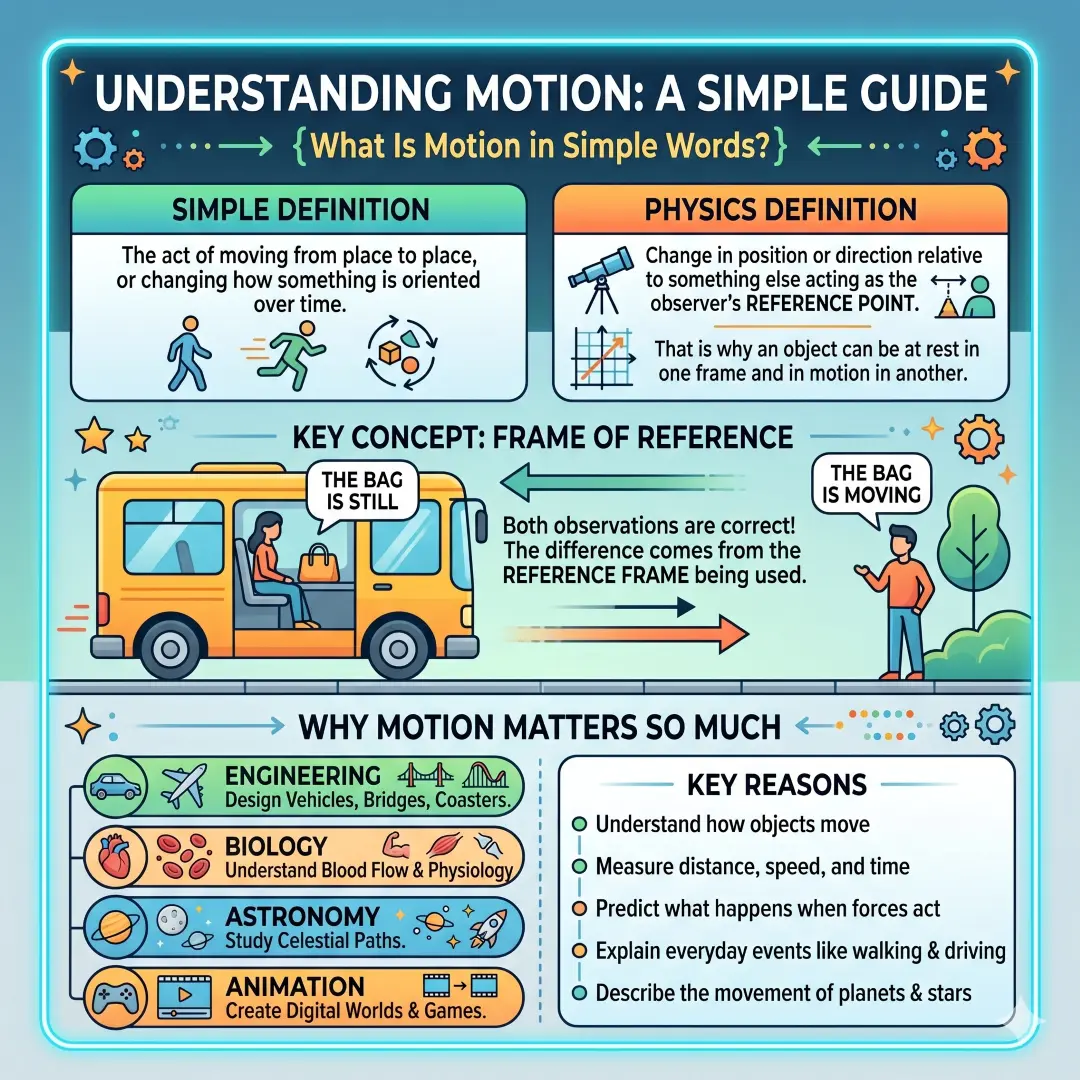
Motion is the act of moving from one place to another, or changing how something is oriented over time. Physics uses a more exact meaning. It looks at motion as a change in position or direction relative to something else that acts as the observer’s reference point. That is why the same object can be at rest in one frame of reference and in motion in another.
A good example is a person sitting inside a moving bus. To the person on the bus, a bag on the seat may look still. But to someone standing on the road, the bag is moving with the bus. Both observations are correct. The difference comes from the reference frame being used.
Why Motion Matters So Much
Motion is not just a school topic. It is part of daily life and modern science. Engineers use it to design cars, airplanes, bridges, elevators, and roller coasters. Doctors and biologists use it to understand blood flow, muscle movement, and how joints work. Astronomers use it to study the paths of planets, moons, stars, and spacecraft. Even video games and animation depend on the same basic ideas about movement and change over time. Motion is one of the threads that connect the physical world.
Here are some simple reasons motion matters:
- It helps us understand how objects move
- It helps us measure distance, speed, and time
- It helps us predict what happens when forces act on objects
- It explains everyday events like walking, driving, throwing, and falling
- It helps scientists describe the movement of planets, satellites, and stars
The Big Idea Behind Motion
The heart of motion is change. If something changes its place, angle, path, or direction over time, it is in motion. Physics does not stop there. It asks how fast the change happens, whether the movement is steady or changing, and what causes that change. That is where terms like distance, displacement, speed, velocity, and acceleration become useful.
Motion becomes much easier to understand when we break it into parts. For example, a runner may cover a long distance but end up close to the starting point, so the displacement is small. A train may travel at a high speed but still slow down as it enters a station, which means its velocity is changing. These distinctions matter because they let us describe motion more precisely.
Important Terms You Need to Know
The table below brings together the key words used to describe motion in physics. These are the building blocks of the topic.
| Term | Meaning | Simple Example | Why It Matters |
|---|---|---|---|
| Position | Where an object is located relative to a reference frame | A book lies on a desk | It tells us the starting point for describing motion |
| Reference frame | The coordinate system or viewpoint used to describe motion | A passenger describes the motion inside a train | Motion depends on the observer’s frame |
| Distance | The total length of the path traveled | Walking 3 km around a park | It shows how much ground was covered |
| Displacement | The change in position from start to finish | Walking around a block and ending near the start | It tells the net change in location |
| Speed | How fast something moves, without direction | A car traveling at 60 km/h | It describes the rate of motion |
| Velocity | Speed with direction | A car moving at 60 km/h east | Direction makes velocity more complete |
| Acceleration | The rate at which velocity changes | A bike speeding up at a traffic light | It explains a change in speed or direction |
| Force | A push or pull that can change motion | Pushing a shopping cart | Forces often cause acceleration |
| Inertia | Resistance to changes in motion | A heavy box is harder to start moving | It helps explain why motion changes slowly in some objects |
| Rest | No change in position relative to a frame | A cup on a table | Rest depends on the chosen frame |
These ideas are standard in physics texts. A description of motion depends on the reference frame, distance is the length of the path, displacement is the change in position, speed is a scalar quantity, velocity includes direction, and acceleration is the change in velocity.
Distance vs Displacement
This is one of the easiest places to get confused, so it deserves a clear explanation. Distance tells you how much ground you covered along the route you took. Displacement tells you how far you ended up from where you started, in a straight-line sense, along with direction. That means distance can be larger than displacement, and sometimes displacement can even be zero if you return to your starting point.
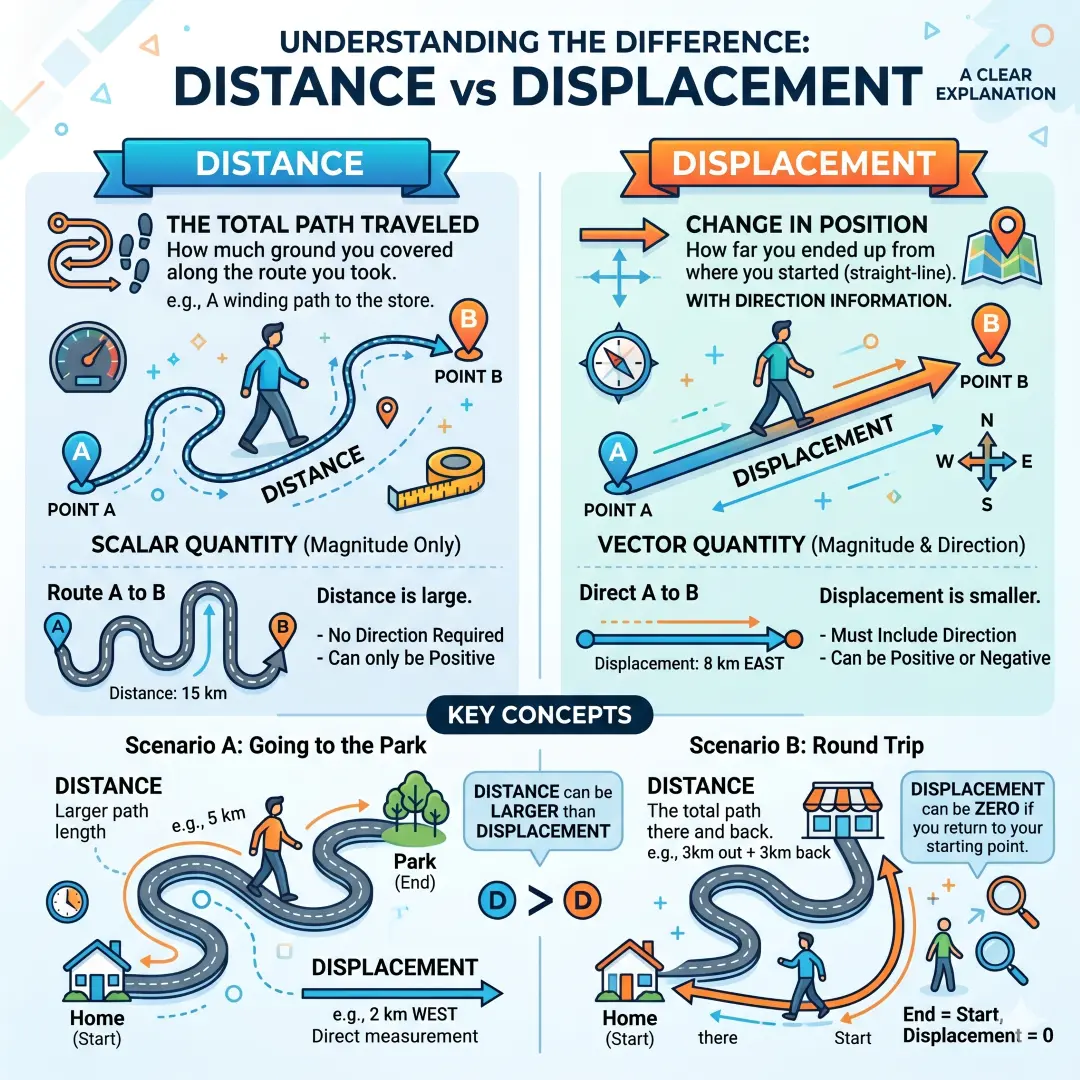
For example, imagine you walk 5 meters east, then 5 meters west. Your distance is 10 meters, because that is the total path traveled. Your displacement is 0, because you ended exactly where you started. This simple difference is one reason physics uses exact language instead of everyday language alone.
Speed vs Velocity
People often use speed and velocity as if they mean the same thing, but physics treats them differently. Speed tells you how fast something moves, and it does not include direction. Velocity tells you how fast something moves and in what direction. That extra direction information makes velocity a vector quantity, while speed is a scalar quantity.
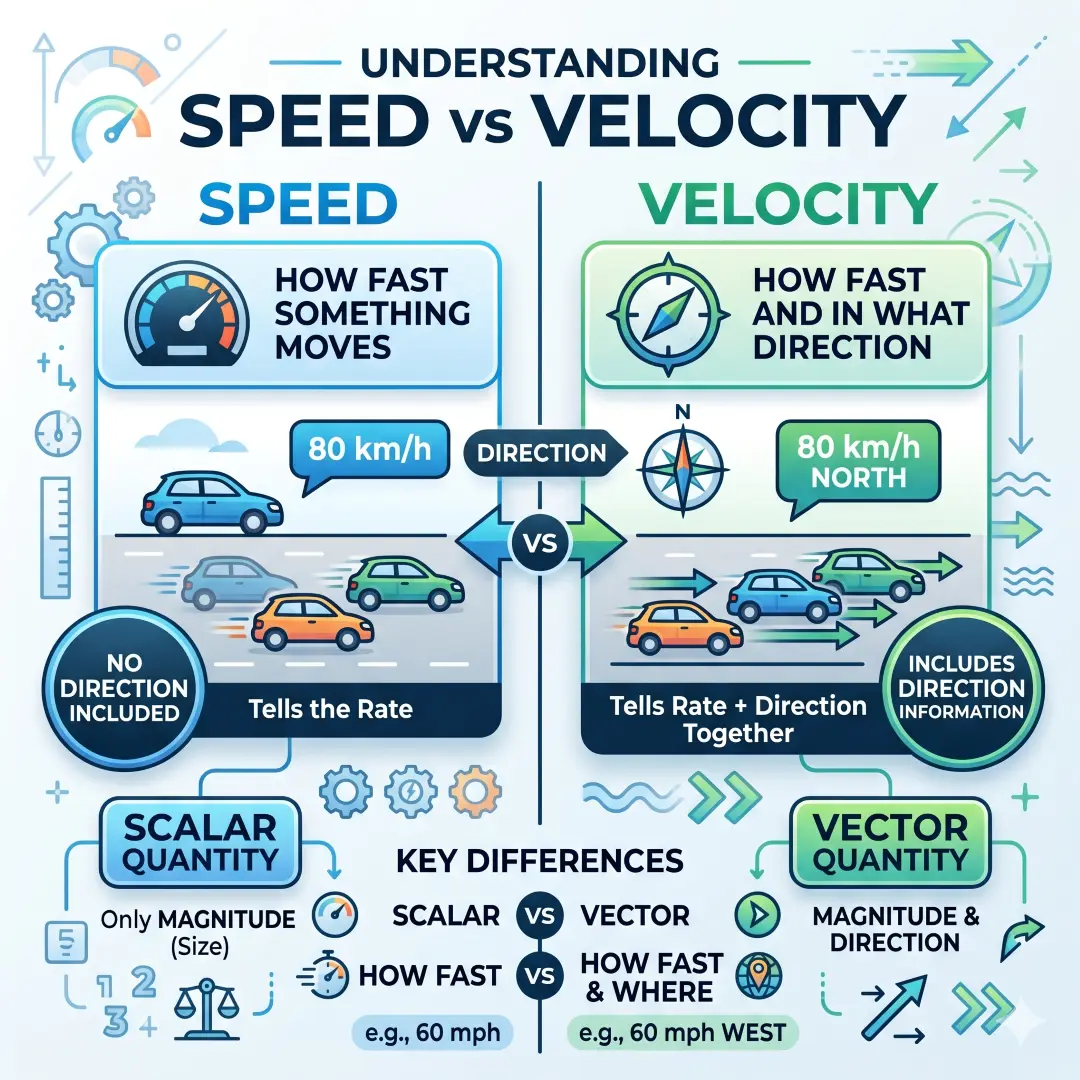
Here is a simple way to think about it. If a car moves at 80 km/h, that is the speed. If it moves at 80 km/h north, that is velocity. Both are useful, but they answer slightly different questions. Speed tells you the rate. Velocity tells you the rate and the direction together.
Acceleration and Why It Changes Everything
Acceleration is the rate of change of velocity. That means acceleration can happen when an object speeds up, slows down, or changes direction. It is not limited to getting faster. A turning car, for example, is accelerating because its direction changes even if its speed stays the same.
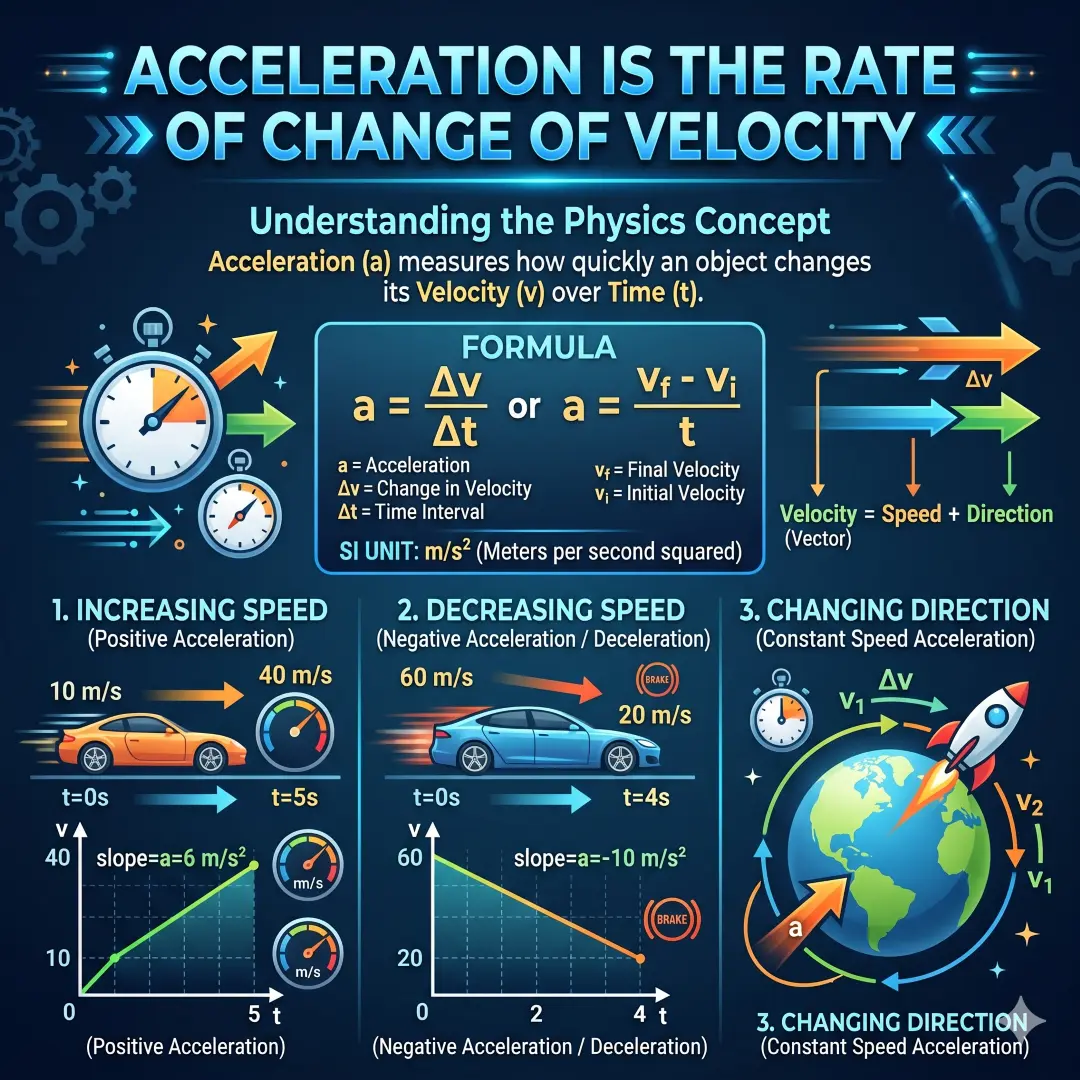
NASA explains acceleration as the change in velocity divided by the change in time, and OpenStax notes that acceleration is a change in velocity, meaning a change in speed, direction, or both. That is why a moving object can accelerate while still feeling smooth to the person inside it. Motion can change quietly or dramatically, depending on the force involved.
A Simple Table for Motion Terms in Everyday Life
The next table connects motion terms with real-world examples. It is a good way to see how physics language matches ordinary life.
| Motion Idea | Everyday Example | What You Observe | Physics Meaning |
|---|---|---|---|
| Position | A person standing by a door | The person is located somewhere specific | Motion starts from a known location |
| Distance | Running around a playground | The path may be long and curved | Total path length matters |
| Displacement | Walking from home to school | The final point is different from the start | Only the net change matters |
| Speed | A scooter moving through traffic | It covers ground at a certain rate | No direction is needed |
| Velocity | A plane heading west at 900 km/h | The direction is just as important as the rate | Speed plus direction |
| Acceleration | A bus leaving a stop | The bus’s velocity changes over time | Motion is becoming faster or changing direction |
| Deceleration | A bicycle slowing before a turn | The bike is losing speed | Acceleration opposite the motion |
| Rest | A phone on a table | It does not move relative to the table | Rest depends on the frame of reference |
This kind of table shows why motion is more than movement alone. It is a movement described carefully, using measurements and comparisons that make sense across different situations.
Types of Motion
In physics, motion appears in several common forms. Britannica describes translation as motion along a line or a curve, and rotation as motion that changes the orientation of a body. The most general motion combines both translation and rotation. Another important type is oscillation, which is a repeated back-and-forth motion around an equilibrium point.
Here is a more detailed table of motion types and what they look like in real life.
| Type of Motion | What It Means | Example | Key Feature |
|---|---|---|---|
| Translational motion | The whole object moves from one place to another | A car driving down a road | The object changes position |
| Rectilinear motion | Motion in a straight line | A lift moving up and down | The path is straight |
| Curvilinear motion | Motion along a curved path | A ball thrown through the air | The path is curved |
| Circular motion | Motion around a circle | A stone tied to a string and swung around | Distance from the center stays nearly constant |
| Rotational motion | The object turns around an axis | A spinning wheel | Orientation changes |
| Oscillatory motion | Motion that repeats back and forth | A pendulum or swing | Repeats around a central point |
| Periodic motion | Motion that repeats at regular intervals | A clock hand, a heartbeat | Pattern comes back again and again |
| Combination motion | Translation and rotation together | A rolling wheel | More than one type of motion at once |
These categories are useful because they help us describe motion based on the path, the shape of the movement, and whether the object turns or repeats its movement. In the real world, many motions are mixed instead of being pure and simple.
Motion and Force Are Closely Connected
Motion and force are tied together. Newton’s laws explain that an object at rest tends to stay at rest, and an object in motion tends to keep moving unless a net external force acts on it. In the same way, a net force causes acceleration, and the size of the acceleration depends on both the force and the mass of the object.
This is why a heavy truck does not change speed as easily as a bicycle. The truck has more mass, so it resists changes in motion more strongly. That resistance is part of what we call inertia. When the force is larger or the mass is smaller, motion changes more easily.
A simple example makes this easy to picture:
- A ball at rest stays at rest until you kick it
- A rolling ball keeps moving until friction or another force slows it
- A car speeds up when the engine provides a net force
- A bicycle slows down when the brakes create a force opposite the motion
What Is a Reference Frame?
A reference frame is the viewpoint or coordinate system from which motion is measured. OpenStax explains that to describe motion, we first need to describe position relative to a convenient frame of reference. This is a very important idea because motion is always relative to something else.
Think of a child sitting in a moving train. The child may feel still relative to the seat. But relative to the station platform, the child is moving with the train. Both descriptions are true. What changes is the frame. This is why physicists are careful about saying what object is being used as the observer’s base point.
Motion in Graphs and Measurements
Scientists do not describe motion only with words. They also use graphs and equations. A position-time graph shows where an object is at different times. A velocity-time graph shows how fast and in what direction it is moving over time. These graphs are useful because they show patterns, such as steady motion, speeding up, slowing down, and changes in direction.
A few key ideas from motion graphs are easy to remember:
- A straight line on a position-time graph often means constant velocity
- A steeper slope means greater velocity
- A curved line means the velocity is changing, which usually means acceleration
- A flat line means the object is not changing position relative to that frame
A Third Table, This Time on Real-World Motion
The table below shows how motion appears in nature, machines, and daily life. It also shows what scientists pay attention to when they study it.
| Real-World Situation | Type of Motion | What Changes | What We Learn From It |
|---|---|---|---|
| A walking person | Translational motion | Position changes over time | Motion can be steady or uneven |
| A ceiling fan | Rotational motion | Orientation changes around an axis | Spinning motion has direction and speed |
| A playground swing | Oscillatory motion | Back-and-forth position repeats | Many motions repeat in cycles |
| A rolling ball | Combination motion | It moves and spins at once | Motion can have more than one part |
| A moving car | Translational motion with acceleration | Speed and direction may change | Forces affect motion on roads |
| A thrown ball | Curvilinear motion | The path bends because of gravity | Motion can follow a curve |
| A clock hand | Periodic motion | Position repeats at regular intervals | Time-based motion is predictable |
| A spacecraft in orbit | Curved motion around a body | Direction changes continuously | Motion in space also follows physics laws |
This table shows a very important truth. Motion is everywhere, but it does not always look the same. Sometimes it is straight. Sometimes it is curved. Sometimes it repeats. Sometimes it combines turning and traveling together.
Motion in Nature and the Universe
Motion is not limited to things on Earth. The same ideas help us understand the movement of planets, moons, comets, and spacecraft. Astronomy depends on motion because celestial bodies are always changing position relative to one another. Even the idea of an orbit is a motion idea, since it describes a path followed over time.
On Earth, motion appears in wind, water flow, falling rain, ocean waves, animal movement, and the rotation of machines. In living bodies, motion also shows up in the beating of the heart, the movement of muscles, and the flow of blood. Motion is a shared language across physics, biology, and engineering.
Common Misunderstandings About Motion
People often get motion wrong because everyday language is a little loose. Physics, on the other hand, needs precision. Here are some common misunderstandings:
- Motion always means speed. Not true. Motion can be slow, fast, changing, or even only rotational.
- A moving object always has acceleration in the direction of motion. Not true. Acceleration can point opposite to motion when an object is slowing down.
- Distance and displacement are the same. Not true. Distance is the path length, while displacement is the change in position.
- Speed and velocity are the same. Not true. Velocity includes direction.
- Rest means absolutely no motion in every sense. Not true. Rest depends on the reference frame.
One small correction here, the last citation should read from the reference-frame sources. The key point remains the same. Rest is not always universal. It is measured relative to something else.
Why Motion Is a Powerful Idea in Science
Motion is powerful because it connects observation to prediction. Once you know how an object moves now, you can often estimate where it will be next, what speed it may reach, or how a force might change its path. That is one reason motion is one of the first major topics in physics. It gives students a way to move from simple observation to real scientific reasoning.
It also builds the foundation for later ideas. Once motion is understood, it becomes easier to learn about forces, energy, momentum, work, gravity, and even relativity. In that sense, motion is not just one topic among many. It is a doorway into the rest of physics.
A Simple Summary of Motion
Motion is a change in position or orientation over time. It is described using reference frames, measured with ideas like distance, displacement, speed, velocity, and acceleration, and explained through forces and Newton’s laws. Motion can be straight, curved, spinning, swinging, or a combination of several patterns at once.
That is why motion matters so much. It is not just something that things do. It is one of the main ways the universe reveals how it works. From a falling leaf to a traveling spacecraft, motion helps us understand change, structure, and cause.
Conclusion
Motion is one of the simplest ideas in science, but it opens the door to some of the deepest questions in physics. What is moving? How fast? In what direction? Relative to what? What caused the change? Those questions are the heart of the subject. They also explain why motion appears everywhere, from ordinary daily life to the largest objects in space.
Once you understand motion, the world starts to look more organized. A walk becomes a path with direction. A turning fan becomes a rotation. A bouncing ball changes velocity. A train ride becomes a lesson in reference frames. That is the beauty of motion. It is common, but it is never boring. It is the language of change itself.
Article References and Sources
- Encyclopaedia Britannica: Motion (Mechanics)
- Encyclopaedia Britannica: Physics (Science Overview)
- OpenStax: Relative Motion, Distance, and Displacement
- OpenStax: Displacement (College Physics)
- OpenStax: Section Summary (Motion Concepts)
- OpenStax: Time, Velocity, and Speed
- OpenStax: Position, Displacement, and Average Velocity
- OpenStax: Introduction to Motion
- NASA Glenn Research Center: Newton’s Laws of Motion
- NASA STEMonstrations: Newton’s First Law of Motion
Also, Read these Articles in Detail
- Physics and Its Fundamentals With Good Explanations
- Matter, Motion, and Energy: The Core Ideas of Physics
- What Is Matter? The Physical Substance of the Universe
- What Is Motion? A Guide to Motion in Physics and Daily Life
- What Is Energy? The Invisible Power Behind Everyday Life
- Kinetic Energy Explained in Simple Language
- Potential Energy: Definition, Types, Formula, and Examples
- Thermal Energy: Heat, Temperature, and Transfer
- Mechanical Energy: Definition, Formula, and Examples
- Chemical Energy: Definition, Science, and Examples
- Electrical Energy: Definition, Works, and Why It Matters
- Radiant Energy: Meaning, Sources, Examples, and Uses
- Nuclear Energy: Definition, How It Works, and Why It Matters
- Sound Energy: Definition, Science, and Examples
- Elastic Energy: Definition, Elasticity, Example, and Facts
Frequently Asked Questions
FAQ 1: What is motion in physics?
Motion is the change in the position or orientation of an object over time. In simple words, something is in motion when it moves from one place to another, turns, spins, or changes the way it is facing as time passes. This is one of the most basic ideas in physics, and it is also one of the most useful. Without motion, there would be no walking, driving, flying, swinging, rolling, or orbiting. In fact, a huge part of the physical world can be understood through motion.
A common mistake is to think motion always means “going from point A to point B.” That is only part of the picture. Motion can also include rotation, where something spins around an axis, and oscillation, where something moves back and forth in a repeated pattern. A ceiling fan is in rotational motion. A swing is in oscillatory motion. A moving car is in translational motion. A thrown ball moves along a curved path. All of these are motion, even though they look different.
In physics, motion is not described in a vague way. It is measured using distance, displacement, speed, velocity, and acceleration. These words help us describe how motion happens, how fast it happens, and whether it changes. That matters because the same object can be seen differently depending on the reference frame. A person sitting in a bus may feel at rest relative to the seat, but they are moving relative to someone standing on the road. So motion is always relative to something else.
Motion also helps us understand the connection between force and change. When a force acts on an object, it may start moving, stop moving, speed up, slow down, or change direction. That is why motion is so important in science. It is not just about movement. It is about how the universe changes and how we describe that change in a precise way.
FAQ 2: Why is motion important in everyday life?
Motion is part of everyday life in ways we often do not even notice. Every time you walk to another room, close a door, ride a bicycle, open a book, throw a ball, or watch a fan spin, you are seeing motion in action. It is one of the most familiar things in the world, but it is also one of the most important. Life as we know it depends on motion in both simple and deep ways.
In daily life, motion helps us travel, work, communicate, and stay safe. Cars, buses, trains, airplanes, elevators, machines, tools, and even the movement of water in pipes all depend on motion. If you think about modern life carefully, almost everything useful around us involves some kind of movement. A factory uses moving belts and rotating machines. A hospital uses moving equipment and flowing liquids. A home uses moving fans, sliding doors, and spinning washing machines. Motion is everywhere.
It also matters because it helps us make decisions. When you cross a road, you judge the motion of cars. When you catch a ball, you judge its path and speed. When you drive, you notice acceleration, braking, and turning. When you cook, you may stir, shake, pour, or rotate something. These are all motion-related actions. Your brain uses motion constantly, even if you do not think about it in scientific terms.
Motion is also important because it is tied to time. The world changes over time, and motion is one of the clearest ways to see that change. A sunset, a spinning wheel, a growing plant, a moving cloud, a running child, and a flying bird all show motion in different forms. Once you understand motion, ordinary life becomes easier to observe and explain. It gives you a better way to think about the world around you.
FAQ 3: What is the difference between distance and displacement?
Distance and displacement are closely related, but they are not the same thing. Distance is the total length of the path an object travels. Displacement is the change in position from the starting point to the ending point in a straight line, along with direction. That difference sounds small, but it is very important in physics.
For example, imagine you walk around a park and come back to the place where you started. Your distance may be large because you covered a lot of ground. But your displacement is zero because your final position is the same as your starting position. This is why displacement is often more useful when the direction of motion matters. Distance tells you how much ground you covered. Displacement tells you where you ended up compared to where you began.
Another simple example is a person walking 3 meters east and then 4 meters west. The total distance is 7 meters because that is the total path traveled. The displacement is 1 meter west because that is the net change in position. The path can be bent, curved, or full of turns, but displacement always looks at the direct change from start to finish.
This difference matters in real life too. A driver may travel 20 kilometers through city streets but end up only 5 kilometers from the starting point. A runner may cover a long route in a race but finish close to where they started. Engineers, scientists, athletes, and navigators all need to know both values. Distance is about the actual path. Displacement is about the final change in position.
So, if you want a simple memory trick, use this. Distance answers, “How much ground did I cover?” Displacement answers, “How far and in what direction did I end up from where I started?” That small difference makes a big impact in physics.
FAQ 4: What is the difference between speed and velocity?
Speed and velocity are often used as if they mean the same thing, but they do not. Speed tells you how fast something is moving. Velocity tells you how fast something is moving and in what direction. That one extra piece of information changes everything.
Speed is a scalar quantity, which means it has only size or magnitude. It does not include direction. If a car is moving at 60 kilometers per hour, that is its speed. Velocity is a vector quantity, which means it has both magnitude and direction. If that same car is moving at 60 kilometers per hour east, that is its velocity.
This difference matters a lot in physics. If a runner goes one lap around a track and ends where they started, their average speed may be high, but their average velocity may be zero because the displacement is zero. That is why velocity is more closely tied to position change, while speed is tied only to how fast the path was covered.
Another useful example is a plane flying north at 800 kilometers per hour. The speed is 800 kilometers per hour. The velocity is 800 kilometers per hour north. If the plane turns south but keeps the same speed, its speed has not changed, but its velocity has changed because the direction changed. That is why direction is so important.
In everyday speech, people usually say “speed” when they really mean “velocity.” Physics is stricter. It needs exact terms because small changes in direction can matter a lot. So remember this simple idea. Speed tells you how fast. Velocity tells you how fast and where.
FAQ 5: What is acceleration, and why is it important?
Acceleration is the rate at which velocity changes over time. That means an object accelerates when it speeds up, slows down, or changes direction. Many people think acceleration only means “getting faster,” but that is only one part of it. In physics, acceleration includes any change in velocity.
For example, a car that increases from 20 kilometers per hour to 60 kilometers per hour is accelerating. A bike that slows down before a stoplight is also accelerating, even though its speed is going down. A train that turns around a curve at steady speed is accelerating too, because its direction is changing. Acceleration is about change in velocity, not just increase in speed.
This idea matters because acceleration often tells us when a force is acting. A force can push an object, pull it, stop it, or bend its path. When that happens, acceleration appears. This is why acceleration is such a key part of Newton’s laws of motion. It helps explain why moving objects do not just keep doing the same thing forever.
In daily life, acceleration is everywhere. When a bus starts moving from a stop, when a plane takes off, when an elevator begins to rise, or when a ball falls toward the ground, acceleration is happening. Even if you do not notice it strongly, your body can feel it. That sinking feeling in a fast elevator or the push you feel in a car turning a corner is linked to acceleration.
Acceleration also helps scientists and engineers design safe and efficient systems. Cars need brakes. Roads need curves designed carefully. Rockets need accurate thrust control. Sports equipment must respond properly to motion. Once you understand acceleration, you begin to understand how motion changes, not just how motion happens.
FAQ 6: What are the main types of motion?
Motion appears in several different forms, and each one has its own pattern. The main types of motion include translational motion, rotational motion, oscillatory motion, circular motion, rectilinear motion, and curvilinear motion. Some objects show only one type, while many show a combination of more than one.
Translational motion happens when an object changes position from one place to another. A moving car, a walking person, or a sliding box are all examples. The whole object shifts location. Rectilinear motion is a special case of translational motion in a straight line. Curvilinear motion happens when the path is curved, like a thrown ball moving through the air.
Rotational motion is different. Here the object turns around an axis. A spinning wheel, a rotating fan blade, and the Earth turning on its axis are examples. In rotational motion, the object may stay in one place overall, but its orientation changes.
Oscillatory motion is the back-and-forth movement around a central point or position. A swing, a pendulum, and a vibrating guitar string are common examples. This kind of motion often repeats itself in a pattern, which is why it is also called periodic motion when the cycle repeats at regular intervals.
Many real objects show more than one type at the same time. A rolling wheel moves forward and spins at once. A planet in orbit moves around a body while also rotating. A person walking while turning their head is combining motions too. That is why motion is such a rich topic. It does not fit into one neat box all the time. It comes in patterns, layers, and combinations.
FAQ 7: What is a reference frame in motion?
A reference frame is the viewpoint or coordinate system used to describe motion. It tells us what we are comparing an object to when we say it is moving or at rest. This is a very important idea because motion is not absolute in everyday physics. It depends on the observer’s frame of reference.
For example, imagine you are sitting in a moving train. To you, a cup on the table may seem at rest because it is not moving relative to the train seat. But to someone standing outside on the platform, that same cup is moving with the train. Both statements are correct. The difference comes from the reference frame.
This is why physics always asks, “Relative to what?” If you do not define the reference frame, motion can become confusing very quickly. A child inside a moving car may think a tree is moving backward. But we know the tree is not moving. It only appears to move because the observer is inside a moving frame. That is a classic example of relative motion.
Reference frames are used everywhere in science. Pilots use them. Astronomers use them. Engineers use them. Even navigation systems use them. The idea helps us compare movement in a clear and organized way. It also teaches an important lesson. What looks still to one observer may be moving to another.
So, when you study motion, always remember this simple rule. You must know the frame before you can fully describe the motion. Without that, the picture is incomplete.
FAQ 8: How does force affect motion?
Force and motion are deeply connected. A force is a push or pull that can change the motion of an object. When force acts on an object, it may start moving, stop moving, speed up, slow down, or change direction. In simple terms, force is one of the main reasons motion changes.
This connection is explained by Newton’s laws of motion. One important idea is that an object at rest tends to stay at rest, and an object in motion tends to keep moving unless acted on by an outside force. This is called inertia. Another key idea is that a net force causes acceleration. That means motion changes when force is not balanced.
A shopping cart is a good example. When you push it, it starts moving. If you push harder, it may speed up more quickly. If you stop pushing, friction and resistance may slow it down. The same happens with bicycles, cars, trains, and even balls rolling across the floor. Force changes motion in many ways.
Force does not always mean a big visible push. It can be subtle. Gravity pulls objects downward. Friction slows motion between surfaces. Tension pulls along ropes or cables. Magnetic force can move or guide certain objects. Each force creates motion effects that scientists can measure and study.
This is why motion cannot be fully understood without force. Motion tells us what an object is doing. Force helps explain why it is doing that. The two ideas work together in nearly every part of physics. If motion is the result, force is often the reason.
FAQ 9: Can something be at rest and still be in motion?
Yes, and this is one of the most interesting ideas in physics. Something can be at rest in one reference frame and still be moving in another. That is because motion is relative. It depends on what you are comparing it to.
Take a person sitting inside a bus. Relative to the seat, the person is at rest. Relative to the road outside, the person is moving along with the bus. Now think about the Earth. A person standing still on the ground may seem not to move. But the Earth itself is rotating and orbiting the Sun, so in a larger frame of reference that person is moving very fast. Motion is never as simple as it first appears.
This idea also shows why science uses careful language. When we say something is “still,” we usually mean still relative to a chosen frame. We do not usually mean it is still in every possible sense. Even objects that seem completely still can be part of larger motion systems. A building on Earth moves with the planet. A person in a plane moves with the aircraft. A book on a table moves with the Earth’s rotation, even though it sits quietly in the room.
That sounds surprising, but it is true. The idea is not confusing once you get used to it. It just means that motion depends on the observer. A thing can be still here and moving there. That is why reference frame is one of the most important ideas in the study of motion.
FAQ 10: Why do scientists study motion so carefully?
Scientists study motion carefully because it helps explain how the physical world works. Motion is not just one topic among many. It is one of the foundations of science. Once you understand motion, you can begin to understand forces, energy, momentum, gravity, and many other key ideas. Motion is often the first step toward deeper scientific thinking.
One reason motion matters so much is that it is measurable. You can measure distance, time, speed, velocity, and acceleration. That means motion can be studied with numbers, graphs, formulas, and experiments. Science depends on measurement, and motion gives scientists a clear way to measure change.
Motion also appears in almost every branch of science. In physics, it helps explain how objects move. In astronomy, it helps explain planets, stars, and spacecraft. In biology, it helps explain muscle movement, blood flow, and body mechanics. In engineering, it helps design machines, vehicles, buildings, and tools. In sports, it helps improve performance and reduce injury. Motion is everywhere science looks.
Scientists also study motion because it allows prediction. If you know how something is moving now, you can often predict where it will be next or how it will react to a force. That is essential in weather systems, travel, engineering design, space exploration, and safety planning. Motion gives us the power to understand not only what is happening, but what may happen next.
And there is another reason. Motion helps us see the world with more care. A bird in the sky, a falling leaf, a swinging door, a rolling wheel, a racing car, a turning planet, all of them follow patterns. Science studies those patterns so we can understand the rules behind them. That is why motion is such a central idea. It connects the simple things we see every day with the larger order of the universe.
