

Physics is one of those subjects that quietly shapes almost everything around us. It explains why a ball falls, how a bridge stays standing, why a phone works, how light travels, and what happens inside atoms and stars.
In simple terms, physics is the branch of science that studies matter, motion, energy, and the way the deepest parts of the universe interact. It reaches from tiny subatomic particles to galaxies and cosmic structures, which is why it sits at the heart of both everyday life and advanced science.
A lot of people think physics is only about formulas. It is not. Physics is also about clear thinking, careful measurement, and asking honest questions about how the world behaves. A good physics explanation should feel practical, not mysterious. It should help you understand what is happening, why it is happening, and what changes when conditions change. That is what makes physics powerful and worth learning.
Table of Contents
What Physics Really Is
Physics is the study of the structure of matter and the interactions between the basic parts of the universe. It looks at how objects move, how forces act, how energy changes form, and how natural laws stay consistent across different situations. In this sense, physics is both practical and philosophical. It gives answers to everyday problems, but it also asks the biggest questions about space, time, gravity, and reality itself.
The beautiful thing about physics is that it connects simple observations to bigger ideas. When you drop a stone, a force acts on it. When it hits the ground, energy is transferred. When sound travels through air, a wave carries that energy. When light moves across space, it follows rules that are different from everyday objects. Physics ties those ideas together instead of treating them as separate facts.
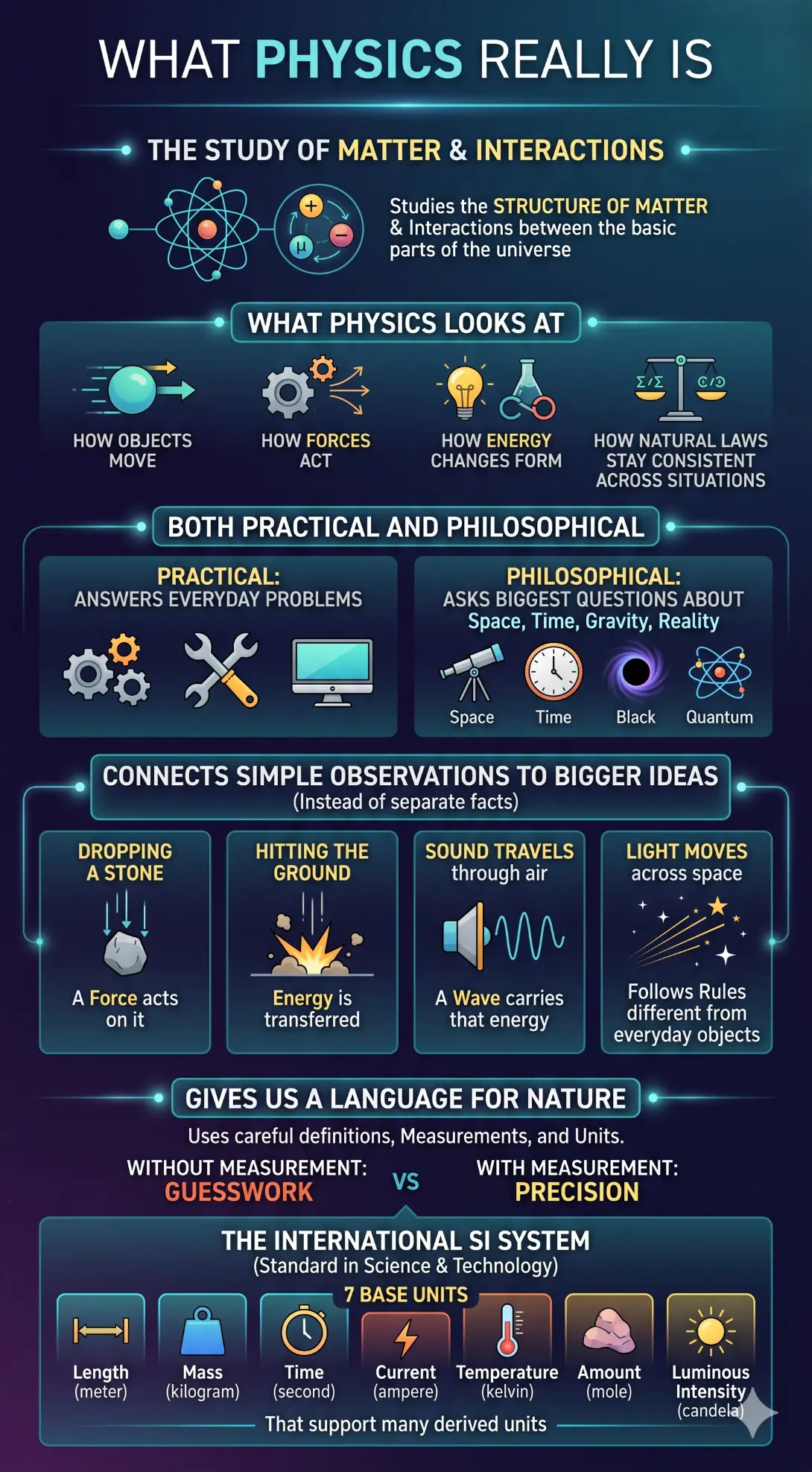
Another reason physics matters is that it gives us a language for nature. That language uses careful definitions, measurements, and units. The international SI system is the standard measurement system used in science and technology, and it is built on seven base units that support many derived units. Without measurement, physics would be guesswork. With measurement, it becomes precise.
The Main Ideas Every Physics Student Should Know
The fundamentals of physics usually begin with matter, motion, force, energy, work, power, waves, temperature, electricity, magnetism, light, atoms, and gravity. Each one sounds simple at first, but each has depth. For example, matter is the material substance that makes up the observable universe, while energy is the capacity to do work. Motion is a change in position over time, and force is what can change motion or shape. These are not separate islands. They are parts of one connected picture.
Below is a clear table that brings these basics together.
Table 1. Core Fundamentals of Physics
| Concept | Simple explanation | Everyday example | Why it matters |
|---|---|---|---|
| Matter | Anything that has physical substance and forms the observable universe. | A chair, water, air, and your phone | It is the starting point for studying physical objects and materials. |
| Motion | A change in position or orientation over time. | A bicycle moving down a street | It helps explain speed, acceleration, and trajectories. |
| Force | A push or pull that can change motion or shape. | Pushing a door open | It is the reason motion changes in the real world. |
| Energy | The capacity for doing work. | A moving car, a charged battery, food in your body | It appears in many forms and moves through systems. |
| Work | Energy transfer when a force moves an object over a distance. | Lifting a box onto a shelf | It connects force, distance, and energy transfer. |
| Power | The rate at which work is done or energy is transferred. | A strong motor finishing a job faster | It tells us how quickly energy is used. |
| Wave | A regular disturbance that transfers energy from place to place. | Water ripples, sound, light | It explains communication, sound, and optics. |
| Electricity | The behavior of electric charge and charge flow. | A lamp powered by a socket | It runs modern life and most technology. |
| Magnetism | A phenomenon linked to magnetic fields, often produced by moving electric charges. | A fridge magnet | It is essential in motors, data storage, and sensors. |
| Light | Electromagnetic radiation that shows both wave-like and particle-like behavior. | Sunlight, a laser pointer | It explains vision, astronomy, and communication. |
Motion, Force, and Newton’s Big Idea
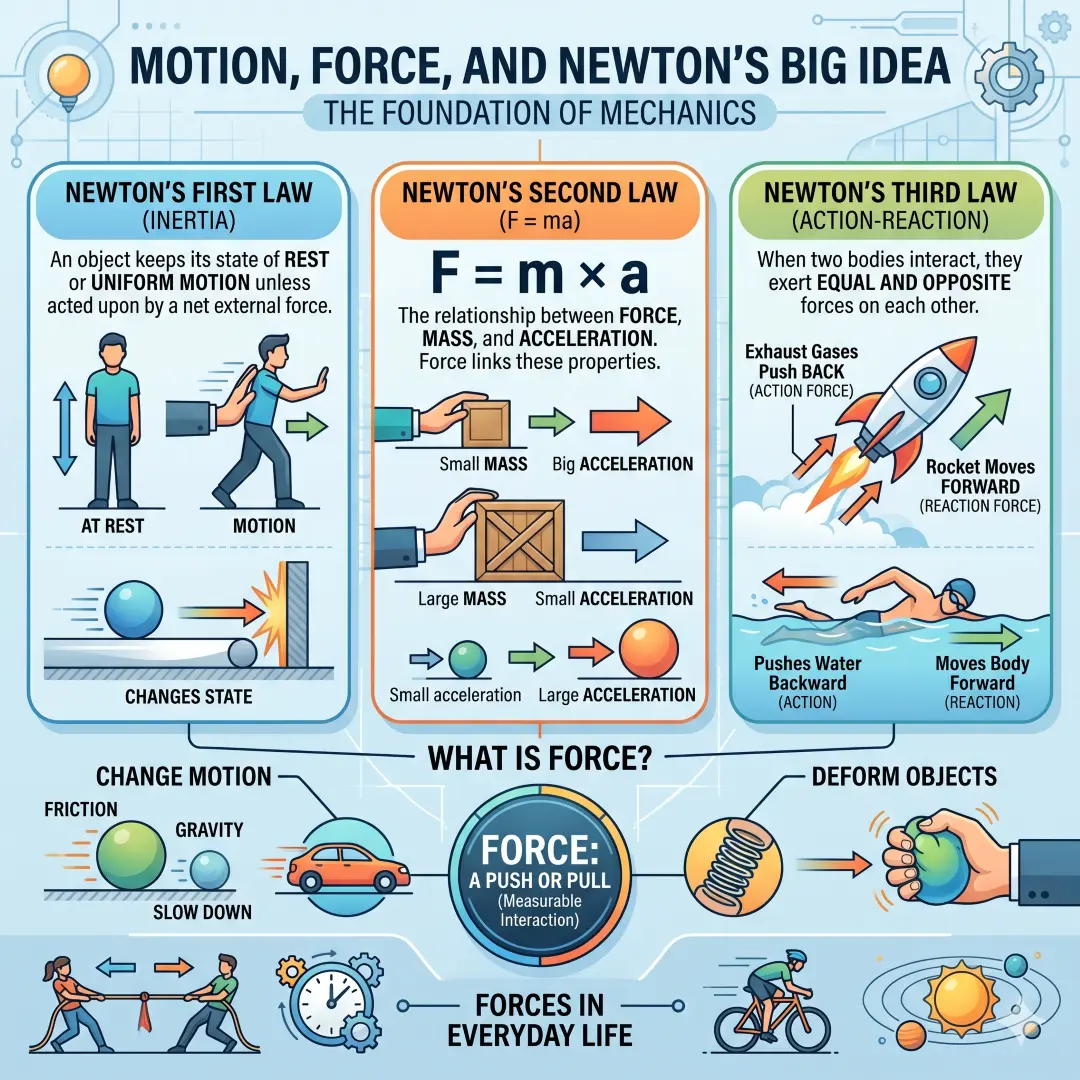
One of the best places to start in physics is motion. Motion sounds simple, but it opens the door to the whole subject of mechanics. Newton’s laws of motion describe how forces affect the motion of a body. The first law says an object keeps its state of rest or uniform motion unless a force acts on it. The second law links force to mass and acceleration. The third law says that when two bodies interact, they exert equal and opposite forces on each other.
That is a huge idea. It means motion does not happen in a vacuum. Something causes change. A rolling ball slows down because friction and gravity are acting on it. A car speeds up because the engine and road surface work together. A rocket moves forward because expelled gases push backward with equal force. These are not just textbook examples. They are real physical patterns you see every day.
You can think of force as a push or pull, but in physics it is more than a casual label. It is a measurable interaction that can maintain motion, change motion, or deform an object. That is why force sits at the center of mechanics. It helps explain everything from a tug-of-war to the path of planets.
A simple example of motion and force
Imagine a soccer ball on grass. If nobody touches it, it stays still. If you kick it, the ball starts moving. The kick is the force, the change in motion is the result, and the grass adds friction, which slows the ball down. This is classic physics in action. There is no mystery, only cause and effect.
Energy, Work, and Power
If motion is about change in position, energy is about the ability to make change happen. Britannica describes energy as the capacity for doing work. It appears as kinetic energy, potential energy, thermal energy, chemical energy, electrical energy, and nuclear energy, among others. In real life, energy often changes form rather than disappearing. A battery stores chemical energy, a moving car has kinetic energy, and a warm pan contains thermal energy.
Work in physics is not the same as work in everyday conversation. In physics, work is the transfer of energy when a force moves an object over a distance. If you lift a backpack onto a table, you are doing work on the backpack. The bigger the force or the distance, the more work is done. That is a very clean and practical definition, and it helps connect force to energy in a measurable way.
Power tells us how fast work is done. Two people may lift the same box to the same height, but the one who does it faster uses more power. That is why power matters in machines, engines, appliances, and human movement. It is not just about how much energy is used. It is about how quickly it is used.
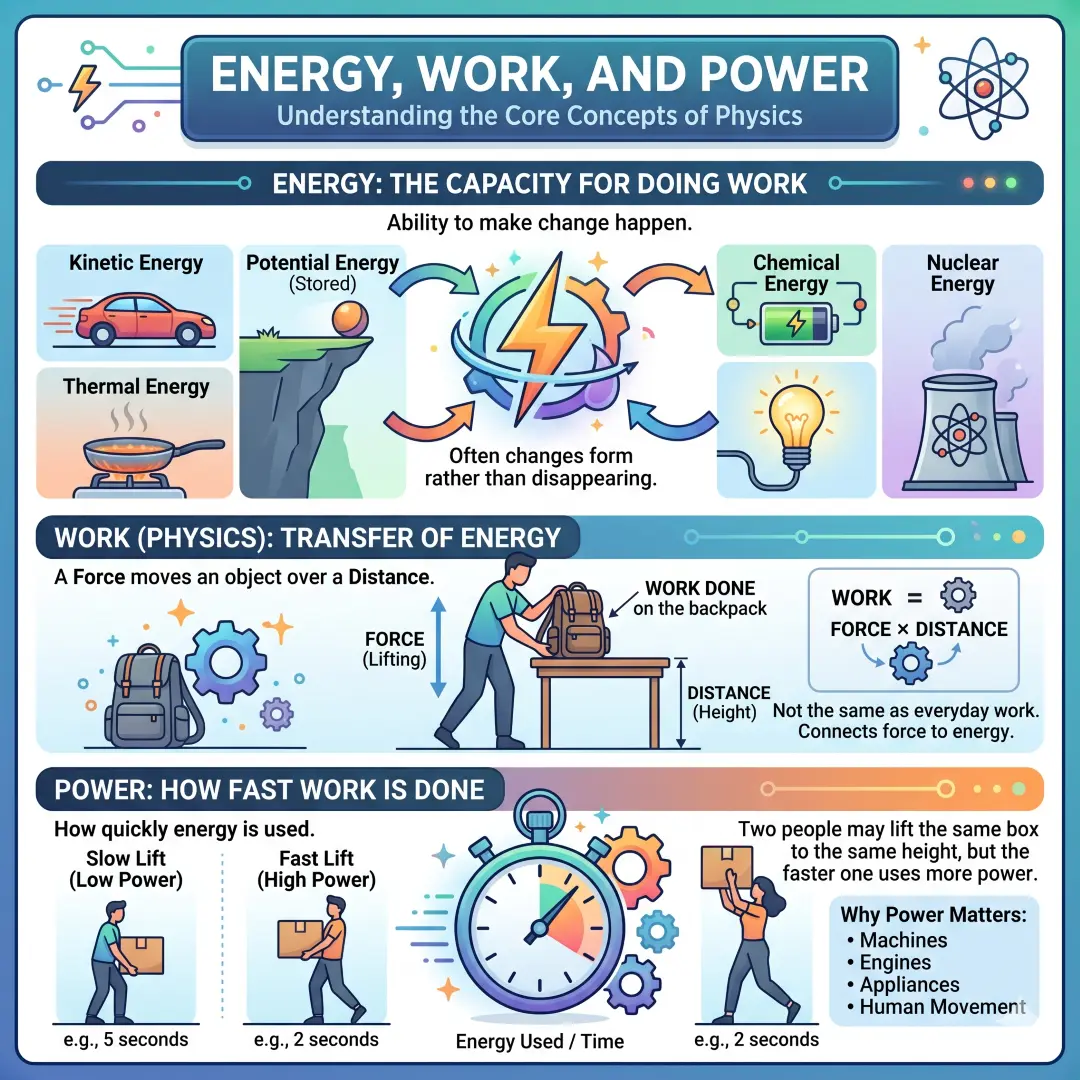
Table 2. Energy, Work, and Power in Plain Language
| Term | What it means | Simple formula idea | Real-life example | Why it matters |
|---|---|---|---|---|
| Energy | The ability to do work. | Can change form | A phone battery powering an app | It is one of the main bookkeeping ideas in physics. |
| Work | Energy transfer caused by force and distance. | W = Fd when the force is along the displacement | Lifting a suitcase | It connects force to useful change. |
| Power | How quickly work is done. | P = W/t | A fast electric kettle heating water | It helps compare machines and performance. |
A useful way to remember this is simple. Energy is what you have, work is what gets done, and power is how fast it gets done. That idea comes up in every branch of physics, from mechanics to electricity to thermodynamics.
Measurement: The Quiet Foundation of Physics
Physics depends on accurate measurement. Without measurement, there is no reliable comparison, no experiment, and no useful law. The SI system is the global standard for measurement in science. According to NIST and BIPM, it uses seven base units and a structure that supports many other derived units used in science and engineering.
Table 3. The Seven SI Base Quantities
| Quantity | SI base unit | Symbol | What it measures |
|---|---|---|---|
| Length | metre | m | Distance or size |
| Mass | kilogram | kg | Amount of matter in an object |
| Time | second | s | Duration of events |
| Electric current | ampere | A | Flow of electric charge |
| Thermodynamic temperature | kelvin | K | Heat-related physical temperature |
| Amount of substance | mole | mol | Count of microscopic entities in chemistry and physics |
| Luminous intensity | candela | cd | Perceived strength of visible light |
This table may look simple, but it is one of the most important tools in science. When physicists describe a force, an energy change, a temperature shift, or a wave behavior, they need consistent units so that results can be tested and shared anywhere in the world. That is how physics stays universal.
Waves, Light, and the Electromagnetic World
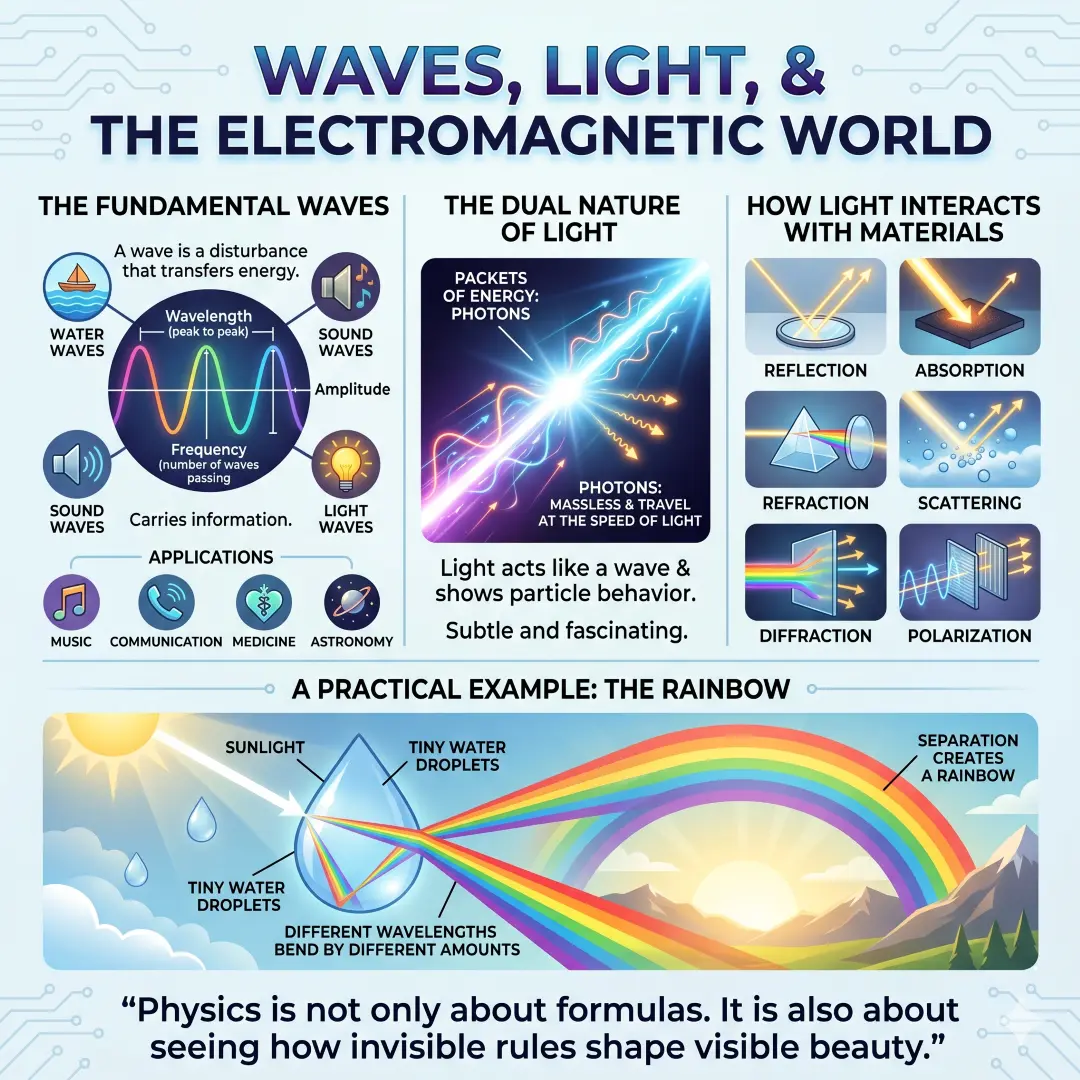
Waves are another foundation of physics. A wave is a disturbance that transfers energy from one place to another in a regular and organized way. Waves can be found in water, sound, and light, and they can carry information. Many waves are described by frequency, wavelength, and amplitude. That is why wave physics matters in music, communication, medicine, and astronomy.
Light is especially interesting because it behaves like a wave and also shows particle-like behavior. NASA explains that light is made of discrete packets of energy called photons, which have no mass and travel at the speed of light. Light can also reflect, absorb, refract, scatter, diffract, and polarize depending on the material it meets. That is why a mirror, a rainbow, and a glass lens all behave differently.
This dual behavior is one reason physics can feel strange at first. We are used to everyday objects acting in only one obvious way. But at the level of light and tiny particles, nature is more subtle. The rules still make sense, yet they are not always intuitive from our daily experience.
A practical example of wave behavior
When sunlight passes through tiny water droplets in the atmosphere, different wavelengths bend by different amounts. That separation creates a rainbow. This is a great reminder that physics is not only about formulas. It is also about seeing how invisible rules shape visible beauty.
Electricity, Magnetism, and Electromagnetism
Electricity and magnetism are deeply connected. Britannica explains that particles with electric charge interact by electric force, while moving charges produce and respond to magnetic forces. This relationship is why the two topics are now treated together as electromagnetism.
A magnetic field is not just a mysterious property of magnets on a fridge. It is part of a larger physical system built around moving charges and fields. This is why electric motors spin, generators produce electricity, and many devices rely on controlled electromagnetic behavior.
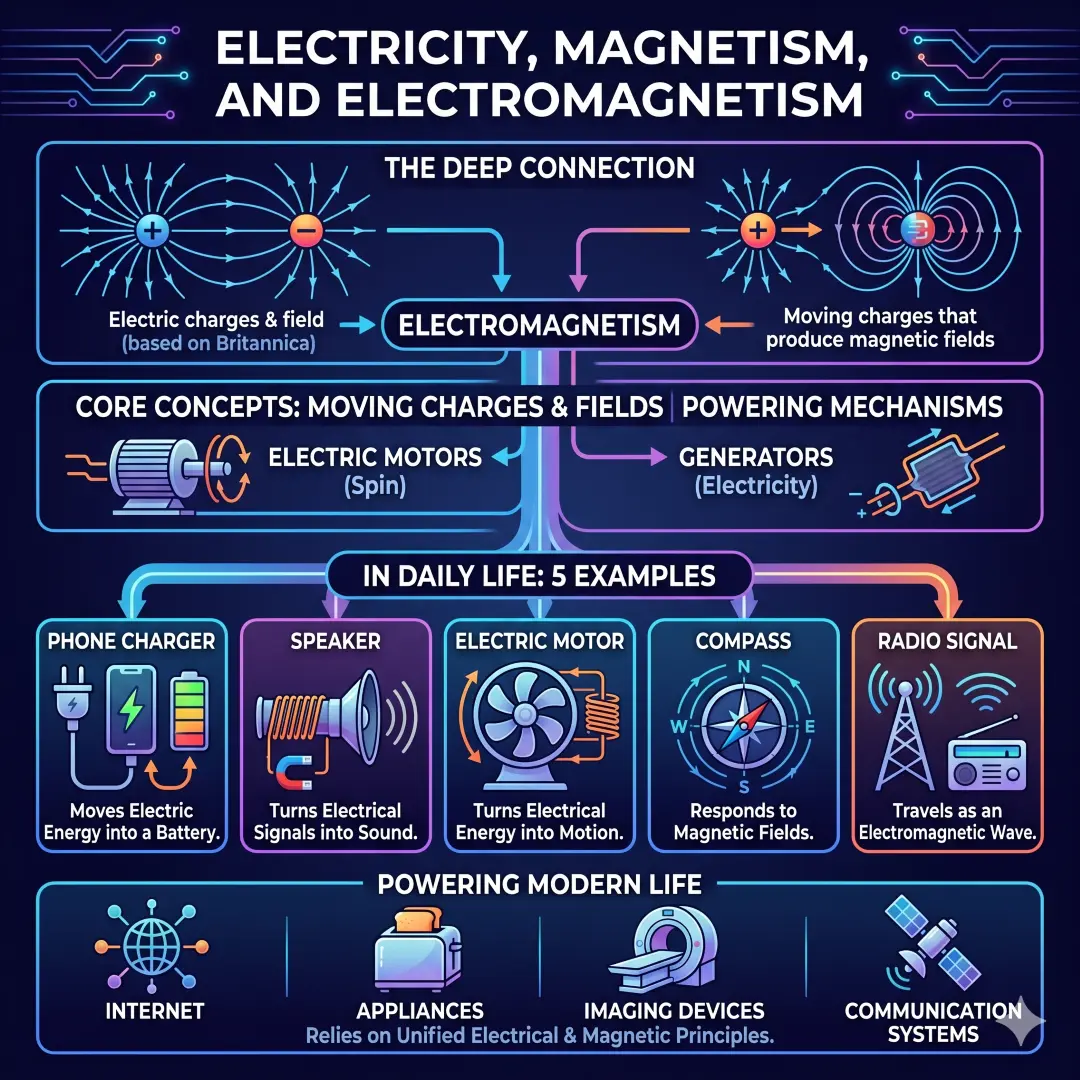
You can see electromagnetism in many simple things:
- A phone charger moves electric energy into a battery.
- A speaker turns electrical signals into sound.
- An electric motor turns electrical energy into motion.
- A compass responds to magnetic fields.
- A radio signal travels as an electromagnetic wave.
This branch of physics is one reason modern life works at all. The internet, appliances, imaging devices, and communication systems all rely on electrical and magnetic principles that were once treated as separate ideas.
Thermodynamics, Heat, and Temperature
Thermodynamics is the study of the relationships between heat, work, temperature, and energy. It asks questions like how energy flows, how systems change, and whether useful work can be extracted from a process. That makes it one of the most practical branches of physics because it shows up in engines, cooking, weather, refrigeration, and the human body.
A kettle boiling on the stove is a perfect thermodynamics example. Heat moves into the water, the temperature rises, and eventually the water changes state. A car engine also depends on thermodynamic ideas, because it turns fuel energy into mechanical work, but not perfectly. Some energy is always lost as heat. This is why real machines are never one hundred percent efficient.
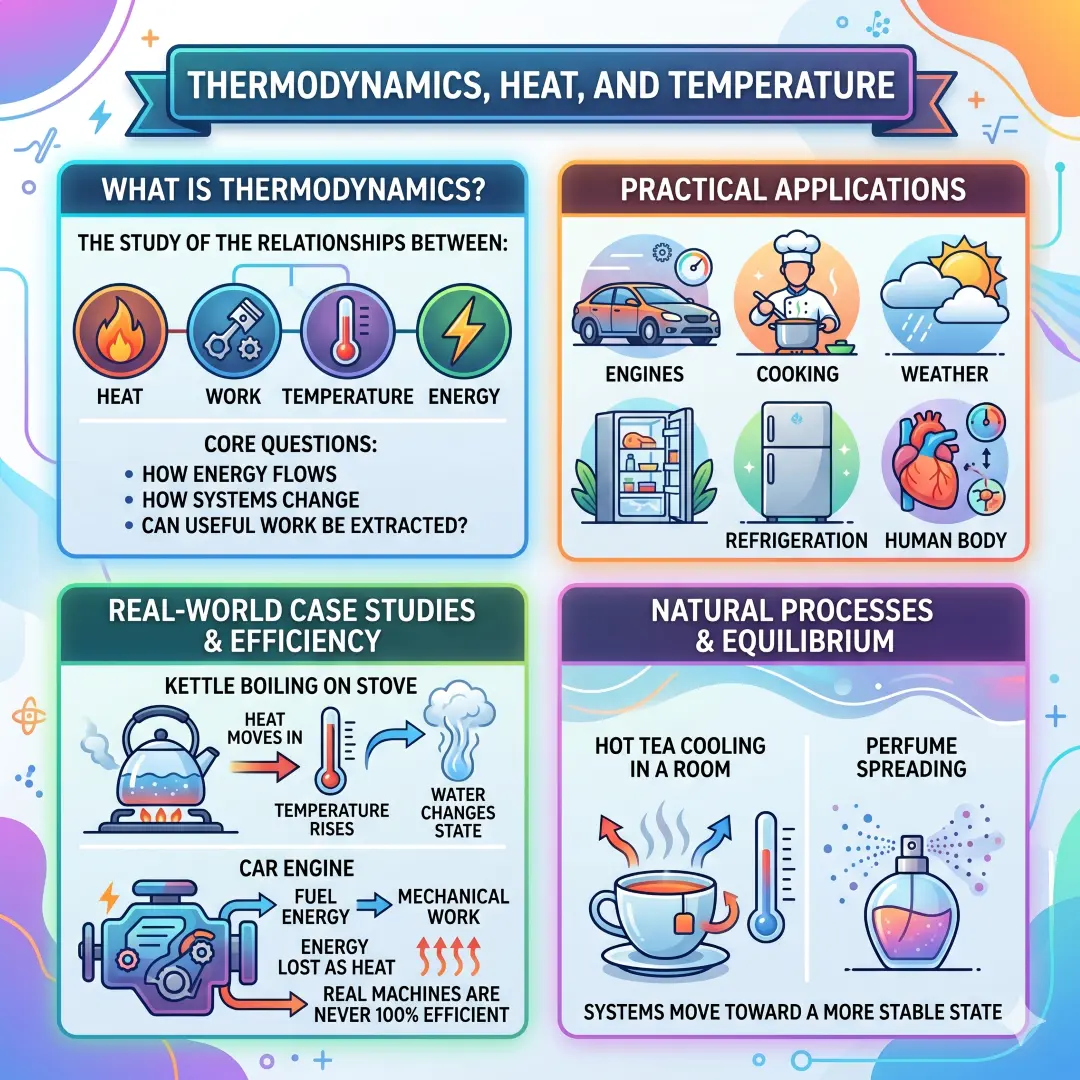
Thermodynamics also helps explain why some processes happen naturally and others do not. A system often moves toward equilibrium, which is a more stable state. That is why hot tea cools down in a room and why perfume spreads through air. Physics is full of such ordinary but revealing examples.
Classical Physics and Modern Physics
Physics is often divided into classical physics and modern physics. Classical physics includes the older but still very useful ideas of mechanics, waves, heat, and electromagnetism. It works extremely well for everyday objects, from baseballs to buildings. Modern physics includes quantum mechanics and relativity, which became essential when scientists started studying atoms, particles, very high speeds, and extreme gravity.
Quantum mechanics deals with the behavior of matter and light on the atomic and subatomic scale. It is built around probabilities rather than simple certainty, which is why tiny systems can behave in ways that seem odd from an everyday point of view. This branch explains atoms, molecules, electrons, and many properties of modern materials.
Relativity, developed by Albert Einstein, changed the way scientists think about space, time, matter, energy, and gravity. It showed that measurements depend on the motion of the observer and the observed object. In special relativity, nothing with mass can travel faster than light, and mass and energy are deeply linked.
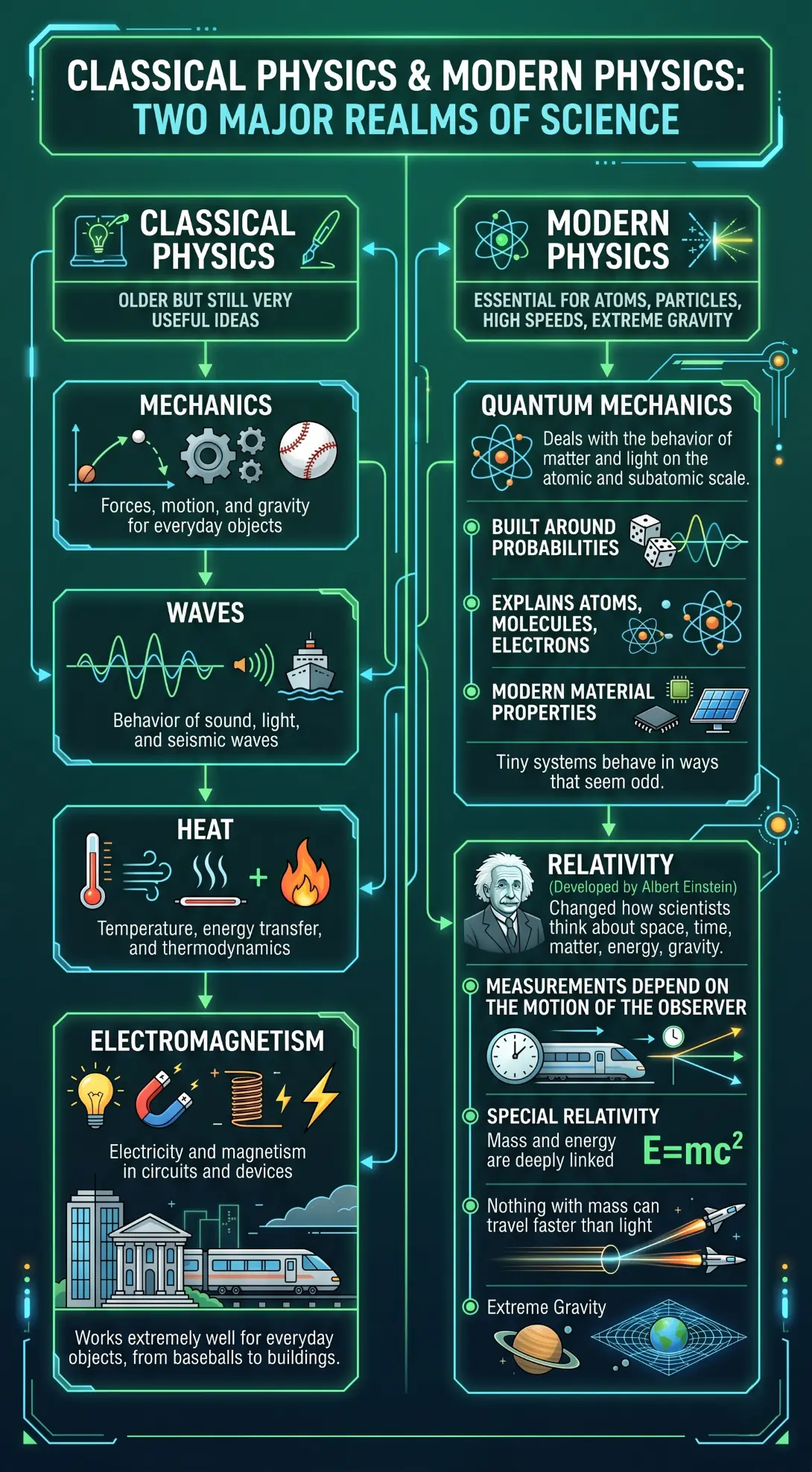
Table 4. Classical Physics vs Modern Physics
| Area | Main focus | Where it works best | Core idea |
|---|---|---|---|
| Classical physics | Motion, force, heat, waves, electricity | Everyday objects and normal speeds | The world can often be described with smooth, predictable laws. |
| Quantum mechanics | Atoms, electrons, photons, subatomic particles | Very small scales | Nature behaves in probabilistic ways, not just deterministic ones. |
| Relativity | Space, time, gravity, high speeds, cosmic scales | Near light speed and strong gravity | Measurements depend on motion and gravity changes the structure of spacetime. |
The Fundamental Forces of Nature
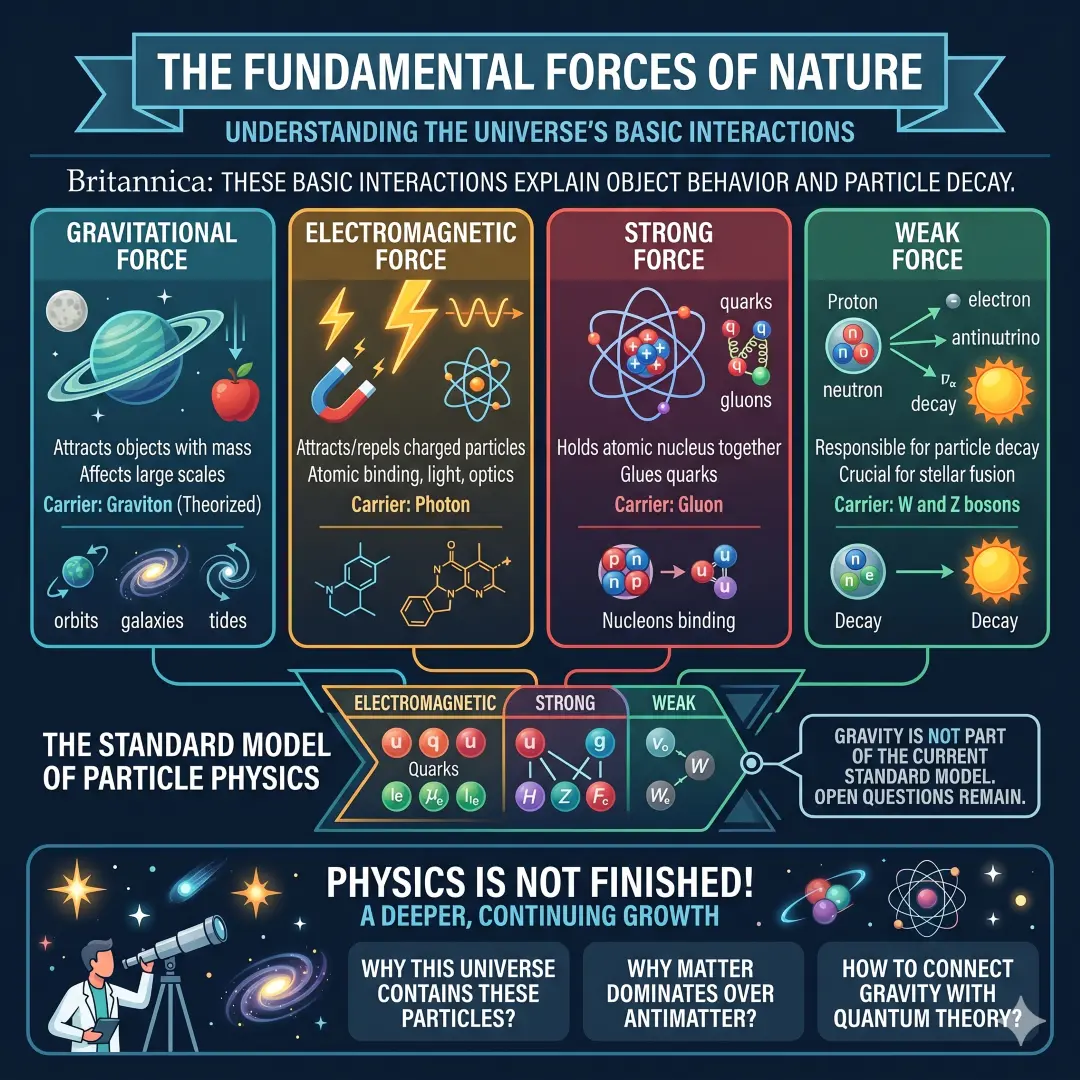
Physics also seeks to understand the basic forces that govern interactions in nature. The commonly recognized four fundamental forces are gravitational, electromagnetic, strong, and weak. According to Britannica, these are the basic interactions that explain how objects and particles behave and how certain particles decay.
The Standard Model in particle physics includes the electromagnetic, strong, and weak forces, along with their carrier particles. It explains a great deal about matter and subatomic interactions, but gravity is not part of the Standard Model in its current form. That is one reason modern physics still has open questions.
This is where physics becomes exciting in a deeper way. The subject is not finished. It is still growing. Scientists continue to ask why the universe contains the particles it does, why matter dominates over antimatter, and how to connect gravity with quantum theory. Those are not small questions. They are some of the biggest questions humans have ever asked.
Why Physics Matters in Real Life
Physics is not only for researchers and students. It quietly shapes daily life in ways most people never stop to count. It affects how roads are built, how engines run, how buildings resist wind, how glasses correct vision, how satellites communicate, and how medical tools use radiation or magnetic fields. The branch may sound abstract, but its results are deeply practical.
Here are some examples of physics in normal life:
- Driving a car uses force, friction, energy, and motion.
- Cooking food uses heat transfer and thermodynamics.
- Hearing music uses sound waves and vibration.
- Seeing a reflection uses light and optics.
- Using electronics depends on electricity, magnetism, and electromagnetism.
Physics also shapes the future. Advanced energy systems, better materials, quantum technologies, particle research, and space science all grow out of physical principles. CERN has even described quantum theory as the theoretical basis of modern physics at the atomic and subatomic level, which shows how central these ideas have become.
A Few Common Misunderstandings About Physics
People often make physics harder than it needs to be. One common mistake is thinking that physics is only about memorizing formulas. The truth is that formulas are only useful when you understand what they represent. F = ma, for example, is not just a symbol chain. It is a short way of saying that force changes motion by producing acceleration in proportion to mass and force.
Another misunderstanding is that physics is disconnected from daily life. It is actually the opposite. Physics explains why a spoon gets hot in soup, why a thrown ball curves, why your phone battery drains, and why sunlight splits into colors. The subject is everywhere, even when nobody is talking about it.
A third mistake is thinking that modern physics replaces classical physics. It does not. Classical physics still works beautifully for most everyday situations. Modern physics steps in where classical ideas are not enough, especially in the tiny world of atoms and the huge world of stars and gravity. Both are useful. Both matter.
How to Understand Physics More Easily
If physics has ever felt intimidating, the best approach is to slow down and build from simple ideas. Start with units, then motion, then force, then energy. After that, move into waves, electricity, and heat, and only then go into quantum mechanics and relativity. The subject becomes much easier when the foundation is solid.
A few good study habits help a lot:
- Read one concept slowly, then explain it in your own words.
- Use real objects as examples, like a ball, a magnet, or a lamp.
- Always watch the units.
- Ask what is causing the change.
- Check whether the idea is about motion, energy, waves, or fields.
Physics becomes much less scary when it feels like a set of connected stories instead of a list of separate rules. A falling object, a glowing bulb, a boiling pot, and a radio signal are all part of the same natural world. Physics gives that world a readable structure.
Final Thoughts
Physics is the language of how things work. It explains the movement of planets, the behavior of atoms, the spread of light, the flow of heat, and the power inside everyday machines. It is both practical and profound, simple in some places and beautifully complex in others. The more you study it, the more you see that it is not just a school subject. It is a way of understanding reality itself.
If you remember only a few ideas from this article, let them be these: matter makes up the physical world, motion describes change, force causes changes in motion, energy moves and changes form, waves carry energy, electricity and magnetism are closely linked, and quantum mechanics and relativity describe the parts of nature that classical physics cannot fully explain. That is the backbone of physics, and it is a surprisingly elegant backbone.
If you read physics with patience, the subject starts to feel less like a wall and more like a map. And once that happens, even the biggest ideas begin to look understandable.
Article’s References and Sources
- Physics: Definition and Scope
- Matter: Definition and Properties
- Motion in Physics
- Force in Physics
- Energy: Forms and Concepts
- Work in Physics
- Power in Physics
- Newton’s Laws of Motion
- Understanding Newton’s Laws (Summary)
- Wave Physics Overview
- Electromagnetic Spectrum: NASA
- Behavior of Light (Reflection, Refraction, etc.): NASA
- Electricity and Magnetism Overview
- Magnetism in Physics
- Thermodynamics: Concepts and Laws
- Thermodynamics Summary
- Quantum Mechanics Overview
- Relativity: Einstein’s Theory
- Fundamental Interactions (Four Forces)
- The Standard Model: CERN
- Quantum Theory: CERN
- SI Units: NIST
Also, Read these Articles in Detail
- Matter, Motion, and Energy: The Core Ideas of Physics
- What Is Matter? The Physical Substance of the Universe
- What Is Motion? A Guide to Motion in Physics and Daily Life
- What Is Energy? The Invisible Power Behind Everyday Life
- Kinetic Energy Explained in Simple Language
- Potential Energy: Definition, Types, Formula, and Examples
- Thermal Energy: Heat, Temperature, and Transfer
- Mechanical Energy: Definition, Formula, and Examples
- Chemical Energy: Definition, Science, and Examples
- Electrical Energy: Definition, Works, and Why It Matters
- Radiant Energy: Meaning, Sources, Examples, and Uses
- Nuclear Energy: Definition, How It Works, and Why It Matters
- Sound Energy: Definition, Science, and Examples
- Elastic Energy: Definition, Elasticity, Example, and Facts
- Geothermal Energy: Clean Electricity, Heating, and Modern Life
- Hydropower Energy: How It Works and Its Importance
- Pumped Hydropower Storage
Frequently Asked Questions
FAQ 1: What is physics, and why is it important?
Physics is the branch of science that studies matter, motion, energy, force, waves, and the basic rules that control how the universe works. It asks simple questions with deep answers. Why does a ball fall? Why does light travel the way it does? Why does electricity power a lamp? Physics gives the logic behind all of these things.
It is important because it helps us understand the world in a clear, practical way. Physics is not limited to classrooms or laboratories. It shapes everyday life. It explains how cars move, how buildings stand, how smartphones work, how sound reaches our ears, and how satellites stay in orbit. Without physics, modern technology would not exist in its current form. It is also the base for many other sciences, including chemistry, astronomy, engineering, and materials science. In simple words, physics helps us see the hidden structure behind ordinary life.
FAQ 2: What are the main fundamentals of physics?
The main fundamentals of physics include matter, motion, force, energy, work, power, waves, heat, electricity, magnetism, light, atoms, and gravity. These ideas form the foundation of the subject. Once you understand them, many other topics become much easier to follow.
Matter is anything that has physical substance. Motion is the change in position of an object over time. Force is a push or pull that can change motion or shape. Energy is the ability to do work, while work is the transfer of energy when a force moves something. Power tells us how quickly work is done. Waves carry energy from one place to another, and electricity and magnetism explain how charges and fields behave. Light helps us understand vision and optics, while gravity explains why objects fall and why planets stay in orbit. These are not separate ideas. They are connected parts of one large system.
FAQ 3: How does motion work in physics?
Motion in physics means a change in position over time. If an object moves from one place to another, it is in motion. To describe motion properly, physics uses ideas like distance, displacement, speed, velocity, and acceleration. These terms may sound similar, but each one has a different meaning.
Speed tells us how fast something moves. Velocity tells us how fast something moves and in what direction. Acceleration tells us how quickly velocity changes. For example, if a car starts from rest and then speeds up, it is accelerating. If it turns a corner, its velocity changes even if the speed stays the same. Motion becomes easier to understand when you realize that physics is not just asking where something is. It is also asking how its position changes, how fast it changes, and what causes that change. That is where force enters the picture.
FAQ 4: What is force in physics, and how does it affect objects?
A force is a push or pull that can change the motion of an object or change its shape. It is one of the most important ideas in physics because motion does not change by itself. Something has to cause that change. That something is usually a force.
If you push a door, lift a bag, kick a ball, or stretch a rubber band, you are applying force. Forces can speed things up, slow them down, stop them, or make them turn. They can also stretch, compress, bend, or twist materials. Newton’s laws of motion explain this relationship very clearly. The first law says that objects keep doing what they are already doing unless a force acts on them. The second law shows that force produces acceleration. The third law says every action has an equal and opposite reaction. These laws are simple on the surface, but they explain a huge amount of the physical world.
FAQ 5: What is the difference between energy, work, and power?
These three ideas are closely linked, but they are not the same thing. Energy is the ability to do work. Work is done when a force moves an object over a distance. Power is the rate at which work is done or energy is transferred. That means power tells you how fast the work happens.
A good example is lifting a box. Suppose two people lift the same box to the same shelf. They do the same amount of work if the force and distance are the same. But if one person does it faster, that person uses more power. Another simple example is a kettle and a heater. Both may transfer energy, but the one that does it more quickly has higher power. In daily life, we often mix these words casually, but in physics they each have a precise meaning. That precision helps scientists measure and compare physical processes clearly.
FAQ 6: Why are waves so important in physics?
Waves are important because they transfer energy from one place to another without moving matter in the same way a solid object moves. This makes them essential in many areas of physics and technology. Some waves travel through water, some through air, and some through empty space. Sound waves, for example, need a medium like air or water. Light waves can travel through space, which is why sunlight can reach Earth.
Waves are described by features like amplitude, frequency, and wavelength. These properties tell us how strong a wave is, how often it repeats, and how long each wave cycle is. The study of waves helps explain music, radio signals, microwaves, X-rays, and even weather patterns. In a deeper sense, waves are one of nature’s most useful ways of moving information and energy. That is why they matter in communication, medicine, astronomy, and everyday life.
FAQ 7: How do electricity and magnetism work together?
Electricity and magnetism are deeply connected, and together they form electromagnetism. Electricity deals with the behavior of electric charges, while magnetism deals with the effects created by moving charges and magnetic fields. For a long time, people studied them as separate topics. Now we know they are closely related.
A simple example is an electric motor. It uses electric current to create motion. A generator does the reverse by turning motion into electricity. Speakers, phones, computers, and power systems all depend on electromagnetic principles. Even a compass works because of Earth’s magnetic field. This is one of the clearest examples of how physics links invisible forces to visible results. Without electromagnetism, modern electronics and communication systems would not work.
FAQ 8: What is thermodynamics, and where do we see it in daily life?
Thermodynamics is the study of heat, temperature, work, and energy transfer. It helps us understand how energy moves through systems and how it changes form. This branch of physics is everywhere in daily life, even if we do not notice it. When water boils, when ice melts, when a car engine runs, or when a refrigerator cools food, thermodynamics is at work.
One of the key ideas in thermodynamics is that energy does not simply disappear. It moves, transforms, or spreads out. Another important idea is that some processes happen naturally while others need outside effort. For example, hot tea cools down in a room because heat moves from warmer to cooler objects. That is a natural flow of energy. Thermodynamics is also important in engines, climate systems, cooking, and human biology. It helps explain not just machines, but life itself.
FAQ 9: What is the difference between classical physics and modern physics?
Classical physics deals with the world of everyday experience. It includes mechanics, motion, force, heat, waves, and electromagnetism. It works extremely well for large objects moving at normal speeds. If you throw a ball, drive a car, or build a bridge, classical physics gives reliable answers.
Modern physics covers areas where classical physics is not enough. It includes quantum mechanics and relativity. Quantum mechanics studies tiny particles like electrons and photons, where nature behaves in a probabilistic way. Relativity, developed by Albert Einstein, explains how space, time, gravity, and motion behave at very high speeds or strong gravitational fields. Both areas are essential for understanding atoms, semiconductors, GPS systems, black holes, and the universe itself. So classical physics is not outdated. It is still useful. Modern physics simply goes deeper and farther.
FAQ 10: How can someone start understanding physics more easily?
The best way to understand physics is to begin with the basics and build slowly. Start with units, measurement, motion, force, and energy. After that, move to waves, electricity, heat, and light. Once those ideas feel familiar, it becomes easier to approach quantum mechanics and relativity. Physics makes much more sense when each new idea sits on a strong foundation.
It also helps to connect physics to real life. Think of a rolling ball, a glowing bulb, a magnet on a fridge, a boiling kettle, or sunlight passing through a window. These are all physics examples. And it’s often easier to learn when you explain the idea in your own words instead of trying to memorize formulas right away. The formulas matter, of course, but the meaning behind them matters even more. Physics becomes much easier when you see it as a story about how the world works, not just a list of equations.
FAQ 11: What is the role of measurement in physics, and why is it so important?
Measurement is one of the most important parts of physics. In fact, without measurement, physics would not be a science in the true sense. Physics depends on numbers, units, observations, and comparisons. It is not enough to say that something is hot, fast, heavy, or bright. A physicist wants to know how hot, how fast, how heavy, or how bright it is. That is where measurement comes in.
Every physical idea becomes clearer when it is measured properly. If you want to study motion, you measure distance and time. If you want to study force, you measure how much push or pull is involved. If you want to study energy, you measure how much work can be done. If you want to study temperature, you need a standard scale. Measurement gives physics its structure and its reliability.
Another reason measurement matters is that it allows people all over the world to understand the same result in the same way. A scientist in one country and a scientist in another country should be able to compare their data without confusion. That is why the SI system is so useful. It gives science a common language. When people use the same units, the same definitions, and the same methods, physics becomes much more accurate and much more trustworthy.
Measurement also teaches discipline. It reminds us that nature does not change just because we guess differently. A good measurement must be careful, repeatable, and honest. That is one of the reasons physics is respected so much. It does not rely on opinion. It relies on evidence.
FAQ 12: What are SI units, and why do physicists use them?
SI units are the standard units used in science around the world. The term SI comes from the French name for the International System of Units. These units are used because they create consistency in scientific work. A physicist in India, a researcher in Europe, and an engineer in the United States can all use the same measurement system and understand each other clearly.
The seven base SI units are used to build all other scientific units. They are metre for length, kilogram for mass, second for time, ampere for electric current, kelvin for temperature, mole for amount of substance, and candela for luminous intensity. These may look simple, but they are the backbone of scientific measurement.
Physicists use SI units because they are clean, universal, and easy to combine. If you know the units, you can often understand the formula better. Units help catch mistakes too. If a calculation gives a strange unit, that is usually a sign that something has gone wrong. So units are not just labels. They are part of the logic of physics.
Using SI units also makes communication easier in textbooks, experiments, laboratories, medicine, engineering, and industry. A good scientific result should not depend on local habits or old custom. It should be clear anywhere in the world. That is one of the reasons SI units remain so important.
FAQ 13: How do Newton’s laws help us understand the physical world?
Newton’s laws of motion are among the most important ideas in classical physics. They explain how objects move and how forces change that motion. These laws may sound simple at first, but they describe an enormous range of real-life events, from a falling apple to a speeding car to a rocket launch.
The first law says that an object will stay at rest or keep moving in a straight line at a constant speed unless an outside force acts on it. This is sometimes called the law of inertia. It explains why a ball will not start rolling by itself and why a moving object eventually slows down if friction is present.
The second law connects force, mass, and acceleration. It tells us that the greater the force, the greater the acceleration, and the greater the mass, the harder it is to change the motion. This law is extremely useful in daily life. It explains why a heavy truck needs more force to accelerate than a bicycle.
The third law says that for every action, there is an equal and opposite reaction. This is why walking works, why rockets move forward, and why a gun recoils when fired. The ground pushes back when your foot pushes down, and that reaction helps you move ahead.
Together, these laws give a clear picture of motion in the everyday world. They are simple, but they are powerful. They help us understand everything from sports to transportation to engineering design.
FAQ 14: What is the difference between speed and velocity in physics?
Speed and velocity are related, but they are not the same. This is one of those small differences that matters a lot in physics. Speed tells you how fast something is moving. Velocity tells you how fast something is moving and in what direction.
For example, if a car moves 60 kilometers per hour, that is its speed. But if the same car moves 60 kilometers per hour north, then that is its velocity. Direction changes the meaning. That is why velocity is a vector quantity, while speed is a scalar quantity. A scalar has only size or magnitude. A vector has both size and direction.
This difference matters because direction often changes the result of motion. A plane heading east is not doing the same thing as a plane heading west, even if both move at the same speed. A thrown ball may slow down, curve, or change direction under the influence of gravity. Velocity helps describe that change more completely than speed alone.
People often use speed and velocity as if they mean the same thing in daily speech. That is fine in casual conversation. But in physics, precision matters. When you want to describe motion properly, you need to know both how fast something is moving and where it is going.
FAQ 15: What is acceleration, and why does it matter in motion?
Acceleration is the rate at which velocity changes. That means an object is accelerating when it speeds up, slows down, or changes direction. Many people think acceleration only means getting faster, but that is only part of the picture. In physics, any change in velocity counts.
Acceleration is very important because it tells us how motion changes over time. A car pulling away from a stoplight accelerates. A bicycle slowing down before a turn also accelerates, because its velocity is changing. Even a satellite moving in orbit is accelerating, because its direction keeps changing as it moves around Earth.
This concept matters because acceleration shows that motion is not always steady. Nature is full of change. Acceleration helps explain why objects respond the way they do when a force acts on them. It also connects closely to Newton’s second law, which links force and mass to acceleration. If a large force acts on a small mass, the acceleration will usually be greater.
In everyday life, acceleration affects cars, elevators, sports, aircraft, and roller coasters. It also affects how our bodies feel movement. When a car starts suddenly, you feel pushed back. When it stops suddenly, you feel thrown forward. Those sensations are all connected to acceleration.
FAQ 16: How do energy transformations happen in everyday life?
Energy transformation means energy changes from one form to another. This is one of the most common processes in the physical world. Energy is not usually created from nothing or destroyed in ordinary situations. Instead, it changes form and moves through systems.
For example, when you eat food, your body transforms chemical energy into movement, heat, and stored energy. When you turn on a lamp, electrical energy becomes light energy and some heat energy. When a car burns fuel, the fuel’s chemical energy becomes motion and heat. When sunlight reaches a solar panel, radiant energy becomes electrical energy. These are all simple but important examples.
Energy transformation is everywhere because nothing in nature sits still in a perfectly isolated way for long. Systems interact. Energy flows. It shifts between forms depending on what is happening. That is why physicists study energy so carefully. It helps them understand machines, living things, and natural events.
This idea also helps explain efficiency. No machine changes energy perfectly. Some energy is usually lost as heat, sound, or friction. That does not mean energy disappears. It means it changes into forms that are less useful for the task we want. Understanding energy transformation helps engineers design better tools and helps scientists study the world more clearly.
FAQ 17: Why are waves important in communication, science, and technology?
Waves are incredibly important because they carry energy and information. In many cases, waves are the reason modern communication exists. Radio, television, mobile phones, Wi-Fi, and satellite signals all depend on wave behavior. Without waves, many of the systems people use every day would not work.
In physics, a wave is a disturbance that travels and transfers energy. Some waves need a medium, like sound waves that travel through air or water. Others, like electromagnetic waves, can travel through empty space. That is why light from the Sun can reach Earth through the vacuum of space.
Waves matter in science because they help explain many natural events. Ocean waves, earthquakes, sound, and light all have wave properties. Scientists study frequency, wavelength, amplitude, and speed to understand how waves behave. These ideas are useful in medicine too. For example, ultrasound uses sound waves to create images inside the body.
Technology also depends heavily on wave behavior. Radio signals, microwave ovens, X-ray machines, fiber optics, and many sensors all work because of wave principles. That makes wave physics one of the most practical areas of the subject. It is not just theory. It is part of modern life in a very real way.
FAQ 18: How do electricity and magnetism appear in daily life?
Electricity and magnetism are part of everyday life in ways people often do not notice. Electricity powers homes, schools, machines, computers, and phones. Magnetism appears in motors, speakers, credit card strips, compasses, and many electronic devices. These two topics are closely linked through electromagnetism.
When electric charges move, they create magnetic effects. When magnetic fields change, they can produce electric current. That relationship is one of the most useful discoveries in physics. It explains how generators produce electricity and how motors turn electrical energy into motion. It also explains why many devices can transmit signals, create sound, or store data.
A simple example is a fan. Electricity flows into the motor, magnetism helps make the blades spin, and the moving blades create air flow. Another example is a phone speaker. Electrical signals are converted into sound waves using electromagnetic behavior. Even charging a battery depends on controlled electrical processes.
The truth is that modern civilization runs on electricity and magnetism. They are not separate ideas sitting in a book. They are living parts of daily life. Understanding them gives you a much better sense of how the world around you actually works.
FAQ 19: What makes modern physics different from classical physics?
Classical physics describes the world we can see and touch in ordinary life. It includes motion, force, energy, heat, light, and waves. It works very well for most everyday situations. If you throw a ball, ride a bicycle, or build a bridge, classical physics gives useful and accurate answers.
Modern physics, on the other hand, deals with situations where classical ideas are not enough. It includes quantum mechanics and relativity. Quantum mechanics explains the strange behavior of tiny things like electrons and photons. At that scale, nature behaves in ways that can seem unusual, even surprising. Instead of exact certainty all the time, physics often uses probabilities.
Relativity explains how space, time, motion, and gravity work when speeds are extremely high or gravity is very strong. This is important for understanding stars, black holes, satellites, and the structure of the universe. It also shows that time and space are not completely fixed in the way people once thought.
The main difference is the scale of the problem. Classical physics works beautifully for large, slow, everyday systems. Modern physics becomes necessary when the world gets very tiny or very extreme. Both are true. Both are useful. And both are part of the same larger picture.
FAQ 20: How can physics help us understand the universe better?
Physics helps us understand the universe by showing that even the biggest and smallest things follow patterns. Planets move under gravity. Stars shine because of nuclear processes. Light travels across space according to electromagnetic rules. Atoms behave according to quantum mechanics. Every part of the universe seems to follow physical principles that can be studied, tested, and described.
This is one of the most amazing things about physics. It does not only explain a falling stone or a spinning wheel. It also explains galaxies, black holes, the expansion of space, and the behavior of particles inside atoms. It gives us a way to connect everyday experience with cosmic reality.
Physics also helps scientists ask better questions. Instead of wondering only what happens, they ask why it happens, how it happens, and what rules shape it. That kind of thinking has led to huge discoveries in astronomy, medicine, communication, energy, and computing. It has changed how human beings understand their place in the universe.
And there is still much to learn. Physics is not finished. New discoveries continue to refine old ideas and open new paths. That is part of what makes it so valuable. It is a subject built on curiosity, careful thinking, and the desire to understand reality as deeply as possible.
