
Potential energy is one of the most useful ideas in physics because it explains why objects can store energy and later release it as motion, heat, light, or sound. In simple words, it is stored energy that depends on an object’s position, shape, arrangement, or condition within a system. A book on a shelf, a stretched spring, a charged battery, and food in your kitchen all carry forms of potential energy because something about their state gives them the ability to do work later. That is why this concept shows up everywhere, from classroom science to engineering, transportation, sports, and nature.
Table of Contents
What Is Potential Energy?
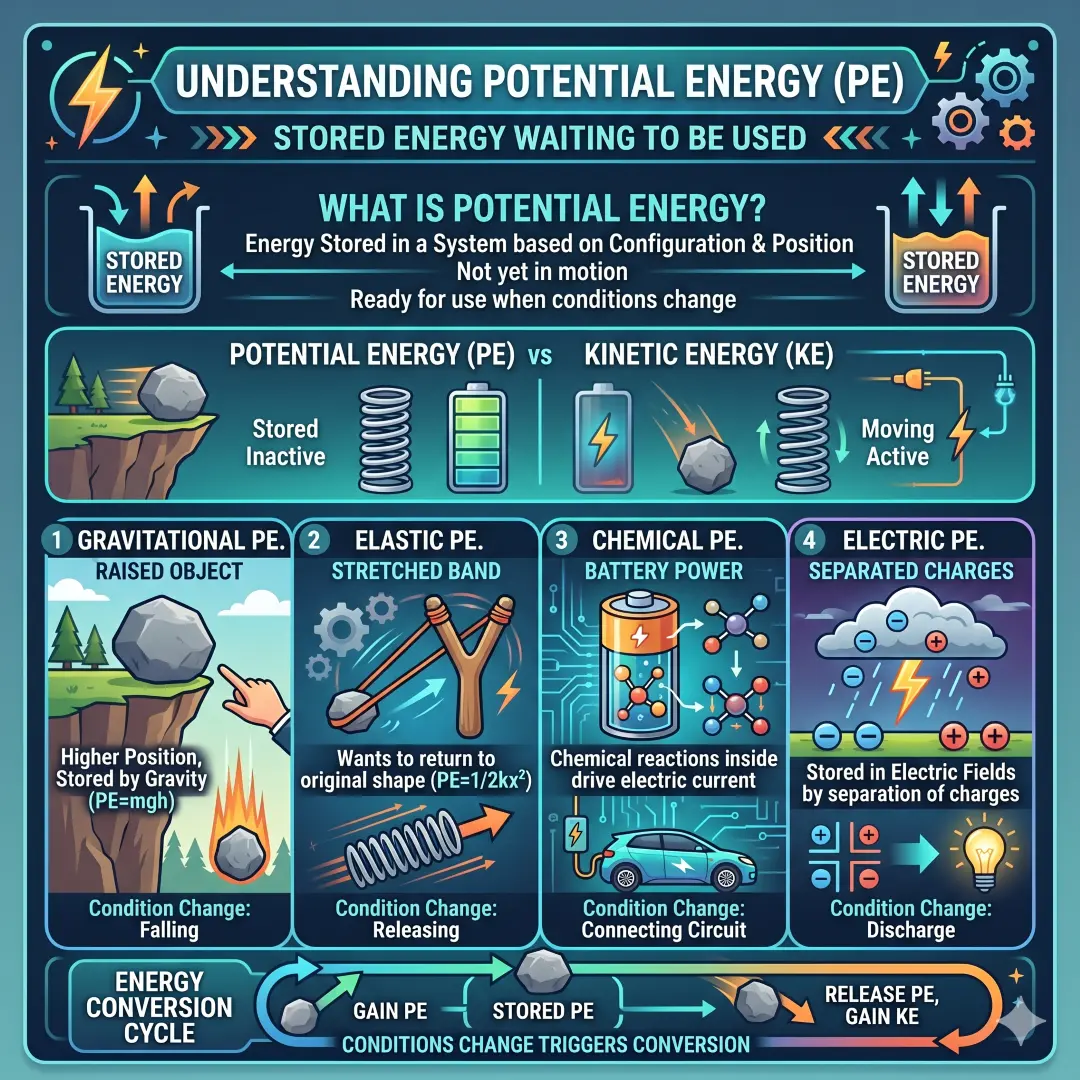
The easiest way to understand potential energy is to think of it as energy that is waiting to be used. It is not energy in motion yet. It is energy stored in a system because of how parts of that system are arranged relative to each other. A raised object has stored energy because gravity can pull it downward. A stretched rubber band has stored energy because it wants to return to its original shape. A battery has stored energy because chemical reactions inside it can drive an electric current. In each case, the energy becomes useful when conditions change.
Another important point is that potential energy is always connected to a system, not just a single object sitting alone. A stone on a hill has gravitational potential energy because of its relationship with Earth. A compressed spring has elastic potential energy because of its condition relative to its relaxed shape. This system-based view matters because physics often cares more about changes in potential energy than about a single absolute value.
Why Potential Energy Matters
This idea matters because it helps explain how energy moves through the world. A waterfall turns gravitational potential energy into kinetic energy. A drawn bow stores elastic potential energy that can launch an arrow. Food stores chemical energy that living things use for movement and body functions. Batteries store energy that can power phones, lamps, and cars. Without potential energy, you would have a much harder time explaining how objects can suddenly start moving or how systems can release energy in a controlled way.
Potential Energy at a Glance
| Type of Potential Energy | What Stores the Energy | Common Formula or Idea | Simple Example | Key Note |
|---|---|---|---|---|
| Gravitational potential energy | Height in a gravitational field | PE = mgh near Earth’s surface | A book on a shelf | Depends on mass, gravity, and height. |
| Elastic potential energy | Stretching or compressing an object | PE = 1/2 kx² | A stretched spring | Depends on the spring constant and displacement. |
| Chemical energy | Bonds inside substances | No single simple school formula | Fuel, food, batteries | Commonly treated as stored energy in bonds or composition. |
| Electric potential energy | Position of charges in an electric field | ΔU = qΔV | A charge moving through a voltage | Depends on the charge and the electric potential difference. |
| Other stored forms | Structure, configuration, or conditions | Varies by system | A wound clock, a raised drawbridge | Energy is stored because the system is not at its lowest-energy state. |
The Main Idea Behind Stored Energy
A useful way to think about potential energy is this. When you do work on a system, you may not always create motion right away. Sometimes you store that energy instead. If you lift an object slowly, your effort goes into increasing its gravitational potential energy. If you stretch a spring, your work is stored as elastic potential energy. If you charge a battery, energy is stored in chemical form. In physics, that stored energy can later return as motion or other forms of energy.
That is why potential energy is closely tied to the idea of work. In many cases, the work done against a conservative force becomes stored energy. This is a major reason scientists use energy methods. They make it easier to track what is happening in a system without following every tiny force step by step.
Gravitational Potential Energy
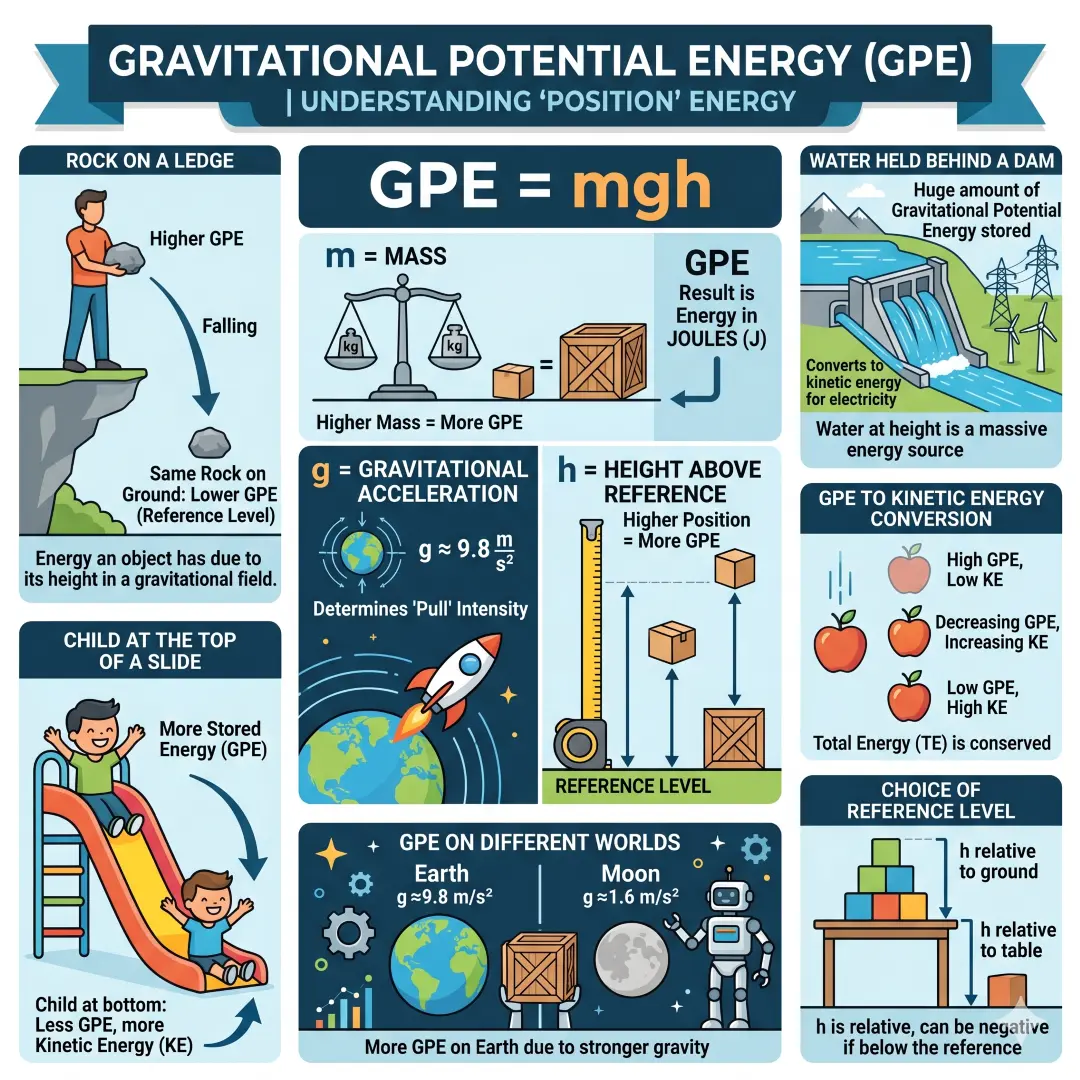
The most familiar form of potential energy is gravitational potential energy. It is the energy an object has because of its position in a gravitational field. Near Earth’s surface, the formula is usually written as PE = mgh, where m is mass, g is the acceleration due to gravity, and h is height above a chosen reference level. This formula is standard in introductory physics for situations close to Earth.
A few simple examples make this very clear.
- A rock on a ledge has more gravitational potential energy than the same rock on the ground.
- A child at the top of a slide has more stored energy than when they reach the bottom.
- Water held behind a dam has a large amount of gravitational potential energy because of its height.
Here is a small example. If an object has a mass of 2 kg and is lifted to a height of 5 m, its gravitational potential energy near Earth is about 98 J, using g ≈ 9.8 m/s². That is not a huge amount in daily life, but it is enough to matter in many engineering and athletic situations.
Why Height Matters
Height matters because lifting something higher requires work against gravity. The farther you lift it, the more energy you store. Mass matters too. A heavy object at the same height stores more energy than a light one. Gravity matters as well, which means the same object would store different amounts of gravitational potential energy on the Moon, Earth, or another planet.
Elastic Potential Energy
Elastic potential energy is the energy stored when an object is stretched, compressed, bent, or deformed in a way that it can return to its original shape. Springs are the classic example, and the usual formula is PE = 1/2 kx², where k is the spring constant, and x is the displacement from equilibrium. The important idea is that the more a spring is stretched or compressed, the more energy it stores.
This shows up in everyday life more often than people think.
- A compressed spring in a toy stores energy.
- A stretched rubber band stores energy before it snaps back.
- A bow stores energy when the string is pulled back.
- A trampoline stores energy when it is pushed downward.
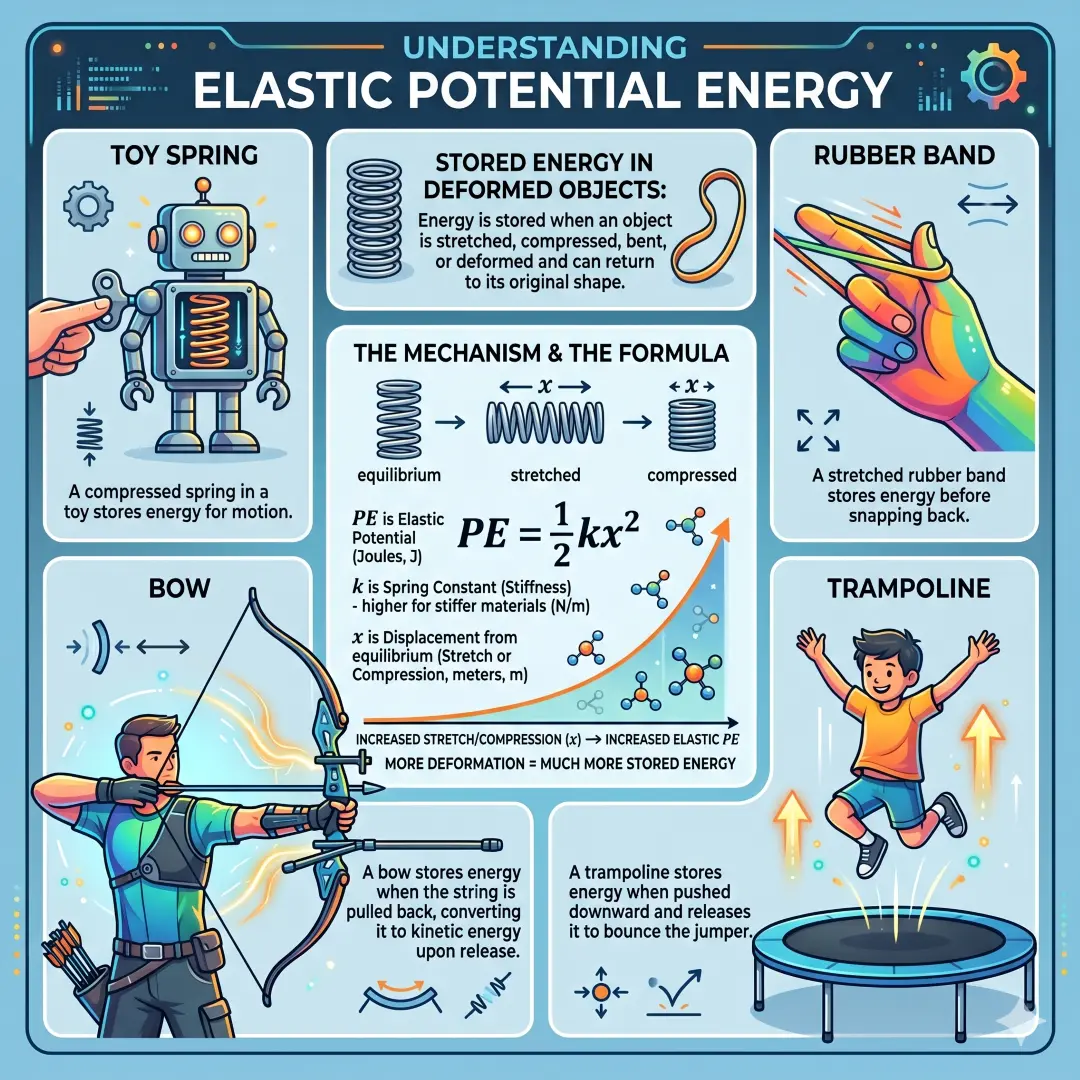
A nice detail here is that the energy depends on the square of the displacement. That means doubling the stretch does not just double the energy. It makes the energy much larger. This is why springs can feel gentle at first and then suddenly become much harder to compress or stretch further.
Chemical Energy and Potential Energy
Chemical energy is also a form of stored energy. It is held in the arrangement of atoms and molecules and is released or absorbed during chemical reactions. Food, fuel, wood, and batteries all store energy this way. In everyday language, people often call this chemical potential energy because it behaves like stored energy that can later be used for work or heat.
This is one reason eating food keeps you moving. Your body breaks down chemical compounds and converts that stored energy into movement, warmth, growth, and repair. It is also why gasoline can power engines and why batteries can power devices. The energy was not created at the moment you used it. It had been stored earlier in the chemical structure.
Electric Potential Energy
Electric potential energy is the stored energy a charged particle has because of its position in an electric field. It is closely related to voltage or electric potential difference. A useful relationship is ΔU = qΔV, which means the change in electric potential energy depends on the amount of charge q and the change in electric potential ΔV. In a constant electric field, the change can also be written in terms of field strength and position.
You can see this in many modern devices and systems.
- Batteries store electrical energy that can later drive a circuit.
- Capacitors store charge and energy for quick release.
- Static electricity is a simple example of electric energy stored in separated charges.
- Electronic devices rely on controlled electrical energy transfer every second.
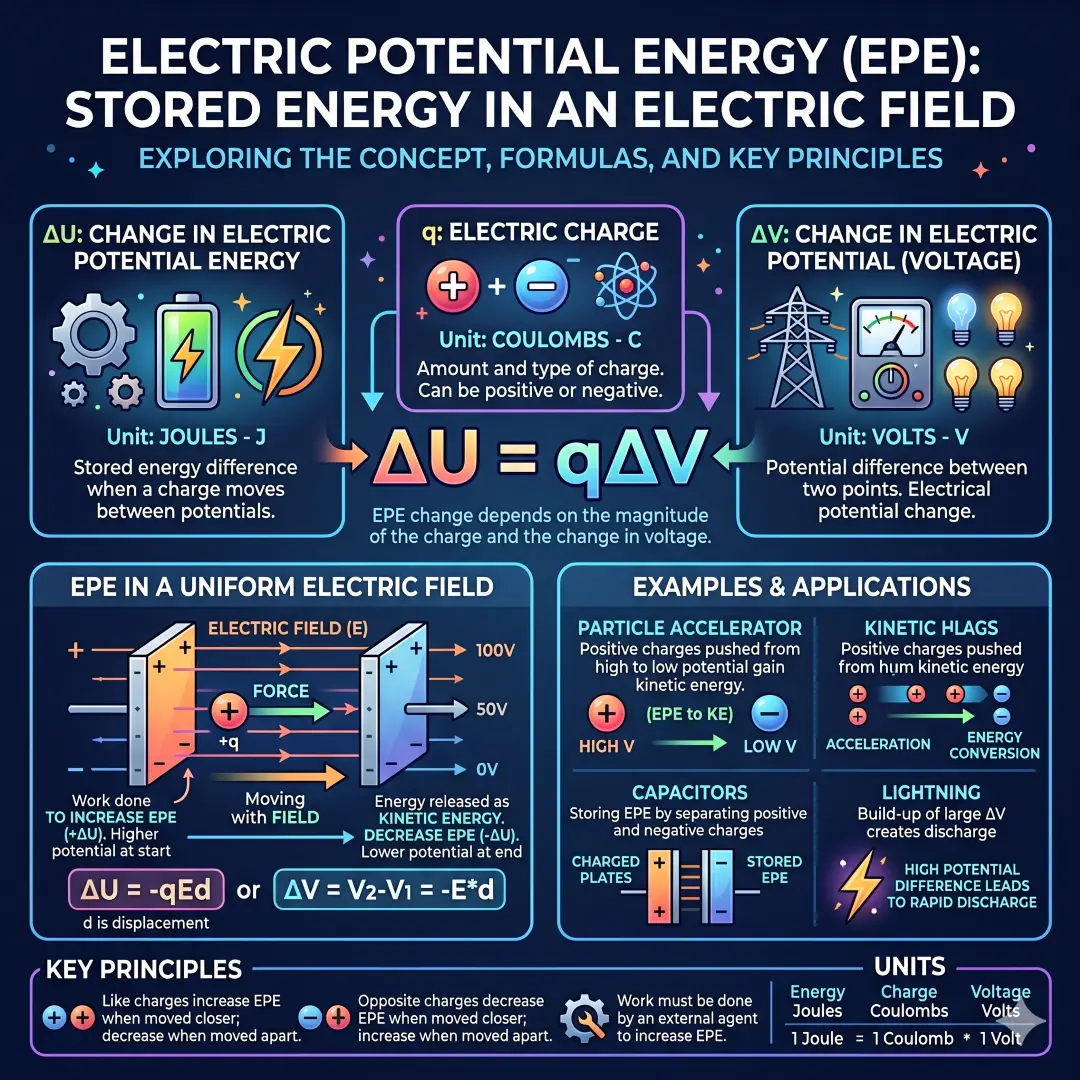
Electric potential energy is often compared with gravitational potential energy because both depend on position in a field. A mass falls in a gravitational field and loses gravitational potential energy. A charge moves in an electric field and can lose electric potential energy. In both cases, the lost potential energy usually becomes kinetic energy.
Potential Energy and Kinetic Energy
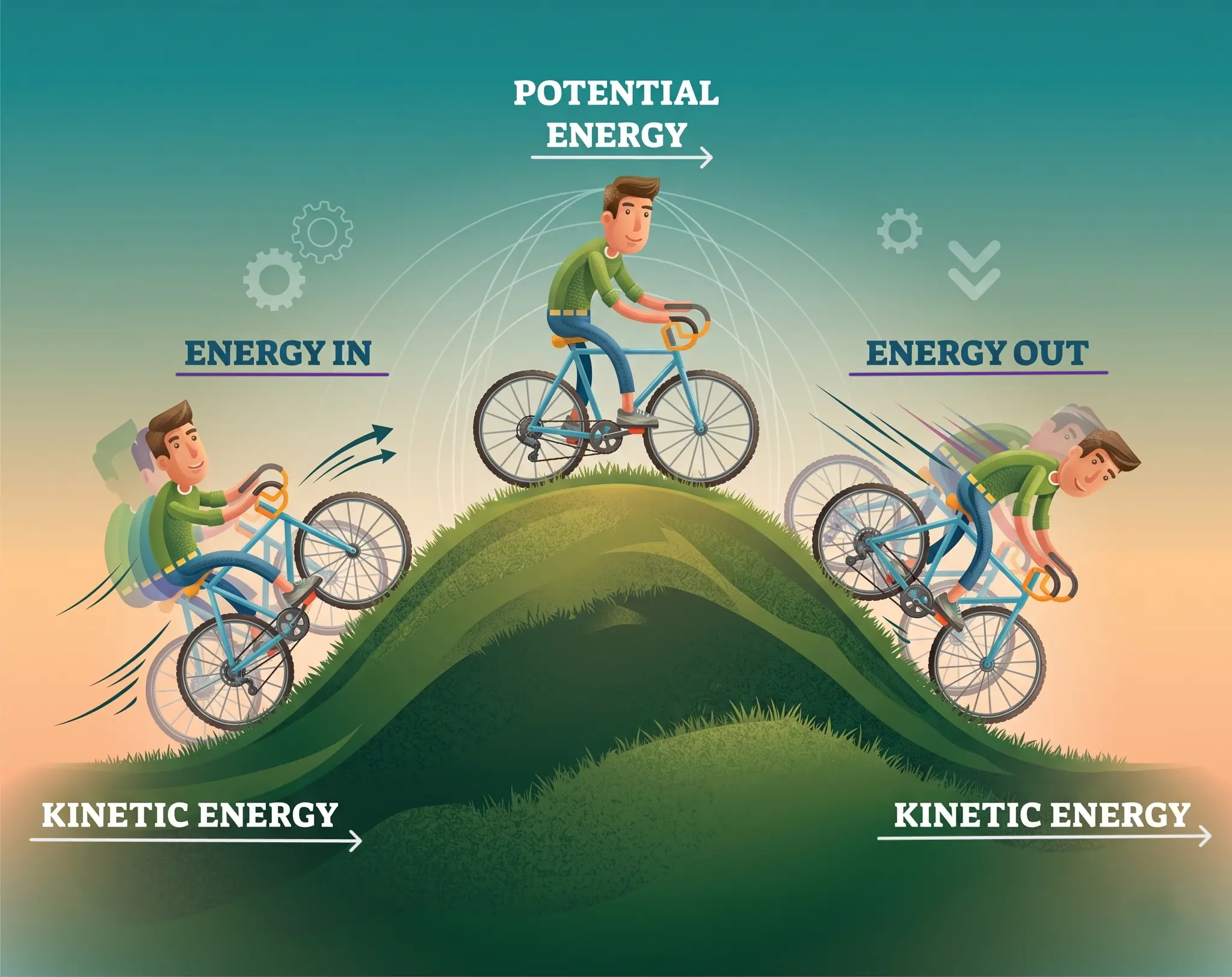
Kinetic energy is the energy of motion, while potential energy is stored energy. These two often trade places. When a ball rolls downhill, its gravitational potential energy decreases and its kinetic energy increases. When a spring releases, elastic potential energy turns into motion. When a charge moves through an electric field, electric potential energy can become kinetic energy.
This exchange is one of the most important ideas in physics because it explains motion in a very clean way. A system can gain one type of energy and lose another, but the total energy stays constant in a closed system. That is the heart of the law of conservation of energy.
A Simple Example of Energy Exchange
Imagine a ball held above the ground.
- At the top, it has mostly potential energy.
- As it falls, the stored energy decreases.
- At the bottom, much of that energy has become kinetic energy.
Now imagine a spring. The same pattern appears.
- When stretched, it stores elastic potential energy.
- As it returns to shape, that energy changes into motion.
- If there is friction, some energy becomes heat and sound instead.
The Law of Conservation of Energy
The law of conservation of energy says that energy cannot be created or destroyed in an isolated system. It can only change form. That is why a falling object does not lose energy overall. Its energy simply shifts from one form to another. The same idea applies to springs, batteries, moving charges, and chemical reactions.
This law is one of the deepest ideas in science because it gives order to many different processes. It connects mechanics, electricity, chemistry, and biology. Once you start looking for it, you see the same pattern everywhere. Energy is stored, transferred, transformed, and conserved.
Why Only Changes in Potential Energy Matter
In many physics problems, the exact zero point of potential energy is chosen for convenience. That means the absolute value is less important than the difference between two states. For example, ground level may be chosen as zero for gravitational potential energy, but another reference level could also be used. What matters physically is the change in energy, not the arbitrary starting number.
This is a practical idea, not just a theoretical one. It lets scientists and engineers choose the easiest reference point for a problem. A bridge designer, a mountain climber, or a physicist can each choose a different zero level depending on what makes the math simplest. The real motion still comes from energy differences.
Large Comparison Table of Potential Energy Types
| Type | Stored By | Common Formula | Typical Unit | Where You See It | What Happens When Released | Key Note |
|---|---|---|---|---|---|---|
| Gravitational potential energy | Height in a gravitational field | PE = mgh near Earth | Joule (J) | Hills, dams, shelves, slides | Often becomes kinetic energy | Depends on mass, gravity, and height. |
| Elastic potential energy | Stretching or compression | PE = 1/2 kx² | Joule (J) | Springs, bows, trampolines, rubber bands | Often becomes motion, sound, or heat | Depends on the spring constant and displacement. |
| Chemical energy | Chemical bonds and arrangement | No single simple formula in basic use | Joule (J) or food energy units | Food, fuel, batteries, wood | Often becomes heat, motion, or electricity | Stored in the structure of substances. |
| Electric potential energy | Charge position in an electric field | ΔU = qΔV | Joule (J) | Circuits, capacitors, static electricity | Often becomes kinetic energy or electric current | Closely tied to voltage. |
| System potential energy | Position, shape, or configuration | Varies by system | Joule (J) | Machines, structures, physical systems | Depends on the force involved | Many conservative forces can be described this way. |
Everyday Examples That Make It Easy to Remember
Potential energy is not just a school topic. It is part of ordinary life.
- A water tank on a high tower stores gravitational potential energy.
- A pulled slingshot stores elastic potential energy.
- A charged phone battery stores chemical energy.
- A static balloon can attract small paper pieces because of electric effects.
- A person standing on a staircase has more gravitational potential energy than the same person sitting on the floor.
You can think of these as different kinds of saved-up energy. Some are easy to see. Some are hidden inside matter or fields. But the principle is the same. The system is in a state that can release energy later.
How Potential Energy Appears in Nature
Nature uses potential energy constantly. Rainwater stored high in the mountains can later feed rivers and hydroelectric systems. Plants store chemical energy from sunlight through photosynthesis, and animals use that stored energy to survive and move. Wind-up toys, falling stones, tidal systems, and moving clouds all involve energy changing from one form to another.
This is also why energy is so central in biology and ecology. Living things are really energy-transforming systems. They take in energy, store it, release it, and pass it along through food chains and ecosystems. That is another reason the idea of stored energy is so powerful. It connects the physical world with the living world.
The Unit of Potential Energy
The standard unit for potential energy is the joule, symbol J. A joule is the preferred SI unit for energy, heat, and work. It is the amount of work done when a force of one newton moves an object one meter in the direction of the force. That makes it the common language for all the energy forms discussed here.
This is useful because it lets us compare very different energy types with the same unit. The energy in a spring, the energy in lifted water, the energy in a battery, and the energy in food can all be measured in joules. That shared unit makes science simpler and more universal.
What Affects Potential Energy?
Different forms of potential energy depend on different factors.
For gravitational potential energy
- Mass increases the energy.
- Height increases the energy.
- Stronger gravity increases the energy.
For elastic potential energy
- Greater stretch or compression increases the energy.
- A larger spring constant means the object stores more energy for the same displacement.
For chemical energy
- The type of bonds and arrangement of atoms matter.
- Different substances store different amounts of energy.
- Reactions can release or absorb that energy.
For electric potential energy
- The size of the charge matters.
- The voltage difference matters.
- The geometry of the field matters too.
Common Misunderstandings About Potential Energy
A lot of people mix up potential energy with kinetic energy, so here are the biggest misunderstandings cleared up in plain language.
- Potential energy is not motion. It is stored energy, not moving energy.
- A higher object usually has more gravitational potential energy, but only if the system and reference point are the same.
- A stretched spring does not store energy because it is moving. It stores energy because of its deformation.
- Potential energy can become heat, sound, or electricity, not only motion. Real systems often lose some energy to friction or resistance.
- The zero point is a choice. Physics usually cares about differences in energy, not an absolute number picked at random.
Real-World Importance in Science and Engineering
Engineers use potential energy every day. A dam stores water high above a turbine so the water can later turn into electrical power. A roller coaster design depends on knowing how much gravitational potential energy is available at the top of each hill. A bridge or building must handle forces that create or release elastic potential energy in structural parts. A battery-powered device depends on chemical energy being delivered at the right rate.
In sports, the same idea is visible everywhere. A high jumper stores energy in the run-up and takeoff. A diver at the top of a board has gravitational potential energy before entering the water. A pole vaulter stores elastic energy in the pole. A tennis racket and ball exchange energy very quickly when they hit. The motion looks different, but the energy logic stays the same.
Potential Energy and Stability
Potential energy also helps explain stability. Systems naturally tend to move toward lower energy states when they can. That is why a stretched spring wants to return to its relaxed shape and why a ball rolls downhill. Lower potential energy often means a more stable arrangement, though real systems can be more complex when friction, external forces, or constraints are involved.
This is one of those ideas that sounds simple but has a strong effect on how the physical world behaves. Stability is not just about whether something stays still. It is about whether the system has a tendency to move toward a lower-energy configuration.
A Practical Table for Daily-Life Thinking
| Situation | What Kind of Potential Energy Is Involved | What Makes It Larger | What Usually Happens Next | Why It Matters |
|---|---|---|---|---|
| Water stored in a dam | Gravitational potential energy | More water height and mass | Water falls and spins turbines | Helps generate electricity. |
| A drawn bow | Elastic potential energy | More pull on the string | Arrow is launched forward | Converts stored energy into motion. |
| Food on a plate | Chemical energy | Chemical content of the food | The body converts it into movement and heat | Fuels life processes. |
| A battery in a flashlight | Chemical and electric energy | Battery chemistry and charge separation | Light and heat are produced in the circuit | Powers portable devices. |
| A ball held above the ground | Gravitational potential energy | Greater height | Ball falls if released | Easy classroom example of energy change. |
| A compressed spring toy | Elastic potential energy | More compression | Toy jumps or moves when released | Shows stored energy very clearly. |
A Simple Way to Remember the Whole Topic
Here is the simplest memory trick. Potential energy is energy stored because of where something is, what shape it has, or how it is arranged. When the system changes, that stored energy can become kinetic energy or another form of energy. That is the heart of the topic. Everything else is just a different example of the same big idea.
Final Thoughts
Potential energy is not a small topic tucked away inside physics. It is a foundation for understanding how the world works. It explains the energy of a raised stone, a stretched spring, a charged battery, a bowl of food, and a river behind a dam. It also explains why energy can move from one form to another without ever disappearing. The more you notice it, the more the world starts to make sense. What looks like stillness is often just energy waiting for the right moment to be released.
Article References and Sources
- Britannica: Potential Energy, Definition and Explanation
- Britannica: Gravitational Potential Energy, Concepts and Examples
- Britannica: Chemical Energy, Meaning and Applications
- Britannica: Law of Conservation of Energy, Detailed Overview
- Openstax: Potential Energy of a System (University Physics)
- Openstax: Gravitational Potential Energy Formula (College Physics)
- Openstax: Elastic Potential Energy and Hooke’s Law
- Openstax: Conservative Forces and Potential Energy
- Openstax: Electric Potential and Potential Difference
- Openstax: Electric Potential Energy Basics
- Openstax: Energy Basics in Chemistry
- Openstax: Summary of Energy Concepts (Chemistry)
- Openstax: Potential Energy and Stability Concepts
- Britannica: Student-Friendly Explanation of Energy Conservation
- NIST: Joule (Unit of Energy), Definition
Also, Read these Articles in Detail
- Physics and Its Fundamentals With Good Explanations
- Matter, Motion, and Energy: The Core Ideas of Physics
- What Is Matter? The Physical Substance of the Universe
- What Is Motion? A Guide to Motion in Physics and Daily Life
- What Is Energy? The Invisible Power Behind Everyday Life
- Kinetic Energy Explained in Simple Language
- Potential Energy: Definition, Types, Formula, and Examples
- Thermal Energy: Heat, Temperature, and Transfer
- Mechanical Energy: Definition, Formula, and Examples
- Chemical Energy: Definition, Science, and Examples
- Electrical Energy: Definition, Works, and Why It Matters
- Radiant Energy: Meaning, Sources, Examples, and Uses
- Nuclear Energy: Definition, How It Works, and Why It Matters
- Sound Energy: Definition, Science, and Examples
- Elastic Energy: Definition, Elasticity, Example, and Facts
- Geothermal Energy: Clean Electricity, Heating, and Modern Life
- Hydropower Energy: How It Works and Its Importance
- Pumped Hydropower Storage
Frequently Asked Questions
FAQ 1: What is potential energy?
Potential energy is the energy something stores because of its position, shape, or condition. It is not energy in motion yet. It is energy that is waiting to be used. That is why people often call it stored energy. A book placed on a shelf has gravitational potential energy because it can fall if it is moved. A stretched rubber band has elastic potential energy because it can snap back. A battery has chemical energy that can later power a device. In each case, the object or system has energy because of the way it is arranged.
This idea is important because it helps explain so many things in science and daily life. A waterfall, a roller coaster, a spring, and even the food we eat all involve some form of potential energy. The energy is not lost. It is simply waiting in one form until the system changes. Then it can become kinetic energy, heat, sound, or electricity. That is the main reason potential energy is such a big idea in physics. It shows how energy can be stored and then released when the time is right.
You can think of potential energy as hidden energy. It may not be obvious at first, but it is there. A heavy object lifted high above the ground has more of it than the same object resting on the floor. A compressed spring stores energy even though it is not moving. A charged battery can sit quietly for a long time, but it still holds energy that can be used later. So, in simple words, potential energy is the energy of waiting.
FAQ 2: What are the main types of potential energy?
There are several important types of potential energy, and each one depends on a different kind of stored condition. The most common types are gravitational potential energy, elastic potential energy, chemical energy, and electric potential energy. Each type appears in different situations, but they all follow the same basic idea. They store energy that can be released later.
Gravitational potential energy is the energy an object has because of its height in a gravitational field. A rock on a hill, water behind a dam, and a person standing at the top of the stairs all have this kind of energy. The higher the object is, the more energy it stores. The heavier it is, the more energy it stores too.
Elastic potential energy is stored when an object is stretched or compressed. Springs are the classic example, but rubber bands, bows, trampolines, and many flexible materials also store this type of energy. The more they are bent, pulled, or squeezed, the more energy they hold.
Chemical energy is stored in the bonds and arrangement of atoms and molecules. Food, fuel, wood, and batteries all store chemical energy. Living things depend on it for movement, growth, and survival. Machines and engines also depend on it in different ways.
Electric potential energy is stored when charges are separated in an electric field. Batteries, capacitors, and static electricity all involve this kind of energy. It plays a huge role in electronics and modern technology.
These types may sound different, but the basic principle is the same. Energy is stored in a system because of where it is, how it is shaped, or how it is arranged. Then that energy can change into another form when conditions change.
FAQ 3: How does gravitational potential energy work?
Gravitational potential energy is the energy an object has because of its height above a reference point. Near Earth’s surface, the formula is usually written as PE = mgh, where m is mass, g is the acceleration due to gravity, and h is height. This formula shows a very simple truth. If an object is heavier, higher, or placed in a stronger gravitational field, it stores more energy.
A good example is a ball held above the ground. At the top, it has stored energy because gravity can pull it downward. If the ball is released, that stored energy begins turning into kinetic energy as the ball falls. The higher the ball starts, the more energy it has to begin with. That is why a ball dropped from a tall building falls with much more energy than one dropped from a low table.
This idea also explains many real-world systems. Water stored in a reservoir above a dam has a lot of gravitational potential energy. When the water is released, it rushes downward and can spin turbines to generate electricity. A person climbing stairs is also increasing their gravitational potential energy because they are moving their body to a higher position. Even though this energy is not always visible, it is very real and very useful.
One important thing to remember is that gravitational potential energy depends on the chosen reference point. In physics, the ground is often set as zero, but that is only a choice. What really matters is the change in height, because that change tells you how much energy is added or removed.
FAQ 4: What is elastic potential energy, and where do we see it in daily life?
Elastic potential energy is the energy stored in an object when it is stretched, compressed, bent, or otherwise deformed in a way that it wants to return to its original shape. Springs are the best-known example, and the formula is usually written as PE = 1/2 kx², where k is the spring constant, and x is the amount of stretch or compression. This means the more the object is stretched or squeezed, the more energy it stores.
You can see elastic potential energy in many everyday situations. A rubber band stretched between your fingers stores energy. A bow pulled back before releasing an arrow stores energy. A trampoline stores energy when someone lands on it and pushes it down. A mousetrap, a spring toy, and even a car suspension system use this same principle.
The interesting thing about elastic energy is that it can be released very quickly. That is why a stretched rubber band can snap so fast and why a bow can launch an arrow with force. The stored energy turns into motion almost immediately. In engineering, this idea is useful because designers need to know how much energy a material can store safely before it breaks or loses shape.
Elastic energy is also a good reminder that energy is not always stored in a tall position or a charged battery. Sometimes it is stored in its shape itself. A twisted, bent, or compressed object may look quiet, but it is full of hidden energy.
FAQ 5: What is the difference between potential energy and kinetic energy?
The difference between potential energy and kinetic energy is simple once you see it clearly. Potential energy is stored energy. Kinetic energy is the energy of motion. One is waiting. The other is moving. That is the basic contrast.
A book on a shelf has potential energy because it can fall. Once it drops, that stored energy turns into kinetic energy because the book is moving. A stretched spring stores potential energy. When it is released, the spring moves, and that energy becomes kinetic energy. A moving car has kinetic energy because it is in motion, but if it climbs a hill, some of that motion energy is converted into gravitational potential energy.
These two forms of energy often trade places. That is one of the most important ideas in physics. In a falling object, potential energy decreases while kinetic energy increases. In a moving object going uphill, kinetic energy can decrease while potential energy increases. Energy changes form, but it does not disappear.
A simple way to remember it is this. Potential energy is like energy in storage. Kinetic energy is energy in action. Most real systems use both. A roller coaster, a swinging pendulum, a bouncing ball, and a thrown stone all move back and forth between the two.
FAQ 6: How is potential energy used in real life?
Potential energy is used everywhere in real life, even when people do not notice it. It appears in homes, transportation, sports, electricity, nature, and biology. It is one of those ideas that quietly supports modern life.
In electricity, batteries store chemical energy that becomes electrical energy when needed. In water systems, hydroelectric dams store water at a high level so its gravitational potential energy can later be turned into electricity. In sports, a diver at the top of a board has stored energy that becomes motion during the dive. A pole vaulter uses a pole that bends and stores elastic potential energy before launching the athlete upward.
In nature, trees store energy from sunlight through chemical processes. That stored energy later supports plant growth and also feeds animals through the food chain. Even a simple snack contains chemical energy that your body can use for walking, thinking, and breathing.
There are also many machine-based examples. A wound-up toy, a compressed spring inside a device, or a charged capacitor in an electronic circuit all depend on potential energy. Without it, many systems would not work the way they do. It gives machines a way to store and release energy in a controlled manner.
So, potential energy is not just a textbook idea. It is part of almost everything that stores, moves, powers, or changes in the world around us.
FAQ 7: Why is potential energy important in physics?
Potential energy is important in physics because it helps explain how energy is stored, transferred, and transformed. Without it, many physical processes would be much harder to understand. It connects force, motion, work, and energy in one clear picture.
One reason it matters so much is that it makes complex motion easier to study. Instead of following every force step by step, physicists can often use energy methods. This is very useful in problems involving falling objects, springs, projectiles, electric fields, and moving systems. It gives a simple way to track what is happening.
Another reason it matters is the law of conservation of energy. Energy is not created or destroyed in a closed system. It changes form. Potential energy is a major part of that story because it often turns into kinetic energy or some other usable form. That idea appears in everything from simple classroom experiments to advanced engineering systems.
It also matters because it helps explain stability. Systems tend to move toward lower energy states when they can. That is why things fall, springs return to normal, and charged particles move in fields. This tendency toward lower energy is one of the reasons physics feels so orderly.
In short, potential energy is important because it helps explain how the world stores and releases energy. It is one of the key ideas that makes physics useful, practical, and easy to connect to daily life.
FAQ 8: What formula is used for potential energy?
There is no single formula for all forms of potential energy because each type depends on a different system. Still, some formulas are especially common in school physics.
For gravitational potential energy near Earth, the formula is PE = mgh. Here, m is mass, g is gravitational acceleration, and h is height. This formula is used when an object is lifted above a reference level. It is one of the most common energy formulas in physics.
For elastic potential energy, the formula is PE = 1/2 kx². In this formula, k is the spring constant, and x is how far the spring is stretched or compressed. This is used for springs and other elastic objects that follow Hooke’s law.
For electric potential energy, the exact expression depends on the situation. A common relationship is ΔU = qΔV, where q is charge, and ΔV is the change in electric potential. This is useful in circuits, fields, and charge movement.
For chemical energy, there is no simple classroom formula like mgh or 1/2 kx² because the amount of energy depends on the substance and the reaction. It is usually studied through chemistry and thermodynamics instead.
What matters most is not memorizing one formula for everything. It is understanding that different kinds of potential energy have different mathematical descriptions, but all of them represent stored energy in a system.
FAQ 9: How do you calculate potential energy in simple examples?
Calculating potential energy becomes easier once you know which type you are working with. For gravitational potential energy, use PE = mgh. For elastic potential energy, use PE = 1/2 kx². Then plug in the numbers carefully.
For example, imagine a 2 kg object lifted 5 meters above the ground. Using g = 9.8 m/s², the calculation is PE = 2 × 9.8 × 5 = 98 joules. That means the object stores 98 J of gravitational potential energy relative to the chosen level.
Now take a spring with a spring constant of 200 N/m that is compressed by 0.1 m. The calculation is PE = 1/2 × 200 × (0.1)². That becomes 1 joule. So the spring stores 1 J of elastic potential energy.
These examples show that the formula matters, but so does the context. You must choose the right type of potential energy before calculating. Also, the units must be correct. Mass should be in kilograms, height in meters, spring constant in newtons per meter, and displacement in meters. The answer is usually given in joules.
The key is to go slowly and think clearly. Ask three questions. What type of potential energy is it? What numbers do I know? Which formula applies? Once you answer those, the calculation usually becomes straightforward.
FAQ 10: Can potential energy change into other forms of energy?
Yes, and that is one of the most important things about potential energy. It can change into many other forms, especially kinetic energy, heat, sound, and electricity. That change is what makes stored energy useful in the real world.
A falling ball is a simple example. As it drops, its gravitational potential energy becomes kinetic energy. A stretched spring does something similar. When released, its elastic potential energy becomes movement. In a battery, chemical energy is transformed into electrical energy, which then powers devices like flashlights or phones. In a hydroelectric dam, water’s stored energy becomes motion and then electricity.
Sometimes, not all the energy becomes motion. Some of it turns into heat because of friction, and some becomes sound because of the way objects collide or move. This is normal in real systems. The total energy is still conserved, but it spreads into different forms.
That is why potential energy is such a powerful concept. It helps explain how the world moves from one state to another without breaking the rules of energy conservation. Energy is never simply lost. It is transformed. And once you understand that, a huge part of physics starts to feel much more natural.
