

The story of Fundamental Rights in India is not just about a list of legal protections printed in a Constitution. It is the story of a nation trying to answer a hard question. How do you build a democracy that protects liberty, dignity, equality, and justice for ordinary people, not just in theory but in real life? The answer became Part III of the Constitution of India, which now contains Articles 12 to 35 and groups these protections into six broad categories, including remedies when rights are violated.
Before India became a republic on 26 January 1950, the idea of enforceable rights had already been developing for years through constitutional proposals, political demands, and the work of the Constituent Assembly. The journey moved through the Cabinet Mission Statement of 16 May 1946, the Objectives Resolution, the Advisory Committee on Fundamental Rights, the Sub-Committee on Fundamental Rights, and then the long, careful drafting process that turned political ideals into constitutional text.
Table of Contents
Why this history matters
If you read the Fundamental Rights chapter only as a legal list, you miss the deeper point. These rights were designed to protect the individual from arbitrary power, but also to make democracy meaningful for a diverse country. That is why the framers spent so much time debating equality, freedom of speech, religion, minority protections, personal liberty, and constitutional remedies. They were not writing abstract poetry. They were building the rules of public life.
In simple words, the history of Fundamental Rights is the history of India deciding that the State should have power, but not unlimited power. That balance sits at the heart of modern constitutional democracy.
What Fundamental Rights mean in the Indian Constitution
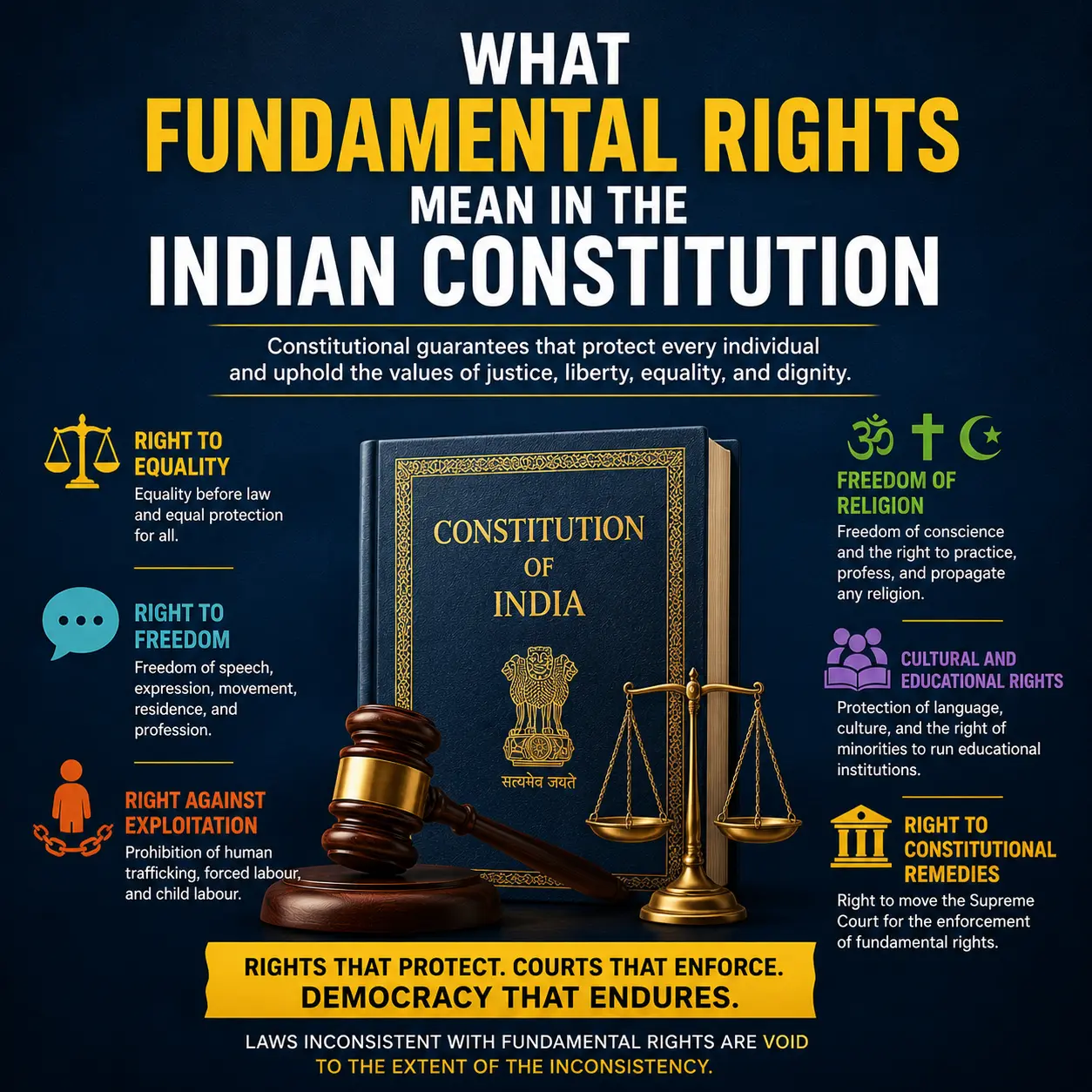
Fundamental Rights are constitutional guarantees that protect people against unfair treatment by the State and, in some situations, against legal systems that would otherwise leave them exposed. In the Indian Constitution, they are placed in Part III and are enforceable through the courts. The Constitution also says that laws inconsistent with these rights are void to the extent of the inconsistency, which gives the chapter real force instead of leaving it as a moral statement only.
The rights in Part III cover a wide area of life. They include equality before law, prohibition of discrimination, freedom of speech and expression, protection of life and personal liberty, freedom of religion, rights of minorities, and the right to constitutional remedies. At one time, they also included the Right to Property, which later changed through a constitutional amendment.
A useful way to think about them is this. A democracy can talk about freedom all day, but without enforceable rights, those promises can vanish the moment power becomes inconvenient. The Indian framers understood that very well. That is why they made the courts part of the rights story from the beginning.
The roots came before 1950
The Constitution did not invent the idea of rights from zero. Long before independence, Indian leaders and constitutional thinkers were already drafting ideas about civil liberties, equality, non-discrimination, speech, education, religious freedom, and social justice. The Commonwealth of India Bill, 1925 included a section on fundamental rights, including elementary education, freedom of expression, gender equality, and non-discrimination. That is important because it shows that rights thinking had already entered Indian political life well before the final Constitution.
The Nehru Report of 1928 also pushed the idea forward. It proposed a constitutional framework with fundamental rights and included a wide range of guarantees, such as equal treatment, civil freedoms, and protections in public life. In the language of that era, it was one of the first serious Indian attempts to imagine a rights-based constitutional order.
Another important step was the Sapru Committee Report of 1945. It is often remembered because it raised, in a serious way, the question of justiciable and non-justiciable rights in Indian constitutional history. That debate mattered a great deal. It forced future drafters to ask a difficult question that still matters today. Which rights should be legally enforceable in court, and which rights should remain as broad social goals?
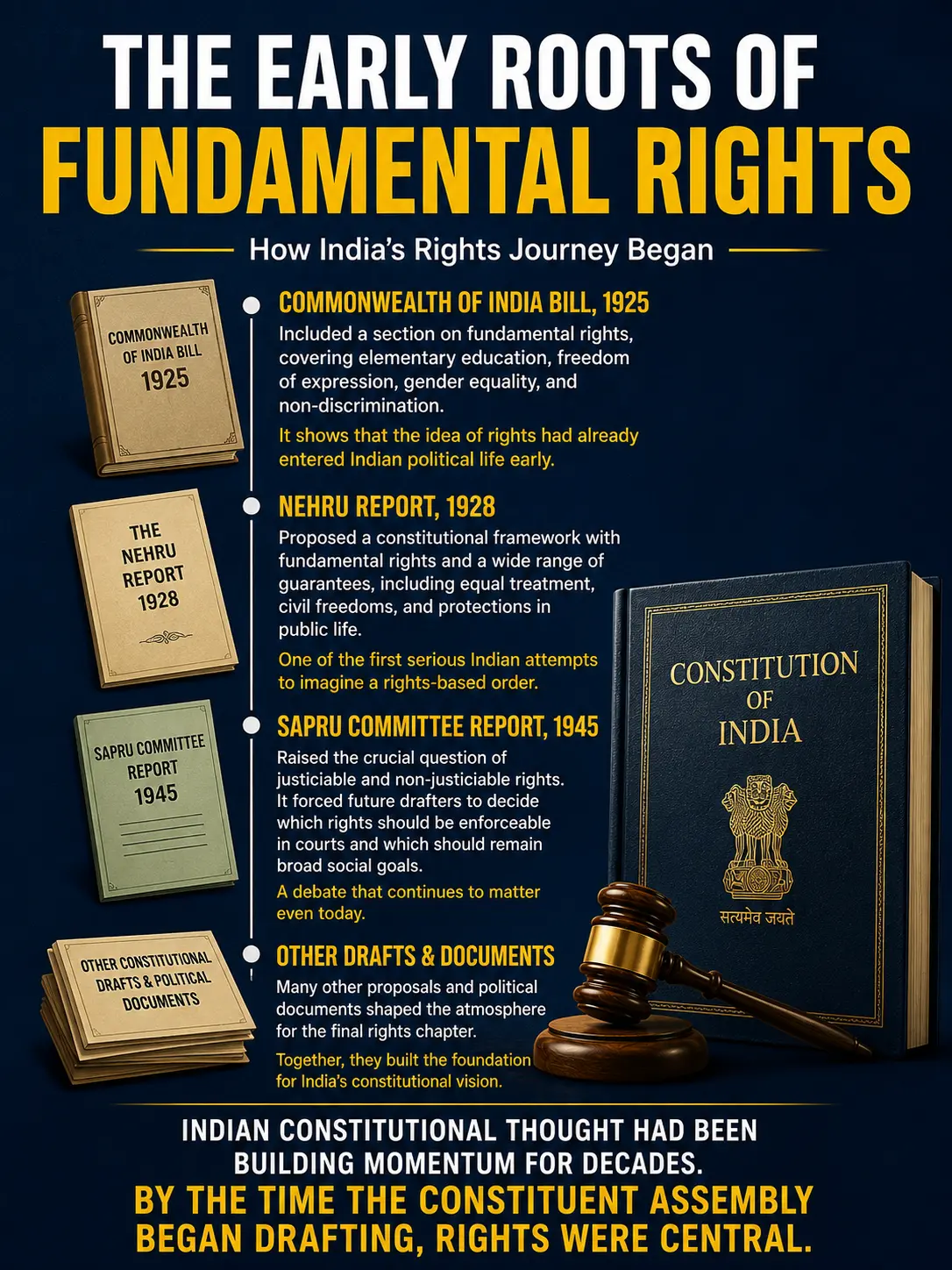
There were also other constitutional drafts and political documents that helped create the atmosphere for the final rights chapter. The important point is not that one document copied another. The important point is that Indian constitutional thought had been building momentum for decades. By the time the Constituent Assembly began serious drafting, rights were no longer a side issue. They were central.
A clear timeline of how Fundamental Rights took shape
The table below shows the long road from early constitutional imagination to the final text of Part III. It is a compact history of how ideas became law.
| Year | Event | Why it mattered |
|---|---|---|
| 1925 | The Commonwealth of India Bill proposed a rights section. | It showed that Indian constitutional thinking had already begun treating rights as central to self-government. |
| 1928 | The Nehru Report called for fundamental rights. | It gave the freedom movement a rights-based constitutional vision. |
| 1945 | The Sapru Committee Report discussed justiciable and non-justiciable rights. | It helped shape the later debate on what should be enforceable in court. |
| 16 May 1946 | The Cabinet Mission Statement called for a preliminary meeting to determine citizens’ and minorities’ rights. | It brought rights directly into the formal constitution-making process. |
| 13 December 1946 | Jawaharlal Nehru introduced the Objectives Resolution. | It set the moral and political foundation for the Constitution, including justice, equality, and freedom. |
| 22 January 1947 | The Objectives Resolution was adopted. | It gave the Assembly a clear constitutional direction. |
| 24 January 1947 | The Advisory Committee on Fundamental Rights, Minorities, and Tribal and Excluded Areas was created. | It formalized the work of designing rights protections. |
| 16 April 1947 | The Report of the Sub-Committee on Fundamental Rights was published. | It was the first major draft of what later became Part III and contained 45 Articles. |
| 4 November 1948 | B.R. Ambedkar presented the Draft Constitution to the Assembly. | This moved rights from committee work into full constitutional debate. |
| 15 November 1948 to 17 October 1949 | The Assembly held the first reading and clause-by-clause debate. | This was the most detailed stage of constitution-making, and Fundamental Rights were heavily discussed. |
| 25, 26, and 29 November 1948 | Article 13 was debated. | It established that existing inconsistent laws would be void to the extent of conflict with Fundamental Rights. |
| 9 December 1948 | Article 32 was debated. | It gave citizens the right to move the Supreme Court for constitutional remedies. |
| 26 January 1950 | The Constitution came into force. | Part III became the living legal shield of the republic. |
| 1951 | The First Amendment inserted Article 31A and Article 31B. | It changed the property-rights balance and protected certain reform laws from being struck down easily. |
| 1967 | Golaknath limited Parliament’s power to amend Fundamental Rights. | It triggered a major constitutional debate about whether rights could be amended at all. |
| 1971 | The Twenty-fourth Amendment strengthened Parliament’s amending power. | It was a direct response to the Golaknath judgment. |
| 1973 | Kesavananda Bharati introduced the basic structure doctrine. | It upheld amendment power but said the Constitution’s basic structure could not be destroyed. |
| 1978 | The Forty-fourth Amendment removed the Right to Property from Part III and placed it under Article 300A. | This changed one of the original Fundamental Rights into a constitutional right. |
That timeline shows something important. Fundamental Rights were not a one-day invention. They were the result of years of argument, drafting, compromise, and legal refinement.
How the Constituent Assembly shaped the rights chapter
Once the Objectives Resolution had been adopted, the Assembly created the Advisory Committee on Fundamental Rights, Minorities, and Tribal and Excluded Areas. That committee then formed a smaller Sub-Committee on Fundamental Rights, chaired by J.B. Kripalani and including members such as B.R. Ambedkar, Hansa Mehta, Alladi Krishnaswami Ayyar, and M.R. Masani. This structure mattered because the Constitution was not drafted by one voice. It was built through a layered process of committees and debates.
The Sub-Committee on Fundamental Rights produced what became the first serious version of the rights chapter. Its report was published on 16 April 1947 and contained 45 Articles, covering equality, freedom, religion, and constitutional remedies. That number is striking because it shows how ambitious the original vision was. The rights chapter was not small or symbolic. It was meant to be broad and powerful from the start.
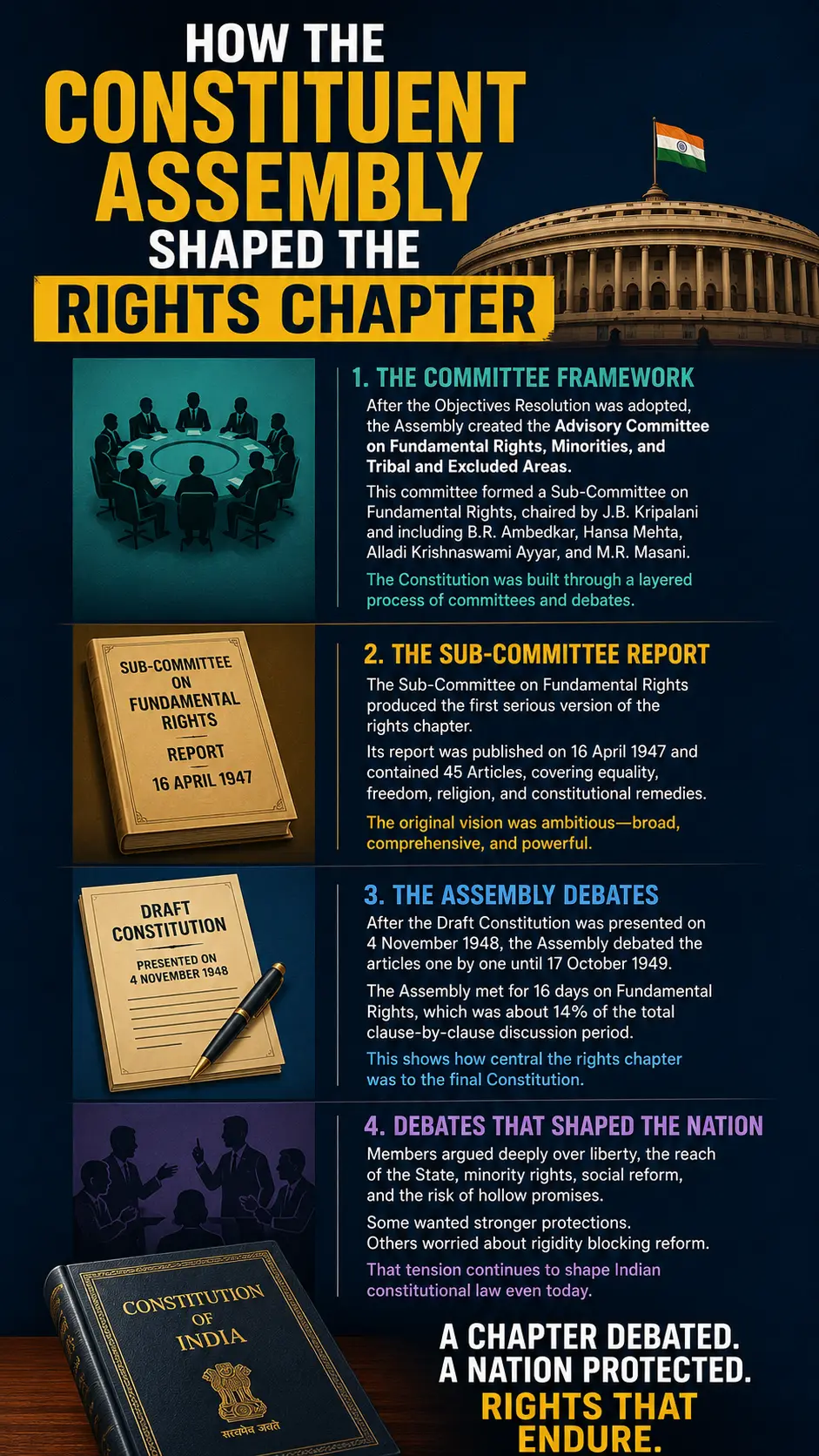
After the Draft Constitution was presented on 4 November 1948, the Assembly entered the hard part. Members debated the articles one by one. This stage lasted until 17 October 1949, and the material on Fundamental Rights took up a significant part of the discussion. The Assembly met for 16 days on Fundamental Rights, which was about 14 percent of the clause-by-clause discussion period. That tells you how central this chapter was to the final Constitution.
The debates were not polite, decorative speeches. Members argued over the meaning of liberty, the reach of the State, the place of minority rights, the future of social reform, and the danger of turning rights into hollow promises. Some wanted stronger protections. Others worried that too much rigidity would block reform. That tension is still visible in Indian constitutional law today.
Why Article 13 became a turning point
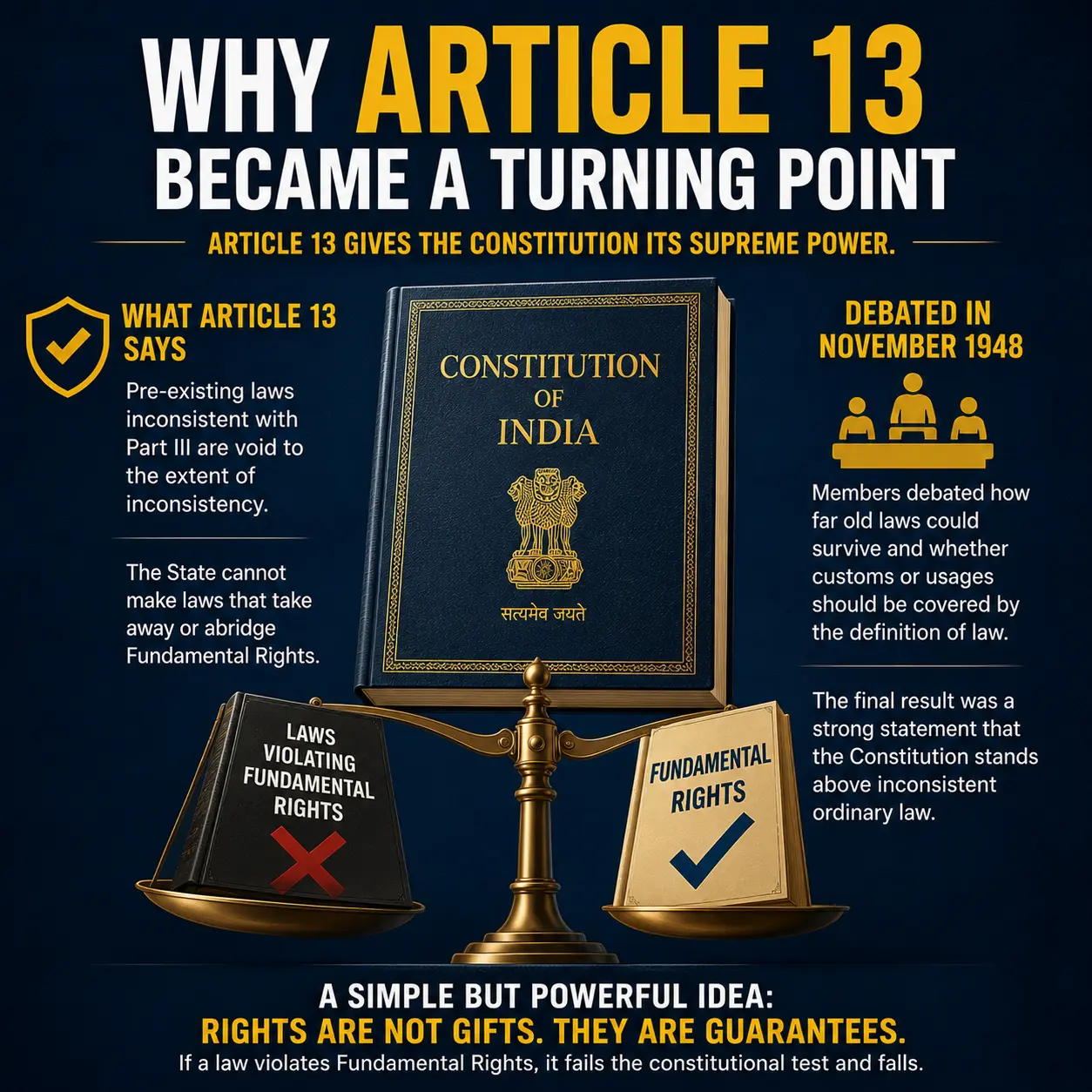
Article 13 is one of the quiet giants of the Constitution. It says that pre-existing laws inconsistent with Part III are void to the extent of inconsistency, and that the State cannot make laws that take away or abridge Fundamental Rights. In plain language, it makes the rights chapter more than an ornament. It gives the chapter legal teeth.
This article was debated in the Constituent Assembly in November 1948. The discussions were about more than technical wording. Members cared about how far old laws could survive in the new republic and whether customs or usages should be covered by the definition of law. The final result was a strong statement that the Constitution would sit above inconsistent ordinary law.
That design choice matters because it tells us what the framers wanted. They did not want rights to depend on the goodwill of future governments. They wanted a constitutional test that laws would have to pass. If they failed that test, they would fall.
Why Article 32 became the soul of enforcement
If Article 13 protects rights by invalidating inconsistent laws, Article 32 protects rights by giving people a direct remedy. It lets citizens approach the Supreme Court when their Fundamental Rights are violated. During the Assembly debate on 9 December 1948, members described this right in powerful terms and treated it as essential to the whole rights system.
This is why Article 32 is often treated as one of the most important provisions in the Constitution. A right without a remedy is often only a promise. The framers understood that, and they made the enforcement mechanism part of the rights chapter itself.
You can see the wisdom of that choice in everyday life. A worker denied equality in public employment, a citizen silenced unlawfully, or a person detained without legal basis does not need a lecture on democracy. They need a remedy. Article 32 exists for that reason.
The six categories of Fundamental Rights
The Constitution organizes Fundamental Rights into broad groups. Each one reflects a different kind of freedom or protection. This structure helps the chapter remain readable while also revealing the philosophy behind it. Rights are not random. They are connected.
| Category | Main Articles | What it protects | Historical meaning |
|---|---|---|---|
| Right to Equality | Articles 14 to 18 | Equality before law, non-discrimination, equal opportunity, abolition of untouchability, abolition of titles | It rejected hereditary privilege and unequal citizenship. |
| Right to Freedom | Articles 19 to 22 | Speech, assembly, association, movement, residence, profession, protection from conviction, life and personal liberty, safeguards against arrest | It built the constitutional space for political and personal liberty. |
| Right against Exploitation | Articles 23 to 24 | Prohibition of trafficking, forced labour, child labour in hazardous work | It responded to the reality that freedom means little if people are trapped in exploitation. |
| Right to Freedom of Religion | Articles 25 to 28 | Freedom of conscience and religion, religious management, freedom from certain taxes and instructions in institutions | It protected India’s plural religious life while preserving constitutional order. |
| Cultural and Educational Rights | Articles 29 to 30 | Protection of minority culture, language, and educational institutions | It recognized that equality also means space for identity and community life. |
| Right to Constitutional Remedies | Article 32 | Right to move the Supreme Court for enforcement of rights | It turns constitutional promises into enforceable law. |
This structure is more than a neat list. It is a theory of citizenship. A citizen must be equal before law, free to speak and move, protected from exploitation, allowed to follow conscience, able to preserve culture, and able to go to court when the State crosses the line. That is the full constitutional picture.
The original shape of the rights chapter was broader than many people remember
The early drafts were ambitious. The Draft Constitution of India, 1948 included rights to equality, freedom, and religion, as well as constitutional remedies, and the broader drafting process also addressed property rights and social reform. The original rights framework was not limited to what many people now casually call civil liberties. It tried to balance liberty with social justice.
That balance is one reason the Indian Constitution is so interesting. It protects individual dignity, but it also leaves space for the State to pursue reforms that may restrict some forms of private power. The tension between freedom and reform was not an accident. It was built into the Constitution from the beginning.
For example, the early constitutional treatment of property included safeguards against arbitrary deprivation and acquisition without compensation. At the same time, Indian leaders were already debating land reform, social equity, and the need to reduce historic inequality. This is one reason the property right later became one of the most contested parts of Part III.
The property-rights debate was one of the biggest early tensions
In the original Constitution, the Right to Property was a Fundamental Right under Article 31, and Article 19(1)(f) also protected the right to acquire, hold, and dispose of property. The framers debated this issue intensely because property touched land reform, compensation, agrarian change, and the future shape of economic justice.
Soon after independence, Parliament moved to protect certain reform laws through Article 31A and Article 31B, both inserted by the First Amendment Act, 1951. Article 31A protected certain laws dealing with acquisition of estates and related reforms, while Article 31B and the Ninth Schedule helped shield listed laws from being invalidated for conflict with Fundamental Rights. This was a major constitutional response to the challenge of balancing rights with social and economic reform.
Then came a larger shift. The Forty-fourth Amendment Act, 1978 removed the Right to Property as a Fundamental Right and placed it under Article 300A as a constitutional right. In other words, it remained protected, but it no longer sat inside Part III. That change shows how living constitutions evolve when the country’s legal and political priorities change.
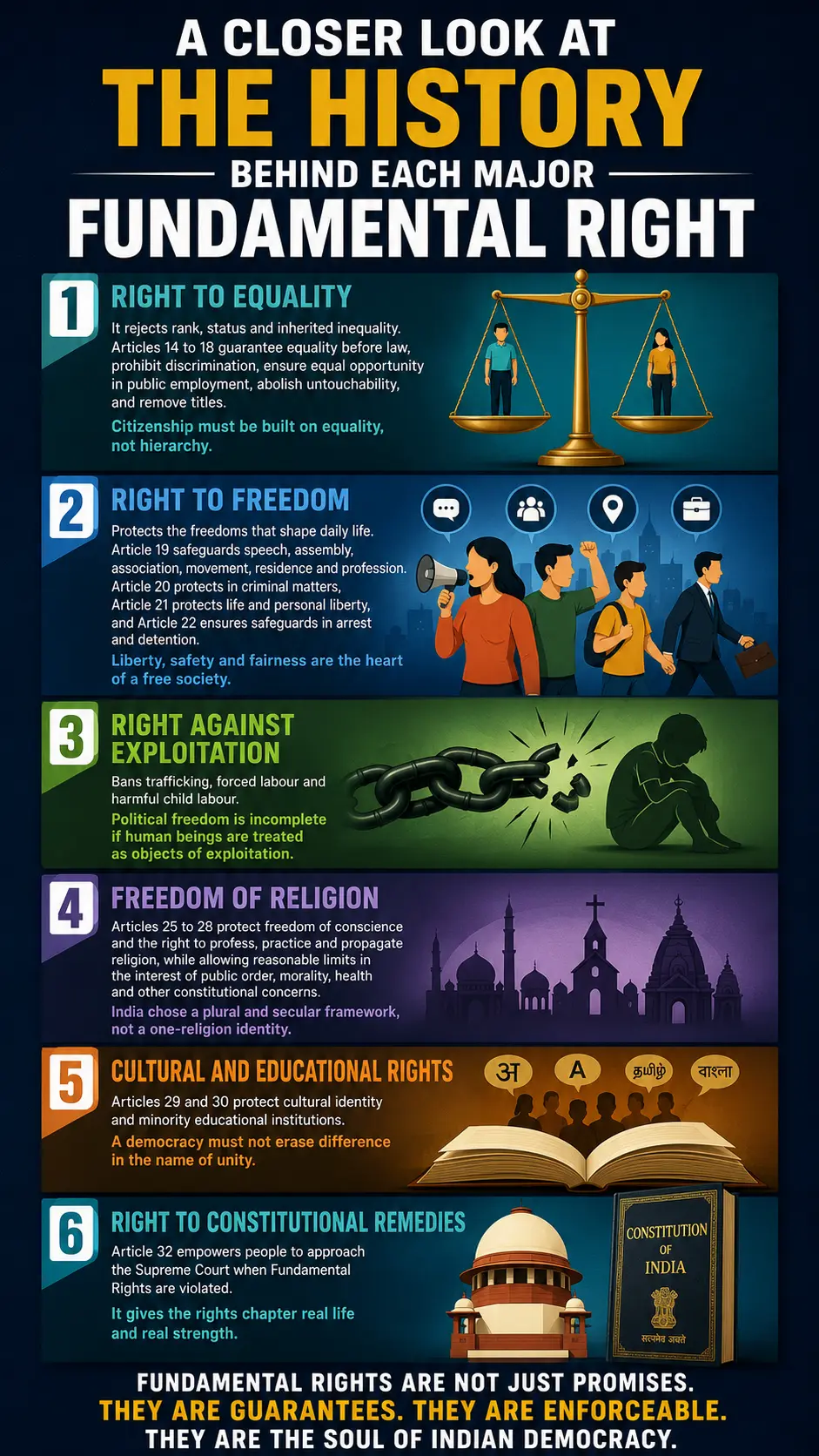
A closer look at the history behind each major right
1. Right to Equality
The Right to Equality was one of the most morally important parts of the Constitution. It rejected the old logic of rank, status, privilege, and inherited inequality. Article 14 guarantees equality before law and equal protection of laws. Articles 15 and 16 prohibit discrimination and support equal opportunity in public employment. Article 17 abolishes untouchability. Article 18 abolishes titles. Together, these provisions tell the State that citizenship must be built on equality, not hierarchy.
A simple example helps. If a public authority treats two people differently just because of caste, religion, sex, or place of birth, the equality chapter gives the injured person a constitutional claim. That is not a small thing in a country as diverse as India. It is one of the basic conditions of democratic legitimacy.
2. Right to Freedom
The Right to Freedom is the most visible face of liberty in the Constitution. Article 19 protects speech, peaceful assembly, association, movement, residence, and profession. Article 20 protects people from retrospective criminal punishment, double jeopardy, and self-incrimination. Article 21 protects life and personal liberty, and Article 22 provides safeguards against arrest and detention in certain cases.
This matters in daily life more than people often realize. A journalist depends on speech. A worker depends on movement and profession. A student depends on liberty and safety. A person facing arrest depends on procedural fairness. The freedom chapter protects all of these situations in different ways.
3. Right against Exploitation
The Right against Exploitation is short, but its moral force is huge. It bans trafficking, forced labour, and harmful child labour. This right reflects a simple truth. Political freedom is incomplete if human beings are still treated like things to be bought, sold, or coerced.
That is why this part of the Constitution belongs in the same chapter as speech and equality. The framers understood that exploitation is not just an economic issue. It is a constitutional issue.
4. Freedom of Religion
The religion chapter, especially Articles 25 to 28, tries to balance individual conscience, community practice, and constitutional order. It protects freedom of conscience and the right to profess, practice, and propagate religion, while also setting limits where public order, morality, health, and other constitutional concerns apply.
This section is historically important because India did not choose a one-religion constitutional identity. It chose a plural framework. That choice was shaped by the country’s diversity and by the Assembly’s serious concern for religious freedom and minority security.
5. Cultural and Educational Rights
Articles 29 and 30 protect cultural identity and minority educational institutions. This was not a decorative add-on. It was a practical response to the fear that majorities could overwhelm minority language, culture, or education systems. The Constitution recognized that a democracy must not erase difference in the name of unity.
For a worldwide reader, this is one of the most thoughtful features of the Indian model. It says that equal citizenship does not require cultural sameness. People can belong to the same constitutional order and still preserve different languages, faiths, and traditions.
6. Right to Constitutional Remedies
Article 32 is often described as the enforcement mechanism of the rights chapter. It gives people the ability to go to the Supreme Court for relief when Fundamental Rights are violated. Without this, the rest of Part III would be much weaker.
This is one reason the rights chapter feels alive. It is not just about what the Constitution says. It is about what people can actually do when power crosses the line.
Landmark constitutional shifts after 1950
The years after 1950 showed that Fundamental Rights would not remain frozen in the text. They would be interpreted, tested, amended, and sometimes fought over in court. One early conflict concerned whether Parliament could amend Fundamental Rights at all. The Golaknath case of 1967 limited Parliament’s power in this area, which triggered a legislative response through the Twenty-fourth Amendment Act, 1971.
Then came Kesavananda Bharati v. State of Kerala in 1973. The Supreme Court upheld Parliament’s power to amend the Constitution, including Fundamental Rights, but also held that Parliament could not destroy the basic structure of the Constitution. That case changed Indian constitutional law forever. It became the main answer to the question of whether rights could be amended out of existence. The answer was no, not if the amendment damaged the Constitution’s basic identity.
The property-rights change in 1978 is another reminder that the Constitution keeps moving. When the Forty-fourth Amendment removed property from Part III and made it a constitutional right under Article 300A, it did not erase protection. It changed the level and style of protection. That distinction matters, especially in a legal system that tries to balance public reform with private rights.
A second table on the rights and their historical meaning
This table connects the constitutional articles to the deeper historical purpose behind them. It is useful because the articles are short, but the ideas behind them are large.
| Article / Group | What it says in practice | Historical reason it mattered | Everyday example |
|---|---|---|---|
| Article 14 | The State cannot deny equality before law or equal protection of the law. | It ended the idea that some people should matter more than others in law. | A local authority cannot treat two similar applicants differently without a lawful reason. |
| Articles 15 and 16 | No discrimination and equal opportunity in public employment. | It tried to prevent caste, religion, sex, and place of birth from deciding access to public life. | A qualified applicant should not be excluded from a job because of identity alone. |
| Article 17 | Abolishes untouchability. | It was a direct constitutional attack on one of the harshest social injustices in Indian society. | A person cannot be denied access to a public space based on untouchability. |
| Article 19 | Protects speech, movement, assembly, association, residence, and profession. | It gave democracy its public voice and protected civic participation. | A citizen can speak, gather, and choose a profession within constitutional limits. |
| Article 21 | Protects life and personal liberty. | It became one of the most powerful rights because it guards the person against state abuse. | A person cannot be deprived of liberty without lawful procedure. |
| Articles 25 to 28 | Freedom of religion and related protections. | It reflected India’s plural society and the need for peaceful coexistence. | A person can follow a faith without unwanted state interference, subject to constitutional limits. |
| Article 29 and 30 | Protects culture, language, and minority institutions. | It protects identity without turning citizenship into uniformity. | A minority community can run an educational institution within constitutional limits. |
| Article 32 | Remedy before the Supreme Court. | It made rights enforceable, not merely aspirational. | A citizen can ask the highest court to protect a violated right. |
What the debates really revealed
The Assembly debates reveal a Constitution under construction, not a finished monument being polished for ceremony. Members worried about exceptions, state power, social reform, minority safety, and whether rights would be too strong or too weak. Some thought the chapter was too strict. Others thought it was not strict enough. That is what serious constitution-making looks like.
One important theme was the difference between rights as ideals and rights as enforceable law. The Assembly was willing to protect rights, but it also knew that some rights would have to coexist with practical governance and social change. That tension explains why the Constitution contains both strong rights and carefully drafted exceptions or limitations.
Another theme was dignity. Even when the members were discussing technical language, the deeper concern was human dignity. The Constitution was not meant to create passive subjects. It was meant to create citizens. That shift from subjecthood to citizenship is one of the greatest historical transformations in modern Indian law.
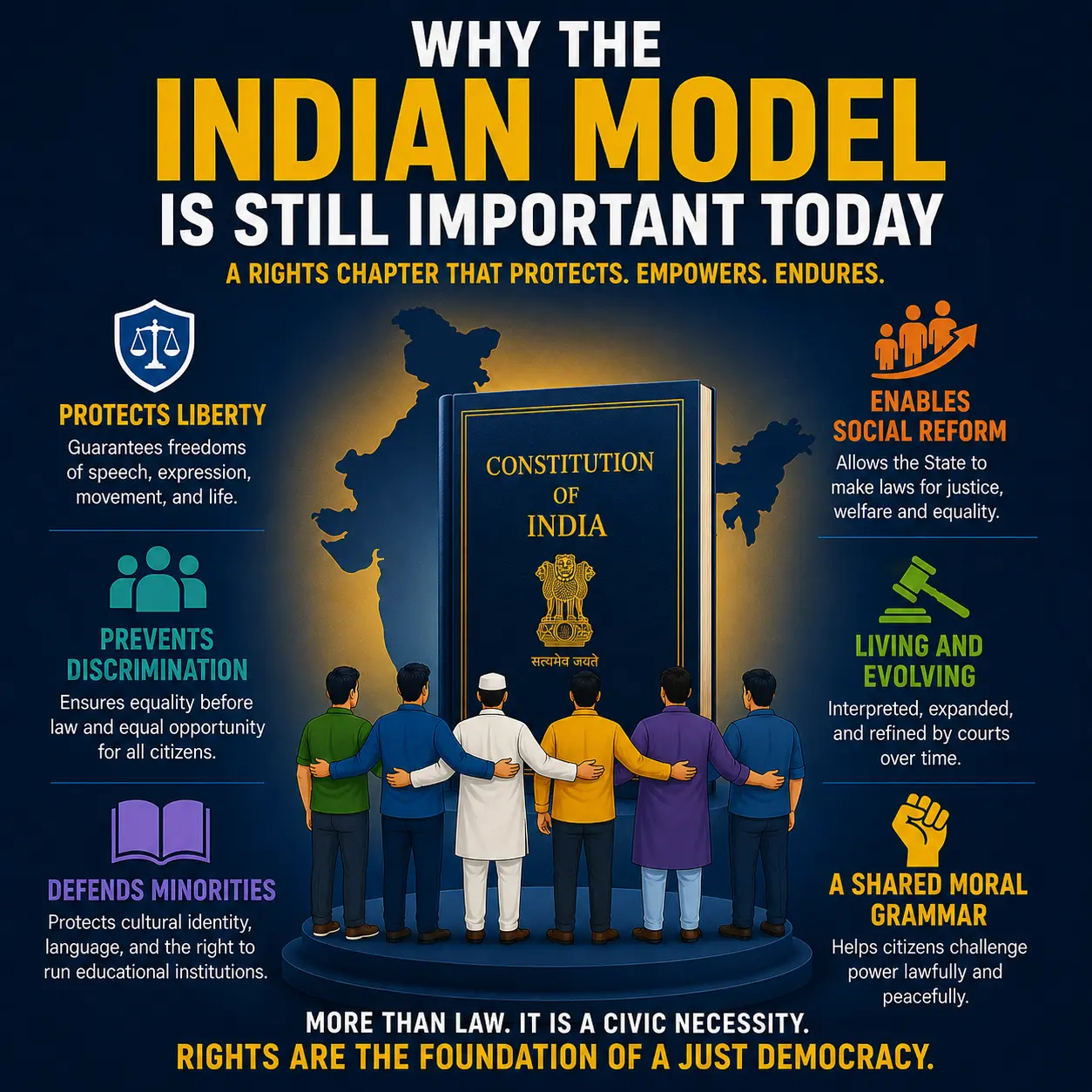
Why the Indian model is still important today
The history of Fundamental Rights in India matters globally because it shows how a constitution can try to do several things at once. It can protect liberty, prevent discrimination, defend minorities, and still make space for social reform. Many constitutions do parts of this. India tried to do all of it in one rights chapter, inside a country with extraordinary linguistic, religious, social, and economic diversity.
That is why the Indian rights story is often studied not just as a national legal history, but as a major democratic experiment. It shows that constitutional rights are not only about limiting government. They are also about giving a society a shared moral grammar. When rights are written well, they teach a nation how to argue with power lawfully.
It also shows that constitutions are living documents. The text of Part III has changed over time. The property right moved. New debates came in. Courts expanded some meanings and narrowed others. But the basic idea remained steady. The individual must have constitutional protection against the abuse of public power. That idea has survived because it is more than legal theory. It is a civic necessity.
Some practical examples that make the history easier to understand
A student who speaks against unfair campus rules depends on Article 19. A worker who is denied equal treatment because of caste depends on Articles 14 to 16. A person wrongfully detained depends on Article 21 and Article 22. A minority-run school depends on Articles 29 and 30. And if the government crosses the line, the person can knock on the door of the courts under Article 32. That is how the historical design becomes daily constitutional life.
This is also why the rights chapter is still so relevant in modern debates about privacy, speech, arrests, discrimination, and digital freedom. The wording may be old, but the principles remain active because they answer timeless questions about power and personhood.
The deeper lesson hidden in the history
The history of Fundamental Rights in the Indian Constitution teaches a simple but powerful lesson. Freedom is not safe just because a nation declares itself free. It becomes safe when the Constitution gives people enforceable protections, when courts can check the State, and when society accepts that equality is not a favor but a right.
It also teaches that rights are never entirely separate from social reality. Untouchability, land reform, religious diversity, minority fears, speech, and personal liberty were all part of the same conversation. That is why Part III feels so alive even today. It was built from real conflicts, real hopes, and real compromises.
And that is the most honest way to read the history. The Fundamental Rights chapter is not only a legal chapter. It is a political memory of how India chose to organize freedom, justice, and dignity in one constitutional frame.
Closing Thoughts
When people ask why the Indian Constitution is so respected, the answer often begins with Fundamental Rights. They are the part of the Constitution that most directly touches everyday life. They protect speech, equality, liberty, religion, culture, and access to justice. But their real power comes from their history. They were born out of debate, shaped by struggle, and tested by time.
So the history of Fundamental Rights is not a side story. It is one of the main stories of Indian constitutionalism. It shows how a free nation tried to make freedom real, how a diverse society tried to write fairness into law, and how a Constitution can still stand as a living promise to ordinary people.
Article References and Citations
- The Constitution of India (Official PDF)
- Part III of the Constitution of India: Fundamental Rights
- Article 13: Laws Inconsistent with Fundamental Rights
- Article 32: Constitutional Remedies
- Supreme Court of India: Jurisdiction and Fundamental Rights
- Commonwealth of India Bill (1925)
- Nehru Report (1928)
- Sapru Committee Report (1945)
- Objectives Resolution and Constitution Making Process
- Advisory Committee on Fundamental Rights, Minorities and Tribal Areas
- Draft Constitution of India (1948)
- Stages of Constitution Making in India
- Article 31A and Land Reform Protections
- Right to Property under the Constitution
- Article 368: Amendment of the Constitution
- Article 32 of the Constitution of India
- Constitutional Remedies under Articles 32 and 226
- Judicial Review and Constitutional Adjudication
- Constitutional Remedies in India
- Right to Constitutional Remedies Study Material
Frequently Asked Questions
FAQ 1. What is the history of Fundamental Rights in the Indian Constitution?
The history of Fundamental Rights in the Indian Constitution is the story of how India turned the idea of liberty into a legal promise. It did not begin on 26 January 1950 all of a sudden. It grew slowly through political debate, constitutional drafting, and public demand for freedom, equality, and dignity. Long before the Constitution came into force, Indian leaders were already thinking about rights like freedom of speech, equality before law, religious liberty, and protection from exploitation.
The earliest roots can be seen in constitutional ideas from the 1920s and 1940s, especially in documents like the Commonwealth of India Bill, 1925, the Nehru Report, 1928, and the Sapru Committee Report, 1945. These early efforts helped shape the final rights chapter in the Constitution. Later, the Constituent Assembly worked through detailed debates and committee reports, especially after the Objectives Resolution and the work of the Advisory Committee on Fundamental Rights.
By the time the Constitution was adopted, Part III had become one of its strongest features. It included rights that protect individuals from unfair state power and gave them the right to go to court when those rights are violated. That is why the history of Fundamental Rights is not just a legal timeline. It is also a story of how India tried to create a democratic society based on justice, liberty, equality, and fraternity. In simple words, these rights are the constitutional shield that protects ordinary people in daily life.
FAQ 2. Why are Fundamental Rights so important in the Indian Constitution?
Fundamental Rights are important because they protect people from abuse, discrimination, and unfair treatment. They are not just nice ideas written in a book. They are enforceable rights, which means people can use them in court when the State or another authority crosses the line. This makes them one of the most powerful parts of the Constitution.
These rights matter because democracy is not only about elections. It is also about whether people can speak freely, live with dignity, follow their religion, move without fear, and receive equal treatment. Without Fundamental Rights, a government could become too powerful and ordinary people would have very little protection. That would weaken democracy very quickly.
The Constitution gives rights in areas such as equality, freedom, religion, protection from exploitation, cultural rights, and constitutional remedies. Together, these rights build a strong legal environment where citizens are not treated like subjects. They are treated like holders of constitutional dignity. That is a huge difference. It means the State has power, but that power has limits. And those limits are not vague moral suggestions. They are legal rules backed by the courts.
FAQ 3. What were the main sources that influenced Fundamental Rights in India?
The Fundamental Rights chapter was shaped by several important sources. It was not copied from one single model. Instead, it grew from Indian political experience, constitutional thought, and a long struggle for self-rule. One of the earliest influences was the Commonwealth of India Bill, 1925, which included many rights-based ideas. Then came the Nehru Report, 1928, which also proposed a rights framework for India.
Another major influence was the Sapru Committee Report, 1945, which helped clarify the difference between justiciable rights and non-justiciable rights. This was important because it forced constitutional thinkers to ask which rights should be enforceable in court and which should remain broader social goals. Later, the Objectives Resolution introduced by Jawaharlal Nehru gave the Constitution a strong moral direction by promising justice, liberty, equality, and fraternity.
The final shape of Fundamental Rights came through the Constituent Assembly debates, the committee work on rights, and the Draft Constitution of 1948. These sources together created a rights chapter that was practical, ambitious, and deeply tied to India’s social reality. So, the history of Fundamental Rights is really a history of ideas coming together over time, not a single event. It was a long constitutional journey.
FAQ 4. How did the Constituent Assembly decide the structure of Fundamental Rights?
The Constituent Assembly did not decide the structure of Fundamental Rights in one sitting. It followed a careful process. First, the Assembly created the Advisory Committee on Fundamental Rights, Minorities, and Tribal and Excluded Areas. This committee then formed a Sub-Committee on Fundamental Rights, which drafted the first detailed version of the rights chapter. That draft contained 45 Articles, which shows how broad and serious the original vision was.
The Assembly then discussed the draft in detail. These debates were not formalities. Members discussed the balance between liberty and social reform, the role of the State, and the protection of minorities. Some members wanted stronger rights. Others were worried that too much rigidity might block necessary reforms. The final structure that emerged was a compromise, but it was a thoughtful one. It aimed to protect people while also allowing the country to grow and reform itself.
This is why the rights chapter is divided into clear groups. You have Right to Equality, Right to Freedom, Right against Exploitation, Freedom of Religion, Cultural and Educational Rights, and Right to Constitutional Remedies. Each section has its own purpose, but all of them work together. The structure is simple enough for citizens to understand, but strong enough to protect them in real life. That balance is one of the biggest achievements of the Assembly.
FAQ 5. What is Article 13 and why is it important in the history of Fundamental Rights?
Article 13 is very important because it gives real strength to Fundamental Rights. It says that any law that is inconsistent with the rights in Part III is void to the extent of that inconsistency. In simple language, if a law violates Fundamental Rights, the Constitution wins. That is a powerful rule.
This article matters historically because it stopped the rights chapter from becoming just a statement of ideals. Without Article 13, Parliament or other law-making bodies could create laws that ignore rights and still expect them to operate normally. But Article 13 makes sure that does not happen. It creates a direct constitutional test for laws. If a law violates rights, courts can strike it down or limit its effect.
The article was debated during the Constituent Assembly in November 1948. Members understood that if Fundamental Rights were going to matter, there had to be a legal mechanism to protect them. Article 13 gave exactly that. It made the Constitution supreme over conflicting laws and helped establish judicial review as a core part of Indian constitutionalism. So, when people talk about the strength of Fundamental Rights, Article 13 is one of the first provisions that should come to mind.
FAQ 6. Why is Article 32 called the heart of Fundamental Rights?
Article 32 is often called the heart of Fundamental Rights because it gives people the right to go directly to the Supreme Court when their rights are violated. This is not a minor legal detail. It is one of the main reasons Fundamental Rights are enforceable and meaningful. A right without a remedy is often just a promise. Article 32 changes that.
Historically, the framers of the Constitution understood that rights must have a protection mechanism. They did not want citizens to depend only on political goodwill or slow administrative processes. They wanted a constitutional remedy. That is why Article 32 became such a central part of the rights chapter. It gives people direct access to justice when the State oversteps its limits.
This article is also important because it supports the entire rights framework. If equality is violated, if speech is suppressed, if liberty is taken away, or if religion is interfered with unfairly, Article 32 offers a constitutional path to challenge it. That is why it has such symbolic and practical importance. It connects the text of the Constitution to the lived reality of justice. And that is exactly what makes it one of the most respected provisions in Indian constitutional law.
FAQ 7. How did the Right to Property change over time in India?
The Right to Property had a very interesting constitutional history. In the original Constitution, it was a Fundamental Right. It was protected under Article 19(1)(f) and Article 31. This meant that people had strong constitutional protection for owning, holding, and dealing with property. But India was also trying to carry out land reform and social change after independence, so this right became a major point of tension.
To support reforms, the First Amendment Act, 1951 added Article 31A and Article 31B, along with the Ninth Schedule. These provisions protected certain laws from being easily struck down for violating Fundamental Rights. The idea was to make land reform and other social reforms possible without being blocked by property-rights challenges at every step.
Then, in 1978, the Forty-fourth Amendment removed the Right to Property from Part III and placed it under Article 300A as a constitutional right instead of a Fundamental Right. That was a major change. It did not erase protection altogether, but it changed its legal status. This shows how the Constitution adapts over time. The history of the Right to Property is a good example of how India tried to balance individual rights with larger social goals.
FAQ 8. What are the six main types of Fundamental Rights in the Indian Constitution?
The Indian Constitution groups Fundamental Rights into six main types, and each one protects a different part of democratic life. First is the Right to Equality, which includes Articles 14 to 18. It protects equality before law, bans discrimination, abolishes untouchability, and rejects titles that create unnecessary status differences.
Second is the Right to Freedom, covered by Articles 19 to 22. This gives people freedom of speech, movement, residence, profession, and assembly, along with protection of life and personal liberty. Third is the Right against Exploitation, which includes Articles 23 and 24. These provisions ban trafficking, forced labour, and harmful child labour.
Fourth is the Right to Freedom of Religion, found in Articles 25 to 28. This protects conscience, religious practice, and related freedoms. Fifth is the Cultural and Educational Rights section, under Articles 29 and 30. These rights protect minority language, culture, and educational institutions. Finally, there is the Right to Constitutional Remedies, under Article 32, which allows people to go to the courts for enforcement of their rights.
Together, these six groups form the heart of Part III. They are not isolated rules. They are a complete constitutional system for human dignity, equality, and freedom.
FAQ 9. How did Fundamental Rights help shape democracy in India?
Fundamental Rights helped shape democracy in India by making sure that government power would not be absolute. Democracy is not only about choosing leaders. It is also about protecting citizens after those leaders come to power. Rights make that possible. They create a constitutional boundary that the State must respect.
The rights chapter protects speech, equality, personal liberty, religion, and access to courts. That means citizens can participate in public life without being crushed by fear or discrimination. A person can speak against injustice, move freely, work in a chosen profession, follow a faith, and defend their dignity in court. That is what makes democracy real instead of symbolic.
The history of Fundamental Rights also shows that the framers understood India’s diversity. They knew the country needed a Constitution that could protect different communities, languages, beliefs, and social groups. So, these rights were not written only to stop abuse. They were also written to make the republic inclusive. In that sense, Fundamental Rights are not just legal protections. They are the foundation of democratic citizenship in India.
FAQ 10. Why is the history of Fundamental Rights still relevant today?
The history of Fundamental Rights is still relevant because the same questions continue to matter today. How much power should the State have? When does security become overreach? How do we protect speech, equality, privacy, religion, and dignity in a changing society? These are not old questions. They are daily constitutional questions.
The history matters because it reminds us that rights were not handed down casually. They were argued over, shaped carefully, and protected through law. That history gives the rights chapter depth. It explains why provisions like Article 14, Article 19, Article 21, and Article 32 continue to matter in courts, public debate, and everyday life. When people face discrimination, detention, censorship, or unfair treatment, they are using a framework built through this long constitutional history.
And there is another reason it remains important. The Constitution is still a living document. Its meaning grows through interpretation, amendment, and public use. So the history of Fundamental Rights is not just about the past. It also tells us how to read the present. It shows that rights are not decorations. They are the living promise of the Indian republic.
