

Fundamental Rights are not just lines printed in the Constitution. They are the everyday shield that protects dignity, liberty, equality, and fair treatment. In India, these rights are placed in Part III of the Constitution, across Articles 12 to 35, and they form one of the most important pillars of constitutional democracy. The Constitution of India was adopted on 26 November 1949 and came into force on 26 January 1950, and from the start it was built around the idea that citizens should not be left at the mercy of power.
What makes these rights so powerful is that they are not abstract ideals. They affect daily life. They decide whether a person can speak freely, live with dignity, move without fear, follow a religion peacefully, study without discrimination, and challenge unfair treatment in court. The Constitution also makes it clear that laws inconsistent with Fundamental Rights can be void, which means these rights are not decorative promises. They have legal force.
Table of Contents
What Fundamental Rights Really Mean
Fundamental Rights are the basic protections guaranteed by the Constitution. They are called “fundamental” because without them, democratic life becomes fragile. A person may have a vote, but without freedom of speech, equality before law, or protection from unlawful detention, that vote would not mean very much in real life. The Constitution itself places these rights in a separate part and provides a direct remedy for their enforcement.
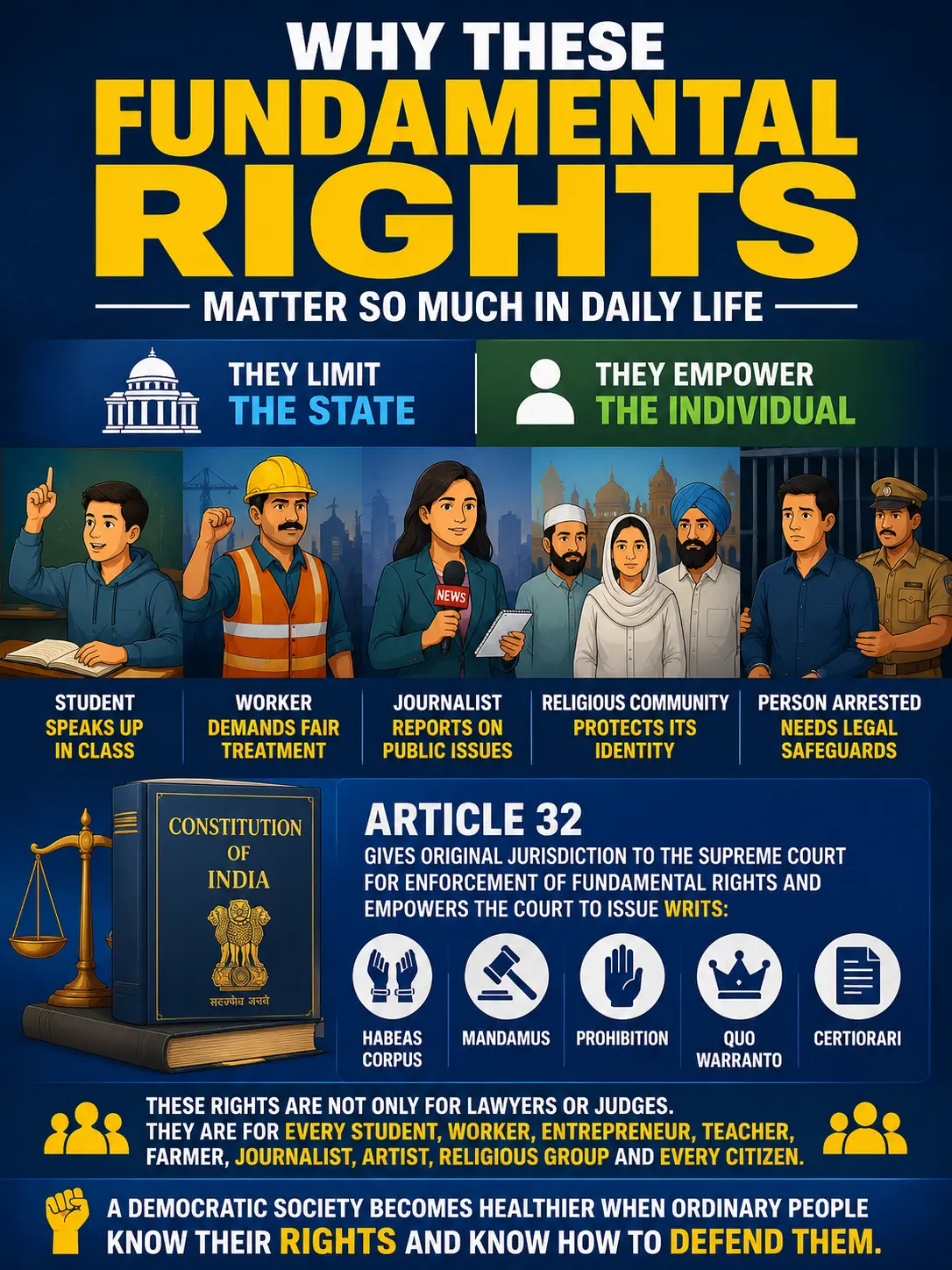
These rights matter for two reasons. First, they limit the State. Second, they empower the individual. In other words, they tell the government what it cannot do, and they tell the citizen what cannot be taken away without lawful justification. That balance is one of the strongest features of Indian constitutionalism.
Why These Rights Matter So Much in Daily Life
For many people, constitutional language can feel distant. But the truth is, Fundamental Rights are present in ordinary moments of life. They matter when a student speaks up in class, when a worker demands fair treatment, when a journalist reports on public issues, when a religious community protects its identity, or when a person is arrested and needs legal safeguards. The Supreme Court of India explains that Article 32 gives original jurisdiction for enforcement of Fundamental Rights and empowers the Court to issue writs such as habeas corpus, mandamus, prohibition, quo warranto, and certiorari.
That is why these rights are not only for lawyers or judges. They are for students, workers, entrepreneurs, teachers, farmers, journalists, artists, religious groups, and every person who wants to live with fairness and self-respect. A democratic society becomes healthier when ordinary people know they have rights and know how to defend them.
The Six Main Fundamental Rights in India
The Constitution classifies Fundamental Rights into six broad groups. Each one protects a different part of life, and together they create a complete system of liberty and justice.
| Category | Key Articles | What It Protects | Why It Matters | Simple Example |
|---|---|---|---|---|
| Right to Equality | Articles 14 to 18 | Equality before law, non-discrimination, equal opportunity in public employment, abolition of untouchability, and abolition of titles | Stops discrimination and builds a fair society | A school cannot treat a child unfairly because of caste, sex, religion, or place of birth |
| Right to Freedom | Articles 19 to 22 | Speech, assembly, association, movement, residence, profession, protection in criminal matters, life and personal liberty, education, and safeguards against arrest and detention | Protects personal freedom and democratic participation | A citizen can express an opinion peacefully and cannot be detained without lawful procedure |
| Right against Exploitation | Articles 23 to 24 | Ban on trafficking, forced labour, begar, and child labour in factories and hazardous work | Protects people from abuse and forced work | A child cannot be made to work in dangerous factory conditions |
| Right to Freedom of Religion | Articles 25 to 28 | Freedom of conscience, religion, religious practice, religious management, tax neutrality, and protection in educational institutions | Preserves religious liberty and peace | A person may follow their faith without coercion, subject to public order, morality, and health |
| Cultural and Educational Rights | Articles 29 to 30 | Protection of minority interests and the right of minorities to establish and administer educational institutions | Protects diversity and minority identity | A linguistic minority can protect its language and run its own institution |
| Right to Constitutional Remedies | Article 32 | Direct access to the Supreme Court for enforcement of Fundamental Rights | Makes rights real, not symbolic | A person can approach the Court if a right is violated |
The Right to Equality Creates the First Layer of Fairness
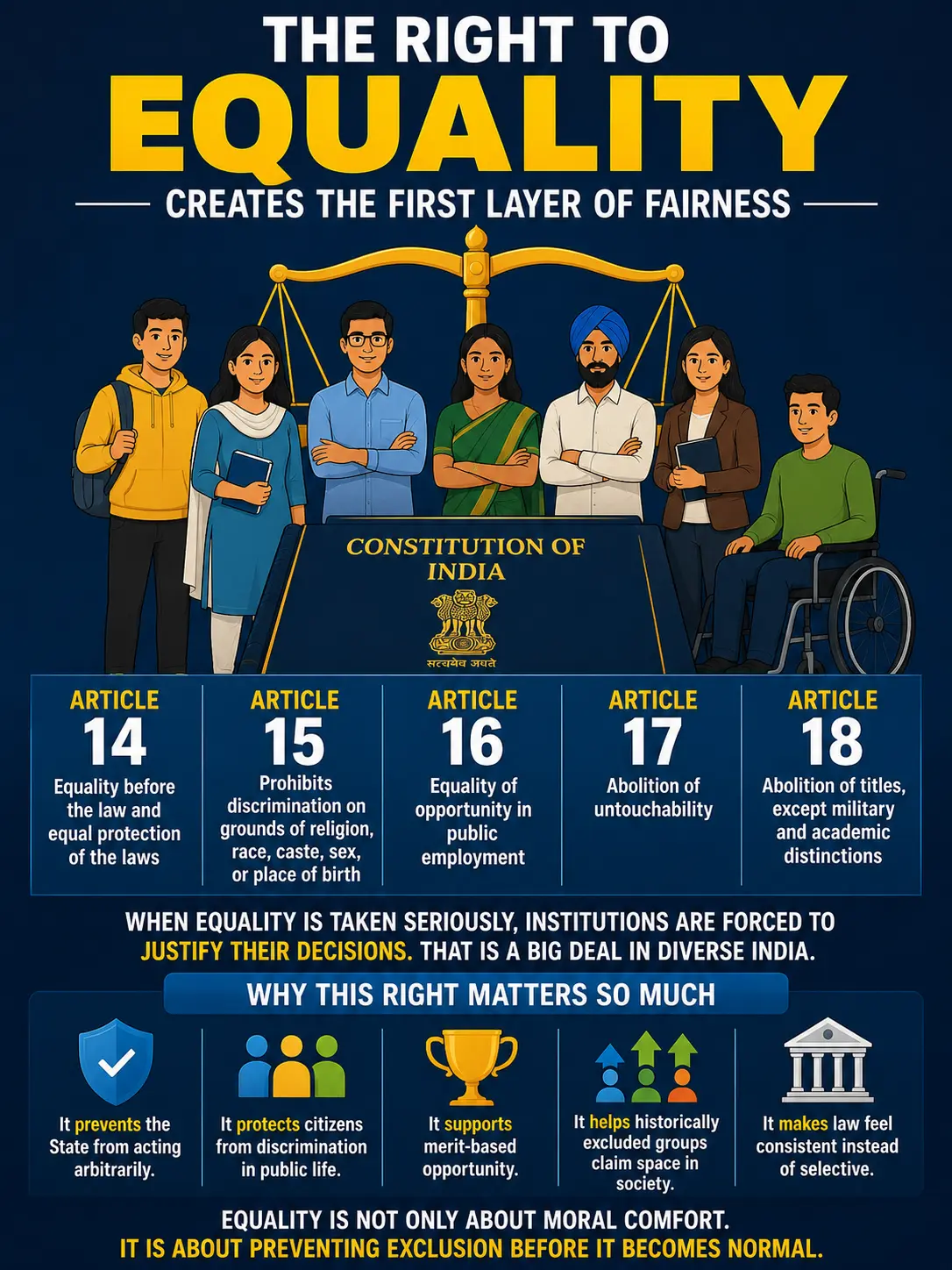
The Right to Equality is one of the clearest signs that the Constitution rejects privilege based on birth. Article 14 says the State shall not deny to any person equality before the law or equal protection of the laws. Article 15 prohibits discrimination on grounds of religion, race, caste, sex, or place of birth. Article 16 speaks about equality of opportunity in public employment. Article 17 abolishes untouchability. Article 18 abolishes titles, except military and academic distinctions.
This is important because inequality often hides itself inside everyday systems. It appears in admission procedures, hiring decisions, social attitudes, housing access, and public services. When equality is taken seriously, institutions are forced to justify their decisions. That is a big deal in a country as large and diverse as India. Equality is not only about moral comfort. It is about preventing exclusion before it becomes normal.
A few practical points show why this right matters so much:
- It prevents the State from acting arbitrarily.
- It protects citizens from discrimination in public life.
- It supports merit-based opportunity.
- It helps historically excluded groups claim space in society.
- It makes law feel consistent instead of selective.
The Right to Freedom Protects the Inner Life of Democracy
The Right to Freedom is where democratic life becomes visible. Article 19 protects speech and expression, peaceful assembly, association, movement, residence, and profession. Article 20 protects people in criminal matters. Article 21 protects life and personal liberty. Article 21A guarantees free and compulsory education for children aged 6 to 14 years. Article 22 provides safeguards in cases of arrest and detention.
This cluster of rights is powerful because it touches both public participation and personal safety. A democracy cannot function well if people are afraid to speak. It also cannot function well if people can be arrested casually, silenced cheaply, or trapped in abusive conditions. The constitutional text is built to prevent exactly that.
Think about what these freedoms do in real life. A journalist can ask hard questions. A worker can join a union. A student can start a discussion group. A business owner can carry on a lawful profession. A person can travel and settle within India, subject to lawful restrictions. These are not luxuries. They are the oxygen of modern citizenship.

Freedom of Speech Is One of the Most Valuable Rights
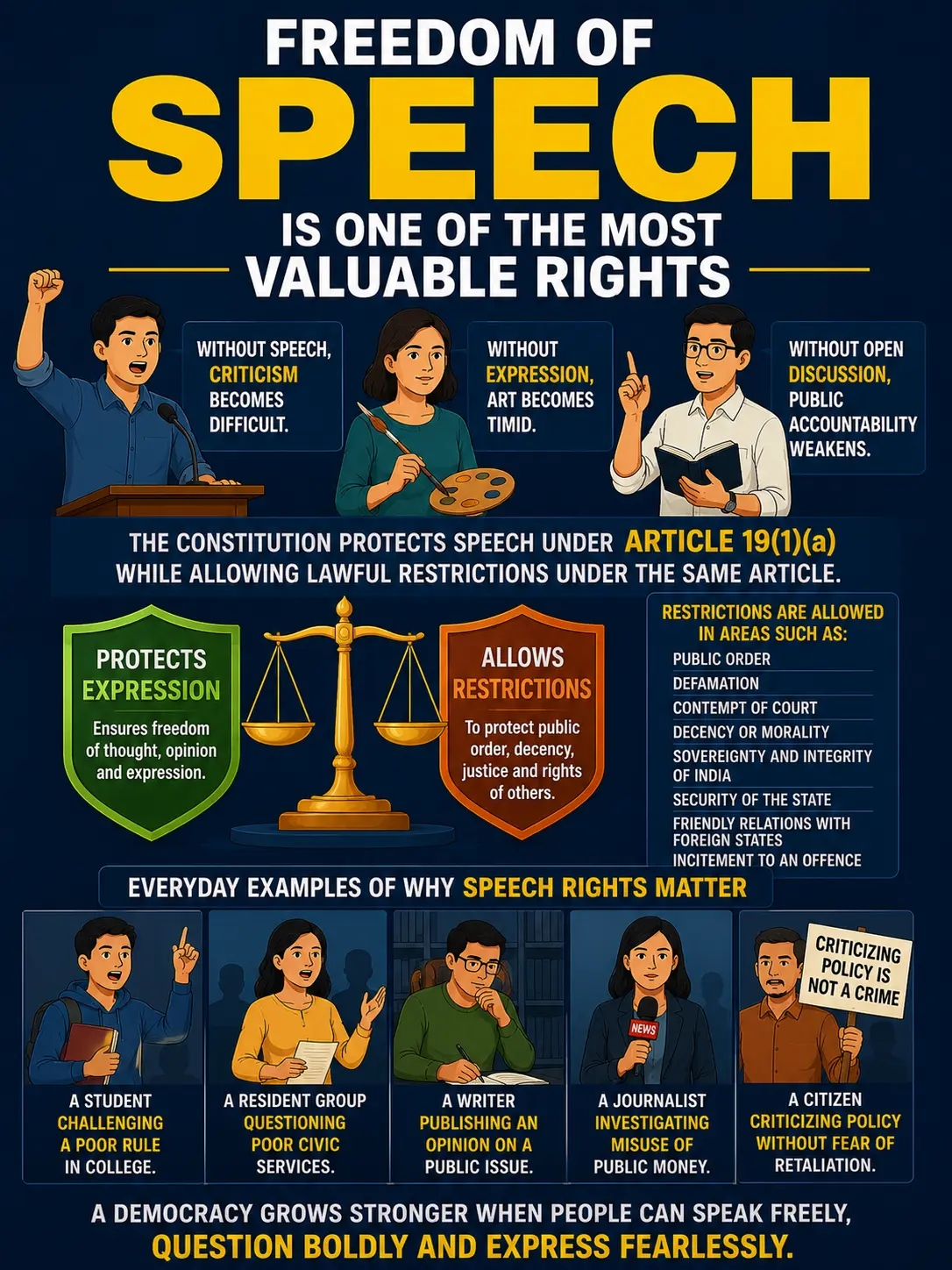
Among all the freedoms, freedom of speech and expression stands out because it supports every other freedom. Without speech, criticism becomes difficult. Without expression, art becomes timid. Without open discussion, public accountability weakens. The Constitution recognizes this and protects speech under Article 19(1)(a), while also allowing lawful restrictions under the same article.
This balance matters. A right is not the same thing as chaos. India’s constitutional design protects expression while also allowing restrictions in specific areas such as public order, defamation, contempt of court, decency, and related grounds, as set out in the Constitution. That balance allows democracy to remain free without becoming lawless.
Here are some everyday examples of why speech rights matter:
- A student challenging a poor rule in college.
- A resident group questioning poor civic services.
- A writer publishing an opinion on a public issue.
- A journalist investigating misuse of public money.
- A citizen criticizing policy without fear of retaliation.
The Right to Life and Personal Liberty Is the Heart of Human Dignity
If one right captures the moral force of the Constitution, it is Article 21. The text says that no person shall be deprived of life or personal liberty except according to procedure established by law. That one sentence has shaped some of the most important conversations in Indian constitutional law. It tells the State that life is not merely biological survival. It includes dignity, security, and lawful treatment.
This is why Article 21 matters so deeply. It protects against arbitrary state power. It supports a fair criminal process. It helps preserve bodily integrity. It gives the courts a strong foundation to examine whether the State has acted fairly or harshly. In practice, it is one of the broadest and most important rights in the Constitution.
You can see its value in very ordinary situations too:
- A person should not be held in custody without lawful reason.
- A detained person should know the grounds of arrest.
- A person should be able to consult a lawyer of choice.
- A child should have access to education.
- The State should not treat human dignity as an optional extra.

The Right to Education Gives Freedom a Real Chance
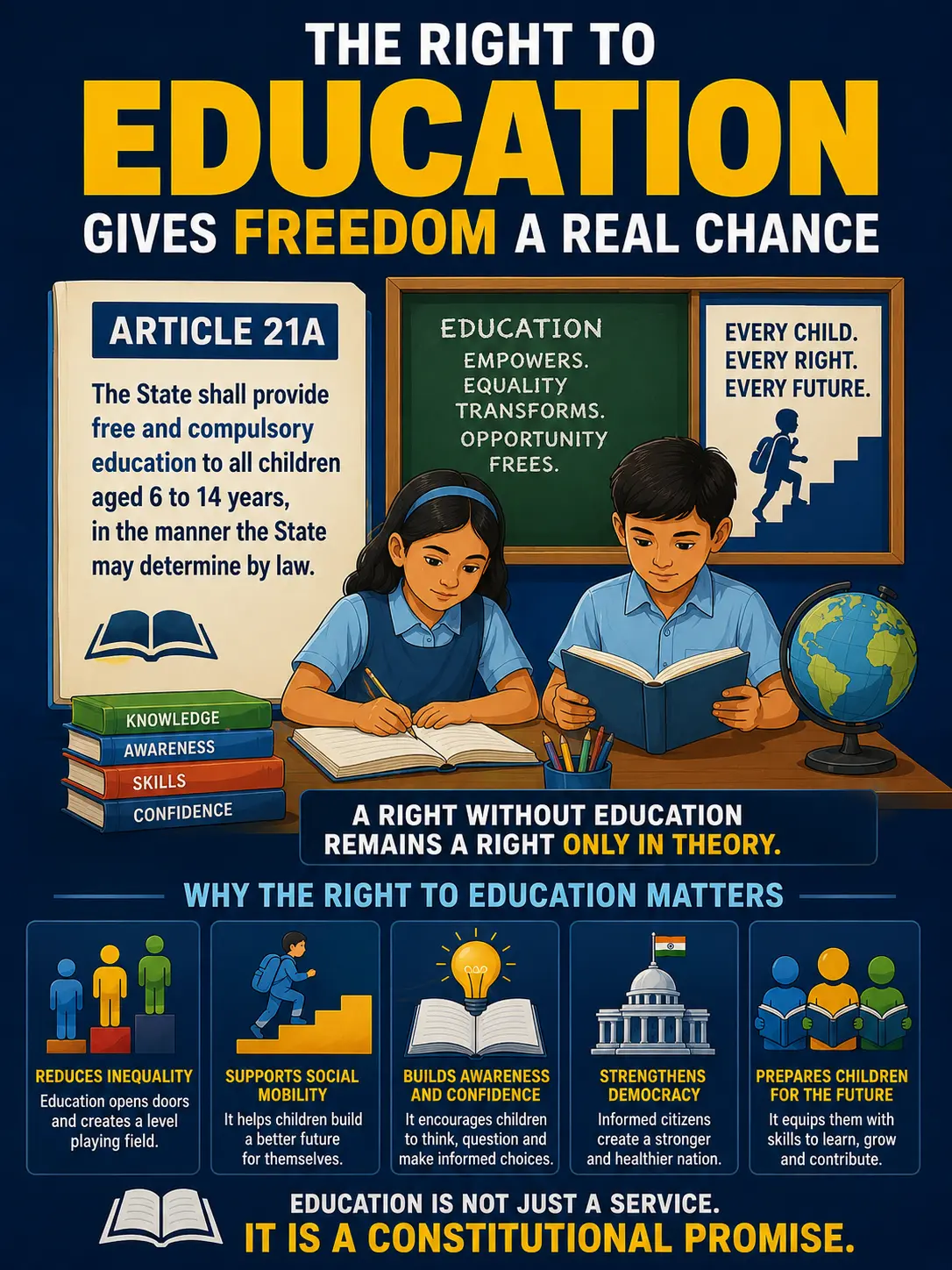
Article 21A is one of the clearest examples of how the Constitution connects liberty with opportunity. The constitutional text requires the State to provide free and compulsory education to all children aged 6 to 14 years, in the manner the State may determine by law. This matters because a right without education often becomes a right only in theory. Education gives children the ability to understand, question, participate, and grow.
This is also why education is not just a policy matter. It is a constitutional promise. It helps reduce inequality, supports social mobility, and prepares children to become informed citizens. A country cannot expect meaningful democracy if large sections of its children are left behind.
The Right against Exploitation Protects the Vulnerable
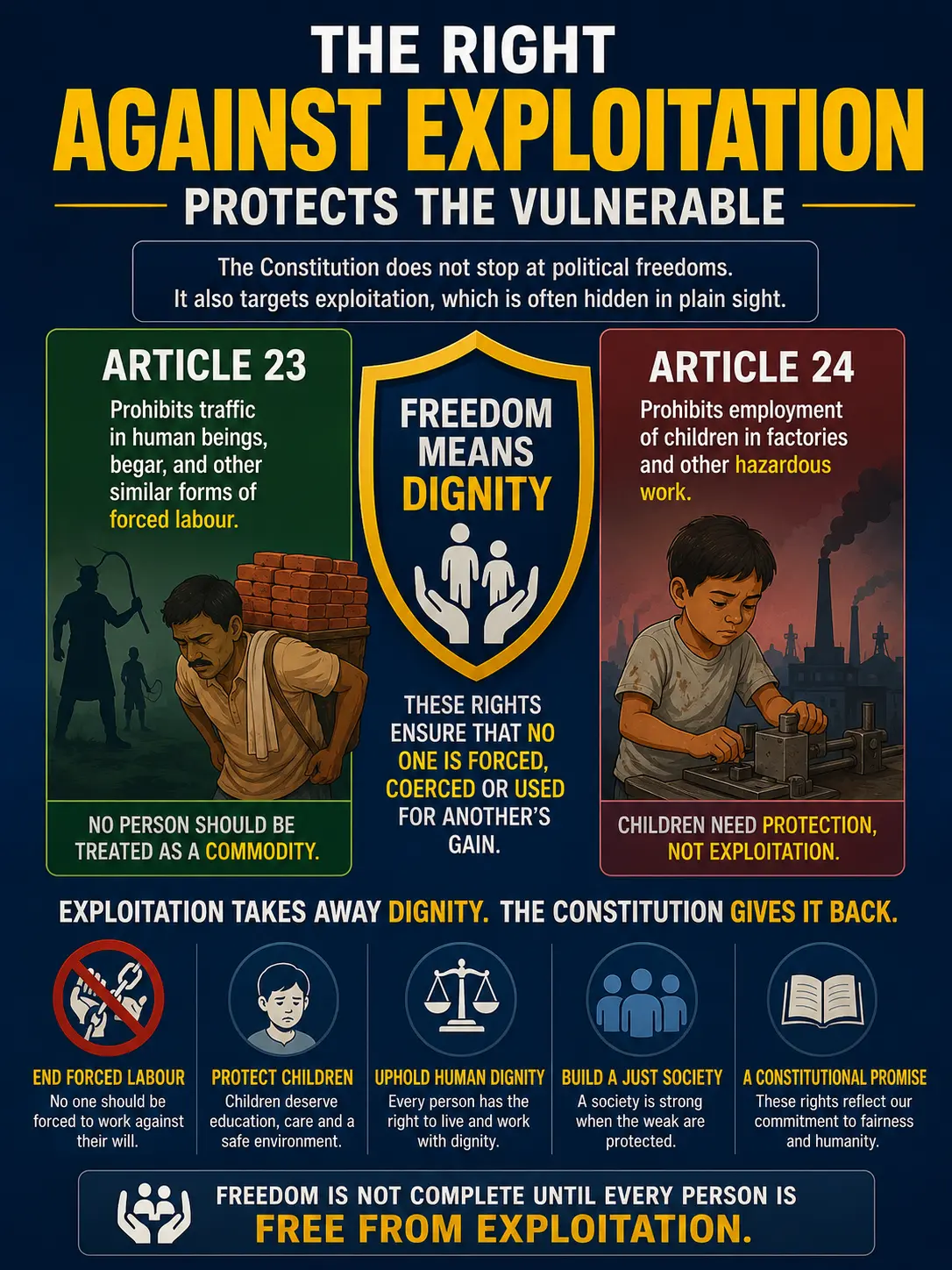
The Constitution does not stop at political freedoms. It also targets exploitation, which is often hidden in plain sight. Article 23 prohibits traffic in human beings, begar, and other similar forms of forced labour. Article 24 prohibits employment of children in factories and other hazardous work.
This is one of the most humane parts of the Constitution. It recognizes that freedom is meaningless if people are forced into work by fear, coercion, or poverty. It also recognizes that children need protection first, not exploitation first. In a country with deep social and economic diversity, these rights are essential to prevent abuse from becoming routine.
The Right to Freedom of Religion Protects Peaceful Belief
Articles 25 to 28 protect religious freedom. Article 25 guarantees freedom of conscience and the right freely to profess, practice, and propagate religion, subject to public order, morality, health, and other constitutional provisions. Article 26 protects the freedom to manage religious affairs. Article 27 prevents a person from being compelled to pay taxes for the promotion of any particular religion. Article 28 protects attendance in certain educational institutions where religious instruction may be involved.
This matters because India is not a single religious culture. It is a large, plural, and deeply varied society. Religious freedom makes coexistence possible without forcing sameness. It allows people to worship, pray, organize, and live according to conscience, while still respecting public order and the rights of others. That is a delicate balance, but it is one the Constitution deliberately tries to protect.
Cultural and Educational Rights Protect India’s Diversity
Articles 29 and 30 safeguard the cultural and educational rights of minorities. Article 29 protects the interests of minorities. Article 30 gives minorities the right to establish and administer educational institutions of their choice. This part of the Constitution is very important because diversity is not treated as a problem. It is treated as something worth preserving.
This is one reason India’s constitutional design stands out. It does not ask smaller communities to disappear into the majority. It recognizes that language, culture, education, and identity deserve space. For a worldwide audience, this is a useful lesson. Stable democracies do not survive by flattening difference. They survive by managing it with fairness.
Article 32 Makes the Rights Real
A right is only as strong as the remedy that supports it. That is why Article 32 is so famous. It gives a person the right to move the Supreme Court for enforcement of Fundamental Rights, and the Court can issue writs such as habeas corpus, mandamus, prohibition, quo warranto, and certiorari. The Supreme Court itself describes Article 32 as part of its original jurisdiction for enforcing Fundamental Rights.
This is one of the finest constitutional ideas anywhere in the world. It means that the Constitution does not leave the citizen helpless when a right is violated. There is a direct path to justice. That direct path gives real meaning to equality, liberty, and dignity. Without remedies, rights can sound beautiful and still fail in practice. With remedies, rights become enforceable.
Why These Rights Are Essential for Democracy
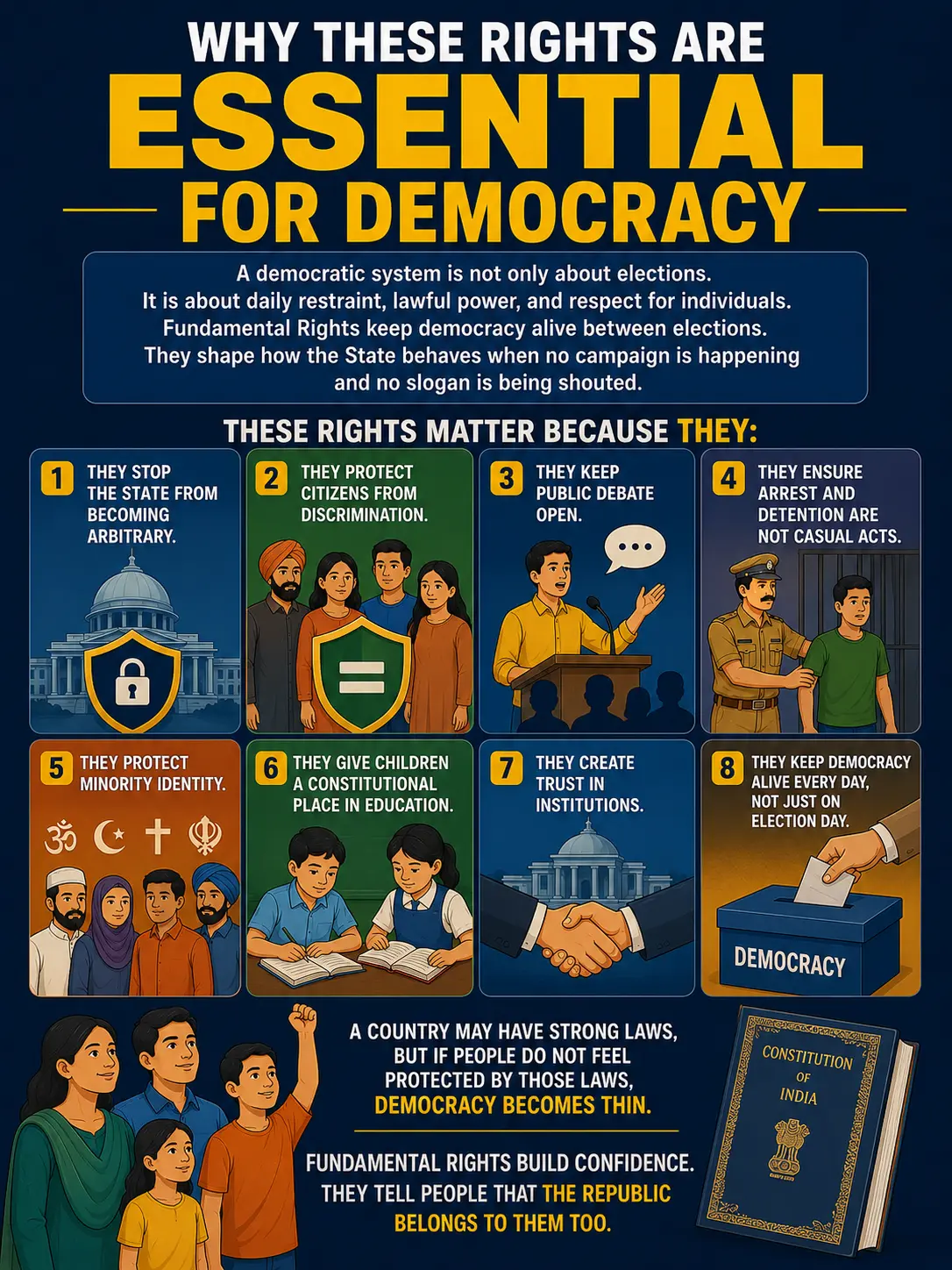
A democratic system is not only about elections. It is about daily restraint, lawful power, and respect for individuals. Fundamental Rights keep democracy alive between elections. They shape how the State behaves when no campaign is happening, and no slogan is being shouted. That is the quiet strength of the Constitution.
These rights matter because they do the following:
- They stop the State from becoming arbitrary.
- They protect citizens from discrimination.
- They keep public debate open.
- They ensure arrest and detention are not casual acts.
- They protect minority identity.
- They give children a constitutional place in education.
- They create trust in institutions.
A country may have strong laws, but if people do not feel protected by those laws, democracy becomes thin. Fundamental Rights build confidence. They tell people that the Republic belongs to them too.
A Table Showing How Fundamental Rights Affect Real Life
| Everyday Situation | Relevant Right | What It Prevents | What It Allows | Why It Matters |
|---|---|---|---|---|
| A person is arrested | Article 22 and Article 21 | Secret detention, denial of legal help, arbitrary custody | Legal consultation and informed arrest procedure | Protects liberty and due process |
| A student faces discrimination | Articles 14, 15, 16 | Bias by caste, religion, sex, or place of birth | Fair treatment and equal opportunity | Supports social justice |
| A journalist writes criticism | Article 19(1)(a) | Silence through intimidation | Peaceful expression and public debate | Keeps democracy accountable |
| A child is made to work in a hazardous place | Article 24 | Child labour in dangerous work | Education and safe childhood | Protects the young from exploitation |
| A minority school wants autonomy | Article 30 | Forced assimilation or denial of institutional identity | Establishing and managing an institution | Preserves cultural diversity |
| A person wants court protection | Article 32 | Rights without remedy | Direct constitutional remedy | Makes rights enforceable |
| A citizen follows a religion | Articles 25 to 28 | Religious coercion or interference | Freedom of conscience and worship | Protects pluralism |
| A worker is forced into unpaid labour | Article 23 | Trafficking and forced work | Free and lawful labour | Protects human dignity |
Fundamental Rights Also Shape Good Citizenship
Knowing your rights changes how you behave as a citizen. A person who understands the Constitution is more likely to question injustice calmly, ask for lawful process, and respect the rights of others. That is important because rights are not only personal shields. They are also civic habits.
A rights-aware citizen tends to:
- Speak with more confidence.
- Notice unfair treatment sooner.
- Demand lawful action instead of favoritism.
- Respect differences in religion, language, and culture.
- Protect the vulnerable more seriously.
- Understand that freedom and responsibility go together.
This is one reason constitutional education matters so much. A democracy is stronger when its people know the rules of the game. Not every citizen needs to become a lawyer, but every citizen benefits from understanding the basic protections that shape public life.
The Balance Between Rights and Reasonable Limits
One common misunderstanding is that Fundamental Rights are absolute. They are not. The Constitution itself builds in limits where necessary. For example, Article 19 allows restrictions in specific cases. Article 25 protects religious freedom subject to public order, morality, health, and other constitutional provisions. That design prevents rights from becoming tools of disorder or domination.
This balance is actually part of the strength of the system. A free society needs boundaries. Speech should be protected, but not at the cost of chaos. Religion should be protected, but not at the cost of public safety. Liberty should be real, but not arbitrary. The Constitution tries to keep those lines clear.
How the Constitution Treats the Right to Property
It is also worth understanding that the Right to Property once stood among the Fundamental Rights, but it was removed by the 44th Constitutional Amendment and now appears as a legal right under Article 300A, which says that no person shall be deprived of property save by authority of law. This change matters because it shows the Constitution has evolved while still protecting lawful property interests.
This is a good reminder that constitutional law is not frozen. It grows with the country. Some rights become more clearly protected, some are reorganized, and some legal balances shift as society changes. But the central idea stays the same. People should not be left helpless in front of state power.
Why Every Indian Citizen Should Care Personally
It is easy to think constitutional rights matter only in major court cases. But every citizen touches these rights in ordinary life. A student who wants fairness, a worker who wants dignity, a parent who wants education for a child, a religious community that wants space, and a citizen who wants lawful arrest procedures all depend on the same constitutional promise.
That is why Fundamental Rights are not just legal phrases. They are part of the emotional architecture of citizenship. They tell people they matter. They tell people they are not invisible. They tell people the Republic has to answer to them too.
A Final Table of the Most Important Takeaways
| Core Idea | What It Means in Practice | Constitutional Support |
|---|---|---|
| Equality | No one should be excluded because of identity or birth | Articles 14 to 18 |
| Liberty | People should be able to speak, move, work, and live freely | Articles 19 to 22 |
| Human dignity | No one should be forced, abused, or treated as less than human | Articles 21, 23, 24 |
| Pluralism | Different religions and cultures deserve space | Articles 25 to 30 |
| Remedy | Rights must be enforceable in court | Article 32 |
| Constitutional supremacy | Laws that violate rights can be challenged | Article 13 |
Conclusion
Fundamental Rights are important for every Indian citizen because they protect dignity, freedom, equality, and justice in real life. They stop abuse of power, support fair treatment, protect minority identity, defend speech, preserve personal liberty, and give people a direct legal remedy when rights are violated. In a democracy as large and diverse as India, that is not a small achievement. It is the foundation of public life.
The deeper truth is simple. A Constitution is only as strong as the rights it protects and the people who understand those rights. When citizens know their Fundamental Rights, they stand taller in society. They ask better questions. They demand fairness. They respect others. And they help keep democracy alive in everyday life, not just on election day.
Article References and Sources
- The Constitution of India (Official Text)
- The Constitution of India – Updated Edition
- Legislative Department, Government of India
- Part III – Fundamental Rights (Articles 12–35)
- Fundamental Rights – Articles 12–35 PDF
- Constitution of India Online Text
- Supreme Court of India Jurisdiction and Article 32 Information
- Article 32 Constitutional Remedies Explained
- Fundamental Rights in the Indian Constitution
- Fundamental Rights Articles 12–35 Explained
- Fundamental Rights Explained in Detail
- Fundamental Rights and Constitutional Framework
Frequently Asked Questions
FAQ 1. What are Fundamental Rights in India, and why do they matter so much?
Fundamental Rights are the basic rights guaranteed by the Constitution of India to protect the dignity, freedom, and equality of every person. They are called “fundamental” because they form the base of a free and fair society. Without them, a citizen would be much more exposed to unfair treatment, abuse of power, and discrimination.
These rights matter because they are not just legal words on paper. They shape real life. They decide whether a person can speak freely, move freely, practice a religion peacefully, get equal treatment, and challenge injustice in court. They also limit the power of the State. That is very important, because power without limits can easily become unfair.
For an ordinary person, Fundamental Rights are like a constitutional safety net. They protect students, workers, women, children, minorities, journalists, business owners, and every other citizen. A person may not think about these rights every day, but they are present in everyday situations. A student raising a voice in class, a citizen questioning an unfair rule, a worker demanding equal treatment, or a person asking for legal help after arrest all depend on these rights.
And this is the deeper point. Rights are not only about personal comfort. They are about human dignity. They tell every citizen, “You matter. Your voice matters. Your freedom matters.” That is why Fundamental Rights are one of the strongest pillars of Indian democracy.
FAQ 2. What are the main Fundamental Rights guaranteed to Indian citizens?
The Constitution gives six major groups of Fundamental Rights. Each one protects a different part of life, and together they create a complete system of liberty and justice.
The first is the Right to Equality, which includes equality before law, equal protection of law, non-discrimination, equal opportunity in public employment, abolition of untouchability, and abolition of titles. This right makes sure people are not treated differently because of caste, religion, sex, or place of birth.
The second is the Right to Freedom, which includes freedom of speech and expression, peaceful assembly, association, movement, residence, profession, protection in criminal matters, protection of life and personal liberty, education, and safeguards against arrest and detention. This right is one of the most important because it supports both democracy and personal independence.
The third is the Right against Exploitation. It protects people from trafficking, forced labour, begar, and child labour in hazardous work. This right exists because freedom is meaningless if people are forced into abuse or slavery-like conditions.
The fourth is the Right to Freedom of Religion. It protects freedom of conscience, religious practice, religious management, and peaceful religious life, subject to public order, morality, and health.
The fifth is the Cultural and Educational Rights. These protect the interests of minorities and allow them to establish and administer educational institutions of their choice.
The sixth is the Right to Constitutional Remedies. This is the right that makes the others enforceable. If a Fundamental Right is violated, a person can approach the court for protection.
Together, these rights build the structure of a constitutional democracy. They are not random rules. They are carefully connected protections that support each other.
FAQ 3. Why is the Right to Equality important for every Indian citizen?
The Right to Equality is important because it rejects the idea that some people should get better treatment simply because of their background. In a country as large and diverse as India, that principle is essential. Without equality, society becomes divided into groups where some enjoy privilege while others face unfair barriers.
This right protects citizens in many ways. Article 14 guarantees equality before law and equal protection of law. That means the law should not be applied casually or selectively. Article 15 prevents discrimination on grounds like religion, race, caste, sex, or place of birth. Article 16 ensures equal opportunity in public employment. Article 17 abolishes untouchability. Article 18 abolishes titles, except military and academic distinctions.
In simple language, the Right to Equality says that human worth should not depend on birth. A child born in one caste, one region, or one social group should not be treated as less deserving than another. This right is especially important because discrimination often hides in ordinary systems like education, jobs, housing, and public services.
A good society needs more than sympathy. It needs legal equality. That is what this right provides. It gives people a fair starting point and tells the State to act without bias. It also helps historically excluded groups claim their proper place in public life. Without this right, democracy would be incomplete.
FAQ 4. How does the Right to Freedom protect the daily life of citizens?
The Right to Freedom is one of the most practical parts of the Constitution because it touches everyday life in very direct ways. It protects not just big political ideas, but also the simple ability to live as a free person.
This right includes freedom of speech and expression, which lets people speak their mind, write opinions, report news, or criticize public action. It includes the freedom to gather peacefully, form associations, move across India, live in different places, and choose a profession. It also includes protection in criminal matters and safeguards against arbitrary arrest and detention. The right to life and personal liberty is part of this group too, and it is one of the most powerful rights in the Constitution.
Why is this so important? Because without freedom, a person cannot truly be a citizen. They become someone who is managed rather than respected. A student cannot ask questions. A worker cannot speak against unfair conditions. A journalist cannot report honestly. A person cannot travel, work, or express themselves with confidence.
This right also reminds us that democracy is not only about voting once in a while. It is about living freely every day. The ability to think, speak, move, work, and associate peacefully is what gives real shape to democratic life. That is why the Right to Freedom is not just useful. It is necessary.
FAQ 5. Why is freedom of speech such an important Fundamental Right?
Freedom of speech and expression is one of the most valuable rights in any democracy because it gives people the power to share ideas, ask questions, and challenge unfairness. Without it, public discussion becomes weak, and power becomes harder to question.
In India, this freedom is protected under the Right to Freedom. It allows a person to speak openly, write freely, publish opinions, create art, ask questions, and take part in public debate. This matters in schools, colleges, workplaces, courts, newsrooms, and on public platforms. It is the right that helps citizens think together as a society.
But this freedom is not only about speaking loudly. It is also about being heard. A democracy works better when many voices can exist at the same time, even when they disagree. A country with no real freedom of expression becomes a place where fear replaces discussion. And once that happens, truth becomes harder to protect.
At the same time, speech rights come with lawful limits. That balance is important. Freedom should not turn into chaos, harm, or abuse. The Constitution protects speech, but it also allows reasonable restrictions in certain cases. So the right is strong, but it is also responsible.
That balance is what makes the right powerful. It protects free thought while keeping society orderly. It allows criticism, debate, creativity, and disagreement. In simple terms, it lets a democracy breathe.
FAQ 6. What is the importance of the Right to Life and Personal Liberty?
The Right to Life and Personal Liberty is one of the deepest and most meaningful rights in the Constitution. It says that no person can be deprived of life or personal liberty except according to lawful procedure. That may sound short, but its impact is enormous.
This right matters because life is more than just staying alive. It includes dignity, security, bodily integrity, fairness, and lawful treatment. A person should not live in fear of arbitrary state power. They should not be detained without reason. They should not be treated carelessly by institutions. The law should protect them, not crush them.
This right also supports several other important protections. It is closely connected to arrest safeguards, criminal justice fairness, humane treatment, education, and dignity in public life. In many ways, it works like the heart of the Constitution. Other rights support it, but it gives them moral and legal strength too.
Think about it in practical terms. If a person is arrested, they need to know the grounds. If a person is detained, they need legal procedure. If a person is living in the country, they should be able to expect dignity and protection. This is why Article 21 is often seen as one of the strongest parts of the Constitution.
It protects the individual from being reduced to a number, a file, or a case. It reminds the State that a human being is not a thing to be handled casually. That is a powerful idea, and it matters to every citizen.
FAQ 7. Why is the Right against Exploitation important in a country like India?
The Right against Exploitation is important because freedom is meaningless if people are forced into unfair, dangerous, or abusive work. A person may be legally free, but if they are trapped by coercion, debt, fear, or violence, that freedom is hollow.
This right addresses some of the worst forms of human abuse. It prohibits traffic in human beings, begar, forced labour, and child labour in hazardous work. These are not small issues. They are serious violations of human dignity. They hurt the weakest people first, especially the poor, children, migrant workers, and vulnerable communities.
In a large and unequal society, exploitation can happen quietly. Sometimes it hides in jobs that do not pay fairly. Sometimes it appears in pressure to work without choice. Sometimes it appears when children are made to work instead of going to school. The Constitution steps in and says these practices are not acceptable.
This right is important because it protects people who may not have the social or economic power to protect themselves. It turns moral concern into legal protection. It says the country should not allow human beings to be treated like property or labor machines.
And this is not only a legal issue. It is a moral one too. A society that tolerates exploitation weakens itself from within. A society that rejects it becomes stronger, fairer, and more humane.
FAQ 8. How do the Rights to Freedom of Religion and Cultural Rights protect India’s diversity?
India is a country of many religions, languages, traditions, and cultural identities. The Right to Freedom of Religion and the Cultural and Educational Rights protect that diversity in a very practical way.
The Right to Freedom of Religion allows a person to believe, worship, and practice their religion peacefully, subject to public order, morality, and health. It also protects the management of religious affairs. This means the Constitution does not force people into one common religious mold. It respects conscience and belief.
The Cultural and Educational Rights protect minorities and allow them to preserve their language, culture, and educational identity. This matters because a democracy should not demand that every group become identical. Diversity is not a weakness. It is part of India’s strength.
These rights help build social peace. When people feel that their faith, language, and culture are respected, they are more likely to trust public institutions. That trust matters a great deal in a country as large as India. It helps reduce unnecessary conflict and supports coexistence.
A simple example makes this clear. A religious community should be able to practice its faith peacefully. A linguistic minority should be able to protect its language. A minority educational institution should be able to preserve its character. These rights help make that possible.
So these are not just symbolic protections. They are practical tools for keeping a plural society stable and respectful.
FAQ 9. What is Article 32, and why is it called the heart of the Constitution?
Article 32 is the constitutional right that allows a person to move the Supreme Court of India for the enforcement of Fundamental Rights. It is often called one of the most important parts of the Constitution because it makes rights enforceable, not just theoretical.
This is important because a right without remedy is weak. A person may know they are right, but if they cannot go to court, the right becomes difficult to protect. Article 32 changes that. It gives citizens a direct constitutional path to justice.
The Supreme Court can issue writs such as habeas corpus, mandamus, prohibition, quo warranto, and certiorari. These legal tools help protect liberty, stop illegal detention, correct unlawful action, and ensure that public authorities behave properly.
This is one reason Article 32 has such a strong reputation. It does not merely describe rights. It gives a way to defend them. That makes it the practical backbone of constitutional protection.
For citizens, this means something very simple and very powerful. If a Fundamental Right is violated, the Constitution does not leave you helpless. There is a remedy. There is a court. There is a path to justice. And that is one of the strongest promises a democracy can make.
FAQ 10. Why should every Indian citizen learn about Fundamental Rights?
Every Indian citizen should learn about Fundamental Rights because knowledge changes power. A person who knows their rights is harder to cheat, easier to protect, and better able to stand up for fairness. That is true in schools, workplaces, courts, and public life.
When citizens understand their rights, they are more likely to notice discrimination, ask for lawful treatment, and resist abuse. They also become more responsible in how they treat others. Rights are not only about personal protection. They also create a culture of respect. If you know your rights, you are more likely to respect the rights of someone else.
This knowledge is especially useful in daily life. A student who understands equality and freedom feels more confident. A worker who understands liberty and dignity can recognize unfair treatment sooner. A parent who understands the right to education can better support a child’s future. A citizen who understands constitutional remedies knows when the law can help.
And there is one more important reason. A democracy survives when ordinary people know how the system is supposed to work. If people do not know their rights, then those rights can become weak in practice. But when citizens understand them, they become part of public life in a real way.
So learning Fundamental Rights is not only for exams or legal study. It is part of being an informed citizen. It helps create a better country, one person at a time.
