

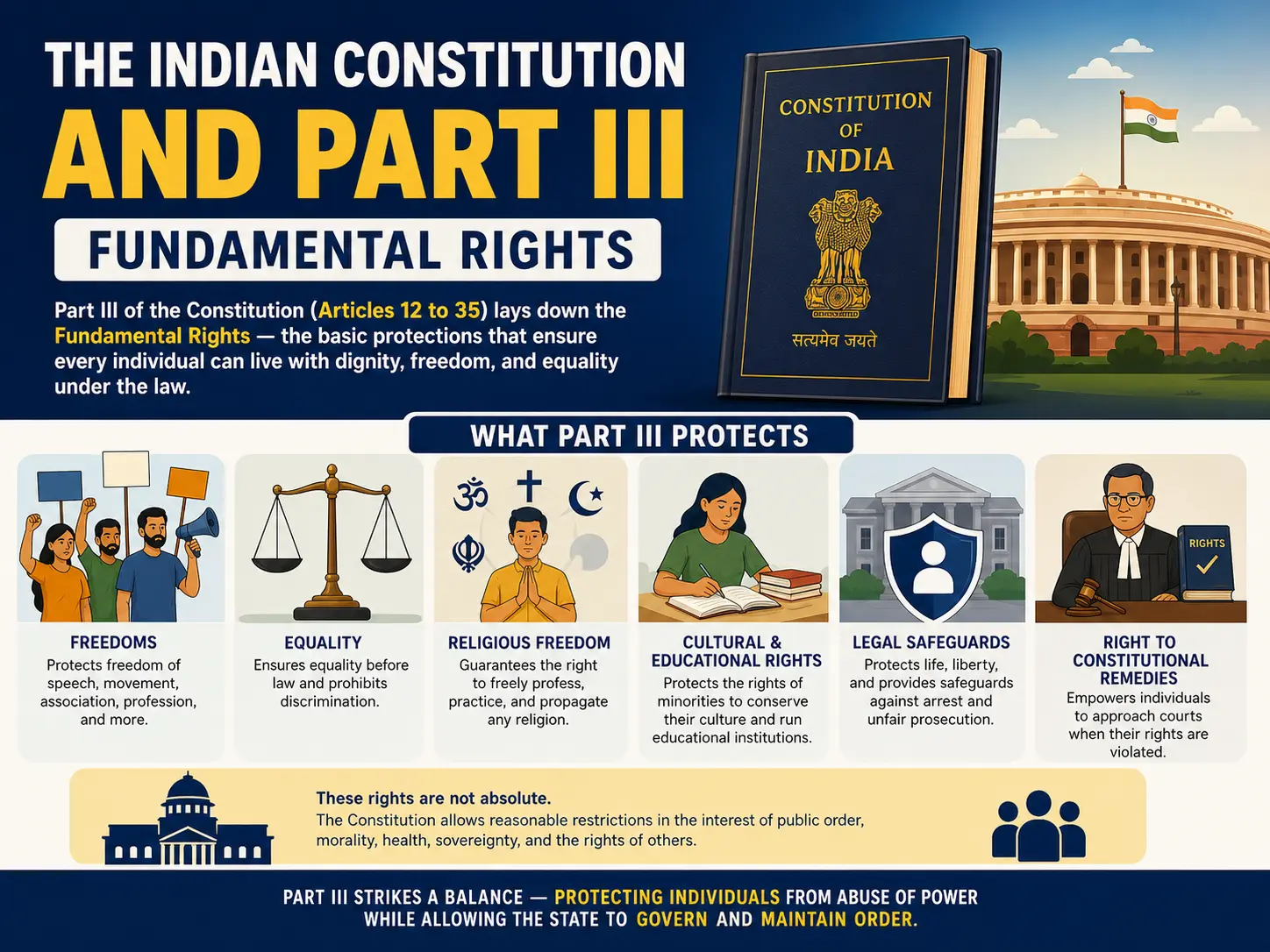
The Indian Constitution is more than a legal document. It is a promise. And nowhere is that promise clearer than in Part III, which sets out the Fundamental Rights. These rights are the basic protections that help people live with dignity, speak freely, work fairly, worship as they choose, and seek justice when the State crosses a line. The official constitutional text places Part III under Fundamental Rights and lays it out from Article 12 to Article 35.
For a reader trying to understand the Constitution step by step, Part III is one of the best places to begin. It shows how the law protects the individual against the abuse of power while still allowing the State to govern, regulate, and maintain order. It also explains who can be challenged in court, what constitutes unequal treatment, and why certain freedoms are not unlimited but are carefully balanced with public order, morality, health, and the rights of others.
This article walks through Part III in a simple, detailed, and practical way. It does not treat the Constitution like a dusty textbook. It treats it like what it really is, a living framework that affects everyday life.
Table of Contents
A quick map of Part III
Before going article by article, it helps to see the whole structure at once. The Constitution itself groups the rights into clear blocks such as Right to Equality, Right to Freedom, Right against Exploitation, Right to Freedom of Religion, Cultural and Educational Rights, Saving of Certain Laws, and Right to Constitutional Remedies.
| Block | Articles | What it mainly covers | Why it matters in real life |
|---|---|---|---|
| General | 12-13 | Defines the State and says laws inconsistent with Part III can be void | This tells you who must respect Fundamental Rights and what happens when a law conflicts with them |
| Right to Equality | 14-18 | Equality before law, non-discrimination, equal opportunity, abolition of untouchability, abolition of titles | Stops unfair treatment based on identity or status |
| Right to Freedom | 19-22 | Speech, movement, association, profession, criminal protections, life and liberty, education, arrest safeguards | Protects daily freedom and personal dignity |
| Right against Exploitation | 23-24 | Human trafficking, forced labour, child labour in factories and hazardous work | Protects vulnerable people from abuse and coercion |
| Right to Freedom of Religion | 25-28 | Religious conscience, worship, religious management, tax protection, education-related safeguards | Preserves personal faith and prevents forced religion-based conduct |
| Cultural and Educational Rights | 29-30 | Minority culture and minority educational institutions | Helps communities preserve identity and build institutions |
| Saving of Certain Laws | 31A-31C | Protects certain laws from being invalidated in specific situations | Balances rights with land reform and Directive Principles |
| Right to Constitutional Remedies | 32-35 | Direct access to the Supreme Court, writs, special powers for Parliament | Gives teeth to every other right |
That is the broad shape of Part III. Now let’s go step by step.
Step 1: Understand what Part III actually does
Part III does not simply list ideals. It makes rights legally meaningful. Article 12 defines “the State” for Part III as the Government and Parliament of India, the Government and Legislature of each State, and all local or other authorities within the territory of India or under the control of the Government of India. That definition matters because Fundamental Rights are enforceable mainly against the State and bodies that act with public power.
Then Article 13 puts teeth into the whole Part. It says laws that are inconsistent with Fundamental Rights are void to the extent of the inconsistency, and the State cannot make a law that takes away or abridges those rights. It also explains that “law” is broad and includes ordinances, orders, bye-laws, rules, regulations, notifications, customs, and usages having the force of law. In simple language, the Constitution is not only guarding against Parliament or a State Legislature. It is also guarding against many forms of official legal action.
This is why Part III is so important. It is not decorative. It is enforceable.
What this means in plain terms
- A ministry cannot casually ignore a Fundamental Right.
- A State law cannot quietly override the Constitution.
- A rule, notification, or order can also be tested if it conflicts with Part III.
- Courts can examine whether the law and the right can stand together.
A simple example helps. Suppose a local authority creates a rule that blocks one religious group from using a public facility without any valid legal reason. Because Article 12 brings local authorities within the meaning of the State, and Article 13 voids inconsistent law, that rule can face a constitutional challenge.
Step 2: Right to Equality, the Constitution’s first big promise
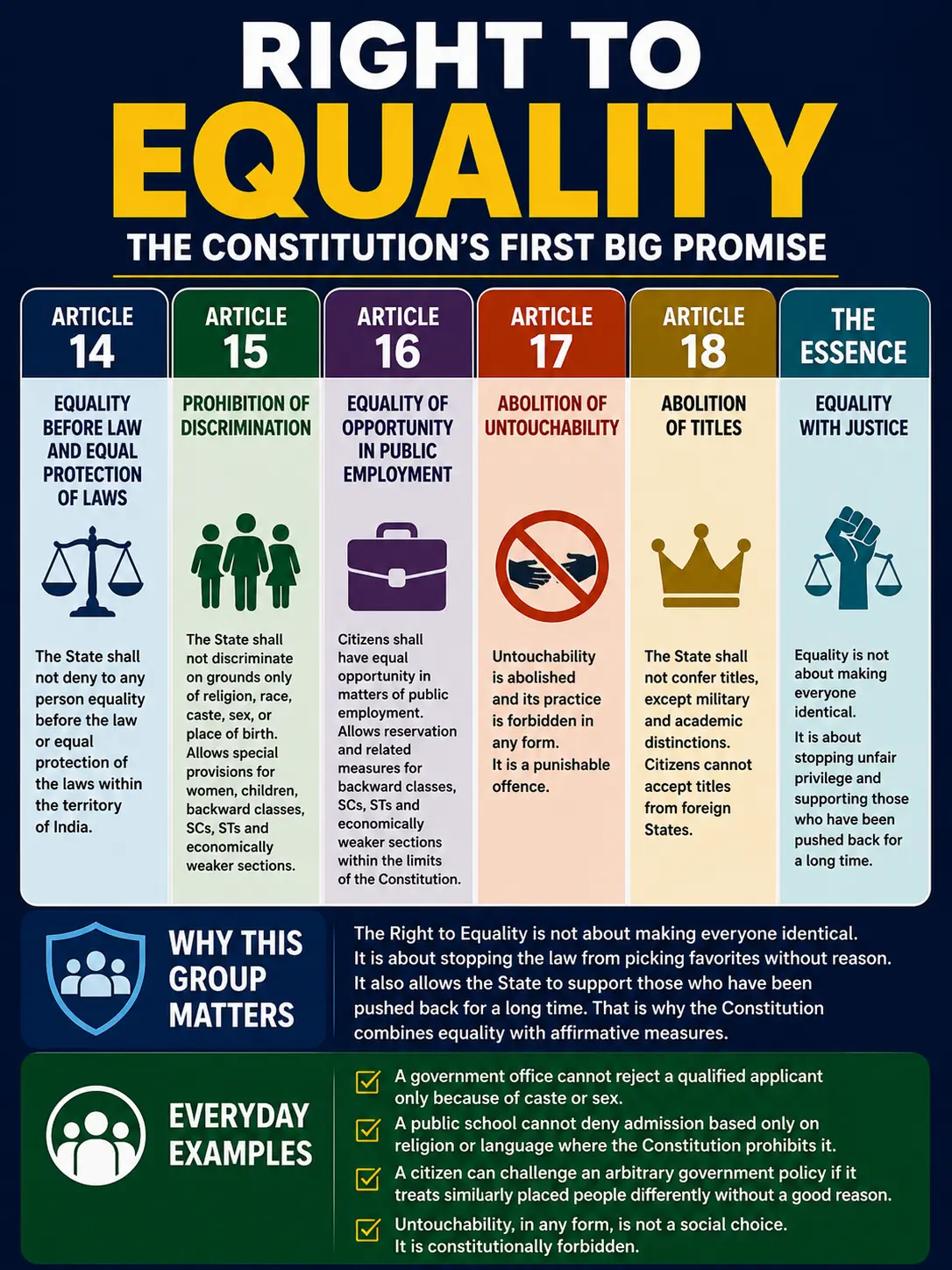
The Right to Equality is the foundation of Part III. It begins with Article 14, which says the State shall not deny to any person equality before the law or equal protection of the laws within the territory of India. That is a powerful idea. It means the law should not create arbitrary privilege or arbitrary disadvantage.
Then Article 15 prohibits discrimination on grounds only of religion, race, caste, sex, or place of birth. It also permits special provisions for women and children, backward classes, Scheduled Castes, Scheduled Tribes, and economically weaker sections in the constitutional framework. This article is not just about abstract equality. It is about making real equality possible in a society where historical disadvantage is very real.
Article 16 deals with equality of opportunity in matters of public employment. It says citizens should have equal opportunity in jobs under the State. It also allows reservation and related measures for backward classes, Scheduled Castes, Scheduled Tribes, and economically weaker sections within the limits laid down by the Constitution.
Then come Article 17 and Article 18, which make the equality principle more concrete. Article 17 abolishes untouchability and forbids its practice in any form. Article 18 abolishes titles, except military and academic distinctions, and prevents Indian citizens from accepting titles from foreign States.
Why this group matters
The Right to Equality is not about making everyone identical. It is about stopping the law from picking favorites without reason. It also allows the State to support those who have been pushed back for a long time. That is one reason the Constitution combines equality with affirmative measures.
Everyday examples
- A government office cannot reject a qualified applicant only because of caste or sex.
- A public school cannot deny admission based only on religion or language where the Constitution prohibits it.
- A citizen can challenge an arbitrary government policy if it treats similarly placed people differently without a good reason.
- Untouchability, in any form, is not a social choice. It is constitutionally forbidden.
A small but important table on equality
| Article | Plain meaning | Practical meaning |
|---|---|---|
| 14 | Equal treatment before law | No arbitrary discrimination by the State |
| 15 | No discrimination on specified grounds | Public spaces and state action must remain fair |
| 16 | Equal opportunity in public employment | Public jobs must be open on fair terms |
| 17 | Abolition of untouchability | Social exclusion of this kind is unconstitutional |
| 18 | Abolition of titles | Public status cannot be turned into hereditary privilege |
Step 3: Right to Freedom, the part people feel in daily life
If Part III has a heart, many would say it is the Right to Freedom. This is where the Constitution protects speech, movement, association, profession, life, liberty, and legal safeguards during arrest and criminal prosecution.
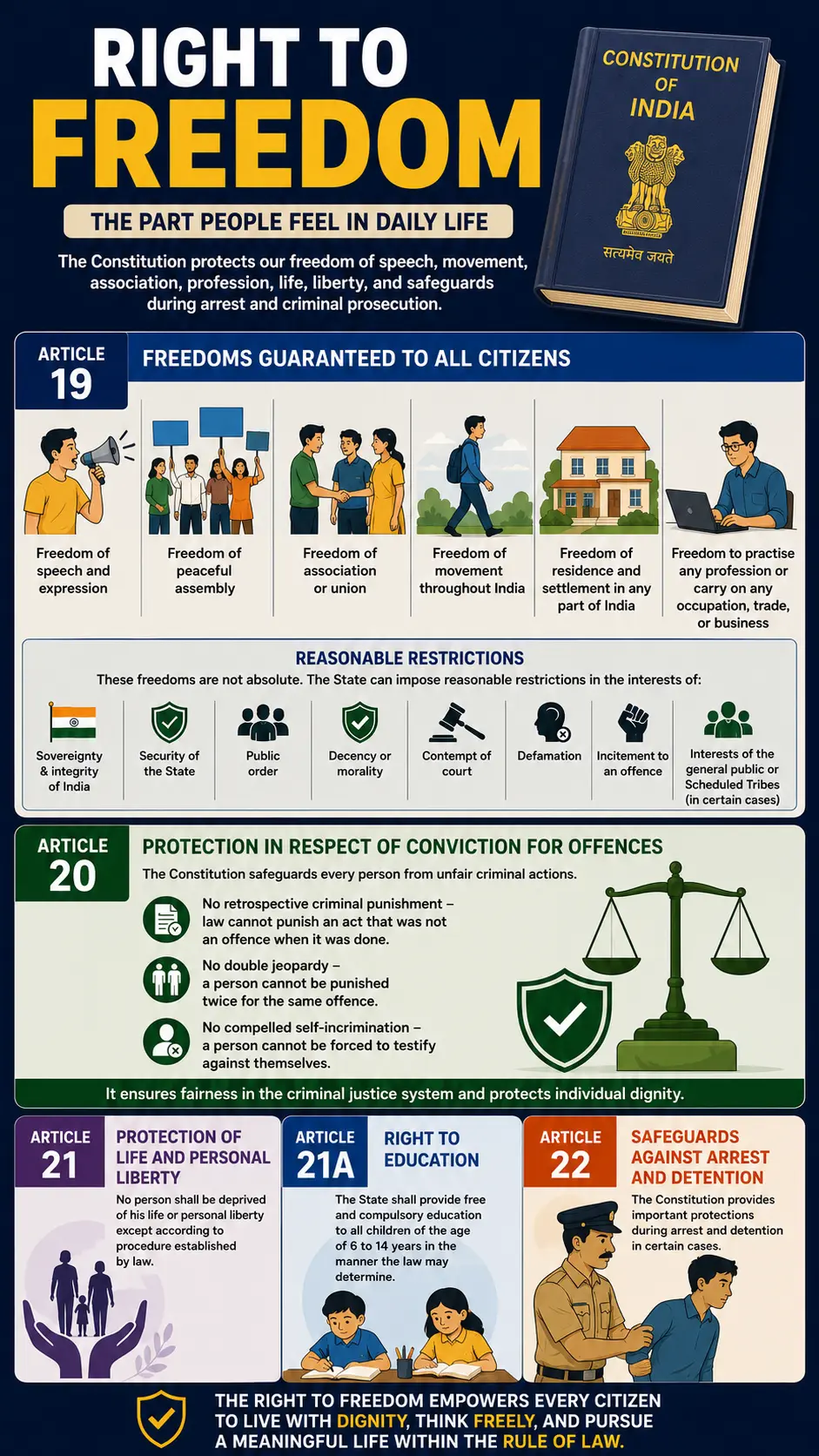
Article 19 gives all citizens the right to freedom of speech and expression, peaceful assembly, association or union, movement throughout India, residence and settlement in any part of India, and the freedom to practise any profession or carry on any occupation, trade, or business. These freedoms are not absolute. The Constitution allows reasonable restrictions for reasons such as sovereignty and integrity of India, security of the State, public order, decency, morality, contempt of court, defamation, incitement to an offence, and, in certain clauses, the interests of the general public or Scheduled Tribes.
Article 20 protects a person in respect of conviction for offences. It prevents retrospective criminal punishment, double jeopardy, and compelled self-incrimination. That means the criminal justice system cannot simply invent punishment after the fact, punish a person twice for the same offence, or force a person to testify against themselves in the manner prohibited by the Constitution.
Article 21 is one of the most famous rights in the Constitution. It says no person shall be deprived of his life or personal liberty except according to procedure established by law. Article 21A adds the Right to education for children aged six to fourteen years, and Article 22 gives safeguards against arrest and detention in certain cases.
Why Article 19 feels so real
Think of how ordinary life works. You speak on social media. You attend a peaceful protest. You join a union. You move to another city for work. You open a business. Every one of those acts touches Article 19 in some way. The Constitution gives these freedoms, but it also reminds us that freedom and responsibility travel together.
Why Article 21 is so powerful
Article 21 began as a protection against unlawful deprivation of life and liberty. Over time, the constitutional conversation around it has become much richer in Indian constitutional law. The Supreme Court’s own materials say Article 32 gives an extensive original jurisdiction to enforce Fundamental Rights, including writs like habeas corpus, mandamus, prohibition, quo warranto, and certiorari. That is the practical side of liberty. It is not only about having a right on paper. It is about being able to enforce it.
A simple rights table
| Article | Core idea | Simple example |
|---|---|---|
| 19 | Freedoms of speech, assembly, association, movement, residence, profession | A citizen can publish views, travel, work, and assemble peacefully within constitutional limits |
| 20 | Protection in criminal cases | No retroactive punishment, no double punishment, no compelled self-incrimination |
| 21 | Life and personal liberty | Police, prisons, and the State must respect lawful procedure |
| 21A | Right to education | Children from six to fourteen have a constitutional right to free and compulsory education |
| 22 | Safeguards against arrest and detention | An arrested person must be informed of grounds and produced before a magistrate within 24 hours, subject to constitutional exceptions |
A small caution
These freedoms are broad, but not limitless. That is not a weakness. It is part of the design. The Constitution protects society from chaos while also protecting the person from overreach. The balance is delicate, and that is exactly why constitutional law is so fascinating.
Step 4: Right against Exploitation, the Constitution’s refusal to tolerate abuse
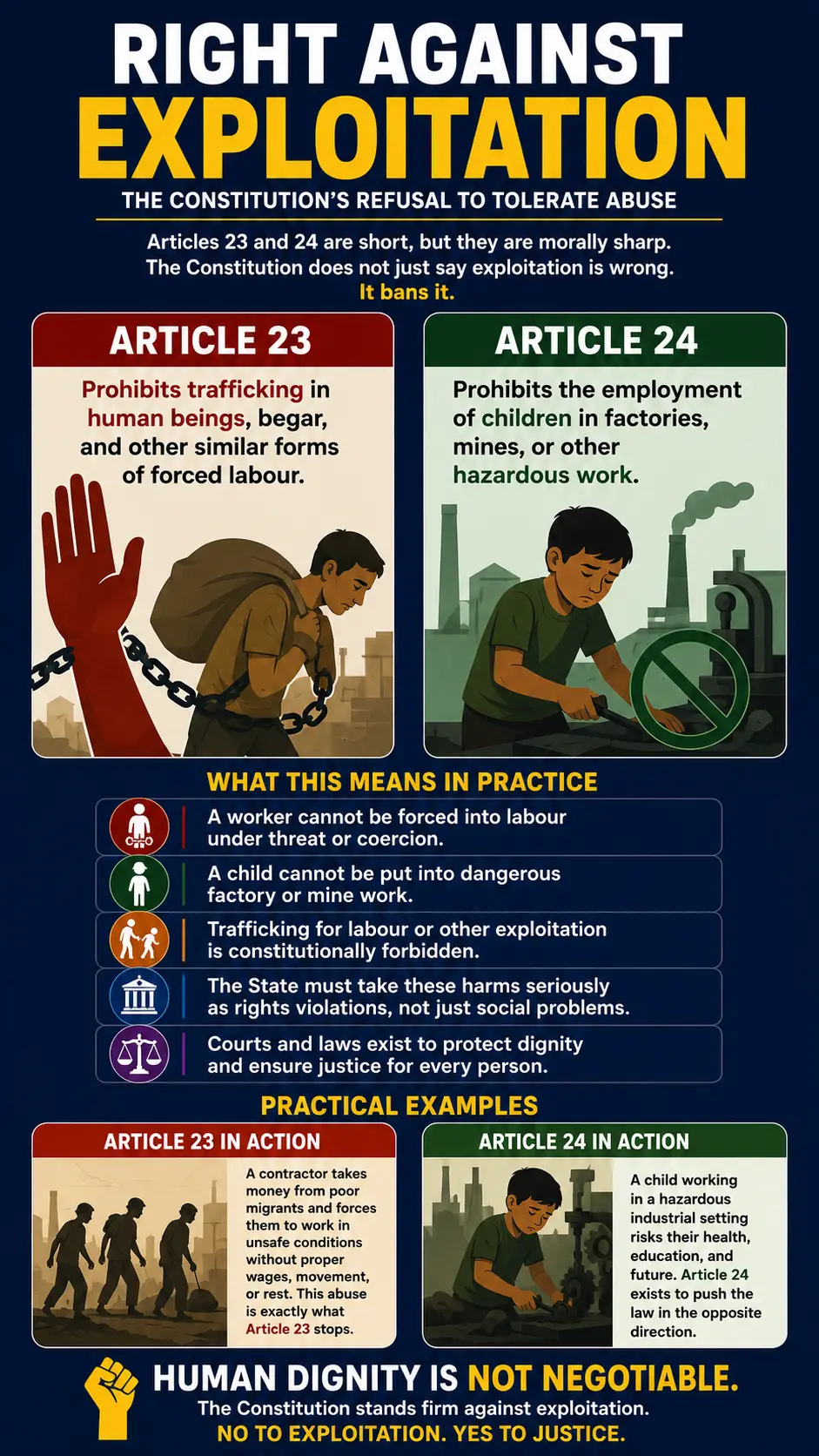
Articles 23 and 24 are short, but they are morally sharp. Article 23 prohibits trafficking in human beings, begar, and other similar forms of forced labour. Article 24 prohibits the employment of children in factories, mines, or other hazardous work.
This is where the Constitution speaks with unusual directness. It does not merely say exploitation is bad. It bans it. The language is firm because the harm is firm. Human trafficking, forced labour, and child exploitation are not minor violations. They are deep assaults on human dignity.
What this means in practice
- A worker cannot be forced into labour under threat or coercion.
- A child cannot be put into dangerous factory or mine work.
- Trafficking for labour or other exploitation is constitutionally forbidden.
- The State must take these harms seriously as rights violations, not just social problems.
Practical example
Imagine a contractor taking money from poor migrants and forcing them to work in unsafe conditions without proper wages, movement, or rest. That is exactly the sort of abuse Article 23 is designed to stop. Imagine a child working in a hazardous industrial setting. Article 24 exists to push the law in the opposite direction.
Step 5: Freedom of religion, not forced belief, not forced silence
The Right to Freedom of Religion runs from Articles 25 to 28. These provisions do not privilege one faith over another. They protect conscience, worship, and religious autonomy while keeping public order, morality, and health in view.
Article 25 guarantees freedom of conscience and the right to freely profess, practise, and propagate religion, subject to public order, morality, health, and the other provisions of Part III. It also allows the State to regulate economic, financial, political, or other secular activity associated with religious practice.
Article 26 gives every religious denomination or section the right to establish and maintain institutions for religious and charitable purposes, manage its own affairs in matters of religion, own and acquire property, and administer such property in accordance with law. Article 27 prevents compulsory taxation for the promotion or maintenance of any particular religion. Article 28 deals with religious instruction and worship in certain educational institutions and places limits on compulsory participation, especially in institutions maintained out of State funds.
The real lesson here
The Constitution is careful. It protects religion, but it does not let religion become a tool of coercion or public unfairness. That is why these articles are framed with both freedom and restraint.
Examples
- A person may follow their faith openly, within lawful limits.
- A religious denomination may manage its own religious affairs.
- No one should be forced to pay a tax that is specifically used to support another religion.
- A student in a State-funded institution cannot be compelled to join religious worship against their consent.
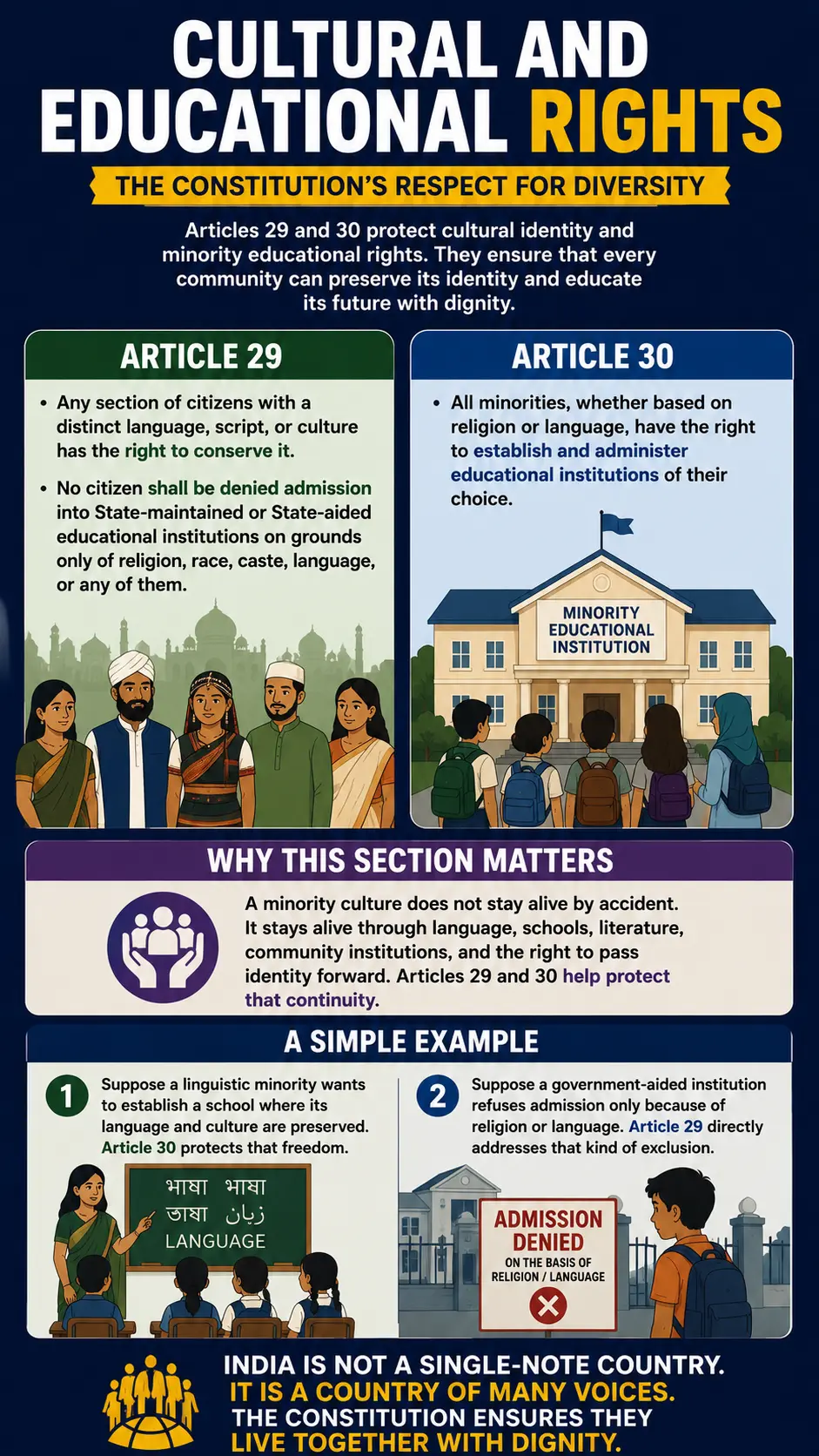
Step 6: Cultural and Educational Rights, the Constitution’s respect for diversity
Articles 29 and 30 protect cultural identity and minority educational rights. Article 29 says any section of citizens with a distinct language, script, or culture has the right to conserve it. It also says no citizen shall be denied admission into State-maintained or State-aided educational institutions on grounds only of religion, race, caste, language, or any of them. Article 30 gives minorities, whether based on religion or language, the right to establish and administer educational institutions of their choice.
This is one of the most humane corners of Part III. The Constitution recognizes that India is not a single-note country. It is a country of languages, scripts, customs, identities, and communities. The law does not ask them to disappear. It asks them to live together with dignity.
Why this section matters
A minority culture does not stay alive by accident. It stays alive through language, schools, literature, community institutions, and the right to pass identity forward. Articles 29 and 30 help protect that continuity.
A simple example
Suppose a linguistic minority wants to establish a school where its language and culture are preserved. Article 30 protects that freedom. Suppose a government-aided institution refuses admission only because of religion or language. Article 29 directly addresses that kind of exclusion.
Step 7: The saving clauses, where rights meet policy
This part often gets ignored, but it is important. Articles 31A, 31B, and 31C are known as saving provisions. The table of contents of the Constitution lists them under Saving of Certain Laws. Article 31 was the old right to property provision in Part III, but it was omitted by the Forty-fourth Amendment Act, 1978.
Article 31A protects certain laws dealing with acquisition of estates, takeover of property management, amalgamation of corporations, and certain related matters from being invalidated on the ground that they conflict with Part III in the manner described in the article. Article 31B validates certain Acts and Regulations, and Article 31C saves laws giving effect to certain Directive Principles.
This is where the Constitution shows its practical side. India needed land reform, economic restructuring, and social change. The Constitution did not want every such measure to be struck down immediately in court. So it created narrow constitutional shelters for certain laws. That is not a blank cheque. It is a controlled compromise.
Important note on property
The Constitution now places “Right to Property” under Article 300A in Part XII, where it says no person shall be deprived of property save by authority of law. That provision is outside Part III.
A small clarification
Some readers assume that because Article 31 is omitted, property is no longer protected at all. That is not quite right. The constitutional structure changed. Property protection still exists, but not as a Fundamental Right in Part III.
Step 8: Right to Constitutional Remedies, the engine that makes everything work
Many lawyers and judges treat Article 32 as the soul of Part III. It gives a person the right to move the Supreme Court by appropriate proceedings for enforcement of the rights conferred by Part III. It also authorizes the Court to issue directions, orders, or writs, including habeas corpus, mandamus, prohibition, quo warranto, and certiorari. The Supreme Court’s own jurisdiction page says Article 32 gives extensive original jurisdiction for enforcement of Fundamental Rights.
That is a remarkable constitutional design. It means a right is not just a promise. It is a right with a courtroom door attached to it.
What the writs do in simple language
- Habeas corpus asks whether a person is being held unlawfully.
- Mandamus directs a public authority to do its legal duty.
- Prohibition stops a lower court or tribunal from acting outside its jurisdiction.
- Quo warranto asks by what authority a person holds a public office.
- Certiorari removes or reviews a decision of a lower authority in appropriate cases.
Article 32(4) says the right guaranteed by this article shall not be suspended except as otherwise provided for by the Constitution. That is another sign of how serious the framers were about constitutional remedies.
Why Article 32 feels special
Because without a remedy, a right can become a slogan. Article 32 prevents that. It converts constitutional language into a route for action. That is why people often call it the protector of the protectors.
A very practical example
Imagine someone is detained without lawful justification and cannot get relief from the ordinary process quickly enough. Article 32 allows direct access to the Supreme Court for enforcement of rights. That speed and seriousness are part of the design itself.
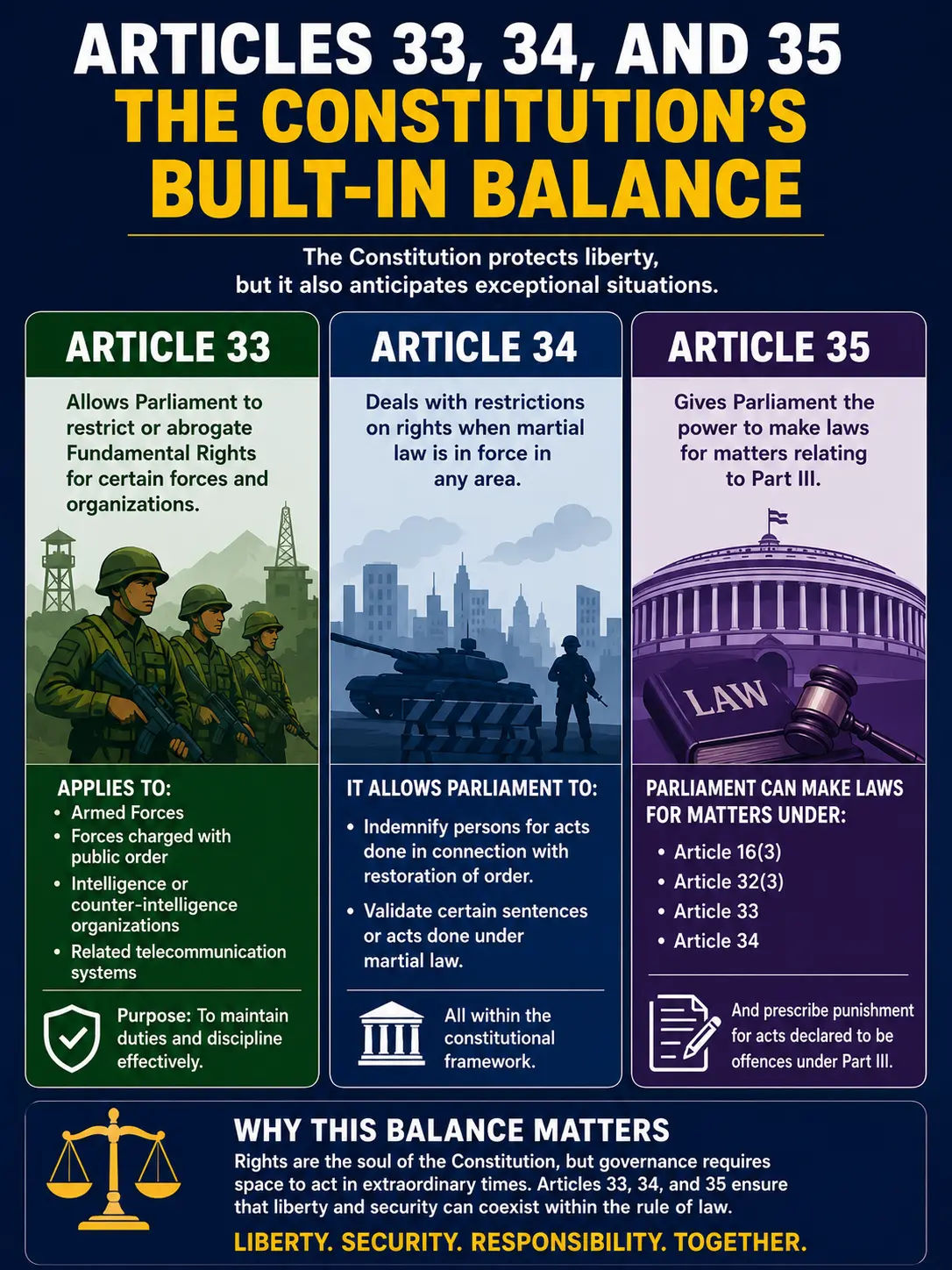
Step 9: Articles 33, 34, and 35, the Constitution’s built-in balance
The last stretch of Part III is often overlooked, but it matters a great deal.
Article 33 allows Parliament to determine the extent to which the rights under Part III may be restricted or abrogated in their application to the Armed Forces, forces charged with public order, intelligence or counter-intelligence organizations, and related telecommunication systems, so that duties and discipline can be properly maintained.
Article 34 deals with restrictions on rights while martial law is in force in any area. It allows Parliament to indemnify persons for acts done in connection with restoration of order and to validate certain sentences or acts done under martial law, within the constitutional framework.
Article 35 says Parliament has the power to make laws for certain matters relating to Part III, including matters under Article 16(3), Article 32(3), Article 33, and Article 34, and for prescribing punishment for acts declared to be offences under Part III.
These articles show that rights and governance must sometimes coexist in difficult conditions. The Constitution is not naive. It protects liberty, but it also anticipates exceptional situations where discipline, security, and legislative power need defined space.
A larger table of the whole Part III, article by article
| Article | Subject | Simple explanation | Typical use in daily life |
|---|---|---|---|
| 12 | Definition of the State | Tells us who must respect these rights | Government bodies and public authorities are covered |
| 13 | Laws inconsistent with Fundamental Rights | Unconstitutional laws are void to the extent of conflict | Courts can test laws against Part III |
| 14 | Equality before law | No arbitrary treatment by the State | Fair policing, fair administration, fair laws |
| 15 | Non-discrimination | No discrimination on specified grounds | Access to public places and state action must be fair |
| 16 | Equal opportunity in public employment | Fair chance in government jobs | Hiring and reservation must follow constitutional rules |
| 17 | Abolition of untouchability | Untouchability is forbidden | Social exclusion on this basis is unconstitutional |
| 18 | Abolition of titles | Public privilege cannot become inherited title culture | Limits honorary power and foreign titles |
| 19 | Freedoms of speech, assembly, association, movement, residence, profession | Core civil freedoms | Speech, work, travel, peaceful protest |
| 20 | Protection in criminal matters | Fair criminal process | No retroactive criminal law, no double punishment, no forced self-incrimination |
| 21 | Life and personal liberty | Basic personal security | Police and State action must follow lawful procedure |
| 21A | Right to education | Free and compulsory education for ages 6 to 14 | Constitutional basis for school access |
| 22 | Protection against arrest and detention | Minimum safeguards after arrest | Right to know grounds of arrest and see a magistrate promptly |
| 23 | Prohibition of traffic and forced labour | No trafficking or forced labour | Protects workers and vulnerable people from coercion |
| 24 | Ban on child labour in hazardous settings | Children cannot be used in dangerous work | Protects children from factory and mine exploitation |
| 25 | Freedom of conscience and religion | Right to believe, practise, and propagate religion within limits | Personal faith and religious expression |
| 26 | Management of religious affairs | Religious denominations can manage their affairs | Religious institutions can govern internal matters |
| 27 | No forced tax for a specific religion | Tax money cannot be earmarked for promotion of a particular religion in the forbidden sense | Protects conscience in taxation |
| 28 | Religious instruction in education | Limits compulsory religious instruction in State-funded settings | Protects students from forced participation |
| 29 | Protection of minorities’ culture | Distinct language, script, or culture can be conserved | Helps communities preserve identity |
| 30 | Minority educational institutions | Minorities can establish and administer schools | Protects educational autonomy of minorities |
| 31A | Saving of certain laws | Shields certain land and management laws from invalidation in defined situations | Supports reform and public interest measures |
| 31B | Validation of certain Acts and Regulations | Protects listed laws from challenge on some constitutional grounds | Strengthens legal stability for certain enactments |
| 31C | Saving of laws giving effect to certain Directive Principles | Helps certain welfare-oriented laws survive conflict | Balances Part III with Parts IV goals |
| 32 | Remedies for enforcement of rights | Right to move the Supreme Court for constitutional relief | Makes rights enforceable in court |
| 33 | Power to modify rights for certain forces | Allows Parliament to adjust rights for armed and security forces | Maintains discipline and duty |
| 34 | Rights during martial law | Handles exceptional situations of martial law | Balances order and accountability |
| 35 | Legislation to give effect to Part III | Parliament’s power to legislate for certain Part III matters | Gives the Constitution working force |
How to read Part III like a thoughtful citizen
A lot of people think constitutional law is only for judges, lawyers, and exam candidates. That is not true. Part III is for everyone. It affects how a child gets education, how an arrest is handled, how a protest is judged, how a school respects minority rights, how a religious practice is treated by law, and how the government behaves in public life.
A smart way to read Part III is in layers.
- First, ask what the article protects.
- Second, ask who the article controls, usually the State.
- Third, ask whether the right is absolute or subject to reasonable restrictions.
- Fourth, ask what remedy exists if the right is violated.
That simple four-step habit makes the Constitution much easier to understand.
A few practical reading tips
- Read Article 12 before reading the rest. It tells you who the Constitution is talking about.
- Read Article 13 early. It tells you what happens when law and right collide.
- Read Article 19 with its restrictions, not in isolation.
- Read Article 21 with Article 32. Right and remedy belong together.
- Read Articles 29 and 30 as part of India’s broader commitment to diversity.
Why Part III still matters so much today
Part III is old in age, but never old in relevance. It matters because people still face discrimination. People still face arbitrary power. Workers still need protection. Children still need protection. Minorities still need space to preserve identity. Citizens still need speech, movement, and legal remedies.
The Constitution does not pretend society is perfect. It knows society can be unfair. That is exactly why Part III exists. It gives a person a legal vocabulary for dignity. It tells the government where its limits are. It tells courts what to protect. And it tells citizens that freedom is not a gift from power. It is a constitutional entitlement.
There is also a deeper idea here. Part III is not only about individual comfort. It is about constitutional culture. A society that respects Fundamental Rights is a society that takes law seriously, power seriously, and people seriously.
A final step-by-step summary
If you want the simplest possible way to remember Part III, hold onto this sequence:
- Article 12 tells you who the State is.
- Article 13 says conflicting laws can fall.
- Articles 14 to 18 protect equality.
- Articles 19 to 22 protect freedom, liberty, and legal safeguards.
- Articles 23 to 24 stop exploitation.
- Articles 25 to 28 protect religion.
- Articles 29 to 30 protect culture and minority education.
- Articles 31A to 31C save certain laws.
- Article 32 gives you the courtroom key.
- Articles 33 to 35 handle special constitutional situations and legislative power.
That is Part III in one clean line. But of course, the beauty of the Constitution is in the details.
Closing thought
Part III of the Indian Constitution is not just a legal chapter. It is the moral backbone of constitutional democracy in India. It protects equality, liberty, dignity, religion, culture, education, and legal remedy. It also admits that rights must sometimes be balanced with public order, social reform, and the practical demands of government. That balance is what makes it serious law, not sentimental language.
And that is why Part III deserves to be read slowly, clearly, and with respect. Once you understand it, you start seeing the Constitution not as a distant document, but as a living shield around ordinary life.
Article References and Sources
- Constitution of India (Official Constitutional Text)
- Constitution of India (Official Legislative Department Portal)
- Supreme Court of India: Jurisdiction Under Article 32
- Constitution of India Archive. Part III: Fundamental Rights (Articles 12–35).
- Article 32: Remedies for Enforcement of Fundamental Rights
- Official Constitution PDF
Also, Read These Articles in Detail
- Fundamental Rights in India
- What Are Fundamental Rights Under the Indian Constitution?
- History of Fundamental Rights in India
- Why Fundamental Rights Are Important for Every Indian Citizen
Frequently Asked Questions
FAQ 1: What is Part III of the Indian Constitution?
Part III of the Indian Constitution is the part that lays down the Fundamental Rights of citizens and, in some cases, all persons. These rights are the constitutional guarantees that protect people from unfair treatment, abuse of power, and basic violations of dignity. They form one of the most important pillars of Indian constitutional democracy.
In simple words, Part III tells the State what it cannot do. It says the government cannot act in a way that destroys equality, freedom, personal liberty, religious freedom, or access to constitutional remedies. That is why Part III matters so much. It is not just a legal chapter. It is a daily-life protection system.
Part III covers Articles 12 to 35. These articles include the Right to Equality, Right to Freedom, Right against Exploitation, Right to Freedom of Religion, Cultural and Educational Rights, and Right to Constitutional Remedies. Together, they create a strong legal shield around the individual.
You can think of Part III like the Constitution’s warning light. When the State goes too far, Part III steps in. When a law is unfair, Part III gives courts a way to test it. When a person’s basic liberty is threatened, Part III gives them a legal path to respond. That is why students, citizens, lawyers, and judges all give it so much importance.
It is also important to understand that Part III does not promise unlimited freedom. It gives freedom with structure. Some rights are subject to reasonable restrictions, and some rights work within the larger constitutional balance. Still, the overall purpose remains the same, which is to protect human dignity and ensure fairness.
FAQ 2: Why is Part III called the heart of the Indian Constitution?
Part III is often called the heart of the Indian Constitution because it gives real meaning to the idea of constitutional democracy. A constitution is not useful if it only describes how power is organized. It must also protect the person from power. That is exactly what Part III does.
It protects people from discrimination, arbitrary action, illegal detention, forced labour, religious interference, and unfair treatment in public life. It also gives people the right to approach the courts when these protections are violated. Without this part, many constitutional promises would remain only words on paper.
Another reason Part III is so central is that it creates a direct connection between the citizen and the Constitution. A person does not need to wait for a special favor from the government to enjoy these rights. These rights already belong to them. The Constitution recognizes them from the start.
Part III also matters because it shapes law, policy, and governance. Legislators must keep it in mind while making laws. Administrators must respect it while implementing rules. Courts use it to test whether a law or government action is valid. That means Part III influences the entire system, not just courtroom cases.
And there is a deeper reason too. Part III reflects the moral values of the Constitution. It tells us that equality is not optional, liberty is not a luxury, and dignity is not something the State can give and take away at will. That is why it sits at the center of the constitutional structure.
FAQ 3: What does Article 12 mean in Part III?
Article 12 is the starting point of Part III because it defines the term “the State.” This is extremely important. Why? Because Fundamental Rights are mainly enforceable against the State and bodies that exercise public power.
Under Article 12, the State includes the Government and Parliament of India, the Government and Legislature of each State, and all local or other authorities within the territory of India or under the control of the Government of India. In simple language, this means the Constitution does not limit itself to the central government alone. It reaches many public bodies and authorities.
This matters because a lot of constitutional disputes are not about Parliament itself. They are about departments, boards, municipal bodies, public institutions, or other authorities that affect people’s lives every day. Article 12 makes sure those bodies cannot escape constitutional scrutiny simply by saying they are not the main government.
A practical example helps here. Suppose a public authority denies a person a service in a way that is unfair or discriminatory. If that authority falls within the meaning of the State, then Part III may apply. That gives the person a constitutional basis for challenge.
So, Article 12 is like the gateway to the rest of Part III. Before you can ask what right has been violated, you first need to know whether the body involved is covered by the Constitution’s idea of the State. That is why Article 12 is so important.
FAQ 4: What is Article 13 and why does it matter so much?
Article 13 is one of the most powerful provisions in Part III because it says that laws inconsistent with Fundamental Rights are void to the extent of the inconsistency. In other words, if a law clashes with a Fundamental Right, the Constitution wins.
Article 13 also says that the State cannot make laws that take away or abridge Fundamental Rights. This means future laws cannot simply erase constitutional protections. It keeps the legislature within constitutional limits.
There is another very important point. Article 13 gives a broad meaning to the word law. It does not mean only an Act passed by Parliament or a State Legislature. It can also include ordinances, orders, bye-laws, rules, regulations, notifications, customs, and usages that have the force of law. That is a very wide safety net.
This matters in real life because rights can be harmed in many different ways. Sometimes the problem is a full law. Sometimes it is a rule or a notification. Sometimes it is an official practice. Article 13 helps courts examine all of these forms of legal power.
Think of Article 13 as the Constitution’s filter. It checks every legal rule against the higher standard of Fundamental Rights. If the rule fails, the Constitution does not bend. The rule does.
FAQ 5: What are the main rights under the Right to Equality?
The Right to Equality is found in Articles 14 to 18. It is one of the strongest and most widely used parts of Part III. It says that people should be treated fairly, without arbitrary discrimination or illegal privilege.
Article 14 guarantees equality before law and equal protection of the laws. This means the State must act fairly and cannot treat similarly placed people differently without a proper reason.
Article 15 prohibits discrimination on grounds only of religion, race, caste, sex, or place of birth. It also allows special provisions for groups that have faced historical disadvantage. This is important because equality is not always about treating everyone identically. Sometimes it means helping people reach a fair starting point.
Article 16 deals with equality of opportunity in public employment. It makes sure that government jobs are not reserved for the favored few and that recruitment is fair.
Article 17 abolishes untouchability. This is a very strong and direct constitutional rejection of a deeply unjust social practice.
Article 18 abolishes titles, except military and academic distinctions. It also restricts certain kinds of title-based privilege, especially when it could create a social hierarchy.
These rights matter because inequality does not always look dramatic. Sometimes it is obvious. Sometimes it is hidden in rules, behavior, hiring practices, or official procedure. The Right to Equality keeps the system honest.
A simple way to remember it is this. Equality under the Constitution is not just about identical treatment. It is about fair treatment, non-discrimination, and dignity.
FAQ 6: What does the Right to Freedom include in Part III?
The Right to Freedom is mainly covered by Articles 19 to 22. It protects the freedoms people use every day to live, speak, move, work, and defend themselves against unlawful state action.
Article 19 gives citizens several freedoms, including the freedom of speech and expression, peaceful assembly, association, movement throughout India, residence and settlement in any part of India, and the freedom to practise any profession or carry on any occupation, trade, or business. These are not minor rights. They shape the entire structure of public life.
But these freedoms are not absolute. The Constitution allows reasonable restrictions for reasons such as public order, morality, decency, security of the State, and other important constitutional concerns. That means freedom exists, but it exists within a lawful structure.
Article 20 gives protections in criminal law. It protects against retrospective criminal punishment, double jeopardy, and self-incrimination. That is a very important safeguard because criminal law can be harsh if left unchecked.
Article 21 protects life and personal liberty. This is one of the most significant rights in the Constitution. It means the State cannot deprive a person of life or liberty except according to lawful procedure.
Article 21A makes education a constitutional right for children aged six to fourteen years.
Article 22 provides protections against arrest and detention in certain cases. It ensures that arrest is not treated casually and that legal safeguards are respected.
Taken together, these articles protect the space in which a person lives as a free human being. Speech, movement, education, fair trial protections, and liberty all belong here.
FAQ 7: What is the meaning of Article 21 in simple language?
Article 21 says that no person shall be deprived of his life or personal liberty except according to procedure established by law. That sounds formal, but the idea behind it is deeply human.
In simple language, Article 21 means the State cannot take away a person’s life or freedom unfairly or unlawfully. It requires lawful procedure, not random power. That one line has become one of the most important constitutional guarantees in India.
The word life here is not only about physical survival. Over time, constitutional interpretation has treated life as something more meaningful than mere existence. It is connected to dignity, safety, and a life worth living within the law.
The phrase personal liberty protects a person from unlawful restraint and unfair interference in their freedom. It includes protection from illegal detention, arbitrary arrest, and other forms of unjust state control.
A good way to understand Article 21 is to think of it as the constitutional promise that the State must respect the person. It cannot treat human beings like objects. It must act through lawful process, and that process must be fair enough to matter.
That is why Article 21 is often discussed in many areas of law. It connects with criminal procedure, prison rights, privacy, dignity, health, and much more. It is one of those articles that looks short on the page but has a very large reach in real life.
FAQ 8: What are Articles 23 and 24 about?
Articles 23 and 24 form the Right against Exploitation. These provisions are short, but they are morally and legally powerful.
Article 23 prohibits traffic in human beings, begar, and other similar forms of forced labour. This means no person should be turned into a tool of exploitation. No one should be trafficked, forced to work against their will, or trapped in a system of coercion and abuse.
Article 24 says that no child below the age prescribed by law shall be employed to work in any factory, mine, or other hazardous employment. The focus here is not only on age. It is also on danger. Children must be protected from harmful work environments.
These rights matter because exploitation often hides behind poverty, dependency, fear, or lack of education. The Constitution does not ignore that. It steps in strongly and says this kind of treatment is not acceptable.
A practical example is easy to imagine. If a poor worker is forced to work without freedom to leave, that may raise concerns under Article 23. If a child is made to work in unsafe industrial conditions, Article 24 becomes relevant. These are not theoretical rules. They deal with serious human harm.
The deeper idea is simple. Work should be lawful and fair. It should not be based on coercion, trafficking, or abuse. The Constitution makes that a clear standard.
FAQ 9: What rights are protected under freedom of religion and cultural rights?
The Constitution protects religion and cultural identity through Articles 25 to 30. These provisions are important because India is a country of many faiths, languages, scripts, and cultural traditions.
Article 25 gives freedom of conscience and the right to freely profess, practise, and propagate religion, subject to public order, morality, health, and other constitutional provisions. This means people can follow their faith, but the law still has a role where public interest is involved.
Article 26 allows religious denominations to manage their own affairs in matters of religion, establish and maintain religious and charitable institutions, and own and administer property according to law.
Article 27 says a person cannot be compelled to pay taxes that are meant specifically for the promotion or maintenance of a particular religion in the constitutional sense.
Article 28 deals with religious instruction in educational institutions and prevents compulsory religious education in certain State-supported settings.
Then come Articles 29 and 30, which protect cultural and educational rights. Article 29 safeguards the right of any section of citizens with a distinct language, script, or culture to conserve it. Article 30 gives minorities the right to establish and administer educational institutions of their choice.
These rights are very important because they show that the Constitution respects diversity. It does not ask communities to erase themselves. It asks them to live together under a shared legal framework.
So, if a community wants to preserve its language or build educational institutions that reflect its identity, the Constitution provides room for that. That is a strong and thoughtful kind of freedom.
FAQ 10: How does Part III protect citizens when their rights are violated?
Part III is not only about listing rights. It is also about enforcing them. That is where Article 32 becomes so important.
Article 32 gives a person the right to move the Supreme Court for the enforcement of Fundamental Rights. This means a citizen can directly seek constitutional remedies when their rights are violated. The Supreme Court can issue writs such as habeas corpus, mandamus, prohibition, quo warranto, and certiorari.
This is crucial because a right without a remedy is weak. Article 32 makes the rights in Part III real. It turns constitutional language into enforceable legal action.
For example, if someone believes they are being held unlawfully, habeas corpus may be relevant. If a public authority refuses to perform a legal duty, mandamus may be used. If a lower authority acts without jurisdiction, prohibition or certiorari may come into the picture. If someone is holding a public office without lawful authority, quo warranto may be used.
This is why many lawyers call Article 32 the protector of Fundamental Rights. It is the bridge between the right and the courtroom.
And that is not the end of the story. Articles 33, 34, and 35 also help balance rights with special constitutional situations and legislative power. These articles show that the Constitution is both protective and practical. It defends liberty, but it also allows the legal system to function in special circumstances.
In the end, the true strength of Part III lies in this simple idea. The Constitution does not merely say what rights exist. It also gives people a legal way to defend them.
FAQ 11: Why is Article 14 such an important part of the Right to Equality?
Article 14 is one of the most important provisions in the entire Constitution because it speaks directly to the idea of equality before law and equal protection of the laws. In simple language, it means the State cannot behave in an arbitrary or unfair way. It must act with reason, fairness, and consistency.
This article matters because a legal system can look fair on paper but still become unfair in practice if power is used carelessly. Article 14 stops that. It tells the government that people who are similarly placed should not be treated badly for no good reason. At the same time, it also allows the State to treat different situations differently when there is a valid constitutional reason. So it is not blind sameness. It is lawful fairness.
That is why Article 14 is often seen as the foundation of modern equality law in India. Many other rights and legal principles are built around it. If a law or policy seems unreasonable, discriminatory, or clearly arbitrary, Article 14 is usually one of the first constitutional ideas that comes into play.
A simple example makes this easier to see. Suppose a public authority gives a benefit to one person in a similar position but denies it to another person without any proper reason. That kind of uneven treatment may raise an Article 14 issue. The law does not forbid all differences. It forbids unfair differences.
And that is the real beauty of Article 14. It tells the State that power must not be random. It must be guided by reason.
FAQ 12: How does Article 15 protect people from discrimination?
Article 15 protects people from discrimination on grounds only of religion, race, caste, sex, or place of birth. This is a direct and strong constitutional statement. It says that identity alone should not become a reason for unfair treatment by the State.
In practical terms, Article 15 matters in places like education, access to public services, and State action in general. A person should not be treated badly just because of who they are. That sounds obvious, but in real life, history shows that discrimination can become normal if the law does not stop it clearly. Article 15 exists precisely because society needed that protection.
The phrase “on grounds only” is important. It means the State cannot use those factors as the sole basis for discrimination. If there are other valid constitutional reasons, the analysis may become more complex. But the article makes the basic rule very clear. Identity by itself cannot be a valid excuse for unfairness.
Article 15 is also important because it recognizes that equality sometimes needs special support. That is why the Constitution allows certain beneficial or protective measures for women, children, and historically disadvantaged groups. So Article 15 is not just about prohibition. It is also about creating space for corrective fairness.
A simple example helps. A government school cannot deny admission to a child only because of caste or religion. A public authority cannot block access to a service only because a person belongs to a particular community. That is the kind of unfairness Article 15 was designed to prevent.
So, Article 15 is not just an equality clause. It is a dignity clause too.
FAQ 13: What does Article 16 mean in relation to government jobs?
Article 16 deals with equality of opportunity in matters of public employment. That means public jobs should be open on fair terms, and no one should be blocked from competing just because of identity, bias, or hidden favoritism.
This article is very important in a country where government employment has long been seen as a stable and respected career path. If recruitment is unfair, public trust in the system weakens. Article 16 helps keep recruitment honest by requiring equal opportunity.
The Constitution also recognizes that equal opportunity does not always mean the same outcome for everyone. Some groups have faced long historical disadvantages. So Article 16 allows the State to make certain special provisions in public employment for backward classes, Scheduled Castes, Scheduled Tribes, and economically weaker sections, within the constitutional framework.
That balance is important. The Constitution does not pretend that all applicants begin from the same place. It allows the State to correct old injustice while still keeping the idea of opportunity alive.
A practical example makes this easier. If a recruitment process is designed in a way that secretly favors one group without a valid constitutional reason, that may violate Article 16. On the other hand, a constitutionally valid reservation or welfare-based measure may be allowed because the Constitution itself supports fairness in a broader sense.
So Article 16 is about opening the door to public employment fairly and lawfully. It is not about privilege. It is about opportunity.
FAQ 14: Why did the Constitution abolish untouchability under Article 17?
Article 17 abolishes untouchability and forbids its practice in any form. This is one of the most powerful and morally direct statements in the entire Constitution.
Untouchability is not just a social wrong. The Constitution treats it as a serious constitutional violation. That tells us something very important. The framers did not see social reform as optional. They saw it as necessary for a just society.
The reason Article 17 matters so much is that untouchability had caused deep and long-lasting humiliation, exclusion, and inequality. It pushed people out of public life and denied them dignity. The Constitution could not accept that. So it used its strongest language to reject the practice completely.
This article is not limited to one narrow form of behavior. It says untouchability is abolished in any form. That broad wording matters because oppressive practices can change shape over time. The Constitution wanted to close that door.
In real life, Article 17 gives constitutional force to the idea that no person should be treated as socially inferior because of caste-based exclusion. It supports the legal and moral movement toward equal citizenship.
A simple example is enough. If a person is denied entry, service, or respect in a public setting because of untouchability-based thinking, that is not a private matter. It is a constitutional issue.
Article 17 is one of those provisions that shows the soul of the Constitution. It does not just manage power. It tries to repair society.
FAQ 15: What is the meaning of Article 19 and why is it so famous?
Article 19 is famous because it protects many of the freedoms that people use in everyday life. It gives citizens the right to freedom of speech and expression, peaceful assembly, association or union, movement throughout India, residence and settlement in any part of India, and the freedom to practise any profession or carry on any occupation, trade, or business.
This article is often called the backbone of civic liberty because it touches so many ordinary actions. Writing, speaking, traveling, joining groups, doing business, and moving across the country all connect in some way to Article 19.
But the Constitution is careful. These rights are not unlimited. The State can place reasonable restrictions for important reasons such as public order, security, morality, decency, and other constitutional concerns. That means Article 19 protects freedom, but not lawlessness.
This balance is what makes Article 19 so strong. It protects people from overreach, but it also recognizes that society needs some boundaries. The result is a freedom that is meaningful rather than chaotic.
A simple example may help. A citizen can express opinions and publish ideas, but they cannot use that freedom in a way that clearly crosses lawful limits. A peaceful protest is protected. Violence is not. That is the basic constitutional idea.
Article 19 matters because it keeps democracy alive. Without speech, movement, association, and the freedom to work, public life becomes narrow and controlled. With Article 19, people can participate in society as free citizens.
FAQ 16: How does Article 20 protect a person in criminal law?
Article 20 gives important protection to people accused of offences. It is a fairness clause in criminal law. It protects against retrospective criminal punishment, double jeopardy, and self-incrimination.
The first protection means a person cannot be punished for something that was not an offence when it was done. That is very basic fairness. A person should know the law before they are held criminally responsible under it.
The second protection, double jeopardy, means a person cannot be punished more than once for the same offence in the constitutional sense. That stops the State from repeatedly prosecuting someone for the same wrongdoing just because it wants another chance.
The third protection, against self-incrimination, means a person cannot be forced to testify against themselves in the way the Constitution forbids. That is a major safeguard in a criminal justice system where the State has strong power.
Article 20 is important because criminal law can be intimidating. A person facing prosecution is often in a vulnerable position. The Constitution does not ignore that imbalance. It builds in fairness so that criminal law does not become a tool of oppression.
A simple example is useful here. If a new law suddenly tries to punish a past act as if it had always been criminal, Article 20 becomes relevant. If someone is tried again and again for the same offence, Article 20 becomes relevant. If an accused person is improperly forced to incriminate themselves, Article 20 matters again.
So Article 20 is not just technical. It is deeply protective of fairness and personal security.
FAQ 17: What is Article 21A and why was it added?
Article 21A gives the Right to Education to children aged six to fourteen years in the manner the Constitution and law provide. This article is a major step because it recognizes education as a constitutional right, not just a policy goal.
Education is not only about books and classrooms. It is about opportunity, confidence, social mobility, and the ability to live with independence. When the Constitution gives education constitutional value, it is really saying that children should not be left behind because of poverty, distance, or social disadvantage.
Article 21A is important because it turns a child’s access to education into a matter of right. That changes the tone completely. It is no longer something to be treated as a favor or a privilege. It becomes something the State must respect and support.
A practical example makes this obvious. If a child within the protected age group is denied school access in a way that violates the constitutional or legal framework, that may raise serious concerns under Article 21A. The right is not symbolic. It has real force.
This article also fits beautifully with the rest of Part III. It links life and liberty with education. That is a strong constitutional idea because a real life of dignity usually needs learning, not just survival.
Article 21A shows that the Constitution does not only protect people from harm. It also tries to open doors for growth.
FAQ 18: What does Article 22 say about arrest and detention?
Article 22 provides safeguards against arrest and detention in certain cases. This article matters because arrest is a serious action. Once someone is arrested, their personal freedom becomes limited, sometimes sharply. The Constitution does not leave that process unchecked.
Article 22 ensures that a person is informed of the grounds of arrest, and that they are produced before a magistrate within the required time, subject to constitutional exceptions. These safeguards are meant to prevent secret or careless deprivation of liberty.
This article is important because the power to arrest can be misused if it is not controlled by law. The Constitution understands that. So it places protective rules around arrest to reduce the risk of abuse.
A simple example helps. If a person is taken into custody, they should not be left completely in the dark about why it happened. The law expects fairness and procedure. That does not mean every arrest is illegal. It means every arrest must stay within constitutional and legal limits.
Article 22 does not make arrest impossible. It makes arrest accountable. That is the real point. The State may have power to arrest in proper situations, but that power must be used lawfully and with respect for personal liberty.
So Article 22 works like a constitutional brake. It stops arrest from becoming arbitrary control.
FAQ 19: What are Articles 29 and 30 about in simple words?
Articles 29 and 30 protect cultural and educational rights. These provisions are very important in a diverse country because they make sure that communities can preserve their identity and build educational institutions that reflect that identity.
Article 29 says that any section of citizens with a distinct language, script, or culture has the right to conserve it. That means culture is not something the Constitution wants to erase. It is something the Constitution respects.
Article 29 also says that no citizen can be denied admission into State-maintained or State-aided educational institutions only on the grounds of religion, race, caste, language, or any of them. That is a strong equality and inclusion rule.
Article 30 gives minorities based on religion or language the right to establish and administer educational institutions of their choice. This is very important because education is one of the main ways communities preserve identity and pass it on to the next generation.
These rights matter because diversity is one of India’s greatest strengths. But diversity can only survive if the legal system allows communities to live with dignity. Articles 29 and 30 do exactly that.
A simple example is useful. If a linguistic minority wants to open a school that helps preserve its language and culture, Article 30 supports that. If a student is denied admission only because of language or religion in a State-aided institution, Article 29 becomes highly relevant.
These articles show that the Constitution values both unity and diversity. It does not force one uniform culture. It protects many.
FAQ 20: How does Article 32 make Fundamental Rights real?
Article 32 is the enforcement tool of Part III. It gives a person the right to move the Supreme Court for the enforcement of Fundamental Rights. This is one of the most important constitutional remedies in India.
Why is Article 32 so powerful? Because a right without a remedy is weak. A right with a direct route to court becomes real. Article 32 turns constitutional promises into enforceable protections.
The Supreme Court can issue writs such as habeas corpus, mandamus, prohibition, quo warranto, and certiorari. These are not just technical legal terms. They are practical legal tools that help a person respond when rights are violated.
For example, if a person is unlawfully detained, habeas corpus may be used. If a public authority is refusing to perform a legal duty, mandamus may be relevant. If a lower body acts beyond its authority, prohibition or certiorari may come into the picture. If someone occupies a public office without legal authority, quo warranto may be used.
Article 32 is so important that it is often described as the guardian of the Fundamental Rights system. It ensures that Part III is not a decorative chapter. It is a living legal mechanism.
And that is the deeper lesson here. The Constitution does not just grant rights and walk away. It builds a path for enforcement. Article 32 is that path.
