

Fundamental Rights are one of the strongest parts of the Indian Constitution. They are not decorative words. They are enforceable rights, backed by the Constitution itself and protected through Article 32, which allows a person to approach the Supreme Court for enforcement of rights in Part III. The Constitution also defines “the State” broadly in Article 12, and that matters because many Fundamental Rights are written against the State, while some are written for all persons, some for citizens, and some for special groups such as children, minorities, or religious denominations.
That one distinction explains almost everything. Many people ask a simple question, but the legal answer is a little more layered. The real issue is not just whether someone lives in India. The real issue is how the Constitution phrases each right. It uses different words on purpose, and those words decide who can claim what. If the article says “all persons” or “no person”, the right is much wider. If it says “all citizens” or “no citizen”, the right is narrower.
Table of Contents
The Short Answer
Who can claim Fundamental Rights in India?
In plain language, citizens, non-citizens, children, prisoners, accused persons, legal persons such as companies in some situations, religious denominations, and minority communities can all claim some Fundamental Rights. But not every right is available to every claimant. The Constitution itself divides the rights into categories. Article 14, Article 20, Article 21, Article 22, Articles 23 and 24, and Articles 25 to 28 use broad language that protects persons and groups beyond citizens. Articles 15, 16, 19, and parts of 29 are citizen-based. Article 30 protects minorities.
That is why a legal answer to this topic has to be precise. A foreign national may rely on Article 14 and Article 21, but not on the citizenship-only freedoms in Article 19. A company may invoke some constitutional protections, but it cannot automatically claim every right as if it were a natural person. A prisoner does not lose constitutional protection just because the prison gate closes. And a child’s right to education does not depend on adult citizenship logic at all. The Constitution gives each of these categories a different kind of shield.

The Easiest Way to Read Part III
The smartest way to understand Fundamental Rights is to read the wording carefully.
If the Constitution says:
- “all citizens”, the right belongs only to citizens.
- “any person” or “no person”, the right is broad and can protect non-citizens too.
- “all persons”, the right is even more explicit in its universal reach.
- “any section of the citizens” or “all minorities”, the right belongs to a defined group.
- “religious denomination or any section thereof”, the right belongs to that religious body as such.
This is not a random drafting style. It is the Constitution telling you exactly who may claim the right. That is why lawyers, judges, students, and ordinary readers often begin with the text first. Once you see the language, the structure becomes much easier to understand.
Who Can Claim What
| Who is claiming the right | Rights they can usually claim | Key limits | Simple example |
|---|---|---|---|
| Citizens of India | Articles 14, 15, 16, 19, 20, 21, 21A, 22, 23, 24, 25, 26, 27, 28, 29, 32 and others, depending on the wording | Some rights are still subject to reasonable restrictions | An Indian citizen can challenge discriminatory State action under Article 14 and also claim free speech under Article 19. |
| Foreigners and non-citizens | Articles 14, 20, 21, 22, 23, 24, 25, 26, 27, 28 | They cannot claim citizenship-only rights such as Article 19 and Article 15 | A foreign national in India can still rely on Article 21 for life and personal liberty. |
| Children | Article 21A, Article 24, and child-related protections under Articles 14, 15, 21, 25, 28 where relevant | Age and subject matter matter | A child below 14 cannot be employed in hazardous work under Article 24. |
| Prisoners, undertrials, and detenus | Articles 14, 20, 21, 22 and related protections | Liberty can be lawfully curtailed, but dignity does not disappear | A prisoner still retains constitutional dignity under Article 21. |
| Companies and other legal persons | Some rights that fit legal persons, especially equality-based and property-linked protections, and in suitable cases other rights | Rights meant only for natural persons cannot always be claimed by a company | An incorporated company can approach court for enforcement of its own fundamental rights where the wording and nature of the right allow it. |
| Religious denominations | Article 26 and related religion clauses | Subject to public order, morality, and health | A religious denomination can manage its own affairs in matters of religion. |
| Minority communities | Articles 29 and 30 | These are tied to citizenship and minority status | A linguistic minority can preserve its culture and establish educational institutions of its choice. |
1. Citizens of India Can Claim the Broadest Set of Rights
Citizens enjoy the widest cluster of Fundamental Rights, but even here the Constitution is selective. Article 15 and Article 16 are citizenship-based equality rights. Article 19 is also limited to all citizens, and it includes freedoms such as speech, assembly, association, movement, residence, and profession. Article 29 and Article 30 protect cultural and educational interests, but the wording again matters. Article 29(1) speaks of any section of the citizens, and Article 30(1) speaks of all minorities, whether based on religion or language.
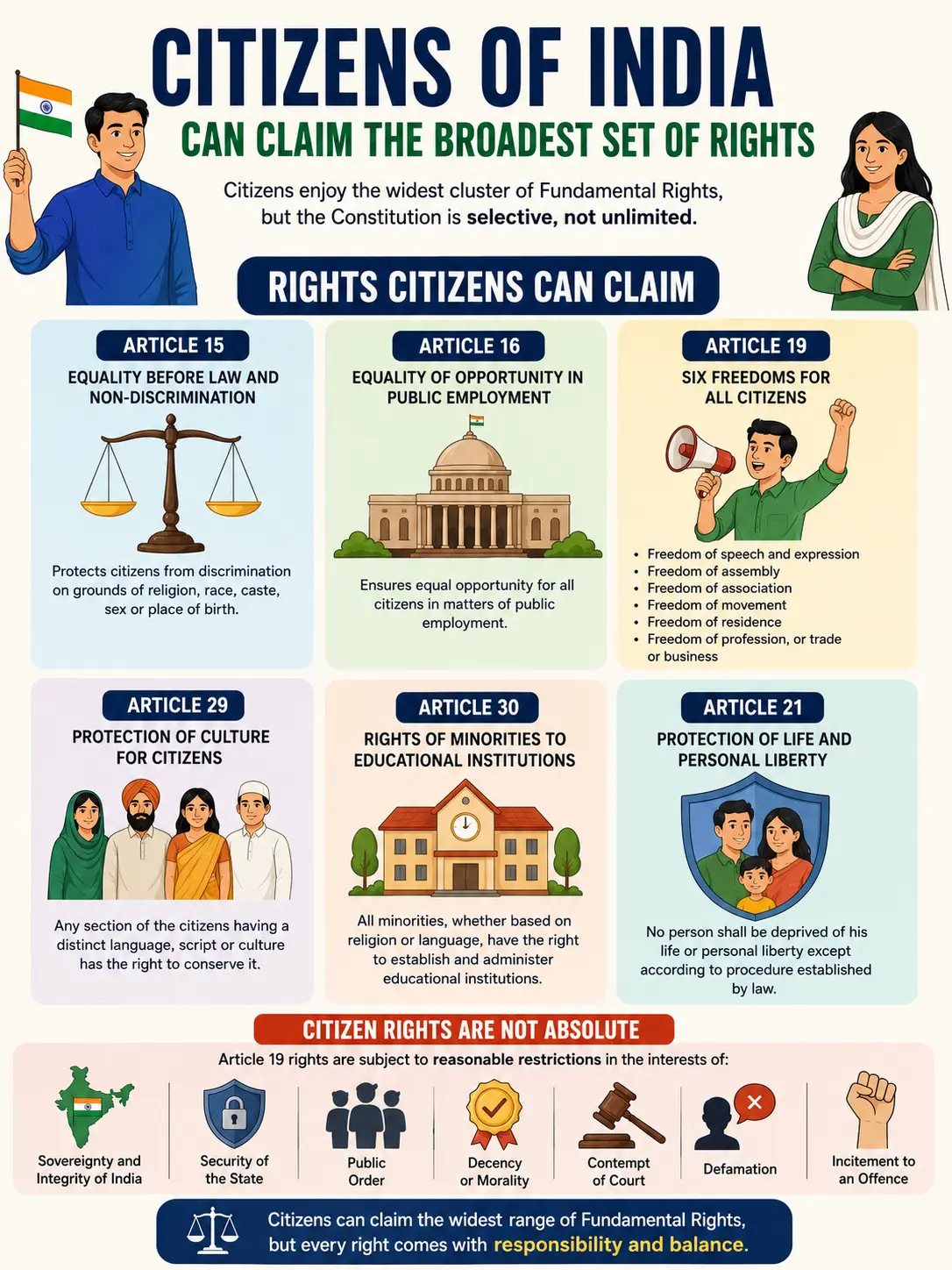
This means a citizen can usually claim both the general rights and the special freedoms reserved for citizens. For example, an Indian citizen may challenge a State rule that discriminates on grounds listed in Article 15, or a recruitment rule under Article 16, or a ban on peaceful expression under Article 19. A citizen can also invoke the constitutional promise of Article 21, which protects life and personal liberty in broad terms.
But citizenship does not mean unlimited freedom. Article 19 itself carries built-in restrictions. Speech can be limited for reasons such as sovereignty, integrity, security of the State, public order, decency, morality, contempt of court, defamation, and incitement to an offence. Similar reasonable restrictions apply to other clauses of Article 19 as well. So even the strongest citizen freedoms are not absolute.
2. Non-Citizens and Foreign Nationals Can Claim Many Rights Too
One of the most common mistakes people make is assuming that only citizens have constitutional protection. That is not true. The Constitution gives many rights to “any person” or “all persons”, and that language is large enough to include foreigners, subject to the specific article. Article 14 protects any person from denial of equality before law. Article 20 uses “No person” in criminal protection. Article 21 protects no person from deprivation of life or personal liberty except according to procedure established by law. Article 22 also begins with “No person”, although it contains special exceptions. Articles 23, 24, 25, 26, 27, and 28 are likewise drafted in broad or universal terms.
The constitutional text is already enough to show that non-citizens are not left outside the gate. The Supreme Court’s own reported language in an older case involving a French national in custody noted that, while certain rights like Article 19 are not available to a non-citizen, he was still entitled, as a human being, to basic rights. That is a useful reminder that the Constitution does not erase dignity at the border.
A foreign national in India can therefore rely on many protections, especially where the Constitution says person instead of citizen. A non-citizen can invoke the equality guarantee under Article 14, criminal safeguards under Article 20, life and personal liberty under Article 21, arrest and detention safeguards under Article 22 subject to constitutional exceptions, anti-trafficking and anti-forced labour protection under Article 23, child labour protection under Article 24, freedom of religion under Article 25, management of religious affairs under Article 26, tax protection relating to religion under Article 27, and protection from compelled religious instruction under Article 28.
But a foreign national cannot usually claim rights that the Constitution gives only to citizens, such as Article 15, Article 16, Article 19, Article 29, and the citizen-specific parts of Article 18. That is a key dividing line. In other words, foreigners are not outside the Constitution. They simply enter through the rights that were written for persons, not through the rights reserved for citizens.
3. Children Have Strong Constitutional Protection
Children are not treated as miniature adults in constitutional law. The text of Article 21A says the State shall provide free and compulsory education to all children of the age of six to fourteen years. That is a direct constitutional commitment. Article 24 also says that no child below the age of fourteen years shall be employed in a factory, mine, or other hazardous employment. These are not optional ideals. They are binding constitutional protections.

Children can also benefit from the broader rights that use the word person, such as Article 14, Article 20, Article 21, Article 22, and Article 25 to Article 28 where relevant. That means a child is protected not only as a child, but also as a person. The Constitution combines specific child-based guarantees with general human protections.
This is why child labour, denial of basic education, or arbitrary treatment of children can become constitutional issues. The protection is especially strong where work is dangerous, where schooling is denied, or where a child is forced into situations that harm dignity and development. The Constitution treats childhood as a protected stage of life, not as a weaker version of adulthood.
4. Prisoners, Undertrials, and Detenus Still Retain Fundamental Rights
A prison cell limits freedom, but it does not erase constitutional personhood. The Supreme Court has repeatedly recognised that prisoners remain human beings with fundamental rights. In a recent judgment, the Court stated that the guarantee of life and personal dignity under Article 21 extends beyond prison gates. Earlier case law also recorded the principle that a prisoner is entitled to basic rights as a human being, even when certain citizen-only rights are unavailable.
That is the core point. A prisoner may lose liberty because of lawful detention, but the Constitution does not allow cruelty, humiliation, or inhuman conditions to become part of the sentence unless the law itself clearly permits a lawful restriction. The right to life in Article 21 is still alive inside prison walls, and the State carries the duty to preserve dignity, humane conditions, and legality.
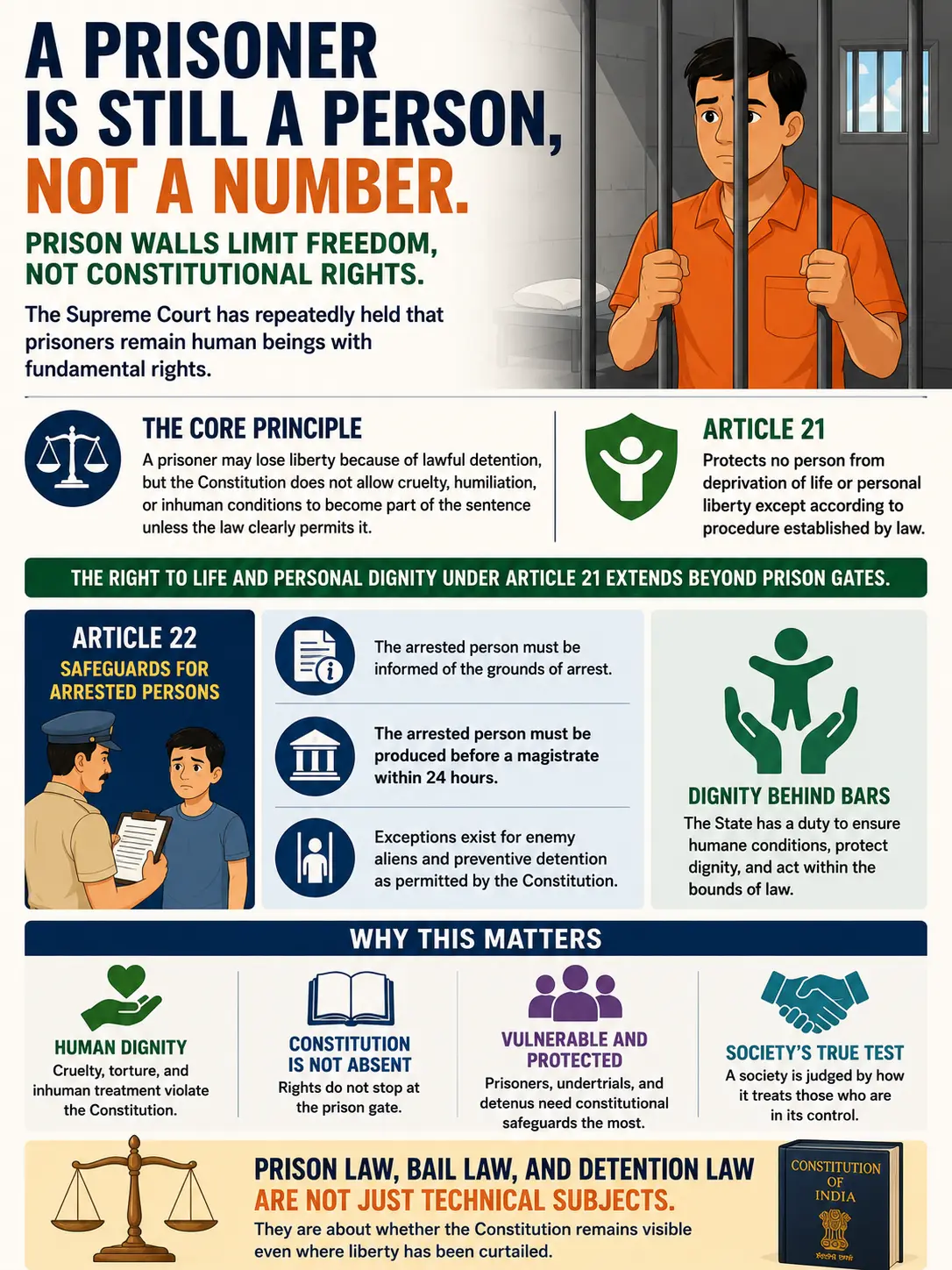
The Constitution itself supports this reading. Article 21 protects no person from deprivation of life or personal liberty except according to procedure established by law. Article 22 requires that an arrested person be informed of the grounds of arrest and be produced before a magistrate within 24 hours, with stated exceptions for enemy aliens and preventive detention. These rights are especially important for prisoners, undertrials, and detenus because they are the very people most vulnerable to abuse of power.
There is also a practical reason this matters. A society is often judged by how it treats those who are already under its control. That is why prison law, bail law, and detention law are never just technical subjects. They are about whether the Constitution remains visible even where liberty has been curtailed.
5. Companies and Other Legal Persons Can Claim Some Fundamental Rights
This is an area where many readers get confused. A company is not a human being, but it is still a legal person. The Supreme Court has long recognised that incorporated companies can approach the Court for enforcement of their fundamental rights, except where the wording or the nature of the right shows that it applies only to natural persons. The same judgment also explained that a shareholder cannot usually complain of a wrong done only to the company unless the shareholder’s own rights are affected too.
That means the Constitution is not limited to flesh-and-blood individuals alone. A company can, in the proper case, assert rights that fit its legal personality. Equality claims under Article 14 often become relevant here, and so do other constitutional protections where the language does not demand a strictly natural person. But a company cannot automatically claim every right in the Constitution. Some rights are obviously personal, bodily, or citizen-based. Those are not always suitable for a corporation.

This is also why the legal system carefully separates the rights of a company from the rights of its shareholders. The company is one legal entity. The shareholders are others. If a law harms the company, the company is normally the first and proper claimant. That simple principle prevents confusion and keeps constitutional litigation focused on the real holder of the right.
6. Religious Denominations and Minority Groups Have Special Constitutional Rights
The Constitution does something very interesting in Articles 25 to 30. It protects religion in broad terms, but it also protects the autonomy of religious groups and minorities. Article 25 says all persons are equally entitled to freedom of conscience and the right freely to profess, practise, and propagate religion. Article 26 gives every religious denomination or any section thereof the right to establish and maintain institutions, manage religious affairs, own property, and administer it according to law. Article 27 protects no person from being compelled to pay taxes used specifically for the promotion or maintenance of any religion. Article 28 protects persons attending educational institutions from unwanted religious instruction or worship in specified situations.
This means a religious body can sometimes assert its own constitutional identity, not just the rights of individual believers. A denomination can protect its religious character, institutions, and property, subject always to public order, morality, and health. That is a real constitutional right, not a symbolic one.
Minority rights are slightly different. Article 29(1) gives any section of the citizens residing in India or any part of it, having a distinct language, script, or culture, the right to conserve the same. Article 29(2) says no citizen shall be denied admission into State-aided or State-maintained educational institutions on grounds only of religion, race, caste, language, or any of them. Article 30(1) then gives all minorities, whether based on religion or language, the right to establish and administer educational institutions of their choice.
So minority rights are strong, but they are not written in vague language. They are carefully tied to citizenship, minority status, and education. That makes them one of the most distinctive parts of Part III. They do not just protect individual conscience. They protect community life, culture, language, and institutional independence.
7. Which Rights Are Citizen-Only?
This is one of the most important parts of the whole topic. Not every Fundamental Right is universal. Some are reserved for citizens because the Constitution says so.
| Right | Who can claim it | Why |
|---|---|---|
| Article 15 | Citizens only | The text says “The State shall not discriminate against any citizen” on listed grounds. |
| Article 16 | Citizens only | The text gives equality of opportunity for all citizens in public employment. |
| Article 19 | Citizens only | It expressly begins with “All citizens shall have the right” to the listed freedoms. |
| Article 29 | Citizens only | It refers to any section of the citizens and says no citizen shall be denied admission on listed grounds. |
| Article 18(2) | Citizens only | It says no citizen of India shall accept any title from a foreign State. |
| Article 18(3) and 18(4) | Non-citizens and office-holders under special limits | These clauses regulate certain conduct of persons holding office of profit or trust under the State. |
The point is simple. When the Constitution wants to give a right only to citizens, it says so in clear language. When it wants to protect everyone, it says person or all persons. That drafting choice is the key to understanding the whole Part III structure.
8. Which Rights Are Broadly Available to Everyone?
The Constitution also contains a large set of rights that are not tied to citizenship.
| Right | Who can claim it | Simple reading |
|---|---|---|
| Article 14 | Any person | Equality before law and equal protection of laws within India. |
| Article 20 | No person | Protection in criminal law against ex post facto punishment, double jeopardy, and self-incrimination. |
| Article 21 | No person | Protection of life and personal liberty. |
| Article 21A | All children aged 6 to 14 | Free and compulsory education. |
| Article 22 | No person, with exceptions | Protection against arrest and detention in certain cases. |
| Article 23 | Everyone | No traffic in human beings, begar, or forced labour. |
| Article 24 | Children below 14 | No child below 14 can be employed in hazardous work. |
| Article 25 | All persons | Freedom of conscience and religion. |
| Article 26 | Religious denominations or sections | Right to manage religious affairs. |
| Article 27 | No person | No compelled tax for promotion of a particular religion. |
| Article 28 | Persons in educational institutions | Protection against forced religious instruction or worship in specified institutions. |
This part of the Constitution is often more inclusive than people expect. It protects dignity, liberty, religion, and education in language that reaches far beyond citizenship alone. That is why a foreigner, a refugee, a student, a worker, or a detained person can all have serious constitutional claims in the right circumstances.
9. The Central Role of Article 32
If a right exists on paper but cannot be enforced, it becomes weak. The Constitution avoids that problem by giving a remedy in Article 32. The Supreme Court says its original jurisdiction can be used for the enforcement of Fundamental Rights, and it can issue writs such as habeas corpus, mandamus, prohibition, quo warranto, and certiorari. That is why Article 32 is often called the constitutional heart of enforcement.
The older Supreme Court language on company rights also makes the same point in a very direct way. Article 32 is about enforcing a petitioner’s own Fundamental Rights, and a person must show that the challenged law or action invades those rights. That helps explain why standing and identity matter so much in constitutional cases. The Court’s own language also confirms that incorporated companies can, in proper cases, come to Court for their own rights.
So when people ask, “Who can claim Fundamental Rights in India?”, the answer is never just about abstract theory. It is also about enforcement. A right must be paired with a claimant who can lawfully invoke it. That is what turns constitutional words into real protection.

The Important Exceptions People Often Miss
There are also some important limits inside the Constitution itself.
First, Article 22 has explicit exceptions. Its protections do not apply to a person who is for the time being an enemy alien, and some clauses do not apply to persons detained under preventive detention law. That is written into the text.
Second, not every right can be claimed in the same way by every legal entity. The corporate rights case makes it clear that the language and nature of the right matter. A company can claim some rights, but where the Constitution points to a natural person or a purely citizen-based freedom, the company may be outside the scope.
Third, the Constitution itself treats some rights as group rights rather than purely individual rights. Article 26 belongs to religious denominations or their sections. Article 29 belongs to sections of citizens with a distinct language, script, or culture. Article 30 belongs to minorities. Those rights are not the same as personal liberties. They are constitutional protections for collective identity and institutional autonomy.
Real-Life Examples That Make the Rule Easy to Remember
Here are a few practical examples.
- An Indian citizen protesting peacefully can rely on Article 19, subject to reasonable restrictions.
- A foreign student in India can still rely on Article 14 and Article 21 if treated unfairly or deprived of personal liberty.
- A child aged 10 cannot be sent to hazardous factory work because Article 24 blocks it.
- A prisoner who has been lawfully convicted still retains dignity and protection under Article 21.
- A company can challenge a discriminatory State measure if the right being claimed suits a legal person and the company itself is the proper claimant.
- A religious denomination can protect its institutions and internal religious affairs under Article 26.
- A linguistic minority can rely on Article 30 to establish and administer educational institutions of its choice.
These examples show the same pattern again and again. The Constitution is not one-size-fits-all. It is category-based, and that is what makes it workable in a huge and diverse country.
The Most Important Mental Shortcut
If you remember only one thing from this article, remember this:
Read the exact word used in the article.
- Citizen means citizen-only.
- Person means broad protection.
- All persons means broader still.
- Minorities means a special community-based right.
- Religious denomination means a religious group, not just an individual believer.
That tiny habit will save you from a lot of confusion. It will also help you read constitutional text like a lawyer, even if you are not one. And honestly, that is often the best way to study the Constitution. The wording is the key. The wording tells the story.
Why This Matters Beyond India
This question matters worldwide because India’s Constitution shows a very useful model. It does not treat rights as one giant block. It separates citizen rights, human rights, group rights, and institutional rights. That makes the text more precise and more practical. It also helps foreign readers understand that constitutional protection can be both universal and selective at the same time.
For students, researchers, and general readers, this is one of the cleanest ways to understand constitutional design. The State is bound. The person is protected. The citizen gets extra freedoms. The child gets special care. The minority gets cultural and educational protection. The prisoner does not lose dignity. The company may claim some rights where the law permits. That is the architecture of Part III.
Final Takeaway
So, who can claim Fundamental Rights in India? The honest answer is: a very wide range of people and bodies, but not all of them can claim all rights. Citizens have the broadest basket. Non-citizens still enjoy many serious rights. Children get special protection. Prisoners remain constitutional persons. Companies can claim some rights as legal persons. Religious denominations and minorities get their own constitutional protections. The key is always the wording of the specific article.
That is the complete guide. Fundamental Rights in India belong to different claimants depending on how the Constitution frames each right. Read the words carefully, and the answer becomes clear.
Article References and Sources
- The Constitution of India (Official Constitutional Text)
- Part III: Fundamental Rights (Constitutional Structure and Articles)
- Supreme Court of India: Jurisdiction Under Article 32
- Know India: Fundamental Rights Overview
- Constitution of India: Article 12 Definition of State
- Article 32 and Constitutional Remedies
- A.K. Gopalan v. State of Madras (Landmark Constitutional Case)
- National Institute of Open Schooling: Fundamental Rights Study Material
- Right to Constitutional Remedies and Writ Jurisdiction
- Constitution of India: Readable Constitutional Text
Also, Read These Articles in Detail
- Fundamental Rights in India
- What Are Fundamental Rights Under the Indian Constitution?
- History of Fundamental Rights in India
- Why Fundamental Rights Are Important for Every Indian Citizen
- Understanding Part III of the Indian Constitution
Frequently Asked Questions
FAQ 1: Who can claim Fundamental Rights in India?
Answer: In India, Fundamental Rights can be claimed by different people and groups depending on the exact wording of the constitutional article. This is the most important thing to understand first. The Constitution does not give the same set of rights to everyone in the same way. Some rights are for all persons, some are only for citizens, and some are for special groups such as children, minorities, religious denominations, and even legal persons like companies in some situations.
For example, Article 14 gives equality before law to any person. That means it protects both citizens and non-citizens. Article 21 protects the life and personal liberty of no person, so it also applies broadly. But Article 19 is different because it applies only to all citizens. That means a foreign national cannot claim the freedoms listed in Article 19 in the same way an Indian citizen can.
This is why the answer is not just “citizens” or “everyone.” The real answer is that who can claim a Fundamental Right depends on the article itself. Once you read the wording carefully, the rule becomes very clear. If the article says citizen, the right is limited. If it says person, the right is broader. If it says “minority” or “religious denomination,” then the right is meant for that particular group.
And that is what makes the Indian Constitution so practical. It gives broad human protection where needed, and special protection where necessary. So yes, many people can claim Fundamental Rights in India, but not all rights belong to all people in the same way.
FAQ 2: Can non-citizens claim Fundamental Rights in India?
Answer: Yes, non-citizens can claim many Fundamental Rights in India, but not all of them. This is a common misunderstanding. People often think constitutional protection is only for Indian citizens, but that is not true. The Constitution uses different words on purpose, and those words decide the scope of the right.
A non-citizen can claim rights that are written for “any person”, “no person”, or “all persons.” These include important protections such as Article 14, Article 20, Article 21, Article 22, Article 23, Article 24, Article 25, Article 26, Article 27, and Article 28. So if a foreign national is treated unfairly, denied dignity, or deprived of liberty without lawful procedure, the Constitution still offers protection.
But there are limits too. A non-citizen generally cannot claim citizen-only rights such as Article 19, Article 15, Article 16, and Article 29. These rights are reserved for Indian citizens because the Constitution says so directly.
This distinction matters a lot in real life. A tourist, a student, a business visitor, or a foreign worker in India may not be able to claim every constitutional freedom, but they are not unprotected. They still have strong legal protection against arbitrary action, illegal detention, forced labour, and violation of personal liberty.
So the simple answer is this. Non-citizens do have Fundamental Rights in India, but the range of those rights is narrower than the rights available to citizens.
FAQ 3: Which Fundamental Rights are available only to citizens of India?
Answer: The Constitution gives some Fundamental Rights only to citizens of India. These are often called citizen-specific rights. The most important ones are Article 15, Article 16, Article 19, and parts of Article 29. Also, Article 18(2) specifically speaks about citizens in the context of titles from foreign States.
Article 15 prevents discrimination by the State against any citizen on certain grounds such as religion, race, caste, sex, or place of birth. Article 16 gives equality of opportunity in public employment to citizens. Article 19 gives citizens freedoms like speech, assembly, association, movement, residence, and profession. Article 29 protects the cultural and linguistic interests of citizens, especially sections of citizens with a distinct language, script, or culture.
These rights are powerful, but they are not for everyone. A foreign national cannot use Article 19 to claim the full set of citizen freedoms. That is because the article itself begins with “all citizens.”
This is not a weakness in the Constitution. It is a deliberate design. Some rights are tied to the political community of the nation. Others are tied to basic human dignity. That is why the Constitution separates them.
So when people ask which Fundamental Rights are only for citizens, the short list is clear. Article 15, Article 16, Article 19, and citizen-based parts of Article 29 are the main examples.
FAQ 4: Can children claim Fundamental Rights in India?
Answer: Yes, children can absolutely claim Fundamental Rights in India, and in some areas they receive special constitutional protection. The Constitution does not treat children as weak versions of adults. It gives them direct rights that are specifically designed for their age and needs.
The most important child-related right is Article 21A, which gives every child between the ages of 6 and 14 years the right to free and compulsory education. This is a very strong constitutional guarantee. It means education is not just a policy idea. It is a constitutional duty of the State.
Another major protection is Article 24, which says that no child below 14 years can be employed in a factory, mine, or other hazardous employment. This protects children from exploitation and dangerous work. It is a direct safeguard for childhood itself.
Children can also benefit from broad rights like Article 14 and Article 21 because those rights are available to all persons. So if a child is treated unfairly, denied dignity, or exposed to unlawful harm, those provisions can still be used.
In simple language, the Constitution protects children in two ways. First, it gives them special rights as children. Second, it gives them general rights as persons. That is why child protection in India has a strong constitutional foundation.
FAQ 5: Do prisoners and undertrials still have Fundamental Rights?
Answer: Yes, prisoners and undertrials still have Fundamental Rights, even though their liberty is restricted by law. This is one of the most important ideas in constitutional law. A person does not stop being a human being just because they are in jail, under trial, or under detention.
The most important right here is Article 21, which protects life and personal liberty. The State can lawfully take away liberty only through a valid legal process, but it cannot strip away human dignity. That means prisoners still have protection against torture, cruelty, inhuman treatment, and arbitrary punishment.
Article 22 is also very important because it gives protections to arrested persons, such as being informed of the grounds of arrest and being produced before a magistrate within 24 hours, subject to constitutional exceptions. These safeguards exist because detention power can be misused if not carefully controlled.
Prisoners may not enjoy every freedom that a free citizen enjoys, but they do not lose all constitutional protection. Their rights may be limited, yet they remain protected by the Constitution. This is why prison conditions, bail, police custody, and preventive detention are all constitutional issues, not just administrative issues.
So the legal principle is simple. A person can lose liberty, but not dignity. That is the heart of the constitutional protection for prisoners and undertrials.
FAQ 6: Can companies or other legal entities claim Fundamental Rights in India?
Answer: Yes, in some situations companies and other legal persons can claim Fundamental Rights in India. A company is not a natural human being, but it is still a legal person. The law recognises it as an entity with rights and duties of its own.
This does not mean a company can claim every right in the Constitution. Some rights are clearly personal and human in nature, so they do not fit a corporate body. But where the wording and nature of the right allow it, a company can approach the court to protect its constitutional interests.
For example, a company may rely on rights linked to equality, fair treatment, and certain property or procedural protections, depending on the case. What matters is whether the right actually belongs to the company and whether the company itself is the proper claimant.
A very important point is that a shareholder and a company are not always the same for legal purposes. If harm is done to the company, the company itself is often the correct party to file the case. A shareholder usually cannot complain about every wrong done to the company unless the shareholder’s own rights are also affected.
So the simple rule is this. A company can claim some Fundamental Rights, but only those that fit its legal nature and the wording of the Constitution.
FAQ 7: What is the difference between rights for “citizens” and rights for “all persons”?
Answer: This is one of the most important differences in the whole Constitution. When the Constitution says “citizens”, it is limiting the right to Indian citizens. When it says “all persons”, “any person”, or “no person”, the right is much broader and usually includes non-citizens too.
For example, Article 19 says all citizens shall have the right to freedom of speech, assembly, association, movement, residence, and profession. That means only citizens can claim those rights. But Article 21 says no person shall be deprived of his life or personal liberty except according to procedure established by law. That means everyone in India is protected, not just citizens.
This wording is not accidental. The Constitution uses precise language to show whether a right is tied to membership in the political community or tied to basic human dignity. Citizen-based rights usually protect political participation and civic freedom. Person-based rights usually protect life, liberty, equality, religion, and freedom from exploitation.
- Here is a simple way to remember it.
- Citizen rights are narrower and specific.
- Person rights are broader and more universal.
So the difference is not just technical. It changes who can actually go to court and ask for protection under that article.
FAQ 8: Can religious groups and minorities claim Fundamental Rights in India?
Answer: Yes, religious groups and minorities can claim special Fundamental Rights in India. The Constitution gives them direct protection because India is a diverse country with many languages, religions, and cultures. These rights are not just about individual belief. They are also about community identity and institutional freedom.
Article 25 gives all persons freedom of conscience and the right to freely profess, practise, and propagate religion. Article 26 goes one step further and gives every religious denomination or any section thereof the right to manage its own religious affairs, establish institutions, and own property, subject to law.
Then comes Article 29, which protects the cultural interests of sections of citizens having a distinct language, script, or culture. Article 30 gives minorities the right to establish and administer educational institutions of their choice. These are very meaningful rights because they protect community survival, not just private belief.
So yes, religious groups and minorities can claim Fundamental Rights. But these rights are not unlimited. They are subject to public order, morality, and health, and they work within the broader constitutional framework.
The big idea is this. The Constitution protects both the individual and the community. That balance is one of its most important strengths.
FAQ 9: Why is Article 32 so important for claiming Fundamental Rights in India?
Answer: Article 32 is important because it gives people a direct way to enforce their Fundamental Rights. A right is useful only when there is a remedy. Article 32 makes the remedy part of the Constitution itself.
This article allows a person whose Fundamental Rights have been violated to approach the Supreme Court. It also supports the use of constitutional writs such as habeas corpus, mandamus, certiorari, prohibition, and quo warranto. These remedies are powerful because they help stop unlawful action, correct illegal decisions, and protect liberty.
That is why Article 32 is often called the heart of constitutional remedies. It is not just a legal formality. It is the practical tool that turns Fundamental Rights into real protection.
For example, if a person is unlawfully detained, habeas corpus may be used. If a public authority refuses to perform a legal duty, mandamus may help. If a lower court or authority acts beyond its power, certiorari or prohibition may be used depending on the situation.
So Article 32 matters because it gives life to the whole system of Fundamental Rights. Without enforcement, rights would remain on paper. With enforcement, they become real.
FAQ 10: What is the easiest way to remember who can claim Fundamental Rights in India?
Answer: The easiest way to remember it is to read the exact words used in the Constitution.
- If the article says all citizens, it is for citizens only.
- If it says any person or no person, it usually includes citizens and non-citizens.
- If it says all persons, the protection is even broader.
- If it says religious denomination, it is for that religious group.
- If it says minority, it is for minority communities.
- If it says children, it is for children within the stated age group.
This method works because the Constitution is written with great care. It does not use vague language when the scope of a right matters. The words themselves tell you who can claim the right.
- Here is a practical memory trick.
- Citizen means limited.
- Person means broad.
- Minority means group-based.
- Child means age-based.
- Denomination means religious body.
Once you remember that pattern, Fundamental Rights in India become much easier to understand. You do not need to guess. The Constitution tells you directly who the right belongs to.
And that is the real beauty of it. The law is detailed, but it is not random. It follows a clear logic that anyone can learn with a little attention.
