

Rights shape almost everything about life in a lawful society. They decide what a person can expect from the state, what they can demand from others, and what protection they can rely on when things go wrong. But not every right is the same. Some rights sit at the highest level of constitutional protection. Others come from ordinary law. That is where the difference between Fundamental Rights and Legal Rights becomes important. Human rights are described as rights people have simply because they are human, while legal rights are powers or privileges recognized and enforced by legal institutions through a constitution, statute, regulation, or judicial precedent.
That difference may sound technical, but it matters in daily life. It affects whether a right is tied to human dignity, whether it can be enforced in court, how hard it is to change, and what kind of remedy a person can get if it is violated. In many systems, Fundamental Rights are a special subset of rights that receive strong protection against government interference, while Legal Rights form the wider category that also includes rights created by ordinary law.
Table of Contents
What Are Fundamental Rights?
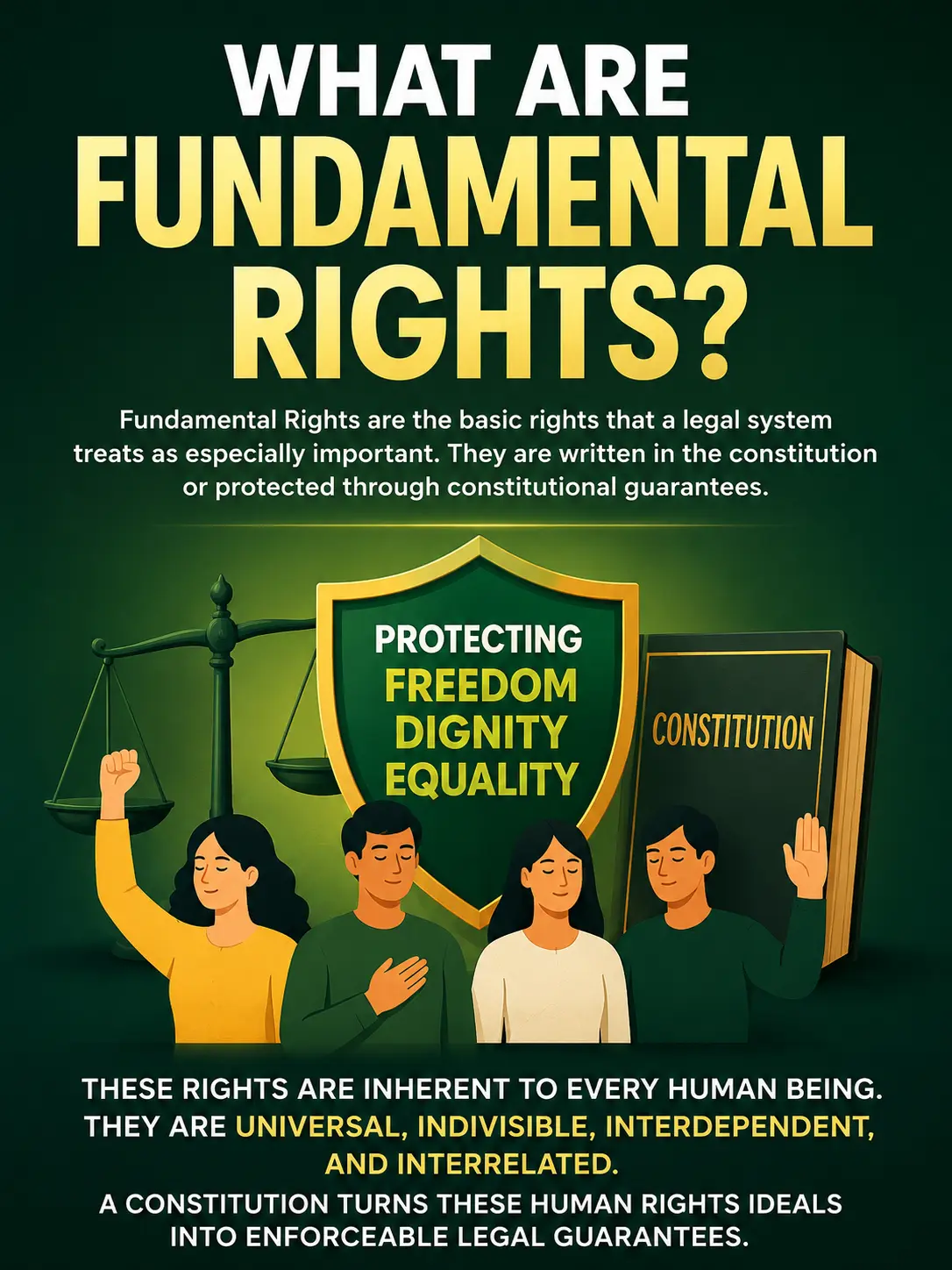
Fundamental Rights are the basic rights that a legal system treats as especially important. In some countries, they are written directly into the constitution. In others, the same idea appears through constitutional interpretation or strong human-rights guarantees. The key point is simple. These rights are treated as essential to human freedom, dignity, and equal treatment. They are not ordinary privileges that the government can hand out casually. They are meant to stand above everyday policy choices.
International human-rights materials describe human rights as rights inherent to all human beings and not granted by any state. They are universal, indivisible, interdependent, and interrelated. That language helps explain why many people see Fundamental Rights as the domestic legal expression of those deeper human-rights ideals. A constitution can turn those ideals into enforceable legal guarantees.
In practical terms, Fundamental Rights usually do a few big jobs:
- They protect people from abuse by the state.
- They preserve basic freedoms like speech, religion, privacy, equality, and fair process.
- They set the minimum standards of a just legal order.
- They are usually protected more strongly than ordinary legal entitlements.
A useful way to think about them is this. If a right is so important that a democracy wants to protect it even when political winds change, it is often treated as fundamental. That is why fundamental rights are usually connected to the constitution or to other deeply protected legal instruments.
What Are Legal Rights?
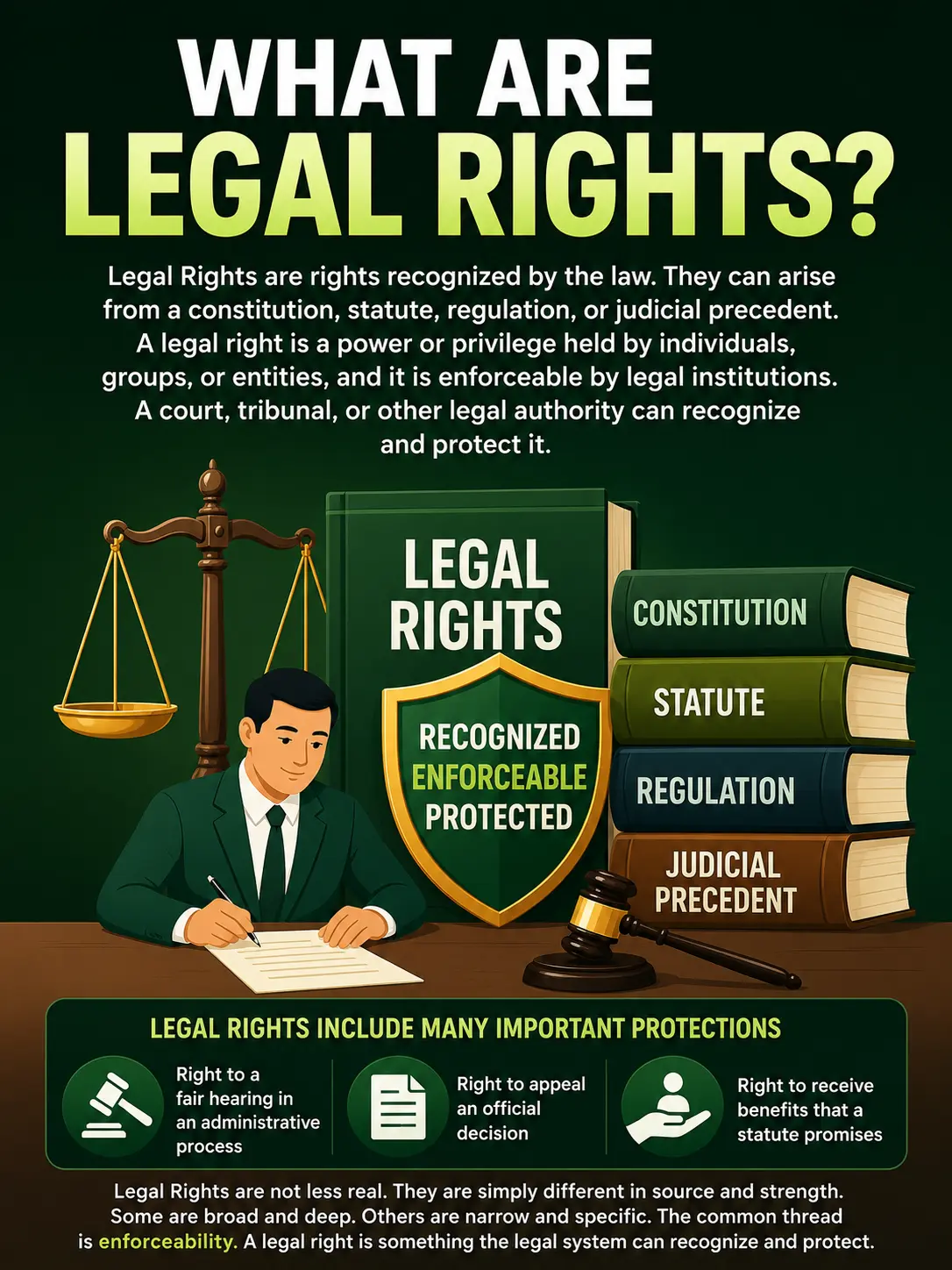
Legal Rights are broader. They are rights recognized by the law, and they can arise from a constitution, statute, regulation, or judicial precedent. A legal right is a power or privilege held by individuals, groups, or entities, and it is enforceable by legal institutions. That means a court, tribunal, or other legal authority can recognize and protect it.
This category covers a very wide range of protections. Some are highly important and closely linked to liberty. Others are much narrower and more practical. For example, legal rights can include the right to a fair hearing in an administrative process, the right to appeal an official decision, or the right to receive benefits that a statute promises. These rights matter a great deal, but they are not always treated as constitutional fundamentals.
So, Legal Rights are not less real. They are simply different in source and strength. Some are broad and deep. Others are narrow and specific. Some can be changed by legislation. Others are embedded in constitutional text or protected by strong judicial review. The common thread is enforceability. A legal right is something the legal system can recognize and protect.
The Shortest Possible Difference
Here is the cleanest way to say it:
Fundamental Rights are the most basic and highly protected rights in a legal system.
Legal Rights are all rights recognized and enforceable by law, including fundamental ones and many ordinary ones.
That means the relationship is usually like this:
- All Fundamental Rights are Legal Rights.
- But not all Legal Rights are Fundamental Rights.
That simple sentence captures most of the legal logic. It is a general rule, not a perfect rule for every country, because legal systems define rights differently. Still, it works well as a practical guide.
A Large Comparison Table
The table below gives a broad, practical comparison of Fundamental Rights and Legal Rights.
| Aspect | Fundamental Rights | Legal Rights |
|---|---|---|
| Basic idea | Rights treated as essential to human dignity, liberty, and constitutional order | Rights recognized and protected by law in general |
| Source | Usually the Constitution or a very strong constitutional framework | Constitution, statute, regulation, or judicial precedent |
| Scope | Narrower, more important, and usually higher in status | Wider and more varied |
| Protection level | Strong protection against government interference | Protection depends on the law that creates the right |
| Changeability | Usually harder to change or weaken | Often easier to modify through ordinary law, unless constitutional |
| Purpose | To secure basic freedom, equality, and dignity | To organize legal relationships and give enforceable entitlements |
| Who can rely on it | Usually every person within the system, though details vary by country | Individuals, groups, and even entities can hold them |
| Enforcement | Courts often give strong remedies and strict review | Enforced through courts, tribunals, and other legal bodies |
| Typical examples | Speech, privacy, equality, religion, fair process, vote in many systems | Appeal rights, benefit rights, procedural rights, property rights, labor rights, consumer rights |
| Relationship to the state | Mainly protects people against misuse of state power | Can regulate rights between people, institutions, and the state |
| Level in the legal hierarchy | Usually very high | Can be high, medium, or ordinary depending on the source |
| Core function | Protect the minimum conditions of free and fair life | Make the legal system work in daily life |
| If violated | Often seen as a serious constitutional or rights issue | May be a legal dispute, claim, or statutory violation |
| Remedies | Constitutional remedies, judicial review, injunctions, declarations | Damages, compensation, appeal, reinstatement, orders, and other legal relief |
The table above is a synthesis of how constitutional rights, human rights, and legally enforceable rights are described in authoritative legal materials.
Why Fundamental Rights Stand Apart
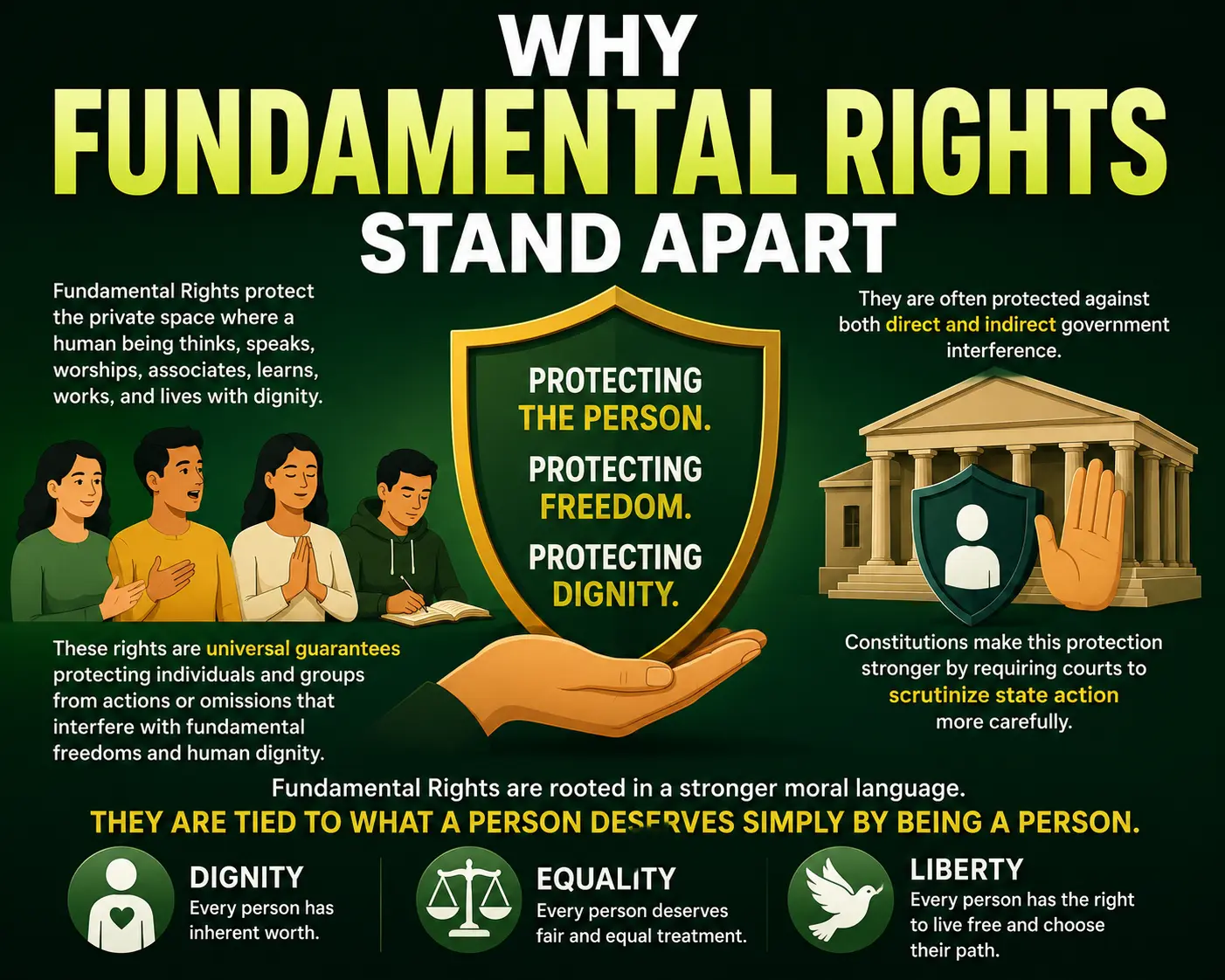
Fundamental Rights stand apart because they are designed to protect the person, not just the legal transaction. They guard the private space where a human being thinks, speaks, worships, associates, learns, works, and lives with dignity. Human-rights materials describe these rights as universal guarantees protecting individuals and groups from actions or omissions that interfere with fundamental freedoms and human dignity.
These rights are often protected against both direct and indirect government interference. That is a major reason they matter so much. A legal system may allow many rules to change with ordinary political debate, but it usually tries to keep fundamental freedoms away from easy interference. A constitution can make that protection stronger by requiring courts to scrutinize state action more carefully.
Another important point is that Fundamental Rights often come with a stronger moral language. They are tied to what a person deserves simply by being a person. That is why the ideas of dignity, equality, and liberty keep appearing whenever people talk about them.
Why Legal Rights Are Still Extremely Important
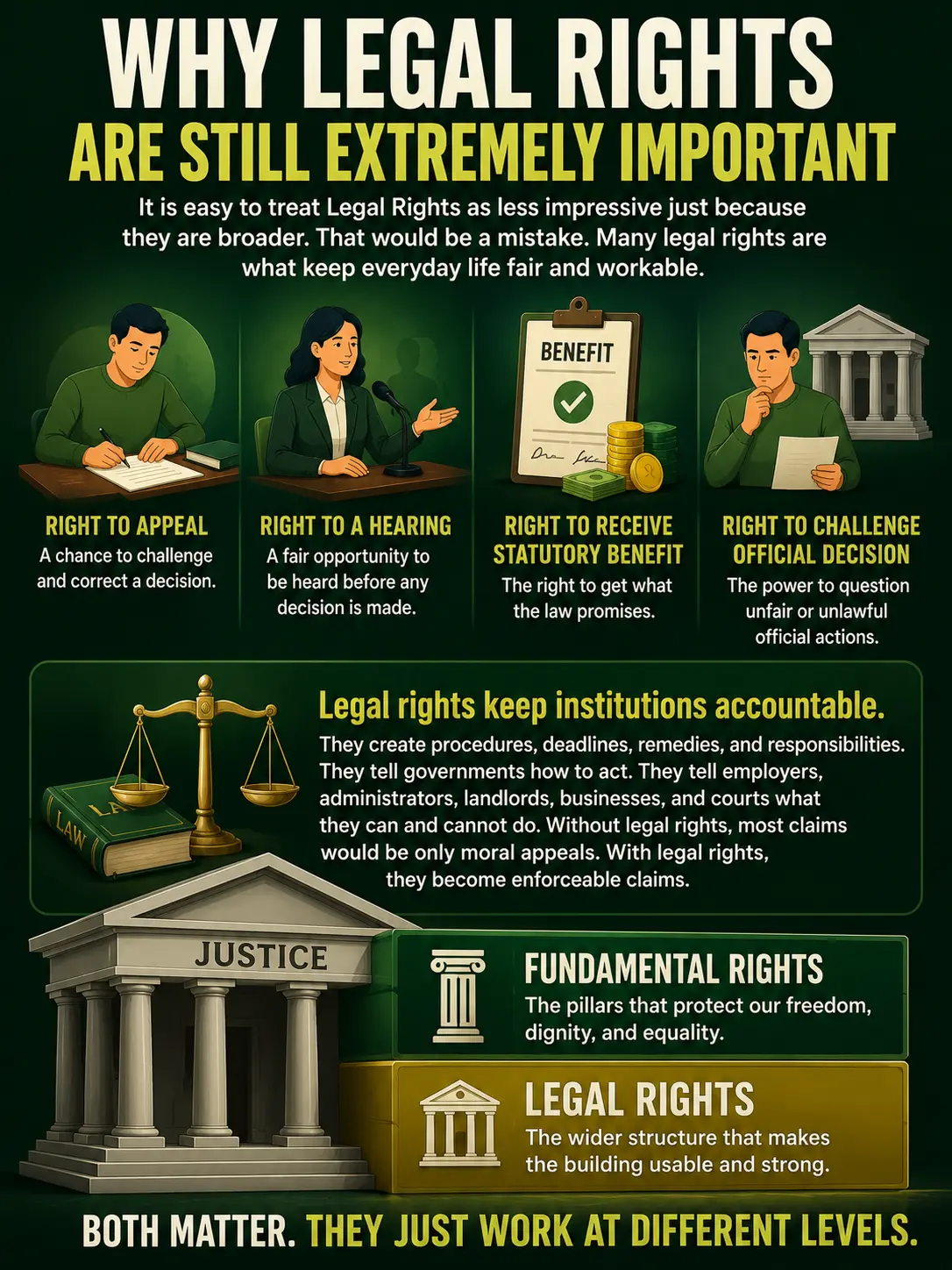
It is easy to treat Legal Rights as less impressive just because they are broader. That would be a mistake. Many legal rights are what keep everyday life fair and workable. A right to appeal, a right to a hearing, a right to receive a statutory benefit, or a right to challenge an official decision can matter enormously to a real person facing real harm.
Legal rights also keep institutions accountable. They create procedures, deadlines, remedies, and responsibilities. They tell governments how to act. They tell employers, administrators, landlords, businesses, and courts what they can and cannot do. Without legal rights, most claims would be only moral appeals. With legal rights, they become enforceable claims.
That is why legal rights are the machinery of a functioning legal order. Fundamental rights are the pillars. Legal rights are the wider structure that makes the building usable. Both matter. They just work at different levels.
Where the Two Overlap
The overlap is where people often get confused. A single right can be both a Fundamental Right and a Legal Right at the same time. For example, freedom of speech or the right to privacy may be treated as a fundamental constitutional guarantee in one system and still count as a legal right because it is legally enforceable.
This overlap is not a contradiction. It is just a matter of level. Think of it like this:
- Every square is a rectangle.
- But not every rectangle is a square.
In the same way:
- Every Fundamental Right is a Legal Right in the systems that protect it that way.
- But many Legal Rights are ordinary rights, not fundamental ones.
The overlap becomes even clearer when you look at human rights. Human rights are universal and inherent. Fundamental rights often translate those ideals into domestic law. Legal rights then provide the practical machinery to make them enforceable. The three ideas are related, but they are not identical.
Table: How They Work in Real Life
| Real-life situation | Fundamental Rights angle | Legal Rights angle | What this means in practice |
|---|---|---|---|
| A government tries to silence criticism | This may trigger speech or expression protections | There may also be statutory media or procedural rights | The person may challenge the action in court |
| A citizen is denied equal treatment by the state | Equality and non-discrimination issues may arise | Administrative or statutory remedies may also exist | The claim can be both constitutional and legal |
| A person is arrested without proper process | Fair process and liberty concerns may arise | Criminal procedure rights also matter | The person can seek release or judicial review |
| A worker is denied a benefit promised by law | Usually this is not a fundamental-right issue by itself | This is a legal-right issue under labor or social law | The person may claim the benefit or compensation |
| A privacy violation occurs through state surveillance | Privacy can be a fundamental concern in many systems | Data-protection or procedure laws may also apply | The person may challenge the surveillance |
| An official refuses to hear an appeal | The issue may not always be fundamental | It is clearly a legal-right and due-process issue | The refusal can be overturned through review |
This table reflects the way rights function at different legal levels. The same event can engage both constitutional protection and ordinary legal procedure.
The Most Important Differences, Explained Simply
1. Source of the right
Fundamental Rights usually come from the constitution or a similarly high legal source. Legal Rights can come from many sources, including statutes, rules, and judicial decisions.
2. Level of importance
Fundamental Rights are treated as basic and essential. Legal Rights can be basic too, but many are more specific and practical.
3. Enforcement strength
Both can be enforced, but Fundamental Rights often receive stronger judicial protection. Courts may apply a more serious level of review when these rights are involved.
4. Scope
Fundamental Rights usually protect broad human freedoms. Legal Rights can cover narrow claims like an appeal process, a permit, a benefit, or a specific legal status.
5. How easily they can be changed
A Fundamental Right is usually more difficult to change because it is tied to constitutional protection. A Legal Right created by ordinary law can often be changed by ordinary law too.
6. Relationship with dignity
Fundamental Rights are closely linked to human dignity and freedom. Legal Rights are more about how the legal system operates and how claims are recognized.
7. Who they protect
Both can protect individuals, but legal rights may also belong to groups and entities, depending on the legal system. That is why companies, organizations, and institutions can hold legal rights in some contexts.
Examples That Make the Difference Easier to See
Here are some simple examples.
A person’s right to free speech is often treated as a Fundamental Right because it protects democratic participation and personal freedom. It is also a Legal Right because the legal system can enforce it.
A person’s right to a fair hearing in an administrative matter is a Legal Right. It may be extremely important, but it usually belongs to the procedural side of law rather than to the highest constitutional category.
A person’s right to privacy may be recognized as a fundamental constitutional protection in many systems, while also being enforceable through ordinary privacy or data-protection law.
A person’s right to receive a statutory pension is usually a Legal Right because it comes from legislation. If the law creates the benefit, the law also defines how it is claimed and enforced.
A person’s right to vote can be treated as fundamental in many constitutional orders, but the exact form of that right, the qualifications for it, and the procedure for exercising it are usually governed by legal rules as well.
A Table of Common Rights and Their Usual Category
| Right | Usually seen as | Why it fits there |
|---|---|---|
| Freedom of speech | Fundamental Right and Legal Right | Protects democratic participation and personal liberty |
| Freedom of religion | Fundamental Right and Legal Right | Protects conscience and belief |
| Right to privacy | Fundamental Right in many systems | Closely tied to dignity and personal autonomy |
| Right to equality | Fundamental Right | Protects against unfair state discrimination |
| Right to a fair hearing | Legal Right | Ensures due process in legal and administrative action |
| Right to appeal | Legal Right | Created by law to review decisions |
| Right to statutory benefits | Legal Right | Comes from legislation or regulations |
| Right to property | Legal Right in many systems, sometimes constitutional | Depends on the legal system and its constitution |
| Right to legal remedy | Legal Right and often fundamental in effect | Allows a person to challenge harm |
| Right to participate in government | Often a Fundamental Right | Supports democratic rule and political equality |
This table is a practical guide, not a rigid universal rule. Different countries classify and protect rights in different ways.
How These Rights Shape Daily Life
Most people do not think about rights in abstract terms. They think about them when life gets difficult. A student may care about speech rights when speaking out at school. A worker may care about legal rights when a promotion is denied unfairly. A family may care about privacy rights when personal data is misused. A citizen may care about due process when facing state action. These are not rare concerns. They are part of daily life.
That is why legal rights and fundamental rights should not be studied only in textbooks. They affect real situations like arrest, detention, education, healthcare, employment, movement, protest, religion, and online life. Rights are not just about courtroom language. They are about how much dignity and security a person has in the real world.
Common Misunderstandings
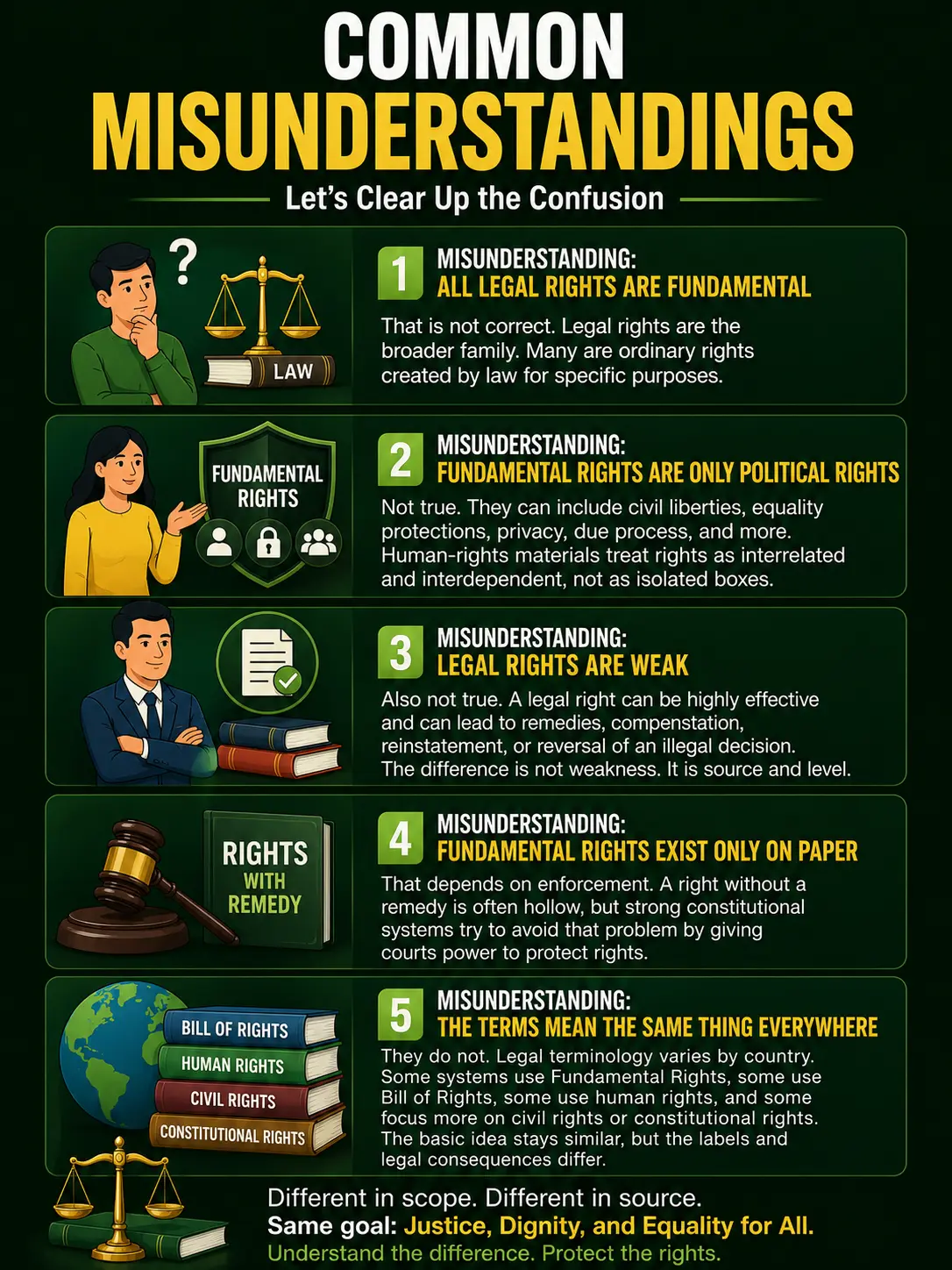
Misunderstanding 1: All legal rights are fundamental
That is not correct. Legal rights are the broader family. Many are ordinary rights created by law for specific purposes.
Misunderstanding 2: Fundamental rights are only political rights
Not true. They can include civil liberties, equality protections, privacy, due process, and more. Human-rights materials treat rights as interrelated and interdependent, not as isolated boxes.
Misunderstanding 3: Legal rights are weak
Also not true. A legal right can be highly effective and can lead to remedies, compensation, reinstatement, or reversal of an illegal decision. The difference is not weakness. It is source and level.
Misunderstanding 4: Fundamental rights exist only on paper
That depends on enforcement. A right without a remedy is often hollow, but strong constitutional systems try to avoid that problem by giving courts power to protect rights.
Misunderstanding 5: The terms mean the same thing everywhere
They do not. Legal terminology varies by country. Some systems use Fundamental Rights, some use Bill of Rights, some use human rights, and some focus more on civil rights or constitutional rights. The basic idea stays similar, but the labels and legal consequences differ.
Why the Distinction Matters in Law and Society
This distinction matters for at least five reasons.
First, it tells us how strong the protection is. A constitutional right often gets stronger treatment than an ordinary statutory benefit.
Second, it tells us where the right comes from. A right created by a constitution is different from one created by an administrative rule.
Third, it helps courts decide the remedy. Some violations need constitutional relief. Others need a simpler legal correction.
Fourth, it helps lawmakers know how careful they need to be when changing the law. If a rule touches a fundamental right, the law may need to be drafted much more carefully.
Fifth, it helps ordinary people understand what to demand. A person who knows the difference between a constitutional guarantee and an ordinary legal entitlement is much better prepared to defend their position calmly and effectively.
Fundamental Rights, Legal Rights, and Human Rights
These three ideas are linked, but they are not identical.
Human Rights are universal and inherent. They belong to people because they are human. They are not granted by a state.
Fundamental Rights are the rights that a legal system chooses to protect at the highest level, often by putting them into the constitution or treating them with special judicial care.
Legal Rights are the full set of rights the law recognizes and enforces. Some are fundamental. Some are not. Some are broad. Some are narrow. But all are part of the legal order.
A simple way to think about them is this:
- Human Rights answer the question, “What do people deserve as human beings?”
- Fundamental Rights answer the question, “What rights does the constitution or high law protect most strongly?”
- Legal Rights answer the question, “What rights does the legal system enforce?”
Table: The Best One-Line Distinction
| Term | Plain-English meaning |
|---|---|
| Human Rights | Rights people have because they are human |
| Fundamental Rights | The most important rights protected at a high constitutional level |
| Legal Rights | Rights the law recognizes and enforces |
| Civil Rights | Rights connected to equal treatment and legal protection in society |
| Due Process | Fair legal procedure before the state can act against a person |
This summary follows the broad definitions used in major legal and human-rights materials.
Conclusion
The difference between Fundamental Rights and Legal Rights is simple once you strip away the jargon. Fundamental Rights are the most basic and strongly protected rights in a legal system. Legal Rights are the wider set of rights that the law recognizes and enforces. Some legal rights are fundamental. Many are not. And that is exactly why the distinction matters.
If you remember only one thing, remember this: Fundamental Rights protect the deepest values of freedom, equality, and dignity, while Legal Rights keep the legal system working in everyday life. One gives the constitutional backbone. The other gives the practical structure. A society needs both.
Article References and Sources
- What Are Human Rights? Available at: OHCHR – What Are Human Rights?
- Human Rights Indicators: A Guide to Measurement and Implementation. Available at: OHCHR – Human Rights Indicators Guide
- Fundamental Right Definition and Legal Meaning. Available at: Cornell Law School – Fundamental Right
- Right: Legal Definition and Explanation. Available at: Cornell Law School – Right (Legal Definition)
- Right to Privacy. Available at: Cornell Law School – Right to Privacy
- Bill of Rights. Available at: Cornell Law School – Bill of Rights
- Law: Definition, History, and Principles. Available at: Britannica – Law
- Due Process. Available at: Britannica – Due Process
- Universal Declaration of Human Rights (UDHR). Available at: United Nations – Universal Declaration of Human Rights (PDF)
- What Are Human Rights? Available at: UNICEF – What Are Human Rights?
Also, Read These Articles in Detail
- Fundamental Rights in India
- What Are Fundamental Rights Under the Indian Constitution?
- History of Fundamental Rights in India
- Why Fundamental Rights Are Important for Every Indian Citizen
- Understanding Part III of the Indian Constitution
- Who Can Claim Fundamental Rights in India?
Frequently Asked Questions
FAQ 1. What is the main difference between Fundamental Rights and Legal Rights?
The main difference is the level and source of protection. Fundamental Rights are the most important rights in a legal system. They are usually placed in the Constitution or protected at a very high legal level. These rights are meant to safeguard human dignity, liberty, equality, and basic freedom. They are the rights that a state should respect even when laws, governments, or public opinion change.
Legal Rights, on the other hand, are all the rights that the law recognizes and can enforce. They may come from the Constitution, statutes, rules, regulations, or court decisions. Some legal rights are very strong. Some are more limited. Some deal with daily procedures, benefits, or official processes. They still matter, but they are not always treated as foundational rights.
A simple way to remember it is this. Fundamental Rights are a special category inside the larger family of Legal Rights. So, every fundamental right is a legal right, but not every legal right is a fundamental right. That one line captures the whole idea very well.
This difference matters because it affects how strongly a right is protected, how it can be challenged in court, and how difficult it is for the government to change it. A fundamental right is usually harder to weaken. A legal right created by ordinary law can often be changed more easily if the law changes. That is why people study these two terms carefully. They are related, but they are not the same.
FAQ 2. Are Fundamental Rights and Human Rights the same thing?
No, they are not exactly the same, although they are closely connected. Human Rights are the broad moral and legal rights that belong to every person simply because they are human. They are universal. That means they are not supposed to depend on nationality, race, religion, gender, wealth, or social status. The idea is that every human being deserves basic dignity and freedom.
Fundamental Rights are the rights that a particular country or legal system gives special constitutional protection to. In many cases, they are the domestic legal form of human rights. In other words, human rights are the bigger idea, and fundamental rights are often how that idea is written into a country’s law.
For example, the right to dignity, equality, free expression, and fair treatment are often thought of as human-rights values. When a constitution protects those values directly, they become Fundamental Rights within that legal system. So the two ideas overlap, but they are not identical.
A good way to think about it is this. Human Rights are the principle. Fundamental Rights are the legally protected version of that principle inside a country. And Legal Rights are the wider set of enforceable rights created by the legal system. That separation helps people understand why some rights are treated as higher or more important than others.
FAQ 3. Why are Fundamental Rights considered more important than ordinary Legal Rights?
Fundamental Rights are considered more important because they protect the basic conditions that make freedom and dignity possible. Without them, a person may not be able to speak freely, practice a religion, live with privacy, receive equal treatment, or challenge unfair state action. These are not small matters. They go to the heart of what it means to live in a free society.
Another reason is that Fundamental Rights usually sit at a higher level in the legal system. That means courts often treat them with greater seriousness. If the government passes a law or takes an action that interferes with a fundamental right, the court may review that action very carefully. This is different from an ordinary legal right, where the issue may be more limited and easier to correct through regular legal processes.
But “more important” does not mean “other legal rights are unimportant.” That would be a mistake. A legal right to appeal, a right to receive a benefit, a right to a hearing, or a right to compensation can matter deeply in real life. The difference is not about value in the human sense. It is about constitutional weight, legal hierarchy, and the strength of protection.
So, the reason fundamental rights stand out is simple. They are designed to protect the person at the deepest level. They are the rights that help preserve democracy, dignity, and fairness when everything else feels unstable.
FAQ 4. Can a single right be both a Fundamental Right and a Legal Right at the same time?
Yes, absolutely. In fact, this happens very often. A single right can belong to both categories because the legal system can protect the same right at different levels. This is one of the most important ideas to understand.
Take freedom of speech as an example. It is often treated as a Fundamental Right because it protects free thought, public debate, criticism of power, and democratic participation. At the same time, it is also a Legal Right because courts, statutes, and legal procedures can enforce it. So the same right lives in both worlds.
The same thing can happen with privacy, equality, or religious freedom. These rights may be recognized as constitutional guarantees, but they are also part of the broader legal system. They can be discussed in court, protected through legal remedies, and supported by ordinary laws.
This overlap can confuse people at first, but it actually makes sense. Think of it like a building. Fundamental Rights are the strongest pillars. Legal Rights are the wider structure that includes those pillars and many other supporting parts. A single right can sit in the center of both.
So when you see a right described in both ways, that does not mean there is a mistake. It usually means the right is powerful enough to deserve constitutional protection and also broad enough to be enforced through the legal system in general.
FAQ 5. What are some common examples of Fundamental Rights?
Common examples usually include rights that protect freedom, dignity, and equality. Although the exact list changes from one country to another, some rights often appear again and again in constitutional systems.
These may include:
Freedom of speech and expression
This protects a person’s ability to speak, write, publish, and share ideas.
Freedom of religion
This protects belief, worship, and conscience.
Equality before the law
This ensures that the state treats people fairly and does not discriminate without lawful reason.
Right to life and personal liberty
This protects a person’s basic existence and freedom from arbitrary state action.
Right to privacy
This protects personal space, personal data, family life, and private decision-making.
Right to fair procedure
This ensures that the state cannot act against a person without proper legal process.
Freedom of movement, association, or assembly
These rights help people travel, meet, organize, and participate in public life.
These rights matter because they protect the basic life of a free person. They are not just legal rules. They are the minimum safeguards of dignity and self-respect. When these rights are respected, people can live, think, and participate more freely.
And that is exactly why they are called fundamental. They are not extra benefits. They are the base layer of freedom.
FAQ 6. What are some common examples of Legal Rights that are not necessarily fundamental?
There are many. Legal Rights cover a very wide range of claims and protections, and many of them are highly useful in everyday life. They are not always constitutional rights, but they are still legally enforceable.
Some common examples include:
Right to appeal
This lets a person ask a higher authority or court to review a decision.
Right to a hearing
This gives a person a fair chance to explain their side before a decision is made.
Right to receive a statutory benefit
If a law promises a pension, subsidy, allowance, or grant, that promise becomes a legal right.
Right to compensation
A person may have the right to compensation if harm is caused by unlawful action.
Right to file a claim under a contract
This is a legal right that comes from an agreement and the law of contracts.
Right to property in some legal systems
Depending on the country, property may be a constitutional right, a statutory right, or both.
Right under labor law
Workers often have rights related to wages, working conditions, leave, safety, and termination procedures.
These rights may not always be called fundamental, but they still matter enormously. A person denied a pension or blocked from appealing an unfair decision may suffer real harm. So legal rights are not “smaller” in a casual sense. They are simply more specific and often easier to trace to a law or regulation.
The cleanest way to see the difference is this. Fundamental Rights protect the basic freedom of a person. Legal Rights organize and enforce many practical parts of life.
FAQ 7. Why can Legal Rights change more easily than Fundamental Rights?
The reason is the source of the right. Legal Rights often come from ordinary laws, rules, or regulations. Those can usually be changed by the same legal process that created them. If a legislature passes a new law, amends an old one, or replaces a regulation, the legal right may change too.
Fundamental Rights are usually protected by the Constitution or another very strong legal framework. That makes them harder to alter. A government cannot usually change them with a simple ordinary law. Often, it needs a more serious legal process, such as a constitutional amendment or special approval. Courts may also strike down laws that interfere with those rights.
This higher protection exists for a reason. If basic rights could be changed too easily, they would not truly be secure. A political majority could weaken freedom, equality, or privacy whenever it wanted. Constitutional protection helps stop that from happening.
So the difference is not only about importance. It is also about durability. Fundamental Rights are built to last and resist sudden political pressure. Legal Rights are still protected, but they are more flexible because they often deal with practical or procedural matters.
That flexibility is not a flaw. It is useful. It allows law to adjust to new situations without disturbing the deeper structure of rights. The legal system needs both stability and change, and these two categories help make that possible.
FAQ 8. What happens when a Fundamental Right is violated?
When a Fundamental Right is violated, the matter is usually treated very seriously. The person affected may be able to go to court and ask for a remedy. Depending on the legal system, that remedy might include stopping the harmful action, declaring the action unlawful, or ordering the state to fix the problem.
A violation of a fundamental right can involve many kinds of harm. It may be unfair censorship, discrimination, unlawful detention, invasion of privacy, or denial of due process. Because the right is fundamental, the court often checks whether the government had a lawful reason and whether the action was necessary and proportionate.
That review is important. It means the state cannot just say, “We had a reason.” It may need to prove that the interference was legal, justified, and limited. This is one of the major strengths of fundamental-right protection. It puts real pressure on power to act fairly.
If the violation is serious, the court may order immediate relief. In some cases, the court may also guide future conduct or require policy changes. The exact remedy depends on the country and the legal issue, but the principle is the same. A fundamental right is not a decorative promise. It is meant to be enforced.
That is why people often turn to constitutional courts or superior courts when these rights are affected. The legal system treats such violations as a threat to the structure of freedom itself, not just as a private complaint.
FAQ 9. Why do ordinary people need to understand the difference between Fundamental Rights and Legal Rights?
Because it helps people know what kind of protection they have and what kind of action they can take. Many legal problems become easier to understand once you know whether you are dealing with a constitutional issue or an ordinary legal claim.
For example, if the state blocks your speech, that may be a Fundamental Right issue. If an office refuses to process your benefit claim, that may be a Legal Right issue. If a workplace denies you the procedure promised by law, that may be a statutory or legal-right issue. If the government discriminates against you, the case may involve both kinds of rights at once.
Understanding the difference also helps people avoid confusion. Not every unfair situation is a fundamental-right violation, and not every legal-right issue is minor. Some rights are constitutional. Some are procedural. Some are contractual. Some are statutory. Knowing the category helps you respond in a smarter way.
It also helps in conversations about politics and policy. When a government proposes a new law, people can ask the right question. Does it affect a constitutional freedom, or does it simply change an ordinary legal entitlement? That is a big difference.
And on a personal level, this knowledge creates confidence. A person who understands rights is less likely to feel helpless. They can recognize when an issue concerns dignity, when it concerns procedure, and when it concerns a legal claim that can be enforced through the proper channel.
FAQ 10. What is the simplest way to remember the difference between Fundamental Rights and Legal Rights?
The simplest way is to remember this sentence:
Fundamental Rights are the highest and most basic rights protected by law, while Legal Rights are the broader set of rights the law recognizes and enforces.
That one sentence gives you the whole structure. If you want an even shorter version, use this rule:
Fundamental Rights are special. Legal Rights are wider.
Or this one:
All Fundamental Rights are Legal Rights, but not all Legal Rights are Fundamental Rights.
That is the easiest mental shortcut.
If you like examples, think of it like this. A Fundamental Right is like the foundation of a house. A Legal Right is like the larger house built around it. The foundation is essential, but the house also needs doors, rooms, windows, and support systems. In the same way, a legal system needs both deep constitutional protection and everyday legal rules.
So when you read or hear these terms, do not treat them as rivals. They work together. One protects the most important freedoms. The other makes the legal system function in daily life. And together, they help keep law meaningful, fair, and usable.
FAQ 11. How do Fundamental Rights protect a person from the government?
Fundamental Rights act like a shield between the individual and state power. That is their most important job. Governments have huge authority. They can pass laws, collect taxes, regulate behavior, control public institutions, and punish wrongdoing. But that power is not unlimited. Fundamental Rights tell the government where the line is.
When a right is fundamental, the state cannot interfere with it casually. It usually needs a lawful reason, a proper process, and a strong justification. That matters because power can easily become unfair if nobody checks it. A constitution tries to stop that by protecting certain rights at a higher level.
Think of freedom of speech. A citizen should be able to criticize public officials, discuss ideas, ask questions, and speak without fear of arbitrary punishment. If the state tries to suppress that freedom without a valid legal basis, the person can challenge it. That is how a Fundamental Right works in practice. It does not just sound good on paper. It creates a real limit on government action.
The same idea applies to equality, privacy, religion, and personal liberty. These rights are important because they keep the state from treating people as if they are powerless. They remind the government that citizens are not subjects to be controlled at will. They are rights holders.
This protection is especially valuable in tense situations. During political conflict, social unrest, or emergency-like conditions, a constitution becomes even more important. A strong Fundamental Right does not mean the state can never act. It means the state must act carefully, lawfully, and fairly. That is the heart of constitutional protection.
FAQ 12. Why are Legal Rights important in everyday life, even if they are not always fundamental?
Legal Rights are the rights that keep normal life organized. People often notice them only when something goes wrong, but they shape everyday life in quiet and practical ways. They help make sure rules are followed, promises are kept, and official decisions can be challenged.
For example, a person may have a right to appeal a decision, a right to a hearing before a harmful action is taken, or a right to compensation after unlawful loss. These are not always the dramatic rights people talk about in constitutional debates, but they can decide whether someone gets justice in a real situation.
A worker may rely on legal rights to get wages on time. A tenant may rely on legal rules to challenge an unfair eviction. A student may rely on legal procedure if a school takes disciplinary action. A taxpayer may rely on legal protections when an authority makes a mistake. These are everyday issues, but they matter deeply.
That is why Legal Rights are not second-class rights. They are simply more specific. Some come from labor law, some from family law, some from contract law, some from property law, and some from administrative law. Each one gives shape to a different part of life.
Without Legal Rights, society would run on vague promises and personal power. That would be unstable and unfair. Legal rights turn rules into real entitlements. They give ordinary people a way to say, “The law promised this to me, and I want it respected.” That is a powerful thing.
FAQ 13. Can Fundamental Rights exist without being written in the Constitution?
Yes, they can sometimes be recognized even if they are not spelled out in the same words. Different legal systems do this in different ways. Some constitutions list rights directly. Others allow courts to infer and protect certain rights through interpretation. In some systems, human-rights principles shape how constitutional protection is understood.
That said, the strongest form of a Fundamental Right is usually one written into the Constitution or treated as constitutionally protected by courts. Written protection makes the right easier to identify and enforce. It also gives people clearer notice about what they can claim.
Still, law is not always limited to written text alone. Courts often read constitutional guarantees in a broader way. For example, a right to dignity or a right to privacy may be recognized from the structure and purpose of the constitution even if the wording is broad rather than detailed. This happens because constitutions are meant to be living frameworks, not frozen documents.
The real question is not only whether a right appears in a neat list. The real question is whether the legal system treats the right as basic, essential, and strongly protected. If it does, the right may function as a Fundamental Right even when the language is broad or interpretive.
So the answer is yes, but with an important condition. The right must be legally elevated and strongly protected. Otherwise, it is just another legal entitlement, not a fundamental guarantee.
FAQ 14. Are Fundamental Rights always unlimited?
No, they are not. This is a common misunderstanding. Fundamental Rights are very important, but they are not always absolute. Most legal systems allow some limits when there is a strong and lawful reason. The key point is that the limit must be justified, proportionate, and legally valid.
For example, freedom of speech is fundamental in many systems, but that does not usually mean a person can say anything anywhere without consequence. Laws may restrict defamation, incitement, threats, or other harmful speech. The idea is not to destroy the right. The idea is to balance it against other important interests.
The same is true for religious freedom. A person may be free to believe what they want, but they may not always be free to act in ways that harm others or break neutral laws. Freedom of movement may be limited in public emergencies or through lawful court orders. Privacy may be limited by valid investigations or public safety measures.
What matters is the standard of review. When a fundamental right is limited, the government must usually show that the limitation is lawful, necessary, and not excessive. That is much stricter than just saying, “We wanted to do this.”
So no, fundamental rights are not unlimited. But they are protected strongly enough that any restriction must be handled with care. That is what separates a constitutional right from a casual policy preference.
FAQ 15. What is the role of Courts in protecting Fundamental Rights and Legal Rights?
Courts are one of the main protectors of both kinds of rights. They check whether laws and government actions are lawful. They listen to complaints. They interpret the Constitution. They review official decisions. And they provide remedies when something has gone wrong.
For Fundamental Rights, courts often play a special role. They may strike down unconstitutional laws, stop unlawful state action, or order the government to correct a violation. This is because fundamental rights sit at the highest level of legal protection. If a law harms one of those rights, the court has to ask whether the law can survive constitutional scrutiny.
For Legal Rights, courts also matter a great deal. Many legal-right disputes are resolved through ordinary legal process. A person may go to court over a contract, an employment issue, a benefit claim, a property dispute, or a statutory entitlement. The court then decides whether the right exists and whether it was respected.
In both cases, courts make rights meaningful. A right without enforcement is just an idea. A court gives that idea force. It turns a promise into a legal remedy.
That is why a strong legal system needs independent courts. If courts are weak, rights become fragile. If courts are strong, people have a real chance to defend themselves. That is true for Fundamental Rights and Legal Rights alike.
FAQ 16. How do Fundamental Rights and Legal Rights affect social justice?
They affect social justice directly and practically. Fundamental Rights set the basic moral and legal floor. They protect equality, dignity, and freedom. Without them, weaker groups can easily be pushed aside, silenced, or mistreated. That is why these rights are so closely tied to fairness in society.
Legal Rights support social justice in a different but equally important way. They create the detailed rules that allow people to claim benefits, challenge unfair treatment, and hold institutions accountable. A law that guarantees fair hiring, safe working conditions, access to education, or appeal rights can improve real lives even if it is not classified as fundamental.
Social justice is not only about big constitutional language. It is also about how rules operate in daily life. A person may need a constitutional right to defend their dignity, but they may also need an ordinary legal right to actually receive justice in a workplace, school, hospital, or government office.
That is why the two categories work together. Fundamental Rights stop the most serious abuses. Legal Rights handle the practical machinery that makes equality and fairness possible. When both are strong, society becomes more stable and more humane.
And that is the deeper point. Rights are not abstract decoration. They are tools that help ordinary people live with more security and less fear.
FAQ 17. What is the difference between a constitutional right and a legal right?
A constitutional right is usually a right written into or strongly protected by the Constitution. It sits at a very high level in the legal hierarchy. These rights are often called Fundamental Rights when they protect basic freedoms like equality, liberty, speech, privacy, or religion.
A legal right is a broader term. It includes any right that the law recognizes and enforces. That can mean a constitutional right, but it can also mean a right created by a statute, regulation, administrative rule, contract, or court decision.
So the relationship is simple:
- A constitutional right is usually a stronger and higher-level right.
- A legal right is the wider category that includes constitutional rights and many others.
For example, the right to free speech may be a constitutional right. The right to appeal a tax decision may be a legal right created by statute. Both are enforceable. Both matter. But they are not the same kind of right.
This distinction helps people understand legal strength. If a right is constitutional, it is often harder to change and easier to defend against government action. If it is only statutory, it may still be valuable, but it depends more on the wording of the law and the current legislature.
So, every constitutional right is a legal right. But not every legal right is constitutional. That is the cleanest way to put it.
FAQ 18. Do Fundamental Rights apply only against the state?
In many legal systems, Fundamental Rights are mainly designed to protect people against the state. That is their original and most common function. They stop the government from overreaching, discriminating unfairly, or violating basic freedoms.
But the exact answer can vary by country and by legal doctrine. In some situations, constitutional rights may also influence private relationships indirectly. For example, courts may interpret labor law, housing law, or media law in light of fundamental values. This does not always mean a direct constitutional claim against a private person. But it can still shape how the law works in private disputes.
The core idea remains the same. Fundamental Rights are mainly about limiting public power. They are especially important when a person is facing the state, because the state has far more power than the individual. That imbalance is exactly why constitutional protection exists.
Legal Rights, by contrast, often work both ways. They can regulate government conduct, private contracts, employment, property, consumer relations, and family matters. They are much more flexible and can apply across many types of legal relationships.
So if someone asks whether fundamental rights apply only against the state, the safest answer is this. Usually yes, at least in their direct form. But their influence can extend beyond that through legal interpretation and related laws.
FAQ 19. Why do some rights feel important even when they are not called Fundamental Rights?
Because importance in real life is not always the same as constitutional classification. A right can be legally ordinary and still be deeply important to the person who depends on it. For example, a right to a pension, a right to medical reimbursement, or a right to appeal an unfair decision may not sound dramatic, but for the person involved, it can be life-changing.
This is one reason Legal Rights deserve respect. They are often the rights that help people handle practical problems. A person may not be thinking about constitutional theory. They may just want their salary, their document, their hearing, or their benefit. That is where legal rights matter most.
Also, not every serious problem needs to be handled at the constitutional level. Law has many layers for a reason. Constitutional rights protect the deepest freedoms. Legal rights handle the many detailed arrangements that make life work. A good legal system needs both.
So a right may not be fundamental in the technical sense, but it can still be essential in practice. That is why people should never dismiss legal rights as minor. A small legal right can carry huge real-world weight.
FAQ 20. What is the easiest way to explain Fundamental Rights vs Legal Rights to a student or beginner?
The easiest explanation is this:
Fundamental Rights are the most basic rights a person needs to live freely and with dignity.
Legal Rights are all the rights the law recognizes and can enforce.
Then add one simple line:
Fundamental Rights are a special part of Legal Rights, but Legal Rights are much wider.
If you want to explain it in a classroom-friendly way, use examples. Say that freedom of speech, equality, privacy, and religion are usually treated as Fundamental Rights because they protect core human freedom. Then say that the right to appeal, the right to a hearing, or the right to a statutory benefit are Legal Rights because they come from law and procedure.
That approach works because it turns an abstract idea into something concrete. Students understand examples much faster than definitions alone. And once they see the difference in everyday situations, the whole topic becomes much easier.
You can also use a simple memory trick:
- Fundamental means basic and deeply protected.
- Legal means recognized and enforced by law.
- Some rights are both.
- Some rights are only legal.
That is enough for most beginners to understand the topic clearly and remember it for a long time.
