
Physics is the science that studies matter, motion, and energy. That simple idea sits underneath almost everything we see around us, from the way a ball rolls across the floor to the way planets move through space. At the most basic level, matter is the substance that makes up the physical universe, motion is the change of position or orientation over time, and energy is the capacity to do work. Together, these three ideas explain a huge share of how the world behaves.
This article breaks those ideas down in plain language. It keeps the science accurate, but it avoids the heavy language that can make physics feel distant. The goal is simple. By the end, matter, motion, and energy should feel less like textbook words and more like everyday tools for understanding life.
Table of Contents
Why Matter, Motion, and Energy Matter So Much
These three ideas are not just school topics. They show up in cooking, travel, sports, weather, machines, buildings, medicine, and space exploration. A hot pan warms food because energy moves from one place to another. A bicycle moves because force changes motion. A book stays on a table because matter has mass and resists motion unless something pushes it. Physics gives us a language for all of that.
And there is a deeper point too. When people understand matter, motion, and energy, they start to see patterns instead of random events. A falling object, a moving car, a burning candle, and a spinning fan may look unrelated at first, but all of them can be explained using the same basic ideas. That is one of the quiet strengths of physics. It connects ordinary life with the wider universe.
What Is Matter?
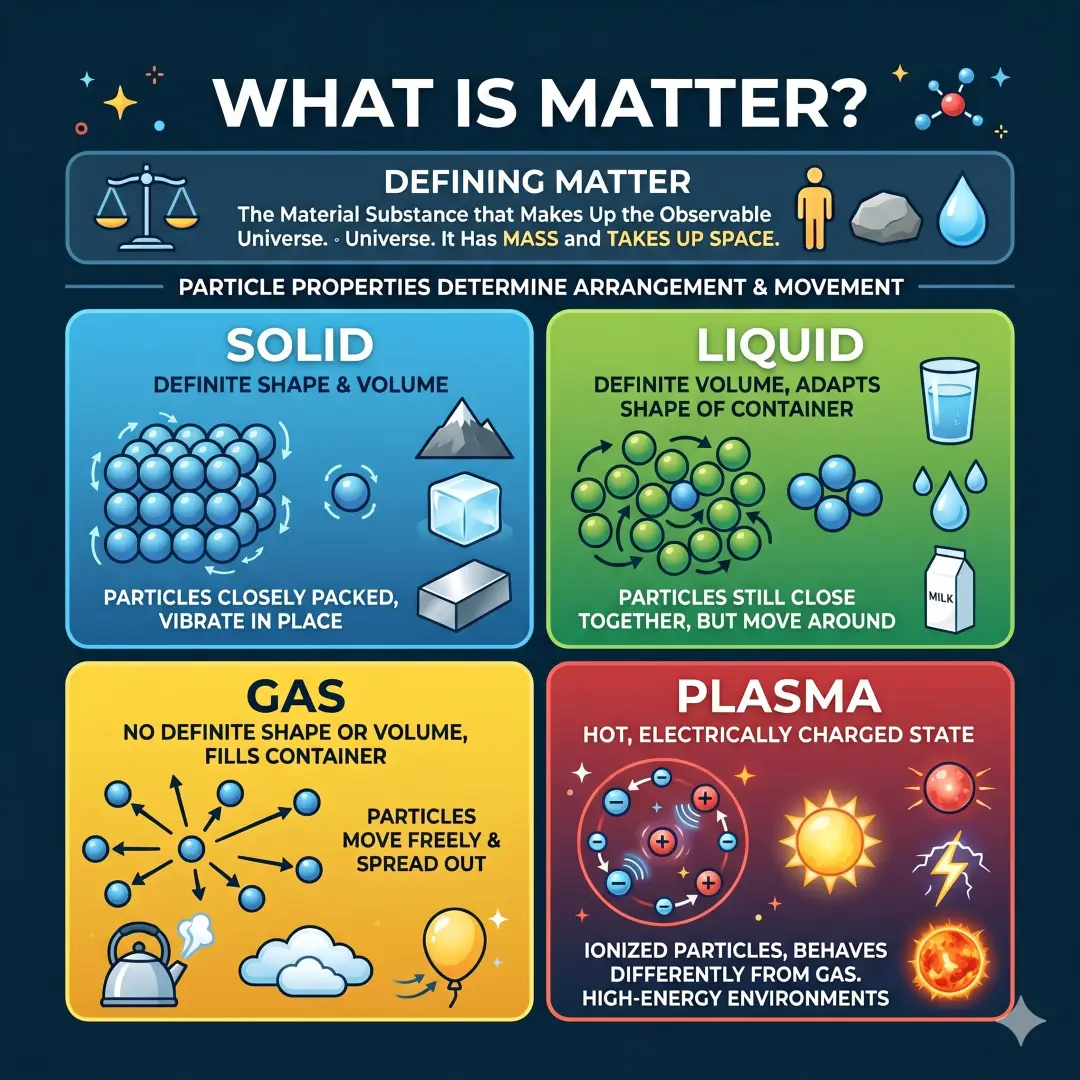
Matter is the material substance that makes up the observable universe. It has mass and takes up space. That means a stone, a cup of water, the air in a room, and even your body are all forms of matter. Matter can exist in different states or phases, and the most familiar ones are solid, liquid, and gas. Plasma is often described as a fourth common state of matter.
A useful way to think about matter is this. If something has weight in a physical sense and occupies space, it is matter. That may sound obvious, but it is an important starting point because almost every physical system we study depends on how matter is arranged, how tightly its particles are packed, and how those particles move.
The Main States of Matter
- Solid: A solid has a definite shape and a definite volume. Its particles are closely packed and usually vibrate in place rather than moving freely.
- Liquid: A liquid has a definite volume but takes the shape of its container. Its particles are still close together, but they can move around each other.
- Gas: A gas has neither a definite shape nor a definite volume. Its particles move freely and spread out to fill the container.
- Plasma: Plasma is a hot, electrically charged state of matter found in stars and other high-energy environments. It behaves differently from ordinary gas because many of its particles are ionized.
A Simple Thought About Matter
Matter is not just “stuff.” It is organized stuff. The way matter is arranged affects everything, including strength, flexibility, flow, heat transfer, and density. A steel beam, a glass of milk, and the air in a balloon all behave differently because their particles are arranged and moving in different ways. That is why the study of matter matters so much in both science and daily life.
What Is Motion?
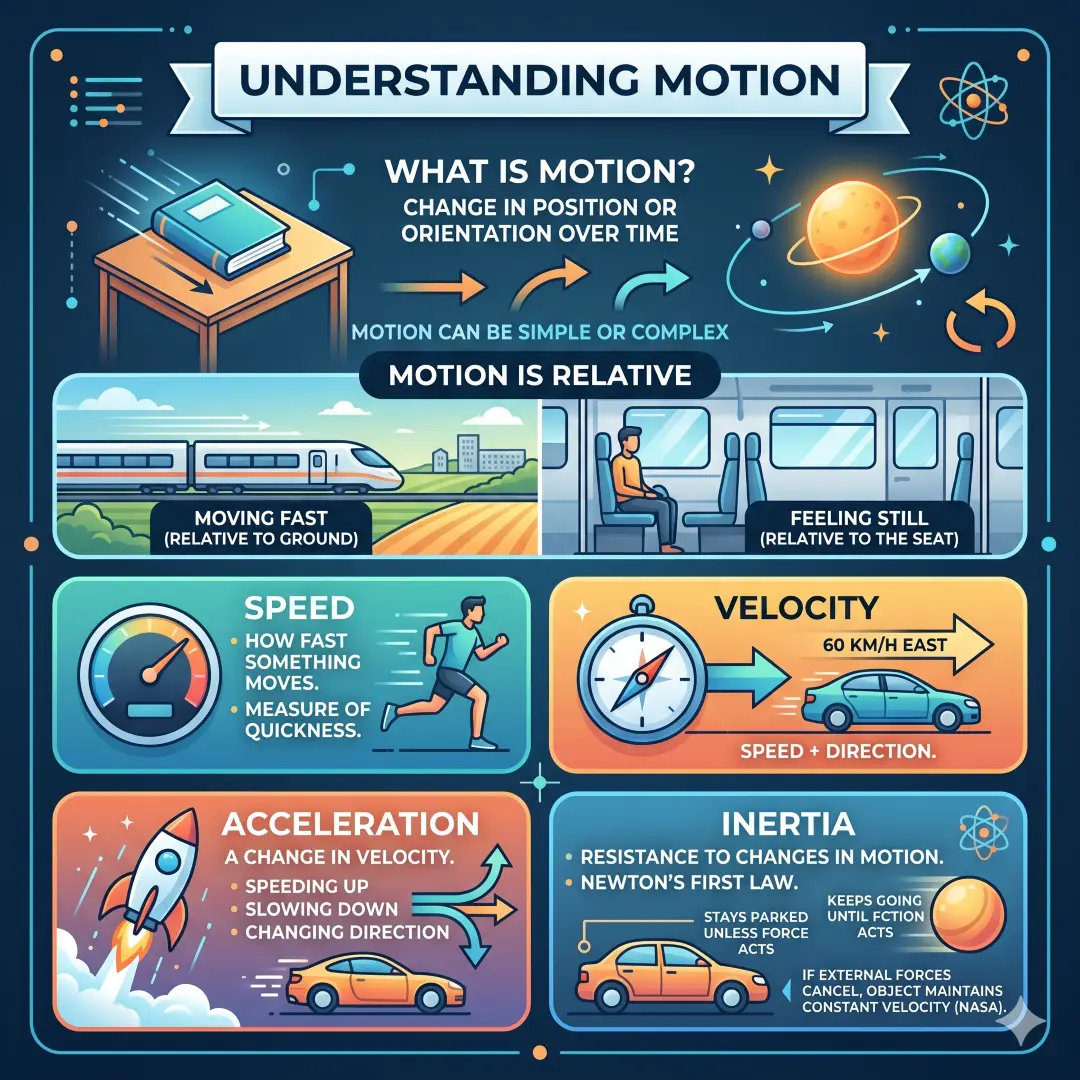
Motion is the change in position or orientation of an object over time. In physics, motion can be as simple as a book sliding across a desk or as complex as a planet orbiting a star. Motion can involve moving in a straight line, curving, rotating, or combining several kinds at once.
Motion is always relative to something else. A train may be moving quickly compared with the ground, while a passenger inside the train feels still relative to the seat. That is one reason motion is such a powerful idea in physics. It depends not only on the object itself, but also on how we measure it.
Important Ideas Connected to Motion
- Speed tells how fast something moves.
- Velocity tells how fast and in what direction something moves.
- Acceleration means a change in velocity.
- Inertia is the tendency of an object to resist changes in its motion.
A parked car stays parked unless a force acts on it. A moving ball keeps going until friction, air resistance, or another force slows it down. That resistance to change is called inertia. NASA explains that if external forces cancel out, the object maintains constant velocity. This idea is the heart of Newton’s first law of motion.
Why Motion Feels So Natural in Daily Life
We see motion everywhere. People walk, rivers flow, leaves fall, airplanes fly, and birds glide. Most of the time we do not stop to ask how motion works because it feels ordinary. But physics asks a different question. It asks what causes motion, what changes motion, and what keeps motion going. That shift in thinking is what makes science so useful.
What Is Energy?
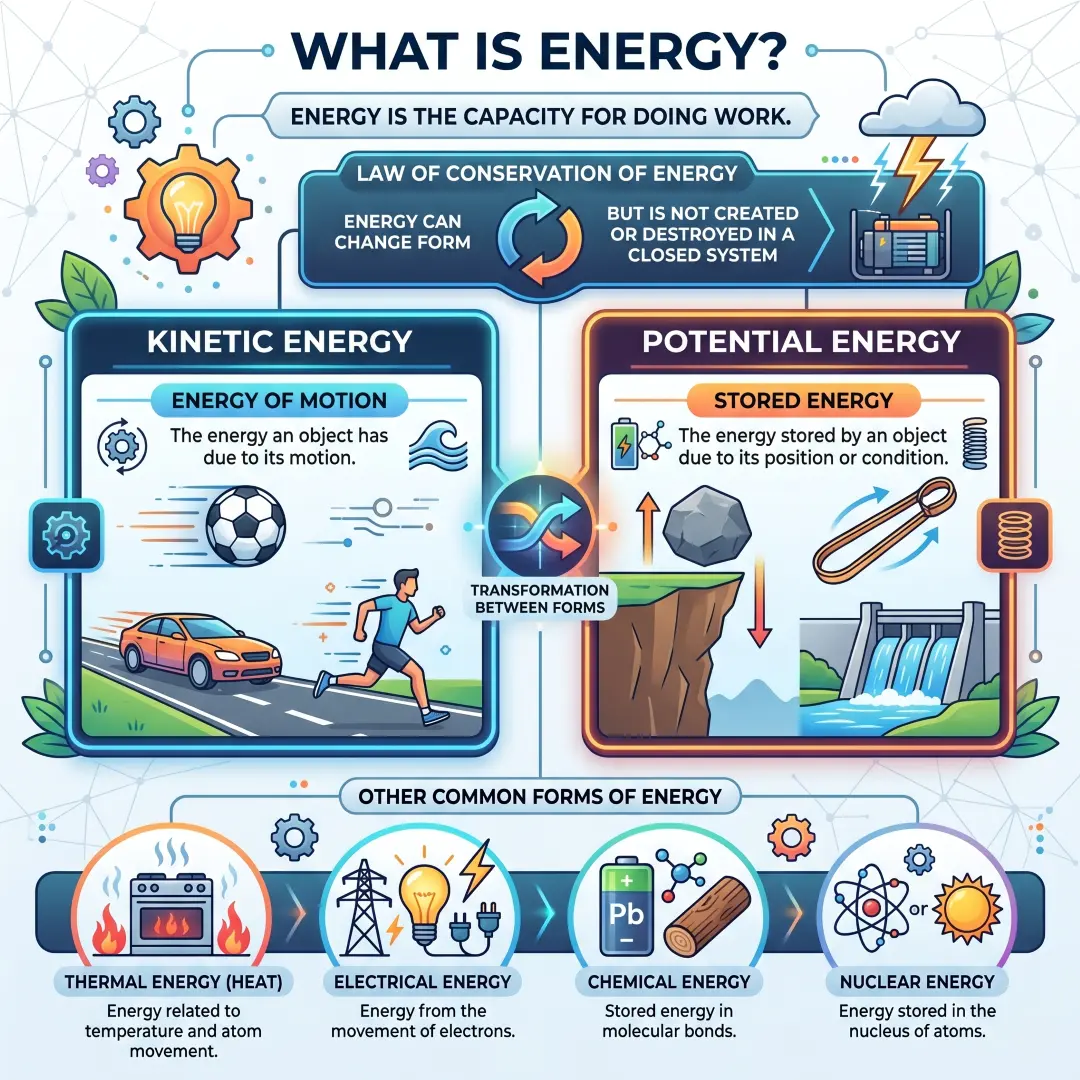
Energy is the capacity for doing work. In physics, it appears in many forms, including kinetic energy, potential energy, thermal energy, electrical energy, chemical energy, and nuclear energy. Energy can change form, but in a closed system it is not created or destroyed. It is transformed.
This is one of the most useful ideas in all of science. A moving object has kinetic energy because motion itself carries energy. A raised object has potential energy because its position gives it the ability to do work later. A battery stores chemical energy. A hot stove has thermal energy. A lightning bolt carries electrical energy. All of these are part of the same larger story.
The Two Most Common Forms of Mechanical Energy
- Kinetic energy is the energy of motion.
- Potential energy is stored energy due to position or condition.
A rolling soccer ball has kinetic energy. A rock held high above the ground has gravitational potential energy. A stretched rubber band has stored energy too. Once released, that stored energy can become motion.
A Big Idea: Energy Changes Form
One of the clearest lessons in physics is that energy moves through systems in different ways. When you do work on an object, you transfer energy to it. When friction acts, some mechanical energy becomes thermal energy. OpenStax explains that energy “lost” to friction is really transformed, often into microscopic motion and heat. So even when energy seems to disappear, it is usually changing form rather than vanishing.
This is easy to see in everyday life. When you rub your hands together, they warm up. When a brake pad slows a bicycle, the pad gets hot. When a phone battery drains, its chemical energy becomes electrical energy and then light, sound, and heat. None of that is mysterious once you remember that energy can move and transform.
Common Energy Transformations
- Chemical energy in food becomes muscle motion and heat in the body.
- Electrical energy in a fan becomes motion of blades and some sound.
- Gravitational potential energy of a falling object becomes kinetic energy.
- Kinetic energy lost to friction becomes thermal energy.
Table 1. Matter, Motion, and Energy at a Glance
| Term | Simple Meaning | Key Features | Everyday Example | Why It Matters | Source |
|---|---|---|---|---|---|
| Matter | Material substance that makes up the physical universe | Has mass, takes up space, exists in states | Water, air, stone, wood | Helps explain what things are made of | Reference Link: Encyclopedia Britannica |
| Solid | A state of matter with fixed shape and volume | Particles are closely packed | Ice, metal, brick | Important in buildings and tools | Reference Link: OpenStax |
| Liquid | A state with fixed volume but no fixed shape | Flows and fits container | Milk, oil, rainwater | Important in plumbing, cooking, and biology | Reference Link: OpenStax |
| Gas | A state with no fixed shape or volume | Expands to fill container | Air, steam | Important in weather and breathing | Reference Link: OpenStax |
| Plasma | An ionized, electrically conducting state | High energy, charged particles | Stars, lightning | Important in astronomy and high-energy physics | Reference Link: Encyclopedia Britannica |
| Motion | Change in position or orientation over time | Can be straight, curved, or rotating | A rolling ball, spinning fan | Explains how objects move | Reference Link: Encyclopedia Britannica |
| Inertia | Resistance to change in motion | More mass usually means more inertia | A heavy cart is harder to start or stop | Helps explain safety, braking, and stability | Reference Link: NASA |
| Energy | Capacity for doing work | Exists in many forms and can transform | Battery power, sunlight, food | Explains heating, motion, machines, life | Reference Link: Encyclopedia Britannica |
| Kinetic energy | Energy of motion | Depends on mass and speed | A moving car | Central to mechanics | Reference Link: Encyclopedia Britannica |
| Potential energy | Stored energy due to position or condition | Can change into other forms | Water behind a dam | Important in engineering and gravity | Reference Link: OpenStax |
How Matter and Motion Work Together
Matter and motion are closely linked. Matter can move, but matter also affects how motion behaves. A feather and a bowling ball fall differently in air because matter interacts with the environment in different ways. A moving object does not move forever in a perfect straight line in the real world because forces such as friction, drag, and gravity change its motion.
This is where force enters the picture. A force is a push or pull that can change motion. If no net force acts on an object, its motion stays the same. If a net force acts, the object can speed up, slow down, or change direction. That is why motion is never just about “moving.” It is about how and why motion changes.
Examples of Matter Affecting Motion
- A steel ball rolls farther than a rubber ball on some surfaces because of differences in shape, mass, and friction.
- A parachute slows a skydiver by increasing air resistance.
- A heavy truck is harder to stop than a small car because its greater mass gives it more inertia.
How Energy Helps Explain Motion
Energy gives motion its power. When an object speeds up, work is being done on it, and its energy changes. OpenStax explains that work and energy are closely related, and that doing work changes an object’s energy. In simple terms, energy is the reason motion can begin, increase, decrease, or stop.
A moving car has kinetic energy. When the car brakes, that kinetic energy does not disappear. Much of it becomes heat in the brake system and the surrounding air. When a lifted object falls, its potential energy changes into kinetic energy as it speeds up. This is one of the most common patterns in physical systems.
Common Situations Where Energy Drives Motion
- A ball thrown upward slows because kinetic energy is changing into gravitational potential energy.
- A compressed spring releases stored energy and pushes an object.
- A paddle wheel spins because flowing water transfers energy to it.
- A battery powers a toy car by converting stored chemical energy into motion.
Table 2. Everyday Examples of Matter, Motion, and Energy
| Situation | Matter Involved | Motion Involved | Energy Involved | What Is Happening? | Source |
|---|---|---|---|---|---|
| Falling book | Book, air, floor | The book speeds up as it falls | Potential energy becomes kinetic energy | Gravity changes position and motion | Source Link: OpenStax |
| Rolling bicycle | Bicycle, road, rider | Wheels rotate and the bike moves forward | Chemical energy from the rider becomes motion | Muscles do work on the pedals | Source Link: OpenStax |
| Boiling water | Water molecules, pot, heat source | Molecules move faster and spread out | Thermal energy increases | Heat changes the state of matter | Source Link: Encyclopedia Britannica |
| Fan running | Fan blades, motor, air | Blades spin and air moves | Electrical energy becomes motion and sound | The motor transfers energy to matter | Source Link: Encyclopedia Britannica |
| Stretching a rubber band | Rubber material | The band changes shape | Elastic potential energy builds up | Stored energy can become motion | Source Link: OpenStax |
| A moving car braking | Car, tires, brake pads, road | Car slows down | Kinetic energy becomes thermal energy | Friction converts energy into heat | Source Link: OpenStax |
| Sunlight warming skin | Skin, air, sunlight | Tiny particle motion increases | Radiant energy becomes thermal energy | Energy transfer causes warming | Source Link: Encyclopedia Britannica |
| Water behind a dam | Water, dam, river system | Water can flow downward later | Gravitational potential energy is stored | Height creates useful stored energy | Source Link: OpenStax |
The Law of Conservation of Energy
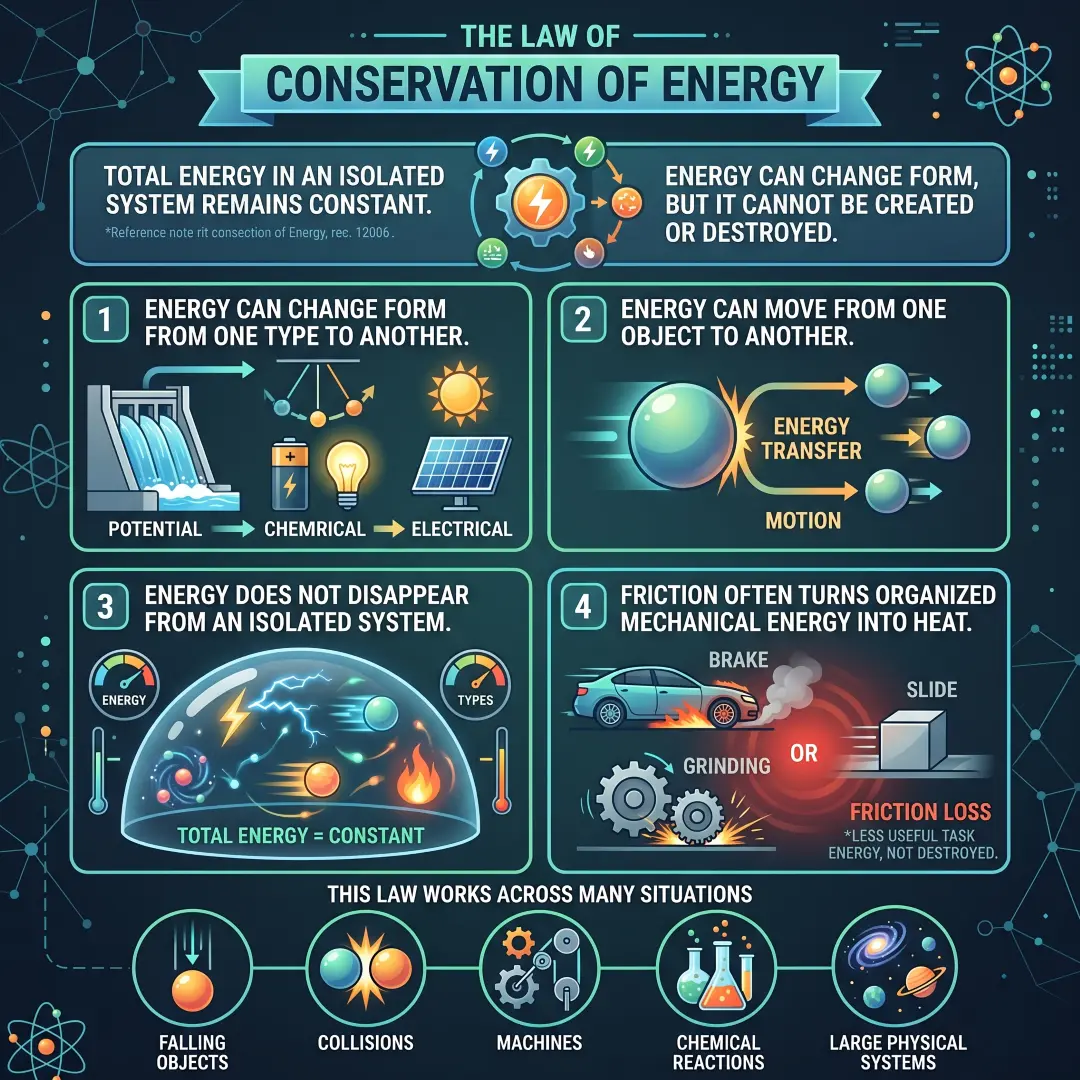
One of the most important principles in physics is the law of conservation of energy. In a closed or isolated system, total energy remains constant. Energy can change form, but the total amount does not simply vanish. OpenStax states this clearly in its discussion of mechanical energy and conservation of energy.
This law is powerful because it works across many situations. It applies to falling objects, collisions, machines, chemical reactions, and even much larger physical systems. When people say energy is “lost,” they usually mean it has become less useful for a particular task, not that it has been destroyed.
What Conservation of Energy Tells Us
- Energy can change from one form to another.
- Energy can move from one object to another.
- Energy does not disappear from an isolated system.
- Friction often turns organized mechanical energy into heat.
Momentum, Collisions, and Motion Changes
When objects move and collide, momentum becomes important. NASA and OpenStax describe momentum as mass multiplied by velocity, and they explain that total momentum in a system remains constant when no external force changes it. This is the law of conservation of momentum.
Momentum helps explain car crashes, ball games, rocket motion, and even explosions. In a collision, some kinetic energy may change form, but momentum can still be conserved. That is why physicists often study energy and momentum together. They are different ideas, but they work hand in hand.
Elastic and Inelastic Collisions
An elastic collision is one where objects separate after impact and do not lose kinetic energy overall. In many real collisions, however, some kinetic energy becomes heat, sound, or deformation. That is called an inelastic collision. The momentum story remains central in both cases.
Simple Examples
- Two billiard balls bouncing apart can be close to an elastic collision.
- A car crash is usually inelastic because energy is spent deforming the vehicles.
- A rocket moves forward because expelled gases carry momentum backward.
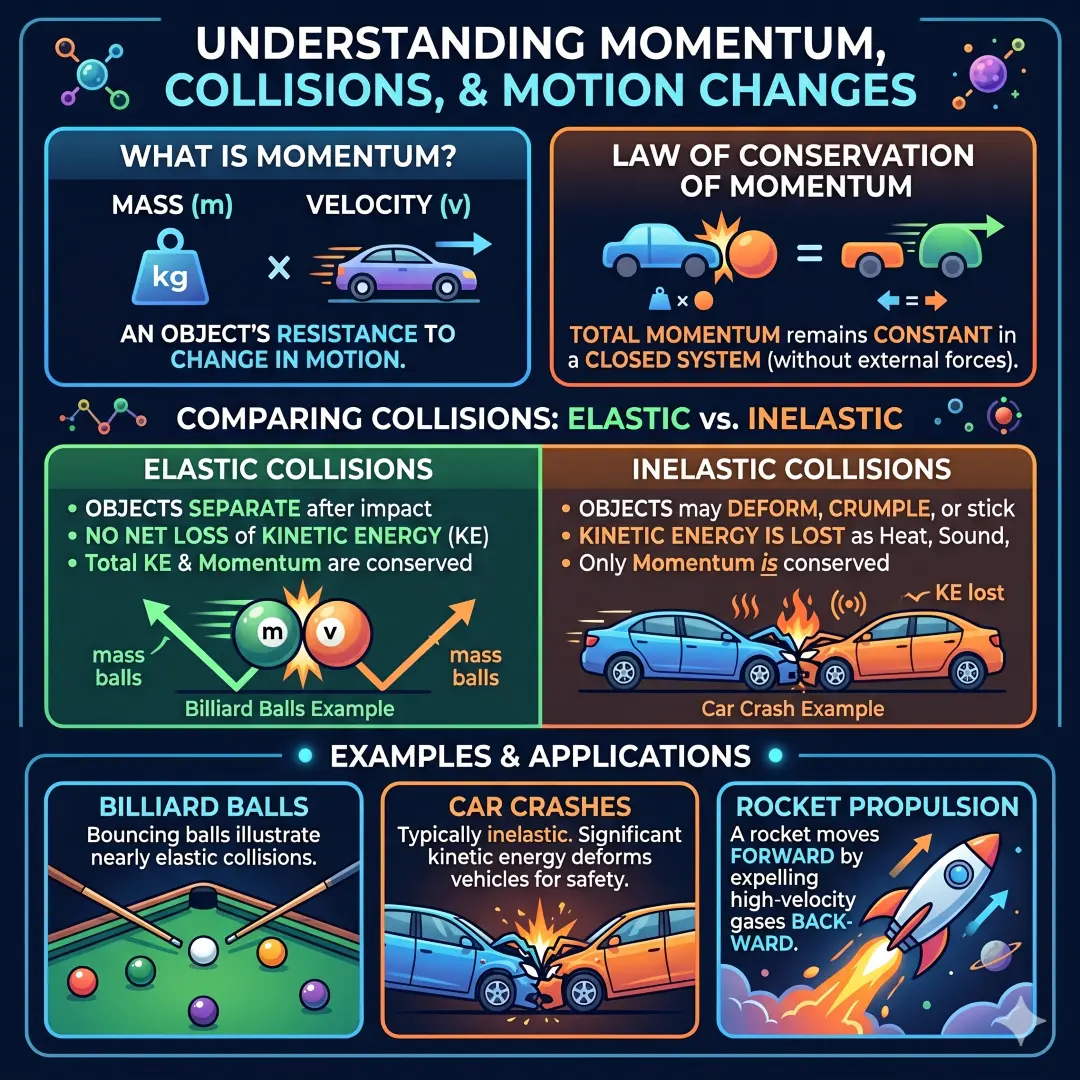
Table 3. Conservation Laws in Simple Language
| Law | What It Says | What It Means in Practice | Simple Example | Source |
|---|---|---|---|---|
| Conservation of energy | Total energy stays constant in a closed system | Energy changes form but is not destroyed | A falling ball changes from potential to kinetic energy | Source Link: OpenStax |
| Conservation of momentum | Total momentum stays constant when no external force acts | Motion transfer matters in collisions and propulsion | Billiard balls, car crashes, rockets | Source Link: NASA GRC |
| Newton’s first law | Objects keep their state of rest or uniform motion unless acted on by a net force | Motion changes only when forces act | A puck gliding on ice slows because of friction | Source Link: NASA |
| Work-energy idea | Doing work changes energy | Forces can transfer energy into or out of a system | Lifting a book adds potential energy | Source Link: OpenStax |
A Closer Look at Work and Energy
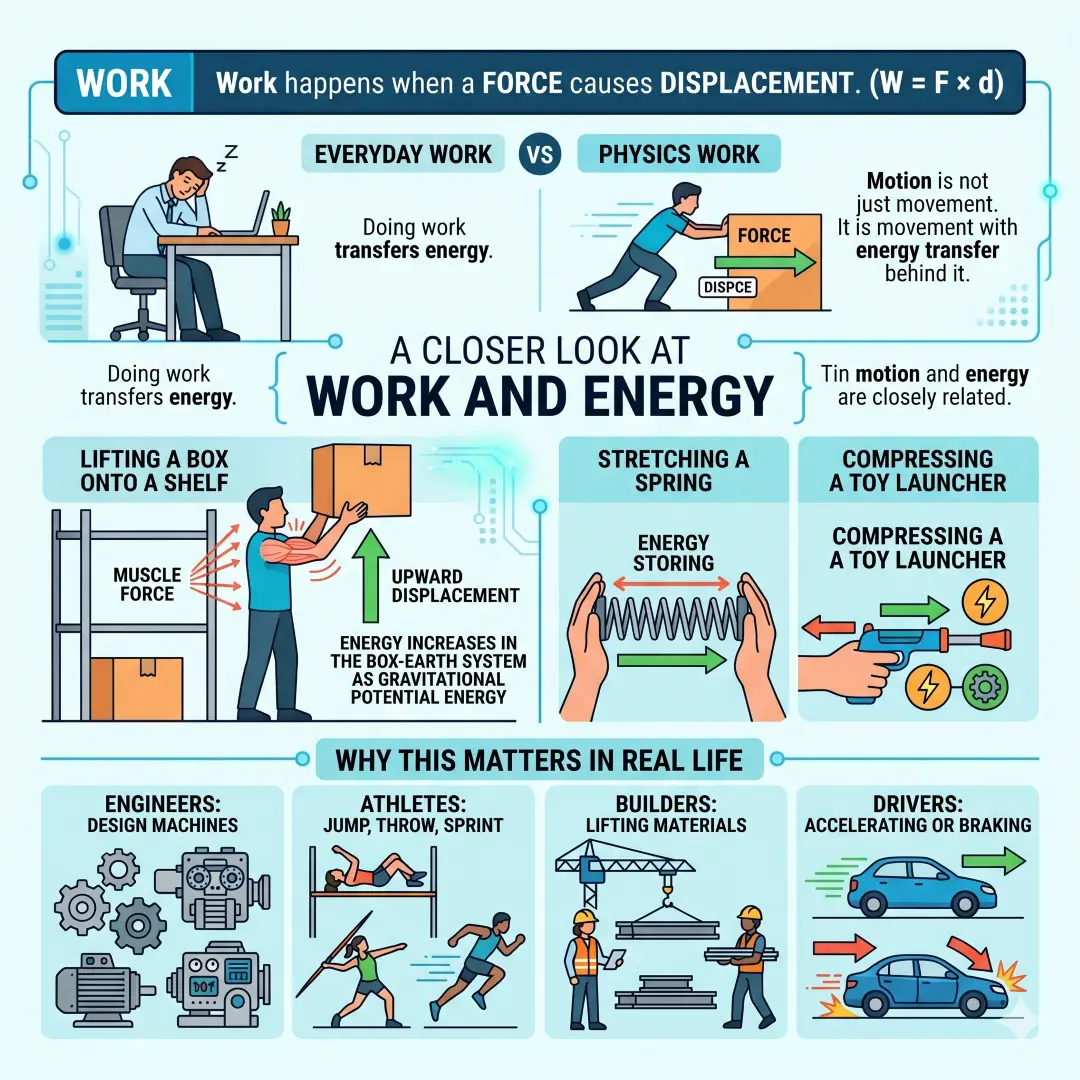
The idea of work in physics is different from everyday speech. In physics, work happens when a force causes displacement. OpenStax describes work and energy as closely related because doing work transfers energy. That link is one of the simplest ways to see how motion and energy belong together.
Imagine lifting a box onto a shelf. Your muscles apply force, the box moves upward, and energy increases in the box-Earth system as gravitational potential energy. The same happens when you stretch a spring or compress a toy launcher. Motion is not just movement. It is movement with energy transfer behind it.
Why This Matters in Real Life
- Engineers use work and energy to design machines.
- Athletes use them every time they jump, throw, or sprint.
- Builders use them when lifting materials.
- Drivers use them when accelerating or braking.
Matter, Energy, and the Universe
At the largest scale, matter and energy help explain stars, planets, galaxies, and the conditions of space itself. Britannica notes that physics aims to find laws that govern matter and energy from microscopic to cosmic scales. NASA also explains that orbital motion depends on gravity and acceleration toward the center of a curved path. That means even the motion of planets can be understood through basic physical ideas.
This larger view is important because it shows that physics is not only about laboratory experiments. It is also about the universe as a whole. The same language that explains a rolling marble can also help explain how planets stay in orbit. That is a remarkable thing.
A Thought to Keep in Mind
The universe is not built from separate ideas. Matter, motion, and energy are woven together. Matter gives the universe structure. Motion gives it change. Energy gives it the ability to act. When these three are understood together, the world becomes easier to read.
How These Ideas Show Up in Daily Life
It is easy to think physics belongs only in classrooms. But every day gives us examples. A kettle heats water because energy is transferred into matter. A person walking to work is converting chemical energy in food into motion. A phone battery slowly drains because stored energy is being transformed into light, sound, heat, and computation. Even a simple door closing shows force, motion, and energy at work.
Here are a few quick examples that make the ideas feel real:
- Cooking uses heat to change the state and structure of matter.
- Transportation uses energy to overcome inertia and friction.
- Sports depend on motion, force, momentum, and energy transfer.
- Weather involves motion of air and water, plus huge energy exchanges.
Table 4. Everyday Life Connections
| Area of Life | Matter Angle | Motion Angle | Energy Angle | Simple Takeaway | Source |
|---|---|---|---|---|---|
| Cooking | Water, oil, food, metal pans | Boiling, stirring, expansion | Heat changes temperature and state | Energy transforms matter during cooking | Source Link: Encyclopedia Britannica |
| Travel | Cars, fuel, roads, passengers | Speed, braking, turning | Fuel energy becomes motion and heat | Motion needs energy input | Source Link: OpenStax |
| Sports | Balls, bats, shoes, bodies | Throwing, running, spinning | Muscles convert chemical energy to motion | Performance depends on physics | Source Link: NASA GRC |
| Home appliances | Metal, plastic, wires, air | Fans spin, motors run | Electrical energy becomes motion, heat, sound | Devices are energy converters | Source Link: Encyclopedia Britannica |
| Weather | Water vapor, clouds, air masses | Wind, rainfall, storms | Heat drives atmospheric motion | Energy powers climate patterns | Source Link: Encyclopedia Britannica |
| Spaceflight | Rockets, fuel, spacecraft | Lift-off, orbit, thrust | Chemical energy becomes kinetic energy | Motion in space follows physics too | Source Link: NASA GRC |
Why These Concepts Are Useful for Students and Readers Everywhere
One reason matter, motion, and energy are worth learning is that they build confidence. Once someone understands these ideas, many other science topics become easier. Chemistry, biology, geology, engineering, astronomy, and environmental science all depend on them in one way or another. Even if a person never becomes a scientist, these ideas sharpen how they see the world.
They also teach a useful habit of mind. Instead of asking only “What happened?”, a curious thinker also asks “What moved?”, “What changed?”, and “Where did the energy go?” That is the kind of question that leads to real understanding.
Skills Built by Learning These Topics
- Better observation
- Clearer problem solving
- Stronger reasoning
- Better understanding of technology and machines
- A deeper sense of how the physical world works
Common Misunderstandings to Avoid
A lot of confusion around physics comes from ordinary language. For example, people often say energy is “used up” or motion is “lost.” In science, the story is more precise. Energy changes form. Motion changes because forces act. Matter does not stop being matter just because it changes state. These small corrections make a big difference.
Another common misunderstanding is that motion always needs a force to keep going. In reality, a net force is needed to change motion, not to maintain constant motion in an ideal case. Friction and air resistance make the real world less ideal, which is why moving objects usually slow down unless energy continues to be supplied.
A Clearer Way to Think About It
- Matter is what things are made of.
- Motion is how matter changes position.
- Energy is what makes change possible.
Final Thoughts
Matter, motion, and energy are not separate islands. They are connected parts of one larger picture. Matter gives physical things their substance. Motion describes how those things move and change. Energy explains how those changes happen and how work gets done. Once you understand those three ideas, you have a strong foundation for almost all of physics.
And maybe that is the most interesting thing about physics. It does not just describe the world. It teaches us how to look at the world with more care. A falling leaf, a running engine, a spinning planet, and a warm cup of tea all begin to make more sense. The universe becomes a little more readable.
Article References and Sources
- Physics Overview: Britannica
- Matter: Definition and Properties (Britannica)
- States of Matter and Classification: OpenStax Chemistry
- Plasma (State of Matter): Britannica
- Motion (Mechanics): Britannica
- Newton’s Laws of Motion: NASA Glenn Research Center
- Energy: Definition and Forms (Britannica)
- Kinetic Energy: Britannica
- Work, Energy, and Power: OpenStax Physics
- Mechanical Energy and Conservation of Energy: OpenStax Physics
- Elastic and Inelastic Collisions: OpenStax Physics
- Conservation of Momentum: NASA Glenn Research Center
- Rocket Principles and Motion: NASA Glenn Research Center
Also, Read these Articles in Detail
- Physics and Its Fundamentals With Good Explanations
- What Is Matter? The Physical Substance of the Universe
- What Is Motion? A Guide to Motion in Physics and Daily Life
- What Is Energy? The Invisible Power Behind Everyday Life
- Kinetic Energy Explained in Simple Language
- Potential Energy: Definition, Types, Formula, and Examples
- Thermal Energy: Heat, Temperature, and Transfer
- Mechanical Energy: Definition, Formula, and Examples
- Chemical Energy: Definition, Science, and Examples
- Electrical Energy: Definition, Works, and Why It Matters
- Radiant Energy: Meaning, Sources, Examples, and Uses
- Nuclear Energy: Definition, How It Works, and Why It Matters
- Sound Energy: Definition, Science, and Examples
- Elastic Energy: Definition, Elasticity, Example, and Facts
Frequently Asked Questions
FAQ 1: What do we mean by matter, motion, and energy in physics?
Matter, motion, and energy are three of the most basic ideas in physics, and they help explain almost everything we see around us. Matter is anything that has mass and takes up space. That includes a rock, a tree, water, air, a chair, and even your body. If something is made of physical stuff, it is matter.
Motion is the change in position of an object over time. A car moving down the road, a bird flying across the sky, a ball rolling on the floor, and even the Earth orbiting the Sun are all examples of motion. Motion can be fast or slow, straight or curved, simple or complex. But at the core, it always means something is changing its place.
Energy is the ability to do work or cause change. It is what makes motion possible, what heats things up, what powers machines, and what keeps life going. A moving car has energy. A stretched spring has energy. Food has energy too, because your body uses it to breathe, grow, think, and move. These three ideas are linked in a very deep way. Matter gives the world its physical form, motion shows how that form changes, and energy makes those changes happen.
And that is why these concepts matter so much. Once you understand them, a lot of the world starts to make sense. A falling object, a burning candle, a flying airplane, and a boiling pot of water all become easier to explain. They may look different on the surface, but physics shows that they are all connected through matter, motion, and energy.
FAQ 2: Why is matter important in everyday life?
Matter is important because it is the basic substance of everything physical around us. Without matter, there would be no buildings, no air to breathe, no food to eat, no water to drink, and no human body. In simple words, matter is the “stuff” the world is made of. It gives objects their mass, size, shape, and physical presence.
In daily life, matter appears in many forms. A metal spoon is matter. The milk in your cup is matter. The air in a room is matter too, even though you cannot see it. Different kinds of matter behave differently because their particles are arranged in different ways. For example, a solid like wood keeps its shape, while a liquid like water flows and takes the shape of its container. A gas like oxygen spreads out and fills the available space.
Matter also matters because it interacts with energy all the time. When you heat water, you are changing the behavior of its particles. When you freeze juice, you are changing its state. When you cook food, matter changes because energy is being transferred into it. That is why matter is not just something passive sitting there. It is active, changing, and always involved in physical processes.
And in a bigger sense, matter helps explain the world in practical ways. Engineers choose specific materials for bridges, airplanes, and electronics because different matter has different strength, weight, and conductivity. Doctors use matter in the form of medicines, tools, and medical devices. So matter is not just a science term. It is part of daily life, technology, health, and survival.
FAQ 3: What are the main states of matter?
The main states of matter are solid, liquid, gas, and plasma. These are the most common forms matter can take, and each one behaves in a different way. A solid has a fixed shape and a fixed volume. A liquid has a fixed volume but no fixed shape. It flows and fits its container. A gas has neither a fixed shape nor a fixed volume, so it spreads out to fill the space it is in. Plasma is a high-energy state of matter with charged particles, and it is found in stars, lightning, and some special man-made devices.
The state of matter depends mainly on how its particles are arranged and how much energy they have. In a solid, particles are packed closely together and usually only vibrate in place. In a liquid, particles are still close, but they can move around each other. In a gas, particles move freely and are much farther apart. In plasma, particles have so much energy that electrons can separate from atoms, creating a charged mixture.
These differences explain a lot of everyday behavior. Ice stays in shape because it is solid. Water pours because it is liquid. Air fills a balloon because it is gas. Lightning is bright and powerful because it is plasma. The state of matter changes when energy is added or removed. Heating ice turns it into water. Heating water turns it into steam. Cooling steam can turn it back into liquid and then solid.
This is one of the most useful ideas in science because it connects invisible particle behavior with visible real-world changes. It helps explain weather, cooking, engines, electricity, and even space science. So when people talk about the states of matter, they are really talking about how matter behaves under different conditions of energy and movement.
FAQ 4: What is motion, and how do we describe it?
Motion is the change in position of an object over time. That means if something moves from one place to another, it is in motion. A person walking, a train moving, a leaf falling, and a planet orbiting are all examples of motion. Motion can happen in a straight line, in a circle, or in a more complex path. It can be fast or slow, smooth or jerky.
Scientists describe motion using ideas like speed, velocity, and acceleration. Speed tells us how fast something is moving. Velocity tells us how fast it is moving and in what direction. Acceleration means a change in velocity. So if a car speeds up, slows down, or changes direction, it is accelerating. These words help us describe motion more accurately than just saying something is “moving.”
Motion is also relative. That means an object can seem still in one situation and moving in another. If you are sitting on a train, you may feel still. But to someone outside the train, you are moving along with it. That is why motion depends on the frame of reference. This is a simple but very important idea in physics.
Motion is everywhere, and it is one of the first things people notice in the physical world. But physics goes deeper than just noticing movement. It asks what causes motion, what changes motion, and what keeps motion going. Once you start asking those questions, motion becomes more than a simple act. It becomes a key to understanding forces, energy, and the way the universe behaves.
FAQ 5: What is the relationship between force and motion?
Force and motion are closely linked. A force is a push or pull that can change the motion of an object. If you kick a ball, your foot applies force and the ball starts moving. If you pull a cart, the force changes its position. If you press on a spring, the force changes its shape. So force is one of the main reasons motion changes.
But motion does not always need a force to continue in the same way. An object in motion tends to keep moving unless a force stops it or changes it. This idea is connected to inertia, which is the tendency of matter to resist changes in motion. A heavy truck is harder to start or stop than a bicycle because it has more inertia. That is why force is important not just for starting motion, but also for changing it.
In the real world, different forces act all the time. Gravity pulls objects downward. Friction slows things down. Air resistance pushes against moving objects. Tension in a rope can pull something upward or sideways. These forces shape the motion of everything around us. A swinging pendulum, a rolling wheel, and a falling apple all move the way they do because of force.
So when we talk about motion, we are really talking about forces in action. Motion is not random. It follows rules. And those rules help explain why objects move the way they do, why some things stop quickly, and why others keep going for a long time.
FAQ 6: What is energy, and why is it so important?
Energy is the ability to do work or cause change. It is one of the most important ideas in all of physics because almost everything depends on it. Without energy, nothing could move, warm up, light up, grow, or transform. Energy is behind motion, heat, electricity, chemical reactions, and life itself.
Energy comes in many forms. Kinetic energy is the energy of motion. Potential energy is stored energy because of position or condition. Thermal energy is related to heat. Chemical energy is stored in food, fuel, and batteries. Electrical energy powers devices. Nuclear energy is stored in the center of atoms. All these forms are different, but they are part of the same big idea.
Energy is important because it explains change. A moving car has energy because it is in motion. A battery has energy because it can power a phone. Food has energy because your body can use it to move and think. A stretched rubber band has energy because it can snap back and do work. Even sunlight carries energy that can warm the Earth and help plants grow.
What makes energy especially useful is that it can change form. Chemical energy can become motion. Electrical energy can become light and heat. Potential energy can become kinetic energy. Energy is never just sitting still in one place forever. It is always moving, transforming, and interacting with matter. That is why it is so central to science and to everyday life.
FAQ 7: What is the difference between kinetic energy and potential energy?
Kinetic energy and potential energy are two major forms of mechanical energy. Kinetic energy is the energy of motion. If an object is moving, it has kinetic energy. A rolling ball, a flying bird, a moving car, and flowing water all have kinetic energy because they are in motion. The faster something moves, the more kinetic energy it has.
Potential energy is stored energy. It is energy that an object has because of its position, shape, or condition. A rock held high above the ground has gravitational potential energy. A stretched spring has elastic potential energy. A water tank placed high above the ground also stores potential energy because it can release that energy later through motion or flow.
The difference between the two is simple but powerful. Kinetic energy is energy in action. Potential energy is energy waiting to be used. A ball held in your hand has potential energy. When you drop it, that energy starts turning into kinetic energy as it falls. A stretched rubber band has potential energy. When you let it go, it turns into motion. This changing back and forth happens constantly in the world around us.
And this is why the two forms are so closely connected. Many physical systems involve energy moving between these two states. A swing goes back and forth between high potential energy and high kinetic energy. A roller coaster does the same thing. Water in a dam, a thrown ball, and even some machines work on the same principle. Once you understand this pair of ideas, a lot of physical change becomes easier to understand.
FAQ 8: How is energy conserved in nature?
The law of conservation of energy says that energy cannot be created or destroyed in a closed system. It can only change form or move from one place to another. This is one of the most important principles in physics, and it helps explain why the world behaves in a predictable way. When people say energy is “lost,” they usually mean it has changed into a form that is less useful for the task at hand, not that it has disappeared.
A good example is a moving car that stops when the brakes are applied. The car’s kinetic energy does not vanish. A lot of it changes into thermal energy because of friction in the brakes and the tires. Another example is a ball falling from a height. Its potential energy changes into kinetic energy as it speeds up. The total energy stays the same, but its form changes.
This idea is useful because it gives scientists and engineers a reliable way to study systems. If they know where energy enters, where it goes, and how it changes, they can better design machines, buildings, engines, and electrical systems. It also helps explain everyday events, like cooking food, charging a battery, or heating a room.
Energy conservation is one of those laws that sounds simple but has huge meaning. It tells us that nature does not waste energy by making it disappear. Instead, nature transforms energy in countless ways. That is why the study of energy is really the study of change itself.
FAQ 9: How do matter, motion, and energy work together in real life?
Matter, motion, and energy are never fully separate. They work together all the time. Matter is the physical substance, motion is what happens when matter changes position, and energy is what makes those changes possible. You can see all three in one simple event, like a person walking. The person is matter. The movement of the legs and body is motion. The food the body uses is energy.
Another clear example is a car. The car is made of matter. When it drives, it is in motion. The fuel inside the car stores chemical energy. That energy is changed into motion, sound, and heat. When the driver presses the brakes, the motion slows and some of the energy becomes heat through friction. So even a normal drive is a perfect example of how the three ideas connect.
The same pattern appears in nature. Wind moves because air particles are matter in motion, driven by energy from the Sun. Water flows because gravity changes its position and motion. Plants grow because they absorb energy from sunlight and use matter from air and soil. At a larger scale, planets move because gravity and motion are linked across space.
Once you start looking for this pattern, you will see it everywhere. Matter gives things shape and mass. Motion changes where they are and how they move. Energy drives the whole process. That is why these ideas are often studied together. They are parts of one system, not separate topics sitting in isolation.
FAQ 10: Why is studying matter, motion, and energy useful for students and everyday people?
Studying matter, motion, and energy is useful because these ideas explain the world in a clear and practical way. You do not need to be a scientist to benefit from them. They help with everyday decisions, such as understanding how appliances work, why cars need fuel, why food gives us strength, and why some objects move the way they do.
For students, these ideas are the foundation of many other subjects. Chemistry depends on matter and energy. Biology depends on energy flow in living things. Engineering depends on force, motion, and energy transfer. Astronomy depends on matter and motion across space. So learning these basics early makes later learning much easier. It gives students a strong base instead of a shaky one.
For everyday people, the value is practical. You understand why a pot gets hot on a stove. You understand why a ball keeps rolling for a while and then stops. You understand why a heavy object is harder to move. You understand why batteries run out and why machines heat up during use. That kind of understanding makes the world feel more logical and less mysterious.
And there is something else too. These ideas train the mind to think carefully. They teach observation, cause and effect, and logical reasoning. That is useful in science, but it is also useful in life. When you understand matter, motion, and energy, you begin to notice patterns more clearly and make better sense of the world around you.
