

India’s Fundamental Rights are not decorative lines in a constitutional document. They are the everyday shield that stands between the individual and unfair power. They give ordinary people the right to speak, move, believe, work, learn, and live with dignity. They also give people a legal way to fight back when those freedoms are threatened. In the Indian constitutional system, the Constitution is the supreme legal authority, and the independent judiciary can strike down laws or government action that violate it.
This protection is Part III of the Constitution of India, which contains Articles 12 to 35. These articles group the rights into clear categories, including equality, freedom, protection against exploitation, freedom of religion, cultural and educational rights, and constitutional remedies. Some of these rights protect citizens, while others protect all persons within India. That distinction matters because freedom is not treated as a privilege for a few. It is built into the constitutional structure itself.
Table of Contents
What Fundamental Rights Really Mean
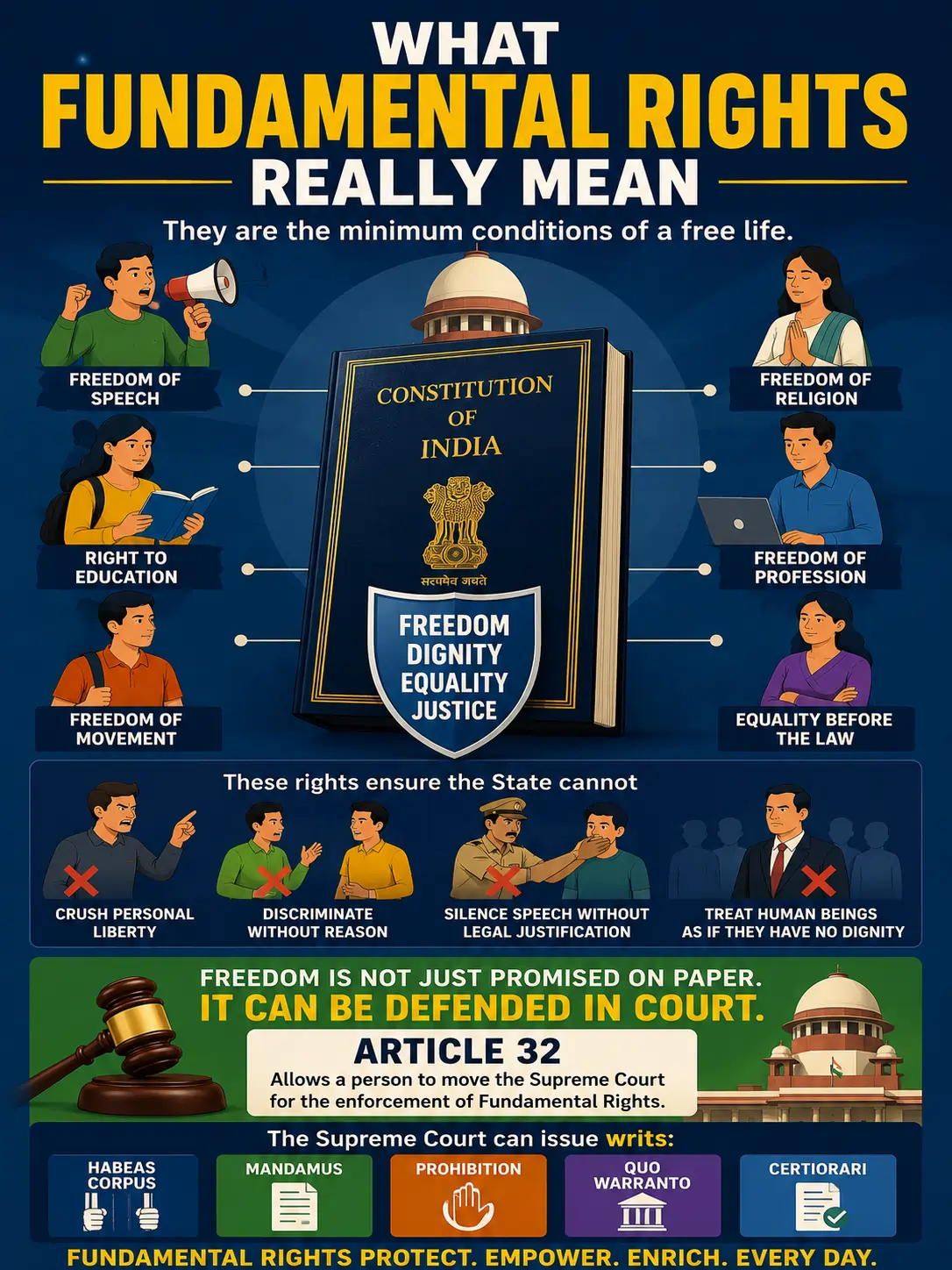
The easiest way to understand Fundamental Rights is to think of them as the minimum conditions of a free life. They do not solve every problem. They do not guarantee comfort or success. But they do ensure that the State cannot casually crush personal liberty, discriminate without reason, silence speech without legal justification, or treat human beings as if they have no dignity at all. That is why these rights sit at the very center of constitutional freedom.
The Constitution also gives people a direct enforcement mechanism. Article 32 allows a person to move the Supreme Court for the enforcement of Fundamental Rights, and the Court can issue writs such as habeas corpus, mandamus, prohibition, quo warranto, and certiorari. In plain language, that means freedom is not just promised on paper. It can be defended in court.
Why These Rights Matter So Much
Freedom becomes real only when it is protected in daily life. A person must be free to criticize authority, gather peacefully, choose an occupation, travel inside the country, follow a faith, educate their children, and stand before a court when the State acts unfairly. That is exactly why the Constitution places freedom of speech and expression, personal liberty, equality before law, and remedies so close to the center of the system.
This is also why the courts have treated these rights as living protections rather than dead text. In Kesavananda Bharati, the Supreme Court held that Parliament cannot alter the Constitution’s basic structure. That decision matters because it limits how far any government can go, even if it has a strong majority. Rights are therefore not left entirely at the mercy of political power.

The Six Broad Groups of Fundamental Rights
| Group | Articles | What it protects | Why it matters for freedom |
|---|---|---|---|
| Right to Equality | 14 to 18 | Equality before law, non-discrimination, equal chance in public employment, abolition of untouchability, abolition of titles | It prevents the State from treating people as unequal beings based on identity, rank, or social status. |
| Right to Freedom | 19 to 22 | Speech, assembly, association, movement, residence, profession, protection in conviction, education, arrest and detention safeguards | It protects the space in which a person can actually live as a free human being. |
| Right against Exploitation | 23 to 24 | Ban on trafficking, forced labour, and child labour in factories and hazardous work | It protects people from being used as tools for profit or abuse. |
| Right to Freedom of Religion | 25 to 28 | Freedom of conscience, religion, religious management, tax neutrality, and protection in educational institutions | It protects belief, worship, and conscience from unnecessary State interference. |
| Cultural and Educational Rights | 29 to 30 | Protection of language, script, culture, and minority educational institutions | It protects the identity of communities, not just individuals. |
| Right to Constitutional Remedies | 32 | The right to move the Supreme Court for enforcement of rights | It makes the other rights meaningful because it gives people a way to enforce them. |
How Each Right Protects Individual Freedom
1. Equality keeps freedom from becoming privilege
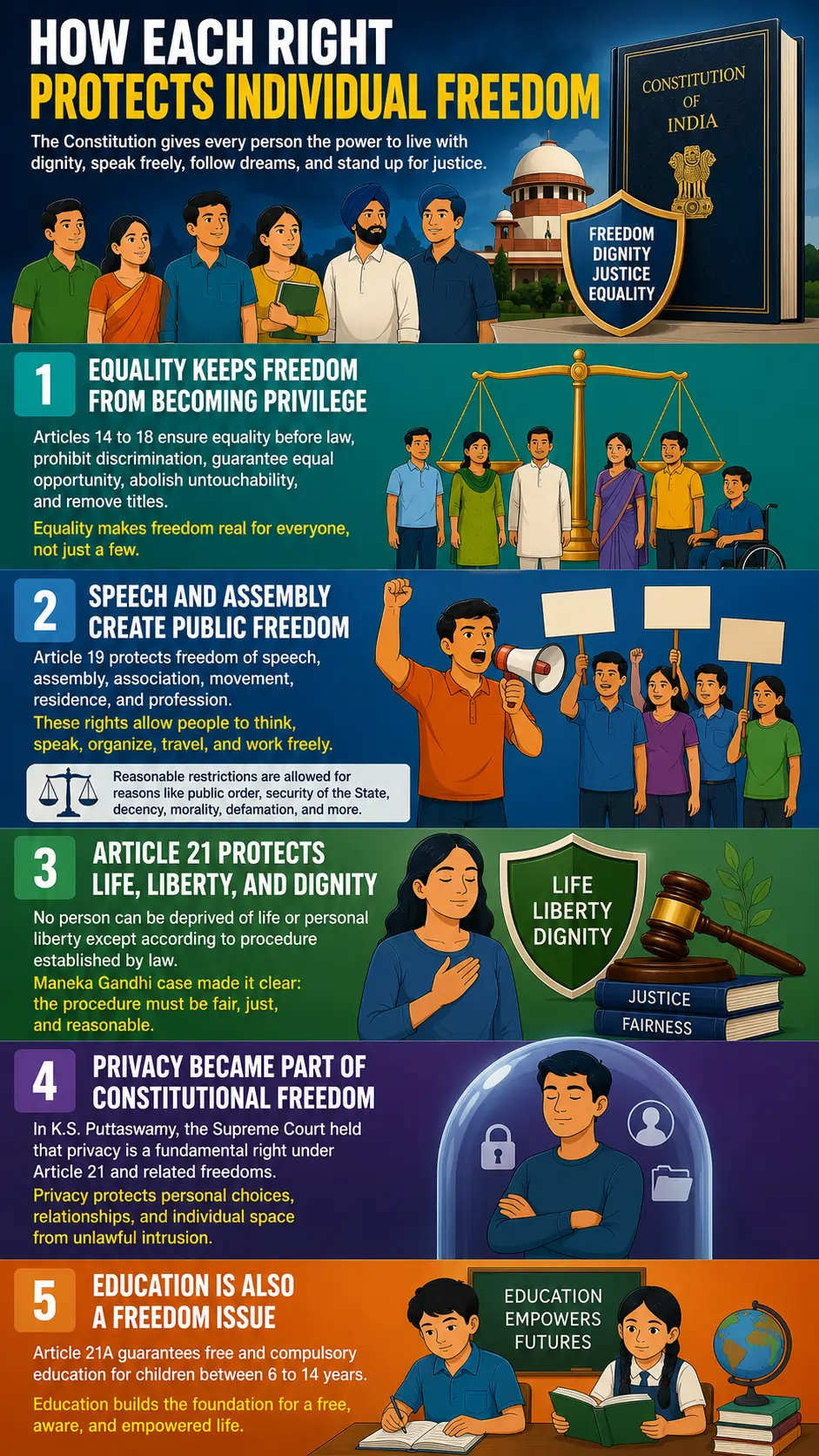
Freedom is weak when only some people enjoy it. Article 14 says the State cannot deny equality before law or equal protection of the laws. Article 15 forbids discrimination on grounds such as religion, race, caste, sex, or place of birth. Article 16 protects equality of opportunity in public employment. Article 17 abolishes untouchability, and Article 18 abolishes titles. Together, these rules stop society from building a caste system of rights where some people are naturally more free than others.
That is not a minor idea. It is the difference between formal democracy and real democracy. If a person can be denied a job, humiliated in public life, or pushed aside because of identity, then personal freedom becomes hollow. Equality turns freedom into something everyone can actually use.
2. Speech and assembly create public freedom
Article 19 protects the freedoms that let people think, speak, organize, move, and work. It includes the right to freedom of speech and expression, peaceful assembly, associations or unions, free movement, residence anywhere in India, and profession or trade. These are the tools of a free life, because no one can really be free if they cannot speak their mind, gather with others, or choose how to earn a living.
At the same time, the Constitution does not treat these rights as absolute. It allows reasonable restrictions for reasons such as sovereignty and integrity of India, security of the State, public order, decency, morality, contempt of court, defamation, and incitement to an offence. This balance matters because freedom is strongest when limits are narrow, lawful, and reviewable.
3. Article 21 protects life, liberty, dignity, and modern freedom
Article 21 says that no person shall be deprived of life or personal liberty except according to procedure established by law. This is one of the most important constitutional sentences in India because it protects the basic conditions of human existence. It is not only about staying alive. Over time, the courts have read it as a guarantee of dignity, fairness, and meaningful liberty.
The Supreme Court’s decision in Maneka Gandhi is a landmark here. The Court explained that the procedure affecting personal liberty cannot be arbitrary, fantastic, or oppressive, and that it must be fair and reasonable. That changed the practical meaning of liberty in India. It meant that the State must behave lawfully and justly when it restricts a person’s freedom.
4. Privacy became part of constitutional freedom
In K.S. Puttaswamy, the Supreme Court held that privacy is a constitutionally protected right. The judgment linked privacy primarily to Article 21, while also recognizing that elements of privacy arise from the broader freedoms and dignity protected by Part III. This matters because personal freedom is not only about public acts. It is also about private choice, private life, and control over one’s personal space.
That recognition fits a simple truth. A person cannot be fully free if every movement, every choice, and every piece of personal life can be watched, exposed, or controlled without a lawful basis. Privacy gives space for personality, conscience, relationships, and individual development.
5. Education is also a freedom issue
Article 21A makes free and compulsory education a constitutional right for children between six and fourteen years of age. This is not just about schooling. It is about making freedom possible in the future. A child who can read, write, reason, and participate in public life is far better placed to defend rights later in life.
That is why education belongs in a discussion about freedom. A right is only as strong as a person’s ability to understand and use it. Education helps turn legal freedom into lived freedom.
A Closer Look at the Rights That Protect Freedom Most Directly
| Article | Core protection | What it looks like in daily life | Why it matters |
|---|---|---|---|
| Article 19(1)(a) | Freedom of speech and expression | Writing, speaking, publishing, protesting, criticising policy | It protects the voice of the individual and keeps public debate alive. |
| Article 19(1)(b) | Peaceful assembly | Meetings, marches, public gatherings | It protects collective action without violence. |
| Article 19(1)(c) | Associations, unions, cooperative societies | Unions, clubs, groups, civic networks | It helps people organise around shared interests. |
| Article 19(1)(d) | Free movement | Travel within India | It keeps a person from being trapped within artificial limits. |
| Article 19(1)(e) | Residence and settlement | Living in any part of India | It supports work, family, and migration choices. |
| Article 19(1)(g) | Profession, occupation, trade, business | Choosing a job or starting a business | It protects economic freedom and personal livelihood. |
| Article 21 | Life and personal liberty | Protection from arbitrary action and unfair detention | It protects dignity and the basic conditions of life. |
| Article 21A | Education | Access to schooling for children | It builds the capability to use other rights. |
| Article 22 | Safeguards after arrest and detention | Right to know grounds of arrest and consult a lawyer | It protects a person from being swallowed by State power. |
What Happens When the State Crosses the Line
The Constitution does not simply say, “Be free.” It also says what happens when freedom is threatened. Article 32 is crucial because it gives the right to move the Supreme Court for enforcement of Fundamental Rights. The Court can issue the classic writs of habeas corpus, mandamus, prohibition, quo warranto, and certiorari. That gives the Constitution real teeth.
Here is a simple way to read those writs:
| Writ | What it does | Simple meaning | Freedom it protects |
|---|---|---|---|
| Habeas corpus | Orders that a detained person be produced before the court | “Show the body” | Protects against illegal detention and disappearance. |
| Mandamus | Directs a public authority to do its legal duty | “Do your duty” | Protects access to lawful public action. |
| Prohibition | Stops a lower court or authority from acting beyond power | “Stop before you exceed authority” | Protects against unlawful proceedings. |
| Quo warranto | Questions the legal basis of holding a public office | “By what authority?” | Protects public power from unlawful occupation. |
| Certiorari | Reviews and corrects an unlawful decision | “Bring the record up for review” | Protects against bad or illegal orders. |
This is one of the deepest ideas in constitutional law. Freedom is not secure because a government says it is secure. Freedom is secure because the Constitution gives people a way to challenge power.
The Balance Between Freedom and Restriction
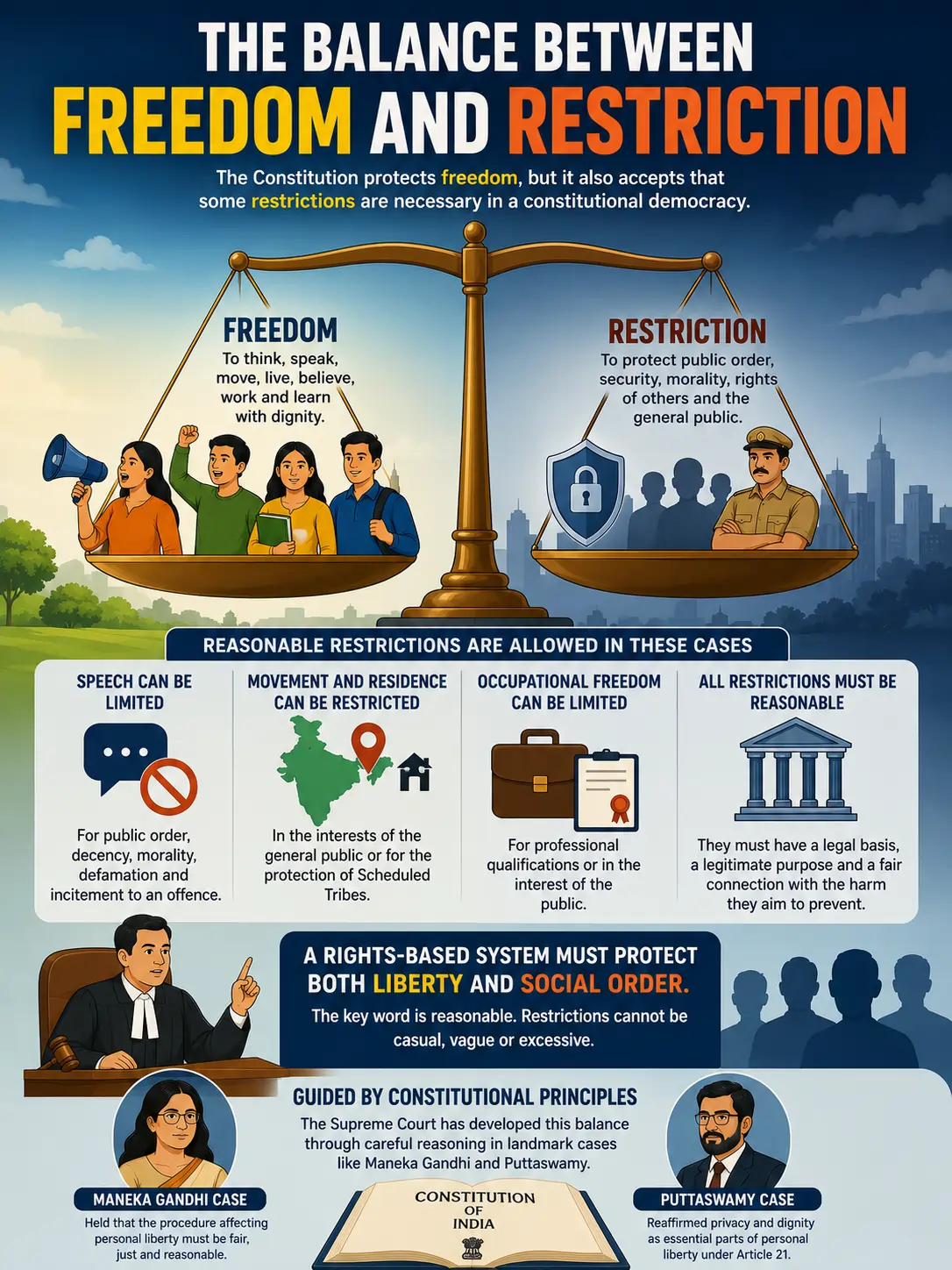
A serious misunderstanding about Fundamental Rights is the belief that they are unlimited. They are not. The Constitution protects freedom, but it also accepts that some restrictions are necessary in a constitutional democracy. For example, speech can be limited for reasons like public order, decency, morality, defamation, and incitement to an offence. Movement and residence can also face reasonable restrictions in the interests of the general public or the protection of Scheduled Tribes. Occupational freedom can be restricted for professional qualifications or public interest.
This balance is important because a rights-based system must protect both liberty and social order. But the key word is reasonable. Restrictions cannot be casual, vague, or excessive. They need a proper legal basis, a legitimate purpose, and a fair connection between the law and the harm it is trying to prevent. That is exactly the kind of reasoning the courts have developed in cases like Maneka Gandhi and Puttaswamy.
Why Dignity Is at the Center of Freedom
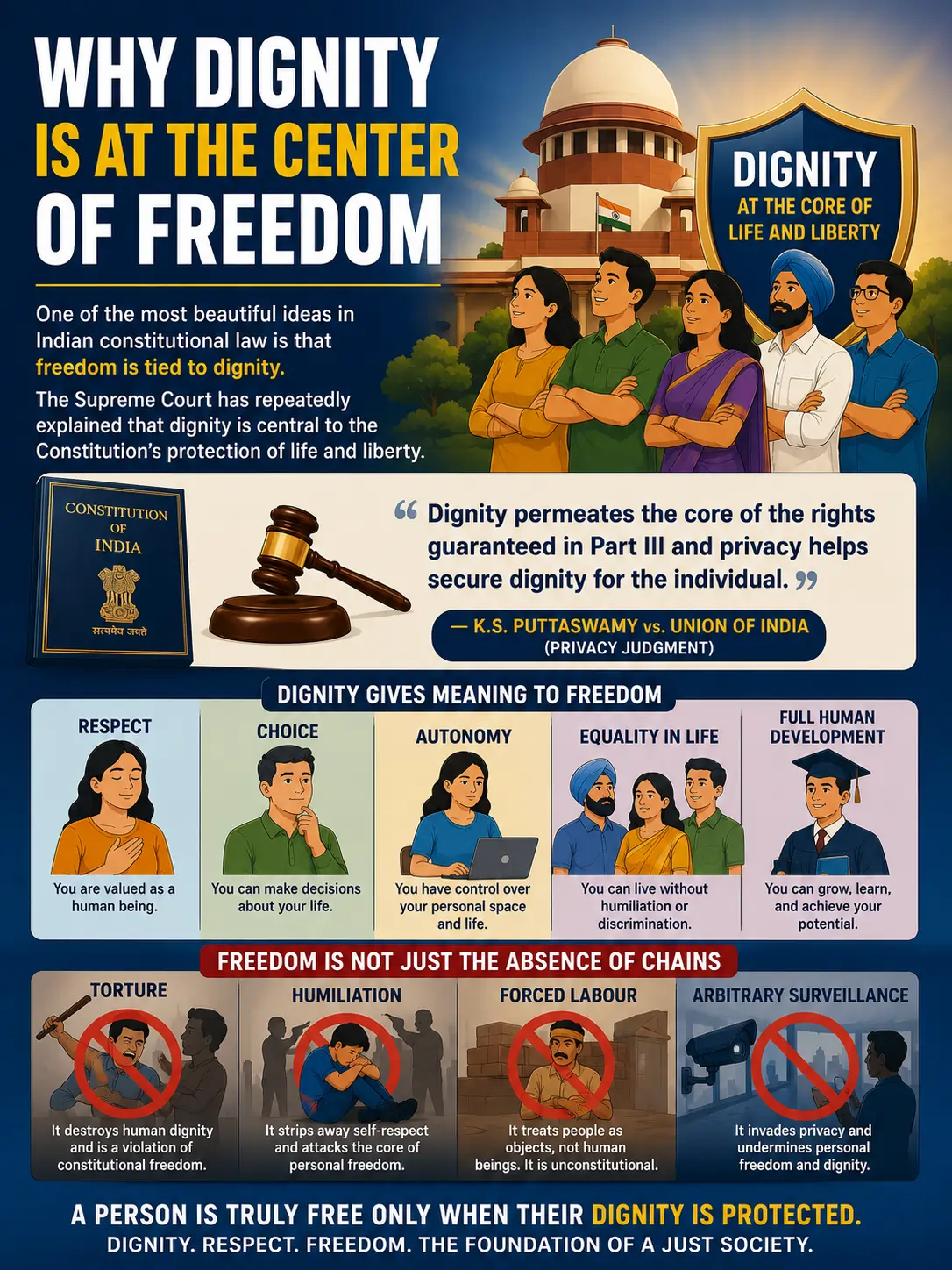
One of the most beautiful ideas in Indian constitutional law is that freedom is tied to dignity. The Supreme Court has repeatedly explained that dignity is central to the Constitution’s protection of life and liberty. In the privacy judgment, the Court observed that dignity permeates the core of the rights guaranteed in Part III and that privacy helps secure dignity for the individual.
That idea changes the way we think about rights. It means a person is not free simply because they are unchained. They are free only when they can live as a full human being, with respect, choice, and control over their life. That is why torture, humiliation, forced labour, and arbitrary surveillance are not just bad practices. They are attacks on constitutional freedom itself.
How Fundamental Rights Work in Everyday Life
Here are some common situations where these rights matter in a very practical way:
- A student writes a sharp opinion about public policy. Article 19(1)(a) protects speech, while the restrictions on speech explain where the legal limits begin.
- A worker joins a union to improve conditions at the workplace. Article 19(1)(c) protects the right to form associations and unions.
- A family moves to another state for better work. Article 19(1)(d) and 19(1)(e) protect movement and residence.
- A person is arrested and wants to know why. Article 22 requires that the grounds of arrest be communicated and that the person can consult a legal practitioner of choice.
- A child from a poor household gets access to schooling. Article 21A makes free and compulsory education a constitutional duty of the State.
- A religious group manages its own affairs. Article 25 and Article 26 protect freedom of conscience and religious administration, subject to public order, morality, health, and other constitutional provisions.
- A linguistic minority wants to preserve its culture and run an educational institution. Articles 29 and 30 protect those cultural and educational rights.
- A person believes a law or action has violated a Fundamental Right. Article 32 gives a direct route to the Supreme Court for enforcement.
These examples show something important. Fundamental Rights are not abstract symbols. They are daily protections that shape how people speak, study, worship, work, and survive.
How the Courts Keep Freedom Alive
A constitution needs a court system that is willing to enforce it. The Indian system gives that role to the independent judiciary. The Supreme Court’s own explanation of the Constitution says that the Constitution binds the legislative, executive, and judicial organs of government, and that the judiciary can invalidate laws or actions that violate it. That is a huge part of why Fundamental Rights are more than promises.
The courts have also widened the meaning of liberty over time. Maneka Gandhi connected liberty with fairness. Puttaswamy connected liberty with privacy. Kesavananda Bharati protected the Constitution itself from destruction by ordinary amendment. Together, these cases show a constitutional culture that does not treat freedom as fragile or optional. It treats it as a living principle.

Why This Matters for a Free Society
A society becomes freer when power is limited, when citizens are equal before the law, when speech is not crushed by fear, when people can move and work without arbitrary barriers, and when courts stand ready to enforce rights. That is the deeper meaning of India’s Fundamental Rights. They create a framework where freedom is not left to chance, mood, or political convenience.
The Constitution also reminds us that freedom is not a single right. It is a cluster of protections that support one another. Speech supports democracy. Equality supports dignity. Liberty supports personal choice. Religion supports conscience. Education supports participation. Remedies support everything else. When one part weakens, the rest become harder to defend.
A Final Thought
The real beauty of India’s Fundamental Rights is that they are both protective and aspirational. They protect people from unfair power, but they also point toward a better social order, one where dignity, equality, and freedom are not unusual gifts but normal expectations. That is why these rights still matter so much. They are not just legal provisions. They are the constitutional language of individual freedom.
If a constitution is a nation’s promise to itself, then India’s Fundamental Rights are among its most important promises. They tell every person that they are not invisible, not powerless, and not outside the protection of law. They tell every person that freedom is real, and that the Constitution is there to defend it.
Article References and Sources
- The Constitution of India (Official Constitutional Text)
- Part III – Fundamental Rights (Articles 12–35)
- Supreme Court of India – Constitution Overview
- Supreme Court of India – Jurisdiction and Powers
- Fundamental Rights Under Part III of the Constitution
- Fundamental Rights and Constitutional Liberties
- Fundamental Rights: Constitutional Perspective
- Supreme Court of India (Official Website)
- Article 124: Establishment and Constitution of the Supreme Court
- Article 131: Original Jurisdiction of the Supreme Court
- Fundamental Rights in the Indian Constitution
- Official PDF on Part III – Fundamental Rights
Also, Read These Articles in Detail
- Fundamental Rights in India
- What Are Fundamental Rights Under the Indian Constitution?
- History of Fundamental Rights in India
- Why Fundamental Rights Are Important for Every Indian Citizen
- Understanding Part III of the Indian Constitution
- Who Can Claim Fundamental Rights in India?
- Legal Rights vs Fundamental Rights
Frequently Asked Questions
FAQ 1: What are Fundamental Rights in India, and why do they matter so much?
Fundamental Rights are the basic freedoms and protections guaranteed by the Constitution of India. They are found mainly in Part III, from Articles 12 to 35. These rights matter because they protect the individual from unfair treatment by the State and help people live with freedom, dignity, and equality. Without them, a person could be silenced, discriminated against, or treated as less important simply because of their background, opinion, religion, or social position.
These rights are not just legal words on paper. They shape everyday life. A person can speak freely, move across the country, choose a job, practice a religion, and challenge unfair State action because the Constitution protects those choices. That is why Fundamental Rights are often called the backbone of Indian democracy. They make sure that power does not sit only with the government. Power is balanced by law, and law is made to serve people, not control them.
Another important point is that these rights protect not only citizens in some cases, but all persons in India in several situations. That includes the right to equality before law, protection of life and personal liberty, and protection against exploitation. So the idea is bigger than citizenship alone. It is about human freedom itself.
In simple language, Fundamental Rights matter because they tell every person, “You are not helpless. You have legal protection.” That single idea is what gives these rights their deep value. They help a democracy stay humane, fair, and accountable.
FAQ 2: How does the Right to Equality protect individual freedom in India?
The Right to Equality is one of the strongest protections for personal freedom because freedom means very little if people are treated differently just because of who they are. This right is found in Articles 14 to 18. It includes equality before the law, equal protection of the laws, non-discrimination, equal opportunity in public employment, the abolition of untouchability, and the abolition of titles.
This right protects individual freedom by stopping the State from creating unfair social divisions. For example, no one can be denied legal protection simply because of caste, religion, sex, race, or place of birth. That means the law must treat people as equals. Not as favorites. Not as outsiders. Not as second-class human beings.
Equality also gives freedom a practical meaning. If one person can get a government job only because of family influence while another equally qualified person is blocked because of identity, then freedom is not real. Equality helps remove that kind of injustice. It creates the conditions in which people can compete, live, and grow on fair terms.
The abolition of untouchability is especially important. It is not only a social reform. It is a constitutional rejection of humiliation. It tells society that no person should be denied dignity because of birth. That is a powerful freedom principle, because dignity and liberty go together.
So the Right to Equality protects freedom by making sure that people are not trapped by discrimination. It gives everyone a fair legal starting point. And once that starting point is fair, personal freedom becomes much more meaningful.
FAQ 3: How does Article 19 protect freedom of speech and expression in India?
Article 19(1)(a) gives citizens the freedom of speech and expression, which is one of the most important rights in a democracy. It allows people to say what they think, write what they believe, publish ideas, criticize public policy, and share opinions without fear of automatic State punishment. This right is the foundation of public debate. And public debate is the heart of democratic life.
This freedom matters because people cannot participate in democracy if they are afraid to speak. Citizens need space to question leaders, support causes, argue about laws, and express disagreement. A quiet public is not always a free public. Sometimes silence comes from fear. Article 19 helps protect people from that fear.
The right is not unlimited, though. The Constitution allows reasonable restrictions for reasons such as public order, security of the State, decency, morality, defamation, and incitement to an offence. That balance is important. Freedom of speech is strong, but it is not a license to cause direct harm without consequence. The law tries to keep the space open for free ideas while also protecting society from serious abuse.
In everyday life, Article 19 protects journalists, students, writers, activists, artists, and ordinary people who want to share views. It also protects criticism of the government, which is vital in any healthy democracy. If people cannot criticize authority, then power grows without check. And unchecked power is one of the biggest threats to freedom.
So Article 19 does more than protect speech. It protects the public voice of the nation. It makes it possible for people to speak, question, disagree, and take part in shaping society.
FAQ 4: What is the importance of Article 21 in protecting life and personal liberty?
Article 21 is one of the most powerful rights in the Indian Constitution. It says that no person shall be deprived of life or personal liberty except according to procedure established by law. At first glance, the words may look simple. But the meaning behind them is very deep.
This right protects a person from arbitrary State action. It means the government cannot take away liberty just because it wants to. There must be a lawful process, and that process must be fair. Over time, the courts have given Article 21 a wide and humane interpretation. It now covers not only physical survival, but also dignity, privacy, fair procedure, and a meaningful life.
That is why Article 21 is often described as the core of personal freedom. A person may have speech rights, equality rights, and religious rights, but if they can be detained unfairly, harassed without reason, or treated without dignity, those rights lose much of their strength. Article 21 protects the basic safety net beneath all the other freedoms.
The courts have also used Article 21 to recognize new dimensions of liberty, including the idea that life must be lived with dignity and not just biological existence. This is important because human beings are not machines. People need safety, respect, and autonomy. A constitutional right to life should reflect that reality.
In practical terms, Article 21 helps people challenge illegal detention, unfair punishment, oppressive procedures, and other forms of unjust State power. It stands as a strong reminder that the government serves the person, not the other way around.
FAQ 5: How does the Constitution protect people from unlawful arrest and detention?
The Constitution gives important safeguards through Article 22, especially for people who are arrested or detained. These protections are designed to prevent the State from using arrest as a tool of fear or oppression. They help preserve personal liberty, which is one of the most precious freedoms in a democratic society.
Under these safeguards, a person must generally be informed of the grounds of arrest as soon as possible. They also have the right to consult and be defended by a legal practitioner of their choice. In certain cases, a person must be produced before a magistrate within a specified time. These are not small technical rules. They are serious constitutional protections.
Why do they matter so much? Because arrest changes a person’s life immediately. It affects reputation, family, work, health, and mental peace. Without legal safeguards, someone could be locked away without explanation, and that would destroy freedom very quickly. The Constitution tries to stop that from happening.
These protections also create accountability. When authorities know that their actions can be checked in court, they are more likely to follow the law carefully. That is how constitutional freedom works in practice. It is not only about rights on paper. It is about procedures that force public power to behave responsibly.
So the protection against unlawful arrest is one of the clearest examples of how Fundamental Rights defend individual freedom. They make sure that the State cannot take away liberty casually or secretly.
FAQ 6: Why is the Right to Privacy considered an important part of individual freedom?
The Right to Privacy is now understood as a key part of constitutional freedom in India. The Supreme Court recognized privacy as a fundamental constitutional protection, closely linked with Article 21 and the broader values of dignity and liberty. This was a major step because it acknowledged something very simple and very human. People need private space to live freely.
Privacy protects personal life from unnecessary intrusion. It covers things like personal information, intimate choices, family life, communication, and inner belief. Without privacy, a person may feel watched, controlled, or exposed all the time. That kind of condition is not real freedom. It may look orderly from the outside, but inside it can feel suffocating.
Privacy matters because freedom is not only about public action. It is also about private choice. People need room to think, choose, fail, recover, and grow without constant interference. A free society does not try to inspect every detail of a person’s life. It gives lawful boundaries to public authority.
This right also matters in the modern world, where data, technology, and surveillance can easily cross personal limits. Personal information can be collected, stored, shared, or misused very quickly. Privacy gives the Constitution a way to respond to these modern risks. It helps ensure that technology serves people, not the other way around.
So the Right to Privacy protects individual freedom by preserving personal space, personal choice, and personal dignity. It gives each person the ability to remain a human being, not just a public object of control.
FAQ 7: How do Fundamental Rights protect freedom of religion in India?
The Constitution protects religious freedom through Articles 25 to 28. These rights guarantee freedom of conscience and the right to freely profess, practice, and propagate religion, subject to certain constitutional limits like public order, morality, health, and other fundamental rights.
This protection is important because religion is deeply connected to identity, belief, and personal conscience. A person should not be forced to believe something, worship in a certain way, or abandon their faith because of pressure from the State. Religious freedom protects inner conviction, and inner conviction is one of the most personal forms of liberty.
The Constitution also allows religious communities to manage their own affairs in matters of religion. That matters because freedom is not only individual. It can also be collective. Communities have a right to preserve their religious institutions and practices within constitutional limits. At the same time, the State can regulate non-religious activities linked to religion where necessary, especially when public order or reform is involved.
This balance is carefully designed. The goal is not to make religion weak. The goal is to make sure that religion and freedom can exist together without one destroying the other. That is a very Indian constitutional idea. It recognizes diversity and tries to protect it without letting any form of belief become a tool of coercion.
So religious freedom under the Constitution protects both conscience and community. It gives people the space to believe, worship, and live according to faith while remaining within a shared legal order.
FAQ 8: What do Cultural and Educational Rights add to personal freedom?
Articles 29 and 30 protect cultural and educational rights, especially for minorities and communities that want to preserve their language, script, culture, and educational institutions. These rights are extremely important because freedom is not only about the individual in isolation. It is also about the life of communities.
A person often grows through language, family culture, and education. If a community loses its right to preserve its identity, then its members may lose an important part of their freedom too. That is why the Constitution protects cultural diversity. It understands that freedom is richer when different communities can live without being forced into one uniform mold.
Article 29 protects the right of any section of citizens to conserve its language, script, or culture. Article 30 gives minorities the right to establish and administer educational institutions of their choice. This is a powerful protection because education shapes the future of a community. If a group can educate its children in a way that reflects its identity and values, then it can preserve itself while participating fully in national life.
These rights also protect against cultural domination. A strong society does not erase differences. It respects them. And a free society does not make people feel ashamed of their roots. It gives them room to carry their identity with confidence.
So cultural and educational rights support individual freedom by protecting the community spaces where identity, memory, and learning survive. They help people remain themselves while still being part of the larger nation.
FAQ 9: How does Article 32 make Fundamental Rights meaningful in real life?
Article 32 is often called the heart and soul of the Constitution because it gives people the right to move the Supreme Court for the enforcement of Fundamental Rights. This is the clause that turns promises into action. Without a remedy, even the best rights can become weak. Article 32 fixes that problem.
The importance of this article is simple. If a right is violated, a person should not be left helpless. They should have a direct constitutional path to challenge the violation. Article 32 gives that path. It allows the Supreme Court to issue powerful writs like habeas corpus, mandamus, prohibition, quo warranto, and certiorari.
This makes Fundamental Rights enforceable, not symbolic. For example, if someone is illegally detained, a court can be asked to secure their release. If a public authority refuses to do its duty, the court can compel action. If a law or order goes beyond legal power, the court can step in. That is how constitutional freedom becomes practical freedom.
Article 32 also shows that the Constitution trusts individuals enough to give them direct standing before the highest court for rights enforcement. That is a huge democratic idea. It means the common person is not powerless. They can go to the Constitution itself and ask for protection.
So Article 32 is the enforcement arm of freedom. It keeps the rest of the rights alive, because a right without a remedy is only half a right.
FAQ 10: In the end, how do Fundamental Rights protect individual freedom in India as a whole?
Fundamental Rights protect individual freedom in India by creating a complete constitutional shield around the person. They protect equality, speech, movement, religion, privacy, education, dignity, and the right to challenge unfair State action. Taken together, they form a system that keeps public power within legal limits and keeps the individual from being reduced to silence or obedience.
This matters because freedom is never one single thing. It is a whole structure of protection. A person needs the freedom to think, speak, move, worship, work, learn, and live without discrimination. They also need a legal method to defend those freedoms when they are threatened. The Indian Constitution gives both the rights and the remedy.
The most important thing to notice is that Fundamental Rights do not treat freedom as a gift from the government. They treat it as a constitutional entitlement. That is a powerful idea. It means the State must respect the person, not command them without limit. It also means the courts can step in when freedom is wrongly denied.
In daily life, this legal structure creates space for confidence. People can speak up, plan their future, and participate in society because the Constitution stands behind them. That is why Fundamental Rights are so central to Indian democracy. They do not just protect individual freedom. They define what freedom means in the Indian constitutional order.
And that is the real strength of these rights. They make sure that every person can live as a free human being, not as a subject waiting for permission.
FAQ 11: What is the difference between Fundamental Rights and ordinary legal rights in India?
Fundamental Rights are special rights written directly into the Constitution of India. They are not ordinary rules made by a simple law passed in Parliament. They sit higher in the legal structure and protect basic human freedom, equality, dignity, and liberty. Ordinary legal rights, on the other hand, usually come from regular laws, rules, contracts, or government policies. They can be changed more easily, and they do not always carry the same constitutional protection.
This difference matters a lot. A regular legal right may help you in a particular situation, like employment, transport, or tenancy. But a Fundamental Right protects something deeper. It protects the conditions that make all other rights meaningful. For example, the Right to Equality ensures that people are not treated unfairly because of identity. The Right to Freedom protects speech, movement, and personal choice. The Right to Life and Personal Liberty protects a person from arbitrary State action. These are not small legal benefits. They are the basic tools of free life.
Another major difference is enforcement. If a regular right is violated, the remedy may depend on the law that created it. But if a Fundamental Right is violated, a person can directly approach the Supreme Court under Article 32 or use other constitutional and legal remedies. That makes the right much stronger in practice. The Constitution itself stands behind it.
And that is why Fundamental Rights are often seen as the most important protections in Indian democracy. They do not simply help a person in one case. They shape the whole relationship between the citizen and the State. They make sure that public power remains limited, lawful, and answerable.
In simple words, ordinary legal rights help people live within society, but Fundamental Rights protect the deeper freedom that makes a just society possible.
FAQ 12: Why is Article 19 considered one of the strongest protections for individual freedom?
Article 19 is one of the strongest protections in the Constitution because it covers several freedoms that people use every single day. These include freedom of speech and expression, peaceful assembly, association, movement, residence, and profession or occupation. Put together, these rights give a person the ability to think, speak, organize, travel, settle, and earn a living with a large degree of freedom.
This article is powerful because it protects both the private and public sides of life. A person may want to write an opinion, join a group, attend a protest, move to another state for work, or start a business. Article 19 protects all of these things, subject to reasonable limits. That makes it one of the most practical parts of the Constitution.
Its importance also comes from the role it plays in democracy. A democratic country needs people who can speak freely, criticize authority, form groups, and debate public issues. If those freedoms are weak, democracy becomes shallow. Elections may still happen, but public life becomes controlled and timid. Article 19 helps prevent that. It keeps the public space open.
At the same time, the Constitution does not make these rights absolute. It allows reasonable restrictions in the interests of public order, security of the State, morality, decency, defamation, and other listed grounds. This balance is important. A free society cannot survive if speech is completely uncontrolled, but it also cannot survive if speech is too tightly crushed. The Constitution tries to walk the middle path.
So Article 19 is strong because it protects the freedom to live openly, participate fully, and make choices without unnecessary interference. It gives democracy its voice and movement.
FAQ 13: How does the Right to Life under Article 21 protect dignity and human freedom?
Article 21 protects life and personal liberty, and over time it has become one of the broadest and most humane parts of the Constitution. At first, the words seem simple. But the meaning is much wider. The courts have treated Article 21 as a protection not just for physical survival, but also for dignity, fairness, privacy, and a meaningful human existence.
This is extremely important because a person can be alive but still not free. If a person is humiliated, detained unfairly, denied basic procedure, or treated like they have no worth, then life exists in a narrow sense but not in a constitutional sense. Article 21 tries to stop that. It insists that life must be lived with respect and liberty.
The idea of dignity is especially important here. Dignity means that every person has value simply because they are human. They do not need wealth, power, or status to deserve constitutional protection. Article 21 supports that idea by placing legal limits on how the State can act. It tells the government that it cannot be arbitrary, cruel, or unfair when dealing with people.
The courts have also expanded the understanding of this article in important decisions. They have linked it to fair procedure and to the idea that liberty cannot be taken away casually. That is why Article 21 is seen as a living right. It grows with society, but it always stays focused on the same goal, which is protecting the human being from unjust power.
So Article 21 protects freedom by making life itself a matter of constitutional concern. It says that freedom is not only about surviving. It is about living with dignity, safety, and lawful protection.
FAQ 14: How does the Constitution protect people from discrimination and social injustice?
The Constitution protects people from discrimination mainly through the Right to Equality, especially Articles 14 to 18. These provisions are meant to make sure that the law treats people fairly and that society does not use identity as a reason to deny respect, opportunity, or legal protection. This is one of the most important ways the Constitution protects freedom, because freedom becomes weak when some groups are pushed down, and others are placed above them.
Article 14 gives equality before the law and equal protection of the laws. That means the legal system must not create unfair privilege or unnecessary exclusion. Article 15 prevents discrimination on grounds such as religion, race, caste, sex, or place of birth. Article 16 protects equal opportunity in public employment. Article 17 abolishes untouchability, and Article 18 abolishes titles. Each of these provisions attacks a different form of inequality.
This matters in daily life because discrimination is not only a moral problem. It is also a direct threat to freedom. If a person is denied access to education, work, public services, or legal dignity because of who they are, then their freedom is not real. They may exist in law, but they do not fully exist as equal participants in society.
The Constitution therefore does more than say “be fair.” It actually gives legal tools to make fairness real. That includes a duty on the State to avoid discrimination and a broader constitutional culture that supports social justice. It is a powerful reminder that a free society cannot be built on humiliation.
So the Constitution protects against discrimination by making equality a legal command, not just a social wish.
FAQ 15: Why are the rights against exploitation so important in India?
The Right against Exploitation, found in Articles 23 and 24, protects people from being used, abused, or trapped in harmful labour conditions. These rights are very important because freedom loses all meaning if a person is forced to work, trafficked, or treated like a disposable object. A truly free society cannot tolerate exploitation, especially when it targets the poor, the vulnerable, or children.
Article 23 bans traffic in human beings, begar, and other forms of forced labour. This is crucial because exploitation often hides behind poverty, desperation, or power imbalance. A person may appear to be “working,” but if they have no genuine choice, then the work is not free. The Constitution recognizes that and forbids it.
Article 24 prohibits the employment of children below a certain age in factories, mines, or other hazardous occupations. This protects children from dangerous labor and gives them room to grow, learn, and live normally. Childhood should be a time for development, not harm. That idea is deeply tied to freedom, because a child forced into dangerous work loses opportunities that can never fully be recovered.
These rights also reflect the moral side of the Constitution. The law does not simply care about contracts or productivity. It cares about whether people are being treated as human beings. That is the deeper point. A person should never become a tool for another person’s profit or convenience.
So the Right against Exploitation protects freedom by defending the weakest members of society from coercion, abuse, and inhuman treatment. It makes liberty more honest and more humane.
FAQ 16: How do cultural and educational rights protect minority freedom in India?
Cultural and Educational Rights, mainly under Articles 29 and 30, are important because they protect the freedom of communities to preserve their identity, language, culture, and educational institutions. This is a very special part of the Constitution because it recognizes that freedom is not just individual. It also belongs to groups and communities that want to remain themselves.
Article 29 protects the right of any section of citizens to conserve its language, script, or culture. That means people do not have to give up their heritage to belong to the nation. Article 30 gives minorities the right to establish and administer educational institutions of their choice. This is important because education shapes identity, leadership, and the future of a community.
These rights matter because a person usually grows up inside a cultural world. Language, customs, history, and shared memory all influence personal identity. If those things are erased, then people can feel cut off from themselves. The Constitution tries to prevent that. It wants a country that is united, but not uniform in a harmful way.
There is also a practical side. Minority communities often worry about losing control over education or culture in larger social systems. These rights help balance that concern. They allow minorities to participate in national life without being absorbed or erased. That is a very important freedom principle.
So cultural and educational rights protect freedom by making room for difference. They tell communities that they do not need to disappear in order to belong.
FAQ 17: What is the role of the Supreme Court in protecting Fundamental Rights?
The Supreme Court of India plays a central role in protecting Fundamental Rights because it is the highest constitutional guardian of those rights. The Constitution gives people the right to move the Supreme Court under Article 32 when their Fundamental Rights are violated. That makes the Court not just a place of appeal, but a direct protector of liberty.
This role is important because rights are only useful if they can be enforced. If someone’s freedom of speech is blocked, if they are detained unfairly, if they face discrimination, or if a public authority acts illegally, the Court can step in. It can issue writs and orders to correct the wrong. That is how constitutional rights become practical rights.
The Court also helps interpret the meaning of rights. Over time, it has explained that Article 21 includes dignity, fair procedure, and privacy. It has also protected the broader constitutional structure from being damaged by excessive change. In that sense, the Court does more than react to individual cases. It shapes the living meaning of freedom in India.
This is especially valuable in a democracy. Governments change. Public opinion changes. But the Court provides continuity. It reminds everyone that power has limits and that individual rights are not optional.
So the Supreme Court protects Fundamental Rights by enforcing them, interpreting them, and keeping them alive in real life. It acts as the constitutional safety net for freedom.
FAQ 18: Why is the idea of reasonable restriction important in a free country?
The idea of reasonable restriction is important because freedom and order must exist together in a constitutional democracy. The Constitution does not treat freedom as an unlimited license to do anything at any time. It recognizes that society needs rules to protect public order, security, morality, health, and the rights of others. But these limits must be reasonable, not excessive or arbitrary.
This is especially clear in Article 19. The Constitution protects speech, assembly, association, movement, residence, and profession, but it also allows restrictions on specific grounds. The purpose is to keep freedom alive while preventing genuine harm. That balance is one of the hardest tasks in constitutional law.
Why not make rights absolute? Because absolute freedom in a crowded society can easily become harmful to others. At the same time, if restrictions are too broad, the right itself becomes meaningless. So the idea of reasonableness acts like a constitutional filter. It asks whether the restriction has a lawful purpose, whether it is connected to that purpose, and whether it goes too far.
This matters a great deal for individual freedom. A reasonable restriction protects people from chaos, but it also protects them from overreach by the State. It keeps power within legal limits. That is the real beauty of the concept. It is not about weakening rights. It is about preserving them in a balanced form.
So reasonable restrictions matter because it helps a democracy remain both free and orderly at the same time.
FAQ 19: How do Fundamental Rights support democracy in India?
Fundamental Rights support democracy by making sure that people can think, speak, organize, vote meaningfully, and live without fear of unfair treatment. A democracy is not only about elections. It is also about the conditions that make participation honest and meaningful. That is where Fundamental Rights come in.
For example, freedom of speech and expression allows public debate. Freedom of assembly allows peaceful protests and collective action. Freedom of association allows unions, groups, and civic organizations. Equality before law ensures that no section of society is treated as less worthy. Article 21 protects life and liberty, while Article 32 gives people a direct route to the Supreme Court when rights are violated.
Together, these protections keep democracy healthy. They make it possible for people to question leaders, criticize policy, defend minority views, and demand justice. Without these rights, democracy can slowly become empty. People may still cast votes, but they will not have genuine freedom in public life.
Fundamental Rights also create trust. When people know that the Constitution protects them, they are more willing to take part in public life. They can speak without constant fear, and they can challenge injustice through lawful means. That is how democracy becomes stable and respectful.
So Fundamental Rights are not separate from democracy. They are the oxygen that democracy breathes. Without them, democratic life becomes weak and uncertain.
FAQ 20: In one simple idea, why are Fundamental Rights essential for individual freedom in India?
Fundamental Rights are essential because they make sure that a person is not left at the mercy of power. They protect the basic space every human being needs to live with dignity, equality, liberty, and security. That is the simplest way to understand them.
If a person can speak freely, move freely, choose a profession, practice a religion, keep personal privacy, receive education, and challenge unlawful State action, then they can live as a free individual. If those things are denied, then freedom shrinks very quickly. The Constitution knows this. That is why it gives such strong protection to these rights.
Fundamental Rights also matter because they are enforceable. They are not only ideals or dreams. A person can go to court and ask for help. That is a huge difference. It means the Constitution is not speaking into the air. It is speaking to real people with real problems.
And beyond the legal side, these rights give a moral message. They say that every person matters. Every person deserves respect. Every person has a place in the constitutional order. That message is what makes Indian democracy humane.
So the simplest answer is this. Fundamental Rights are the legal foundation of individual freedom in India. They protect the person, limit power, and make liberty real.
