

Article 14 is one of the most powerful and quietly important parts of the Indian Constitution. It looks short on paper, but it carries a deep idea. It says that the State shall not deny to any person equality before the law or the equal protection of the laws within the territory of India. That one sentence has shaped the way courts think about fairness, state power, discrimination, and the basic dignity of human beings. It is the backbone of the Right to Equality in Part III of the Constitution, and it sits beside Articles 15 to 18, which develop the same constitutional promise in more specific ways.
What makes Article 14 special is that it is not only about treating everyone exactly the same. It is also about stopping unfairness that hides behind laws, policies, and official action. Over time, the Supreme Court has read Article 14 as a living guarantee against arbitrariness, hostile discrimination, and irrational state action.
In plain language, it means the government cannot act like one rule is for one person and another rule is for another person without a good reason. That principle has been repeated in landmark cases such as E.P. Royappa and Maneka Gandhi, where the Court said that equality and arbitrariness cannot live together.
Table of Contents
The text of Article 14
The constitutional text is beautifully simple. Article 14 says, “The State shall not deny to any person equality before the law or the equal protection of the laws within the territory of India.” The words are broad on purpose. They use “any person”, not just citizens, and they apply within the territory of India, which gives the clause both reach and force. This wording is the starting point for everything that follows.
That simplicity can be misleading. The sentence has two distinct ideas inside it, and each one matters differently. The first is equality before law. The second is equal protection of the laws. These are not just repeated phrases. They point to two different sides of constitutional equality, one more negative and one more positive.
What “equality before law” really means
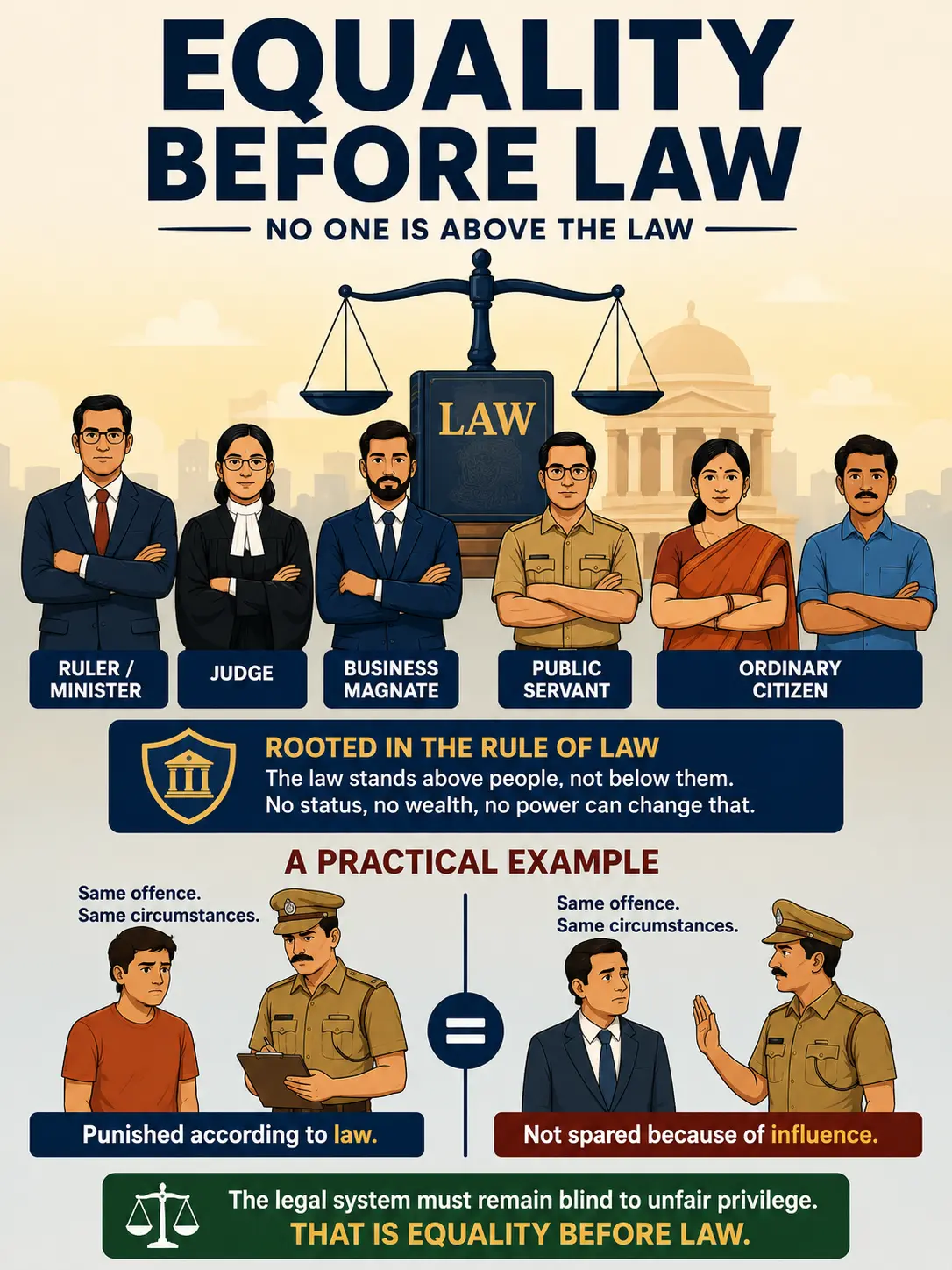
Equality before the law means that no one is above the law. A ruler, a minister, a judge, a business magnate, a public servant, and an ordinary person are all subject to the legal order. No one gets a private system of justice because of status, wealth, birth, gender, religion, or political power. In that sense, the idea is rooted in the rule of law. The law stands above people, not below them.
This is why equality before the law is often called a negative concept. It tells the State what it must not do. It must not create hidden privilege. It must not protect the powerful while punishing the weak. It must not treat the same conduct differently without lawful justification. The idea is simple enough, but its effect is huge. It pushes public power toward restraint and consistency.
A practical example makes this easier to see. If two people commit the same offence in the same circumstances, the law should not punish one harshly because of family status and let the other walk free because of influence. That would break the very idea of equality before the law. The constitutional promise is that the legal system must remain blind to unfair privilege.
What “equal protection of the laws” means
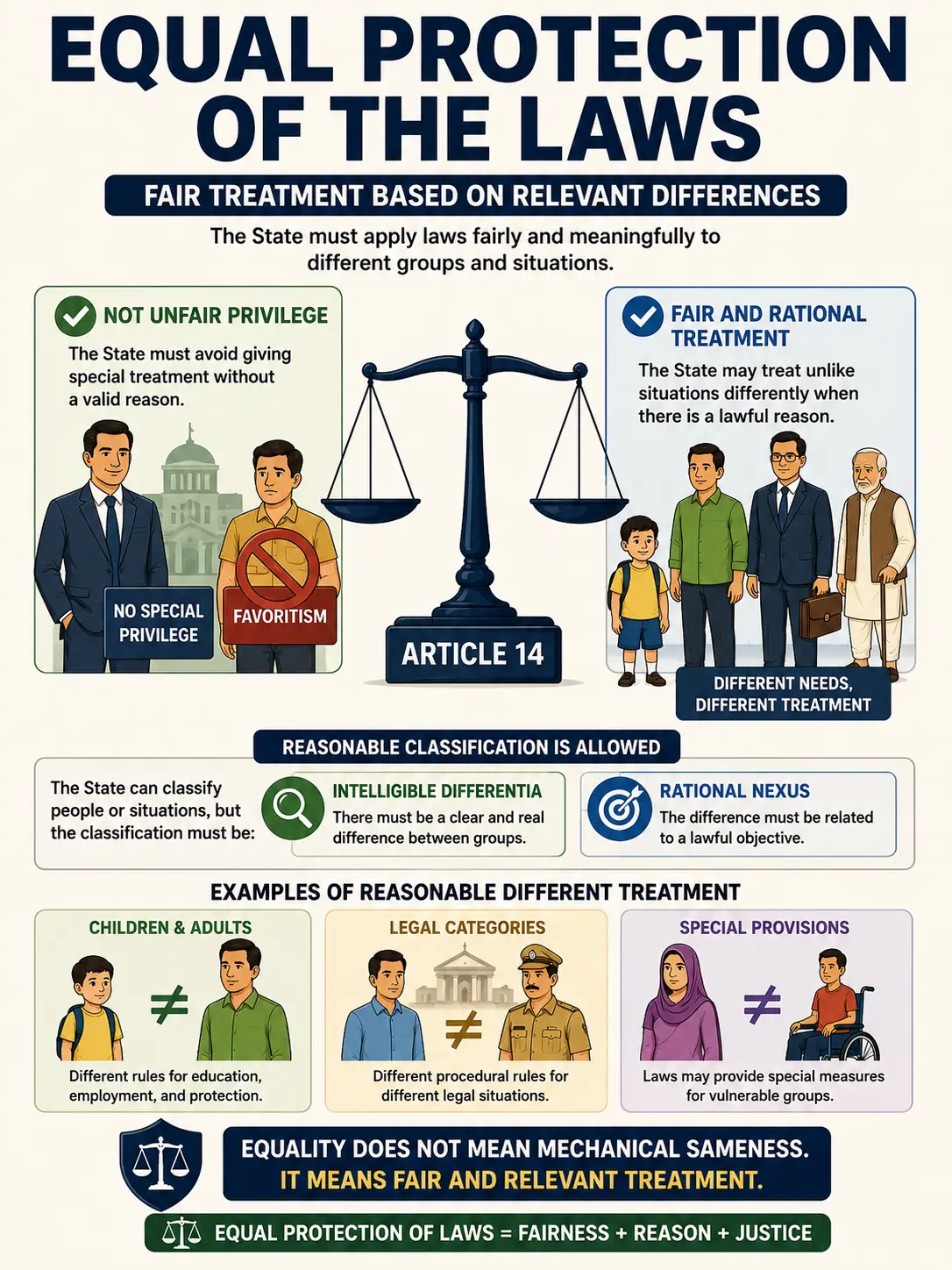
Equal protection of the laws goes a step further. It means that the State should not only avoid unfair privilege, it should also make sure that laws are applied fairly and meaningfully to different groups and situations. In practice, this allows the State to treat unlike situations differently when there is a lawful reason to do so. That is why courts have long accepted the idea of reasonable classification under Article 14.
This part of Article 14 is often seen as a positive concept. It does not always demand identical treatment. It demands fair treatment according to relevant differences. For example, children may be treated differently from adults, or people in different legal categories may be placed under different procedural rules, but only if the classification is rational and connected to a lawful objective.
That is why equal protection of laws is not the same as giving everyone the exact same legal response in every situation. Equality does not mean mechanical sameness. It means fair and rational treatment. Courts have said this again and again, because without that distinction, the State could not make any sensible law at all.
The real constitutional idea behind Article 14
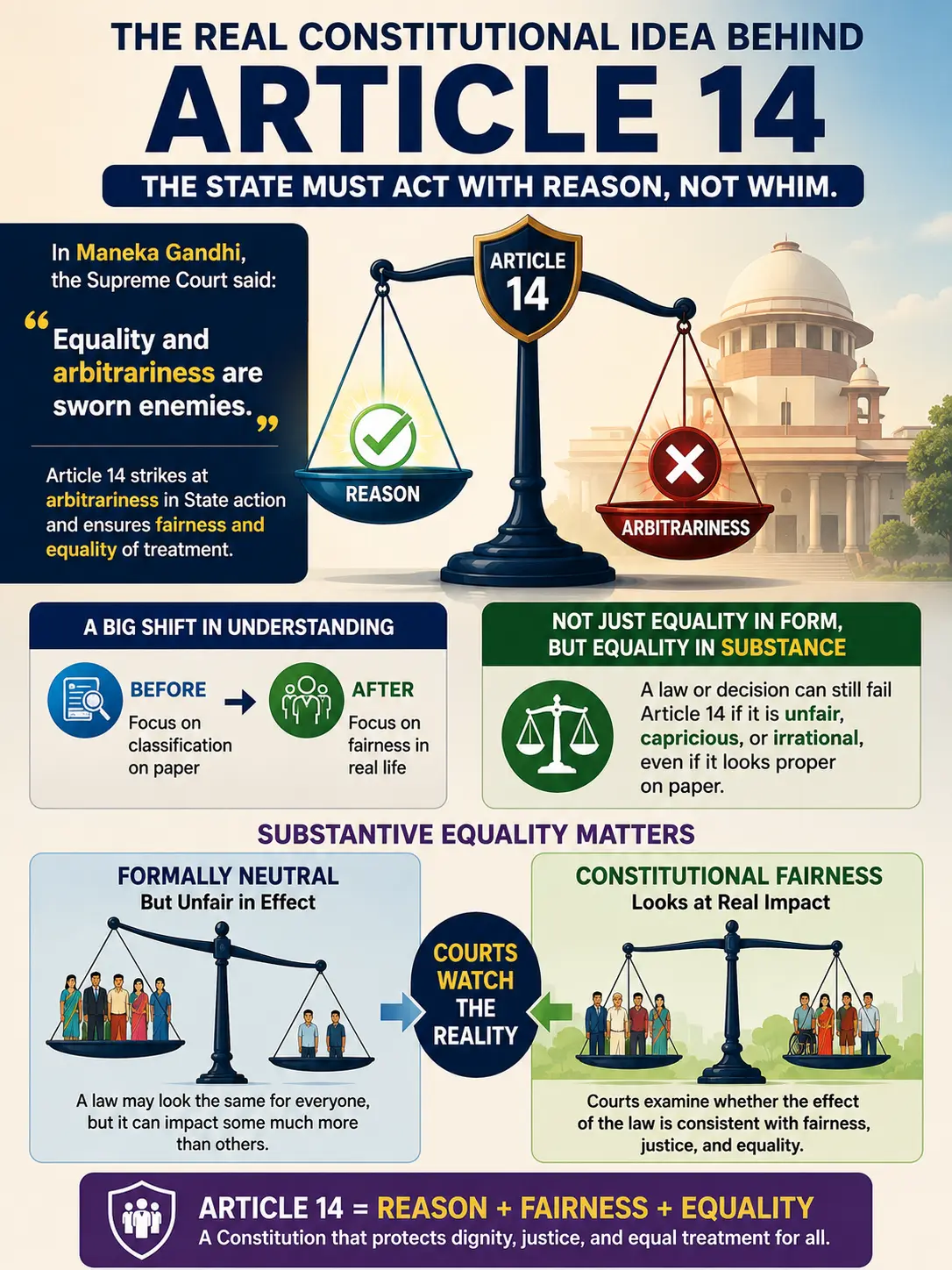
The deeper idea behind Article 14 is that the State must act with reason, not whim. That is why the Supreme Court’s language in Maneka Gandhi became so important. The Court said that “equality and arbitrariness are sworn enemies” and that Article 14 strikes at arbitrariness in State action and ensures fairness and equality of treatment. That statement changed the way constitutional equality is understood in India.
Before that, equality was often discussed mainly through the lens of classification. After that, the focus widened. A law or decision could still fail Article 14 even if it looked neatly classified on paper, if in reality it was unfair, capricious, or irrational. That is why lawyers and judges often say that Article 14 is not only about equality in form, but also equality in substance.
This move toward substantive equality matters a lot. It means the Constitution cares not only about whether a rule looks equal, but also about whether it works fairly in real life. A law can be formally neutral and still hit one group much harder than another. Courts watch for that. They ask whether the effect of the law is consistent with constitutional fairness.
Why Article 14 is so significant
The significance of Article 14 is hard to overstate. It is one of the first protections against oppressive government action. It protects people from discrimination, but it also protects them from hidden unfairness that may not use the language of discrimination at all. In that sense, it is both a shield and a standard. It shields people from injustice and gives courts a standard for checking state power.
It also supports trust in public institutions. When people believe that the law is applied unevenly, confidence in government drops quickly. Article 14 helps prevent that collapse by insisting on legality, consistency, and reason. The State may still make distinctions, but it must be able to explain them. That requirement is what turns power into public power rather than private favoritism.
In everyday life, the value of Article 14 shows up in many ordinary situations. It affects admissions, recruitment, taxation, licensing, policing, public benefits, penalties, access to justice, and welfare schemes. It is not only a courtroom idea. It is a governance idea. Whenever the State makes a choice that affects people differently, Article 14 is somewhere in the background asking whether the choice is fair, justified, and non-arbitrary.
The doctrine of reasonable classification
One of the most important tools under Article 14 is the doctrine of reasonable classification. The Supreme Court has long said that Article 14 forbids class legislation but does not forbid reasonable classification. That principle appears in classic decisions such as Anwar Ali Sarkar and Ram Krishna Dalmia.
The logic is straightforward. Not every law can apply to everyone in the same way at the same time. Society is too complex for that. So the law may separate people or situations into groups, but the grouping must be based on an intelligible differentia and must have a rational nexus with the object of the law. Those two requirements are the famous twin tests.
The first test asks whether the distinction is real and understandable. The second asks whether the distinction actually helps the law achieve its purpose. If the distinction is artificial, or if it does not connect to the object of the law, the classification fails. That is how courts separate genuine policy choice from disguised discrimination.
The twin tests of reasonable classification
| Test | What it asks | Why it matters | Simple example |
|---|---|---|---|
| Intelligible differentia | Is there a real and clear basis for separating one group from another? | Stops random or fake distinctions | A law treating minors differently from adults |
| Rational nexus | Does the distinction actually help achieve the law’s purpose? | Stops irrelevant or unfair classification | Speedier procedure for a special category of cases only when there is a real need for speed |
| No hostile discrimination | Is the law singling out a group without a fair reason? | Protects against targeted unfairness | A rule that burdens one group for no logical reason |
| Non-arbitrariness | Is the law based on reason instead of caprice? | Broadens equality beyond neat categories | A policy changed on whim without explanation |
The point of this doctrine is not to handcuff the State. It is to make sure the State does not hide discrimination inside administrative convenience. Courts give the legislature room to classify, but not room to act irrationally. That balance is one of the most delicate parts of constitutional law.
From formal equality to substantive equality
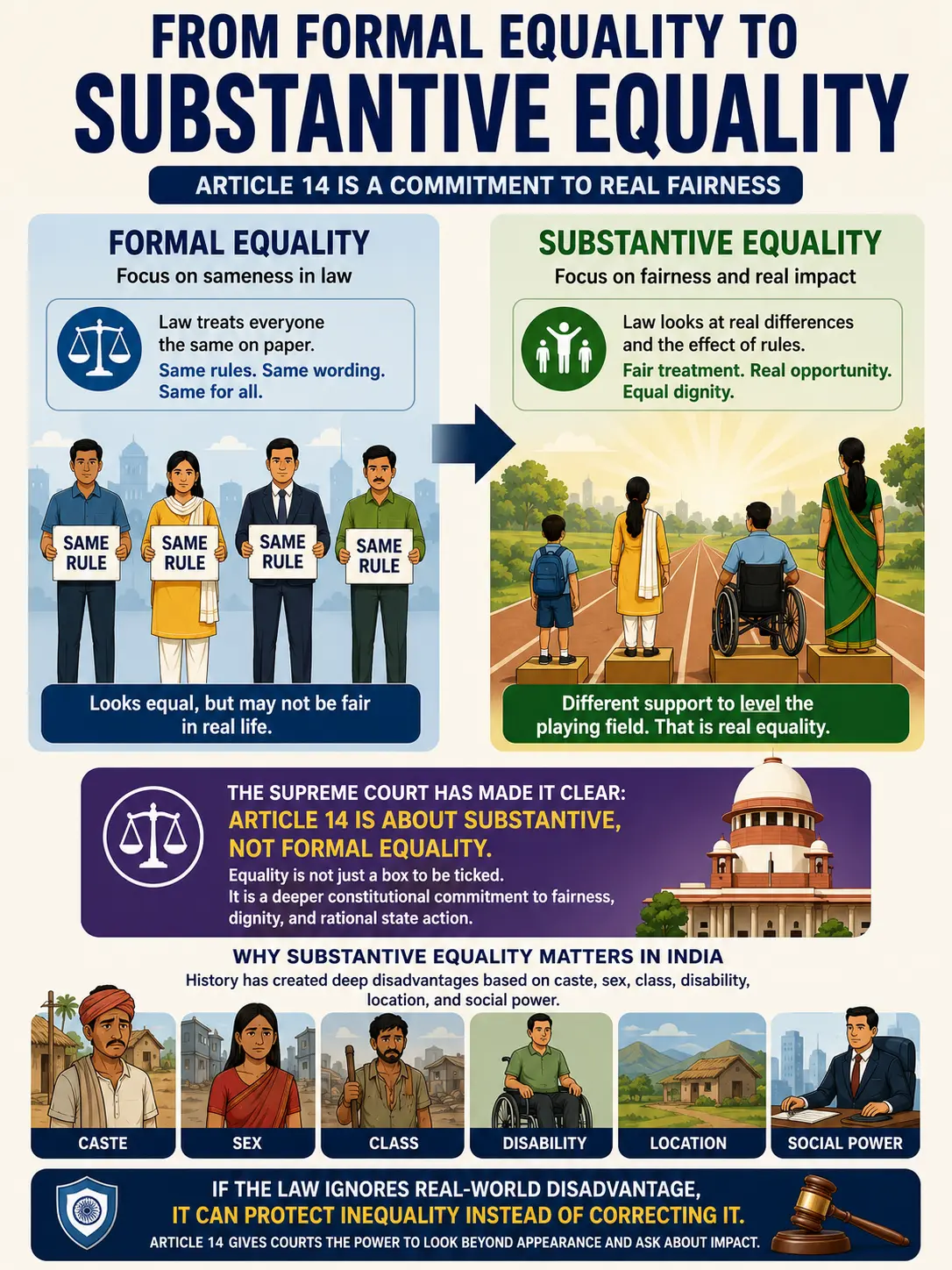
The old way of thinking about equality focused heavily on formal sameness. If the law said the same thing to everyone, it was often assumed to be equal. But that approach can miss real-world disadvantage. Substantive equality asks a harder question. Does the law actually produce fair treatment in context? Does it help or hurt equality in lived reality?
The Supreme Court has made clear in later decisions that Article 14 is about substantive and not formal equality. That means equality is not just a box to be ticked. It is a deeper constitutional commitment to fairness, dignity, and rational state action.
This matters especially in a country like India, where history has produced long lines of exclusion based on caste, sex, class, disability, location, and social power. If the law simply pretends everyone starts from the same place, it can end up protecting inequality instead of correcting it. Article 14 gives courts room to look beyond appearance and ask about impact.
Major landmark judgments that shaped Article 14
The meaning of Article 14 did not appear fully formed on day one. It was built case by case. The early cases established the idea of reasonable classification. Later cases expanded the protection against arbitrariness. Together, they created the modern equality doctrine.
Key cases and what they changed
| Case | Core idea | Why it matters |
|---|---|---|
| State of West Bengal v. Anwar Ali Sarkar | Article 14 does not require every law to be universal, but classification must be reasonable | Helped frame the reasonable classification test |
| Ram Krishna Dalmia v. Justice S. R. Tendolkar | Article 14 forbids class legislation, not reasonable classification | Became a classic authority on equality analysis |
| E.P. Royappa v. State of Tamil Nadu | Equality is dynamic and cannot be trapped in rigid formulas | Opened the door to a broader understanding of equality |
| Maneka Gandhi v. Union of India | Article 14 strikes at arbitrariness and ensures fairness | Connected equality with reasonableness and due process values |
| Later Supreme Court equality cases | Article 14 protects substantive equality | Reinforced that formal neutrality is not enough |
Each of these cases adds a layer. Anwar Ali Sarkar tells us that laws can classify, but not capriciously. Ram Krishna Dalmia confirms the same principle in a clearer form. E.P. Royappa turns equality into something dynamic. Maneka Gandhi pushes the doctrine even further by tying equality to non-arbitrariness. That is the path through which Article 14 became a powerful equality guarantee rather than a narrow anti-discrimination clause.
Article 14 and Arbitrariness
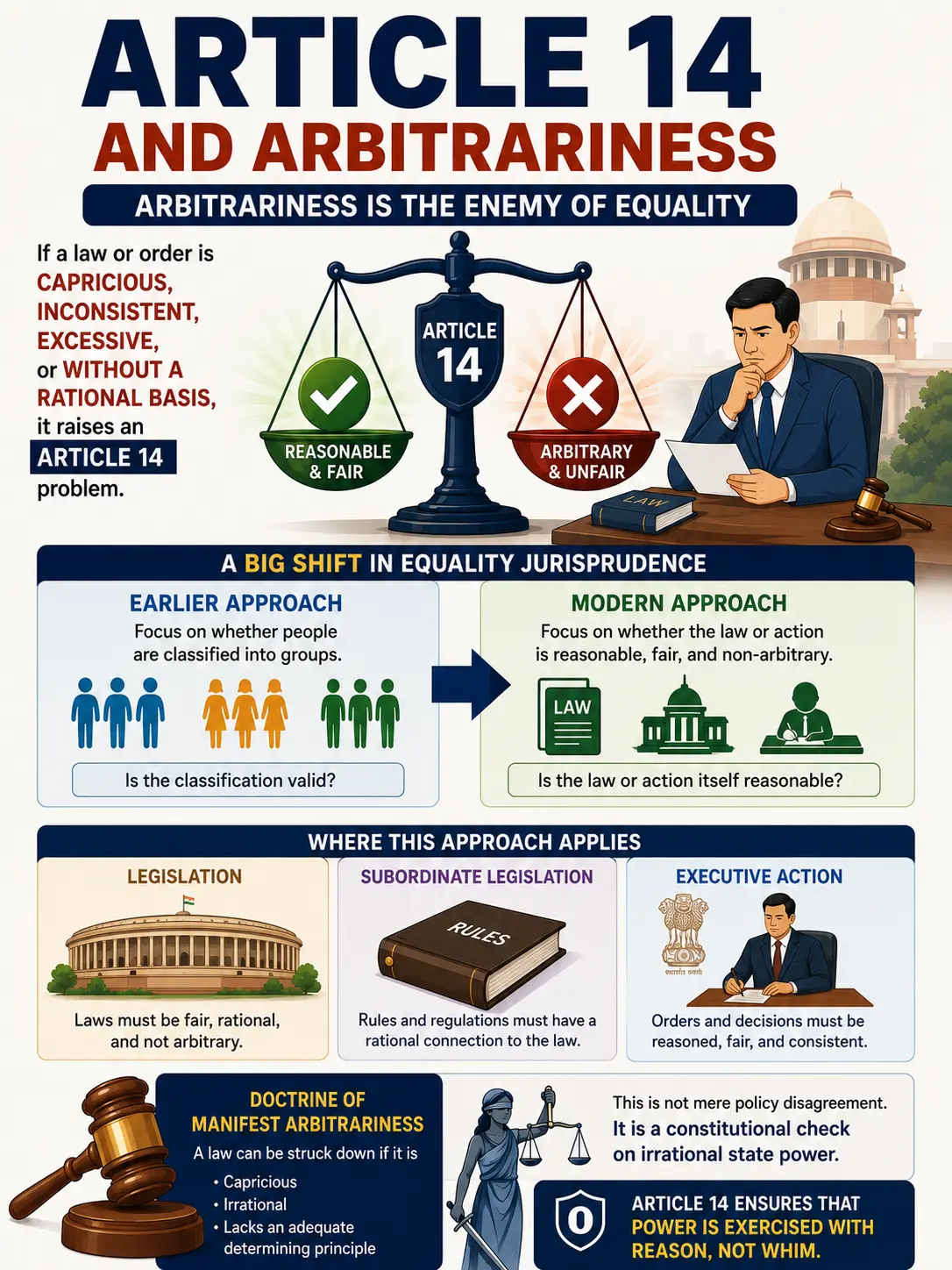
One of the most important modern ideas under Article 14 is that arbitrariness is the enemy of equality. If a law or order is capricious, inconsistent, excessive, or without a rational basis, it raises an Article 14 problem. This is true even when the law does not openly mention a suspect group.
This is a big shift. Earlier, many equality challenges focused on whether people were classified into groups. Now the courts can also ask whether the law is simply unreasonable or unfair in itself. That approach became especially important in challenges to legislation, subordinate legislation, and executive action.
The doctrine of manifest arbitrariness pushed this even further in later jurisprudence. It says that a law can be struck down if it is capricious, irrational, or lacks an adequate determining principle. This is not the same as mere policy disagreement. It is a constitutional check on irrational state power.
Why Article 14 is not the same as absolute sameness
A lot of people think equality means everyone must be treated exactly the same all the time. That is not how constitutional equality works. Treating everyone identically can actually be unfair if people are starting from very different positions or if the objective of the law requires different treatment for different circumstances.
For instance, a scholarship scheme for economically weaker students does not violate equality merely because it is not available to everyone. If the classification is reasonable and the objective is genuine, the Constitution can allow it. That is why the courts repeatedly say that Article 14 permits reasonable classification and equalising measures when they are justified by the facts.
This is one of the most important lessons of Article 14. Equality is not a mechanical formula. It is a constitutional method for deciding when difference is fair and when difference becomes discrimination. That distinction is the heart of many equality disputes.
Who can use Article 14?
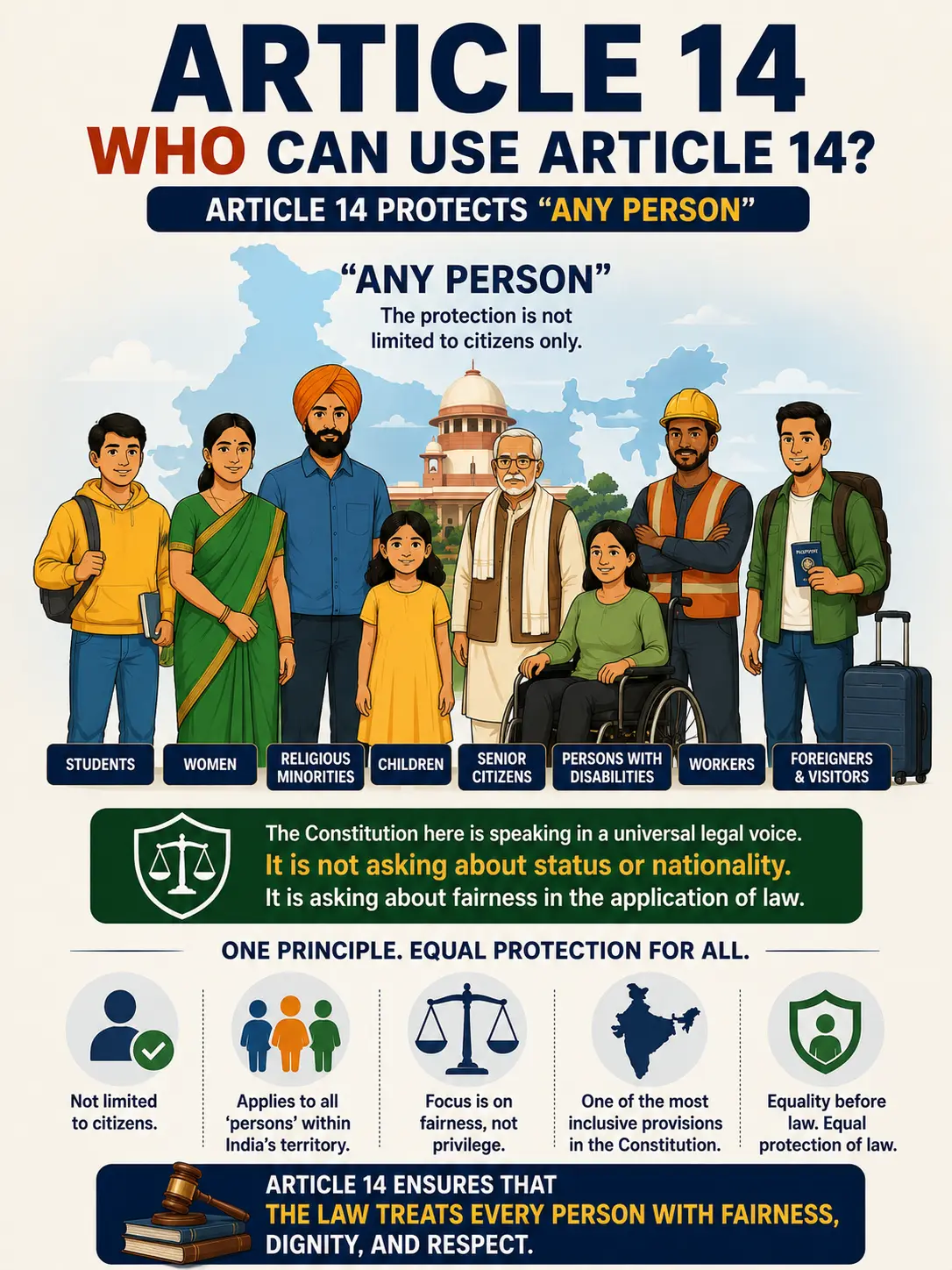
The text of Article 14 uses the phrase “any person”. That means the protection is not limited to citizens only. It is broad enough to protect a much wider class of persons within India’s territory. That is one reason the provision is so central to constitutional justice.
Because the clause says “any person”, its protection reaches beyond narrow citizenship boundaries. The Constitution here is speaking in a universal legal voice. It is not asking whether a person belongs to a privileged category. It is asking whether the law is being applied fairly. That makes Article 14 one of the most inclusive provisions in the entire equality chapter.
How Article 14 connects with other equality rights
Article 14 is the foundation stone, but it does not stand alone. Article 15 prohibits discrimination on specific grounds like religion, race, caste, sex, or place of birth. Article 16 deals with equality of opportunity in public employment. Articles 17 and 18 deal with untouchability and titles. These provisions give specific shape to the broad promise of Article 14.
You can think of it this way. Article 14 is the constitutional principle of equality. The later articles are more specific applications of that principle. They tackle recurring forms of inequality that the founding document knew would matter in real life. Together, they form a complete equality architecture.
How the equality articles work together
| Article | Main focus | Practical role | Relationship with Article 14 |
|---|---|---|---|
| Article 14 | Equality before law and equal protection of laws | General equality guarantee | Foundation |
| Article 15 | Discrimination on specific grounds | Stops direct group-based exclusion | Specific extension of equality |
| Article 16 | Public employment equality | Guards access to State jobs | Employment-specific equality |
| Article 17 | Abolition of untouchability | Removes a historic form of social exclusion | Strong equality enforcement |
| Article 18 | Abolition of titles | Prevents hereditary or symbolic privilege | Reinforces egalitarianism |
This structure shows something important. The Constitution does not rely on a single sentence to solve inequality. It creates a framework. Article 14 sets the tone, while the other articles tackle specific injustices in more direct ways. That is a smart design, because equality problems are rarely all the same.
Examples of Article 14 in action
The best way to understand Article 14 is to see how it works in real life. Here are some common situations where the idea comes alive.
- If a public authority gives benefits to one group, it must show a lawful and rational reason for excluding another similarly placed group.
- If a law creates a special procedure for a class of cases, the State must explain why that special procedure is needed and why it is not merely unfair targeting.
- If a policy changes without any principle and with no clear objective, it may be attacked as arbitrary.
- If two similarly situated people are treated differently because of irrelevant considerations, the constitutional promise of equality is weakened.
- If a classification is based on a real difference and is tied to the aim of the law, it may survive constitutional scrutiny.
Simple real-world illustrations
1. Public recruitment: If the government uses educational qualifications or age limits for certain posts, that is not automatically unconstitutional. The question is whether the requirement is relevant to the job. If it is, the classification can be justified.
2. Welfare benefits: A welfare scheme can be limited to a certain income group. That does not violate equality merely because everyone does not receive it. The classification can be justified if it targets a real need and the distinction is rational.
3. Criminal procedure: A special procedure for a special kind of case may be valid if the reason for the difference is real and the law is not used to single out people unfairly. But if the procedure is used to create injustice, Article 14 can be invoked.
4. Administrative decisions: If a licence is refused to one applicant but granted to another in a similar situation, the authority must be able to explain the difference. Without a rational explanation, the decision may appear arbitrary.
Common mistakes people make about Article 14
A lot of confusion surrounds Article 14 because it sounds simple. Here are the most common mistakes people make when they first hear about it.
- Mistake 1: Equality means identical treatment in every case.
That is not true. The Constitution allows reasonable distinctions. - Mistake 2: Any difference between groups is discrimination.
Not every difference is unconstitutional. The question is whether the difference is reasonable and connected to the law’s purpose. - Mistake 3: Article 14 applies only to citizens.
The text says any person, which makes its scope broader. - Mistake 4: Article 14 is only about caste or gender discrimination.
It is much wider. It also covers arbitrary classification, unfair procedure, and irrational state action. - Mistake 5: A law is safe if it looks neutral.
Formal neutrality is not enough if the real effect is unequal or arbitrary.
Why Article 14 matters beyond the courtroom
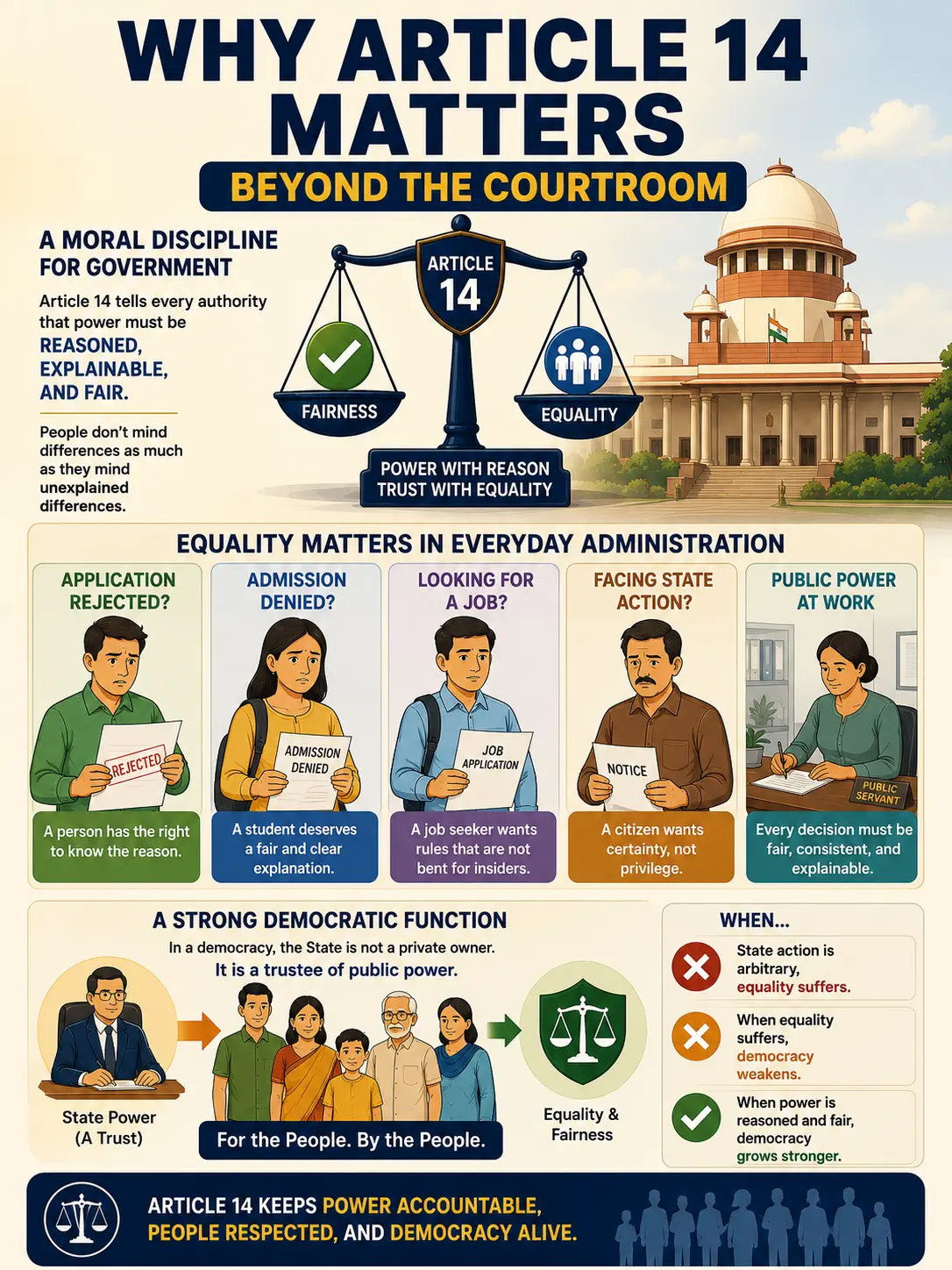
Article 14 is not just a constitutional theory for judges and lawyers. It is a moral discipline for government. It tells every authority, from the smallest office to the highest ministry, that power must be reasoned, explainable, and fair. That is a very human idea. People do not mind differences as much as they mind unexplained differences.
This is why equality matters in daily administration. A person whose application is rejected wants to know why. A student denied admission wants a fair reason. A job seeker wants rules that are not bent for insiders. A citizen facing state action wants certainty that the system is not tilting toward privilege. Article 14 gives those expectations constitutional weight.
It also has a strong democratic function. In a democracy, the State is not supposed to behave like a private owner. It is supposed to behave like a trustee of public power. Article 14 helps keep that trust intact. When state action becomes arbitrary, equality suffers. When equality suffers, democratic legitimacy weakens.
Article 14 and fairness in modern governance
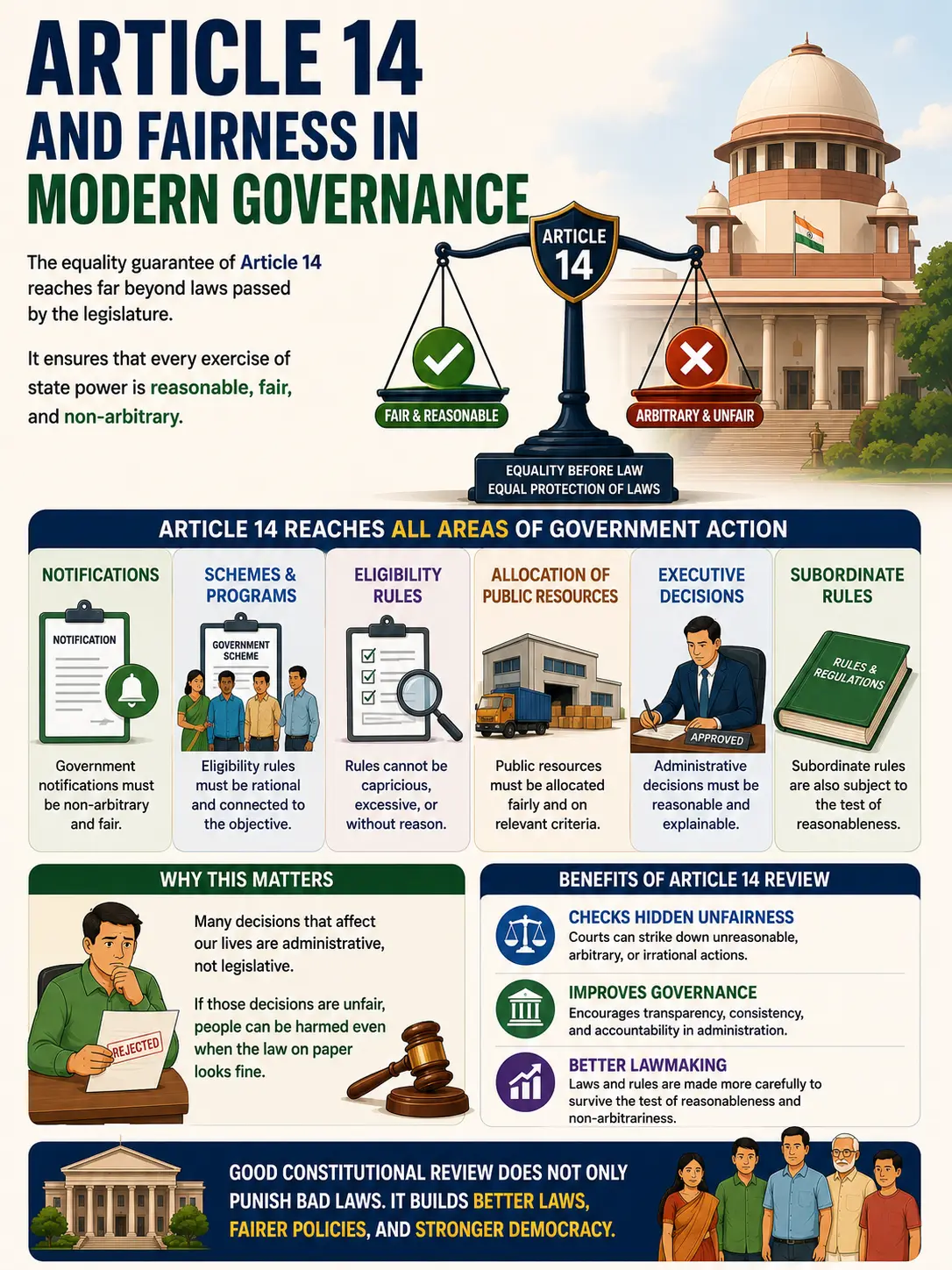
Modern governments do much more than pass laws. They issue notifications, frame schemes, set eligibility rules, allocate public resources, and make countless executive decisions. Article 14 reaches all of that. It is not limited to statutes passed by Parliament or state legislatures. The equality guarantee also checks executive action and subordinate rules when they become unreasonable or arbitrary.
That is important because many of the most consequential decisions in modern life are administrative rather than legislative. If those decisions are unfair, people can be harmed even when the law on paper looks fine. Article 14 gives courts the language to challenge that hidden unfairness.
It also encourages better lawmaking. When lawmakers know that a rule must survive the test of reasonableness, rational basis, and non-arbitrariness, they are more careful. Good constitutional review does not only punish bad laws. It improves the quality of law itself.
A closer look at the words “within the territory of India”
The phrase “within the territory of India” gives Article 14 a territorial reach. It means the guarantee operates inside India’s legal space. That wording matters because constitutional rights often depend on scope, place, and context. In Article 14, the focus is on protection from unequal state treatment wherever Indian authority operates in the territory.
This territorial focus also reminds us that constitutional equality is part of public order itself. It is not a private promise. It is a rule governing the State wherever it exercises authority. That is one reason Article 14 is often described as foundational. It does not just protect a right. It shapes the structure of government behavior.
Why lawyers, judges, and ordinary readers care so much about Article 14
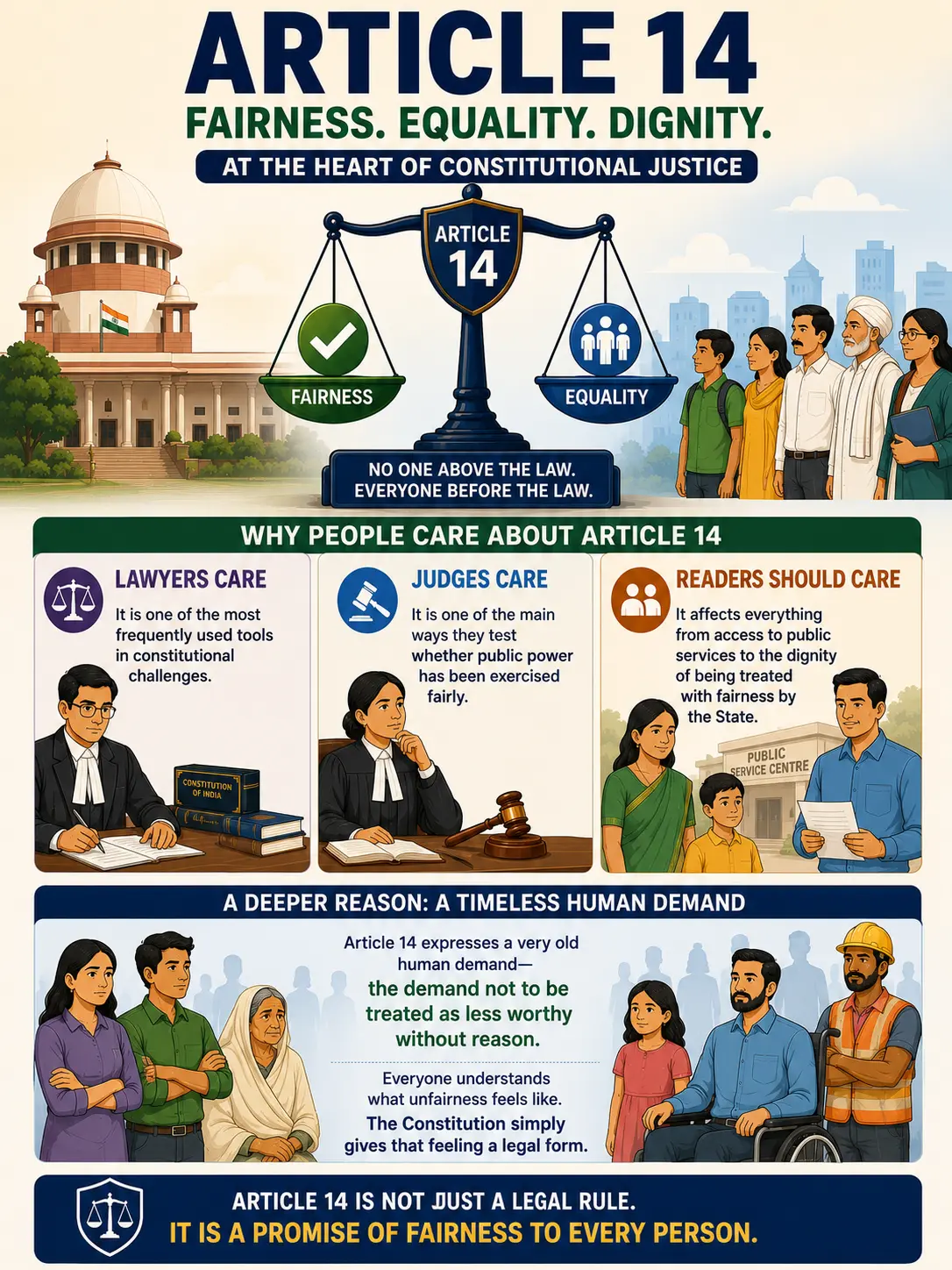
Lawyers care about Article 14 because it is one of the most frequently used tools in constitutional challenges. Judges care because it is one of the main ways they test whether public power has been exercised fairly. Ordinary readers should care because it affects everything from access to public services to the dignity of being treated with fairness by the State.
There is also a deeper reason. Article 14 expresses a very old human demand, the demand not to be treated as less worthy without reason. That is why it resonates across legal systems and across generations. Everyone understands what unfairness feels like. The Constitution simply gives that feeling a legal form.
The practical meaning of Article 14 in one glance
| Idea | Plain meaning | What it stops | What it allows |
|---|---|---|---|
| Equality before law | No one is above the law | Privilege, favoritism, immunity without legal basis | Uniform subjection to law |
| Equal protection of laws | Similar cases should be treated similarly; different cases can be treated differently for good reason | Hostile discrimination, unfair administration | Reasonable classification |
| Non-arbitrariness | State action must be based on reason | Whim, caprice, irrationality | Fair and rational policy choices |
| Substantive equality | Real fairness matters, not just formal sameness | Hollow neutrality that hides inequality | Measures that actually improve equality |
The lasting significance of Article 14
The lasting significance of Article 14 lies in its honesty. It does not pretend that equality is easy. It recognizes that people and situations differ, and it allows the law to account for that. But it draws a line. Difference is allowed only when it is justified, connected to a valid purpose, and free from arbitrariness. That balance is what makes the clause so durable.
It is also significant because it keeps the Constitution humane. A legal system can become cold very quickly if it treats fairness as a technical detail. Article 14 stops that drift. It reminds the State that law is not only about control. It is also about justice, dignity, and trust.
In the end, Article 14 is not just a rule against discrimination. It is a constitutional promise that public power will behave with reason, fairness, and equal concern. That promise still matters every time the State makes a choice that affects real people. And that is why Article 14 remains one of the most important ideas in the Indian constitutional order.
Article References and Sources
- Government of India. (1950). The Constitution of India: Article 14 – Equality before law and equal protection of laws.
- Supreme Court of India. (1974). E.P. Royappa v. State of Tamil Nadu.
- Supreme Court of India. (1978). Maneka Gandhi v. Union of India.
- Supreme Court of India. (1952). State of West Bengal v. Anwar Ali Sarkar.
- Supreme Court of India. (1958). Ram Krishna Dalmia v. Justice S. R. Tendolkar.
- Supreme Court of India. (2021). Interpretation of substantive equality under Article 14.
Also, Read These Articles in Detail
- Fundamental Rights in India
- What Are Fundamental Rights Under the Indian Constitution?
- History of Fundamental Rights in India
- Why Fundamental Rights Are Important for Every Indian Citizen
- Understanding Part III of the Indian Constitution
- Who Can Claim Fundamental Rights in India?
- Legal Rights vs Fundamental Rights
- How Fundamental Rights Protect Individual Freedom in India
Frequently Asked Questions
FAQ 1: What is Article 14 in simple words?
Article 14 is the constitutional promise that the State shall not deny to any person equality before the law or the equal protection of the laws within the territory of India. In simple words, it means the government must act fairly, must not give unfair privilege to one person over another, and must not apply the law in a random or biased way. It is one of the strongest protections in the Right to Equality chapter because it speaks to both legal fairness and public fairness. The first part, equality before law, says no one is above the law. The second part, equal protection of the laws, means people in similar situations should get similar treatment, while different situations can be treated differently if there is a good reason.
FAQ 2: Why is Article 14 so important in the Indian Constitution?
Article 14 is important because it is the foundation of constitutional fairness. It does more than stop open discrimination. It also checks arbitrariness, which means unfair, unreasonable, or whimsical state action. That is why courts treat it as a living principle, not just a formal rule. If the government makes a rule, policy, or decision that treats people unfairly without a proper reason, Article 14 can be used to challenge it. This makes it central to justice in daily life, public administration, recruitment, welfare schemes, and legal procedure. It is one of the clearest ways the Constitution tells the State that power must be reasoned, not random.
FAQ 3: What is the difference between “equality before law” and “equal protection of the laws”?
The two phrases in Article 14 are related, but they are not exactly the same. Equality before law is a more negative idea. It means no one gets special legal privilege just because of rank, money, office, or status. Everyone stands equal in the eyes of the law. Equal protection of the laws is more positive. It means the law must protect people fairly, and it can make reasonable distinctions when the circumstances are different. So the Constitution does not demand blind sameness. It demands fairness. That is why a rule for children can be different from a rule for adults, or a scheme for economically weaker groups can exist without breaking equality, as long as the distinction is rational and lawful.
FAQ 4: Does Article 14 mean everyone must be treated exactly the same?
No, and that is one of the biggest misunderstandings about equality. Article 14 does not force the State to treat all people in exactly the same way in every situation. It allows reasonable classification, which means the law may separate people or situations into groups if there is a real and relevant difference between them and if that difference connects to the purpose of the law. This is why the Constitution does not block all distinctions. It blocks unfair distinctions. A law can treat minors differently from adults, or a welfare rule can focus on a specific income group, without violating equality, if the classification is genuinely justified.
FAQ 5: What is reasonable classification under Article 14?
Reasonable classification is the legal idea that helps courts decide whether a distinction made by a law is fair or not. The Supreme Court has long said that Article 14 forbids class legislation but permits reasonable classification. For a classification to be valid, two things must exist. First, there must be an intelligible differentia, which means a real and understandable basis for separating one group from another. Second, that differentia must have a rational nexus with the object of the law, which means the distinction must actually help achieve the law’s purpose. If either part is missing, the classification may fail constitutional scrutiny.
FAQ 6: What did the Supreme Court say about arbitrariness under Article 14?
The Supreme Court gave Article 14 a wider meaning by saying that equality and arbitrariness are sworn enemies. In E.P. Royappa, the Court said that Article 14 strikes at arbitrariness in State action and ensures fairness and equality of treatment. That idea became one of the most important developments in Indian constitutional law. It means a law or decision can be challenged not only because it openly discriminates, but also because it is capricious, irrational, or based on no clear principle. Later judgments carried this thinking forward and made it clear that equality is not just about neat categories. It is also about the quality of the State’s reasoning.
FAQ 7: Can Article 14 protect non-citizens too?
Yes. Article 14 uses the words “any person”, not “any citizen”. That wording is very important. It means the protection of equality is broad and is not limited only to Indian citizens. Anyone within India’s territory can invoke the basic protection against unequal or arbitrary state action, depending on the legal context. This wide language is one reason Article 14 is considered such a strong and humane constitutional guarantee. The Constitution is not speaking only to citizens here. It is speaking to everyone under the authority of the Indian legal system.
FAQ 8: How does Article 14 help in real life?
Article 14 matters in everyday life much more than many people realize. It affects public recruitment, admissions, government schemes, tax rules, licensing, police action, administrative decisions, and court procedures. If two people are similarly placed and the State treats them differently without a valid reason, Article 14 may come into play. If a policy looks neutral on paper but works unfairly in practice, the equality principle can still be used to question it. That is why the article is not just a textbook right. It is a working principle that protects fairness in real government decisions.
FAQ 9: What are the landmark cases linked with Article 14?
Several landmark cases shaped the meaning of Article 14. State of West Bengal v. Anwar Ali Sarkar helped explain that laws can classify, but the classification must be reasonable. Ram Krishna Dalmia v. Justice S. R. Tendolkar became a major authority on the idea that Article 14 forbids class legislation but allows reasonable classification. E.P. Royappa v. State of Tamil Nadu expanded the idea of equality by attacking arbitrariness. Maneka Gandhi v. Union of India strengthened the connection between equality, fairness, and non-arbitrariness. Together, these cases show how the understanding of Article 14 grew from a narrow equality rule into a broader constitutional standard of fairness.
FAQ 10: Why does Article 14 matter today more than ever?
Article 14 matters today because modern governments make countless decisions that shape people’s lives, and not all of them come through big laws passed in Parliament. Many happen through policies, notifications, schemes, and administrative orders. That makes the danger of arbitrariness much bigger. Article 14 acts like a constitutional filter. It asks whether the State has a real reason, a fair basis, and a lawful purpose for what it is doing. In a world where people depend on public systems for education, jobs, welfare, and justice, this guarantee is not old-fashioned at all. It is one of the most practical rights in the Constitution.
FAQ 11: Is Article 14 only about discrimination?
No, Article 14 is wider than a simple anti-discrimination rule. It does protect people from unfair treatment, but it also does something more subtle and more powerful. It checks whether the State is acting in a reasonable, fair, and non-arbitrary way. That means even if a law does not openly mention caste, religion, sex, or any other direct ground of discrimination, it can still raise an Article 14 problem if it is irrational or capricious. This is why equality under the Constitution is not limited to obvious exclusion. It also covers hidden unfairness in rules, policies, and official decisions. The courts have repeatedly said that arbitrariness and equality cannot stand together, which is one reason Article 14 has such a broad reach in modern constitutional law.
In practical life, this matters a lot. A policy can look clean on paper and still be unfair in operation. That is why Article 14 is used to test not just the words of a law, but its logic, its purpose, and its effect. If the government acts without a proper basis, treats similar people differently without reason, or changes rules in a way that looks random, the equality guarantee can be invoked. So yes, Article 14 is about discrimination, but it is also about much more than discrimination. It is about the quality of state power itself.
FAQ 12: What is the real meaning of “equality before law”?
Equality before law means that no person is above the law and no person is beneath it. Rich or poor, powerful or ordinary, every person is subject to the same legal order. The idea comes from the rule of law, which is one of the deepest ideas in constitutional government. In simple terms, the government cannot create private privilege for some people and special punishment for others unless the law itself gives a lawful and rational reason. This is why equality before law is often described as a negative guarantee. It tells the State what it must not do.
This phrase is important because it stops the legal system from becoming a tool of favoritism. If the law is enforced differently just because one person has influence and another does not, then equality before law breaks down. That is exactly the kind of misuse Article 14 is designed to prevent. It keeps the legal system honest and reminds public authorities that they are bound by law, not free to choose winners and losers on personal whim.
FAQ 13: What does “equal protection of the laws” mean in practice?
Equal protection of the laws means that the law should protect people fairly according to their real circumstances. It does not force the State to treat everyone in exactly the same way. Instead, it allows different treatment where the difference is real, relevant, and connected to the purpose of the law. This is why the Constitution permits reasonable classification. The law may classify people or situations, but that classification must be based on an understandable difference and must have a proper relation to the object the law is trying to achieve.
In practice, this gives the State room to design policies that fit different needs. For example, children can be treated differently from adults, and weaker groups can be given special support. That does not violate equality if the classification is fair and logically connected to the purpose of the rule. So equal protection of the laws is not about blind sameness. It is about fair legal treatment that respects real differences while preventing abuse.
FAQ 14: Why do courts talk so much about “reasonable classification” under Article 14?
Courts talk about reasonable classification because it is the main legal test used to decide whether a distinction made by a law is valid or not. The Supreme Court has long said that Article 14 forbids class legislation but allows reasonable classification. That means the State can create groups, but it cannot do so in a random or hostile way. The classification must satisfy two classic conditions. There must be an intelligible differentia, and there must be a rational nexus between that differentia and the purpose of the law.
This test matters because governments often need to make distinctions. A tax law may apply differently to different income groups. A welfare scheme may target only a specific category of people. A recruitment rule may require different qualifications for different posts. Those distinctions are not automatically unfair. The question is whether they are rooted in reason and connected to the law’s object. That is why the doctrine of reasonable classification sits at the heart of Article 14 review. It helps separate legitimate policy from disguised unfairness.
FAQ 15: What is the importance of the “intelligible differentia” test?
The intelligible differentia test asks whether there is a clear and real basis for separating one group from another. The basis cannot be vague, fake, or purely decorative. It must be something the law can point to and defend. This is the first half of the reasonable classification doctrine under Article 14. If there is no real distinction, then the classification is suspect from the start.
This test is important because it prevents laws from creating artificial groups just to justify unequal treatment. Suppose a rule picks out a class of people, but the selection has no meaningful relation to the issue the law is trying to solve. In that case, the classification does not really explain anything. It only hides inequality behind neat wording. The intelligible differentia test forces the State to show that its grouping is real, not invented. That is a strong safeguard against unfairness.
FAQ 16: What is the meaning of “rational nexus” under Article 14?
The rational nexus requirement asks whether the classification actually helps the law achieve its purpose. A distinction may be real, but that is not enough. It must also be relevant to the object of the law. If the difference between groups does not help the law do what it is supposed to do, then the classification fails the constitutional test. This is the second half of the reasonable classification rule and one of the most practical tools in Article 14 analysis.
A simple way to think about it is this. The law must not only pick a real category. It must pick a relevant category. Otherwise, the classification becomes arbitrary. For example, if a rule is meant to ensure safety, the distinction used by the rule should connect to safety. If the distinction has nothing to do with the objective, the law may be struck down for violating equality. So the rational nexus test keeps the State focused on logic, not convenience.
FAQ 17: How did the case of Maneka Gandhi change the meaning of Article 14?
Maneka Gandhi v. Union of India was a turning point because it expanded the understanding of equality beyond narrow formal classification. The Supreme Court made it clear that Article 14 is not only about treating similar people alike. It is also about preventing arbitrariness in state action. The Court’s famous statement that equality and arbitrariness are sworn enemies became one of the most quoted lines in Indian constitutional law.
This mattered because it changed the focus of equality review. Before that, courts often asked mainly whether the law classified people reasonably. After Maneka Gandhi, courts could also ask whether the law or action was fair, reasonable, and non-arbitrary in a broader sense. That made Article 14 much more powerful. It turned equality into a living standard of constitutional fairness rather than a narrow technical test.
FAQ 18: Why is E.P. Royappa important for understanding equality?
E.P. Royappa v. State of Tamil Nadu is important because it pushed Indian equality law toward a more dynamic and realistic understanding. The case is often remembered for the idea that arbitrariness is the very antithesis of equality. That means if state action is arbitrary, it cannot really be equal. The Court made it clear that equality is not frozen in rigid formulas. It is a living constitutional value that must respond to real unfairness.
This case helped open the door to modern equality thinking. It made it easier for courts to examine whether official action is truly fair in substance, not just equal in appearance. That shift matters a great deal because many forms of unfairness do not look dramatic at first glance. They appear in procedure, discretion, and policy design. E.P. Royappa gave courts a stronger way to challenge those hidden forms of inequality.
FAQ 19: Can Article 14 be used against government policies, not just laws passed by Parliament?
Yes, absolutely. Article 14 is not limited to statutes passed by the legislature. It can also apply to executive action, administrative decisions, notifications, circulars, and policy choices. That is one reason the right is so useful in real life. Governments do not only make law in the formal sense. They also make decisions every day through administrative power. If those decisions are arbitrary, irrational, or unfair, Article 14 can be used to challenge them.
This broad reach is crucial in modern governance. Many of the decisions that shape people’s lives come from offices, departments, and authorities, not from big public debates in Parliament. If those decisions are left unchecked, equality can be damaged quietly. Article 14 provides a constitutional check on that everyday power. It says the State must stay fair not only when it writes laws, but also when it applies them.
FAQ 20: What is the biggest lesson ordinary people should take from Article 14?
The biggest lesson is that fairness is a constitutional right, not a favor. Article 14 tells every person that the law should not be used to protect privilege, create hidden bias, or punish people without reason. It is one of the strongest reminders that a democratic State must act with logic, transparency, and consistency. When the State treats similar people differently, or arbitrarily uses power, the Constitution gives people a language to question it.
For ordinary readers, this matters because it shows that equality is not an abstract legal slogan. It is something that protects daily life, public services, and dignity. Whether the issue is recruitment, access to welfare, administrative delay, or unequal treatment by a public authority, Article 14 stands in the background as a real safeguard. It reminds us that a just system does not treat everyone identically in every case. It treats people fairly, reasonably, and without arbitrariness.
