

Article 15 of the Indian Constitution is one of the most important equality provisions in modern constitutional law. It speaks directly to a simple but powerful idea. No person should be treated unfairly because of their religion, race, caste, sex, or place of birth. That idea may sound obvious today, but in real life it has enormous force. It affects who can be excluded, who must be included, and when the State can step in to correct deep social inequality.
At the same time, Article 15 is not just a ban on discrimination. It is also a constitutional tool for social justice, protective discrimination, and affirmative action.
In other words, it does two things at once. It says the State must not discriminate on prohibited grounds, and it also allows the State to make special provisions for groups that have faced historical disadvantage. That is why Article 15 sits at the heart of India’s equality framework.
Table of Contents
What Article 15 actually says
The present text of Article 15 contains six clauses. The first two are strict anti-discrimination rules. The next four are enabling clauses that allow special measures in specific situations. The Constitution now also includes Article 15(6), which was inserted by the Constitution (One Hundred and Third Amendment) Act, 2019 for economically weaker sections.
Here is the structure in a simple way:
| Clause | Basic idea | What it does |
|---|---|---|
| Article 15(1) | The State shall not discriminate against any citizen on grounds only of religion, race, caste, sex, place of birth, or any of them | Protects citizens from direct State discrimination on these grounds |
| Article 15(2) | No citizen shall face disability, liability, restriction, or condition on those same grounds regarding access to public places and public facilities | Extends equality into everyday public life |
| Article 15(3) | The State may make special provisions for women and children | Allows protective measures for women and children |
| Article 15(4) | The State may make special provisions for socially and educationally backward classes, Scheduled Castes, and Scheduled Tribes | Forms the basis for many reservation and welfare measures in education and social policy |
| Article 15(5) | The State may make special provisions by law for admission to educational institutions for socially and educationally backward classes, SCs, and STs, including private educational institutions, except minority institutions | Expands affirmative action into education, including certain private institutions |
| Article 15(6) | The State may make special provisions for economically weaker sections and may reserve up to 10% of seats in educational institutions, subject to the constitutional text | Adds an income-based affirmative action route |
The actual wording matters, because Article 15 uses the phrase “grounds only”. That means the Constitution is aimed at discrimination based purely or mainly on the listed characteristics. Courts have repeatedly treated that phrase as important when deciding whether a law or policy is truly discriminatory.
Why Article 15 was needed
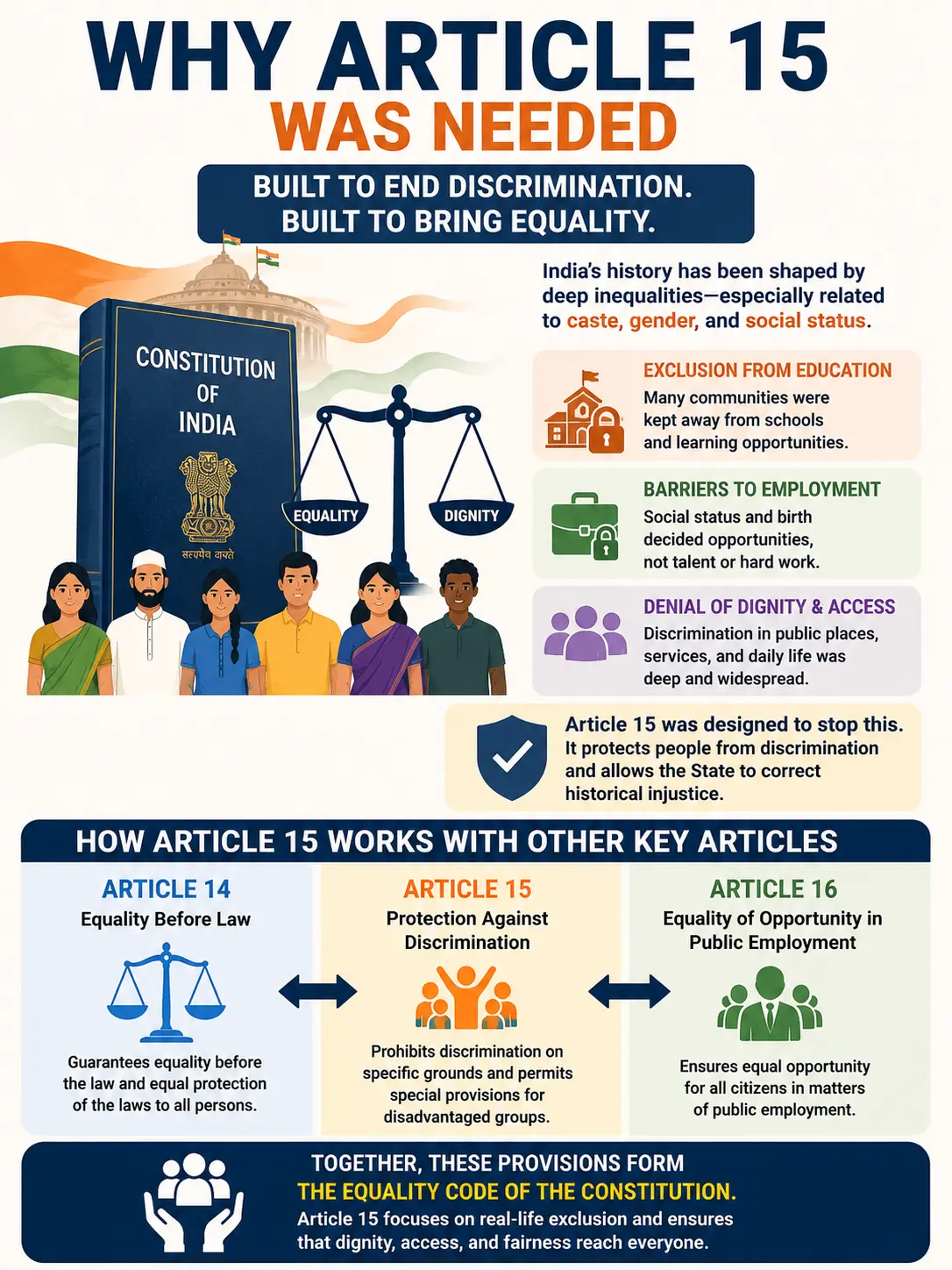
India’s history makes Article 15 easy to understand and impossible to ignore. The Constitution was written in a society shaped by deep inequalities, especially linked to caste, gender, and social status. The framers knew that formal equality alone would not fix this. If the law simply said everyone is equal, but society remained unequal, many people would still be locked out of schools, jobs, public spaces, and dignity. Article 15 was designed to stop that.
This is why Article 15 works alongside Article 14, which guarantees equality before the law, and Article 16, which deals with equality of opportunity in public employment. Together, these provisions form the equality code of the Constitution. Article 15 is especially important because it speaks not just about the State in the abstract, but about concrete exclusion in daily life.
Clause by clause, what Article 15 means in real life
Article 15(1): No State discrimination on prohibited grounds
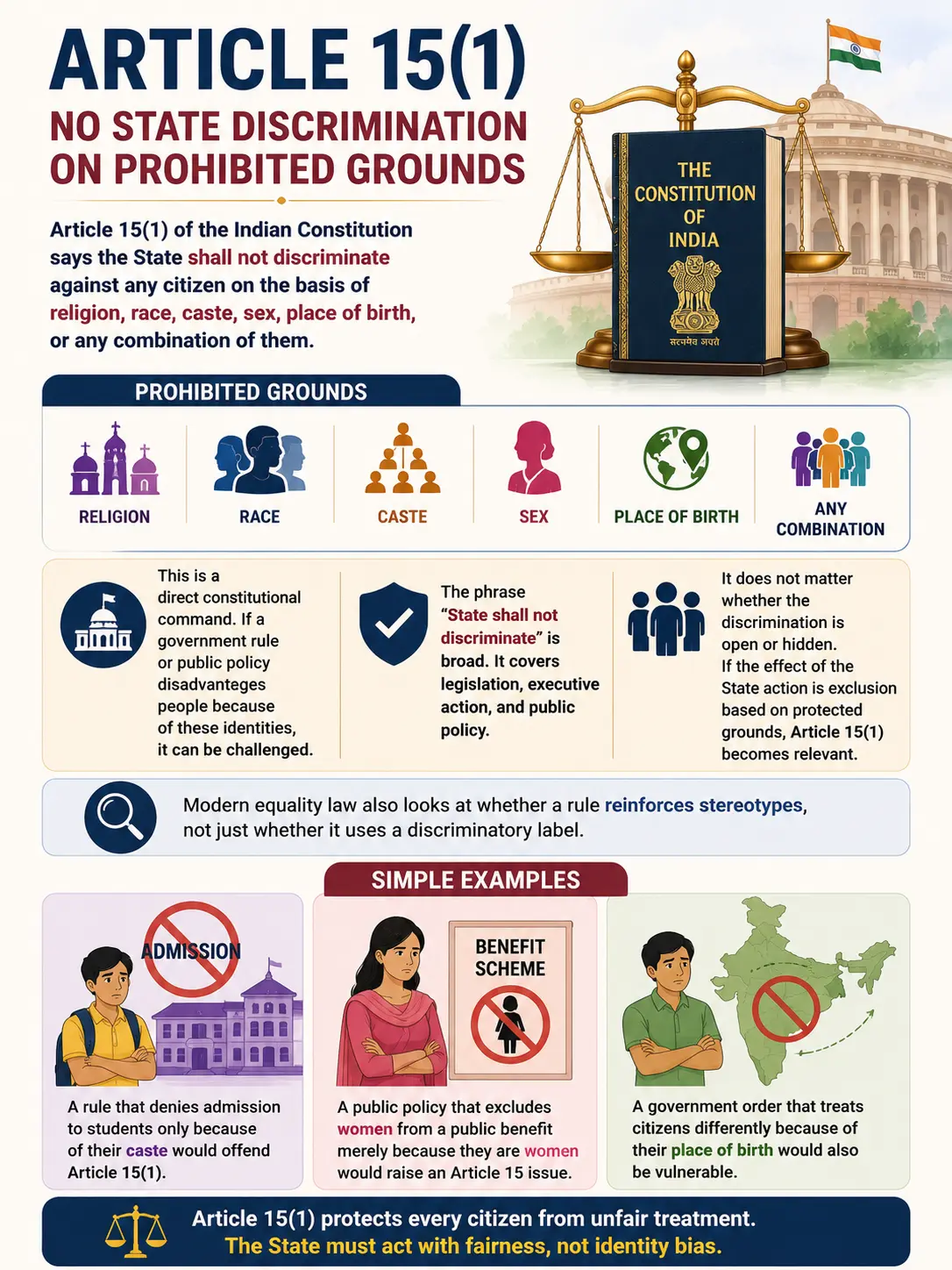
This clause says the State cannot discriminate against any citizen on the basis of religion, race, caste, sex, place of birth, or any combination of them. It is a direct constitutional command. If a government rule or public policy disadvantages people because of one of these identities, the rule can be challenged.
The phrase “State shall not discriminate” is broad. It covers legislation, executive action, and public policy. It does not matter whether the discrimination is open or hidden. If the effect of the State action is exclusion based on protected grounds, Article 15(1) becomes relevant. Modern equality law also pays attention to whether a rule reinforces stereotypes rather than merely whether it uses a discriminatory label.
A few simple examples make this clearer:
- A rule that denies admission to students only because of their caste would offend Article 15(1).
- A public policy that excludes women from a public benefit merely because they are women would raise an Article 15 issue.
- A government order that treats citizens differently because of their place of birth would also be vulnerable.
Article 15(2): Equality in access to public places and public facilities
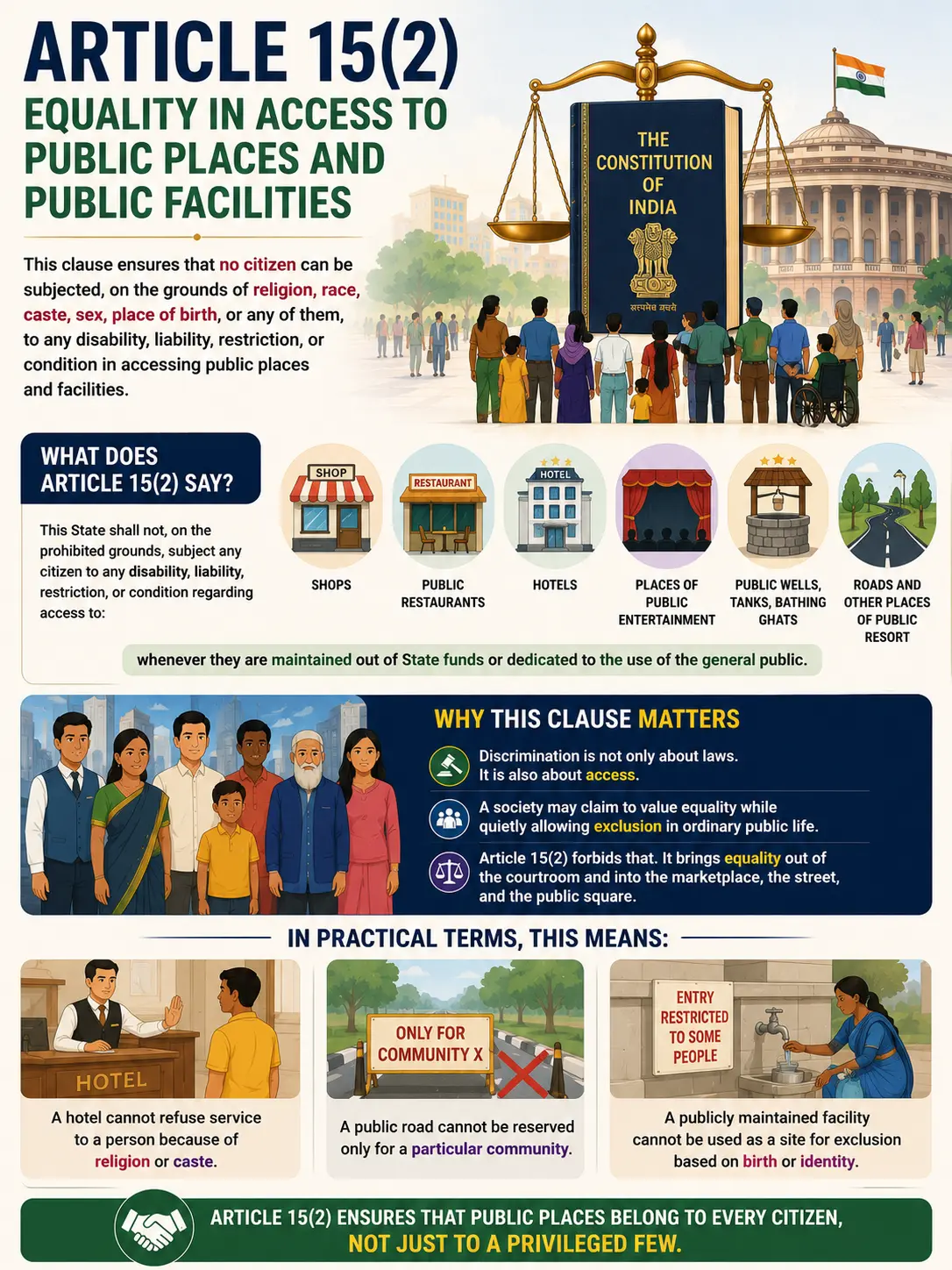
This clause is often overlooked, but it is highly practical. It says no citizen can be subjected, on the prohibited grounds, to a disability, liability, restriction, or condition regarding access to shops, public restaurants, hotels, places of public entertainment, or public wells, tanks, bathing ghats, roads, and other places of public resort maintained out of State funds or dedicated to public use.
This matters because discrimination is not only about laws. It is also about access. A society may claim to value equality while quietly allowing exclusion in ordinary public life. Article 15(2) forbids that. It pushes equality out of the courtroom and into the marketplace, the street, and the public square.
In practical terms, this means:
- A hotel cannot refuse service to a person because of religion or caste.
- A public road cannot be reserved only for a particular community.
- A publicly maintained facility cannot be used as a site for exclusion based on birth or identity.
Article 15(3): Special provisions for women and children
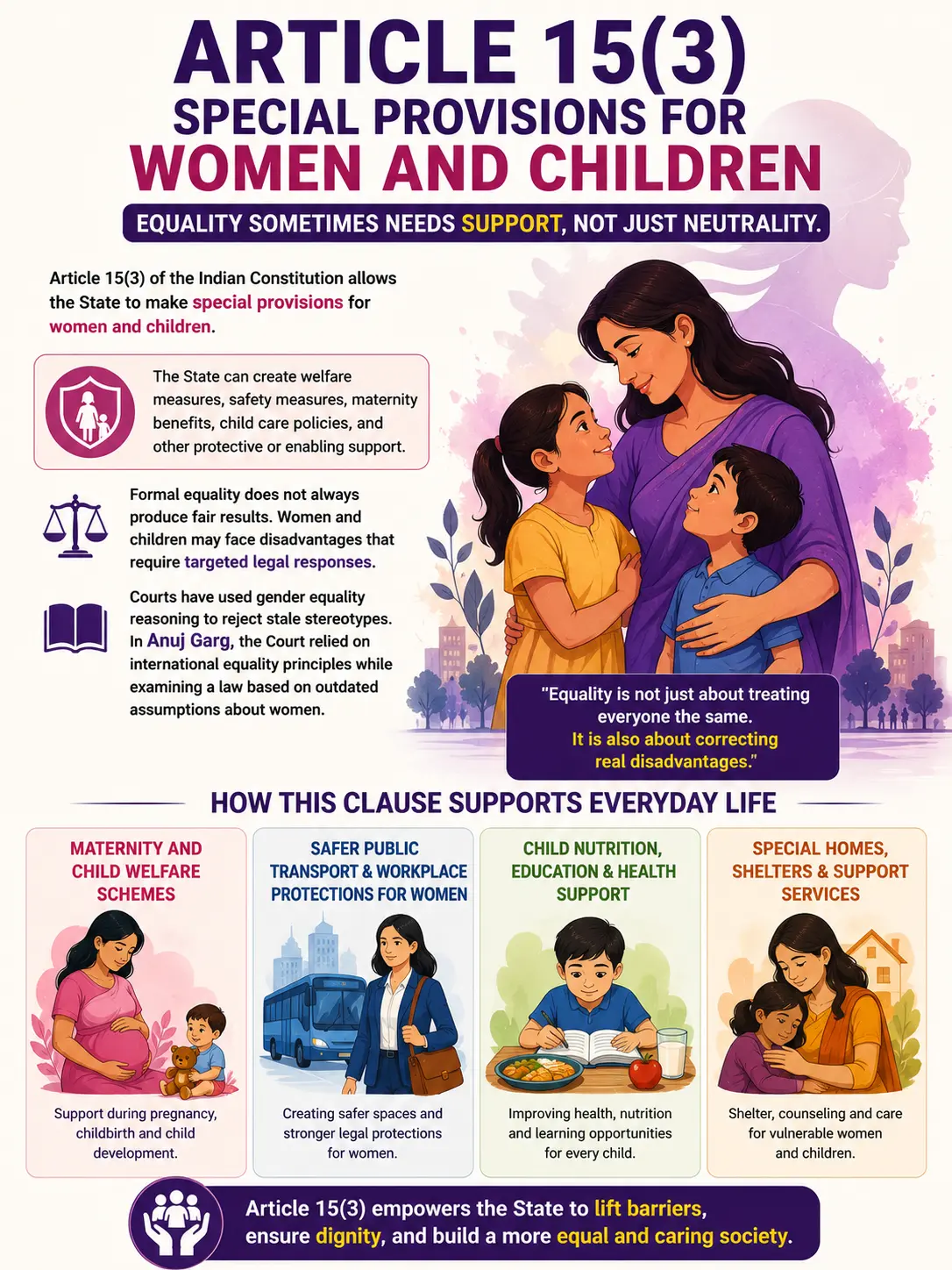
This clause is one of the Constitution’s clearest acknowledgments that equality sometimes needs support, not just neutrality. It allows the State to make special provisions for women and children. That may include welfare measures, safety measures, maternity benefits, child care policies, and other forms of protective or enabling support.
The idea here is simple. Formal equality does not always produce fair results. Women and children may face disadvantages that require targeted legal responses. Article 15(3) gives constitutional room for that kind of policy. Courts have also used gender equality reasoning in cases that reject stale stereotypes about women’s roles. In Anuj Garg, for example, the Court drew on international equality principles while examining a law that reflected old assumptions about women and public morality.
This clause matters in everyday life because it supports measures such as:
- maternity and child welfare schemes
- safer public transport or workplace protections for women
- child nutrition, education, and health support
- special homes, shelters, or support services for vulnerable women and children
Article 15(4): Special provisions for backward classes, SCs, and STs
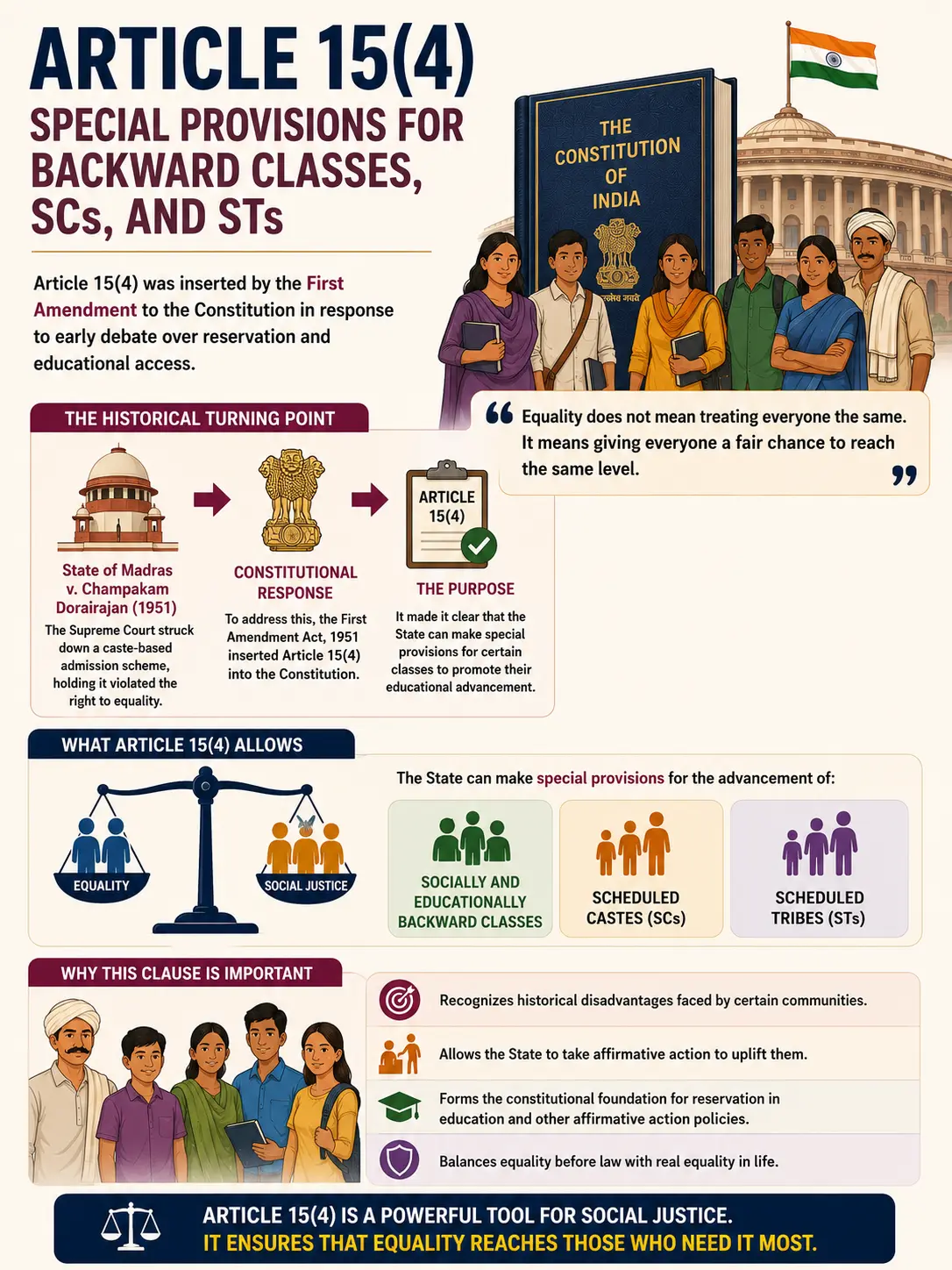
Article 15(4) was inserted by the First Amendment in response to early constitutional debate over reservation and educational access. The historical turning point was State of Madras v. Champakam Dorairajan, where the Supreme Court dealt with a caste-based admission scheme and the constitutional tension between equality and social policy. Article 15(4) was then added to make it clear that the State could make special provisions for socially and educationally backward classes, Scheduled Castes, and Scheduled Tribes.
This is a very important clause. It shows that the Constitution does not treat equality as a flat, one-size-fits-all rule. Instead, it recognizes that some groups may need special treatment to reach a meaningful level of equality. That is why Article 15(4) became a foundation for reservation policy and other affirmative action measures in India.
A useful way to think about it is this:
| Situation | Why Article 15(4) matters |
|---|---|
| A backward class has been excluded from education for generations | The State can make a special provision to improve access |
| SCs or STs face long-term structural disadvantage | The Constitution permits corrective action |
| A policy aims to widen educational opportunity | Article 15(4) gives it constitutional support |
Article 15(5): Special provisions in education, including private institutions
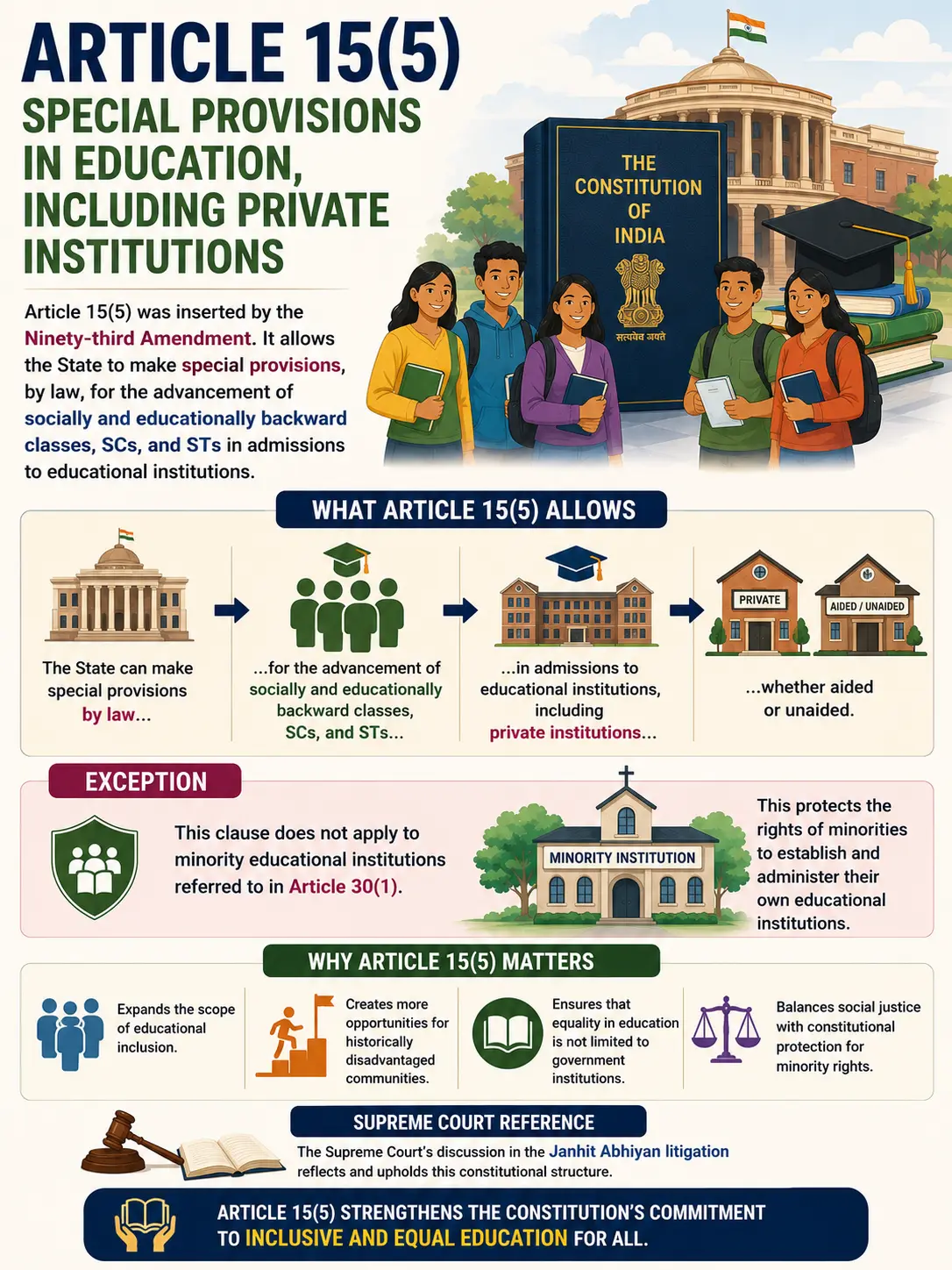
Article 15(5) was inserted by the Ninety-third Amendment. It allows the State to make special provisions, by law, for the advancement of socially and educationally backward classes, SCs, and STs in admissions to educational institutions, including private educational institutions, whether aided or unaided, except minority educational institutions referred to in Article 30(1).
This clause broadened the constitutional space for educational inclusion. The wording is significant because it extends beyond government institutions. It keeps minority educational institutions outside its scope to protect minority rights under the Constitution. The Supreme Court’s discussion in the Janhit Abhiyan litigation reflects that structure.
In plain language, Article 15(5) means the State can support access to education in a wider range of institutions when the goal is to advance disadvantaged groups. That is one reason education policy in India often refers back to Article 15.
Article 15(6): Economic weakness as a constitutional category
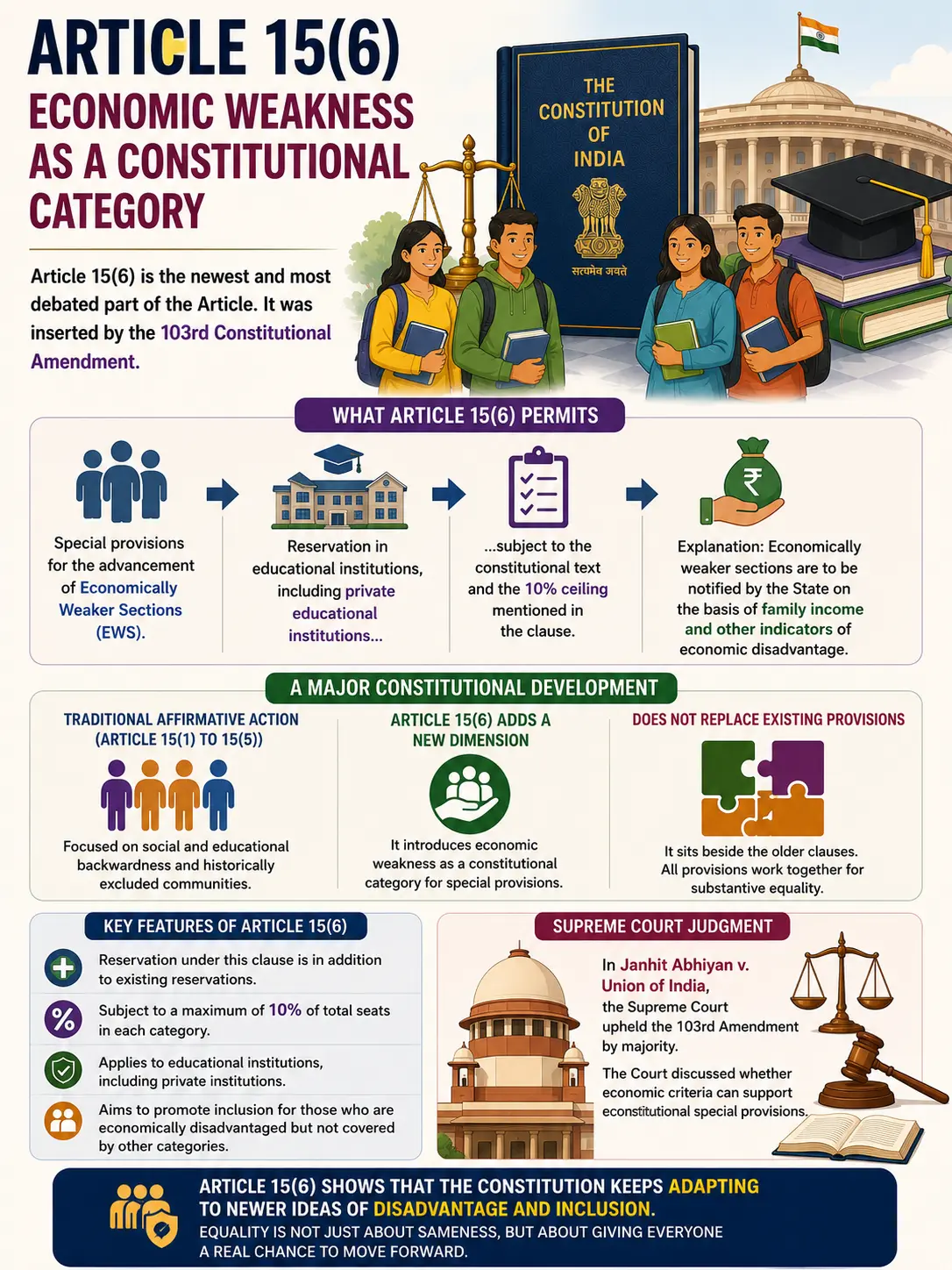
Article 15(6) is the newest and most debated part of the article. It was inserted by the 103rd Constitutional Amendment and permits special provisions for the advancement of economically weaker sections. It also allows reservation in educational institutions, including private educational institutions, subject to the constitutional text and the 10% ceiling mentioned in the clause. The explanation says economically weaker sections are to be notified by the State on the basis of family income and other indicators of economic disadvantage.
This is a major constitutional development because it reflects a shift in emphasis. Traditional affirmative action in Article 15 was built around social and educational backwardness and historically excluded communities. Article 15(6) adds an economic dimension. That does not erase the older clauses. It sits beside them. The Constitution text itself says the reservation under this clause is in addition to existing reservations and subject to a maximum of 10 per cent of total seats in each category.
The Supreme Court’s judgment in Janhit Abhiyan v. Union of India is central here. The Court upheld the 103rd Amendment by majority and discussed whether economic criteria can support constitutional special provisions. The judgment shows that Article 15 today is not frozen in 1950. It keeps adapting to newer ideas of disadvantage and inclusion.
A timeline of how Article 15 evolved
| Year | Event | Why it mattered |
|---|---|---|
| 1950 | The Constitution came into force with the original anti-discrimination rule in Article 15(1) and (2) | Established the basic constitutional ban on discrimination |
| 1951 | The First Amendment inserted Article 15(4) | Allowed special provisions for backward classes, SCs, and STs after early litigation on reservations |
| 2005 | The Ninety-third Amendment inserted Article 15(5) | Expanded educational affirmative action, including in certain private institutions |
| 2019 | The 103rd Amendment inserted Article 15(6) | Added economically weaker sections as a constitutional basis for special provisions |
| 2022 | The Supreme Court upheld the 103rd Amendment in Janhit Abhiyan | Confirmed the validity of the EWS clause in Article 15(6) |
The difference between discrimination and affirmative action
A lot of confusion around Article 15 comes from mixing up two very different ideas.
Discrimination means treating someone worse because of a protected ground such as caste, sex, or religion. Article 15(1) and 15(2) prohibit that.
Affirmative action means making special provisions to help groups that have suffered disadvantage. Article 15(3), 15(4), 15(5), and 15(6) permit that in defined situations.
This distinction matters because equality is not always about identical treatment. Sometimes equal treatment keeps people unequal. The Constitution allows targeted support when the law is trying to remove old barriers rather than create new ones.
Here is a simple comparison:
| Feature | Discrimination | Affirmative action |
|---|---|---|
| Basic idea | Unfair exclusion or disadvantage | Corrective or protective support |
| Constitutional effect | Usually prohibited under Article 15(1) and 15(2) | Permitted under Article 15(3), 15(4), 15(5), and 15(6) |
| Typical target | A person or group is kept out | A disadvantaged group is helped in |
| Constitutional purpose | Prevent inequality | Reduce inequality and broaden access |
How the courts have shaped Article 15
Article 15 is not just a text. It is also a living legal principle shaped by court decisions.
Champakam Dorairajan
This early case is remembered because it helped trigger the constitutional amendment that became Article 15(4). The dispute showed that the original equality framework did not yet fully support special educational provisions. The Constitution changed quickly after that. That tells you how significant the case was.
Anuj Garg
In Anuj Garg, the Court took a more modern view of gender equality and rejected reasoning built on old stereotypes. The judgment is often discussed for showing that law should not reinforce ideas about women as weak, dependent, or confined to narrow roles. It is a useful example of Article 15 being read progressively, especially in connection with sex discrimination.
Navtej Singh Johar
The constitutional conversation around Article 15 also expanded in Navtej Singh Johar, where the Court recognised that equality and dignity cannot be read narrowly. The judgment materials reflect the idea that Article 15’s reference to sex has been given an expansive constitutional meaning in modern jurisprudence. That broader understanding matters because discrimination is often indirect, stereotyped, or disguised.
Janhit Abhiyan
The Janhit Abhiyan case matters because it confirms that Article 15 continues to evolve. The Court considered whether the 103rd Amendment, which inserted Article 15(6), violated the basic structure. The majority upheld it, which means the Constitution now clearly contains an economic-criteria route for certain special provisions.
Why Article 15 matters beyond India
Even though Article 15 is part of the Indian Constitution, its idea is universal. Many countries struggle with the same question. How do you protect equality without pretending that all people begin from the same place? That is the real genius of Article 15. It does not treat equality as a slogan. It treats equality as a practical promise that has to work in real life.
A few lessons travel well across borders:
- Equality needs both non-discrimination and corrective action.
- Public access matters as much as courtroom language.
- Stereotypes can be as harmful as open exclusion.
- Social justice is stronger when it has constitutional backing.
What kinds of discrimination Article 15 is designed to prevent
Article 15 is not limited to one narrow form of bias. It is meant to stop many kinds of unequal treatment that arise from identity or background.
| Type of discrimination | How it can appear | Why Article 15 is relevant |
|---|---|---|
| Religious discrimination | Excluding people because of faith or perceived faith | Protected under Article 15(1) and 15(2) |
| Caste discrimination | Denying access, dignity, or opportunity due to caste status | Central concern of the equality clauses |
| Sex discrimination | Treating women or men unfairly because of sex | Directly covered, and also addressed through Article 15(3) |
| Place of birth discrimination | Penalising people for being born in a certain region | Explicitly prohibited |
| Multiple-ground discrimination | Exclusion based on a combination of identity markers | Article 15 covers “any of them,” so the constitutional analysis can include combined grounds |
A practical reading of Article 15 in everyday terms
You do not need a law degree to understand the spirit of Article 15. Ask a few basic questions:
- Is the State treating someone worse because of a protected identity?
- Is a public place or public service being restricted on those grounds?
- Is the State making a special provision to correct disadvantage?
- Is the measure limited, justified, and consistent with the constitutional text?
If the answer to the first two is yes, there may be a violation. If the answer to the third is yes, the Constitution may allow it. That balance is the heart of Article 15.
Some clear examples
Example 1: Access to public spaces
If a public facility refuses entry to someone because of caste or religion, Article 15(2) is implicated. Equality in the Constitution is not limited to paper rights. It reaches public life itself.
Example 2: Women-focused welfare measures
If the State creates a support scheme only for women to address safety, health, or opportunity gaps, Article 15(3) can support it. This is not discrimination in the constitutional sense. It is a permitted special provision.
Example 3: Educational support for backward classes
If the State makes special admission provisions for socially and educationally backward classes, SCs, or STs, Article 15(4) and 15(5) provide the constitutional foundation.
Example 4: Economic disadvantage
If the State wants to support people who are economically weak and otherwise outside existing reservation categories, Article 15(6) now provides a constitutional route, subject to the limits written into the clause.
The deeper idea behind Article 15
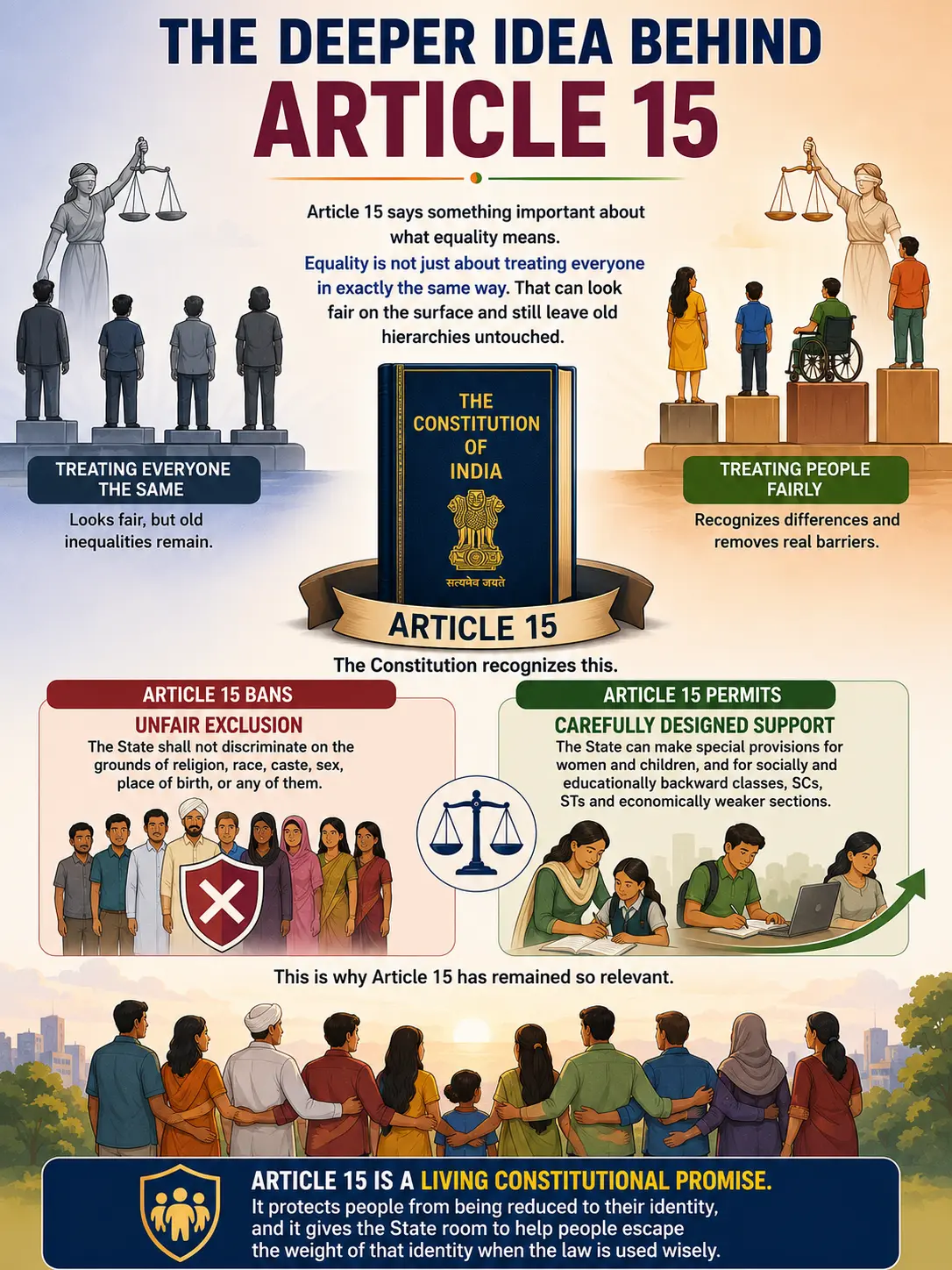
Article 15 says something important about what equality means. Equality is not just about treating everyone in the same way. That can look fair on the surface and still leave old hierarchies untouched. The Constitution recognizes this. So it bans unfair exclusion and also permits carefully designed support for those who have been historically pushed to the margins.
This is why Article 15 has remained so relevant. It is not a dead rule. It is a living constitutional promise. It protects people from being reduced to their identity, and it gives the State room to help people escape the weight of that identity when the law is used wisely.
Final thoughts
Article 15 is one of the clearest expressions of India’s commitment to dignity and equality. It stops the State from discriminating on key grounds, protects access to public life, and gives constitutional support to special measures for women, children, backward classes, Scheduled Castes, Scheduled Tribes, and economically weaker sections. It began as a safeguard against overt discrimination, but it has grown into a much broader framework for substantive equality.
That growth is exactly what makes Article 15 so important. It reflects a constitutional truth that still feels modern. Equal citizenship is not achieved by ignoring difference. It is achieved by preventing unfair exclusion and, when needed, by correcting the damage that history has already done.
If you are reading Article 15 for study, teaching, writing, or general awareness, the main thing to remember is this. The article is not only about what the State cannot do. It is also about what the State may do to make equality real. That balance is what gives Article 15 its strength, its flexibility, and its lasting relevance.
Article References and Sources
- Constitutional Sources
- Important Supreme Court Cases Referenced
- State of Madras v. Champakam Dorairajan (1951)
- This landmark case led to the adoption of the First Constitutional Amendment, which introduced Article 15(4) and strengthened affirmative action provisions.
- Reference:
- Anuj Garg v. Hotel Association of India (2007)
- A landmark judgment on gender equality, constitutional morality, and protection against discrimination based on sex.
- References:
- Janhit Abhiyan v. Union of India (2022)
- A Constitution Bench decision that upheld the 103rd Constitutional Amendment and the 10% reservation for Economically Weaker Sections (EWS) under Article 15(6).
- References:
- State of Madras v. Champakam Dorairajan (1951)
- Additional Academic and Legal References
Also, Read These Articles in Detail
- Fundamental Rights in India
- What Are Fundamental Rights Under the Indian Constitution?
- History of Fundamental Rights in India
- Why Fundamental Rights Are Important for Every Indian Citizen
- Understanding Part III of the Indian Constitution
- Who Can Claim Fundamental Rights in India?
- Legal Rights vs Fundamental Rights
- How Fundamental Rights Protect Individual Freedom in India
- Right to Equality Under Article 14
Frequently Asked Questions
FAQ 1. What is Article 15 of the Indian Constitution?
Article 15 is one of the most important parts of the Fundamental Rights chapter in the Indian Constitution. It protects people from discrimination by the State on specific grounds such as religion, race, caste, sex, and place of birth. In simple words, it means the government cannot treat citizens unfairly just because of who they are or where they come from.
This article matters because equality is not just a nice idea. It is a legal promise. Without a rule like Article 15, discrimination could easily become normal in public life, education, access to services, and government action. The Constitution makes it clear that identity cannot be used as a reason to deny dignity, opportunity, or basic fairness.
Article 15 is also important because it does more than stop unfair treatment. It also allows the State to make special provisions for people who have faced historic disadvantage. That means the Constitution understands something very practical. Sometimes treating everyone exactly the same does not create real equality. Some groups need support to reach the same starting line. That is why Article 15 contains both a prohibition on discrimination and permission for affirmative action.
You can think of it like this. Article 15 says the government cannot shut the door on someone because of their identity. But it can open a wider door for those who have been kept out for generations. That balance is what makes Article 15 so powerful.
It is also one of the clearest expressions of the Constitution’s social vision. India did not want equality to remain only on paper. It wanted equality to work in real life. Article 15 is part of that effort.
FAQ 2. What does Article 15(1) prohibit?
Article 15(1) prohibits the State from discriminating against any citizen on the grounds only of religion, race, caste, sex, place of birth, or any of them. The phrase “grounds only” is very important here. It means the forbidden ground must be the real basis of the discrimination. If a government action is based only on one of these protected factors, it can be challenged under Article 15(1).
This clause is aimed at direct discrimination. For example, if a State policy gives benefits to one group and excludes another group purely because of caste or religion, that can raise a serious constitutional problem. The same is true if a public authority treats women differently simply because they are women, without any valid constitutional justification.
The strength of Article 15(1) lies in its simplicity. It draws a clear boundary. Certain identities cannot be used by the State as reasons for unequal treatment. That rule is not symbolic. It has real legal force.
At the same time, Article 15(1) works together with the rest of the equality provisions in the Constitution. It does not stand alone. It supports the larger idea that the State must act fairly, without bias, and without carrying old social prejudices into law or policy.
A useful way to understand it is this. If the State is making a decision and the decision is shaped mainly by religion, race, caste, sex, or place of birth, Article 15(1) is likely to be involved. The Constitution does not allow the government to turn identity into a barrier.
FAQ 3. What is the purpose of Article 15(2)?
Article 15(2) protects citizens from discrimination in access to public places and public facilities. It says no citizen shall, on the grounds only of religion, race, caste, sex, or place of birth, be subjected to any disability, liability, restriction, or condition regarding the use of shops, public restaurants, hotels, places of public entertainment, or access to public wells, tanks, bathing ghats, roads, and other places of public resort maintained out of State funds or dedicated to public use.
This clause is very practical. It deals with everyday life. It is not only about laws written in books. It is about whether people can actually move through society with dignity. A person should not be refused service, excluded from a public facility, or denied ordinary access because of identity.
Article 15(2) matters because discrimination often appears in small, ordinary acts. A person may be denied entry. A family may be kept away from a public source of water. A community may be treated as unwelcome in public spaces. The Constitution directly forbids this kind of exclusion.
The deeper meaning of this clause is that public life belongs to all citizens. If a place is public, then discrimination cannot decide who gets in and who does not. That is a very strong equality principle. It says the law must reach into daily social conduct, not just formal government offices.
In simple terms, Article 15(2) protects the right to move, enter, use, and participate in public life without being judged by identity. That is a basic part of dignity.
FAQ 4. Why does Article 15 allow special provisions for women and children?
Article 15(3) allows the State to make special provisions for women and children. This clause exists because the Constitution recognizes that equal treatment is not always enough. Women and children often face unique disadvantages, and the law may need to respond with special support rather than simple sameness.
This does not mean women and children are being treated as less important. It means the Constitution accepts that they may need targeted protection to enjoy real equality. That could include welfare schemes, safety measures, educational support, health programs, maternity benefits, child care support, or other protective laws.
The logic behind Article 15(3) is very human. If a group faces conditions that create special barriers, then the State may step in with special help. That is not discrimination in the negative sense. It is a constitutional tool for justice.
For women, this clause has often been used to justify laws and policies that improve safety, opportunity, and access. For children, it supports measures that protect health, nutrition, education, and development. These are not luxuries. They are essentials.
This clause also shows that the Constitution does not believe formal neutrality is always fair. Sometimes neutrality hides inequality. Article 15(3) allows the law to be practical, compassionate, and corrective.
In a very simple sense, it says this. If people start from very different positions, the State may need to give more help to those who face greater burdens. That is not favoritism. That is constitutional fairness.
FAQ 5. What is Article 15(4), and why is it important for reservations?
Article 15(4) is one of the most significant clauses in the equality framework. It allows the State to make special provisions for the advancement of socially and educationally backward classes of citizens, as well as Scheduled Castes and Scheduled Tribes. This clause became important after early constitutional debate on reservation and educational access.
Its importance is huge because it gives constitutional support to affirmative action. In plain language, it means the State is allowed to help communities that have suffered long-term exclusion. That help may take the form of reservation, scholarships, special admissions, welfare measures, or other supportive policies.
Article 15(4) reflects a deep truth about society. Not everyone has had the same historical opportunities. Some communities have been kept out of education and social progress for generations. If the law pretends that everyone starts at the same line, it will only protect the already privileged. Article 15(4) avoids that mistake.
This clause changed the meaning of equality in India. Equality is not only about stopping discrimination. It is also about correcting disadvantage. That is why Article 15(4) is often described as a foundation of social justice in constitutional law.
It is also important to understand that Article 15(4) does not say the State must make special provisions in every case. It says the State may do so. That gives the government legal room to design policies according to social need and constitutional limits.
So, when people talk about reservation or affirmative action in education, Article 15(4) is one of the first constitutional provisions they are really talking about.
FAQ 6. What does Article 15(5) do in education?
Article 15(5) expands the State’s power to make special provisions for the advancement of socially and educationally backward classes, Scheduled Castes, and Scheduled Tribes in matters of admission to educational institutions, including private educational institutions, except minority educational institutions protected under the Constitution.
This clause is important because it moves the equality discussion into education in a broader way. It is not limited to government schools or colleges. It also touches certain private institutions, which makes the clause especially significant in a modern education system where private institutions play a major role.
The practical effect is that the Constitution allows a wider reach for social justice in admissions. If disadvantaged groups are being left behind in education, the State can legally design measures to improve their access. That may include reservations or other forms of special treatment.
Article 15(5) also shows that education is not just a private matter. Education shapes opportunity, mobility, employment, and long-term social change. If access to education is unequal, the effects spread across a person’s whole life. The Constitution clearly understands this.
At the same time, the clause respects the constitutional protection of minority educational institutions. So the system is not unlimited. It is balanced. The State gets the power to promote inclusion, but that power is still shaped by other constitutional rights.
In everyday terms, Article 15(5) tells us that education is too important to leave to chance. If society has created barriers, the Constitution allows the law to build bridges.
FAQ 7. What is Article 15(6), and how does it relate to economically weaker sections?
Article 15(6) is the newer part of Article 15. It was added by the 103rd Constitutional Amendment and allows the State to make special provisions for the advancement of economically weaker sections. It also permits reservation in educational institutions, including private educational institutions, subject to the constitutional text and the limit mentioned in the clause.
This clause is important because it introduces economic disadvantage as a constitutional basis for special support. Traditional affirmative action in Article 15 focused mainly on social and educational backwardness, especially for historically excluded communities. Article 15(6) adds another layer by recognizing that poverty itself can block access to opportunity.
That does not replace the older clauses. It adds to them. The Constitution is not saying that economic weakness is the same as caste-based or social backwardness. It is saying that economic hardship can also justify special provisions in education.
This clause has been discussed heavily in constitutional debate because it raised big questions. Can economic criteria support reservation? How should economic weakness be defined? Can special provisions based on income fit within the equality structure of the Constitution? These are serious issues, and the Supreme Court examined them in Janhit Abhiyan v. Union of India, where the amendment was upheld by a majority.
For ordinary readers, the main point is clear. Article 15(6) shows that the Constitution continues to grow. It still protects old forms of disadvantage, but it also tries to respond to newer forms of exclusion linked to financial hardship.
That makes Article 15 more flexible, and in some ways more realistic, because poverty can be just as limiting as any other barrier when it comes to education.
FAQ 8. How is discrimination different from affirmative action under Article 15?
Discrimination and affirmative action are not the same thing at all, even though people sometimes mix them up.
Discrimination means unfair treatment based on a protected ground such as religion, caste, sex, or place of birth. Article 15(1) and Article 15(2) prohibit that kind of treatment. The idea is to stop exclusion, stigma, and unequal access.
Affirmative action, on the other hand, means special support for groups that have faced historic disadvantage. Article 15(3), Article 15(4), Article 15(5), and Article 15(6) permit that kind of support in defined situations. The idea here is not to create unfairness. It is to reduce it.
This distinction is the heart of Article 15. The Constitution is not against all different treatment. It is against unjust different treatment. Sometimes people need different measures to reach real equality. That is why the Constitution allows the State to create special provisions for women, children, backward classes, SCs, STs, and economically weaker sections.
A simple example helps here. If a government denies access to a public benefit because of caste, that is discrimination. But if it gives a targeted scholarship to a historically excluded group, that is usually affirmative action.
The key question is always this. Is the State using difference to exclude, or to include? Article 15 allows the second and forbids the first.
So, when people hear the word “reservation,” they should not automatically think it is a violation of equality. In many cases, it is a constitutional method of making equality real.
FAQ 9. Which Supreme Court cases are important for understanding Article 15?
Several Supreme Court cases have shaped the way Article 15 works today. Each one added a layer to the meaning of equality, discrimination, and special provisions.
One of the earliest and most important is State of Madras v. Champakam Dorairajan. That case played a big role in the constitutional history of reservation. It led to the insertion of Article 15(4) through the First Amendment. In other words, the Constitution changed in response to the case.
Another important case is Anuj Garg v. Hotel Association of India. This case is widely discussed for its approach to gender equality. It showed that the law should not rest on old stereotypes about women. The Court’s reasoning reflected a modern understanding of equality, especially under Article 15.
Then there is Navtej Singh Johar v. Union of India, which broadened constitutional thinking on dignity, identity, and equality. The case is important because it shows that equality law cannot remain narrow or outdated. It must respond to real human experience.
Finally, Janhit Abhiyan v. Union of India is central to Article 15 today because it upheld the 103rd Amendment and therefore the Article 15(6) framework for economically weaker sections. This makes the case especially important for anyone studying the current shape of affirmative action in India.
These cases matter because Article 15 is not only about text. It is also about how courts read that text in changing times. The Constitution stays the same on the page, but the way it lives in practice grows through judicial interpretation.
So if you really want to understand Article 15, you should read it together with the major cases. That is where the full picture appears.
FAQ 10. Why is Article 15 still important today?
Article 15 remains important because discrimination has not disappeared. It has changed form, but it still exists. Sometimes it is open. Sometimes it is subtle. Sometimes it appears in public policy, and sometimes it appears in everyday social behavior. Article 15 gives the Constitution a way to respond to all of that.
Its importance also comes from the fact that equality is not a one-time achievement. It is an ongoing constitutional task. New problems keep appearing. Social exclusion changes shape. Economic disadvantage, gender inequality, caste bias, and public discrimination continue in different forms. Article 15 helps the law respond without losing sight of fairness.
It is also important because it holds together two ideas that can seem opposite but are actually deeply connected. It says the State must not discriminate. And it says the State may take special steps to correct disadvantage. That balance is what makes Article 15 so durable.
For students, lawyers, teachers, and general readers, Article 15 is more than a constitutional clause. It is a statement of values. It says a society should not judge people by birth, identity, or social background. It should make room for dignity, access, and justice.
And that is why Article 15 still feels alive. It is not just about the past. It speaks directly to the present and to the kind of country the Constitution wants India to be.
