Mechanical energy is one of the most useful ideas in physics because it explains how things move, lift, fall, swing, roll, stretch, and do work in the real world. In simple terms, it is the energy tied to an object’s motion and position. That means a moving car, a swinging pendulum, a raised book, a stretched spring, and a rolling ball can all have mechanical energy in different ways. In physics, mechanical energy is usually described as the sum of kinetic energy and potential energy, and that idea shows up again and again in school science, engineering, sports, machines, and daily life.
What makes mechanical energy especially useful is that it is easy to see in action. You can watch a stone fall, a child on a swing, or water rushing through a turbine and actually notice energy changing form. In a closed system, energy is not destroyed, but it can shift from one form to another. Mechanical energy is one of the clearest places where that principle becomes visible.
Table of Contents
What Is Mechanical Energy?
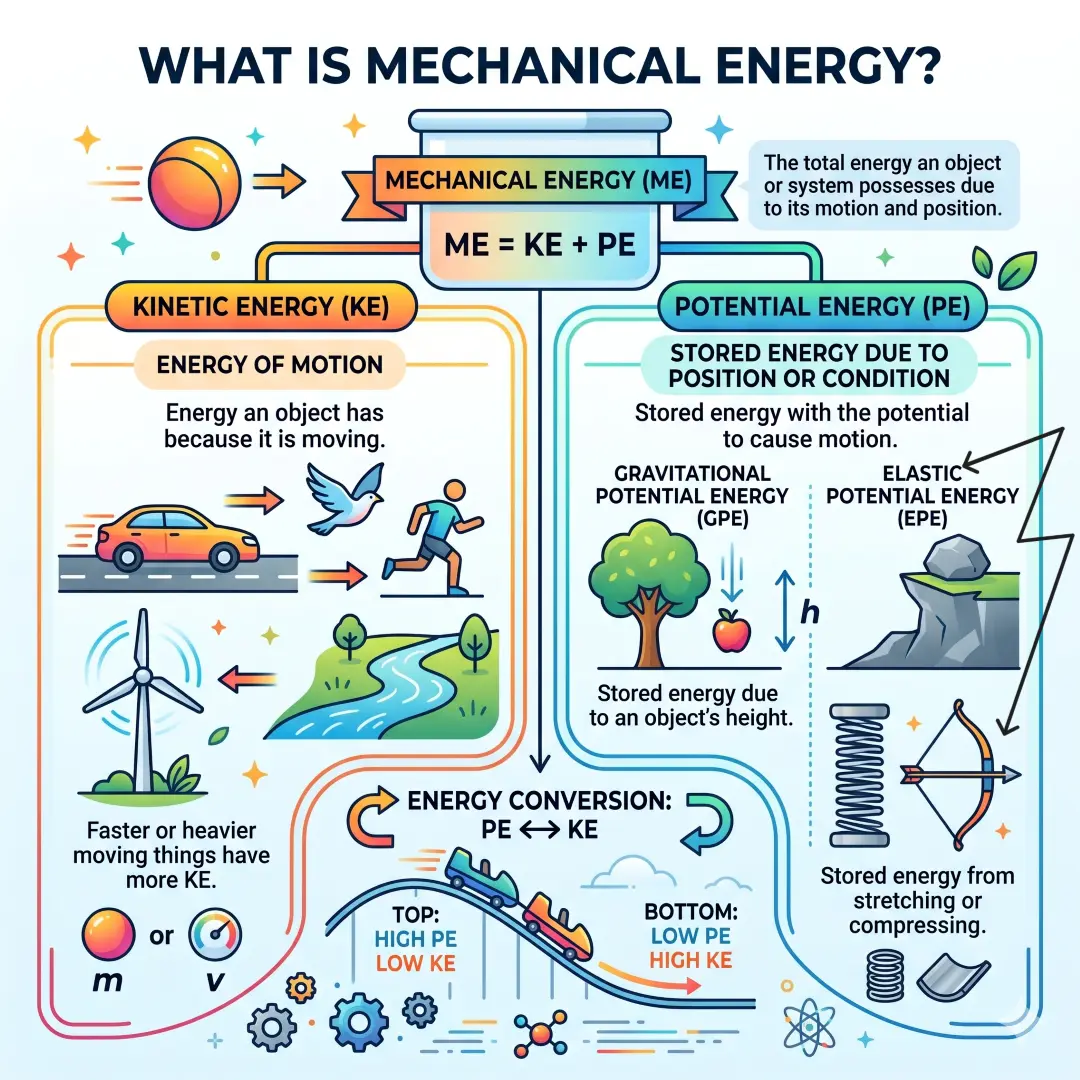
Mechanical energy is the energy an object or system has because of its motion and position. In the simplest school-level definition, it is the total of kinetic energy and potential energy. If something is moving, it has kinetic energy. If something is stored at a height, stretched, compressed, or positioned in a way that can later produce motion, it has potential energy. Put those together, and you get mechanical energy.
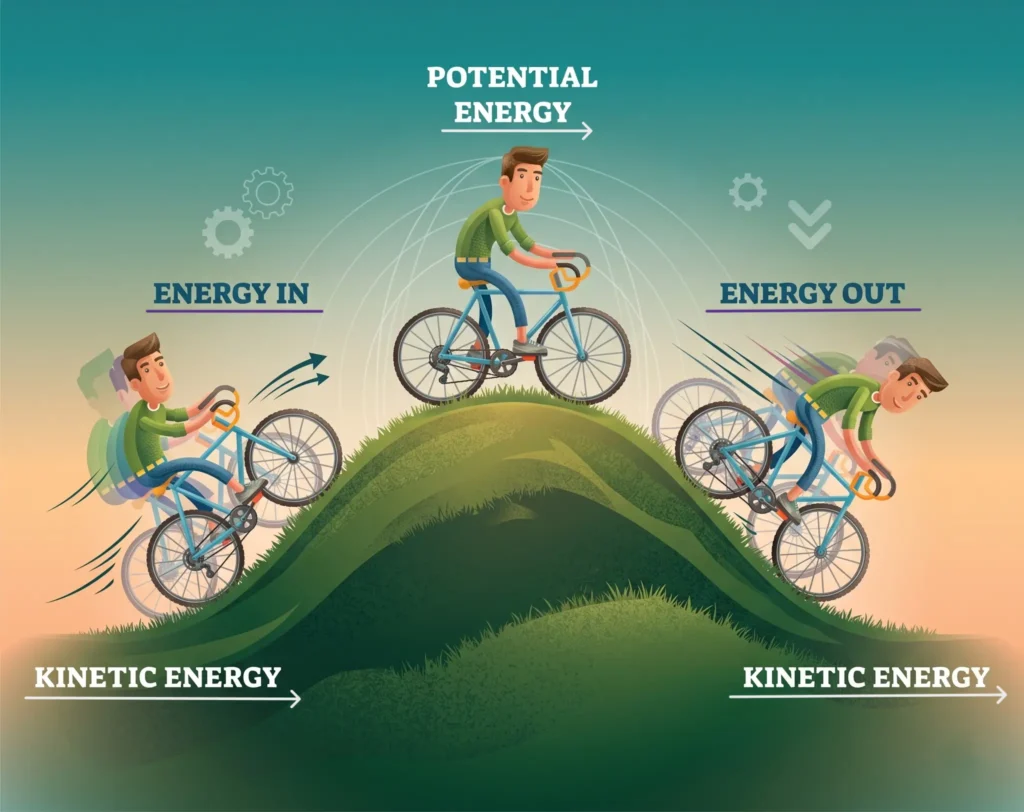
You can think of it like this. A parked bike at the top of a hill has potential energy because of its position. Once it starts rolling downhill, that stored energy changes into kinetic energy, which is the energy of motion. The total mechanical energy may remain constant in an ideal case, even though the balance between potential and kinetic energy keeps changing. That is one of the most important ideas in the study of energy.
The Two Main Parts of Mechanical Energy
Mechanical energy is made up of two major kinds of energy.
1. Kinetic Energy
Kinetic energy is the energy of motion. Anything that moves has kinetic energy, whether it is a running person, a flying bird, a spinning fan, or a car on the road. The faster an object moves, the more kinetic energy it has. Mass also matters. A heavy moving object carries more kinetic energy than a lighter one moving at the same speed.
2. Potential Energy
Potential energy is stored energy. It is energy waiting to be released or transformed. It can come from height, shape, or position. For mechanical energy, the two common forms are gravitational potential energy and elastic potential energy. A ball held high above the ground has gravitational potential energy. A stretched rubber band or compressed spring has elastic potential energy.
The Basic Formula for Mechanical Energy
The general formula is:
Mechanical Energy = Kinetic Energy + Potential Energy
Or:
ME = KE + PE
When you go a little deeper, the common formulas are:
- Kinetic Energy, KE = 1/2 mv²
- Gravitational Potential Energy, PE = mgh
- Elastic Potential Energy, PE = 1/2 kx²
Here:
- m = mass
- v = velocity
- g = acceleration due to gravity
- h = height
- k = spring constant
- x = stretch or compression from equilibrium position
These formulas matter because they let you calculate how much energy an object has in a real situation. They are not just textbook symbols. They help explain roller coasters, falling objects, bouncing balls, bouncing springs, swinging objects, and moving vehicles.
Why Mechanical Energy Matters
Mechanical energy is not just a science chapter. It is part of how the world works. Engineers use it to design machines, bridges, engines, turbines, elevators, and transportation systems. Athletes rely on it every second. Builders use it when they lift materials. Farmers use it when machines move soil or water. Even a simple hand pump, a bicycle, or a seesaw shows mechanical energy in action.
It also helps explain energy transfer. When one form of energy changes into another, mechanical energy often appears in the middle of the process. Solar energy can become electrical energy, and electrical energy can drive a motor that produces mechanical motion. That is a common pathway in modern technology.
Mechanical Energy and the Law of Conservation of Energy
One of the biggest ideas connected to mechanical energy is the law of conservation of energy. This law says energy cannot be created or destroyed. It can only change form. In a closed or isolated system, the total energy stays constant.
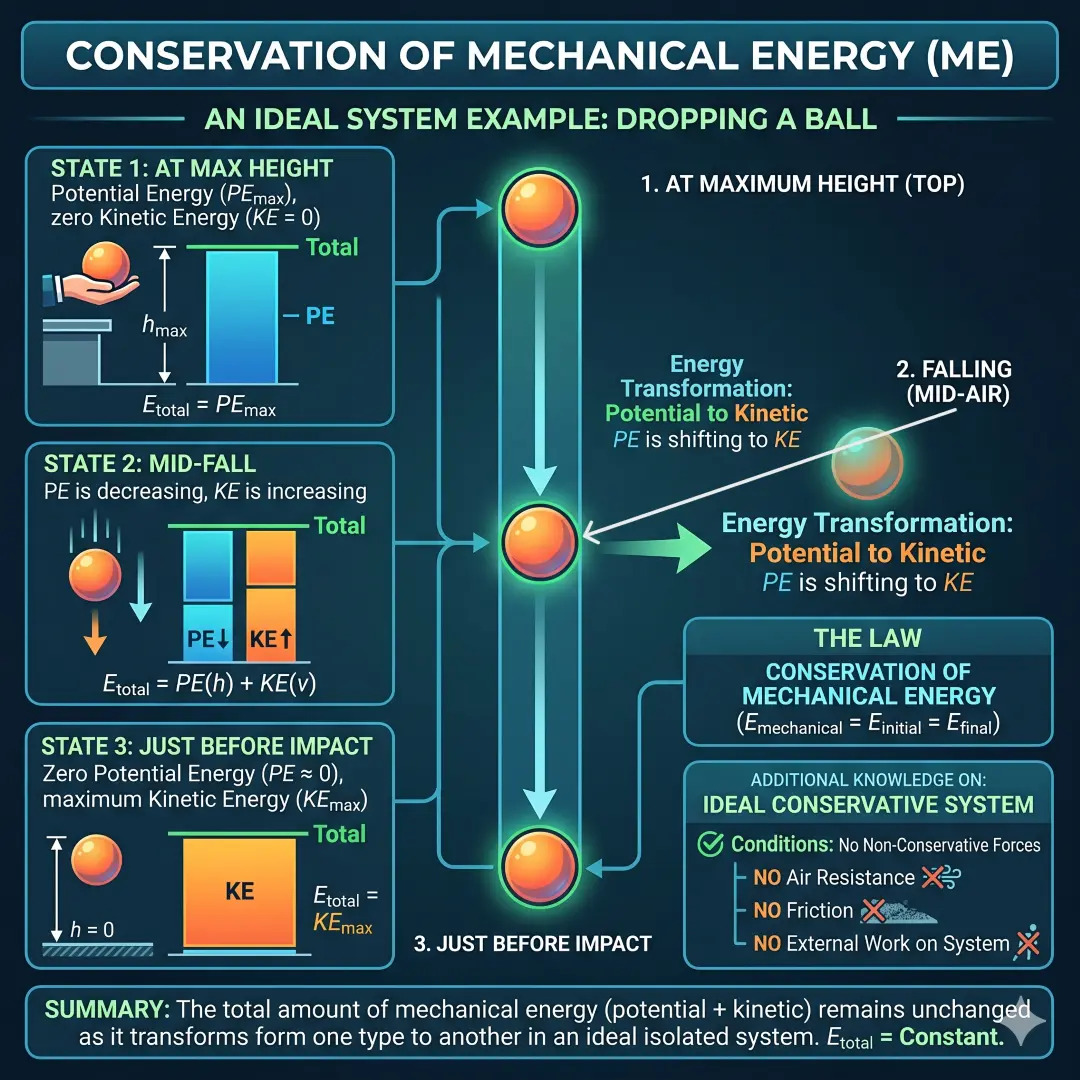
In many ideal situations, the total mechanical energy of a system also stays constant. For example, if you drop a ball, its potential energy decreases as it falls, but its kinetic energy increases. The energy is shifting from stored energy to motion energy. The total can stay the same if no energy is lost to outside effects.
But real life is not always ideal. Friction, air resistance, and deformation can turn some mechanical energy into thermal energy or sound. That does not mean energy disappears. It means the mechanical part of it becomes harder to see because it has changed into another form.
Mechanical Energy in Everyday Life
Mechanical energy is all around us, often in plain sight.
- A child on a swing is constantly changing between kinetic and potential energy.
- A rolling soccer ball has kinetic energy.
- A raised hammer has potential energy.
- A compressed spring stores elastic potential energy.
- A bicycle moving downhill turns stored gravitational potential energy into speed.
- A windmill uses moving air to create mechanical rotation.
- A car engine converts energy into mechanical motion.
These examples matter because they make the idea easier to picture. Mechanical energy is not hidden away in a lab. It is part of ordinary movement, lifting, pushing, pulling, bouncing, and spinning.
Types of Mechanical Energy
Mechanical energy is often grouped into two broad types of energy, but there are also more specific forms within those groups.
Gravitational Potential Energy
This is energy an object has because of its position in a gravitational field. The higher the object, the more energy it can store. A rock on a cliff has more gravitational potential energy than the same rock lying on the ground.
Elastic Potential Energy
This is energy stored in stretched or compressed objects. Springs, bows, rubber bands, trampolines, and diving boards are good examples. When released, they can convert that stored energy into motion.
Translational Kinetic Energy
This is the energy of an object moving from one place to another. A truck on the road or a runner on a track has this kind of energy.
Rotational Kinetic Energy
This is the energy of spinning motion. A wheel, a ceiling fan, a drill bit, or a spinning top all have rotational kinetic energy.
Vibrational Motion
Many objects also vibrate. A guitar string, a tuning fork, or a spring can oscillate and carry mechanical energy through repeated motion.
Mechanical Energy and Work
The idea of work is closely tied to mechanical energy. In physics, work is done when a force moves an object through a distance. That means work is a way of transferring mechanical energy from one object or system to another.
If you push a box across the floor, you are doing work on it. If you lift a book onto a shelf, you are doing work against gravity. If a machine moves a load, mechanical energy is being transferred. This connection between force, distance, work, and energy is one of the most important bridges in physics.
How Mechanical Energy Changes Form
Mechanical energy is rarely stuck in one form for long. It changes as objects move.
For example:
- At the top of a hill, an object has more potential energy.
- As it moves downward, potential energy decreases.
- At the same time, kinetic energy increases.
- Near the bottom, kinetic energy is usually highest.
This is why a roller coaster feels exciting. It climbs slowly, storing energy, then rushes down as stored energy turns into speed. The ride is really a controlled conversion of mechanical energy, carefully shaped by track design and gravity.
Mechanical Energy and Friction
In the real world, friction plays a huge role. Friction is a force that opposes motion, and it often converts mechanical energy into heat. That is why a sliding object slows down on a rough surface and why your hands feel warm when rubbed together.
This is an important point because many beginners think mechanical energy is lost when motion stops. But energy is not destroyed. It is transformed. Some becomes thermal energy, some may become sound, and some may deform the object itself. That is still part of the energy story.
Mechanical Energy in Machines
Machines are built to make mechanical energy useful. A lever, pulley, wheel and axle, inclined plane, gear, or screw can help move loads more efficiently by changing force, distance, or direction. These simple machines are the foundation of many larger systems.
A car engine, airplane engine, crane, and many industrial machines all involve mechanical energy at some stage. The exact energy source may differ, but the output is often motion, lifting, rotation, or force. In modern systems, energy can be transformed from solar, chemical, or electrical forms into mechanical motion.
Mechanical Energy in Sports and Human Movement
Human movement is a perfect everyday example of mechanical energy. When you jump, run, throw, kick, climb, or swing a bat, your body uses energy in very physical ways. Muscles apply force, joints move, and the body transfers energy through motion and position.
A basketball player jumping toward the hoop stores energy while crouching, then converts it into upward motion. A baseball pitcher turns body rotation into ball speed. A cyclist turns muscle power into wheel motion. All of these are examples of mechanical energy working in the real world.
Mechanical Energy and Nature
Nature is full of mechanical energy. Rivers move rocks, wind moves leaves, waves rise and fall, and animals move through space using muscle-generated mechanical energy. Even a falling apple or a swinging branch reflects the same basic physical rules.
Waterfalls are a great example. Water high on a mountain has gravitational potential energy. As it falls, that energy becomes kinetic energy. In hydroelectric systems, that motion can then be used to produce electricity. This is a beautiful example of energy changing form without disappearing.
Mechanical Energy and Power
Mechanical energy is related to power, but they are not the same thing. Energy is the ability to do work, while power is the rate at which work is done or energy is transferred. A machine can use a lot of mechanical energy, but if it uses it slowly, the power is low. If it uses the same energy quickly, the power is high.
This difference matters in real life. A crane lifting a heavy object and a person lifting a bag may both do work, but the crane can often do it much faster and with more power. That is why power ratings matter in motors, vehicles, and industrial systems.
A Closer Look at Common Formulas
Here is a practical table that shows the most useful formulas connected to mechanical energy.
Table 1: Key Mechanical Energy Formulas
| Quantity | Formula | What It Means | Common Unit |
|---|---|---|---|
| Mechanical Energy | ME = KE + PE | Total energy from motion and position | joule (J) |
| Kinetic Energy | KE = 1/2 mv² | Energy due to motion | joule (J) |
| Gravitational Potential Energy | PE = mgh | Energy due to height in gravity | joule (J) |
| Elastic Potential Energy | PE = 1/2 kx² | Energy stored in a spring or elastic object | joule (J) |
These formulas are standard in physics education and are used to analyze moving systems, falling objects, and spring motion.
Table of Real-World Examples of Mechanical Energy
Table 2: Everyday Examples
| Example | Type of Mechanical Energy | What Is Happening | Simple Explanation |
|---|---|---|---|
| A ball thrown into the air | Kinetic + Potential | It moves upward and slows down | Motion changes into stored height energy |
| A parked car on a hill | Potential Energy | It can roll downward | Height stores energy |
| A moving bicycle | Kinetic Energy | Wheels rotate and bike moves forward | Energy of motion |
| A stretched rubber band | Elastic Potential Energy | It stores energy until release | Shape stores energy |
| A swinging pendulum | Kinetic + Potential | It keeps changing position and speed | Energy moves back and forth |
| A waterfall | Potential to Kinetic | Water falls from a height | Height becomes motion |
| A compressed spring | Elastic Potential Energy | Spring is ready to rebound | Stored energy can become motion |
| A rotating fan | Rotational Kinetic Energy | Blades spin rapidly | Energy of spinning motion |
These examples make the concept much easier to remember because each one shows mechanical energy in a visible way.
Mechanical Energy in Simple Daily Activities
Everyday life is filled with small mechanical energy changes that we barely notice.
When you open a door, your hand applies force and moves the door through a distance. When you climb stairs, your body increases its gravitational potential energy. When you slide a chair across the room, you use kinetic energy and then lose some of it to friction. When you drop a spoon, gravitational potential energy quickly turns into kinetic energy.
And even ordinary actions like bouncing a ball, shaking a bottle, pulling a drawer, or winding a toy simply show the same idea. Mechanical energy is not a rare thing. It is a daily thing.
Mechanical Energy Versus Other Forms of Energy
It helps to compare mechanical energy with other major energy forms so the differences are clear.
Table 3: Mechanical Energy and Other Energy Types
| Energy Type | What It Is | Main Example | How It Differs from Mechanical Energy |
|---|---|---|---|
| Mechanical Energy | Energy of motion and position | A moving bike | Based on motion and stored position |
| Thermal Energy | Energy associated with heat | Hot water | Linked to particle motion at the microscopic level |
| Chemical Energy | Energy stored in bonds | Food, fuel | Stored in chemical structure, not motion directly |
| Electrical Energy | Energy from moving charges | Electric current | Involves charge movement, not object motion |
| Light Energy | Energy carried by electromagnetic waves | Sunlight | Travels as waves, not as mechanical motion |
| Sound Energy | Energy of vibrating matter | A ringing bell | Depends on vibrations through a medium |
This comparison shows that mechanical energy is only one part of the broader energy family, but it is one of the most visible and intuitive forms.
Mechanical Energy and the Real Meaning of Efficiency
In real machines, not all input energy becomes useful mechanical energy. Some energy is always lost to friction, heat, sound, or vibration. That is why efficiency matters. A more efficient machine turns a larger share of the input energy into useful output.
For example, a well-designed motor converts electrical energy into mechanical rotation with relatively low loss. A poorly maintained machine may waste much more energy as heat. Efficiency is one reason engineers care so much about friction, lubrication, materials, and design.
Table of Mechanical Energy Changes in Common Situations
Table 4: Energy Transformations
| Situation | Energy Before | Energy After | What Changes It |
|---|---|---|---|
| Dropping a stone | Potential | Kinetic | Gravity |
| Lifting a box | Chemical energy in muscles | Potential | Work done by a person |
| Stretching a spring | Mechanical input | Elastic Potential | Force applied to spring |
| Riding downhill | Potential | Kinetic | Gravity and slope |
| Braking a bicycle | Kinetic | Heat + Sound | Friction |
| Swinging on a swing | Potential ↔ Kinetic | Potential ↔ Kinetic | Gravity and motion |
| Operating a fan | Electrical | Mechanical motion | Motor |
| Using a hydroelectric turbine | Potential of water | Mechanical, then electrical | Falling water and turbine rotation |
This kind of transformation is one of the clearest ways to understand how mechanical energy fits into larger energy systems.
Common Misconceptions About Mechanical Energy
A lot of confusion around mechanical energy comes from small misunderstandings. Let’s clear up a few of them.
1. “Mechanical energy is only about moving things.”
Not true. Mechanical energy includes both motion and position. A still object can still have mechanical energy if it is stored at a height or under tension.
2. “Energy is lost when friction happens.”
Energy is not destroyed. It changes form, often into heat or sound. Mechanical energy may decrease, but total energy still follows conservation laws.
3. “Potential energy is not real because the object is not moving.”
Potential energy is very real. It is stored energy that can be released later. A raised weight or stretched spring may not be moving, but they can still do work.
4. “Mechanical energy is the same as all energy.”
Not at all. Mechanical energy is just one category. Energy also appears as chemical, thermal, electrical, nuclear, radiant, and more.
Table of Important Terms Related to Mechanical Energy
Table 5: Key Vocabulary
| Term | Meaning | Why It Matters |
|---|---|---|
| Mechanical energy | Energy from motion and position | Main topic |
| Kinetic energy | Energy of motion | Shows how fast or strongly something moves |
| Potential energy | Stored energy | Explains energy waiting to be released |
| Gravitational potential energy | Energy due to height | Important for falling objects and hills |
| Elastic potential energy | Energy stored in stretched or compressed objects | Important in springs and rubber bands |
| Work | Energy transfer by force through distance | Connects force and energy |
| Friction | Force that opposes motion | Turns mechanical energy into heat |
| Power | Rate of doing work | Tells how quickly energy is used |
| Conservation of energy | Energy cannot be created or destroyed | Core law behind energy changes |
| Efficiency | Useful output divided by input | Shows how well a machine uses energy |
These terms form the vocabulary of mechanical energy and help connect the topic to the rest of physics.
Mechanical Energy in Technology and Modern Life
Modern technology depends heavily on mechanical energy. Motors turn electrical energy into motion. Engines turn fuel energy into movement. Generators do the reverse, converting mechanical motion into electrical energy. This back-and-forth conversion is central to the way civilization runs.
A solar-powered aircraft, for example, uses sunlight to produce electricity, and then that electricity drives a motor that produces mechanical motion. That chain of conversion shows how different forms of energy work together in practical systems.
In wind turbines, moving air creates rotational motion. That rotation is mechanical energy, and it can then be converted into electricity. In hydroelectric power, falling water spins turbines in much the same way. These are not just textbook examples. They are major parts of the world’s energy systems.
Mechanical Energy and the Human Body
The human body is a machine in many ways. Muscles convert chemical energy from food into mechanical movement. When you walk, climb, lift, chew, breathe, or even blink, your body is using energy to create motion.
This is one reason nutrition, exercise, and movement are so closely linked. The food you eat stores chemical energy. Your body turns that energy into the mechanical energy needed for motion. That same motion may then become heat, help you do work, or move you through space.
A Practical Example: The Falling Ball
A falling ball is one of the best ways to understand mechanical energy.
At the top, the ball has more gravitational potential energy because it is high up. As it falls, gravity pulls it downward. Its potential energy decreases, and its kinetic energy increases. Right before it hits the ground, most of its mechanical energy is in the form of motion.
If the ball bounces, some of its energy is temporarily stored as elastic potential energy when it compresses on impact. But because no real collision is perfectly efficient, some energy is also lost as sound and heat. That is why the ball does not bounce forever.
A Practical Example: The Swing
A swing is another clean example. At the highest point, the child has more potential energy and less kinetic energy. As the swing moves downward, the potential energy turns into kinetic energy. At the bottom, speed is greatest. Then the process reverses on the other side.
This back-and-forth motion continues because energy keeps changing between forms. In a perfect system, it would continue forever. In the real world, air resistance and friction at the pivot slowly reduce the motion unless someone pushes again.
Mechanical Energy and Springs
Springs are one of the clearest examples of elastic potential energy. When you compress or stretch a spring, you are storing energy in its shape. Once released, the spring returns to its original form and releases that stored energy as motion.
This idea is used in many devices, including clocks, toys, shock absorbers, and mechanical tools. Springs are useful because they can store energy compactly and release it predictably. That makes them simple but powerful mechanical components.
Mechanical Energy in Design and Engineering
Engineers spend a lot of time thinking about how to manage mechanical energy. A bridge must handle moving loads. A machine must transfer motion without wasting too much energy. A vehicle must turn fuel or electricity into movement in a controlled and efficient way.
Good design often means reducing unwanted friction, controlling vibrations, improving efficiency, and using the right materials. A well-designed system can move energy where it is needed while limiting losses. That is why mechanical energy is not only a physics idea. It is a design principle.
Why Students Should Learn Mechanical Energy
Students often meet mechanical energy early in science, and for good reason. It teaches a simple but deep idea. Energy is not just a thing that exists. It moves, changes form, and helps explain the behavior of objects around us.
Once students understand mechanical energy, many other topics become easier. Motion, force, gravity, work, power, machines, and conservation laws all start to connect. That connection is what makes physics feel organized instead of random.
Table of Quick Study Notes
Table 6: Fast Revision Guide
| Question | Answer |
|---|---|
| What is mechanical energy? | Energy due to motion and position |
| What are the two main forms? | Kinetic energy and potential energy |
| What is kinetic energy? | Energy of motion |
| What is potential energy? | Stored energy due to height, shape, or position |
| What unit is used? | Joule (J) |
| What happens with friction? | Some mechanical energy turns into heat and sound |
| Is energy destroyed? | No, it changes form |
| Where do we see mechanical energy? | In cars, swings, springs, balls, machines, and nature |
This kind of summary is useful because it lets readers review the whole topic quickly after reading the full explanation.
The Bigger Picture
Mechanical energy may seem simple at first, but it sits at the center of a much bigger scientific story. It helps explain how objects move, how machines work, how living bodies act, and how energy flows through systems. It also reminds us that the world is not built from separate pieces that never interact. Everything is connected through forces and energy changes.
A stone on a hill, a child on a swing, a spinning fan, a falling leaf, a compressed spring, a moving train, and a turning turbine all follow the same basic rules. That is the quiet beauty of mechanical energy. It is simple enough for beginners and deep enough for serious study.
Final Thoughts
Mechanical energy is one of the clearest ways to understand how the physical world works. It ties together motion, position, force, work, gravity, springs, machines, and energy conservation in one easy framework. Once you understand it, you start seeing it everywhere. That is what makes it such an important part of science.
It is also practical. Mechanical energy explains how people move, how vehicles travel, how machines operate, and how natural systems behave. It is not just a definition to memorize. It is a way to understand the real world in a smarter and more connected way.
If you look closely, mechanical energy is everywhere. In a child jumping rope. In water falling over a cliff. In a wheel turning. In a spring snapping back. In a bicycle rolling home. And once you notice it, the world starts to look a little more ordered, a little more logical, and a lot more interesting.
Article References and Sources
- OpenStax: Mechanical Energy and Conservation of Energy
- OpenStax: Work, Power, and the Work-Energy Theorem
- OpenStax: Conservation of Energy (College Physics)
- OpenStax: Sources of Energy (University Physics)
- Encyclopaedia Britannica: Energy (Science Overview)
- Encyclopaedia Britannica: Energy Conversion and Conservation
- Britannica Kids: Conservation of Energy
- Britannica Kids: Energy (Student Resource)
- Britannica Kids: Energy (Kids Version)
- Energy Education: Potential Energy
- Energy Education: Work
- Energy Education: Mechanical Power
- Energy Education: Simple Machines
- Energy Education: Mechanical Equivalent of Heat
- Khan Academy: Types of Energy
Also, Read these Articles in Detail
- Physics and Its Fundamentals With Good Explanations
- Matter, Motion, and Energy: The Core Ideas of Physics
- What Is Matter? The Physical Substance of the Universe
- What Is Motion? A Guide to Motion in Physics and Daily Life
- What Is Energy? The Invisible Power Behind Everyday Life
- Kinetic Energy Explained in Simple Language
- Potential Energy: Definition, Types, Formula, and Examples
- Thermal Energy: Heat, Temperature, and Transfer
Frequently Asked Questions
FAQ 1: What is mechanical energy, and why is it important?
Mechanical energy is the energy an object has because of its motion and position. That sounds simple, but it covers a huge part of everyday life. If something is moving, it has kinetic energy. If something is stored at a height, stretched, or compressed, it has potential energy. Mechanical energy is the total of those two forms.
This idea matters because it helps explain how the world works in a very practical way. A rolling ball, a swinging pendulum, a raised book, a moving car, and a stretched rubber band all show mechanical energy in different forms. The object may not look powerful at first, but it still has energy stored in its motion or position.
Mechanical energy is also important because it connects many big science ideas. It helps explain force, work, gravity, motion, friction, and energy conservation. Once you understand mechanical energy, many other physics concepts become much easier to follow. For example, when a ball falls, its potential energy changes into kinetic energy. When a spring snaps back, stored energy becomes motion. When a machine turns, mechanical energy is at work.
In real life, mechanical energy is everywhere. It is in vehicles, sports, tools, machines, rivers, wind, and even the movement of your own body. When you walk, jump, lift, or push something, you are using mechanical energy in a very direct way. That is why this topic is not just a science lesson. It is a way to understand the physical world more clearly.
And the best part is that mechanical energy is easy to observe. You do not need a complicated lab to see it. You can watch it happen in a swing, a bicycle, a waterfall, or even a bouncing ball. That makes it one of the most useful and relatable ideas in physics.
FAQ 2: What are the two main types of mechanical energy?
The two main types of mechanical energy are kinetic energy and potential energy. These two forms work together constantly in the real world, and most examples of mechanical energy involve both of them in some way.
Kinetic energy is the energy of motion. Any object that is moving has kinetic energy. A running child, a spinning fan, a flying bird, a moving train, and a rolling football all have kinetic energy. The faster the object moves, the more kinetic energy it has. Mass also matters. A heavy object moving at the same speed as a light one will usually have more kinetic energy.
Potential energy is stored energy. It is energy that an object has because of its position or shape. The most common type is gravitational potential energy, which depends on height. A book on a shelf, water stored behind a dam, or a rock at the top of a hill all have gravitational potential energy. Another important type is elastic potential energy, which is stored in stretched or compressed objects like springs and rubber bands.
These two types often change into each other. A ball lifted into the air has more potential energy at the top. As it falls, that potential energy turns into kinetic energy. A stretched spring stores potential energy until it is released, and then it becomes motion. A swing also moves back and forth between the two.
This change is one of the clearest examples of how energy works in physics. Mechanical energy is not fixed in one form. It is always shifting, depending on what the object is doing. That is why kinetic and potential energy are so closely connected. They are different, but they are part of the same larger story.
FAQ 3: How do you calculate mechanical energy?
Mechanical energy is calculated by adding kinetic energy and potential energy together.
The basic formula is:
Mechanical Energy = Kinetic Energy + Potential Energy
Or:
ME = KE + PE
To calculate it properly, you first need to know the type of system you are studying. If an object is moving, you calculate kinetic energy using the formula:
KE = 1/2 mv²
Here, m means mass and v means velocity.
If an object is at a height in a gravitational field, you calculate gravitational potential energy using:
PE = mgh
Here, m is mass, g is gravitational acceleration, and h is height.
If the object is a spring or something elastic, you may use:
PE = 1/2 kx²
Here, k is the spring constant and x is the amount of stretch or compression.
What makes mechanical energy useful is that you can measure it in real situations. For example, if you know the mass of a ball and its speed, you can find its kinetic energy. If you know how high it is above the ground, you can find its potential energy. Then you combine them to find total mechanical energy.
This is helpful in physics, engineering, sports, and machine design. It lets people predict motion, compare systems, and understand how energy changes in different conditions. And even though the formulas look simple, they describe very real and powerful ideas.
FAQ 4: What is the difference between kinetic energy and potential energy?
The difference is straightforward, but it is one of the most important ideas in physics.
Kinetic energy is the energy of motion. It exists when an object is moving. The faster it moves, the greater its kinetic energy. A speeding bicycle, a flying airplane, or a spinning wheel all have kinetic energy.
Potential energy is stored energy. It exists when an object has the potential to move later because of its position, shape, or condition. A lifted stone has gravitational potential energy. A stretched rubber band has elastic potential energy. The energy is not being used yet, but it is ready to be released.
A simple way to remember the difference is this. Kinetic energy is active energy. Potential energy is waiting energy.
Here is a practical example. Imagine a ball resting on a shelf. It has potential energy because of its height. Now imagine that same ball falling to the floor. As it moves, its potential energy decreases and its kinetic energy increases. Right before it hits the ground, most of its mechanical energy is in motion.
Both forms matter equally. One is not better than the other. In fact, most physical systems involve a constant exchange between the two. That exchange is what makes so many movements in nature and technology possible.
And this is why the two terms are often taught together. They are different, but they work like partners.
FAQ 5: Where do we see mechanical energy in everyday life?
You see mechanical energy all around you, even if you do not notice it right away.
A person walking has mechanical energy because the body is moving. A bicycle rolling down a road has kinetic energy. A book placed on a high shelf has potential energy. A stretched rubber band stores elastic potential energy. A fan blade spinning has rotational kinetic energy. A child on a swing keeps changing between potential and kinetic energy. A waterfall turns stored energy into moving water.
Mechanical energy also shows up in simple home activities. When you open a door, push a chair, pull a drawer, or throw a ball, you are using force to create motion. When you climb stairs, your body uses energy to gain height. When you jump, your legs turn stored chemical energy from food into mechanical motion.
Outside the home, the examples are just as common. Cars, buses, trains, cranes, elevators, drills, turbines, and power tools all rely on mechanical energy. Even nature uses it constantly. Wind moves trees. Rivers carry rocks. Waves move across the sea. Animals run, fly, swim, and jump using mechanical energy too.
This is why mechanical energy is such a useful topic. It is not hidden in a textbook. It is part of daily life. Once you start looking for it, you will notice it everywhere.
FAQ 6: How does mechanical energy change form?
Mechanical energy changes form all the time. That is one of its most interesting features.
A very common example is a falling object. At the top, it has more potential energy because of its height. As it falls, gravity pulls it downward. The potential energy decreases, and the kinetic energy increases. The object speeds up because stored energy is becoming motion.
A swing works the same way. At the highest point, it has more potential energy and less kinetic energy. As it moves downward, the potential energy turns into motion. At the lowest point, the swing is moving fastest, so kinetic energy is highest. Then the process reverses as it rises again.
A spring does something similar. When you compress or stretch it, you store elastic potential energy. When you release it, that stored energy becomes motion.
In real life, some mechanical energy also turns into heat and sound because of friction or impact. A bouncing ball loses some energy with every bounce. A sliding box slows down because friction takes mechanical energy and changes it into thermal energy. But the total energy is still conserved. It just changes form.
This transformation is one of the most important lessons in physics. Energy does not vanish. It moves, shifts, and changes shape. Mechanical energy is one of the clearest places where you can watch that happen.
FAQ 7: What role does friction play in mechanical energy?
Friction plays a very important role in mechanical energy because it changes the way motion behaves.
Friction is a force that opposes motion. When objects rub against each other, some of their mechanical energy is converted into heat. That is why a moving object on a rough surface slows down. It is also why your hands feel warm when you rub them together. Mechanical energy is not destroyed. It is transformed into another form of energy.
This matters in almost every real-world situation. A bicycle tire on the road, a car braking, a box sliding across the floor, and even a machine with moving parts all deal with friction. Sometimes friction is useful. For example, it helps you walk without slipping. It helps brakes stop a car. It helps a pencil write on paper.
But friction can also waste energy. In machines, it can reduce efficiency, create heat, and cause wear and tear. That is why engineers work hard to reduce unnecessary friction through lubrication, better materials, and improved design.
Without friction, many things would not work properly. But with too much friction, energy gets lost too quickly. So the goal is often balance. You want enough friction where it helps, and as little as possible where it causes loss.
This is one reason mechanical energy in the real world is different from the neat, ideal examples in textbooks. Real systems always deal with friction, and that makes the study of energy more realistic and more interesting.
FAQ 8: What is the relationship between mechanical energy and work?
Work and mechanical energy are closely connected. In physics, work happens when a force moves an object through a distance. That means work is a way of transferring energy.
If you lift a box onto a shelf, you do work against gravity. That work increases the box’s potential energy. If you push a ball across the floor, you do work on it and give it kinetic energy. If a machine lifts, turns, or moves something, work is being done and mechanical energy is being transferred.
This connection is important because it explains how energy enters or leaves a system. Work is not just about effort. It is about energy transfer in motion. That is why the study of work and mechanical energy often appears together in physics.
You can think of it this way. Mechanical energy is what an object has. Work is how that energy is changed or moved around. A person pushing a swing is doing work. A falling object is doing work through gravity. A spring is doing work when it pushes back after being compressed.
This relationship is one of the foundations of classical mechanics. It helps explain how forces cause motion and how energy flows from one object to another. Once you understand work, mechanical energy becomes much easier to understand too.
FAQ 9: Why is mechanical energy important in machines and technology?
Mechanical energy is essential in machines and technology because many devices exist to create, control, or transfer motion.
A machine often takes one type of energy and turns it into mechanical motion. A motor converts electrical energy into spinning motion. An engine converts fuel energy into movement. A turbine uses moving water or air to turn blades. A crane lifts heavy loads using mechanical force. A pump moves water. A drill spins a bit. A fan moves air.
All of these are examples of mechanical energy in action. The machine does not create energy from nothing. It transforms energy from one form into another and uses that energy to do useful work.
This is also why engineers care so much about efficiency. Some energy is always lost as heat, sound, or friction. A good machine minimizes those losses and uses as much of the input energy as possible for the intended motion.
Mechanical energy is also important in design. When engineers build bridges, vehicles, elevators, turbines, or industrial systems, they must think about forces, motion, stress, and energy transfer. They need to know how much energy is involved, where it goes, and how it behaves under real conditions.
So mechanical energy is not just a school concept. It is a working principle behind much of modern life. Without it, machines would not move, systems would not function, and technology would not work the way it does.
FAQ 10: How can I understand mechanical energy more easily with real-life examples?
The easiest way to understand mechanical energy is to connect it to things you already know and see every day.
Start with a simple object like a ball. If the ball is sitting still on the ground, it has very little mechanical energy in motion. If you lift it to a table, it gains potential energy. If you throw it, it gains kinetic energy. If you drop it, you can watch one type change into the other.
Now think about a swing. At the top, the swing has more potential energy. At the bottom, it has more kinetic energy. That back-and-forth change gives you a clear picture of how energy moves.
A rubber band is another easy example. When it is relaxed, it stores little elastic energy. When you stretch it, energy is stored in its shape. When released, that stored energy becomes motion. A spring works the same way.
You can also think about hills and roads. A car parked on a hill has more gravitational potential energy than the same car parked on flat ground. If the brakes are off, the car may roll downhill because stored energy is turning into motion.
And do not forget your own body. When you walk, run, jump, climb stairs, or throw something, you are using mechanical energy every time. Your muscles convert chemical energy from food into motion. That is a direct and very personal example.
The more examples you collect, the easier the idea becomes. Mechanical energy is not abstract when you see it in action. It is visible in movement, position, and everyday change. Once you notice it, the concept starts to feel very natural.
