

Part 1:
Every modern democracy depends on a fair and impartial public administration. Governments make decisions that affect millions of people every day. From maintaining law and order to delivering healthcare, education, transportation, and public welfare, government employees perform essential duties that directly influence people’s lives. Because of this, the process of recruiting people into public service must be transparent, fair, and free from discrimination.
This is where Article 16 of the Constitution of India becomes one of the most significant Fundamental Rights. It guarantees that every eligible citizen has an equal opportunity to compete for employment or appointment under the State. The Article seeks to eliminate unfair barriers and ensure that government jobs are awarded on lawful and constitutional principles rather than favoritism, prejudice, or arbitrary decisions.
Unlike many constitutional provisions that remain largely theoretical, Article 16 has a direct impact on millions of individuals. Every year, countless candidates apply for positions in government departments, public sector organizations, educational institutions, police services, armed forces, courts, municipal bodies, and other public authorities. The constitutional promise of equality in public employment affects each of these recruitment processes.
But equality doesn’t always mean treating everyone in the same way. Society often contains historical inequalities that prevent certain communities from competing on an equal footing. Recognizing this reality, the Constitution also permits carefully designed affirmative measures, including reservations for specific socially and educationally disadvantaged groups. This creates a careful balance between formal equality and substantive equality.
Understanding Article 16 therefore requires more than simply reading its text. It requires an appreciation of constitutional values, judicial interpretation, public policy, and the continuing effort to create a more inclusive and efficient public administration.
Table of Contents
What Is Article 16?
Article 16 forms part of Part III of the Constitution of India, which contains the country’s Fundamental Rights.
Its central purpose is simple.
Every citizen should have an equal opportunity to compete for employment or appointment under the State.
This protection extends to recruitment, selection, appointment, promotion in specified circumstances, and other service matters wherever the Constitution or law makes Article 16 applicable.
The Article prevents the government from making employment decisions solely because of a person’s:
- Religion
- Race
- Caste
- Sex
- Descent
- Place of birth
- Residence except where constitutionally permitted
- Any combination of these grounds
Instead, recruitment should be based on constitutional principles, merit where applicable, eligibility conditions established by law, and legitimate administrative requirements.

Where Does Article 16 Fit Within the Constitution?
| Constitutional Feature | Description |
|---|---|
| Part | Part III |
| Category | Fundamental Rights |
| Broad Theme | Equality |
| Main Objective | Equal opportunity in public employment |
| Beneficiaries | Citizens |
| Applies To | Employment under the State |
| Nature | Fundamental constitutional guarantee |
Why Was Article 16 Necessary?
Before independence, public employment often reflected social hierarchies, colonial priorities, and unequal access to education and opportunity.
Many talented individuals faced barriers because of:
- Caste
- Religion
- Gender
- Regional identity
- Social status
- Economic conditions
- Traditional occupations
- Discriminatory administrative practices
The Constitution sought to replace these inequalities with a framework based on justice and equal opportunity.
Article 16 therefore became a constitutional safeguard ensuring that public offices belong to all citizens rather than a privileged few.

Constitutional Philosophy Behind Article 16
The Constitution is founded on several guiding ideals.
Among the most important are:
- Justice
- Equality
- Liberty
- Fraternity
- Human dignity
- Rule of law
- Democratic governance
Article 16 reflects each of these values.
If access to government employment depends upon birth rather than ability, democracy weakens.
If appointments depend upon favoritism rather than constitutional standards, public confidence declines.
If capable citizens are denied opportunities because of discrimination, society loses valuable talent.
Article 16 attempts to prevent each of these outcomes.

Relationship Between Articles 14, 15, and 16
Although these Articles are closely connected, each performs a different constitutional function.
| Article | Primary Purpose | Area Covered |
|---|---|---|
| Article 14 | Equality before law and equal protection of laws | General application |
| Article 15 | Prohibits discrimination in specific public and social contexts | Access to public places, education, welfare measures |
| Article 16 | Equality of opportunity in government employment | Public employment |
Together they create a broad constitutional framework promoting equality throughout public life.
Meaning of Equality of Opportunity
Equality of opportunity doesn’t guarantee identical outcomes.
Instead, it guarantees that every eligible citizen begins the recruitment process under constitutionally fair conditions.
For example:
Imagine that a government department announces recruitment for administrative officers.
Three candidates apply.
- Candidate A belongs to a wealthy family.
- Candidate B comes from a rural background.
- Candidate C belongs to a historically disadvantaged community.
Article 16 requires that the recruitment process be conducted fairly according to constitutional principles. Every applicant who satisfies the eligibility criteria must receive an equal chance to compete.
Objectives of Article 16
Some of the major objectives include:
- Protect fairness in government recruitment.
- Eliminate discrimination.
- Encourage merit within constitutional limits.
- Improve public administration.
- Build public confidence.
- Promote social justice.
- Ensure equal access to public offices.
- Strengthen democracy.
- Protect constitutional morality.
- Maintain administrative integrity.

Who Can Claim Protection Under Article 16?
Unlike some Fundamental Rights that extend to all persons, Article 16 primarily protects citizens.
The protection applies to eligible citizens seeking employment under the State.
This includes recruitment in:
- Central Government
- State Governments
- Union Territories
- Constitutional authorities
- Government departments
- Public sector undertakings in applicable situations
- Government educational institutions
- Local authorities
- Statutory bodies
- Other public authorities covered by constitutional principles

Meaning of ‘Employment Under the State’
The expression “State” has a broad constitutional meaning.
It generally includes:
- Central Government
- State Governments
- Parliament
- State Legislatures
- Government departments
- Municipal authorities
- Panchayats
- Constitutional authorities
- Public authorities performing governmental functions
- Various statutory institutions
Private companies generally do not fall within this category unless specific legal circumstances require otherwise.
Important Features of Article 16
| Feature | Explanation |
|---|---|
| Fundamental Right | Constitutionally protected |
| Citizen-centric | Available mainly to citizens |
| Employment focused | Applies to public employment |
| Anti-discrimination | Prevents prohibited discrimination |
| Supports merit | Encourages fair competition |
| Allows affirmative action | Certain reservations permitted |
| Judicially enforceable | Can be enforced through constitutional remedies |
Clause-by-Clause Explanation of Article 16
Article 16 contains several clauses.
Each serves a distinct constitutional purpose.
Article 16(1): Equality of Opportunity for All Citizens
The first clause states that there shall be equality of opportunity for all citizens in matters relating to employment or appointment to any office under the State.
This provision creates the foundation of public employment law.
It emphasizes that every eligible citizen should have a fair opportunity to compete.
The guarantee extends to matters such as:
- Recruitment
- Initial appointment
- Selection procedures
- Competitive examinations
- Interview processes
- Consideration for appointment
- Other employment matters governed by constitutional principles
It seeks to eliminate arbitrary barriers while encouraging fairness and transparency.

Practical Meaning of Article 16(1)
Suppose a government department advertises vacancies for engineers.
Eligibility includes:
- Engineering degree
- Required age
- Prescribed examination
- Medical fitness
Anyone satisfying these conditions should receive a fair opportunity to compete.
The department cannot unlawfully reject applicants merely because they belong to a particular religion or caste.
Examples of Article 16(1)
Example 1
A public university advertises teaching posts.
Every qualified citizen meeting the educational requirements can apply.
This reflects equality of opportunity.
Example 2
A State Public Service Commission conducts examinations using identical standards for all eligible candidates.
This supports Article 16(1).
Example 3
A government department publicly announces vacancies instead of secretly appointing individuals without competition.
This promotes constitutional fairness.
Key Principles Emerging from Article 16(1)
- Equal opportunity does not eliminate reasonable eligibility conditions.
- Merit remains important.
- Recruitment should be transparent.
- Arbitrary exclusion is unconstitutional.
- Public offices are not private property.
- Government employment must serve public interest.
Article 16(2): Protection Against Discrimination
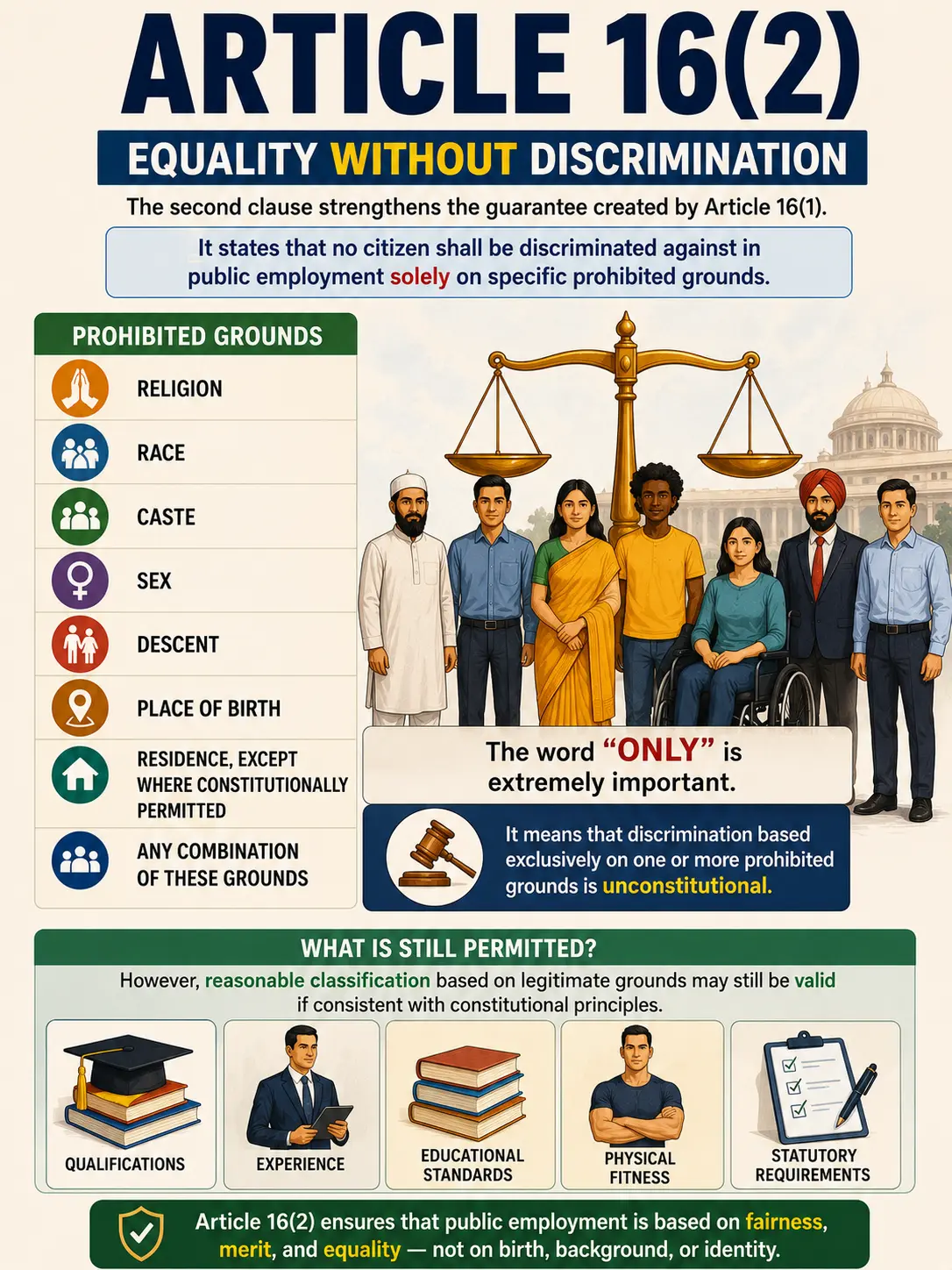
The second clause strengthens the guarantee created by Article 16(1).
It states that no citizen shall be discriminated against in public employment solely on specific prohibited grounds.
These include:
- Religion
- Race
- Caste
- Sex
- Descent
- Place of birth
- Residence, except where constitutionally permitted
- Any combination of these grounds
The word “only” is extremely important.
It means that discrimination based exclusively on one or more prohibited grounds is unconstitutional.
However, reasonable classification based on legitimate qualifications, experience, educational standards, physical fitness, or statutory requirements may still be valid if consistent with constitutional principles.
Illustrations of Article 16(2)
Illustration 1
A qualified applicant is rejected solely because of religion.
This violates Article 16(2).
Illustration 2
A recruitment authority refuses to consider women for a post despite there being no lawful exclusion.
Such action may violate constitutional guarantees unless supported by valid legal provisions.
Illustration 3
An applicant is denied consideration only because of caste.
This would ordinarily conflict with Article 16(2).
Difference Between Article 16(1) and Article 16(2)
| Basis | Article 16(1) | Article 16(2) |
|---|---|---|
| Main purpose | Equality of opportunity | Prohibition of discrimination |
| Nature | Positive guarantee | Negative prohibition |
| Focus | Fair competition | Preventing unfair exclusion |
| Coverage | Employment opportunities | Discriminatory treatment |
| Objective | Equal access | Equal treatment |
Equality Does Not Mean Identical Treatment
This is one of the most misunderstood aspects of constitutional law.
True equality sometimes requires recognizing real social disadvantages.
For example, two candidates may appear equal on paper.
Yet one may have studied in well-equipped schools with extensive resources, while another may have overcome generations of social disadvantage with limited access to education.
The Constitution therefore balances equality with social justice through carefully designed provisions, which are discussed in the later clauses of Article 16.
Merit and Equality Can Coexist
A common misconception is that equality and merit are always in conflict.
In reality, the Constitution seeks to combine both.
Public employment should be:
- Fair
- Transparent
- Efficient
- Inclusive
- Constitutionally compliant
The goal is not simply to appoint the highest-scoring candidate in every circumstance, but to create a public service that reflects constitutional values while maintaining administrative efficiency.
Key Takeaways from Part 1
- Article 16 guarantees equality of opportunity in public employment.
- It is a Fundamental Right contained in Part III of the Constitution.
- Article 16(1) establishes equal opportunity for eligible citizens.
- Article 16(2) prohibits discrimination on specified constitutional grounds.
- The Article applies to employment under the State.
- Equality under Article 16 promotes fairness, transparency, accountability, and public confidence.
- The Constitution balances equality with social justice, which becomes even more evident in the later clauses of Article 16.
In Part 2, we’ll examine Article 16(3), Article 16(4), Article 16(4A), Article 16(4B), Article 16(5), and Article 16(6) in depth. We’ll also explore reservations in public employment, Economically Weaker Sections (EWS), reservations in promotion, backlog vacancies, domicile requirements, constitutional amendments, practical illustrations, and detailed comparison tables.
Part 2
Understanding the Balance Between Equality and Social Justice
In Part 1, we learned that Article 16(1) guarantees equality of opportunity in public employment and Article 16(2) prohibits discrimination on specific grounds such as religion, race, caste, sex, descent, place of birth, and residence except where the Constitution itself permits otherwise.
These provisions seem to suggest that every citizen must always be treated exactly the same during recruitment. But the Constitution adopts a more practical and balanced approach.
The framers recognized that India had inherited centuries of social inequality, educational disadvantages, and limited access to opportunities for many communities. If the Constitution simply declared everyone equal without addressing these historical disadvantages, genuine equality might never become a reality.
For this reason, the Constitution allows certain carefully designed exceptions that promote substantive equality rather than merely formal equality.
The remaining clauses of Article 16 create this constitutional balance.
Article 16(3): Residence Requirement for Certain Public Employment
Text and Purpose
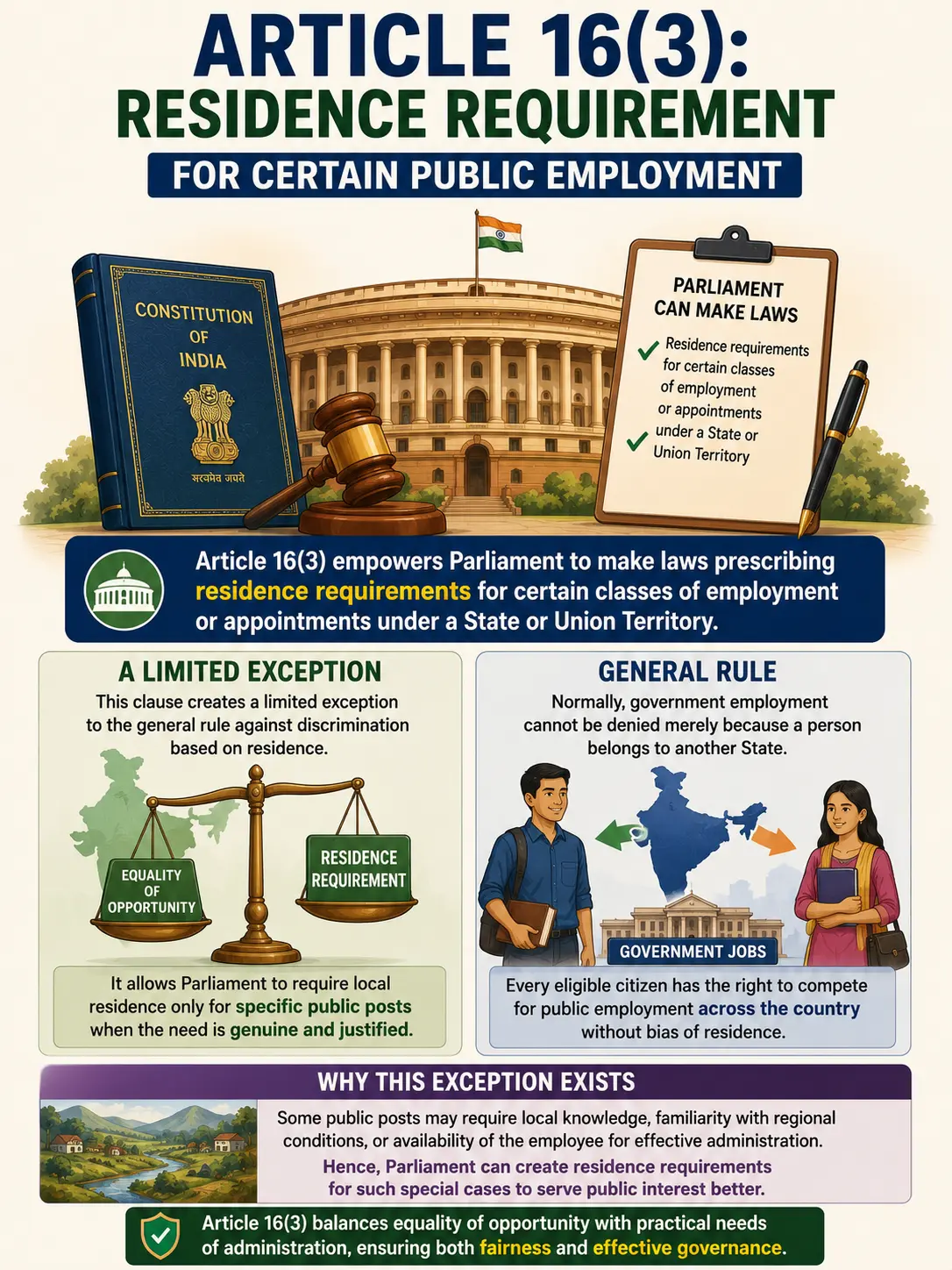
Article 16(3) empowers Parliament to make laws prescribing residence requirements for certain classes of employment or appointments under a State or Union Territory.
This clause creates a limited exception to the general rule against discrimination based on residence.
Normally, government employment cannot be denied merely because a person belongs to another State.
However, Parliament may determine that specific public posts require local residence due to unique administrative or regional circumstances.
Why Was Article 16(3) Included?
India is a vast country with enormous geographical, cultural, and linguistic diversity.
Some government posts require employees who:
- Understand local customs.
- Speak regional languages.
- Are familiar with local administrative conditions.
- Can effectively serve remote communities.
- Possess knowledge of local geography.
The Constitution therefore allows Parliament to prescribe residence requirements in carefully defined situations.
This power is not available to individual State Governments unless authorized by parliamentary legislation.
Key Features of Article 16(3)
| Feature | Explanation |
|---|---|
| Constitutional purpose | Limited exception regarding residence |
| Law-making authority | Parliament only |
| Applies to | Certain public employment |
| Objective | Meet administrative and regional needs |
| Nature | Exception to the general rule of equality |
Illustrative Example
Imagine a government creates specialized administrative posts for extremely remote tribal regions where employees must communicate in a local language and remain stationed in isolated areas for extended periods.
If Parliament has enacted a law permitting residence requirements for such posts, those requirements may be constitutionally valid.
Without parliamentary authorization, a State generally cannot impose such restrictions solely on its own.
Important Points About Article 16(3)
- It is an exception, not the general rule.
- Parliament alone has this constitutional power.
- Residence requirements must have legal authority.
- The provision does not permit arbitrary discrimination.
- Every restriction must satisfy constitutional standards.
Article 16(4): Reservation for Backward Classes
One of the Most Significant Clauses
Among all the clauses of Article 16, Clause (4) has generated the greatest constitutional discussion.
It provides that nothing in Article 16 prevents the State from making provisions for reservation in appointments or posts in favor of any backward class of citizens that, in the opinion of the State, is not adequately represented in public services.
This clause reflects the Constitution’s commitment to social justice.
Why Was Article 16(4) Necessary?
Equal opportunity alone may not eliminate inequalities that have developed over generations.
Many communities historically experienced:
- Limited educational opportunities.
- Social exclusion.
- Economic hardships.
- Occupational restrictions.
- Lack of political representation.
- Restricted access to government employment.
Article 16(4) allows the State to address these structural disadvantages through reservation policies where constitutional conditions are satisfied.
Conditions for Applying Article 16(4)
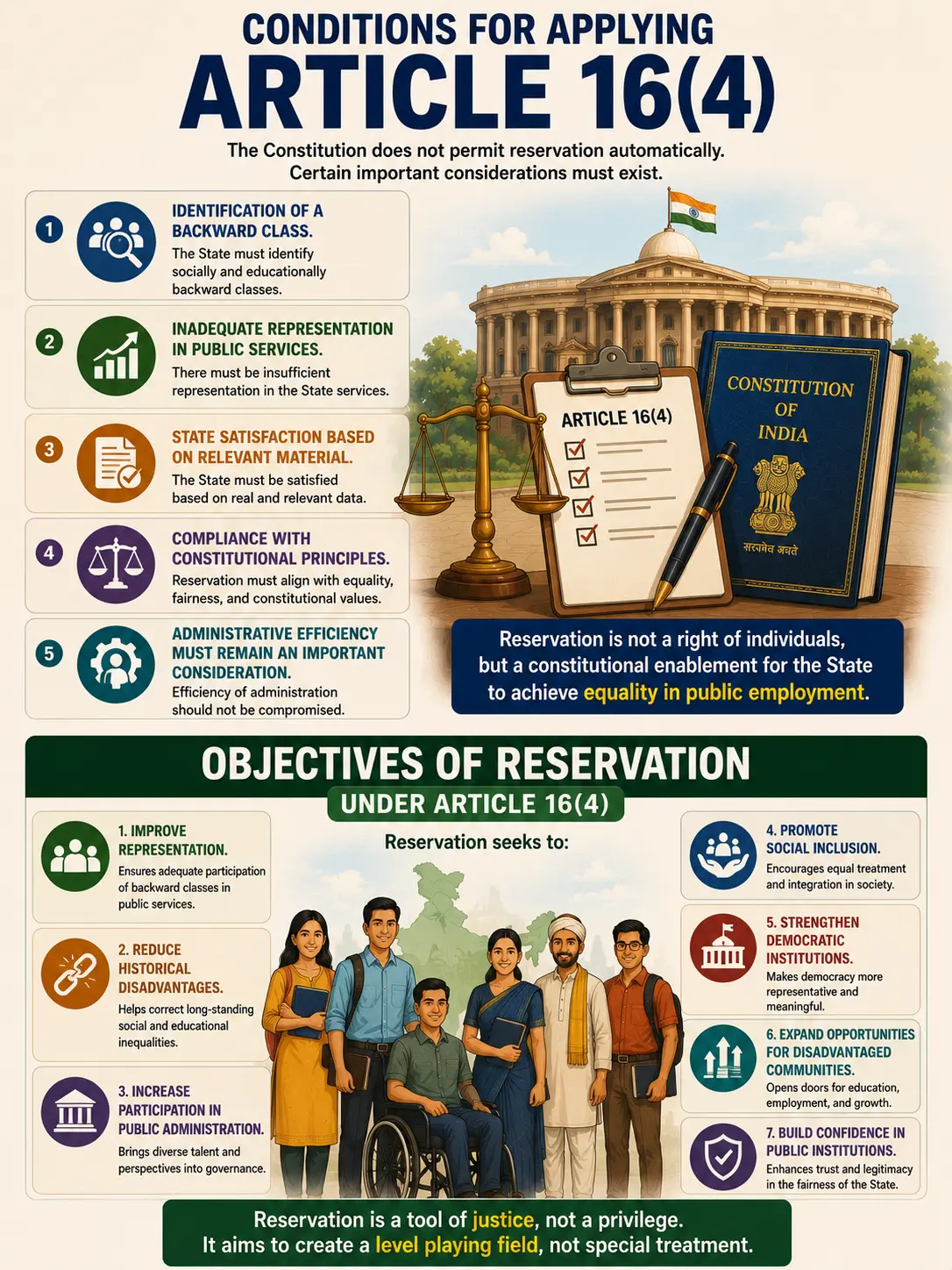
The Constitution does not permit reservation automatically.
Certain important considerations must exist.
These include:
- Identification of a backward class.
- Inadequate representation in public services.
- State satisfaction based on relevant material.
- Compliance with constitutional principles.
- Administrative efficiency must remain an important consideration.
Objectives of Reservation Under Article 16(4)
Reservation seeks to:
- Improve representation.
- Reduce historical disadvantages.
- Increase participation in public administration.
- Promote social inclusion.
- Strengthen democratic institutions.
- Expand opportunities for disadvantaged communities.
- Build confidence in public institutions.
Examples of Reservation
Reservation may apply to eligible candidates belonging to constitutionally recognized categories, subject to prevailing laws and judicial decisions.
Illustration:
Suppose a department announces 500 vacancies.
If reservation policies apply under constitutional and statutory provisions, a specified number of posts may be reserved for eligible candidates belonging to identified categories while the remaining posts remain open for general competition.
Every candidate must still satisfy the prescribed eligibility conditions.
Reservation does not eliminate educational qualifications or other essential requirements.
Reservation Is Not the Same as Guaranteed Employment
This distinction is extremely important.
Reservation means:
- Reserved opportunities exist.
- Eligible candidates compete within applicable reservation categories.
- Required qualifications remain mandatory.
- Selection procedures continue to operate.
It does not mean every applicant automatically receives a government job.
Major Features of Article 16(4)
| Feature | Explanation |
|---|---|
| Nature | Enabling provision |
| Objective | Improve representation |
| Applies to | Public employment |
| Based on | Constitutional requirements |
| Focus | Social justice and equality |
Article 16(4A): Reservation in Promotion
Background
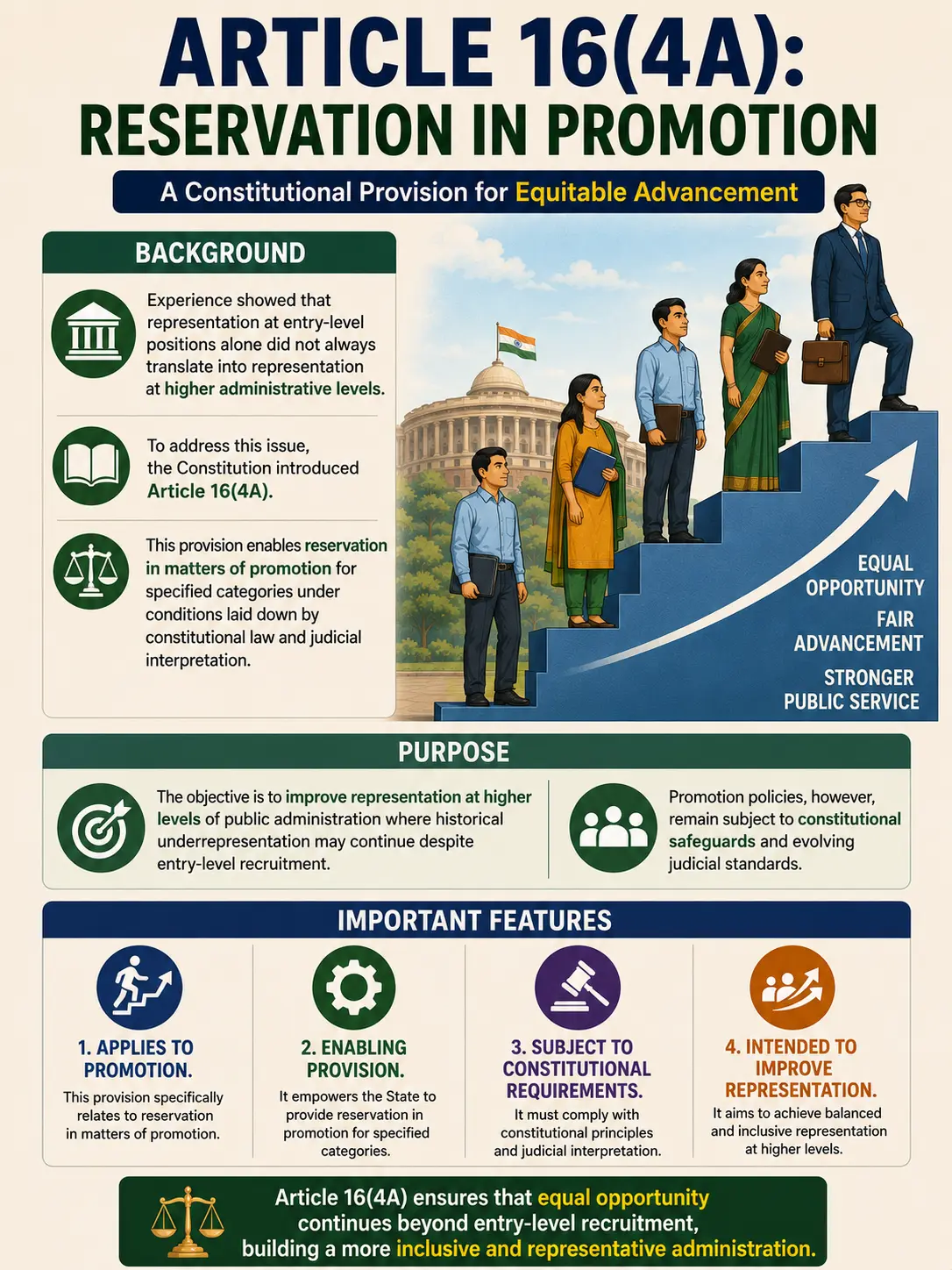
Experience showed that representation at entry-level positions alone did not always translate into representation at higher administrative levels.
To address this issue, the Constitution introduced Article 16(4A).
This provision enables reservation in matters of promotion for specified categories under conditions laid down by constitutional law and judicial interpretation.
Purpose
The objective is to improve representation at higher levels of public administration where historical underrepresentation may continue despite entry-level recruitment.
Promotion policies, however, remain subject to constitutional safeguards and evolving judicial standards.
Important Features
- Applies to promotion.
- Enabling provision.
- Subject to constitutional requirements.
- Intended to improve representation.
Article 16(4B): Carry Forward Rule and Backlog Vacancies
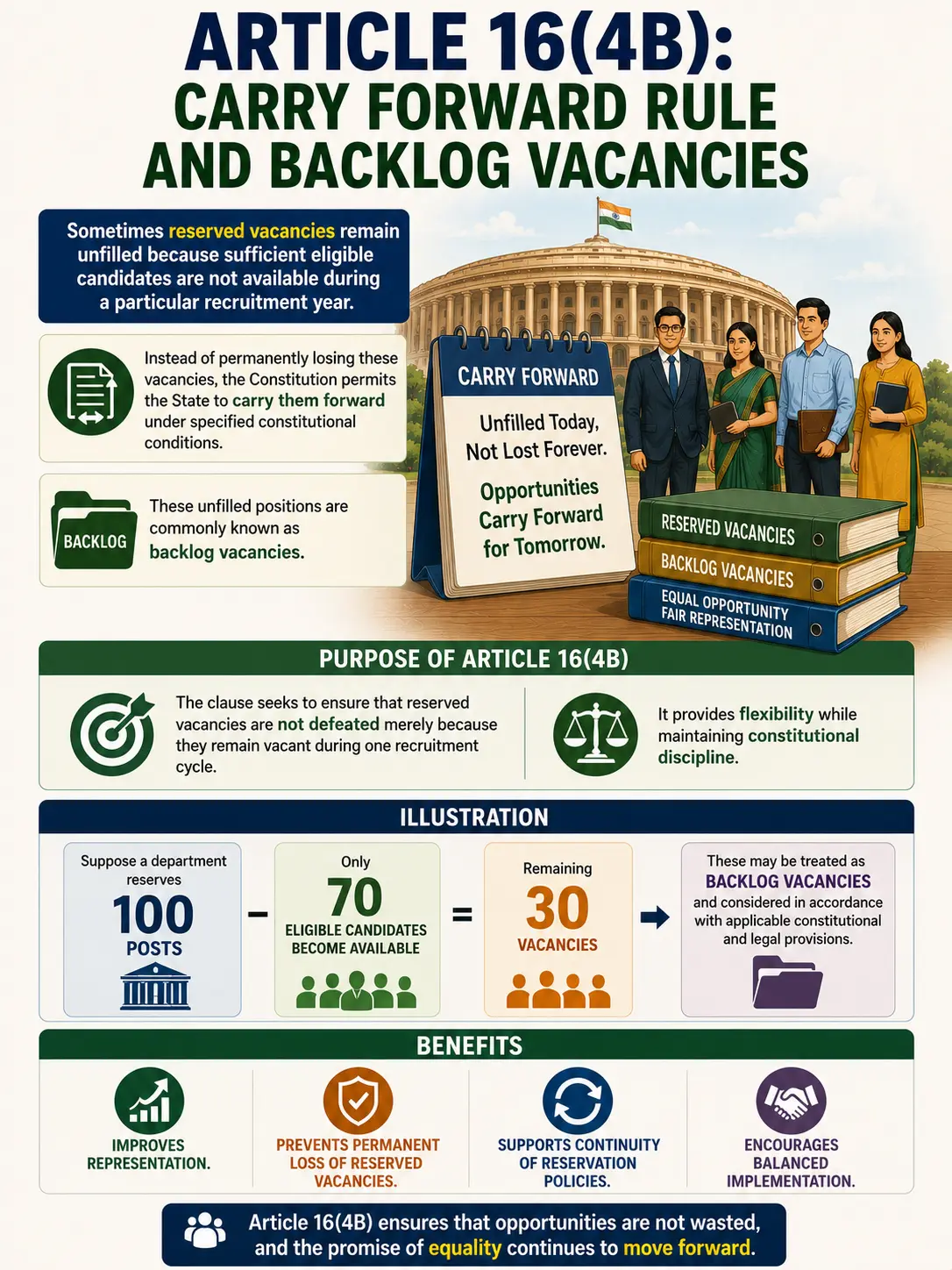
Sometimes reserved vacancies remain unfilled because sufficient eligible candidates are not available during a particular recruitment year.
Instead of permanently losing these vacancies, the Constitution permits the State to carry them forward under specified constitutional conditions.
These unfilled positions are commonly known as backlog vacancies.
Purpose of Article 16(4B)
The clause seeks to ensure that reserved vacancies are not defeated merely because they remain vacant during one recruitment cycle.
It provides flexibility while maintaining constitutional discipline.
Illustration
Suppose a department reserves 100 posts.
Only 70 eligible candidates become available.
The remaining 30 vacancies may be treated as backlog vacancies and considered in accordance with applicable constitutional and legal provisions.
Benefits
- Improves representation.
- Prevents permanent loss of reserved vacancies.
- Supports continuity of reservation policies.
- Encourages balanced implementation.
Article 16(5): Religious Institutions
This clause creates another limited exception.
It allows laws requiring that certain offices connected with religious or denominational institutions be filled by persons professing a particular religion or belonging to a specific denomination.
Why Does This Exception Exist?
Religious institutions often perform functions closely connected with their own beliefs, traditions, customs, and methods of worship.
For example:
- Priests.
- Religious teachers.
- Temple functionaries.
- Certain ecclesiastical offices.
The Constitution recognizes that these institutions may legitimately require office holders who follow the relevant faith or denomination.
Illustrative Example
A law governing the appointment of a priest in a temple may prescribe religious qualifications that are closely connected with performing religious duties.
Such requirements differ from ordinary public employment.
Article 16(6): Reservation for Economically Weaker Sections (EWS)
Introduction
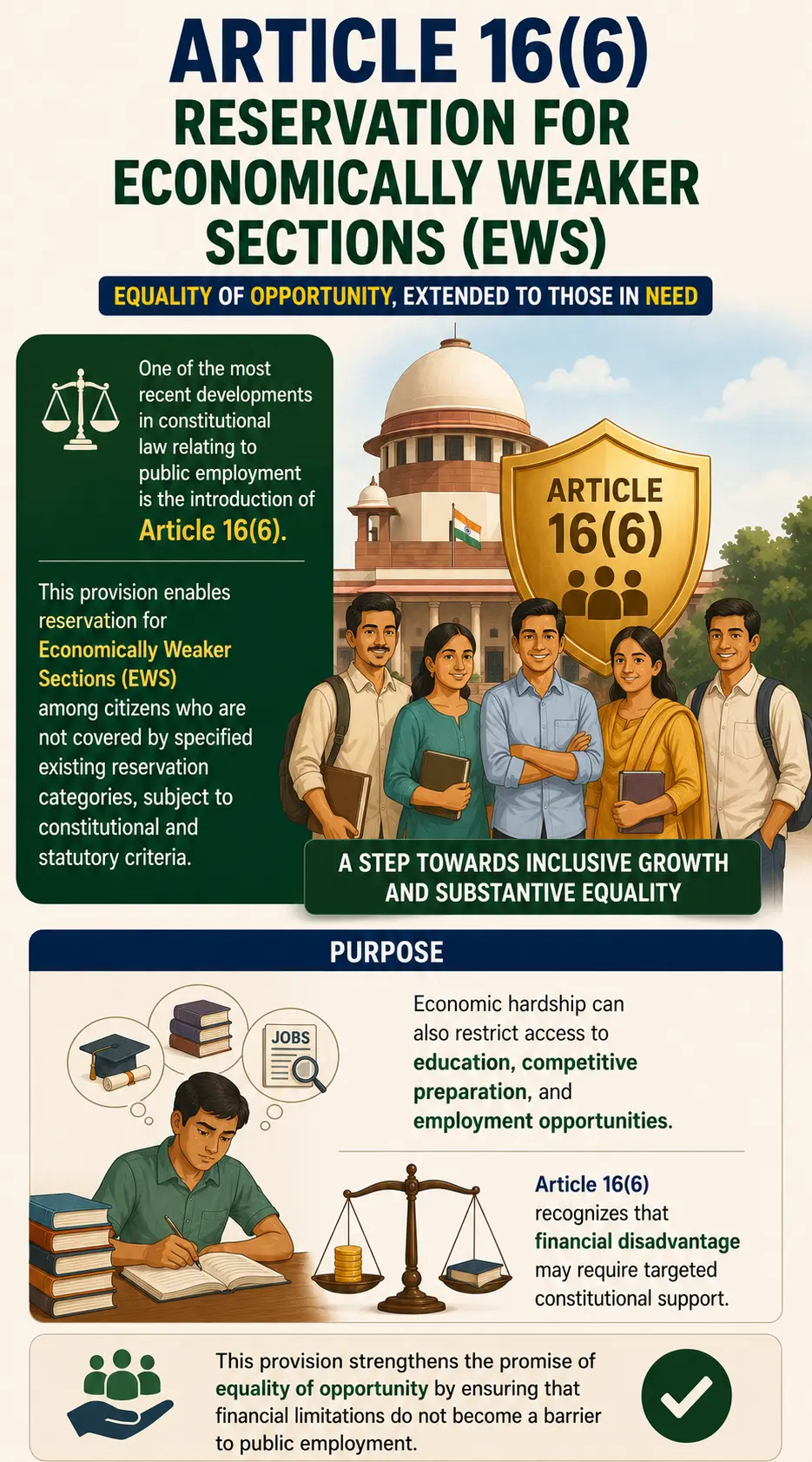
One of the most recent developments in constitutional law relating to public employment is the introduction of Article 16(6).
This provision enables reservation for Economically Weaker Sections (EWS) among citizens who are not covered by specified existing reservation categories, subject to constitutional and statutory criteria.
Purpose
Economic hardship can also restrict access to education, competitive preparation, and employment opportunities.
Article 16(6) recognizes that financial disadvantage may require targeted constitutional support.
Key Features
| Aspect | Description |
|---|---|
| Focus | Economic disadvantage |
| Nature | Enabling provision |
| Applies to | Public employment |
| Constitutional basis | Article 16(6) |
| Objective | Improve opportunities for economically weaker citizens |
Important Constitutional Amendments Related to Article 16
Over time, Parliament has amended the Constitution to address changing social and administrative needs.
Some of the most important amendments affecting Article 16 include:
| Constitutional Amendment | Major Effect |
|---|---|
| Seventy-seventh Amendment | Introduced Article 16(4A) |
| Eighty-first Amendment | Added Article 16(4B) regarding backlog vacancies |
| Eighty-fifth Amendment | Modified aspects relating to promotion under reservation |
| One Hundred and Third Amendment | Introduced Article 16(6) relating to EWS reservation |
Vertical and Horizontal Reservations
Reservation policies are often classified into two broad categories.
Vertical Reservation
Vertical reservation applies to constitutionally recognized social categories.
Examples include reservations for eligible members of:
- Scheduled Castes (SCs)
- Scheduled Tribes (STs)
- Other Backward Classes (OBCs)
- Economically Weaker Sections (EWS)
Horizontal Reservation
Horizontal reservation cuts across various vertical categories.
Examples may include reservations provided for eligible:
- Persons with disabilities.
- Ex-servicemen.
- Certain other categories recognized by law.
Comparison Table
| Vertical Reservation | Horizontal Reservation |
|---|---|
| Category based | Cross-category |
| Applies to identified social groups | Applies across categories |
| Separate constitutional framework | Operates within broader reservation structure |
| Focuses on representation | Focuses on inclusion of special groups |
Merit and Reservation
One of the most debated constitutional questions concerns the relationship between merit and reservation.
The Constitution does not treat these ideas as mutually exclusive.
A fair recruitment system seeks to combine:
- Merit.
- Equality.
- Representation.
- Administrative efficiency.
- Social justice.
- Constitutional values.
Merit itself cannot be measured solely through examination marks. Educational opportunities, social background, access to resources, and historical disadvantages also influence performance.
The constitutional approach attempts to account for these realities while maintaining standards required for public administration.
Common Misunderstandings About Article 16
| Misunderstanding | Correct Position |
|---|---|
| Reservation guarantees employment | No. Eligibility and selection remain necessary. |
| Equality means identical treatment | The Constitution permits reasonable affirmative measures. |
| States may freely impose residence requirements | Parliament has the constitutional authority under Article 16(3). |
| Reservation removes merit completely | Constitutional law seeks to balance merit with social justice. |
| Article 16 applies to all private employment | It primarily concerns employment under the State. |
Real-Life Importance of Article 16
Article 16 influences recruitment to numerous public positions, including:
- Civil services.
- Police services.
- Government schools.
- Public universities.
- Municipal bodies.
- Public hospitals.
- Revenue departments.
- Engineering services.
- Administrative departments.
- Constitutional authorities.
- Public commissions.
- Government research organizations.
For millions of aspirants, Article 16 represents more than a legal provision. It is the constitutional promise that public employment should be governed by fairness, equal opportunity, and justice rather than prejudice or arbitrary preference.
Summary of Part 2
The later clauses of Article 16 demonstrate that equality under the Constitution is both principled and practical.
While Article 16(1) and Article 16(2) establish the general rule of equal opportunity and non-discrimination, Articles 16(3) to 16(6) recognize that certain carefully limited exceptions and affirmative measures may be necessary to achieve genuine equality in public employment.
These provisions address residence requirements in limited situations, reservations for inadequately represented backward classes, reservation in promotions, backlog vacancies, appointments connected with religious institutions, and reservations for Economically Weaker Sections (EWS). Together, they reflect the Constitution’s effort to balance equality, representation, administrative efficiency, and social justice.
In Part 3, we’ll examine the landmark Supreme Court judgments interpreting Article 16, its relationship with Articles 14, 15, 17, 18, and 335, the doctrine of equality in public employment, constitutional limitations on reservation policies, practical recruitment scenarios, emerging challenges, comparative constitutional perspectives, and a comprehensive conclusion to the article.
Part 3:
The Role of the Judiciary in Interpreting Article 16
The Constitution lays down the broad principles governing equality in public employment. However, applying those principles to real-life situations is not always straightforward. Questions often arise about reservation policies, promotions, recruitment procedures, eligibility criteria, and the balance between equality and administrative efficiency.
Over the decades, the Supreme Court of India has played a central role in interpreting Article 16. Through numerous decisions, the Court has explained the meaning of equality, clarified the scope of reservation, and ensured that public employment remains consistent with constitutional values.
These judgments have transformed Article 16 from a constitutional provision into a practical framework that guides governments, recruitment agencies, public authorities, and courts throughout the country.
Landmark Supreme Court Judgments on Article 16
1. Indra Sawhney v. Union of India (1992)
One of the most influential constitutional decisions concerning Article 16 is the Indra Sawhney judgment, often referred to as the Mandal Commission Case.
The case examined the constitutional validity of reservations for Other Backward Classes (OBCs) in public employment.
The judgment clarified several important constitutional principles.
Major Contributions
- Reservation under Article 16(4) is an enabling provision.
- Reservation is intended to improve representation rather than guarantee employment.
- The concept of the Creamy Layer was introduced for OBCs to ensure that reservation benefits reach genuinely disadvantaged sections.
- Reservation in appointments generally should not exceed reasonable constitutional limits, except in extraordinary circumstances justified by relevant considerations.
- Merit and social justice should be harmonized rather than treated as opposing principles.
This judgment continues to influence reservation policies across India.
2. M. Nagaraj v. Union of India (2006)
This case examined constitutional amendments relating to reservation in promotions.
The Supreme Court held that before providing reservation in promotions, the State should consider relevant constitutional requirements, including:
- Inadequate representation.
- Backwardness where constitutionally relevant.
- Administrative efficiency.
The judgment emphasized that constitutional safeguards remain essential whenever reservation policies are implemented.
3. Jarnail Singh v. Lachhmi Narain Gupta (2018)
The Court revisited certain aspects of M. Nagaraj.
It clarified important principles regarding reservation in promotions and further refined the constitutional approach toward implementing Article 16(4A).
The decision reinforced that reservation policies must always remain consistent with constitutional equality.
4. State of Kerala v. N. M. Thomas (1976)
This judgment expanded the understanding of equality.
The Court observed that equality sometimes requires positive measures to remove long-standing disadvantages.
The decision helped shape the modern understanding that equality is not merely identical treatment but also includes measures promoting substantive justice.
5. EWS Reservation Judgment (2022)
The constitutional validity of the One Hundred and Third Constitutional Amendment, which introduced Article 16(6) relating to Economically Weaker Sections (EWS), was challenged before the Supreme Court.
The Court upheld the constitutional validity of the amendment, recognizing that economic disadvantage may legitimately be considered while designing reservation policies under the constitutional framework.
Timeline of Important Developments
| Year | Development | Significance |
|---|---|---|
| 1950 | Constitution came into force | Article 16 became enforceable |
| 1976 | N. M. Thomas judgment | Broader understanding of equality |
| 1992 | Indra Sawhney judgment | Landmark reservation principles |
| 1995 | 77th Constitutional Amendment | Reservation in promotion introduced |
| 2000 | 81st Constitutional Amendment | Backlog vacancies addressed |
| 2001 | 85th Constitutional Amendment | Promotion-related changes |
| 2019 | 103rd Constitutional Amendment | EWS reservation introduced |
| 2022 | EWS judgment | Constitutional validity upheld |
Relationship Between Article 16 and Other Fundamental Rights
Article 16 does not operate in isolation.
It forms part of a broader constitutional framework designed to protect equality and justice.
Article 14 and Article 16
Article 14 establishes:
- Equality before law.
- Equal protection of laws.
Article 16 applies these broader principles specifically to public employment.
Article 14 supplies the general rule.
Article 16 provides a specialized application.
Article 15 and Article 16
Although both prohibit discrimination, they operate in different areas.
| Article 15 | Article 16 |
|---|---|
| Public spaces, educational institutions, and certain welfare measures | Public employment |
| Addresses discrimination in specified public contexts | Focuses on recruitment and appointments |
| Applies in broader social settings | Applies to government employment |
Together, they strengthen the constitutional promise of equality.
Article 17 and Article 16
Article 17 abolishes untouchability.
Without Article 17, discrimination based on historical social practices could continue to affect access to employment.
Together, these Articles promote dignity and equal participation in public life.
Article 18 and Article 16
Article 18 abolishes titles that create artificial social distinctions.
Combined with Article 16, it reinforces the principle that public office should depend upon constitutional standards rather than inherited privilege.
Article 335 and Article 16
Article 335 recognizes the claims of Scheduled Castes (SCs) and Scheduled Tribes (STs) in public services while also emphasizing the importance of maintaining administrative efficiency.
This provision helps balance representation with effective governance.
Constitutional Principles Emerging from Article 16
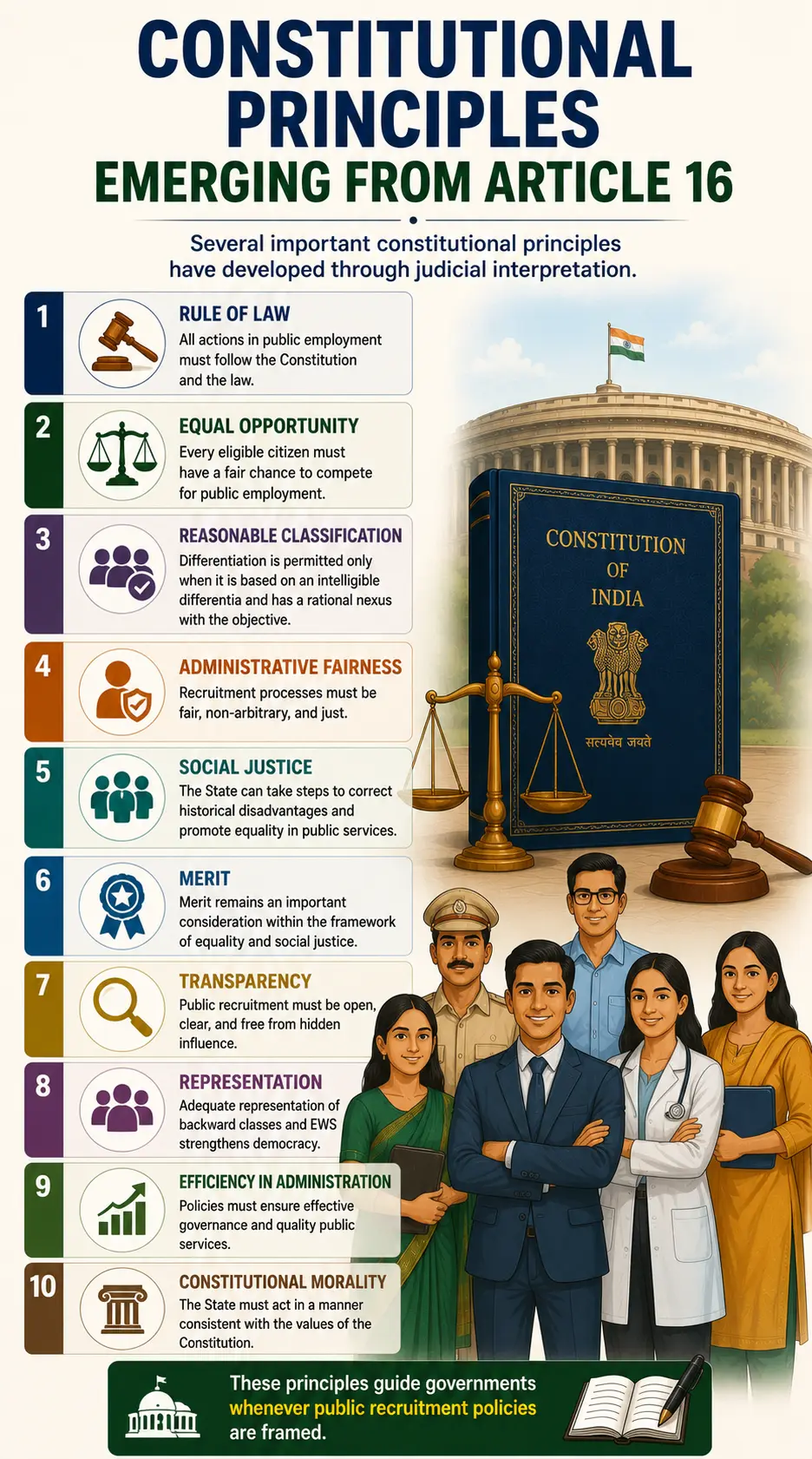
Several important constitutional principles have developed through judicial interpretation.
These include:
- Rule of law
- Equal opportunity
- Reasonable classification
- Administrative fairness
- Social justice
- Merit
- Transparency
- Representation
- Efficiency in administration
- Constitutional morality
These principles guide governments whenever public recruitment policies are framed.
Merit and Social Justice
Public debate often presents merit and reservation as competing ideas.
The Constitution adopts a more balanced approach.
Merit certainly matters.
Government institutions require capable and qualified individuals.
But constitutional equality also recognizes that opportunities available to individuals may differ because of historical, educational, geographical, or social factors.
The objective is therefore not to choose between merit and justice.
Instead, the Constitution attempts to combine both while preserving the efficiency of public administration.
Administrative Efficiency
Public employment affects millions of citizens every day.
Government officers make decisions involving:
- Healthcare.
- Taxation.
- Infrastructure.
- National security.
- Education.
- Environmental protection.
- Disaster management.
- Social welfare.
- Financial regulation.
Consequently, recruitment policies must maintain high standards of competence.
Efficiency remains an important constitutional consideration alongside equality.
Practical Recruitment Principles Under Article 16
A constitutionally sound recruitment process generally includes:
- Public advertisement of vacancies.
- Clearly defined eligibility criteria.
- Equal access to application procedures.
- Transparent examinations.
- Objective evaluation.
- Fair interviews.
- Publication of results.
- Compliance with reservation policies where applicable.
- Judicial review when constitutional violations occur.
Illustrative Recruitment Scenario
Suppose a government department announces recruitment for 500 Administrative Officers.
The recruitment process may include:
- Public notification.
- Educational qualification requirements.
- Age criteria.
- Competitive examination.
- Interview.
- Document verification.
- Medical examination.
- Reservation according to constitutional and statutory provisions.
- Final merit list.
- Appointment.
Throughout the process, Article 16 requires fairness, transparency, and equal opportunity.
Situations That May Violate Article 16
The following examples illustrate actions that may conflict with constitutional principles.
Example 1
Rejecting an applicant solely because of religion.
Example 2
Filling government posts secretly without inviting eligible candidates to apply.
Example 3
Selecting candidates exclusively because of political favoritism.
Example 4
Creating arbitrary eligibility conditions unrelated to the duties of the post.
Example 5
Ignoring constitutionally valid reservation policies during recruitment.
Situations That May Be Constitutionally Valid
Certain actions are generally consistent with Article 16 when supported by law.
Examples include:
- Minimum educational qualifications.
- Medical fitness requirements.
- Physical standards for police or armed forces.
- Age limits prescribed by law.
- Experience requirements.
- Reservation authorized by the Constitution.
- Selection through competitive examinations.
- Promotion according to lawful service rules.
Common Misconceptions About Article 16
| Myth | Reality |
|---|---|
| Article 16 guarantees a government job. | It guarantees an equal opportunity to compete, not automatic employment. |
| Reservation means merit is ignored. | Reservation operates within a constitutional framework that also values administrative efficiency. |
| Article 16 applies to every employer. | It mainly governs employment under the State. |
| Every difference in treatment is discrimination. | Reasonable classification based on legitimate objectives may be constitutionally valid. |
| Reservation removes the need for qualifications. | Essential qualifications remain necessary. |
Challenges in Implementing Article 16
Although Article 16 provides a strong constitutional foundation, implementation is not always simple.
Some continuing challenges include:
- Balancing equality with efficiency.
- Identifying genuinely disadvantaged groups.
- Periodic review of reservation policies.
- Ensuring transparency in recruitment.
- Reducing delays in public appointments.
- Addressing litigation arising from recruitment disputes.
- Preventing corruption and favoritism.
- Expanding equal access to quality education before recruitment begins.
These issues continue to shape public policy and constitutional debates.
International Perspective
Many democratic countries recognize equality in public employment, although the methods differ.
Some jurisdictions primarily prohibit discrimination.
Others also permit affirmative action under limited circumstances.
Common constitutional values found across many democracies include:
- Equal opportunity.
- Fair recruitment.
- Merit-based appointments.
- Transparency.
- Accountability.
- Protection against discrimination.
India’s constitutional framework is distinctive because it combines equality with an explicit commitment to social justice and representation.
Why Article 16 Matters in Everyday Life
Article 16 is not limited to constitutional textbooks or courtrooms.
Its influence extends to millions of citizens who participate in recruitment for:
- Civil services.
- Police departments.
- Public universities.
- Government hospitals.
- Public sector organizations.
- Municipal corporations.
- State commissions.
- Revenue services.
- Engineering departments.
- Scientific institutions.
- Public schools.
- Administrative services.
Every transparent recruitment notification, competitive examination, and lawful selection process reflects the constitutional values embodied in Article 16.
Quick Reference Table
| Clause | Subject | Purpose |
|---|---|---|
| 16(1) | Equality of opportunity | Equal access to public employment |
| 16(2) | Non-discrimination | Protects against prohibited discrimination |
| 16(3) | Residence | Allows Parliament to prescribe residence requirements in limited cases |
| 16(4) | Reservation | Improves representation of inadequately represented backward classes |
| 16(4A) | Promotion | Enables reservation in promotion under constitutional conditions |
| 16(4B) | Backlog vacancies | Permits carry forward of certain reserved vacancies |
| 16(5) | Religious institutions | Allows religion-based qualifications for specified religious offices |
| 16(6) | EWS | Enables reservation for Economically Weaker Sections |
Key Takeaways
- Article 16 guarantees equality of opportunity in matters relating to public employment.
- It is one of the most important Fundamental Rights in the Constitution.
- Equality under Article 16 is not merely theoretical. It governs recruitment practices across public institutions.
- The Constitution prohibits discrimination while also permitting carefully designed affirmative measures to address historical disadvantages.
- Judicial interpretation has played a vital role in shaping the meaning and application of Article 16.
- The Article seeks to balance merit, representation, administrative efficiency, and social justice.
- Transparent recruitment processes strengthen public confidence in democratic institutions.
- Article 16 continues to evolve through constitutional amendments, legislative action, and judicial interpretation, ensuring that the promise of equality remains relevant in a changing society.
Conclusion
Article 16 stands as one of the strongest constitutional safeguards for fairness in public employment. It reflects the belief that government service should be open to all eligible citizens through a process that is transparent, impartial, and guided by the rule of law. By prohibiting discrimination on specific grounds while allowing carefully structured affirmative measures, the Constitution seeks to create opportunities that are both fair and meaningful.
The Article also reminds us that equality is not achieved simply by treating everyone identically. Genuine equality often requires acknowledging historical disadvantages and creating lawful mechanisms that promote broader participation in public institutions. At the same time, these measures must operate within constitutional limits and preserve the efficiency and integrity of public administration.
More than seven decades after the Constitution came into force, Article 16 continues to shape recruitment policies, influence judicial decisions, and protect the aspirations of millions of citizens seeking public employment. Its enduring significance lies in its ability to balance individual rights with collective welfare, making it a cornerstone of India’s constitutional commitment to justice, equality, and democratic governance.
Article References and Sources
- Constitution of India, Article 16
- Full Text of Article 16 of the Constitution of India
- Constitution (Seventy-seventh Amendment) Act, 1995
- Constitution (Eighty-first Amendment) Act, 2000
- Constitution (Eighty-fifth Amendment) Act, 2001
- Constitution (One Hundred and Third Amendment) Act, 2019
- Indra Sawhney v. Union of India (1992)
- M. Nagaraj v. Union of India (2006)
- Jarnail Singh v. Lachhmi Narain Gupta (2018)
- State of Kerala v. N. M. Thomas (1976)
- Constitutional Overview of Article 16
- Interpretation and Constitutional Scope of Article 16
Also, Read These Articles in Detail
- Fundamental Rights in India
- What Are Fundamental Rights Under the Indian Constitution?
- History of Fundamental Rights in India
- Why Fundamental Rights Are Important for Every Indian Citizen
- Understanding Part III of the Indian Constitution
- Who Can Claim Fundamental Rights in India?
- Legal Rights vs Fundamental Rights
- How Fundamental Rights Protect Individual Freedom in India
- Right to Equality Under Article 14
- Article 15: Protection Against Discrimination
Frequently Asked Questions
FAQ 1. What is Article 16 of the Indian Constitution?
Article 16 of the Constitution of India guarantees equality of opportunity in matters relating to public employment and appointments under the State. It is one of the Fundamental Rights contained in Part III of the Constitution and plays a vital role in ensuring fairness during government recruitment. The main objective of this Article is to provide every eligible citizen with an equal chance to compete for government jobs without facing discrimination based on factors such as religion, race, caste, sex, descent, place of birth, or residence, except where the Constitution specifically allows otherwise.
The Article promotes a transparent and merit-based recruitment process while also recognizing the need for social justice. It allows the government to introduce constitutionally valid reservation policies for certain disadvantaged groups to improve their representation in public services. In this way, Article 16 balances the principles of equality, fairness, merit, and inclusion, making it one of the most significant constitutional safeguards for public employment in India.
FAQ 2. Why is Article 16 important for government jobs in India?
Article 16 is important because it establishes the constitutional foundation for fair recruitment in government services. Every year, millions of candidates apply for positions in central and state government departments, public sector organizations, universities, police services, and other public institutions. This Article ensures that all eligible citizens receive an equal opportunity to compete for these positions through a transparent and lawful selection process.
Its importance extends beyond recruitment alone. Article 16 also strengthens public confidence in government institutions by reducing arbitrary appointments and promoting accountability. At the same time, it acknowledges that certain communities have historically faced disadvantages in accessing education and employment. Therefore, it permits constitutionally recognized reservation policies that aim to improve representation without abandoning the broader principle of equality. As a result, Article 16 serves both individual rights and the larger goal of building an inclusive and efficient public administration.
FAQ 3. Does Article 16 guarantee every citizen a government job?
No. Article 16 does not guarantee that every citizen will receive a government job. Instead, it guarantees an equal opportunity to compete for employment under the State. This distinction is extremely important. The Constitution ensures that eligible candidates are given a fair chance to participate in the recruitment process, but the final selection depends on factors such as educational qualifications, eligibility criteria, competitive examinations, interviews, physical standards where applicable, and other lawful recruitment requirements.
For example, if thousands of candidates apply for a limited number of government vacancies, only those who successfully meet the prescribed standards will be selected. Article 16 protects candidates from unlawful discrimination during this process, but it does not promise employment simply because a person has applied. In other words, it safeguards fairness in the selection process rather than guaranteeing a particular outcome.
FAQ 4. Who can claim protection under Article 16 of the Constitution?
The protection provided by Article 16 is primarily available to citizens of India seeking employment or appointment under the State. It applies to recruitment conducted by the Central Government, State Governments, local authorities, constitutional bodies, statutory authorities, and various public institutions that fall within the constitutional meaning of the term State.
The Article generally does not apply to employment offered by private companies because private employment is governed by different legal principles. However, whenever a recruitment process involves government employment or appointments under public authorities covered by the Constitution, Article 16 becomes an important constitutional safeguard. It ensures that every eligible citizen receives fair consideration without unlawful discrimination during recruitment or appointment.
FAQ 5. What kinds of discrimination are prohibited under Article 16?
Article 16(2) specifically prohibits discrimination in matters relating to public employment solely on the grounds of religion, race, caste, sex, descent, place of birth, residence except where constitutionally permitted, or any combination of these grounds. This means that a qualified candidate cannot legally be denied an opportunity for a government job simply because they belong to a particular religion, caste, gender, or region.
However, the Constitution also recognizes that reasonable eligibility conditions may be necessary for certain posts. Educational qualifications, professional experience, age limits, medical fitness, or physical standards for specialized services may all be valid if they are directly related to the duties of the position. Therefore, Article 16 prohibits arbitrary discrimination while allowing reasonable and lawful recruitment standards that serve legitimate public interests.
FAQ 6. What is the difference between Article 14 and Article 16?
Although Article 14 and Article 16 both promote equality, they operate in different areas of constitutional law. Article 14 guarantees equality before the law and equal protection of the laws to all persons. It is a broad constitutional principle that applies across many areas of governance and public administration.
Article 16, on the other hand, focuses specifically on equality of opportunity in public employment. It applies the broader principles of Article 14 to government recruitment and appointments. While Article 14 establishes the general concept of equality, Article 16 provides detailed constitutional protection for citizens seeking employment under the State. Together, these two Articles form an important part of India’s constitutional framework for ensuring fairness, justice, and equal treatment.
FAQ 7. Why does Article 16 allow reservations in public employment?
The Constitution permits reservations because equal treatment alone may not be enough to eliminate disadvantages that have developed over many generations. Certain communities have historically faced barriers in education, employment, and social participation, making it difficult for them to compete on truly equal terms. Article 16(4) allows the State to introduce reservation policies for backward classes of citizens that are not adequately represented in public services.
The purpose of reservation is not to provide automatic employment. Instead, it aims to improve representation and create fair opportunities for disadvantaged communities while maintaining constitutional standards. Candidates benefiting from reservation must still satisfy the prescribed eligibility conditions and recruitment requirements. This approach reflects the Constitution’s effort to balance equality, social justice, and administrative efficiency within public employment.
FAQ 8. What is the significance of Article 16(6) relating to Economically Weaker Sections (EWS)?
Article 16(6) enables the State to make provisions for reservation in public employment for eligible citizens belonging to the Economically Weaker Sections (EWS) who are not covered by specified existing reservation categories. This provision recognizes that economic hardship can also create significant barriers to education, competitive examinations, and access to government employment.
The inclusion of EWS reservation reflects the evolving nature of constitutional policy. It expands the scope of affirmative measures by considering economic disadvantage alongside other forms of social inequality. Like other reservation policies, EWS reservation operates within a constitutional and legal framework, and eligible candidates must continue to satisfy all applicable qualifications and recruitment standards.
FAQ 9. How has the Supreme Court influenced the interpretation of Article 16?
The Supreme Court of India has played a crucial role in explaining and developing the meaning of Article 16. Through several landmark judgments, the Court has clarified the constitutional principles governing equality, reservations, promotions, and public employment. These decisions have helped define the limits of government authority while protecting both individual rights and the broader objectives of social justice.
Important judicial decisions have addressed issues such as the Creamy Layer principle, reservation in promotions, backlog vacancies, and the constitutional validity of reservation for Economically Weaker Sections (EWS). By interpreting Article 16 in the light of changing social conditions, the Supreme Court has ensured that the constitutional guarantee of equality remains relevant while maintaining the balance between fairness, representation, and administrative efficiency.
FAQ 10. How does Article 16 strengthen democracy and good governance?
Article 16 strengthens democracy by ensuring that government employment is based on constitutional principles rather than favoritism, prejudice, or arbitrary decision-making. When citizens know that recruitment is conducted fairly, public confidence in government institutions increases. Transparent recruitment also helps attract capable individuals who can contribute to effective public administration and better delivery of public services.
Beyond recruitment, Article 16 reflects the Constitution’s broader vision of creating an inclusive society where every eligible citizen has an opportunity to serve the nation. By combining equal opportunity, non-discrimination, merit, social justice, and administrative efficiency, the Article promotes both individual rights and national development. Its continued relevance demonstrates how constitutional values can shape a fair, accountable, and democratic system of public employment for present and future generations.
FAQ 11. What does “equality of opportunity” mean under Article 16?
The phrase “equality of opportunity” under Article 16 means that every eligible citizen should have a fair and unbiased chance to compete for employment or appointment under the State. It does not mean that everyone will receive the same result or be appointed to a government position. Instead, it ensures that the recruitment process begins on equal constitutional footing, without unlawful discrimination based on religion, race, caste, sex, descent, place of birth, or other prohibited grounds.
In practice, equality of opportunity requires government authorities to follow transparent recruitment procedures. Vacancies should be publicly advertised, eligibility criteria should be clearly defined, examinations and interviews should be conducted fairly, and candidates should be evaluated according to lawful standards. The purpose is to prevent favoritism, nepotism, political influence, or arbitrary decision-making from affecting public appointments.
This constitutional guarantee also recognizes that genuine equality sometimes requires measures that help historically disadvantaged communities participate more effectively in public employment. Therefore, Article 16 combines equal opportunity with carefully structured affirmative measures, creating a balanced approach that promotes both fairness and social justice.
FAQ 12. Does Article 16 apply to private companies and private sector jobs?
In general, Article 16 applies only to public employment or appointments under the State. This includes employment in the Central Government, State Governments, constitutional authorities, local bodies, statutory organizations, and other public institutions that fall within the constitutional meaning of the term State. It does not ordinarily regulate recruitment by private companies, private businesses, or privately owned organizations.
Private employers usually operate under different labour laws, employment contracts, and other legal frameworks rather than Article 16. However, if a public authority or government-controlled institution conducts recruitment, the constitutional principles contained in Article 16 become highly relevant.
This distinction is important because the Constitution was designed to regulate governmental power. Since government authorities exercise public power on behalf of the people, they are expected to maintain higher standards of fairness, transparency, and accountability while making appointments. That’s why Article 16 focuses specifically on public employment rather than private sector hiring.
FAQ 13. What is the meaning of “employment under the State” in Article 16?
The expression “employment under the State” has a wider constitutional meaning than many people assume. It includes employment offered by various government institutions and public authorities that perform governmental functions. These may include the Central Government, State Governments, government departments, constitutional bodies, local authorities, statutory corporations, public educational institutions, and many other organizations that fall within the constitutional definition of State.
The purpose of using a broader definition is to ensure that constitutional principles of equality are followed wherever public power is exercised in matters of recruitment. Government employment affects millions of citizens, and therefore appointments must be made according to constitutional standards rather than personal preferences or discriminatory practices.
Whether a particular organization falls within the definition of the State depends upon constitutional principles and judicial interpretation. Courts have developed various tests over time to determine whether an institution performs public functions or is sufficiently connected with the government to attract constitutional obligations under Article 16.
FAQ 14. Why does Article 16 permit reservation if it guarantees equality?
At first glance, some people believe that reservation and equality contradict each other. However, the Constitution adopts a broader understanding of equality. It recognizes that historical discrimination, unequal educational opportunities, and long-standing social disadvantages may prevent some communities from competing on truly equal terms.
For this reason, Article 16(4) allows the State to make provisions for reservation in public employment for certain backward classes of citizens that are not adequately represented in government services. The objective is not to create unfair advantages but to improve representation and provide meaningful opportunities to communities that have historically remained underrepresented.
Reservation therefore functions as an instrument of social justice within the broader framework of equality. At the same time, reservation operates within constitutional limits. Candidates must still satisfy the prescribed eligibility conditions, educational qualifications, and other recruitment standards. This balanced approach reflects the Constitution’s effort to harmonize equality, representation, and administrative efficiency.
FAQ 15. What is the Creamy Layer principle, and why is it important?
The Creamy Layer principle is an important constitutional concept developed through judicial interpretation to ensure that reservation benefits reach those who genuinely need them. The principle generally applies to Other Backward Classes (OBCs) and seeks to exclude the more socially and economically advanced members of these communities from reservation benefits.
The idea behind this principle is straightforward. Reservation is intended to support disadvantaged sections of society. If relatively advanced members continue to receive these benefits generation after generation, those who remain genuinely disadvantaged may never receive adequate opportunities. The Creamy Layer principle therefore promotes a more equitable distribution of reservation benefits within eligible communities.
The application of this principle has significantly influenced reservation policy in India. It reflects the Constitution’s broader objective of promoting fairness while ensuring that affirmative measures continue to serve their intended purpose.
FAQ 16. Can the government prescribe educational qualifications and age limits under Article 16?
Yes. Article 16 does not prevent the government from prescribing reasonable eligibility conditions for public employment. Educational qualifications, age limits, professional experience, technical expertise, physical fitness, and medical standards are all legitimate requirements when they are directly related to the duties and responsibilities of a particular post.
For example, a government hospital may require medical degrees for doctors, while engineering departments may require recognized engineering qualifications. Similarly, police services and armed forces may prescribe physical standards necessary for effective performance of official duties.
What Article 16 prohibits is arbitrary or discriminatory treatment that has no reasonable connection with the nature of the employment. As long as eligibility conditions are lawful, objective, and relevant to the position being filled, they are generally consistent with constitutional principles. This allows public authorities to maintain professional standards while ensuring fairness during recruitment.
FAQ 17. What are backlog vacancies under Article 16(4B)?
Backlog vacancies are reserved posts that remain unfilled during a particular recruitment year because sufficient eligible candidates are not available or for other legally recognized reasons. Article 16(4B) allows the State to carry forward these vacancies to future recruitment cycles under the constitutional framework.
Without this provision, reserved vacancies could permanently disappear whenever they remained vacant during a recruitment process. Carrying them forward helps ensure that the constitutional objective of improving representation is not defeated simply because suitable candidates were unavailable in one particular year.
However, the management of backlog vacancies must still comply with constitutional principles and applicable laws. Governments are expected to implement these provisions in a balanced manner while maintaining transparency, fairness, and administrative efficiency throughout the recruitment process.
FAQ 18. What is Article 16(5), and why is it considered an exception?
Article 16(5) creates a limited constitutional exception for appointments connected with religious or denominational institutions. It allows laws that require certain religious offices to be filled by persons professing a particular religion or belonging to a specific religious denomination where such qualifications are directly connected with the nature of the office.
For example, appointments involving priests or certain religious functionaries may legitimately require adherence to the faith or denomination associated with the institution. These requirements are fundamentally different from ordinary government recruitment because the duties themselves are religious in character.
This exception demonstrates that the Constitution recognizes the unique nature of certain religious offices while continuing to uphold the broader principle of equality in ordinary public employment. It is a carefully limited provision and does not permit unrestricted discrimination in government services.
FAQ 19. How does Article 16 contribute to good governance and public administration?
A fair recruitment system is one of the strongest foundations of good governance, and Article 16 plays a central role in achieving that objective. By requiring equal opportunity, transparency, and non-discrimination in public employment, the Article helps ensure that government institutions recruit capable individuals through lawful procedures.
When appointments are based on constitutional principles rather than favoritism or personal influence, public confidence in government institutions increases. Citizens are more likely to trust public administration when they believe recruitment processes are fair and accountable.
Article 16 also supports efficient governance by encouraging a diverse and representative public workforce. Government employees serve people from different regions, cultures, languages, and social backgrounds. A recruitment system that reflects constitutional values strengthens both democratic institutions and the quality of public service delivered to society.
FAQ 20. What are the most important lessons to remember about Article 16?
Article 16 is much more than a legal provision governing government jobs. It represents the Constitution’s commitment to creating a fair and inclusive system of public employment where every eligible citizen has an opportunity to compete according to lawful and transparent procedures. It protects individuals against discrimination while recognizing that historical inequalities sometimes require carefully designed affirmative measures.
Some of the most important principles to remember include equality of opportunity, non-discrimination, social justice, reservation, administrative efficiency, transparency, and constitutional fairness. Together, these principles guide recruitment across public institutions and influence the interpretation of service laws throughout India.
Even after decades of constitutional development, Article 16 continues to remain highly relevant. Every government recruitment examination, public advertisement, appointment process, and judicial review reflects the enduring importance of this constitutional guarantee. It remains one of the strongest examples of how the Constitution seeks to balance individual rights with the larger goal of building an efficient, representative, and democratic public administration.
