

Part 1
India’s Constitution is much more than a legal document. It is a vision for building a society where every person is treated with dignity, respect, and equality. Among its most powerful promises is Article 17, a provision that abolished one of the oldest and most discriminatory social practices in the country’s history, untouchability.
Unlike many constitutional provisions that simply grant rights, Article 17 directly attacks a social evil. It doesn’t merely discourage discrimination. It abolishes untouchability completely and makes its practice a punishable offence. This single article represents India’s determination to replace centuries of exclusion with equality and justice. It reflects the belief that no person should suffer humiliation or social exclusion because of birth or caste.
Even today, Article 17 remains one of the strongest constitutional commitments to human dignity, social equality, and constitutional morality. Although laws have significantly reduced many forms of discrimination, the constitutional journey continues because social change often takes longer than legal reform.
Table of Contents
Article 17 at a Glance
| Particular | Details |
|---|---|
| Constitutional Provision | Article 17 |
| Part of Constitution | Part III – Fundamental Rights |
| Fundamental Right | Right to Equality |
| Purpose | Abolition of Untouchability |
| Applies To | Every person in India |
| Nature of Right | Absolute prohibition against untouchability |
| Legal Consequence | Practice is punishable according to law |
| Implemented Through | Protection of Civil Rights Act, 1955 and later strengthened by other legislation |
| Core Constitutional Values | Equality, Human Dignity, Social Justice, Fraternity |
Understanding Article 17
The Constitution states:
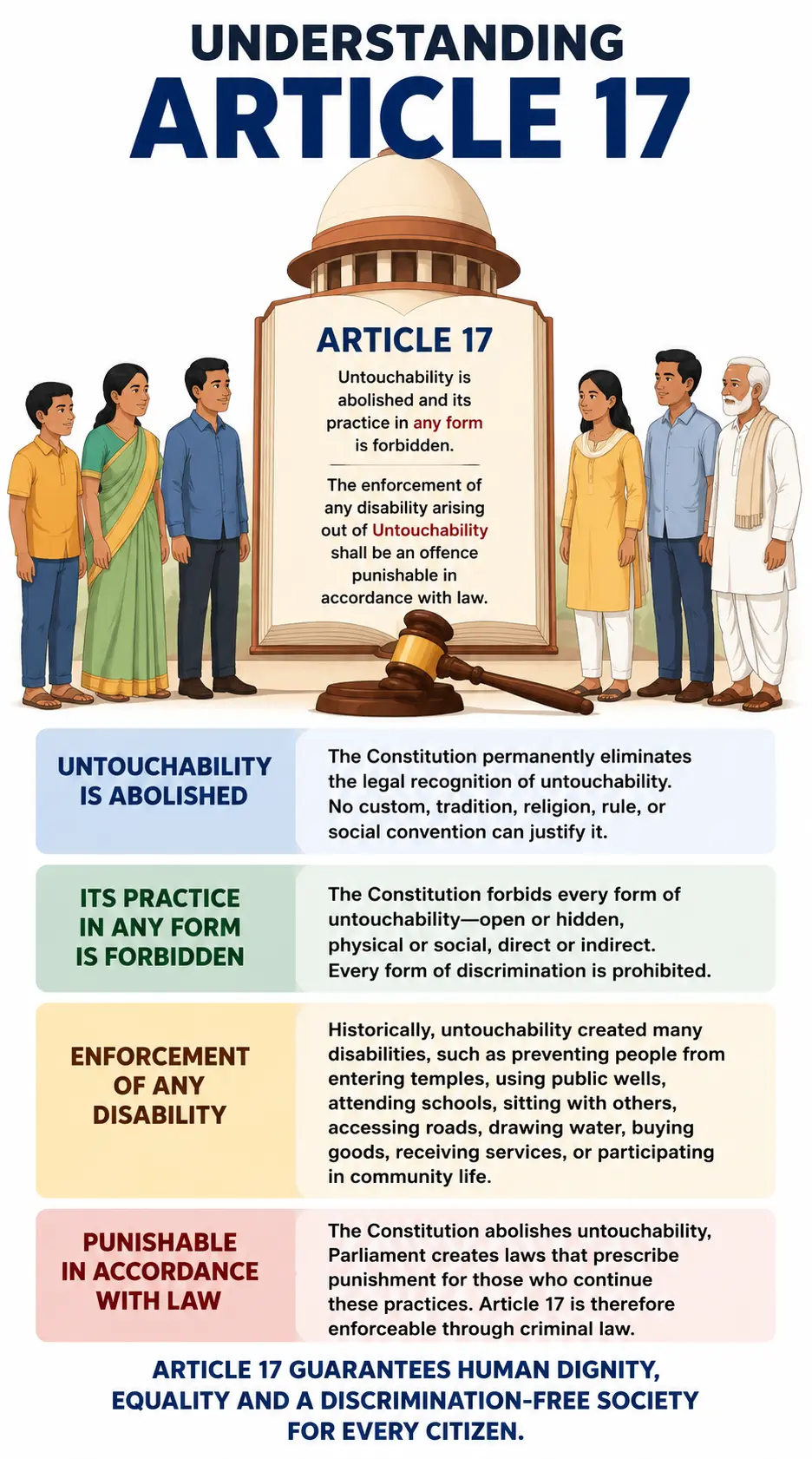
“Untouchability” is abolished and its practice in any form is forbidden. The enforcement of any disability arising out of “Untouchability” shall be an offence punishable in accordance with law.
Although this constitutional provision contains only one sentence, its impact is enormous.
Every phrase has legal importance.
“Untouchability is abolished”
This means the Constitution permanently eliminated the legal recognition of untouchability.
- No custom.
- No tradition.
- No religious practice.
- No local rule.
- No social convention.
Nothing can justify treating another human being as “untouchable.”
“Its practice in any form is forbidden”
This wording is intentionally broad.
The Constitution does not prohibit only one particular act.
Instead, it forbids every form of untouchability.
Whether discrimination happens openly or secretly, physically or socially, directly or indirectly, the constitutional prohibition remains the same.
“Enforcement of any disability”
Historically, untouchability created countless disabilities.
These included preventing people from:
- Entering temples
- Using public wells
- Attending schools
- Sitting with others
- Entering restaurants
- Accessing roads
- Drawing water
- Buying goods
- Receiving services
- Participating in community life
Article 17 declares that imposing any such disability is unconstitutional.
“Punishable in accordance with law”
The Constitution itself abolishes untouchability.
Parliament then created laws that prescribe punishment for those who continue these practices.
This constitutional design ensures that Article 17 is not merely symbolic.
It is enforceable through criminal law.
Why Did India Need Article 17?
To understand Article 17, we must first understand the historical problem it sought to eliminate.
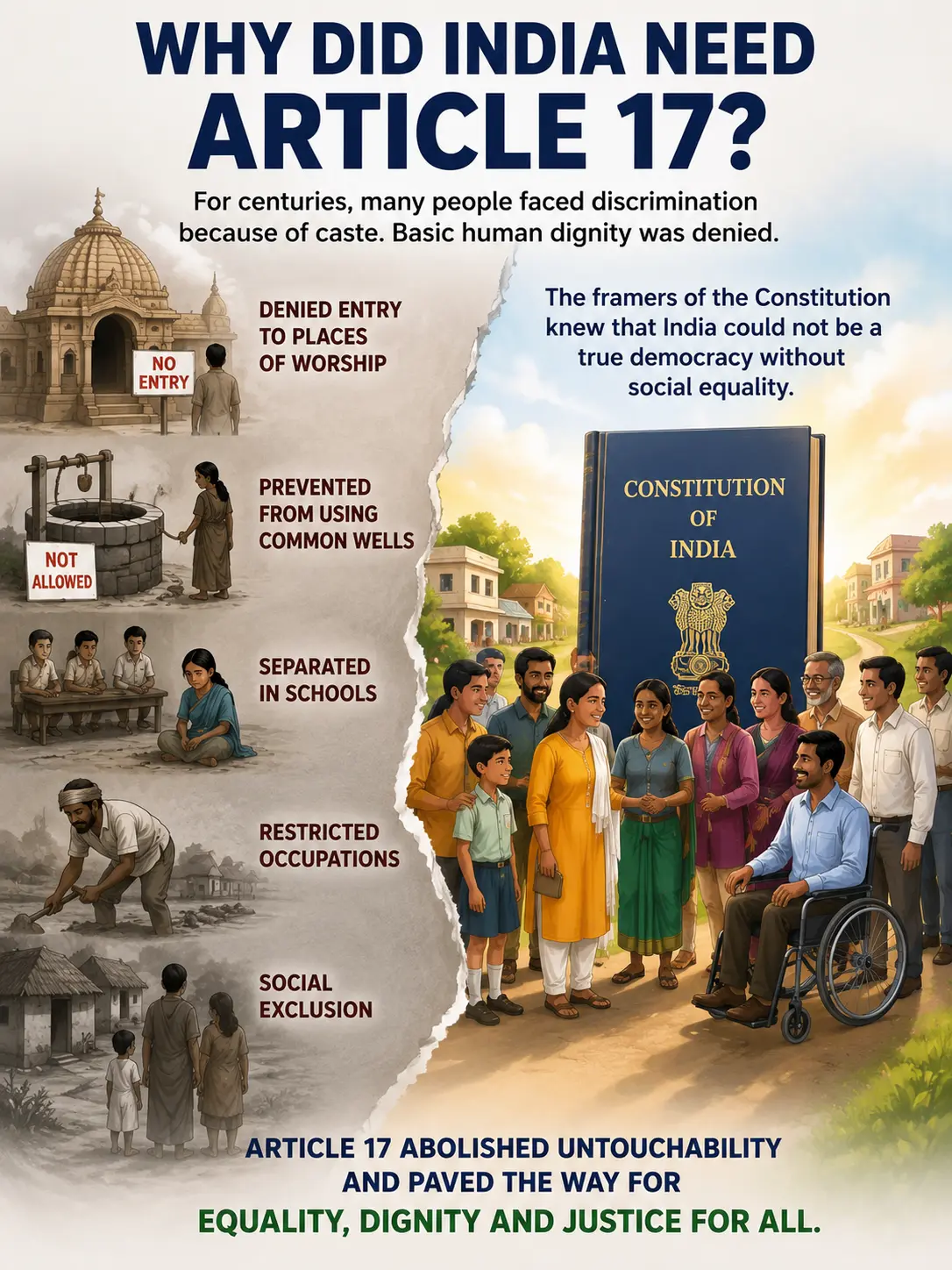
For centuries, certain communities experienced discrimination because of caste.
Many individuals were denied basic human dignity.
Some could not enter places of worship.
Others were prevented from using common roads or wells.
Children were sometimes separated in educational institutions.
Workers faced restrictions on occupation.
Families experienced social exclusion.
Communities lived under systems that denied equal treatment.
Not every region followed identical practices.
Not every community behaved similarly.
But enough discrimination existed across many parts of India that the framers of the Constitution believed constitutional intervention was necessary.
India could not become a genuine democracy while millions of people remained socially excluded because of birth.
Political equality without social equality would remain incomplete.
That understanding shaped Article 17.
What Was Untouchability?
The Constitution deliberately uses the word “Untouchability” within quotation marks.
Interestingly, the Constitution does not provide an exact definition.
Instead, courts have interpreted the provision as referring to the social practice arising from the caste system rather than its ordinary dictionary meaning of avoiding physical contact for reasons like illness or hygiene.
Historically, untouchability involved treating certain communities as socially inferior and denying them equal participation in public life.
It affected nearly every aspect of daily existence.
Examples of Historical Disabilities Associated with Untouchability
| Area of Life | Historical Discrimination |
|---|---|
| Religion | Denial of temple entry |
| Education | Separate seating or denial of admission |
| Water Sources | Prohibition from using public wells or tanks |
| Public Roads | Restrictions on movement |
| Employment | Occupational segregation |
| Housing | Separate settlements outside villages |
| Public Facilities | Denforcement from restaurants, hotels, shops |
| Social Life | Exclusion from ceremonies and festivals |
| Healthcare | Discriminatory access to services |
| Community Participation | Denial of equal treatment |
Untouchability Was Never Just About Physical Contact
Many people misunderstand the constitutional meaning of untouchability.
It was never limited to touching someone.
Instead, it represented an entire system of social exclusion.
It affected dignity.
It affected opportunity.
It affected education.
It affected livelihood.
It affected freedom.
It affected citizenship.
Article 17 therefore protects much more than physical interaction.
It protects the constitutional promise that every human being deserves equal respect.
The Historical Background Before the Constitution
India’s struggle against untouchability did not begin in 1950.
Long before independence, many reformers challenged caste discrimination.
Social reform movements emerged across different regions.
Religious thinkers questioned discriminatory practices.
Educational movements encouraged inclusion.
Freedom fighters linked political independence with social equality.
The demand for abolishing untouchability gradually became part of India’s broader movement for justice.
By the time the Constitution was drafted, many members of the Constituent Assembly believed that democracy could not survive alongside institutionalized social discrimination.
Social Reformers Who Challenged Untouchability
Numerous reformers contributed to this movement.
Some worked through education.
Some through religion.
Some through political activism.
Some through law.
Some through constitutional reform.
Among the most influential were:
- Dr. B. R. Ambedkar
- Mahatma Gandhi
- Jyotirao Phule
- Savitribai Phule
- Sri Narayana Guru
- Periyar E. V. Ramasamy
- Swami Dayanand Saraswati
- Ayyankali
- Pandita Ramabai
Although these leaders differed in philosophy and methods, many shared a common belief that discrimination based on caste had no place in a just society.
Dr. B. R. Ambedkar and Article 17
No discussion of Article 17 is complete without understanding the contribution of Dr. Bhimrao Ramji Ambedkar.
As the Chairman of the Drafting Committee, he brought both legal expertise and lived experience to the constitutional process.
Throughout his life, Dr. Ambedkar faced caste-based discrimination.
These experiences shaped his determination to create constitutional protections that would guarantee equality.
He consistently argued that:
- Political democracy alone was insufficient.
- Social democracy was equally necessary.
- Equality before law must become equality in everyday life.
- Human dignity must be protected through enforceable rights.
Article 17 reflects these constitutional ideals.
Mahatma Gandhi’s Campaign Against Untouchability
Mahatma Gandhi also regarded untouchability as a serious social evil.
He travelled extensively across India, encouraging social reform and urging communities to reject discriminatory practices.
He promoted greater social inclusion and emphasized that every person deserved dignity and respect.
Although Gandhi and Ambedkar often disagreed on methods and political strategies, both believed that untouchability had no place in an independent India.
Why Article 17 Is Unique Among Fundamental Rights
Many Fundamental Rights require governments to avoid discrimination.
Article 17 goes further.
It completely abolishes an existing social practice.
Very few constitutions in the world contain such a direct prohibition against a specific historical social evil.
That makes Article 17 internationally significant.
How Article 17 Differs from Other Equality Provisions
| Article | Subject | Main Purpose |
|---|---|---|
| Article 14 | Equality before law | Equal legal protection |
| Article 15 | Non-discrimination | Prevents discrimination on specified grounds |
| Article 16 | Public employment | Equal opportunity in government jobs |
| Article 17 | Untouchability | Completely abolishes untouchability |
| Article 18 | Titles | Abolishes hereditary and certain official titles |
Together, these provisions create the constitutional foundation of India’s Right to Equality.
The Values Protected by Article 17
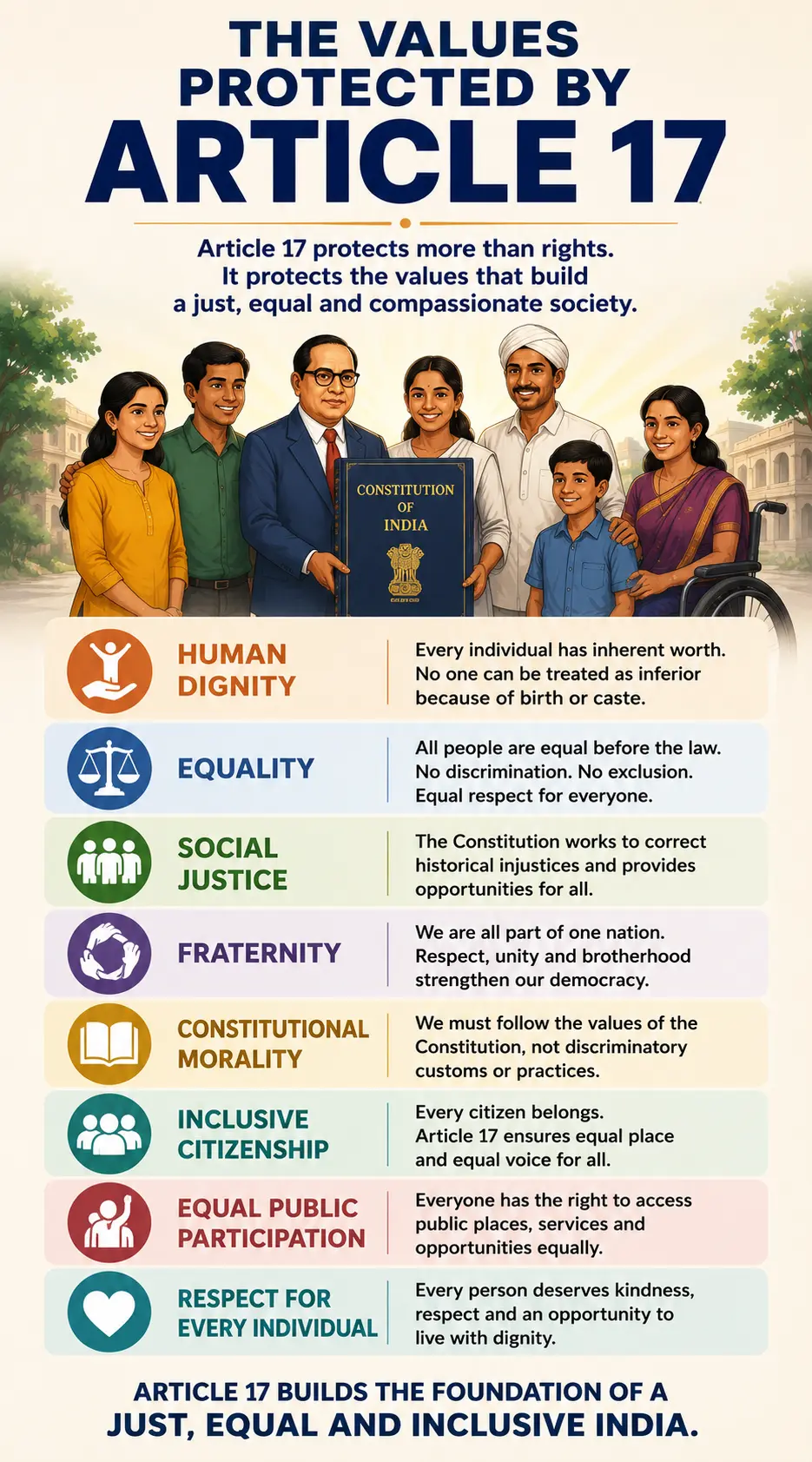
Article 17 is about much more than banning discrimination.
It protects several constitutional ideals simultaneously.
These include:
- Human dignity
- Equality
- Social justice
- Fraternity
- Constitutional morality
- Inclusive citizenship
- Equal public participation
- Respect for every individual
Each of these values strengthens democratic society.
Article 17 and Human Dignity
Perhaps the greatest contribution of Article 17 is its protection of human dignity.
The Constitution recognizes that every individual possesses equal worth.
No one becomes superior because of birth.
No one becomes inferior because of caste.
Every person deserves equal respect.
That simple idea transformed Indian constitutional law.
It shifted the focus from inherited social status to equal citizenship.
Why Article 17 Still Matters Today
Some people assume Article 17 belongs only to history.
That would be a mistake.
Although India has made remarkable progress, constitutional protections remain essential.
Whenever discrimination occurs, Article 17 reminds society that equality is not optional.
It is a constitutional obligation.
The existence of strong legal protections also reflects the continuing commitment of the State to eliminate practices rooted in untouchability through enforcement, awareness, rehabilitation measures, and institutional support.
Key Takeaways from Part 1
| Topic | Summary |
|---|---|
| Article 17 | Abolishes untouchability completely |
| Constitutional Position | Part III, Right to Equality |
| Nature | Absolute prohibition |
| Purpose | Protect dignity and equality |
| Legal Effect | Practice becomes a punishable offence |
| Historical Importance | Ends centuries of caste-based disabilities |
| Central Constitutional Value | Human dignity above social hierarchy |
| Implementation | Parliament enacted laws to punish violations |
Part 2A
In Part 1, we explored the historical background of untouchability, the constitutional significance of Article 17, and why the framers of the Constitution considered its abolition essential for building an equal and democratic society.
But writing Article 17 into the Constitution was only the first step.
A constitutional promise alone cannot eliminate a deeply rooted social practice. For a right to become meaningful, it must be backed by laws, effective enforcement, responsive institutions, and public awareness. Recognizing this, the Constitution empowered Parliament to enact legislation that would punish the practice of untouchability and protect those who suffered because of it.
Over the years, Parliament enacted several important laws that transformed Article 17 from a constitutional declaration into an enforceable legal right. These laws provide criminal penalties, establish special courts, define offences, protect victims, and strengthen the government’s responsibility to ensure equality in everyday life.
This part examines the legal framework that gives practical effect to Article 17, beginning with Article 35, the Protection of Civil Rights Act, 1955, and the broader constitutional machinery designed to eliminate untouchability.
From Constitutional Promise to Legal Reality
The Constitution declares that untouchability is abolished.
However, it also states that enforcing any disability arising from untouchability shall be an offence “punishable in accordance with law.”
This wording is significant.
The Constitution itself does not list criminal offences or specify punishments. Instead, it directs Parliament to create legislation that defines offences and prescribes penalties.
This constitutional design ensures flexibility. As society changes, Parliament can strengthen or amend the law without altering the Constitution itself.
How Article 17 Works in Practice
| Stage | Constitutional or Legal Action | Purpose |
|---|---|---|
| Step 1 | Article 17 abolishes untouchability | Ends legal recognition of the practice |
| Step 2 | Article 35 authorizes Parliament to legislate | Ensures uniform national law |
| Step 3 | Protection of Civil Rights Act, 1955 | Defines offences and punishments |
| Step 4 | SC/ST (Prevention of Atrocities) Act, 1989 | Strengthens protection against caste-based atrocities |
| Step 5 | Police, Courts, and Government Authorities | Investigate, prosecute, and enforce the law |
| Step 6 | Judiciary | Interprets constitutional rights and safeguards justice |
Together, these measures ensure that Article 17 is not merely symbolic. It has legal force and practical consequences.
Article 35: Parliament’s Exclusive Power to Make Law
One of the less discussed but highly important constitutional provisions connected with Article 17 is Article 35.
Many constitutional rights can be implemented through laws made by both Parliament and State Legislatures, depending on the subject matter. However, Article 35 creates an exception.
It gives Parliament the exclusive authority to enact laws for certain constitutional provisions, including the enforcement of Article 17.
This approach promotes consistency across India.
If every State created different criminal laws relating to untouchability, there could be significant differences in legal protection. Parliament’s exclusive power ensures that the prohibition applies uniformly throughout the country.
Why Article 35 Is Important
Article 35 serves several constitutional purposes.
It:
- Creates a uniform national legal framework.
- Prevents conflicting State laws.
- Ensures equal protection for citizens across India.
- Supports effective implementation of Fundamental Rights.
- Reinforces Parliament’s responsibility to safeguard constitutional equality.
Without Article 35, enforcement could have varied significantly from one State to another.
Relationship Between Articles 17 and 35
| Article | Primary Function | Importance |
|---|---|---|
| Article 17 | Abolishes untouchability | Creates the constitutional right |
| Article 35 | Authorizes Parliament to make laws | Makes Article 17 enforceable through legislation |
These two provisions work together.
Article 17 creates the constitutional command.
Article 35 enables Parliament to translate that command into criminal law.
The Protection of Civil Rights Act, 1955
The first major law enacted to implement Article 17 was the Untouchability (Offences) Act, 1955.
Later, the law was substantially amended.
In 1976, its name was changed to the Protection of Civil Rights Act, 1955, to better reflect its purpose.
The change in terminology was more than symbolic.
The new name emphasized that the law protects the civil rights guaranteed by the Constitution rather than merely punishing individual acts.
This shift also reflected a broader understanding that equality involves protecting the dignity and rights of every citizen.
Objectives of the Protection of Civil Rights Act
The Act seeks to:
- Give legal effect to Article 17.
- Eliminate disabilities arising from untouchability.
- Criminalize discriminatory practices.
- Protect equal access to public places.
- Safeguard human dignity.
- Promote social equality.
- Punish offenders.
- Encourage equal participation in public life.
Major Features of the Protection of Civil Rights Act
| Feature | Explanation |
|---|---|
| Constitutional Basis | Article 17 |
| Original Name | Untouchability (Offences) Act, 1955 |
| Present Name | Protection of Civil Rights Act, 1955 |
| Purpose | Eliminate disabilities arising from untouchability |
| Nature of Law | Criminal legislation |
| Coverage | Applies throughout India |
| Protected Interest | Equal enjoyment of civil rights |
| Enforcement Agencies | Police, Courts, Government Authorities |
What Are ‘Civil Rights’ Under the Act?
The Act defines civil rights in relation to Article 17.
These rights include those arising from the abolition of untouchability.
In simple terms, every citizen has the right to enjoy public facilities, services, institutions, and opportunities without being excluded because of caste-based untouchability.
These are not special privileges.
They are ordinary rights that belong equally to every person.
Examples of Civil Rights Protected by Law
Historically, many people were denied access to basic public facilities.
The Protection of Civil Rights Act makes such discriminatory conduct unlawful.
Protected rights include equal access to:
- Public roads
- Public wells
- Public tanks
- Rivers
- Ghats
- Educational institutions
- Hospitals
- Hotels
- Restaurants
- Shops
- Public entertainment venues
- Religious places open to the public
- Community facilities
- Government institutions
- Public transport facilities
- Public parks
The law reinforces that no citizen may be denied these facilities solely because of untouchability.
Illustrative Examples
Example 1
A person is prevented from entering a temple that is legally open to all members of the public solely because of caste.
This may amount to an offence under the Protection of Civil Rights Act.
Example 2
A restaurant refuses service to a customer because members of a particular caste are considered “untouchable.”
Such discrimination is prohibited.
Example 3
Children are forced to sit separately in a publicly funded educational institution because of caste-based untouchability.
Such treatment violates constitutional equality and may attract legal consequences depending on the circumstances.
Example 4
A village prevents certain families from drawing water from a public well because of caste.
The law treats this as a serious violation of civil rights.
Rights Protected Under the Protection of Civil Rights Act
The legislation safeguards numerous aspects of daily life.
These include the right to:
- Enter public places.
- Access educational institutions.
- Receive services.
- Participate in religious activities where public entry is permitted.
- Use public water sources.
- Purchase goods.
- Access healthcare.
- Travel freely on public roads.
- Participate in social life without discrimination.
- Live with dignity.
Categories of Offences Under the Act
The Act criminalizes many different forms of discrimination arising from untouchability.
These include:
1. Denial of Access
Refusing entry into places that are legally open to the public.
Examples include:
- Temples
- Hotels
- Restaurants
- Educational institutions
- Public roads
- Shops
- Hospitals
2. Denial of Public Services
Refusing services that are ordinarily available to the general public.
Examples include:
- Water supply
- Public transportation
- Medical services
- Community facilities
3. Social Disabilities
Imposing restrictions that isolate or humiliate individuals because of untouchability.
Historically, these included:
- Separate seating
- Separate utensils
- Social exclusion
- Restrictions on participation in community activities
4. Economic Disabilities
The law also addresses discrimination affecting livelihood and economic participation where such disabilities arise from untouchability.
Important Offences Under the Act
| Offence | Nature of Violation |
|---|---|
| Denying entry to public places | Restricts constitutional equality |
| Refusing access to public wells | Violates civil rights |
| Restricting access to educational institutions | Denies equal opportunity |
| Refusing service in hotels or restaurants | Unlawful discrimination |
| Preventing use of public roads | Illegal disability |
| Denying entry to public places of worship | Prohibited under the Act where public access exists |
| Enforcing caste-based disabilities | Direct violation of Article 17 |
| Promoting practices arising from untouchability | Punishable according to law |
Punishment Under the Protection of Civil Rights Act
The Act prescribes criminal penalties for offences committed under its provisions.
Over time, amendments have strengthened these penalties to increase deterrence and improve enforcement.
Depending on the nature of the offence and the applicable provisions, punishments may include:
- Imprisonment
- Fine
- Both imprisonment and fine
For repeat offenders, the law generally provides for stricter punishment, reflecting the seriousness with which Parliament views continued violations of Article 17. The exact sentence depends on the offence charged and the provisions in force. (See the Protection of Civil Rights Act, 1955, as amended.)
Why Criminal Punishment Matters
Some may ask why social discrimination should attract criminal liability.
The answer lies in the nature of the harm.
Untouchability is not merely offensive behavior.
It is a denial of constitutional equality.
It attacks human dignity.
It excludes people from public life.
It weakens democracy itself.
By making such acts punishable, the Constitution and Parliament affirm that equality is a legal obligation, not simply a moral aspiration.
Who Can Be Held Liable?
The Protection of Civil Rights Act applies to individuals who commit prohibited acts.
Depending on the facts of a case, liability may also extend in accordance with the Act’s provisions to persons who enforce disabilities arising from untouchability or otherwise violate the rights protected by the legislation.
Courts examine each case based on the evidence, the statutory provisions involved, and the applicable legal standards.
Role of Public Authorities
Effective enforcement depends on more than legislation.
Public authorities play a vital role by:
- Receiving complaints.
- Registering criminal cases where appropriate.
- Conducting fair investigations.
- Protecting victims and witnesses.
- Filing charge sheets.
- Supporting prosecution before the courts.
- Promoting awareness of constitutional rights.
The success of Article 17 depends not only on strong laws but also on consistent and impartial enforcement.
Key Takeaways from Part 2A
| Topic | Summary |
|---|---|
| Article 35 | Gives Parliament exclusive authority to legislate for enforcing Article 17. |
| Protection of Civil Rights Act, 1955 | Primary legislation implementing the abolition of untouchability. |
| Purpose | Protect civil rights and punish discriminatory practices arising from untouchability. |
| Protected Rights | Equal access to public places, services, education, worship, and community facilities. |
| Nature of Law | Criminal law designed to enforce constitutional equality. |
| Constitutional Goal | Transform Article 17 from a constitutional guarantee into an enforceable reality. |
Part 2B
In Part 2A, we examined how Article 35 empowered Parliament to enact laws that give practical effect to Article 17. We also discussed the Protection of Civil Rights Act, 1955, which criminalizes the practice of untouchability and protects the civil rights guaranteed by the Constitution.
However, lawmakers and courts gradually recognized that certain forms of caste-based discrimination went far beyond the denial of access to public places or services. In many cases, members of the Scheduled Castes (SCs) and Scheduled Tribes (STs) faced serious violence, intimidation, humiliation, social boycotts, forced displacement, and other grave offences.
To address these crimes more effectively, Parliament enacted another landmark law, the Scheduled Castes and the Scheduled Tribes (Prevention of Atrocities) Act, 1989.
This legislation does not replace the Protection of Civil Rights Act, 1955. Instead, it strengthens India’s legal framework by targeting severe offences committed against members of SCs and STs because of their caste or tribal identity.
Why Was Another Law Needed?
Although the Protection of Civil Rights Act, 1955, was an important step, it became clear over time that more comprehensive legal protection was necessary.
Several reasons contributed to the enactment of the SC/ST (Prevention of Atrocities) Act, 1989.
These included:
- Continued reports of caste-based violence.
- Social and economic oppression in certain regions.
- Low conviction rates in some cases.
- Fear among victims of reporting offences.
- Intimidation of witnesses.
- Need for stronger criminal provisions.
- Requirement for faster investigation and trial.
- Need for victim rehabilitation and protection.
Parliament concluded that existing legal provisions alone were insufficient to address these serious crimes.
Objectives of the SC/ST (Prevention of Atrocities) Act, 1989
The Act has several important objectives.
These include:
- Prevent atrocities against members of Scheduled Castes and Scheduled Tribes.
- Provide stronger criminal penalties.
- Ensure speedy investigation and trial.
- Protect victims and witnesses.
- Provide relief and rehabilitation.
- Promote constitutional equality.
- Strengthen implementation of Article 17 and other Fundamental Rights.
- Create accountability among public authorities.
Constitutional Foundation of the Act
The Act reflects several constitutional principles.
| Constitutional Provision | Connection with the Act |
|---|---|
| Article 14 | Equality before law |
| Article 15 | Prohibition of discrimination |
| Article 16 | Equal opportunity in public employment |
| Article 17 | Abolition of untouchability |
| Article 21 | Protection of life and personal liberty |
| Article 46 | Promotion of educational and economic interests of Scheduled Castes and Scheduled Tribes |
| Article 338 | National Commission for Scheduled Castes |
| Article 338A | National Commission for Scheduled Tribes |
The Act is therefore part of a broader constitutional commitment to equality, dignity, and social justice.
Understanding the Meaning of ‘Atrocity’
The term “atrocity” in the context of this law refers to certain specified offences committed against members of the Scheduled Castes or Scheduled Tribes because of their caste or tribal identity.
The Act lists numerous offences.
These go beyond ordinary criminal conduct because they involve discrimination rooted in caste prejudice and social exclusion.
Major Categories of Offences
The Act covers a wide range of criminal acts.
Some important categories include:
1. Physical Violence
Examples include:
- Assault
- Grievous hurt
- Wrongful confinement
- Criminal intimidation
- Murder
- Attempt to commit serious violent offences
2. Public Humiliation
The Act recognizes that dignity is a constitutional value.
Acts intended to insult or humiliate a member of an SC or ST in situations covered by the Act are treated seriously.
3. Social Boycott and Exclusion
Certain forms of organized exclusion may amount to offences under the law.
Examples include:
- Preventing participation in community life.
- Restricting access to common facilities.
- Forcing segregation.
4. Property-Related Offences
The Act contains provisions addressing certain unlawful acts affecting land, houses, or other property belonging to members of Scheduled Castes or Scheduled Tribes.
5. Economic Exploitation
Certain acts involving forced labour, unlawful occupation, or economic oppression may attract liability under the Act, depending on the facts and the applicable provisions.
6. Sexual Offences
The law provides enhanced protection for members of Scheduled Castes and Scheduled Tribes where offences of a sexual nature are committed under circumstances covered by the Act, alongside relevant provisions of other criminal laws.
Illustrative Categories of Offences
| Category | Illustrative Conduct |
|---|---|
| Physical violence | Assault, grievous hurt, murder |
| Public humiliation | Intentional caste-based insults in situations covered by law |
| Property offences | Certain unlawful acts affecting land or homes |
| Economic oppression | Forced labour or unlawful deprivation of livelihood |
| Social exclusion | Organized denial of community participation |
| Intimidation | Threats intended to prevent lawful exercise of rights |
| Sexual offences | Offences attracting enhanced legal protection under applicable laws |
The Importance of Protecting Human Dignity
The Constitution repeatedly emphasizes human dignity.
Article 17 abolishes untouchability.
Article 21 protects life and personal liberty.
Together, these provisions recognize that equality is not limited to legal status.
A person’s dignity must also be protected in daily life.
Public humiliation based on caste attacks this constitutional value.
That is why Parliament enacted stronger criminal provisions to discourage such conduct.
Special Courts for Speedy Justice
One of the major strengths of the Act is its emphasis on speedy justice.
Ordinary criminal trials may sometimes take considerable time.
Recognizing the seriousness of atrocities, the Act provides for the establishment of Special Courts and Exclusive Special Courts, depending on statutory requirements and the needs of a particular State.
Their objectives include:
- Faster trials.
- Efficient case management.
- Greater attention to sensitive offences.
- Timely delivery of justice.
What Is a Special Court?
A Special Court is a designated court authorized to try offences under the Act.
These courts help reduce delays by focusing on cases arising under this legislation.
Some States also establish Exclusive Special Courts, which deal primarily with offences under the Act.
Difference Between Ordinary Criminal Courts and Special Courts
| Ordinary Criminal Court | Special Court under the Act |
|---|---|
| Hears many categories of criminal cases | Focuses on offences under the Act |
| Larger case load | Designed to improve efficiency in atrocity cases |
| General criminal jurisdiction | Special statutory jurisdiction |
| Standard trial process | Faster handling where possible under law |
Role of Special Public Prosecutors
The Act also provides for the appointment of Special Public Prosecutors.
These prosecutors have an important responsibility.
They represent the prosecution during trial and help ensure that cases are presented effectively before the court.
Their work includes:
- Examining evidence.
- Questioning witnesses.
- Presenting legal arguments.
- Assisting the court.
- Protecting the interests of justice.
Duties of Police Officers
The police play a crucial role in implementing the Act.
Their responsibilities generally include:
- Receiving complaints.
- Registering First Information Reports (FIRs) where required by law.
- Conducting prompt investigations.
- Collecting evidence.
- Recording witness statements.
- Filing charge sheets where appropriate.
- Coordinating with prosecutors.
Professional, impartial, and timely investigation is essential for ensuring that constitutional protections are meaningful in practice.
Responsibilities of State Governments
State Governments have several statutory and administrative responsibilities.
These may include:
- Establishing Special Courts where required.
- Appointing Special Public Prosecutors.
- Monitoring implementation.
- Conducting awareness programmes.
- Providing relief measures.
- Coordinating rehabilitation efforts.
- Reviewing progress through monitoring mechanisms.
Effective implementation depends not only on legislation but also on administrative commitment.
Rights of Victims
The law recognizes that victims require more than punishment of offenders.
They also need protection, support, and access to justice.
Depending on the applicable legal provisions and circumstances, victims may be entitled to:
- Fair investigation.
- Speedy trial.
- Protection from intimidation.
- Relief measures.
- Rehabilitation assistance.
- Participation in legal proceedings as provided by law.
- Respectful treatment by authorities.
Witness Protection
Witnesses often play a decisive role in criminal trials.
Fear of retaliation can discourage individuals from coming forward.
Accordingly, the legal framework includes measures intended to protect witnesses and support the integrity of the judicial process.
Relief and Rehabilitation
The objective of the Act extends beyond criminal punishment.
It also recognizes the importance of restoring the dignity and security of victims.
Relief and rehabilitation measures may include assistance provided in accordance with the Act, the Rules framed under it, and applicable government schemes.
These measures aim to help victims recover from the consequences of offences and rebuild their lives.
Monitoring the Implementation of the Act
Implementation is regularly reviewed through statutory and administrative mechanisms.
These include:
- Periodic review meetings.
- State-level monitoring committees.
- District-level monitoring arrangements.
- Data collection and reporting.
- Coordination among departments.
Monitoring helps identify implementation challenges and improve enforcement.
Key Amendments to Strengthen the Law
Over the years, Parliament has amended the Act to respond to changing circumstances and strengthen protections.
Important objectives of these amendments include:
- Expanding the list of offences.
- Improving victim protection.
- Strengthening investigation procedures.
- Enhancing accountability.
- Supporting speedy justice.
- Clarifying legal provisions in light of judicial developments.
These amendments demonstrate that the law continues to evolve to meet contemporary challenges.
Comparison Between the Two Major Laws
| Feature | Protection of Civil Rights Act, 1955 | SC/ST (Prevention of Atrocities) Act, 1989 |
|---|---|---|
| Primary Purpose | Enforce Article 17 by prohibiting untouchability | Prevent atrocities against SCs and STs |
| Nature | Civil rights protection through criminal law | Special criminal legislation |
| Main Focus | Disabilities arising from untouchability | Serious caste and tribe based offences specified by law |
| Special Courts | Not the central feature | Yes, provided under the Act |
| Victim Protection | Limited compared to later legislation | Comprehensive statutory framework |
| Relief Measures | Basic legal protection | Broader relief and rehabilitation framework |
| Constitutional Link | Direct implementation of Article 17 | Supports Articles 14, 15, 17, 21, and 46 |
Why These Laws Matter Together
Neither law works in isolation.
The Protection of Civil Rights Act, 1955 addresses disabilities arising from untouchability.
The SC/ST (Prevention of Atrocities) Act, 1989 targets specified serious offences committed against members of Scheduled Castes and Scheduled Tribes.
Together, they create a stronger legal framework that advances the constitutional ideals of equality, human dignity, social justice, and fraternity.
Key Takeaways from Part 2B
| Topic | Summary |
|---|---|
| Need for the 1989 Act | Address serious caste-based atrocities beyond the scope of earlier legislation. |
| Objectives | Prevention, protection, speedy justice, and rehabilitation. |
| Special Courts | Help ensure quicker trials of offences under the Act. |
| Special Public Prosecutors | Conduct prosecutions and assist courts. |
| Victim Protection | Includes safeguards, relief, and rehabilitation under the legal framework. |
| Constitutional Basis | Reinforces Articles 14, 15, 17, 21, and 46. |
| Overall Importance | Strengthens the enforcement of constitutional equality and protects vulnerable communities from serious offences. |
Part 2C
In Part 2A, we examined the Protection of Civil Rights Act, 1955, and how Parliament transformed the constitutional guarantee under Article 17 into an enforceable legal right.
In Part 2B, we explored the Scheduled Castes and the Scheduled Tribes (Prevention of Atrocities) Act, 1989, along with its objectives, major offences, Special Courts, victim protection measures, and rehabilitation framework.
This final section of Part 2 focuses on another equally important pillar of constitutional governance, the judiciary. Laws become meaningful only when courts interpret them fairly, enforce them consistently, and protect the rights guaranteed by the Constitution.
Over the decades, the Supreme Court of India and various High Courts have repeatedly emphasized that Article 17 is not a symbolic declaration. It is an enforceable Fundamental Right that protects human dignity, equality, and constitutional morality.
The Judiciary as the Guardian of Article 17
India follows the principle of constitutional supremacy.
Every law, executive action, and public authority must function within the limits of the Constitution.
Whenever constitutional rights are violated, the courts have the authority to examine those actions and provide appropriate remedies.
In matters involving Article 17, the judiciary performs several important functions.
These include:
- Interpreting constitutional provisions.
- Protecting Fundamental Rights.
- Reviewing government actions.
- Ensuring proper implementation of legislation.
- Granting constitutional remedies.
- Promoting equality before law.
- Protecting individual dignity.
Without an independent judiciary, constitutional guarantees would often remain theoretical rather than practical.
Constitutional Remedies Available to Citizens
A Fundamental Right is meaningful only if individuals can enforce it.
The Constitution therefore provides direct remedies.
Article 32
Article 32 allows individuals to approach the Supreme Court of India for the enforcement of Fundamental Rights.
Dr. B. R. Ambedkar famously described this provision as the “heart and soul” of the Constitution because it gives citizens a direct constitutional remedy when their rights are violated.
Article 226
Every High Court also has the power under Article 226 to issue appropriate writs for protecting legal and constitutional rights.
In many situations, affected persons may approach the jurisdictional High Court for relief.
Comparison Between Articles 32 and 226
| Feature | Article 32 | Article 226 |
|---|---|---|
| Court | Supreme Court | High Courts |
| Purpose | Enforcement of Fundamental Rights | Enforcement of Fundamental Rights and certain other legal rights |
| Nature | Constitutional remedy | Wider constitutional jurisdiction |
| Importance | Direct protection of Fundamental Rights | Broad judicial review and constitutional supervision |
Together, these provisions strengthen the protection offered by Article 17.
Relationship Between Article 17 and Other Fundamental Rights
Although Article 17 is unique, it does not operate in isolation.
It works alongside several other constitutional guarantees.
| Article | Subject | Connection with Article 17 |
|---|---|---|
| Article 14 | Equality before law | Equal legal protection for every person |
| Article 15 | Prohibition of discrimination | Prevents discrimination on specified grounds, including caste |
| Article 16 | Equality in public employment | Ensures equal opportunity |
| Article 17 | Abolition of untouchability | Eliminates caste-based disabilities arising from untouchability |
| Article 21 | Right to life and personal liberty | Protects dignity and meaningful life |
| Article 32 | Constitutional remedies | Direct enforcement before the Supreme Court |
| Article 226 | High Court jurisdiction | Judicial protection through writs |
These provisions collectively establish a constitutional framework based on equality rather than social hierarchy.
The Principle of Constitutional Morality
Modern constitutional jurisprudence frequently refers to constitutional morality.
The concept requires public authorities and citizens to act according to the values embodied in the Constitution rather than discriminatory social customs.
These values include:
- Equality
- Human dignity
- Liberty
- Justice
- Fraternity
- Rule of law
- Respect for Fundamental Rights
Article 17 reflects constitutional morality by rejecting practices that undermine equal citizenship.
Landmark Judicial Decisions
Over the years, courts have clarified the meaning and scope of Article 17.
Some important decisions include:
State of Karnataka v. Appa Balu Ingale (1995)
In this important judgment, the Supreme Court reaffirmed that practices arising from untouchability are inconsistent with constitutional values.
The Court emphasized that equality cannot remain confined to constitutional text. It must become a reality in everyday life.
The judgment reinforced the obligation of authorities to enforce laws enacted under Article 17.
People’s Union for Democratic Rights v. Union of India (1982)
Although this case primarily concerned labour rights, the Supreme Court stressed that Fundamental Rights must be interpreted broadly to protect vulnerable sections of society.
The decision reflects the Court’s approach of giving practical meaning to constitutional guarantees.
Safai Karamchari Andolan v. Union of India (2014)
This judgment dealt with the continued existence of manual scavenging, a practice incompatible with constitutional values.
The Supreme Court directed governments to take effective measures for eliminating the practice, rehabilitating affected persons, and ensuring implementation of existing laws.
The judgment highlighted the close relationship between human dignity, Article 17, and Article 21.
Major Constitutional Principles Emerging from Judicial Decisions
The courts have consistently emphasized that:
- Untouchability has no place in a constitutional democracy.
- Human dignity is inseparable from equality.
- Fundamental Rights must receive liberal interpretation.
- Governments have a duty to enforce protective legislation.
- Social justice is a constitutional commitment, not merely a political objective.
Role of the National Commission for Scheduled Castes
The National Commission for Scheduled Castes (NCSC) is a constitutional body established under Article 338.
Its major functions include:
- Investigating complaints.
- Monitoring constitutional safeguards.
- Advising governments.
- Conducting inquiries.
- Presenting reports.
- Recommending measures for improving implementation.
Role of the National Commission for Scheduled Tribes
The National Commission for Scheduled Tribes (NCST) functions under Article 338A.
Its responsibilities include:
- Monitoring safeguards.
- Investigating complaints.
- Advising governments on policy.
- Protecting constitutional rights.
- Reviewing implementation of welfare measures.
Government Initiatives Supporting Article 17
Laws alone cannot eliminate discrimination.
Public awareness, education, and social inclusion are equally important.
Governments at different levels undertake initiatives such as:
- Awareness campaigns.
- Educational scholarships.
- Skill development programmes.
- Economic empowerment schemes.
- Legal aid services.
- Community outreach programmes.
- Rehabilitation initiatives.
- Social justice programmes.
These measures complement the constitutional objective of achieving substantive equality.
Article 17 and Social Transformation
One of the remarkable features of Article 17 is that it seeks to transform society rather than merely regulate government action.
Its impact extends to:
- Public institutions.
- Educational systems.
- Employment practices.
- Community participation.
- Public administration.
- Access to justice.
- Social attitudes.
It reminds every citizen that equality is both a constitutional principle and a shared social responsibility.
Practical Illustration
Imagine a situation where members of a community are prevented from using a public facility solely because of caste.
Such conduct may involve:
- Violation of Article 17.
- Offences under the Protection of Civil Rights Act, 1955, where applicable.
- Additional offences under the SC/ST (Prevention of Atrocities) Act, 1989, if the statutory requirements are satisfied.
- Constitutional remedies before the courts.
This illustrates how constitutional provisions, legislation, and judicial remedies work together.
Challenges That Still Remain
India has made significant constitutional and legislative progress.
However, challenges continue in some areas.
These include:
- Lack of awareness about legal rights.
- Delays in investigation or trial in certain cases.
- Social prejudice.
- Fear of reporting offences.
- Uneven implementation across regions.
- Need for continued public education.
Addressing these challenges requires cooperation among governments, educational institutions, civil society, local communities, and citizens.
The Road Ahead
The success of Article 17 ultimately depends upon three equally important factors.
First, strong constitutional safeguards.
Second, effective enforcement of criminal laws.
Third, lasting social change based on respect, inclusion, and equality.
Education, awareness, economic opportunity, and constitutional values remain essential for ensuring that discrimination has no place in modern India.
Summary of Part 2
| Subject | Key Learning |
|---|---|
| Article 35 | Parliament has exclusive authority to enact laws implementing Article 17. |
| Protection of Civil Rights Act, 1955 | Criminalizes disabilities arising from untouchability. |
| SC/ST (Prevention of Atrocities) Act, 1989 | Provides stronger protection against specified caste-based offences. |
| Judiciary | Enforces constitutional guarantees and interprets Article 17. |
| Articles 32 and 226 | Provide constitutional remedies before the Supreme Court and High Courts. |
| Constitutional Bodies | NCSC and NCST monitor safeguards and investigate complaints. |
| Government Initiatives | Promote equality through awareness, welfare, education, and rehabilitation. |
| Overall Objective | Protect dignity, equality, and social justice while eliminating practices associated with untouchability. |
Part 3A
In Part 1, we explored the historical background of untouchability, the constitutional significance of Article 17, and the vision of the framers of the Constitution.
In Part 2A, Part 2B, and Part 2C, we examined the legal framework that gives effect to Article 17, including the Protection of Civil Rights Act, 1955, the Scheduled Castes and the Scheduled Tribes (Prevention of Atrocities) Act, 1989, the role of the judiciary, constitutional remedies, and the responsibilities of public institutions.
This part turns our attention to the present.
More than seven decades have passed since the Constitution came into force on 26 January 1950. During this period, India has undergone enormous social, political, educational, and economic transformation. Opportunities that were once denied to many communities have expanded through constitutional safeguards, legislation, education, affirmative action, and social reform.
Yet the constitutional mission of Article 17 remains relevant.
A law can prohibit discrimination, but lasting equality also depends on changing attitudes, strengthening institutions, improving awareness, and ensuring that every individual understands the values of the Constitution.
Article 17 therefore continues to serve not only as a legal rule but also as a reminder of the kind of society that India seeks to build, one where dignity is universal, and equality is real.
Article 17 in Contemporary India
Today’s India is very different from the country that adopted the Constitution in 1950.
The nation has witnessed:
- Rapid urbanization.
- Expansion of education.
- Growth of constitutional awareness.
- Technological progress.
- Greater political participation.
- Increased access to justice.
- Stronger legal protections.
- Wider public debate on equality and human rights.
These developments have helped reduce many traditional barriers.
However, constitutional rights require continuous protection.
Whenever discrimination occurs, Article 17 provides the legal and moral foundation for addressing it.
Why Article 17 Continues to Matter
Some people believe Article 17 belongs only to history.
That assumption overlooks an important constitutional reality.
The Constitution protects rights not only to correct past injustice but also to prevent future discrimination.
Article 17 remains relevant because it:
- Protects human dignity.
- Strengthens democracy.
- Promotes equal citizenship.
- Encourages social inclusion.
- Supports constitutional morality.
- Reinforces the rule of law.
- Protects vulnerable communities.
- Reminds institutions of their constitutional responsibilities.
The Continuing Importance of Constitutional Equality
Equality is not achieved simply by declaring that everyone is equal.
Real equality requires:
- Equal opportunity.
- Equal treatment.
- Equal protection of the law.
- Equal access to public institutions.
- Equal respect for human dignity.
Article 17 contributes to each of these objectives.
How India Has Changed Since 1950
The constitutional journey has produced remarkable progress.
Several developments illustrate this transformation.
| Area | Progress Since the Constitution Came Into Force |
|---|---|
| Education | Greater access to schools, colleges, universities, and professional education |
| Political Participation | Increased representation in democratic institutions |
| Employment | Expanded opportunities through constitutional safeguards and reservations where applicable |
| Public Services | Improved access to transportation, healthcare, banking, and welfare schemes |
| Legal Protection | Stronger criminal laws and constitutional remedies |
| Technology | Easier access to legal information and digital public services |
| Public Awareness | Greater understanding of equality and constitutional rights |
| Judicial Protection | Active role of courts in enforcing Fundamental Rights |
These achievements demonstrate that constitutional values can produce long-term social change when supported by effective institutions.
Article 17 and Social Transformation
The framers of the Constitution understood that democracy is not limited to elections.
A democratic society also requires equal respect among citizens.
Article 17 contributes to social transformation by encouraging people to move beyond inherited social divisions.
It promotes a society where:
- Birth does not determine dignity.
- Every citizen enjoys equal constitutional status.
- Public institutions remain open to everyone.
- Merit and opportunity replace social exclusion.
- Human rights receive equal protection.
From Legal Equality to Social Equality
One of the greatest challenges for every constitutional democracy is converting legal equality into social equality.
The Constitution can prohibit discrimination.
Courts can punish offenders.
Governments can implement welfare programmes.
But genuine equality also depends upon everyday behaviour.
It depends on how people treat one another in:
- Schools.
- Colleges.
- Workplaces.
- Villages.
- Cities.
- Public offices.
- Religious institutions.
- Community organizations.
- Families.
Social equality grows when constitutional values become part of ordinary life.
The Role of Education
Education has always been one of the strongest tools against discrimination.
An informed society is more likely to respect constitutional values.
Schools and universities help students understand:
- The Constitution.
- Fundamental Rights.
- Equality before law.
- Human dignity.
- Democratic citizenship.
- Social justice.
- Respect for diversity.
Students who learn these principles are more likely to reject discriminatory practices throughout their lives.
How Educational Institutions Promote Equality
Educational institutions contribute in many ways.
They:
- Teach constitutional values.
- Encourage inclusive classrooms.
- Promote equal participation.
- Prevent discrimination.
- Support diversity.
- Foster mutual respect.
- Build civic responsibility.
Importance of Constitutional Education
| Educational Goal | Constitutional Value Promoted |
|---|---|
| Teaching Fundamental Rights | Constitutional awareness |
| Civic education | Democratic participation |
| Human rights education | Respect for dignity |
| Legal literacy | Awareness of constitutional remedies |
| Inclusive classrooms | Equality |
| Community activities | Fraternity |
| Student discussions | Constitutional morality |
| Legal aid programmes | Access to justice |
Role of Universities and Law Schools
Universities play a particularly important role.
Law schools train the future:
- Judges.
- Lawyers.
- Prosecutors.
- Civil servants.
- Academics.
- Policymakers.
These professionals influence how constitutional principles are interpreted and implemented.
A strong understanding of Article 17 helps ensure that future legal institutions remain committed to equality.
Legal Awareness Among Citizens
Many constitutional rights remain underused simply because people are unaware of them.
Legal awareness programmes help citizens understand:
- Their constitutional rights.
- Available legal remedies.
- Government support mechanisms.
- Complaint procedures.
- Anti-discrimination laws.
Knowledge empowers individuals to protect their own rights and assist others.
Role of the Media
The media plays an important role in strengthening constitutional democracy.
Responsible journalism can:
- Increase awareness.
- Highlight legal developments.
- Explain court judgments.
- Encourage public debate.
- Promote constitutional literacy.
- Expose unlawful discrimination.
- Inform citizens about legal protections.
At the same time, accurate reporting is essential.
Sensitive legal issues should always be reported responsibly and fairly.
Digital Media and Constitutional Awareness
Digital technology has transformed access to legal information.
Today, citizens can:
- Read constitutional provisions online.
- Access government publications.
- Follow Supreme Court judgments.
- Watch educational lectures.
- Participate in legal awareness programmes.
- Learn through online courses.
- Access legal aid resources.
Technology has made constitutional education more accessible than ever before.
Role of Civil Society
Civil society organizations contribute significantly to constitutional awareness.
Their activities often include:
- Legal literacy campaigns.
- Community outreach.
- Human rights education.
- Research.
- Public awareness programmes.
- Support for vulnerable communities.
Working alongside government institutions, they help strengthen democratic participation.
Public Institutions and Constitutional Responsibility
Every public institution has constitutional responsibilities.
These include:
- Government departments.
- Educational institutions.
- Police authorities.
- Local governments.
- Public sector organizations.
- Courts.
- Constitutional commissions.
Each institution contributes to protecting equality in different ways.
How Different Institutions Support Article 17
| Institution | Primary Responsibility |
|---|---|
| Parliament | Enacts laws |
| Judiciary | Interprets and enforces the Constitution |
| Police | Investigates offences |
| Educational Institutions | Promote constitutional awareness |
| Government Departments | Implement welfare and legal measures |
| National Commissions | Monitor constitutional safeguards |
| Local Authorities | Ensure equal access to public services |
| Citizens | Respect constitutional values in everyday life |
The Importance of Fraternity
One constitutional value closely connected with Article 17 is fraternity.
Fraternity means more than peaceful coexistence.
It reflects a sense of shared citizenship.
It encourages people to:
- Respect one another.
- Support equal dignity.
- Reject discrimination.
- Strengthen national unity.
- Promote social harmony.
Without fraternity, equality becomes difficult to achieve.
Economic Empowerment and Equality
Economic opportunity also contributes to social equality.
Employment, education, entrepreneurship, and skill development help individuals participate more fully in national life.
Government initiatives supporting education, financial inclusion, entrepreneurship, and employment therefore complement the broader constitutional objective of social justice.
Urban and Rural Perspectives
The implementation of constitutional values may differ across regions due to varying social, economic, and cultural conditions.
| Aspect | Urban Areas | Rural Areas |
|---|---|---|
| Access to Education | Generally wider | Improving through government initiatives |
| Public Awareness | Often higher due to greater access to information | Increasing through education and outreach |
| Legal Services | More readily available | Expanding through legal aid programmes |
| Digital Access | Higher internet penetration | Growing digital connectivity |
| Community Structure | More diverse social interaction | Stronger traditional community networks |
Both urban and rural communities continue to benefit from constitutional education and effective implementation of legal safeguards.
Challenges That Require Continued Attention
Despite significant constitutional progress, certain challenges remain.
These include:
- Limited awareness of legal rights in some areas.
- Social prejudice and stereotypes.
- Uneven implementation of laws.
- Delays in legal proceedings in some cases.
- Need for greater constitutional literacy.
- Better access to legal aid.
- Continued public education on equality.
Recognizing these challenges is important because it encourages continuous improvement rather than complacency.
Constitutional Values in Everyday Life
Article 17 is not relevant only in courtrooms.
Its principles influence daily life.
Every citizen contributes to constitutional democracy by:
- Treating others with respect.
- Rejecting discrimination.
- Following the rule of law.
- Supporting equal opportunity.
- Promoting inclusive communities.
- Respecting the dignity of every individual.
These everyday actions strengthen the constitutional promise of equality.
Key Takeaways from Part 3A
| Topic | Summary |
|---|---|
| Present-Day Relevance | Article 17 continues to protect equality and human dignity. |
| Education | Builds constitutional awareness and promotes inclusion. |
| Media | Increases public understanding of constitutional rights. |
| Civil Society | Supports legal literacy and social justice initiatives. |
| Public Institutions | Share responsibility for implementing constitutional values. |
| Citizens | Play a vital role in creating an inclusive society. |
| Overall Goal | Transform legal equality into lasting social equality. |
Part 3B
In Part 3A, we explored the continuing relevance of Article 17 in modern India. We discussed the role of education, constitutional awareness, public institutions, media, civil society, and citizens in strengthening equality and social justice.
This part expands the discussion by examining constitutional morality, India’s commitment to international human rights, the responsibilities of citizens and institutions, and how different democratic nations address discrimination. Although every country has its own history and legal system, many constitutional democracies share a common goal of ensuring that every individual is treated with dignity and equality before the law.
Article 17 is therefore not only an important provision within the Constitution of India. It also reflects values that are widely recognized in modern constitutional and international law.
Understanding Constitutional Morality
One of the most significant ideas in modern constitutional law is constitutional morality.
The expression does not refer to personal morality or religious beliefs.
Instead, it means acting according to the values and principles embodied in the Constitution.
Whenever a conflict arises between discriminatory social practices and constitutional values, the Constitution must prevail.
Constitutional morality encourages individuals, governments, institutions, and courts to respect:
- Equality
- Human dignity
- Justice
- Liberty
- Fraternity
- Rule of law
- Fundamental Rights
These principles guide decision-making in a democratic society.
Why Constitutional Morality Is Important
The framers of the Constitution understood that societies often carry long-standing customs and traditions.
Many traditions strengthen communities.
However, if any practice violates constitutional guarantees of equality and dignity, public authorities are expected to uphold the Constitution.
This is why Article 17 is so significant.
It makes it clear that no custom, tradition, or social practice can justify untouchability.
The Constitution remains the supreme law of the land.
Characteristics of Constitutional Morality
| Principle | Meaning |
|---|---|
| Respect for Equality | Every individual deserves equal treatment before the law. |
| Human Dignity | Every person possesses inherent worth. |
| Rule of Law | Laws apply equally to all individuals and institutions. |
| Justice | Legal systems should protect fairness and rights. |
| Fraternity | Citizens should respect and support one another as equals. |
| Constitutional Supremacy | Constitutional values prevail over discriminatory customs. |
The Responsibility of Every Citizen
The Constitution guarantees rights.
At the same time, a democratic society depends upon responsible citizenship.
Every individual contributes to constitutional democracy by respecting the dignity and equality of others.
Citizens strengthen Article 17 when they:
- Reject discrimination.
- Treat everyone with respect.
- Support equal opportunities.
- Follow constitutional values.
- Encourage inclusive communities.
- Report unlawful discrimination where appropriate.
- Promote harmony and mutual respect.
Equality becomes stronger when constitutional values are practiced in everyday life.
Role of Families in Building Equality
The first lessons about equality often begin at home.
Families help shape attitudes toward:
- Respect.
- Diversity.
- Inclusion.
- Compassion.
- Cooperation.
- Equal treatment.
Children who grow up learning that every individual deserves dignity are more likely to become responsible constitutional citizens.
Role of Schools and Universities
Educational institutions do much more than teach academic subjects.
They also prepare students for democratic citizenship.
Schools and universities encourage:
- Respect for diversity.
- Inclusive learning.
- Civic responsibility.
- Constitutional awareness.
- Peaceful conflict resolution.
- Equal participation in educational activities.
Education therefore supports the long-term objectives of Article 17.
How Educational Institutions Promote Constitutional Values
| Educational Activity | Constitutional Benefit |
|---|---|
| Civic education | Greater constitutional awareness |
| Legal literacy programmes | Better understanding of rights |
| Debates and discussions | Democratic participation |
| Inclusive classrooms | Equality in practice |
| Community service | Social responsibility |
| Human rights education | Respect for dignity |
Role of Public Authorities
Every public authority shares responsibility for implementing constitutional guarantees.
These include:
- Parliament.
- State Legislatures.
- Courts.
- Police.
- District administration.
- Educational authorities.
- Constitutional commissions.
- Local governments.
Their responsibilities extend beyond enforcing laws.
They also include promoting equality, preventing discrimination, and protecting public confidence in the rule of law.
Good Governance and Article 17
Good governance supports constitutional equality through:
- Fair administration.
- Transparency.
- Accountability.
- Equal access to public services.
- Efficient delivery of welfare programmes.
- Respect for legal procedures.
- Prompt action against unlawful discrimination.
These administrative principles strengthen public trust in constitutional institutions.
Article 17 and International Human Rights
Although Article 17 is a unique constitutional provision, its underlying values are recognized throughout the world.
Many international human rights instruments emphasize:
- Equality.
- Human dignity.
- Non-discrimination.
- Equal protection of the law.
- Freedom from degrading treatment.
These principles reinforce the broader commitment to protecting every individual regardless of background.
Universal Declaration of Human Rights (UDHR)
The Universal Declaration of Human Rights (1948) is one of the most influential human rights documents in history.
Several of its principles closely align with the values protected by Article 17.
These include:
- Equal dignity of all human beings.
- Equality before the law.
- Freedom from discrimination.
- Equal enjoyment of rights.
- Respect for human dignity.
Although the UDHR is not a constitution, it has greatly influenced constitutional thinking around the world.
International Covenant on Civil and Political Rights (ICCPR)
India is a State Party to the International Covenant on Civil and Political Rights (ICCPR).
The Covenant recognizes important civil and political rights, including:
- Equality before the law.
- Equal legal protection.
- Freedom from discrimination.
- Protection of human dignity.
- Effective legal remedies.
These principles complement the objectives of Article 17.
International Covenant on Economic, Social and Cultural Rights (ICESCR)
The ICESCR focuses on social and economic rights.
It promotes:
- Equal access to education.
- Fair working conditions.
- Social security.
- Health.
- Adequate standards of living.
While its scope differs from Article 17, both seek to create conditions in which every person can live with dignity.
Sustainable Development Goals (SDGs)
The United Nations Sustainable Development Goals encourage countries to build inclusive societies.
Several goals relate closely to constitutional equality.
These include:
- SDG 1 – No Poverty.
- SDG 4 – Quality Education.
- SDG 5 – Gender Equality.
- SDG 10 – Reduced Inequalities.
- SDG 16 – Peace, Justice and Strong Institutions.
Progress toward these goals also supports the broader constitutional vision of equality and social justice.
Comparison Between Article 17 and International Human Rights Principles
| Article 17 | Comparable International Principle |
|---|---|
| Abolition of untouchability | Equality and non-discrimination |
| Protection of dignity | Universal human dignity |
| Equal citizenship | Equal legal protection |
| Criminalization of discriminatory practices | Protection against degrading treatment |
| Constitutional remedies | Effective legal remedies |
Although the legal systems differ, the underlying values are remarkably similar.
Comparative Perspective: Democracies and Equality
Different democratic nations have adopted different approaches to combating discrimination.
Some rely primarily on constitutional guarantees.
Others use detailed civil rights legislation.
Many combine constitutional protections with criminal laws, equality commissions, and anti-discrimination policies.
General Comparison of Equality Frameworks
| Country | General Constitutional Approach |
|---|---|
| India | Fundamental Rights, Article 17, anti-discrimination laws, protective legislation |
| United States | Constitutional equal protection principles supported by federal civil rights laws |
| Canada | Constitutional Charter rights combined with human rights legislation |
| South Africa | Constitution strongly emphasizes equality, dignity, and prohibition of unfair discrimination |
| United Kingdom | Equality legislation supported by human rights protections |
Although each system reflects its own constitutional history, they all recognize that equal dignity is essential to democracy.
Why Article 17 Is Internationally Significant
Article 17 is unusual because it directly abolishes a specific historical social practice.
Many constitutions prohibit discrimination in general terms.
India’s Constitution goes further by expressly abolishing untouchability and authorizing Parliament to make it a punishable offence.
This demonstrates the Constitution’s commitment to addressing a deeply rooted social injustice through both constitutional and legislative action.
Role of Technology in Promoting Equality
Technology has transformed access to constitutional information.
Citizens can now:
- Read constitutional provisions online.
- Access court judgments.
- Learn through digital education platforms.
- Use online legal awareness programmes.
- Obtain government information.
- Access legal aid resources.
- Participate in awareness campaigns through digital media.
Technology cannot replace legal institutions, but it can improve public awareness and access to information.
Corporate Responsibility and Equality
Private organizations also contribute to constitutional values.
Many workplaces encourage:
- Equal opportunity.
- Inclusive recruitment.
- Anti-discrimination policies.
- Diversity training.
- Respectful workplace environments.
- Fair grievance mechanisms.
Although Article 17 primarily operates within the constitutional and legal framework, broader commitments to equality reinforce its objectives.
Building an Inclusive Society
An inclusive society is one in which every individual feels respected, protected, and able to participate in public life.
Such a society values:
- Equality.
- Diversity.
- Mutual respect.
- Fair opportunity.
- Rule of law.
- Democratic participation.
These values strengthen both constitutional democracy and national unity.
Equality as a Continuing Constitutional Journey
The Constitution did not assume that equality would be achieved overnight.
Instead, it created institutions, laws, and remedies capable of supporting continuous progress.
Every generation has a responsibility to preserve these constitutional values.
The continuing importance of Article 17 reminds us that democracy is strengthened whenever dignity and equality are protected in practice.
Key Takeaways from Part 3B
| Topic | Summary |
|---|---|
| Constitutional Morality | Requires adherence to constitutional values over discriminatory customs. |
| Citizens | Strengthen democracy by respecting equality and dignity. |
| Educational Institutions | Promote constitutional awareness and civic responsibility. |
| International Human Rights | Reinforce values of equality, dignity, and non-discrimination. |
| Comparative Constitutional Law | Democracies worldwide use constitutional and legislative measures to combat discrimination. |
| Technology | Expands access to legal knowledge and constitutional education. |
| Inclusive Society | Built on respect, equal opportunity, and the rule of law. |
Part 3C
In Part 3A, we examined the continued importance of Article 17 in contemporary India, including the roles of education, public institutions, media, civil society, and citizens in promoting equality.
In Part 3B, we explored the concept of constitutional morality, India’s commitment to international human rights, comparative constitutional perspectives, and the importance of building an inclusive society.
This final part brings the entire discussion together. It revisits the constitutional journey of Article 17, clears up common misconceptions, presents a chronological timeline of major developments, summarizes key constitutional principles, and explains why the abolition of untouchability remains one of the greatest achievements of the Constitution of India.
Article 17: More Than a Constitutional Provision
Many provisions of the Constitution regulate the relationship between citizens and the State.
Article 17 does something more.
It seeks to transform society itself.
The framers of the Constitution understood that political democracy alone would not be enough.
A nation where citizens could vote freely but still faced social exclusion because of birth could never fully realize the ideals of equality and justice.
Article 17 therefore represents a commitment to creating a society where every individual enjoys equal dignity, regardless of caste or social background.
The Constitutional Vision Behind Article 17
The Constitution does not merely prohibit discrimination.
It seeks to build a society based on shared constitutional values.
These values include:
- Equality
- Justice
- Liberty
- Fraternity
- Human Dignity
- Rule of Law
- Social Justice
- Equal Citizenship
Together, these principles form the moral and legal foundation of Indian democracy.
Common Myths and Facts About Article 17
Like many constitutional provisions, Article 17 is sometimes misunderstood.
The following table explains some common misconceptions.
| Myth | Fact |
|---|---|
| Article 17 applies only to government authorities. | Article 17 abolishes untouchability, and Parliament has enacted laws that punish prohibited conduct by individuals as well as address institutional responsibilities. |
| Untouchability only means physical contact. | In constitutional law, untouchability refers to caste-based disabilities and social exclusion, not ordinary situations involving hygiene or health. |
| Article 17 is only symbolic. | It is an enforceable Fundamental Right, supported by criminal legislation and judicial remedies. |
| Only courts are responsible for implementing Article 17. | Parliament, governments, police, educational institutions, constitutional commissions, civil society, and citizens all have important roles. |
| Article 17 became irrelevant after 1950. | It continues to guide constitutional interpretation, legislation, public policy, and judicial decisions. |
| Equality can be achieved only through legislation. | Laws are essential, but education, awareness, social reform, and public participation are equally important. |
Timeline of Article 17 and the Abolition of Untouchability
The development of Article 17 reflects decades of constitutional thought and legal reform.
| Year | Major Development |
|---|---|
| Before Independence | Social reform movements challenge caste-based discrimination across different regions of India. |
| 1946 | The Constituent Assembly begins drafting the Constitution. |
| 1947 | India becomes independent. |
| 26 November 1949 | The Constitution of India is adopted. |
| 26 January 1950 | The Constitution comes into force, and Article 17 becomes enforceable. |
| 1955 | Parliament enacts the Untouchability (Offences) Act. |
| 1976 | The law is amended and renamed the Protection of Civil Rights Act, 1955. |
| 1989 | Parliament enacts the Scheduled Castes and the Scheduled Tribes (Prevention of Atrocities) Act. |
| 1995 onwards | Judicial decisions continue to strengthen constitutional protections against caste-based discrimination. |
| Present Day | Article 17 remains an important constitutional guarantee supported by legislation, judicial interpretation, awareness programmes, and institutional safeguards. |
How Article 17 Supports Democracy
A democracy is judged not only by its elections but also by how it treats every individual.
Article 17 strengthens democracy by:
- Protecting equal citizenship.
- Encouraging inclusive participation.
- Rejecting social exclusion.
- Promoting constitutional morality.
- Supporting peaceful coexistence.
- Reinforcing public confidence in the Constitution.
- Strengthening the rule of law.
Without equality, democratic institutions cannot fully achieve their purpose.
Article 17 and the Idea of Human Dignity
One of the most powerful themes running through the Constitution is human dignity.
Every person possesses inherent worth.
That dignity does not depend on:
- Birth.
- Caste.
- Religion.
- Wealth.
- Occupation.
- Social status.
Article 17 reflects this principle by rejecting practices that deny equal respect to individuals.
Practical Importance of Article 17 in Everyday Life
Although Article 17 is a constitutional provision, its influence extends into everyday situations.
Its principles support:
- Equal access to public facilities.
- Fair treatment in educational institutions.
- Respectful workplace environments.
- Equal participation in community life.
- Inclusive public administration.
- Protection against unlawful discrimination.
These examples demonstrate that constitutional rights affect ordinary life in meaningful ways.
Key Constitutional Lessons from Article 17
Article 17 teaches several enduring constitutional lessons.
1. Equality Is the Foundation of Democracy
Political freedom alone cannot create a just society.
Social equality is equally important.
2. Human Dignity Is Non-Negotiable
Every individual deserves equal respect.
The Constitution recognizes this as a legal principle rather than a matter of personal preference.
3. Laws Alone Cannot Change Society
Legislation provides protection.
However, lasting social change also requires:
- Education.
- Public awareness.
- Responsible citizenship.
- Community participation.
- Constitutional values.
4. Institutions Matter
Strong constitutional institutions help transform constitutional ideals into practical reality.
These include:
- Parliament.
- Judiciary.
- Police.
- Educational institutions.
- Constitutional commissions.
- Local governments.
5. Every Citizen Shares Responsibility
The Constitution belongs to every citizen.
Respecting equality in daily life strengthens democracy.
Article 17 and Competitive Examinations
Article 17 is frequently included in examinations related to:
- LL.B.
- LL.M.
- Judicial Services Examinations
- UPSC Civil Services Examination
- State Public Service Commission Examinations
- UGC NET (Law)
- CLAT
- AILET
- Constitutional Law Papers
- Political Science
- Public Administration
Students should understand not only the text of Article 17 but also its historical background, constitutional significance, implementing legislation, and judicial interpretation.
Quick Revision Table
| Topic | Key Point |
|---|---|
| Article Number | Article 17 |
| Part of Constitution | Part III – Fundamental Rights |
| Right Protected | Right to Equality |
| Primary Objective | Abolition of untouchability |
| Nature | Absolute constitutional prohibition |
| Implementing Law | Protection of Civil Rights Act, 1955 |
| Additional Protection | SC/ST (Prevention of Atrocities) Act, 1989 |
| Related Articles | Articles 14, 15, 16, 21, 32, 35, 46, 226 |
| Core Constitutional Values | Equality, dignity, fraternity, social justice |
Comprehensive Summary of the Entire Article Series
| Part | Major Topics Covered |
|---|---|
| Part 1 | Historical background, meaning of untouchability, drafting of Article 17, constitutional objectives, role of Dr. B. R. Ambedkar and other reformers, relationship with the Right to Equality. |
| Part 2A | Article 35, Protection of Civil Rights Act, 1955, civil rights, offences, punishments, constitutional implementation. |
| Part 2B | SC/ST (Prevention of Atrocities) Act, 1989, Special Courts, victim protection, rehabilitation, constitutional framework. |
| Part 2C | Judiciary, constitutional remedies, landmark judgments, constitutional commissions, judicial interpretation, government initiatives. |
| Part 3A | Contemporary relevance, education, public awareness, media, civil society, public institutions, continuing challenges. |
| Part 3B | Constitutional morality, international human rights, comparative constitutional law, inclusive governance, technology, global perspectives. |
| Part 3C | Myths and facts, constitutional timeline, examination points, practical importance, key lessons, final constitutional reflections. |
Why Article 17 Will Always Matter
Constitutions are written for generations, not merely for the present.
Article 17 reflects a timeless constitutional principle.
Every individual deserves equal dignity.
Every citizen deserves equal respect.
Every person deserves equal protection of the law.
Although society continues to evolve, these values remain constant.
Article 17 reminds us that democracy is strongest when no individual is excluded because of birth and when the Constitution protects both freedom and equality with equal determination.
Its importance extends beyond legal textbooks and courtrooms. It shapes public institutions, educational systems, legislative policy, judicial reasoning, and everyday interactions among citizens.
The abolition of untouchability stands as one of the Constitution’s clearest affirmations that discrimination has no place in a democratic republic founded on justice, liberty, equality, and fraternity.
Conclusion
Article 17 occupies a unique position within the Constitution of India. Unlike many constitutional provisions that simply recognize rights, it directly abolishes a deeply rooted social practice and empowers Parliament to enforce that abolition through legislation. Together with the Protection of Civil Rights Act, 1955, the Scheduled Castes and the Scheduled Tribes (Prevention of Atrocities) Act, 1989, judicial interpretation, constitutional remedies, and institutional safeguards, it forms a comprehensive legal framework aimed at protecting human dignity, equality, and social justice.
The journey envisioned by the framers of the Constitution is an ongoing one. Laws provide the foundation, courts ensure enforcement, governments implement policies, educational institutions spread constitutional awareness, and citizens bring constitutional values to life through their actions.
More than seventy-five years after the Constitution came into force, Article 17 continues to stand as a powerful reminder that democracy is not measured only by political institutions but also by the equal dignity and respect accorded to every human being. It remains one of the most transformative provisions of the Constitution and a lasting symbol of India’s commitment to building a society based on equality, justice, fraternity, and the rule of law.
Article References and Sources
- Constitution of India. Article 17: Abolition of Untouchability.
- Protection of Civil Rights Act, 1955 (formerly the Untouchability (Offences) Act, 1955).
- The Scheduled Castes and the Scheduled Tribes (Prevention of Atrocities) Act, 1989.
- Constituent Assembly Debates. Debates relating to Draft Article 11 (present Article 17).
- Constitution of India. Part III: Fundamental Rights.
- Constitution of India. Articles 14 to 18: Right to Equality.
- Constitution of India. Directive Principles of State Policy (Articles 36 to 51).
- Constitution of India. Fundamental Duties (Article 51A).
- Constitution of India Archive. Article 17: Abolition of Untouchability.
- India Code. Official Repository of Central Acts of Parliament.
- Indian Kanoon. Article 17 of the Constitution of India.
- National Law School Constitutional Law Journal. Research on Article 17 and Constitutional Interpretation.
- Drishti Judiciary. Abolition of Untouchability under Article 17.
- Legal Commentary on Article 17 of the Constitution of India.
- Supreme Court of India. Judgments and Constitutional Case Law.
- Ministry of Law and Justice, Government of India. Constitutional and Legislative Resources.
Also, Read These Articles in Detail
- Fundamental Rights in India
- What Are Fundamental Rights Under the Indian Constitution?
- History of Fundamental Rights in India
- Why Fundamental Rights Are Important for Every Indian Citizen
- Understanding Part III of the Indian Constitution
- Who Can Claim Fundamental Rights in India?
- Legal Rights vs Fundamental Rights
- How Fundamental Rights Protect Individual Freedom in India
- Right to Equality Under Article 14
- Article 15: Protection Against Discrimination
- Article 16: Equality of Opportunity in Public Employment
Frequently Asked Questions
FAQ 1. What is Article 17 of the Indian Constitution?
Article 17 of the Indian Constitution is one of the most important Fundamental Rights guaranteed under Part III of the Constitution. It abolishes the practice of untouchability and declares that its practice in any form is strictly prohibited. It also provides that enforcing any disability arising out of untouchability is a punishable offence under the law.
This Article was included to eliminate a long-standing social practice that denied equality, dignity, and basic human rights to certain communities based on caste. Before the Constitution came into force, many people were prevented from entering temples, attending schools, using public wells, accessing roads, or participating in social life simply because of their birth.
The Constitution sought to end these injustices by making untouchability unconstitutional. Unlike many constitutional provisions that simply prohibit certain government actions, Article 17 also applies to discriminatory practices carried out by private individuals. This makes it one of the strongest constitutional safeguards against social discrimination.
Today, Article 17 continues to protect the principles of human dignity, equality, social justice, and equal citizenship. It reminds both the government and society that every individual deserves equal respect regardless of caste or social background.
FAQ 2. Why was Article 17 included in the Constitution of India?
The framers of the Constitution included Article 17 because they believed that political independence alone would not create a truly democratic nation. India also needed social equality.
For centuries, untouchability subjected many people to discrimination, exclusion, and humiliation. These practices affected nearly every aspect of daily life, including education, employment, housing, public services, and religious participation. Millions of people were denied opportunities that others enjoyed simply because of their caste.
The Constitution was designed to remove these historical inequalities and establish a society based on justice, liberty, equality, and fraternity.
Article 17 became an essential part of this vision because it directly attacked one of the most harmful forms of discrimination. It ensured that no individual could be treated as inferior because of birth.
Even today, the Article continues to serve as an important reminder that constitutional values must always prevail over discriminatory customs and practices.
FAQ 3. What does the term “untouchability” mean under Article 17?
The Constitution does not provide a formal definition of “untouchability.” Instead, the term has been understood in its historical and constitutional context.
Under Article 17, untouchability refers to the traditional practice of imposing social disabilities on individuals because of their caste. It includes discrimination that prevents people from enjoying equal access to public places, public services, educational institutions, religious institutions, and other common facilities solely because of caste-based social practices.
The quotation marks around the word “Untouchability” are important. They indicate that the Constitution is referring to the historical practice of caste-based discrimination rather than the ordinary dictionary meaning of avoiding physical contact.
For example, temporary isolation due to contagious diseases or medical treatment has nothing to do with Article 17. The constitutional prohibition specifically targets caste-based discrimination and the disabilities arising from it.
FAQ 4. How does Article 17 protect the Right to Equality?
Article 17 is an essential part of the Right to Equality guaranteed by the Constitution.
It works alongside Articles 14, 15, 16, and 18 to create a comprehensive framework that protects individuals from discrimination.
While Article 14 guarantees equality before the law and Article 15 prohibits discrimination on certain grounds, Article 17 goes a step further by completely abolishing untouchability. Instead of merely discouraging discriminatory behaviour, it declares the practice unconstitutional and makes its enforcement punishable by law.
This combination of constitutional provisions helps ensure that equality is not limited to legal theory. It becomes a practical right that people can enjoy in everyday life.
Article 17 therefore strengthens democracy by promoting equal treatment, equal dignity, and equal opportunities for every citizen.
FAQ 5. Which law implements Article 17 in India?
To give practical effect to Article 17, Parliament enacted the Untouchability (Offences) Act, 1955, which was later amended and renamed the Protection of Civil Rights Act, 1955.
This legislation makes it a criminal offence to enforce disabilities arising from untouchability. It protects civil rights that became available after the Constitution abolished untouchability.
The Act addresses various forms of discrimination, including denial of access to public places, refusal to provide services because of untouchability, and interference with the exercise of rights guaranteed under Article 17.
In addition to this law, the Scheduled Castes and the Scheduled Tribes (Prevention of Atrocities) Act, 1989 provides stronger legal protection against serious offences committed against members of Scheduled Castes and Scheduled Tribes.
Together, these laws strengthen the constitutional guarantee provided by Article 17.
FAQ 6. Does Article 17 apply only to the government?
No. One of the unique features of Article 17 is that it applies to both the State and private individuals.
Many Fundamental Rights primarily regulate government actions. However, Article 17 has a much broader reach because it prohibits anyone from practicing untouchability.
This means that discrimination arising from untouchability is prohibited whether it is committed by:
- Government authorities
- Public institutions
- Private organisations
- Individual citizens
- Community groups
This broader application reflects the Constitution’s recognition that social discrimination can occur outside government institutions as well.
By making private enforcement of untouchability unlawful, Article 17 strengthens protection for every citizen.
FAQ 7. How is Article 17 connected with other constitutional provisions?
Article 17 does not function in isolation. It operates together with several other constitutional provisions to establish a complete framework for equality and social justice.
For example:
- Article 14 guarantees equality before the law.
- Article 15 prohibits discrimination on specific grounds.
- Article 16 ensures equality of opportunity in public employment.
- Article 21 protects the right to live with dignity.
- Article 23 prohibits exploitation.
- Article 25 guarantees freedom of religion while ensuring that religious practices cannot justify untouchability.
- Article 38 encourages the State to promote social justice.
- Article 46 directs the State to protect the educational and economic interests of weaker sections.
- Article 51A reminds citizens of their duty to promote harmony and respect the dignity of every individual.
Together, these constitutional provisions reinforce one another and help build an inclusive democratic society.
FAQ 8. What are some examples of practices prohibited under Article 17?
Article 17 prohibits every form of disability arising from untouchability.
Examples of prohibited practices include:
- Preventing someone from entering publicly accessible places because of caste.
- Denying access to common water sources.
- Refusing admission to institutions on the basis of untouchability.
- Restricting access to public facilities because of caste-based discrimination.
- Imposing social disabilities solely because of birth.
- Excluding individuals from community activities on the basis of untouchability.
These examples illustrate the constitutional principle that every citizen has an equal right to participate in public life.
The Constitution rejects any custom or practice that treats individuals as socially inferior because of caste.
FAQ 9. Why is Article 17 still important today?
Although India has made significant progress since the Constitution came into force, Article 17 continues to remain highly relevant.
It serves several important purposes.
First, it protects individuals against discrimination arising from untouchability.
Second, it reinforces constitutional values such as human dignity, equality, fraternity, and social justice.
Third, it encourages governments, educational institutions, and civil society to promote awareness and eliminate discriminatory attitudes.
Finally, it reminds every citizen that equality is not merely a constitutional promise but also a social responsibility.
The continued importance of Article 17 lies in its ability to protect individual rights while encouraging society to move towards greater inclusion and equal respect for all.
FAQ 10. What is the overall significance of Article 17 in the Indian Constitution?
The significance of Article 17 extends far beyond abolishing a single discriminatory practice.
It represents the Constitution’s commitment to creating a society where every individual enjoys equal dignity and equal opportunities regardless of caste.
By abolishing untouchability, the Constitution rejected centuries of social exclusion and established equality as a fundamental constitutional principle.
Article 17 also demonstrates that Fundamental Rights are practical guarantees rather than symbolic promises. Through supporting legislation and judicial enforcement, it provides meaningful protection against discrimination while encouraging social transformation.
Perhaps its greatest contribution is that it affirms a simple but powerful constitutional principle. Every human being deserves respect, equal treatment, and the freedom to participate fully in society without discrimination based on birth.
For this reason, Article 17 remains one of the strongest expressions of constitutional morality, human dignity, social justice, and equal citizenship in the Indian constitutional framework.
FAQ 11. Is Article 17 an absolute Fundamental Right?
Yes, Article 17 is generally regarded as an absolute Fundamental Right because it completely abolishes untouchability and prohibits its practice in every form. Unlike some Fundamental Rights that are subject to reasonable restrictions under specific circumstances, Article 17 contains no such exceptions. Its language is direct, clear, and unconditional.
The Constitution declares that “Untouchability” is abolished and that enforcing any disability arising from it is a punishable offence. This means no individual, institution, custom, or authority can legally justify or continue any practice that falls within the constitutional understanding of untouchability.
The absolute nature of Article 17 reflects the seriousness with which the framers of the Constitution viewed caste-based discrimination. They believed that certain social practices were so harmful to human dignity and democratic values that they should be prohibited without qualification.
At the same time, the practical enforcement of Article 17 depends upon laws enacted by Parliament. These laws define offences, prescribe punishments, establish procedures for investigation, and provide remedies for victims. Together, the Constitution and these laws ensure that the prohibition against untouchability is not merely symbolic but legally enforceable.
The importance of Article 17 lies in its firm constitutional message that human dignity cannot be compromised and that equality is a right belonging to every citizen.
FAQ 12. What rights do citizens enjoy because of Article 17?
Article 17 guarantees every citizen the right to live free from disabilities arising out of untouchability. It reinforces the idea that all people are equal before the law and deserve equal respect in society.
As a result of Article 17, individuals cannot be denied access to public facilities merely because of caste. Every person has the right to use public roads, public parks, educational institutions, healthcare facilities, transportation services, community spaces, and other places intended for public use without discrimination based on untouchability.
The Article also strengthens a person’s right to dignity, equal treatment, and social inclusion. It helps create an environment where opportunities are determined by ability, education, and effort rather than birth.
In addition to these constitutional protections, citizens also have the right to seek legal remedies if their rights under Article 17 are violated. Courts and statutory authorities can take action against unlawful practices, helping to protect both individual rights and the broader constitutional commitment to equality.
Ultimately, Article 17 ensures that citizenship in India carries equal constitutional value for everyone.
FAQ 13. What responsibilities do governments have under Article 17?
The Central Government and State Governments have an important responsibility to ensure that Article 17 is implemented effectively throughout the country.
Their responsibilities extend far beyond passing laws. Governments are expected to enforce constitutional guarantees through administrative action, education, public awareness, law enforcement, and welfare programmes.
Some of these responsibilities include:
- Enforcing laws that prohibit untouchability.
- Investigating complaints fairly and promptly.
- Protecting individuals from caste-based discrimination.
- Promoting equal access to public institutions.
- Supporting educational and social welfare initiatives.
- Training public officials to uphold constitutional values.
- Conducting awareness campaigns to reduce discrimination.
- Ensuring equal treatment in government services.
Governments also have a broader constitutional duty to promote social justice, equal opportunity, and inclusive development. These responsibilities arise not only from Article 17 but also from several other constitutional provisions that encourage the welfare of weaker sections and the promotion of equality.
FAQ 14. How does Article 17 promote human dignity?
One of the greatest achievements of Article 17 is that it protects human dignity.
Human dignity means that every person deserves respect simply because they are a human being. It recognises that no one should be treated as inferior because of caste, religion, race, gender, language, or social background.
Untouchability denied this basic dignity by excluding people from public life, limiting opportunities, and treating certain communities as socially inferior. Article 17 rejects this idea completely.
By abolishing untouchability, the Constitution affirms that every citizen deserves equal respect in schools, workplaces, public institutions, religious places that are open under law, markets, transportation, and all other areas of public life.
The Article also supports the broader constitutional vision that democracy is not limited to elections or government institutions. It must also exist in everyday social relationships where every individual is treated fairly and respectfully.
Human dignity therefore stands at the heart of Article 17.
FAQ 15. What is the relationship between Article 17 and social justice?
Social justice is one of the guiding principles of the Indian Constitution, and Article 17 plays a central role in achieving this objective.
Social justice seeks to remove historical inequalities and create conditions where every individual has an equal opportunity to participate in society.
Untouchability created barriers that affected education, employment, housing, public participation, and economic progress. These barriers prevented many communities from enjoying equal opportunities for generations.
Article 17 directly addresses these historical injustices by eliminating one of their primary causes. It replaces discrimination with constitutional equality and encourages institutions to become more inclusive.
The Article also supports government policies designed to improve educational opportunities, economic development, and social welfare for historically disadvantaged communities.
In this way, Article 17 contributes to building a society where fairness is based on constitutional values rather than inherited social status.
FAQ 16. How does Article 17 strengthen Indian democracy?
A democratic nation depends upon the principle that every citizen enjoys equal status before the law.
Article 17 strengthens Indian democracy by ensuring that discrimination based on untouchability has no constitutional legitimacy.
Without equality, democracy becomes incomplete. If certain individuals are denied participation in public life because of birth, the democratic ideal of equal citizenship cannot be fully realised.
Article 17 therefore supports democracy in several ways.
It promotes:
- Equal citizenship
- Equal participation
- Rule of law
- Human dignity
- Social inclusion
- National unity
- Constitutional morality
- Equal opportunities
By encouraging equal treatment across society, Article 17 helps create stronger democratic institutions and greater public confidence in the Constitution.
FAQ 17. How have laws strengthened the implementation of Article 17?
The Constitution provides the foundation, but legislation gives practical effect to Article 17.
Parliament enacted the Protection of Civil Rights Act, 1955 to make the constitutional prohibition enforceable through criminal law. This legislation identifies offences connected with untouchability and provides penalties for violations.
Later, the Scheduled Castes and the Scheduled Tribes (Prevention of Atrocities) Act, 1989 introduced additional legal protections against serious offences committed against members of Scheduled Castes and Scheduled Tribes.
Together, these laws strengthen constitutional guarantees by:
- Defining prohibited conduct.
- Prescribing punishments.
- Protecting victims.
- Providing legal remedies.
- Supporting law enforcement agencies.
- Encouraging accountability.
These legal measures demonstrate that constitutional rights become more effective when supported by comprehensive legislation and proper implementation.
FAQ 18. Can social customs override Article 17?
No. Social customs, traditions, or long-standing practices cannot override the Constitution.
The Constitution is the supreme law of India, and every law, policy, custom, and practice must remain consistent with it.
If any custom promotes or enforces untouchability, it cannot receive constitutional protection. Article 17 makes it clear that untouchability has no legal validity regardless of how long a particular practice may have existed.
This principle reflects the idea of constitutional morality, where constitutional values take precedence over discriminatory traditions.
As society changes, customs must also evolve to respect the principles of equality, dignity, and justice guaranteed by the Constitution.
FAQ 19. Why is public awareness important for the success of Article 17?
Laws alone cannot eliminate discrimination. Public awareness plays an equally important role.
Article 17 can achieve its full purpose only when citizens understand both their rights and responsibilities.
Educational institutions, families, community organisations, media, and public authorities all contribute to creating awareness about constitutional values.
Awareness helps people:
- Understand the meaning of equality.
- Recognise unlawful discrimination.
- Respect the dignity of others.
- Report violations.
- Promote social harmony.
- Encourage inclusive behaviour.
- Build stronger communities.
As more people become familiar with constitutional principles, discriminatory attitudes gradually decline and social inclusion becomes stronger.
For this reason, education and public awareness remain essential components of the long-term success of Article 17.
FAQ 20. What is the lasting constitutional importance of Article 17?
The lasting importance of Article 17 lies in its powerful commitment to equality, human dignity, and social justice.
It transformed India’s constitutional framework by declaring that untouchability has no place in a democratic society. More importantly, it established that equality is not simply an ideal but an enforceable constitutional guarantee.
Article 17 continues to influence legislation, judicial interpretation, public policy, educational initiatives, and social reform efforts. It serves as a reminder that democracy requires more than political participation. It also requires equal respect for every individual.
Its significance extends beyond legal rights. It reflects the Constitution’s vision of an inclusive society where every citizen enjoys equal status, equal opportunity, and equal protection under the law.
Even decades after the Constitution came into force, Article 17 remains one of the strongest symbols of India’s commitment to building a society based on justice, fraternity, constitutional morality, and the inherent dignity of every human being.
