

Part 1
Introduction
Every democratic nation is built on a simple but powerful idea that every citizen deserves equal respect before the law. Wealth, family background, occupation, religion, or social status should never determine a person’s legal standing or dignity. This belief forms the foundation of the Constitution of India and is reflected in the Right to Equality in Part III of the Constitution.
Among these constitutional guarantees, Article 18 occupies a unique place. While other equality provisions focus on preventing discrimination or ensuring equal opportunities, Article 18 goes a step further. It removes the official system of granting titles that could create artificial social distinctions among people.
For centuries, many societies recognized people through hereditary titles, royal honors, or government-bestowed distinctions that elevated some individuals above others. Kings rewarded loyal nobles with prestigious titles. Colonial governments used honorifics to strengthen political influence. Such practices often divided society into privileged and ordinary classes.
Independent India deliberately chose a different path.
Instead of encouraging permanent social ranks, the Constitution declared that the nation would recognize citizens as equals. Public respect should be earned through character, service, knowledge, courage, and achievements rather than inherited or government-created titles. This constitutional commitment is expressed through Article 18, which abolishes titles except for specific military and academic distinctions.
Although Article 18 contains only four clauses, its importance extends far beyond their length. It reflects India’s rejection of colonial traditions, feudal privileges, and systems that create unnecessary social hierarchy. It also protects democratic values by ensuring that the government cannot manufacture privileged classes through honorary titles.
This article explains every aspect of Article 18 in simple language. You’ll understand its history, constitutional meaning, legal interpretation, practical application, and why it continues to remain relevant in modern India.
Table of Contents
What Is Article 18?
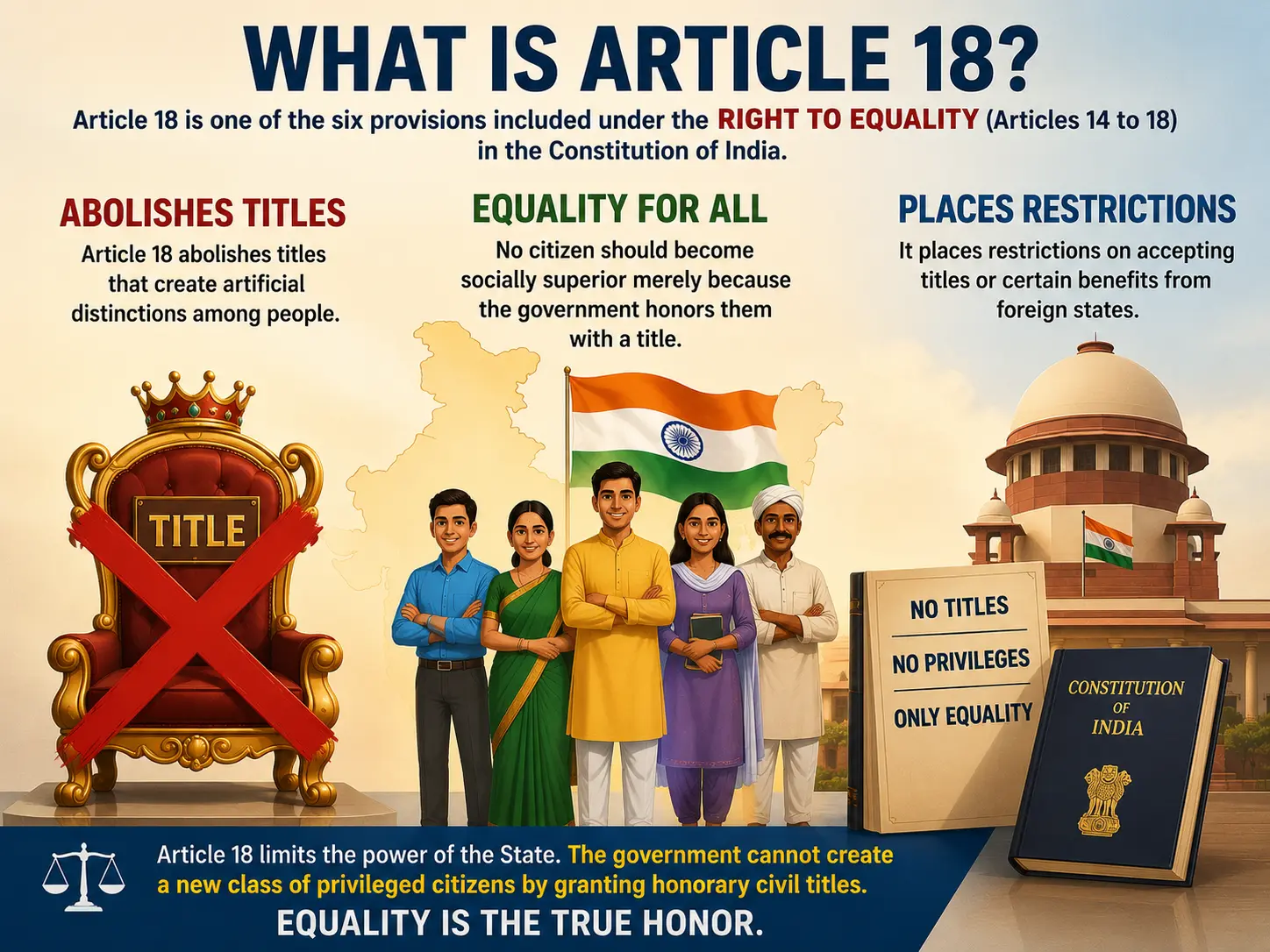
Article 18 is one of the six provisions included under the Right to Equality (Articles 14 to 18) in the Constitution of India.
Its primary purpose is straightforward.
It abolishes titles that create artificial distinctions among people and places restrictions on accepting titles or certain benefits from foreign states.
Unlike many constitutional provisions that focus mainly on protecting individuals from discrimination, Article 18 also places limitations on the powers of the State itself. The government cannot create a new class of privileged citizens by granting honorary civil titles.
This reflects one of the strongest democratic ideals.
No citizen should become socially superior merely because the government decides to honor them with a title.
Where Does Article 18 Appear in the Constitution?
| Particular | Details |
|---|---|
| Constitution | Constitution of India |
| Part | Part III |
| Fundamental Right | Right to Equality |
| Article Number | Article 18 |
| Subject | Abolition of Titles |
| Applies To | Citizens, Government, Certain Non-Citizens Holding Public Office |
| Major Objective | Prevent creation of social hierarchy through titles |
The Complete Constitutional Text of Article 18
Article 18 contains four separate clauses, each dealing with a different situation concerning titles and foreign recognition. Together they ensure that titles cannot be used to undermine equality or influence public officials.
| Clause | Purpose |
|---|---|
| Article 18(1) | Prohibits the State from conferring titles except military and academic distinctions |
| Article 18(2) | Prohibits Indian citizens from accepting titles from foreign States |
| Article 18(3) | Restricts certain non-citizens holding public office from accepting foreign titles without Presidential consent |
| Article 18(4) | Restricts persons holding offices of profit or trust from accepting presents, emoluments, or offices from foreign States without Presidential consent |
Although these clauses are short, they work together to preserve national integrity, impartial governance, and equality.
Why Did the Constitution Include Article 18?
When India became independent in 1947, the country inherited many traditions from the colonial period.
During British rule, numerous honorary titles were awarded to influential individuals.
Some well-known examples included:
- Rai Bahadur
- Khan Bahadur
- Rao Bahadur
- Diwan Bahadur
- Sir
- Various hereditary royal titles
These titles often carried enormous social prestige. In many cases, they were granted to individuals who had rendered services to the colonial administration.
While some recipients genuinely contributed to society, the broader system encouraged loyalty to the colonial government and created visible distinctions between ordinary citizens and those enjoying official recognition.
Independent India wanted to move away from this model.
The Constitution sought to build a society where:
- Every citizen would enjoy equal dignity.
- Social status would not depend on government-granted titles.
- Democracy would replace hereditary privilege.
- Public offices would serve citizens rather than social elites.
- Merit and service would matter more than inherited honor.
Article 18 became one of the constitutional tools to achieve these goals.
Historical Background of Abolition of Titles
Understanding Article 18 becomes easier when viewed through history.
Ancient Kingdoms
Throughout history, rulers rewarded loyal supporters with titles.
Examples included:
- Duke
- Baron
- Count
- Lord
- Prince
- Nawab
- Raja
- Maharaja
Many of these titles eventually became hereditary, passing from one generation to another.
As a result, social hierarchy became deeply rooted.
Colonial India
During British rule, titles served several purposes.
They rewarded:
- Administrative assistance
- Political loyalty
- Military support
- Public service favorable to colonial administration
Examples included:
| Colonial Title | Purpose |
|---|---|
| Rai Bahadur | Honor awarded mainly to distinguished Hindu individuals |
| Khan Bahadur | Similar recognition generally awarded to distinguished Muslim individuals |
| Diwan Bahadur | Honor recognizing administrative or public services |
| Sir | British knighthood granted under the Crown |
| Companion Orders | Recognition within British imperial honors system |
Such honors enhanced prestige and often increased social influence.
After independence, India consciously rejected this colonial practice.
The Vision of the Constitution Makers
The framers of the Constitution believed that democracy cannot flourish if governments continue creating privileged social classes.
Their vision rested on several principles.
Equality
Every citizen should possess equal legal dignity.
Democracy
Public respect should arise from democratic participation rather than inherited or government-created privilege.
Merit
Achievements should be recognized without creating permanent social ranks.
National Unity
Removing official titles would reduce artificial divisions among citizens.
These ideas influenced the inclusion of Article 18 in the chapter on Fundamental Rights.
Objectives of Article 18
The Article serves multiple constitutional purposes.
| Objective | Explanation |
|---|---|
| Protect Equality | Prevent artificial social distinctions |
| Strengthen Democracy | Avoid creation of privileged classes |
| Remove Colonial Legacy | End colonial honor systems |
| Promote Merit | Encourage recognition based on achievements rather than titles |
| Prevent Foreign Influence | Restrict acceptance of foreign titles and benefits |
| Maintain Public Trust | Ensure government officials remain independent |
Key Features of Article 18
Some important characteristics include:
- It forms part of the Fundamental Rights.
- It supports the broader principle of Equality.
- It limits governmental power.
- It restricts certain actions of citizens.
- It also applies in specific situations to non-citizens.
- It permits academic distinctions.
- It permits military distinctions.
- It discourages artificial social hierarchy.
- It strengthens democratic governance.
- It reflects India’s commitment to equal citizenship.
Understanding Article 18(1) in Detail
The first clause is the heart of Article 18.
It states that the State shall not confer any title except military or academic distinctions.
This means the government cannot create civil titles that elevate individuals into a privileged social category.
Simple Meaning
Imagine a government introducing permanent titles such as:
- National Lord
- Supreme Citizen
- Royal Guardian
- People’s Baron
Such titles would immediately create symbolic social superiority.
Article 18 prevents exactly this kind of practice.
Instead, the Constitution ensures that governments cannot manufacture prestige through official titles.
Who Is Bound by Article 18(1)?
| Institution | Covered? |
|---|---|
| Union Government | Yes |
| State Governments | Yes |
| Government Departments | Yes |
| Public Authorities | Yes |
| Constitutional Bodies Acting as the State | Yes |
What Does “Title” Mean?
A title generally refers to an honorific designation attached before or after a person’s name that signifies special rank, official status, hereditary privilege, or superior social standing.
Examples around the world include:
- Lord
- Lady
- Sir
- Baron
- Count
- Viscount
- Duke
- Earl
Article 18 seeks to prevent the Indian State from creating comparable civil distinctions that undermine equality.
What Is Not Considered a Prohibited Title?
The Constitution specifically allows two important exceptions.
| Exception | Reason |
|---|---|
| Military Distinctions | Recognize bravery and exceptional military service |
| Academic Distinctions | Recognize educational qualifications and scholarly achievement |
Examples include academic degrees like B.A., M.Sc., Ph.D., and military honors awarded for gallantry or distinguished service. These are permitted because they acknowledge achievement and expertise rather than creating hereditary or permanent social privilege.
Part 2
Understanding Article 18(2) in Detail
After prohibiting the State from conferring titles, the Constitution places another important restriction directly upon Indian citizens.
Article 18(2) states:
“No citizen of India shall accept any title from any foreign State.”
Although this sentence appears simple, it serves several important constitutional purposes.
It ensures that an Indian citizen’s loyalty remains with India and prevents foreign governments from influencing citizens through honorary titles or distinctions.
The Constitution recognizes that titles awarded by foreign governments may carry prestige, influence, or even political significance. Accepting such titles without restriction could create questions about allegiance and national interest.
Simple Meaning of Article 18(2)
Imagine an Indian citizen who has made remarkable achievements in science, literature, sports, or public service.
Suppose another country wishes to award that person an official title such as:
- Lord
- Baron
- Knight
- Count
- Any other formal title recognized by that country’s legal system
Article 18(2) says that an Indian citizen cannot accept such a title from a foreign State.
The Constitution therefore protects the dignity and independence of Indian citizenship.
Objectives of Article 18(2)
The framers included this clause for several reasons.
| Objective | Explanation |
|---|---|
| Protect National Loyalty | Prevent divided allegiance toward foreign governments |
| Maintain Equality | Stop creation of privileged classes through foreign titles |
| Prevent Political Influence | Reduce opportunities for foreign governments to influence Indian citizens |
| Preserve National Sovereignty | Ensure citizens remain free from foreign governmental honors that could affect public confidence |
| Strengthen Democracy | Reinforce equal citizenship regardless of foreign recognition |
Examples to Understand Article 18(2)
Example 1
A foreign government offers an Indian scientist the hereditary title of Baron.
Result: The Indian citizen cannot accept it.
Example 2
An Indian entrepreneur is offered an official title carrying legal status in another country.
Result: Acceptance is prohibited under Article 18(2).
Example 3
An Indian citizen receives an invitation to become part of a foreign nobility system.
Result: Such acceptance is not permitted.
Understanding Article 18(3) in Detail
The Constitution also addresses another situation.
Some people serving India may not be Indian citizens.
For example:
- Foreign technical experts
- International advisers
- Foreign diplomats serving in special positions
- Professionals appointed to public offices
Article 18(3) applies to such individuals.
It provides that a person who is not an Indian citizen but holds an office of profit or trust under the State shall not accept any title from a foreign State without the consent of the President of India.
Why Was Article 18(3) Included?
Public officials are expected to work impartially.
If a foreign government grants titles to officials serving India, there could be concerns about:
- Neutrality
- Independence
- Public confidence
- Conflict of interest
Therefore, Presidential approval acts as a constitutional safeguard.
Who Can Be Covered Under Article 18(3)?
| Category | Covered? |
|---|---|
| Foreign citizen serving in a government office | Yes |
| Foreign adviser appointed by the Government | Yes |
| Foreign expert holding public office | Yes |
| Ordinary foreign tourist | No |
| Foreign business visitor | No |
Role of the President
The Constitution does not create an absolute prohibition here.
Instead, it requires the consent of the President of India before accepting such titles.
This allows flexibility in exceptional diplomatic or national interest situations while protecting constitutional values.
Understanding Article 18(4) in Detail
Article 18(4) extends constitutional protection even further.
It provides that no person holding an office of profit or trust under the State shall accept any present, emolument, or office from or under a foreign State without the consent of the President.
Unlike Article 18(2), this clause is not limited to titles.
It also covers:
- Valuable gifts
- Financial benefits
- Paid offices
- Positions under foreign governments
Meaning of Important Terms
| Term | Meaning |
|---|---|
| Office of Profit | A position carrying salary, allowances, or financial benefits under the government |
| Office of Trust | A public position involving responsibility and confidence |
| Present | Valuable gifts or property |
| Emolument | Salary, allowance, payment, honorarium, or financial benefit |
| Foreign State | Another sovereign nation or its government |
Purpose of Article 18(4)
This clause protects public administration from outside influence.
Its objectives include:
- Preventing corruption
- Preventing conflicts of interest
- Maintaining public confidence
- Ensuring impartial governance
- Protecting national security
- Preserving administrative independence
Illustrative Examples
Example 1
A government official receives an expensive luxury gift from another country’s government.
Without Presidential consent, acceptance would violate Article 18(4).
Example 2
A public servant is offered a paid advisory position by a foreign government.
Presidential approval becomes necessary before acceptance.
Example 3
A government-appointed expert receives substantial financial benefits from another State.
Article 18(4) regulates such situations.
Article 18 at a Glance
| Clause | Who Is Covered? | Restriction |
|---|---|---|
| 18(1) | Government | Cannot confer titles except military and academic distinctions |
| 18(2) | Indian citizens | Cannot accept foreign titles |
| 18(3) | Non-citizens holding public office | Need Presidential consent before accepting foreign titles |
| 18(4) | Persons holding offices of profit or trust | Need Presidential consent before accepting presents, emoluments, or offices from foreign States |
Military Distinctions Allowed Under Article 18
The Constitution specifically permits military distinctions.
Military honors recognize:
- Exceptional bravery
- Courage during war
- Distinguished military service
- Leadership
- Sacrifice for the nation
These distinctions do not create hereditary or permanent social classes.
Instead, they recognize acts of extraordinary service.
Some examples include:
- Param Vir Chakra
- Maha Vir Chakra
- Vir Chakra
- Ashoka Chakra
- Kirti Chakra
- Shaurya Chakra
These awards are constitutionally valid because Article 18 expressly allows military distinctions.
Academic Distinctions Allowed Under Article 18
Academic qualifications are also excluded from the prohibition.
Examples include:
- B.A.
- B.Sc.
- M.A.
- M.Sc.
- LL.B.
- LL.M.
- M.B.B.S.
- M.D.
- Ph.D.
- D.Litt.
These are educational qualifications demonstrating knowledge, skill, and successful completion of recognized courses of study.
They do not create privileged legal status.
Difference Between Titles and Academic Degrees
| Academic Degree | Title |
|---|---|
| Earned through education | Conferred as an honor |
| Indicates qualification | Indicates rank or status |
| Open to all eligible students | Usually granted selectively |
| Based on examinations and research | Based on recognition by authority |
| Constitutionally permitted | Generally prohibited under Article 18 unless specifically exempt |
Difference Between Military Honors and Civil Titles
| Military Distinction | Civil Title |
|---|---|
| Recognizes bravery | Creates social distinction |
| Based on service | Based on official conferment |
| Constitution expressly permits it | Constitution generally prohibits it |
| Does not establish nobility | May imply superior rank in society |
| Honors sacrifice | Historically associated with privilege |
National Civilian Awards in India
Many people wonder whether national civilian awards violate Article 18.
Some of India’s highest civilian honors include:
- Bharat Ratna
- Padma Vibhushan
- Padma Bhushan
- Padma Shri
These awards recognize exceptional contributions in fields such as:
- Science
- Medicine
- Literature
- Public affairs
- Education
- Sports
- Arts
- Social work
- Engineering
- Industry
- Public service
Unlike hereditary or honorific titles, these awards are intended to acknowledge distinguished service to the nation rather than confer a superior social rank.
Are Bharat Ratna and Padma Awards Constitutional?
This question eventually reached the Supreme Court of India.
Some argued that national awards resembled prohibited titles.
Others argued they merely recognized outstanding achievements.
The Supreme Court settled this issue in the landmark case Balaji Raghavan v. Union of India (1996).
The Landmark Supreme Court Judgment
Balaji Raghavan v. Union of India (1996)
This is one of the most significant judgments relating to Article 18.
The petition challenged the constitutional validity of national civilian awards such as:
The argument was that these awards amounted to prohibited titles.
The Supreme Court rejected this contention and upheld the validity of the awards. It held that these honors are not “titles” within the meaning of Article 18(1) because they are meant to recognize exceptional service and do not create a class of nobility. The Court also emphasized that recipients must not use the awards as prefixes or suffixes to their names, and misuse could justify withdrawal of the award under the applicable rules.
Key Principles Laid Down by the Supreme Court
| Principle | Explanation |
|---|---|
| National awards are constitutional | They recognize exceptional merit and service |
| Awards are not titles | They do not establish a privileged class |
| No prefixes or suffixes | Recipients should not use award names before or after their names as titles |
| Fair selection is essential | The process should remain objective, transparent, and free from favoritism |
| Awards should retain prestige | They should be conferred sparingly and only on truly deserving individuals |
Difference Between National Awards and Prohibited Titles
| National Awards | Prohibited Titles |
|---|---|
| Recognize outstanding contributions | Confer social or hereditary status |
| Do not create legal privileges | May create privileged classes |
| Cannot be used as permanent honorifics before or after names | Intended to function as honorific designations |
| Encourage excellence | Historically reinforced hierarchy |
| Constitutionally valid when used correctly | Constitution generally prohibits them |
Why Article 18 Still Matters Today
More than seven decades after the Constitution came into force, Article 18 continues to play an important role.
It reminds governments that equality is not only about laws but also about public symbols.
A democratic society should not encourage permanent social ranks created by official recognition. Respect should come from integrity, talent, service, and contribution to society rather than inherited or state-created status.
Article 18 therefore remains a powerful constitutional safeguard that reinforces the ideals of equality, dignity, impartial governance, and democratic citizenship for every individual.
Part 3
Importance of Article 18 in Indian Democracy
Every Constitution contains provisions that symbolize the values of a nation. Some establish governmental institutions, while others protect the rights and dignity of citizens. Article 18 belongs to the latter category. Although brief, it carries deep constitutional significance because it reinforces the principle that every individual is equal in the eyes of the law.
A democratic society cannot thrive if governments create official classes of “higher” and “lower” citizens. Article 18 helps prevent such divisions by ensuring that the State does not grant titles that elevate certain individuals above others.
In practical terms, Article 18 contributes to a society where achievements are respected, but legal equality remains untouched.
Why Is Article 18 Important?
The importance of Article 18 extends beyond simply abolishing titles.
It protects several fundamental constitutional values.
1. Protects Equality
Equality is one of the most important principles of the Constitution.
Article 18 ensures that:
- Citizens remain legally equal.
- No government-created nobility exists.
- Artificial social divisions are discouraged.
- Public dignity belongs to everyone.
Without this provision, governments could theoretically reward supporters with prestigious titles, gradually creating a privileged class.
2. Strengthens Democracy
Democracy depends on equal citizenship.
Every citizen has:
- One vote.
- Equal legal protection.
- Equal constitutional rights.
- Equal civic dignity.
Article 18 supports these democratic ideals by preventing official distinctions that suggest one citizen is socially superior to another.
3. Removes Colonial Traditions
India experienced nearly two centuries of British colonial rule.
During that period, honorary titles were frequently awarded to influential individuals.
Some famous examples included:
- Rai Bahadur
- Khan Bahadur
- Diwan Bahadur
- Sir
Independent India chose not to continue this practice.
Article 18 represents a constitutional break from colonial systems that encouraged hierarchy and political loyalty through titles.
4. Promotes Merit Instead of Privilege
A democratic society values achievement.
People should be respected because of:
- Knowledge
- Honesty
- Courage
- Scientific discoveries
- Artistic excellence
- Public service
- Innovation
They should not receive permanent social superiority merely because a government grants an honorific title.
5. Prevents Political Favoritism
Imagine a government that begins awarding prestigious titles to political supporters.
Over time, those titles could:
- Increase political influence.
- Create elite groups.
- Encourage favoritism.
- Reduce public trust.
Article 18 helps prevent such situations.
6. Protects National Sovereignty
The Constitution also restricts acceptance of foreign titles and benefits in certain circumstances.
This ensures that:
- National interests remain paramount.
- Public officials remain independent.
- Foreign governments cannot easily influence decision-makers through honors or rewards.
Constitutional Values Promoted by Article 18
| Value | How Article 18 Supports It |
|---|---|
| Equality | Prevents artificial social hierarchy |
| Democracy | Ensures equal civic dignity |
| Justice | Discourages privilege based on titles |
| Liberty | Protects citizens from undue governmental influence |
| National Unity | Encourages equal national identity |
| Integrity | Protects public institutions from foreign influence |
| Transparency | Reduces opportunities for political favoritism |
| Meritocracy | Rewards genuine achievement rather than inherited status |
Relationship Between Article 18 and Other Fundamental Rights
Although Article 18 is an independent constitutional provision, it works closely with the other articles under the Right to Equality.
| Article | Subject | Connection with Article 18 |
|---|---|---|
| Article 14 | Equality before law | Article 18 strengthens equal legal status by preventing privileged classes. |
| Article 15 | Prohibition of discrimination | Both seek to eliminate unfair distinctions among citizens. |
| Article 16 | Equality of opportunity in public employment | Prevents privilege in government service, while Article 18 prevents privilege through titles. |
| Article 17 | Abolition of untouchability | Removes one form of social inequality while Article 18 removes another form of official hierarchy. |
| Article 18 | Abolition of titles | Completes the constitutional vision of equality by eliminating state-created honorific ranks. |
Together, these provisions create a comprehensive framework aimed at ensuring equality, dignity, and fairness.
Real-Life Examples Showing the Spirit of Article 18
Understanding constitutional provisions becomes easier when connected to everyday situations.
Example 1: A Distinguished Scientist
A scientist develops a groundbreaking medical treatment that saves countless lives.
The Government may recognize this extraordinary contribution through a national civilian award.
However:
- The award does not give the scientist special legal rights.
- The scientist remains equal before the law.
- The scientist cannot claim superiority over other citizens because of the award.
This reflects the principle behind Article 18.
Example 2: A Brave Soldier
A soldier displays exceptional courage during a military operation.
The soldier receives a gallantry award.
This is constitutionally permitted because military distinctions recognize acts of bravery rather than creating hereditary or permanent social ranks.
Example 3: A University Professor
A professor earns a Ph.D. after years of research.
Using the degree is perfectly valid because academic distinctions are specifically exempted under Article 18.
Example 4: A Government Officer Offered a Foreign Position
A senior public official is invited by a foreign government to accept a prestigious paid advisory role.
Before accepting such an office or related benefits, the constitutional requirements under Article 18(4) must be satisfied, including obtaining the President’s consent where applicable.
Common Misconceptions About Article 18
Many people misunderstand the scope of Article 18.
The following table addresses some common misconceptions.
| Misconception | Reality |
|---|---|
| Article 18 prohibits every kind of award. | No. Military and academic distinctions are expressly permitted, and national civilian awards have been held to be constitutional when used properly. |
| Academic degrees are prohibited titles. | Incorrect. Degrees such as B.A., M.Sc., and Ph.D. are allowed. |
| Military medals violate the Constitution. | No. Military distinctions are specifically permitted. |
| National awards create a privileged class. | No. They recognize exceptional service and do not confer legal superiority. |
| Article 18 applies only to citizens. | Not entirely. Some clauses also apply to non-citizens holding offices of profit or trust under the State. |
How Article 18 Promotes Good Governance
Good governance depends upon fairness and public confidence.
Article 18 contributes to both.
It ensures that governments cannot manufacture prestige through official titles.
Instead, governments are encouraged to:
- Recognize merit fairly.
- Maintain impartial administration.
- Preserve equal dignity among citizens.
- Avoid unnecessary hierarchy.
- Prevent conflicts of interest involving foreign governments.
Comparison with Systems That Recognize Nobility
Different countries have adopted different constitutional approaches to titles.
Some continue to maintain systems of nobility or hereditary honors rooted in their historical traditions. India chose a different path by embedding equality within its constitutional framework.
The comparison below highlights the contrast in broad constitutional philosophy.
| Feature | Traditional Nobility Systems | Indian Constitutional Approach |
|---|---|---|
| Hereditary titles | May exist | Not recognized under Article 18 |
| Government-created nobility | Possible in some systems | Prohibited |
| Equality of citizens | May coexist with formal ranks | Strong constitutional emphasis |
| Military honors | Common | Permitted |
| Academic degrees | Common | Permitted |
| Democratic equality | Varies | Central constitutional value |
Article 18 in the Modern World
Although Article 18 was adopted in 1950, its relevance has not diminished.
Modern societies continue to face challenges such as:
- Political favoritism
- Misuse of public recognition
- Conflicts of interest
- Foreign influence
- Growing social inequality
Article 18 serves as a reminder that constitutional equality requires constant protection.
Even today, governments must ensure that public recognition never becomes a means of creating privileged social classes.
Interesting Facts About Article 18
- Article 18 is the final provision under the Right to Equality in Part III of the Constitution.
- It consists of four clauses.
- It abolishes titles except for military and academic distinctions.
- It places obligations not only on the State but also on citizens and certain public office holders.
- It reflects India’s decision to reject colonial systems of official honorific titles.
- It promotes constitutional morality by emphasizing equal civic dignity.
- It complements Articles 14, 15, 16, and 17, completing the constitutional vision of equality.
Quick Revision Table
| Topic | Key Point |
|---|---|
| Article Number | Article 18 |
| Fundamental Right | Right to Equality |
| Location | Part III of the Constitution |
| Purpose | Abolition of titles |
| State Power | Cannot confer titles except military and academic distinctions |
| Indian Citizens | Cannot accept titles from foreign States |
| Foreign Public Officials Serving India | Need Presidential consent to accept foreign titles |
| Office of Profit or Trust | Need Presidential consent before accepting certain foreign presents, emoluments, or offices |
| Military Distinctions | Permitted |
| Academic Distinctions | Permitted |
| National Civilian Awards | Constitutional when used in accordance with the principles laid down by the Supreme Court |
Key Takeaways
- Article 18 protects the constitutional principle of equality by abolishing titles that could create artificial social hierarchy.
- The Constitution permits only military and academic distinctions as exceptions.
- Indian citizens cannot accept titles from foreign States.
- Certain public office holders require the President’s consent before accepting foreign titles, offices, presents, or emoluments.
- National civilian awards such as the Bharat Ratna and Padma Awards recognize exceptional service and, when used correctly, do not amount to prohibited titles.
- Article 18 complements the broader framework of equality established by Articles 14 to 17.
- The provision continues to strengthen democracy, transparency, and public confidence in constitutional governance.
Conclusion
Article 18 may seem like one of the shortest provisions in the Constitution. Yet its significance is far greater than its length suggests. It reflects a conscious constitutional choice to reject systems that elevate individuals through official titles and to embrace a society founded on equality, dignity, and democratic citizenship.
By abolishing titles, permitting only military and academic distinctions, and regulating the acceptance of foreign honors and benefits, Article 18 reinforces the idea that public respect should be earned through genuine achievement, service, courage, scholarship, and integrity rather than through hereditary privilege or state-created rank.
Its connection with the broader Right to Equality ensures that every citizen stands on the same constitutional footing. Whether someone is a teacher, scientist, soldier, artist, entrepreneur, farmer, public servant, or student, the Constitution recognizes each person as equal before the law.
More than seven decades after the Constitution came into force, Article 18 continues to uphold the ideals of justice, equality, and national integrity. It remains an enduring reminder that a healthy democracy values merit, honors excellence, and protects equal dignity for all without creating privileged classes.
Article Reference and Sources
The following constitutional documents, judicial decisions, and reliable legal references were used to develop the article:
- Constitution of India: Article 18: Abolition of Titles
- The Constitution of India: Article 18 (Official Constitutional Provision)
- Balaji Raghavan & S.P. Anand v. Union of India (1996): Supreme Court of India
- Supreme Court of India Judgment (Balaji Raghavan Case PDF)
- Article 18 of the Indian Constitution: Abolition of Titles
- Article 18 of the Indian Constitution: Constitutional Overview
- Balaji Raghavan v. Union of India (1996): National Awards and Article 18
- National Awards and Article 18: Constitutional Interpretation
- Balaji Raghavan v. Union of India: Case Background and Analysis
- Republic Day Awards and Article 18: Constitutional Perspective
These references collectively support the discussion of:
- Article 18 and its four clauses
- Right to Equality (Articles 14 to 18)
- Abolition of titles
- Military and academic distinctions
- Foreign titles and constitutional restrictions
- National civilian awards
- Bharat Ratna and Padma Awards
- Balaji Raghavan v. Union of India (1996)
- Constitutional interpretation by the Supreme Court
- Equality, democracy, and constitutional principles
Also, Read These Articles in Detail
- Fundamental Rights in India
- What Are Fundamental Rights Under the Indian Constitution?
- History of Fundamental Rights in India
- Why Fundamental Rights Are Important for Every Indian Citizen
- Understanding Part III of the Indian Constitution
- Who Can Claim Fundamental Rights in India?
- Legal Rights vs Fundamental Rights
- How Fundamental Rights Protect Individual Freedom in India
- Right to Equality Under Article 14
- Article 15: Protection Against Discrimination
- Article 16: Equality of Opportunity in Public Employment
- Article 17 and the Abolition of Untouchability in India
Frequently Asked Questions
FAQ 1. What is Article 18 of the Indian Constitution?
Article 18 is one of the Fundamental Rights included under the Right to Equality in Part III of the Constitution of India. Its main purpose is to abolish titles that create artificial social distinctions among citizens. The Constitution ensures that every person enjoys equal dignity and equal legal status, regardless of wealth, family background, profession, or social position.
Article 18 reflects the belief that a democratic nation should not recognize individuals as socially superior simply because they have received an official title from the government. Instead, people should earn respect through their character, hard work, knowledge, public service, courage, or other genuine achievements.
The Article contains four clauses, each dealing with a different aspect of titles and foreign honors. The first clause prohibits the State from conferring titles except military and academic distinctions. The second clause prevents Indian citizens from accepting titles from foreign countries. The third clause places restrictions on certain non-citizens holding public office in India, while the fourth clause regulates the acceptance of presents, emoluments, and offices from foreign States by persons holding offices of profit or trust.
Although Article 18 is comparatively short, its constitutional significance is enormous. It strengthens equality, supports democracy, discourages the creation of privileged social classes, and protects the independence of public institutions. Even today, it remains one of the important constitutional safeguards that preserve the idea that every citizen stands equal before the law.
FAQ 2. Why did the Constitution abolish titles under Article 18?
The decision to abolish titles was based on India’s commitment to building a democratic and equal society after independence. Before independence, especially during the colonial period, many honorary titles were granted to individuals as recognition for loyalty, administrative service, or other contributions. These titles often carried considerable prestige and sometimes created social divisions by placing certain people above others.
When the Constitution was being drafted, its framers wanted to move away from systems that encouraged privilege based on official recognition rather than genuine merit. They believed that democracy could not function effectively if governments continued to create special classes of citizens through titles.
By abolishing titles, Article 18 promotes several constitutional values. It protects equality, prevents unnecessary social hierarchy, strengthens public confidence in democratic institutions, and ensures that citizens are respected because of their achievements rather than government-created distinctions.
The provision also reflects India’s rejection of colonial traditions that linked honors with political influence or social status. Instead, the Constitution encourages a society where opportunities and dignity are available to everyone on equal terms.
In modern times, Article 18 continues to remind governments that public recognition should never become a tool for creating privileged groups or weakening the constitutional principle of equality.
FAQ 3. What are the four clauses of Article 18, and what do they mean?
Article 18 consists of four separate clauses, and each clause addresses a different constitutional issue related to titles and foreign honors.
Article 18(1) prohibits the State from conferring any title except military and academic distinctions. This means the government cannot create titles that give citizens a higher social status or establish a new class of privileged individuals.
Article 18(2) states that no Indian citizen shall accept any title from a foreign State. This provision protects national loyalty and prevents foreign governments from influencing Indian citizens through official honors.
Article 18(3) applies to persons who are not Indian citizens but hold an office of profit or trust under the Indian government. Such individuals cannot accept titles from foreign States without obtaining the consent of the President of India.
Article 18(4) places additional restrictions on persons holding offices of profit or trust. They cannot accept presents, financial benefits, or offices from foreign governments without the President’s approval.
Together, these four clauses work to protect equality, maintain administrative independence, preserve national sovereignty, and prevent conflicts of interest. Although each clause deals with a different situation, they all support the common constitutional objective of ensuring that public life remains free from artificial privilege and improper influence.
FAQ 4. Does Article 18 prohibit all awards and honors in India?
No. One of the most common misunderstandings about Article 18 is that it prohibits every form of award or honor. This is not correct.
The Constitution specifically allows military distinctions and academic distinctions. Military honors recognize acts of bravery, courage, and distinguished service to the nation. Academic distinctions recognize educational achievements and professional qualifications earned through study, research, and examinations.
In addition, national civilian awards such as the Bharat Ratna, Padma Vibhushan, Padma Bhushan, and Padma Shri have been held to be constitutionally valid by the Supreme Court of India. These awards recognize exceptional contributions in areas such as science, education, literature, medicine, sports, public affairs, social service, and the arts.
However, these awards must not function as titles. Award recipients cannot use them as permanent prefixes or suffixes before or after their names in a manner that creates social superiority.
The important difference is that Article 18 prohibits titles that establish privileged status, but it does not prohibit genuine recognition of outstanding achievements when such recognition does not undermine equality.
FAQ 5. Why are military and academic distinctions allowed under Article 18?
The Constitution recognizes that certain distinctions are based on merit, knowledge, courage, or professional achievement rather than social privilege. For this reason, Article 18 specifically allows military and academic distinctions.
Military distinctions honor individuals who have displayed extraordinary bravery, leadership, or sacrifice while serving the nation. Awards such as the Param Vir Chakra, Maha Vir Chakra, Vir Chakra, Ashoka Chakra, Kirti Chakra, and Shaurya Chakra recognize exceptional acts performed under difficult and often dangerous circumstances.
Academic distinctions, on the other hand, reflect educational accomplishments. Degrees such as B.A., B.Sc., M.A., M.Sc., LL.B., M.B.B.S., M.D., and Ph.D. indicate that a person has successfully completed a recognized course of study or research.
These distinctions do not create hereditary privileges, permanent social classes, or unequal legal rights. They simply acknowledge genuine achievement.
By permitting these exceptions, the Constitution encourages excellence while ensuring that equality remains protected. It recognizes that honoring hard work and exceptional service is consistent with democratic values, provided such recognition does not create artificial hierarchy.
FAQ 6. Can an Indian citizen accept a title from a foreign country under Article 18?
Generally, no. Article 18(2) clearly states that an Indian citizen cannot accept any title from a foreign State.
The purpose of this restriction is to preserve national loyalty and prevent foreign governments from exercising influence through official honors. Titles often carry prestige, recognition, and symbolic importance. If unrestricted acceptance were allowed, it could raise questions about allegiance or create situations where foreign recognition affects public perception.
This constitutional safeguard reflects the principle that Indian citizenship should remain independent of foreign governmental honors.
However, it is important to distinguish between a title and other forms of recognition. International academic achievements, professional memberships, or private awards that do not constitute official titles from a foreign State may fall into different legal categories depending on their nature.
The Constitution focuses specifically on official titles conferred by foreign States, ensuring that Indian citizens remain free from foreign governmental distinctions that may conflict with constitutional values.
FAQ 7. What is the difference between a title and a national civilian award?
Although both may recognize individuals, a title and a national civilian award are fundamentally different.
A title generally creates an official social distinction. Historically, titles often indicated higher rank, nobility, hereditary privilege, or permanent social status. Examples from different parts of the world include Lord, Baron, Count, and similar honorifics.
A national civilian award, however, simply recognizes outstanding service or exceptional achievement. It does not elevate a person into a privileged legal or constitutional position.
For example, the Bharat Ratna honors extraordinary national service of the highest order, while the Padma Awards recognize distinguished contributions across various fields. These awards acknowledge excellence without creating permanent social hierarchy.
The Supreme Court of India has clarified that these awards are constitutional because they do not function as prohibited titles under Article 18. At the same time, recipients should not use these awards as prefixes or suffixes to their names.
The distinction is therefore clear. Titles create status. Awards recognize achievement.
FAQ 8. What did the Supreme Court decide about national awards under Article 18?
The constitutional validity of India’s national civilian awards was examined in the landmark case Balaji Raghavan v. Union of India (1996).
Some petitioners argued that awards such as the Bharat Ratna and Padma Awards violated Article 18 because they resembled prohibited titles.
After carefully examining the issue, the Supreme Court concluded that these awards are constitutional. The Court held that they are not titles within the meaning of Article 18 because they simply recognize exceptional service and do not create a class of privileged citizens.
The Court also emphasized several important safeguards.
Recipients should not use these awards as permanent honorifics before or after their names.
The selection process should remain objective and based on genuine merit.
Awards should not become political tools or lose their prestige through excessive distribution.
This judgment remains one of the most important constitutional interpretations of Article 18 and continues to guide the administration of national civilian awards in India.
FAQ 9. How does Article 18 strengthen equality and democracy in India?
Article 18 plays a significant role in strengthening both equality and democracy.
A democratic nation is based on the principle that every citizen deserves equal respect before the law. Governments should not create artificial social classes by granting official titles that elevate some individuals above others.
By abolishing titles, Article 18 reinforces the constitutional promise that all citizens possess equal dignity.
It also protects democratic governance by preventing governments from using honorary titles to reward political supporters or influential individuals. Without such constitutional safeguards, official titles could gradually become symbols of political influence, privilege, or social superiority.
The Article also promotes meritocracy by encouraging recognition based on genuine contributions rather than inherited status or official rank.
In addition, restrictions relating to foreign titles and benefits help preserve national independence and reduce the possibility of foreign influence over public officials.
Together, these protections strengthen public confidence in constitutional institutions and help ensure that democracy remains fair, transparent, and inclusive.
FAQ 10. Why is Article 18 still relevant in today’s world?
Although Article 18 became effective in 1950, its importance has not diminished over time.
Modern societies continue to face challenges involving political favoritism, public influence, international relations, conflicts of interest, and growing social inequality. In such an environment, the constitutional principles embodied in Article 18 remain highly valuable.
The provision reminds governments that recognition should encourage excellence without creating privileged social classes. It also ensures that public institutions remain independent and that foreign governments cannot easily influence individuals holding important public positions.
Furthermore, Article 18 complements the broader framework of Fundamental Rights by reinforcing the ideals of equality, justice, fairness, and democratic citizenship.
Its message is timeless. Every person deserves equal constitutional dignity, regardless of background, wealth, occupation, or social standing. Respect should come from integrity, knowledge, service, innovation, courage, and dedication to society, not from official titles or inherited privilege.
For these reasons, Article 18 continues to serve as one of the Constitution’s enduring safeguards, protecting both the spirit of democracy and the equal status of every citizen.
FAQ 11. What does the term “abolition of titles” mean under Article 18?
The abolition of titles under Article 18 means that the State cannot create or confer official titles that place certain individuals in a higher social position than others. This constitutional rule is designed to preserve equality and prevent the emergence of privileged classes in a democratic society.
Before India became independent, titles were often granted to individuals as marks of honor or loyalty. Some titles became symbols of prestige and social influence, while others even carried hereditary importance. The framers of the Constitution believed that continuing such a system would be inconsistent with the principles of democracy and equality.
By abolishing titles, the Constitution ensures that every citizen stands on an equal footing before the law. A person’s respect in society should come from their honesty, hard work, education, courage, innovation, public service, or professional excellence rather than from an officially granted designation.
It is important to understand that Article 18 does not prevent people from earning respect through their achievements. Instead, it prevents the government from creating permanent social distinctions through official titles.
This provision also reflects the idea that democracy is strongest when every citizen enjoys equal dignity and equal constitutional status, regardless of background, occupation, wealth, or influence.
FAQ 12. What is the difference between Article 18 and the other Right to Equality provisions?
The Right to Equality includes Articles 14, 15, 16, 17, and 18, and each Article serves a different purpose while supporting the same constitutional objective.
Article 14 guarantees equality before the law and equal protection of the laws.
Article 15 prohibits discrimination on specific grounds such as religion, race, caste, sex, or place of birth.
Article 16 ensures equality of opportunity in matters relating to public employment.
Article 17 abolishes untouchability and prohibits its practice in any form.
Article 18, however, focuses on a different aspect of equality. Instead of addressing discrimination or employment opportunities, it eliminates government-created titles that could create artificial social hierarchy.
Together, these Articles work as a complete constitutional framework. While Articles 14 to 17 remove different forms of inequality, Article 18 ensures that the State cannot introduce new inequalities by creating privileged social ranks.
This makes Article 18 an essential part of India’s broader commitment to justice, equality, dignity, and democratic governance.
FAQ 13. Who is affected by Article 18 of the Constitution?
Article 18 affects different categories of people depending on the clause involved.
The first clause applies mainly to the State, including the Union Government, State Governments, and public authorities. It prevents them from conferring titles except military and academic distinctions.
The second clause applies directly to Indian citizens, prohibiting them from accepting titles from foreign States.
The third clause applies to non-citizens who hold an office of profit or trust under the State. These individuals cannot accept foreign titles without the consent of the President of India.
The fourth clause applies to persons holding an office of profit or trust, whether citizens or non-citizens, where applicable. They cannot accept certain presents, emoluments, or offices from foreign governments without Presidential approval.
Because Article 18 covers several different situations, its scope extends beyond ordinary citizens. It also protects public administration by ensuring that government officials remain independent and free from improper foreign influence.
This broad constitutional approach helps preserve equality, impartial governance, and national sovereignty.
FAQ 14. What is meant by military distinctions and academic distinctions under Article 18?
The Constitution makes two important exceptions to the general prohibition on titles. These are military distinctions and academic distinctions.
Military distinctions are honors awarded to members of the armed forces for acts of extraordinary bravery, leadership, courage, or distinguished service. These awards recognize exceptional contributions made while protecting the nation.
Examples include the Param Vir Chakra, Maha Vir Chakra, Vir Chakra, Ashoka Chakra, Kirti Chakra, and Shaurya Chakra.
Academic distinctions are educational qualifications earned through formal study, examinations, research, or scholarly work. Degrees such as B.A., B.Sc., M.A., M.Sc., LL.B., M.B.B.S., M.D., and Ph.D. fall within this category.
The Constitution allows these distinctions because they recognize genuine achievement rather than creating permanent social superiority.
Unlike hereditary or honorific titles, military decorations and academic qualifications do not establish privileged legal status. They simply acknowledge merit, dedication, knowledge, and service.
This careful distinction allows the Constitution to encourage excellence while maintaining equality among all citizens.
FAQ 15. Why can’t Indian citizens accept titles from foreign States?
The restriction contained in Article 18(2) serves several important constitutional purposes.
When a foreign government grants an official title to an Indian citizen, that title may carry political, diplomatic, or symbolic significance. Accepting such recognition could raise questions regarding loyalty, independence, or foreign influence.
To prevent such situations, the Constitution clearly states that Indian citizens shall not accept titles from foreign States.
This rule protects the dignity of Indian citizenship and reinforces the idea that constitutional allegiance should remain with India alone.
The provision also supports equality by ensuring that foreign governments cannot create new distinctions among Indian citizens through official titles.
In today’s interconnected world, international cooperation is common, but Article 18 continues to ensure that official foreign titles do not undermine India’s constitutional values or democratic principles.
It remains an important safeguard for national sovereignty as well as public confidence in constitutional institutions.
FAQ 16. What is meant by an office of profit or an office of trust under Article 18?
The expressions office of profit and office of trust are important constitutional terms used in Article 18(3) and Article 18(4).
An office of profit generally refers to a position under the government that carries financial benefits such as salary, allowances, honorarium, or other monetary compensation.
An office of trust refers to a public position involving responsibility, confidence, and duties performed on behalf of the government or the public.
People holding such positions are expected to act fairly, independently, and in the public interest.
Because these offices involve significant responsibility, the Constitution places additional restrictions on accepting foreign titles, valuable gifts, paid positions, or financial benefits.
These safeguards help prevent conflicts of interest and protect the integrity of public administration.
The requirement of obtaining the President’s consent before accepting certain foreign benefits ensures that national interests remain protected while allowing flexibility in exceptional situations.
FAQ 17. How does Article 18 protect India’s democracy and constitutional values?
Article 18 contributes significantly to the strength of Indian democracy by reinforcing several core constitutional values.
One of the most important values is equality. Every citizen should enjoy equal dignity regardless of profession, family background, wealth, or influence.
The Article also supports justice by preventing governments from creating official classes of superior citizens.
It encourages merit by recognizing that respect should be earned through achievement rather than government-created privilege.
Another important contribution is the protection of public trust. When governments cannot distribute honorary titles for political or personal reasons, citizens are more likely to view public institutions as fair and impartial.
Article 18 also protects national sovereignty by regulating the acceptance of foreign titles and benefits, thereby reducing opportunities for external influence over public officials.
Taken together, these constitutional safeguards strengthen democracy by ensuring that power remains accountable, public administration remains impartial, and every citizen enjoys equal constitutional status.
FAQ 18. Are Bharat Ratna and Padma Awards considered titles under Article 18?
No. According to the Supreme Court of India, Bharat Ratna and the Padma Awards are not titles prohibited by Article 18.
These awards recognize exceptional contributions made by individuals in fields such as science, medicine, literature, education, sports, arts, engineering, public affairs, and social service.
The Court explained that these awards acknowledge outstanding achievement rather than creating a privileged class of citizens.
However, the Court also emphasized an important condition. Award recipients should not use these honors as permanent prefixes or suffixes before or after their names like prohibited titles.
This distinction preserves the constitutional purpose of Article 18 while allowing the nation to recognize extraordinary contributions made by deserving individuals.
The judgment also highlighted the importance of maintaining fairness, transparency, and objectivity in selecting award recipients so that the awards continue to represent genuine excellence.
FAQ 19. What are some common misconceptions about Article 18?
Many people misunderstand the scope and purpose of Article 18, leading to several common misconceptions.
One misunderstanding is that the Constitution prohibits every type of award. In reality, military distinctions, academic distinctions, and valid national civilian awards are permitted.
Another misconception is that academic degrees such as Ph.D. or M.B.B.S. are prohibited titles. These are educational qualifications and are fully allowed under the Constitution.
Some people also believe that military medals violate Article 18. This is incorrect because military distinctions are specifically recognized as constitutional exceptions.
Another misunderstanding is that Article 18 applies only to Indian citizens. In fact, some of its provisions also apply to certain non-citizens holding public offices.
Finally, some assume that national awards automatically create privileged status. The Supreme Court has clarified that these awards recognize achievement but do not establish a higher constitutional position.
Understanding these distinctions helps citizens appreciate the true purpose of Article 18 and its role in preserving equality.
FAQ 20. Why is Article 18 considered an important safeguard for future generations?
Article 18 is not only relevant for today’s citizens but also serves as a constitutional safeguard for future generations.
Societies change over time. Political systems evolve, governments change, and new challenges emerge. Without constitutional protections, there could always be a risk that official titles might once again become tools for creating social hierarchy or political influence.
By permanently embedding the abolition of titles within the Constitution, India has ensured that future governments remain committed to the principles of equality, democracy, and constitutional dignity.
The Article also teaches future generations that true respect comes from knowledge, honesty, service, innovation, compassion, leadership, and dedication to society rather than from official designations or inherited privilege.
Its continued relevance extends beyond legal interpretation. It shapes the values of citizenship by encouraging fairness, humility, merit, and equal respect for every individual.
As India continues to grow and develop, Article 18 will remain an essential constitutional guarantee, reminding every generation that democracy flourishes when all citizens stand equal before the law and when public honor never becomes a substitute for constitutional equality.
