

Electrical energy is one of the most important forms of energy in modern life. It powers homes, schools, hospitals, factories, computers, phones, trains, streetlights, and so much more. Without it, daily life would look very different. We would lose not only comfort, but also speed, communication, productivity, and a huge part of modern safety. Electricity is a secondary energy source, which means it is produced by converting other primary energy sources, such as coal, natural gas, nuclear fuel, wind, and solar energy, into usable electrical power.
People often use the words electricity and electrical energy as if they mean the same thing. In everyday speech, that is usually fine. But in science, there is a useful difference. Electricity refers to the flow of electric charge or electrical power, while electrical energy is the energy carried, stored, or used by that flow. In simple terms, electricity is the movement, and electrical energy is the useful power behind that movement.
This topic matters more than ever. Global electricity demand has been growing strongly, driven by electrification, air conditioning, data centers, and expanding use across buildings, transport, and industry. The International Energy Agency reported that global electricity demand increased by 4.3% in 2024 and projected continued strong growth into the next few years.
Table of Contents
What Is Electrical Energy?
Electrical energy is the energy associated with the movement of electrons in a conductor or the force that can push those electrons through a circuit. When electrical energy flows through wires, it can light a bulb, spin a motor, heat a coil, or power a digital device. In a battery, it can also be stored and released later when needed. That is why electrical energy is both flexible and incredibly useful.
A simple way to think about it is this. If mechanical energy is the energy of motion and thermal energy is the energy of heat, then electrical energy is the energy of moving charges and electric fields. It is one of the cleanest and easiest forms of energy to transport over a distance, even though it must first be produced from another source.
Electrical energy can be:
- Generated at a power station or through a renewable system
- Stored in a battery or a capacitor
- Transferred through wires and grid systems
- Converted into light, heat, sound, or motion
That ability to convert into many other forms is one reason electrical energy is so central to modern civilization.
Why Electrical Energy Is So Important
There are many forms of energy in the world, but electrical energy stands out because it is easy to control, easy to distribute, and easy to convert into other useful forms. It helps people communicate, learn, travel, manufacture goods, and stay healthy. In a hospital, for example, it keeps life-support systems running. In a home, it powers lights, fans, refrigerators, and charging devices. In industry, it drives machines that make everything from food products to cars.
It is also the foundation of the digital world. Computers, servers, internet routers, phones, tablets, and smart appliances all depend on electrical energy. As more activity becomes digital, electricity becomes even more valuable. The growth in data centers, electric vehicles, and electrified heating and transport is one reason electricity demand is rising so quickly around the world.
Basic Science Behind Electrical Energy
To understand electrical energy, it helps to know a few key scientific ideas.
1. Electric charge
Everything starts with a charge, which comes in positive and negative forms. The tiny particles called electrons carry a negative charge. When electrons move, they create an electric current.
2. Current
Electric current is the flow of charge through a conductor such as a wire. It is measured in amperes or amps.
3. Voltage
Voltage is the force or pressure that pushes electric charges through a circuit. You can think of it like the pressure in a water pipe.
4. Resistance
Resistance is anything that makes it harder for current to flow. Some materials resist electricity strongly, while others, like copper, let electricity pass more easily.
5. Power
Power is the rate at which energy is used or transferred. In electrical systems, power is measured in watts.
6. Energy
Energy is the total amount of work done. The standard SI unit is the joule. According to NIST, the joule is the preferred SI unit of energy or work, and a watt equals one joule per second.
These ideas work together in every electrical device. When current flows through resistance, energy can become heat. When current flows through a motor, energy becomes motion. When it flows through a bulb or screen, energy becomes light.
Electrical Energy vs Power
People often mix up energy and power, but they are not the same.
Energy is the total amount used.
Power is how fast that energy is used.
A small device may use a little energy for a long time. A large device may use a lot of energy in a short time. That is why a kettle, air conditioner, or heater can consume much more electricity than a phone charger.
Simple comparison
| Term | Meaning | Common unit | Easy example |
|---|---|---|---|
| Electrical energy | Total usable electricity consumed or stored | joule, watt-hour, kilowatt-hour | A phone battery lasts all day |
| Electrical power | Rate of energy use | watt, kilowatt | A 1000-watt heater uses energy quickly |
The difference matters because your electricity bill is usually based on energy, not just power. Utility bills often use kilowatt-hours because that unit tells you how much energy was used over time. One kilowatt-hour is equal to using one kilowatt of power for one hour.
Common Units of Electrical Energy
Electrical energy can be measured in several units. The most common are joules and watt-hours. In science, joules are standard. In homes and billing systems, kilowatt-hours are more common because they are easier to understand for real-world electricity use.
Table 1. Important units related to electrical energy
| Unit | Symbol | What it measures | Easy meaning | Example use |
|---|---|---|---|---|
| Joule | J | Energy or work | The basic scientific unit of energy | Physics, engineering |
| Watt | W | Power | Energy used per second | Device ratings |
| Watt-hour | Wh | Energy | One watt used for one hour | Small batteries |
| Kilowatt-hour | kWh | Energy | One thousand watts used for one hour | Electricity bills |
| Kilowatt | kW | Power | One thousand watts of power | Air conditioners, motors |
A good rule of thumb is this.
- Watts tell you how fast a device uses energy.
- Watt-hours tell you how much energy it uses in total.
That distinction is crucial when comparing appliances, batteries, and electricity costs.
How Electrical Energy Is Produced
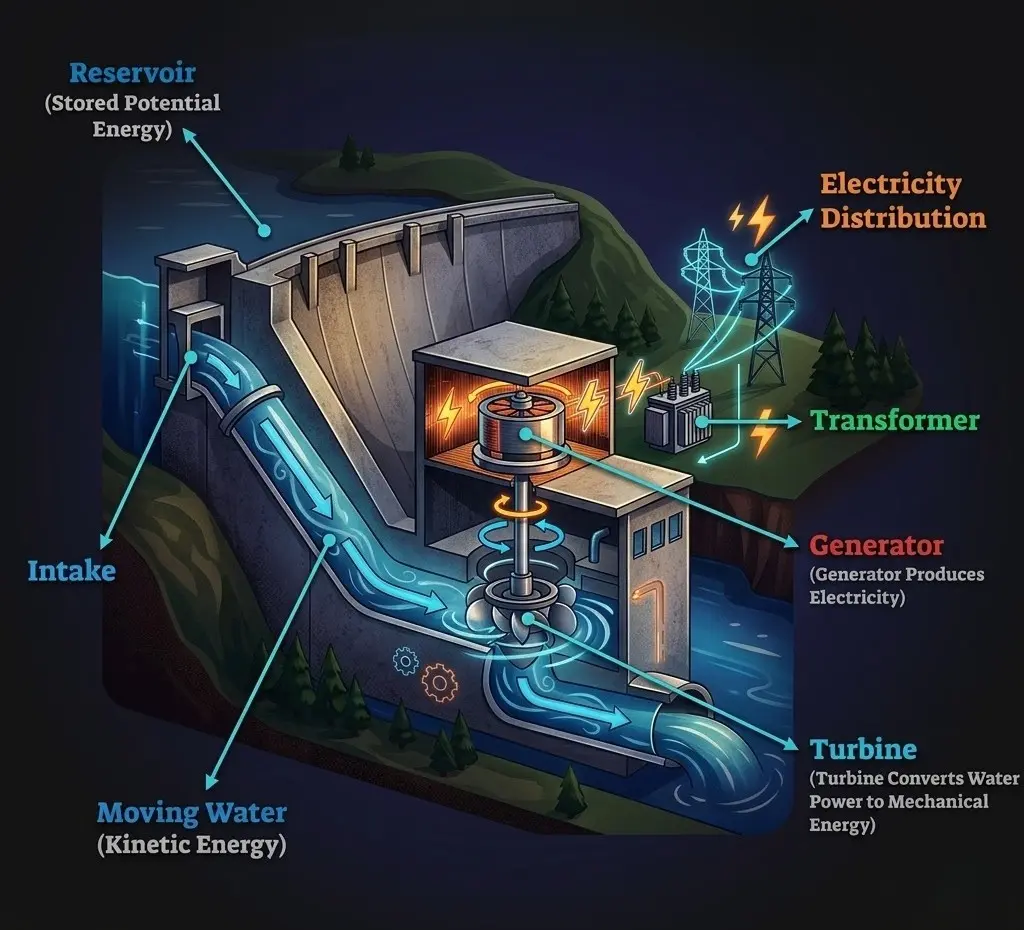
Electrical energy is rarely found in a ready-to-use form in nature. Instead, it is usually produced by converting other forms of energy into electricity. This is why electricity is called a secondary energy source. The main pathways include fossil fuels, nuclear energy, and renewable energy sources such as hydropower, wind, solar, biomass, and geothermal energy.
The main ways electricity is generated
- Steam turbines using heat from coal, natural gas, nuclear reactions, biomass, geothermal heat, or solar thermal energy
- Gas turbines that burn fuel and spin quickly
- Hydro turbines are powered by moving water
- Wind turbines are powered by moving air
- Solar photovoltaics that directly convert sunlight into electricity
In many countries, electricity comes from a mix of these sources rather than just one. That mix changes over time depending on fuel prices, policy, weather, technology, and demand.
A Large and Useful Table of Electricity Generation Sources
The table below gives a broad view of common generation sources and how they work.
Table 2. Major sources of electrical energy
| Source | How it creates electricity | Strengths | Limitations | Everyday example |
|---|---|---|---|---|
| Coal | Burns to make steam that spins a turbine | Reliable, large-scale output | High emissions, polluting | Traditional power plant |
| Natural gas | Burns to drive turbines or make steam | Flexible, fast start-up | Still a fossil fuel | Grid balancing |
| Nuclear energy | Fission releases heat for steam turbines | Very high output, low direct carbon emissions | Waste handling, high cost | Base-load power plant |
| Hydropower | Moving water spins turbines | Renewable, efficient, long life | Depends on rainfall and river systems | Dam-based generation |
| Wind energy | Wind turns turbine blades | Renewable, low operating emissions | Intermittent, weather-dependent | Wind farm |
| Solar photovoltaics | Sunlight is converted directly into electricity | Clean, scalable, modular | Only generates in daylight | Rooftop solar panels |
| Solar thermal | Concentrated sunlight makes heat for turbines | Renewable, can store heat | Needs strong sunlight | Large solar plant |
| Biomass | Organic material is burned or converted to fuel | Uses waste materials | Emissions depend on feedstock | Waste-to-energy plant |
| Geothermal | Heat from inside the Earth produces steam | Steady, low emissions | Location dependent | Geothermal station |
This table shows a simple truth. Electrical energy can come from many different paths, and each path has trade-offs. Some are cleaner. Some are steadier. Some are cheaper to scale. A strong power system often needs a balanced mix.
How Electrical Energy Moves Through a Circuit
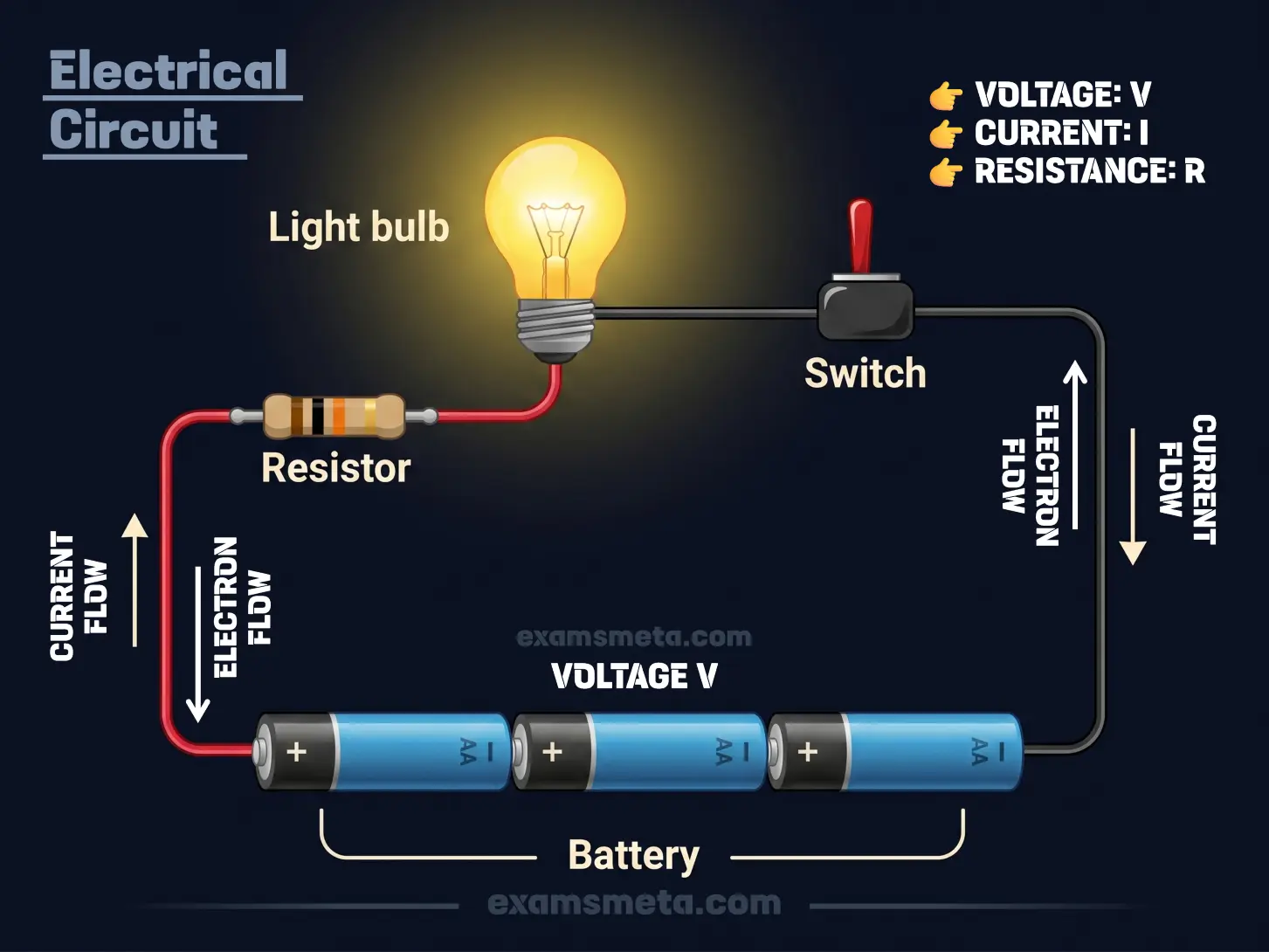
A circuit is a closed path that lets electric current flow. It usually includes a source such as a battery, conducting wires, and a device that uses the energy, such as a lamp or motor.
A basic circuit works like this:
- The power source creates a voltage difference
- That voltage pushes electrons through the conductor
- The electrons carry electrical energy
- The device converts that energy into light, heat, sound, or motion
- The flow continues as long as the circuit remains closed
If the circuit is broken, current stops flowing, and the energy transfer ends. That is why switches are so useful. They let us control the flow of electrical energy with ease.
Forms in Which Electrical Energy Can Be Seen
Electrical energy is not always visible, but its effects are easy to notice.
Common forms of electrical energy output
- Light, in bulbs, LEDs, screens, and displays
- Heat, in heaters, ovens, toasters, and irons
- Motion, in fans, pumps, mixers, and motors
- Sound, in speakers, buzzers, and alarms
- Magnetic effects, in electromagnets, relays, and transformers
- Chemical change, in batteries and electroplating
This flexibility is one reason electricity is so valuable. The same basic form of energy can do many different jobs depending on the device it passes through.
Examples of Electrical Energy in Daily Life
Electrical energy is all around us, even when we do not think about it.
Home examples
- A refrigerator uses electrical energy to keep food cold
- A fan converts electrical energy into motion
- A television converts electrical energy into light and sound
- A washing machine uses electricity to spin a drum and run controls
- A charger moves electrical energy into a battery
School examples
- Classroom lights
- Computers and projectors
- Lab equipment
- Printers and routers
City examples
- Traffic lights
- Elevators
- Streetlights
- Subway systems
- Water pumps
Industrial examples
- Conveyor belts
- Welding machines
- Heavy motors
- Robotic arms
- Cooling systems
These examples show how deeply electrical energy is woven into everyday life. Without it, many modern systems would simply stop.
Electrical Energy and the Power Grid
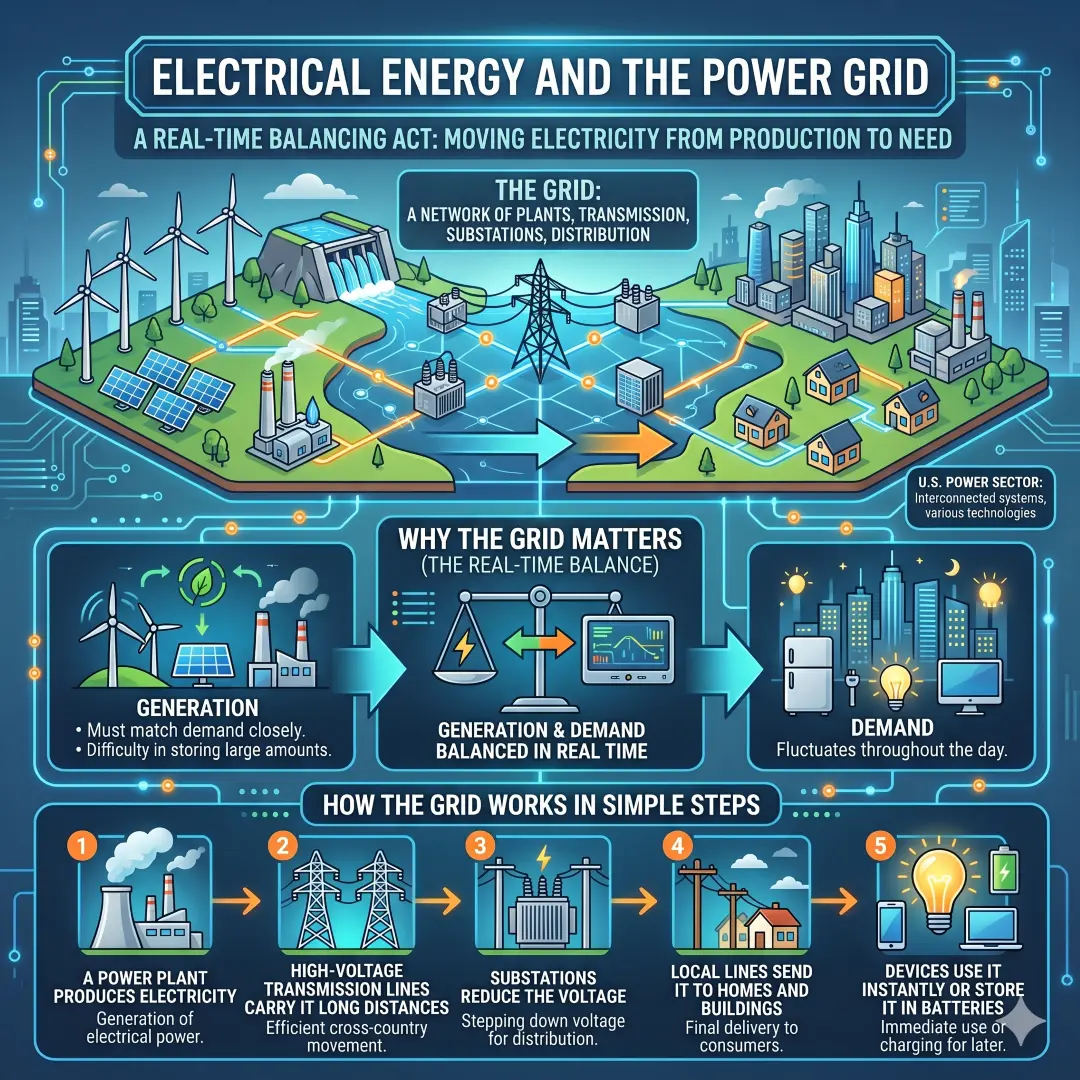
Once electricity is generated, it is usually sent into a power grid. The grid is a network of plants, transmission lines, substations, and distribution lines that move electricity from where it is produced to where it is needed.
The grid matters because electricity must be delivered in real time. Large amounts are hard to store, so generation and demand must stay closely balanced. That balancing act is one of the biggest tasks in the modern energy system. The U.S. power sector, for example, operates through interconnected grid systems and a variety of generation technologies.
How the grid works in simple steps
- A power plant produces electricity
- High-voltage transmission lines carry it long distances
- Substations reduce the voltage
- Local lines send it to homes and buildings
- Devices use it instantly or store it in batteries
Good grids are reliable, efficient, and flexible. As electricity demand rises, grids must also become smarter and stronger.
Why Electrical Energy Can Be Efficient
Electrical energy is highly useful because it can be transmitted and converted with relatively little loss compared with some other forms of energy use. Many machines can be designed to do exactly the task required, which reduces waste. A motor, for example, can turn electrical energy directly into motion without needing several intermediate steps.
Still, no system is perfect. Losses happen through resistance, heat, friction, and long-distance transmission. That is why engineers work hard on better conductors, better insulation, smarter grid design, and more efficient devices. In energy systems, every small improvement matters.
Advantages of Electrical Energy
Electrical energy has many strong advantages, which is why it has become the backbone of modern society.
- Easy to transport through wires and grids
- Easy to control with switches, sensors, and software
- Easy to convert into light, heat, sound, and motion
- Quiet in use for many devices
- Clean at the point of use when compared with burning fuels indoors
- Useful for automation and modern digital systems
- Compatible with renewables such as wind and solar
These advantages help explain why governments, companies, and households rely on electricity more every year. The global shift toward electrification is not a trend sitting on the edge of the system. It is already reshaping it.
Disadvantages and Challenges of Electrical Energy
Electrical energy is powerful, but it is not free from problems.
- It must usually be generated from another energy source
- It can be dangerous if handled carelessly
- Transmission can cause losses
- Storage can be expensive at a large scale
- Some generation methods still produce pollution
- Grid systems need constant balancing and maintenance
- Demand can rise faster than infrastructure growth
In many places, the challenge is not whether electricity is useful. It clearly is. The challenge is how to generate it cleanly, move it reliably, store it efficiently, and make it affordable for everyone.
Electrical Energy Storage
One major question is how to store electrical energy when it is not needed right away. Storage helps smooth out changes in demand and supply. This matters especially for solar and wind, because they depend on weather and daylight.
Common storage methods
- Batteries
- Pumped hydro storage
- Capacitors
- Flywheels
- Thermal storage
- Hydrogen production and reconversion
Each method has its own strengths. Batteries are great for devices and vehicles. Pumped hydro can support large grids. Capacitors release energy quickly. Thermal storage can help with heat or concentrated solar systems. The right choice depends on the job.
Electrical Energy in Batteries
A battery stores chemical energy and converts it into electrical energy when needed. Inside the battery, chemical reactions move electrons through a circuit. That is why batteries are so useful in remote controls, smartphones, flashlights, laptops, and electric vehicles.
How batteries help daily life
- They make portable devices possible
- They support backup power during outages
- They help balance renewable energy systems
- They power transportation in electric vehicles
Battery technology has become one of the most important parts of the energy transition. As devices and vehicles become more electric, storage becomes even more important.
Electrical Energy and Renewable Power
Many people today are interested in cleaner energy systems. That is where renewable sources matter. Solar panels, wind turbines, hydropower, and other low-emission technologies can generate electricity without burning fossil fuels directly.
The IEA noted that the rise in electricity demand through 2027 is expected to be covered entirely by low-emissions technologies in its 2025 outlook. That signals a major shift in how the world is thinking about power.
Why renewables matter
- Lower direct emissions
- Better long-term energy security
- Falling technology costs in many markets
- Easier to deploy in remote or modular systems
- Helpful for reducing dependence on imported fuels
Renewables do create new challenges, like variability and grid integration, but they also open the door to a cleaner and more flexible power system.
A Practical Table on Electrical Energy in Daily Life
Table 3. Where does electrical energy show up around you
| Place | Device or system | What electrical energy does | Why it matters |
|---|---|---|---|
| Home | Light bulbs | Produces light | Makes rooms usable at night |
| Home | Refrigerator | Runs the compressor and the cooling system | Keeps food safe |
| School | Computers | Powers processing and display | Supports learning and research |
| Hospital | Medical equipment | Runs monitors and machines | Supports patient care |
| Road | Traffic lights | Controls traffic flow | Improves safety |
| Factory | Motors and robots | Drives production lines | Improves speed and accuracy |
| Transport | Electric trains | Powers movement | Moves people efficiently |
| Telecom | Routers and servers | Maintains communication networks | Keeps the internet working |
This is what makes electrical energy so special. It is not limited to one kind of task. It quietly supports almost every part of modern living.
Safety and Electrical Energy
Electricity is useful, but it must be treated with respect. Even a small current can be dangerous under the wrong conditions. Safety matters in homes, schools, workplaces, and industrial settings.
Basic electrical safety habits
- Never touch exposed wires
- Keep your hands dry around electrical devices
- Do not overload sockets
- Use proper insulation and grounding
- Turn off the power before repairs
- Keep appliances away from water
- Replace damaged cords and plugs
- Use certified equipment whenever possible
These are simple habits, but they save lives. Electrical safety is one of the quiet foundations of modern life. People do not usually notice it when things go right, but they notice it instantly when things go wrong.
The Role of Electrical Energy in the Modern Economy
Modern economies depend on electrical energy for productivity, communication, logistics, and innovation. Factories need it. Offices need it. Data centers need it. Shops need it. Public transport needs it. Even agriculture increasingly depends on electrically powered systems for pumping, cooling, and processing.
The global rise in electricity use is tied to several big forces:
- Electrification of buildings
- Electrification of transport
- Industrial automation
- Expansion of data centers
- Rising cooling demand
- Population growth and urbanization
The IEA has described this as an emerging Age of Electricity, with strong demand growth expected through 2027.
Why Electrical Energy Keeps Growing in Importance
There was a time when electricity felt like a luxury in many parts of the world. Today, it is a basic necessity, and in many systems, it is becoming even more central than before. That change is happening because electricity works well with digital technology, modern manufacturing, clean transport, and efficient home systems.
The world is also using more electricity for:
- Cooling buildings during hot weather
- Charging devices and vehicles
- Running online services
- Supporting clean heating systems
- Improving industrial performance
As demand rises, the task is not just to produce more electricity. It is to produce it wisely. That means building systems that are reliable, affordable, clean, and fair.
Interesting Real-World Facts About Electrical Energy
- Electricity is a secondary energy source, not a primary one. It is made by converting other energy sources.
- The joule is the standard SI unit of energy.
- A watt is one joule per second.
- Electricity can be generated from fossil fuels, nuclear energy, and renewables.
- Global electricity demand rose by 4.3% in 2024.
- Demand is expected to keep growing strongly through 2027.
These facts show how important electricity has become not just as a scientific idea, but as a practical force shaping the modern world.
A Detailed Table on Electrical Energy Terms
Table 4. Key terms explained simply
| Term | Simple meaning | Why it matters |
|---|---|---|
| Electrical energy | Energy carried by moving electric charges | Powers devices and systems |
| Electric current | Flow of charge | Makes electricity useful |
| Voltage | Electrical pressure | Pushes current through a circuit |
| Resistance | Opposition to flow | Affects how easily current moves |
| Power | Rate of energy use | Helps compare devices |
| Circuit | Closed path for current | Lets electricity flow |
| Conductor | Material that allows current to move easily | Used in wires and cables |
| Insulator | Material that resists current | Used for safety and control |
| Generator | Machine that produces electricity | Found in power plants |
| Transformer | Device that changes voltage | Helps with transmission and distribution |
These terms come up again and again in science, engineering, and daily life. Learning them makes the whole topic much easier to understand.
How to Think About Electrical Energy in Simple Language
A helpful mental picture is to compare electricity with water.
- Voltage is like water pressure
- Current is like a water flow
- Resistance is like a narrow pipe
- Electrical energy is the useful power in the moving water
- A circuit is like a closed pipe loop
This comparison is not perfect, but it makes the basic idea easier to grasp. Electricity is not water, of course, but the analogy helps many people understand how current moves and why devices work the way they do.
Another way to think about it is this. Electrical energy is like money moving through a system. It can be sent, stored, converted, spent, and measured. That makes it one of the most versatile forms of energy we use every day.
The Future of Electrical Energy
The future of electrical energy will likely be shaped by three big ideas.
1. Cleaner generation
More electricity is expected to come from solar, wind, hydro, nuclear, and other low-emission technologies.
2. Smarter grids
Digital controls, sensors, automation, and flexible systems will make power networks more efficient and reliable.
3. Higher demand
More cars, more devices, more cooling, more online activity, and more electrified systems will all raise the need for electricity. The IEA expects strong demand growth to continue, which means planning and investment will matter even more.
This future is not only about technology. It is also about access. Millions of people still need better electricity access, better reliability, and better affordability. A truly strong energy future must work for everyone, not just for the places with the most advanced infrastructure.
Common Mistakes People Make When Talking About Electrical Energy
Here are a few misunderstandings that come up often:
- Thinking power and energy are the same thing
- Assuming electricity is always a clean energy source
- Believing all electricity comes from one source
- Confusing voltage with current
- Forgetting that electricity must usually be generated from another form of energy
- Thinking batteries create electricity from nothing
These mistakes are easy to make, but once the basic ideas are clear, they stop being confusing. A little science goes a long way.
Conclusion
Electrical energy is one of the greatest tools humans have ever learned to use. It is invisible in many cases, yet it shapes almost every part of modern life. It lights our homes, powers our machines, runs our digital systems, and helps entire cities function smoothly. It can come from fossil fuels, nuclear power, or renewable sources like wind and solar. It can be stored in batteries, carried through grids, and converted into heat, motion, light, and sound.
At the same time, electricity is entering a new phase. Global demand is rising fast, driven by electrification, cooling, data centers, and new technologies. That means the world needs smarter systems, cleaner generation, stronger grids, and better storage. The future of electricity is not just about having more of it. It is about using it wisely.
And that is what makes electrical energy so fascinating. It is simple enough to explain to a child, yet powerful enough to support modern civilization. It is science, engineering, economy, and everyday life all at once.
Article References and Sources
- U.S. Energy Information Administration. “Electricity Explained.”
- U.S. Energy Information Administration. “Electricity in the United States.”
- U.S. Energy Information Administration. “Electricity Data and Information.”
- U.S. Department of Energy. “Electricity 101.”
- U.S. Environmental Protection Agency. “Electric Power Sector Basics.”
- National Institute of Standards and Technology. “Joule Definition and Energy Units.”
- International Energy Agency. “Electricity 2025.”
- International Energy Agency. “Global Energy Review 2025: Electricity.”
- International Energy Agency. “Electricity Mid-Year Update 2025.”
- International Energy Agency. “Global Electricity Demand Trends.”
Also, Read these Articles in Detail
- Physics and Its Fundamentals With Good Explanations
- Matter, Motion, and Energy: The Core Ideas of Physics
- What Is Matter? The Physical Substance of the Universe
- What Is Motion? A Guide to Motion in Physics and Daily Life
- What Is Energy? The Invisible Power Behind Everyday Life
- Kinetic Energy Explained in Simple Language
- Potential Energy: Definition, Types, Formula, and Examples
- Thermal Energy: Heat, Temperature, and Transfer
- Mechanical Energy: Definition, Formula, and Examples
- Chemical Energy: Definition, Science, and Examples
Frequently Asked Questions
FAQ 1: What is electrical energy, and how does it work?
Electrical energy is the energy that comes from the movement of electric charges, usually electrons, through a conductor like a wire. It is one of the most useful forms of energy in everyday life because it can travel through circuits and be changed into many other forms, such as light, heat, sound, and motion.
A simple way to understand it is to think of a closed path called a circuit. When a power source such as a battery, generator, or power grid creates a push, electric charges begin to move. That movement is the electric current. As current flows through a device, the device uses the energy in that current to do work. A bulb glows. A fan spins. A heater warms a room. A phone charges. The basic idea stays the same. The electricity is carrying energy, and the device is turning that energy into something useful.
What makes electrical energy so important is not just that it exists, but that it is easy to control. You can switch it on or off. You can send it through wires. You can store it in batteries for later. You can use a little of it in a tiny device or a lot of it in a huge machine. That flexibility is a big reason modern life depends on it so much.
It also helps to remember that electricity is usually a secondary energy source. That means it is not normally found ready to use in large amounts in nature. It is produced by converting other energy sources like coal, natural gas, wind, solar, hydropower, or nuclear energy into electrical form. So electrical energy is both a scientific idea and a practical tool. It is the invisible force behind much of the world around us.
FAQ 2: What is the difference between electrical energy, electric current, voltage, and power?
These four terms are closely related, but they do not mean the same thing. Understanding the difference makes electricity much easier to study and use.
Electrical energy is the total energy available in or used by an electrical system. It is the amount of useful energy carried or consumed over time. In homes and workplaces, it is often measured in kilowatt-hours.
Electric current is the flow of electric charge through a circuit. It tells you how many electrons are moving. Current is measured in amps or amperes. If current is high, more charge is moving through the circuit at once.
Voltage is the electrical force that pushes charge through the circuit. It is often compared to pressure in a water pipe. Without voltage, current does not flow. Voltage is measured in volts.
Power is the rate at which energy is used. It tells you how fast a device consumes electrical energy. Power is measured in watts. A 1000-watt heater uses energy much faster than a 10-watt bulb.
Here is the easiest way to keep them apart:
- Voltage is the push
- Current is the flow
- Power is the speed of energy use
- Electrical energy is the total amount used or stored
A device may have high voltage but low current. Another may draw a lot of current but use energy slowly or quickly, depending on the design. That is why these terms are often taught together. They work as a team, but each one plays a different role.
Once this becomes clear, many common electrical questions stop feeling confusing. You start to understand not just what a device does, but how and why it does it.
FAQ 3: How is electrical energy generated in the first place?
Electrical energy is usually generated by converting another form of energy into electricity. That conversion can happen in several different ways, and the method depends on the source being used.
In a thermal power plant, fuel such as coal, natural gas, or biomass is burned to create heat. That heat turns water into steam. The steam spins a turbine. The turbine turns a generator. The generator produces electricity.
In nuclear power, the fuel is not burned in the usual sense. Instead, energy is released from the nucleus of atoms through nuclear fission. That heat also creates steam, which drives a turbine and generator.
In hydropower, flowing or falling water turns turbines directly. In wind power, moving air spins turbine blades. In solar photovoltaic systems, sunlight is converted directly into electricity by solar cells, without needing steam or moving parts in the same way. That makes solar panels especially interesting, because they use light itself as the energy source.
The important thing to understand is that electricity does not usually appear by itself. It comes from a system. That system may involve heat, motion, sunlight, water, or nuclear reactions. Once generated, the electricity can be sent into a power grid and used almost anywhere.
Different generation methods have different strengths. Some are reliable. Some are clean. Some are fast to build. Some are cheap to run. A country often uses a mix because no single source is perfect for every need. This is one reason electricity systems are such a big topic in engineering and energy policy.
FAQ 4: Why is electrical energy so important in everyday life?
Electrical energy matters because it supports so many parts of modern life that it is easy to take it for granted. But once the power goes out, people quickly notice how much they depend on it.
At home, it runs lights, fans, refrigerators, televisions, washing machines, chargers, and Wi-Fi routers. In schools, it powers computers, projectors, lab tools, and lighting. In hospitals, it supports life-saving equipment, monitoring systems, cooling systems, and communication tools. In factories, it drives motors, machines, and automated systems that make goods efficiently.
Electrical energy is also at the center of the digital world. Phones, laptops, servers, data centers, and communication networks all rely on it. Even activities that seem simple, like sending a message or watching a video, depend on electricity somewhere in the chain.
One of the biggest reasons electricity is so valuable is that it is easy to convert into other useful forms. It can become heat for cooking or warming, motion for machines and vehicles, sound for alarms and speakers, and light for homes and streets. That makes it one of the most flexible energy forms ever used by humans.
It also helps that electricity is quiet, fast, and easy to control. You do not have to manually move fuel into every device. You just switch it on. That convenience has changed how people live, work, learn, travel, and communicate.
So when people talk about modern life, they are really talking about electricity in action. It is not a side feature of society. It is one of the foundations.
FAQ 5: What are the main units used to measure electrical energy?
The main units used to measure electrical energy are joules, watt-hours, and kilowatt-hours. Each one is useful in a different setting.
The joule is the standard scientific unit of energy. It is used in physics, engineering, and technical writing. One watt is equal to one joule per second, which helps connect power and energy in a clear way.
The watt-hour is another energy unit. It tells you how much energy is used when one watt of power runs for one hour. It is easier to understand than joules for some everyday tasks, especially small batteries and devices.
The kilowatt-hour is the most familiar unit for electricity use in homes and businesses. This is the unit that usually appears on an electricity bill. One kilowatt-hour means using 1000 watts for one hour. That could be a 1000-watt heater running for one hour, or ten 100-watt bulbs running for one hour, or a mix of devices that together use that much energy.
Here is a simple way to remember the difference:
- Joules are the scientific base unit
- Watt-hours are useful for devices and batteries
- Kilowatt-hours are used for bills and larger energy use
This matters because people often confuse power with energy. A device with high wattage may not always use the most total energy if it runs only for a short time. On the other hand, a low-power device can still use a lot of energy if it stays on all day.
So when you look at an appliance label or an electricity bill, the numbers tell a story. They show how much energy a device uses, how fast it uses it, and how that use adds up over time.
FAQ 6: What are the main sources of electrical energy, and how do they compare?
There are many sources of electrical energy, and each one has its own strengths and limits. The main sources include coal, natural gas, nuclear energy, hydropower, wind energy, solar energy, biomass, and geothermal energy.
Coal is a traditional source that can generate large amounts of electricity, but it produces high emissions and pollution. Natural gas is more flexible and cleaner than coal in many cases, but it is still a fossil fuel. Nuclear energy produces very large amounts of electricity with low direct carbon emissions, but it comes with high construction costs and waste management issues.
Among renewables, hydropower is steady and efficient but depends on geography and water availability. Wind energy is clean and increasingly important, but output changes with the weather. Solar energy is one of the fastest-growing sources because panels are modular and easy to install, but it works best in sunlight and does not produce power at night without storage. Biomass can make use of waste and organic material, while geothermal energy is reliable in the right locations.
Here is the real point. No energy source is perfect. A strong electricity system usually uses a mix. The right balance depends on land, climate, fuel supply, cost, technology, and national goals.
That is why comparing sources is never just about asking which one is “best.” It is about asking the best for what purpose, in what place, and under what conditions. A city, a rural village, an island, and a large industrial region may all need different solutions.
FAQ 7: How does electrical energy move through a power grid?
Electrical energy reaches most homes and buildings through a power grid, which is a connected network that moves electricity from the point of generation to the point of use.
The process begins at a power plant or renewable energy site. Electricity is produced there and then sent through transmission lines at high voltage. High voltage is used because it helps electricity travel long distances more efficiently. After that, substations reduce the voltage to safer and more usable levels. Then, distribution lines carry the electricity into neighborhoods, schools, hospitals, offices, and factories.
The grid has to work in real time. Electricity cannot be stored easily in huge amounts on the grid itself, so supply and demand must stay balanced all the time. If demand suddenly rises, the grid must respond quickly. If generation drops, backup systems may be needed. That is why grid operators pay such close attention to stability, frequency, and load balancing.
A useful way to think about the grid is as a giant delivery system. The power plant makes the package. The transmission network carries it over a long distance. The local lines deliver it to the final address. And the final device uses the energy immediately.
The grid is one of the most important engineering systems ever built. It quietly supports everything from a child’s night light to a major hospital. And as more devices and vehicles become electric, the grid will become even more important in the years ahead.
FAQ 8: What are the advantages of electrical energy?
Electrical energy has many advantages, which is why it is used so widely across the world.
One major advantage is that it is easy to control. You can switch it on and off instantly. You can regulate its flow. You can direct it into tiny devices or large systems. That control makes it ideal for technology.
Another advantage is that it is easy to convert. The same electrical input can produce light in a bulb, heat in a heater, motion in a fan, or sound in a speaker. This flexibility is one of its biggest strengths.
Electrical energy is also quiet in many uses. Unlike some engines and fuel-burning systems, it can power devices without much noise. That helps in homes, schools, offices, and hospitals.
It is also very useful for automation and digital technology. Computers, robots, communication systems, and smart devices all depend on electricity to operate.
In many situations, electricity is also cleaner at the point of use. A device running on electricity does not have to burn fuel inside the room. That can improve air quality indoors and make life more comfortable.
Here are the main advantages in short form:
- Flexible
- Easy to distribute
- Easy to control
- Easy to convert
- Useful for modern technology
- Quiet in many applications
- Compatible with renewable generation
That does not mean electricity is perfect. It still must be generated and managed carefully. But as a practical energy form, it is hard to beat. It helps explain why so much of modern society is built around it.
FAQ 9: What are the dangers or challenges of electrical energy?
Even though electrical energy is useful, it also comes with real risks and challenges. Respect matters here. Electricity is not something to treat casually.
The first danger is electric shock. If the body becomes part of an electrical path, current can move through tissues and cause injury or death. That is why wet hands, damaged wires, and exposed plugs are serious hazards.
Another issue is fire risk. Overloaded circuits, poor wiring, loose connections, and damaged appliances can generate heat and start fires. Many home fires are linked to electrical faults that could have been prevented.
There are also technical challenges. Electricity must be generated and used at the same time unless it is stored. That makes balancing supply and demand difficult. It also means power systems need strong planning, backup, and maintenance.
Other challenges include:
- Transmission losses
- Storage costs
- Weather-related variability
- Infrastructure maintenance
- High setup costs for some technologies
- Environmental concerns from certain generation sources
And in some places, the biggest challenge is access itself. Reliable electricity is still not equally available everywhere. Some communities face outages, limited infrastructure, or high costs.
So yes, electrical energy is powerful. But power always comes with responsibility. Safe wiring, proper insulation, trained workers, and good system design all matter. That is how people enjoy the benefits while reducing the risks.
FAQ 10: What is the future of electrical energy?
The future of electrical energy is likely to be bigger, smarter, cleaner, and more connected than it is today. That change is already happening.
One major trend is electrification. More cars, buses, heating systems, appliances, and industrial tools are moving from fuel-based systems to electric ones. That means electricity will play a larger role in transport, heating, and manufacturing.
Another trend is the growth of renewable energy. Solar and wind systems are being added in many regions because they are cleaner and increasingly cost-effective. But renewables also bring the need for better storage, smarter grids, and better forecasting.
A third trend is the rise of digital energy systems. Smart meters, sensors, automation, and software are helping utilities manage electricity more efficiently. That makes it easier to detect problems, reduce waste, and respond to changes in demand.
There is also growing interest in battery storage, electric vehicles, microgrids, and more flexible power networks. These tools help electricity systems become more resilient and more adaptable.
The big picture is simple. Electricity is not becoming less important. It is becoming more important. The world is using more of it, depending on it in more places, and expecting it to be cleaner and more reliable at the same time.
That is a tall order. But it is also a promising one. If the future is built well, electrical energy will remain one of the strongest foundations of modern life, just as it is today.
