

Radiant energy is one of the most familiar forms of energy in daily life, even when we do not stop to name it. It is the energy carried by electromagnetic radiation, which includes radio waves, microwaves, infrared, visible light, ultraviolet, X-rays, and gamma rays. The sunlight that warms your skin, the light in a room, the signal from a radio tower, and the heat you feel from a hot stove are all connected to this same broad idea. Radiant energy travels in waves, it can move through empty space, and it plays a major role in how life, climate, technology, and communication all work.
A simple way to think about it is this. When energy moves through space as electromagnetic radiation, that moving energy is radiant energy. Some of it is visible to our eyes, but a lot of it is invisible. We see only a small slice of the spectrum, while instruments can detect much more. That is why the same physical world can look very different to humans than it does to scientific sensors.
Table of Contents
What Radiant Energy Really Means
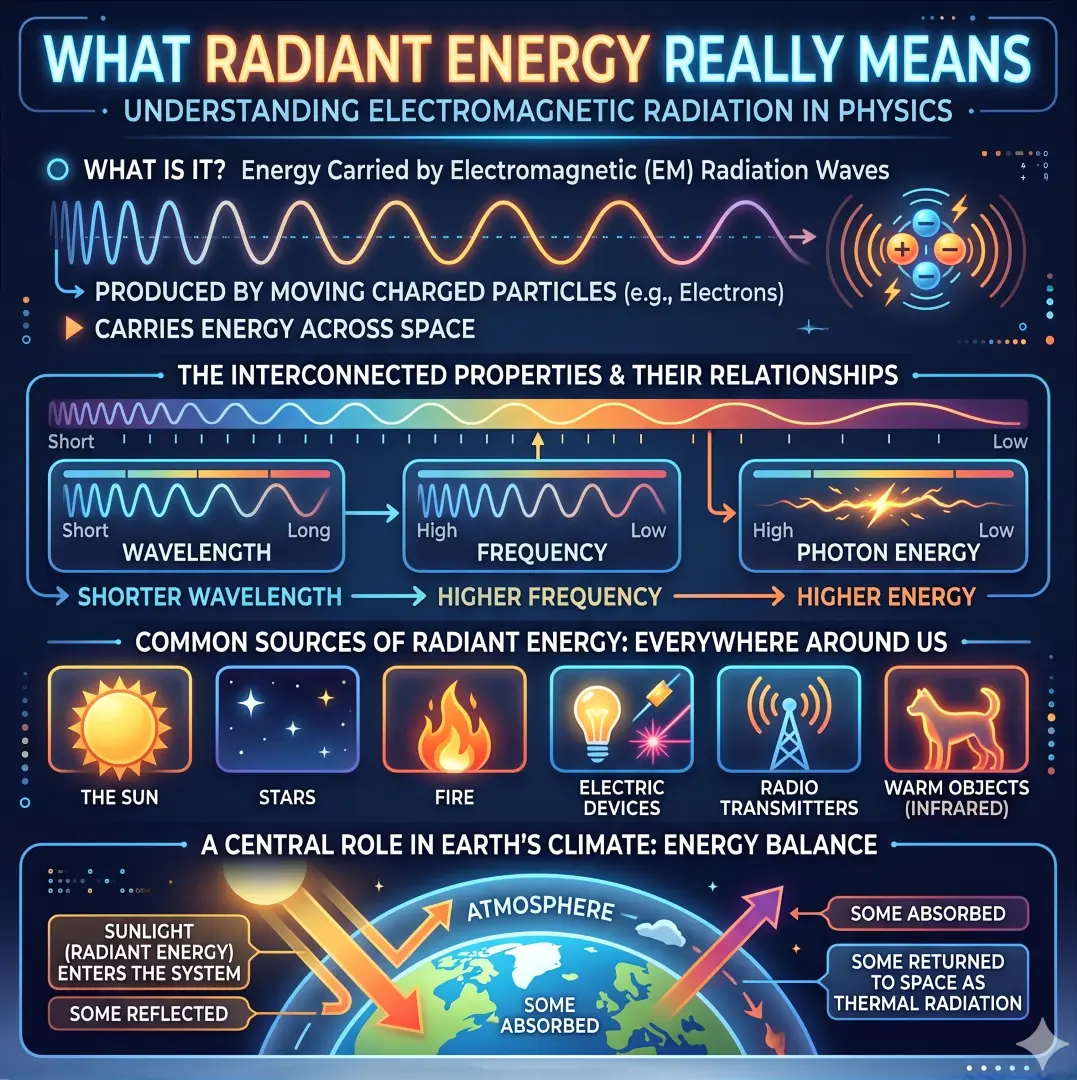
In physics, radiant energy is not a vague idea. It is the energy carried by waves of electromagnetic radiation. Those waves are produced by moving charged particles, and they carry energy across space. The energy can be described in terms of wavelength, frequency, or photon energy, and those three ideas are closely connected. A shorter wavelength means a higher frequency, and higher frequency means higher energy.
This matters because radiant energy is everywhere. It comes from the Sun, from stars, from fire, from electric devices, from radio transmitters, and from warm objects that give off infrared radiation. It also plays a central role in climate because sunlight enters Earth’s system as radiant energy, then some of it is reflected, some absorbed, and some eventually sent back into space as thermal radiation.
Why Radiant Energy Is Such a Big Deal
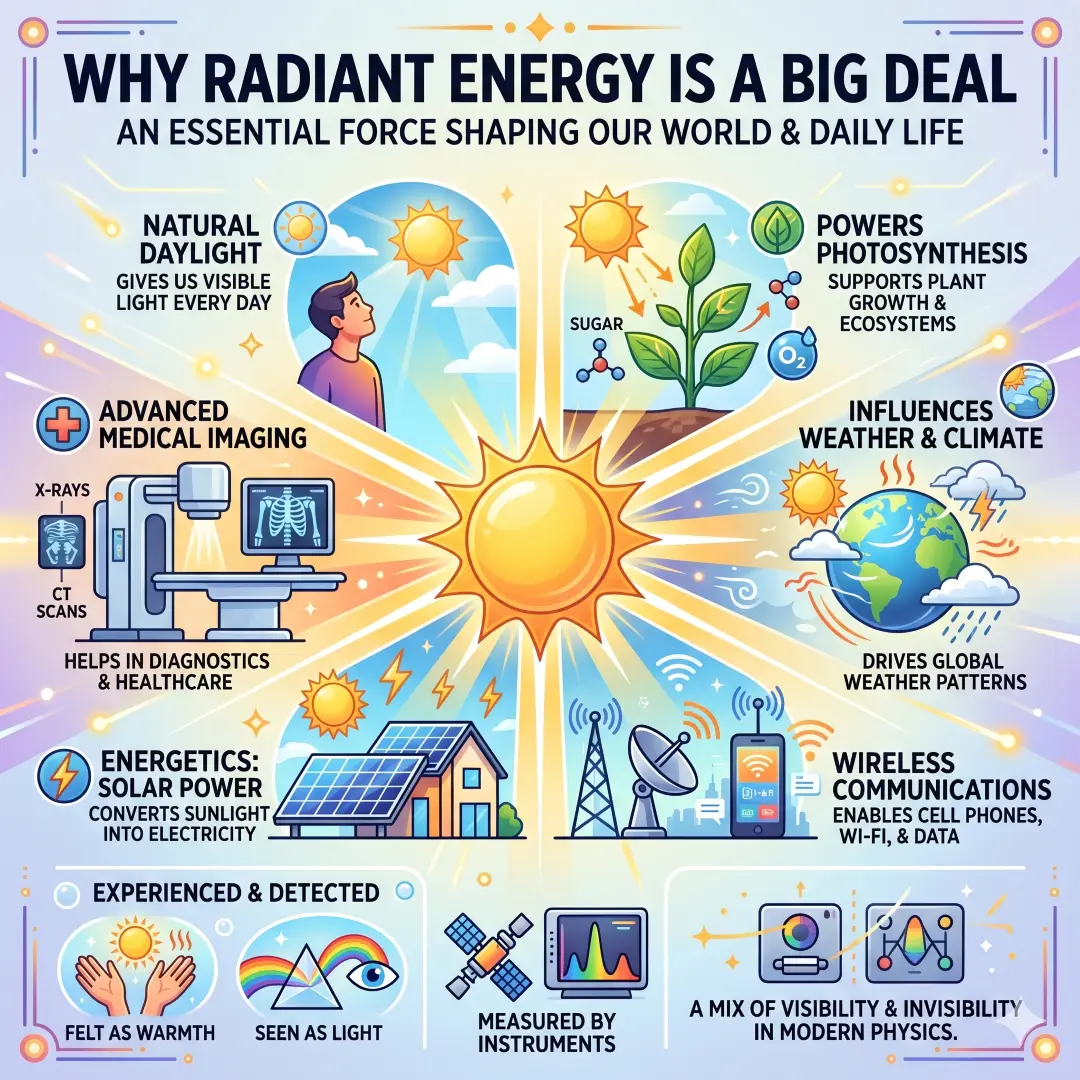
Radiant energy is part of daily life in more ways than most people realize. It gives us daylight, supports photosynthesis, helps power solar panels, allows wireless communication, makes medical imaging possible, and influences weather and climate. It is not just a science term. It is a practical part of how modern civilization works.
It also reminds us that energy is not always something you can touch or see directly. You can feel the warmth from radiant energy, see some of it as light, and detect the rest with instruments. That mix of visibility and invisibility is part of what makes the topic so interesting. It is ordinary enough to experience every day, yet deep enough to connect to advanced physics.
How Radiant Energy Travels
Radiant energy travels as electromagnetic waves, and those waves can move through the atmosphere and through the vacuum of space. That is why sunlight can cross millions of kilometers from the Sun to Earth. Unlike sound, which needs a material medium like air or water, electromagnetic radiation does not need matter to move through.
These waves differ in wavelength and frequency. Long wavelengths have lower frequencies and lower energy. Short wavelengths have higher frequencies and higher energy. This is the basic pattern behind the entire electromagnetic spectrum. Radio waves sit on one end, and gamma rays sit on the other. Visible light is only a thin band in the middle.
Another helpful idea is the photon. Light can be described as a stream of tiny energy packets called photons, and each photon carries a specific amount of energy. The higher the frequency, the more energetic the photon. That is why gamma rays and X-rays are far more energetic than radio waves, even though they are all part of the same family.
Radiant Energy and the Electromagnetic Spectrum
The electromagnetic spectrum is the full range of electromagnetic radiation. It includes radio waves, microwaves, infrared, visible light, ultraviolet, X-rays, and gamma rays. The borders between these regions are approximate and vary by convention, but the overall order is always the same.
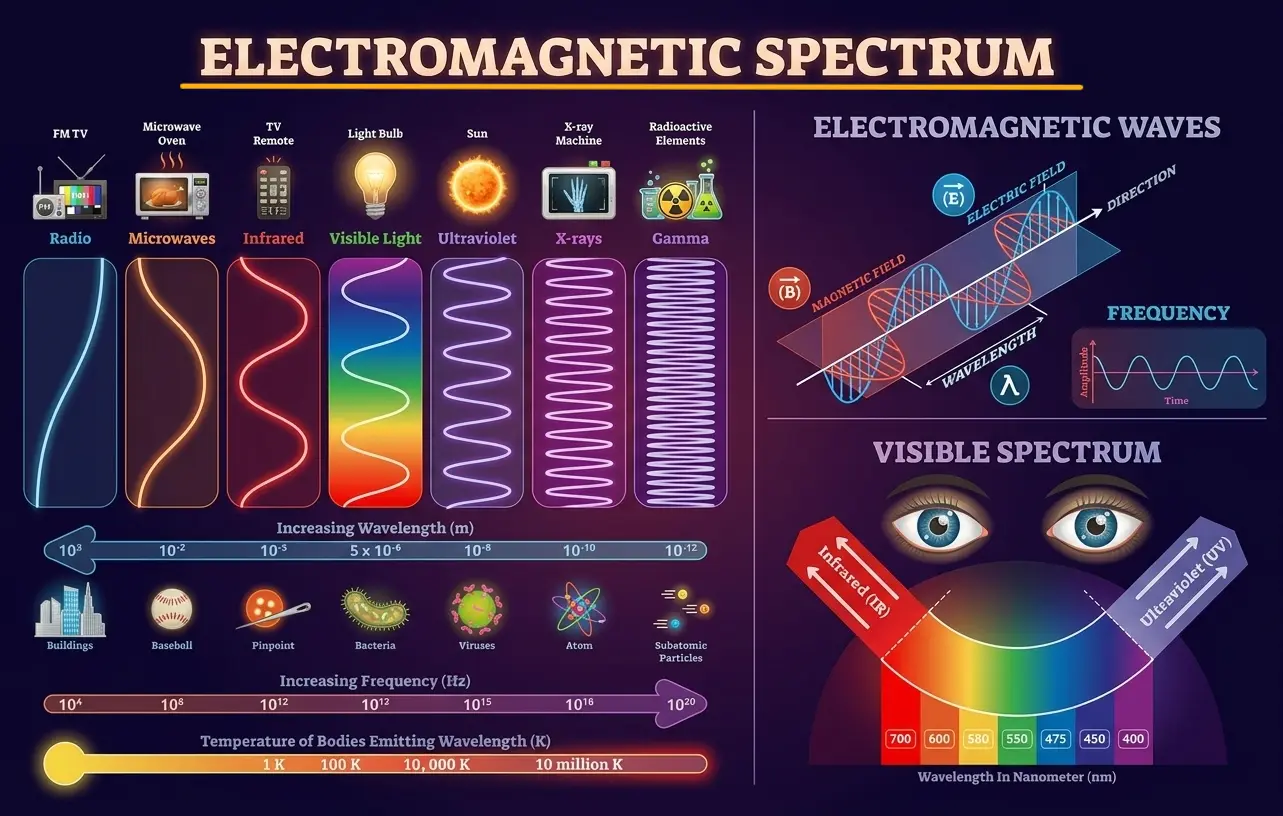
Here is a clear, practical table that shows where each part of the spectrum sits and how people usually encounter it.
| Spectrum region | Approx. wavelength range | Approx. frequency range | Common examples | Typical uses | What to remember |
|---|---|---|---|---|---|
| Radio waves | Greater than 1 x 10⁻¹ m | Less than 3 x 10⁹ Hz | Broadcasting signals, communication towers | Radio, TV, navigation, wireless systems | Lowest energy in the spectrum. |
| Microwaves | 1 x 10⁻³ to 1 x 10⁻¹ m | 3 x 10⁹ to 3 x 10¹¹ Hz | Microwave ovens, radar, Wi-Fi | Cooking, radar, satellite links | Often associated with heating and communication. |
| Infrared | 7 x 10⁻⁷ to 1 x 10⁻³ m | 3 x 10¹¹ to 4 x 10¹⁴ Hz | Heat from warm objects, remote controls, thermal cameras | Heating, sensing, night vision, building inspections | Strongly linked to heat and thermal radiation. |
| Visible light | 4 x 10⁻⁷ to 7 x 10⁻⁷ m | 4 x 10¹⁴ to 7.5 x 10¹⁴ Hz | Sunlight, lamps, colors you can see | Vision, photography, illumination | The only part humans see directly. |
| Ultraviolet | 1 x 10⁻⁸ to 4 x 10⁻⁷ m | 7.5 x 10¹⁴ to 3 x 10¹⁶ Hz | UV from the Sun, black lights, tanning lamps | Sterilization, sensing, chemistry | UV can be useful, but too much can harm skin and eyes. |
| X-rays | 1 x 10-11 to 1 x 10⁻⁸ m | 3 x 10¹⁶ to 3 x 10¹⁹ Hz | Medical imaging, airport security scanners | Medicine, inspection, materials analysis | Higher energy and ionizing. |
| Gamma rays | Less than 1 x 10-11 m | Greater than 3 x 10¹⁹ Hz | Cosmic sources, nuclear processes | Research, medicine, nuclear science | Highest energy region commonly discussed. |
The table makes one thing very clear. Radiant energy is not just light. It is a whole spectrum of energy types that behave in related ways but show up differently in daily life and science.
A Simple Comparison of Related Energy Terms
People often mix up radiant energy, thermal energy, kinetic energy, and electrical energy. They are related, but they are not the same thing. This table keeps the differences clear.
| Energy term | What it means | Easy example |
|---|---|---|
| Radiant energy | Energy carried by electromagnetic waves | Sunlight reaching your face |
| Thermal energy | Energy from the motion of atoms and molecules in a substance | A cup of hot tea |
| Kinetic energy | Energy of motion | A moving bicycle |
| Electrical energy | Energy associated with moving electric charges | Electricity flowing to a lamp |
| Chemical energy | Energy stored in chemical bonds | Food, batteries, fuel |
| Potential energy | Stored energy due to position or arrangement | Water behind a dam |
These forms of energy often change into one another. Sunlight can become electricity in a solar panel, chemical energy in plants, or thermal energy in a warm wall, depending on what absorbs it.
Natural Sources of Radiant Energy
The biggest natural source of radiant energy in everyday life is the Sun. The Sun emits heat and light as solar radiation, which is another way of saying electromagnetic radiation. That energy reaches Earth, drives weather, supports ecosystems, and powers solar technologies.
Other natural sources include stars, lightning, volcanic activity, and warm surfaces that emit infrared radiation. On a human scale, even your own body gives off low-level infrared radiation because anything warm radiates energy. That is why thermal cameras can detect people in the dark.
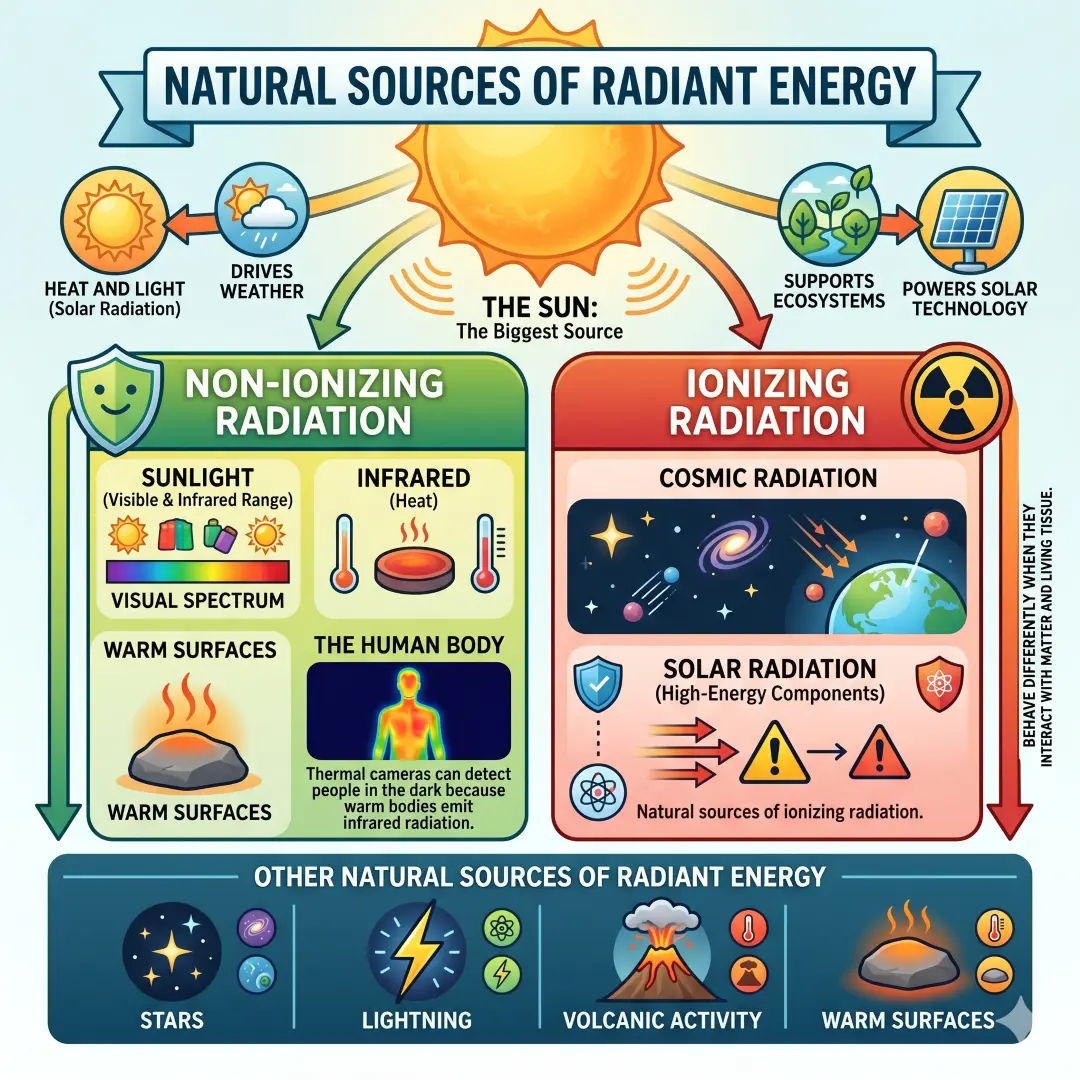
Natural radiant energy also comes in forms that people do not always think about. Cosmic radiation and solar radiation are both natural sources of ionizing radiation, while sunlight in the visible and infrared range is typically non-ionizing. The category matters because the two behave differently when they interact with matter and living tissue.
Human-Made Sources of Radiant Energy
Human beings create and use radiant energy in many useful ways. Radio towers send out radio waves, microwave links move data, lasers emit concentrated light, and medical devices use X-rays to see inside the body. These are all controlled uses of electromagnetic energy.
The most familiar modern example is the solar panel. When sunlight hits a photovoltaic cell, the cell absorbs the energy and creates electrical charges that move, producing electricity. Another major approach is concentrating solar-thermal power, where mirrors focus sunlight to produce heat that can be used to generate electricity or stored for later use.
Here are some everyday human-made sources and systems that rely on radiant energy:
- LED lamps and other lighting systems, which produce visible light.
- Microwave ovens, which use microwave radiation to heat food.
- Remote controls, which use infrared signals.
- Wi-Fi and mobile networks, which use radiofrequency waves.
- X-ray machines, which use ionizing radiation for imaging.
- Solar panels, which turn sunlight into electricity.
How Radiant Energy Interacts with Matter
When radiant energy reaches a surface, several things can happen. It may be absorbed, reflected, scattered, or transmitted. The result depends on the material, the wavelength, and the surface conditions. Snow and ice reflect a lot of sunlight. Dark surfaces often absorb more. Glass can let visible light pass through while blocking much of the infrared.
This interaction is one reason radiant energy matters in architecture, clothing, agriculture, and climate science. A shiny rooftop can reflect more sunlight. A dark road can absorb more and get hotter. A greenhouse can trap heat because different wavelengths behave differently as they move in and out. These are everyday examples of electromagnetic behavior shaping the physical world.
Radiant energy can also be converted into other forms of energy. A solar cell turns light into electrical energy. A human body absorbs sunlight and converts some of that energy into heat. A plant absorbs sunlight and uses it in photosynthesis to build chemical energy. In each case, the incoming radiant energy does not vanish. It changes form.
Radiant Energy, Heat, and Thermal Radiation
A lot of people hear the phrase radiant energy and think only of light. But infrared radiation is just as important. In fact, heat transfer by radiation is one of the main ways energy moves from a warm object to a cooler one. That is why you can feel warmth from a stovetop, a fire, or the Sun without touching the source.
The Sun gives off both visible light and infrared energy, and the Earth also sends energy back out as long-wave thermal radiation. This exchange is a major part of the planet’s energy budget, which is the balance between incoming and outgoing radiant energy. That balance helps control Earth’s temperature and climate.
A useful way to picture this is to imagine the Earth as a kind of energy accountant. Sunlight comes in, some is reflected, some is absorbed, and some later leaves the planet as infrared radiation. If the balance changes, temperatures shift too. That is one reason climate scientists pay so much attention to radiation measurements.
Radiant Energy and Climate
Radiant energy is central to climate science. Incoming sunlight is the main source of energy for the Earth system, and the atmosphere, clouds, aerosols, oceans, land, and ice all influence how much is absorbed or reflected. The balance between incoming solar radiation and outgoing thermal radiation affects temperature, rainfall, and long-term climate patterns.
Some of the incoming solar energy is reflected by clouds, snow, ice, and bright surfaces. Some is absorbed by the atmosphere. Some reaches land and ocean surfaces. Once the surface warms, it emits energy back as infrared radiation. This steady back-and-forth exchange is one of the basic engines of weather and climate.
This is also why changes in clouds, atmospheric particles, or surface reflectivity can matter so much. A small change in how much radiant energy is trapped or reflected can produce a larger effect over time. Climate is not just about temperature. It is about energy flow.
How Radiant Energy Is Measured
Scientists measure radiant energy with the field of radiometry. Radiometry deals with the measurement of optical radiation, and common quantities include radiant flux, radiant intensity, irradiance, and radiance. These are measured in units like watt, watt per steradian, and watt per square meter.
That might sound technical, but the idea is simple. Scientists need a way to describe how much radiation exists, how strong it is, and where it is going. For example, irradiance tells you how much radiant power lands on a surface per unit area. That matters in solar engineering, remote sensing, photography, and climate science.
There is also a difference between radiometry and photometry. Radiometry measures electromagnetic radiation across the optical range. Photometry measures light as the human eye perceives it. So radiometry is the broader scientific tool, while photometry is tuned to human vision.
Radiant Energy in Everyday Life
Even without studying physics, people rely on radiant energy constantly. Think about these examples:
- Sunlight makes mornings brighter and supports outdoor life.
- Heat from a fire reaches you partly by radiation.
- A light bulb fills a room with visible radiant energy.
- A microwave oven heats food with microwave radiation.
- A TV remote sends an infrared signal.
- A medical X-ray lets doctors see bones and some internal structures.
You can also notice radiant energy in homes and buildings. Warm windows, sunlight through glass, heat from kitchen appliances, and infrared inspections in energy audits all depend on the movement of electromagnetic energy. Builders and engineers use this knowledge to reduce heat loss, improve comfort, and save energy.
Another common example is a winter day with bright sun and cold air. The air may feel chilly, but direct sunlight can still warm your skin and surfaces. That happens because radiant energy travels directly from the Sun and is absorbed by matter it reaches.
Where Radiant Energy Helps Society the Most
Radiant energy is useful because it can do so many different jobs. It can carry information, provide light, heat things, reveal hidden details, and power devices. That versatility is why it appears in so many fields.
Some of the biggest practical uses include:
- Communication, through radio, microwave, and satellite signals.
- Medicine, through X-rays and other imaging systems.
- Energy, through solar panels and solar thermal systems.
- Science, through spectroscopy and astronomy.
- Safety and security, through thermal cameras and inspection tools.
- Daily comfort, through lighting, heating, and building design.
In each of these cases, the same basic principle is at work. Radiant energy is being guided, measured, absorbed, or converted into something useful. That is one reason the subject is so important in both science classes and real-world engineering.
Radiant Energy and the Human Body
Our bodies interact with radiant energy all the time. Visible light lets us see. Infrared radiation can warm the skin. Ultraviolet radiation from the Sun can help the body produce vitamin D, but too much exposure can damage skin and eyes. That is why balance matters so much.
Not all radiant energy is harmless at every dose. Non-ionizing radiation does not have enough energy to remove electrons, but intense exposure can still heat tissue and cause damage. Ionizing radiation, such as X-rays and gamma rays, has enough energy to remove electrons from atoms and molecules, which can alter DNA and increase health risks at high exposure levels.
That does not mean we should fear radiant energy. It means we should understand it. The same family of energy that brings us sunlight and vision also includes powerful forms used carefully in medicine and science. Context, intensity, and duration are what matter.
Risks, Safety, and Common Sense
A clear understanding of radiant energy helps people make safer choices. Sun exposure is one example. The right amount can be part of healthy daily life, but too much ultraviolet exposure can cause burns, premature skin aging, eye damage, and skin cancer.
Medical imaging is another example. X-rays and CT scans use ionizing radiation, but they are performed because the medical benefit is often worth the controlled exposure. Healthcare workers use shielding, dose limits, and careful procedures to keep exposure as low as reasonably possible.
Everyday common sense helps too. You can reduce unnecessary UV exposure with shade, clothing, and sunscreen. You can avoid staring directly at strong light sources. You can use microwave ovens properly. And you can respect warning signs around high-energy equipment. None of this is dramatic. It is just good habits around a powerful natural force.
A Closer Look at Solar Energy
Solar energy is probably the most famous form of practical radiant energy. The Sun emits heat and light as solar radiation, and humans capture that radiation in two major ways. Photovoltaics convert sunlight directly into electricity. Concentrating solar-thermal power uses mirrors to focus sunlight and turn it into heat, which can then generate electricity or be stored.
This is a great example of radiant energy becoming useful in more than one way. A rooftop solar panel turns it into electric power for a home. A solar thermal plant turns it into heat for large-scale electricity generation. A well-designed building can use it for passive warming in cold weather and smart shading in hot weather.
Solar energy also shows why radiant energy is such a global topic. The Sun shines on every region of Earth at least part of the year, but the amount reaching the ground depends on location, season, time of day, local weather, and the angle of the sunlight. That is why solar potential is not exactly the same everywhere.
Radiant Energy in Science and Research
Scientists rely on radiant energy to learn about the universe. Telescopes detect radiation from stars, galaxies, planets, and clouds of gas and dust. Different wavelengths reveal different kinds of information, so the same object can look completely different in radio, infrared, visible, ultraviolet, or X-ray light.
That is a huge reason the electromagnetic spectrum matters. Astronomers do not just study visible light. They use the whole spectrum to look at temperature, composition, motion, and energy. A hot object may stand out in X-rays or ultraviolet. A cool dust cloud may be far more visible in infrared. Different kinds of radiant energy reveal different parts of reality.
The same logic appears in labs on Earth. Researchers use spectroscopy, detectors, and calibrated instruments to measure electromagnetic radiation precisely. That lets them study materials, test devices, and build better technologies. In other words, radiant energy is not only something we receive. It is something we can study with extraordinary detail.
A Few Easy Ways to Picture Radiant Energy
Sometimes science becomes clearer when it is tied to everyday scenes. Here are a few useful images to keep in mind:
- A sunny window. Light comes in, warms the room, and reflects off surfaces.
- A campfire. You feel heat from a distance because radiant energy is moving outward.
- A phone signal. Information rides on radiofrequency waves.
- A thermal camera. It sees infrared patterns that your eyes cannot.
- A solar roof. Sunlight becomes electricity.
These examples show that radiant energy is not a rare laboratory thing. It is a normal part of the world we already live in. The science only gives us better words for what is happening.
The Bigger Picture
Radiant energy is one of the cleanest and most useful ideas in physics because it connects so many parts of life. It explains why the Sun warms Earth, why we can see, why radio and Wi-Fi work, why some radiation helps while other kinds need careful control, and why the planet’s energy balance is so important.
It also shows something beautifully simple. Energy moves. It changes form. It crosses space. It gets absorbed, reflected, and emitted again. That cycle is happening around us all the time. Once you notice it, the world starts to look more connected. Sunlight on a wall, warmth from a cup, a signal on your phone, and an image from a medical scanner all belong to the same family of physical reality.
Final Thought
If there is one takeaway, it is this. Radiant energy is the energy of electromagnetic radiation, and it is everywhere. It gives us light, heat, communication, medical tools, climate balance, and solar power. It is simple enough to explain in one sentence, yet rich enough to fill an entire field of science. That is what makes it such a fascinating topic.
Article References and Sources
- U.S. Energy Information Administration (EIA): Forms of Energy
- NASA Earth Observatory: Electromagnetic Spectrum Basics
- NASA Science: Introduction to the Electromagnetic Spectrum
- NASA Science: Anatomy of the Electromagnetic Spectrum
- NASA Science: Earth’s Radiation Budget
- NASA Imagine the Universe: Electromagnetic Spectrum Overview
- NASA Imagine the Universe: Electromagnetic Spectrum Chart
- U.S. Department of Energy: Solar Radiation Basics
- U.S. Department of Energy: How Solar Works
- U.S. Department of Energy: Principles of Heating and Cooling
- U.S. Department of Energy: Thermographic Inspections
- U.S. Department of Energy: Atmospheric Radiation Explained
- Centers for Disease Control and Prevention (CDC): Non-Ionizing Radiation
- Centers for Disease Control and Prevention (CDC): Ionizing Radiation
- NIST: Radiometry and Photometry Review
Also, Read these Articles in Detail
- Physics and Its Fundamentals With Good Explanations
- Matter, Motion, and Energy: The Core Ideas of Physics
- What Is Matter? The Physical Substance of the Universe
- What Is Motion? A Guide to Motion in Physics and Daily Life
- What Is Energy? The Invisible Power Behind Everyday Life
- Kinetic Energy Explained in Simple Language
- Potential Energy: Definition, Types, Formula, and Examples
- Thermal Energy: Heat, Temperature, and Transfer
- Mechanical Energy: Definition, Formula, and Examples
- Chemical Energy: Definition, Science, and Examples
- Electrical Energy: Definition, Works, and Why It Matters
Frequently Asked Questions
FAQ 1: What is radiant energy?
Radiant energy is the energy that travels in the form of electromagnetic waves. That includes visible light, infrared radiation, ultraviolet radiation, radio waves, microwaves, X-rays, and gamma rays. It is one of the most common forms of energy in the universe, and it shows up in everyday life more often than most people realize. The light from the Sun, the warmth you feel from a fire, the signal from a Wi-Fi router, and the image made by an X-ray machine all involve radiant energy in different ways.
What makes radiant energy so interesting is that it can move through empty space. It does not need air, water, or any other material to travel. That is why sunlight can cross the huge distance from the Sun to Earth. It is also why signals can move between satellites and receivers far away. Radiant energy is not just one thing either. It comes in different forms depending on its wavelength and frequency, which affect how much energy it carries.
A simple way to think about it is this. If energy is moving as light or any other form of electromagnetic radiation, it is radiant energy. Some forms are visible to the human eye, but many are invisible. That does not make them less real. In fact, many invisible forms of radiant energy are essential to modern life, from communication systems to medical imaging. So when people talk about radiant energy, they are talking about a huge family of energy types that shape how we live, work, and understand the world.
FAQ 2: How does radiant energy travel?
Radiant energy travels as electromagnetic waves, and these waves can move through space without needing a physical medium. That is a major difference between radiant energy and something like sound. Sound needs air, water, or another material to travel through, but electromagnetic waves do not. This is why the Sun can heat the Earth even though space is mostly empty.
These waves move at the speed of light in a vacuum. They are made up of changing electric and magnetic fields, which support each other as they move forward. The energy carried by the wave depends on its frequency and wavelength. Waves with shorter wavelengths and higher frequencies carry more energy. Waves with longer wavelengths carry less.
This is why the electromagnetic spectrum is so useful. It helps us understand that not all radiant energy behaves the same way. Radio waves can travel long distances and are useful for communication. Microwaves can heat food. Infrared waves carry heat. Visible light lets us see. Ultraviolet, X-rays, and gamma rays carry much more energy and need careful handling. So radiant energy is not just one type of wave. It is a wide spectrum of energy that behaves differently depending on where it sits in that spectrum.
FAQ 3: What are the main sources of radiant energy?
The biggest natural source of radiant energy is the Sun. Sunlight is a powerful example because it brings both light and heat to Earth. It supports life, affects weather, and powers solar technology. Without radiant energy from the Sun, Earth would be a cold, dark place where life as we know it could not survive.
But the Sun is not the only source. Other natural sources include stars, lightning, hot objects, and even the human body, which gives off infrared radiation. Any object with a temperature above absolute zero emits some radiant energy. That means a warm wall, a fire, a stove, or a person all radiate energy in the form of infrared waves.
Human-made sources are everywhere too. Light bulbs, lasers, radio transmitters, microwave ovens, cell towers, Wi-Fi routers, and X-ray machines all use radiant energy in different ways. Some produce visible light, some send out signals, and some are used in science or medicine. So radiant energy comes from both natural and artificial sources, and each source serves a different purpose. This is one reason the topic is so broad and so useful.
FAQ 4: What is the electromagnetic spectrum, and how does radiant energy fit into it?
The electromagnetic spectrum is the full range of electromagnetic radiation. It includes radio waves, microwaves, infrared, visible light, ultraviolet, X-rays, and gamma rays. Radiant energy is the energy carried by all of these waves. So in simple terms, the electromagnetic spectrum is the map, and radiant energy is what moves across that map.
Each part of the spectrum has different properties. Radio waves have the longest wavelengths and the lowest frequencies. They are widely used for broadcasting and communication. Microwaves have shorter wavelengths and are used in cooking, radar, and wireless communication. Infrared is strongly connected to heat. Visible light is the tiny part of the spectrum that human eyes can detect. Ultraviolet can help with things like sterilization but can also damage skin and eyes. X-rays and gamma rays are highly energetic and are used carefully because they can affect living tissue.
This spectrum matters because it helps us understand how one type of radiant energy differs from another. It also shows that light is only a small part of the bigger picture. People often think of light as something separate from radiation, but it is actually part of the same family. Once you see the spectrum clearly, radiant energy becomes much easier to understand.
FAQ 5: How is radiant energy different from heat and thermal energy?
This is one of the most common questions, and it is a good one. Radiant energy, heat, and thermal energy are related, but they are not exactly the same. Radiant energy is energy carried by electromagnetic waves. Thermal energy is the energy inside a substance due to the motion of its atoms and molecules. Heat is the transfer of thermal energy from one object to another because of a temperature difference.
Here is a simple example. When you stand near a fire, you feel warmth. Some of that warmth reaches you by radiation, which is radiant energy traveling through space. Some reaches you by convection, which is moving air. Some may come from direct contact if you touch something hot. The radiant part is the energy traveling as infrared waves.
Another example is sunlight. The Sun gives off radiant energy, and when that energy is absorbed by your skin or a wall, it can turn into thermal energy. So radiant energy can become heat, but it is not the same thing as heat. That difference matters in science because it helps explain how energy moves and changes form. It also helps explain why objects can feel warm from a distance without touching them.
FAQ 6: What are some everyday examples of radiant energy?
Radiant energy is all around you, even if you do not notice it. One of the easiest examples is sunlight. It reaches your eyes, warms your skin, and helps plants grow. Another common example is the light from a lamp or LED bulb. That light is visible radiant energy.
You also experience radiant energy when you use a remote control. Most remotes send signals using infrared radiation, which your eyes cannot see. A microwave oven uses microwave radiation to heat food. A mobile phone and Wi-Fi router use radiofrequency waves to send information. Even a thermal camera depends on infrared radiant energy to detect temperature patterns.
There are also less obvious examples. A black shirt can feel warmer in the sun because it absorbs more radiant energy. A shiny surface can stay cooler because it reflects more. A person sitting near a window may feel warmer if sunlight enters the room. So radiant energy is not just a science concept sitting in a textbook. It is part of daily life, from the moment you wake up in the morning to the moment you go to sleep at night.
FAQ 7: How does radiant energy support life on Earth?
Life on Earth depends heavily on radiant energy from the Sun. Plants use sunlight in photosynthesis, which helps them make food. That process supports plant growth, and plants are the base of most food chains. Without radiant energy from sunlight, ecosystems would collapse.
Radiant energy also helps regulate Earth’s climate and temperature. The planet receives solar radiation, absorbs part of it, reflects part of it, and sends some back out as infrared radiation. This balance keeps Earth warm enough for life while still allowing different climates and seasons to exist. If the balance changed too much, the environment would become much harder for living things.
Humans depend on radiant energy too. We use sunlight for warmth and daylight. We use it in farming, architecture, water heating, and power generation. In a very direct sense, radiant energy supports food, shelter, communication, and health. It is easy to think of it as just light, but it is much more than that. It is one of the main reasons life on Earth can continue in the form we know today.
FAQ 8: How is radiant energy used in technology and medicine?
Radiant energy is one of the most important tools in modern technology. In communication, radio waves carry broadcast signals, mobile data, and satellite communication. Microwaves are used for radar and wireless networks. Lasers use concentrated light for cutting, scanning, surgery, and data transmission. These technologies work because radiant energy can be controlled, directed, and measured very precisely.
In medicine, radiant energy plays a huge role. X-rays help doctors see bones and detect internal problems. CT scans use X-ray technology to create detailed internal images. Radiation therapy uses carefully controlled forms of ionizing radiation to treat certain cancers. Infrared imaging can help detect temperature differences in the body or in medical equipment. Even sterilization tools can rely on ultraviolet radiation in certain settings.
What makes this so valuable is that radiant energy can do jobs that other forms of energy cannot do as easily. It can pass through tissue, carry signals over long distances, or reveal hidden structures. But the same power that makes it useful also means it must be handled with care. That is why science and medicine use very specific controls, safety rules, and exposure limits when working with radiant energy.
FAQ 9: Is radiant energy dangerous?
Radiant energy itself is not automatically dangerous. The risk depends on the type of radiation, the amount of exposure, and how long the exposure lasts. Some forms of radiant energy are harmless or useful in everyday life. Visible light and normal infrared exposure are part of daily experience. Radio waves and many microwaves are also used safely in communication and cooking when equipment is properly designed.
The forms that need more care are usually the high-energy ionizing types, such as X-rays and gamma rays, because they can damage cells and DNA at high doses. Ultraviolet radiation from the Sun can also be harmful in large amounts, especially to skin and eyes. That is why people use sunscreen, sunglasses, shade, and protective clothing.
So the honest answer is this. Radiant energy is neither good nor bad by itself. It depends on how it is used. A small amount in the right context may be helpful. Too much in the wrong context can be harmful. That is true for many natural forces, and radiant energy is no exception. The smart approach is understanding the type of radiation, respecting its power, and using proper protection when needed.
FAQ 10: Why is radiant energy important in science and everyday life?
Radiant energy is important because it connects so many parts of the world. In science, it helps explain the electromagnetic spectrum, the behavior of light, the movement of heat, and the energy balance of Earth. Scientists use it to study stars, weather, climate, materials, and living systems. Without radiant energy, modern astronomy, climate science, and medical imaging would look very different.
In everyday life, radiant energy helps us see, stay warm, communicate, cook, travel, and stay healthy. It powers solar panels, lights our homes, carries Wi-Fi signals, and lets doctors use imaging tools. It also affects our comfort, our clothing choices, the way buildings are designed, and how food is grown. Even something as ordinary as sunlight on a window is part of this larger story.
Another reason it matters is that radiant energy helps people understand how energy changes form. Light can become heat. Sunlight can become electricity. Radiation can become a signal. That simple idea appears everywhere in physics and engineering. And once you understand it, a lot of the world starts making more sense. Radiant energy may sound like a technical term, but it is really one of the most practical ideas in all of science.
