
Nuclear energy is one of the most talked-about power sources in the world, and for good reason. It sits at the crossroads of science, climate policy, energy security, industrial growth, and public debate. In simple terms, it is the energy released from the nucleus of an atom, usually through nuclear fission, and it can produce enormous amounts of electricity with very small amounts of fuel. Today, nuclear power supplies about 10% of global electricity, and recent international data show that the world’s operating fleet at the end of 2024 stood at 377 GW(e) across 417 reactors in 31 Member States. Global nuclear generation in 2024 reached about 2617.3 TWh, which is roughly 9% of world electricity.
That matters because the world needs more electricity than ever. Homes, hospitals, factories, data centers, transport systems, and modern digital services all depend on steady power. Nuclear energy is often part of the answer because it is low-emission, reliable, and able to provide large-scale electricity around the clock. The International Energy Agency says nuclear power is an important low-emission source and a dispatchable power source that can complement renewables, while its 2025 analysis says nuclear generation is on track to reach a new record high and keep setting records in the years that follow.
Table of Contents
What Nuclear Energy Actually Is
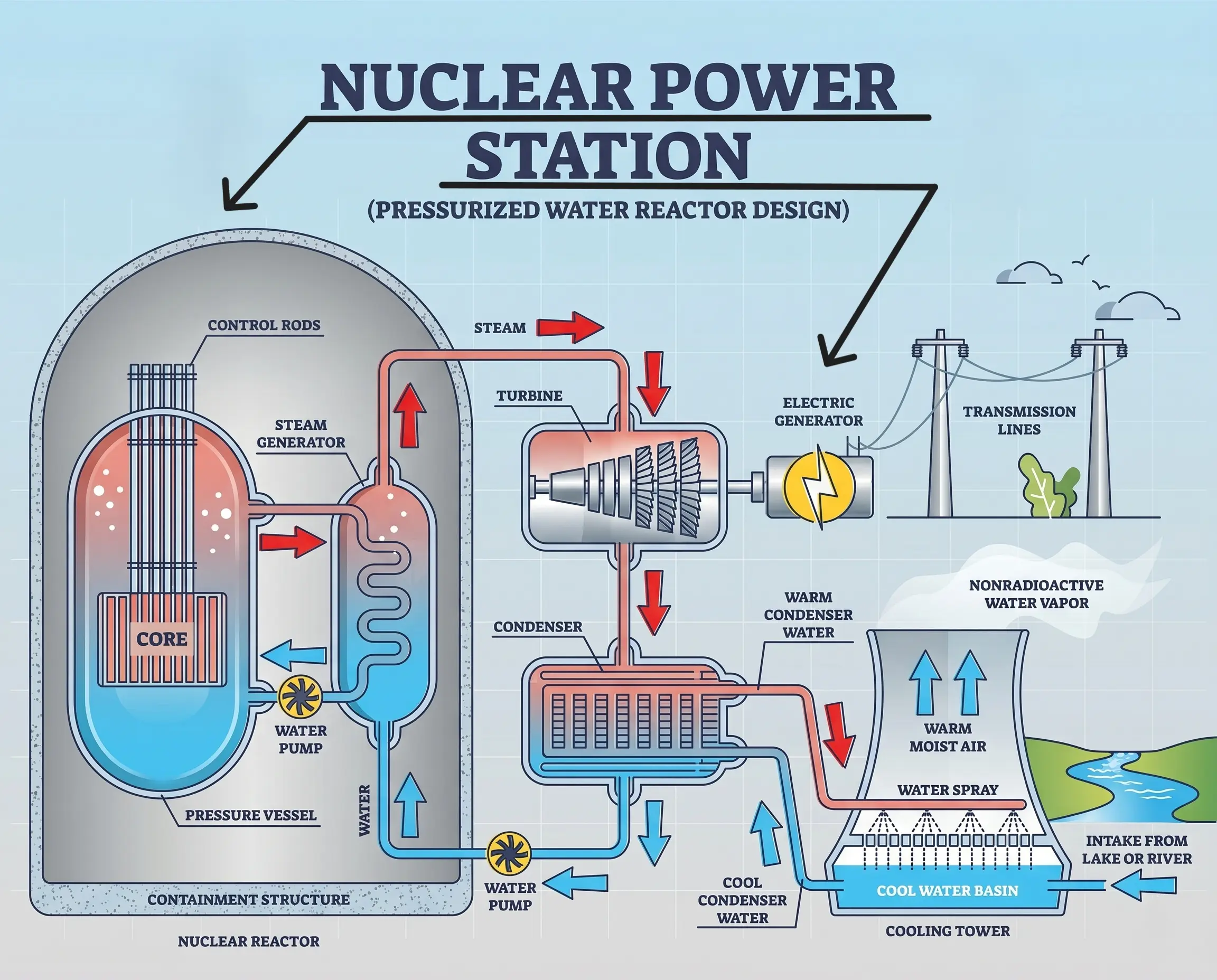
Nuclear energy is the energy stored inside an atom’s nucleus. In power plants, that energy is released through fission, which means splitting heavy atoms such as uranium into smaller parts. That splitting releases heat, which is used to make steam. The steam spins a turbine, the turbine turns a generator, and electricity is produced. That basic idea is simple, but the engineering behind it is highly advanced.
A nuclear power plant does not work like a giant explosion. It works like a tightly controlled heat machine. The reactor keeps the fission chain reaction stable, the cooling system carries away heat, and multiple safety systems stand ready to respond if anything changes. In other words, the magic is not in chaos. The magic is in control.
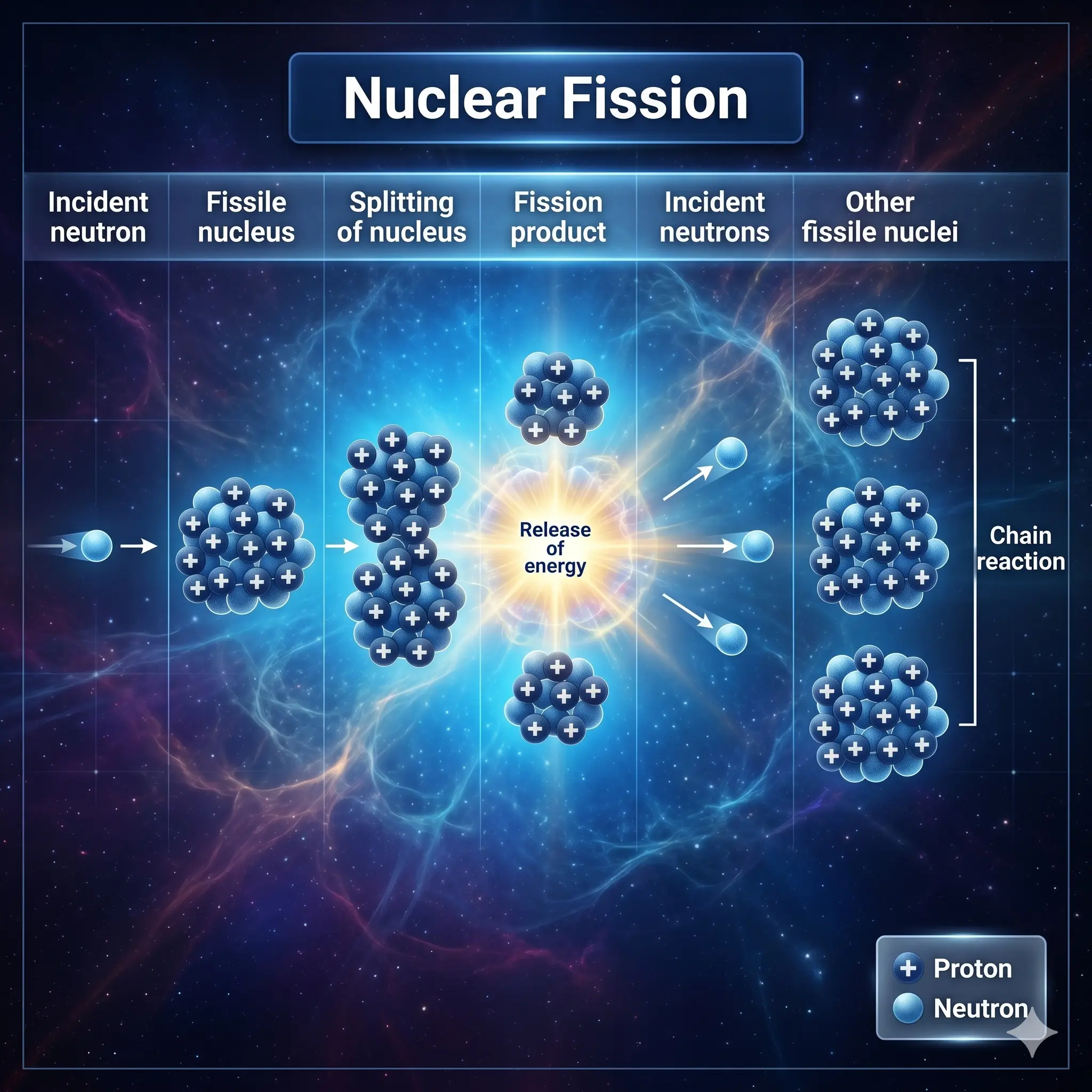
It also helps to understand what nuclear energy is not. It is not the same as coal, oil, or gas, which release energy by burning carbon-based fuels. Nuclear energy comes from changes in the atom itself, which is why such a tiny amount of nuclear fuel can produce so much heat. That is one of the biggest reasons nuclear power has such a strong role in modern energy discussions.
How a Nuclear Power Plant Works
The core of a nuclear plant is the reactor core. Inside the core are fuel assemblies made of uranium fuel, usually shaped into ceramic pellets and sealed in metal tubes. When atoms in the fuel split, they release heat. That heat is carried away by a coolant, usually water, and then used to make steam. The steam drives a turbine, and the turbine drives a generator. After that, the steam is cooled back into water and sent through the system again.
One of the most common reactor families is the light water reactor. The IAEA says light water reactors are the most common water-cooled reactors worldwide and come mainly in two types, pressurized water reactors and boiling water reactors. In a pressurized water reactor, the water in the core is kept under high pressure so it does not boil inside the reactor. In a boiling water reactor, the water does boil inside the reactor vessel, and the steam goes directly to the turbine.
The important thing is that both designs are built around the same basic idea, which is to turn nuclear heat into moving steam and then convert that movement into electricity. That is why nuclear energy is often described as a heat source first and an electricity source second.
Main Parts of a Nuclear Power Plant
| Part | What it does | Why it matters |
|---|---|---|
| Reactor core | Holds the fuel where fission happens | It is the main heat source of the plant. |
| Nuclear fuel | Provides the atoms that split and release heat | It is the energy source that drives the whole system. |
| Control rods | Absorb neutrons and slow the chain reaction | They help keep the reactor stable and safe. |
| Coolant | Carries heat away from the reactor core | It prevents overheating and transfers energy to the next stage. |
| Steam generator or direct steam path | Uses heat to produce steam | Steam is what turns the turbine. |
| Turbine | Spins when steam moves through it | It converts thermal energy into mechanical energy. |
| Generator | Turns motion into electricity | This is the final step in electricity production. |
| Condenser | Cools that steam back into water | It allows the cycle to continue efficiently. |
| Containment structure | Adds a strong protective barrier around the reactor | It is a major safety feature of the plant. |
Why Nuclear Energy Still Matters in the Modern World
The best way to understand nuclear energy is to look at the bigger picture. The world is using more electricity because of urban growth, industry, digital infrastructure, air conditioning, electric vehicles, and AI-driven data centers. At the same time, countries are trying to cut emissions and reduce dependence on imported fuels. Nuclear energy fits into that tension because it can provide large amounts of power with very low operating emissions.
Another reason it matters is energy security. Nuclear plants can run for long periods and are not affected by weather in the same way as solar and wind are. That does not make them a replacement for renewables. It makes them a partner to renewables, especially in systems that need stable electricity day and night. The IEA specifically notes that nuclear can complement renewables while contributing to electricity security as a dispatchable source.
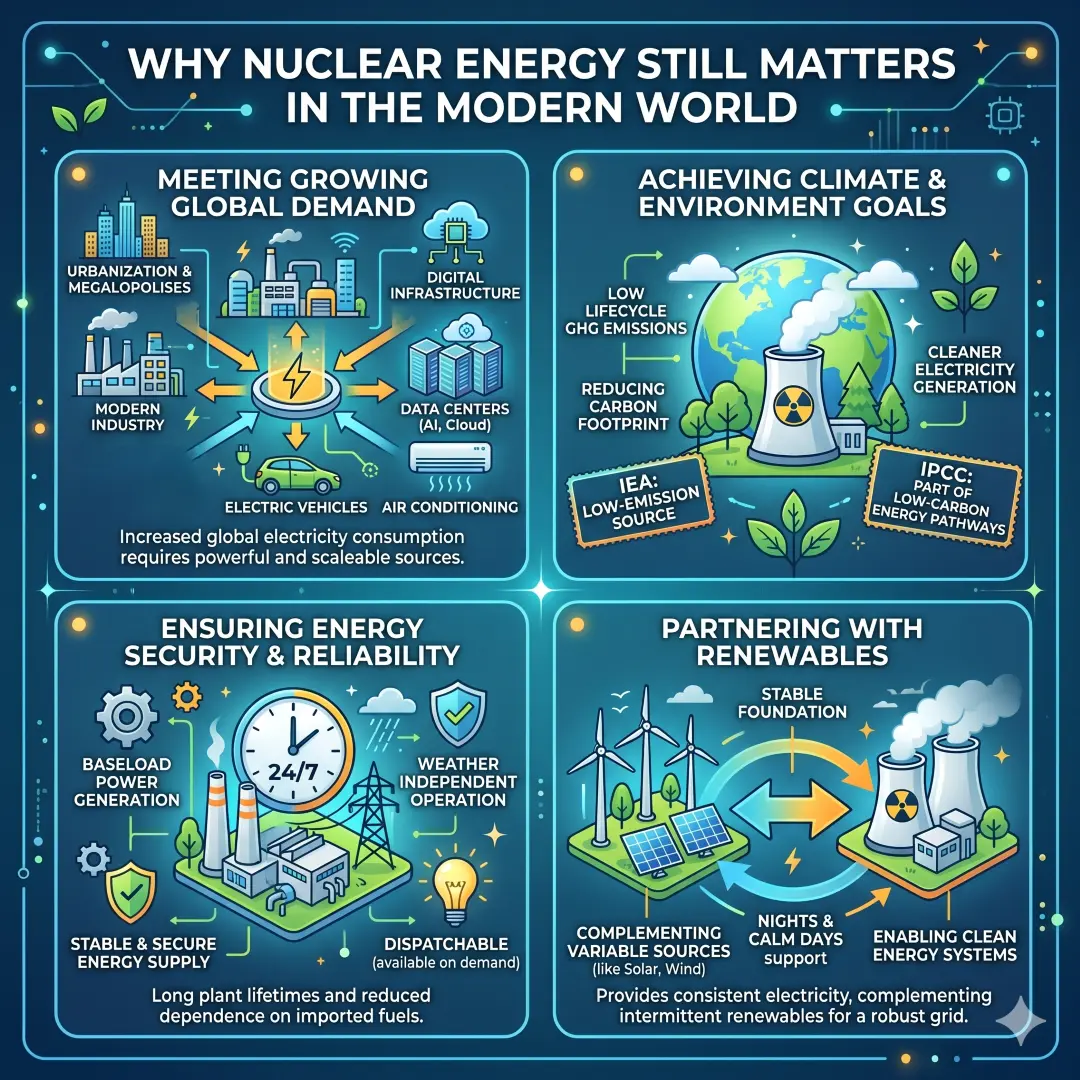
There is also the climate side. The IPCC describes nuclear power as having low lifecycle greenhouse gas emissions, and the IEA calls it a low-emission source of electricity. That is why nuclear is often included in serious low-carbon energy pathways. It is not the only solution, but in many places it is a powerful part of the solution.
Current Global Snapshot of Nuclear Energy
| Indicator | Latest available figure | What it tells us |
|---|---|---|
| Operating nuclear capacity | 377 GW(e) at the end of 2024 | The global fleet remains very large. |
| Operating reactors | 417 reactors at the end of 2024 | Nuclear remains a major part of the power mix. |
| Member States with operating reactors | 31 | Nuclear is geographically concentrated but globally important. |
| Electricity generated in 2024 | About 2617.3 TWh | Output remained extremely high. |
| Share of global electricity | About 9% in 2024 | Nuclear is still a meaningful global electricity source. |
| Operating experience | About 20,200 reactor-years at 653 reactors by end-2024 | The industry has decades of operating history. |
| Outlook | A new record is expected in 2025 | The sector is moving into another growth phase. |
The numbers tell a very clear story. Nuclear energy is not a niche idea. It is an established global industry with a long operating history, a large installed base, and renewed policy interest in several regions.
The Biggest Advantages of Nuclear Energy
Nuclear energy has several strengths that explain why governments, utilities, and industries keep returning to it.
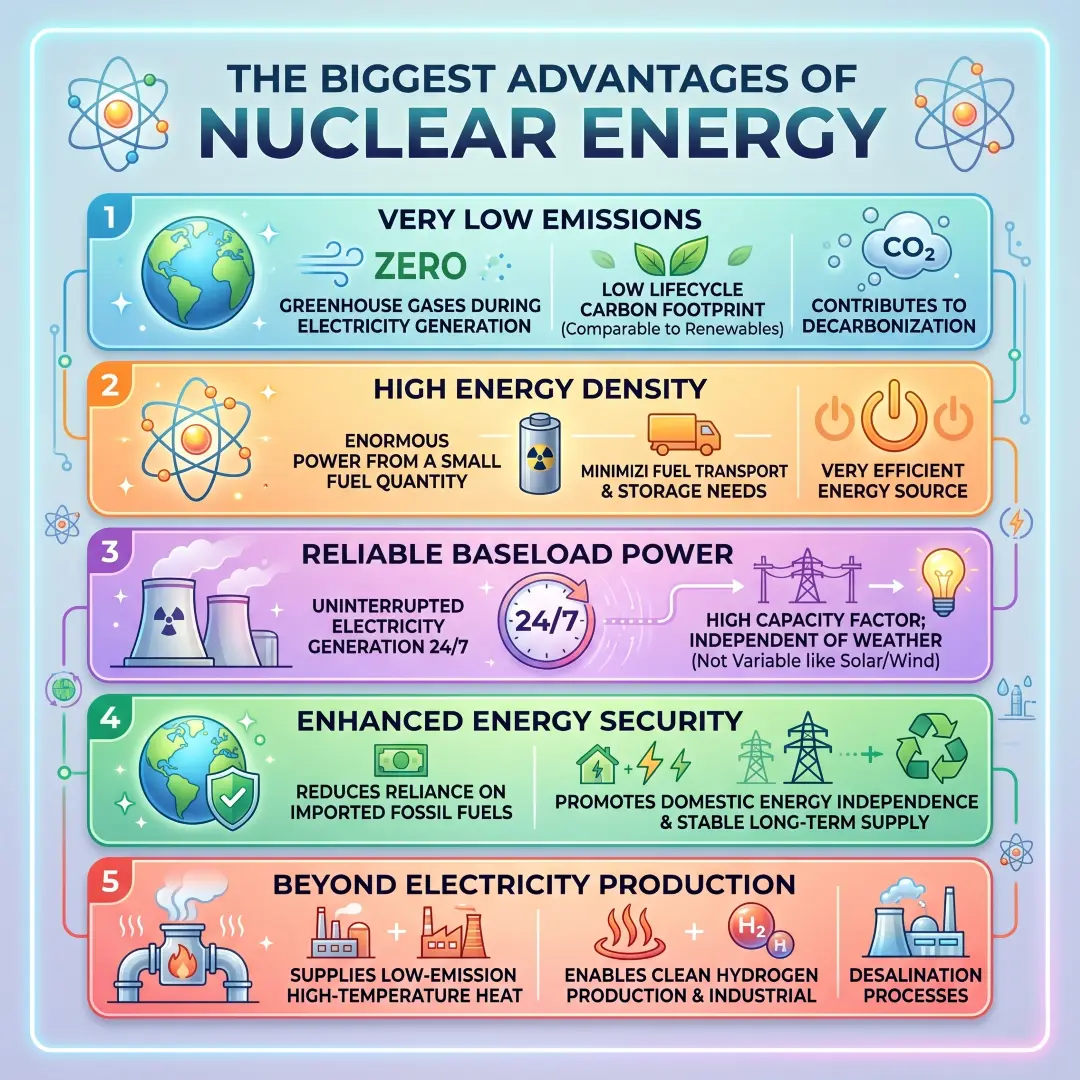
- Very low operational emissions. Nuclear plants do not emit greenhouse gases while generating electricity, which makes them attractive in low-carbon power systems.
- Large output from a small amount of fuel. Because fission releases so much energy, nuclear fuel is incredibly energy dense. That helps reduce fuel transport and storage needs.
- Reliable baseload power. Nuclear plants can run continuously for long periods and are not dependent on sunlight or wind.
- Support for energy security. Domestic nuclear generation can reduce reliance on imported fossil fuels.
- Useful for more than electricity. Nuclear energy can also support low-emission heat and hydrogen production.
There is a practical point here that often gets missed. Energy systems are not just about how clean a source is. They are also about how well that source works in the real world. Nuclear energy is valuable because it can deliver big, steady power when people need it.
Common Criticisms and Real Challenges
Nuclear energy is not a perfect solution. It comes with real challenges, and those challenges deserve honest treatment.
One major issue is cost. Large nuclear plants often require huge upfront investment, long construction timelines, and careful financing. The IEA says costs, project overruns, and financing remain major barriers even as momentum grows.
Another issue is public trust. People remember accidents, even when those events are rare. That memory shapes politics, regulation, and social acceptance. Nuclear power has decades of operating experience, but public fear can still slow projects or lead to phaseouts.
There is also the issue of radioactive waste. It is often discussed simplistically, but the real story is more technical. Waste must be managed safely for long periods, and the IAEA says disposal is the final step, involving facilities designed for containment and isolation over long time frames.
Here is the honest version. Nuclear energy is not “easy.” It is a high-capability energy system that demands strong institutions, skilled people, careful regulation, and public confidence. When those pieces are weak, the project becomes difficult. When those pieces are strong, nuclear can be a serious part of a clean energy mix.
Safety, Regulation, and Why Nuclear Plants Are So Heavily Controlled
Safety is one of the first things people think about when they hear nuclear energy. That is understandable. Nuclear plants use radioactive materials, and that means mistakes can have serious consequences. Because of that, the industry is built around layers of protection, independent oversight, and strict operating rules.
The IAEA’s reactor database is widely regarded as a highly authoritative source for reactor data, and its annual reports describe the reactor fleet, operating history, and performance data using information collected from national correspondents and data providers. That matters because nuclear safety is not based on casual estimates. It is based on constant monitoring, reporting, and review.
Another useful fact is that the industry has accumulated roughly 20,200 reactor-years of operating experience by the end of 2024. That does not erase the seriousness of nuclear risks, but it does show that the global fleet has been operating for a very long time. Experience does not guarantee perfection. It does improve learning.
A well-run nuclear system depends on several layers working together:
- Prevention, so problems are less likely in the first place.
- Protection, so faults do not spread easily.
- Containment, so any radioactive material stays inside controlled barriers.
- Emergency planning, so people know what to do if something unexpected happens.
That layered approach is one reason nuclear energy has such a distinct place in the energy world. It is not just about generating power. It is about managing risk at every step.
Radioactive Waste and Spent Fuel, Explained Simply
This topic is often surrounded by confusion, so it helps to keep the language plain. When a reactor has been used, some material becomes spent fuel, and some supporting materials become radioactive waste. These materials do not vanish, and they must be handled carefully.
The IAEA says the operation and decommissioning of nuclear facilities generate radioactive waste, and that waste must be managed in ways that keep people and the environment safe over long periods of time. The final disposal step is built around engineered and natural barriers designed for containment and isolation.
That is a very different idea from simply “throwing waste away.” Nuclear waste management is really about classification, storage, transport, monitoring, and ultimately disposal in carefully designed facilities. For some kinds of waste, storage is temporary. For others, long-term isolation is the goal.
A useful way to think about it is this. If nuclear energy is a powerful machine, then waste management is the maintenance system that keeps the machine honest. It is not a side issue. It is part of the deal from the beginning.
A Simple Comparison of Nuclear Energy With Other Power Sources
| Feature | Nuclear energy | Coal and gas | Solar and wind |
|---|---|---|---|
| Carbon emissions during operation | Very low, and no greenhouse gases while generating electricity. | High, because they burn fuel. | Very low during operation. |
| Availability | Steady, day and night. | Steady if fuel is available, but emissions are high. | Depends on the weather and daylight. |
| Fuel needs | Very small amounts of fuel can produce a large output. | Large ongoing fuel supply needed. | No fuel in the usual sense, but it needs materials and land. |
| Upfront cost | Usually high. | Can be lower to build, but fuel and emissions costs are high. | Often lower and falling, though grid integration matters. |
| Grid role | Good for stable, high-output electricity and complementing renewables. | Reliable but carbon-heavy. | Excellent for clean growth, but needs storage and flexibility. |
| Typical challenge | Long projects, financing, waste, and public acceptance. | Pollution, fuel price swings, and climate damage. | Variability, storage, land use, transmission. |
This table is not about choosing one source as the winner. It is about understanding trade-offs. Every power source has strengths and weaknesses. The best energy systems usually mix several sources rather than relying on a single one.
The Role of Nuclear Energy in Climate Strategy
A serious climate plan needs more than good intentions. It needs power sources that are clean, reliable, and scalable. That is where nuclear energy becomes important. The IEA has said nuclear can play a significant role in net-zero pathways, and the IPCC recognizes nuclear as a low-emissions source that can help reduce greenhouse gas output.
One reason this matters is that electricity demand keeps rising. Another is that many countries still depend heavily on fossil fuels. Nuclear power can help cut emissions while keeping the lights on. That combination is difficult to achieve, which is why nuclear remains part of climate and energy debates in so many countries.
It also matters that the energy transition is not happening in a vacuum. Countries need industrial heat, grid stability, and enough power for growing digital economies. Nuclear energy is one of the few tools that can support all of those needs at scale.
Small Modular Reactors and the Next Chapter
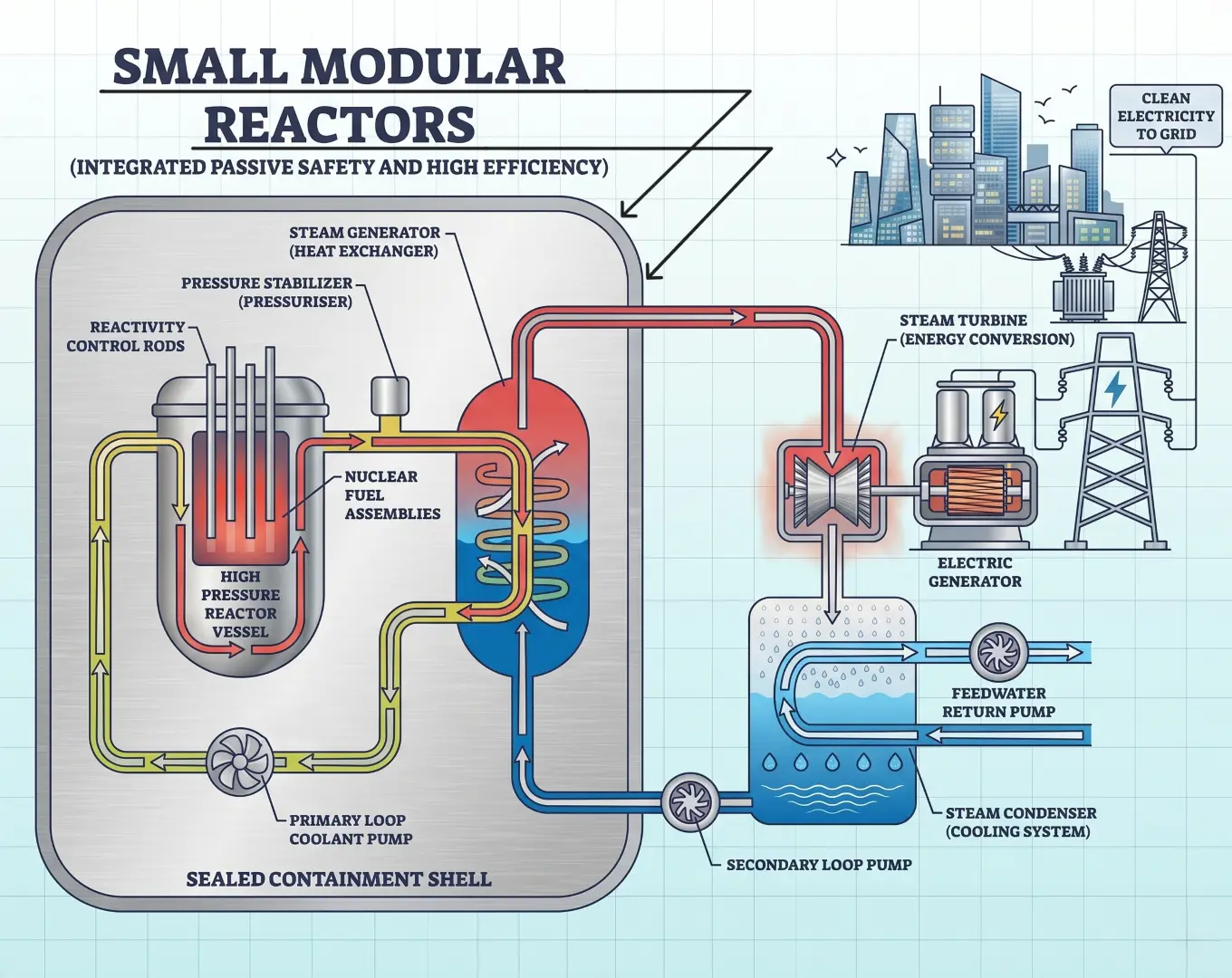
A lot of future talk around nuclear energy now focuses on small modular reactors, often called SMRs. The IAEA says SMRs are an option for flexible power generation and a wider range of users and applications. They can support hybrid systems, work with renewables, and in some cases offer better upfront affordability than traditional large plants.
The appeal is easy to understand. A smaller reactor can be easier to site, easier to finance in stages, and potentially faster to deploy than a giant plant that takes many years and huge capital. SMRs may also be useful for industrial sites, remote regions, and non-electric applications like heat or hydrogen.
But the keyword is potential. These reactors are promising, yet wide commercial deployment is still developing. They are not a magic fix. They are a new design path that could make nuclear energy more flexible and more accessible over time.
Where Nuclear Energy Is Growing and Where It Is Slowing
Different countries treat nuclear energy in very different ways. Some are expanding it. Some are extending the life of existing reactors. Some are phasing it out. And some are still deciding. This patchwork is one reason the global nuclear story is so interesting.
| Region or country pattern | What is happening | Why it matters |
|---|---|---|
| Asia | A large share of recent nuclear growth has come from Asia, especially China. (Reference Link: IAEA) | It shows where the center of new nuclear construction is moving. |
| France | Reactor output recovery has helped push global generation higher. (Reference Link: IEA) | Mature fleets can still be very important in global supply. |
| Japan | Restarts have supported the outlook for higher nuclear generation. (Reference Link: IEA) | Policy choices can change national energy mixes for years. |
| United States | It has the largest single-country reactor fleet with 94 operable reactors in the latest report. (Reference Link: World Nuclear Association) | Even without rapid new builds, a large existing fleet still matters enormously. |
| United Kingdom | The country is balancing aging reactors, new projects, and long-term energy planning. (Reference Link: World Nuclear Association) | It shows the challenge of replacing old capacity. |
| United Arab Emirates | The Barakah plant has become a major example of new nuclear deployment in a newcomer market. (Reference Link: World Nuclear Association) | It shows that nuclear can be adopted outside traditional nuclear countries. |
This diversity is important. Nuclear energy is not a one-size-fits-all technology. It is shaped by finance, regulation, politics, engineering culture, and public trust.
Examples of Real-World Uses Beyond Basic Electricity
Nuclear energy is often framed as just “electricity from a reactor,” but its reach can be broader.
- It can help power industrial heat for heavy industry.
- It can support hydrogen production, especially in low-emission systems.
- It can provide district heating in some settings, depending on plant design and policy.
- It can support electricity systems that need steady output alongside variable renewables.
These use cases matter because the energy transition is broader than power generation alone. Heat, fuels, and industry are all part of the picture, and nuclear can contribute in more than one lane.
What People Often Get Wrong About Nuclear Energy
There are a few misunderstandings that show up again and again.
First, people sometimes think nuclear power is the same as nuclear weapons. It is not. Civil nuclear energy is about controlled fission for peaceful purposes, under safety and safeguards systems. The IAEA was created partly to support peaceful uses and oversight, alongside safety and safeguards.
Second, people often imagine every reactor is identical. It is not. There are different reactor designs, different cooling systems, different fuel arrangements, and different safety features. The IAEA lists several reactor types, and light water reactors are the most common worldwide.
Third, people sometimes assume nuclear waste is a simple, impossible problem. It is difficult, yes. But there are established management and disposal approaches, and the industry works under strict long-term safety concepts.
And finally, people sometimes think nuclear energy is either a perfect hero or a complete villain. Real life is not that clean. Nuclear energy is a serious engineering system with real strengths and real risks. The useful conversation is not about slogans. It is about evidence.
The Future of Nuclear Energy
The future of nuclear energy will probably not look exactly like its past. That is already visible in the current data. The IEA says nuclear generation is set to hit a new record in 2025, and the agency expects continued growth through the following years as maintenance completes, restarts continue, and new reactors come online in multiple markets.
The sector still has to solve big problems. Financing must improve. Projects need better delivery. Supply chains need resilience. Public trust needs careful rebuilding in some countries. None of that is trivial.
Even so, nuclear energy has a strong chance of staying important because the world needs more firm, low-emission power. Renewable energy is growing fast, but most serious decarbonization strategies still need a source that can keep running when the sun is down and the wind is calm. Nuclear can fill part of that role.
There is also a wider shift happening. More institutions are treating nuclear as a practical clean-energy option rather than a legacy technology. That does not mean all concerns are gone. It means the conversation has become more mature, more technical, and more focused on delivery.
A Practical Way to Think About Nuclear Energy
If you strip away the politics, nuclear energy can be understood in one straightforward way. It is a high-density, low-emission, dispatchable source of power that can support modern electricity systems, but only if countries are willing to invest in safety, regulation, financing, and public confidence. That is the trade.
That trade is why nuclear energy continues to attract both strong support and strong criticism. Supporters see clean, steady electricity and energy security. Critics see cost, waste, and risk. Both sides are reacting to real facts. The best answers usually come from honest comparisons, not loud certainty.
Final Thoughts
Nuclear energy is not a small topic. It is a central part of how the world thinks about clean electricity, grid reliability, industrial growth, and climate action. It has a long operating history, strong technical foundations, and a future that still looks important, even if the path ahead is uneven. Current international data show a global fleet of 417 reactors at the end of 2024, generating about 2617.3 TWh and supplying about 9% of the world’s electricity, while new analysis suggests the sector is heading into another period of growth.
The clearest way to describe nuclear power is this. It is a difficult technology, but a remarkably useful one. It is not the only answer to the energy challenge, but it is one of the few tools that can deliver large amounts of steady, low-emission electricity on a scale that matters. And in a world that needs more power, not less, that makes nuclear energy worth understanding carefully.
Article References and Sources
- International Energy Agency Nuclear Power Overview
- IEA New Era for Nuclear Energy Report
- IEA The Path to a New Era for Nuclear Energy
- IEA Nuclear Power and Secure Energy Transitions
- IAEA Power Reactor Information System PRIS
- IAEA Nuclear Power Reactors in the World PDF
- IAEA Global Trends in Nuclear Power
- IAEA Water Cooled Reactors Guide
- IAEA Small Modular Reactors Information
- IAEA Advances in Small Modular Reactors 2024
- IAEA Radioactive Waste and Spent Fuel Management
- IAEA Disposal of Radioactive Waste Information
- US DOE Nuclear Reactor Working Guide
- US DOE Fast Facts About Nuclear Energy
- EIA Types of Nuclear Power Reactors
- World Nuclear Association Performance Report
Also, Read these Articles in Detail
- Physics and Its Fundamentals With Good Explanations
- Matter, Motion, and Energy: The Core Ideas of Physics
- What Is Matter? The Physical Substance of the Universe
- What Is Motion? A Guide to Motion in Physics and Daily Life
- What Is Energy? The Invisible Power Behind Everyday Life
- Kinetic Energy Explained in Simple Language
- Potential Energy: Definition, Types, Formula, and Examples
- Thermal Energy: Heat, Temperature, and Transfer
- Mechanical Energy: Definition, Formula, and Examples
- Chemical Energy: Definition, Science, and Examples
- Electrical Energy: Definition, Works, and Why It Matters
- Radiant Energy: Meaning, Sources, Examples, and Uses
Frequently Asked Questions
FAQ 1: What is nuclear energy, and how does it actually produce electricity?
Nuclear energy is the energy released from the nucleus of an atom. In power plants, this energy is usually produced through nuclear fission, which means splitting heavy atoms such as uranium into smaller atoms. When that split happens, it releases a huge amount of heat. That heat is the real starting point of nuclear electricity.
The process sounds complex, but the idea is quite simple. Inside a nuclear reactor, fuel rods hold material that can undergo fission. When the atoms split, they release heat and more neutrons. Those neutrons go on to split other atoms, and that creates a controlled chain reaction. The reactor is designed so this reaction stays steady, not wild.
That heat is used to warm water. The water turns into steam, the steam spins a turbine, and the turbine powers a generator. The generator then produces electricity for homes, factories, hospitals, trains, and other users. So even though the fuel source is highly advanced, the final part of the process is familiar. It is just heat turning water into steam, and steam turning motion into electricity.
One of the reasons nuclear energy stands out is its energy density. A very small amount of nuclear fuel can create a very large amount of power. That makes it different from coal, oil, or gas, which need to be burned in much larger quantities. It also means nuclear plants can produce huge electricity output without constant fuel deliveries.
Another important point is that nuclear power is not the same as nuclear weapons. Civil nuclear energy is built around controlled reactions for peaceful electricity generation. It is carefully regulated, watched, and designed with multiple safety systems. That control is a big part of what makes nuclear energy useful and trusted in many countries.
So, in simple terms, nuclear energy is a way of turning the invisible energy inside atoms into reliable electricity. It is a highly engineered process, but the basic logic is easy to follow once you break it down.
FAQ 2: Why do many experts say nuclear energy is important for the future of electricity?
Nuclear energy matters because the world needs more clean, steady, and large-scale electricity. That need is growing every year. Cities are expanding. Industries are using more power. Data centers are growing fast. Electric vehicles are putting new pressure on grids. And many countries want to reduce greenhouse gas emissions without risking blackouts or unstable supply.
This is where nuclear power becomes very valuable. It can produce electricity all day and all night, regardless of the weather. That is a major advantage over sources like solar and wind, which are excellent clean energy options but depend on sunlight and wind conditions. Nuclear energy can work alongside them and help balance the whole system.
Another reason it matters is energy security. Countries that rely too much on imported fossil fuels can become vulnerable to price shocks, supply disruptions, and political pressure. Nuclear power can reduce that dependence because a small amount of fuel produces a lot of energy, and fuel can often be stored for long periods.
Nuclear energy also has a strong role in decarbonization. It produces electricity with very low operational emissions. That makes it useful in climate strategies, especially where governments want to cut pollution while still keeping power grids stable.
There is also a practical issue. A lot of energy planning is not about one perfect source. It is about building a system that can survive real life. Wind and solar are growing, which is good. But grids still need stable backup, firm capacity, and sources that can run for long periods. Nuclear energy can provide that support.
So when experts talk about the future of electricity, nuclear energy keeps coming up because it solves more than one problem at once. It helps with carbon reduction, reliability, and long-term supply. That combination is hard to find, and that is why nuclear remains important.
FAQ 3: Is nuclear energy really clean, and what does low-emission mean in practical terms?
Yes, nuclear energy is widely considered a low-emission source of electricity. That means it does not release carbon dioxide while generating power the way coal, oil, and gas do. This is one of the biggest reasons it is part of many climate and energy plans.
When people say nuclear is clean, they usually mean it produces very little greenhouse gas pollution during operation. That is true. But the full picture is a little broader. Nuclear plants still need mining, construction, fuel processing, maintenance, and decommissioning. Those steps do involve energy use and emissions. Even so, the overall lifecycle emissions are generally low compared with fossil fuels.
That is why nuclear energy sits in a special place in the clean energy conversation. It is not clean in the sense of being completely impact-free. No major energy source is. But it is clean in the sense that it can provide very large amounts of electricity without the high emissions that come from burning fossil fuels.
This matters in practical terms. A power grid with more nuclear energy can reduce total carbon output without sacrificing reliability. That is especially useful in countries where electricity demand is rising fast, and the climate target is serious.
There is also another layer to this. Clean energy is not only about emissions. It is also about system stability, land use, and long-term dependability. Nuclear power uses a relatively small amount of land compared with many other large-scale energy systems, and it can produce power continuously for long periods.
So yes, nuclear energy is clean in an important sense. It is not perfect, but it is one of the strongest low-emission tools available for large electricity systems. That is why it keeps showing up in serious climate discussions.
FAQ 4: What are the biggest advantages of nuclear energy compared with other power sources?
The biggest advantage of nuclear energy is that it gives you very large amounts of reliable electricity from a small amount of fuel. That sounds simple, but it changes everything. It means nuclear plants can generate enormous power without needing frequent fuel deliveries or huge fuel storage.
Another major advantage is reliability. Nuclear plants are not dependent on daylight or weather. They can run continuously for long periods, which is a big deal in modern electricity systems. When people need power, they usually need it now, not only when the wind is blowing or the sun is shining.
A third advantage is low operational emissions. This makes nuclear energy useful for countries trying to reduce carbon pollution while keeping their grids stable. In many climate plans, that is exactly the kind of balance people are looking for.
Nuclear power also improves energy security. Countries can store fuel in advance, and because fuel use is relatively small, they are less exposed to constant shipment problems and international fuel price shocks. That can make a national power system more resilient.
There is also the issue of high output. A single plant can provide a lot of electricity from one site, which is useful where land is limited or where the grid needs a major, steady source.
In addition, nuclear energy can support more than electricity. It can also contribute to industrial heat and hydrogen production, depending on the system design. That gives it a broader role in future energy planning.
So the main strengths are clear. Nuclear energy is reliable, powerful, low-emission, and energy-dense. That does not make it the answer to every problem, but it does make it a very important part of the conversation.
FAQ 5: What are the main concerns people have about nuclear energy?
The biggest concerns about nuclear energy usually fall into four areas: cost, waste, safety, and public trust.
Cost is a major issue because nuclear plants are expensive to build. They often need large upfront investment, and construction can take many years. If a project goes over budget or gets delayed, the financial burden can become very heavy. That is one reason some countries hesitate to start new plants.
Waste is another concern. Used nuclear fuel and other radioactive materials must be managed carefully for long periods. People often worry about where the waste will go, who will guard it, and how safe it will remain over time. These are fair questions. Nuclear waste is not something to ignore or downplay.
Safety is the most emotional issue for many people. Accidents are rare, but when they happen, the consequences can be severe. That is why nuclear plants have many safety systems, strict rules, and heavy oversight. Still, public memory of past accidents continues to shape opinion.
Public trust matters because nuclear energy depends on confidence. Even a technically strong project can struggle if the public does not believe the operators or regulators. This is why communication, transparency, and regulation are so important.
There are also concerns around decommissioning, which is the process of shutting down and dismantling old plants safely. That process takes time, planning, and money.
So the concerns are real. Nuclear energy is not a casual technology. It is powerful, but that power comes with responsibility. A good nuclear program has to earn trust every step of the way.
FAQ 6: How safe is nuclear energy, and what makes a nuclear power plant secure?
Nuclear energy is designed around layers of safety. That is one of the most important things to understand. A nuclear power plant is not built with one single protection system. It is built with many overlapping systems so that if one part fails, another can step in.
The reactor core is enclosed inside strong structures that help contain radioactive material. There are also control rods that can slow down or stop the chain reaction. Cooling systems remove heat from the reactor so temperatures stay under control. And emergency systems are prepared to respond if something unusual happens.
Modern nuclear safety is based on the idea of defense in depth. That means several barriers stand between the radioactive material and the environment. The goal is to prevent problems from turning into serious incidents.
Plant operators are also trained very carefully. They follow procedures, track equipment constantly, and work under strict regulatory rules. Independent regulators inspect plants and set standards that must be met.
Another key point is that nuclear power plants are usually monitored much more closely than many other industrial facilities. That is because the material involved requires it. This constant oversight helps reduce risk.
Of course, no energy source is zero risk. But nuclear power is not a free-for-all. It is one of the most tightly controlled technologies in the energy sector. Its safety depends on design, training, maintenance, regulation, and discipline. When all of those are strong, nuclear plants can operate safely for long periods.
So the answer is this. Nuclear energy is safe when it is properly designed, properly operated, and properly regulated. The safety systems are not an afterthought. They are built into the entire system from the start.
FAQ 7: What happens to nuclear waste, and why is it such a big topic?
Nuclear waste is a big topic because it remains radioactive and must be handled with care. The waste does not disappear after use. Some materials need short-term storage, while others require long-term isolation.
The most common public concern is about spent fuel, which is fuel that has already been used in a reactor. It still contains radioactive material and heat, so it cannot simply be thrown away. It must first be cooled and stored in safe facilities. Over time, some of it may be moved into other long-term management systems.
There are different categories of radioactive waste. Some are low-level and easier to manage. Others are more concentrated and require stricter handling. The important thing is that waste is classified, tracked, and managed according to its level of hazard.
The challenge is not just technical. It is also social and political. People want to know that waste will remain safe for many years, even across generations. That means storage and disposal plans must be extremely durable.
Modern waste management uses engineering, geology, monitoring, and long-term planning. The final disposal method for the most problematic waste usually involves carefully designed facilities that isolate the material from people and the environment.
This is why waste gets so much attention. It is one of the few parts of nuclear energy that cannot be rushed or treated casually. It needs planning that lasts much longer than a political cycle or a business quarter.
So yes, waste is a challenge. But it is also a managed challenge. The question is not whether it exists. The question is whether a country has the discipline and systems to manage it properly.
FAQ 8: What is the difference between a pressurized water reactor and a boiling water reactor?
The two most common reactor types are pressurized water reactors and boiling water reactors. Both are forms of light water reactors, and both use water to transfer heat. But the way they handle that water is different.
In a pressurized water reactor, the water in the reactor core is kept under very high pressure. That stops it from boiling inside the reactor. Instead, the hot water transfers heat to a separate water loop, which then makes steam. That steam spins the turbine.
In a boiling water reactor, the water is allowed to boil inside the reactor vessel. The steam created there goes directly to the turbine. That makes the design a bit different in structure and operation.
Both systems are proven and widely used. Neither one is automatically better in every situation. The choice depends on engineering preferences, historical development, regulation, and the needs of the country or company building the plant.
The basic purpose is the same in both cases. They take heat from fission and turn it into steam for electricity generation. The difference is mostly in how the water and steam are managed.
For readers who are not engineers, the easiest way to remember it is this. One design keeps the water under pressure and makes steam later. The other lets the water boil directly in the reactor. That is the simple version, and it is enough to understand the main distinction.
FAQ 9: What is the future of nuclear energy, especially with small modular reactors?
The future of nuclear energy looks more active than it did a few years ago. One of the biggest reasons is growing interest in small modular reactors, or SMRs.
SMRs are smaller than traditional large nuclear plants, and they are designed to be built in a more modular way. That can make construction easier, financing more flexible, and deployment more practical in some regions. They may also be useful for areas that cannot support very large plants.
Another reason people are excited about SMRs is that they could support hybrid energy systems. That means they could work alongside renewables, storage, and industrial users in different combinations. In some settings, SMRs may also help with district heating, industrial heat, or hydrogen production.
Still, it is important to stay realistic. SMRs are promising, but they are not a finished answer to every energy problem. Many designs are still moving through development, licensing, and commercial rollout. So the future is bright, but it is still being built.
Beyond SMRs, the broader future of nuclear energy depends on several things. Countries need better financing, faster project delivery, stronger supply chains, and more public confidence. If those pieces improve, nuclear could expand in a meaningful way.
The larger trend is clear. Many governments are again taking nuclear seriously as part of long-term clean energy planning. That does not mean every country will build more plants. It does mean nuclear is no longer being dismissed as easily as it once was.
So the future of nuclear energy is not about one single technology. It is about a wider shift toward reliable, low-emission power systems, with SMRs as one of the most interesting parts of that shift.
FAQ 10: How should people think about nuclear energy in a balanced and practical way?
The most balanced way to think about nuclear energy is to treat it as a powerful tool, not a miracle, and not a disaster. It has clear strengths, and it has real limits.
Its strengths are easy to name. It is low-emission, high-output, reliable, and useful for keeping electricity systems stable. It can help countries reduce dependence on fossil fuels. It can support climate goals. And it can run for long periods with a relatively small amount of fuel.
Its limits are also easy to name. It costs a lot to build. It takes time. It creates radioactive waste that must be carefully managed. And it requires strong institutions, skilled workers, public confidence, and stable regulation.
That means the real question is not whether nuclear energy is perfect. It is whether it is useful enough to justify the investment and responsibility. In many places, the answer is yes. In some places, the answer may be no. That depends on local conditions, energy demand, politics, budgets, and existing infrastructure.
A practical view also means comparing nuclear energy fairly with other sources. Coal and gas are easier in some ways, but they produce far more pollution. Solar and wind are excellent and necessary, but they need storage, grid upgrades, and backup support. Nuclear can sit in the middle and help make the whole system more stable.
So the smartest way to view nuclear energy is with clear eyes. It is not simple. It is not cheap. It is not risk-free. But it is a serious, proven, and highly capable energy source that still has a major role to play in the world’s electricity future.
