

Freedom is one of humanity’s greatest aspirations. Every person wants the liberty to think, speak, travel, work, and live with dignity without unnecessary interference. A democratic nation exists because its people enjoy these freedoms while respecting the rights of others.
The Constitution of India recognizes this principle by guaranteeing the Right to Freedom under Articles 19, 20, 21, and 22. These provisions form the backbone of Indian democracy. They protect individual liberty while allowing the government to maintain public order, national security, and social harmony.
Among all the Fundamental Rights, the Right to Freedom is perhaps the most frequently discussed because it directly affects everyday life. Whether someone posts opinions on social media, starts a business, travels to another state, attends a peaceful protest, or receives legal protection after an arrest, these constitutional provisions come into play.
The framers of the Constitution understood that political freedom alone was not enough. Citizens also needed personal freedom, legal protection, and safeguards against arbitrary government action. That’s why the Constitution carefully balances individual rights with the interests of society.
This detailed guide explains every aspect of Articles 19 to 22, including their meaning, clauses, restrictions, judicial interpretation, practical examples, landmark judgments, and their continuing importance in modern India.
Table of Contents
Understanding the Right to Freedom
The Right to Freedom guarantees that citizens and, in some cases, every person in India can enjoy personal liberty and protection under the law.
It covers four major constitutional provisions:
| Article | Subject | Who Benefits? |
|---|---|---|
| Article 19 | Six Fundamental Freedoms | Citizens only |
| Article 20 | Protection in Criminal Cases | Every person |
| Article 21 | Protection of Life and Personal Liberty | Every person |
| Article 22 | Protection Against Arbitrary Arrest and Detention | Every person with certain exceptions |
Together, these articles ensure that democracy is meaningful rather than merely symbolic.

Why the Right to Freedom Is So Important
Without freedom, democracy cannot survive.
These constitutional protections help people:
- Express opinions openly
- Question government policies
- Travel freely
- Choose occupations
- Start businesses
- Practice professions
- Protect themselves against illegal punishment
- Live with dignity
- Receive fair legal treatment
- Prevent misuse of state power
Every democratic institution depends upon these freedoms.
Historical Background
India experienced centuries of colonial rule where many freedoms were restricted.
During British rule:
- Newspapers faced censorship.
- Political meetings were often prohibited.
- Freedom fighters were imprisoned.
- Peaceful protests were suppressed.
- Preventive detention laws were widely used.
After independence, the makers of the Constitution wanted to ensure that such abuses would never become normal again.
Inspired by democratic constitutions around the world and India’s freedom struggle, they included strong protections under Articles 19 to 22.
Overview of Articles 19 to 22
| Article | Main Protection |
|---|---|
| 19(1)(a) | Freedom of Speech and Expression |
| 19(1)(b) | Peaceful Assembly |
| 19(1)(c) | Form Associations or Unions |
| 19(1)(d) | Move Freely Throughout India |
| 19(1)(e) | Reside Anywhere in India |
| 19(1)(g) | Profession, Occupation, Trade or Business |
| 20 | Criminal Law Protections |
| 21 | Life and Personal Liberty |
| 22 | Protection Against Arrest |
Article 19: Six Fundamental Freedoms
Article 19 applies only to Indian citizens.
Originally, it contained seven freedoms, but the Right to Property under Article 19(1)(f) was removed by the 44th Constitutional Amendment, 1978, and became a legal right under Article 300A.
Today, Article 19 guarantees six freedoms.
1. Freedom of Speech and Expression
Article 19(1)(a)
This freedom allows citizens to:
- Express opinions
- Write articles
- Publish books
- Speak publicly
- Create films
- Paint artworks
- Compose music
- Share ideas online
- Criticize government policies
- Participate in public debates
Expression includes more than spoken words.
It may involve:
- Books
- Newspapers
- Television
- Radio
- Cinema
- Theatre
- Paintings
- Photography
- Internet
- Blogs
- Podcasts
- Social media posts
Examples
- Writing a newspaper article
- Giving a public speech
- Publishing research
- Posting opinions online
- Creating educational videos
- Designing political cartoons

Reasonable Restrictions on Speech
Freedom of speech is not absolute.
The government may impose reasonable restrictions in the interests of:
| Ground | Meaning |
|---|---|
| Sovereignty and Integrity of India | Protecting national unity |
| Security of the State | Preventing threats to national security |
| Friendly Relations with Foreign States | Maintaining international relations |
| Public Order | Preventing riots and violence |
| Decency | Preventing obscene content |
| Morality | Protecting accepted moral standards |
| Contempt of Court | Maintaining judicial authority |
| Defamation | Protecting a person’s reputation |
| Incitement to an Offence | Preventing criminal acts |
These restrictions must be reasonable and proportionate.
Freedom of the Press
The Constitution does not specifically mention freedom of the press, but courts have consistently held that it forms part of Freedom of Speech and Expression.
A free press helps by:
- Informing citizens
- Investigating corruption
- Reporting public issues
- Supporting transparency
- Encouraging accountability

Freedom of Commercial Speech
Businesses may advertise products and services, provided advertisements do not violate laws relating to fraud, obscenity, or public welfare.
Commercial expression also enjoys constitutional protection within reasonable limits.
Right to Information
The Right to Information has been recognized as flowing from the broader concept of freedom of speech because informed citizens are better able to express opinions and participate in democracy.
Freedom of Artistic Expression
Artists enjoy constitutional protection while creating:
- Films
- Literature
- Music
- Sculpture
- Dance
- Theatre
- Paintings
- Digital content
However, artistic freedom remains subject to constitutional restrictions.
2. Freedom to Assemble Peacefully
Article 19(1)(b)
Citizens may gather peacefully and without weapons.
Peaceful assemblies include:
- Public meetings
- Demonstrations
- Cultural gatherings
- Academic seminars
- Political rallies
- Awareness campaigns
Conditions
The assembly must:
- Be peaceful
- Be unarmed
- Follow lawful regulations
Restrictions
Authorities may regulate assemblies for:
- Public order
- State security
- Protection of public safety
Permission requirements for large gatherings are generally intended to manage traffic, security, and public convenience rather than eliminate the right itself.
3. Freedom to Form Associations
Article 19(1)(c)
Citizens may create:
- Political parties
- Trade unions
- Cooperative societies
- Professional organizations
- Clubs
- Student groups
- NGOs
- Cultural organizations
This freedom strengthens democracy because citizens can collectively pursue common goals.
Reasonable Restrictions
Restrictions may be imposed to protect:
- National sovereignty
- Public order
- Morality
Organizations engaged in unlawful or violent activities do not receive constitutional protection.
4. Freedom of Movement
Article 19(1)(d)
Citizens may move freely throughout India.
This means they may travel between:
- States
- Union Territories
- Cities
- Villages
without needing special permission in ordinary circumstances.
Restrictions
Movement may be restricted for:
- Public interest
- Protection of Scheduled Tribes
- Environmental conservation
- Security concerns
- Disaster management
Some protected tribal areas require permits to preserve indigenous culture and fragile ecosystems.
5. Freedom to Reside Anywhere
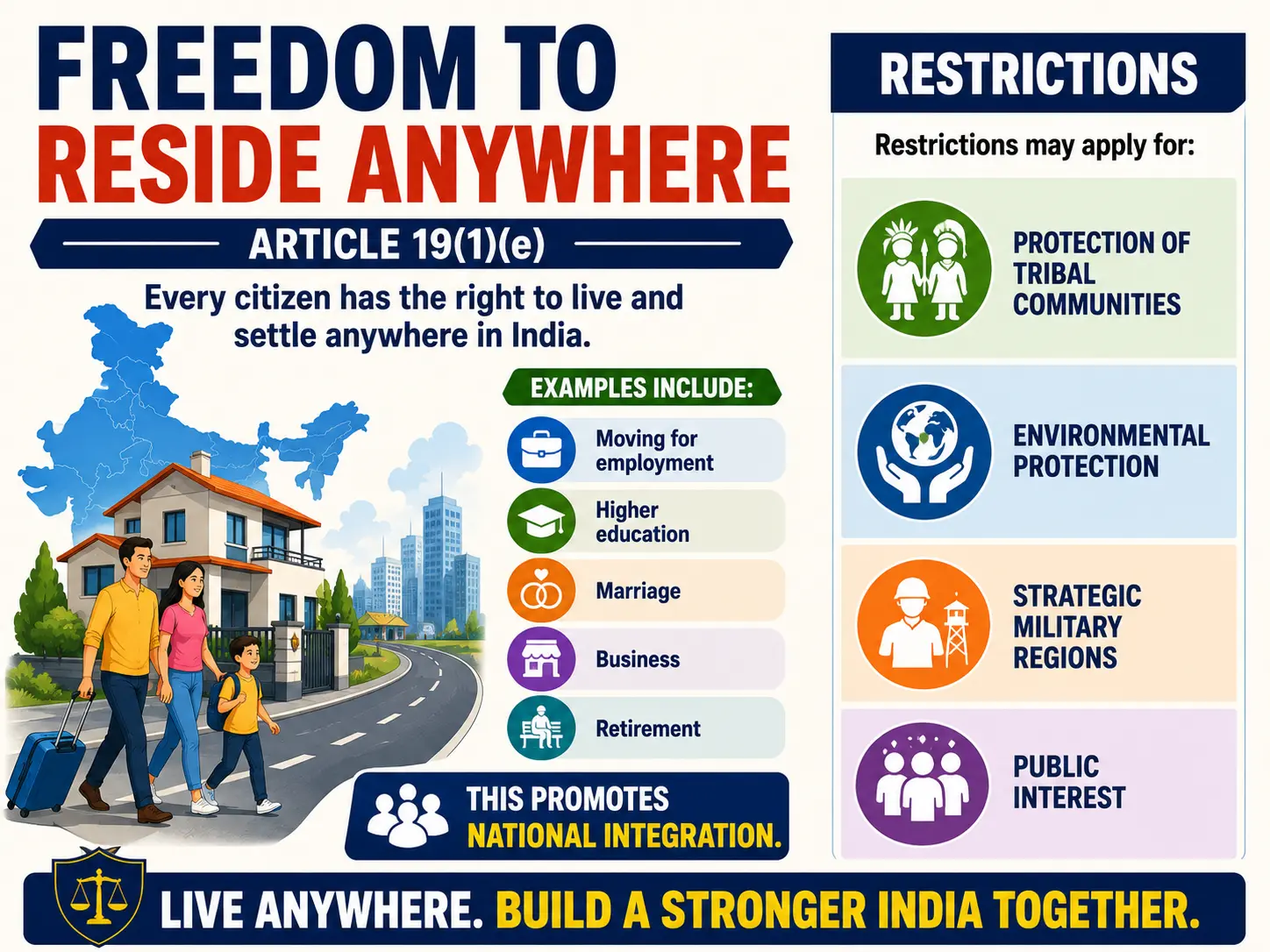
Article 19(1)(e)
Every citizen has the right to live and settle anywhere in India.
Examples include:
- Moving for employment
- Higher education
- Marriage
- Business
- Retirement
This promotes national integration.
Restrictions
Restrictions may apply for:
- Protection of tribal communities
- Environmental protection
- Strategic military regions
- Public interest
6. Freedom of Profession, Occupation, Trade and Business
Article 19(1)(g)
Every citizen may:
- Choose a profession
- Start a business
- Practice a trade
- Work independently
- Offer professional services
Examples include:
- Doctor
- Teacher
- Engineer
- Lawyer
- Farmer
- Shop owner
- Software developer
- Artist
- Consultant
- Entrepreneur
Reasonable Restrictions
The government may:
- Require professional qualifications
- Issue licenses
- Regulate industries
- Protect consumers
- Ensure workplace safety
- Control harmful businesses
For example:
Doctors require medical qualifications.
Lawyers require enrollment with professional authorities.
Restaurants must comply with health regulations.
Article 20: Protection in Respect of Conviction for Offences
Unlike Article 19, Article 20 protects every person, including foreign nationals.
It contains three important safeguards.

Protection Against Ex Post Facto Laws
Article 20(1)
No person can be punished under a law that did not exist when the act was committed.
Example:
If an action was legal in 2025, Parliament cannot later pass a law in 2026 and punish someone for that earlier action.
This protects legal certainty.
Protection Against Double Jeopardy
Article 20(2)
No person shall be prosecuted and punished twice for the same offence.
If someone has already been tried and punished by a competent court, they cannot face another punishment for the identical offence.
This principle prevents repeated harassment through multiple prosecutions.
Protection Against Self-Incrimination
Article 20(3)
No accused person can be compelled to become a witness against themselves.
This means:
- Forced confessions are prohibited.
- Coercion cannot be used to obtain admissions of guilt.
- Silence cannot automatically be treated as proof of guilt.
This safeguard supports fair criminal investigations.
Article 21: Protection of Life and Personal Liberty
Among all Fundamental Rights, Article 21 has received perhaps the broadest judicial interpretation.
It states:
No person shall be deprived of life or personal liberty except according to procedure established by law.
Initially interpreted narrowly, Article 21 has gradually evolved into a vast source of human rights.
Today it protects numerous rights necessary for living with dignity.
Meaning of Life
The word life means much more than physical survival.
It includes:
- Human dignity
- Mental well-being
- Privacy
- Clean environment
- Health
- Education
- Shelter
- Reputation
- Safe working conditions
- Livelihood
- Legal aid
- Fair procedure
Life means living as a human being with dignity rather than merely existing.
Meaning of Personal Liberty
Personal liberty includes freedom from arbitrary restraint.
It protects:
- Individual autonomy
- Personal choices
- Movement
- Privacy
- Bodily integrity
- Family life

Expansion of Article 21 Through Judicial Interpretation
Over the decades, courts have recognized several rights under Article 21.
These include:
- Right to Live with Dignity
- Right to Privacy
- Right to Education before the separate constitutional guarantee under Article 21A
- Right to Clean Environment
- Right to Health
- Right to Speedy Trial
- Right to Legal Aid
- Right to Livelihood
- Right Against Custodial Violence
- Right to Emergency Medical Care
- Right to Reputation
- Right to Sleep
- Right to Clean Drinking Water
- Right to Shelter
- Right to Fair Investigation
This makes Article 21 one of the most dynamic provisions of the Constitution.
Important Rights Recognized Under Article 21
Right to Privacy
Privacy protects personal information, family life, communication, and individual decision-making.
Examples include:
- Mobile phone data
- Personal correspondence
- Medical records
- Financial information
- Biometric information
Right to Health
Health includes:
- Medical treatment
- Emergency healthcare
- Public health measures
- Safe hospitals
Governments are expected to make reasonable efforts to provide healthcare facilities.
Right to Clean Environment
A healthy environment contributes directly to life.
This includes:
- Clean air
- Safe drinking water
- Pollution control
- Waste management
- Forest conservation
Right to Livelihood
Livelihood enables people to survive with dignity.
Unreasonable deprivation of employment may affect Article 21.
Right to Legal Aid
Poor individuals should receive legal assistance where justice requires it.
Equal access to justice strengthens democracy.
Right to Speedy Trial
Justice delayed may become justice denied.
Unnecessary delays in criminal proceedings may violate Article 21.

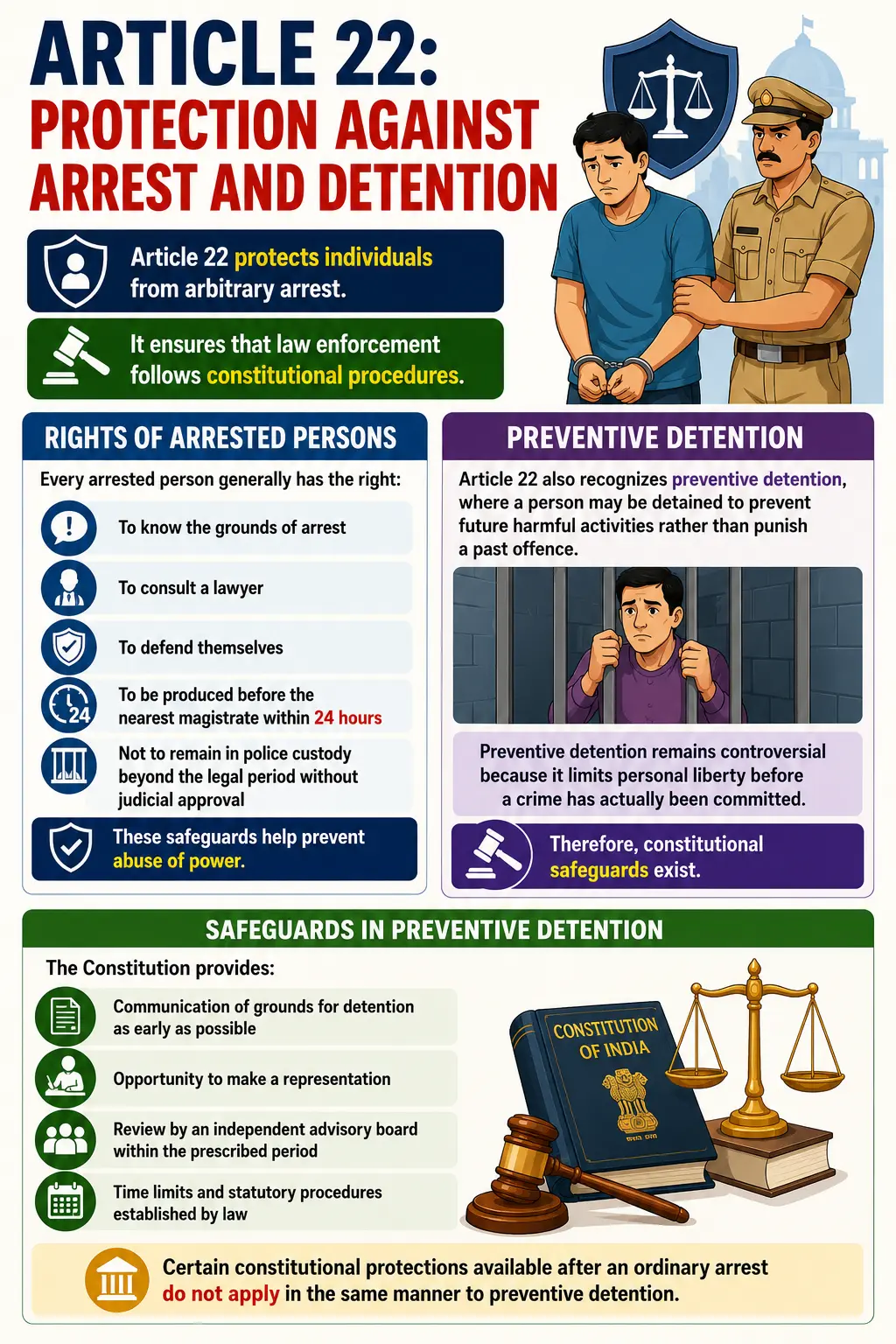
Article 22: Protection Against Arrest and Detention
Article 22 protects individuals from arbitrary arrest.
It ensures that law enforcement follows constitutional procedures.
Rights of Arrested Persons
Every arrested person generally has the right:
- To know the grounds of arrest
- To consult a lawyer
- To defend themselves
- To be produced before the nearest magistrate within 24 hours
- Not to remain in police custody beyond the legal period without judicial approval
These safeguards help prevent abuse of power.
Preventive Detention
Article 22 also recognizes preventive detention, where a person may be detained to prevent future harmful activities rather than punish a past offence.
Preventive detention remains controversial because it limits personal liberty before a crime has actually been committed.
Therefore, constitutional safeguards exist.
Safeguards in Preventive Detention
The Constitution provides:
- Communication of grounds for detention as early as possible
- Opportunity to make a representation
- Review by an independent advisory board within the prescribed period
- Time limits and statutory procedures established by law
Certain constitutional protections available after an ordinary arrest do not apply in the same manner to preventive detention.
Difference Between Punitive and Preventive Detention
| Feature | Punitive Detention | Preventive Detention |
|---|---|---|
| Purpose | Punishment | Prevention |
| Based On | Past offence | Anticipated harmful activity |
| Criminal Trial | Usually required | Not necessarily before detention |
| Evidence | Based on completed act | Based on preventive considerations |
| Objective | Punish offender | Protect public order or security |
Relationship Between Articles 19, 20, 21 and 22
These articles work together.
| Article | Focus |
|---|---|
| 19 | Everyday civil freedoms |
| 20 | Fair criminal justice |
| 21 | Life and dignity |
| 22 | Protection from arbitrary arrest |
Together they create a comprehensive framework for liberty.
Landmark Supreme Court Judgments
Maneka Gandhi v. Union of India (1978)
This landmark judgment transformed the interpretation of Article 21.
The Court held that any law restricting personal liberty must be fair, just, and reasonable, not arbitrary. It also emphasized that Articles 14, 19, and 21 are interconnected and must be interpreted together.
This decision greatly expanded the scope of personal liberty.
A.K. Gopalan v. State of Madras (1950)
One of the earliest constitutional cases, it initially adopted a narrow interpretation of Article 21 by treating each Fundamental Right separately. Later decisions, particularly Maneka Gandhi, moved away from this approach.
Kharak Singh v. State of Uttar Pradesh (1962)
The Court examined police surveillance and recognized that personal liberty extends beyond mere physical restraint, laying important groundwork for later privacy jurisprudence.
Justice K.S. Puttaswamy (Retd.) v. Union of India (2017)
A nine-judge Bench unanimously declared that the Right to Privacy is a Fundamental Right protected under Article 21 and related constitutional provisions. This judgment has had a profound impact on digital rights, data protection, and personal autonomy.
Hussainara Khatoon v. State of Bihar (1979)
The Court recognized the Right to Speedy Trial as an essential part of Article 21, highlighting the need to reduce prolonged detention of undertrial prisoners.
Olga Tellis v. Bombay Municipal Corporation (1985)
The Court held that the Right to Livelihood is closely connected with the Right to Life, emphasizing that depriving people of their means of livelihood can threaten their dignity and survival.
D.K. Basu v. State of West Bengal (1997)
This judgment laid down detailed guidelines to prevent custodial torture and abuse during arrest and detention. It reinforced accountability and strengthened the protection of personal liberty under Articles 21 and 22.
Everyday Examples of the Right to Freedom
| Situation | Relevant Article |
|---|---|
| Writing an opinion piece | Article 19(1)(a) |
| Holding a peaceful demonstration | Article 19(1)(b) |
| Forming a student association | Article 19(1)(c) |
| Traveling from Kerala to Punjab | Article 19(1)(d) |
| Relocating for employment | Article 19(1)(e) |
| Opening a small business | Article 19(1)(g) |
| Protection against retrospective punishment | Article 20(1) |
| Protection against repeated prosecution | Article 20(2) |
| Refusing forced self-incrimination | Article 20(3) |
| Receiving emergency medical treatment | Article 21 |
| Protection of personal privacy | Article 21 |
| Being informed about reasons for arrest | Article 22 |
Rights Available Only to Citizens and Rights Available to Every Person
| Provision | Citizens | Foreign Nationals |
|---|---|---|
| Article 19 | ✅ | ❌ |
| Article 20 | ✅ | ✅ |
| Article 21 | ✅ | ✅ |
| Article 22 | ✅ | ✅ (subject to constitutional and statutory exceptions) |
Reasonable Restrictions Under Article 19
Freedom is never unlimited.
If every person exercised rights without responsibility, society could face disorder, violence, and harm.
Reasonable restrictions ensure a balance between:
- Individual liberty
- National security
- Public peace
- Public health
- Morality
- Rights of other citizens
The courts examine whether such restrictions are lawful, proportionate, and connected to a legitimate objective.
Importance of Judicial Review
The Supreme Court of India and the High Courts play a vital role in protecting the Right to Freedom.
When citizens believe that their Fundamental Rights have been violated, they may approach the courts. Through judicial review, courts examine whether government actions comply with the Constitution. If a law or executive action is found to be unconstitutional, it can be struck down or limited.
This constitutional safeguard prevents arbitrary exercise of power and preserves the balance between the State and individual liberty.
Role of Citizens in Protecting Freedom
Constitutional rights work best when citizens also act responsibly.
Responsible exercise of freedom includes:
- Respecting the rights of others
- Following lawful regulations
- Avoiding violence and hate speech
- Participating peacefully in public affairs
- Supporting constitutional values
- Using legal remedies when rights are violated
Freedom and responsibility go hand in hand.
Challenges in the Modern Era
The meaning of freedom continues to evolve as society changes. New technologies and social developments have created fresh constitutional questions.
Some contemporary issues include:
- Digital privacy and protection of personal data
- Artificial intelligence and algorithmic decision-making
- Online misinformation and responsible speech
- Cybercrime and online security
- Freedom of expression on digital platforms
- Environmental protection as part of the Right to Life
- Public health emergencies and temporary restrictions on movement
- Balancing national security with civil liberties
Courts and lawmakers continue to interpret the Constitution to address these evolving challenges while preserving the core values of liberty and justice.
Key Differences Between Articles 19, 20, 21, and 22
| Feature | Article 19 | Article 20 | Article 21 | Article 22 |
|---|---|---|---|---|
| Nature | Civil freedoms | Criminal justice protections | Life and liberty | Arrest safeguards |
| Applies To | Citizens | Every person | Every person | Every person with specified exceptions |
| Main Objective | Individual freedom | Fair criminal process | Human dignity | Prevent arbitrary detention |
| Restrictions | Reasonable constitutional restrictions | Constitutional safeguards | Procedure established by law interpreted as fair, just, and reasonable | Constitutional and statutory procedures |
Key Points to Remember
- Articles 19 to 22 collectively form the Right to Freedom under the Constitution of India.
- Article 19 guarantees six essential freedoms to Indian citizens.
- Article 20 protects every person from unfair criminal punishment.
- Article 21 safeguards life, dignity, and personal liberty, and has expanded through judicial interpretation to include numerous derivative rights.
- Article 22 provides procedural safeguards against arbitrary arrest and detention.
- None of these freedoms are absolute. They may be subject to constitutionally valid and reasonable restrictions in the larger public interest.
- Judicial review remains one of the strongest mechanisms for enforcing these rights and maintaining constitutional governance.
Final Thoughts
The Right to Freedom is much more than a collection of legal provisions. It reflects the vision of a democratic republic where individuals can think independently, speak openly, pursue their aspirations, and live with dignity under the protection of the law.
Articles 19 to 22 ensure that freedom is meaningful in everyday life. They protect expression, movement, livelihood, fair treatment in criminal proceedings, personal liberty, and safeguards against arbitrary detention. At the same time, they recognize that liberty must coexist with public order, national security, and the rights of others.
Over the decades, constitutional interpretation has broadened these protections to meet the needs of a changing society. Rights such as privacy, a clean environment, legal aid, speedy trial, and human dignity now stand firmly within the constitutional promise of personal liberty.
For every citizen, student, legal professional, policymaker, and informed reader, understanding Articles 19 to 22 is essential because these provisions continue to shape the relationship between the individual and the State. They remain a powerful reminder that a strong democracy is built not only on elections and institutions, but also on the everyday freedoms that allow people to live, participate, and thrive with dignity.
Article Reference and Sources
The following authoritative references were used to prepare and verify the information presented in the article “Right to Freedom Under Articles 19 to 22 Explained.”
- Constitution of India (Legislative Department, Ministry of Law and Justice)
Official text of the Constitution of India, including Articles 19, 20, 21, and 22. - Constitution of India Documents (Legislative Department)
Official repository containing the latest Constitution documents and amendments. - Supreme Court of India Official Website
Official portal for judgments, constitutional matters, and judicial information. - Constitution Overview by the Supreme Court of India
Overview of the Constitution, Fundamental Rights, judicial review, and constitutional framework. - Supreme Court of India Judgment Search Portal
Official database for searching landmark constitutional judgments, including cases related to Articles 19 to 22.
These official references provide reliable information on:
- Part III of the Constitution (Fundamental Rights)
- Article 19 and its six freedoms
- Article 20 protections in criminal law
- Article 21 and the Right to Life and Personal Liberty
- Article 22 safeguards against arbitrary arrest and detention
- Judicial Review
- Landmark Supreme Court judgments, including:
- A.K. Gopalan v. State of Madras
- Maneka Gandhi v. Union of India
- Kharak Singh v. State of Uttar Pradesh
- Hussainara Khatoon v. State of Bihar
- Olga Tellis v. Bombay Municipal Corporation
- D.K. Basu v. State of West Bengal
- Justice K.S. Puttaswamy (Retd.) v. Union of India
Also, Read These Articles in Detail
- Fundamental Rights in India
- What Are Fundamental Rights Under the Indian Constitution?
- History of Fundamental Rights in India
- Why Fundamental Rights Are Important for Every Indian Citizen
- Understanding Part III of the Indian Constitution
- Who Can Claim Fundamental Rights in India?
- Legal Rights vs Fundamental Rights
- How Fundamental Rights Protect Individual Freedom in India
- Right to Equality Under Article 14
- Article 15: Protection Against Discrimination
- Article 16: Equality of Opportunity in Public Employment
- Article 17 and the Abolition of Untouchability in India
- Article 18: Abolition of Titles and Its Importance
Frequently Asked Questions
FAQ 1. What is the Right to Freedom under the Indian Constitution?
The Right to Freedom is one of the most important Fundamental Rights guaranteed by the Constitution of India. It is provided under Articles 19 to 22 and protects the liberty, dignity, and legal rights of individuals. These constitutional provisions ensure that people can express their opinions, move freely, choose their profession, live with dignity, and receive protection against arbitrary arrest and unfair criminal proceedings.
The makers of the Constitution believed that democracy cannot function unless citizens enjoy meaningful freedom. Voting alone isn’t enough. People must also have the freedom to speak, question authorities, form organizations, travel across the country, and earn a living according to their abilities and interests.
The Right to Freedom is divided into four major constitutional provisions:
- Article 19 guarantees six important freedoms to Indian citizens.
- Article 20 protects every person against unfair punishment in criminal cases.
- Article 21 protects the Right to Life and Personal Liberty.
- Article 22 provides safeguards against arbitrary arrest and detention.
One of the most remarkable features of these rights is that they protect ordinary activities that people perform every day. For example, writing an article, starting a business, attending a peaceful public meeting, choosing where to live, or defending oneself in a court of law all fall within the broad idea of constitutional freedom.
Over the years, courts have expanded these rights through important judgments. Today, the Right to Freedom also includes protections such as the Right to Privacy, Right to Live with Dignity, Right to Legal Aid, Right to Clean Environment, Right to Health, and Right to Speedy Trial.
Although these freedoms are broad, they aren’t unlimited. The Constitution allows the government to impose reasonable restrictions whenever necessary to protect public order, national security, morality, the sovereignty and integrity of India, and the rights of other people.
In simple terms, the Right to Freedom ensures that every individual can live as a free and responsible member of society while maintaining a balance between personal liberty and the larger interests of the nation.
FAQ 2. What are the six freedoms guaranteed under Article 19?
Article 19 is one of the most well-known provisions of the Indian Constitution because it guarantees six essential freedoms to every Indian citizen. These freedoms help people participate actively in a democratic society and make independent choices in their personal, professional, and social lives.
The six freedoms are:
- Freedom of Speech and Expression
- Freedom to Assemble Peacefully
- Freedom to Form Associations or Unions
- Freedom to Move Freely Throughout India
- Freedom to Reside and Settle Anywhere in India
- Freedom to Practice Any Profession or Carry on Any Occupation, Trade, or Business
Each freedom serves a unique purpose.
The Freedom of Speech and Expression allows citizens to express their views through speeches, writing, books, newspapers, films, paintings, music, digital platforms, and social media.
The Freedom to Assemble Peacefully allows citizens to organize meetings, public discussions, peaceful demonstrations, and cultural events without carrying weapons.
The Freedom to Form Associations enables people to establish political parties, trade unions, professional organizations, clubs, and voluntary groups.
The Freedom of Movement allows citizens to travel freely across different states and union territories without unnecessary restrictions.
The Freedom to Reside Anywhere gives every citizen the right to settle in any part of the country for education, employment, business, or personal reasons.
The Freedom of Profession or Business allows citizens to choose their careers, establish businesses, practice professions, and pursue lawful economic activities.
These freedoms play a significant role in protecting democracy because they encourage participation, innovation, debate, economic growth, and social development.
However, Article 19 also recognizes that complete freedom without responsibility may create disorder. Therefore, these rights are subject to reasonable restrictions imposed by law for legitimate constitutional purposes.
FAQ 3. Is the Right to Freedom absolute in India?
No. The Right to Freedom is not absolute. While it is one of the strongest constitutional protections available to citizens, the Constitution clearly allows the government to impose reasonable restrictions whenever required to protect the interests of society and the nation.
This balance is one of the defining features of the Indian Constitution.
For example, a person has the Freedom of Speech, but that doesn’t mean they can spread violence, incite riots, publish defamatory statements, reveal sensitive national security information, or encourage criminal activities.
Similarly, people have the right to organize peaceful public meetings, but authorities may regulate the time, location, or manner of those meetings to maintain public order and ensure public safety.
Some of the important grounds on which restrictions may be imposed include:
- Security of the State
- Sovereignty and Integrity of India
- Public Order
- Friendly Relations with Foreign States
- Decency
- Morality
- Contempt of Court
- Defamation
- Incitement to an Offence
The key word is reasonable.
Courts carefully examine whether a restriction is justified, fair, proportionate, and connected to a legitimate constitutional objective. Arbitrary or excessive restrictions may be declared unconstitutional through judicial review.
This constitutional approach protects both individual liberty and public interest, ensuring that one person’s freedom does not unfairly harm another person’s rights or the stability of society.
FAQ 4. What protections are provided under Article 20 of the Constitution?
Article 20 provides three important protections in criminal law and applies to every person, including foreign nationals. These safeguards ensure fairness in criminal proceedings and prevent abuse of legal power.
The first protection is against Ex Post Facto Laws.
This means a person cannot be punished for an act that was not considered an offence when it was committed. Likewise, a heavier punishment introduced later cannot be applied retrospectively to an earlier act.
The second protection is against Double Jeopardy.
This constitutional principle ensures that no individual can be prosecuted and punished more than once for the same offence after a valid trial. It protects people from repeated legal harassment and multiple punishments for identical charges.
The third protection is against Self-Incrimination.
Under Article 20(3), an accused person cannot be forced to become a witness against themselves. Confessions obtained through force, coercion, or intimidation violate this constitutional safeguard.
These protections strengthen the criminal justice system by promoting fairness, preventing misuse of authority, and ensuring that legal proceedings respect the dignity of every individual.
Article 20 remains one of the strongest constitutional safeguards because it protects people regardless of their citizenship and continues to operate even during serious criminal investigations.
FAQ 5. Why is Article 21 called the heart of Fundamental Rights?
Many constitutional experts describe Article 21 as the heart of the Fundamental Rights because it protects the Right to Life and Personal Liberty, and its meaning has expanded significantly through judicial interpretation.
The Constitution states that no person shall be deprived of life or personal liberty except according to a procedure established by law.
Initially, this provision was interpreted narrowly. Over time, however, courts recognized that life means much more than simply remaining alive.
Today, Article 21 protects numerous rights that contribute to a dignified human life.
These include:
- Right to Live with Dignity
- Right to Privacy
- Right to Health
- Right to Shelter
- Right to Livelihood
- Right to Clean Environment
- Right to Clean Drinking Water
- Right to Reputation
- Right to Legal Aid
- Right to Speedy Trial
- Right to Emergency Medical Care
- Right Against Custodial Violence
The scope of Article 21 continues to evolve as society changes. Courts often interpret it in light of new social, technological, and environmental challenges.
For example, digital privacy, environmental pollution, healthcare access, and fair investigation procedures have all become important aspects of personal liberty under Article 21.
Because of its broad interpretation, Article 21 serves as one of the strongest constitutional protections available to every individual living in India.
FAQ 6. What is the Right to Privacy under Article 21?
The Right to Privacy is one of the most significant rights recognized under Article 21. It protects an individual’s personal life from unnecessary or arbitrary interference and allows people to make personal decisions with dignity and autonomy.
Privacy covers many aspects of everyday life.
These include:
- Personal information
- Medical records
- Financial information
- Family life
- Personal communications
- Mobile phone data
- Digital identity
- Biometric information
- Internet activity
- Personal choices
Privacy doesn’t mean complete secrecy. Instead, it means that any interference with a person’s private life must be lawful, necessary, and proportionate.
The recognition of privacy became especially important in the digital age, where technology allows the collection and storage of vast amounts of personal information.
Today, issues involving smartphones, online services, digital payments, facial recognition, surveillance systems, and social media all relate to the broader concept of privacy.
The constitutional recognition of privacy also strengthens other important freedoms such as Freedom of Speech, Personal Liberty, Human Dignity, and Individual Autonomy.
As technology continues to evolve, the Right to Privacy will remain one of the most important constitutional protections for every individual.
FAQ 7. What rights does a person have after being arrested under Article 22?
Article 22 protects individuals against arbitrary arrest and unlawful detention by ensuring that certain legal procedures are followed immediately after an arrest.
When a person is arrested under ordinary criminal law, several constitutional safeguards become available.
These include:
- The Right to Know the Grounds of Arrest
- The Right to Consult and Be Defended by a Lawyer
- The Right to Be Produced Before the Nearest Magistrate Within 24 Hours
- Protection against prolonged police custody without judicial authorization
These safeguards reduce the possibility of unlawful detention and misuse of police powers.
Producing the arrested person before a magistrate allows an independent judicial authority to examine whether the detention is legally justified.
Article 22 also addresses Preventive Detention, where individuals may be detained to prevent future threats rather than punish past offences. Since preventive detention affects personal liberty even before a criminal conviction, the Constitution provides additional procedural safeguards, including communication of the grounds of detention and review by an advisory board as required by law.
Overall, Article 22 plays an essential role in protecting the rule of law by ensuring that arrests are conducted according to constitutional principles rather than arbitrary decisions.
FAQ 8. What is the difference between Articles 19, 20, 21, and 22?
Although all four articles form part of the Right to Freedom, each serves a different constitutional purpose.
Article 19 focuses on civil liberties available to Indian citizens. It guarantees freedoms relating to speech, assembly, association, movement, residence, and profession.
Article 20 protects every person against unfair criminal punishment. It prohibits retrospective criminal laws, repeated punishment for the same offence, and compelled self-incrimination.
Article 21 protects the broader concept of Life and Personal Liberty. Through judicial interpretation, it now includes numerous rights that ensure human dignity and fair treatment.
Article 22 protects individuals from arbitrary arrest and detention by laying down important procedural safeguards.
These articles work together instead of functioning separately.
For example:
- A journalist expressing opinions may rely on Article 19.
- An accused person facing criminal prosecution receives protection under Article 20.
- A patient seeking emergency medical care may invoke Article 21.
- Someone arrested by law enforcement receives procedural safeguards under Article 22.
Together, these constitutional provisions create a comprehensive framework that protects liberty while allowing the government to maintain law, order, and national security.
FAQ 9. Which landmark Supreme Court judgments expanded the Right to Freedom?
Several important judgments have significantly expanded the meaning and scope of the Right to Freedom under the Constitution.
One of the most influential cases is Maneka Gandhi v. Union of India (1978).
This judgment transformed the interpretation of Article 21 by holding that any law affecting personal liberty must be fair, just, and reasonable. It also established that Articles 14, 19, and 21 should be interpreted together rather than in isolation.
Another important case is Justice K.S. Puttaswamy (Retd.) v. Union of India (2017).
In this landmark decision, a nine-judge Bench unanimously recognized the Right to Privacy as a Fundamental Right protected under the Constitution.
The decision in Hussainara Khatoon v. State of Bihar (1979) established the Right to Speedy Trial, emphasizing that unnecessary delays in criminal proceedings violate personal liberty.
In Olga Tellis v. Bombay Municipal Corporation (1985), the Court recognized the Right to Livelihood as an essential part of the Right to Life.
The judgment in D.K. Basu v. State of West Bengal (1997) introduced important safeguards against custodial violence and abuse during arrest.
Earlier, Kharak Singh v. State of Uttar Pradesh (1962) contributed to the development of privacy and personal liberty jurisprudence.
Together, these judgments have transformed the Right to Freedom from a limited legal guarantee into a broad constitutional protection covering many aspects of modern life.
FAQ 10. Why is the Right to Freedom essential for a democratic country?
The Right to Freedom is essential because democracy depends on the active participation of informed and independent citizens.
Without constitutional freedom, people cannot openly express opinions, question public policies, form organizations, pursue education, establish businesses, or participate meaningfully in public life.
Freedom encourages innovation, creativity, scientific progress, social reform, and economic development. It allows individuals to pursue their goals while respecting the rights of others.
These constitutional protections also prevent excessive concentration of government power by ensuring that public authorities remain accountable to the law.
For ordinary citizens, the Right to Freedom affects everyday life in many ways.
It allows people to:
- Speak freely within constitutional limits.
- Travel across India.
- Choose where to live.
- Start businesses.
- Practice professions.
- Seek legal protection after arrest.
- Defend themselves in court.
- Live with dignity.
- Protect their privacy.
- Access justice through independent courts.
At the same time, the Constitution reminds everyone that rights come with responsibilities. Citizens are expected to exercise their freedoms peacefully, lawfully, and with respect for the rights of other people.
Ultimately, the Right to Freedom reflects the values of justice, equality, human dignity, and the rule of law. It ensures that democracy is not merely a system of government but a way of life in which every individual has the opportunity to think freely, live with dignity, and contribute to the nation’s progress.
FAQ 11. Who can claim the Right to Freedom under Articles 19 to 22?
The Right to Freedom under Articles 19 to 22 applies differently depending on the specific constitutional provision. While some rights are available only to Indian citizens, others protect every person, including foreign nationals living or staying in India.
Article 19 is reserved exclusively for Indian citizens. This means only citizens can claim the six freedoms guaranteed under this article, such as the Freedom of Speech and Expression, Freedom of Movement, Freedom to Reside Anywhere in India, Freedom to Form Associations, Freedom of Peaceful Assembly, and Freedom to Practice Any Profession or Carry on Any Occupation, Trade, or Business.
On the other hand, Articles 20, 21, and 22 extend their protection to every person. This includes Indian citizens, foreign nationals, tourists, business visitors, students from other countries, refugees in situations governed by Indian law, and others who are present within the jurisdiction of India, subject to constitutional and legal limitations.
For example, if a foreign tourist is arrested in India, that individual is still protected by Article 20, which prevents unfair criminal punishment, and by Article 21, which guarantees the Right to Life and Personal Liberty. Similarly, Article 22 provides procedural safeguards in cases of arrest, except where constitutional exceptions apply.
This distinction shows that while certain democratic freedoms belong specifically to citizens, the Constitution also recognizes that human dignity, fair legal treatment, and personal liberty are universal values that deserve protection regardless of nationality.
By creating this balanced approach, the Constitution protects both the rights of citizens and the fundamental human rights of every individual under Indian law.
FAQ 12. What is meant by reasonable restrictions under Article 19?
One of the most important features of Article 19 is that although it grants important freedoms, those freedoms are not unlimited. The Constitution allows the government to impose reasonable restrictions whenever they are necessary to protect society, maintain public order, and preserve national interests.
The word reasonable is extremely important.
A restriction cannot simply be arbitrary or excessive. It must have a genuine constitutional purpose, follow legal procedures, and remain proportionate to the problem it seeks to address.
For example, the government cannot completely prohibit peaceful public discussion simply because it disagrees with certain opinions. However, it may regulate speech that encourages violence, spreads hatred, threatens national security, or incites criminal acts.
Similarly, people have the right to organize peaceful public meetings. But authorities may regulate traffic arrangements, venue permissions, safety measures, and crowd management to prevent public disorder.
Reasonable restrictions under Article 19 may be imposed in the interests of:
- Sovereignty and Integrity of India
- Security of the State
- Public Order
- Friendly Relations with Foreign States
- Decency
- Morality
- Contempt of Court
- Defamation
- Incitement to an Offence
Whenever restrictions are challenged, courts examine whether they satisfy constitutional standards. If a restriction is found to be unfair, disproportionate, or unrelated to any legitimate constitutional objective, it may be declared unconstitutional through judicial review.
This careful balance protects both individual freedom and the collective interests of society.
FAQ 13. How does Article 19 protect freedom of speech and expression?
The Freedom of Speech and Expression guaranteed under Article 19(1)(a) is one of the foundations of democratic governance. It allows citizens to communicate their ideas, opinions, beliefs, criticism, and creativity without unnecessary interference from the government.
This freedom is much broader than simply speaking.
It includes expressing ideas through:
- Books
- Newspapers
- Magazines
- Television
- Radio
- Films
- Photography
- Paintings
- Music
- Public speeches
- Academic research
- Digital media
- Podcasts
- Blogs
- Social media platforms
Citizens may express political opinions, participate in public discussions, criticize government policies, support social causes, publish educational content, or engage in artistic expression.
Freedom of speech also contributes to:
- Democratic participation
- Government accountability
- Transparency
- Scientific progress
- Academic freedom
- Social reform
- Cultural development
At the same time, this freedom carries responsibilities.
Speech that threatens national security, promotes violence, damages another person’s reputation through defamation, violates standards of decency and morality, or encourages criminal activities may be restricted according to constitutional principles.
The courts have repeatedly emphasized that healthy criticism of government policies is a vital part of democracy. The Constitution protects disagreement, debate, and discussion because informed citizens strengthen democratic institutions.
FAQ 14. Why is Article 21 considered a living and evolving constitutional provision?
Unlike many legal provisions that remain unchanged in their practical interpretation, Article 21 has continuously evolved through judicial interpretation to meet the changing needs of society.
The Constitution simply states that no person shall be deprived of life or personal liberty except according to a procedure established by law.
However, courts gradually recognized that life cannot be limited to mere physical existence.
Living with dignity requires many additional protections.
As society developed, Article 21 expanded to include numerous rights that were not specifically listed in the Constitution but were considered essential for meaningful human life.
These include:
- Right to Privacy
- Right to Health
- Right to Clean Environment
- Right to Clean Drinking Water
- Right to Livelihood
- Right to Shelter
- Right to Reputation
- Right to Education before the insertion of Article 21A
- Right to Legal Aid
- Right to Speedy Trial
- Right Against Custodial Violence
- Right to Emergency Medical Care
- Right to Human Dignity
This gradual expansion demonstrates the flexibility of the Constitution.
As new challenges arise, including technological developments, environmental concerns, healthcare issues, and digital privacy questions, Article 21 continues to provide constitutional protection by adapting to modern realities while preserving fundamental principles of liberty and justice.
FAQ 15. What is preventive detention, and how is it different from ordinary arrest?
Preventive detention refers to the detention of a person with the objective of preventing future activities that may threaten national security, public order, or other legally recognized interests. Unlike ordinary criminal detention, preventive detention is not intended to punish a person for a crime that has already been committed.
This makes preventive detention very different from normal criminal proceedings.
In an ordinary criminal case:
- A person is accused of committing a past offence.
- Evidence is collected.
- A criminal investigation takes place.
- The accused receives a trial.
- Punishment follows only after legal procedures are completed if guilt is established.
In preventive detention:
- The purpose is prevention rather than punishment.
- Authorities act based on concerns regarding future conduct, subject to the law governing preventive detention.
- Special constitutional procedures apply.
Because preventive detention directly affects personal liberty, the Constitution includes safeguards.
These generally include:
- Communication of the grounds of detention as early as possible.
- An opportunity to make a representation against the detention.
- Review by an Advisory Board within the period prescribed by law.
- Compliance with constitutional and statutory requirements governing the duration and procedure of detention.
Preventive detention has remained one of the most debated areas of constitutional law because it requires balancing individual liberty with public safety and national security.
FAQ 16. What is the importance of Article 22 in protecting individual liberty?
Article 22 serves as one of the most important constitutional safeguards against the misuse of arrest and detention powers. It ensures that personal liberty cannot be taken away without following proper legal procedures.
Whenever a person is arrested under ordinary criminal law, Article 22 provides several essential rights.
These include:
- Being informed of the reasons for arrest.
- Consulting and being defended by a legal practitioner.
- Being produced before the nearest magistrate within 24 hours of arrest, excluding the time necessary for the journey.
- Protection against prolonged police custody without judicial authorization.
These procedural safeguards strengthen the Rule of Law by ensuring that executive authorities remain accountable.
Without such protections, individuals could face unlawful detention, prolonged custody, or arbitrary exercise of governmental power.
Article 22 also plays an important role in maintaining public confidence in the justice system.
Citizens know that constitutional procedures exist to protect their liberty even during criminal investigations.
Although preventive detention laws create certain exceptions, the Constitution still requires procedural safeguards designed to reduce the possibility of arbitrary detention.
Overall, Article 22 reinforces the principle that liberty is the rule and unlawful detention is the exception.
FAQ 17. How are Articles 19, 20, 21, and 22 connected with each other?
Although Articles 19, 20, 21, and 22 deal with different aspects of freedom, they work together to create a comprehensive constitutional framework for protecting individual liberty.
Each article addresses a separate area.
Article 19 focuses on civil freedoms such as speech, movement, association, residence, peaceful assembly, and profession.
Article 20 protects individuals facing criminal prosecution by preventing retrospective punishment, double jeopardy, and compelled self-incrimination.
Article 21 safeguards the broader concepts of life, dignity, and personal liberty.
Article 22 protects individuals against arbitrary arrest and unlawful detention.
Instead of operating independently, these articles often overlap.
For example, if government action restricts a person’s liberty, courts may examine whether the action satisfies the requirements of Articles 14, 19, and 21 together. This approach became especially significant after the landmark Maneka Gandhi judgment.
Together, these constitutional provisions ensure that freedom is protected not only in everyday life but also during criminal investigations, legal proceedings, administrative actions, and situations affecting personal liberty.
Their combined operation forms one of the strongest pillars of India’s constitutional democracy.
FAQ 18. How does the Right to Freedom affect the daily lives of ordinary citizens?
Many people assume constitutional law only matters in courtrooms, but the Right to Freedom influences countless aspects of everyday life.
Every time a person expresses an opinion, starts a business, travels to another state, joins a professional organization, attends a peaceful meeting, or chooses where to live, constitutional freedoms are being exercised.
Students benefit from the freedom to pursue education across different states.
Employees rely on the freedom to relocate for better career opportunities.
Entrepreneurs depend upon the freedom to establish lawful businesses.
Writers, artists, journalists, researchers, and teachers exercise the Freedom of Speech and Expression every day.
Patients receive constitutional protection through rights related to health and dignity under Article 21.
People arrested by law enforcement receive safeguards under Article 22, ensuring that legal procedures are followed properly.
Environmental protection, workplace safety, legal aid, emergency medical treatment, and privacy in digital communication also reflect the practical impact of constitutional freedom.
In short, these rights are not abstract legal concepts.
They shape everyday experiences by protecting individual choices while maintaining a fair balance with the interests of society.
FAQ 19. What role does the Supreme Court play in protecting the Right to Freedom?
The Supreme Court of India plays a central role in protecting the Right to Freedom by interpreting the Constitution, reviewing government actions, and safeguarding Fundamental Rights through judicial review.
Whenever citizens believe that their constitutional rights have been violated, they may approach the courts through appropriate legal remedies.
The Supreme Court examines whether laws, executive decisions, and government actions comply with constitutional principles.
If a law unfairly restricts freedom or violates Fundamental Rights, the Court may declare it unconstitutional or limit its application.
Over the decades, the Supreme Court has significantly expanded the meaning of constitutional liberty through landmark judgments involving:
- Freedom of Speech
- Personal Liberty
- Privacy
- Human Dignity
- Legal Aid
- Environmental Protection
- Livelihood
- Speedy Trial
- Custodial Safeguards
This evolving interpretation has strengthened constitutional democracy by ensuring that the Constitution remains relevant even as society changes.
Judicial review also prevents arbitrary exercise of governmental power and preserves the balance between individual rights and legitimate public interests.
Without an independent judiciary, constitutional guarantees would have far less practical value.
FAQ 20. Why should every citizen understand the Right to Freedom under Articles 19 to 22?
Understanding the Right to Freedom is essential because constitutional rights become meaningful only when people know they exist and understand how they operate.
Citizens who understand these rights are better equipped to:
- Protect their personal liberty.
- Exercise their freedoms responsibly.
- Participate in democratic processes.
- Recognize unlawful restrictions.
- Seek legal remedies when necessary.
- Respect the rights of others.
- Contribute positively to society.
Knowledge of Articles 19 to 22 also promotes constitutional awareness among students, teachers, professionals, public servants, entrepreneurs, and ordinary citizens.
It encourages informed public debate and strengthens democratic institutions by reminding both citizens and public authorities that governmental power is always subject to constitutional limits.
At the same time, understanding these provisions highlights an equally important principle.
Every constitutional right carries corresponding responsibilities.
Freedom of speech should not become hate speech.
Freedom of assembly should remain peaceful.
Freedom of business should comply with the law.
Personal liberty should respect the rights and freedoms of others.
The Right to Freedom ultimately represents much more than legal protection. It reflects the constitutional vision of a society built on justice, liberty, equality, human dignity, and the Rule of Law. By understanding and responsibly exercising these rights, every citizen contributes to a stronger democracy and helps preserve the constitutional values that continue to guide India today.
