

Imagine living in a country where people cannot criticize the government, express their opinions, publish books, share ideas, question authority, create art, or peacefully communicate their beliefs. Such a society would struggle to remain democratic because democracy depends on open discussion, public participation, and the free exchange of ideas.
This is precisely why Article 19(1)(a) occupies such an important place in the Constitution of India.
Among all the freedoms guaranteed under Article 19, the Freedom of Speech and Expression is often considered the foundation upon which every other democratic freedom stands. It enables citizens to participate in governance, hold public authorities accountable, exchange knowledge, express creativity, protect minority opinions, and contribute to social progress.
But this freedom is not unlimited.
The Constitution also recognizes that unrestricted speech can sometimes threaten public order, national security, the dignity of individuals, or the administration of justice. Therefore, while Article 19(1)(a) grants one of the broadest freedoms available to citizens, Article 19(2) permits the State to impose carefully defined reasonable restrictions under specific circumstances.
Over the decades, the Supreme Court of India has expanded the meaning of this freedom through numerous landmark judgments. Today, Article 19(1)(a) protects far more than simply speaking with words.
It includes:
- Freedom of the press
- Freedom of artistic expression
- Freedom to publish
- Freedom to receive information
- Freedom of commercial speech
- Right to silence
- Freedom of internet-based expression
- Freedom of political communication
- Right to criticize government policies
- Freedom of academic discussion
- Freedom through films, literature, music, theatre, and digital media
Modern constitutional interpretation has transformed Article 19(1)(a) into one of the most dynamic provisions of the Indian Constitution.
This comprehensive guide explains every important aspect of this fundamental freedom in clear and simple language.
Table of Contents
What Is Article 19(1)(a)?
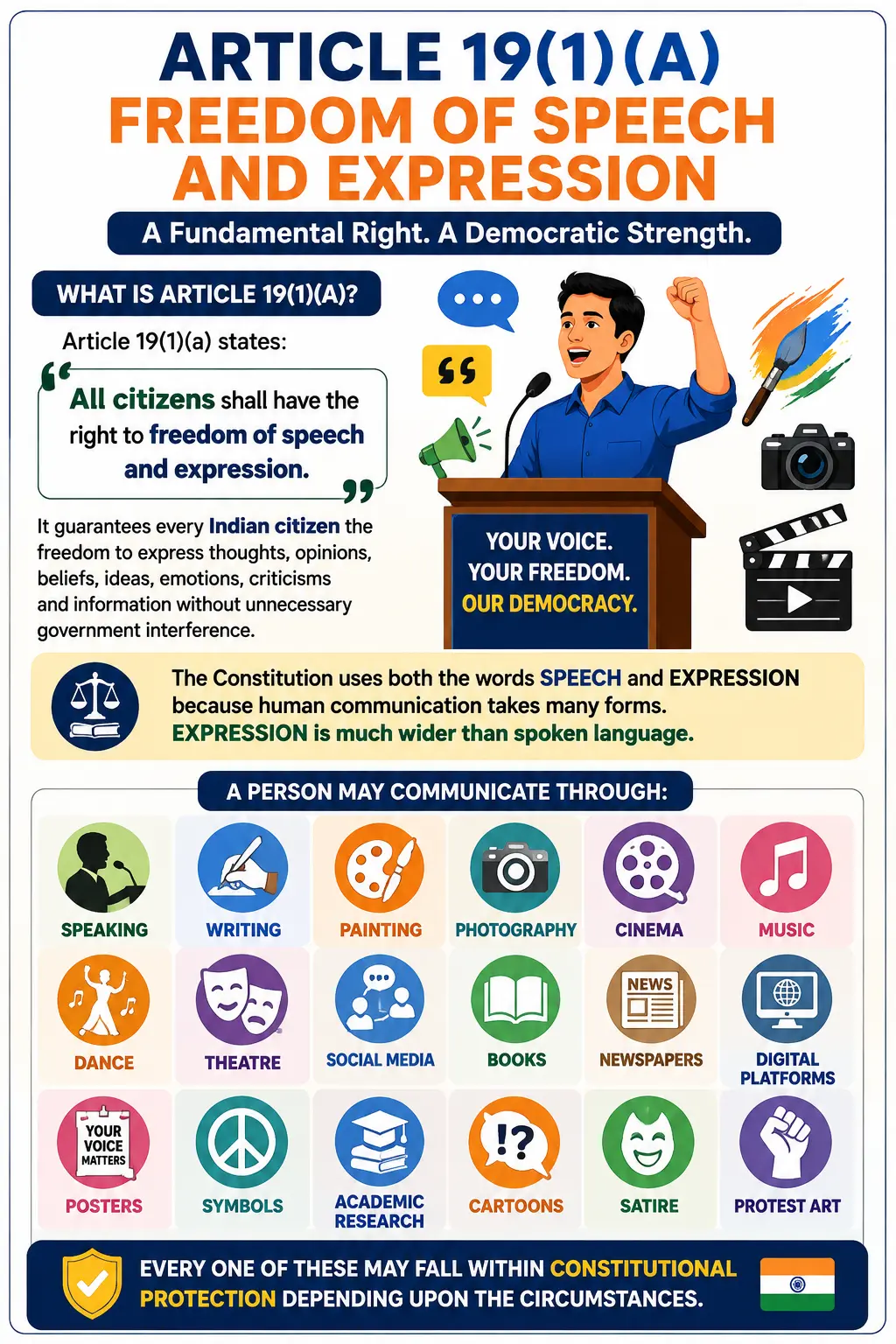
Article 19(1)(a) states:
“All citizens shall have the right to freedom of speech and expression.”
Although the wording appears simple, its constitutional significance is enormous.
The provision guarantees that every Indian citizen may freely express thoughts, opinions, beliefs, ideas, emotions, criticisms, and information without unnecessary government interference.
The Constitution deliberately uses both the words speech and expression because human communication takes many forms.
Expression is much wider than spoken language.
A person may communicate through:
- Speaking
- Writing
- Painting
- Photography
- Cinema
- Music
- Dance
- Theatre
- Social media
- Books
- Newspapers
- Digital platforms
- Posters
- Symbols
- Academic research
- Cartoons
- Satire
- Protest art
Every one of these may fall within constitutional protection depending upon the circumstances.
Constitutional Position of Article 19(1)(a)
| Particular | Details |
|---|---|
| Constitutional Provision | Article 19(1)(a) |
| Part of Constitution | Part III – Fundamental Rights |
| Fundamental Right | Right to Freedom |
| Available To | Citizens of India only |
| Nature | Qualified Fundamental Right |
| Restricted By | Article 19(2) |
| Purpose | Protect free communication of ideas and opinions |
| Constitutional Importance | Foundation of democratic governance |
Why Freedom of Speech Matters
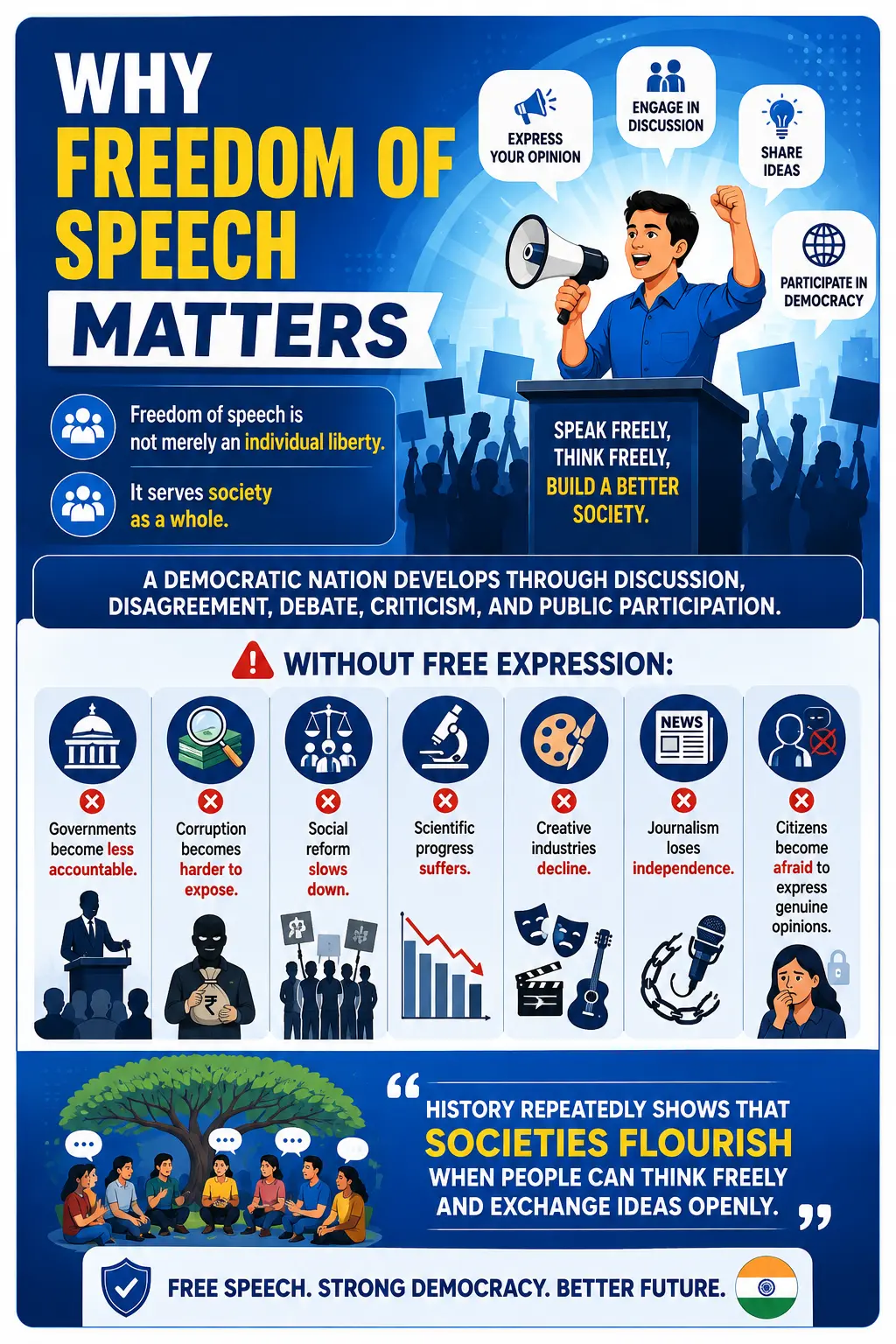
Freedom of speech is not merely an individual liberty.
It serves society as a whole.
A democratic nation develops through discussion, disagreement, debate, criticism, and public participation.
Without free expression:
- Governments become less accountable.
- Corruption becomes harder to expose.
- Social reform slows down.
- Scientific progress suffers.
- Creative industries decline.
- Journalism loses independence.
- Citizens become afraid to express genuine opinions.
History repeatedly shows that societies flourish when people can think freely and exchange ideas openly.
Objectives Behind Article 19(1)(a)
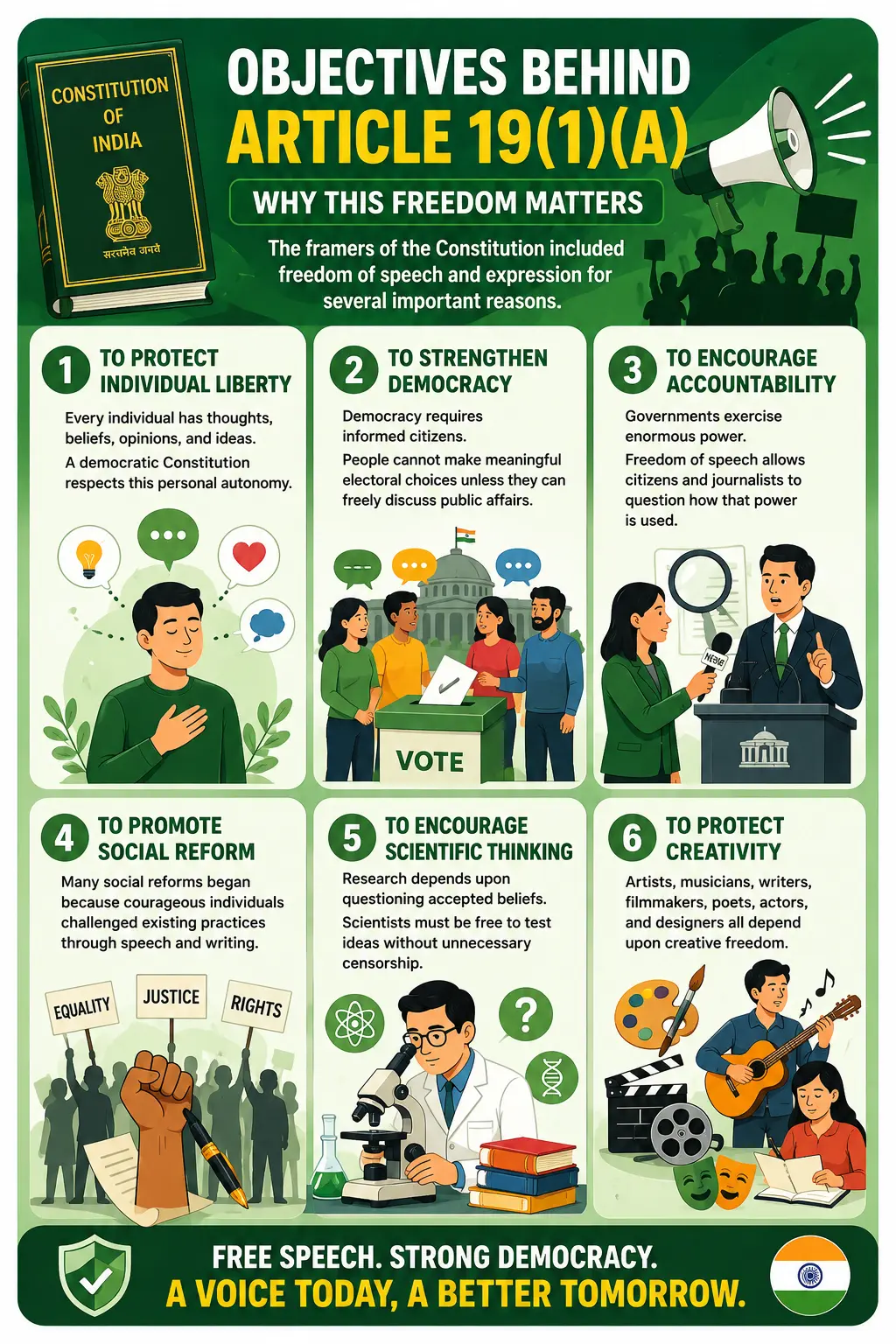
The framers of the Constitution included this freedom for several important reasons.
1. To Protect Individual Liberty
Every individual has thoughts, beliefs, opinions, and ideas.
A democratic Constitution respects this personal autonomy.
2. To Strengthen Democracy
Democracy requires informed citizens.
People cannot make meaningful electoral choices unless they can freely discuss public affairs.
3. To Encourage Accountability
Governments exercise enormous power.
Freedom of speech allows citizens and journalists to question how that power is used.
4. To Promote Social Reform
Many social reforms began because courageous individuals challenged existing practices through speech and writing.
5. To Encourage Scientific Thinking
Research depends upon questioning accepted beliefs.
Scientists must be free to test ideas without unnecessary censorship.
6. To Protect Creativity
Artists, musicians, writers, filmmakers, poets, actors, and designers all depend upon creative freedom.
Meaning of “Speech”
Speech generally refers to verbal communication.
It includes:
- Public speeches
- Political speeches
- Classroom lectures
- Interviews
- Public discussions
- Debates
- Television appearances
- Podcasts
- Online discussions
- Video messages
Speech may be:
- Positive
- Critical
- Supportive
- Neutral
- Humorous
- Satirical
- Emotional
- Educational
The Constitution generally protects all these forms unless they violate the reasonable restrictions under Article 19(2).
Meaning of “Expression”
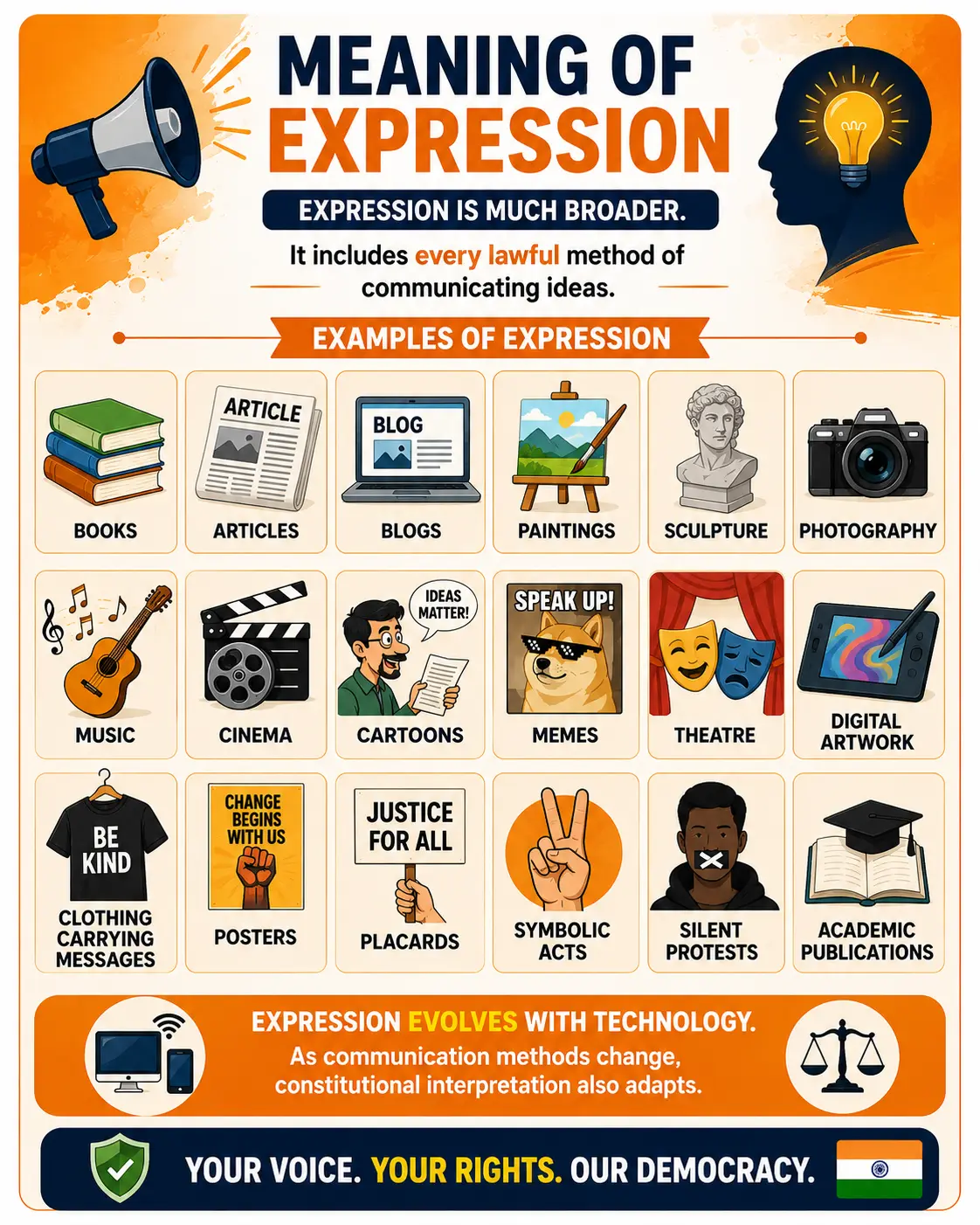
Expression is much broader.
It includes every lawful method of communicating ideas.
Examples include:
- Books
- Articles
- Blogs
- Paintings
- Sculpture
- Photography
- Music
- Cinema
- Cartoons
- Memes
- Theatre
- Digital artwork
- Clothing carrying messages
- Posters
- Placards
- Symbolic acts
- Silent protests
- Academic publications
Expression evolves with technology.
As communication methods change, constitutional interpretation also adapts.
Major Forms of Protected Expression
| Form of Expression | Protected Under Article 19(1)(a)? |
|---|---|
| Speaking | Yes |
| Writing | Yes |
| Books | Yes |
| Newspapers | Yes |
| Journalism | Yes |
| Online Articles | Yes |
| Blogs | Yes |
| Films | Yes, subject to lawful regulation |
| Music | Yes |
| Theatre | Yes |
| Paintings | Yes |
| Photography | Yes |
| Political Speech | Yes |
| Academic Discussion | Yes |
| Satire | Yes |
| Commercial Advertisements | Protected to a certain extent |
| Social Media Posts | Yes, subject to law |
| Peaceful Symbolic Expression | Yes |
Freedom of Speech Is the Heart of Democracy
Many constitutional scholars describe Article 19(1)(a) as the heartbeat of Indian democracy.
Why?
Because every democratic institution depends upon informed citizens.
Consider elections.
Citizens need freedom to:
- Discuss political parties
- Criticize leaders
- Compare policies
- Read newspapers
- Watch debates
- Publish opinions
- Conduct campaigns
- Ask difficult questions
Without these freedoms, elections would lose much of their democratic value.
Relationship Between Freedom of Speech and Other Fundamental Rights
Freedom of speech is closely connected with several constitutional rights.
| Fundamental Right | Relationship |
|---|---|
| Article 14 | Equality supports equal opportunity to express ideas. |
| Article 19(1)(b) | Peaceful assembly often involves speech. |
| Article 19(1)(c) | Associations communicate common objectives. |
| Article 19(1)(d) | Public meetings require movement. |
| Article 21 | Personal liberty includes several expressive freedoms. |
| Article 32 | Constitutional remedies protect free speech violations. |
Freedom of the Press
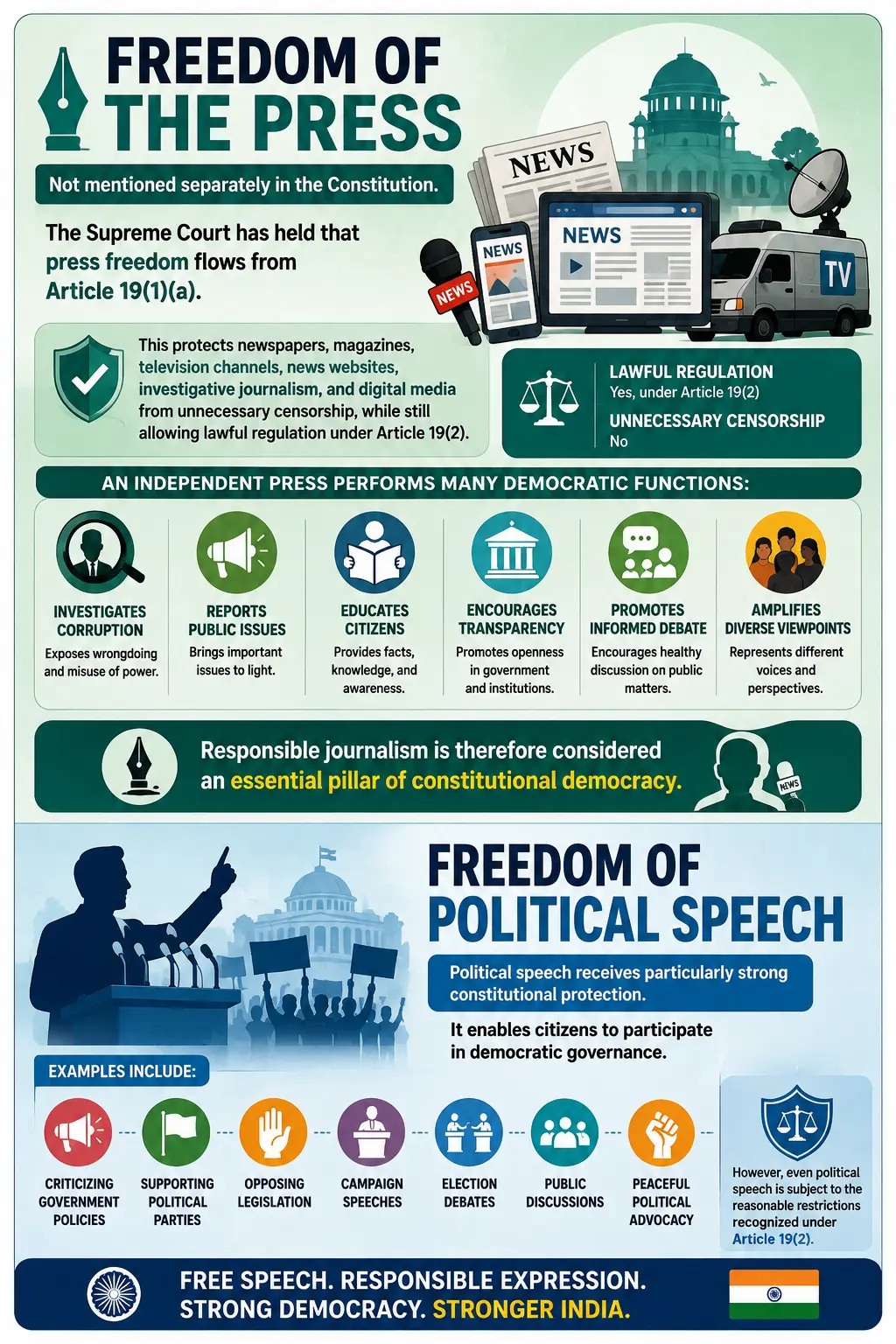
Interestingly, the Constitution does not separately mention the Freedom of the Press.
Instead, the Supreme Court has consistently held that press freedom naturally flows from Article 19(1)(a).
This protects newspapers, magazines, television channels, news websites, investigative journalism, and digital media from unnecessary censorship, while still allowing lawful regulation under Article 19(2).
An independent press performs many democratic functions:
- Investigates corruption
- Reports public issues
- Educates citizens
- Encourages transparency
- Promotes informed debate
- Amplifies diverse viewpoints
Responsible journalism is therefore considered an essential pillar of constitutional democracy.
Freedom of Political Speech
Political speech receives particularly strong constitutional protection because it enables citizens to participate in democratic governance.
Examples include:
- Criticizing government policies
- Supporting political parties
- Opposing legislation
- Campaign speeches
- Election debates
- Public discussions
- Peaceful political advocacy
However, even political speech is subject to the reasonable restrictions recognized under Article 19(2).
Freedom of Artistic Expression
Art often reflects society.
Paintings, literature, cinema, music, theatre, poetry, dance, photography, cartoons, and digital artwork communicate ideas that words alone sometimes cannot.
Article 19(1)(a) protects artistic creativity, though creative works may still be regulated under laws that satisfy the constitutional requirements of Article 19(2).

Freedom of Academic Expression
Universities thrive when ideas can be discussed openly.
Academic freedom encourages:
- Research
- Debate
- Innovation
- Scientific inquiry
- Intellectual disagreement
- Publication of scholarly work
Knowledge advances because people are free to challenge existing theories and present new evidence.
Freedom in the Digital Age
The internet has dramatically expanded the scope of expression.
Today, citizens communicate through:
- Blogs
- Social media
- Podcasts
- Video platforms
- Discussion forums
- Online newspapers
- Educational websites
- Digital classrooms
- Virtual conferences
The Supreme Court has recognized that constitutional freedoms extend into the digital environment, making online expression an important aspect of modern democratic participation.
Right to Receive Information
Freedom of expression is not limited to speaking.
It also includes the ability to receive information.
Citizens form opinions by accessing:
- News reports
- Educational materials
- Government publications
- Books
- Public debates
- Research papers
- Digital content
An informed society is better equipped to participate in democracy and make reasoned decisions.
Right to Silence
Freedom of speech also includes the freedom not to speak.
Individuals cannot ordinarily be compelled to express beliefs they do not hold, except where valid constitutional or statutory requirements apply.
This principle recognizes personal autonomy and freedom of conscience.
Commercial Speech
Advertising and commercial communication also involve expression.
The Supreme Court has recognized that truthful commercial speech may receive constitutional protection because consumers benefit from access to accurate information about goods and services.
However, misleading advertisements, fraudulent claims, and unlawful commercial practices remain subject to regulation.
Reasonable Restrictions Under Article 19(2)
Article 19(1)(a) is broad, but it is not absolute.
Article 19(2) permits the State to impose reasonable restrictions only on specific constitutional grounds.
| Ground | Meaning |
|---|---|
| Sovereignty and Integrity of India | Protection of national unity and territorial integrity |
| Security of the State | Protection against activities threatening national security |
| Friendly Relations with Foreign States | Avoidance of serious diplomatic harm |
| Public Order | Prevention of violence and serious disturbances |
| Decency | Protection of accepted standards of morality |
| Morality | Prevention of obscene or harmful expression within constitutional limits |
| Contempt of Court | Protection of judicial authority and administration of justice |
| Defamation | Protection of individual reputation |
| Incitement to an Offence | Prevention of speech encouraging criminal acts |
These restrictions must always satisfy the constitutional test of reasonableness. They cannot be arbitrary, excessive, or unrelated to the purpose for which they are imposed.
What Makes a Restriction ‘Reasonable’?
Courts examine several factors, including:
- Whether there is a valid legal basis.
- Whether the restriction serves a legitimate constitutional purpose.
- Whether it is proportionate to the harm sought to be prevented.
- Whether it unnecessarily suppresses lawful expression.
- Whether procedural safeguards are available.
A restriction that is excessive or arbitrary may be declared unconstitutional.
Important Judicial Principles
Over the years, constitutional courts have developed several guiding principles.
These include:
- Free speech is essential for democracy.
- Restrictions must be narrowly justified.
- Criticism of government is generally protected.
- Public debate deserves strong constitutional protection.
- Prior censorship requires careful constitutional scrutiny.
- The internet is an important medium of expression.
- Artistic and literary works should be viewed as a whole rather than in isolated parts.
Landmark Supreme Court Decisions
| Case | Constitutional Contribution |
|---|---|
| Romesh Thappar v. State of Madras (1950) | Recognized freedom of political discussion as central to democracy. |
| Brij Bhushan v. State of Delhi (1950) | Examined prior restraint on publication and strengthened press freedom. |
| Sakal Papers v. Union of India (1962) | Protected newspaper circulation from unreasonable governmental interference. |
| Bennett Coleman & Co. v. Union of India (1973) | Affirmed that restrictions affecting newspapers could impact press freedom under Article 19(1)(a). |
| Indian Express Newspapers v. Union of India (1985) | Reaffirmed the importance of an independent press in a democratic society. |
| S. Rangarajan v. P. Jagjivan Ram (1989) | Held that freedom of expression cannot be suppressed merely because a section of society disagrees with a viewpoint. |
| Secretary, Ministry of Information & Broadcasting v. Cricket Association of Bengal (1995) | Recognized the significance of electronic media and the public’s right to receive information. |
| Shreya Singhal v. Union of India (2015) | Struck down Section 66A of the Information Technology Act, reinforcing protection for online speech. |
| Anuradha Bhasin v. Union of India (2020) | Recognized access to the internet as closely connected with the exercise of freedom of speech and expression in the digital era. |

Examples of Protected Speech
Generally, constitutional protection extends to:
- Writing a newspaper article.
- Publishing a research paper.
- Peacefully criticizing government policies.
- Delivering a public lecture.
- Performing a theatrical play.
- Producing a documentary film.
- Creating artwork.
- Writing poetry.
- Publishing a blog.
- Sharing opinions on social media.
- Peaceful academic debate.
- Political campaigning.
- Investigative journalism.
Whether a particular act is protected always depends on the surrounding facts and applicable law.
Examples of Speech That May Be Restricted
Depending on the circumstances and applicable law, restrictions may apply to expression involving:
- Incitement to violence.
- Defamation of identifiable individuals.
- Contempt of court.
- Threats to national security.
- Speech leading to serious public disorder.
- Certain forms of obscenity regulated by law.
- Speech encouraging criminal offences.
Each situation requires careful constitutional analysis.
Role of Citizens in Protecting Free Speech
Freedom of speech carries responsibilities alongside rights.
Citizens strengthen democracy when they:
- Verify facts before sharing information.
- Respect differing opinions.
- Avoid hate and violence.
- Engage in civil debate.
- Protect the dignity of others.
- Support independent journalism.
- Encourage informed discussion.
Responsible exercise of free speech benefits the entire society.
Freedom of Speech in Everyday Life
Article 19(1)(a) influences ordinary life in countless ways.
A student presenting a classroom argument, a teacher publishing research, an author writing a novel, a filmmaker producing a documentary, a journalist reporting on public affairs, an artist creating a mural, or a citizen posting a reasoned opinion online all engage with the constitutional values protected by this provision.
Its impact extends beyond courtrooms and constitutional texts. It shapes education, culture, science, politics, business, entertainment, and civic life.
Challenges in the Modern Era
The digital age has created new opportunities for communication while also introducing complex constitutional questions.
Some contemporary issues include:
- Balancing free speech with online misinformation.
- Addressing hate speech while protecting legitimate criticism.
- Regulating digital platforms.
- Safeguarding journalistic independence.
- Protecting artistic freedom.
- Managing rapidly evolving technologies such as artificial intelligence.
- Ensuring internet access without unnecessary restrictions.
- Preserving privacy alongside freedom of expression.
Courts and lawmakers continue to address these evolving challenges within the constitutional framework.
Article 19(1)(a) at a Glance
| Aspect | Explanation |
|---|---|
| Constitutional Provision | Article 19(1)(a) |
| Fundamental Right | Freedom of Speech and Expression |
| Who Can Claim It? | Citizens of India |
| Nature of Right | Fundamental but subject to reasonable restrictions |
| Restriction Provision | Article 19(2) |
| Covers | Speech, writing, press, art, films, digital communication, academic expression, political discussion and more |
| Democratic Importance | Encourages accountability, transparency and informed participation |
| Judicial Role | Courts ensure restrictions remain constitutional and reasonable |
Key Takeaways
- Article 19(1)(a) guarantees every Indian citizen the Freedom of Speech and Expression.
- The right protects far more than spoken words. It extends to writing, journalism, literature, art, cinema, academic work, political communication, peaceful symbolic expression, and digital media.
- Freedom of the press is derived from Article 19(1)(a), even though it is not expressly mentioned in the Constitution.
- The right supports democratic participation, transparency, creativity, scientific inquiry, and social reform.
- It is available only to citizens of India, unlike some other fundamental rights that also apply to non-citizens.
- The freedom is subject to reasonable restrictions under Article 19(2) on specific grounds such as the sovereignty and integrity of India, security of the State, public order, decency, morality, contempt of court, defamation, and incitement to an offence.
- Constitutional courts have consistently interpreted Article 19(1)(a) broadly, ensuring that it evolves with new forms of communication and changing social realities.
- Responsible use of free speech strengthens democracy by encouraging informed discussion, respect for differing viewpoints, and accountability in public life.
Article 19(1)(a) remains one of the most influential provisions of the Constitution because it protects not only an individual’s right to express ideas but also society’s collective interest in open dialogue, informed decision-making, and democratic governance. Its enduring significance lies in maintaining a constitutional balance between liberty and responsibility, ensuring that freedom continues to flourish while safeguarding the values essential to a just and orderly society.
Article Reference, Sources, and Citations
- Constitution of India (Official Text)
- Article 19 of the Constitution of India (Constitutional Text)
- Supreme Court of India
- Romesh Thappar v. State of Madras (1950)
- Brij Bhushan v. State of Delhi (1950)
- Sakal Papers (P) Ltd. v. Union of India (1962)
- Bennett Coleman & Co. v. Union of India (1973)
- Indian Express Newspapers v. Union of India (1985)
- S. Rangarajan v. P. Jagjivan Ram (1989)
- Secretary, Ministry of Information & Broadcasting v. Cricket Association of Bengal (1995)
- Shreya Singhal v. Union of India (2015)
- Anuradha Bhasin v. Union of India (2020)
- Article 19(1)(a) and Reasonable Restrictions under Article 19(2)
- Constitutional Text of Article 19
These references collectively support the constitutional provisions, judicial interpretations, and landmark case law discussed throughout the article while providing readers with reliable resources for further study.
Also, Read These Articles in Detail
- Fundamental Rights in India
- What Are Fundamental Rights Under the Indian Constitution?
- History of Fundamental Rights in India
- Why Fundamental Rights Are Important for Every Indian Citizen
- Understanding Part III of the Indian Constitution
- Who Can Claim Fundamental Rights in India?
- Legal Rights vs Fundamental Rights
- How Fundamental Rights Protect Individual Freedom in India
- Right to Equality Under Article 14
- Article 15: Protection Against Discrimination
- Article 16: Equality of Opportunity in Public Employment
- Article 17 and the Abolition of Untouchability in India
- Article 18: Abolition of Titles and Its Importance
- Right to Freedom Under Articles 19 to 22
Frequently Asked Questions
FAQ 1. What is Article 19(1)(a) of the Constitution of India?
Article 19(1)(a) is one of the most significant Fundamental Rights guaranteed under Part III of the Constitution of India. It gives every Indian citizen the Freedom of Speech and Expression, allowing people to express their thoughts, opinions, beliefs, ideas, and emotions without unnecessary interference from the government.
This freedom goes far beyond simply speaking. It protects many different forms of communication, including writing, publishing books, newspapers, magazines, blogs, art, music, films, theatre, photography, social media posts, academic discussions, and even certain forms of peaceful symbolic expression.
The purpose of this constitutional guarantee is to ensure that citizens can actively participate in a democratic society. Democracy works best when people are free to ask questions, debate public issues, criticize policies, share knowledge, and exchange ideas openly.
However, Article 19(1)(a) does not provide unlimited freedom. The Constitution also recognizes that unrestricted speech may sometimes harm society. Therefore, Article 19(2) allows the government to impose reasonable restrictions in specific situations involving matters such as national security, public order, defamation, contempt of court, and incitement to an offence.
Over the years, the Supreme Court of India has interpreted Article 19(1)(a) broadly, making it one of the strongest constitutional protections for individual liberty and democratic participation.
FAQ 2. Why is the Freedom of Speech and Expression important in a democracy?
The Freedom of Speech and Expression is often described as the foundation of every healthy democracy because it allows citizens to participate meaningfully in public life. Without the ability to speak freely, question decisions, or express different opinions, democratic institutions cannot function effectively.
This freedom enables people to:
- Discuss public issues
- Criticize government policies
- Support or oppose political parties
- Participate in elections
- Share scientific knowledge
- Promote social reforms
- Protect human rights
- Expose corruption
- Encourage transparency
When citizens can freely express their opinions, governments become more accountable. Public officials know that their decisions can be examined, debated, and questioned by the people they serve.
Freedom of expression also encourages innovation and creativity. Writers, artists, musicians, researchers, journalists, filmmakers, and educators all depend upon this freedom to communicate ideas that contribute to society’s growth.
And democracy benefits from disagreement. Different viewpoints help people examine issues from multiple perspectives before forming opinions. Respectful debate often leads to better public policies and stronger institutions.
Without freedom of speech, fear replaces discussion, and democracy gradually loses one of its most essential features.
FAQ 3. Who can enjoy the right under Article 19(1)(a)?
The protection provided by Article 19(1)(a) is available only to citizens of India. Unlike some other Fundamental Rights, which are available to both citizens and non-citizens, Article 19 specifically grants this freedom to Indian citizens.
Every citizen, regardless of religion, gender, language, caste, profession, economic background, or political belief, enjoys equal protection under this provision.
This means that citizens may:
- Express opinions publicly
- Write articles
- Publish books
- Create artwork
- Participate in political debates
- Deliver speeches
- Share information online
- Join public discussions
- Express academic views
- Criticize public policies
Although non-citizens may enjoy certain legal protections under other constitutional provisions and laws, the specific freedoms listed in Article 19, including the Freedom of Speech and Expression, are reserved for Indian citizens.
This distinction reflects the constitutional framework established by the Constitution’s framers, while maintaining several other protections for every person under different constitutional provisions.
FAQ 4. What kinds of expression are protected under Article 19(1)(a)?
The Constitution intentionally uses the broad phrase “speech and expression” because people communicate in many different ways. As a result, Article 19(1)(a) protects much more than spoken words.
Protected forms of expression generally include:
- Speaking
- Writing
- Books
- Newspapers
- Magazines
- Academic research
- Journalism
- Blogs
- Poetry
- Music
- Dance
- Paintings
- Photography
- Films
- Documentaries
- Political speeches
- Public discussions
- Social media posts
- Peaceful symbolic acts
- Digital communication
Modern constitutional interpretation has also extended this protection to many forms of online communication because today’s society increasingly depends upon digital platforms for sharing information and participating in public discourse.
The exact scope of protection depends upon the facts of each case. Courts examine whether the expression falls within constitutional protection and whether any lawful restriction under Article 19(2) applies.
This broad interpretation ensures that constitutional rights continue to remain relevant as technology and communication methods evolve.
FAQ 5. Is the Freedom of Speech and Expression an absolute right?
No. Article 19(1)(a) provides a broad constitutional guarantee, but it is not an absolute right.
The framers of the Constitution understood that complete freedom without any limitations could sometimes create serious harm. Therefore, Article 19(2) allows the State to impose reasonable restrictions on this freedom under carefully defined circumstances.
These restrictions may relate to:
- Sovereignty and Integrity of India
- Security of the State
- Friendly Relations with Foreign States
- Public Order
- Decency
- Morality
- Contempt of Court
- Defamation
- Incitement to an Offence
The word “reasonable” is extremely important. The government cannot impose restrictions simply because it disagrees with someone’s opinion. Every restriction must satisfy constitutional standards and must have a valid legal justification.
The Supreme Court of India regularly reviews laws affecting free speech to ensure that restrictions remain fair, proportionate, and consistent with constitutional values.
This balanced approach protects both individual liberty and the broader interests of society.
FAQ 6. Does Article 19(1)(a) protect freedom of the press?
Yes. Although the Constitution does not specifically mention Freedom of the Press, the Supreme Court of India has consistently held that it forms an essential part of the Freedom of Speech and Expression guaranteed under Article 19(1)(a).
An independent press performs many important democratic functions.
It helps:
- Report public events
- Investigate corruption
- Inform citizens
- Encourage transparency
- Question government actions
- Present diverse opinions
- Promote public discussion
- Strengthen accountability
Newspapers, magazines, television channels, digital news platforms, and other forms of journalism all contribute to keeping citizens informed about matters affecting society.
However, press freedom is not unlimited. Journalists and media organizations remain subject to laws that satisfy the constitutional requirements under Article 19(2).
Responsible journalism balances freedom with professional ethics by presenting verified information, respecting individual rights, and avoiding unlawful conduct.
A free and responsible press remains one of the strongest pillars of a constitutional democracy.
FAQ 7. How does Article 19(1)(a) apply to social media and the internet?
The growth of the internet has changed the way people communicate, and constitutional protections have evolved alongside these changes.
Today, many people express their views through:
- Social media platforms
- Blogs
- Online newspapers
- Podcasts
- Video-sharing platforms
- Discussion forums
- Digital classrooms
- Educational websites
The Supreme Court of India has recognized that online communication is an important means of exercising the Freedom of Speech and Expression.
This means that citizens generally enjoy constitutional protection while expressing lawful opinions on digital platforms. At the same time, online expression remains subject to the same constitutional limitations that apply to offline speech.
For example, activities involving defamation, incitement to violence, or threats to public order may still be regulated according to law.
The internet has become one of the most important spaces for democratic participation. It allows citizens to exchange information instantly, participate in public debates, access educational resources, and engage with national and global issues.
As technology continues to evolve, constitutional principles continue to guide how free expression should be protected in the digital age.
FAQ 8. What are the reasonable restrictions under Article 19(2)?
While Article 19(1)(a) protects freedom of expression, Article 19(2) specifies the limited grounds on which the government may impose restrictions.
These constitutional grounds include:
- Sovereignty and Integrity of India
- Security of the State
- Friendly Relations with Foreign States
- Public Order
- Decency
- Morality
- Contempt of Court
- Defamation
- Incitement to an Offence
Each restriction must satisfy constitutional principles. Courts examine whether:
- There is a valid law.
- The restriction serves a legitimate purpose.
- The limitation is proportionate.
- It does not unnecessarily suppress lawful speech.
- It respects constitutional guarantees.
For instance, peaceful criticism of government policies is generally protected. But speech that directly incites violence or encourages criminal acts may lawfully attract restrictions under Article 19(2).
This constitutional framework seeks to preserve both individual freedom and public welfare, ensuring that neither is sacrificed unnecessarily.
FAQ 9. Which landmark Supreme Court judgments have shaped Article 19(1)(a)?
Several landmark decisions of the Supreme Court of India have expanded and clarified the meaning of Article 19(1)(a) over the decades.
Some of the most important judgments include:
- Romesh Thappar v. State of Madras (1950), which emphasized the importance of political discussion in a democracy.
- Brij Bhushan v. State of Delhi (1950), which addressed prior restraints on publication.
- Sakal Papers v. Union of India (1962), which strengthened the constitutional protection of newspapers.
- Bennett Coleman & Co. v. Union of India (1973), which reaffirmed press freedom.
- Indian Express Newspapers v. Union of India (1985), which highlighted the essential role of an independent press.
- S. Rangarajan v. P. Jagjivan Ram (1989), which emphasized that expression cannot ordinarily be suppressed merely because it is unpopular or controversial.
- Secretary, Ministry of Information & Broadcasting v. Cricket Association of Bengal (1995), which recognized the importance of electronic media.
- Shreya Singhal v. Union of India (2015), which significantly strengthened protection for online speech.
- Anuradha Bhasin v. Union of India (2020), which discussed the relationship between internet access and constitutional freedoms.
Together, these judgments have helped shape one of the world’s most comprehensive constitutional approaches to protecting free expression while maintaining reasonable safeguards.
FAQ 10. What responsibilities come with the Freedom of Speech and Expression?
The Freedom of Speech and Expression is both a constitutional right and a civic responsibility. While citizens are free to express their opinions, they are also expected to exercise that freedom responsibly.
Responsible expression includes:
- Respecting the rights and dignity of others
- Avoiding false or misleading information
- Engaging in respectful public debate
- Verifying facts before sharing information
- Respecting the rule of law
- Avoiding speech that encourages violence or criminal activity
- Supporting peaceful democratic discussion
- Promoting constructive dialogue
Freedom becomes stronger when it is exercised with honesty, fairness, and respect. Responsible communication helps create an environment where different opinions can coexist without fear or hostility.
Article 19(1)(a) is not only about protecting an individual’s ability to speak. It also helps build a society where ideas can compete freely, knowledge can spread openly, creativity can flourish, and democratic institutions remain accountable to the people.
By using this freedom wisely, citizens contribute to a more informed, inclusive, and resilient democracy, ensuring that constitutional values continue to guide public life for generations to come.
FAQ 11. How does Article 19(1)(a) protect the right to criticize the government?
One of the most valuable features of Article 19(1)(a) is that it protects the right of citizens to peacefully criticize the government, public authorities, and public policies. In a democratic country, criticism is not a sign of disloyalty. Instead, it is often a sign that citizens are actively participating in public life and holding those in power accountable.
Governments make decisions that affect every aspect of society, including education, healthcare, employment, infrastructure, taxation, environmental protection, and national security. Since these decisions influence millions of people, citizens must have the freedom to discuss them openly.
Under Article 19(1)(a), people may:
- Question government decisions
- Express disagreement with laws
- Write articles criticizing public policies
- Speak at public meetings
- Participate in political debates
- Share opinions through newspapers and digital media
- Campaign peacefully for policy changes
- Support or oppose government initiatives
This freedom also enables journalists, researchers, lawyers, teachers, activists, and ordinary citizens to bring public issues into national discussion.
However, this constitutional protection does not extend to speech that falls within the reasonable restrictions under Article 19(2). For example, criticism that directly incites violence, threatens national security, or amounts to defamation may attract lawful restrictions.
The Supreme Court of India has repeatedly emphasized that democracy thrives when citizens are free to express differing opinions. Governments change over time, but the constitutional protection of peaceful criticism remains an essential safeguard for democratic accountability.
FAQ 12. What is the relationship between Article 19(1)(a) and Article 19(2)?
Article 19(1)(a) and Article 19(2) work together to create a balanced constitutional framework.
While Article 19(1)(a) grants every Indian citizen the Freedom of Speech and Expression, Article 19(2) recognizes that this freedom cannot be completely unrestricted in every situation.
Think of them as two parts of the same constitutional design.
The first part guarantees liberty.
The second part protects society from certain forms of harmful expression.
Article 19(2) permits the government to impose reasonable restrictions only on specific constitutional grounds, such as:
- Sovereignty and Integrity of India
- Security of the State
- Friendly Relations with Foreign States
- Public Order
- Decency
- Morality
- Contempt of Court
- Defamation
- Incitement to an Offence
The Constitution deliberately limits these grounds so that governments cannot suppress speech simply because they dislike criticism or disagree with public opinion.
Whenever a restriction is challenged before a court, judges examine several important questions.
These include:
- Is there a valid law?
- Does the restriction serve a legitimate constitutional purpose?
- Is the restriction proportionate?
- Is it excessive or arbitrary?
- Does it unnecessarily interfere with free expression?
Only restrictions that satisfy constitutional standards can survive judicial review.
This careful balance ensures that India protects both individual liberty and the larger interests of society.
FAQ 13. Does Article 19(1)(a) protect artistic and creative expression?
Yes. Article 19(1)(a) provides broad constitutional protection for artistic and creative expression, making it possible for artists to communicate ideas through different creative forms.
Art has always played an important role in society. Sometimes it entertains. Sometimes it educates. And sometimes it encourages people to think differently about social, cultural, political, or historical issues.
Creative expression may include:
- Paintings
- Drawings
- Music
- Dance
- Poetry
- Novels
- Short stories
- Films
- Documentaries
- Photography
- Theatre
- Cartoons
- Digital artwork
- Sculpture
- Literary works
Artists often use imagination, symbolism, humour, or satire to express their ideas. The Constitution recognizes that creativity is an important part of a free society.
At the same time, artistic freedom is subject to the reasonable restrictions mentioned in Article 19(2). Courts generally examine creative works in their entirety rather than focusing on isolated words or scenes.
The Supreme Court of India has repeatedly observed that freedom of expression also protects ideas that may be unpopular or controversial, provided they do not violate constitutional limitations.
By protecting artistic freedom, Article 19(1)(a) encourages cultural diversity, intellectual growth, and creative innovation across the country.
FAQ 14. Is freedom of speech different from freedom of expression?
Although the two phrases are closely related, Freedom of Speech and Freedom of Expression are not the same.
Speech mainly refers to communication through spoken words.
Examples include:
- Public speeches
- Conversations
- Political addresses
- Interviews
- Lectures
- Debates
- Podcasts
- Video discussions
Expression, on the other hand, is much broader.
It includes every lawful method of communicating ideas, feelings, opinions, beliefs, or information.
Examples include:
- Writing
- Books
- Articles
- Films
- Music
- Dance
- Photography
- Painting
- Theatre
- Digital communication
- Social media content
- Peaceful symbolic acts
This is why the Constitution uses both words together.
The phrase “Freedom of Speech and Expression” ensures that constitutional protection extends beyond verbal communication and covers the many different ways people express themselves in modern society.
As communication technologies continue to develop, courts have interpreted the meaning of expression broadly so that constitutional rights remain effective in both traditional and digital environments.
FAQ 15. Does Article 19(1)(a) protect academic freedom and scientific research?
Yes. Although the Constitution does not separately mention academic freedom, it is widely understood to be an important part of the Freedom of Speech and Expression.
Education and scientific progress depend upon the ability to ask questions, test ideas, challenge existing theories, and present new evidence.
Teachers, students, researchers, scientists, scholars, and educational institutions contribute to society by expanding knowledge through open discussion and critical thinking.
Academic expression may include:
- Research publications
- Scientific studies
- University lectures
- Seminars
- Conferences
- Academic debates
- Books
- Educational articles
- Research papers
- Scholarly criticism
History shows that many scientific discoveries were initially questioned before eventually gaining acceptance. If researchers could not freely publish their findings, scientific development would slow considerably.
Article 19(1)(a) therefore supports an environment where evidence-based discussion can flourish.
At the same time, academic freedom does not exempt anyone from complying with valid laws. Research must still respect legal requirements relating to public safety, intellectual property, ethics, and other applicable constitutional principles.
By encouraging intellectual inquiry, Article 19(1)(a) contributes to education, innovation, and the long-term development of society.
FAQ 16. How does Article 19(1)(a) protect journalists and the media?
A free and independent media is one of the strongest safeguards of democracy, and Article 19(1)(a) plays a central role in protecting it.
Although the Constitution does not specifically mention Freedom of the Press, the Supreme Court of India has consistently held that press freedom is an essential part of the broader Freedom of Speech and Expression.
Journalists perform several important public functions.
They:
- Report current events
- Investigate corruption
- Explain public policies
- Provide factual information
- Highlight social issues
- Encourage informed public discussion
- Promote governmental accountability
- Represent diverse viewpoints
Without independent journalism, citizens may struggle to obtain reliable information needed to participate effectively in democratic decision-making.
Modern journalism now extends far beyond printed newspapers.
It includes:
- Television news
- Online news portals
- Digital magazines
- Investigative journalism
- Independent reporting
- Educational journalism
- Documentary filmmaking
- Public-interest reporting
Like every constitutional freedom, press freedom also operates within the limits established by Article 19(2).
Responsible journalism combines constitutional liberty with accuracy, fairness, verification, and respect for legal standards.
FAQ 17. Can social media posts be protected under Article 19(1)(a)?
Yes. In today’s digital world, social media platforms have become one of the primary ways people communicate, exchange ideas, and participate in public discussions.
As a result, lawful social media activity generally falls within the protection of Article 19(1)(a).
Citizens commonly use digital platforms to:
- Express opinions
- Share educational content
- Discuss current affairs
- Promote public awareness
- Participate in democratic conversations
- Support social causes
- Publish creative work
- Communicate with large audiences
The Supreme Court of India has recognized that constitutional freedoms continue to apply in the digital environment because the internet has become an important medium of communication.
However, constitutional protection does not mean that every online activity is automatically lawful.
Speech involving matters such as:
- Defamation
- Incitement to violence
- Threats to national security
- Criminal intimidation
- Other unlawful activities
may still be regulated under valid laws consistent with Article 19(2).
The internet has greatly expanded opportunities for democratic participation, making digital expression one of the most significant developments in modern constitutional law.
FAQ 18. Why is the right to receive information connected with Article 19(1)(a)?
Many people think that freedom of expression only protects the right to speak.
In reality, constitutional courts have recognized that meaningful expression also depends upon the right to receive information.
A person cannot make informed decisions without access to reliable knowledge.
Citizens regularly obtain information through:
- Books
- Newspapers
- Television
- Educational institutions
- Research publications
- Government announcements
- Digital platforms
- Public discussions
- Academic journals
- Online resources
Receiving information enables people to:
- Understand public issues
- Evaluate government policies
- Participate in elections
- Develop informed opinions
- Engage in public debate
- Improve education
- Advance scientific knowledge
An informed population strengthens democracy because citizens can make decisions based on facts rather than rumours or incomplete information.
This understanding has become even more important in the digital age, where information travels rapidly across multiple platforms.
The constitutional protection of free expression therefore supports both the right to communicate information and the right to receive it.
FAQ 19. What role does the Supreme Court play in protecting Article 19(1)(a)?
The Supreme Court of India serves as the guardian of the Constitution and plays a vital role in protecting the Freedom of Speech and Expression.
Whenever laws or government actions are challenged for violating Article 19(1)(a), the Court examines whether those actions comply with constitutional requirements.
Its responsibilities include:
- Interpreting constitutional provisions
- Protecting Fundamental Rights
- Reviewing laws affecting free speech
- Ensuring reasonable restrictions remain constitutional
- Maintaining the balance between liberty and public interest
- Developing constitutional principles through judicial decisions
Over many decades, the Supreme Court has expanded the meaning of Article 19(1)(a) to include several important freedoms that are not expressly mentioned in the constitutional text.
These include protections relating to:
- Freedom of the Press
- Commercial speech
- Electronic media
- Digital communication
- Online expression
- Access to information
- Peaceful political discussion
The Court also ensures that governments cannot impose arbitrary restrictions that unnecessarily interfere with constitutional freedoms.
Its decisions continue to shape how Article 19(1)(a) applies to changing social conditions and technological developments.
FAQ 20. Why is Article 19(1)(a) considered one of the most important Fundamental Rights in India?
Many constitutional experts consider Article 19(1)(a) to be one of the cornerstones of Indian democracy because it supports nearly every aspect of democratic governance.
Without free expression, citizens would find it difficult to:
- Discuss public issues
- Question government actions
- Vote intelligently
- Promote social reforms
- Publish research
- Create art
- Practice journalism
- Share scientific discoveries
- Exchange ideas
- Participate in democratic life
This single constitutional provision influences education, politics, literature, journalism, business, science, technology, culture, and everyday communication.
It also strengthens several other constitutional values, including:
- Liberty
- Equality
- Human dignity
- Transparency
- Accountability
- Democratic participation
- Rule of law
- Constitutional governance
Over the years, the Supreme Court of India has interpreted Article 19(1)(a) broadly so that it remains effective even as society and technology continue to change.
Whether citizens are speaking at a public meeting, writing a research paper, publishing a newspaper article, creating a documentary, participating in an election campaign, or expressing their opinions through digital platforms, Article 19(1)(a) provides the constitutional foundation that makes such participation possible.
Its enduring importance lies in protecting both individual liberty and the collective strength of democracy. By ensuring that ideas can be expressed, examined, debated, and challenged peacefully, Article 19(1)(a) helps build an informed, responsible, and participatory society where constitutional values continue to guide public life.
