

Sound energy is one of those things people live with every second of the day, even when they hardly notice it. It is in the music we play, the voices we hear, the alarm clock that wakes us up, the rumble of traffic outside, and the quiet rustle of leaves in the wind. It helps us communicate, enjoy entertainment, warn ourselves of danger, and understand the world around us.
At a basic level, sound is a mechanical disturbance that travels through a material medium such as air, water, wood, or metal. It cannot travel through a vacuum because there is no matter there to carry the disturbance. In simple words, sound needs something to move through. That is why astronauts in space cannot hear each other directly unless they use equipment.
This article takes a close look at sound energy, how it works, where it comes from, how it moves, how humans hear it, and why it matters so much in daily life. It also explains the practical side of sound, including pitch, loudness, frequency, intensity, decibels, infrasound, ultrasound, and noise pollution. The goal is to keep everything clear, natural, and useful.
Table of Contents
What Is Sound Energy?
Sound energy is the energy produced when an object vibrates and creates sound waves. These waves carry energy through a medium, usually as a series of compressions and rarefactions. In everyday language, this means that when something shakes, moves, strikes, or vibrates fast enough, it can push the surrounding air or other material and make sound.
A guitar string is a simple example. When it vibrates, it disturbs the air around it. That disturbance travels outward and reaches your ears as sound. The same thing happens with a drum, a speaker, a bell, a car engine, or even a human voice. Sound is not just noise. It is a real physical transfer of energy.
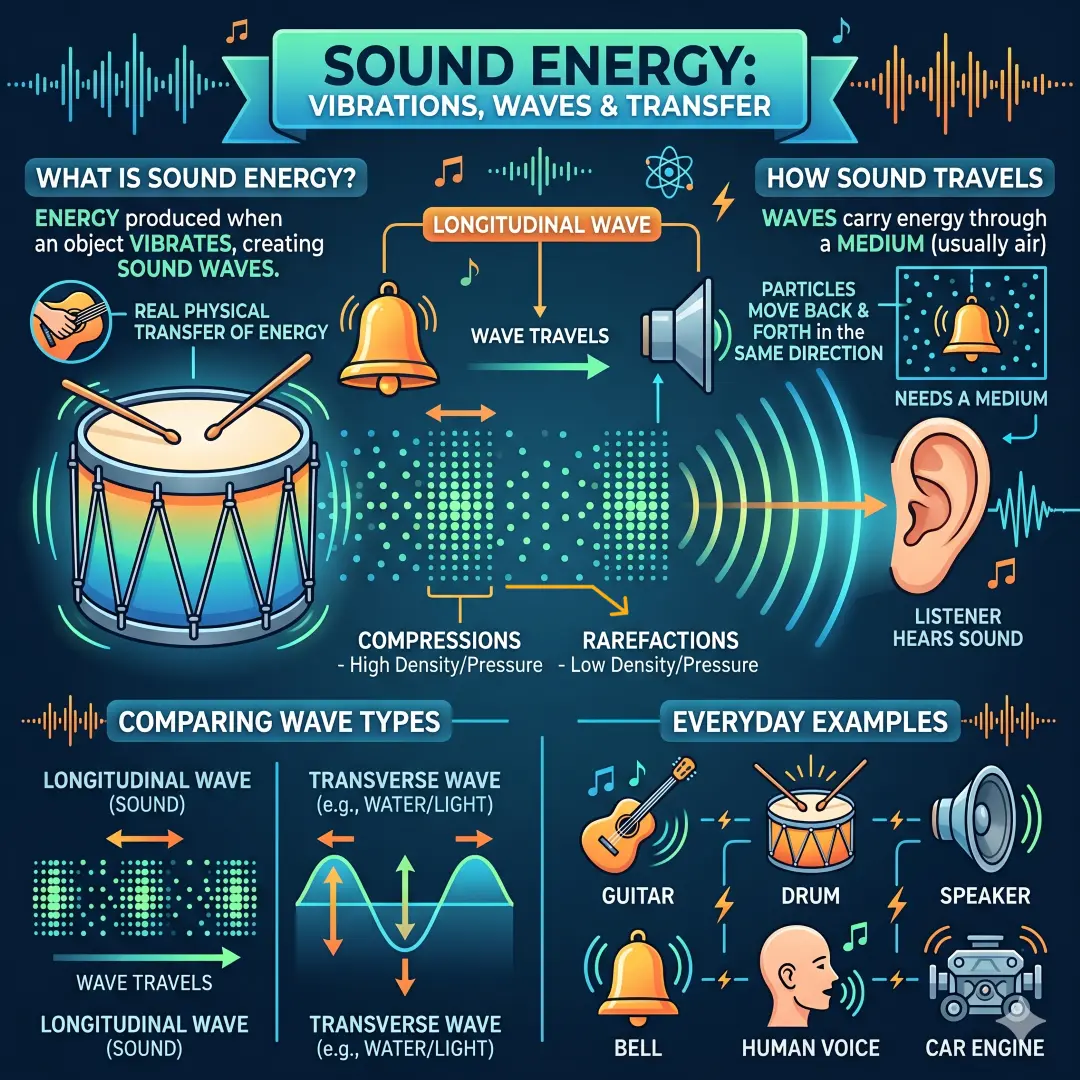
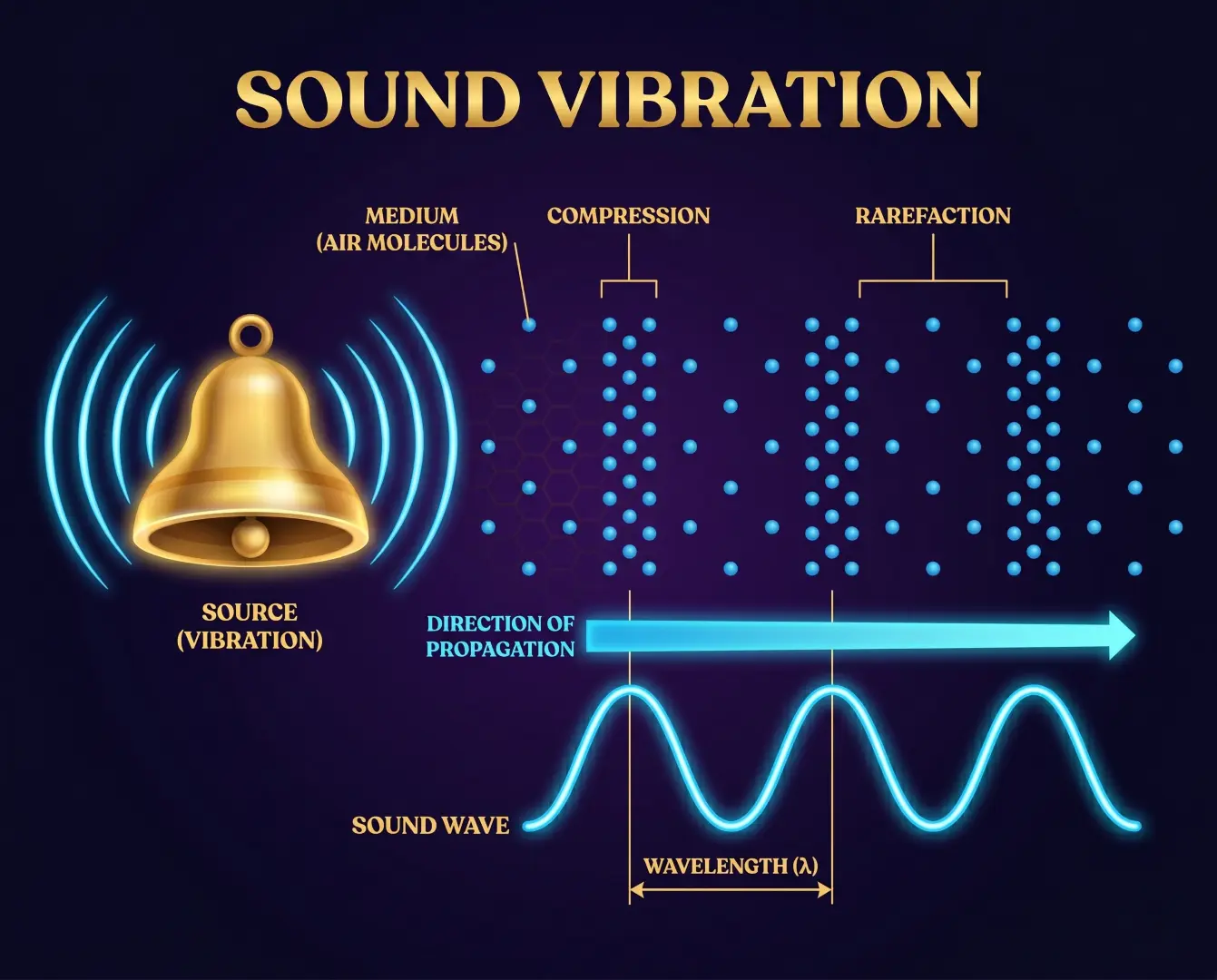
Sound is often described as a wave, but it is a special kind of wave. It is a longitudinal wave, which means the particles of the medium move back and forth in the same direction as the wave travels. That is different from many water waves, where the motion looks more up and down.
How Sound Energy Is Created
Sound energy starts when an object vibrates. The vibration may be small or powerful, slow or fast, gentle or intense. Once the object moves, it disturbs nearby particles in the medium. Those particles then disturb the next particles, and the energy spreads outward.
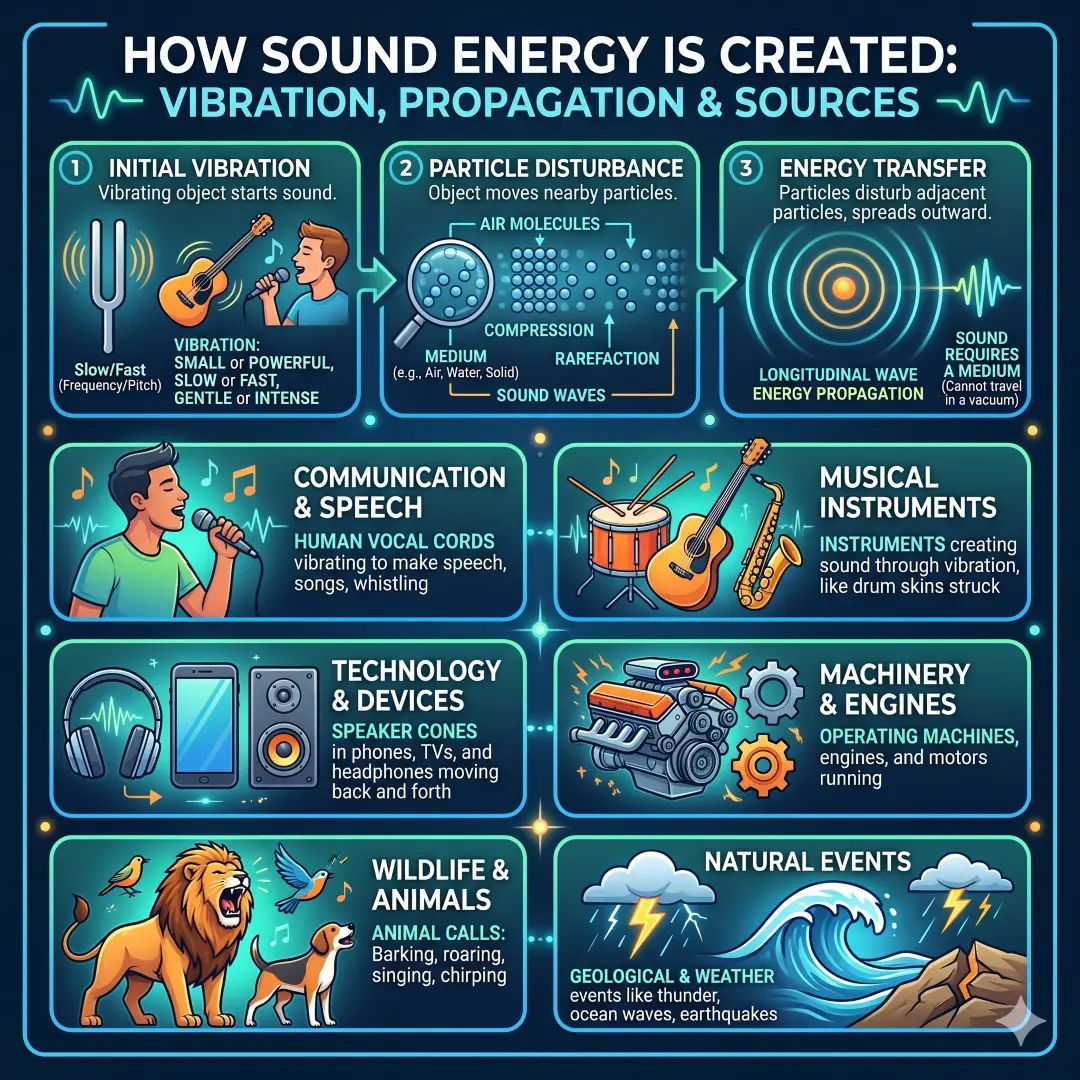
Here are some common sources of sound energy:
- Human vocal cords, when we speak or sing
- Drum skins when they are struck
- Speaker cones in phones, TVs, or headphones
- Machine parts when engines or motors run
- Animal calls such as barking, chirping, or roaring
- Natural events like thunder, earthquakes, and ocean waves
Sound is always tied to motion. No vibration, no sound. That simple idea explains a huge part of the sound we hear every day.
How Sound Energy Travels
Sound moves by passing energy from one particle to the next. In air, this means one air molecule pushes the next air molecule, and that chain reaction continues until the sound reaches your ear. The sound itself is not the air moving across the room. It is the energy moving through the air.
The speed of sound depends on the medium. In dry air at 0 °C, the speed of sound is about 331.29 meters per second. In liquid water at 8 °C, it is about 1,439 meters per second. So sound travels much faster in water than in air.
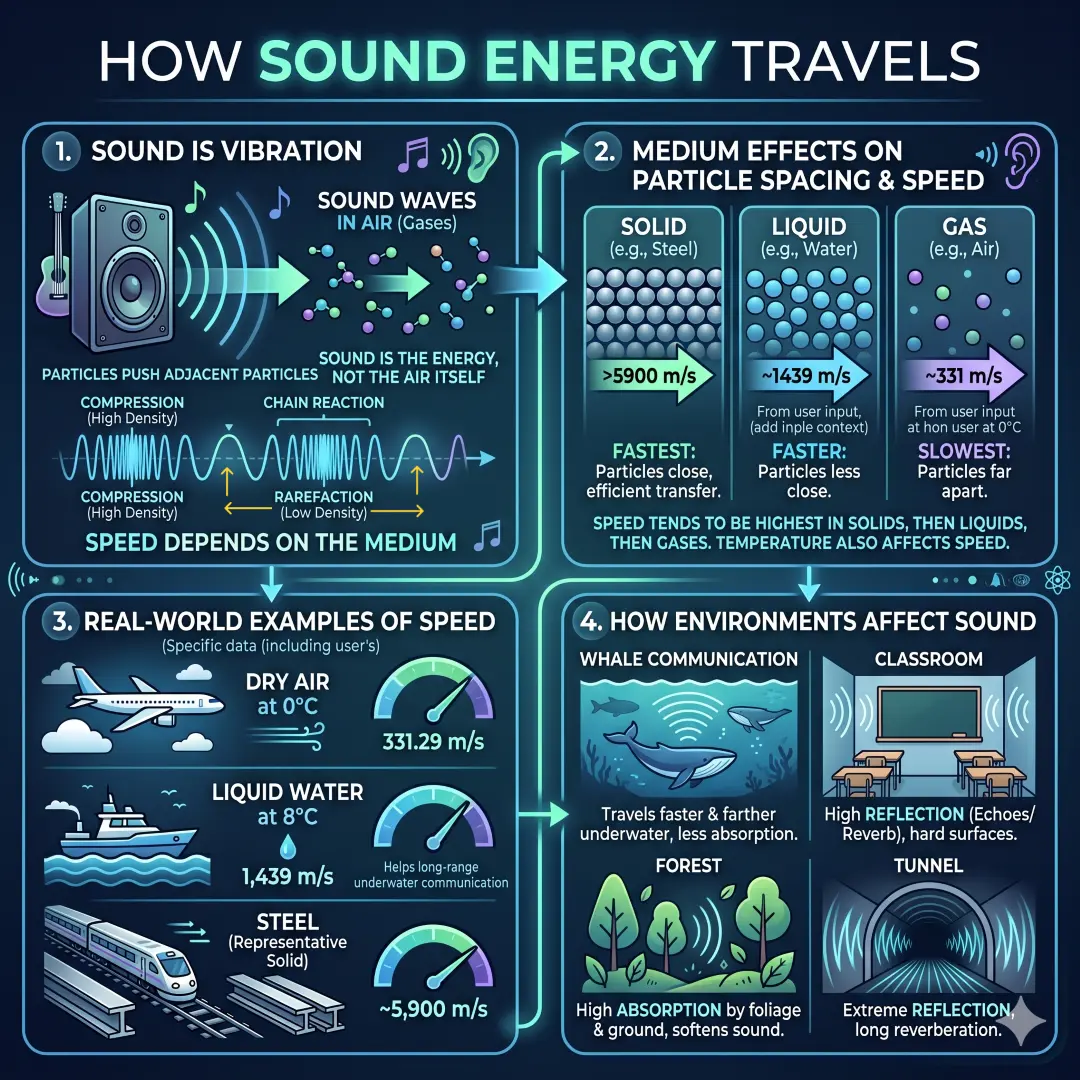
That difference matters in real life. It is one reason whales can communicate over long distances underwater, and one reason sound behaves differently in a classroom, a forest, a tunnel, or the ocean. The material around the sound changes how quickly and how clearly the energy moves.
Main Properties of Sound Energy
Sound has several important properties. These help us describe sound more accurately and explain why one sound feels different from another.
1. Frequency
Frequency is how many waves pass a point in one second. It is measured in hertz (Hz). Frequency affects pitch, which is how high or low a sound seems.
2. Amplitude
Amplitude is the size of the wave. A bigger amplitude usually means more energy. It is closely tied to loudness.
3. Intensity
Sound intensity is the amount of energy flowing per unit area per unit time. In simple terms, it tells us how strong the sound is at a given point.
4. Wavelength
Wavelength is the distance between two matching points on a wave, like one compression to the next. It helps describe the structure of sound waves.
5. Speed
The speed of sound is how fast sound waves move through a medium. It changes with the material and conditions around it.
6. Timbre
Timbre is the unique quality or tone of a sound. It is why a violin and a flute playing the same note still sound different.
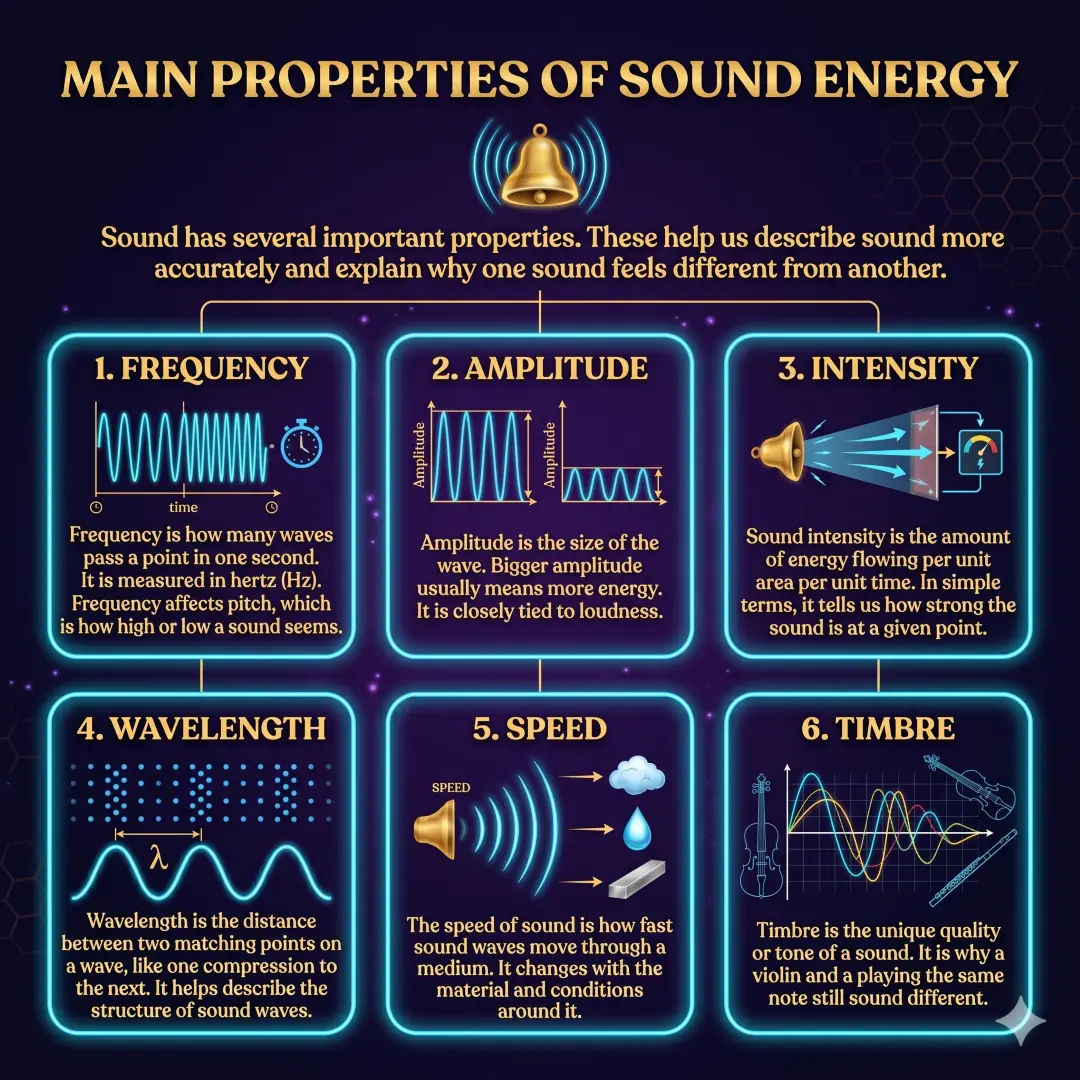
Table 1. Key Properties of Sound Energy
| Property | Meaning | Why It Matters |
|---|---|---|
| Frequency | Number of wave cycles per second | Helps determine pitch |
| Amplitude | Height or strength of the wave | Affects loudness and energy |
| Intensity | Energy flowing through a unit area | Helps measure sound strength |
| Wavelength | Distance between repeating wave points | Helps describe wave structure |
| Speed | How fast sound moves through a medium | Changes with air, water, or solids |
| Timbre | Unique quality of a sound | Helps us tell instruments and voices apart |
Sound Energy in Everyday Life
Sound energy is everywhere. You hear it from the moment you wake up until you fall asleep. It is so normal that people often forget how useful it is.
Some everyday examples include:
- Talking on the phone
- Listening to music
- Hearing a door knock
- Using an alarm
- Enjoying birdsong in the morning
- Listening to a teacher in class
- Hearing a car horn in traffic
- Following a voice in a crowded room
Sound is one of the main ways humans share information. A single voice can carry emotion, warning, comfort, direction, and memory. A laugh can lift the mood. A siren can alert people to danger. A whisper can create privacy. That is the beauty of sound energy. It is physical, but it also shapes human experience in a deeply personal way.
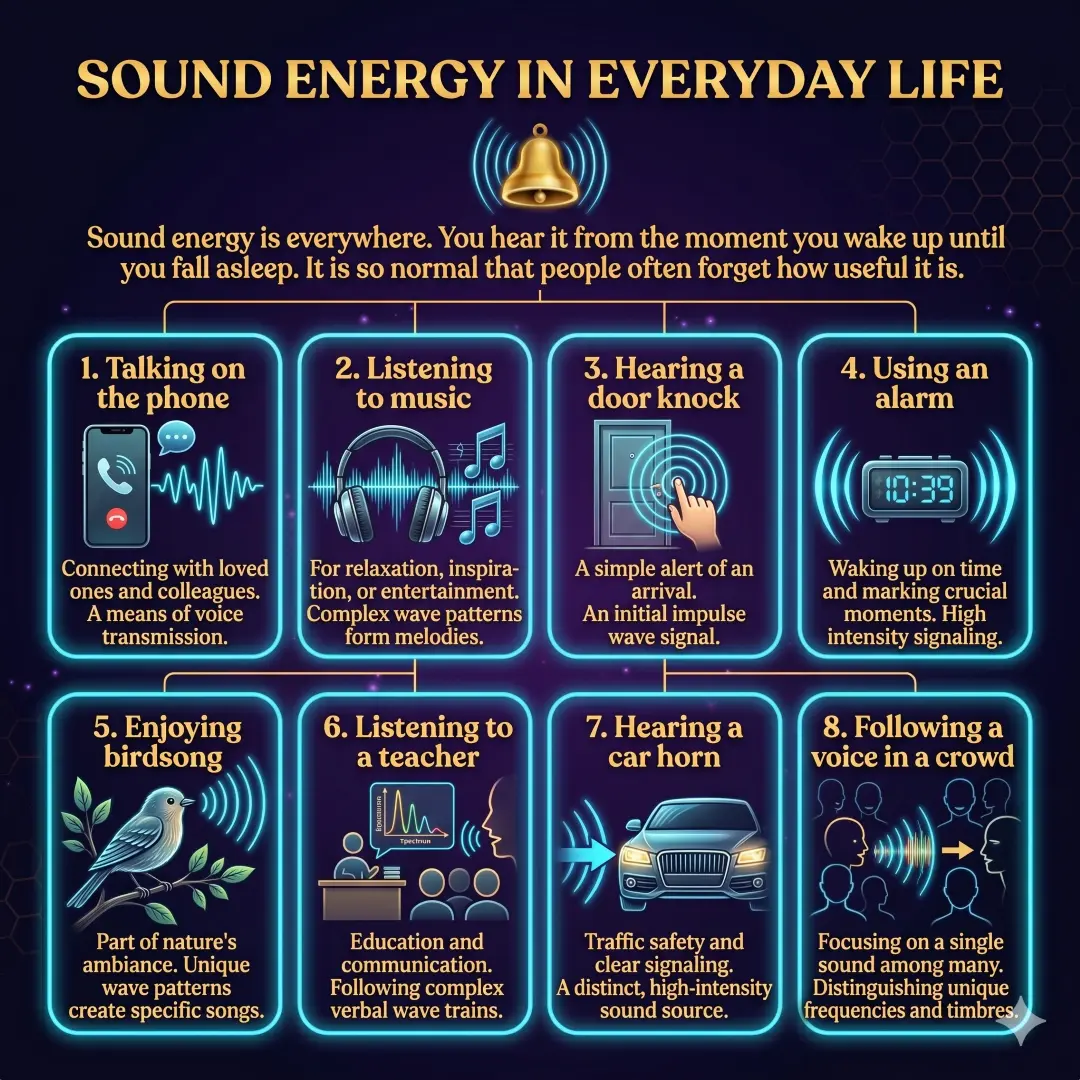
Table 2. Everyday Examples of Sound Energy
| Situation | Source of Sound Energy | What Happens |
|---|---|---|
| Talking | Vibration of vocal cords | Air carries the sound to another person |
| Drumming | Struck drum surface | The surface vibrates and sends sound outward |
| Music playback | Speaker cone movement | Electrical energy becomes sound energy |
| Clapping | Hands striking together | Impact creates vibration and sound |
| Door closing | Movement and collision | Energy turns into a sharp sound |
| Rain falling | Water droplets hitting surfaces | Tiny impacts create repeated sounds |
How Humans Hear Sound
The human ear is an incredibly sensitive system. It catches sound waves, converts them into signals, and sends those signals to the brain. Humans can generally detect sounds from about 20 Hz to 20 kHz. In many adults, the upper limit is lower than that, especially with age.
The ear does not just hear sound. It sorts it. It helps us recognize speech, notice direction, sense distance, and react to danger. That is why hearing is so important in daily life. Without sound, communication becomes harder, and many warning signs become less noticeable.
The most sensitive speech region for human hearing is often around the frequencies used in conversation, roughly in the middle range, where speech sounds are easiest to understand. That is one reason why a clear voice matters so much in classrooms, meetings, and public spaces.
Table 3. Audible Sound, Infrasound, and Ultrasound
| Type of Sound | Frequency Range | Basic Idea | Common Examples |
|---|---|---|---|
| Infrasound | Below about 20 Hz | Too low for normal human hearing | Earthquakes, avalanches, volcano activity, some large natural events |
| Audible sound | About 20 Hz to 20 kHz | Within human hearing range | Speech, music, traffic, animal sounds |
| Ultrasound | Above about 20 kHz | Too high for normal human hearing | Medical imaging, bat echolocation, industrial testing |
The broad idea is simple. Infrasound is below the normal hearing range, audible sound is what most people can hear, and ultrasound is above human hearing. Some animals, such as bats, can use ultrasound for navigation and hunting.
Pitch, Loudness, and Intensity
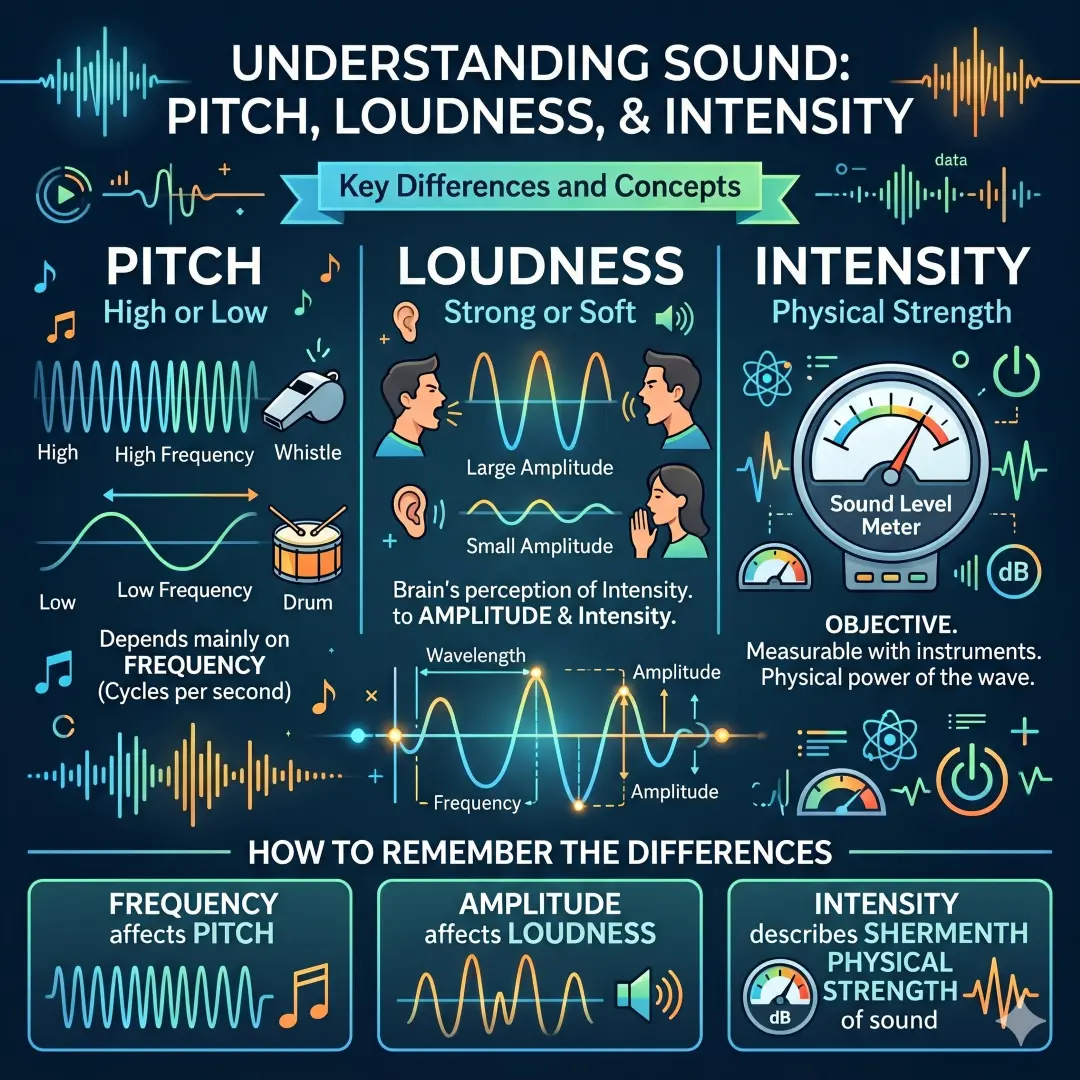
People often mix up pitch and loudness, but they are not the same.
Pitch tells us whether a sound seems high or low. It depends mainly on frequency. A whistle usually has a higher pitch than a drum.
Loudness tells us how strong or soft a sound seems. It is connected to amplitude and intensity. A sound with a bigger amplitude usually feels louder.
Intensity is more objective. It can be measured with instruments. Loudness is how the brain interprets intensity. That is why two people may describe the same sound differently.
A useful way to remember the difference:
- Frequency affects pitch
- Amplitude affects loudness
- Intensity describes the physical strength of the sound
What Are Decibels?
Sound is often measured in decibels (dB). A decibel is a unit used to describe sound intensity and sound pressure level. It is a logarithmic scale, which means it handles very small and very large values compactly.
The decibel scale is useful because the range of human hearing is huge. The weakest sound we can hear is far quieter than the loudest sound our ears can safely handle. A logarithmic scale makes that range easier to work with.
Sound level matters because loud noise can damage hearing. Prolonged or sudden exposure to very loud sounds can lead to noise-induced hearing loss, and the damage can be permanent.
Table 4. Sound and the Human Experience
| Sound Example | Common Feeling or Use | Why It Matters |
|---|---|---|
| Soft music | Calm, relaxed mood | Can reduce stress and improve atmosphere |
| Speech | Communication | Helps people share ideas and emotions |
| Siren | Alert or urgency | Warns people to move or pay attention |
| Birdsong | Pleasant and natural | Often linked with peaceful surroundings |
| Loud machinery | Fatigue or discomfort | Can be stressful over time |
| Echo in a hall | Spacious or dramatic effect | Shows how sound reflects from surfaces |
Sound is not only a physical event. It is also part of memory, comfort, and culture. A song can bring back childhood. A familiar voice can make someone feel safe. A certain sound can remind us of home, school, rain, festivals, or travel.
Sound Energy in Nature
Nature is full of sound energy. Some of it is gentle. Some of it is powerful. And some of it, like thunder or a crashing wave, can be impossible to ignore.
Examples include:
- Birds calling in trees
- Wind moving through grass
- Rain hitting rooftops
- Thunder during storms
- Ocean waves breaking on shore
- Animals use sound to communicate
- Insects buzzing in the evening
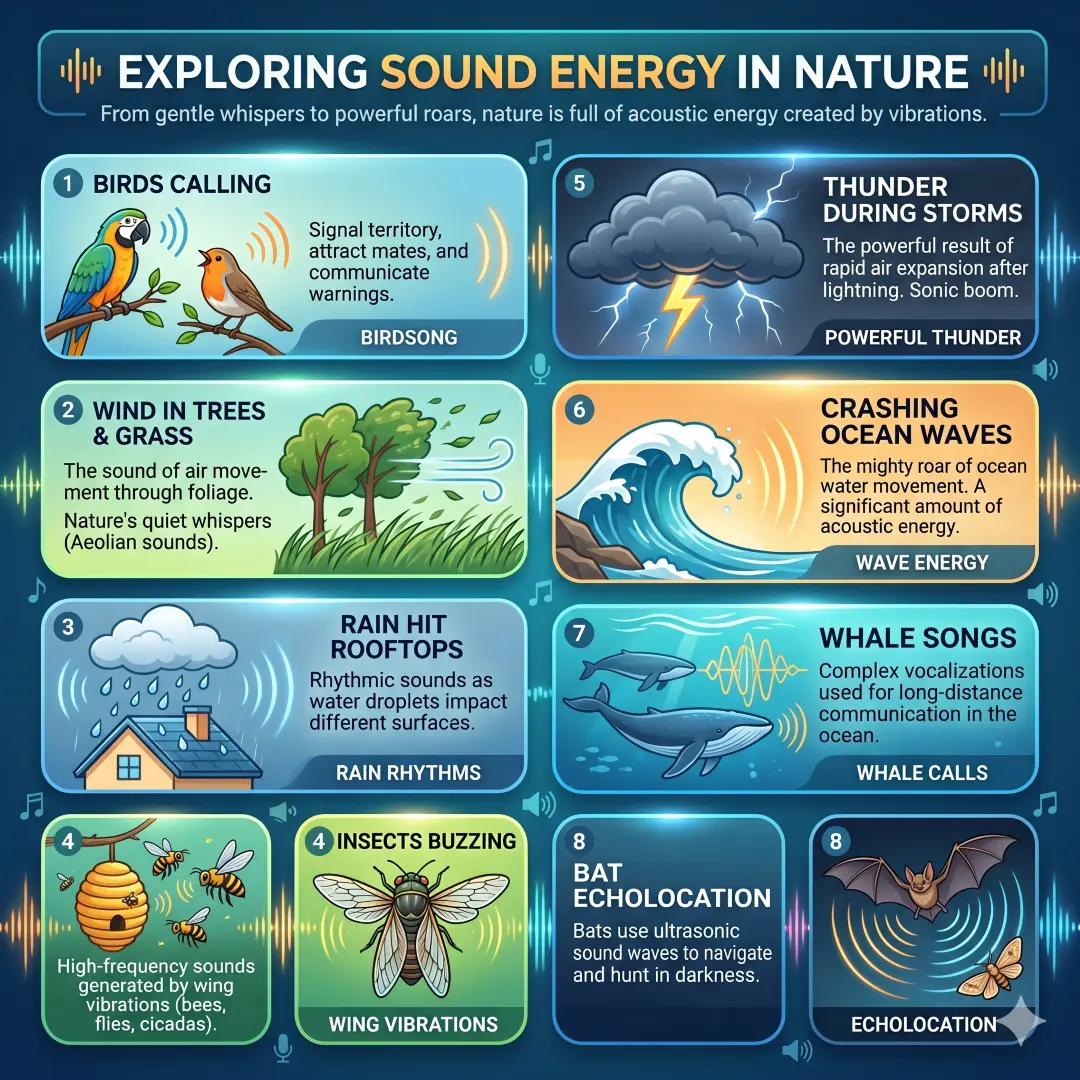
These sounds are not random. They often serve a purpose. Birds use sound to attract mates or mark territory. Many animals use sound to warn others. Whales and dolphins use sound in water because sound travels so well there.
Nature also reminds us that sound can be both beautiful and practical. A gentle stream may calm us, while a loud thunderclap may make us take shelter.
Sound Energy in Technology
Modern technology depends on sound energy in many ways. In fact, a huge part of daily life would feel incomplete without it.
Common examples include:
- Telephones and smartphones
- Radio and television
- Headphones and speakers
- Microphones
- Recording devices
- Doorbells and alarms
- Navigation systems
- Medical imaging tools
A microphone converts sound energy into electrical signals. A speaker does the opposite and turns electrical signals back into sound. That simple exchange is at the heart of music playback, video calls, broadcasting, and many other tools.
Technology has also made sound easier to store, edit, and share. People can record a voice note, trim a podcast, or replay a concert at home. Sound may be ancient, but the tools around it keep evolving.
Table 5. Sound Energy in Technology
| Device | What Sound Does | Practical Use |
|---|---|---|
| Microphone | Converts sound to an electrical signal | Recording, calls, broadcasting |
| Speaker | Converts an electrical signal to sound | Music, videos, announcements |
| Headphones | Deliver sound close to the ear | Private listening |
| Alarm clock | Produces an alert sound | Wakes people up |
| Sonar equipment | Uses sound waves in water | Navigation and detection |
| Ultrasound scanner | Uses high-frequency sound | Medical imaging |
Ultrasound and Infrasound in Real Life
Ultrasound is sound above the human hearing range. It is widely used in medicine, especially in imaging. It is also used in industry, cleaning systems, and animal behavior studies. Bats are one of the best-known natural users of ultrasound because it helps them locate objects and prey.
Infrasound is sound below the hearing range. Even though humans usually cannot hear it clearly, it still exists and can sometimes be detected by the body under certain conditions. It is associated with some natural events, including earthquakes, avalanches, and volcanic activity.
This is a useful reminder that the world is full of sounds we do not always hear. Human hearing is powerful, but it is only part of the larger acoustic picture.
Sound Energy and Health
Sound can be helpful, comforting, and necessary. But too much sound can become harmful. Noise-induced hearing loss happens when sound is too loud, too long, or both. It can damage the delicate structures in the inner ear.
Health concerns related to excessive sound include:
- Permanent hearing damage
- Temporary ringing in the ears
- Difficulty understanding speech
- Stress and fatigue
- Reduced concentration
- Sleep disturbance
This is why hearing care matters. The ear is not designed to handle endless loud noise. Once damaged, hearing does not always recover fully.
Some useful habits for hearing safety are:
- Keep the volume at a sensible level
- Take breaks from loud environments
- Stand farther away from loudspeakers or machinery
- Use ear protection when needed
- Pay attention when sound feels painful or overwhelming
Table 6. Simple Ways to Protect Hearing
| Situation | Safer Choice | Why It Helps |
|---|---|---|
| Listening to music | Keep volume moderate | Reduces strain on the ear |
| At a concert | Move away from the speakers | Lowers sound intensity |
| Using tools or machines | Wear ear protection | Blocks harmful noise |
| Traveling in traffic | Avoid long exposure to honking and engine noise | Helps reduce daily noise load |
| Using earbuds | Take regular breaks | Gives ears time to recover |
| Working in a noisy place | Follow safety rules | Prevents long-term hearing damage |
Sound Energy in Communication
Sound is one of the oldest communication tools on Earth. Before written language, before phones, before the internet, there was voice, rhythm, and signal.
Humans use sound to:
- Speak
- Sing
- Warn
- Teach
- Comfort
- Celebrate
- Organize groups
- Tell stories
This is why sound energy is not just a physics topic. It is a social tool. It shapes friendships, families, classrooms, workplaces, and entire cultures. A conversation can move emotions. A chant can unite a crowd. A bell can guide a village. A song can travel across generations.
Sound Energy in Science and Experimentation
Sound has been studied for centuries because it is both visible in its effects and measurable in science. Scientists analyze how sound reflects, bends, spreads, and changes through different materials. This field is often called acoustics, the science of sound.
Some important scientific ideas related to sound include:
- Reflection, which can create an echo
- Absorption, when a material soaks up sound
- Transmission, when sound passes through a medium
- Resonance, when an object vibrates strongly at a certain frequency
- The Doppler effect, when sound seems to change pitch because the source is moving
These ideas help explain why some rooms echo, why some materials reduce noise, and why a passing ambulance sounds different as it moves toward and away from you.
Table 7. Sound Behavior in Different Situations
| Effect | What Happens | Example |
|---|---|---|
| Reflection | Sound bounces off a surface | Echo in a canyon |
| Absorption | Sound is reduced by the material | Curtains softening a room |
| Transmission | Sound passes through something | Hearing through a wall |
| Resonance | An object vibrates strongly | A musical instrument body |
| Doppler effect | Pitch appears to change | Passing siren |
Why Sound Energy Is So Important
Sound energy matters because it connects the physical world to human life in a direct way. It helps us hear danger, enjoy music, understand speech, and learn from the environment. It also helps doctors, engineers, musicians, and scientists do their work.
Here is a simple summary of why sound energy is important:
- It supports communication
- It helps with safety
- It enriches music and art
- It supports medical technology
- It helps scientists study matter and movement
- It gives us clues about the environment around us
Without sound, the world would feel much less connected. That is why sound energy is such a central part of life, even when we do not think about it.
Common Misunderstandings About Sound Energy
People often misunderstand sound in a few ways.
- Misunderstanding 1: Sound is just noise
- Not true. Sound can be music, speech, warning signals, nature, or silence broken by a small vibration.
- Misunderstanding 2: A loud sound is always a better sound
- Not true. A very loud sound can be damaging and unpleasant.
- Misunderstanding 3: Sound can travel anywhere
- Not true. Sound needs a medium, so it cannot travel through a vacuum.
- Misunderstanding 4: Pitch and loudness mean the same thing
- Not true. Pitch depends mainly on frequency. Loudness depends mainly on amplitude and intensity.
A Simple Way to Remember Sound Energy
Think of sound as a message carried by vibration.
- Something vibrates
- The vibration disturbs the medium
- The disturbance travels as a sound wave
- Your ear receives it
- Your brain interprets it
That is the heart of sound energy in one neat chain.
Final Thoughts
Sound energy is simple on the surface and rich underneath. It is a form of energy created by vibration, carried through a medium, and understood by the ear and brain. It shapes communication, science, music, safety, health, and daily life. It can be soft or powerful, useful or harmful, natural or man-made. It can warn us, calm us, teach us, and move us.
Once you start noticing it, sound is everywhere. In the hum of a room, the beat of a song, the echo of footsteps, the call of birds, the hum of machines, and the quiet of night, sound energy keeps working in the background. It is one of the most familiar things in life, and still one of the most fascinating.
Article References and Sources
- Encyclopedia Britannica: Sound Physics
- Encyclopaedia Britannica: Sound Intensity
- Encyclopaedia Britannica: How Does Sound Travel?
- Encyclopaedia Britannica: Speed of Sound
- NCBI: Human Hearing Range and Auditory System
- NCBI: Speech and Hearing Science
- NCBI: Ultrasound and High Frequency Sound
- National Institutes of Health: Infrasound Research Study
- NIDCD: How Sound Is Measured
- NIDCD: Noise-Induced Hearing Loss
- NIDCD: How Noise Damages Hearing
- Encyclopaedia Britannica: Acoustics and Sound Science
Also, Read these Articles in Detail
- Physics and Its Fundamentals With Good Explanations
- Matter, Motion, and Energy: The Core Ideas of Physics
- What Is Matter? The Physical Substance of the Universe
- What Is Motion? A Guide to Motion in Physics and Daily Life
- What Is Energy? The Invisible Power Behind Everyday Life
- Kinetic Energy Explained in Simple Language
- Potential Energy: Definition, Types, Formula, and Examples
- Thermal Energy: Heat, Temperature, and Transfer
- Mechanical Energy: Definition, Formula, and Examples
- Chemical Energy: Definition, Science, and Examples
- Electrical Energy: Definition, Works, and Why It Matters
- Radiant Energy: Meaning, Sources, Examples, and Uses
- Nuclear Energy: Definition, How It Works, and Why It Matters
Frequently Asked Questions
FAQ 1: What is sound energy, and how does it work?
Sound energy is the energy produced when something vibrates and sends those vibrations through a material such as air, water, wood, or metal. In simple terms, sound begins when an object moves back and forth quickly enough to disturb the particles around it. Those particles then pass the vibration along, and that moving disturbance reaches our ears as sound.
This is why sound is often described as a mechanical wave. It does not travel by itself in empty space. It needs a medium to carry it. That medium can be air in a room, water in the ocean, or even solid materials like a metal pipe. Without a medium to carry the vibration, sound cannot travel.
A good way to picture it is to think about a bell. When the bell is struck, it starts vibrating. The air nearby also begins to move in small, repeated motions. That motion spreads outward in all directions. By the time it reaches your ear, your brain interprets it as the sound of a bell.
Sound energy is not just something we hear. It is also something that moves energy from one place to another. That makes it a real and important form of energy, not just a feeling or a noise. It helps people talk, helps musicians create music, helps machines give warnings, and helps nature communicate in countless ways.
In everyday life, sound energy is all around us. We hear it in speech, music, footsteps, traffic, alarms, animals, and weather. It is one of the most familiar forms of energy, yet it is easy to overlook because it is always there. But once you think about it, sound becomes much more interesting. It is energy in motion, and it shapes a huge part of human life.
FAQ 2: How is sound energy created?
Sound energy is created when an object vibrates. That vibration may come from a person speaking, a guitar string being plucked, a drum being struck, or a machine motor running. The key idea is simple. When something moves back and forth, it pushes the surrounding particles and creates sound waves.
The source of the sound is always the starting point. For example, when you speak, your vocal cords vibrate as air passes through them. Those vibrations create sound waves that move through the air. When someone else listens, their ears pick up those waves and turn them into meaning.
The same thing happens with many other objects. A speaker turns electrical energy into sound by making a cone vibrate. A drumhead vibrates after it is hit. A car engine vibrates as it runs. Even natural events like thunder involve energy being released and turned into sound.
It helps to remember that sound is not the object itself. It is the result of the object moving. A quiet object does not make sound because there is no vibration strong enough to disturb the nearby medium. That is why a still table is silent, but a tapped table produces a clear sound.
Sound energy is often a change from another form of energy. In a microphone, sound can become electrical energy. In a speaker, electrical energy becomes sound energy. In a drum, motion from a hand or stick becomes vibration, and the vibration becomes sound. This energy change is one reason sound is so useful in technology and daily life.
So, when you hear a sound, you are hearing motion. You are hearing a vibration turned into a wave that travels outward and reaches your ear. That simple process is behind almost every sound in the world.
FAQ 3: Why does sound need a medium to travel?
Sound needs a medium because it travels by moving particles from one place to another. It does not move through empty space on its own. This is one of the most important ideas in sound energy, and it explains why sound behaves the way it does.
When an object vibrates, it pushes on nearby particles. Those particles then push on the next ones, and the disturbance spreads. If there are no particles, there is nothing to push. That means no sound can travel through a vacuum.
This is why space is silent in the normal sense. Even though explosions or collisions might create sound on a planet or in a spacecraft, that sound cannot move through empty space the way it can in air or water. There is no material medium to carry the wave.
Different media carry sound in different ways. In the air, sound moves at a moderate speed. In water, it moves faster. In solids, sound can often travel even faster because the particles are packed more tightly together. That makes it easier for vibration to pass from one particle to the next.
This idea has many real-world examples. You can often hear a train on the tracks before you can hear it clearly through the air. You can also hear a knock better through a solid door than through open air in some situations. These examples show how the medium affects sound travel.
So, the need for a medium is not just a theory. It is the reason sound works the way it does everywhere around us. No medium means no sound, at least not the kind we normally hear. That one fact explains a lot about the physics of sound.
FAQ 4: What are the main properties of sound energy?
Sound energy has several important properties that help us understand and measure it. These include frequency, amplitude, intensity, wavelength, speed, and timbre. Each one tells us something different about the sound we hear.
Frequency is the number of wave cycles that pass in one second. It is measured in hertz (Hz). Frequency is closely related to pitch, which is how high or low a sound seems. High-frequency sounds usually seem high-pitched, while low-frequency sounds usually seem low-pitched.
Amplitude is the size or strength of the wave. Bigger amplitude usually means a stronger sound and more energy. It is closely connected to loudness. A loud sound usually has a larger amplitude than a soft sound.
Intensity tells us how much sound energy flows through a certain area in a given time. It is a more physical measurement than loudness. Loudness is how we perceive intensity with our ears and brain.
Wavelength is the distance between two matching points in a wave, such as one compression to the next. It helps describe the structure of the wave.
Speed tells us how quickly the sound travels through the medium. This changes depending on whether the sound is moving through air, water, or a solid.
Timbre is the unique quality or character of a sound. It is what makes one instrument sound different from another, even if they are playing the same note.
These properties work together. They help us describe speech, music, machine noise, animal calls, and natural sounds in a clear way. Without them, sound would be much harder to study and understand.
FAQ 5: What is the difference between pitch, loudness, and intensity?
These three terms are closely related, but they are not the same.
Pitch is the quality that helps us hear whether a sound is high or low. It depends mainly on frequency. A whistle has a high pitch because its vibrations are fast. A drum has a lower pitch because its vibrations are slower.
Loudness is how strong or soft a sound seems to our ears. It is tied to amplitude, which is the size of the wave. A sound with a larger amplitude usually feels louder. A smaller amplitude usually feels softer.
Intensity is the physical amount of sound energy passing through an area in a given time. It is something that can be measured scientifically. Loudness, on the other hand, is partly about human perception. Two people may hear the same sound and describe it slightly differently.
A simple way to remember the difference is this:
- Pitch tells you how high or low a sound is
- Loudness tells you how strong or soft it seems
- Intensity tells you the actual physical power of the sound
A high-pitched sound is not always loud. A loud sound is not always high-pitched. And a sound with high intensity may still be heard differently depending on the listener and the environment.
This is why music, speech, and noise all feel different even when they share similar energy. Your ear and brain do not just measure sound. They interpret it. That interpretation is shaped by pitch, loudness, and intensity working together.
FAQ 6: How do humans hear sound energy?
Humans hear sound energy through a very sensitive system called the ear. The process starts when sound waves enter the outer ear and travel inward. Those waves cause parts of the ear to move, and the movement is then turned into signals that the brain can understand.
First, the sound waves travel through the ear canal and make the eardrum vibrate. Those vibrations move through tiny bones in the middle ear. Then the vibrations reach the inner ear, where they are changed into electrical signals. The auditory nerve sends those signals to the brain, and the brain interprets them as sound.
This process happens very quickly. It allows us to understand speech, enjoy music, and react to danger almost instantly. It also helps us tell where a sound is coming from, whether it is moving, and whether it is getting louder or softer.
Humans usually hear sounds in the range of about 20 Hz to 20,000 Hz. Sounds below that range are called infrasound, and sounds above it are called ultrasound. Most adults cannot hear those extreme ranges naturally, though some animals can.
Hearing is not only about music and conversation. It is also a safety tool. We rely on sound to notice alarms, approaching vehicles, warning signals, and other important events. That is why protecting hearing matters so much.
So when you hear a voice, a song, or a bell, your ears are doing far more than just sensing vibration. They are translating energy into meaning. That is one of the most remarkable things about the human body.
FAQ 7: What are infrasound and ultrasound?
Infrasound and ultrasound are two types of sound that fall outside the normal human hearing range.
Infrasound refers to sound waves with a frequency below about 20 Hz. Most people cannot hear them clearly, but they still exist and can sometimes be detected by instruments or felt under certain conditions. Infrasound is often linked with natural events such as earthquakes, volcanic activity, avalanches, and large storms.
Ultrasound refers to sound waves above about 20,000 Hz. Humans cannot normally hear these frequencies, but many animals can. Bats, for example, use ultrasound to navigate and catch prey. Dolphins use it in water, and scientists and doctors use it in medical imaging and other tools.
These sounds matter because they show that the world contains much more sound than human ears can directly notice. Just because we cannot hear a wave does not mean it is not there. Sound is larger than human hearing.
Ultrasound is especially useful in medicine. It helps doctors create images of the inside of the body without surgery. It is also used in industry for checking materials and in cleaning devices. Infrasound is important in science because it can help researchers study events that are too large or too distant to hear normally.
This is one of the fascinating things about sound energy. The same basic wave idea can cover everything from a baby’s cry to a whale call to a hospital scan. The frequency changes, the use changes, but the principle stays the same.
FAQ 8: Why is sound energy important in daily life?
Sound energy is important because it helps people live, work, learn, and connect with one another. It is one of the main ways humans communicate. Without sound, speech, music, alarms, and many forms of guidance would be far more difficult.
In daily life, sound helps in many ways:
- It allows us to talk to each other
- It lets us listen to music and entertainment
- It helps us hear warnings like alarms and sirens
- It gives us clues about our surroundings
- It helps teachers, doctors, drivers, and workers do their jobs
- It creates atmosphere in homes, public spaces, and events
Sound also carries emotion. A calm voice can comfort someone. A joyful laugh can brighten a room. A sad song can reflect how a person feels. These things are hard to measure, but they matter deeply.
Sound is also essential in the natural world. Birds use sound to communicate. Animals use sound to warn, attract, or locate. Even the weather and water create sounds that tell us something about the environment.
In technology, sound energy is just as important. Phones, speakers, microphones, radios, and alarms all rely on sound. Medical tools also use sound in useful ways. That makes sense both practical and personal.
So, sound energy is not just a physics topic in a book. It is part of everyday life. It supports safety, connection, learning, and enjoyment. It would be hard to imagine modern life without it.
FAQ 9: Can sound energy be harmful?
Yes, sound energy can be harmful when it is too loud, too frequent, or too long-lasting. While sound is useful and necessary, excessive noise can damage hearing and affect health.
One of the biggest risks is noise-induced hearing loss. This can happen when a person is exposed to very loud sound for too long or to sudden, intense noise. The inner ear is delicate, and once it is damaged, the harm may be permanent.
Sound can also cause other problems. Loud or constant noise can lead to stress, irritation, poor concentration, tiredness, and sleep problems. People living or working in noisy environments often feel these effects more strongly.
Some common harmful sources of sound include:
- Very loud music
- Traffic noise
- Heavy machinery
- Construction sites
- Fireworks
- Sirens at close range
- Long exposure to headphones at high volume
The good news is that many of these risks can be reduced. Keeping the volume lower, taking breaks from noise, standing farther away from loud sources, and using ear protection can all help.
This does not mean sound is bad. It means sound should be respected. Just like too much sun or too much heat can be harmful, too much sound can also cause problems. Healthy hearing depends on balance.
So yes, sound energy can be damaging, but only when it crosses a safe limit. In normal amounts, sound is one of the most useful parts of life. In excessive amounts, it becomes a real health concern.
FAQ 10: What are some real-life examples of sound energy?
Sound energy appears in countless real-life situations, and once you start looking for it, you notice it everywhere. It is in the voice of a friend, the crack of thunder, the ring of a phone, and the beat of a drum.
Some clear examples include:
- Speaking and singing
Your vocal cords vibrate, and sound travels through the air. - Musical instruments
A guitar string, piano string, drumhead, or flute column of air produces sound through vibration. - Machines and engines
Motors, fans, and vehicles make sound as their parts move. - Animal sounds
Birds chirp, dogs bark, frogs croak, and whales call using sound energy. - Weather events
Thunder, wind, rain, and waves all create sound. - Warning systems
Alarms, bells, and sirens use sound to get attention quickly. - Communication devices
Phones, radios, and speakers turn signals into sound so people can hear them.
These examples show that sound energy is not limited to one place or one purpose. It appears in nature, in homes, in cities, in schools, in hospitals, and in technology. It is part of both simple life and advanced science.
And that is what makes sound so interesting. It is ordinary, but it is never small. A tiny vibration can become a message, a memory, a warning, or a song. That is sound energy at work.
