Elastic energy is one of those ideas in physics that sounds technical at first, but it shows up all around us in ordinary life. Every time you stretch a rubber band, compress a spring, bend a bow, or squash a trampoline mat, you are dealing with elastic energy. It is the energy stored in an object when it changes shape and then tries to return to its original shape.
That simple idea matters a lot. It helps explain how everyday objects work, why some materials feel soft while others feel stiff, and how machines, toys, buildings, and even parts of the human body handle force. It also connects to bigger ideas in physics, mechanics, force, work, and energy transfer.
This article takes a full, practical look at elastic energy in a way that is easy to follow. It explains what it is, how it works, where it appears, how to calculate it, and why it matters in science and daily life. It also includes examples, tables, and clear comparisons so the whole topic feels less abstract and more useful.
Table of Contents
What Is Elastic Energy?
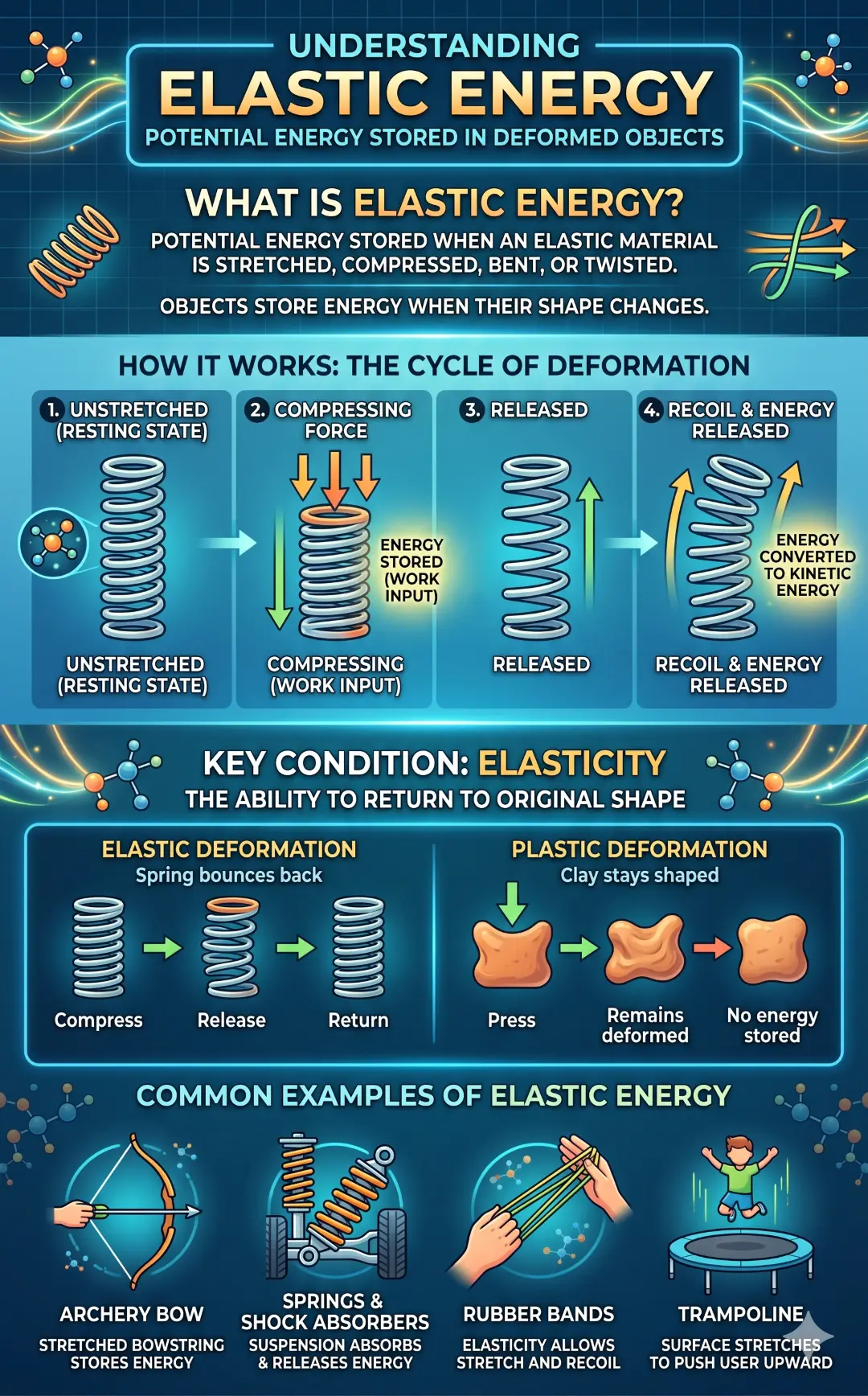
Elastic energy is the potential energy stored in an object when it is stretched, compressed, bent, or twisted, as long as the object can return to its original shape after the force is removed.
That means the object is not just changing shape. It is storing energy because of that change.
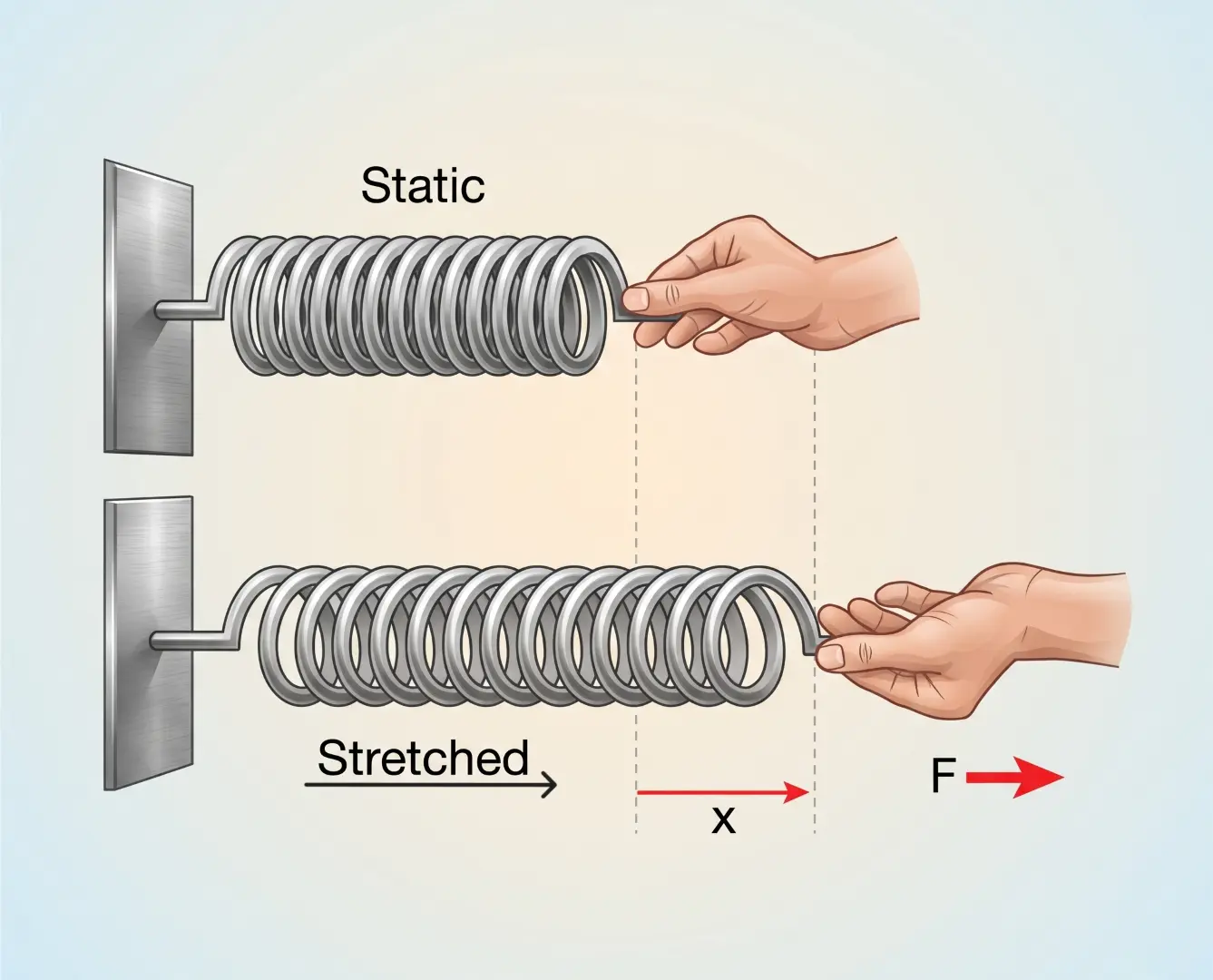
A good example is a spring. When you compress a spring, you put energy into it. The spring resists that change and stores the energy. When you let go, the stored energy is released, and the spring pushes back to its original length.
This is why elastic energy is also closely related to the idea of elasticity, which is a material’s ability to return to its original shape after being deformed.
The Basic Idea Behind Elastic Energy
The idea is actually very human and very physical. Materials do not like being forced out of shape. When you stretch a material, the atoms and molecules inside it move slightly from their normal positions. The material resists this change. That resistance is what stores energy.
So, in simple language:
- Force changes the shape of an object
- The object resists that change
- The energy used to deform it gets stored
- When the force stops, the object may release that stored energy
This is why a stretched bowstring can shoot an arrow, why a rubber ball bounces, and why a spring mattress feels springy.
Elasticity and Elastic Energy
To understand elastic energy, you also need to understand elasticity.
Elasticity is the ability of a material to return to its original size and shape after being stretched, compressed, or otherwise deformed.
A material with high elasticity can be deformed a lot and still recover. A material with low elasticity may stay bent, broken, or changed.
Here is the connection:
- Elasticity is the property of the material
- Elastic energy is the energy stored because of that property
A rubber band has good elasticity. A lump of clay does not. If you stretch a rubber band, it stores elastic energy and snaps back. If you bend clay, it stays bent because it does not behave elastically in the same way.
How Elastic Energy Is Stored
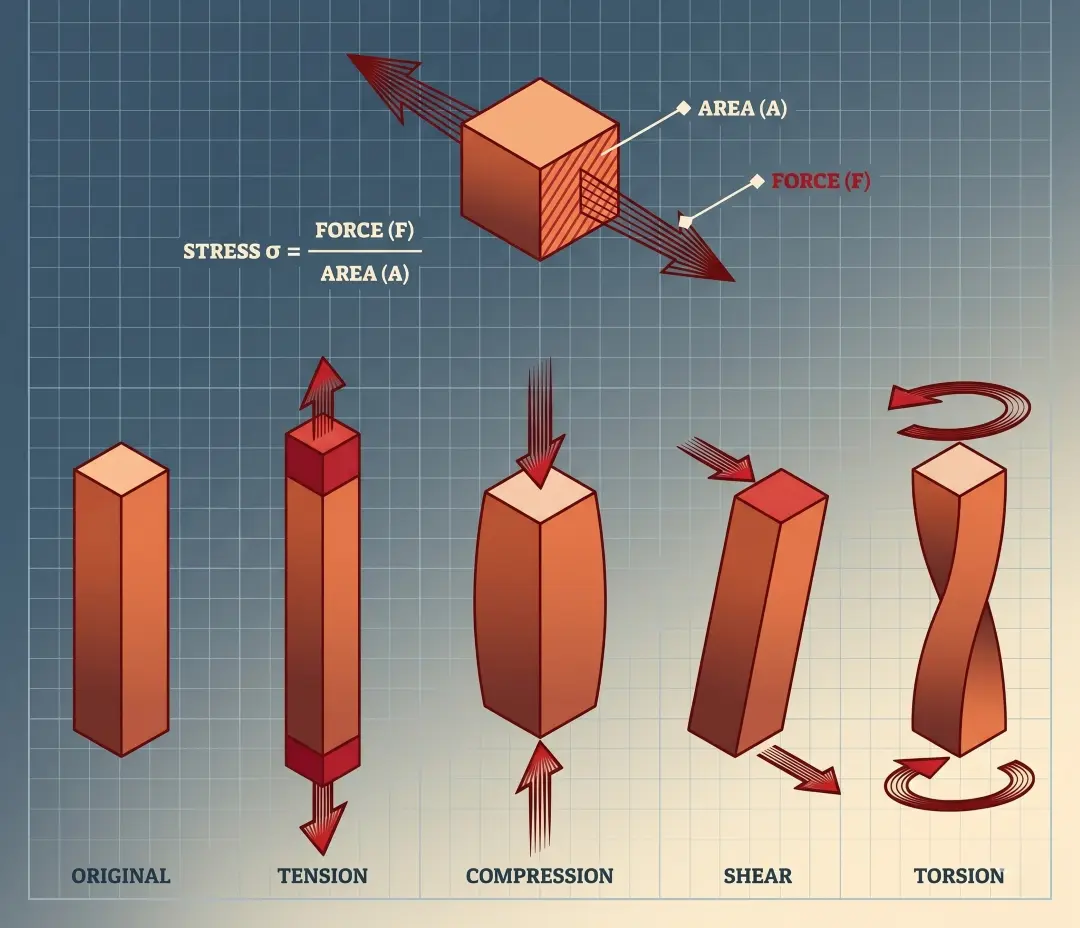
Elastic energy is stored when a material is deformed. The deformation can be one of several kinds.
1. Stretching
When you pull an object longer than its normal size, it stores energy.
Examples:
- Rubber bands
- Bungee cords
- Tension springs
2. Compressing
When you squeeze or shorten an object, it stores energy.
Examples:
- Springs
- Foam cushions
- Car suspension systems
3. Bending
When an object is bent, some elastic energy may be stored.
Examples:
- Fishing rods
- Archery bows
- Flexible plastic rulers
4. Twisting
When an object is twisted, it can also store energy.
Examples:
- Twisted wires
- Torsion springs
- Some engine components
The object must remain within its elastic limit for this to work properly. If the force is too great, the object may not return to its original shape.
A Simple Everyday Example
Think about stretching a spring toy.
When you pull it, you do work on the spring. That work does not disappear. It becomes stored as elastic potential energy. When you let the spring go, the stored energy turns back into motion. The spring moves, recoils, and returns toward its original form.
This is one of the most important ideas in physics. Energy is not created from nothing. It changes form.
Elastic Potential Energy and Elastic Energy
People often use the phrases elastic energy and elastic potential energy almost interchangeably.
Strictly speaking, elastic potential energy is the full physics term. It is a form of potential energy stored in an elastic object because of its shape change.
In everyday writing, though, elastic energy is a simpler and widely understood phrase. Both ideas point to the same thing in practice:
energy stored in an object because it has been elastically deformed
The Scientific Formula for Elastic Energy
For many springs, the elastic energy stored can be calculated using the formula:
Elastic Potential Energy = (1/2) × k × x²
Where:
- k = spring constant
- x = displacement from the original position
This formula is often written as:
E = (1/2) kx²
What the symbols mean
- E = elastic potential energy
- k = stiffness of the spring
- x = how far the spring is stretched or compressed
The key idea here is that the more the spring is stretched or compressed, the more energy it stores. And a stiffer spring stores more energy for the same amount of deformation.
What Is the Spring Constant?
The spring constant is a measure of how stiff a spring is. It tells you how much force is needed to stretch or compress a spring by a certain amount.
- A large spring constant means the spring is stiff
- A small spring constant means the spring is soft
For example:
- A strong metal spring in a machine may have a large k
- A soft rubber band may have a smaller effective stiffness
This matters because different materials store elastic energy differently. A stiff spring and a soft spring will not behave the same way under the same force.
Why the Formula Uses the Square of Displacement
The formula uses x², which means the displacement is squared.
That means if you double the stretch or compression, the energy does not just double. It increases much more.
For example:
- Stretching a spring by 2 units stores 4 times as much energy as stretching it by 1 unit, if the spring stays within its elastic range
That is why a small extra stretch can make a big difference.
Work and Elastic Energy
Work is the transfer of energy when a force moves an object. When you stretch or compress something, you do work on it.
That work becomes stored as elastic energy.
This relationship is very important:
- Work done on the object becomes elastic energy
- When the object returns to shape, that energy becomes motion or another form of energy
This is why a stretched spring can move a toy car, or why a compressed spring in a click pen can push the ink mechanism forward.
Elastic Energy in Real Life
Elastic energy is not just a classroom idea. It appears in many useful places.
- Springs
- Springs are one of the clearest examples. They store energy when compressed or stretched.
- Trampolines
- When a person lands on a trampoline, the mat and springs stretch and store energy. Then that energy helps launch the person upward.
- Bows and Arrows
- When an archer pulls back the bowstring, the bow stores elastic energy. Releasing the string converts that energy into the arrow’s motion.
- Rubber Bands
- A stretched rubber band stores energy and then releases it quickly when let go.
- Car Suspension
- Vehicle suspensions use springs and shock absorbers to store and control energy from bumps in the road.
- Clock Mechanisms
- Some clocks and mechanical toys use springs to store energy and keep moving.
- Ball Sports
- When a ball hits the ground, it deforms slightly and stores some elastic energy before bouncing back.
Table 1: Common Examples of Elastic Energy
| Object | How It Stores Elastic Energy | What Happens Next | Everyday Example |
|---|---|---|---|
| Rubber band | Stretched by pulling | Snaps back quickly | Holding papers together |
| Spring | Compressed or extended | Returns to original shape | Click pens, toys |
| Trampoline | Mat and springs deform | Pushes person upward | Jumping and bouncing |
| Bow | Limbs bend under tension | Launches arrow | Archery |
| Bouncy ball | Deforms on impact | Rebounds upward | Sports and play |
| Mattress coil | Springs compress under body weight | Provides support and rebound | Beds and cushions |
| Car suspension | Springs compress on bumps | Smooths the ride | Vehicles on rough roads |
Table 2: Elastic, Plastic, and Rigid Behavior
| Type of Behavior | Meaning | Returns to Original Shape? | Example |
|---|---|---|---|
| Elastic | Shape changes temporarily | Yes | Spring, rubber band |
| Plastic | Shape changes permanently | No | Bent paper clip after overbending |
| Rigid | Does not deform easily | Usually very little | Stone, thick metal block |
This table matters because not every material acts the same way. Some materials are highly elastic, some are permanently deformed when pushed too far, and some barely change shape at all.
The Elastic Limit
Every elastic material has a limit.
The elastic limit is the maximum amount a material can be stretched, compressed, or bent and still return to its original shape.
If you stay within that limit, the material behaves elastically. If you go beyond it, the material may become permanently deformed or even break.
What happens when the elastic limit is exceeded
- The material may not return to its original shape
- It may lose its ability to store energy properly
- It may become damaged
- It may break
This is why a rubber band can only be stretched so far before it snaps. And it is why a metal spring can be overloaded.
Hooke’s Law and Elastic Energy
A major idea linked to elastic energy is Hooke’s Law.
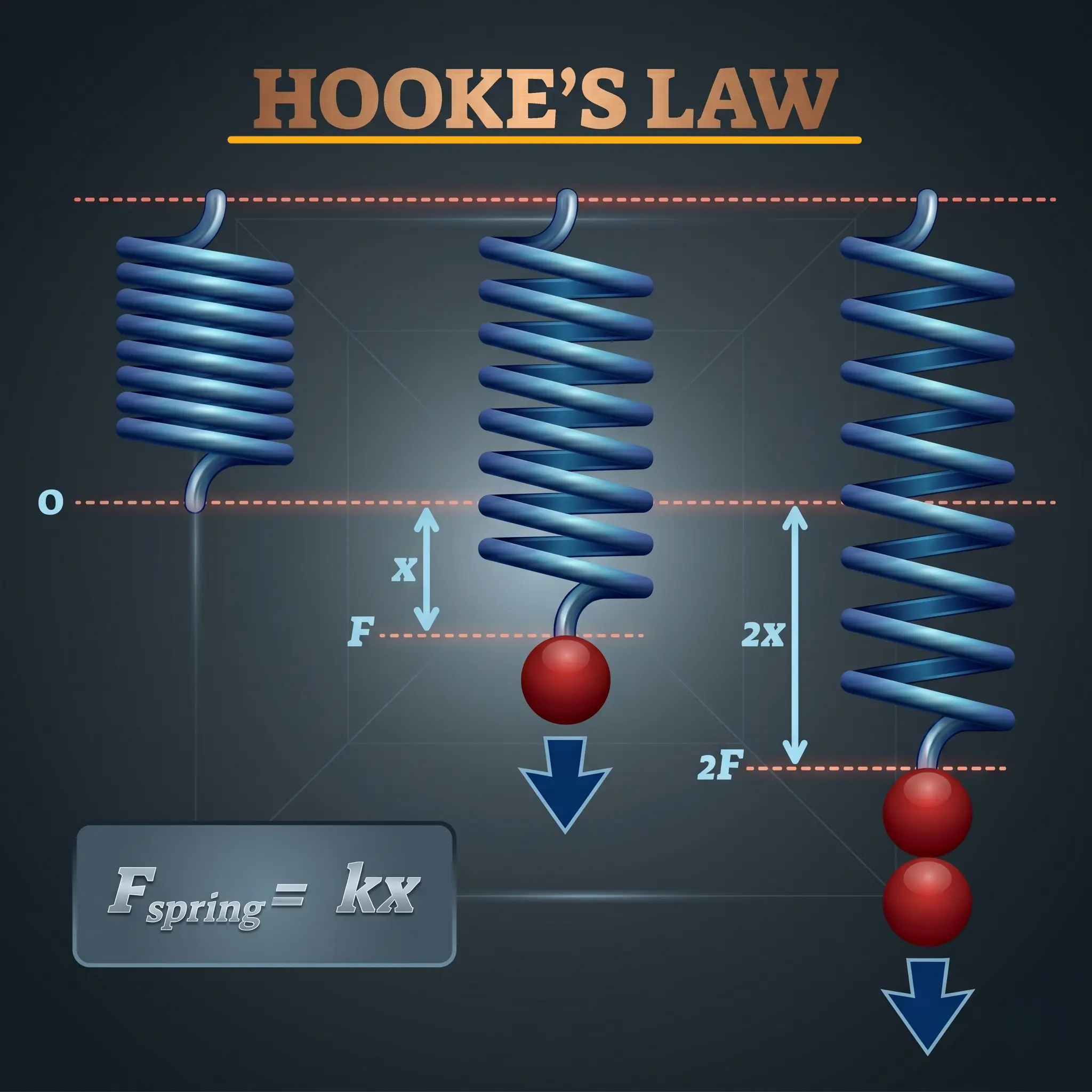
Hooke’s Law says that the force needed to stretch or compress a spring is proportional to the distance it is stretched or compressed, as long as the spring is not stretched beyond its elastic limit.
In simple form:
F = kx
Where:
- F = force
- k = spring constant
- x = displacement
This law helps explain how springs behave in many systems.
What Hooke’s Law tells us
- More stretch means more force
- Stiffer springs need more force
- The relationship is predictable within the elastic range
Hooke’s Law and the elastic energy formula work together. One describes force, and the other describes stored energy.
How Elastic Energy Changes Into Other Forms of Energy
Elastic energy does not stay stored forever unless the object remains deformed. When the object is released, the energy changes form.
Elastic energy can become:
- Kinetic energy when the object moves
- Sound energy when an object snaps or bounces
- Heat energy because of internal friction
- Light energy in rare cases, through certain materials or devices
A bouncing ball is a good example. When it hits the floor:
- It slows down
- It flattens slightly
- It stores elastic energy
- It rebounds upward
- Some energy is lost as heat and sound
That is why no bounce is perfectly efficient.
Why No Real Object Is Perfectly Elastic
In real life, no object is perfectly ideal. Some energy is always lost.
A perfectly elastic object would return all the stored energy without any loss. But in reality, materials lose some energy to:
- Heat
- Sound
- Internal friction
- Permanent deformation
That is why a ball does not bounce back to the exact same height every time. And it is why a spring eventually wears out after repeated use.
Elastic Energy vs Kinetic Energy
These two forms of energy are often connected, but they are not the same.
| Elastic Energy | Kinetic Energy |
|---|---|
| Stored in a deformed object | Energy of motion |
| Exists when the object is stretched or compressed | Exists when the object is moving |
| Can turn into motion when released | Can arise from released elastic energy |
| Example: compressed spring | Example: moving toy car |
A spring is a good bridge between the two. When compressed, it stores elastic energy. When released, that energy becomes kinetic energy.
Elastic Energy vs Gravitational Potential Energy
Both are forms of potential energy, but they come from different causes.
| Elastic Energy | Gravitational Potential Energy |
|---|---|
| Stored by changing shape | Stored by raising an object to a height |
| Depends on stretch or compression | Depends on position in a gravitational field |
| Example: stretched rubber band | Example: book on a shelf |
| Released when the object returns to shape | Released when the object falls |
This comparison helps show that potential energy is not one single thing. It has different forms depending on what kind of energy is stored and where it comes from.
Materials That Store Elastic Energy Well
Not all materials behave the same way. Some store elastic energy better than others.
Materials with strong elastic behavior
- Steel springs
- Rubber
- Latex
- Some plastics
- Special elastic fabrics
Materials with weak elastic behavior
- Clay
- Wet dough
- Chalk
- Brittle materials
- Some ceramics
The structure of the material matters. Metals can be very good at returning to shape within their limit. Rubber can stretch a lot and still recover. Clay, on the other hand, keeps the new shape.
Why Rubber Feels So Elastic
Rubber is famous for its elasticity because its long molecular chains can stretch and then return to their original arrangement.
That is why rubber bands can be pulled far without breaking, at least to a point. Their molecules behave in a flexible way. The material stores and releases energy efficiently.
This is one reason rubber is used in:
- Bands
- Seals
- Tires
- Shock-absorbing parts
- Elastic cords
Elastic Energy in Sports
Sports are full of elastic energy, even when people do not think about it.
Examples in sports
- A pole vaulter bends the pole, storing elastic energy before rising upward
- A tennis racket strings deform slightly when hitting the ball
- A basketball compresses on the court and bounces back
- A diving board bends under weight and then springs the diver upward
- A bowler’s shoe sole can compress slightly for comfort and support
This energy transfer helps athletes move, bounce, launch, and absorb impact.
Elastic Energy in Engineering
Engineers use elastic energy in many practical systems because it can store and release energy in a controlled way.
Engineering uses include
- Vehicle suspensions
- Bridges
- Shock absorbers
- Mechanical clocks
- Pressure valves
- Safety devices
- Actuators
- Construction materials
For example, a bridge must handle loads from traffic, wind, and temperature changes. Some flex is normal and even useful. The structure stores and releases small amounts of elastic energy while staying safe.
Elastic Energy and Safety
Elastic energy can be helpful, but it can also be dangerous if not controlled.
A spring under high tension can snap back suddenly. A stretched cable can recoil with force. A compressed object can release energy quickly.
That is why safety matters in:
- Construction
- Manufacturing
- Vehicle repair
- Sports equipment
- Mechanical tools
Workers and engineers must understand elastic behavior so they can avoid accidents.
Table 3: Advantages and Limitations of Elastic Energy
| Advantages | Limitations |
|---|---|
| Stores energy efficiently | Not all energy is recovered |
| Can be released quickly | Can be dangerous if overloaded |
| Useful in machines and tools | Materials can wear out |
| Supports motion and bounce | Has an elastic limit |
| Helps absorb shock | Can cause permanent deformation |
This table shows why elastic energy is so useful, but also why it has to be used with care.
Elastic Energy in the Human Body
The human body also uses elastic energy.
Examples in the body
- Tendons store and release small amounts of elastic energy during movement
- Muscles and connective tissues stretch and recoil
- The Achilles tendon helps with walking, running, and jumping by acting like a spring
- The chest wall and lungs have elastic properties that help breathing
This is one of the reasons walking, running, and jumping are smoother and more efficient than they would be without elasticity.
Why Elastic Energy Matters in Daily Life
You may not notice it, but elastic energy is everywhere.
It helps:
- Hold objects together
- Absorb shock
- Create bounce
- Improve comfort
- Store energy in tools
- Make movement efficient
Even simple things like writing with a click pen or sitting on a cushioned chair involve elastic behavior in some way.
Table 4: Elastic Energy in Daily Life
| Item | Elastic Part | Function |
|---|---|---|
| Click pen | Small spring | Pushes the tip in and out |
| Mattress | Coils and foam | Supports body weight |
| Shoes | Sole materials | Absorb impact while walking |
| Wristband | Elastic fiber | Fits snugly around the wrist |
| Toy launcher | Spring or rubber band | Launches a projectile |
| Door closer | Spring mechanism | Helps doors shut smoothly |
| Hair tie | Stretchable material | Holds hair in place |
This table shows that elastic energy is not a rare scientific curiosity. It is built into many useful objects.
How to Think About Elastic Energy in Simple Words
A simple way to understand it is this:
If something is pushed, pulled, bent, or twisted and it wants to go back, it is likely storing elastic energy.
That little sentence captures the heart of the concept.
Common Misunderstandings About Elastic Energy
People sometimes mix up a few ideas.
- Misunderstanding 1: Any stretched object has endless elastic energy
- Not true. Every material has limits.
- Misunderstanding 2: Elastic energy only exists in springs
- Not true. It exists in many objects, including rubber bands, balls, bows, and tissues in the body.
- Misunderstanding 3: If something stretches, it must be elastic
- Not always. Some objects stretch and then stay changed. That is plastic deformation, not elastic behavior.
- Misunderstanding 4: Elastic energy is the same as motion
- Not the same. It becomes motion only when released.
A Closer Look at Real-World Examples
- The trampoline
- When someone jumps, the mat stretches and stores energy. Then it pushes back. That push is what helps send the person upward. The trampoline works because elastic energy is stored and released in a controlled cycle.
- The bow and arrow
- The bow bends when the string is pulled. Energy is stored in the bow limbs. When the string is released, the arrow gains speed. This is a direct conversion from elastic energy to kinetic energy.
- The bouncing ball
- A ball briefly changes shape on contact with the ground. That deformation stores energy. The ball then regains its shape and bounces. Some energy is always lost, which is why each bounce is lower than the last.
- The spring mattress
- The coils compress under body weight and support the person. That is useful elastic behavior. It helps distribute weight and improves comfort.
Table 5: Energy Conversion Examples
| Situation | Energy Before | Energy During | Energy After |
|---|---|---|---|
| Stretching a rubber band | Chemical energy from muscles | Elastic energy stored in band | Kinetic energy when released |
| Jumping on trampoline | Kinetic energy from jump | Elastic energy in mat and springs | Kinetic energy upward |
| Pulling a bow | Muscular energy | Elastic energy in bow | Kinetic energy of arrow |
| Dropping a ball | Gravitational potential energy | Elastic energy at impact | Kinetic energy after bounce |
This table makes the process easier to picture. Energy moves from one form to another, but it does not vanish.
Why Elastic Energy Is Important in Physics
Elastic energy is a key topic in physics because it helps explain how forces affect materials.
It connects with:
- Newton’s laws of motion
- Work and energy
- Stress and strain
- Material science
- Mechanical systems
- Wave motion
- Oscillations
Without elastic energy, many systems in the physical world would be much harder to explain. Springs, vibrations, impacts, and many forms of motion all rely on it.
Stress and Strain
To understand elasticity more deeply, it helps to know stress and strain.
Stress
Stress is the force applied per unit area inside a material.
Strain
Strain is the amount the material changes shape compared with its original size.
When a material is stretched or compressed, it experiences stress and strain. If the material stays within its elastic range, it can store elastic energy and return to normal.
These are important concepts in engineering because they help determine whether a structure is safe and stable.
How Temperature Can Affect Elastic Energy
Temperature can change how materials behave.
- Some materials become less elastic in very cold conditions
- Some become softer in heat
- Rubber can behave differently depending on temperature
- Metals can expand or contract with temperature changes
That matters in real life because a spring, tire, or rubber band may not perform exactly the same way in every climate.
Elastic Energy and Oscillations
When a spring moves back and forth, it can create oscillations.
An oscillation is repeated motion around a central position.
A classic example is a mass attached to a spring. If you pull it down and let go, the system moves up and down. The elastic energy in the spring changes into kinetic energy and back again in a repeating cycle.
This is the basis of:
- Spring toys
- Vibrating systems
- Mechanical watches
- Some scientific instruments
How Elastic Energy Helps Reduce Shock
Elastic materials can absorb impact. This is very useful.
When a car hits a bump, the suspension compresses and stores some energy temporarily. That reduces the force felt by passengers. The same idea works in shoes, helmets, protective pads, and many safety devices.
Without elasticity, impacts would be much harsher.
Table 6: Elastic Energy in Safety and Comfort
| Application | Elastic Feature | Benefit |
|---|---|---|
| Car suspension | Springs and dampers | Smooth ride |
| Running shoes | Flexible sole | Reduced impact on joints |
| Protective helmet padding | Compressible foam | Shock absorption |
| Office chair cushion | Elastic foam | Comfort during sitting |
| Gym mat | Soft elastic surface | Safer landings |
This is one of the clearest examples of how science improves daily life. Elastic energy is not just theory. It helps protect people.
What Happens When Elastic Energy Is Released Too Fast?
If elastic energy is released suddenly, the result can be dramatic.
Examples include:
- A snapped rubber band
- A spring jumping loose
- A stretched cable recoiling
- A toy launcher firing a projectile
That sudden release can be useful, like in a bow and arrow. But it can also be risky. That is why people should handle tensioned materials carefully.
Elastic Energy in Technology and Machines
Many machines use elastic components because they are reliable, simple, and efficient.
Some examples are:
- Clamps
- Switches
- Key mechanisms
- Engine valves
- Timing systems
- Safety latches
These parts often rely on springs or flexible materials to create a controlled force. Elastic energy helps machines reset, close, open, or return to a starting position.
Why Some Objects Bounce More Than Others
Not every object bounces the same way.
A superball bounces much more than a lump of clay because it stores and releases elastic energy effectively. A clay ball barely bounces because it does not recover its shape well.
A bouncing object usually needs:
- Good elasticity
- Low energy loss
- A shape that deforms and recovers well
This is why balls used in sports are designed carefully. Their bounce depends on how much elastic energy they can store and release.
The Connection Between Elastic Energy and Material Design
Engineers and designers often choose materials based on how much elastic energy they need them to store.
For example:
- Tires need flexibility and resilience
- Springs need controlled stiffness
- Sports gear needs impact absorption
- Clothing elastics need stretch and recovery
- Building materials need safe deformation under load
This is a practical science decision. The right material can make a product stronger, safer, more comfortable, and longer lasting.
Table 7: Material Choice and Elastic Performance
| Material | Elastic Behavior | Best Used For |
|---|---|---|
| Rubber | Very stretchy | Bands, seals, grips |
| Steel | Strong and springy | Springs, tools, machinery |
| Foam | Compressible | Cushions, padding |
| Plastic | Varies by type | Clips, casings, flexible parts |
| Fabric with elastic fiber | Stretchable and recoverable | Clothing, straps |
This shows how material science and elastic energy go hand in hand.
How Students Can Understand Elastic Energy Better
A student can build a strong mental picture of elastic energy by remembering these points:
- It is stored energy
- It appears when something changes shape
- The object must be able to return to its original shape
- The energy is released when the object recovers
- It often turns into movement
That is enough to understand most classroom examples.
Helpful classroom examples
- Stretching a spring
- Pulling a slingshot
- Compressing foam
- Bending a ruler
- Bouncing a ball
Everyday Signs That Elastic Energy Is at Work
You can spot elastic energy in ordinary moments:
- A shoelace stretches when tied
- A chair cushion compresses under weight
- A door stopper deforms slightly on impact
- A gym ball bounces under pressure
- A hair tie returns to shape after being stretched
These small examples make the concept feel less abstract and more familiar.
Table 8: Quick Review of Key Terms
| Term | Meaning |
|---|---|
| Elastic energy | Energy stored when an object is deformed |
| Elasticity | Ability to return to original shape |
| Potential energy | Stored energy |
| Kinetic energy | Energy of motion |
| Spring constant | Measure of stiffness |
| Hooke’s Law | Force is proportional to displacement in elastic systems |
| Elastic limit | Maximum deformation before permanent change |
| Deformation | Change in shape or size |
| Stress | Force per unit area |
| Strain | Relative change in shape or length |
This table works as a fast reference and helps tie the whole topic together.
A Simple Way to Remember Elastic Energy
Here is an easy memory sentence:
Stretch it, compress it, bend it, or twist it, and if it wants to spring back, it may be storing elastic energy.
That line captures the spirit of the concept in a plain, useful way.
Why Elastic Energy Is So Useful in the Real World
Elastic energy matters because it helps the world work smoothly.
It allows:
- Motion to be stored and released
- Shocks to be absorbed
- Objects to bounce and recover
- Machines to reset and repeat
- Bodies to move efficiently
- Structures to flex safely
That is a powerful list for something people often first meet in school physics.
Final Thoughts on Elastic Energy
Elastic energy is one of the best examples of how simple physics ideas connect to real life. It appears in the spring of a pen, the bounce of a ball, the pull of a bow, the comfort of a mattress, and the movement of the human body. It is invisible most of the time, but its effects are easy to see.
The basic rule is straightforward. When an object is stretched, compressed, bent, or twisted within its elastic limit, it stores energy. When the force is removed, that energy is released. Sometimes it becomes motion. Sometimes it becomes sound or heat. And sometimes it is used to do useful work in machines, sports, or daily life.
Once you start looking for it, elastic energy shows up everywhere. It is in the things we use, the things we wear, the things we ride in, and the things we play with. It is a small idea with a very large presence.
If you understand elastic energy, you understand a key part of how the physical world holds itself together, bounces back, and keeps moving.
Article References and Sources
- Khan Academy: What Is Elastic Potential Energy?
- Khan Academy: Spring Potential Energy and Hooke’s Law Review
- Khan Academy: Intro to Springs and Hooke’s Law
- Khan Academy: Potential Energy Stored in a Spring
- Khan Academy: Learn and Try: Spring Force and Hooke’s Law
- Wikipedia: Hooke’s Law
- Khan Academy: Forces and Newton’s Laws of Motion
- Khan Academy: Newton’s First and Second Laws
- Khan Academy Video: Potential Energy Stored in a Spring
- Khan Academy Video: Intro to Springs and Hooke’s Law
Also, Read these Articles in Detail
- Physics and Its Fundamentals With Good Explanations
- Matter, Motion, and Energy: The Core Ideas of Physics
- What Is Matter? The Physical Substance of the Universe
- What Is Motion? A Guide to Motion in Physics and Daily Life
- What Is Energy? The Invisible Power Behind Everyday Life
- Kinetic Energy Explained in Simple Language
- Potential Energy: Definition, Types, Formula, and Examples
- Thermal Energy: Heat, Temperature, and Transfer
- Mechanical Energy: Definition, Formula, and Examples
- Chemical Energy: Definition, Science, and Examples
- Electrical Energy: Definition, Works, and Why It Matters
- Radiant Energy: Meaning, Sources, Examples, and Uses
- Nuclear Energy: Definition, How It Works, and Why It Matters
- Sound Energy: Definition, Science, and Examples
Frequently Asked Question
FAQ 1: What is elastic energy, and how does it work in everyday life?
Elastic energy is the energy stored in an object when it is stretched, compressed, bent, or twisted, as long as the object can return to its original shape afterward. It is a type of potential energy, which means the energy is stored and ready to be used later.
You see elastic energy in daily life more often than you might think. A stretched rubber band stores energy. A compressed spring stores energy. A trampoline stores energy when someone lands on it. A bow and arrow system stores energy when the string is pulled back. In each case, the object changes shape for a moment, and that change holds energy inside it.
The important thing is that the object must be elastic. That means it can go back to its normal shape after the force is removed. If a material stays bent or damaged, then it is no longer acting in a truly elastic way. A paper clip can be bent slightly and return to shape, but if it is bent too far, it may stay bent. That is where the idea of the elastic limit becomes important.
In simple words, elastic energy is what an object stores when you force it out of shape but not too far. It is part of why many everyday objects work smoothly. Pens click, balls bounce, mattresses support your body, and shoes absorb impact because of elastic behavior.
This idea matters in physics, engineering, and ordinary life. It helps explain how motion can be stored, delayed, and released. It also shows how energy moves from one form to another. A stretched object may look still, but it is quietly holding energy until that energy is released.
So, whenever you pull, push, squeeze, or bend something and it springs back, elastic energy is likely at work. It is one of the simplest and most useful ideas in the study of energy.
FAQ 2: What are the best examples of elastic energy in real life?
There are many strong examples of elastic energy in real life, and most of them are easy to notice once you know what to look for.
A classic example is a spring. When you compress or stretch a spring, it stores elastic potential energy. When you let it go, that stored energy turns into motion. This is why springs are used in pens, car suspensions, mechanical toys, and many other devices.
Another common example is a rubber band. If you stretch it, you are putting energy into it. That energy stays stored until you release it. Then the band snaps back. The same idea applies to elastic cords, hair ties, and bungee cords.
A trampoline is also a very good example. When someone lands on it, the surface stretches and the springs underneath compress. That stores energy, which helps push the person back into the air. This is a clear case of energy changing from kinetic energy to elastic energy and then back to kinetic energy again.
A bow and arrow is another simple but powerful example. When an archer pulls the bowstring, the bow bends and stores energy. Letting go transfers that energy into the arrow, sending it forward at high speed.
A bouncy ball also shows elastic energy in action. When it hits the ground, it changes shape for a moment. That deformation stores energy, and the ball then recovers its shape and bounces upward. Of course, not all the energy comes back. Some is lost as sound and heat.
There are also less obvious examples. Mattresses, shoe soles, protective padding, gym equipment, and even some parts of the human body use elastic properties. Tendons, for example, can act a little like springs by storing and releasing small amounts of energy during movement.
These examples show that elastic energy is not just a science lesson. It is part of how the world stays flexible, comfortable, and efficient.
FAQ 3: What is the difference between elastic energy and elastic potential energy?
In most everyday discussions, elastic energy and elastic potential energy are used to mean almost the same thing. Both refer to the energy stored in an object when it is deformed and can still return to its original shape.
Still, there is a small language difference. Elastic potential energy is the more formal physics term. It describes energy stored because of an object’s elastic deformation. The word potential means the energy is stored and can be used later. This is the same reason we say gravitational potential energy when an object is held at a height.
The shorter phrase elastic energy is more casual. People often use it because it is easier to say and easier to read. In most school-level explanations, blog posts, and everyday examples, the meaning is the same.
For example, when you stretch a rubber band, the energy stored in it can be called either elastic energy or elastic potential energy. When you compress a spring, the same thing is true. The object is holding energy because of its change in shape.
If you want to be especially precise in science writing, elastic potential energy is usually the better term. But in a simple article, elastic energy works well and still communicates the idea clearly.
So the difference is mostly about wording, not about the basic concept. Both terms point to the same physical idea, which is stored energy in an elastic object.
FAQ 4: How is elastic energy stored in a spring or rubber band?
Elastic energy is stored in a spring or rubber band when a force changes its shape. That force might stretch it, compress it, or bend it. The energy is stored because the material resists the change and wants to return to its normal shape.
Let’s take a spring first. When you compress a spring, the coils get pushed closer together. When you stretch it, the coils move farther apart. In both cases, the metal resists the change. The work you do by pushing or pulling the spring becomes stored energy. That stored energy is elastic potential energy.
A rubber band works in a similar way, although its structure is different. Rubber is made of long molecular chains that can stretch and then return to their original form. When you pull a rubber band, those chains straighten and rearrange. The energy you use to stretch it becomes stored in the material. When you let go, the chains relax back, and the band snaps into its old shape.
The key idea is that energy does not disappear. It changes form. Your hand does work on the spring or rubber band. That work becomes stored elastic energy. Then, when the object is released, the energy comes back out as motion, sound, or a little bit of heat.
This is why a spring can power a toy or why a rubber band can launch a small object. The energy was stored first, then released later. That two-step process is one of the most useful ideas in mechanics.
FAQ 5: What is Hooke’s Law, and why is it important for elastic energy?
Hooke’s Law is a rule that describes how many elastic objects behave when they are stretched or compressed. It says that the force needed to deform a spring is directly proportional to the distance it is stretched or compressed, as long as the spring stays within its elastic limit.
The simple form of the law is:
F = kx
Where:
- F is the force
- k is the spring constant
- x is the displacement or stretch
This law is important because it helps predict how much force is needed to stretch a spring and how much elastic energy it can store. A stiff spring has a larger spring constant, so it needs more force to stretch it the same distance. A softer spring has a smaller constant, so it stretches more easily.
Hooke’s Law also connects directly to the energy stored in the spring. The elastic energy in a spring is usually given by:
E = (1/2) kx²
This tells us that the stored energy increases as the spring is stretched or compressed more. It also shows that the energy grows very quickly because the displacement is squared.
That is why Hooke’s Law matters so much in physics and engineering. It helps explain springs, shock absorbers, weighing scales, mechanical toys, and many other systems. It also gives a clear way to calculate how much energy is stored in an elastic object.
In simple terms, Hooke’s Law tells us how much force is needed, and the elastic energy formula tells us how much energy is stored. Together, they give a full picture of how springs and similar objects behave.
FAQ 6: What is the elastic limit, and why does it matter?
The elastic limit is the greatest amount of force or deformation an object can handle and still return to its original shape. If you stay within that limit, the object behaves elastically. If you go beyond it, the object may stay bent, break, or change permanently.
This matters because not every material can stretch forever. A rubber band can stretch a lot, but only up to a point. A metal spring can compress and extend for a long time, but it also has limits. A paper clip can bend a little and return to shape, but if you bend it too much, it will stay bent. That means the elastic limit has been crossed.
When the elastic limit is exceeded, the material may enter plastic deformation. That means the shape change is no longer temporary. The object does not fully recover. In some cases, it may even break.
The elastic limit is very important in engineering, construction, and design. Builders, designers, and mechanics need to know how much stress a material can take before it becomes unsafe. Bridges, springs, machine parts, and even protective gear depend on this knowledge.
In daily life, the elastic limit helps explain why some things last a long time while others fail under pressure. A mattress can compress many times and keep working. A cheap rubber band may snap quickly. The difference often comes down to how far the material can be pushed before it crosses its elastic limit.
So, the elastic limit is the line between safe, temporary deformation and permanent damage. It is one of the most important ideas in the study of elastic energy and material behavior.
FAQ 7: How does elastic energy change into other forms of energy?
Elastic energy changes into other forms of energy when the object is released or allowed to return to its original shape. This energy transfer is one of the most interesting parts of the topic.
The most common conversion is from elastic energy to kinetic energy, which is the energy of motion. For example, when you release a compressed spring, it moves. The energy that had been stored in the spring becomes motion. The same thing happens with a rubber band, a bouncy ball, or a trampoline.
But elastic energy can also change into other forms. Some of it can become sound energy. That happens when a spring snaps, a ball hits the ground, or a material quickly returns to shape. Some energy can become heat energy because of friction inside the material. That is one reason no real bouncing object returns all its energy perfectly.
A good example is a ball bouncing on the floor. When the ball falls, it has kinetic energy. When it hits the ground, it deforms and stores elastic energy. Then it springs back upward, turning that energy into motion again. But not all of it comes back. Some is lost as sound and heat, so each bounce is lower than the last.
This process shows an important rule in physics. Energy is not destroyed. It changes form. Elastic energy is just one stage in that process.
So, whenever an object springs back, launches, rebounds, or vibrates, you are watching energy move from one form to another. That is what makes elastic systems so useful and so common in the real world.
FAQ 8: Why don’t all materials store elastic energy in the same way?
Not all materials store elastic energy in the same way because materials have different structures, strengths, and levels of flexibility.
Some materials, like rubber and steel springs, are very good at storing elastic energy. Rubber can stretch a long way and still recover. Steel can deform a little and return to its original shape many times. That makes both materials very useful in elastic systems.
Other materials, like clay, chalk, or brittle ceramics, do not behave elastically in the same way. If you try to bend or stretch them too much, they do not bounce back. They may crack, crumble, or stay permanently changed.
The reason for this difference lies in the internal structure of the material. Some materials have molecular or atomic arrangements that allow temporary deformation. Others do not. In rubber, long molecular chains can stretch and then recoil. In metal springs, the atomic bonds allow limited but repeatable movement. In brittle materials, the structure breaks instead of flexing.
Temperature, shape, and thickness can also affect how a material stores elastic energy. A material may act differently in hot weather than in cold weather. A thin piece may bend more easily than a thick one. A soft material may compress easily, while a stiff one may resist strongly.
This is why engineers choose materials carefully. A car suspension needs one kind of elastic behavior. A shoe sole needs another. A building beam needs strength and controlled flexibility. The choice depends on how much elastic energy the material should store and release.
So, the way a material stores elastic energy depends on its structure, its elasticity, and the limits of its physical behavior.
FAQ 9: Where is elastic energy used in technology, sports, and the human body?
Elastic energy is used in many places across technology, sports, and the human body, and it plays a much bigger role than most people realize.
In technology, springs are everywhere. They appear in click pens, switches, clamps, door closers, watch mechanisms, shock absorbers, and car suspensions. These systems use elastic energy to store force, release motion, or absorb impact. A spring in a pen helps the tip move in and out smoothly. A car suspension uses springs to reduce the force of bumps and make the ride more comfortable.
In sports, elastic energy helps with movement, launch, and bounce. A trampoline stores energy when a person lands on it. A tennis racket and its strings deform slightly when they hit the ball. A basketball compresses against the floor and bounces back. A pole vault pole bends and then springs the athlete upward. These are all clear examples of elastic energy helping athletes move more efficiently.
The human body also uses elastic behavior. Tendons can store small amounts of elastic energy during movement, especially while running or jumping. The Achilles tendon is a famous example. It acts a little like a spring, helping the body return energy during repeated motion. The chest wall and lungs also show elastic properties during breathing.
This is one reason movement in the body is so efficient. Elastic structures help reduce wasted energy and make repeated actions smoother.
So, whether it is a machine, a ball, an athlete, or a tendon, elastic energy helps store and release motion in a controlled and useful way.
FAQ 10: How can students understand elastic energy in a simple and memorable way?
Students can understand elastic energy best by linking it to everyday objects and simple actions. The idea does not need to feel complicated. At its heart, it is just stored energy caused by shape change.
A very simple way to remember it is this:
When an object is stretched, compressed, bent, or twisted and wants to return to its original shape, it may be storing elastic energy.
That sentence captures most of the concept.
Students should also remember a few key ideas:
- Elastic energy is a type of potential energy
- It is stored in objects, not in motion itself
- It appears when something changes shape
- It is released when the object returns to normal
- It often turns into kinetic energy
A few easy examples help a lot:
- Stretching a rubber band
- Compressing a spring
- Jumping on a trampoline
- Pulling back a bowstring
- Watching a ball bounce
These examples make the topic feel real. And once students understand the pattern, they can recognize elastic energy in many new situations.
It also helps to compare elastic energy with other types of energy. For example, gravitational potential energy comes from height, while elastic energy comes from deformation. That contrast makes both forms easier to remember.
The best study tip is to focus on the idea of stored energy plus shape change. If students keep that in mind, the whole topic becomes much simpler. And once the concept is clear, it is easy to see why elastic energy matters in science, sports, tools, machines, and everyday life.
