

Geothermal energy is one of those ideas that feels simple once you hear it, but the more you look at it, the more impressive it becomes. It is the heat that comes from inside the Earth, and people have been using it for centuries in the form of hot springs, baths, and natural heating.
Today, that same underground heat can warm buildings, support farms, heat water, and generate electricity. The Earth keeps producing this heat naturally, which is why geothermal is treated as a renewable energy source.
What makes geothermal energy so interesting is that it is not just another clean power option. It is also one of the most dependable. Sunlight disappears at night. Wind slows down when the air is still. But the heat below our feet is there all the time. That makes geothermal especially useful for steady, round-the-clock power, heating systems, and other jobs that need reliability. It is not a perfect solution for every place, but where the geology is right, it can be remarkably valuable.
Table of Contents
What Is Geothermal Energy?
Geothermal energy is the heat stored inside the Earth. According to the U.S. Energy Information Administration, this heat comes from deep inside the planet and is produced by the slow breakdown of radioactive particles in Earth’s core, a process that continues naturally in rocks all over the planet. That means geothermal energy is always being replenished, which is a big reason it is classed as renewable.
The word itself comes from two roots, geo meaning Earth and thermal meaning heat. That name is fitting, because geothermal energy is literally Earth heat put to work. It can be captured in several ways depending on temperature, depth, and local geology. Some systems use hot water or steam from deep underground. Others use the stable temperature of shallow ground for heating and cooling buildings.
A useful way to think about geothermal energy is this. The Earth is like a giant thermal battery. In some places, the heat is close to the surface and easy to reach. In others, it sits much deeper underground. Scientists and engineers use drilling, piping, heat exchangers, turbines, and pumps to bring that heat into everyday life.
How Geothermal Energy Works
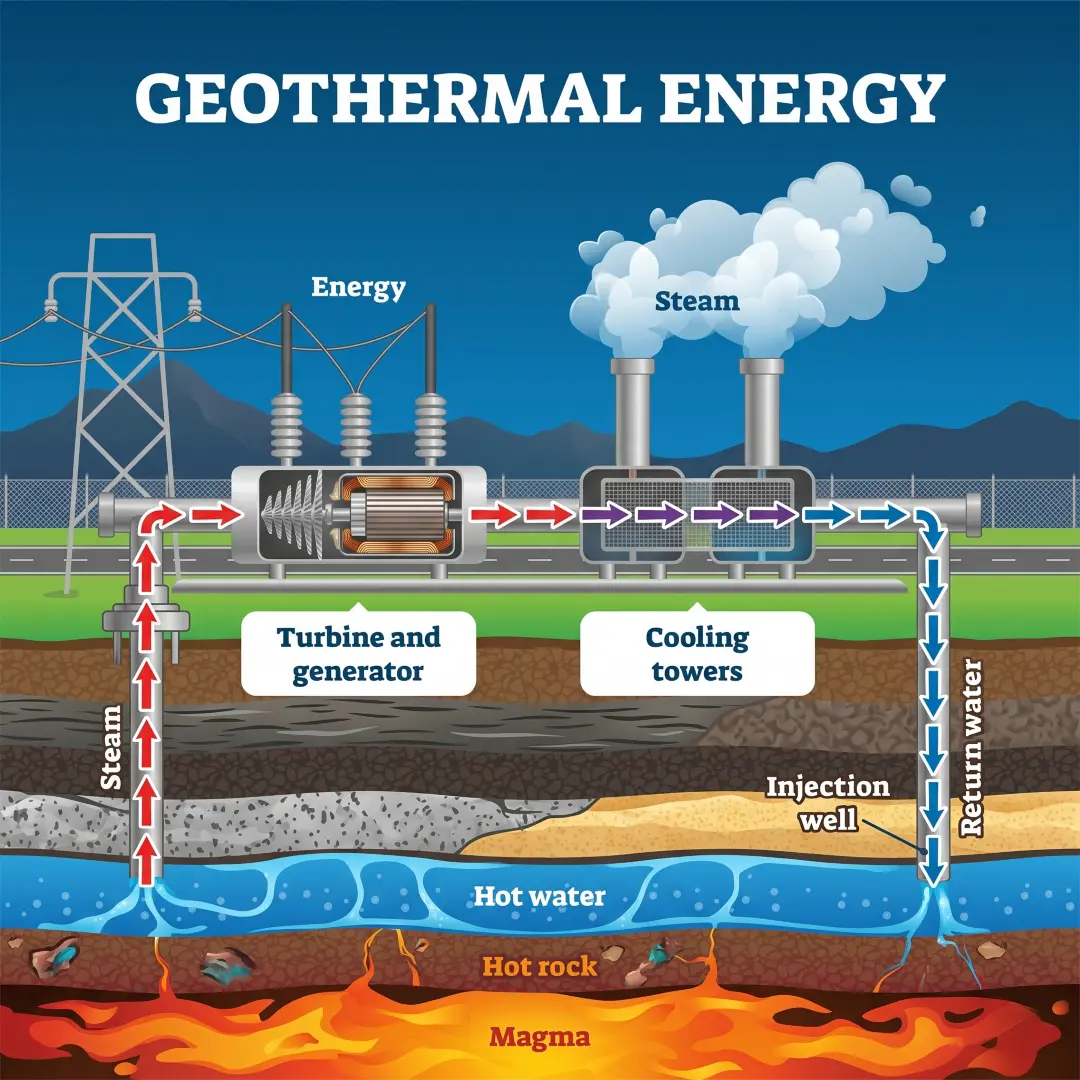
The basic idea is straightforward. Heat from underground is brought to the surface, where it can either be used directly or converted into electricity. In power generation, wells are drilled into geothermal reservoirs, and hot water or steam is piped upward. That steam spins a turbine, the turbine turns a generator, and the generator produces electricity. Some plants use very hot water, while others use steam directly.
For geothermal electricity, the resource usually needs to be hot enough for industrial use. One EIA explanation says that geothermal electricity generation typically requires water or steam at around 300°F to 700°F and that power plants are generally built close to the geothermal reservoir, often within a mile or two of the Earth’s surface. That is one reason geothermal plants are location-sensitive. They depend on the right underground conditions.
For heating and cooling, the process is different. A geothermal heat pump uses the relatively stable temperature a few feet below the surface to move heat in or out of a building. In winter, it pulls heat from the ground into the home. In summer, it sends indoor heat back into the ground. DOE notes that shallow ground temperatures are often around 40°F to 70°F or 4.5°C to 21°C, which is warm enough in winter and cool enough in summer to support efficient exchange.
The Main Forms of Geothermal Energy
Geothermal energy is not one single technology. It includes several different approaches, each with its own use case. The table below gives a clear view of the major forms. It brings together the most common categories used in energy systems, buildings, and industry.
| Form of geothermal energy | How it works | Main use | Best-known strength | Typical setting |
|---|---|---|---|---|
| Hydrothermal resource | Uses naturally occurring underground water or steam trapped in hot rock | Electricity generation and direct heating | Already proven and widely used | Areas with hot water reservoirs or volcanic activity |
| Dry steam system | Steam from underground goes directly to a turbine | Electricity generation | Simple design | Rare, but highly suitable geothermal fields |
| Flash steam system | Very hot water rises to the surface and pressure drop turns part of it into steam | Electricity generation | Efficient in high-temperature reservoirs | Deep, hot geothermal reservoirs |
| Binary cycle system | Heat from geothermal water transfers to another fluid with a lower boiling point | Electricity generation from moderate temperatures | Can use lower-temperature resources | Places where hot water is available but not enough for dry steam |
| Geothermal heat pump | Uses stable shallow ground temperature to move heat | Heating and cooling buildings | Efficient for homes and businesses | Almost anywhere with suitable ground access |
| Enhanced Geothermal System, or EGS | Engineers create or improve underground pathways so water can circulate through hot rock | Electricity and heat | Can expand geothermal beyond natural reservoirs | Hot rock areas with limited natural permeability |
This table reflects the main categories used by energy agencies and researchers. Natural hydrothermal systems are already in use, while EGS is often described as a next-generation path because it aims to broaden geothermal access beyond the places that already have ideal underground water flow.
How Geothermal Electricity Is Generated
There are three classic power plant types that use geothermal heat to make electricity, and each one fits a different kind of underground resource. They are dry steam, flash steam, and binary cycle plants. DOE and EIA both describe these as the major commercial approaches.
| Power plant type | What enters the plant | What happens next | Main advantage | Main limitation |
|---|---|---|---|---|
| Dry steam | Steam from underground | Steam drives the turbine directly | Simple and efficient | Only works in rare steam-rich reservoirs |
| Flash steam | Very hot pressurized water | Pressure drops, some water flashes into steam, steam drives the turbine | Strong output in hot reservoirs | Needs very hot water and careful well design |
| Binary cycle | Moderate-temperature geothermal fluid | Heat is transferred to a secondary fluid that boils more easily, and that vapor drives the turbine | Works with lower-temperature resources and often reduces emissions | More equipment, more complexity |
| EGS-based plant | Injected fluid through engineered rock pathways | Fluid absorbs heat and returns to surface for power generation | Could open geothermal to many more regions | Still developing and needs more drilling and testing |
The key point is that geothermal power plants are really heat-to-electricity systems. They do not burn fuel in the way coal, oil, or gas plants do. Instead, they use the Earth’s own heat to make the turbine turn. That is why geothermal is often described as low-emission and dispatchable, meaning it can be available whenever needed rather than only when the sun is shining or the wind is blowing.
Where Geothermal Energy Is Used
Geothermal energy has two broad uses. One is electricity generation. The other is direct use, which means using heat without converting it to electricity first. That second category is often overlooked, but in many places it is just as important as power generation.
| Use category | What it means | Typical examples | Why it matters |
|---|---|---|---|
| Electricity generation | Heat is converted into electrical power | Turbines, generators, grid supply | Provides steady clean power |
| Space heating | Heat warms buildings directly or through district systems | Homes, offices, schools | Cuts fossil fuel use for heating |
| District heating | Hot water is piped to many buildings from one source | Neighborhood heating networks | Efficient for cities and campuses |
| Greenhouse heating | Heat supports plant growth in controlled spaces | Vegetables, flowers, seedlings | Helps agriculture in colder climates |
| Aquaculture | Warm water supports fish and other aquatic life | Fish farms, hatcheries | Improves growth conditions |
| Industrial heat | Heat is used in manufacturing and processing | Drying, washing, processing lines | Reduces fossil fuel demand in factories |
| Bathing and recreation | Natural hot water is used for tourism and wellness | Hot springs, spas, resorts | Supports local economies |
| Geothermal heat pumps | Uses shallow ground temperature for heating and cooling | Buildings, campuses, communities | Highly efficient year-round comfort |
Direct use is especially common in places with easy access to warm groundwater or hot springs. It can power district heating systems, greenhouse operations, food drying, and aquaculture. Heat pumps, meanwhile, work in many climates because they rely on the relatively stable temperature below the surface rather than on hot underground reservoirs.
Why Geothermal Energy Matters
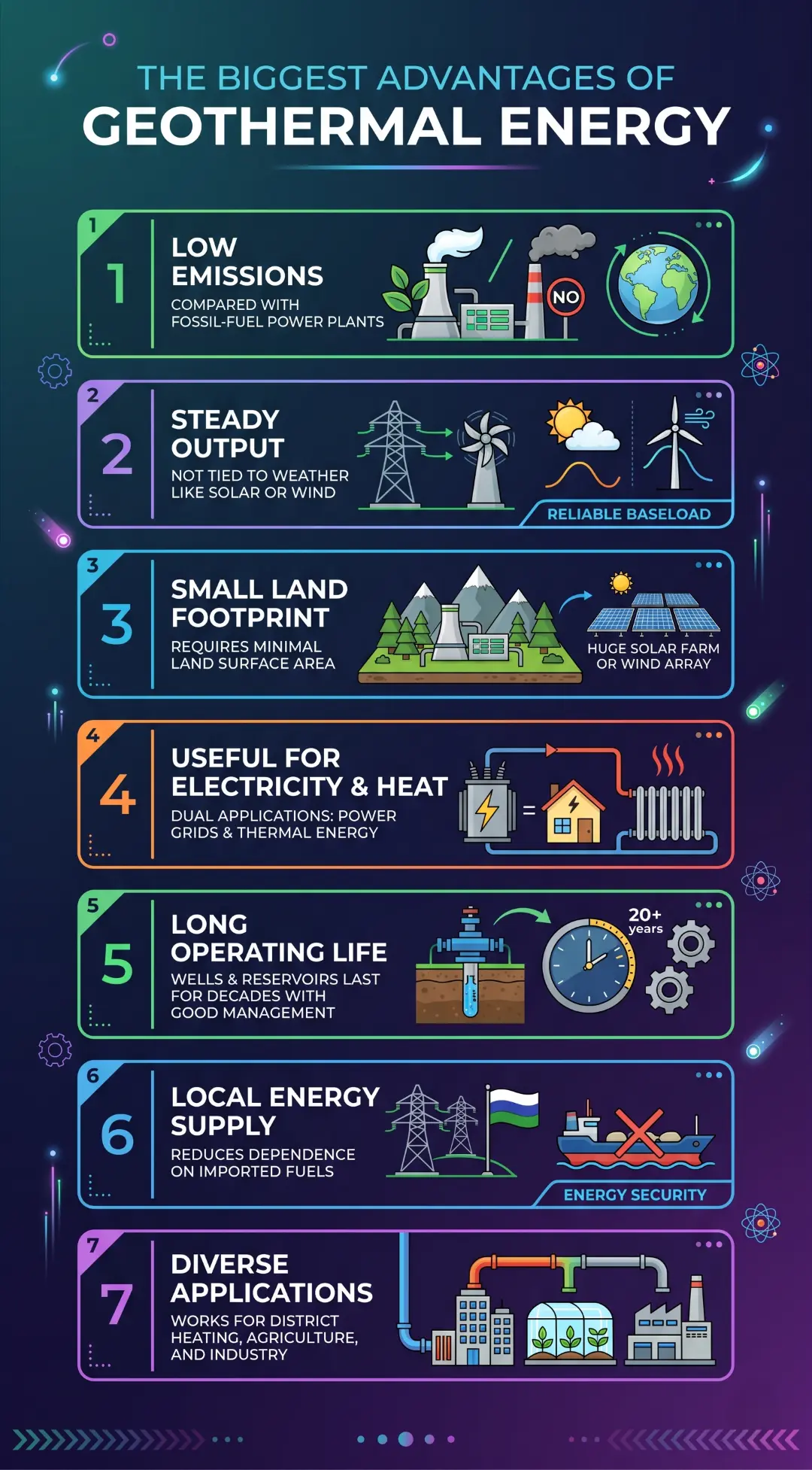
Geothermal energy matters because the world needs energy that is clean, reliable, and available when people actually need it. A power source can be low-carbon, but if it is too variable, it may not fit every job. Geothermal is useful because it can support both electricity and heat, and it does so with a very small footprint compared with many other energy systems.
This is especially important in the heating sector. Heating buildings, water, and industrial systems still uses a lot of fossil fuel in many countries. Geothermal heat can replace part of that demand directly. The IEA has noted that direct use of modern renewable energy in heating still has room to grow significantly, and geothermal can be part of that shift.
Geothermal energy is also valuable because it can provide baseload or firm power, meaning it can run for long hours and help stabilize the grid. That makes it a useful partner for solar and wind. When solar output falls in the evening or wind output dips during a calm period, geothermal can help fill the gap if the system is designed well.
The Biggest Advantages of Geothermal Energy
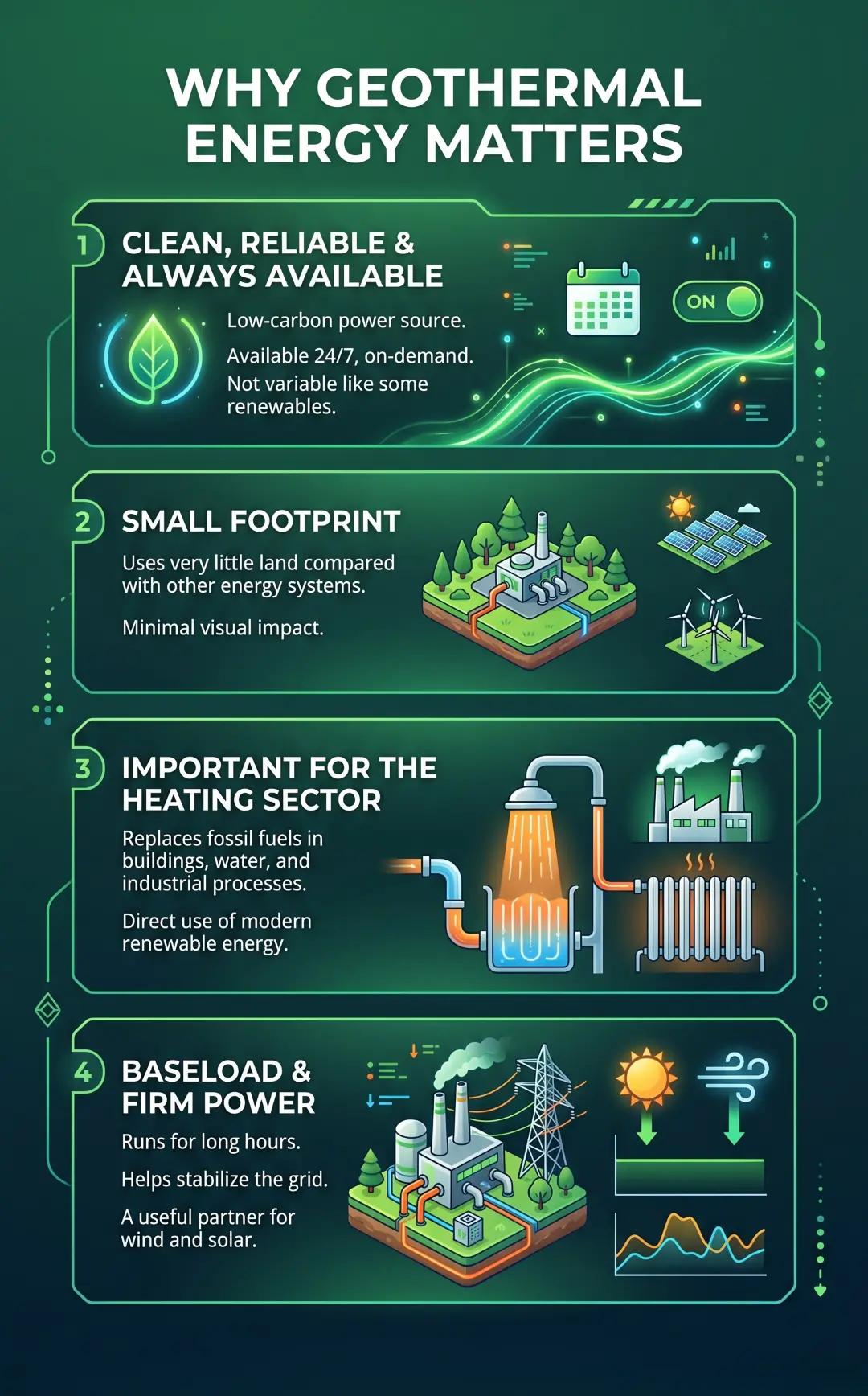
The benefits of geothermal energy go beyond the fact that it is renewable. It has several practical strengths that make it stand out.
- Low emissions compared with fossil-fuel power plants
- Steady output that is not tied to weather in the same way as solar or wind
- Small land footprint for many projects
- Useful for both electricity and heat
- Long operating life when wells and reservoirs are managed well
- Local energy supply that can reduce dependence on imported fuels
- Works for district heating, agriculture, and industry, not just power grids
EIA notes that geothermal power plants do not burn fuel, and their emissions are much lower than those of fossil-fuel plants, including about 97% less sulfur compounds and 99% less carbon dioxide in the comparison it presents. That does not mean geothermal is impact-free, but it does mean the climate and air-quality advantages can be substantial.
The Main Challenges and Limits
Geothermal energy also has real challenges, and it is better to be honest about them. It is not always easy to build, and it is not suitable for every location.
| Challenge | What it means | Why it matters |
|---|---|---|
| High upfront drilling cost | Wells and underground exploration are expensive | Projects need large early investment |
| Location dependence | Not every place has ideal reservoirs | Some countries have far more potential than others |
| Exploration risk | Hot rock or water may not be where it was expected | A bad drilling result can be costly |
| Permitting and development time | Projects can take years to plan and approve | Slows expansion |
| Scaling and corrosion | Minerals in hot water can damage equipment | Raises maintenance needs |
| Induced seismicity | Some engineered systems can trigger small earthquakes | Needs careful monitoring and regulation |
| Water management | Fluids must be handled properly | Prevents waste and environmental problems |
These issues explain why geothermal has grown more slowly than solar and wind in many markets. The resource is excellent, but the early stages are often expensive and uncertain. The IEA has pointed out that development risk and permitting delays are major reasons geothermal still plays a smaller role globally than its potential would suggest.
Geothermal Energy Around the World
Geothermal energy is especially important in countries with volcanic activity, tectonic movement, or good underground heat resources. Some places use it for electricity. Others use it more for heating. In a few countries, geothermal plays a huge national role. IRENA notes that geothermal covers a significant share of electricity demand in Iceland, El Salvador, New Zealand, Kenya, and the Philippines, and in Iceland it meets more than 90% of heating demand.
That is a striking example of how local geology can shape national energy systems. In colder countries, geothermal heat can make winter life much easier and much cheaper. In volcanic regions, geothermal electricity can support the grid and reduce imported fuel dependence. In fast-growing countries, it can provide stable power to complement solar and wind.
The global geothermal sector is still relatively small compared with other renewable technologies, but it is not standing still. IRENA reports that global installed geothermal capacity reached 15.4 GW by the end of 2024, and that 0.4 GW of new geothermal capacity was added in 2024. REN21 also reported strong growth in geothermal direct use in 2024, showing that heat applications are an increasingly important part of the story.
Geothermal Energy Versus Other Renewables
Geothermal is often compared with solar, wind, hydropower, and biomass. Each renewable source has a different job. Geothermal is not trying to replace all of them. It fits a specific need in the energy mix.
| Energy source | Best strength | Main weakness | How geothermal compares |
|---|---|---|---|
| Solar | Cheap and fast to deploy | Intermittent, depends on sunlight | Geothermal is steadier |
| Wind | Strong electricity production in good sites | Variable output | Geothermal is more predictable |
| Hydropower | Reliable in water-rich regions | Depends on rainfall and water flow | Geothermal is less weather-dependent |
| Biomass | Can be dispatchable | Uses feedstock and can compete for land | Geothermal avoids fuel supply chains |
| Nuclear | Very steady power | High cost and long build times | Geothermal can be smaller and more modular |
| Geothermal | Provides firm power and heat | Site-dependent and drilling-intensive | Strong for local heat and stable electricity |
The point is not that geothermal is better than everything else. It is that geothermal solves a different problem. It is especially useful where energy systems need dependable heat or non-weather-dependent electricity. That is why many energy planners now see it as a complement to solar and wind rather than a competitor.
A Closer Look at Geothermal Heat Pumps
One of the most practical geothermal technologies for everyday life is the geothermal heat pump, also called a ground-source heat pump. This system uses the stable underground temperature a few feet below the surface to heat and cool buildings efficiently. These systems can be used for a single home, a business, a campus, or even a neighborhood system, and they can work in all climates if the site is suitable.
A geothermal heat pump does not create heat from scratch in the same way a furnace does. Instead, it moves heat. That matters because moving heat is often far more efficient than generating it. In winter, the system extracts heat from the ground and brings it into the building. In summer, it pushes indoor heat back into the ground. This is why many people see heat pumps as a smart long-term comfort technology.
For homes, schools, offices, and public buildings, heat pumps can reduce energy demand, cut fuel use, and improve comfort. They can also produce hot water in some configurations. That makes them one of the most flexible geothermal options available to ordinary users, not just power companies.
Environmental Impact of Geothermal Energy
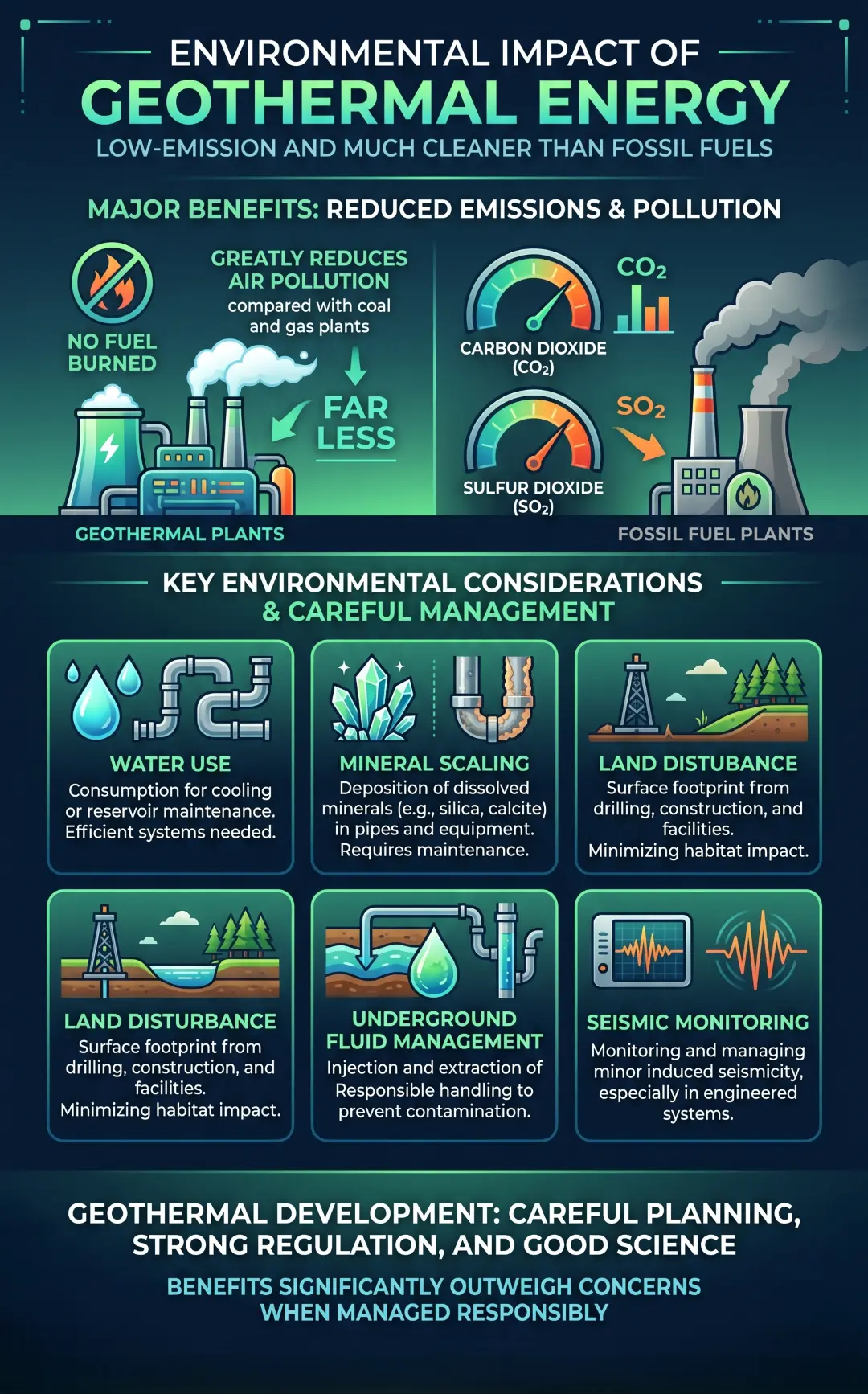
Geothermal energy is often described as clean, but it is more accurate to say that it is low-emission and much cleaner than fossil fuels. That distinction matters. The technology still has environmental questions that need careful handling.
The good news is that geothermal power plants do not burn fuel, which greatly reduces air pollution compared with coal and gas plants. The EIA says geothermal plants may still release small amounts of carbon dioxide and sulfur dioxide, but far less than fossil plants. The exact impact depends on reservoir chemistry and project design.
Other environmental issues can include water use, mineral scaling, land disturbance from drilling, and the need to manage underground fluids responsibly. In engineered systems, seismic monitoring is also important. These concerns do not erase the benefits. They simply mean geothermal should be developed carefully, with good science and strong regulation.
Geothermal and the Future of Energy
The future of geothermal energy looks more promising than many people realize. A big reason is technology. New drilling methods, improved reservoir engineering, and better understanding of deep rock heat could unlock areas that were once considered unreachable. The IEA says the technical potential becomes much larger as developers go deeper, and it highlights enormous resource potential at greater depths. It also notes that China, the United States, and India together hold three-quarters of the global market potential for next-generation geothermal electricity.
This matters because the old geothermal model depended heavily on rare, naturally favorable sites. Newer approaches, including Enhanced Geothermal Systems and advanced drilling methods, could make geothermal more widely usable. In plain language, that means geothermal might move from being a niche local resource to a broader clean energy tool. It will not happen overnight, but the direction is promising.
There is also growing interest in pairing geothermal with data centers, industrial heat, and clean hydrogen ecosystems where firm low-carbon power is valuable. Because geothermal can run continuously, it fits industries that need high uptime. That is one reason the technology is gaining attention well beyond the traditional energy world.
Real-World Examples of Geothermal Use
Geothermal energy becomes easier to understand when you see how it is used in daily life. Some examples are very large. Others are surprisingly ordinary.
- Iceland uses geothermal heat on a massive scale, especially for space heating and hot water.
- Kenya has built a major geothermal electricity sector in the Rift Valley.
- The Philippines uses geothermal power as a major part of its electricity mix.
- New Zealand uses geothermal for electricity and direct heating.
- Greenhouses in colder regions use geothermal heat to support crop growth.
- Aquaculture farms use geothermal water to maintain stable conditions for fish.
- District heating systems use underground heat to warm entire communities.
- Homes and schools in many regions use geothermal heat pumps for comfort and efficiency.
These examples show that geothermal is not just a power plant story. It is also a heating story, an agriculture story, a city planning story, and sometimes even a tourism story. That broad usefulness is one of its biggest strengths.
Common Myths About Geothermal Energy
People often misunderstand geothermal energy because it is hidden underground. Here are a few common myths and what really happens.
- Myth 1: Geothermal only works in volcanoes.
Reality: Volcanic areas are excellent for geothermal, but engineered systems and heat pumps can expand use beyond volcanic zones. - Myth 2: Geothermal is only for electricity.
Reality: A huge amount of value comes from direct heat use, including buildings, agriculture, and industry. - Myth 3: Geothermal is too small to matter.
Reality: It is still a modest part of global energy, but in the right places it can supply a major share of electricity or heating demand. - Myth 4: Geothermal is simple to build.
Reality: The resource is powerful, but drilling and exploration are expensive and technically demanding. - Myth 5: Geothermal is the same everywhere.
Reality: Resource quality, depth, temperature, and rock type all change the design and cost of a project.
A Practical Summary Table
This final table is a quick reference guide that pulls the whole topic together. It is useful if you want a clean mental map of the subject.
| Topic | Simple explanation | Why it matters | Example |
|---|---|---|---|
| Source of energy | Heat from inside the Earth | It is naturally replenished | Hot rocks, hot water, steam |
| Main power method | Heat makes steam, steam spins a turbine | Produces electricity | Geothermal power plant |
| Direct use | Heat is used without making electricity | Saves fuel and energy | Greenhouses, district heating |
| Heat pumps | Uses stable ground temperature | Efficient heating and cooling | Homes and schools |
| Best advantage | Reliable and low-emission | Helps cut fossil fuel use | 24/7 clean power |
| Main challenge | Drilling is costly and risky | Slows growth in some regions | Deep wells and exploration |
| Future potential | New drilling and EGS may expand use | More countries could use geothermal | Next-generation geothermal |
Why Geothermal Energy Deserves More Attention
Geothermal energy deserves more attention because it does more than one job well. It can generate electricity, support heating, improve comfort in buildings, and help agriculture and industry. It also offers something that many other renewables cannot always promise, which is constant availability. That makes it valuable in modern energy systems that need both cleanliness and reliability.
It is also a technology with room to grow. The global installed base is still modest, but the long-term resource potential is large, especially if drilling and reservoir technology keep improving. The next phase of geothermal may look very different from the old image of a plant sitting beside a hot spring. It may involve deeper wells, engineered rock systems, and broader use in cities and industries that need nonstop low-carbon heat and power.
And that is what makes geothermal energy so compelling. It is ancient heat, but it is also a modern solution. It sits quietly under the ground, yet it can power turbines, warm homes, and support food production. In a world that needs more clean energy and less waste, that is a very useful combination.
Article References and Sources
- U.S. Energy Information Administration Geothermal Overview
- U.S. Department of Energy. “Geothermal Basics.”
- U.S. Energy Information Administration. “Use of Geothermal Energy.”
- U.S. Energy Information Administration. “Geothermal Power Plants.”
- U.S. Department of Energy. “Geothermal Heat Pumps.”
- U.S. Department of Energy. “Geothermal Heat Pump Systems.”
- U.S. Energy Information Administration. “Geothermal Energy and the Environment.”
- International Energy Agency. “The Future of Geothermal Energy.”
- International Energy Agency. “Heating and Renewable Energy Systems.”
- International Renewable Energy Agency. “Geothermal Energy.”
- U.S. Department of Energy. “Enhanced Geothermal Systems.”
- International Energy Agency. “Global Geothermal Potential for Electricity Generation Using EGS Technologies.”
- U.S. Energy Information Administration. “Geothermal Energy for Kids.”
- U.S. Energy Information Administration. “Renewable Energy Annual Geothermal Report.”
- U.S. Department of Energy. “Tribal Energy Guide on Geothermal.”
Also, Read these Articles in Detail
- Physics and Its Fundamentals With Good Explanations
- Matter, Motion, and Energy: The Core Ideas of Physics
- What Is Matter? The Physical Substance of the Universe
- What Is Motion? A Guide to Motion in Physics and Daily Life
- What Is Energy? The Invisible Power Behind Everyday Life
- Kinetic Energy Explained in Simple Language
- Potential Energy: Definition, Types, Formula, and Examples
- Thermal Energy: Heat, Temperature, and Transfer
- Mechanical Energy: Definition, Formula, and Examples
- Chemical Energy: Definition, Science, and Examples
- Electrical Energy: Definition, Works, and Why It Matters
- Radiant Energy: Meaning, Sources, Examples, and Uses
- Nuclear Energy: Definition, How It Works, and Why It Matters
- Sound Energy: Definition, Science, and Examples
- Elastic Energy: Definition, Elasticity and Example
Frequently Asked Questions
FAQ 1. What is geothermal energy, and how does it work?
Geothermal energy is the heat that comes from inside the Earth. It is stored deep underground in rocks, hot water, and steam. This heat is always there, and it keeps moving naturally from the center of the planet toward the surface. That is why geothermal energy is considered a renewable energy source. It does not run out in the same way fossil fuels do, because the Earth keeps producing and storing heat over very long periods of time.
The way geothermal energy works is actually quite simple once you break it down. In some places, hot water or steam is trapped underground in natural reservoirs. People drill wells into those reservoirs and bring the hot fluid to the surface. The steam can spin a turbine, which then turns a generator and creates electricity. In other cases, the heat is used directly without making electricity first. For example, it can warm buildings, heat water, support greenhouses, or help with aquaculture.
There is also another major use of geothermal energy called a geothermal heat pump. This system does not depend on deep underground steam. Instead, it uses the stable temperature of the ground a few feet below the surface. In winter, it pulls heat from the earth into a building. In summer, it removes heat from the building and sends it back underground. This makes it very efficient for heating and cooling.
What makes geothermal energy special is that it can provide steady power and reliable heat. Solar power depends on sunlight. Wind power depends on air movement. But geothermal can keep working day and night, in every season, as long as the system is properly managed. That makes it one of the most dependable clean energy options available today.
In simple terms, geothermal energy is Earth heat turned into useful energy for modern life. It can light homes, run machines, warm water, and keep buildings comfortable. It is quiet, powerful, and often overlooked.
FAQ 2. Why is geothermal energy considered a renewable and clean energy source?
Geothermal energy is considered renewable because the Earth’s internal heat is naturally replenished over time. The heat deep inside the planet comes from the slow decay of radioactive materials in the Earth’s interior, along with heat that has remained since the planet was formed. That means the resource is not being used up in the way coal, oil, and natural gas are used up.
It is also considered clean energy because it produces far fewer emissions than fossil fuels. Geothermal power plants do not burn fuel to make electricity. Instead, they use natural heat. That means there is much less release of carbon dioxide, sulfur compounds, and other air pollutants. This matters because cleaner energy helps reduce climate change and also improves air quality.
Of course, geothermal energy is not completely free from environmental impact. Some geothermal plants can release small amounts of gases that were trapped underground. There can also be concerns about water use, drilling, land disturbance, and underground pressure management. But when compared with conventional power plants that burn coal or gas, geothermal is far cleaner.
Another reason geothermal is valuable is that it can provide firm power. That means it can work all the time, not just when weather conditions are ideal. This gives it an advantage over some other renewable sources that are more variable. In a modern energy system, that kind of reliability is extremely useful.
So when people call geothermal energy renewable and clean, they are talking about two different strengths. It is renewable because Earth keeps making heat. It is clean because it produces much less pollution than fossil fuels. Those two things make it a strong option for the future.
FAQ 3. What are the main types of geothermal energy systems?
There are several important types of geothermal energy systems, and each one works in a slightly different way. The most common types are dry steam, flash steam, binary cycle, geothermal heat pumps, and enhanced geothermal systems, often called EGS.
A dry steam system is the simplest. It uses steam directly from underground to spin a turbine. This is very efficient, but it only works in places where steam is naturally available, which is not very common.
A flash steam system uses very hot water that comes from deep underground. When the pressure drops as the water reaches the surface, part of it turns into steam. That steam is used to drive the turbine. This is one of the most widely used geothermal power technologies.
A binary cycle system is used when the geothermal fluid is not hot enough to make steam directly. Instead, the heat from the geothermal water is transferred to another fluid with a lower boiling point. That secondary fluid becomes vapor and powers the turbine. This design allows power generation from lower-temperature resources.
A geothermal heat pump is different from the others. It does not rely on a hot reservoir deep underground. Instead, it uses the stable temperature of shallow ground to heat and cool buildings. It is one of the most practical geothermal technologies for homes, offices, schools, and community buildings.
Then there is Enhanced Geothermal Systems, or EGS. This is a newer approach that tries to create or improve underground pathways so water can move through hot rock more effectively. EGS could expand geothermal energy into regions that do not have natural geothermal reservoirs.
Each of these systems has its own strengths. Some are better for electricity. Some are better for heating and cooling. Some are still developing. Together, they show that geothermal energy is not one single technology but a whole family of useful solutions.
FAQ 4. How is geothermal electricity generated?
Geothermal electricity is generated by turning underground heat into motion, and then turning that motion into electrical power. The process usually starts with a geothermal well. Engineers drill deep into the Earth to reach hot water or steam stored in underground rock formations.
Once the hot fluid reaches the surface, it is used in one of several ways. In a dry steam plant, the steam goes straight to a turbine. The turbine spins because of the force of the steam, and that spinning motion drives a generator. The generator then produces electricity.
In a flash steam plant, very hot water rises from the ground under high pressure. When it reaches the surface, the pressure drops and some of the water flashes into steam. That steam powers the turbine. The remaining hot water may be reused or sent back underground.
In a binary cycle plant, the geothermal fluid heats another liquid that boils at a much lower temperature. The secondary liquid becomes vapor, and that vapor turns the turbine. This system is useful because it can work with geothermal resources that are not hot enough for flash steam plants.
After the heat is used, the cooled water is often sent back underground through an injection well. This helps maintain reservoir pressure and supports long-term sustainability. It also helps manage the water cycle inside the geothermal field.
So the whole process is really about a chain of energy changes. Heat becomes steam or vapor. Steam or vapor becomes motion. Motion becomes electricity. It is a clean, practical, and elegant system when the geology is right.
FAQ 5. What are the biggest advantages of geothermal energy?
The biggest strength of geothermal energy is that it is reliable. It can run day and night, in winter and summer, because the heat underground is always there. That makes it very different from solar and wind, which depend on changing weather conditions.
Another major advantage is that geothermal can be used for both electricity generation and direct heating. That is a big deal. Many energy sources do one job well, but geothermal can serve several needs at once. It can power a plant, heat a home, warm a greenhouse, or support industrial work.
Geothermal energy also has a relatively small land footprint. Many geothermal projects take up less surface area than comparable energy systems. That can make them a good fit in places where land is limited or where preserving the landscape matters.
A further advantage is that geothermal systems often have long operating lives when they are managed properly. Once the wells and infrastructure are in place, they can keep working for many years. That can make them valuable long-term assets.
There is also the matter of emissions. Compared with fossil fuel plants, geothermal plants usually produce far fewer greenhouse gases and much less air pollution. That makes them useful for countries and communities trying to lower their carbon footprint.
And then there is energy security. Geothermal is local. It uses heat that already exists beneath the Earth in a specific place. That means countries with good geothermal resources can reduce dependence on imported fuels.
So the main advantages are reliability, flexibility, lower emissions, small land use, and long-term usefulness. Those are strong reasons why geothermal energy deserves more attention than it often gets.
FAQ 6. What are the challenges and limitations of geothermal energy?
Even though geothermal energy has many strengths, it also comes with real challenges. The first and most obvious one is high upfront cost. Drilling deep wells is expensive. Finding the right underground reservoir can also take time and money. Before a project starts producing power, the developer may need to spend a lot on exploration, surveys, and drilling.
Another challenge is that geothermal energy is location-dependent. Not every place has hot enough rock, accessible steam, or underground water at the right depth. Some areas are ideal. Others are much harder to develop. This means geothermal is not as universal as solar or wind.
There is also the issue of resource risk. A company might drill a well and not find what it expected. That uncertainty can make investors cautious, because they may spend a lot before knowing whether the project will succeed.
Some geothermal systems also face scaling and corrosion. Minerals dissolved in hot water can build up inside pipes and equipment. Over time, that can damage machinery and increase maintenance needs. Engineers have to manage that carefully.
In some cases, especially with Enhanced Geothermal Systems, there is concern about induced seismicity, which means very small earthquakes triggered by underground fluid movement or pressure changes. These events are usually minor, but they still need to be monitored and controlled.
Water management is another issue. Geothermal systems often reinject fluids underground to maintain pressure and reduce waste. That works well, but it requires good design and careful operation.
So geothermal energy is powerful, but it is not simple. It works best when geology, engineering, finance, and regulation all line up properly. That is why it grows more slowly than some other renewables, even though its long-term potential is very strong.
FAQ 7. Where in the world is geothermal energy used the most?
Geothermal energy is used most in places with strong underground heat resources, especially regions with volcanic activity, tectonic movement, or hot rock close to the surface. Some of the best-known geothermal countries include Iceland, Kenya, New Zealand, the Philippines, El Salvador, and the United States.
In Iceland, geothermal energy is a major part of daily life. It helps provide heating, hot water, and electricity. In fact, geothermal heating plays a huge role in keeping homes and buildings warm in a cold climate.
In Kenya, geothermal power has become a major source of electricity. The East African Rift Valley gives the country excellent geological conditions for geothermal development.
In the Philippines, geothermal power has long been important for the national electricity mix. The country has strong volcanic resources that support large-scale geothermal plants.
In New Zealand, geothermal energy is used for both electricity and direct heat. The country has taken advantage of its active geology for decades.
In El Salvador, geothermal energy is also a valuable part of the power system, showing how even smaller countries can benefit greatly when the geological conditions are right.
And in the United States, geothermal energy is used in several western states where underground heat resources are strong. There is also growing interest in enhanced geothermal systems, which may expand the technology into new regions.
What all of these examples show is that geothermal energy is highly local. It depends on what is happening underground. But where the resource is available, it can play a major role in both power and heating.
FAQ 8. How does geothermal energy compare with solar and wind power?
Geothermal energy, solar power, and wind power are all renewable, but they work in different ways and solve different problems. Solar and wind are often praised for how quickly they can be deployed and how much they can scale. Geothermal stands out for something else. It gives steady, continuous output.
Solar panels generate electricity when sunlight is available. That usually means daytime production and lower output at night. Wind turbines depend on moving air, so their output changes with the weather. Geothermal is different because it taps into underground heat, which is available all the time.
This means geothermal can help balance a grid that also uses solar and wind. For example, a region can produce solar power during the day, wind power when conditions are right, and geothermal power as a stable base. That mix can make the system more reliable.
Geothermal also works well for heating, which is an area where solar and wind are not always the easiest direct solutions. Heat pumps and district heating systems can use geothermal energy in a way that fits everyday life very well.
But geothermal does have a drawback compared with solar and wind. It is more expensive and difficult to build in the early stages because of drilling and geological uncertainty. Solar farms and wind farms can often be built faster and in more places.
So the comparison is not about one technology winning over the others. It is about fit. Solar and wind are great for scale. Geothermal is great for consistency and heat. Together, they make a stronger clean energy system than any one of them alone.
FAQ 9. What is a geothermal heat pump, and why is it useful?
A geothermal heat pump, also called a ground-source heat pump, is a system that uses the stable temperature of the ground to heat and cool buildings. It does not need deep hot steam or a volcanic area. It just needs the natural fact that the ground a few feet below the surface stays at a fairly steady temperature throughout the year.
In winter, the heat pump takes heat from the ground and moves it into a building. In summer, it does the opposite. It takes heat from inside the building and sends it underground. This makes it a very efficient way to control indoor temperature.
The usefulness of a geothermal heat pump comes from how little energy it needs to move heat compared with how much comfort it provides. Since it is moving heat instead of creating it from scratch, it can be much more efficient than many conventional heating and cooling systems.
It is useful for homes, schools, offices, hospitals, and even larger campuses or neighborhoods. In places with high energy prices or long winters, it can make a big difference in operating costs over time. It can also reduce dependence on fossil fuels.
Another benefit is comfort. Geothermal heat pumps often provide steady, even heating and cooling rather than big swings in temperature. That can make indoor spaces more pleasant.
So a geothermal heat pump is one of the most practical forms of geothermal energy for everyday people. It takes the hidden stability of the ground and turns it into visible comfort inside buildings.
FAQ 10. What is the future of geothermal energy?
The future of geothermal energy looks promising, especially if new technology keeps lowering cost and reducing risk. For a long time, geothermal was limited by geography. It worked best in places with hot water reservoirs or volcanic activity. But that picture is changing.
One of the biggest reasons for optimism is Enhanced Geothermal Systems, or EGS. These systems aim to create usable underground pathways in hot rock that does not naturally have enough water flow. If that approach keeps improving, geothermal could become available in far more places than before.
Better drilling methods also matter. Drilling deeper and more accurately can reduce cost and increase the number of useful sites. Advances in materials, reservoir management, and seismic monitoring can also make projects safer and more efficient.
There is growing interest in geothermal for more than just electricity. It may play a bigger role in industrial heat, district heating, agriculture, data centers, and other areas where constant low-carbon energy is valuable. That is important because a lot of global energy use goes to heat, not just electricity.
The future may also include hybrid systems that combine geothermal with solar, wind, storage, and other technologies. That kind of combination could make clean energy systems more flexible and more reliable.
So the future of geothermal energy is not just about building more power plants. It is about expanding the whole idea of underground heat as a modern energy resource. If the technology continues to improve, geothermal could become a much bigger part of the world’s clean energy transition than it is today.
