

Hydropower energy is one of those ideas that looks simple at first and then reveals a lot more the moment you slow down and study it. Water moves downhill, a turbine spins, electricity is produced, and homes, schools, factories, and hospitals stay powered. But behind that simple picture is a system that touches physics, engineering, climate planning, river management, and the daily lives of millions of people. Hydropower is one of the oldest forms of renewable electricity, and it still plays a major role in modern power systems because it can provide clean electricity, storage, and grid flexibility all at once.
What makes hydropower special is not just that it comes from moving water. It is also the way it fits into the energy system. Unlike some renewable sources that depend heavily on weather in the moment, hydropower can often be adjusted quickly. That means it can help cover sudden changes in electricity demand, support other renewables like solar and wind, and keep the grid steady when the system is under pressure. In the wider global picture, hydropower remains the largest renewable source of electricity, and it still produces a huge share of the world’s clean power.
Table of Contents
Hydropower Energy Explained in Simple Words
Hydropower energy is electricity made from the force of moving water. In practical terms, a river, a reservoir, or a channel sends water through a system of pipes and machinery. The water turns a turbine, the turbine spins a generator, and the generator produces electricity. The amount of electricity available depends mainly on two things: the flow of water and the head, which means the difference in height between the water source and the turbine. The bigger the flow and the higher the head, the more power can be produced.
The beauty of hydropower is that it uses the water cycle, which is continually renewed by the sun. That makes the fuel itself, water, naturally reusable in the long term. Hydropower plants can be large or small. Some are tied to major dams and reservoirs. Others are run-of-river facilities that work with the natural flow of a river. Some are designed to pump water uphill when demand is low and release it later when demand is high. All of them are built around the same physical idea, which is to convert the energy in moving water into usable electricity.
How Hydropower Works
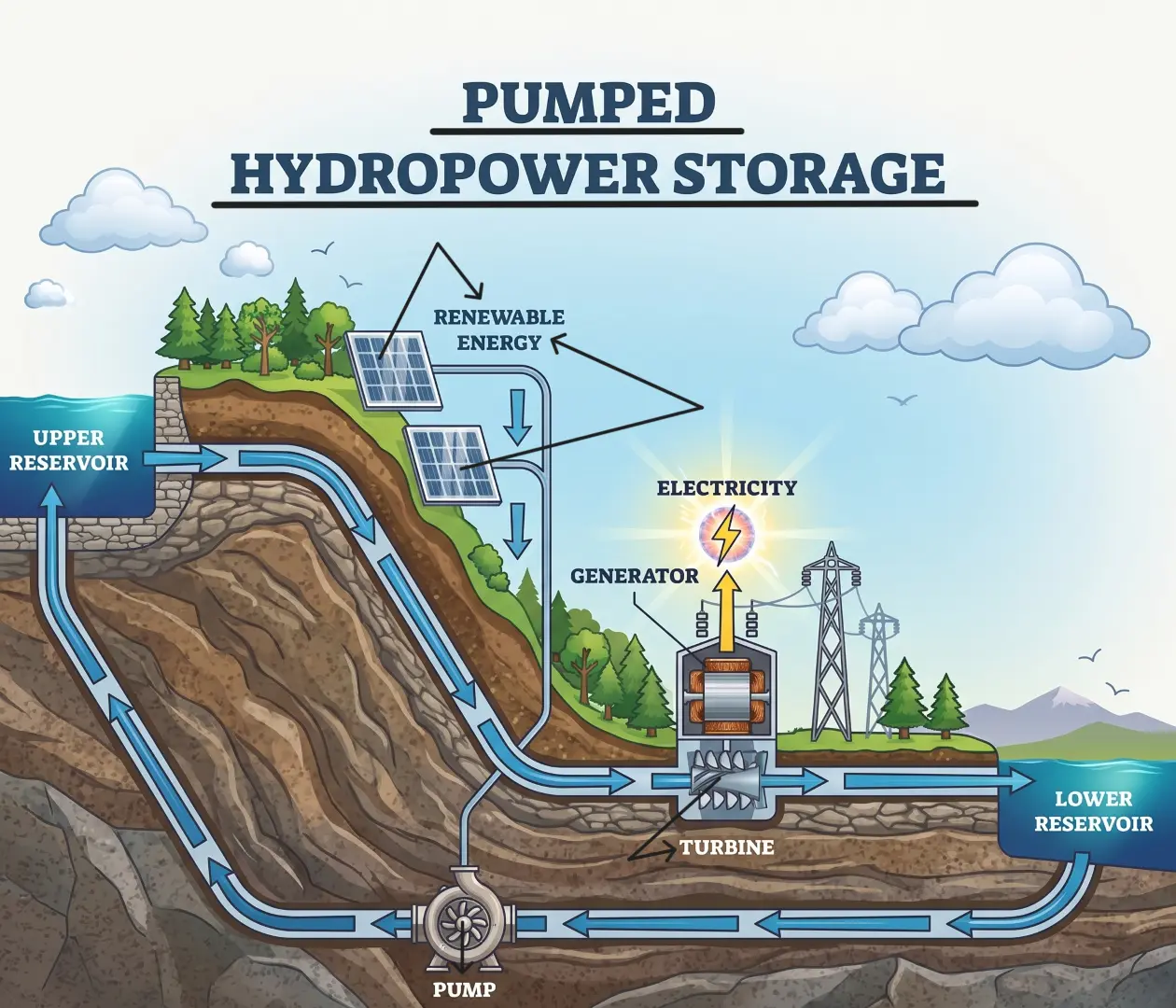
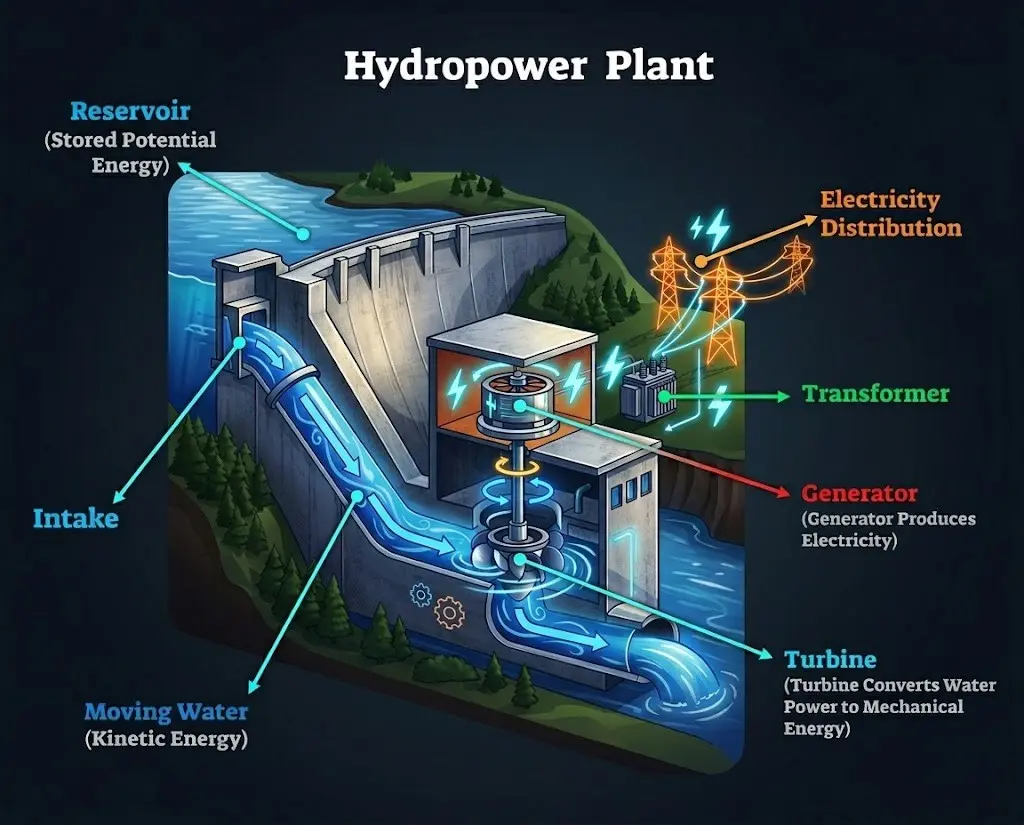
The process is easier to understand when broken into steps. First, water is gathered or diverted from a river, lake, or reservoir. Then it travels through a penstock, which is a pipe or tunnel that directs water toward the power plant. As the water rushes through, it spins the blades of a turbine. That rotation turns a generator, which creates electricity. The electricity then moves into transmission lines and eventually reaches homes, businesses, and public infrastructure.
The physics here is elegant. Water stored at a higher elevation contains potential energy. When it moves downward, that energy becomes kinetic energy. The turbine captures that motion and converts it into mechanical rotation. The generator then changes the mechanical energy into electrical energy. It is a clean example of energy conversion, and it is one of the reasons hydropower has remained important for so long.
A hydropower plant is also tightly linked to the place where it sits. The design depends on the terrain, the river’s seasonal patterns, the water volume, and the required power output. That is why no two hydropower stations look exactly alike. Some are huge, some are modest, and some are built to work quietly in the background with very little visible infrastructure.
Main Parts of a Hydropower Plant
The table below shows the most common parts of a hydropower system and what each part actually does.
| Component | What It Does | Why It Matters | Example of Use | Notes |
|---|---|---|---|---|
| Dam | Holds back water and creates height difference | Builds head and helps control flow | Large reservoir projects | Not every hydropower plant needs a dam |
| Reservoir | Stores water for later release | Helps match electricity supply with demand | Storage hydropower | Can also support irrigation and flood control |
| Intake | Guides water into the plant | Starts the generation process | River diversion systems | Often designed to manage debris and flow |
| Penstock | Carries water under pressure to the turbine | Speeds up water and directs energy flow | Most conventional plants | A key link in the system |
| Turbine | Spins when water pushes its blades | Converts water motion into mechanical rotation | Francis, Kaplan, Pelton designs | The turbine choice depends on head and flow |
| Generator | Turns rotation into electricity | Produces the electric power used on the grid | All hydropower stations | Works with the turbine shaft |
| Transmission lines | Carry electricity to users | Connects power plants to the grid | Regional and national networks | Essential for distribution |
| Spillway | Releases excess water safely | Protects the dam and plant | Flood management | Important during heavy rainfall |
| Fish passage systems | Helps fish move around barriers | Reduces harm to aquatic life | Fish ladders and elevators | Used where migration is important |
The Main Types of Hydropower
Hydropower is not one single design. There are several major types, and each one suits a different landscape and energy need. The main categories commonly described are run-of-river, storage hydropower, pumped storage, and offshore hydropower.
| Type | How It Works | Strengths | Limitations | Common Use Case |
|---|---|---|---|---|
| Run-of-river | Uses the natural flow of a river with limited storage | Lower land footprint, simpler operation | Output can vary with river flow | Areas with steady river movement |
| Storage hydropower | Stores water in a reservoir behind a dam | Reliable, flexible, can generate on demand | Larger environmental and social footprint | Grid power and seasonal balancing |
| Pumped storage | Pumps water uphill when power is cheap, releases it later | Acts like large-scale energy storage | Uses more electricity for pumping than it later returns | Backup power and peak demand support |
| Offshore hydropower | Uses water movement in marine settings | Expands the range of hydropower options | More site-specific and less common | Specialized coastal or marine projects |
Run-of-river projects are often chosen where builders want to avoid very large reservoirs. They use the river’s downward movement to run turbines, and the water is returned to the river after passing through the powerhouse. Storage hydropower is more controllable because water can be held back and released when needed. That makes it especially useful when electricity demand changes during the day or across seasons. Pumped storage is different again because it stores energy by moving water uphill and then releasing it later, which is why many people compare it to a giant water-based battery.
Why Hydropower Matters So Much
Hydropower matters because it does more than just produce electricity. It also supports grid stability, water management, energy security, and in many places local jobs and regional development. Modern hydropower plants can deliver essential power, storage, flexibility, and climate services. That is one reason many energy planners see them as a practical part of the transition to cleaner electricity systems.
Hydropower is also a major source of electricity in the real world, not just in theory. The International Energy Agency says hydropower generated around 4,500 TWh of electricity in 2024, which was about 14% of global electricity generation. It also remains the largest renewable source of electricity. In other words, hydropower is not a niche solution. It is already deeply embedded in the global grid.
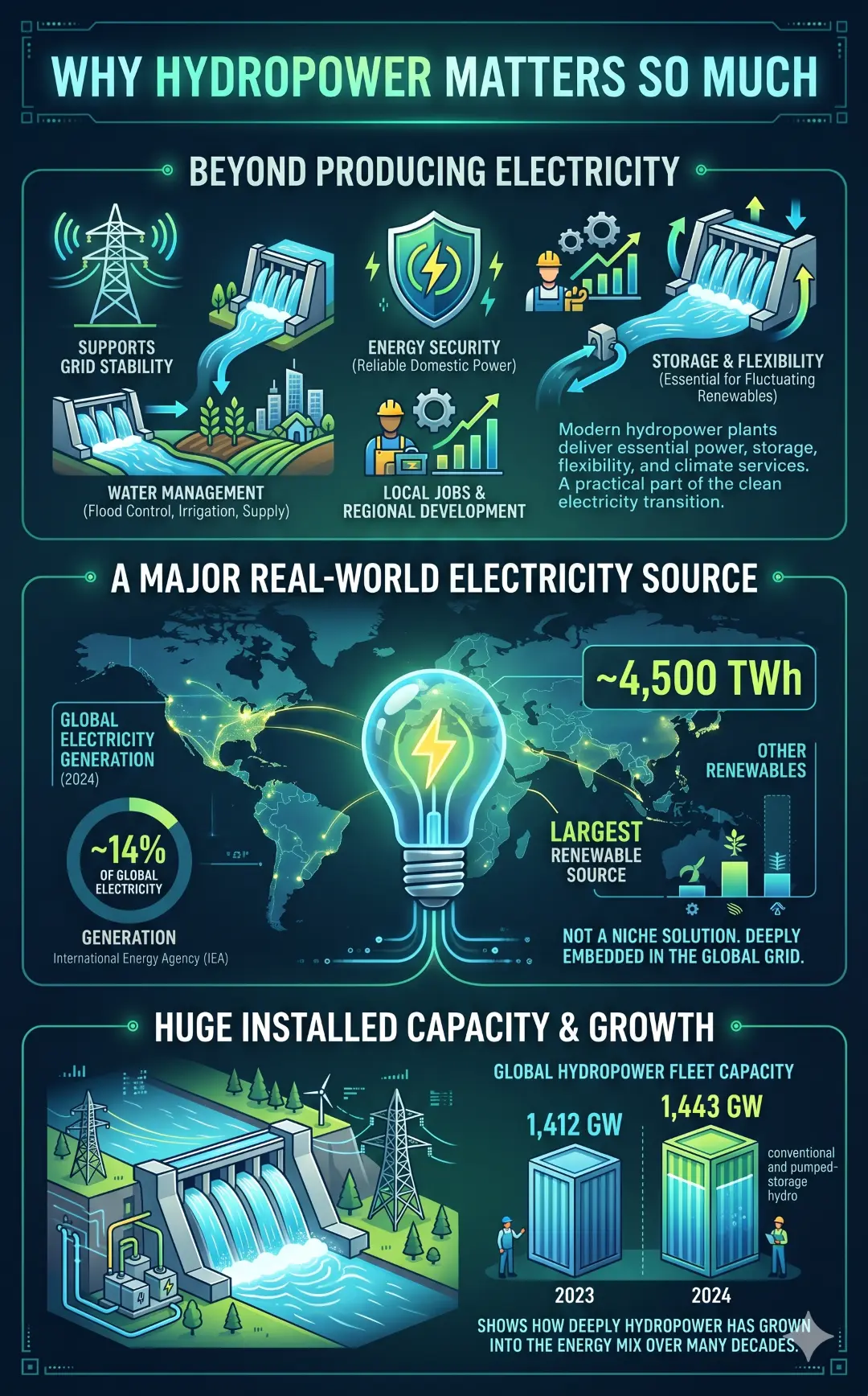
The scale is also huge at the installed-capacity level. One major global outlook reported a hydropower fleet of 1,412 GW in 2023, while another industry facts page put 2024 installed capacity at 1,443 GW, including both conventional and pumped storage hydro. Those numbers show how deeply hydropower has grown into the energy mix over many decades.
The Biggest Advantages of Hydropower Energy
Hydropower has a long list of strengths, and that is why it has stayed relevant for so long. The most important advantage is that it can produce low-carbon electricity without burning fuel during operation. That makes it a valuable replacement for fossil-fuel generation in many settings. Hydropower is also flexible, reliable, and capable of supporting the grid in ways that not every renewable can.
Here are the main benefits in simple language:
- Renewable source because it relies on the water cycle, which is continuously renewed by the sun.
- Flexible operation because many plants can increase or reduce output quickly.
- Grid stability because hydropower can respond fast when demand changes.
- Energy storage through pumped storage hydropower, which can hold energy for later use.
- Long operating life because hydropower facilities often last many decades.
- Multi-purpose value because reservoirs can also support irrigation, flood control, drinking water, and recreation.
- Domestic energy supply because countries can use their own water resources rather than imported fuel.
A big strength of hydropower is that it works well with solar and wind. When the sun is not shining or the wind is weak, hydropower can help fill the gap. When renewable supply is high, pumped storage can absorb excess electricity and save it for later. That is one of the clearest examples of how different clean energy sources can support each other instead of competing.
Hydropower and the Modern Electricity Grid
Electricity systems today need more than just generation. They need flexibility, storage, backup, and fast response. Hydropower is useful because it can supply all of these in the right conditions. In the United States, a federal energy source says hydropower and pumped storage provide essential power, storage, and grid flexibility services, and pumped storage makes up the vast majority of utility-scale energy storage there.
This matters more now than it did in the past because power systems are changing. Solar and wind are growing quickly, but their output is variable. Hydropower can smooth out those changes. The International Energy Agency says annual capacity additions of pumped-storage hydropower are forecast to double by 2030, and that these plants can provide both flexibility and storage as electricity systems evolve.
A useful way to think about pumped storage is this. When electricity is cheap or abundant, the system uses that power to pump water to a higher reservoir. Later, when demand rises, the water is released to generate electricity. It is not perfect, and it does use more electricity to pump water than it later produces, but its real value lies in system support, not just energy returned.
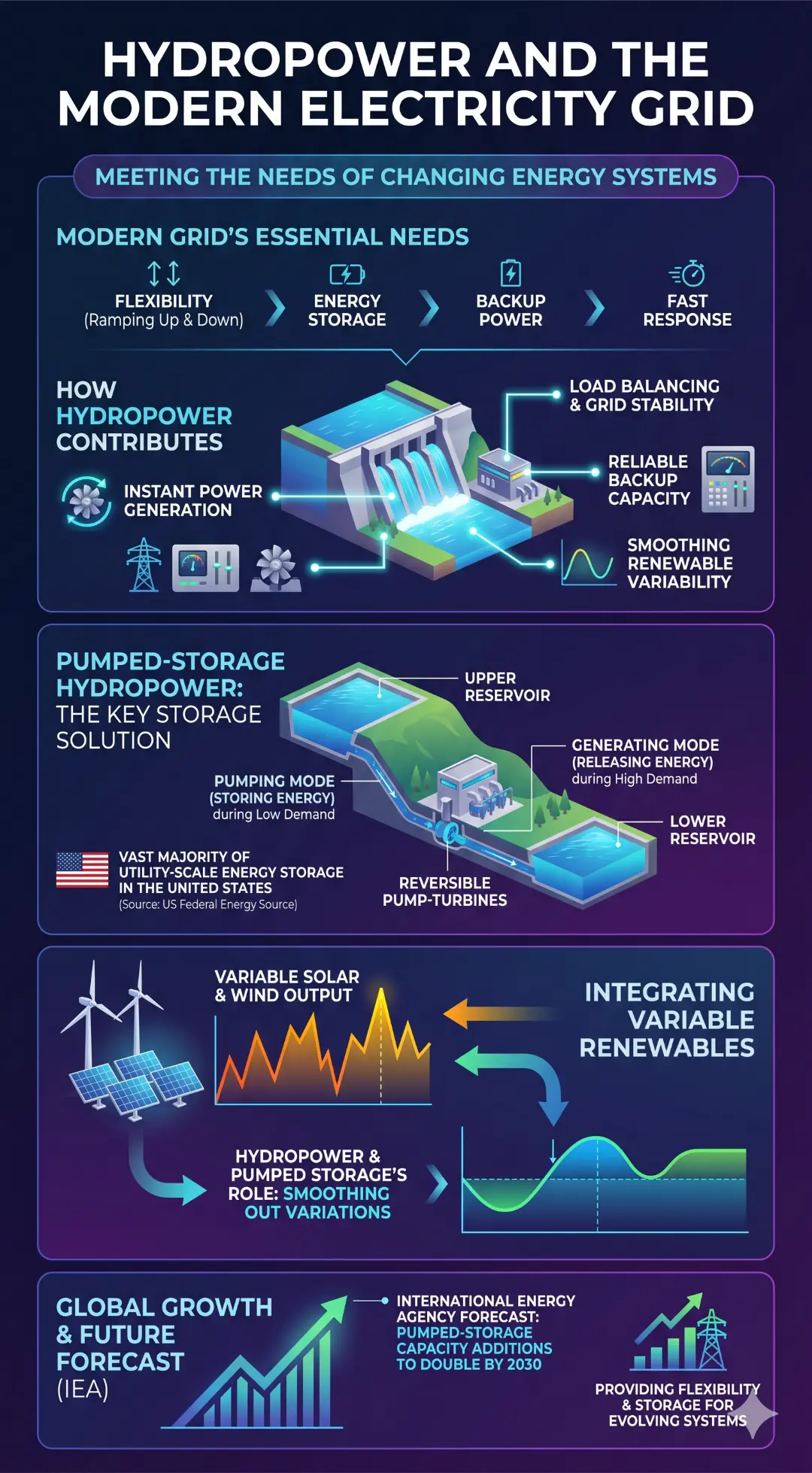
Table: Hydropower vs Other Energy Needs
| Need in the Grid | How Hydropower Helps | Why It Is Useful | Example |
|---|---|---|---|
| Peak electricity demand | Releases stored water quickly | Helps meet sudden spikes in use | Evening demand in cities |
| Backup power | Can go from zero to output fast | Supports outages and disruptions | Emergency grid support |
| Storage | Pumps water uphill for later use | Shifts electricity across time | Pumped storage plants |
| Renewable balancing | Compensates for wind and solar swings | Keeps supply more stable | Mixed renewable grids |
| Water management | Stores and releases water strategically | Helps with floods and droughts | Reservoir operations |
The Environmental Side of Hydropower
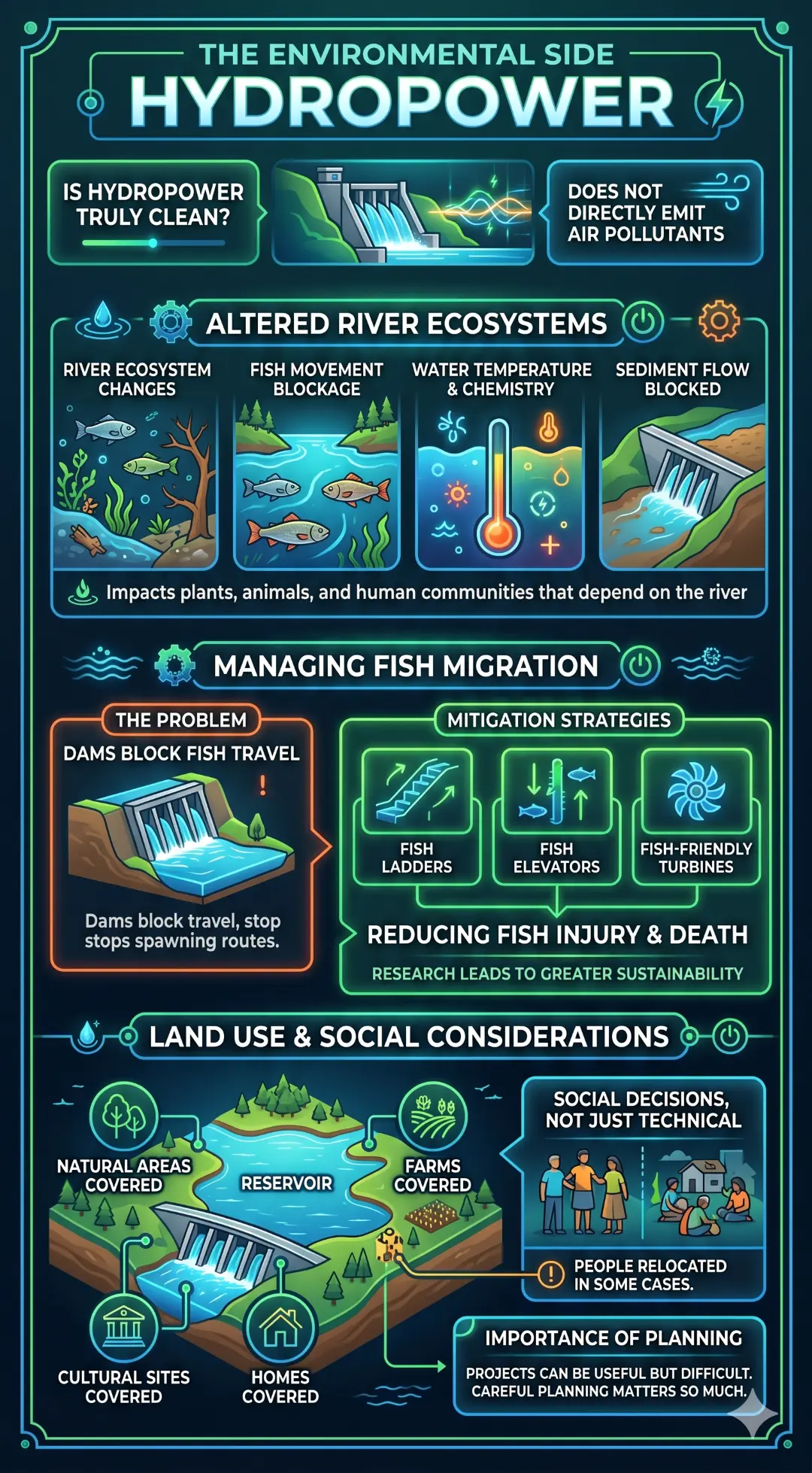
Hydropower is often described as clean energy, and in many ways that is true. It does not directly emit air pollutants while generating electricity. But that does not mean hydropower is impact-free. Large dams and reservoirs can change river ecosystems, fish movement, water temperature, water chemistry, and sediment flow. Those changes can affect plants, animals, and human communities that depend on the river.
One important issue is fish migration. Dams can block fish that need to travel upstream to spawn. To deal with that, some facilities use fish ladders, fish elevators, and more fish-friendly turbine designs. Research supported by federal energy agencies has aimed to reduce fish injury and death rates, because protecting river life is part of making hydropower more sustainable.
Another issue is land use. Reservoirs may cover natural areas, farms, cultural sites, and homes. In some cases, people have to be relocated. That means hydropower decisions are not only technical decisions. They are social decisions too. A project can be useful in one sense and difficult in another, which is why planning matters so much.
Hydropower also has associated emissions during construction, mainly from concrete and steel production. But hydropower plants often operate for 50 to 100 years, so those upfront emissions are spread over a very long working life. Reservoirs can also emit carbon dioxide and methane in some settings because biomass decomposes in water, and the exact level depends on local conditions. That is why hydropower is best understood as low-carbon, not magically zero-impact.
Table: Benefits and Challenges Side by Side
| Hydropower Strengths | Hydropower Challenges |
|---|---|
| Produces renewable electricity from moving water | Can alter river flow and water temperature |
| Provides grid flexibility and fast response | Can affect fish migration and aquatic life |
| Supports energy storage through pumped storage | Large projects may flood land and affect communities |
| Helps with flood control, irrigation, and water supply | Reservoir emissions can vary by site and conditions |
| Can last for many decades | Permitting and project development can be slow and complex |
Hydropower Around the World
Hydropower is used on every inhabited continent, and it has been especially important in countries with strong river systems, mountainous terrain, or existing water infrastructure. The largest hydropower-producing countries by installed capacity include China, Brazil, the United States, Canada, and Russia. That reflects both geography and decades of infrastructure investment.
The International Energy Agency also notes that almost two-thirds of global hydropower capacity additions in 2023 took place in China. At the same time, the overall pace of growth has not been fast enough to match long-term climate and clean-energy needs. That means hydropower is still important, but more development, better permitting, and stronger sustainability planning are needed if the sector is going to keep up.
A major global outlook says hydropower will need to keep expanding to support net-zero pathways, with around double the amount of hydropower installed today needed by 2050 in some scenarios. It also estimates that doubling capacity by 2050 would require around US$3.7 trillion in cumulative investment, or roughly US$130 billion per year. Those numbers show that hydropower is not just a technical topic. It is also a financing challenge.
A Simple Comparison of Hydropower With Other Renewables
| Feature | Hydropower | Solar Power | Wind Power |
|---|---|---|---|
| Fuel source | Moving water | Sunlight | Moving air |
| Best strength | Flexibility and storage | Cheap daytime generation | Low-cost electricity in windy regions |
| Main limitation | Site-specific and river-dependent | Stops at night and weakens in clouds | Changes with weather |
| Grid role | Balancing and backup | Bulk daytime supply | Large-scale generation |
| Storage compatibility | Excellent, especially pumped storage | Needs batteries or other storage | Needs batteries or flexible backup |
| Typical stability | Often high when water is available | Variable | Variable |
Hydropower stands out because it is not only a generator. It is also a system tool. Solar and wind are growing faster in many places, but hydropower remains valuable because it can help the whole grid behave more smoothly. That is one of the main reasons energy planners still rely on it.
Real-World Uses Beyond Electricity
A lot of people think hydropower is only about turning on lights. But the story is broader than that. Many hydropower projects are used for water supply, irrigation, flood control, and even recreation. Reservoirs may support boating, fishing, or swimming in some places. In other words, hydropower infrastructure often does double duty.
This multi-purpose role is especially important in areas facing climate change. As floods and droughts become more stressful in many regions, water storage and regulation matter more. Hydropower can help store water for dry periods and release it when needed. That does not solve every water problem, but it can make water management more flexible.
Hydropower can also support local economies. It creates jobs in construction, operations, maintenance, engineering, environmental science, manufacturing, and water management. The workforce benefits are not the only reason to build hydropower, but they are part of the reason many communities support it.
The Science Behind Head, Flow, and Output
If you want to understand hydropower properly, three terms matter a lot: head, flow, and efficiency. Head is the vertical distance that water falls or the pressure difference that drives it. Flow is the amount of water moving through the system. Efficiency is how well the plant turns water’s energy into electricity. The better the design and the stronger the natural conditions, the more useful electricity the plant can produce.
This is why a plant built on a steep mountain river can behave very differently from a plant on a wide lowland river. The terrain changes the head. The river changes the flow. The turbine choice changes the conversion process. Hydropower is a very physical form of energy. It does not work by guesswork. It works because the laws of motion and gravity are doing their job all the time.
Where Hydropower Fits Best
Hydropower is strongest where there is reliable water movement and the right geography. That often means mountain regions, large rivers, valleys, and places with existing dams or water infrastructure. It can also work well when a country already needs dams for irrigation or water management, because adding generation equipment to an existing structure can improve the value of the project.
But not every place is a good hydropower site. Rivers are not identical, and not every river should be dammed. Environmental sensitivity, community needs, sediment flow, seasonal variation, and migration routes all matter. That is why careful project design is so important. In hydropower, location is everything.
Table: When Hydropower Makes the Most Sense
| Situation | Why Hydropower Helps | Best Hydropower Type |
|---|---|---|
| Steep terrain and strong river flow | High head and steady motion support efficient generation | Storage or run-of-river |
| Need for grid balancing | Fast response helps stabilize supply | Storage or pumped storage |
| Existing dam already in place | Generation can be added without building a new water barrier | Retrofit hydropower within storage systems |
| High solar and wind penetration | Flexible hydro can support variable renewables | Pumped storage and dispatchable hydro |
| Water management needs alongside power | Reservoirs can support irrigation and flood control | Storage hydropower |
Challenges the Industry Still Has to Solve
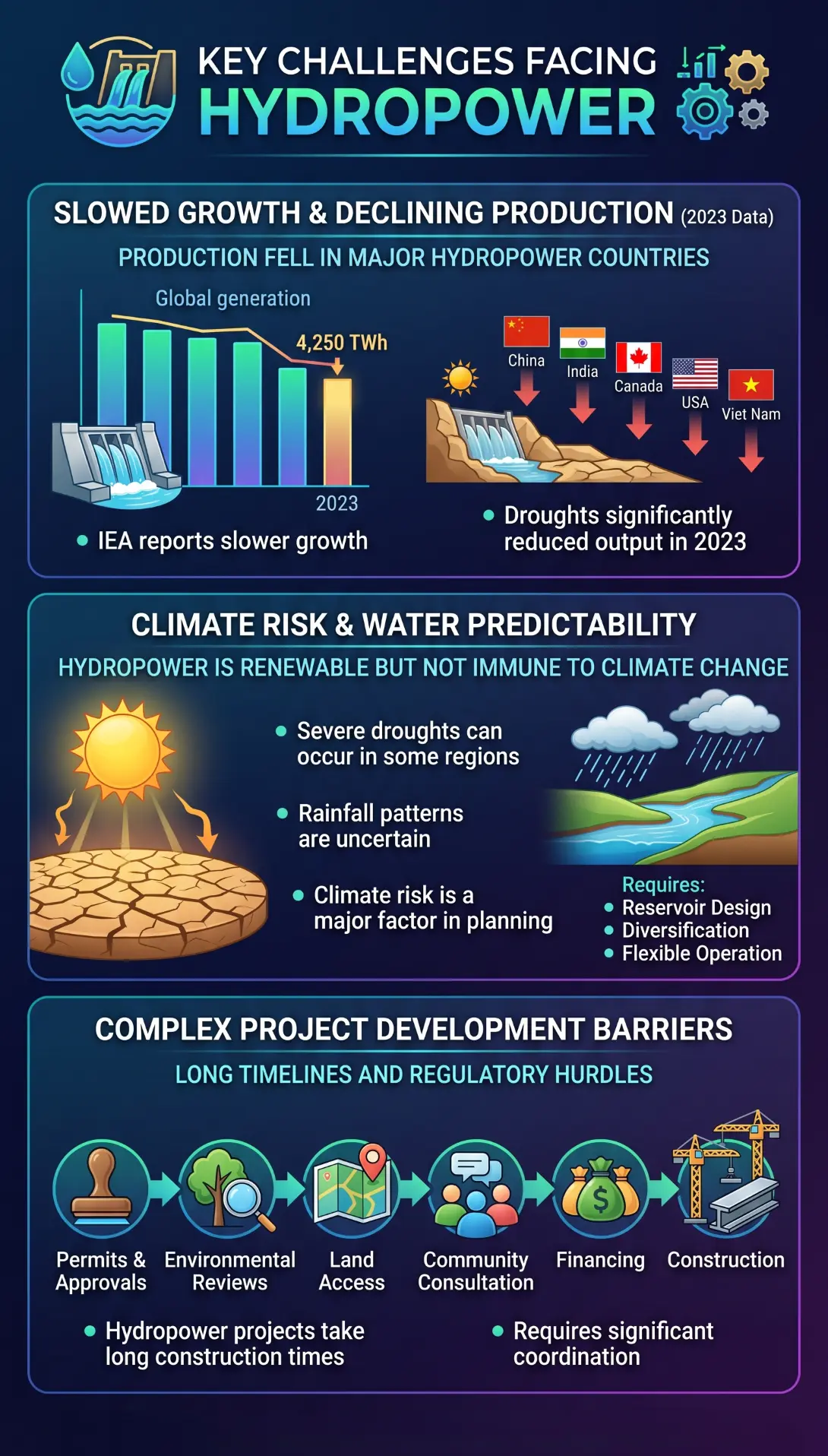
Hydropower is valuable, but it faces real challenges. One major issue is that the pace of growth has been slower than many climate and energy plans would like. The International Energy Agency says global hydropower generation fell in 2023 because droughts hit several major hydropower countries, including China, India, Canada, the United States, and Viet Nam. That cut global generation to 4,250 TWh in that year.
That is a reminder that hydropower depends on water, and water is not always predictable. Climate change can make droughts more severe in some regions and rainfall patterns more uncertain in others. So even though hydropower is renewable, it is not immune to climate risk. In fact, climate risk is one of the strongest reasons planners are now paying more attention to reservoir design, diversification, and flexible operation.
Another challenge is project development itself. Hydropower projects can require permits, environmental reviews, land access, community consultation, financing, and long construction times. These are not small issues. They shape whether a project gets built at all. That is why industry reports keep stressing the need for stronger planning and better sustainability processes.
Pumped Storage: The Quiet Giant of Energy Storage
Pumped storage hydropower deserves special attention because it solves a problem that modern electricity systems really care about, which is time. Electricity is hard to store in large volumes, but pumped storage stores energy by moving water between two elevations. This lets the system save energy at one moment and use it later at another moment.
The sector is already enormous. One major industry source says pumped storage hydropower provides more than 90% of all stored energy in the world. The U.S. Department of Energy also notes that pumped storage provides the overwhelming share of utility-scale energy storage in the United States. These figures make pumped storage one of the most important forms of grid-scale storage on the planet.
Why does that matter? Because as more solar and wind enter the system, the grid needs ways to move electricity across hours, not just minutes. Pumped storage does that by turning water into a flexible storage medium. It is not a new idea, but it is becoming more important, not less.
A Few Practical Examples of Hydropower in Everyday Life
Hydropower is easy to picture in a giant dam, but it is also present in smaller, more ordinary settings. A city might use a hydropower plant tied to a water-supply system. An irrigation canal might be fitted with a turbine. A run-of-river project might quietly feed electricity into a regional grid. Even a reservoir used mainly for flood control can also generate power when the conditions are right.
That flexibility is one reason hydropower feels so practical. It can work in the background while doing other jobs at the same time. And in a world that needs cleaner power without losing reliability, that kind of multi-tasking is incredibly valuable.
Table: Common Misunderstandings About Hydropower
| Myth | Reality |
|---|---|
| Hydropower always means a giant dam | Many systems are run-of-river or use existing structures. |
| Hydropower has no environmental impact | Dams and reservoirs can affect fish, sediment, water temperature, and land use. |
| Hydropower is old-fashioned and not useful anymore | It remains the largest renewable source and is key for grid flexibility. |
| Hydropower only makes electricity | Many projects also support flood control, irrigation, and water supply. |
| Pumped storage wastes energy so it is useless | It uses more energy to pump than it later returns, but its value is in storage and grid support. |
The Future of Hydropower Energy
The future of hydropower is likely to be shaped by three big forces. The first is decarbonization, because countries need cleaner electricity. The second is grid flexibility, because solar and wind keep growing. The third is climate resilience, because water systems are becoming more stressed and less predictable in many places. Hydropower sits right at the intersection of those three needs.
The International Energy Agency expects more than 150 GW of new hydropower capacity to come online by the end of the decade, mostly in emerging and developing economies. It also says hydropower generation is expected to rise between 2025 and 2030, even though its share of global electricity may dip slightly because other renewables are growing faster. That is a strong sign that hydropower is still very much part of the future, even in a fast-changing energy mix.
The sector’s challenge is not whether hydropower matters. It clearly does. The real challenge is how to build, modernize, and operate hydropower in ways that are more sustainable, more climate-resilient, and more sensitive to local communities and ecosystems. That is where the next generation of hydropower decisions will be made.
Final Thoughts
Hydropower energy has lasted because it solves real problems. It turns moving water into electricity, but it also does much more than that. It helps balance grids, store power, support water management, and strengthen energy security. It can be built in large systems or smaller ones. It can work with other renewables. And when designed carefully, it can support a cleaner energy future without losing sight of the river, the land, or the people who depend on them.
There is a simple reason hydropower still matters. Electricity systems need power that is clean, dependable, and flexible. Hydropower can provide all three in the right setting. That is a rare combination, and it is one of the reasons this long-standing technology remains so relevant in the modern world.
Article References and Sources
- U.S. Department of Energy. Hydropower Basics
- U.S. Department of Energy. How Hydropower Works
- U.S. Department of Energy. Benefits of Hydropower
- U.S. Energy Information Administration. Hydropower Energy Explained
- U.S. Energy Information Administration. Hydropower and the Environment
- International Energy Agency. Hydroelectricity Overview
- International Hydropower Association. Discover Facts About Hydropower
- International Hydropower Association. 2024 World Hydropower Outlook
- World Bank Group. Hydroelectric Power Guide for Developers and Investors
Also, Read these Articles in Detail
- Physics and Its Fundamentals With Good Explanations
- Matter, Motion, and Energy: The Core Ideas of Physics
- What Is Matter? The Physical Substance of the Universe
- What Is Motion? A Guide to Motion in Physics and Daily Life
- What Is Energy? The Invisible Power Behind Everyday Life
- Kinetic Energy Explained in Simple Language
- Potential Energy: Definition, Types, Formula, and Examples
- Thermal Energy: Heat, Temperature, and Transfer
- Mechanical Energy: Definition, Formula, and Examples
- Chemical Energy: Definition, Science, and Examples
- Electrical Energy: Definition, Works, and Why It Matters
- Radiant Energy: Meaning, Sources, Examples, and Uses
- Nuclear Energy: Definition, How It Works, and Why It Matters
- Sound Energy: Definition, Science, and Examples
- Elastic Energy: Definition, Elasticity and Example
- Geothermal Energy: Clean Electricity, Heating, and Modern Life
- Pumped Hydropower Storage
Frequently Asked Questions
FAQ 1. What is hydropower energy, and how does it work?
Hydropower energy is electricity made from the movement of water. It is one of the oldest and most widely used forms of renewable energy, and the basic idea behind it is simple. When water flows from a higher place to a lower place, it carries kinetic energy. A hydropower plant captures that energy and turns it into electricity.
In most systems, water is held in a reservoir or directed from a river into a penstock, which is a large pipe or tunnel. The fast-moving water then strikes a turbine, causing it to spin. That spinning motion drives a generator, and the generator produces electricity. The electricity is then sent through power lines to homes, schools, factories, and other places that need power.
What makes hydropower so useful is that it is both simple in concept and highly effective in practice. It does not need fuel in the usual sense, because the water cycle keeps renewing the resource naturally. Sunlight causes water to evaporate, clouds form, rain falls, and rivers keep moving. That means hydropower can keep working as long as water continues to flow.
Hydropower is also valued because it can be scaled in different ways. Some plants are huge and serve entire regions. Others are smaller and help local communities or specific industries. And while the equipment may look complex, the principle is really just this: moving water becomes spinning motion, and spinning motion becomes electricity. That’s the heart of hydropower generation.
FAQ 2. Why is hydropower considered one of the most important renewable energy sources?
Hydropower matters because it does more than just generate electricity. It provides clean power, supports grid stability, helps manage water resources, and can store energy for later use. That combination is rare. Many energy sources can do one or two of those things, but hydropower can often do all of them together.
One big reason it is so important is that it can respond quickly to changing demand. When people turn on lights, machines, or heating systems, the electricity grid needs to react fast. Hydropower plants can increase or reduce output quickly, which makes them very useful for balancing the grid. This is especially important when other renewable sources like solar and wind are changing throughout the day.
Hydropower is also important because it has a long operating life. Many facilities last for decades, and some keep working for much longer with proper maintenance and upgrades. That makes them a stable part of the energy system over time.
Another reason is scale. Hydropower already supplies a major share of the world’s renewable electricity. That means it is not a small side option. It is already deeply embedded in the way the world produces power. And as countries look for cleaner and more reliable energy, hydropower remains one of the few technologies that can provide renewable electricity and system flexibility at the same time.
FAQ 3. What are the main types of hydropower systems?
There are several major types of hydropower systems, and each one works a little differently depending on the landscape, the river flow, and the purpose of the project.
The first type is run-of-river hydropower. This kind of plant uses the natural flow of a river with little or no large water storage. It is often seen as a simpler approach because it depends more directly on the river’s movement. It can be a good option where the river flow is fairly steady, but output may change when the river level changes.
The second type is storage hydropower. This uses a dam and reservoir to hold water back so it can be released when needed. This gives operators much more control. They can produce electricity when demand is high instead of only when the river happens to flow strongly. Storage systems are often the most flexible kind of hydropower.
The third type is pumped storage hydropower. This one works like a giant energy storage system. When electricity is cheap or plentiful, water is pumped uphill to a higher reservoir. Later, when power is needed, the water is released downhill through turbines to generate electricity. This is not about creating energy from nothing. It is about storing energy for later use, which is very helpful for modern electricity grids.
There are also smaller or more specialized systems, including hydropower built into existing water infrastructure. The right type depends on the location, the need, the budget, and the environmental conditions. That is why hydropower is not one single technology but a family of related systems.
FAQ 4. What are the biggest advantages of hydropower energy?
One of the biggest advantages of hydropower energy is that it is renewable. The water cycle keeps replenishing the resource, so unlike coal, oil, or gas, the fuel itself is not permanently used up during generation.
Another major advantage is low carbon emissions during operation. Hydropower plants do not burn fuel while making electricity, so they can help reduce air pollution and greenhouse gas emissions when they replace fossil fuel power plants. That makes them especially valuable in a world trying to cut emissions.
Hydropower is also very flexible. Many plants can start, stop, or adjust output quickly. That means they can help balance the grid when electricity demand changes suddenly. This is one reason hydropower works so well alongside solar and wind, which can vary depending on weather and time of day.
A fourth advantage is storage. With pumped storage, hydropower can store energy in the form of water at higher elevation and release it later. This helps electricity systems handle peak demand and sudden changes more smoothly.
There is also the matter of multi-purpose use. A hydropower reservoir may also support irrigation, flood control, drinking water, and sometimes recreation. That gives it extra value beyond electricity alone.
And finally, hydropower plants often last a long time. That long life can make them a strong investment when they are planned carefully and maintained properly. For many regions, hydropower remains one of the most practical ways to produce reliable clean electricity.
FAQ 5. What are the environmental impacts of hydropower?
Hydropower is often described as clean energy, and in many ways that is true. But it does have environmental impacts, especially when large dams and reservoirs are involved. A responsible view needs to include both the benefits and the trade-offs.
One major concern is river ecosystem disruption. Dams can change the natural flow of water, which affects fish, plants, sediments, and water temperature. Some fish species depend on moving upstream or downstream at certain times of the year, and a dam can block that migration.
Another issue is land flooding. Large reservoirs may cover forests, farmland, wildlife habitat, and sometimes even communities. That can mean environmental loss and social disruption. In some cases, people need to move from the area before a reservoir is filled.
There can also be changes in sediment flow. Rivers naturally carry silt and other materials downstream. Dams can trap that sediment, which may affect soil health, riverbanks, and coastal areas farther downstream.
That said, hydropower projects can be designed more responsibly. Engineers use fish ladders, fish elevators, improved turbine design, and environmental flow rules to reduce harm. Careful planning matters a lot. Small or well-managed projects may have much lower impacts than large ones, especially when they are built with environmental protection in mind.
So the honest answer is this. Hydropower can be a strong part of a cleaner energy system, but it is not impact-free. The goal is not to pretend otherwise. The goal is to build and run projects in ways that protect both people and nature as much as possible.
FAQ 6. What is pumped storage hydropower, and why is it so useful?
Pumped storage hydropower is one of the smartest ideas in the energy world because it solves a very practical problem, which is how to store large amounts of electricity. Electricity is hard to store directly, but pumped storage stores energy using water and gravity.
Here’s how it works. When the grid has extra electricity, usually during times of low demand, that power is used to pump water from a lower reservoir to a higher one. Later, when demand rises, the water is released back downhill through turbines, and electricity is produced. It is basically a giant water battery.
This system is useful because electricity demand changes all the time. People use more power in the evening, during heat waves, or when factories are running at full load. At the same time, solar panels and wind turbines may produce more electricity at some moments and less at others. Pumped storage helps fill those gaps.
It is also useful because it supports grid reliability. If a power system needs fast backup, pumped storage can respond quickly. That helps prevent blackouts and keeps the system more stable.
Another reason it matters is scale. Batteries are excellent for many uses, but pumped storage can store much larger amounts of energy over longer periods. That’s why it remains one of the most important forms of energy storage in the world.
So when people talk about making the grid cleaner and more flexible, pumped storage is usually part of the conversation. It may not be flashy, but it plays a huge role.
FAQ 7. How does hydropower support solar and wind power?
Hydropower and solar or wind often work best when they work together. That is because solar and wind are variable. The sun doesn’t shine at night, clouds can reduce solar output, and wind levels can change from one hour to the next. Hydropower helps fill those gaps.
A hydropower plant can increase generation when solar output drops in the evening or when wind slows down. That makes the whole electricity system more stable. Instead of relying on one source alone, the grid can use multiple clean sources that complement each other.
This is especially important for grid flexibility. A modern energy system needs power that can move up or down as needed. Hydropower is very good at that because many plants can adjust quickly. It can act as a balancing tool when renewable output shifts.
Pumped storage hydropower is especially helpful here. When solar or wind produces too much electricity at certain times, pumped storage can absorb the extra power by pumping water uphill. Later, it can release that water and send electricity back to the grid when needed.
This kind of cooperation is one of the most practical ideas in clean energy planning. It shows that the future of electricity is not just about one source replacing another. It is about building a smarter system where different technologies support each other. Hydropower plays a very important role in that system.
FAQ 8. What are the biggest challenges facing hydropower today?
Even though hydropower has many strengths, it also faces some serious challenges. One of the biggest is climate variability. Hydropower depends on water, and water supply can change because of droughts, irregular rainfall, snowpack shifts, and seasonal changes. If rivers carry less water than expected, electricity output can fall.
Another challenge is environmental concern. Large dams can affect river ecosystems, fish migration, sediment movement, and water quality. In many places, there is now stronger public pressure to protect rivers and communities. That means new projects often face more scrutiny than they did in the past.
There is also the issue of project development. Building a hydropower plant can take a long time. It often involves environmental studies, land rights, engineering work, financing, and public consultation. These steps are necessary, but they can slow things down.
Cost is another factor. Large hydropower projects can require major upfront investment. Even if they last a long time, the construction cost can be difficult for some countries or companies to manage.
And then there is aging infrastructure. Many existing hydropower plants were built decades ago. Some need upgrades, modern controls, better safety systems, or environmental improvements. That means the future of hydropower is not only about building new projects. It is also about improving old ones.
So hydropower remains powerful, but it is not effortless. It needs good planning, modern design, and careful environmental management to stay relevant and responsible.
FAQ 9. Is hydropower energy really clean and sustainable?
This is a fair question, and the honest answer is that hydropower is cleaner than fossil fuels, but it is not perfectly impact-free in every case. Its sustainability depends a lot on the type of project, the location, and how well it is managed.
On the clean side, hydropower does not burn coal, oil, or gas during operation. That means no direct smoke or combustion emissions while the plant is producing electricity. This is one of the main reasons it is such a valuable renewable energy source.
But sustainability also includes the natural environment and human communities. A big reservoir can flood land, alter river flow, affect fish, and change water conditions. If a project damages ecosystems badly or displaces people without proper planning, it is hard to call that fully sustainable.
That is why modern hydropower is increasingly focused on better design and better governance. Things like fish passages, environmental flow rules, improved sediment management, and community consultation can make a real difference.
Small-scale hydropower or upgrades to existing infrastructure may also be more sustainable in some cases than building a brand-new large dam in a sensitive area. The key is not to treat all hydropower the same. Some projects are much better than others.
So yes, hydropower can absolutely be part of a sustainable energy future. But sustainability depends on how thoughtfully the project is planned, built, and operated.
FAQ 10. What is the future of hydropower energy?
The future of hydropower energy looks important, but it will probably look different from the past. In earlier decades, the focus was often on building large dams and expanding electricity supply quickly. Today, the focus is shifting toward flexibility, storage, climate resilience, and environmental protection.
One major future role for hydropower is supporting systems with more solar and wind. As clean electricity grows, the grid will need more ways to balance supply and demand. Hydropower and especially pumped storage are very well suited for that job.
Another future role is modernizing old plants. Many existing hydropower stations can be improved with new turbines, better automation, stronger safety systems, and more efficient water use. That can boost output without necessarily building a brand-new plant.
Hydropower will also matter more in climate planning. As weather patterns shift, water management will become even more important. Reservoirs can help with drought support, flood control, and seasonal balancing, although they also need to be managed carefully.
The future is not only about technology. It is also about responsibility. New hydropower projects will need to respect rivers, wildlife, and local communities more than ever before. That means the best future projects will be the ones that are both technically strong and environmentally thoughtful.
So the long-term future of hydropower is not just alive. It is still very important. But it has to evolve. The most successful hydropower systems will be the ones that stay useful in a changing energy world while also protecting the water systems they depend on.
