

Pumped hydropower storage is one of those ideas that sounds simple, almost old-fashioned, until you look closely and realize how important it really is. In plain language, it stores electricity by moving water between two reservoirs at different heights. When there is extra power on the grid, water is pumped uphill. When the grid needs electricity, that same water is released back downhill through turbines to generate power. It is a clean, proven way to store energy on a large scale, and it has been doing this job for decades.
That matters more now than ever. As wind and solar keep growing, power systems need storage that can handle big swings in supply and demand. Recent energy reports show that hydropower remains a major part of the global electricity system, and pumped storage hydropower already provides more than 90% of stored energy worldwide. Global pumped storage capacity is close to 200 GW, which makes it the largest form of renewable energy storage in use today.
Table of Contents
What Pumped Hydropower Storage Actually Is
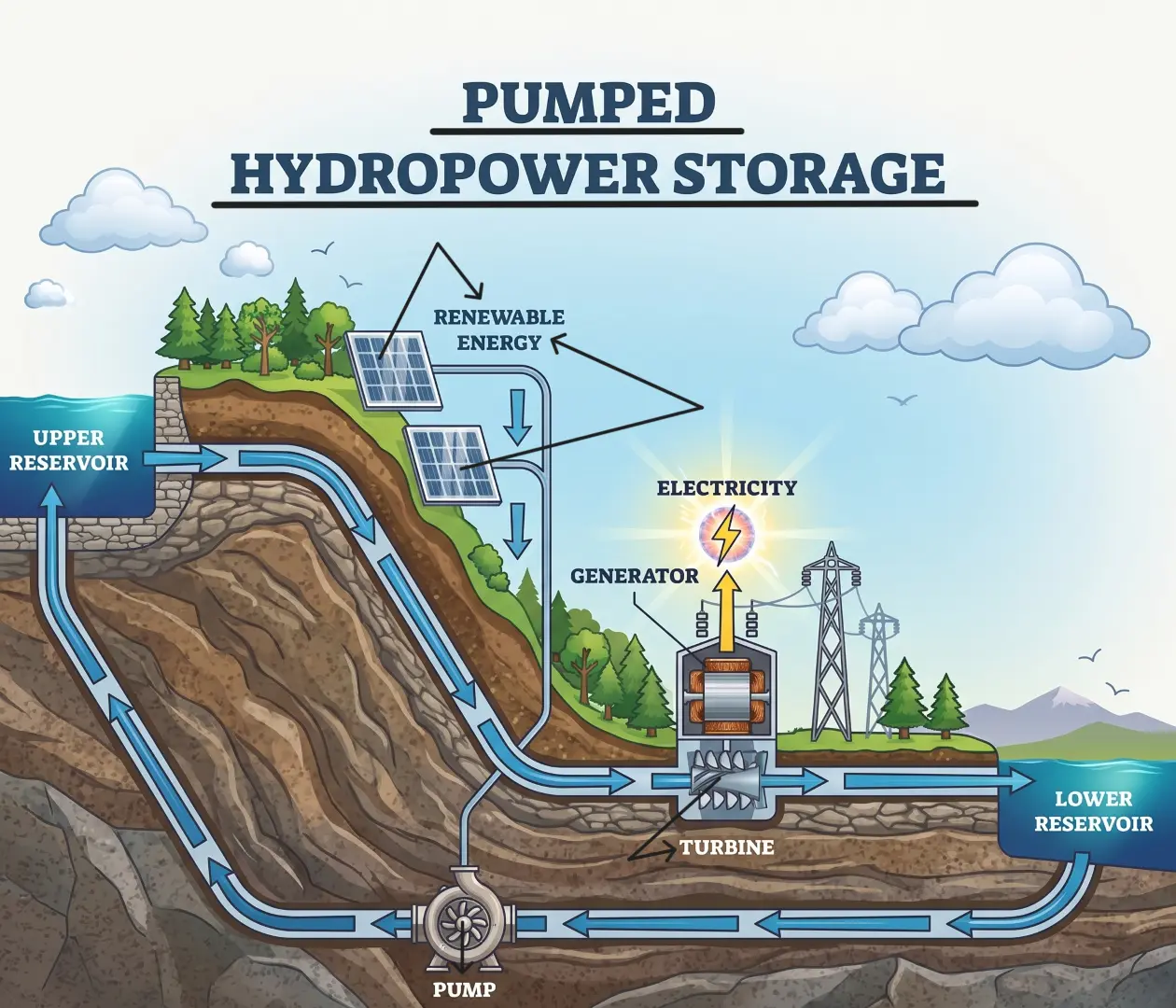
Pumped hydropower storage, often called pumped storage hydropower or PSH, is a form of hydroelectric energy storage. It uses two reservoirs placed at different elevations. The upper reservoir stores water like an energy bank, while the lower reservoir acts as the place where water collects after generation. The system uses a turbine, a generator, and pumps to move water up and down as needed.
The best way to think about it is this. Electricity is a bit like traffic. Sometimes the grid is packed with power from solar panels, wind farms, and power plants. Sometimes it is short on supply. PSH helps smooth those changes. It stores energy when there is too much and releases energy when there is too little. That is why many people call it a giant battery, even though it works with water instead of chemicals.
Hydropower overall is still the world’s largest renewable electricity source. In 2024, it generated around 4,500 terawatt-hours of electricity, or about 14% of global electricity generation. Pumped storage sits inside that broader hydropower family, but it plays a special role because it is not mainly built to produce constant power. It is built to store and release power on demand.
How Pumped Hydropower Storage Works
The process is easy to describe, but it is beautiful when you break it into steps.
1. When electricity is abundant
When solar output is high, wind power is strong, or demand is low, the plant uses that extra electricity to run pumps. The pumps move water from the lower reservoir to the upper reservoir. That water is now storing energy in the form of height.
2. When electricity is needed
When demand rises, the water is released from the upper reservoir. It flows back down through a penstock or tunnel, spins a turbine, and drives a generator that sends electricity to the grid.
3. The cycle repeats
After generation, the water collects in the lower reservoir and can be pumped back up again later. In that sense, the water is reused over and over. That is a major reason PSH is so attractive for long-term grid storage.
A simple real-world example
Picture a sunny afternoon. Rooftop solar, utility solar, and wind farms are producing a lot of electricity. Prices drop. Instead of wasting that extra power, a pumped storage plant uses it to pump water uphill. Then, around sunset, when households turn on lights, air conditioners, and appliances, the plant releases the water and sends electricity back to the grid. That is the whole trick, and it is a very smart one.
Key Facts About Pumped Hydropower Storage
| Topic | What it means | Why it matters |
|---|---|---|
| Basic idea | Stores electricity by moving water between two reservoirs at different elevations. | Makes energy storage possible at the grid scale. |
| Storage role | Acts like a giant rechargeable water battery. | Helps balance power supply and demand. |
| Global importance | Provides more than 90% of stored energy worldwide. | Shows that PSH is the dominant long-duration storage technology. |
| Installed capacity | Nearly 200 GW globally. | Proves the technology is already operating at a huge scale. |
| United States | About 22 GW of generating capacity and 550 GWh of energy storage. | Shows how much storage value one national fleet can deliver. |
| Efficiency | Typical round-trip efficiency is around 80%, with a reported range of 70% to 87%. | Tells you how much energy is recovered after pumping losses. |
| Grid flexibility | Can operate across a very wide range, from about -100% to 100% of capacity. | Makes it useful for fast balancing and flexible operation. |
| Climate value | Research found PSH had the lowest average global warming potential among several grid-storage options studied. | Supports its role in cleaner power systems. |
The Main Types of Pumped Hydropower Storage
Pumped storage is not one single design. There are several versions, and the choice depends on land, water, cost, and environmental conditions. The two broad categories often discussed are open-loop and closed-loop systems. Some modern planning also looks at systems that use one existing reservoir and one new off-river reservoir.
| Type | How it works | Strengths | Trade-offs |
|---|---|---|---|
| Open-loop PSH | Connects a reservoir to a naturally flowing water feature through a tunnel or conduit. | Often, a lower construction cost if existing water infrastructure is available. | Can face more environmental and permitting hurdles because it interacts with natural waterways. |
| Closed-loop PSH | Uses two reservoirs that are not continuously connected to naturally flowing water. | Usually has fewer environmental impacts and can have a shorter licensing timeline. | Often needs more upfront civil works because the reservoirs must be built or adapted. |
| Existing reservoir plus off-river reservoir | Uses one existing reservoir and one new off-river reservoir. | Can lower costs while still limiting some environmental impacts. | Site-specific design can be complex and still needs careful planning. |
This variety matters because the future of pumped storage is not limited to a few mountain valleys. New design approaches are expanding where PSH can be built, especially in places that need long-duration storage but do not have traditional steep terrain nearby.
Why Pumped Hydropower Storage Matters So Much
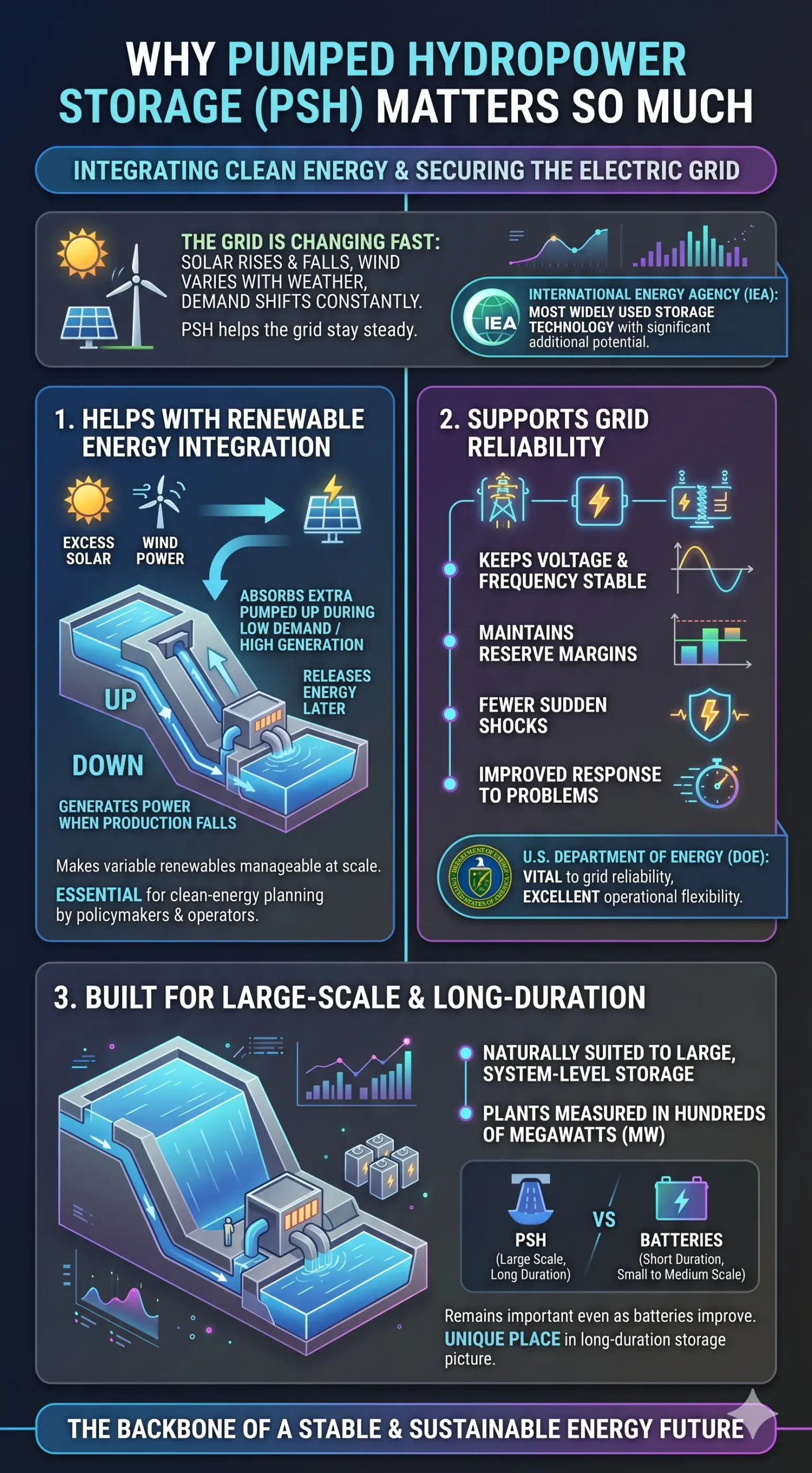
The electric grid is changing fast. Solar power rises and falls with daylight. Wind power changes with the weather. Electricity demand changes by the hour, by the season, and sometimes by the minute. PSH helps the grid stay steady when all of those changes happen at once. It is one of the most established forms of grid-scale storage, and the International Energy Agency describes pumped-storage hydropower as the most widely used storage technology, with significant additional potential in several regions.
1. It helps with renewable energy integration
When solar and wind produce more electricity than the grid can immediately use, PSH can absorb that extra power. Later, when production falls, it can give the energy back. That makes variable renewables much easier to manage at scale. This is one reason policymakers and grid operators keep coming back to pumped storage in clean-energy planning.
2. It supports grid reliability
PSH is not just about storing electricity. It also helps keep voltage, frequency, and reserve margins stable. In practice, that means fewer sudden shocks to the system and a better ability to respond when something goes wrong. The U.S. Department of Energy describes PSH as vital to grid reliability, and its technical assessments show that these plants can offer excellent operational flexibility.
3. It is built for large-scale
A lot of storage technologies work well in small pieces. PSH is different. It is naturally suited to large, system-level storage, often with plants measured in hundreds of megawatts. That is one reason it remains important even as batteries keep getting better. Batteries are excellent in many roles, but PSH still has a unique place in the long-duration storage picture.
The Biggest Benefits of Pumped Hydropower Storage
Here is where PSH stands out.
- Long-duration storage. It can store energy for many hours, which is useful when solar fades in the evening or when wind patterns shift.
- Large capacity. It works well at the grid scale, not just the household or neighborhood scale.
- Mature technology. It is established, understood, and already operating in many countries.
- High operational flexibility. Modern systems can move across a broad output range, which helps with balancing the grid.
- Low emissions profile. Recent lifecycle research found a low average greenhouse gas impact compared with several other grid-storage options.
- Reuse of water. The same water can be cycled repeatedly, which is why the technology behaves like a rechargeable system.
There is also a practical advantage that people sometimes overlook. PSH gives grid operators something hard to replace with very short-duration tools. It can shift large blocks of energy from one time period to another, which is exactly what a renewable-heavy power system needs.
The Challenges and Limits
Pumped hydropower storage is powerful, but it is not easy.
1. High upfront cost
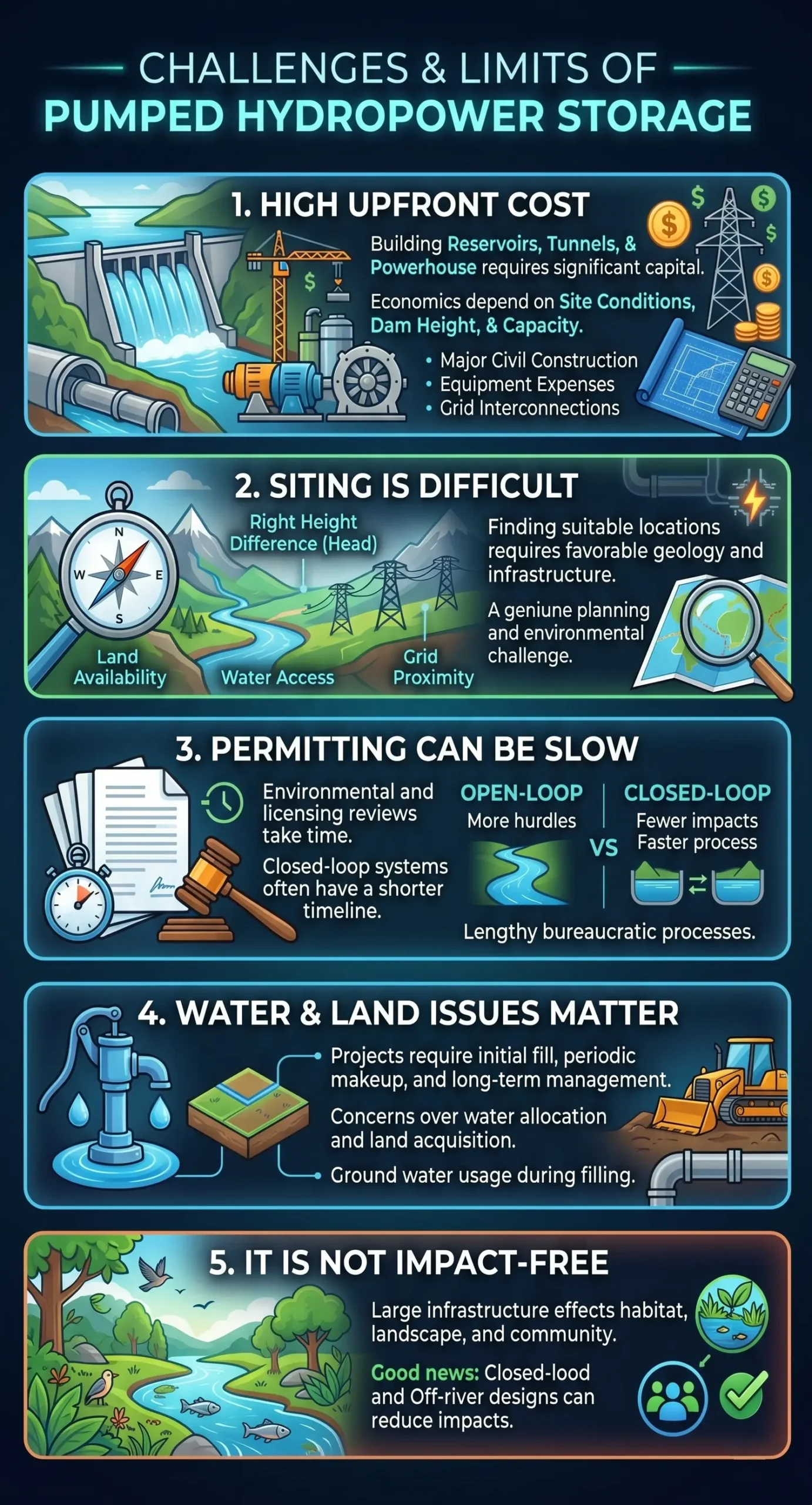
Building reservoirs, tunnels, powerhouse equipment, and grid connections takes serious money. Civil construction is usually a major part of the expense. NREL’s cost research highlights how much the economics depend on site conditions, reservoir size, generating capacity, and dam height.
2. Siting is difficult
Not every landscape is suitable. A good site needs the right height difference, land availability, water access, grid connection, and environmental fit. NREL’s supply-curve work exists because finding favorable PSH locations is a genuine planning problem, not just an engineering exercise.
3. Permitting can be slow
Open-loop projects often face more environmental and licensing hurdles because they interact with natural waterways. Closed-loop systems usually have fewer environmental impacts and a shorter licensing timeline, but they still need careful review.
4. Water and land issues matter
Even though the water is reused, projects still need initial fill, periodic makeup, land use planning, and long-term water management. Some systems may depend on groundwater or external water sources during filling and maintenance.
5. It is not impact-free
No large infrastructure is impact-free. Habitat, landscape, community concerns, and local water conditions all need serious attention. The good news is that research increasingly points to closed-loop and off-river designs as ways to reduce some of those pressures.
Pumped Hydropower Storage vs. Batteries
People often compare PSH to lithium-ion batteries, and that comparison makes sense. Both store energy and release it later. But they are not the same kind of solution.
| Feature | Pumped Hydropower Storage | Lithium-Ion Batteries |
|---|---|---|
| Main storage method | Water is stored at different heights. | Chemical storage inside cells. |
| Typical role | Long-duration, grid-scale storage. | Fast deployment and highly scalable modular storage. |
| Round-trip efficiency | Around 80% on typical new plants, with reported ranges of 70% to 87%. | Often high, but it depends on chemistry and use case. |
| Scale | Very large, often hundreds of megawatts. | Highly modular, from small systems to utility-scale. |
| Construction | Requires major civil works and suitable terrain. | Easier to site in many places. |
| Grid value | Strong for long-duration shifting and stability. | Strong for rapid response and flexible deployment. |
| Environmental profile | Can be low-emissions, especially in closed-loop designs. | Depends on manufacturing, materials, and recycling pathways. |
The smart way to think about this is not “which one wins,” but “which one fits the job.” Batteries are great for short, fast responses. PSH is often better when the grid needs large blocks of energy moved over many hours. That is why both technologies are likely to keep growing together rather than replacing each other completely.
Where Pumped Hydropower Storage Is Used in the Real World
PSH is useful anywhere electricity demand changes a lot and renewable generation is growing quickly. It can help in big cities, industrial regions, regions with strong solar output, places with strong wind resources, and power systems that need more flexibility than simple generation can provide. The technology is already in operation in many parts of the world, and the global installed fleet is large enough to matter at the system level.
Common real-world jobs
- Shifting daytime solar energy into evening demand
- Absorbing excess wind power at night
- Providing reserve capacity for sudden demand spikes
- Supporting black-start and recovery planning in some grid setups
- Reducing curtailment of renewable generation
- Helping keep the grid stable during seasonal peaks
A lot of people think of energy storage as a small gadget problem. PSH proves the opposite. This is infrastructure. It is about carrying an entire power system through moments when supply and demand do not line up neatly. That is a very different job, and it is one reason pumped storage keeps coming back into energy conversations worldwide.
Environmental and Climate Perspective
The environmental story around pumped hydropower storage is more nuanced than a simple yes or no. On one hand, it is a large infrastructure technology and can affect land, water, ecosystems, and local communities. On the other hand, lifecycle research has found that PSH can have very low greenhouse gas impact compared with several other grid-scale storage options, and one NREL analysis found it had the lowest average global warming potential among the technologies studied.
Closed-loop systems are especially interesting here. Because they are not continuously connected to naturally flowing water, they can lower some of the ecological trade-offs that often complicate open-loop projects. That does not mean they are automatically easy or impact-free. It does mean they may offer a better balance in places where clean-energy expansion has to be paired with careful land and water stewardship.
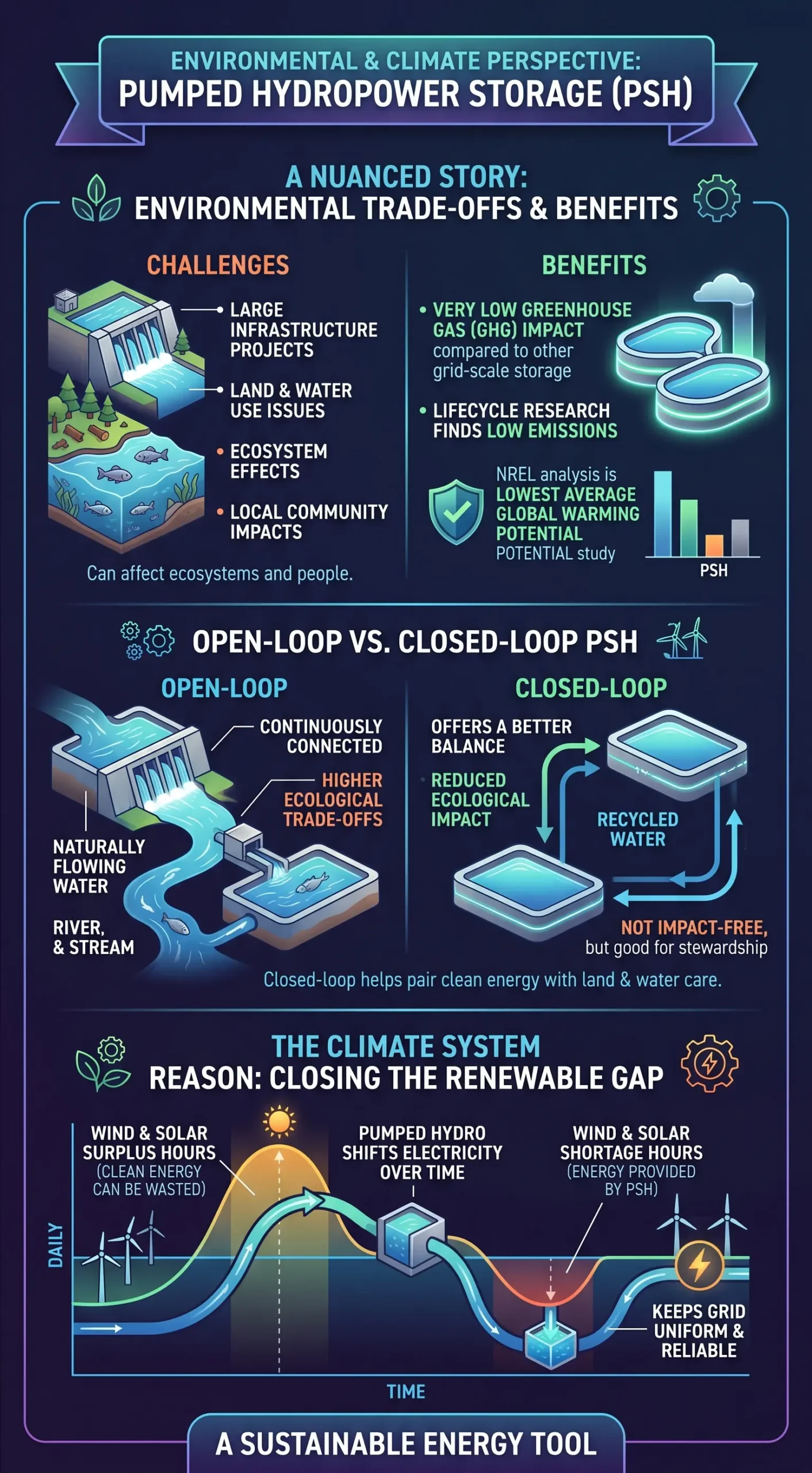
There is also a climate-system reason PSH matters. Energy systems with more solar and wind need tools that can move electricity across time. Without storage, clean energy can be wasted during surplus hours and missed during shortage hours. Pumped hydropower helps close that gap in a very direct way.
The Future of Pumped Hydropower Storage
The future of PSH looks stronger than many people expected a few years ago. The reason is not nostalgia. It is system need. Wind and solar are growing fast, and grids now need more long-duration storage, more flexibility, and more resilience. The International Energy Agency says pumped-storage hydropower remains the most widely used storage technology and still has significant additional potential.
The direction of innovation is also changing. New planning tools, cost models, geospatial supply curves, and life-cycle analyses are making it easier to identify good projects and avoid weak ones. That matters because the old idea that pumped storage only works in a handful of mountain regions is no longer accurate. Closed-loop and off-river concepts are widening the map.
Policy support is growing too. In the United States, recent federal work has included financial assistance for project design, transmission studies, power market assessments, and permitting to help move PSH projects forward. That kind of support shows how seriously decision makers are treating long-duration storage.
A Clear Example of Why PSH Still Matters
Imagine a region with lots of solar power. Around noon, the system produces more electricity than homes and businesses need. Without storage, some of that clean power may be curtailed. With pumped hydropower storage, the extra electricity can pump water uphill. Then at 7 p.m., when people come home, cook dinner, switch on lights, and use air conditioning, the plant releases the water and sends power back into the grid. That simple shift can reduce waste, support reliability, and make the whole system work better.
That is the real beauty of pumped storage. It does not try to fight the natural rhythm of energy use. It works with it.
Common Myths About Pumped Hydropower Storage
| Myth | Reality |
|---|---|
| It wastes water | The same water is reused again and again. The system stores energy by moving water, not by consuming it in the usual sense. |
| It is only for mountains | Newer closed-loop and off-river designs are widening the range of possible sites. |
| It is outdated | It is a mature technology, but it remains one of the most important tools for long-duration storage. |
| It is just a big battery, nothing more | It behaves like a battery in some ways, but it also provides major grid services and very large-scale storage. |
| It always harms the environment | Impacts vary widely by design. Closed-loop systems often reduce some of the environmental trade-offs. |
Important Terms to Know
| Term | Meaning |
|---|---|
| Upper reservoir | The higher body of water where energy is stored. |
| Lower reservoir | The lower body of water that receives water after generation. |
| Turbine | A machine turned by flowing water to produce mechanical motion. |
| Generator | Equipment that turns mechanical motion into electricity. |
| Penstock | A pipe or tunnel that carries water to the turbine. |
| Round-trip efficiency | The percentage of energy you get back after pumping and generation losses. |
| Long-duration energy storage | Storage that can shift power over many hours or longer. |
| Open-loop | A PSH design connected to naturally flowing water. |
| Closed-loop | A PSH design not continuously connected to a natural waterway. |
| Ancillary services | Support functions that help the grid stay stable and reliable. |
Why Pumped Hydropower Storage Still Deserves Attention
In a world that talks a lot about new technology, pumped hydropower storage is a reminder that the best solution is not always the newest one. Sometimes it is the one that already works, can scale widely, and fits a real system need. PSH has a strong record, a huge installed base, and a role that is likely to grow as electricity systems get more renewable, more digital, and more dependent on flexible storage.
It is not perfect. It needs careful site selection, investment, water planning, and environmental review. But when the design is right, the value is hard to ignore. It can absorb surplus electricity, release power when needed, help manage peaks, and support a cleaner grid without relying on scarce battery materials for every use case.
That is why pumped hydropower storage keeps earning attention from engineers, policymakers, investors, and grid operators. It is not flashy. It is not a headline-grabbing gadget. But it does something extremely important. It gives the electric grid time, and time is one of the most valuable things any power system can have.
Article References and Sources
- U.S. Department of Energy. “Pumped Storage Hydropower.”
- U.S. Department of Energy. “How Pumped Storage Hydropower Works.”
- International Hydropower Association. “2024 World Hydropower Outlook.”
- International Hydropower Association. “Pumped Storage Hydropower Factsheet.”
- International Energy Agency. “Hydroelectricity.”
- International Energy Agency. “Grid-Scale Storage.”
- DOE: Technology Strategy Assessment: Pumped Storage Hydropower.
- DOE: Wind and Solar Integration and System Reliability Initiative.
- NREL: Lifetime Greenhouse Gas Emissions of Energy Storage Technologies
- NREL: Pumped Storage Hydropower Supply Curves
- NREL: Pumped Storage Hydropower Cost Modeling PDF
- NREL: Closed-Loop Pumped Storage Hydropower Resource Assessment PDF
- DOE: Lower Environmental Impacts of Closed-Loop Pumped Storage
- NREL. “Annual Technology Baseline: Pumped Storage Hydropower”
- Oak Ridge National Laboratory: PSH FAST Commissioning Technical Report PDF
Also, Read these Articles in Detail
- Physics and Its Fundamentals With Good Explanations
- Matter, Motion, and Energy: The Core Ideas of Physics
- What Is Matter? The Physical Substance of the Universe
- What Is Motion? A Guide to Motion in Physics and Daily Life
- What Is Energy? The Invisible Power Behind Everyday Life
- Kinetic Energy Explained in Simple Language
- Potential Energy: Definition, Types, Formula, and Examples
- Thermal Energy: Heat, Temperature, and Transfer
- Mechanical Energy: Definition, Formula, and Examples
- Chemical Energy: Definition, Science, and Examples
- Electrical Energy: Definition, Works, and Why It Matters
- Radiant Energy: Meaning, Sources, Examples, and Uses
- Nuclear Energy: Definition, How It Works, and Why It Matters
- Sound Energy: Definition, Science, and Examples
- Elastic Energy: Definition, Elasticity and Example
- Geothermal Energy: Clean Electricity, Heating, and Modern Life
- Hydropower Energy: How It Works and Its Importance
Frequently Asked Questions
FAQ 1: What is pumped hydropower storage, and how does it work?
Pumped hydropower storage is a way of storing electricity by moving water between two reservoirs at different heights. It is often described as a giant rechargeable battery, but instead of storing energy inside chemical cells, it stores energy in the form of gravitational potential energy. That simply means the water is kept at a higher level so it can later flow back down and produce electricity when needed.
The process is straightforward, but very clever. When there is extra electricity on the grid, the system uses that power to run pumps. Those pumps move water from the lower reservoir to the upper reservoir. The water is not being used up. It is just being moved uphill and saved for later. Then, when electricity demand rises, the water is released from the upper reservoir. It flows back down through a turbine, which spins a generator and sends electricity to the grid.
This makes pumped hydropower storage extremely useful in modern power systems. Electricity supply and demand do not always match perfectly. Solar power is stronger in the daytime. Wind power can rise and fall with the weather. People use more electricity at certain hours, especially in the evening. Pumped storage helps smooth out those differences. It stores surplus electricity when supply is high and releases it when supply is low.
A simple way to think about it is this. Imagine filling a bucket with water when electricity is cheap and abundant, then emptying it later when the grid needs support. The system works the same way, just on a much larger scale. And because it can be used repeatedly, pumped hydropower storage is one of the most practical forms of long-duration energy storage available today.
It is also valuable because it can respond to the grid in a flexible way. It does not only store energy. It can also help with grid stability, frequency control, and peak demand management. That is one reason it remains important even in a world that is rapidly adopting solar panels, wind turbines, and batteries.
FAQ 2: Why is pumped hydropower storage so important for modern electricity grids?
Pumped hydropower storage matters because electricity grids need balance. Every second of every day, the grid must match electricity supply with electricity demand. If too much electricity is produced, some of it may be wasted. If too little is produced, the grid becomes unstable. That is where pumped storage comes in. It gives power systems a way to move energy across time.
Modern electricity grids are changing fast. More countries are adding solar, wind, and other renewable energy sources. These are clean and important, but they are also variable. The sun does not shine at night. The wind does not blow in a perfectly steady way. So the grid needs storage that can absorb extra energy and return it later. Pumped hydropower storage does exactly that.
It is especially useful for peak shaving, which means reducing strain when demand is highest. For example, in the evening, families may be cooking, using air conditioners, charging devices, and turning on lights all at once. That creates a demand spike. A pumped storage plant can release water and deliver electricity during that time, helping the grid avoid stress.
It also supports renewable energy integration. Sometimes solar farms and wind farms produce more power than the grid can use at that moment. Without storage, some of that clean electricity may be curtailed, which means it is simply not used. Pumped storage gives that power a second life. It can be stored and sent back out when it is needed most.
And there is another reason it matters. Pumped storage offers a kind of reliability that many other storage technologies struggle to match at large scale. It can provide long operating hours, strong output, and dependable grid support. That is why it is often seen as a backbone technology for cleaner power systems. It is not flashy, but it is deeply useful.
FAQ 3: What are the main advantages of pumped hydropower storage?
There are many reasons why pumped hydropower storage is valued so highly, and most of them come down to scale, reliability, and flexibility.
One major advantage is large-scale storage capacity. Pumped storage plants can store huge amounts of energy. That makes them suitable for utility systems, not just small community use. In other words, this is not a tiny backup system. It is infrastructure that can support entire regions.
Another major advantage is long-duration storage. Some energy storage systems can respond quickly, but only for a short time. Pumped storage can deliver electricity for many hours, which is extremely important when renewable output drops or demand stays high for a long stretch.
A third advantage is high efficiency. No storage system is perfect, because some energy is always lost in the process. But pumped hydropower storage is still very efficient compared with many large-scale storage options. Its round-trip efficiency is often around 80%, which means a large portion of the energy used to pump the water can be recovered later.
It is also a mature technology. That matters more than people sometimes realize. Because pumped storage has been used for decades, engineers understand how to design, operate, and maintain it. There is less guesswork than with newer storage methods. That makes planning easier and often improves long-term confidence.
Another benefit is grid flexibility. A pumped storage plant can help meet sudden changes in demand, support system frequency, and provide reserve power. It can be a quiet but powerful stabilizing force behind the scenes.
And there is one more practical benefit. The same water can often be reused many times. That makes the system feel like a rechargeable loop. It does not consume fuel in the usual way, and that makes it very attractive in a low-carbon energy future.
FAQ 4: What are the different types of pumped hydropower storage systems?
There are several kinds of pumped hydropower storage systems, and the design depends on local geography, water access, environmental rules, and grid needs. The two most common categories are open-loop and closed-loop systems.
An open-loop system is connected to a natural waterway, such as a river or existing reservoir. Water moves through the system with some connection to the broader water environment. This can be useful in places where natural water infrastructure already exists. But it can also create more environmental and permitting concerns because the project may interact more directly with the ecosystem.
A closed-loop system is different. It is not continuously connected to a naturally flowing body of water. Instead, it uses two reservoirs that are mostly isolated from rivers or lakes. This design can reduce some environmental impacts and may make permitting easier in certain cases. It is often seen as a strong option for new projects because it gives planners more control over the site.
There are also systems that use one existing reservoir and one new off-river reservoir. This approach can reduce cost and environmental disruption in some situations while still allowing large-scale energy storage. It is one reason the future of pumped storage is broader than many people think.
Each type has strengths and trade-offs. Open-loop systems may be easier to connect to existing water infrastructure. Closed-loop systems may be easier to manage environmentally. Off-river designs may open up new site options. So the best type depends on the location and the project goals.
The important thing is this. Pumped storage is not a single rigid model. It is a family of designs, and that flexibility is one reason the technology remains relevant in so many different places around the world.
FAQ 5: How efficient is pumped hydropower storage compared with other energy storage systems?
Pumped hydropower storage is generally considered a highly efficient large-scale storage option. A common way to measure this is through round-trip efficiency, which tells you how much energy you get back after putting energy into the system. For pumped storage, the typical round-trip efficiency is often around 80%, with some systems falling a little lower or rising a little higher depending on design and operating conditions.
That means if you use 100 units of electricity to pump water uphill, you might get about 80 units back when the water is released. Some energy is always lost because of friction, mechanical limits, and electrical conversion. But that level of efficiency is still strong for a technology that can store energy at such a large scale.
Compared with lithium-ion batteries, pumped storage is not always more efficient, but efficiency is not the only thing that matters. Batteries are often excellent for rapid response and short-duration storage. Pumped storage is especially valuable for longer-duration shifting and huge energy volumes. So the comparison should not only be about percentage efficiency. It should also be about what role each system plays in the grid.
Another point is durability. A pumped storage plant can operate over a very long period if properly maintained. That gives it a strong life-cycle value. It is not just about how much energy you get back in one cycle. It is also about how many cycles the system can handle and how well it serves the grid over decades.
So while pumped storage may not win every single comparison, it performs very well in the area that matters most for power systems. It provides dependable, long-duration storage at very large scale, and that makes it a powerful tool even if it is not the most efficient option in every narrow test.
FAQ 6: What are the biggest challenges or drawbacks of pumped hydropower storage?
Even though pumped hydropower storage is highly useful, it does have real challenges. It is not a perfect solution, and any honest discussion should include the limits.
The first major challenge is high upfront cost. Building a pumped storage plant requires major civil construction. You need reservoirs, tunnels, pumps, turbines, power equipment, and grid connections. That takes a lot of time and money. Compared with smaller technologies, the starting investment can be very large.
The second challenge is site availability. Not every place is suitable for pumped storage. A good site needs the right elevation difference, space for reservoirs, access to water, and a connection to the electric grid. Geography matters a great deal. That means some regions can build PSH more easily than others.
Another drawback is the permitting process. Large water and land projects often face environmental review, legal steps, and community concerns. That can slow down development. Open-loop systems can be especially complicated because they may affect natural waterways.
There are also environmental and land-use concerns. Even though the water is reused, the project still takes land and can affect habitats, ecosystems, and local communities. That does not mean pumped storage is bad. It simply means the planning must be careful and responsible.
And then there is the issue of long development timelines. Big infrastructure takes time to design, approve, finance, and build. In a fast-moving energy market, that can feel slow. But some energy solutions are built for speed, while pumped storage is built for longevity. It is important to understand that difference.
So the drawbacks are real, but they do not erase the value of the technology. They simply mean that pumped storage must be planned with care, patience, and the right site.
FAQ 7: How does pumped hydropower storage help with renewable energy like solar and wind?
Pumped hydropower storage is one of the most useful tools for making solar and wind power easier to use at large scale. The reason is simple. Renewable electricity does not always arrive exactly when people need it. Pumped storage helps bridge that gap.
Take solar power as an example. Solar panels produce the most electricity during the middle of the day, when the sun is strongest. But many households and businesses use more electricity in the evening. That means there is often a mismatch between supply and demand. Pumped storage can solve that by absorbing the extra midday electricity and sending it back later.
Wind power creates a similar challenge. Wind may be strong at night or during quiet periods when demand is low. Instead of wasting that power, the grid can use it to pump water uphill. Later, when the wind slows or demand rises, the stored energy can be released.
This is one reason pumped storage is often described as a partner to renewable energy. It does not generate electricity from sunlight or wind directly, but it makes those resources more reliable and more useful. Without storage, a clean grid can still struggle with timing problems. With storage, the system becomes much smoother.
Pumped storage also helps reduce curtailment, which happens when renewable electricity cannot be used even though it was produced. Curtailment is a waste of clean energy. By storing surplus power, pumped hydropower storage helps make sure more of that clean electricity actually reaches people when it is needed.
So the relationship is simple but powerful. Renewables produce clean energy. Pumped storage moves that energy through time. And that combination makes the whole power system better.
FAQ 8: Is pumped hydropower storage environmentally friendly?
The answer is not just yes or no. Pumped hydropower storage can be environmentally beneficial in a broader energy sense, but it also has physical impacts that must be handled carefully.
On the positive side, PSH can support a cleaner electricity system. By helping integrate renewable energy and reducing dependence on fossil-fuel backup generation, it can lower overall emissions from the power sector. It also has a strong life-cycle profile compared with some other storage technologies, especially when designed and operated well.
Another positive point is that the water itself is reused many times. That means the system is not burning fuel or consuming water in the way people sometimes assume. The water acts as a storage medium. It moves up and down through the system repeatedly.
But there are still environmental concerns. Any large reservoir and construction project affects land use. It may disturb habitats, change local water conditions, and require careful ecosystem planning. Open-loop systems can interact more directly with rivers or lakes, which can raise more concerns than closed-loop designs.
That is why closed-loop pumped storage is getting attention. It can reduce some of the impact on natural waterways while still providing the energy storage the grid needs. It does not eliminate environmental trade-offs, but it can improve the balance.
So the honest answer is this. Pumped hydropower storage is not impact-free, but it can be a strong part of a cleaner energy future when it is carefully planned. In many cases, its broader climate benefits can be very significant.
FAQ 9: What is the future of pumped hydropower storage?
The future of pumped hydropower storage looks promising, especially as the world continues to build more renewable energy and look for ways to keep the grid stable.
One big reason is the rise of long-duration energy storage needs. Short battery storage is useful, but many grids also need systems that can move large amounts of electricity across many hours. Pumped storage is one of the few technologies already proven at that scale.
Another reason is innovation in project design. New types of closed-loop and off-river systems are making it possible to consider sites that were not practical before. That expands the potential for growth. It also gives planners more options in places where traditional reservoir geography is limited.
There is also more attention on grid resilience. As power systems face stronger weather events, changing demand patterns, and higher renewable penetration, the value of steady storage grows. Pumped storage can help power systems recover from disruptions and respond more smoothly to sudden changes.
Policy support matters too. Governments and grid planners are increasingly recognizing that storage is not optional in a cleaner grid. It is a core part of the system. And pumped storage, because it is mature and scalable, often stands out in those discussions.
Of course, the future will not be simple. Projects still need land, water planning, financing, and community support. But the broader direction is clear. As the energy transition continues, pumped hydropower storage is likely to remain one of the most important tools for balancing renewable electricity and keeping the grid reliable.
FAQ 10: How should people understand pumped hydropower storage in simple terms?
The simplest way to understand pumped hydropower storage is to think of it as a water-based battery for the grid. It stores extra electricity by using that power to push water uphill. Later, it gets that water to flow back down and turn turbines, which creates electricity again.
That is the basic idea. But the deeper meaning is more interesting. Pumped storage is not just about storing energy. It is about giving the grid flexibility. It helps clean energy work better. It supports demand peaks. It helps the system stay stable. And it does all of that with a technology that has already proven itself in real-world use.
People sometimes assume that only brand-new technologies matter in energy. But pumped storage shows that mature technologies can still be essential. It has scale, reliability, and a clear role in the transition to cleaner power. It is one of those rare systems that is both simple in concept and powerful in impact.
And that is why it keeps showing up in energy conversations around the world. It solves a real problem. Electricity does not always arrive when we need it. Pumped hydropower storage helps fix that. It shifts energy across time, which is exactly what a modern grid needs.
So when you hear the term, do not think of something remote or overly technical. Think of a smart system that uses gravity, water, and engineering to keep the lights on in a cleaner, more flexible world.
