Short Intro Summary: Force is one of the most important ideas in physics because it helps explain how and why objects move, stop, speed up, slow down, or change direction. The article explores force as a push or pull that acts on objects and shows how it connects directly to motion, balance, gravity, friction, and acceleration. It explains the meaning of force in simple language while also covering important scientific ideas such as Newton’s laws of motion, vector quantities, mass, weight, and the formula F = ma. The article also highlights how force is measured in newtons (N) and why direction matters when studying motion.
The article goes deep into the different types of forces, including both contact forces and non-contact forces. Readers learn about friction, tension, normal force, spring force, drag, lift, and gravitational force, along with the four fundamental forces found in nature. Real-life examples make each concept easier to understand. Everyday situations such as walking, driving, lifting objects, riding bicycles, flying airplanes, and even sitting on a chair are explained through the idea of force. Large and well-structured tables help organize the information clearly, making complex topics feel simple and practical instead of overwhelming.
The article also explains how force shapes the world far beyond daily life. It shows how engineers use force when designing bridges, machines, and vehicles, how athletes depend on force in sports, and how gravity controls planets and stars in space. Important concepts such as balanced and unbalanced forces, inertia, net force, free-body diagrams, and air resistance are explained in a natural and easy-to-follow way. By the end, the article makes it clear that force is not just a classroom topic. It is a powerful idea that helps people understand the behavior of objects, machines, nature, and the universe itself.
Table of Contents
Force is one of those ideas that sounds simple at first and then quietly turns out to sit at the center of almost everything around us. When you push a door open, pull a suitcase across the floor, kick a ball, stretch a rubber band, or feel the weight of your body on the ground, you are dealing with force. In physics, force is usually described as a push or pull in a specific direction, and it is treated as a vector quantity, which means direction matters just as much as size. That one detail changes everything, because a force is never just “how much.” It is also “which way.”
Force is also one of the main reasons motion changes. An object can keep moving steadily, slow down, speed up, or change direction because forces act on it. Newton’s laws connect force to motion in a very direct way, especially through the idea that the net external force on an object is related to its mass and acceleration. That is why force is not only a physics topic. It is a practical idea that explains sports, vehicles, engineering, weather, machines, and even how planets stay in orbit.
What Force Really Means
A force is not a thing you can always see, but you can see its results. A ball curves because of force. A chair holds you up because of force. A plane flies because multiple forces balance and compete with each other. In science, force is treated as something that can change the motion of an object, and that change can mean speeding up, slowing down, stopping, starting, or turning. If there is no net force, motion does not necessarily stop. The object may keep moving at constant velocity.
That is why force is closely tied to the word acceleration. Acceleration is not just about going faster. It also includes changing direction. A car moving around a curve is accelerating even if its speed stays the same, because its direction is changing. That point matters a lot in real life, because force often shows up in ways that are not obvious at first glance.
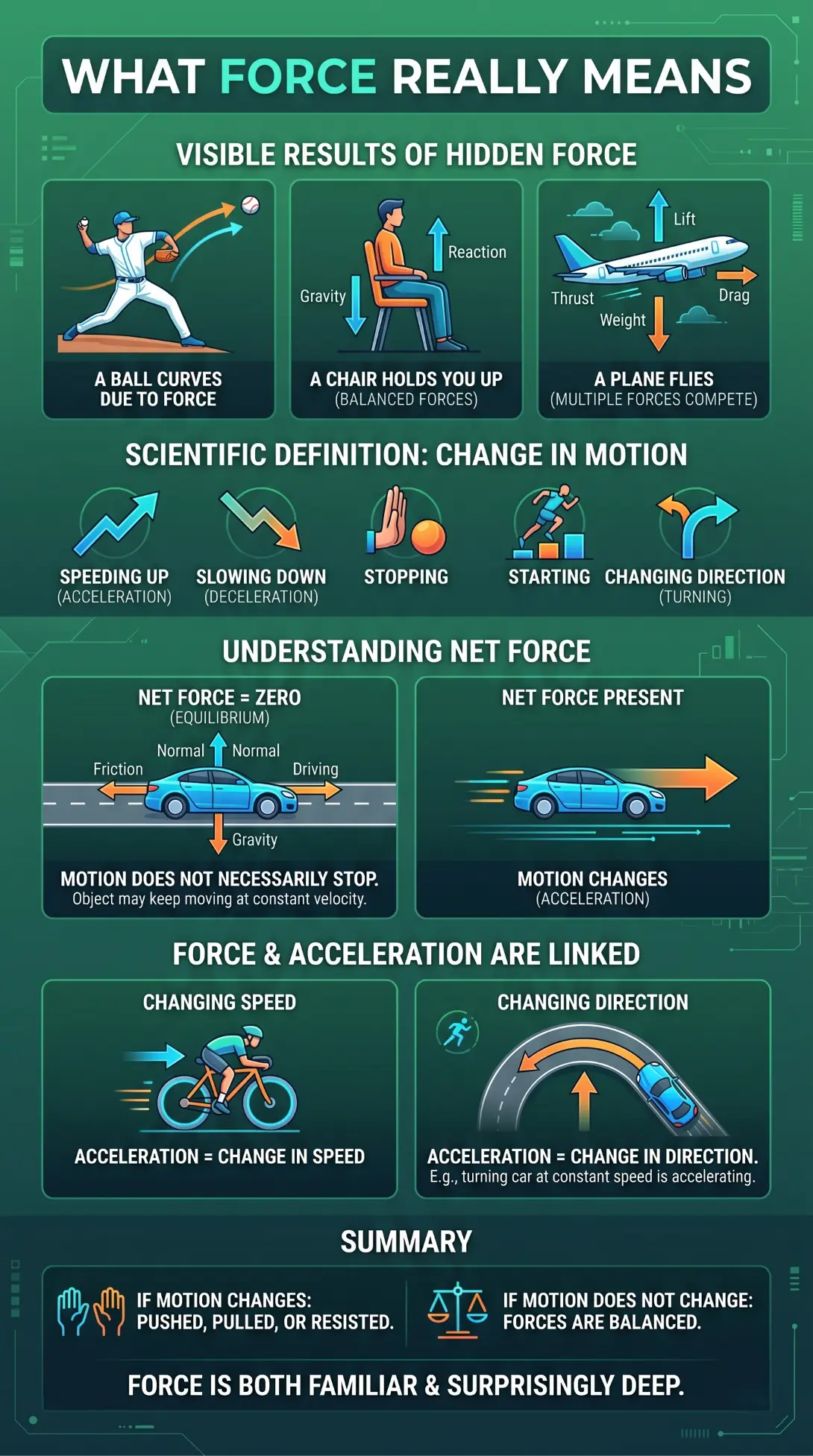
A simple way to think about force is this. If motion changes, something pushed, pulled, resisted, or balanced that motion. And if motion does not change, the forces may still be there, just balanced in a way that hides the effect. That is why force is both familiar and surprisingly deep.
Why Force Matters So Much
Force is one of the most useful ideas in all of physics because it helps explain both small and large things. On the small side, force helps explain why a book stays on a table, why a spring stretches, and why friction makes walking possible. On the large side, force helps explain Earth’s orbit, falling objects, the behavior of stars, and the motion of aircraft. Gravity is the most familiar force in daily life, but it is only one part of a larger picture that includes electromagnetism, the strong nuclear force, and the weak nuclear force.
This matters because forces are not only academic. They are practical. Engineers use force to design bridges, elevators, airplane wings, brakes, robots, sports equipment, buildings, and medical devices. Architects think about force when planning load-bearing structures. Mechanics think about force when studying engines and friction. Athletes deal with force every time they sprint, jump, throw, or swing. In other words, force is everywhere once you know how to look for it.
The Scientific Definition of Force
In physics, force is usually described in terms of its effect on motion and its direction. It has both magnitude and direction, so it is a vector. That means a force of 10 N to the left is not the same as a force of 10 N to the right, even though the size is the same. Direction changes the outcome.
The SI unit of force is the newton, symbol N. This unit is part of the International System of Units, which is used widely in science and technology. One newton is the force needed to give a 1-kilogram object an acceleration of 1 meter per second squared, which is why force is often written in relation to mass and acceleration.
In formula form, the most common expression is:
F = ma
where F is force, m is mass, and a is acceleration. When more than one force acts on an object, the important quantity is the net force, often written as Fₙₑₜ or ∑F. That is the total effect of all the forces combined.
A Clean Table of the Main Ideas About Force
| Idea | Meaning | Simple Example | Why It Matters |
|---|---|---|---|
| Force | A push or pull with direction | Pushing a shopping cart | It can change motion |
| Vector quantity | Has size and direction | 5 N left, 5 N right | Direction changes the result |
| Net force | Total of all forces acting together | Push forward plus friction backward | Decides acceleration |
| Acceleration | Change in velocity | Car speeding up or turning | Shows the effect of force |
| Mass | Amount of matter in an object | Heavy bag vs light bag | Affects how force changes motion |
| Newton (N) | SI unit of force | 1 N, 10 N, 100 N | Standard way to measure force |
Force is one of the few ideas that links the math of motion to the reality of daily life. That is why it appears so often in mechanics, engineering, astronomy, and even sports analysis.
Newton’s Laws and the Idea of Force
The story of force is closely tied to Newton’s laws of motion. These laws gave physics a framework that still works remarkably well for everyday motion. Newton’s first law says that an object remains at rest or keeps moving at constant velocity unless acted on by a net external force. In plain language, motion does not change by itself. Something has to cause that change.
Newton’s second law gives the clearest link between force and motion. It says the acceleration of an object depends on the net force acting on it and its mass. The bigger the force, the bigger the acceleration. The bigger the mass, the harder it is to accelerate the object. This is why a small push can move a bicycle easily, while the same push may do very little to a truck.
Newton’s third law is just as important. It says that forces always come in pairs. If one body exerts a force on another body, the second body exerts an equal and opposite force back on the first. A swimmer pushes on the wall, and the wall pushes back. A person walks by pushing backward on the ground, and the ground pushes the person forward. These pairs act on different bodies, which is why they do not cancel in the way many people first imagine.
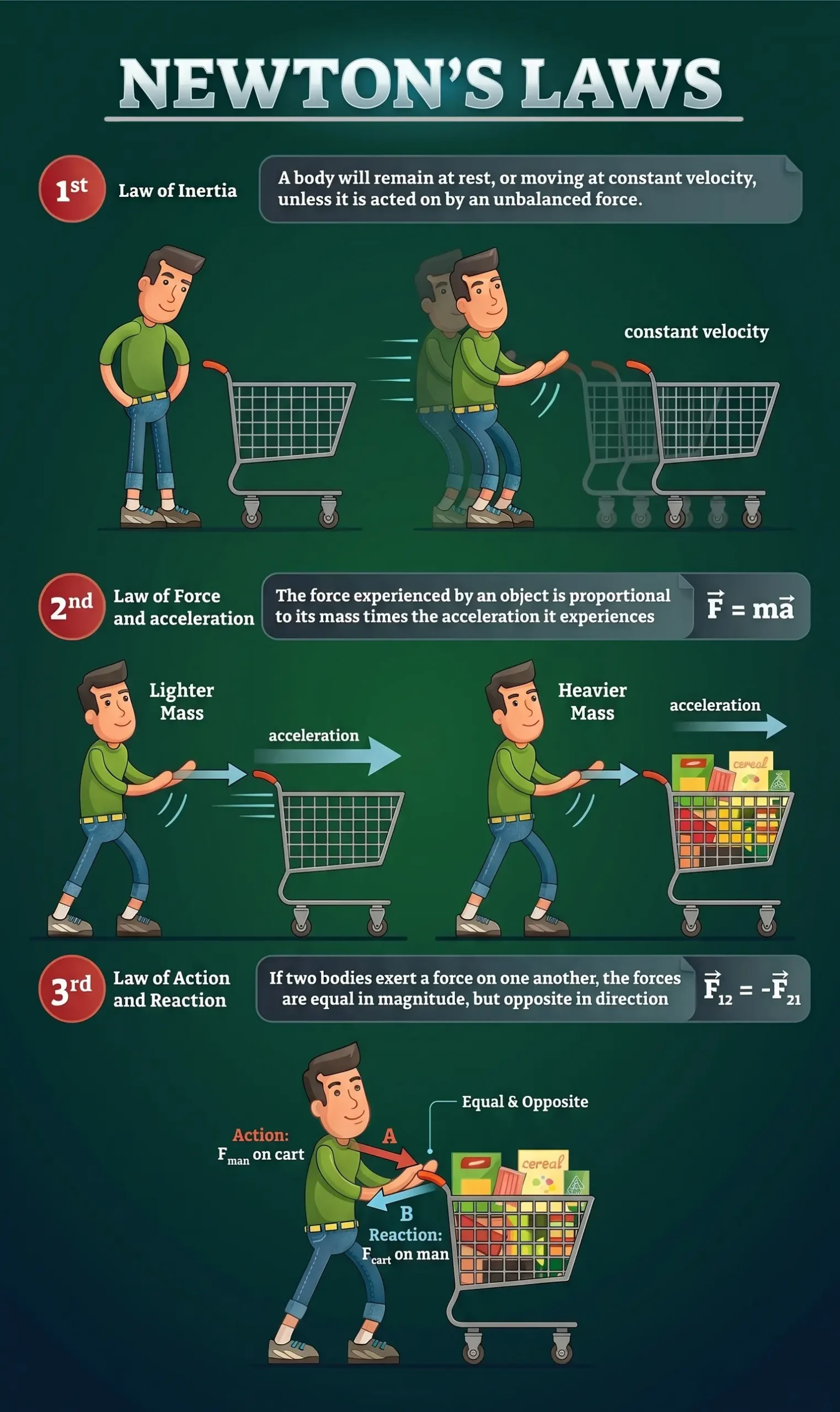
Table: Newton’s Laws in Simple Language
| Newton’s Law | Simple Idea | Everyday Example | What It Teaches About Force |
|---|---|---|---|
| First Law | Motion stays the same unless a net force acts | A hockey puck keeps sliding | Force is needed to change motion |
| Second Law | Force causes acceleration | A lighter cart accelerates more than a heavy cart | More force usually means more acceleration |
| Third Law | Every force has an equal and opposite partner force | Walking, swimming, rocket thrust | Forces occur in pairs |
These laws are not just classroom formulas. They are the backbone of how scientists and engineers understand movement in the physical world.
Types of Force
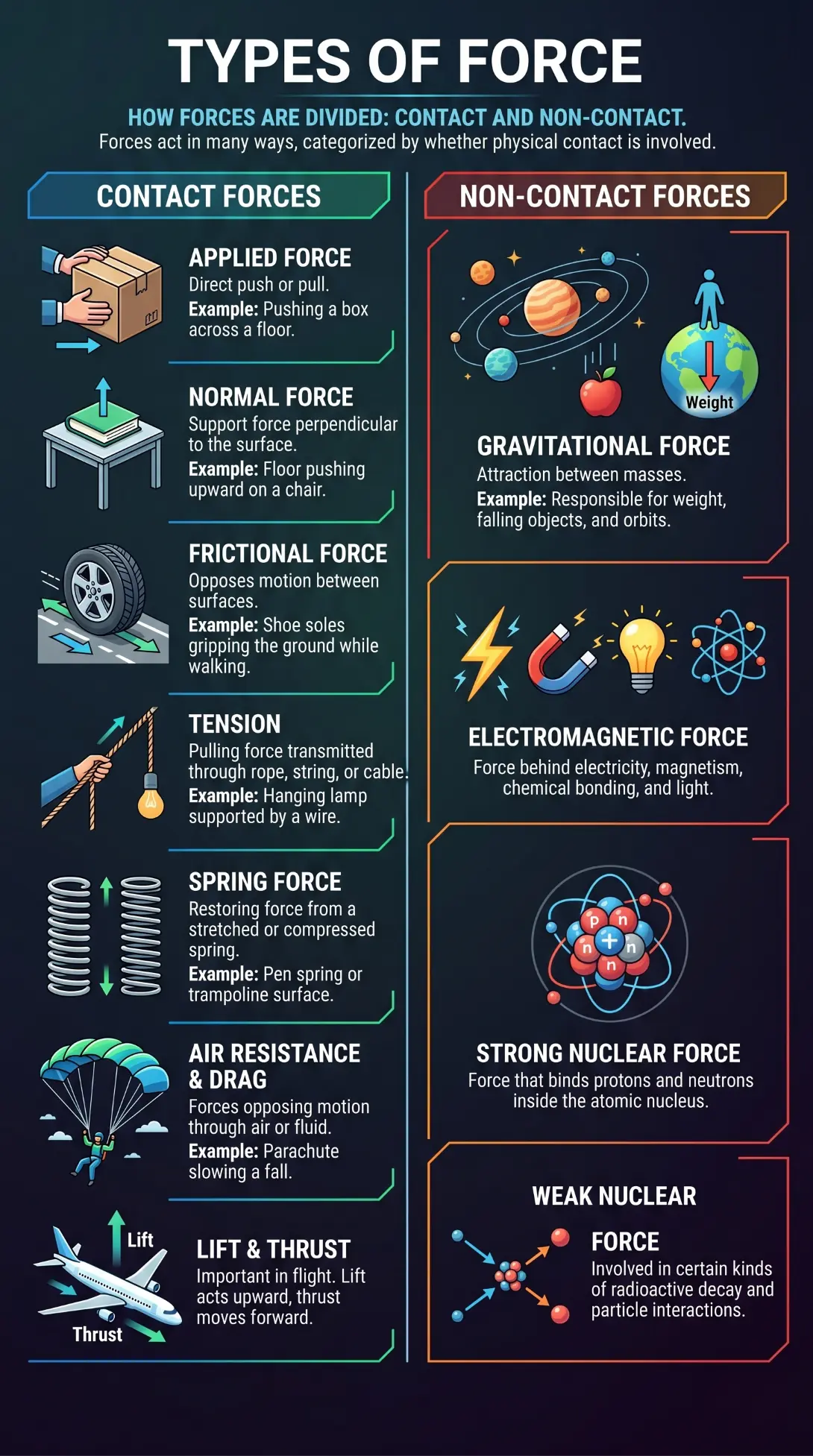
Forces are often divided into two broad groups: contact forces and non-contact forces. Contact forces happen when objects touch. Non-contact forces act across distance. That division is useful because it helps organize the huge variety of forces we see in nature and technology. Contact forces like tension, friction, normal force, and spring force arise from microscopic electric interactions between atoms and molecules. Non-contact forces include gravity and those associated with electricity and magnetism.
Contact Forces
These are the forces that require physical contact.
- Applied force
A direct push or pull from a person or object. For example, pushing a box across a floor. - Normal force
The support force from a surface that acts perpendicular to that surface. For example, the floor pushes upward on a chair. - Frictional force
A force that opposes motion or attempted motion between surfaces in contact. For example, the soles of the feet grip the ground while walking. - Tension
The pulling force is transmitted through a rope, string, or cable. For example, a hanging lamp supported by a wire. - Spring force
The restoring force from a stretched or compressed spring. Example, a pen spring or a trampoline surface. - Air resistance and drag
Forces that oppose motion through air or another fluid. For example, a parachute slows a fall. - Lift and thrust
Important in flight. Lift acts upward, thrust moves the aircraft forward.
Non-Contact Forces
These act even when objects are not touching.
- Gravitational force
The attraction between masses. It is responsible for weight, falling objects, and planetary orbits. - Electromagnetic force
The force behind electricity, magnetism, chemical bonding, and light. - Strong nuclear force
The force that binds protons and neutrons inside the atomic nucleus. - Weak nuclear force
A force involved in certain kinds of radioactive decay and particle interactions.
Table: Types of Force, What They Do, and Where You See Them
| Type of Force | Category | What It Does | Common Example |
|---|---|---|---|
| Applied force | Contact | Pushes or pulls an object | Shoving a drawer shut |
| Normal force | Contact | Supports an object from a surface | Desk supporting a laptop |
| Friction | Contact | Opposes motion | Bicycle brakes, walking shoes |
| Tension | Contact | Pulls through a rope or cable | Elevator cable |
| Spring force | Contact | Restores stretched or compressed objects | A stretched spring returning to shape |
| Drag | Contact with fluid | Resists motion through air or water | A skydiver falling |
| Lift | Contact with fluid | Helps aircraft rise | Airplane wings |
| Thrust | Contact with fluid | Drives motion forward | Jet engine |
| Gravity | Non-contact | Pulls masses together | Apple falling from a tree |
| Electromagnetic force | Non-contact | Governs charges and magnets | A magnet sticking to a fridge |
| Strong nuclear force | Non-contact | Holds the nucleus together | Stability of atoms |
| Weak nuclear force | Non-contact | Supports radioactive decay | Beta decay in nuclei |
This table is useful because force is often easier to understand when you see the same idea in many forms. The names change, but the logic is the same. Something pushes, pulls, supports, resists, attracts, or binds.
Force, Mass, and Acceleration
One of the most important relationships in physics is that force does not act on empty space. It acts on objects with mass. When a force acts on a mass, it can produce acceleration. That relationship is the heart of Newton’s second law. If the net force increases while mass stays the same, acceleration increases. If mass increases while force stays the same, acceleration decreases.
This is easy to see in daily life. Compare pushing an empty shopping cart with pushing a full one. The empty cart speeds up quickly. The full cart feels heavier and resists change more. The force is the same, but the mass is not. That difference changes the acceleration.
A useful way to think about it is this:
- More force usually means more acceleration
- More mass usually means less acceleration
- No net force means no change in velocity
That last point is easy to miss. An object can move and still have no net force acting on it if it is moving at constant speed in a straight line. Force is about changing motion, not just creating motion.
Weight Is a Force, Not the Same Thing as Mass
People use the word weight in different ways, and that confuses. In science and technology, weight is a force. It is the force caused by gravity on a body in a particular reference frame. That means weight is measured in newtons. In everyday speech, people often use weight to mean mass, but that is not the technical meaning.
This difference is important. A person with a mass of 60 kg has the same mass on Earth and on the Moon, but the weight changes because the gravitational strength changes. Mass stays the same. Weight changes with the strength of gravity. That is one reason astronauts feel light in orbit, even though their mass has not disappeared.
A common approximation on Earth is:
Weight = Mass × Gravitational Acceleration
or
W = mg
where g is about 9.8 m/s² near Earth’s surface. A 10 kg object, therefore, has a weight of about 98 N on Earth.
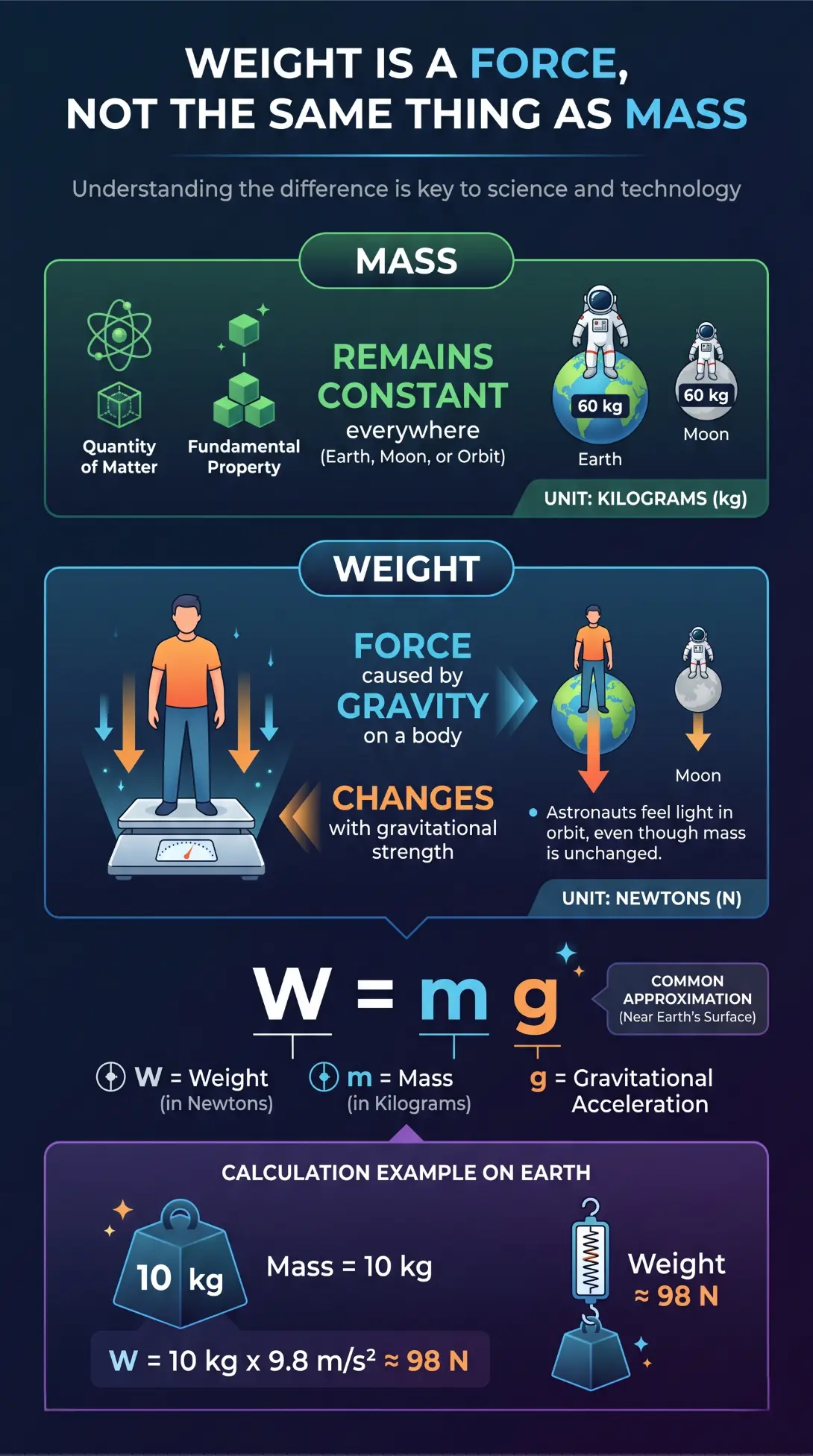
Table: Mass and Weight Compared
| Property | Mass | Weight |
|---|---|---|
| What it is | Amount of matter | Force due to gravity |
| SI unit | kilogram (kg) | newton (N) |
| Changes with location? | No, usually stays the same | Yes, depends on gravity |
| Example | A backpack has 5 kg of mass | The backpack may weigh about 49 N on Earth |
| Why it matters | Determines inertia | Determines how strongly gravity pulls |
A lot of confusion disappears once you separate these two ideas. Mass is what an object has. Weight is what gravity does to it.
Gravity as a Force
Of all the forces people notice in everyday life, gravity is the most familiar. It keeps our feet on the ground, gives objects weight, shapes orbits, and helps hold galaxies together. On large scales, gravity follows an approximate inverse-square relationship with distance, which means the force becomes weaker as the distance grows.
Gravity also has a beautiful simplicity. The farther two objects are from each other, the weaker the attraction. But the bigger their masses, the stronger the attraction. That is why planets are so important in astronomy. They are massive enough for gravity to shape motion on a huge scale.
And yet gravity is still the weakest of the four fundamental forces. Even so, it acts over enormous distances, which makes it incredibly important. That combination of weakness and reach is what gives gravity its cosmic power.
Friction and Why Life on Earth Works the Way It Does
Without friction, daily life would feel very strange. We would slip when walking, struggle to hold objects, and have trouble stopping vehicles. Friction is a force that opposes motion or attempted motion between surfaces in contact. It depends on the materials involved and is related to the normal force pushing the objects together.
There are two especially important kinds of friction:
- Static friction, which acts when surfaces are not sliding relative to each other
- Kinetic friction, which acts when surfaces are sliding past each other
Friction is often treated as a nuisance, but it is also a helper. It lets you walk, grip, write, brake, and climb. Too little friction causes slips. Too much can waste energy and wear down surfaces. So friction is not just something to reduce. It is something to manage.
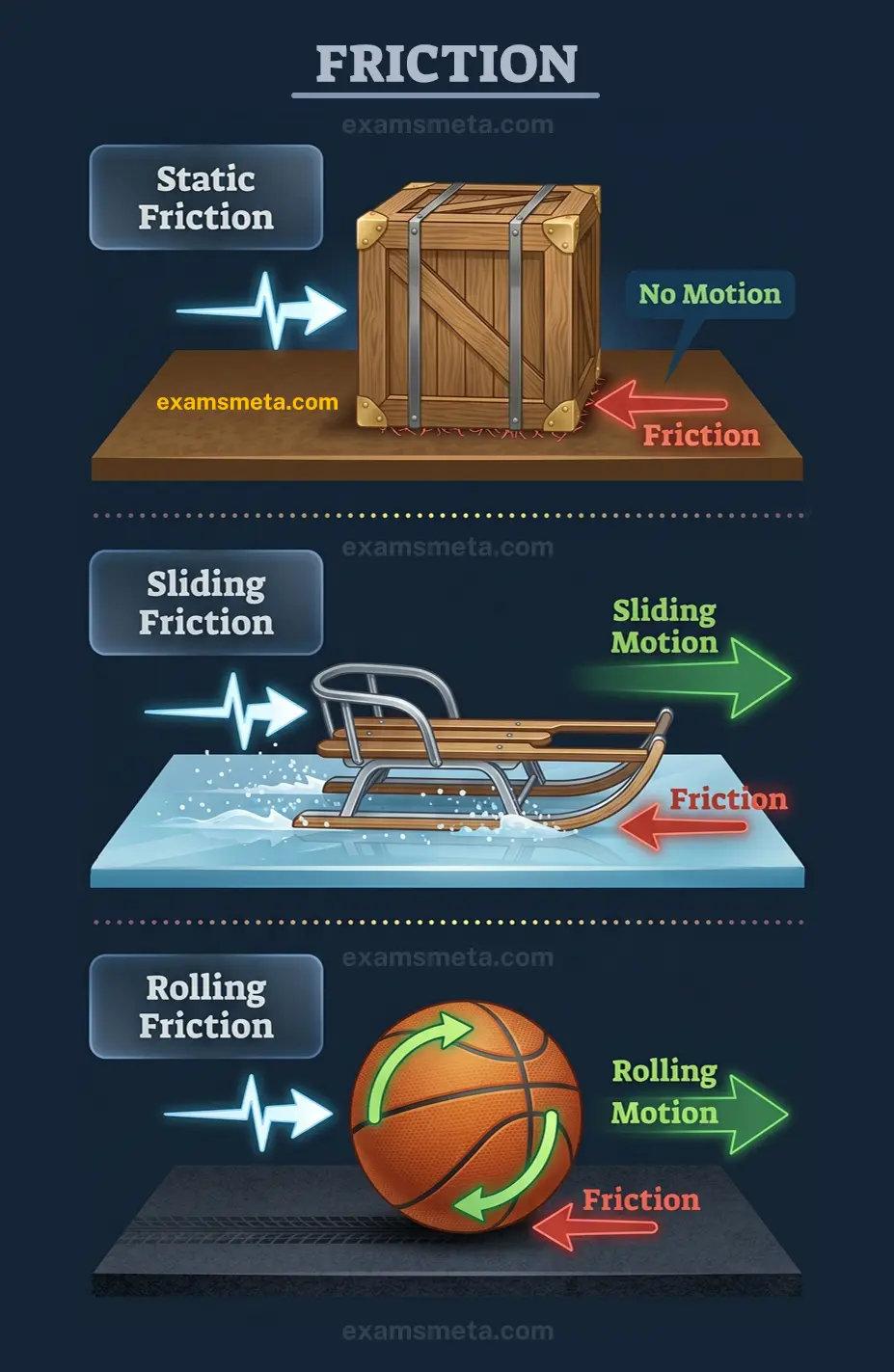
Table: Friction in Real Life
| Situation | Role of Friction | What Happens |
|---|---|---|
| Walking | Needed for grip | Shoes push backward, ground pushes forward |
| Braking a bicycle | Slows motion | Friction turns motion into heat |
| Sliding a box | Opposes motion | More force is needed to keep it moving |
| Climbing stairs | Prevents slipping | The shoe and the step must grip each other |
| Walking on ice | Too little friction | Slipping becomes likely |
Friction is one of those forces people notice most when it is missing. That alone shows how central it is to movement in the real world.
Force in the Air, on Roads, and in Machines
Force becomes especially interesting when objects move through air or fluids. A moving aircraft deals with lift, weight, thrust, and drag. These four forces are the basis of flight. Lift acts upward, weight acts downward, thrust pushes the aircraft forward, and drag resists motion through the air. Flight depends on the balance and competition among these forces.
The same general idea appears in cars, boats, rockets, and sports balls. A car needs traction from friction to move and brakes to stop. A rocket needs thrust to overcome gravity and drag. A ball in flight is influenced by gravity, air resistance, and sometimes spin-related forces. Force never acts in isolation. In real life, several forces usually act at once.
This is why engineers often use free-body diagrams. These diagrams show all the forces acting on one object, usually as arrows. They help organize thinking and avoid mistakes. You do not draw the forces the object exerts on others. You draw the forces acting on the object you are studying. That simple habit makes problem-solving much easier.
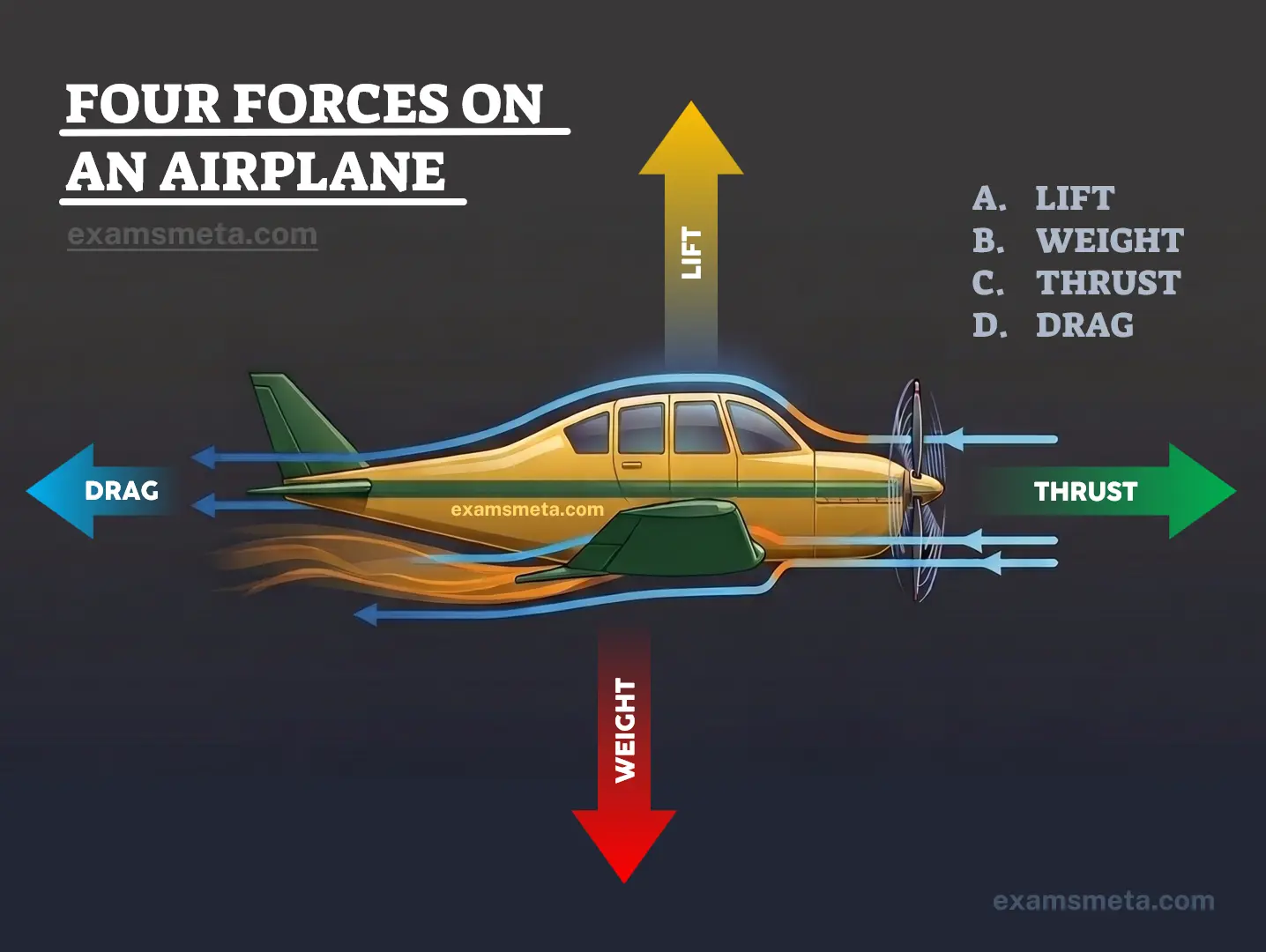
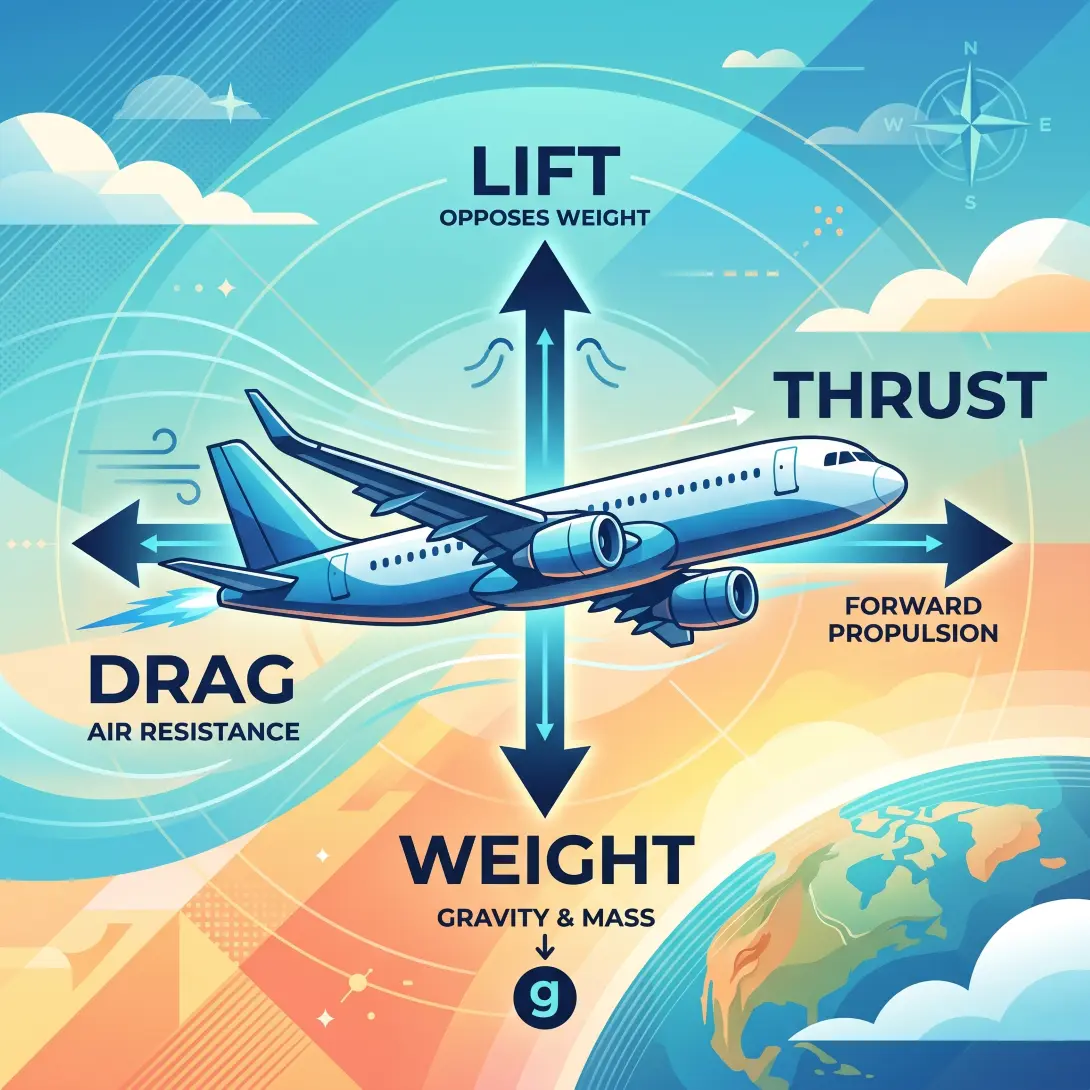
Table: Four Forces on an Airplane
| Force | Direction | What It Does | Example |
|---|---|---|---|
| Lift | Upward | Counters weight | Wings generating upward force |
| Weight | Downward | Pulls the plane toward Earth | Gravity acting on the aircraft |
| Thrust | Forward | Moves the plane ahead | Engine or propeller action |
| Drag | Backward | Resists forward motion | Air pushing against the plane |
The airplane example is useful because it shows force as a system, not as a single idea. The plane flies only because the forces are managed carefully.
How to Measure Force
Force is measured with tools such as spring balances, force sensors, and other instruments that respond to stretching, compression, or electronic measurement. In scientific work, the standard unit is the newton. Because force is a vector, measurement often includes both value and direction. A force of 20 N upward is not the same as 20 N sideways.
The newton is part of a larger measurement system designed for precision and clarity across science and technology. This makes it easier for scientists, engineers, and teachers in different countries to communicate without confusion. The unit system matters because, without standard units, force calculations would quickly become messy.
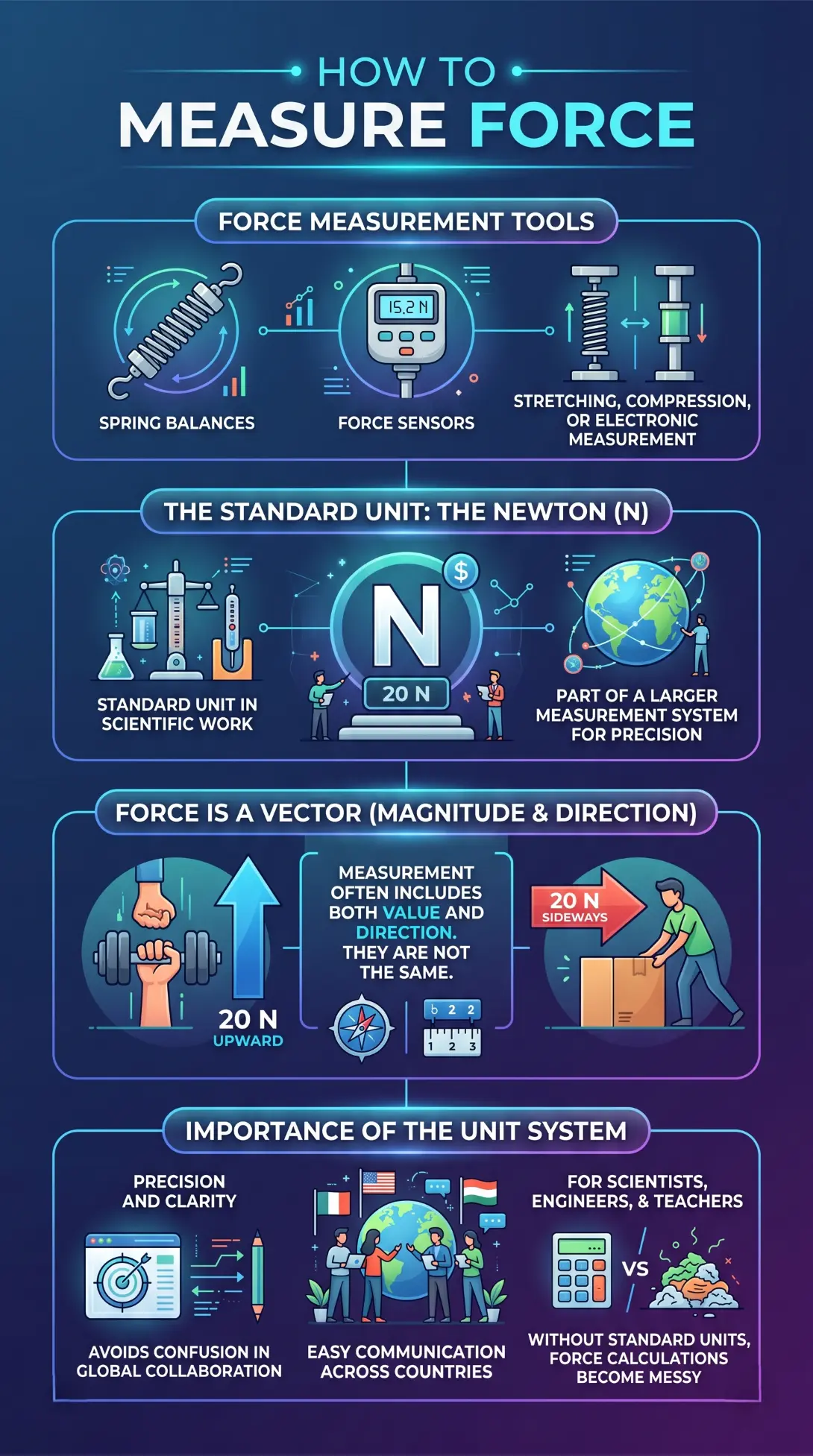
Table: Common Force Units and Quantities
| Quantity | Symbol | SI Unit | Unit Symbol |
|---|---|---|---|
| Force | F | newton | N |
| Mass | m | kilogram | kg |
| Acceleration | a | meter per second squared | m/s² |
| Weight | W | newton | N |
| Distance | d | meter | m |
These units work together. If you understand the units, the formulas become much easier to trust and use correctly.
Force and Free-Body Diagrams
A free-body diagram is one of the best tools for understanding force. It is a simple sketch of an object with arrows showing every force acting on it. The arrow length suggests strength, and the arrow direction shows where the force acts. This is a very clean way to think about complex situations.
A few rules make free-body diagrams useful:
- Draw only the object you are analyzing
- Include all forces acting on that object
- Use arrows to show direction
- Label each force clearly
- Do not include the net force as a separate arrow in the diagram
This method is used in almost every serious mechanics problem. It keeps the picture simple when the situation itself is not simple. A box on an inclined plane, a person on an elevator, and a satellite in orbit can all be analyzed more clearly with this approach.
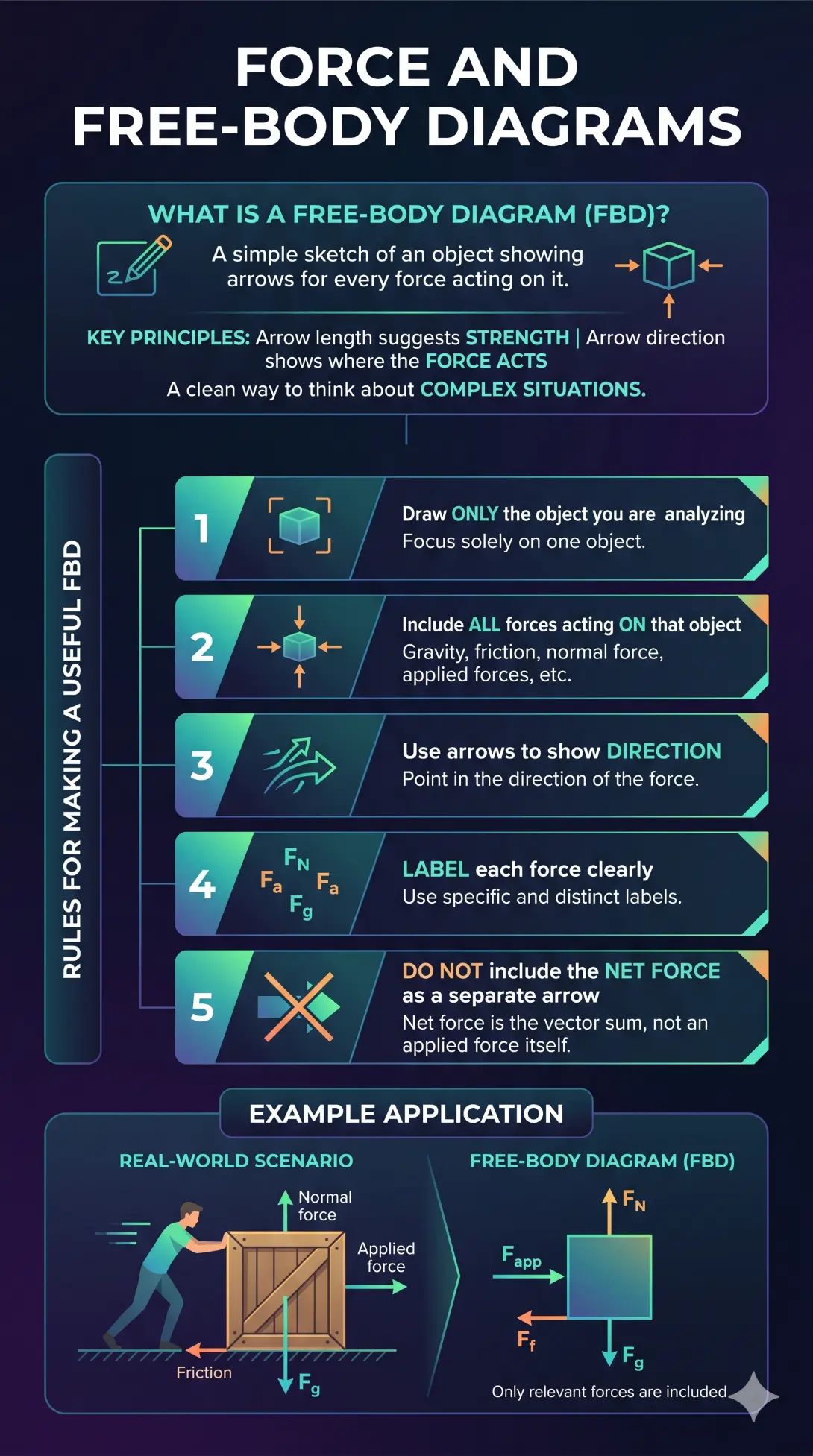
Table: A Simple Force Checklist for Problem Solving
| Step | What to Ask | Why It Helps |
|---|---|---|
| 1 | What object am I studying? | Keeps the analysis focused |
| 2 | Which forces act on it? | Prevents missing an important force |
| 3 | Are the forces balanced? | Helps predict motion |
| 4 | What is the net force? | Shows the total effect |
| 5 | Is acceleration present? | Connects force to motion |
| 6 | What direction matters most? | Force is a vector, so direction matters |
This is the kind of method that turns force from a vague idea into something you can actually work with.
Force in Everyday Life
Force is so common that people often stop noticing it. But once you start paying attention, it shows up in almost every ordinary action.
- When you open a door, your hand applies force to the handle
- When you sit in a chair, the chair applies an upward normal force
- When you walk, the friction between your shoes and the ground gives you forward motion
- When you throw a ball, your arm applies force and changes the ball’s velocity
- When you brake a vehicle, friction converts motion into heat and slows the car
- When you stretch a rubber band, the elastic force tries to pull it back
These are not separate stories. They are all examples of the same basic principle. Force changes motion, resists motion, supports motion, or holds matter together. Once you see that pattern, the world becomes a lot more understandable.
Common Misconceptions About Force
Many misunderstandings about force come from everyday language. One common mistake is thinking that a moving object must have a force in the same direction as its motion. That is not always true. A spacecraft coasting in space can keep moving with little or no net force acting on it. What matters is the net force, not simply motion itself.
Another mistake is confusing mass with weight. Mass is not the same as weight, and weight is not just another word for how much material something contains. In science, weight is a force measured in newtons, while mass is measured in kilograms.
A third misconception is thinking that action-reaction forces cancel each other. They do not, because they act on different objects. Your feet push on the ground, and the ground pushes back on you. That pair does not cancel because each force belongs to a different body.
Table: Common Mistakes and the Correct Idea
| Mistake | Correct Idea |
|---|---|
| Force and motion are the same thing | Force causes changes in motion, but motion can continue without a net force |
| Mass and weight are the same | Mass is matter, weight is gravitational force |
| Equal and opposite forces cancel everywhere | They act on different objects, so they do not cancel on one object |
| Only moving objects have forces | Objects at rest also have forces acting on them |
| Force is just a number | Force has both size and direction |
These mistakes are common, but once they are cleared up, the whole topic becomes much easier to understand.
Force in Nature and the Universe
On the biggest scale, force explains the structure of the universe. Gravity keeps planets in orbit, shapes stars, and helps form galaxies. Electromagnetism controls light, chemistry, and electricity. The strong nuclear force holds atomic nuclei together, and the weak nuclear force plays a role in radioactive processes. Together, these four fundamental forces define how matter behaves at the deepest level.
That is an astonishing thought. A word that describes pushing a shopping cart also helps explain why atoms exist and why stars shine. Force is one of the best examples of how a simple-sounding idea can carry enormous meaning.
Practical Examples of Force in Different Fields
In sports
Force determines how fast a ball moves, how high a jumper rises, how hard a batter hits, and how quickly a runner can accelerate off the starting block. Coaches and athletes often think in terms of force without always using the word.
In engineering
Structures must withstand forces from weight, wind, vibration, and load. Bridges, towers, and buildings are designed so that forces are distributed safely. This is one reason force analysis is so central to design.
In transportation
Cars need friction for traction. Planes need lift and thrust. Rockets need a force big enough to overcome gravity and atmospheric drag. Vehicles are basically force-management systems.
In daily household life
Opening jars, moving furniture, hanging shelves, using tools, and even holding a cup all involve force. Most people are surrounded by force all day and never stop to name it.
A Bigger Table: Force in Real Situations
| Situation | Forces Involved | Main Effect |
|---|---|---|
| A book resting on a table | Weight and normal force | Balanced forces keep it still |
| A car accelerating | Engine force, friction, air resistance | Net force makes it speed up |
| A ball thrown upward | Applied force, gravity, and air resistance | Motion changes after release |
| A person walking | Friction, normal force, weight | Forward motion becomes possible |
| A plane is taking off | Lift, thrust, drag, weight | An aircraft rises if lift exceeds weight |
| A falling object | Gravity, air resistance | Speed changes as the net force acts |
| A stretched spring | Elastic spring force | Spring pulls back toward rest |
Seeing force this way makes it easier to connect textbook physics to the world people actually live in.
Why Force Is a Beautiful Idea
Force is powerful because it is both simple and deep. A child can understand pushing and pulling. A student can learn F = ma. An engineer can design with forces in mind. An astronomer can study orbital motion. A physicist can trace force down to the structure of matter itself. That is a wide range for a single idea.
And maybe that is why force remains one of the first great ideas in science. It is easy to notice, but hard to fully exhaust. The more carefully you look at force, the more it explains. The more it explains, the more connected the world begins to feel.
Final Thoughts on Force
Force is the language of interaction. It tells us when one thing influences another, when motion changes, when surfaces resist, when gravity pulls, when springs rebound, and when objects stay in balance. It is a central idea in physics because it links the visible world to the underlying rules.
If you remember only a few things, keep these in mind. Force is a push or pull; it has a direction, is measured in newtons, and changes motion by creating acceleration. From that simple base, an enormous amount of science opens up.
Force is not just a physics chapter. It is a way of reading the world.
Article References and Sources
- NASA Glenn Research Center. “Four Forces on an Airplane.”
- OpenStax Physics. “Newton’s Second Law of Motion.”
- OpenStax University Physics Volume 1. “Newton’s Third Law.”
- NASA Science. “Fundamental Forces of Nature.”
- OpenStax University Physics Volume 1. “Common Forces.”
- National Institute of Standards and Technology (NIST). “SI Units.”
- OpenStax College Physics. “Normal, Tension, and Other Examples of Forces.”
- OpenStax University Physics. “Friction.”
- OpenStax University Physics. “Drawing Free-Body Diagrams.”
- NIST Guide for the Use of the International System of Units.
Also, Read these Articles in Detail
- Physics and Its Fundamentals With Good Explanations
- Matter, Motion, and Energy: The Core Ideas of Physics
- What Is Matter? The Physical Substance of the Universe
- What Is Motion? A Guide to Motion in Physics and Daily Life
- What Is Energy? The Invisible Power Behind Everyday Life
- Kinetic Energy Explained in Simple Language
- Potential Energy: Definition, Types, Formula, and Examples
- Thermal Energy: Heat, Temperature, and Transfer
- Mechanical Energy: Definition, Formula, and Examples
- Chemical Energy: Definition, Science, and Examples
- Electrical Energy: Definition, Works, and Why It Matters
- Radiant Energy: Meaning, Sources, Examples, and Uses
- Nuclear Energy: Definition, How It Works, and Why It Matters
- Sound Energy: Definition, Science, and Examples
- Elastic Energy: Definition, Elasticity, and Example
- Geothermal Energy: Clean Electricity, Heating, and Modern Life
- Hydropower Energy: How It Works and Its Importance
- Pumped Hydropower Storage
Frequently Asked Questions
FAQ 1: What is force in physics, and why is it such an important idea?
Force is a push or pull that can change the motion, shape, or direction of an object. That sounds simple, but it sits at the heart of physics. Every time something starts moving, stops moving, speeds up, slows down, bends, stretches, or turns, some form of force is involved. In other words, force is one of the main ways we understand how objects interact with each other in the physical world.
A force is not just about movement in the usual sense. A book resting on a table is also affected by force. The book stays in place because the downward force of gravity is balanced by the upward normal force from the table. So even when nothing seems to be happening, forces may still be acting. That is one of the most interesting things about force. It is often invisible, but its effects are not.
Force matters because it explains both simple and advanced things. It helps explain why a football flies through the air, why a car needs fuel to keep moving, why a bridge stays standing, and why planets stay in orbit. It also helps explain friction, tension, lift, drag, and gravity. Once you understand force, a huge part of physics starts to make sense.
In daily life, force is everywhere. You use force when you open a door, carry a bag, lift a chair, pedal a bicycle, or even just stand still. Your muscles apply force. The ground applies force back. The air pushes against moving objects. Water pushes on boats. Magnets apply force without touching. That is why force is not just a textbook idea. It is a real part of ordinary life.
Force is also important because it links directly to Newton’s laws of motion. These laws explain how force and motion work together. They show that force is what changes motion, and that without a net force, motion does not change. That one idea shapes a huge amount of science and engineering.
FAQ 2: What is the difference between force, mass, and weight?
This is one of the most common questions in physics, and it is a very important one. Force, mass, and weight are related, but they do not mean the same thing.
Mass is the amount of matter in an object. It tells you how much stuff the object contains. Mass is measured in kilograms (kg). It does not depend on location. A rock has the same mass on Earth, on the Moon, or in space.
Weight is a force. It is the pull of gravity on an object. Weight is measured in newtons (N). Unlike mass, weight changes depending on the strength of gravity. A person weighs less on the Moon than on Earth because the Moon’s gravity is weaker, but the person’s mass stays the same.
Force is the broader idea. It is any push or pull that can change motion. Weight is one kind of force, but not the only kind. Friction is a force. Tension is a force. Air resistance is a force. The force from your hand pushing a box is a force, too.
A simple way to remember the difference is this:
- Mass tells how much matter something has
- Weight tells how strongly gravity pulls on it
- Force tells what kind of push or pull is acting
A common formula connects mass and weight:
W = mg
where W is weight, m is mass, and g is the acceleration due to gravity. On Earth, g is about 9.8 m/s².
So if an object has a mass of 10 kg, its weight on Earth is about 98 N. But if you take it somewhere else with different gravity, the weight changes while the mass stays the same. That difference is very important in science, engineering, and space travel.
FAQ 3: What are the main types of force, and how are they different from each other?
Forces are usually grouped into two big categories, contact forces and non-contact forces. This is a useful way to understand how they work.
Contact forces happen when objects touch each other. Some of the most common contact forces are:
- Applied force, which is a direct push or pull
- Friction, which opposes motion between surfaces
- Normal force, which is the support force from a surface
- Tension, which acts through ropes, strings, or cables
- Spring force, which comes from stretched or compressed springs
- Drag, which is the resistance from air or water
- Lift, which helps aircraft rise in the air
These forces are easy to notice in daily life. When you push a cart, that is an applied force. When your shoes grip the floor, that is friction. When a chair holds you up, that is a normal force. When a rope pulls a bucket upward, that is tension.
Non-contact forces act without physical touching. The most important ones are:
- Gravitational force
- Electromagnetic force
- Strong nuclear force
- Weak nuclear force
Gravity pulls masses together. It keeps us on Earth and keeps planets in orbit. Electromagnetic force controls electricity, magnetism, and chemical interactions. The strong nuclear force holds the atomic nucleus together. The weak nuclear force is involved in certain kinds of radioactive decay.
These forces behave very differently, but they all fit under the larger idea of force because each one causes an effect on matter or motion. Some act only when objects touch. Others act across distance. Some are strong over tiny scales. Others act across enormous distances. Together, they explain a huge part of the physical universe.
FAQ 4: What does Newton’s second law say about force, and why is it so important?
Newton’s second law is one of the most useful ideas in all of physics. It says that the acceleration of an object depends on the net force acting on it and its mass. In simple form, the law is written as:
F = ma
This means force equals mass times acceleration. The formula tells us three very important things.
First, if you apply more force to the same object, it accelerates more. That is why pushing a light cart is easier than pushing a heavy truck. Second, if the object has more mass, the same force produces less acceleration. Third, force and acceleration are linked through direction as well as size.
This law is important because it gives a practical way to predict motion. If you know the forces acting on an object, you can estimate what it will do next. That is useful in sports, engineering, transportation, and space science. It helps answer questions like:
- How fast will a car speed up?
- How much force does a bridge need to resist?
- How does a rocket leave Earth?
- Why does a ball curve in the air?
The law also explains why a strong push on a small object can cause a big change, while the same push on a large object may do very little. Mass resists change. That resistance is often called inertia.
So Newton’s second law is not just a formula to memorize. It is a way of thinking clearly about motion. It shows that force is not random. Force produces measurable change, and that change depends on how much matter is being moved.
FAQ 5: What is the net force, and why does it matter more than a single force?
Net force is the total force acting on an object after all the individual forces are combined. This matters because objects do not respond to each force separately in the same way. They respond to the overall result.
For example, imagine you push a box to the right with 20 N of force, while friction pushes left with 5 N. The net force is:
20 N – 5 N = 15 N to the right
That 15 N is what actually changes the motion of the box. If the forces were equal, the net force would be zero, and the motion would not change. The object might stay at rest, or it might keep moving at the same speed in a straight line.
This idea is very important because many real situations involve more than one force. A falling object is pulled downward by gravity but pushed upward by air resistance. A car moving on a road is pushed forward by engine force but slowed by friction and drag. A book on a table is pulled down by gravity and supported upward by the table.
The net force tells you the final effect. That is why physicists often focus on the net force instead of one isolated force. It is the total answer that matters.
A few simple truths about net force are worth remembering:
- If net force = 0, motion does not change
- If the net force is not zero, acceleration happens
- The direction of the net force tells the direction of acceleration
- A bigger net force usually means bigger acceleration, if mass stays the same
Understanding net force is one of the best ways to make sense of motion in the real world. It turns confusion into order.
FAQ 6: What is friction, and why is it both useful and annoying?
Friction is a force that opposes motion between surfaces in contact. It appears whenever two surfaces try to slide, roll, or move across each other. Friction is one of the most familiar forces in daily life, and it is both helpful and troublesome.
It is helpful because without friction, many normal activities would be difficult or impossible. You need friction to walk. Your feet push backward on the ground, and the ground pushes you forward. You need friction to hold a pencil, grip a steering wheel, and stop a bicycle. Brakes work because friction slows motion.
But friction also creates problems. It wastes energy as heat, wears down machine parts, and makes movement harder. That is why engineers often try to reduce friction in engines, bearings, and moving parts. They use oils, smooth surfaces, and special materials to make machines work better.
There are two main kinds of friction:
- Static friction, which stops motion from starting
- Kinetic friction, which acts when motion is already happening
Static friction is usually stronger than kinetic friction. That is why it can take more force to start moving a heavy object than to keep it moving. This is easy to notice when you try to slide a large box across a floor.
Friction depends on several things, including the type of surfaces and how hard they are pressed together. Rough surfaces usually create more friction than smooth ones. But the exact amount can vary in real situations.
So friction is not simply “bad” or “good.” It is necessary. It gives us grip and control, but it also creates resistance and heat. It is one of the clearest examples of how force shapes everyday life.
FAQ 7: How do gravity, lift, thrust, and drag work together in flight?
Flight is one of the best places to see force in action. An airplane stays in the air because four main forces act on it at the same time: lift, weight, thrust, and drag.
Weight pulls the airplane downward because of gravity. Lift pushes it upward. Thrust pushes it forward. Drag pushes backward and resists motion through the air.
For an airplane to take off, the lift must become strong enough to overcome its weight. At the same time, thrust must be strong enough to overcome drag. If these forces are balanced the wrong way, the plane cannot rise or keep moving efficiently.
This simple force balance explains a lot about aviation:
- Large wings can help create more lift
- Powerful engines provide more thrust
- Streamlined shapes reduce drag
- Proper weight control helps the aircraft stay efficient
It also explains why the weather matters so much. Wind, air density, humidity, and turbulence all affect the forces on an aircraft. Pilots and engineers must understand these forces carefully.
The same ideas appear in many other flying things, too, not just airplanes. Birds, drones, helicopters, and rockets all deal with force balance in their own ways. Rockets, for example, use thrust to overcome gravity and drag. They do not need wings for lift the way airplanes do.
So flight is really a story about force management. The object rises, moves, and stays stable because forces are working together in a carefully controlled way.
FAQ 8: What is a free-body diagram, and how does it help in understanding force?
A free-body diagram is a simple drawing that shows all the forces acting on one object. It is one of the most useful tools in physics because it makes complicated situations easier to understand.
In a free-body diagram, the object is usually drawn as a box or dot. The arrows show each force acting on it. The direction of the arrow shows the direction of the force. The length of the arrow can show the size of the force. Each arrow is labeled clearly.
This kind of diagram helps because it forces you to think carefully about what is actually acting on the object. For example, if a box sits on the floor and someone pushes it, the diagram may include:
- The applied force from the push
- The friction force from the floor
- The normal force upward from the floor
- The weight is downward due to gravity
That is much clearer than trying to imagine everything at once.
Free-body diagrams are useful for many situations:
- A person standing in an elevator
- A car accelerating down a road
- A ball hanging from a string
- A block sliding down a ramp
- A satellite moving around Earth
Once you learn how to draw them, they become a powerful tool for solving problems. They help you separate the forces, check direction, and find the net force. That makes the physics much easier to manage.
A good free-body diagram does not need to be fancy. It needs to be correct and clear. And that is what makes it so valuable.
FAQ 9: How does force show up in everyday life, even when people do not notice it?
Force is part of ordinary life all the time. Most people do not think about it because it becomes so familiar, but it is always there, shaping movement and balance.
When you open a door, your hand applies force. When you sit on a chair, the chair pushes upward with a normal force. When you walk, friction gives your feet the grip they need. When you lift a bag, your muscles apply upward force. When you drop a phone, gravity pulls it down. When you ride a bicycle, the force from your legs, the wheels, and the road all work together.
Even small actions involve several forces at once. A spoon in a cup, a plate on a table, a pen in your hand, and a bag hanging from your shoulder all depend on force balance. Nothing is truly “force-free” in daily life. At rest and in motion, force is still there.
Here are a few easy examples:
- A hammer drives a nail because of a strong applied force
- A fan moves air because of the force on the blades
- A magnet holds a paper clip because of the electromagnetic force
- A parachute slows a person because of drag
- A hanging lamp stays up because of tension in the wire
The more you pay attention, the more force you see in ordinary things. That is one reason the concept is so useful. It helps explain the world people already live in, not just the world seen in a lab.
FAQ 10: Why is force considered one of the most important ideas in science?
Force is important because it connects almost everything in the physical world. It helps explain motion, rest, balance, energy, gravity, machines, flight, and the structure of atoms. That is a very wide range for one idea.
At the human scale, force explains how we move, how tools work, how vehicles travel, and how buildings stay standing. At the planetary scale, it explains gravity and orbital motion. At the atomic scale, it explains the forces that hold matter together. Very few ideas are useful at so many levels.
Force is also important because it is measurable. Scientists do not just talk about force in vague terms. They measure it in newtons, compare it, model it, and use it to make predictions. That makes it one of the most practical concepts in science.
It also matters because force helps people solve real problems. Engineers use it to design safe bridges. Doctors use force principles in medical tools and implants. Athletes train with force in mind. Pilots rely on force balance. Builders, designers, mechanics, physicists, and astronauts all depend on it.
And there is another reason force stands out. It teaches a deep lesson about the universe. Things do not happen randomly. They happen because interactions take place. One object affects another. One push meets another pull. One force balances another. That pattern runs through nature again and again.
So force is not just a topic in physics class. It is a way of understanding how the world works. And once you understand it, even ordinary things start to look a little more interesting, a little more connected, and a lot more understandable.
FAQ 11: What is a force vector?
A force vector is a force that has both size and direction. That may sound like a small detail, but it is actually one of the most important ideas in physics. A force is never just “how strong” it is. It is also “which way” it acts. That direction changes the result completely.
For example, a force of 10 N to the right is not the same as a force of 10 N to the left. The size is the same, but the effect is different because the directions are opposite. This is why force is called a vector quantity. It cannot be fully described with a number alone. It needs direction, too.
Force vectors are usually shown with arrows. The length of the arrow shows the strength of the force, and the arrowhead shows the direction. This is useful in physics because it makes the invisible easier to visualize. When several forces act on the same object, each one is represented as a separate vector. Then they are combined to find the net force.
This idea matters in daily life more than most people realize. When you push a shopping cart, your force is a vector. When wind pushes against a window, that is a vector force too. When gravity pulls an object downward, it acts as a vector in the downward direction. Once you understand that force is directional, a lot of motion becomes much easier to explain.
FAQ 12: How do balanced forces work?
Balanced forces happen when all the forces acting on an object cancel each other out. In that case, the net force is zero. This does not mean there are no forces. It only means the forces are equal in size and opposite in direction, so their total effect is canceled.
A simple example is a book resting on a table. Gravity pulls the book downward, but the table pushes upward with an equal normal force. The two forces are balanced, so the book stays at rest. Another example is a person standing still on the floor. Their weight pulls downward, and the floor pushes upward with the same strength.
Balanced forces are important because they explain why objects can stay still or keep moving at a steady speed. If the net force is zero, the motion does not change. That is a very deep idea. It means force is not required to keep something moving forever. Force is required to change motion.
You see balanced forces in all kinds of places:
- A hanging lamp at rest
- A picture frame on a wall
- A parked car on level ground
- A boat floating steadily in calm water
Balanced forces may seem boring, but they are the reason many things stay stable. Without them, the world would be in constant chaos. They are the quiet side of force, but they are just as important as the dramatic side.
FAQ 13: What are unbalanced forces?
Unbalanced forces are forces that do not cancel each other. When this happens, the net force is not zero, and the object’s motion changes. It may start moving, stop moving, speed up, slow down, or change direction.
This is the basic reason anything accelerates. A soccer ball does not move on its own after it is kicked because gravity, friction, and air resistance continue to affect it. A car speeds up because the engine creates enough force to overcome resistance. A falling object accelerates because gravity is stronger than air resistance at first.
Unbalanced forces are easy to notice in motion changes:
- A bike starts moving when you pedal hard enough
- A shopping cart speeds up when you push it
- A car slows down when the brakes create more force in the opposite direction
- A ball turns when a side force acts on it
The key point is that unbalanced forces create change. That is why they are so important in physics. They explain movement in a practical, everyday way. If the forces are not balanced, the object cannot keep doing exactly what it was doing before.
A lot of physics is really about identifying which forces are balanced and which are not. Once you get that skill, motion becomes much easier to understand. It is one of the cleanest ideas in science.
FAQ 14: What is inertia, and how is it connected to force?
Inertia is the tendency of an object to resist changes in its motion. An object at rest wants to stay at rest. An object in motion wants to keep moving at the same speed in the same direction unless a net force acts on it. That is inertia in simple language.
Inertia is closely tied to mass. The more mass an object has, the more inertia it has. That means it is harder to start moving, stop moving, or turn. A small ball is easy to move. A truck is much harder. The difference is not just size. It is inertia.
This is why force is needed. Force is what overcomes inertia. When you push a box, your force is trying to change the box’s motion, while the box’s inertia resists that change. The same thing happens when the brakes slow a car or when a passenger lurches forward as a bus stops suddenly. The body wants to keep moving because of inertia.
In everyday life, inertia is everywhere:
- A passenger feels jerked forward when a vehicle stops suddenly
- A heavy object is harder to move than a light one
- A ball keeps rolling until friction slows it down
- A spinning wheel resists changes in direction
Inertia is not a force itself. That is an important point. It is a property of matter. Force is what acts against it. The two ideas work together in almost every motion problem. Once you understand inertia, Newton’s laws make much more sense.
FAQ 15: What is tension force?
Tension force is the pulling force that moves through a rope, string, cable, or similar connector when it is stretched tight. It is a contact force, and it acts along the length of the rope or cable. In simple terms, tension is what happens when something is pulling on an object through a flexible connector.
A good example is a bucket hanging from a rope. Gravity pulls the bucket downward, and the rope pulls upward with tension. If the bucket is at rest, the two forces are balanced. Another example is a lift supported by steel cables. The cables carry the tension that holds the cabin up.
Tension also appears in many daily situations:
- A person pulling a sled with a rope
- A cable supporting a hanging lamp
- A clothesline holding wet clothes
- A suspension bridge carrying traffic through cables
Tension is interesting because ropes and strings can only pull, not push. That makes them different from rigid supports like walls or poles. The force travels through the material, and the material must be strong enough to handle it. If the tension is too high, the rope can snap.
That is why tension matters in engineering, construction, sports equipment, and everyday tools. It is one of the simplest-looking forces, but it carries a lot of responsibility.
FAQ 16: What is the normal force?
The normal force is the force exerted by a surface on an object resting on it. It acts perpendicular to the surface, which is why it is called “normal.” In simple words, it is the support force that keeps objects from falling through floors, tables, chairs, and other surfaces.
For example, if a book rests on a table, gravity pulls it downward. But the table pushes upward with a normal force. That force is what holds the book up. If you sit in a chair, the seat pushes upward on you with a normal force. When you stand on the ground, the ground pushes upward too.
This force is often misunderstood because people think surfaces are passive. They are not. Surfaces respond to the weight or pressure placed on them. The normal force is that response. It is one of the reasons objects can rest without sinking through solid ground.
Here is the important part. The normal force is not always equal to the weight. On a flat surface, it often is, but not always. On an inclined plane, for example, the normal force is smaller because the surface is slanted. In an elevator, it can become larger or smaller depending on whether the elevator is speeding up or slowing down.
That makes the normal force a very practical idea. It helps explain support, balance, and the way surfaces interact with objects in the real world.
FAQ 17: What is air resistance or drag?
Air resistance, also called drag, is the force that opposes motion through air. It acts on moving objects and pushes against their direction of travel. The faster something moves, the more drag it usually experiences. That is why air resistance becomes so noticeable at higher speeds.
A falling person feels drag from the air. A bicycle rider feels it too. A car moving quickly has to push through the air, and that takes energy. A parachute works because it creates a huge amount of drag, which slows the fall of a person in a safe and controlled way.
Drag depends on several things:
- Speed
- Shape of the object
- Surface area
- Density of the air
Objects that are streamlined experience less drag. That is why airplanes, racing cars, and even sports helmets are shaped the way they are. Designers often try to reduce drag because it saves energy and improves performance.
Drag is a force people often ignore, but it is always there whenever motion happens in air. It plays a major role in transportation, sports, weather, and flight. Without drag, many things would move very differently. It is one of those forces that quietly shapes the world all the time.
FAQ 18: What is lift in simple words?
Lift is the upward force that helps an aircraft or other object rise through the air. It is one of the four main forces in flight, along with weight, thrust, and drag. Lift acts opposite to gravity, which pulls things downward.
For airplanes, lift is created by the wings as air flows around them. The shape and angle of the wings help create pressure differences and airflow patterns that generate upward force. That upward force allows the aircraft to stay in the air. Without enough lift, the plane cannot rise or remain airborne.
Lift is not limited to airplanes. Birds use lift, too. Helicopters use rotating blades to generate it. Kites can also produce lift when wind flows over them in the right way.
A few simple points about lift:
- Lift acts upward
- It helps overcome weight
- It depends on air flow and shape
- It is essential for flight
Lift is a wonderful example of how force can be used creatively. It does not just push things around. It makes controlled motion possible. That is why it is so important in aviation and aerodynamics.
FAQ 19: What is a newton, and how is force measured?
A newton is the standard unit used to measure force. Its symbol is N. It is part of the SI system, which is the international standard used in science and engineering.
One newton is the amount of force needed to give a 1-kilogram object an acceleration of 1 meter per second squared. That definition connects force directly to mass and acceleration, which is why the unit is so useful in physics.
In practical terms, force is measured with tools like:
- Force sensors
- Spring balances
- Dynamometers
These instruments help scientists and engineers measure how strong a push or pull is. They are used in laboratories, construction sites, factories, and classrooms. Measuring force matters because it allows people to compare results and design things safely.
For example:
- The force needed to open a door can be measured
- The pulling force in a cable can be checked
- The force from a machine can be tested
- The load on a bridge can be calculated
The Newton makes force measurable and manageable. Without a standard unit, it would be hard to compare one force with another. That is why the unit matters so much. It gives force to a common language.
FAQ 20: Why should we learn about force in daily life?
Learning about force is useful because force is part of almost everything people do. It is not just for scientists, engineers, or students taking physics. It helps ordinary people understand how the world works.
When you know about force, you understand why some things move easily, and others do not. You understand why a car needs brakes, why a chair holds your weight, why a bicycle falls without balance, why a ball curves in the air, and why a bridge does not collapse under load. That knowledge is practical.
It also helps with safety. If you know how force works, you can better understand:
- Why seat belts matter
- Why helmets protect people
- Why rough roads affect motion
- Why lifting with the legs is safer than straining the back
- Why machines need maintenance
Force also improves problem-solving. It helps you think clearly about motion, support, pressure, resistance, and balance. Even outside science, this way of thinking is useful. It teaches you to ask, “What is pushing here?” “What is pulling there?” “Are the forces balanced?” Those are simple questions, but they lead to clear answers.
And perhaps that is the real value of learning force. It gives you a stronger way to read everyday life. You begin to notice what is happening under the surface. A door does not just open. A chair does not just hold. A ball does not just fall. There are forces behind all of it.
That is why force remains one of the most important ideas in science and one of the most useful ideas in real life.
