

Mechanics is one of the most important branches of physics. It helps us understand how objects move, why they move, and what makes them stop, speed up, slow down, bend, rotate, or stay still. From a rolling ball to a flying airplane, from a bridge standing firm under heavy traffic to a satellite orbiting Earth, mechanics is working everywhere.
This subject may sound technical at first, but the ideas behind it are easy to grasp when they are explained in simple words. You do not need to be a scientist to notice motion, force, gravity, friction, momentum, or energy in daily life. You see them every time you push a door, lift a bag, ride a bicycle, or watch rainwater flow down a slope. Mechanics is simply the study of these everyday and extraordinary actions.
In this article, we will explore mechanics in a clear, detailed, and practical way. You will learn what it means, how it is divided, why it matters, how it is used in real life, and how it connects with other fields such as engineering, astronomy, machine design, and sports science. The goal is to make the topic feel simple, useful, and alive.
Table of Contents
What Is Mechanics?
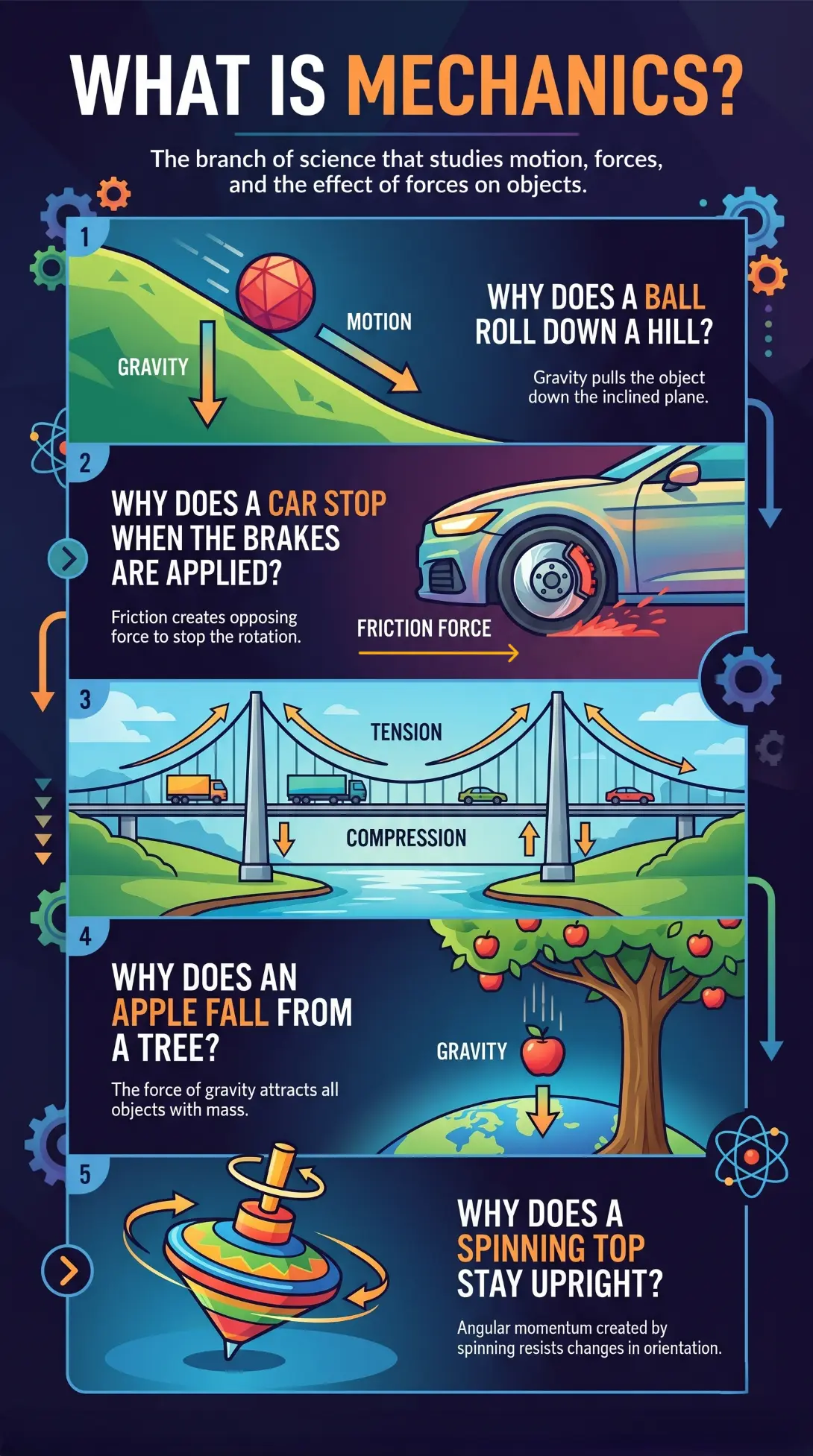
Mechanics is the branch of science that studies motion, forces, and the effect of forces on objects. It explains how objects move, how they remain at rest, and how external influences change their behavior.
At the most basic level, mechanics asks questions like these:
- Why does a ball roll down a hill?
- Why does a car stop when the brakes are applied?
- Why does a bridge not collapse under heavy weight?
- Why does an apple fall from a tree?
- Why does a spinning top stay upright for some time?
These are not just interesting questions. They are the foundation of how we understand the physical world.
Mechanics is one of the oldest and most practical areas of physics. It is used in designing machines, buildings, roads, vehicles, airplanes, ships, robots, and even medical devices. It also helps in understanding natural phenomena such as tides, planetary motion, earthquakes, and fluid flow.
Why Mechanics Matters in Daily Life
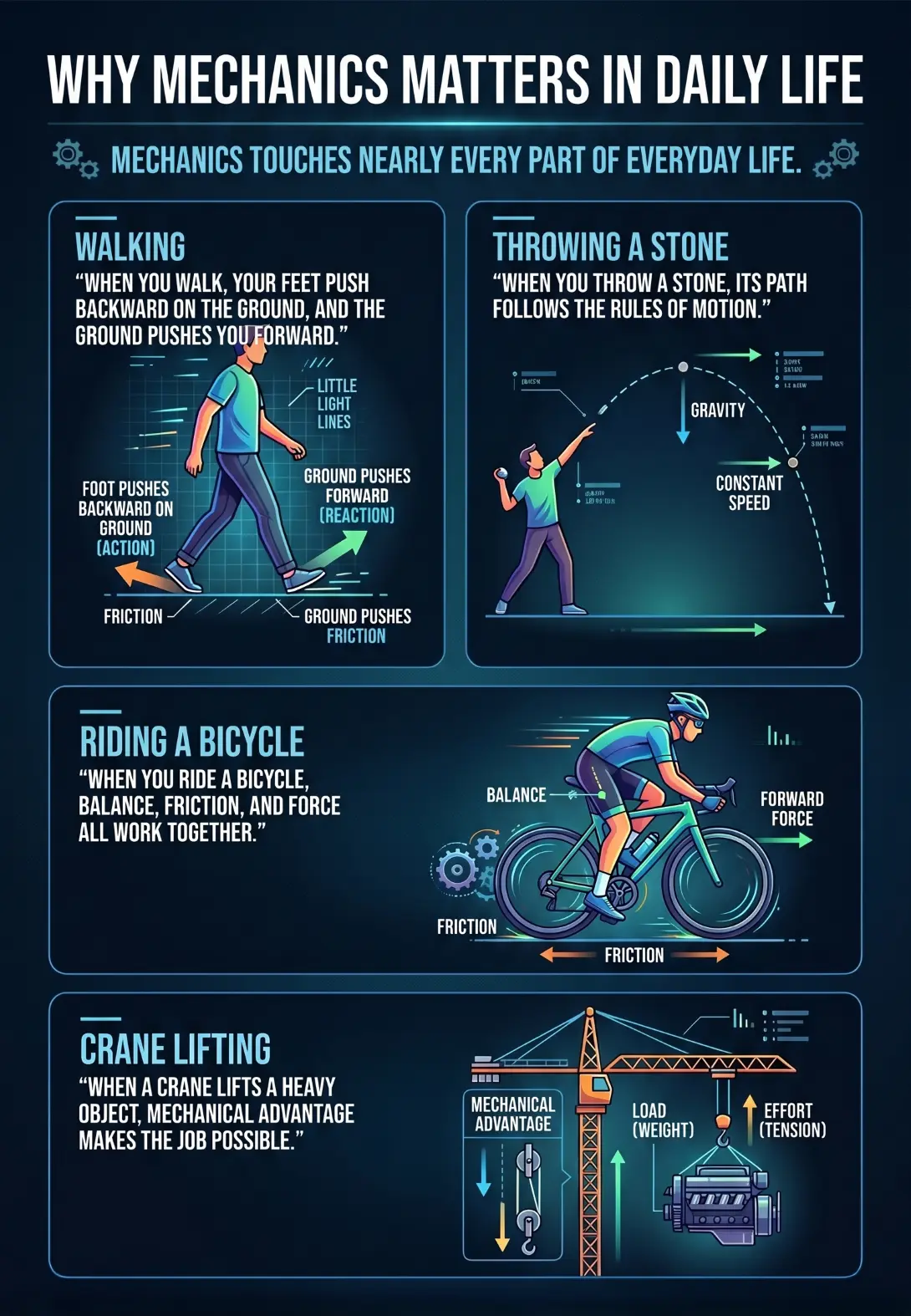
Many people think mechanics is only for scientists or engineers. That is not true. It touches nearly every part of everyday life.
Here are a few simple examples:
- When you walk, your feet push backward on the ground, and the ground pushes you forward.
- When you throw a stone, its path follows the rules of motion.
- When you ride a bicycle, balance, friction, and force all work together.
- When a crane lifts a heavy object, mechanical advantage makes the job possible.
- When a car turns a corner, circular motion and friction are involved.
So, whether you are cooking, traveling, playing sports, or building something, mechanics is always there in the background.
Main Branches of Mechanics
Mechanics is usually divided into several major parts. Each part studies motion and forces differently.
1. Classical Mechanics
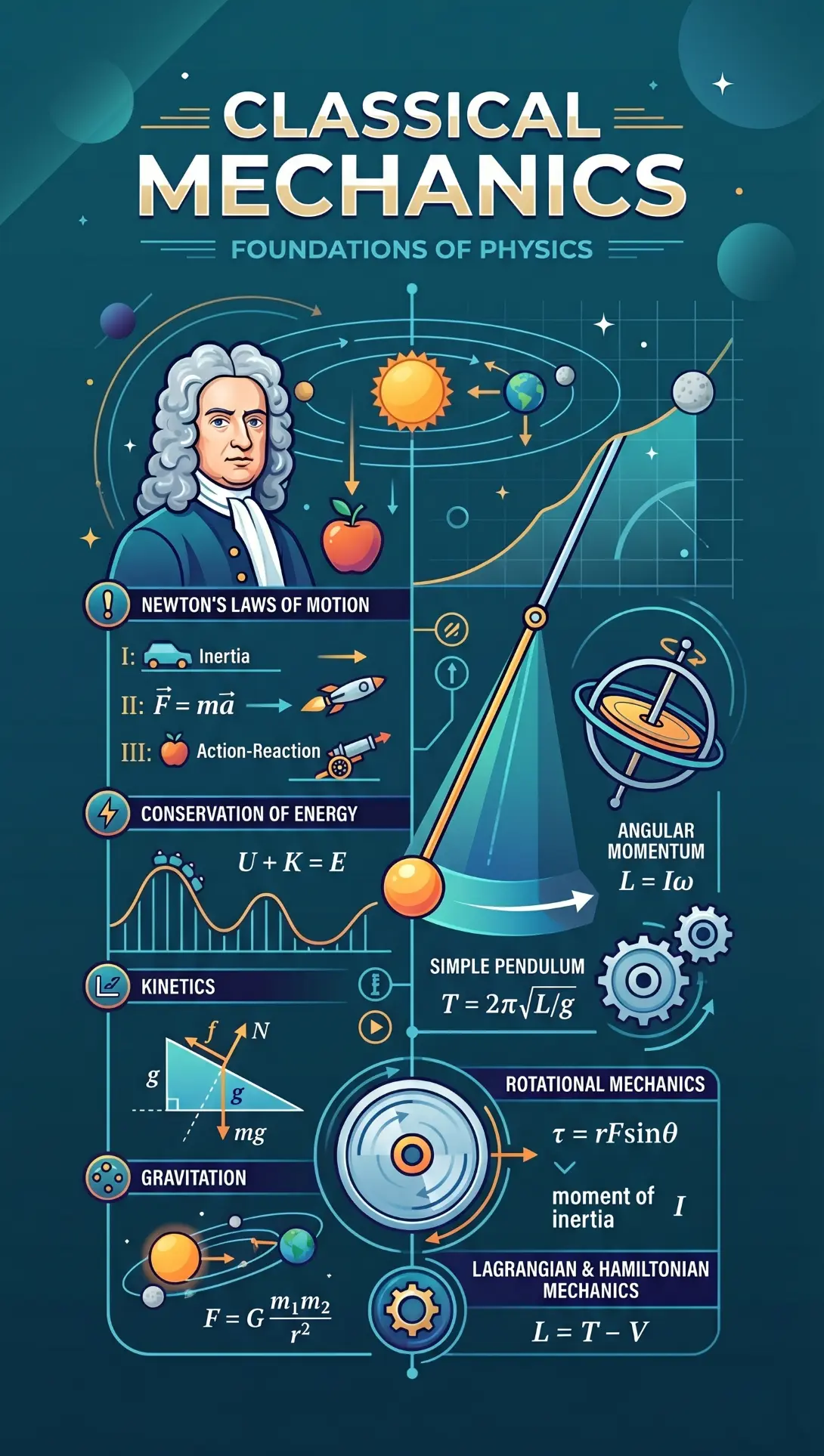
Classical mechanics deals with the motion of objects that are not extremely small and do not move at speeds close to the speed of light. It includes the laws of Newton, kinematics, dynamics, and statics.
It works very well for:
- cars
- planets
- balls
- machines
- buildings
- everyday objects
2. Quantum Mechanics
Quantum mechanics studies particles that are extremely small, such as electrons, photons, and atoms. In this world, nature behaves in ways that are very different from everyday experience. Objects do not always have exact positions or speeds in the usual sense.
3. Relativistic Mechanics
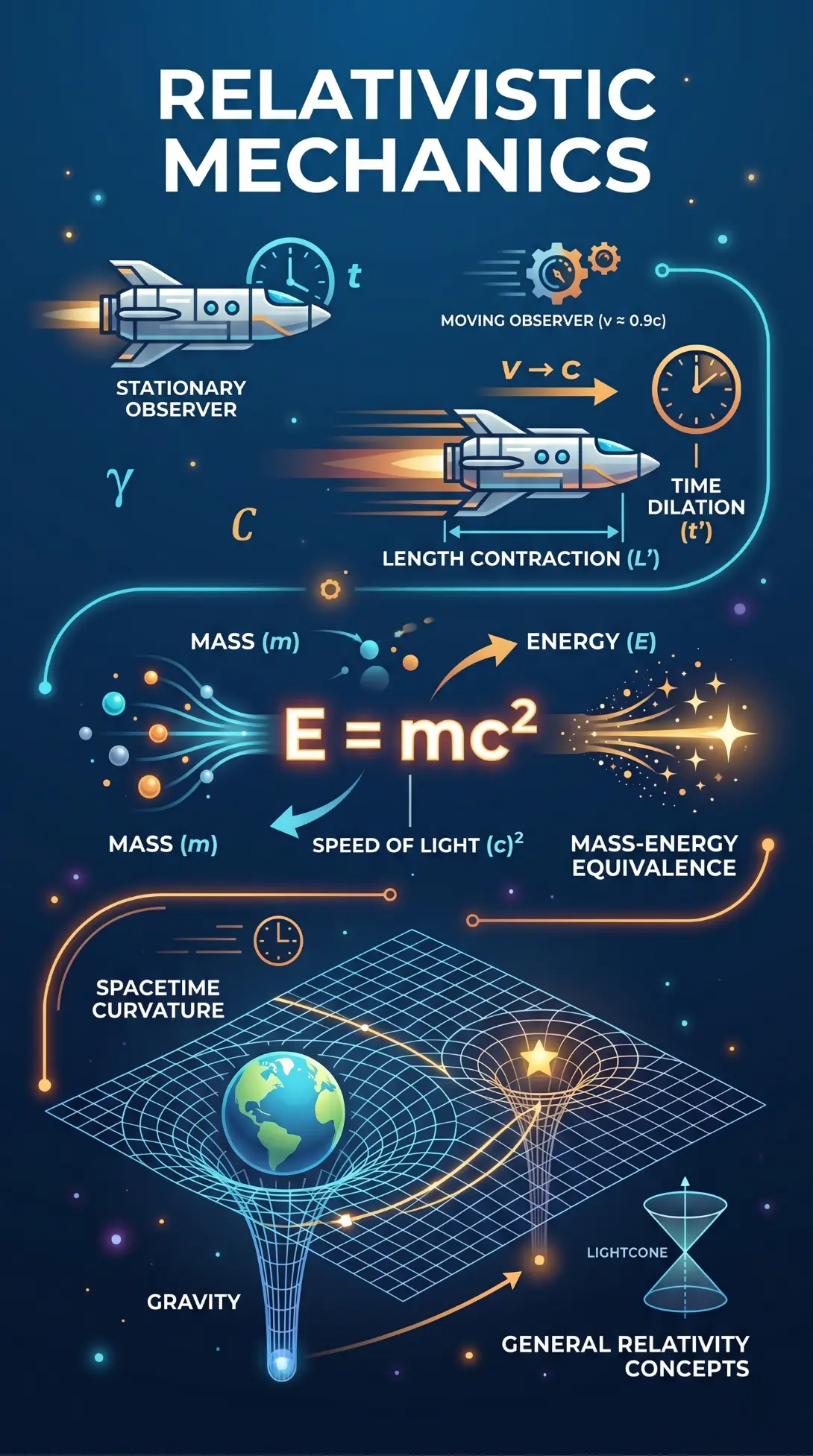
Relativistic mechanics is used when objects move at speeds close to the speed of light. In such cases, time, length, and mass behave differently than in everyday life.
4. Continuum Mechanics
Continuum mechanics treats materials like solids and fluids as continuous bodies rather than collections of separate particles. It is very important in engineering, materials science, and fluid analysis.
5. Fluid Mechanics
Fluid mechanics studies liquids and gases. It helps explain how water flows through pipes, how air moves around an airplane wing, and how blood circulates in the body.
6. Statics and Dynamics
- Statics studies objects at rest or in equilibrium.
- Dynamics studies objects in motion and the forces that cause motion.
These branches often overlap and support each other.
A Simple History of Mechanics
The story of mechanics goes back thousands of years. Early thinkers observed motion in the sky, falling objects, and simple machines. Over time, these observations became more organized and mathematical.
Some of the biggest milestones include:
- Ancient Greece
Early philosophers studied motion and balance. They tried to understand levers, pulleys, and motion in nature. - Archimedes
He made major contributions to statics, buoyancy, and leverage. His work laid the foundation for understanding how forces act on objects. - Galileo Galilei
Galileo studied falling bodies and motion on inclined planes. He helped show that motion can be described mathematically. - Isaac Newton
Newton changed physics forever by formulating the three laws of motion and the law of universal gravitation. His work became the core of classical mechanics. - Later Developments
Scientists later expanded mechanics into thermodynamics, quantum theory, relativity, and continuum mechanics.
This long development shows that mechanics is not just a school topic. It is one of the great intellectual achievements in human history.
The Fundamental Ideas of Mechanics
To understand mechanics, you need to know a few basic ideas. These ideas appear again and again in science and engineering.
1. Motion
Motion is the change in position of an object with time. If a car moves from one place to another, it is in motion. If a person walks across a room, that is motion too.
2. Force
A force is a push or pull acting on an object. Forces can change the object’s speed, direction, or shape.
Examples of forces include:
- gravity
- friction
- tension
- normal force
- applied force
- air resistance
3. Mass
Mass is the amount of matter in an object. It measures how much stuff the object contains and affects how hard it is to change its motion.
4. Acceleration
Acceleration is the rate at which velocity changes. If a car speeds up, slows down, or turns, it is accelerating.
5. Energy
Energy is the ability to do work. In mechanics, common forms include kinetic energy and potential energy.
6. Momentum
Momentum is the amount of motion an object has. It depends on mass and velocity.
7. Equilibrium
An object is in equilibrium when the total force and total torque acting on it are balanced. It does not necessarily mean the object is at rest. It can also move at constant speed.
Newton’s Laws of Motion
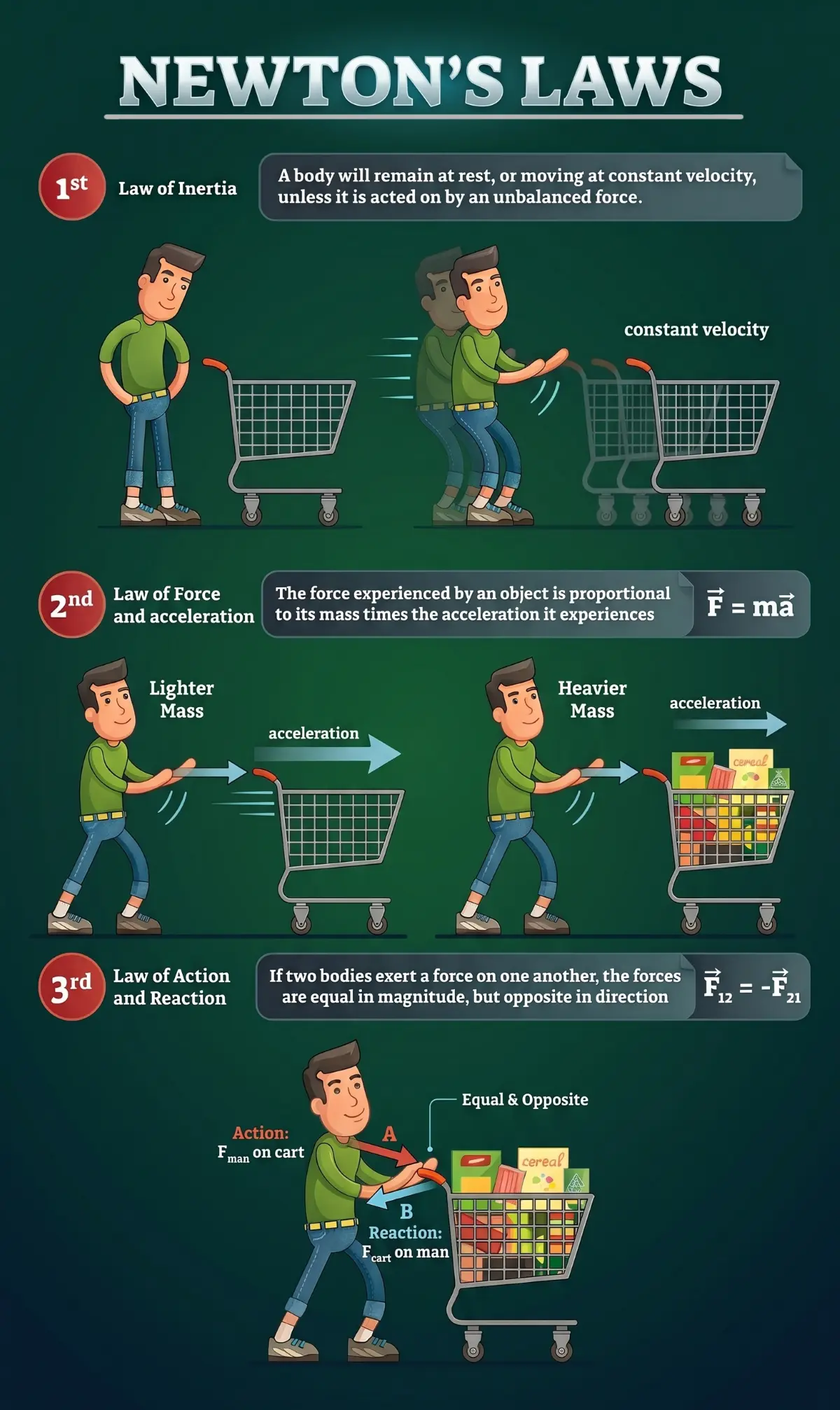
The heart of classical mechanics is Newton’s laws of motion. These three laws describe how forces affect movement.
First Law of Motion
An object remains at rest or moves with constant velocity unless acted upon by an external force.
This is often called the law of inertia.
Example:
A book on a table stays there until someone moves it.
Second Law of Motion
The acceleration of an object depends on the net force acting on it and its mass.
In simple form:
F = ma
Where:
- F = force
- m = mass
- a = acceleration
Example:
It is easier to push an empty shopping cart than a full one because the full one has more mass.
Third Law of Motion
For every action, there is an equal and opposite reaction.
Example:
When you jump off a boat, you push the boat backward while the boat pushes you forward.
These laws may look simple, but they explain a huge amount of the physical world.
Kinematics: Studying Motion Without Forces
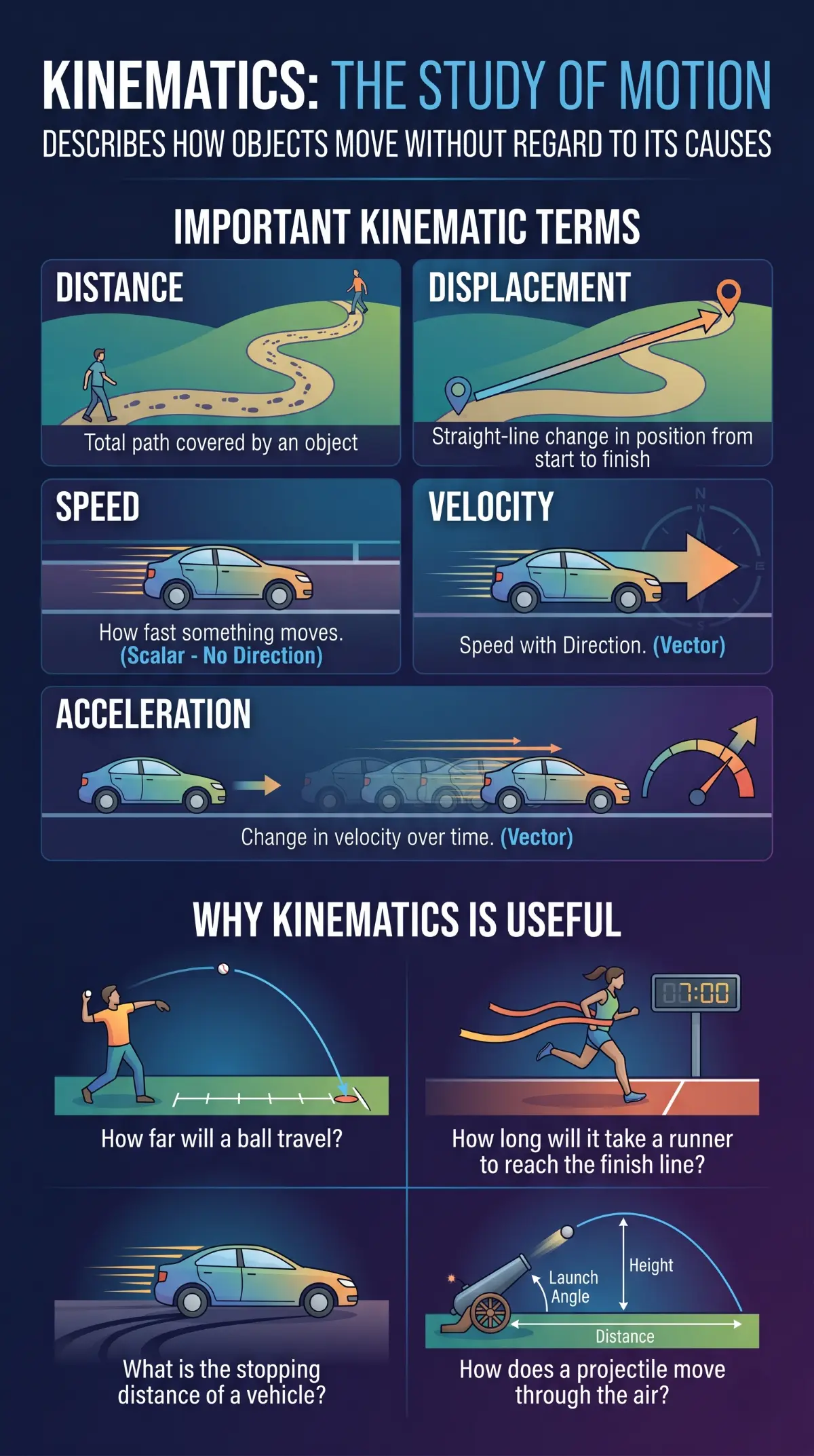
Kinematics is the study of motion without focusing on the cause of motion. It describes how an object moves using concepts like displacement, velocity, speed, and acceleration.
Important Kinematic Terms
- Distance
The total path covered by an object. - Displacement
The straight-line change in position from start to finish. - Speed
How fast something moves. It has no direction. - Velocity
Speed with direction. - Acceleration
Change in velocity over time.
Why Kinematics Is Useful
Kinematics helps answer practical questions such as:
- How far will a ball travel?
- How long will it take a runner to reach the finish line?
- What is the stopping distance of a vehicle?
- How does a projectile move through the air?
Dynamics: Understanding Forces and Their Effects
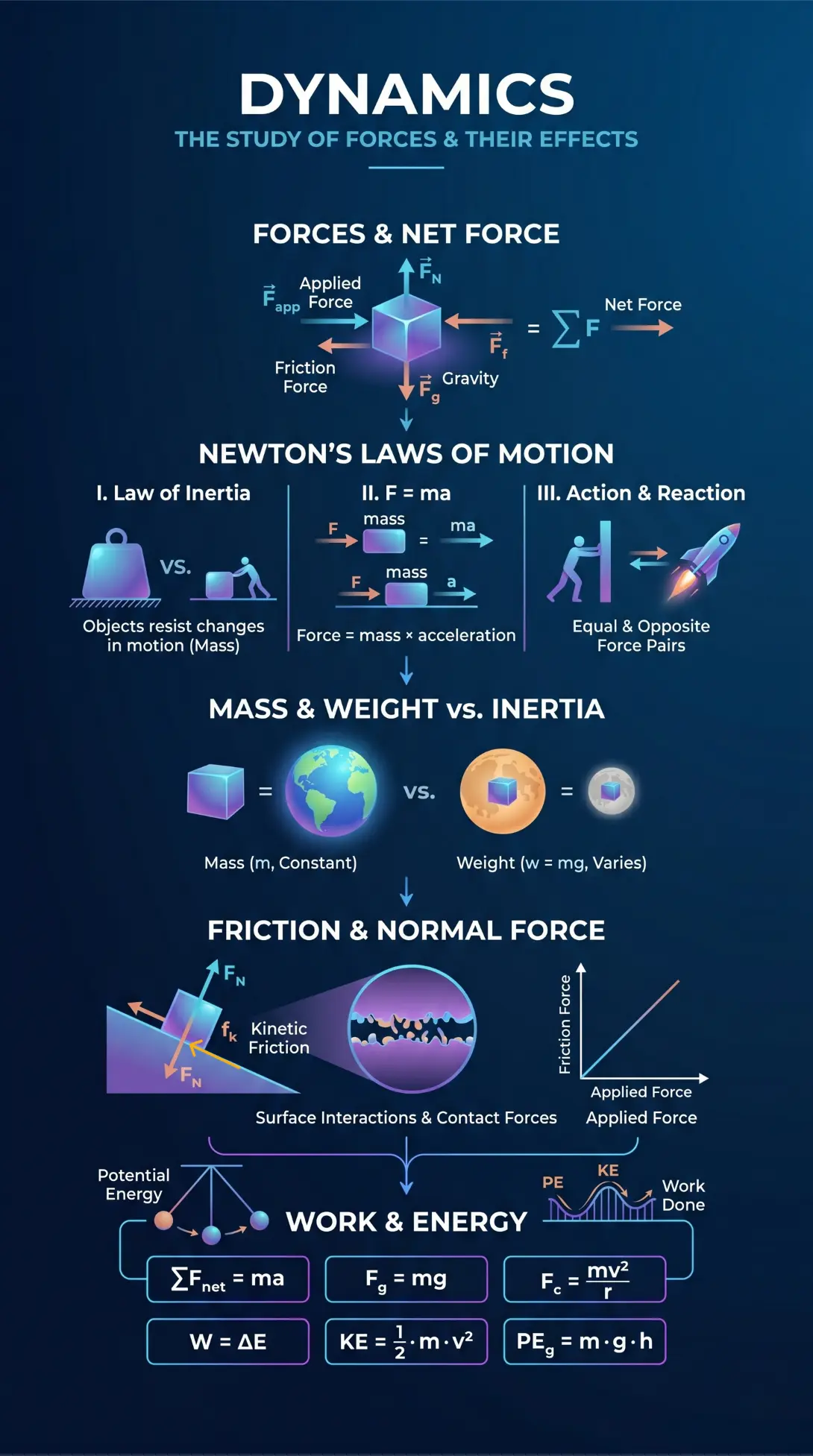
Dynamics studies the causes of motion. It explains why motion changes. While kinematics describes motion, dynamics explains motion.
For example, when a football is kicked:
- Kinematics describes the ball’s path
- Dynamics explains the kick, the force, and the influence of gravity and air resistance
Important topics in dynamics include:
- net force
- friction
- tension
- centripetal force
- torque
- impulse
- momentum
Dynamics is central to engineering, sports, transportation, and machine design.
Statics: The Mechanics of Rest
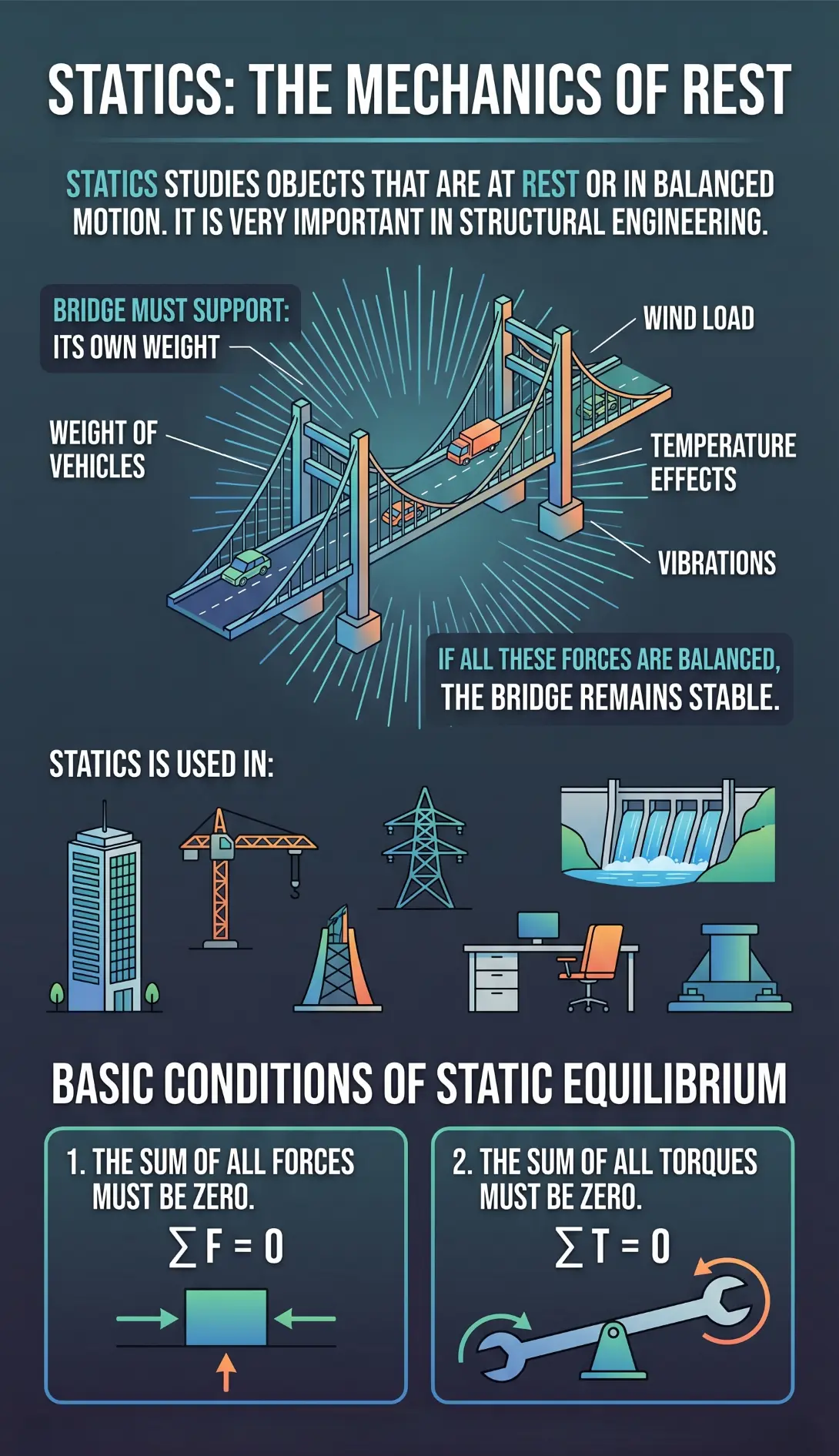
Statics studies objects that are at rest or in balanced motion. It is very important in structural engineering.
A bridge, for example, must support:
- its own weight
- the weight of vehicles
- wind load
- temperature effects
- vibrations
If all these forces are balanced, the bridge remains stable.
Statics is used in:
- buildings
- cranes
- towers
- dams
- furniture
- machine supports
Basic Conditions of Static Equilibrium
For an object to be in equilibrium:
- The sum of all forces must be zero.
- The sum of all torques must be zero.
If either condition is not met, the object will move or rotate.
Work, Energy, and Power in Mechanics
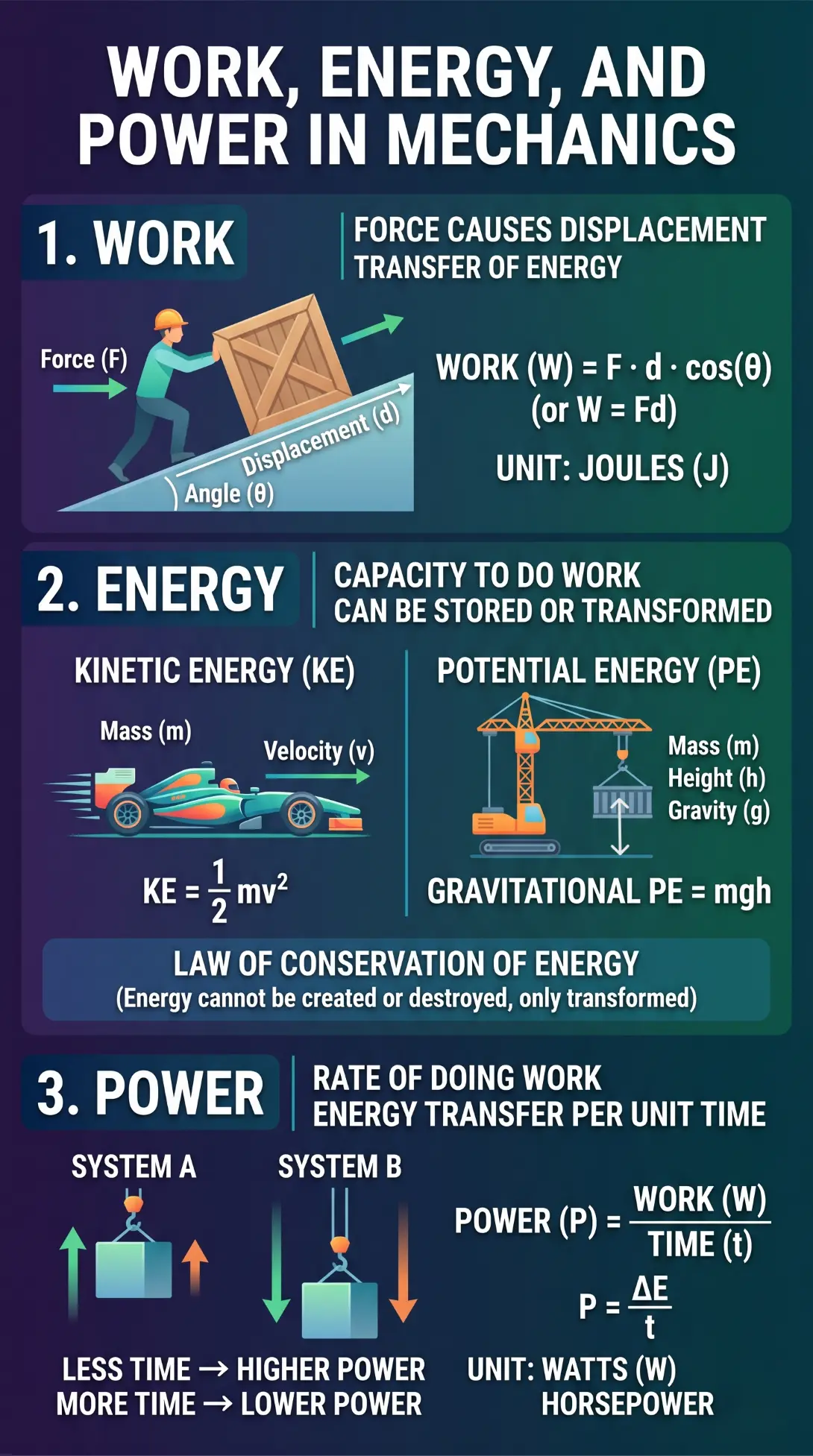
These three ideas are closely related.
Work
In mechanics, work is done when a force causes displacement.
Work = Force × Distance
If you push a box across the floor, you do work on the box.
Energy
Energy is the capacity to do work. A moving car has kinetic energy. A raised object has potential energy.
Power
Power is the rate at which work is done.
A fast machine can do the same work as a slower one, but in less time, so it has greater power.
Types of Mechanical Energy
- Kinetic Energy
Energy of motion. - Potential Energy
Energy is stored because of position or shape. - Elastic Potential Energy
Energy is stored in stretched or compressed materials.
Real-Life Example
A child on a swing keeps converting potential energy to kinetic energy and back again. That is a perfect mechanics example.
Momentum and Impulse
Momentum
Momentum is defined as mass times velocity.
Momentum = mass × velocity
The more momentum an object has, the harder it is to stop.
Impulse
Impulse is the change in momentum caused by a force acting over time.
This concept is very useful in:
- car safety
- sports
- collisions
- crash analysis
Example
A cricket bat increases the ball’s momentum in a short time. A car airbag increases the time of impact, which reduces the force on the passenger.
Friction: The Force That Resists Motion
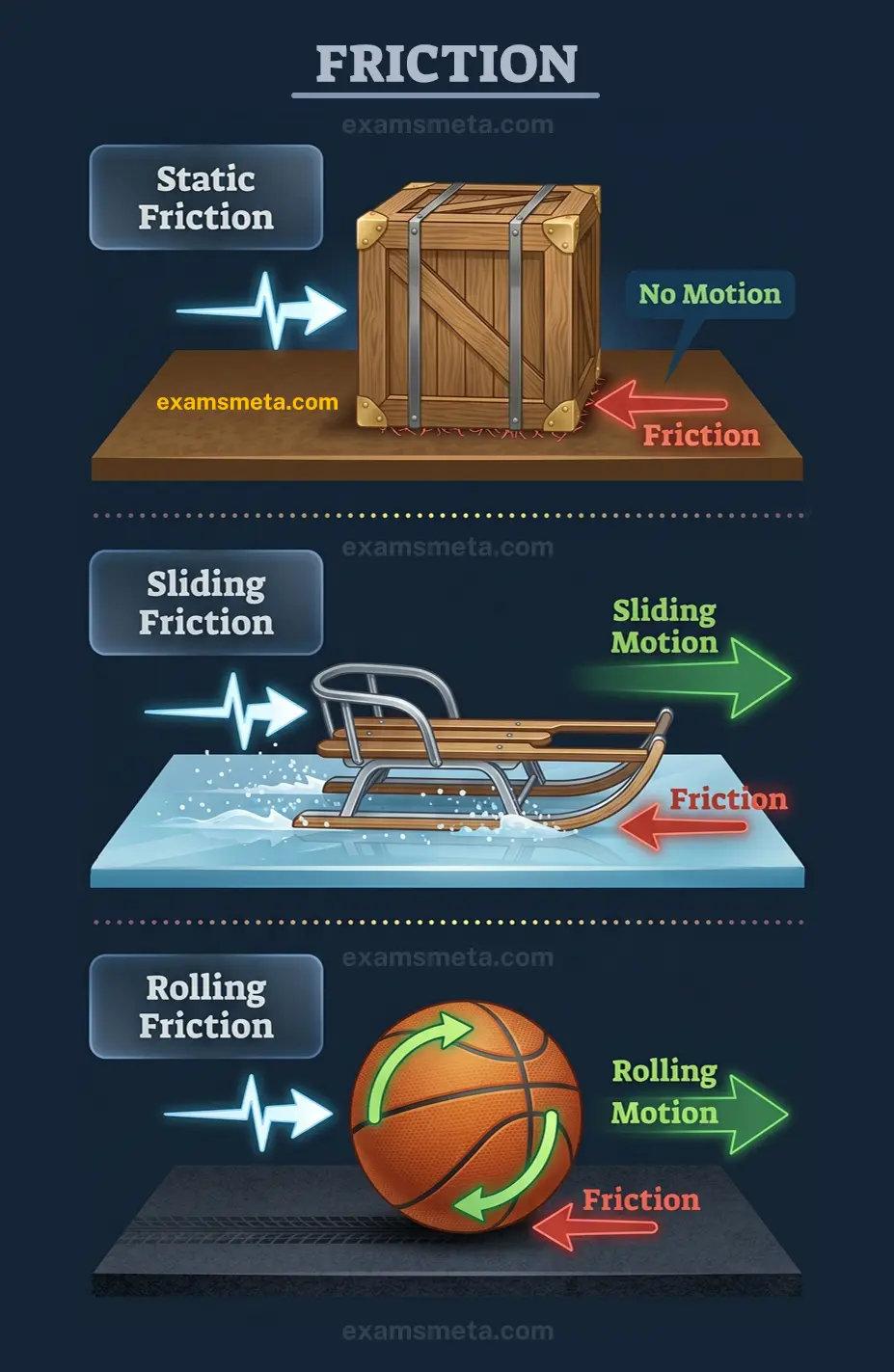
Friction is a force that opposes motion when two surfaces touch.
There are several types of friction:
- Static friction
- Sliding friction
- Rolling friction
- Fluid friction
Why Friction Is Important
Friction is both helpful and harmful.
It helps us:
- walk without slipping
- hold objects
- write with a pen
- brake vehicles
It also causes:
- wear and tear
- heat loss
- energy waste in machines
Without friction, many daily tasks would be impossible. But too much friction can damage machines and waste energy.
Gravity and Mechanics
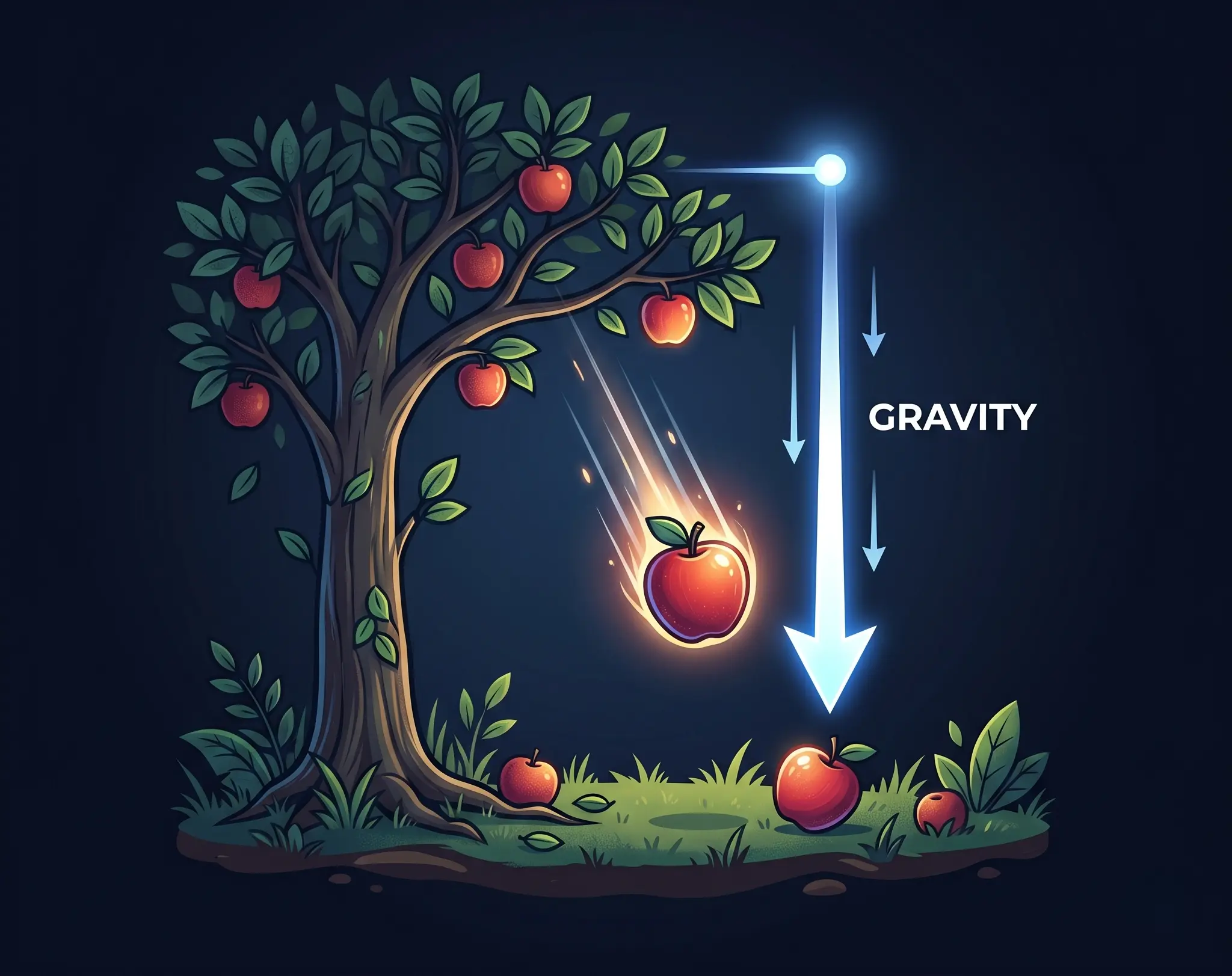
Gravity is one of the most powerful and familiar forces in mechanics. It pulls objects toward one another. On Earth, gravity pulls objects downward toward the center of the planet.
What Gravity Does
- Makes objects fall
- Gives weight to objects
- Keeps the Moon in orbit
- Keeps planets around the Sun
- Affects tides
- Influences projectile motion
Weight vs Mass
These are not the same thing.
- Mass is the amount of matter.
- Weight is the force caused by gravity acting on mass.
An object has the same mass everywhere, but its weight can change depending on the strength of gravity.
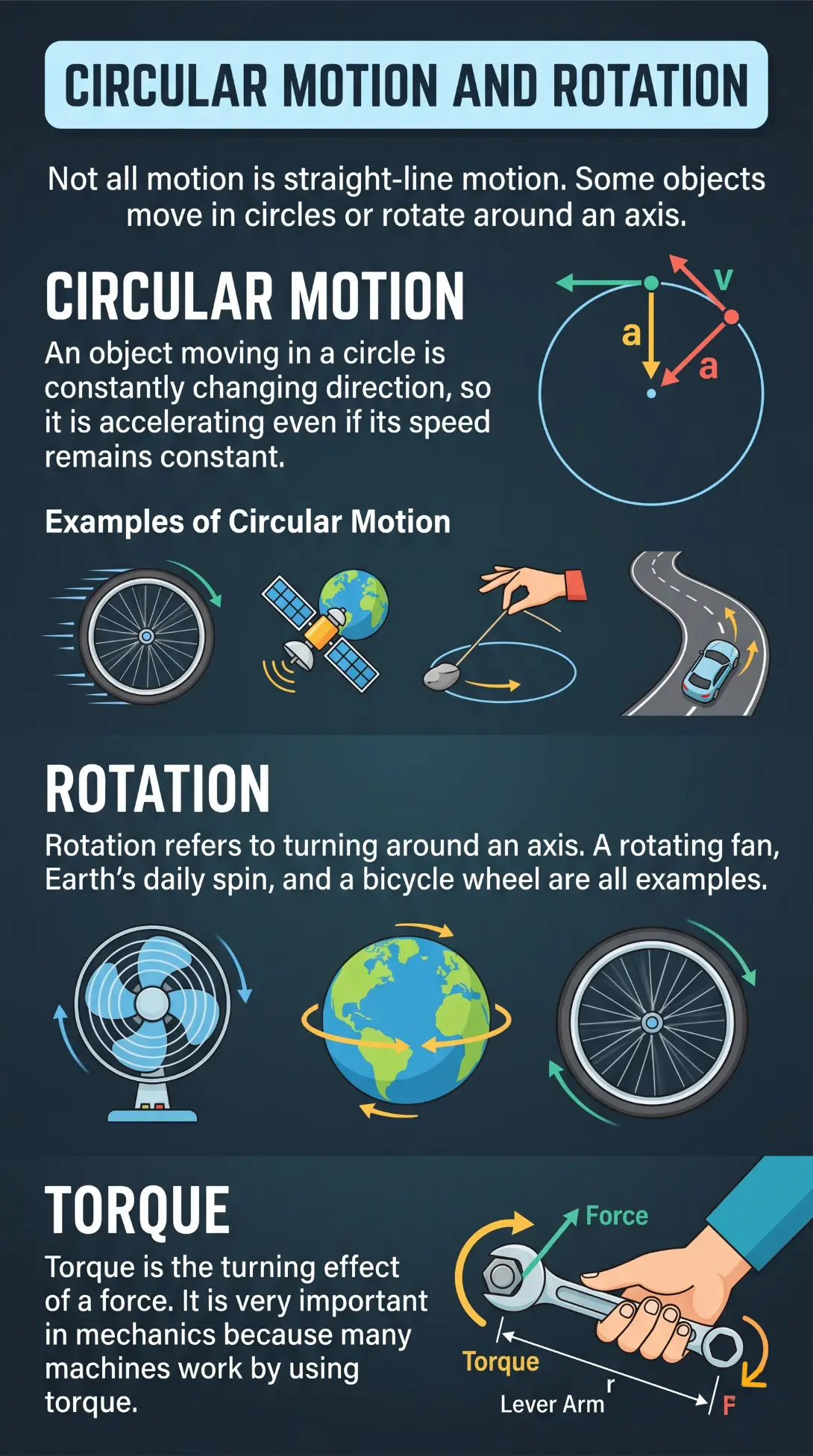
Circular Motion and Rotation
Not all motion is straight-line motion. Some objects move in circles or rotate around an axis.
Circular Motion
An object moving in a circle is constantly changing direction, so it is accelerating even if its speed remains constant.
Examples of Circular Motion
- a spinning wheel
- a satellite orbiting Earth
- a stone tied to a string and whirled in a circle
- a car turning around a curved road
Rotation
Rotation refers to turning around an axis. A rotating fan, Earth’s daily spin, and a bicycle wheel are all examples.
Torque
Torque is the turning effect of a force. It is very important in mechanics because many machines work by using torque.
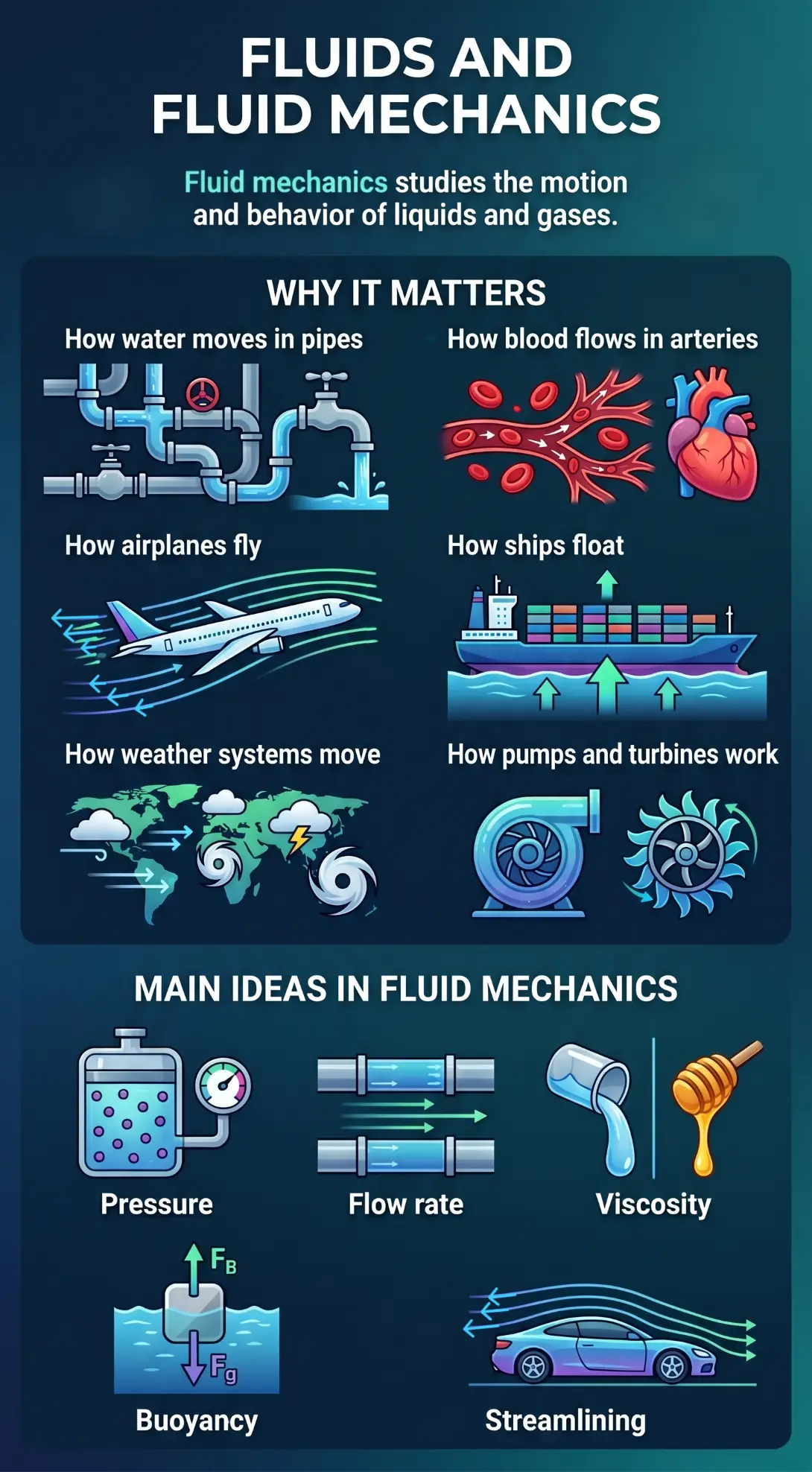
Fluids and Fluid Mechanics
Fluid mechanics studies the motion and behavior of liquids and gases.
Why It Matters
It helps explain:
- How water moves in pipes
- How blood flows in arteries
- How airplanes fly
- How ships float
- How weather systems move
- How pumps and turbines work
Main Ideas in Fluid Mechanics
- Pressure
- Flow rate
- Viscosity
- Buoyancy
- Streamlining
Example
A boat floats because the water pushes upward on it. That upward force is called the buoyant force.
Simple Machines and Mechanical Advantage
A huge part of mechanics is the study of simple machines. These devices make work easier by changing the size or direction of a force.
Types of Simple Machines
- Lever
- Pulley
- Wheel and axle
- Inclined plane
- Wedge
- Screw
Mechanical Advantage
Mechanical advantage shows how much a machine multiplies force.
Everyday Examples
- A seesaw is a lever
- A flagpole uses a pulley
- A ramp is an inclined plane
- A knife is a wedge
- A jar lid acts like a screw
These machines may look simple, but they are the basis of many complex tools and devices.
Mechanics in Engineering
Engineering depends heavily on mechanics. Without it, safe and efficient structures would be impossible to design.
Where Mechanics Is Used in Engineering
- Civil engineering
Roads, bridges, dams, tunnels, and buildings - Mechanical engineering
Engines, machines, tools, HVAC systems, and manufacturing equipment - Aerospace engineering
Aircraft, rockets, spacecraft, and drones - Automobile engineering
Cars, buses, trucks, brakes, suspension, and engine systems - Robotics
Motion planning, balance, joints, motors, and mechanical arms
Why Engineers Need Mechanics
Engineers use mechanics to:
- Predict stress and strain
- Choose safe materials
- Reduce failure
- Improve efficiency
- Control motion
- Manage loads and vibrations
Mechanics in Sports
Sports are full of mechanics, even when players do not think about it.
Examples
- A football kick depends on force, angle, and timing.
- A tennis serve uses torque and momentum.
- A high jump uses body mechanics and balance.
- A cyclist depends on pedaling force, friction, and energy transfer.
- A swimmer uses fluid mechanics to move through water.
Coaches and athletes often improve performance by studying biomechanics, which is the mechanics of living bodies.
Biomechanics: Mechanics in the Human Body
Biomechanics applies mechanics to the movement of humans and animals. It helps us understand how muscles, bones, joints, and tissues work together.
Why Biomechanics Matters
It is useful in:
- sports training
- physical therapy
- prosthetic design
- injury prevention
- posture correction
- walking and running analysis
Example
When you run, your legs act like levers, your muscles produce force, and your joints allow movement. All of this can be studied through mechanics.
Large Comparison Table of Key Concepts in Mechanics
| Concept | Meaning | Main Formula or Idea | Common Example | Why It Matters |
|---|---|---|---|---|
| Motion | Change in position over time | Described by displacement, velocity, and acceleration | A car moving on a road | It is the main subject of mechanics |
| Force | Push or pull | F = ma in many cases | Pushing a door | Forces change motion and shape |
| Mass | Amount of matter | Measured in kilograms | A heavy suitcase | It affects inertia and acceleration |
| Weight | Gravitational force on mass | Weight = mg | A person standing on Earth | It depends on gravity |
| Velocity | Speed with direction | Distance over time with direction | A plane flying north | It gives a full motion description |
| Acceleration | Change in velocity | Change in velocity over time | A speeding car | It shows how motion changes |
| Work | Force causing displacement | Work = Force × Distance | Lifting a box | It connects force and energy |
| Energy | Ability to do work | Kinetic or potential | A stretched spring | It powers motion and change |
| Momentum | Motion quantity | Momentum = mv | A moving truck | Important in collisions |
| Friction | Force resisting motion | Depends on surfaces | Shoes gripping the ground | It enables control and grip |
| Torque | Turning effect of force | Force × distance from pivot | Opening a wrench | Important for rotation |
| Pressure | Force per unit area | Pressure = Force / Area | A sharp knife cuts easily | Crucial in fluids and solids |
| Equilibrium | Balanced forces and torques | Net force = 0, net torque = 0 | A book lying still | Important in statics |
Detailed Table of Branches of Mechanics
| Branch | What It Studies | Typical Topics | Real-World Uses | Simple Example |
|---|---|---|---|---|
| Classical Mechanics | Motion of everyday objects | Motion, force, energy, momentum | Vehicles, machines, planets | A thrown ball |
| Quantum Mechanics | Behavior of tiny particles | Atoms, electrons, waves, uncertainty | Electronics, lasers, semiconductors | Electron movement in an atom |
| Relativistic Mechanics | Motion near light speed | Time dilation, mass-energy relations | Particle physics, space research | Fast-moving particles |
| Statics | Objects in balance | Equilibrium, load distribution, torque | Buildings, bridges, cranes | A table standing on the floor |
| Dynamics | Motion and causes of motion | Force, acceleration, momentum | Engines, robotics, vehicles | A moving car |
| Fluid Mechanics | Liquids and gases | Pressure, flow, viscosity, buoyancy | Pipes, aircraft, weather, blood flow | Water flowing through a hose |
| Continuum Mechanics | Behavior of solid and fluid materials | Stress, strain, deformation | Materials, construction, manufacturing | A bent metal rod |
Common Formulas Used in Mechanics
Here is a simple table of some essential formulas.
| Sr. No. | Quantity | Formula | Meaning |
|---|---|---|---|
| 1 | Speed | Distance / Time | How fast an object moves |
| 2 | Velocity | Displacement / Time | Speed with direction |
| 3 | Acceleration | Change in velocity / Time | How velocity changes |
| 4 | Force | F = ma | Force equals mass times acceleration |
| 5 | Work | Force × Distance | Work is done when a force moves an object |
| 6 | Power | Work / Time | Rate of doing work |
| 7 | Momentum | p = mv | Motion quantity |
| 8 | Weight | W = mg | Gravitational force |
| 9 | Pressure | Force / Area | Force spread over a surface |
| 10 | Kinetic Energy | KE = 1/2 mv² | Energy of motion |
| 11 | Potential Energy | PE = mgh | Energy due to height |
| 12 | Torque | Force × perpendicular distance | Turning effect of force |
These formulas are widely used in school science, university studies, and technical work. They are simple on paper, but they describe a huge part of the real world.
Examples That Make Mechanics Easier to Understand
Example 1: Pushing a Shopping Cart
A light cart moves easily. A heavier cart needs more force. This shows the relationship between mass, force, and acceleration.
Example 2: Throwing a Ball Upward
When you throw a ball upward, it slows down because of gravity. At the highest point, its speed becomes zero for a moment before it starts falling back.
Example 3: Riding a Bicycle
Bicycles involve force, balance, friction, rotation, and energy transfer. The wheels rotate, the brakes create friction, and the rider’s muscles provide force.
Example 4: Opening a Door
When you push a door near the handle, it opens more easily than pushing near the hinge. That happens because torque depends on distance from the pivot.
Example 5: Floating in Water
A swimmer floats because the water pushes upward with buoyant force. The body’s weight and the water’s upward force balance each other.
How Mechanics Shapes Modern Technology
Modern life would look very different without mechanics.
Technologies Built on Mechanics
- Cars and motorcycles
- Airplanes and helicopters
- Trains and ships
- Robots and automation systems
- Cranes and lifting equipment
- Medical devices
- Power plants
- Sports equipment
- Home appliances
- Spacecraft and satellites
Each of these depends on motion, force, structure, and energy transfer. That is why mechanics is not just theory. It is practical knowledge that keeps the world running.
Mechanics and Safety
Safety is another major reason Mechanics matters.
Examples of Safety Uses
- Seat belts reduce injury by controlling momentum change.
- Helmets spread impact force over a larger area.
- Bridges are tested for load and stress.
- Elevators use counterweights and control systems.
- Buildings are designed to withstand wind and earthquakes.
When Mechanics is understood properly, accidents can be reduced, and lives can be protected.
Mechanics in Nature
Nature follows mechanical principles, too.
Natural Examples
- Planetary motion
Planets orbit because of gravity and inertia. - Waterfall flow
Water moves downward because of gravity. - Tides
The Moon and Sun influence ocean movement. - Bird flight
Airflow, lift, drag, and wing structure are all mechanical ideas. - Tree bending in the wind
Elasticity and force are involved.
Nature is full of motion and balance, and mechanics gives us the language to describe it.
Stress, Strain, and Elasticity
In many materials, forces do not just move things. They also change shape.
- Stress is a force per unit area inside a material.
- Strain is the deformation caused by stress.
- Elasticity is the ability of a material to return to its original shape after being stretched or compressed.
Practical Examples
- Rubber bands stretch and return
- Springs compress and expand
- Metal beams bend slightly under load
- Bridges experience stress from traffic and wind
These ideas are essential in architecture, manufacturing, and material science.
Difference Between Mechanics and Other Branches of Physics
Mechanics is often compared with other areas of physics. Here is a simple table.
| Branch of Physics | Main Focus | How It Relates to Mechanics |
|---|---|---|
| Mechanics | Motion, force, energy, balance | Directly studies physical movement |
| Thermodynamics | Heat and temperature | Often connected through engines and energy transfer |
| Electromagnetism | Electric and magnetic fields | Used in motors, generators, and devices that involve motion |
| Optics | Light behavior | Mechanical principles can affect lenses and instruments |
| Quantum Physics | Tiny particles | Extends mechanics into the microscopic world |
| Relativity | High-speed and strong gravity effects | Expands mechanics for extreme conditions |
Mechanics is often the starting point because it explains the most familiar physical processes.
Why Students Should Learn Mechanics
For students, mechanics is one of the most valuable topics in science.
Benefits of Learning Mechanics
- It improves problem-solving skills.
- It helps explain everyday events.
- It builds a strong foundation for engineering and technology.
- It develops logical thinking.
- It connects math with real life.
- It improves understanding of nature.
- It prepares students for advanced science topics.
Mechanics also teaches patience. Many problems can be solved in more than one way, and that encourages careful thinking.
Common Mistakes Students Make in Mechanics
Even though mechanics is logical, students often make some avoidable mistakes.
Frequent Errors
- Confusing mass with weight
- Mixing up speed and velocity
- Forgetting that direction matters in vectors
- Ignoring friction when solving problems
- Using the wrong units
- Skipping the free-body diagram
- Forgetting to check whether forces are balanced
- Confusing work with energy
- Assuming motion always means a force is present in the direction of motion
- Overlooking torque in rotational problems
A careful approach solves most of these issues.
How to Study Mechanics Effectively
Here are some helpful study habits.
- Learn the basic definitions first.
- Practice diagrams, especially force diagrams.
- Use units correctly in every problem.
- Understand formulas, do not just memorize them.
- Solve many examples from daily life.
- Check your direction signs in vector problems.
- Review graph interpretation for motion topics.
- Connect theory to experiments whenever possible.
Mechanics becomes easier when you see it as a system of ideas that work together.
A Large Table of Real-Life Applications of Mechanics
| Area | Mechanical Principle Used | Example | Result |
|---|---|---|---|
| Transport | Motion, friction, force, energy | Car braking system | Safe stopping |
| Construction | Statics, stress, torque | Bridge design | Structural stability |
| Sports | Momentum, rotation, projectile motion | Football kick | Better performance |
| Medicine | Biomechanics, fluid flow | Artificial limbs | Improved movement |
| Agriculture | Machines, force, motion | Tractors and harvesters | Faster work |
| Aerospace | Lift, drag, propulsion | Aircraft wings | Controlled flight |
| Energy systems | Torque, rotation, fluid flow | Turbines | Power generation |
| Household tools | Leverage, pressure | Scissors and knives | Easier cutting |
| Manufacturing | Force, motion, machine design | Assembly lines | Efficient production |
| Robotics | Dynamics, joints, control | Robotic arm | Precise movement |
Mechanics and the Real World
The beauty of mechanics is that it turns the physical world into something understandable. What looks random at first often follows clear patterns.
A falling leaf, a swinging pendulum, a spinning wheel, and a moving train all obey the same broad rules of motion. The details differ, but the logic is shared. That is why mechanics is so powerful. It gives us a common framework for understanding almost everything that moves or resists movement.
It also shows that science is not distant from ordinary life. A person balancing a tray, a child sliding on a playground, a worker carrying bricks, and a pilot guiding a plane are all participating in mechanics, whether they know it or not.
Future Importance of Mechanics
Even as technology changes, mechanics will remain essential. New materials, smart machines, autonomous vehicles, robotics, and space exploration all depend on mechanics at a deep level.
Some future directions include:
- Robotic Movement Systems
- Medical Biomechanics
- Advanced Aircraft Design
- Space Travel
- Renewable Energy Turbines
- Micro-machines and Nanotechnology
- Earthquake-resistant Structures
- Smart Transport Systems
The more advanced technology becomes, the more important mechanics becomes in shaping it.
Final Thoughts on Mechanics
Mechanics is more than a science chapter. It is a way of understanding the world. It explains why objects move, why they stay still, how they react to force, and how energy flows through everyday life. It gives us the tools to build bridges, design machines, improve sports performance, protect passengers, and explore space.
At the same time, mechanics is beautifully simple. A push, a pull, a fall, a turn, a stretch, a stop, these ordinary events become meaningful when you look at them through the lens of mechanics. That is what makes this subject so useful and so fascinating.
Whether you are a student, teacher, engineer, writer, or curious reader, learning mechanics opens the door to a deeper understanding of nature and technology. It is one of those subjects that keeps growing with you. The more you notice it, the more the world starts to make sense.
And that is the real strength of mechanics. It helps us see the hidden order inside motion, force, and energy, all around us, every single day.
Article References and Sources
- NASA Physics and Mechanics Resources
- Encyclopaedia Britannica: Mechanics
- Khan Academy: Physics and Mechanics Lessons
- MIT OpenCourseWare: Classical Mechanics
- The Physics Classroom: Motion and Forces
- HyperPhysics: Mechanics Concepts
- OpenStax College Physics
- NASA Glenn Research Center: Aerodynamics and Fluid Mechanics
- CK-12 Foundation Physics Concepts
- Stanford Encyclopedia of Philosophy: Classical Mechanics
- American Physical Society
- National Geographic Science Resources
- University Physics Online Textbook
- ScienceDirect: Mechanics Research Articles
- Britannica: Newton’s Laws of Motion
- NASA Spaceflight and Gravity Resources
- LibreTexts Physics: Mechanics
- Engineering Toolbox: Mechanics and Engineering Data
- BBC Bitesize: Forces and Motion
- National Science Foundation
Also, Read these Articles in Detail
- Physics and Its Fundamentals With Good Explanations
- Matter, Motion, and Energy: The Core Ideas of Physics
- What Is Matter? The Physical Substance of the Universe
- What Is Motion? A Guide to Motion in Physics and Daily Life
- What Is Energy? The Invisible Power Behind Everyday Life
- Kinetic Energy Explained in Simple Language
- Potential Energy: Definition, Types, Formula, and Examples
- Thermal Energy: Heat, Temperature, and Transfer
- Mechanical Energy: Definition, Formula, and Examples
- Chemical Energy: Definition, Science, and Examples
- Electrical Energy: Definition, Works, and Why It Matters
- Radiant Energy: Meaning, Sources, Examples, and Uses
- Nuclear Energy: Definition, How It Works, and Why It Matters
- Sound Energy: Definition, Science, and Examples
- Elastic Energy: Definition, Elasticity, and Example
- Geothermal Energy: Clean Electricity, Heating, and Modern Life
- Hydropower Energy: How It Works and Its Importance
- Pumped Hydropower Storage
- Force: Meaning, Types, Formula, and Examples
Frequently Asked Questions
FAQ 1: What is mechanics?
Mechanics is the branch of physics that studies motion, forces, and the effect of those forces on objects. It explains why things move, why they stay still, and what happens when a push or pull acts on them. It is one of the most practical areas of science because it shows up in almost everything around us.
Think about a ball rolling across the floor, a car braking at a traffic light, a child swinging on a playground swing, or a bridge carrying heavy vehicles. All of these situations involve mechanical principles. That is why mechanics is such an important subject. It helps us understand the physical world in a simple but powerful way.
Mechanics also gives us the tools to solve real problems. Engineers use it to design buildings, machines, vehicles, and tools. Scientists use it to study planets, falling objects, rotating systems, and fluid flow. Even in daily life, you use mechanics without thinking about it. When you open a door, lift a bag, ride a bicycle, or throw something, you are dealing with force, mass, acceleration, and energy.
The subject becomes easier when you break it into simple ideas. Motion tells us what is happening. Force tells us why it is happening. Energy tells us how much ability an object has to do work. Momentum tells us how hard it is to stop something. These ideas work together and form the foundation of mechanics.
So, in simple words, mechanics is the science of how objects move and how forces affect them. It is both a basic science and a highly practical one, which is why it remains one of the most important topics in physics.
FAQ 2: Why is mechanics important in daily life?
Mechanics is important in daily life because it explains the movement, balance, and force behind ordinary actions. You may not notice it, but every day you use mechanical ideas many times without even thinking about them.
For example, when you walk, your feet push backward on the ground, and the ground pushes you forward. That is Newton’s third law of motion in action. When you carry a heavy box, your muscles apply force to lift it. When you sit on a chair, the chair applies an upward normal force that balances your weight. These are all simple but real examples of mechanics at work.
It also helps with things that feel more complicated. A car uses mechanics in its engine, tires, brakes, suspension, and steering system. A bicycle depends on friction, rotation, and balance. A fan works because of rotational motion. A bridge stands because of careful static balance and load distribution. Even water flowing through a pipe follows the rules of fluid mechanics.
Mechanics is also important for safety. Seat belts, airbags, helmets, elevators, cranes, and bridges are designed using mechanical principles. Without this knowledge, many modern systems would not be reliable or safe. If engineers misunderstood force or motion, buildings could fail, vehicles could become dangerous, and machines could break too easily.
It also saves energy and improves efficiency. When machines are designed well, they use less fuel, waste less power, and perform better. That is why mechanics matters in transport, construction, manufacturing, agriculture, sports, medicine, and space technology.
In short, mechanics is not just a school subject. It is part of how life works. It helps us move, build, travel, and stay safe in the world around us.
FAQ 3: What are the main branches of mechanics?
The main branches of mechanics are classical mechanics, quantum mechanics, relativistic mechanics, statics, dynamics, fluid mechanics, and continuum mechanics. Each branch studies motion and force in a slightly different way, and together they give us a full picture of physical behavior.
Classical mechanics deals with everyday objects. It includes the laws of motion, force, energy, and momentum. This is the branch most people first learn in school. It works very well for cars, balls, buildings, machines, and planets in ordinary conditions.
Quantum mechanics studies tiny particles such as electrons, photons, and atoms. In this microscopic world, the rules are very different from the ones we see in daily life. Objects do not always behave in a predictable way, and probabilities become important.
Relativistic mechanics is used when objects move very fast, close to the speed of light. At such speeds, time and space behave differently than in normal situations. This branch is important in advanced physics and space research.
Statics studies objects that are at rest or in balance. It helps explain how structures like bridges, towers, and buildings stay stable. Dynamics studies objects in motion and the forces that cause that motion.
Fluid mechanics focuses on liquids and gases. It helps us understand pressure, flow, buoyancy, and viscosity. This branch is used in weather studies, ship design, aeroplanes, plumbing, and blood flow.
Continuum mechanics studies how materials behave as continuous bodies. It is useful for understanding stress, strain, deformation, and material strength.
These branches may sound separate, but they often overlap. A bridge designer, for example, may use statics, dynamics, and continuum mechanics together. A scientist studying blood flow may use fluid mechanics and biomechanics. That is what makes mechanics such a broad and useful field.
FAQ 4: What are Newton’s laws of motion?
Newton’s laws of motion are three basic rules that explain how forces affect movement. They are among the most important ideas in classical mechanics, and they are used in science, engineering, and everyday problem-solving.
The first law says that an object will stay at rest or keep moving in a straight line at constant speed unless acted upon by an external force. This is also called the law of inertia. It means that objects resist changes in their motion. A book on a table stays still until someone moves it. A moving car will continue rolling unless brakes, friction, or another force slows it down.
The second law says that the acceleration of an object depends on the net force acting on it and its mass. This is usually written as F = ma. Here, F stands for force, m for mass, and a for acceleration. This law explains why a light object is easier to move than a heavy one. It also shows why stronger forces produce greater acceleration.
The third law says that for every action, there is an equal and opposite reaction. If you push on a wall, the wall pushes back with equal force. When a rocket launches, it pushes exhaust gases downward, and the gases push the rocket upward.
These three laws are simple, but they explain a huge amount of what happens around us. They help us understand walking, driving, lifting, throwing, rotating, falling, and balancing. They are also the starting point for many advanced ideas in mechanics.
If you understand Newton’s laws, you already understand one of the most important foundations of physics.
FAQ 5: What is the difference between mass and weight?
Mass and weight are related, but they are not the same thing. This is one of the most common points of confusion in mechanics, but the difference is actually simple.
Mass is the amount of matter in an object. It tells us how much stuff the object contains. It is measured in kilograms. Mass stays the same no matter where the object is. A rock has the same mass on Earth, on the Moon, or in space.
Weight, on the other hand, is the force caused by gravity acting on an object’s mass. It is measured in newtons. Weight depends on the strength of gravity, so it can change from one place to another. The same person weighs less on the Moon than on Earth because the Moon has weaker gravity.
You can think of it like this. Mass is a property of the object itself. Weight is the pull of gravity on that object. So when people say they “weigh” a certain number of kilograms, they are actually mixing up mass and weight in everyday language.
The weight formula is W = mg, where W is weight, m is mass, and g is the acceleration due to gravity. On Earth, g is about 9.8 m/s².
This difference matters in science, engineering, and space travel. If you are designing a scale, a rocket, or a structure, you must know whether you are dealing with mass or weight. They are connected, but they are not identical.
FAQ 6: What is the role of force in mechanics?
Force is one of the central ideas in mechanics. It is a push or pull that can change the motion, shape, or direction of an object. Without force, there would be no movement changes, no stopping, no bending, and no acceleration.
Force can do many things. It can start motion, stop motion, speed up an object, slow it down, turn it, stretch it, compress it, or bend it. For example, when you kick a football, your foot applies force to the ball, and the ball moves. When you apply the brakes in a car, force helps slow the vehicle down. When you stretch a spring, the force changes its shape.
In mechanics, force is usually measured in newtons. It is a vector quantity, which means it has both size and direction. That is important because two forces of the same size can have different effects depending on the direction in which they act.
Forces can also work together. If several forces act on an object, the most important thing is the net force, which is the total combined effect. If the net force is zero, the object is in equilibrium. If the net force is not zero, the object will accelerate.
There are different kinds of force too, such as gravity, friction, tension, normal force, air resistance, and applied force. Each one plays a special role in mechanical systems.
So, force is the real engine behind mechanical change. It is what makes mechanics alive and useful.
FAQ 7: What is friction, and why does it matter?
Friction is a force that opposes motion when two surfaces touch each other. It resists slipping and sliding, and it is one of the most common forces in everyday life.
Friction matters because it is both helpful and harmful. It helps us walk, hold objects, write with pens, and brake vehicles. Without friction, your feet would slip on the ground, your hands would not grip things properly, and cars would not stop safely.
At the same time, friction also causes wear and tear. It creates heat, wastes energy, and can damage moving parts in machines. That is why engines, gears, and mechanical systems often need lubrication. Oil and grease reduce friction so machines can run more smoothly.
There are several types of friction.
- Static friction keeps an object from starting to move.
- Sliding friction acts when an object slides across a surface.
- Rolling friction acts when an object rolls.
- Fluid friction acts when an object moves through a liquid or a gas.
A simple example is pushing a heavy box across the floor. It is harder to start the box moving because of static friction. Once it begins to slide, sliding friction takes over. If the box were placed on wheels, rolling friction would be smaller, and the box would move more easily.
Friction is a perfect example of how mechanics works in the real world. It is not just a force to be studied. It is a force that shapes how we live, move, and build things.
FAQ 8: What are work, energy, and power in mechanics?
Work, energy, and power are closely connected ideas in mechanics, and understanding them gives you a much better view of how motion and force interact.
Work is done when a force causes an object to move. In simple terms, if you push or pull something and it moves in the direction of the force, you are doing work. The formula is Work = Force × Distance. If there is no movement, then no mechanical work is done, even if you are trying hard.
Energy is the ability to do work. A moving car has kinetic energy because of its motion. A book placed on a shelf has potential energy because of its position. A compressed spring has elastic potential energy because of its shape. Energy can change from one form to another, but it is not created or destroyed in normal mechanical processes.
Power is the rate at which work is done. It tells us how quickly energy is used. A powerful engine can do a large amount of work in a short time. That is why power is important in machines, vehicles, and tools.
A good example is climbing stairs. If two people climb the same stairs, they do the same amount of work against gravity. But if one climbs faster, that person uses more power. The work may be the same, but the time taken is different.
These concepts appear in everything from engines and elevators to sports and walking. They are simple ideas, but they help explain a huge part of the physical world.
FAQ 9: What is momentum in mechanics?
Momentum is the quantity of motion an object has. It depends on both the object’s mass and its velocity. The formula is momentum = mass × velocity, or p = mv.
Momentum matters because it tells us how hard it is to stop a moving object. A small object moving very fast can have significant momentum, while a large object moving slowly can also have a lot of momentum. That is why a truck and a bicycle behave very differently in motion.
Momentum is especially important in collisions. When two objects collide, their total momentum is usually conserved in a closed system. This is called the law of conservation of momentum. It is a key idea in mechanics and is used in car crash analysis, ball games, and rocket propulsion.
Think about a moving cricket ball. When a bat hits it, the bat changes the ball’s momentum in a short time. The same idea helps explain why airbags are useful in vehicles. They increase the time over which the passenger’s momentum changes, which reduces the force on the body.
Momentum is also useful in space science. Rockets work by pushing gas backward at high speed. The rocket gains forward momentum in response. So even though momentum sounds like a simple idea, it has deep practical value.
If you understand momentum, you understand why moving things are sometimes hard to stop and why timing matters so much in forces and collisions.
FAQ 10: How is mechanics used in engineering and technology?
Mechanics is one of the main foundations of engineering and technology. Almost every machine, structure, transport system, and mechanical device depends on it in some way.
In civil engineering, mechanics is used to design bridges, buildings, roads, dams, and tunnels. Engineers must calculate loads, stresses, and forces so that structures remain safe and stable. They need to know how materials will behave under pressure, wind, weight, and vibration.
In mechanical engineering, mechanics is used for machines, engines, tools, turbines, and industrial equipment. Here, the focus is on movement, energy transfer, torque, friction, and mechanical efficiency. If a machine wastes too much energy or wears out too quickly, its design must be improved.
In automobile engineering, mechanics help with braking systems, steering, suspension, fuel systems, tires, and collision safety. Every part of a vehicle is affected by force and motion. A good car design depends on a strong mechanical understanding.
In aerospace engineering, mechanics is used to study flight, lift, drag, propulsion, and stability. Airplanes, rockets, drones, and satellites all rely on mechanical principles to function correctly.
In robotics, mechanics help control joints, movement, balance, grip, and arm motion. A robot that lifts an object or moves through a room must be carefully designed so that its mechanical parts work together.
Technology also depends on mechanics in smaller ways. Machines in factories, elevators in buildings, pumps in water systems, medical tools, and even home appliances all rely on motion, force, and energy transfer.
So, mechanics is not just theory sitting in a textbook. It is a practical science that supports the modern world. Without it, engineering would be far less safe, efficient, and reliable.
