A wave is one of the most familiar ideas in science, yet it shows up in far more places than many people realize. You see it in the sea, hear it in sound, feel it in earthquakes, and even use it every time you send a message, watch a video, or listen to music. In simple terms, a wave is a moving disturbance that carries energy from one place to another. The matter in the medium may move a little, but the wave itself is what travels. That basic idea sits at the center of physics, ocean science, acoustics, and modern communication systems.
What makes waves so interesting is that they are both simple and powerful. A tiny ripple in water, a voice crossing a room, or a radio signal reaching your phone all depend on wave behavior. Waves can reflect, bend, spread out, overlap, and carry information across enormous distances. Some need a material medium like air or water. Others can travel through the vacuum of space. That difference is one of the reasons waves are such a big deal in science.
Table of Contents
What Is a Wave?
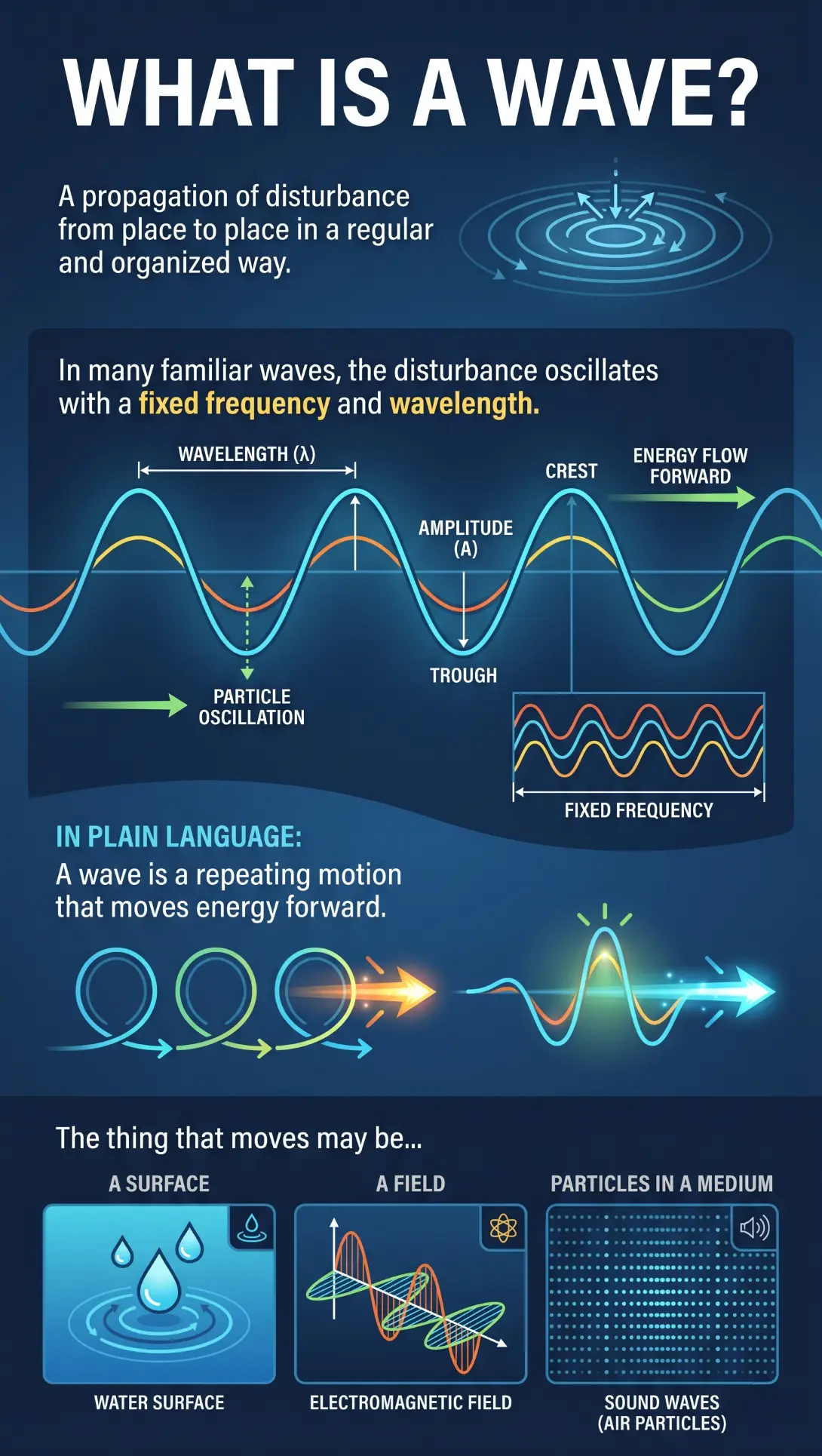
A wave is a propagation of disturbance from place to place in a regular and organized way. In many familiar waves, the disturbance oscillates with a fixed frequency and wavelength. In plain language, a wave is a repeating motion that moves energy forward. The thing that moves may be a surface, a field, or particles in a medium, depending on the kind of wave you are looking at.
A useful way to think about a wave is to imagine a row of people passing a signal along without walking down the line. The signal moves, but the people mostly stay where they are. That is close to what happens in many waves. The disturbance travels, but the medium itself does not travel with the same speed and direction as the wave.
Waves matter because they transfer energy and sometimes information. That is true for ocean swells, seismic waves, sound waves, and electromagnetic waves. It is also why waves are used in technology, medicine, navigation, astronomy, and communication.
The Main Idea Behind Wave Motion
Every wave starts with a source that creates a disturbance. That disturbance spreads outward. As it spreads, different points in the wave rise and fall, compress and rarefy, or oscillate in some other repeating pattern. The exact motion depends on the type of wave, but the basic logic stays the same. A source moves, energy is launched, and the disturbance travels.
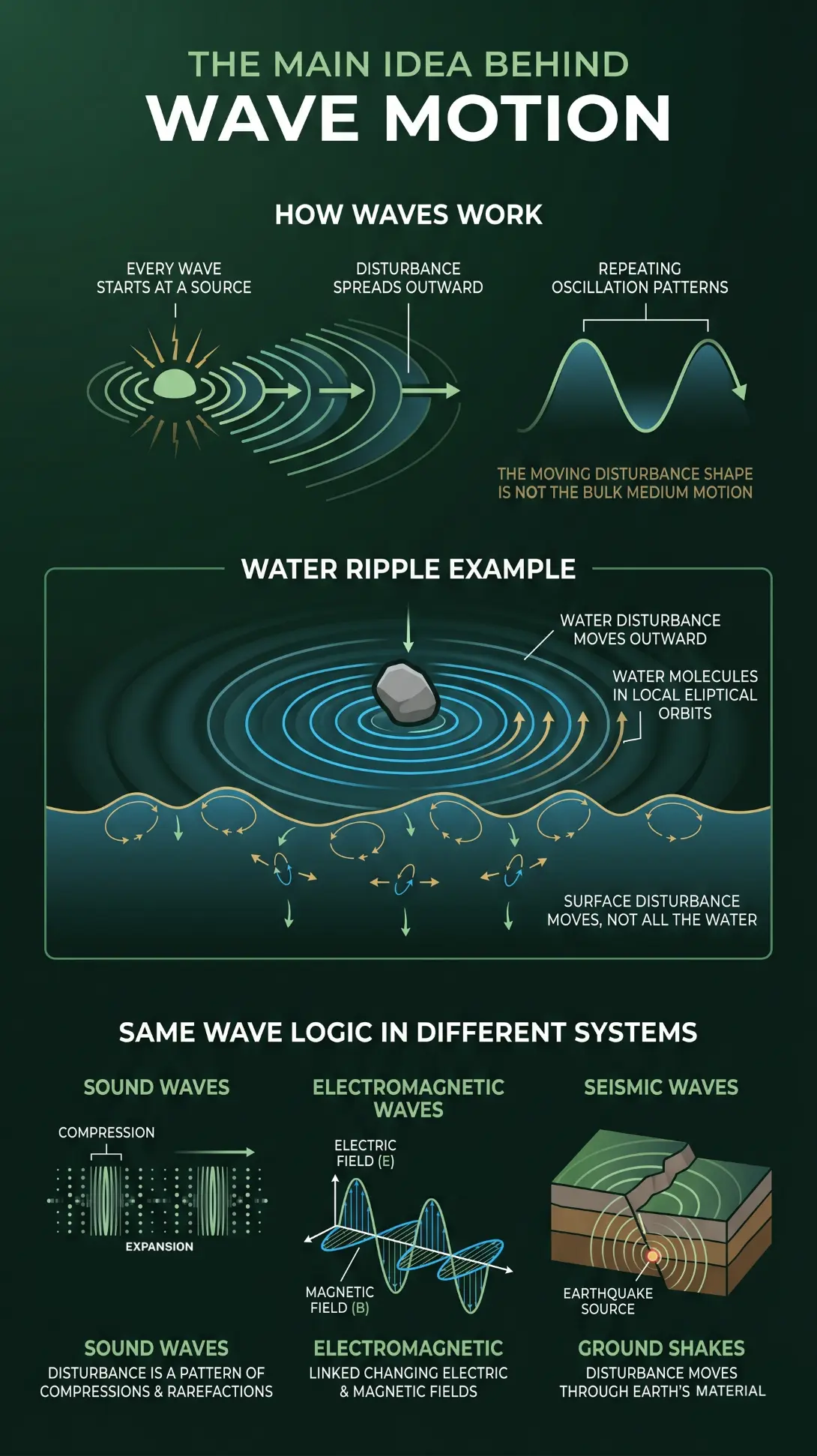
For example, when a stone drops into a pond, it disturbs the water surface. Ripples move outward in circles. The water does not all move outward with the ripple. Instead, the surface disturbance moves while the water molecules mostly move in local paths. That is one reason wave motion can be confusing at first. The moving shape is not the same thing as the bulk motion of the medium.
In sound, the disturbance is a pattern of compressions and rarefactions in air, liquid, or solid material. In electromagnetic waves, the disturbance is a linked changing electric field and magnetic field. In seismic waves, the disturbance moves through Earth as the ground shakes. These are very different systems, but they still follow the wave idea.
Key Properties of a Wave
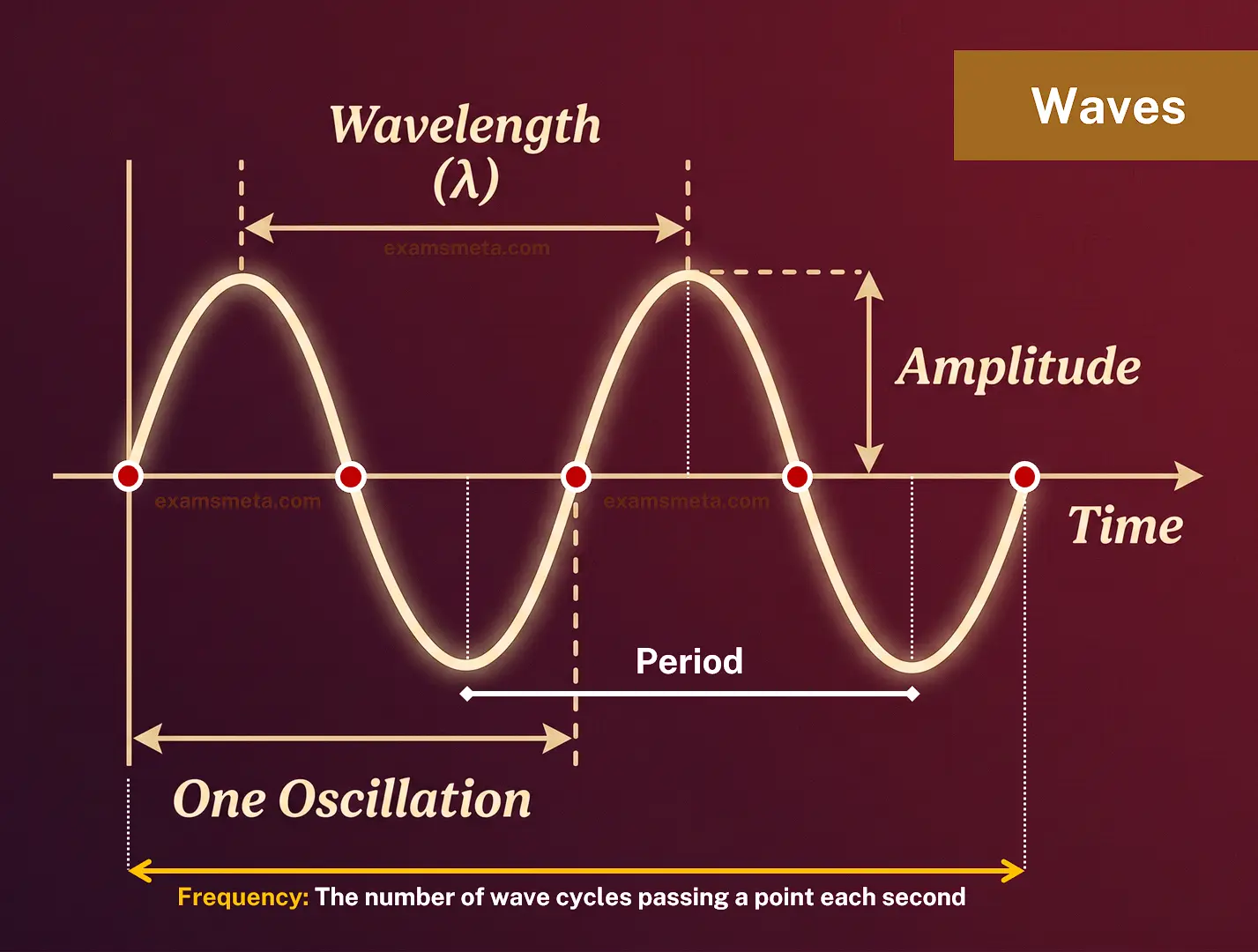
The language of waves is built from a few core properties. Once you understand these, the rest becomes much easier. The most important ones are amplitude, wavelength, frequency, period, and speed.
Wave Properties Table
| Property | Meaning | Why It Matters | Simple Example | Scientific Note |
|---|---|---|---|---|
| Amplitude | The maximum displacement from the equilibrium position | Higher amplitude usually means more energy | A taller ocean swell or louder sound | Amplitude is the maximum displacement of a vibrating point from rest. |
| Wavelength | The distance between identical points on successive waves | Helps describe the size of a wave pattern | Crest to crest in water waves | Wavelength is often written as λ. |
| Frequency | The number of wave cycles passing a point each second | Higher frequency often means shorter wavelength | A high-pitched sound has higher frequency than a low-pitched sound | Frequency is measured in hertz (Hz). |
| Period | Time taken for one full cycle | Useful in timing and oscillation problems | Time between one wave crest and the next arriving crest | Period is the inverse of frequency. |
| Wave speed | How fast the disturbance moves | Tells you how quickly the wave travels through a medium or space | Speed of a sound wave in air | A common relationship is speed = wavelength × frequency. |
The simple relationship wave speed = wavelength × frequency is one of the most useful formulas in wave science. If the speed stays fixed, a higher frequency means a shorter wavelength. If the wavelength gets longer, the frequency must drop. That tradeoff shows up again and again in physics.
A quick way to picture the key terms
- Crest is the highest point of a wave.
- Trough is the lowest point of a wave.
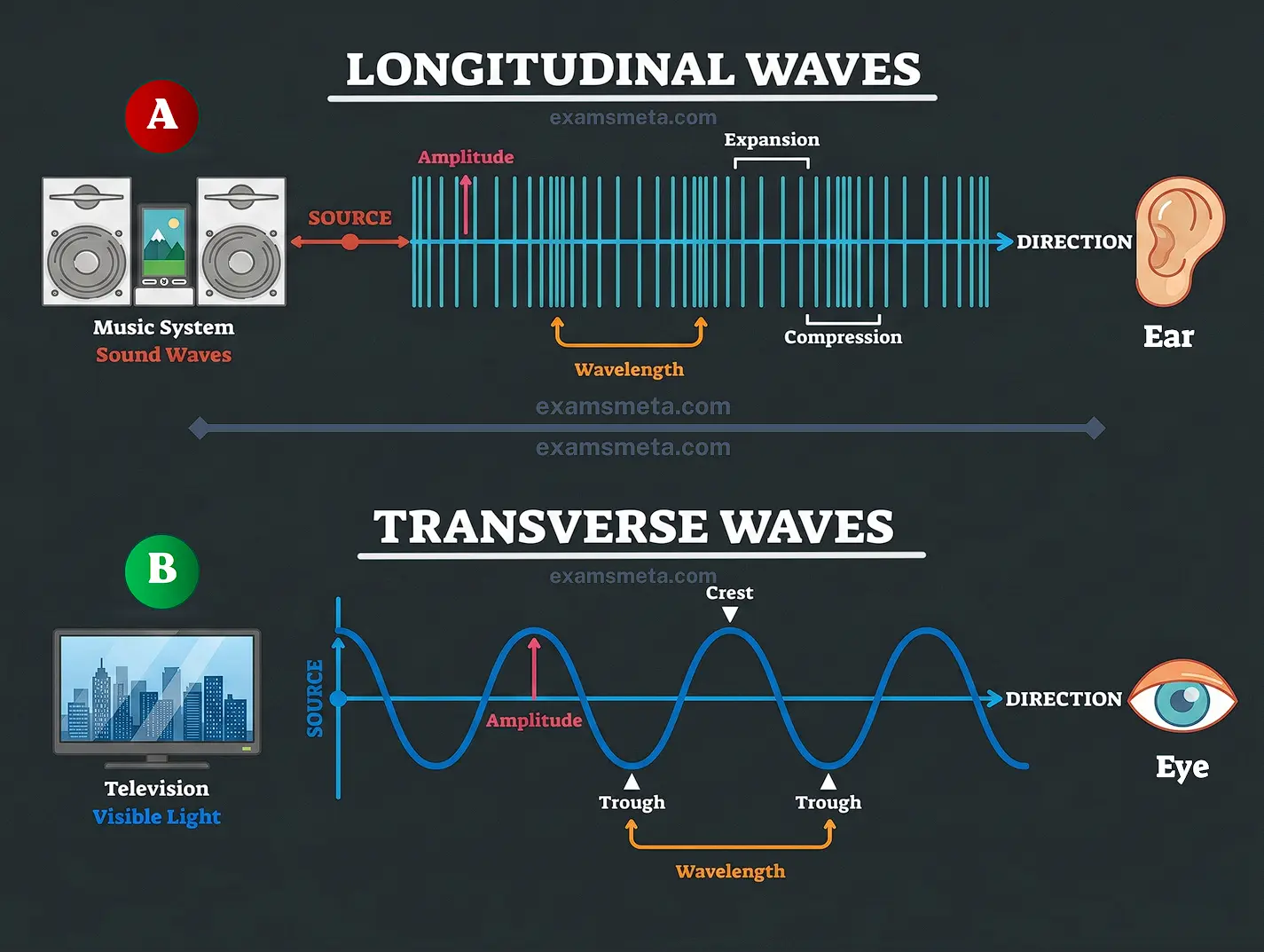
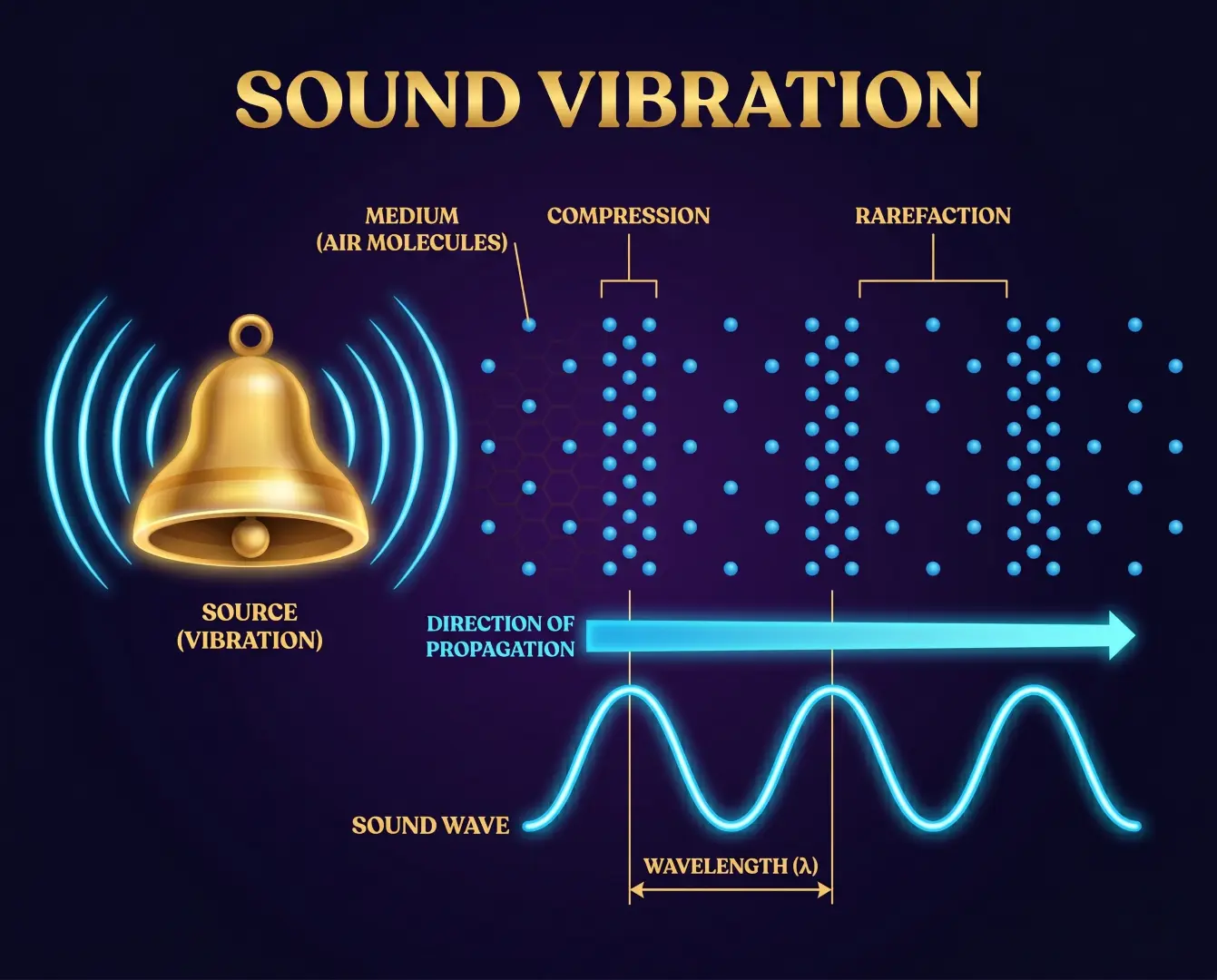
- Compression is a crowded region in a longitudinal wave.
- Rarefaction is a spread-out region in a longitudinal wave.
- Cycle is one complete repeat of the wave pattern.
These terms are small, but they carry a lot of meaning. Once you can identify them, wave diagrams stop looking mysterious and start looking readable.
Types of Waves
Waves are usually grouped in more than one way. One common classification is based on how the disturbance moves. Another is based on the physical nature of the wave. A third is based on whether a medium is needed.
1. Transverse Waves
In a transverse wave, the disturbance moves perpendicular to the direction the wave travels. If the wave moves forward, the particles or field oscillate up and down or side to side. Water surface ripples are often taught as an example of transverse motion, though real water waves can be more complex. Electromagnetic waves are also transverse.
Examples of transverse waves:
- Light waves
- Radio waves
- Waves on a stretched string
- Some surface water waves
2. Longitudinal Waves
In a longitudinal wave, the disturbance moves in the same direction as the wave travels. The medium compresses and expands along the line of motion. Sound in air is the classic example. Earthquake P waves are also longitudinal waves.
Examples of longitudinal waves:
- Sound waves
- P waves
- Compression waves in a slinky
- Pressure waves in fluids
3. Mechanical Waves
A mechanical wave needs a material medium such as air, water, rock, or a solid string. That is why sound cannot travel in empty space. Mechanical waves move by causing particles in the medium to oscillate.
4. Electromagnetic Waves
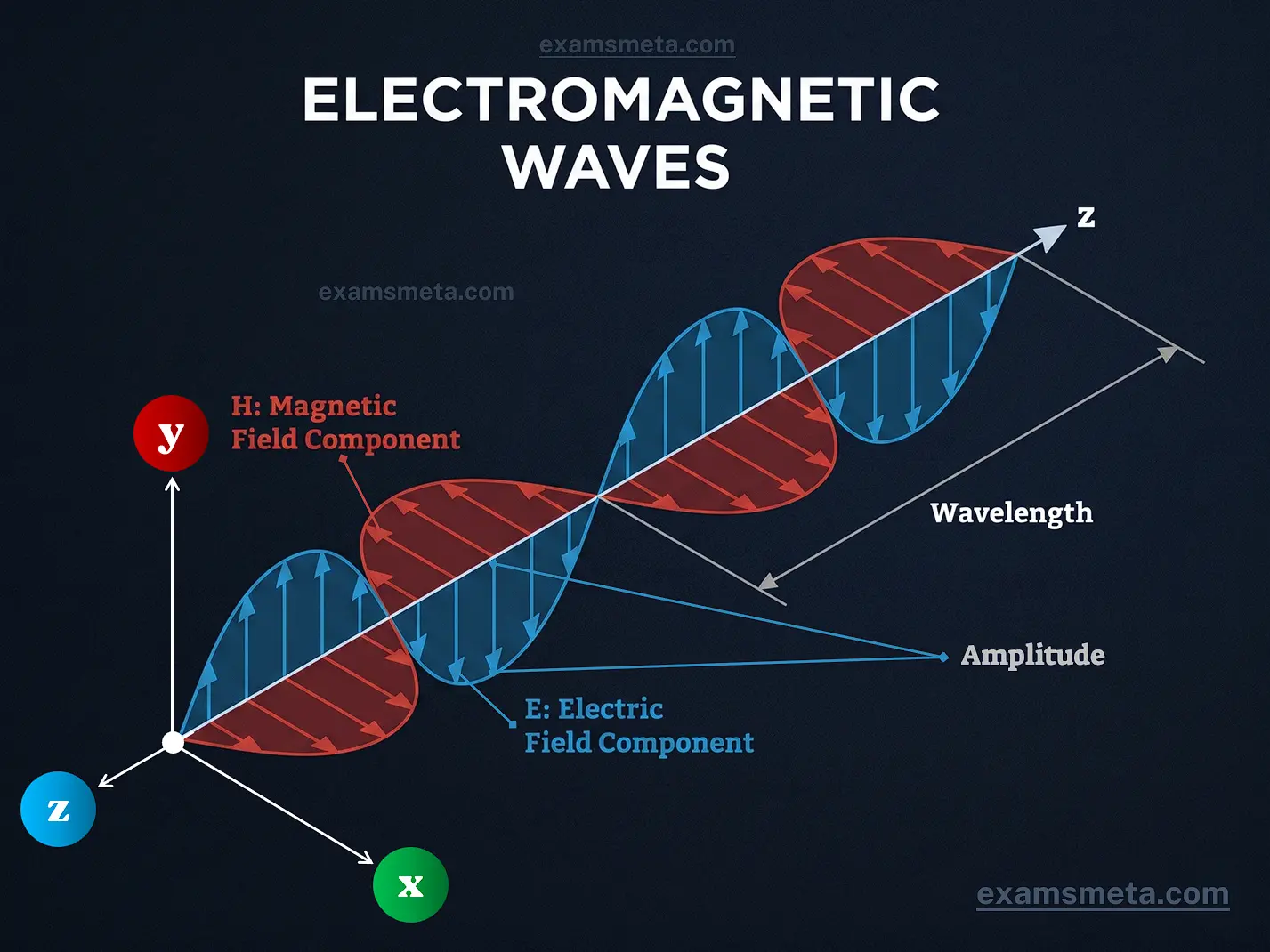
An electromagnetic wave is made of changing electric and magnetic fields. It does not require a medium, which means it can travel through the vacuum of space. This is how sunlight reaches Earth, how radio signals move, and how X-rays are used in medicine.
5. Matter Waves
At very small scales, particles such as electrons show wave-like behavior. This is part of wave-particle duality, a core idea in quantum mechanics. In modern physics, matter can behave like both a particle and a wave, depending on how it is measured.
Wave Types Compared Side by Side
| Wave Type | Needs a Medium? | Main Motion | Common Examples | Everyday Importance |
|---|---|---|---|---|
| Mechanical wave | Yes | Disturbance moves through matter | Sound, slinky wave, earthquake waves | Lets us hear, feel shaking, and study Earth’s interior. |
| Electromagnetic wave | No | Changing electric and magnetic fields | Light, radio, microwaves, X-rays | Makes communication, vision, astronomy, and imaging possible. |
| Transverse wave | Depends on the wave type | Oscillation is perpendicular to travel | Light, string waves | Useful in optics and many vibration systems. |
| Longitudinal wave | Depends on the wave type | Oscillation is parallel to travel | Sound, P waves | Essential in acoustics and seismic science. |
| Surface wave | Yes | Motion near a boundary between media | Ocean waves | Important in coastal science and navigation. |
What Happens When Waves Travel
Waves do not just move. They interact. That interaction is what makes them useful and, at times, beautiful. When waves meet barriers, openings, or other waves, they can behave in surprising ways.
Reflection
Reflection happens when a wave bounces off a surface. A sound echo in a canyon is reflection. Light reflecting from a mirror is another example. In both cases, the wave changes direction after hitting the boundary.
Refraction
Refraction is the bending of a wave when it enters a new medium or region where its speed changes. A straw in a glass of water looks bent because light changes speed as it passes between air and water. Ocean waves also refract as they move into shallower water near shore.
Diffraction
Diffraction is the spreading out of a wave after it passes through a narrow opening or around an obstacle. That is why sound can be heard around corners more easily than you might expect. Waves are not always straight lines. They can spread, wrap, and fan out depending on the situation.
Interference
Interference happens when waves overlap. If peaks meet peaks, the wave can become stronger. If peaks meet troughs, the wave can weaken or cancel. This is one reason waves are so useful in engineering and physics. Interference helps explain music, noise, optics, and many signal-processing systems.
Polarization
Polarization refers to the direction in which a transverse wave oscillates. Light can be polarized, which is why polarized sunglasses reduce glare. This is a wave property that matters in optics, photography, and communication technologies.
Wave Behavior Table
| Behavior | What It Means | Example | Why It Matters |
|---|---|---|---|
| Reflection | Wave bounces back from a surface | Echo from a wall | Helps in sonar, optics, and acoustics. |
| Refraction | Wave bends because speed changes | Light in water | Important in lenses, vision, and ocean science. |
| Diffraction | Wave spreads around obstacles or openings | Sound around a doorway | Shows that waves are not limited to straight paths. |
| Interference | Waves combine and change amplitude | Noise canceling, ripples on water | Used in technology and explains many natural patterns. |
| Polarization | Oscillations restricted to one direction | Polarized light | Useful in sunglasses, screens, and scientific instruments. |
Waves in Water
Water waves are probably the first image that comes to mind when people hear the word wave. They are visible, familiar, and easy to relate to. But water waves are more than just pretty motion. They are complex physical systems shaped by wind, gravity, water depth, fetch, and shoreline conditions.
Wind waves form when wind transfers energy to the sea surface. Their height depends on wind speed, wind duration, and fetch, which is the distance over water that the wind blows in one direction. A long strong wind over a long stretch of open water can build much larger waves than a short breeze over a small pond.
Ocean waves are often described by wave height, wavelength, period, and steepness. The term significant wave height is used in ocean reporting to describe the average height of the highest third of waves. That gives a practical picture of sea conditions without being distorted by a few unusually large waves.
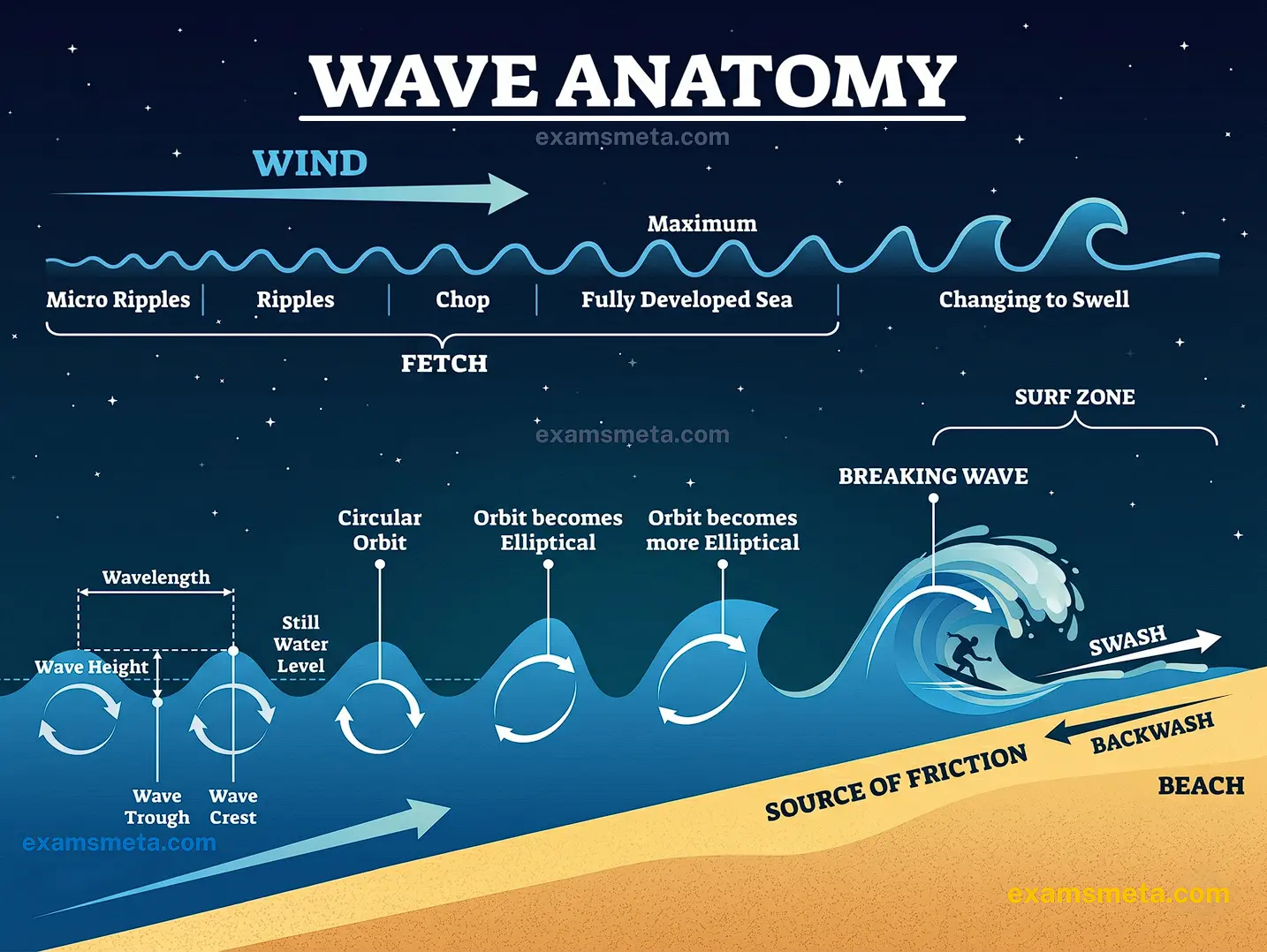
As waves enter shallower water near land, they slow down, their wavelength shortens, and their height and steepness can increase. This is why waves often become steeper and eventually break near the shore. That breaking action is not just beautiful. It also shapes beaches and coastlines over time.
Ocean wave terms worth knowing
- Crest: the top of the wave
- Trough: the bottom of the wave
- Height: the vertical distance from trough to crest
- Wavelength: the distance between successive crests or troughs
- Period: the time between wave peaks passing the same point
Ocean wave facts table
| Ocean Wave Term | Meaning | Practical Example | Why It Helps |
|---|---|---|---|
| Wave height | Vertical distance from trough to crest | A 2 meter swell at sea | Helps sailors and forecasters judge sea conditions. |
| Wave period | Time between waves | 10 seconds between crests | Longer periods often mean larger, more organized swells. |
| Wavelength | Distance between crests | Long ocean swell across open water | Important for forecasting and coastal behavior. |
| Fetch | Distance wind blows over water | Strong wind across the ocean | More fetch can build larger waves. |
Ocean waves also include special types such as tsunamis and Rossby waves. A tsunami is not the same as a normal wind wave. It is a very long wave caused by large disturbances such as undersea earthquakes or landslides. Rossby waves are huge, slow-moving ocean waves linked to Earth’s rotation and large-scale ocean dynamics.
Sound as a Wave
Sound is one of the most important everyday examples of a longitudinal mechanical wave. It is created by vibrations, and those vibrations make nearby particles in air, water, or solids oscillate. We hear sound because those pressure changes reach our ears and are interpreted by the brain.
Sound has frequency, amplitude, wavelength, and intensity. Frequency affects pitch, so higher frequency sounds are heard as higher pitched. Amplitude affects loudness, so larger amplitude usually means a louder sound. In real life, a whisper and a shout are both sound waves, but their amplitudes and intensities are very different.
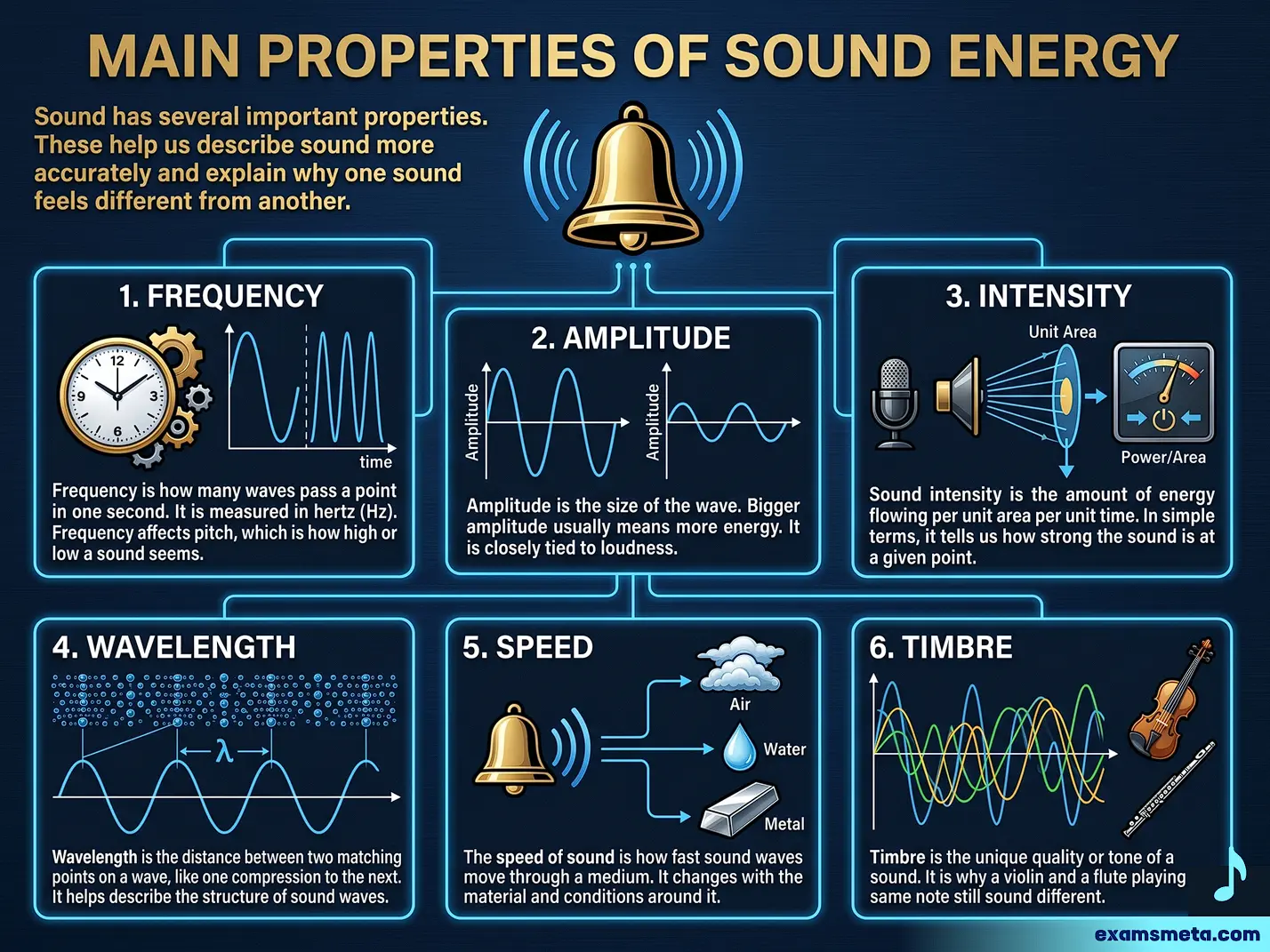
Sound also supports a rich mix of musical effects. Different frequencies can combine into complex waveforms. That is why a violin, a flute, and a human voice can all play the same note and still sound different. Their waveforms and harmonics are not the same, so the ear hears them as different kinds of sound.
Sound wave examples
- A doorbell creates compressions in air.
- A speaker moves back and forth to generate pressure waves.
- A thunderclap travels as a sound wave through the atmosphere.
- A heartbeat can be detected by sound-based medical tools in some settings.
One practical point matters a lot here. Sound cannot travel in a vacuum because it needs matter to carry the vibration. That is why space is silent in the ordinary sense, even though electromagnetic signals can still travel there.
Seismic Waves and Earthquakes
Earthquakes generate seismic waves, which are waves that move through the Earth. These waves help scientists understand earthquakes and also reveal information about the structure of our planet. Seismic waves come in different forms, and each one behaves differently.
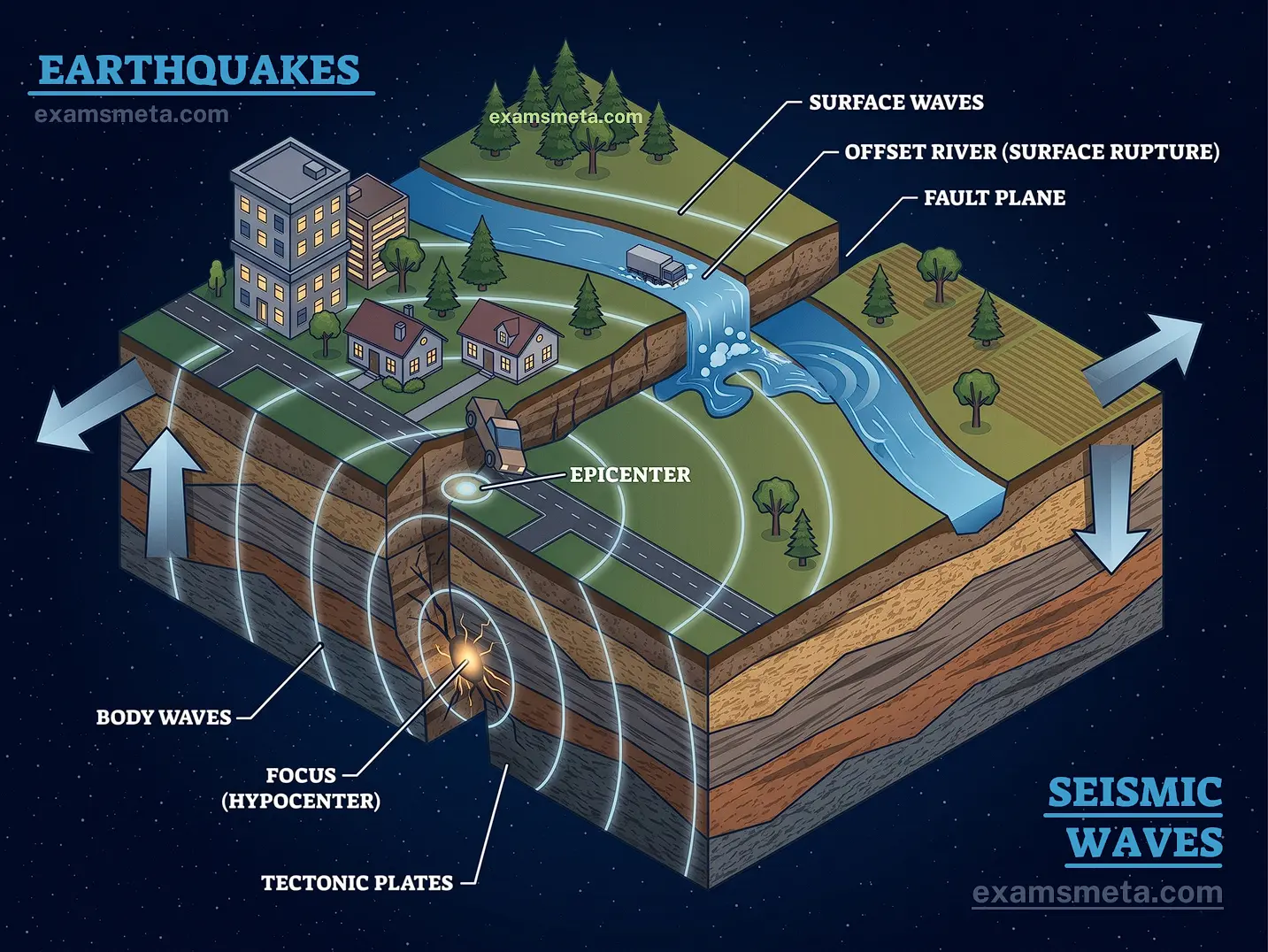
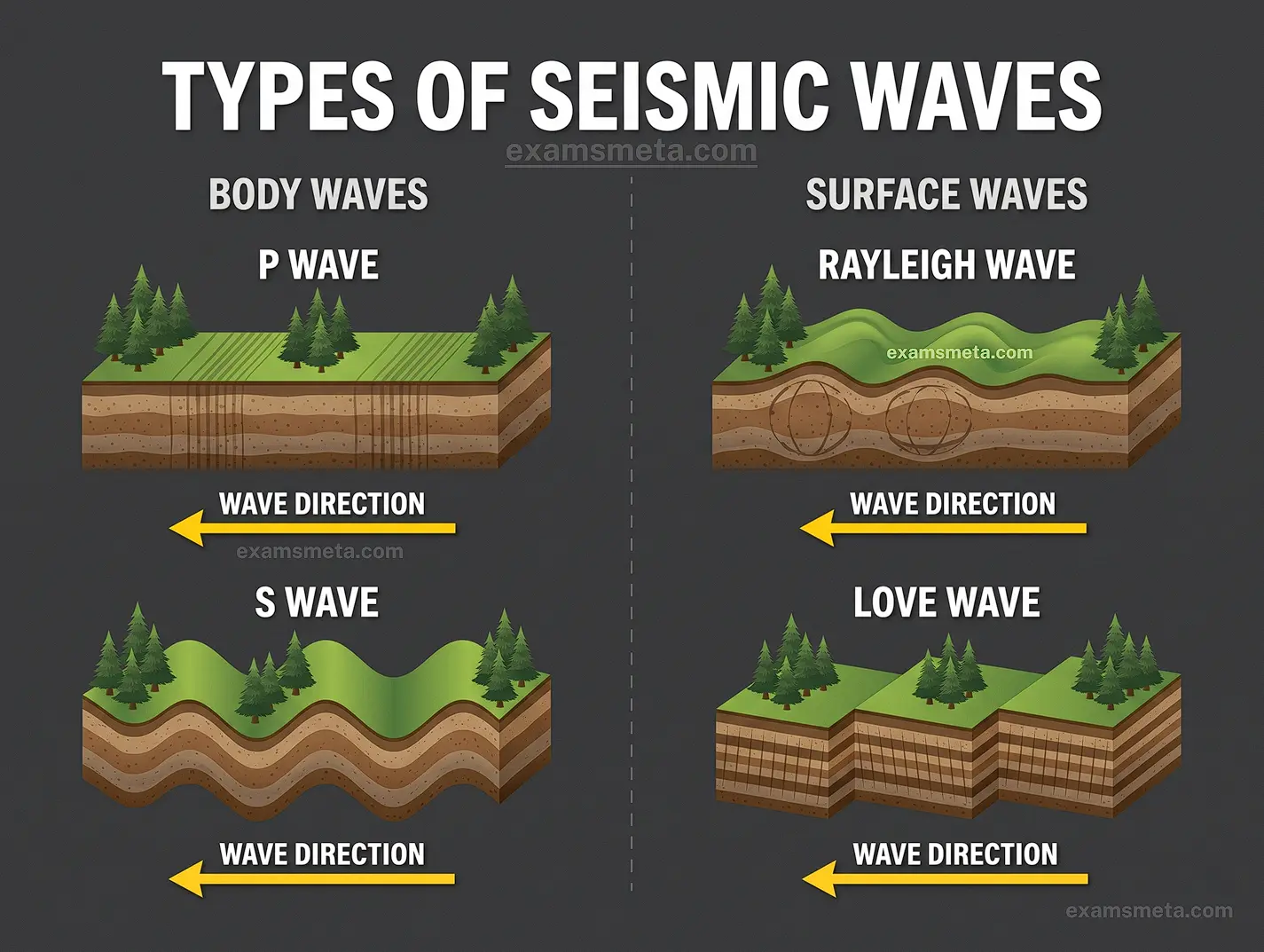
The two major body waves are P waves and S waves. P waves, also called compressional waves, are the fastest seismic waves and arrive first. They move through solids and liquids. S waves, also called shear waves, move the ground perpendicular to the direction of travel and do not pass through liquids. That is one reason scientists know Earth’s outer core is liquid.
Seismic waves are not only for earthquake science. They are also used in exploration, engineering, and hazard monitoring. A seismograph records ground motion, and that record helps scientists analyze the timing, strength, and character of an earthquake.
Seismic wave table
| Wave Type | Movement | Medium | Key Feature | Real-World Use |
|---|---|---|---|---|
| P wave | Compression and expansion in the direction of travel | Solids and liquids | Fastest seismic wave | Helps detect earthquakes quickly. |
| S wave | Shear motion perpendicular to travel direction | Solids only | Arrives after P waves | Helps study Earth’s deep interior. |
| Surface wave | Moves along Earth’s surface | Solid ground | Often causes strong shaking near the surface | Important in earthquake damage analysis. |
A useful comparison is that P waves are often compared to lightning and S waves to thunder, because the P waves arrive first and the S waves follow. That simple comparison makes the sequence easier to remember.
Electromagnetic Waves and Light
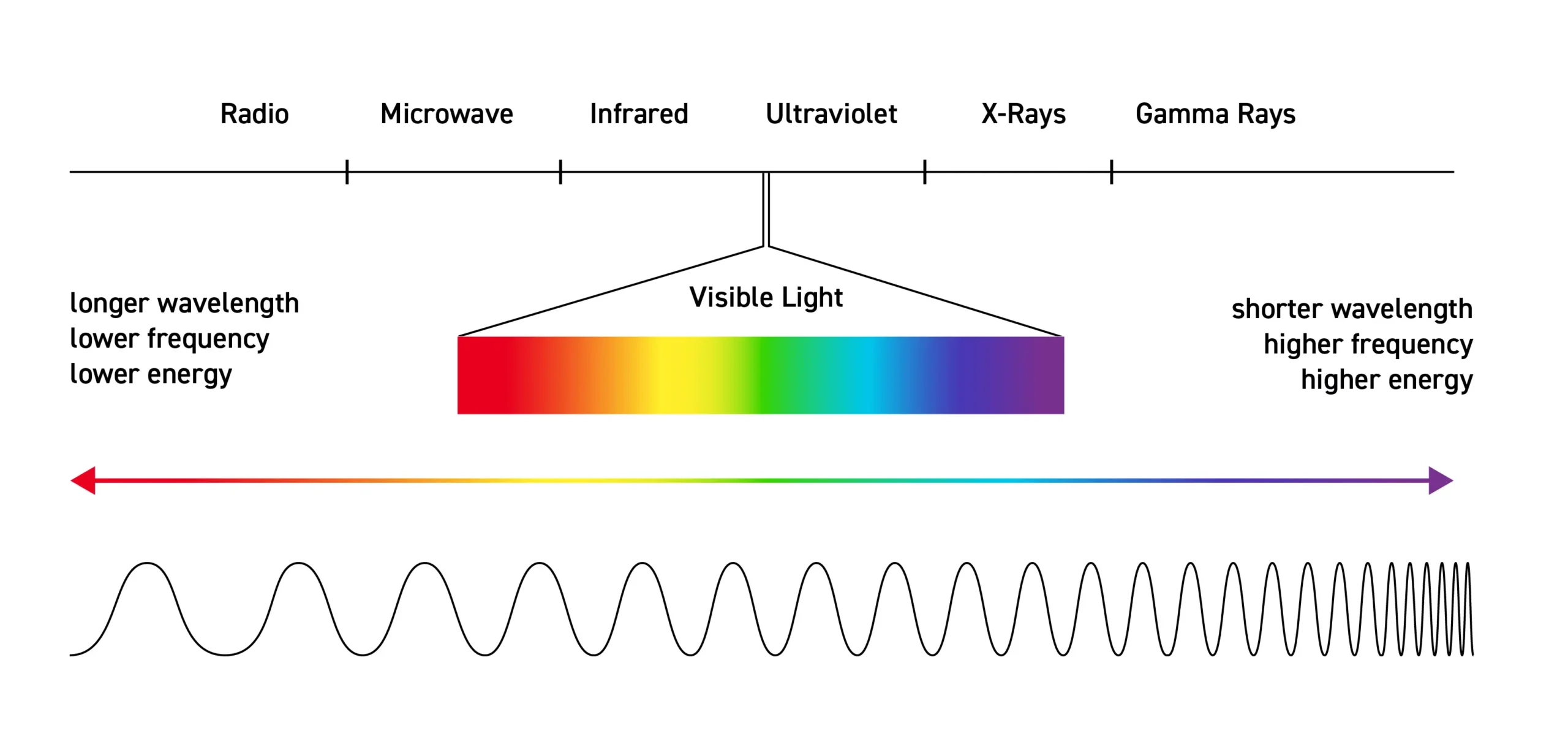
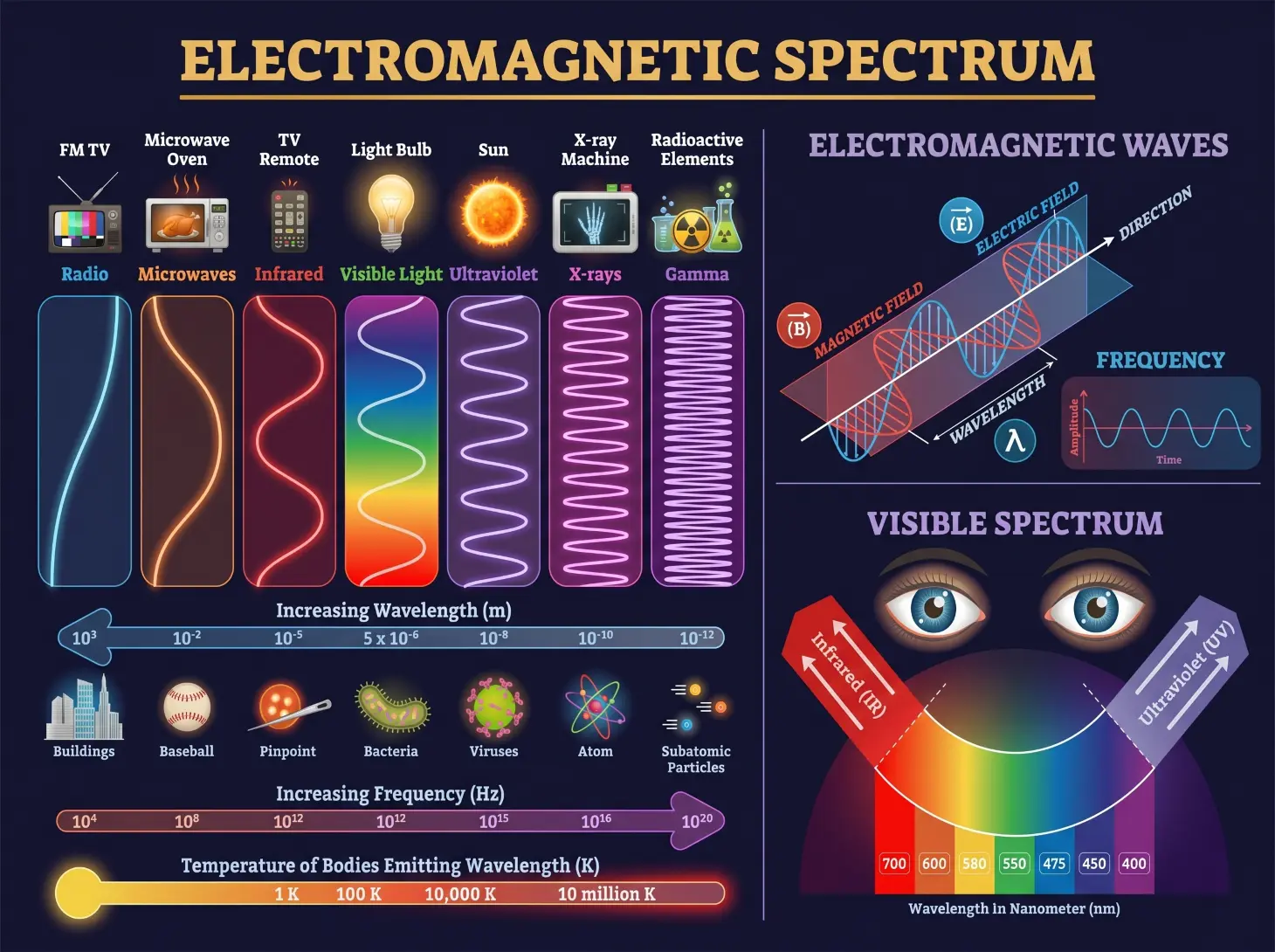
Electromagnetic waves are a huge part of modern life. They include radio waves, microwaves, infrared, visible light, ultraviolet, X-rays, and gamma rays. All of them travel as waves, but they differ in wavelength, frequency, and energy. Shorter wavelength means higher frequency and, in general, higher energy.
These waves do not need a medium. They can move through air, glass, and vacuum. That is why sunlight reaches Earth across space. It is also why radio broadcasts, Wi-Fi, mobile networks, remote sensing, and many medical tools work the way they do.
Electromagnetic spectrum table
| Region | Relative Wavelength | Relative Frequency | Common Uses | Important Detail |
|---|---|---|---|---|
| Radio | Longest | Lowest | Broadcasting, communications | Carries information over long distances. |
| Microwave | Long | Low to medium | Cooking, radar, communication | Useful for signal transmission and sensing. |
| Infrared | Longer than visible light | Medium | Heat sensing, remote controls | Often associated with thermal radiation. |
| Visible light | Middle range | Middle range | Human vision, photography | The part the human eye can detect. |
| Ultraviolet | Shorter than visible light | Higher | Sterilization, astronomy | Can carry more energy than visible light. |
| X-rays | Very short | Very high | Medical imaging, materials testing | Penetrates many materials. |
| Gamma rays | Shortest | Highest | Nuclear processes, astronomy | Extremely energetic radiation. |
The electromagnetic spectrum is not just a textbook chart. It is a working map of modern technology. Every time you use a phone, view a satellite image, get an X-ray, or read astronomy data, you are relying on wave behavior in the electromagnetic range.
Wave Energy and Power
Waves are not only patterns. They carry energy, and that energy can do real work. The amount of energy in a wave is related to its amplitude and frequency. In many cases, larger amplitude means larger energy transfer. That is why big ocean breakers feel stronger, loud sounds seem more intense, and large ground motions in earthquakes can cause more damage.
This idea helps explain why waves are so important in engineering and natural hazards. A wave that carries more energy can produce more motion, more heating, more shaking, or more pressure. On the other hand, smaller waves can still carry information very efficiently, which is exactly what makes communication systems so useful.
Energy and amplitude table
| Wave Feature | Lower Value | Higher Value | Likely Effect |
|---|---|---|---|
| Amplitude | Small ripple, quiet sound | Large swell, loud sound | Greater energy transfer. |
| Frequency | Fewer cycles per second | More cycles per second | Can affect pitch, energy, and wave behavior depending on the wave type. |
| Wave intensity | Weak signal | Strong signal | Affects how noticeable or powerful the wave feels. |
Wave-Particle Duality
One of the most fascinating ideas in modern physics is wave-particle duality. It means that tiny objects, especially at the quantum scale, do not fit neatly into the old idea that something must be either a particle or a wave. Light can behave like a wave in many experiments, but it also behaves like a particle in others. The same kind of dual behavior applies to matter at very small scales.
A photon is a particle of light, and its energy depends on wavelength. Shorter wavelength light carries more energy per photon than longer wavelength light. That is a big reason ultraviolet, X-rays, and gamma rays are treated differently from visible light and radio waves.
At the quantum level, waves are not just a metaphor. They are part of how nature works. That does not mean a baseball behaves like a wave in any practical sense. But for electrons and other tiny particles, wave-like behavior becomes measurable and extremely important.
Wave Examples in Daily Life
Waves are everywhere, even when we do not notice them. Some are visible, some are audible, and some are hidden inside the devices we use every day.
Daily-life examples of waves
- Ocean waves shape coastlines and affect shipping, surfing, and weather-related safety.
- Sound waves let us speak, listen, sing, and detect danger.
- Light waves let us see the world around us.
- Radio waves connect phones, TVs, and wireless networks.
- Microwaves are used in communication and cooking.
- Seismic waves help scientists understand earthquakes and Earth’s layers.
- Water ripples show the basic pattern of wave motion in a form anyone can see.
Once you start looking, you notice wave behavior almost everywhere. A crowd doing the stadium wave. A guitar string vibrating. A mobile signal moving from a tower to a handset. Even the colors of light and the sounds around you are all part of a much larger wave story.
Why Waves Matter in Science and Technology
Waves are not just an abstract topic for exams. They are one of the main tools humans use to understand the world. Science depends on waves in astronomy, seismology, acoustics, optics, medical imaging, and climate observation. Technology depends on them for communication, sensing, and measurement.
Here are a few real uses:
- Medical imaging uses X-rays and other wave-based techniques.
- Astronomy uses electromagnetic waves across the spectrum to study stars, galaxies, and planets.
- Earth science uses seismic waves to study earthquakes and Earth’s interior.
- Communication systems use radio, microwave, and optical signals.
- Navigation and weather systems use radar and satellite sensing.
Without waves, modern life would look very different. There would be no radio, no Wi-Fi, no sound as we know it, and no easy way to observe many parts of the universe. That is a strong reminder that waves are not just part of science. They are part of civilization.
Wave Table for Quick Revision
| Topic | Main Idea | Useful Example | One-Line Memory Trick |
|---|---|---|---|
| Wave | A disturbance that carries energy | Ripple in a pond | Motion travels, matter mostly stays local. |
| Amplitude | Maximum displacement | Taller ocean wave | Bigger amplitude usually means more energy. |
| Wavelength | Distance between matching points | Crest to crest | Long wave, longer gap. |
| Frequency | Cycles per second | Pitch of sound | More cycles, higher frequency. |
| Period | Time for one cycle | Time between crests | More time, lower frequency. |
| Reflection | Bounce back | Echo | Wave returns after hitting a boundary. |
| Refraction | Bending | Bent straw in water | Speed change causes direction change. |
| Diffraction | Spreading out | Sound around a corner | Waves can bend around openings. |
| Interference | Overlap of waves | Two ripples meeting | Waves can build up or cancel out. |
| P wave | Fast seismic compressional wave | Early earthquake arrival | P comes before S. |
| S wave | Slower shear wave | Ground shaking | S does not travel through liquids. |
| Electromagnetic wave | Wave of electric and magnetic fields | Light, radio | No medium is needed. |
Common Misunderstandings About Waves
People often confuse the movement of the wave with the movement of the material carrying it. That is a big one. A wave is not usually the same thing as the medium itself moving from one place to another. In many cases, the medium only vibrates around a resting position while the energy travels onward.
Another common misunderstanding is that all waves are visible. They are not. Sound waves are invisible, seismic waves are hidden underground, and most electromagnetic waves are invisible to the human eye. We know they are there because we can detect their effects.
A third mistake is to think all waves behave the same way. They do not. Some need a medium, some do not. Some are transverse, some longitudinal. Some carry little energy, some carry enough to reshape coastlines or shake buildings. That variety is part of what makes wave science so rich.
Why the Study of Waves Still Feels Important Today
The more we learn about waves, the more useful they become. They help us listen to the Earth, look into space, diagnose illness, guide vehicles, and send data across the world. They also help us understand something deeper about nature. The universe is full of patterns, rhythms, and signals, and waves are one of the main ways those patterns become visible to us.
That is why wave science never feels old. It is part of basic physics, but it also sits at the center of modern life. A school student learning the meaning of wavelength is building a foundation for later ideas in acoustics, optics, engineering, and communication. A researcher studying seismic waves is helping improve safety. A scientist reading radio or X-ray data is exploring parts of reality the human eye can never see.
Final Thoughts
A wave is more than a line on a graph or a moving shape on the water. It is a powerful way energy travels through nature. It explains sound, light, Earthquakes, ocean motion, wireless communication, and even the strange world of quantum physics. Once you understand waves, a lot of science starts to connect.
And that is the real beauty of the topic. Waves are everywhere, but they are never boring. They are in the air, in the sea, in the ground, in space, and in the signals we rely on every day. They carry energy, shape the world, and remind us that motion can be both invisible and deeply important at the same time.
Article References and Sources
References
- Wave: Definition, Types, Properties, and Wave Behavior (Britannica)
- Wave Physics Summary and Fundamental Concepts (Britannica)
- Water Waves: Properties, Characteristics, and Effects (Britannica)
- Wave Motion: Definition, Examples, Types, and Facts (Britannica)
- The Electromagnetic Spectrum Explained (NASA Science)
Additional Educational Resources
- Electromagnetic Spectrum and Radio Waves Educational Video
- Visible Light Waves and the Electromagnetic Spectrum Educational Video
Advanced Scientific Reading
- Ion Scale Electromagnetic Waves in the Inner Heliosphere Research Paper
- Wave Physics as an Analog Recurrent Neural Network Research Study
- Surface Electromagnetic Waves and Near-Field Radiation Research Paper
- Surface Plasma Waves Across Intrinsic Josephson Junction Layers Research Paper
Community Discussions and Educational Explanations
- What Are Electromagnetic Waves? Community Explanation and Discussion
- Understanding Electromagnetic Waves and the Electromagnetic Spectrum Discussion
- Why Sound Cannot Travel Through Space but Radio Waves Can Discussion
- How NASA Converts Space Signals into Sound Discussion
- Understanding Electromagnetic Radiation and Light Discussion
- How the Sun Produces Electromagnetic Radiation Discussion
Also, Read these Articles in Detail
- Physics and Its Fundamentals With Good Explanations
- Matter, Motion, and Energy: The Core Ideas of Physics
- What Is Matter? The Physical Substance of the Universe
- What Is Motion? A Guide to Motion in Physics and Daily Life
- What Is Energy? The Invisible Power Behind Everyday Life
- Kinetic Energy Explained in Simple Language
- Potential Energy: Definition, Types, Formula, and Examples
- Thermal Energy: Heat, Temperature, and Transfer
- Mechanical Energy: Definition, Formula, and Examples
- Chemical Energy: Definition, Science, and Examples
- Electrical Energy: Definition, Works, and Why It Matters
- Radiant Energy: Meaning, Sources, Examples, and Uses
- Nuclear Energy: Definition, How It Works, and Why It Matters
- Sound Energy: Definition, Science, and Examples
- Elastic Energy: Definition, Elasticity, and Example
- Geothermal Energy: Clean Electricity, Heating, and Modern Life
- Hydropower Energy: How It Works and Its Importance
- Pumped Hydropower Storage
- Force: Meaning, Types, Formula, and Examples
- Mechanics: Motion, Forces, Energy, and Applications
Frequently Asked Questions
FAQ 1. What is a wave?
A wave is a moving disturbance that carries energy from one place to another. That sounds simple, and it is, but it explains a huge part of how nature works. Waves are all around us. They appear in water, sound, light, earthquakes, and even in the signals that carry information to our phones and devices. The important idea is that the wave moves, but the material carrying the wave does not always travel with it in the same way.
In a water wave, for example, the water mostly moves up and down while the ripple moves across the surface. In a sound wave, air particles vibrate back and forth as sound travels through them. In a light wave, changing electric and magnetic fields move through space without needing air or water at all. That is why light from the Sun can travel through the vacuum of space and reach Earth.
A wave is not just a shape or a pattern. It is also a way to transfer energy without carrying matter from one place to another in a large way. That is one of the reasons waves are so useful in science. They let us understand communication, vibration, motion, and even the structure of the Earth and the universe. Once you understand wave motion, a lot of other ideas become much easier to follow.
FAQ 2. What are the main properties of a wave?
The main properties of a wave are amplitude, wavelength, frequency, period, and wave speed. These are the basic words used to describe how a wave behaves, how it looks, and how it moves. If you know these properties, you can understand most wave problems in physics and many real-world wave situations too.
Amplitude is the maximum distance the wave moves from its rest position. In simple terms, it tells you how big or strong the wave is. A larger amplitude usually means more energy. In sound, a larger amplitude means a louder sound. In water, it often means a taller wave.
Wavelength is the distance between two matching points on a wave, such as crest to crest or trough to trough. It tells you how spread out the wave is. A long wavelength means the wave stretches farther between peaks. A short wavelength means the peaks are closer together.
Frequency is the number of wave cycles that pass a point in one second. It is measured in hertz (Hz). High frequency means more cycles in less time. In sound, higher frequency usually means higher pitch. In light, higher frequency means shorter wavelength and more energy.
Period is the time taken for one full wave cycle. It is the opposite of frequency. If frequency is high, the period is short. If frequency is low, the period is long.
Wave speed tells us how fast the wave travels. A simple formula connects the main quantities: wave speed = wavelength × frequency. This relationship is one of the most useful ideas in wave science.
These properties are not just for exams. They help explain sound quality, ocean movement, radio signals, earthquake waves, and light behavior. That is why they matter so much.
FAQ 3. What is the difference between transverse and longitudinal waves?
The difference between transverse waves and longitudinal waves is the direction in which the particles or disturbance move compared to the direction the wave travels.
In a transverse wave, the movement of the particles is perpendicular to the direction the wave moves. Imagine a wave traveling forward while the particles move up and down. That is the basic idea. Light waves are transverse waves, and waves on a string are also a good example. If you shake one end of a rope up and down, the wave travels along the rope while the rope itself moves side to side or up and down.
In a longitudinal wave, the movement of the particles is parallel to the direction the wave travels. The particles move back and forth in the same direction as the wave. Sound waves are the best example. As sound travels through air, it creates compressions and rarefactions. Compressions are regions where particles are crowded together. Rarefactions are regions where particles are spread apart.
A simple way to remember this is to think of a spring or slinky. If you push and pull it along its length, you create a longitudinal wave. If you move it up and down, you create a transverse wave.
This difference is important because it affects how the wave behaves. It also helps us understand which waves need a medium and which ones do not. Electromagnetic waves are transverse and can travel in space. Sound waves are longitudinal and need matter such as air, water, or solid material.
FAQ 4. Why can light travel through space but sound cannot?
Light can travel through space because it is an electromagnetic wave. It does not need air, water, or any material medium to move. It is made of changing electric fields and magnetic fields that support each other while the wave travels. That is why sunlight can cross the vacuum of space and reach Earth.
Sound, on the other hand, is a mechanical wave. It needs a medium to travel. That medium can be air, water, or a solid material. Sound moves when particles in the medium vibrate and pass the disturbance along. In empty space, there are no particles close enough together to carry that vibration. So sound cannot travel there in the normal way.
That is why space is silent. If you were somehow standing in space without protection, you would not hear explosions, engines, or voices because there would be no air to carry the sound. But you could still receive light and other electromagnetic signals.
This difference is one of the clearest examples of how wave types are not all the same. Some waves need matter, and some do not. That simple fact has huge effects on science, astronomy, communication, and daily life.
FAQ 5. What happens when waves reflect, refract, diffract, or interfere?
Waves do not always move in a straight and simple way. They interact with surfaces, openings, and other waves. When that happens, they can reflect, refract, diffract, or interfere.
Reflection happens when a wave bounces back from a surface. A mirror reflecting light is one example. An echo is another. Sound waves hit a wall or mountain and return to you.
Refraction happens when a wave bends because it enters a new medium or a region where its speed changes. A straw in a glass of water looks bent because light changes speed as it moves from air into water. Refraction is also very important in lenses, glasses, cameras, and ocean waves near shore.
Diffraction happens when a wave spreads out after passing through a narrow opening or around an obstacle. Sound can often be heard around corners because it diffracts. Water waves also spread after passing through a gap.
Interference happens when two or more waves meet. If the peaks of the waves line up, they can combine and become stronger. This is called constructive interference. If the peak of one wave meets the trough of another, they can weaken or cancel each other. That is called destructive interference. This is the idea behind noise-canceling headphones and many optical experiments.
These behaviors show that waves are not just moving lines. They are active systems that interact with the world around them. That is why wave science is so useful in real life.
FAQ 6. How do ocean waves form and why do they change near the shore?
Ocean waves usually form when wind transfers energy to the surface of the water. The stronger the wind, the longer it blows, and the farther it travels across open water, the larger the waves can become. That open stretch of water is called fetch. A long fetch gives the wind more time and space to build up wave energy.
Once formed, waves travel across the ocean as moving patterns of energy. The water itself does not simply rush forward with the wave. Instead, the water particles move in small circular or looping paths, especially in deep water. That is why waves can travel across huge distances without moving all the water along with them.
As waves approach the shore, they enter shallower water. This changes the way they move. The wave slows down because the bottom of the wave starts interacting with the seabed. When that happens, the wavelength becomes shorter, the wave gets steeper, and the wave height often increases. Eventually, the wave can become too steep and break.
That breaking action is what we see as surf on the beach. It is also one of the main ways waves shape coastlines, move sand, and affect boats, swimmers, and coastal buildings.
Not all ocean waves are the same. A normal wind wave is very different from a tsunami. A tsunami is much longer, faster in deep water, and usually caused by a major disturbance such as an underwater earthquake or landslide. So when people say “wave,” the exact type really matters.
FAQ 7. What is the role of waves in sound and music?
Waves are the heart of sound and music. Every sound you hear comes from a vibration. When something vibrates, it pushes the surrounding air, water, or solid material and creates a sound wave. That wave reaches your ears, and your brain interprets it as sound.
In music, wave behavior matters even more. The frequency of a sound wave affects its pitch. A higher frequency gives a higher pitch. A lower frequency gives a lower pitch. That is why a flute sounds high and a bass drum sounds low.
The amplitude of the wave affects loudness. Bigger amplitude usually means a louder sound. That is why a whisper feels soft and a shout feels intense.
But sound is not just one simple wave. Real musical sounds are made of a main frequency and many related frequencies called harmonics or overtones. These extra frequencies give each instrument its own sound quality, or timbre. That is why a violin and a piano can play the same note but still sound very different.
Waves also help create special musical effects. Interference can strengthen or weaken sounds. Resonance can make an object vibrate strongly when it matches a certain frequency. That is part of what gives musical instruments their rich tone. Even a concert hall is designed with wave behavior in mind so that sound travels well and stays clear.
So when you listen to music, you are really listening to wave patterns. That is a beautiful way to think about sound.
FAQ 8. How are seismic waves used to study earthquakes and Earth’s interior?
Seismic waves are waves that travel through the Earth, usually caused by earthquakes, volcanic activity, or other underground disturbances. They are incredibly important because they help scientists understand both earthquake activity and the hidden structure of our planet.
There are two main body waves. The first is the P wave, or primary wave. It is the fastest seismic wave and arrives first at a monitoring station. P waves are compressional waves, so the material moves back and forth in the same direction the wave travels. These waves can move through solids and liquids.
The second is the S wave, or secondary wave. It moves more slowly than a P wave and travels by shearing motion, meaning the particles move perpendicular to the direction of travel. S waves can only move through solids, not liquids. That is a very important clue for scientists studying Earth’s interior.
Because P waves and S waves behave differently, they help scientists figure out what lies beneath the surface. For example, the fact that S waves do not travel through the Earth’s outer core is one of the reasons scientists know the outer core is liquid.
There are also surface waves, which travel along the Earth’s surface and often cause the most damage during earthquakes. These waves can make the ground shake strongly and for longer periods of time.
Seismic waves are not just useful for studying earthquakes. They also help in engineering, construction safety, mineral exploration, and disaster preparedness. In a way, the Earth speaks through waves, and scientists know how to listen.
FAQ 9. What are electromagnetic waves and where are they used in everyday life?
Electromagnetic waves are waves made of changing electric and magnetic fields. They do not need a medium, so they can travel through empty space. They exist in a wide range, from radio waves to gamma rays, and they play a huge role in both nature and technology.
At the low-energy end of the spectrum are radio waves, which are used for broadcasting and wireless communication. Then come microwaves, which are used in communication systems and cooking. Infrared waves are often associated with heat and are used in thermal sensing and remote controls. Visible light is the part of the spectrum that human eyes can detect. Beyond that are ultraviolet, X-rays, and gamma rays, which carry more energy and have important uses in science and medicine.
We use electromagnetic waves all the time without even thinking about it. When you use a phone, watch television, connect to Wi-Fi, or take a medical scan, electromagnetic waves are involved. Sunlight itself is part of this family. That means the light and warmth reaching Earth from the Sun are both wave-based phenomena.
These waves also help scientists explore the universe. Different wavelengths reveal different kinds of information about stars, planets, galaxies, and cosmic events. That makes electromagnetic waves one of the most powerful tools in modern science.
So, whether you are looking at a screen, heating food, or receiving a signal, you are using the wave world in a very practical way.
FAQ 10. Why is the study of waves important in science and daily life?
The study of waves is important because waves are everywhere, and they affect almost everything we do. They are part of sound, light, motion, earthquakes, weather, communication, and technology. Without wave science, a huge part of modern life would be impossible to understand or use properly.
In science, waves help explain how energy moves. They help us understand the Earth’s interior through seismic data. They help us study the Sun, distant stars, and galaxies through electromagnetic radiation. They also help us understand vibration, resonance, and signal behavior in physics and engineering.
In daily life, waves are part of speech, music, radio, television, mobile communication, cooking, medical imaging, and more. Even the simple act of hearing someone speak depends on sound waves traveling through air. Watching a screen depends on light waves reaching your eyes. Listening to the weather forecast depends on radio and digital wave transmission.
Waves also teach a deeper lesson. They show that motion can happen without everything traveling together. They show that energy can move across space in very organized ways. And they show that nature often repeats itself in patterns that are both simple and powerful.
That is why waves are not just a topic in science class. They are a central idea in how the world works. Once you understand waves, you start seeing connections everywhere. And that makes the subject useful, practical, and quietly fascinating.
FAQ 11. What is the difference between a wave and a vibration?
A vibration is the repeated back-and-forth motion of an object or particle around a fixed point. A wave is what happens when that vibration or disturbance moves through space or a medium and carries energy from one place to another. That is the key difference. A vibration can exist in one place, but a wave is the traveling form of that motion.
Think about a guitar string. When you pluck it, the string vibrates. That vibration creates a sound wave in the air. The string itself moves a little, but the sound wave moves outward and reaches your ears. The same thing happens when you drop a stone into water. The water surface vibrates up and down, but the ripple spreads outward as a wave.
This difference matters because it helps explain how many things work in nature. A clock pendulum vibrates. A speaker cone vibrates. A mobile phone antenna vibrates electrically. But the sound, radio signal, or light that results from those motions is the wave. The wave is the traveling effect. The vibration is the local motion that creates it.
Another simple way to think about it is this. A vibration is often the source. A wave is often the journey. The source moves in place, and the wave carries the effect forward. That is why these two words are related, but they are not the same thing.
In daily life, this idea shows up everywhere. A fan blade spinning creates vibration in air. A train passing by can cause vibration in the ground. A ringing bell vibrates metal and produces sound waves. Once you begin noticing the difference, the world starts looking more organized and a lot easier to understand.
FAQ 12. Why do some waves carry more energy than others?
Some waves carry more energy because of differences in amplitude, frequency, and sometimes the strength of the source that created them. In simple terms, a bigger or faster wave often carries more energy than a smaller or slower one. But the exact relationship depends on the type of wave.
For many waves, a larger amplitude means more energy. That is easy to see in water waves. A small ripple has less energy than a large swell. In sound, a soft sound carries less energy than a loud one. In seismic activity, a tiny ground tremor carries less energy than a major earthquake.
Frequency also matters. In electromagnetic waves, higher frequency often means higher energy. That is why X-rays and gamma rays are more energetic than visible light or radio waves. Their waves are more tightly packed together, and each unit of the wave carries more energy.
The source matters too. A gentle push creates a small wave. A strong push creates a stronger one. If you tap a string lightly, it produces a weak vibration. If you strike it harder, the wave becomes larger and more energetic.
This is one reason waves are so useful in science and technology. We can choose the wave we need depending on how much energy or information we want to send. A radio signal can carry information with relatively low energy. A medical imaging beam may need much higher energy. In nature, a small wave can be harmless, while a large one can reshape a shoreline or damage a building.
So when people ask why some waves matter more than others, the answer is usually about how much energy they carry and how that energy behaves.
FAQ 13. What is wavelength in simple words?
Wavelength is the distance between two matching points on a wave. That could be the distance from one crest to the next crest, or from one trough to the next trough. It tells you how long one full part of the wave is.
A long wavelength means the wave stretches out over a larger space. A short wavelength means the wave repeats more closely together. You can see this clearly in water waves. Some waves are wide and spread out, while others are tightly packed. Both are waves, but their wavelengths are different.
Wavelength is important because it connects directly to frequency and wave speed. If the wave speed stays the same, then a longer wavelength usually means a lower frequency. A shorter wavelength usually means a higher frequency. This relationship appears in sound, light, ocean waves, and many other kinds of wave motion.
In sound, wavelength affects pitch in an indirect way. High-pitched sounds usually have short wavelengths. Low-pitched sounds usually have long wavelengths. In light, wavelength helps determine color. Red light has a longer wavelength than blue or violet light. That is why wavelength is not just a science term. It is part of how we see and hear the world.
A simple memory trick is this. Wavelength is the “size” of one wave cycle. If you can measure one repeat of the pattern, you know the wavelength. That makes it one of the most useful ideas in wave science.
FAQ 14. What does frequency mean in waves?
Frequency tells us how many wave cycles pass a point in one second. It is measured in hertz (Hz). If a wave has a frequency of 5 Hz, that means 5 complete cycles pass a fixed point every second. If it has a frequency of 100 Hz, then 100 cycles pass every second.
Frequency is one of the most important wave properties because it often changes how we experience a wave. In sound, frequency controls pitch. A high frequency sound feels high pitched. A low frequency sound feels deep or low pitched. In light, frequency is linked to color and energy. Higher frequency light is more energetic and has a shorter wavelength.
Frequency also helps us compare different wave systems. A slow ocean swell has a low frequency because the crests arrive far apart. A vibrating guitar string has a higher frequency when it produces a higher note. A radio signal uses frequency to carry information across long distances.
People sometimes confuse frequency with speed, but they are not the same. A wave can move quickly and still have a low frequency. It can also move more slowly and still have a high frequency. Frequency is about repetition, not just motion. That is why it is such a useful measurement.
If you want a simple image, think of frequency as how often the wave repeats. More repeats in less time means higher frequency. Fewer repeats in the same amount of time means lower frequency. That idea works in physics, music, communication, and many parts of everyday life.
FAQ 15. How do waves help in communication?
Waves are at the heart of modern communication. Every time you make a phone call, send a message, listen to the radio, use Wi-Fi, or watch a broadcast, waves are doing the work behind the scenes. Most of this happens through electromagnetic waves such as radio waves, microwaves, and sometimes light waves.
The basic idea is simple. Information is placed onto a wave by changing its frequency, amplitude, or another property in a controlled way. This is called modulation. The receiving device then reads those changes and turns them back into usable data, sound, image, or text.
For example, a radio station sends out a signal using radio waves. Your radio receives the wave and converts it into sound. A mobile phone sends data through microwave-frequency signals to towers and satellites. Wi-Fi uses electromagnetic waves to move data around a home or office. Even fiber optic internet uses light waves to carry information through thin glass fibers.
Waves are perfect for communication because they travel efficiently and can move across large distances. They can also carry a huge amount of information when controlled properly. That is why the digital world depends so heavily on wave technology.
This is one of the best examples of how a simple physical idea becomes a life-changing tool. A wave is not just something that moves water or sound. It is also how people speak across cities, countries, and oceans without needing wires in every case.
FAQ 16. Why are waves important in medicine and imaging?
Waves are very important in medicine because they help doctors look inside the body without always needing surgery. One of the most familiar examples is the use of X-rays. X-rays are a type of electromagnetic wave with high energy. They can pass through soft tissue more easily than through bone, which makes them useful for imaging broken bones and other internal structures.
Other wave-based tools are used too. Ultrasound uses sound waves to create images of organs, blood flow, and unborn babies. It works by sending high-frequency sound into the body and then reading the echoes that bounce back. This is a very practical example of reflection in real life.
Different waves are used for different purposes because they interact with matter in different ways. Some waves penetrate deeply. Some bounce back more strongly. Some reveal density changes. Some show movement. That variety gives doctors a lot of useful information.
Wave-based imaging is valued because it is often fast, non-invasive, and informative. It helps doctors make better decisions about injury, illness, and treatment. And it keeps improving as technology improves.
The key point is that medicine depends on wave science more than many people realize. The body can be studied through motion, sound, and radiation, and waves are the bridge that makes that possible.
FAQ 17. What is resonance and why does it matter?
Resonance happens when an object is forced to vibrate at its natural frequency and the vibration becomes much stronger. That sounds technical, but the idea is very familiar. If you push a swing at just the right time, each push adds more motion. The swing goes higher and higher. That is resonance in action.
Every object has natural frequencies at which it prefers to vibrate. When an outside force matches one of those frequencies, the response can become large. This can be helpful or dangerous depending on the situation.
In music, resonance gives instruments their rich sound. A guitar body, violin body, or drum shell can amplify sound because of resonance. Without it, the music would sound weak and flat.
In engineering, resonance has to be handled carefully. Bridges, buildings, and machines can all be affected by repeated vibrations. If the timing matches a natural frequency, the motion can grow too large. That is one reason engineers study vibration so closely.
Resonance also appears in everyday life. A glass may vibrate strongly when a singer hits the right note. A radio receiver uses resonance to tune in to the correct station. Even parts of the human body respond to vibration in certain ways.
So resonance is not just a physics term. It is a pattern that connects sound, design, safety, and even music. It shows how powerful waves become when timing is right.
FAQ 18. What are surface waves and how are they different from other waves?
Surface waves travel along the boundary between two media. The best-known example is the wave that moves across the surface of water. These waves are different from body waves, which move through the interior of a material, such as seismic P waves and S waves.
A surface wave usually has motion that is strongest near the surface and decreases with depth. In water, the motion can look circular or elliptical. In earthquakes, surface waves travel along the Earth’s crust and often cause the most noticeable shaking and damage near the surface.
Surface waves are important because they often affect people more directly than deeper waves do. Ocean surface waves can impact boats, beaches, and coastal structures. Seismic surface waves can shake buildings and roads with great force. In both cases, the wave travels along a boundary where the effects are easy to observe.
These waves also help scientists study interactions between different materials. The surface between air and water, or between rock layers, is often where wave behavior becomes especially interesting. That is why surface waves are studied in ocean science, geology, and engineering.
A simple way to think about them is this. Body waves move through the inside. Surface waves move along the edge. That difference may sound small, but it changes everything about how the wave behaves and what it can do.
FAQ 19. How do waves show up in everyday life?
Waves show up in everyday life more often than most people realize. They are not limited to science labs or textbooks. They are part of normal life from the moment you wake up to the moment you go to sleep.
When you hear an alarm clock, you are hearing sound waves. When you look outside, you are using light waves. When you use Wi-Fi, your device is relying on electromagnetic waves. When you listen to music, you are hearing carefully shaped sound waves. When the sea moves, water waves are transferring energy across the surface. When earthquakes happen, seismic waves spread through the ground.
Waves are also part of motion in smaller, quieter ways. A phone screen responds to wave-based signals. A microwave oven uses electromagnetic waves to heat food. A doctor may use ultrasound waves to create images. Even a stadium crowd doing the wave is a nice human example of wave-like motion spreading through a group.
The important thing is that waves are not rare. They are common. They are practical. And they connect many different parts of life in one simple idea: energy moving through space in a patterned way.
Once you start paying attention, you realize how many parts of the world depend on waves. That makes wave science feel less like a chapter in a book and more like a map of everyday reality.
FAQ 20. Why should students learn about waves carefully?
Students should learn about waves carefully because waves are one of the basic ideas that connect many areas of science. If you understand waves well, you get a stronger grip on physics, sound, light, earth science, technology, and even parts of medicine. It is one of those topics that keeps coming back in different forms.
Waves teach useful habits of thinking. They help students see patterns, compare systems, and understand how energy moves. They also show why one type of motion can behave very differently from another. That kind of thinking is useful far beyond a classroom test.
For example, a student who understands frequency, wavelength, and amplitude can make sense of sound, color, and signal strength more easily. A student who understands reflection, refraction, and interference is already building the tools needed for optics, acoustics, and communication topics later on. A student who understands seismic waves has a better starting point for learning about earthquakes and Earth’s interior.
Wave study is also practical. It connects to music, phones, medical tools, internet systems, ocean science, and weather observation. That makes it a very real part of life, not just theory.
And there is another reason too. Waves are elegant. They show how a simple disturbance can create patterns that travel far, interact in complex ways, and carry meaningful information. That is a powerful idea, and it is worth learning well.
