

The International System of Units, usually called SI, is the world’s shared language for measurement. It gives people in science, engineering, medicine, trade, education, and everyday life a common way to measure things like length, mass, time, temperature, electric current, and more. The modern SI is built on seven base units, and since 20 May 2019, all SI units have been defined through fixed physical constants of nature rather than physical objects or changing artifacts. That shift made the system more stable, more precise, and better suited to modern science and technology.
Table of Contents
What the SI System Really Is
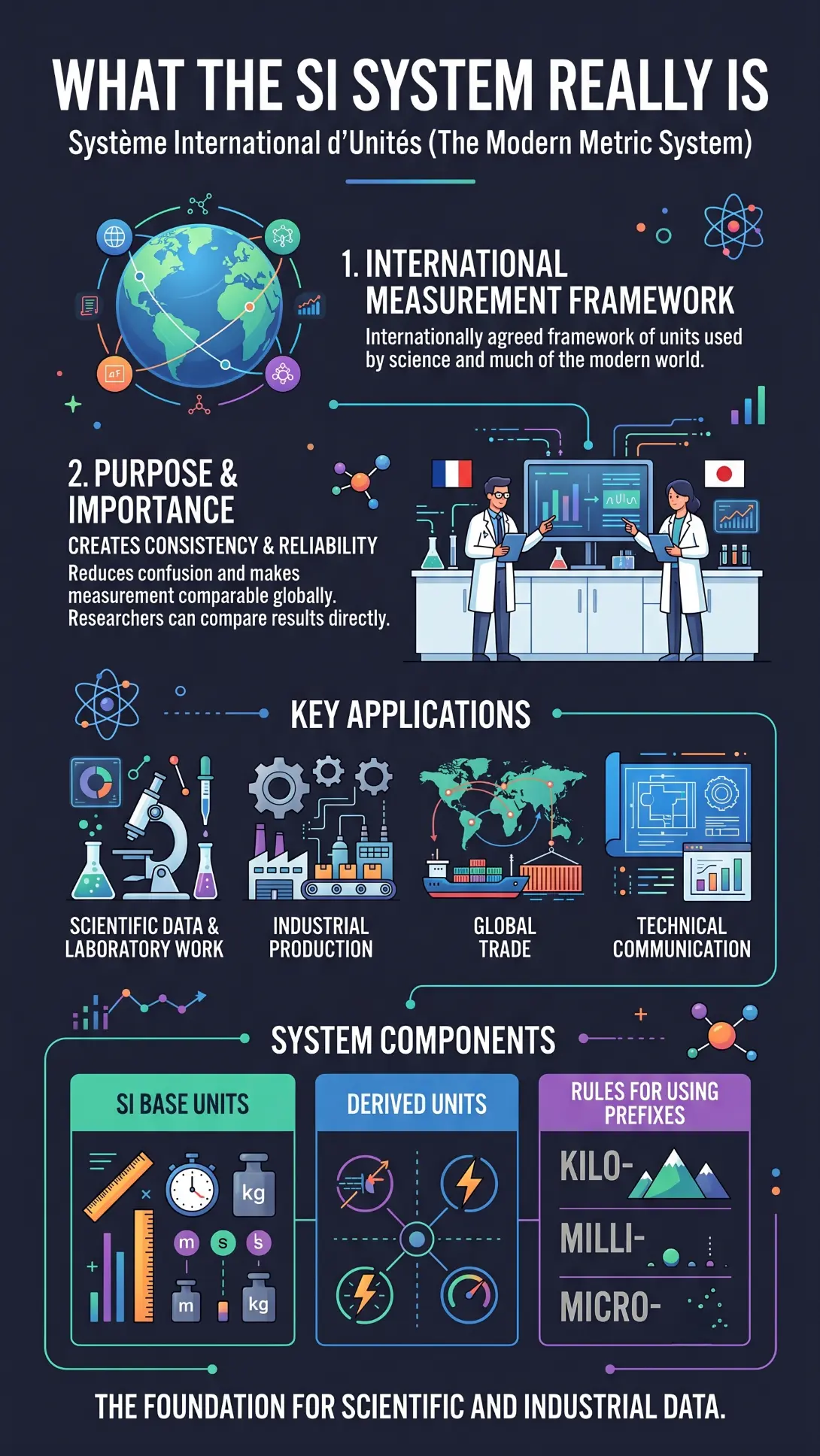
The SI system is the standard measurement system used across most of the world. It is the foundation for scientific data, laboratory work, industrial production, global trade, and technical communication. When two researchers in different countries measure the same thing, they need the same unit system so their results can be compared directly. That is exactly what SI provides. It creates consistency, reduces confusion, and makes measurement reliable from one country to another.
The word SI comes from the French name Système International d’Unités. It is often called the modern metric system, although it is more precise to say that SI is the internationally agreed framework of units used by science and much of the modern world. The system includes the familiar base units, the derived units, and the rules for using prefixes like kilo-, milli-, and micro-.
Why the SI System Matters So Much
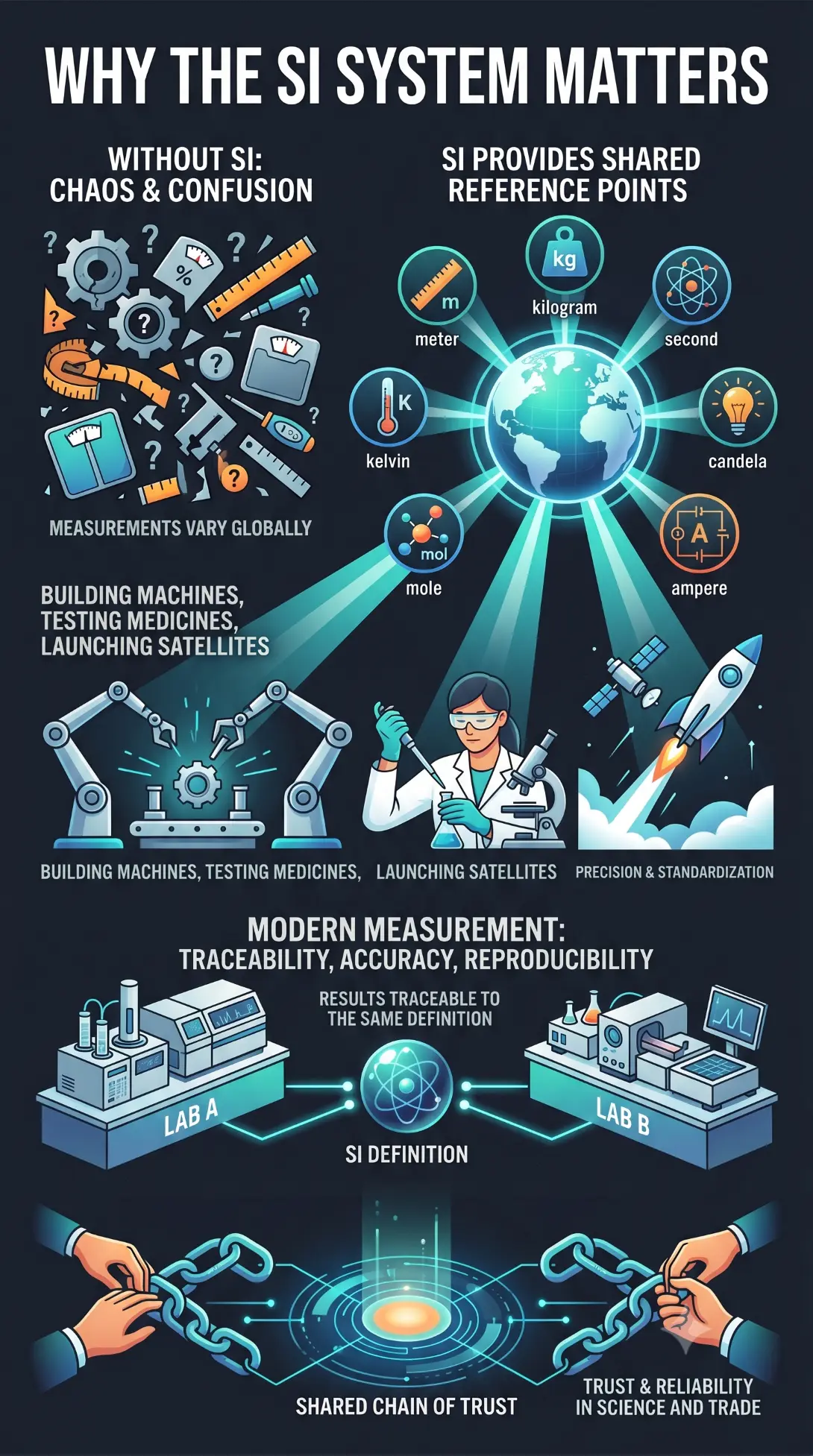
A world without a shared measurement system would be messy. A meter, a gram, or a second would mean different things in different places. That would make building machines, testing medicines, launching satellites, and even buying material for a school project much harder. SI solves that problem by giving everyone the same reference points.
It also matters because modern measurement is not just about convenience. It is about traceability, accuracy, and reproducibility. If a laboratory in one country measures a quantity, another laboratory anywhere else in the world should be able to trace that result back to the same SI definition and reach the same answer within expected uncertainty. That shared chain of trust is one of the strongest features of the system.
A Short History of the SI System
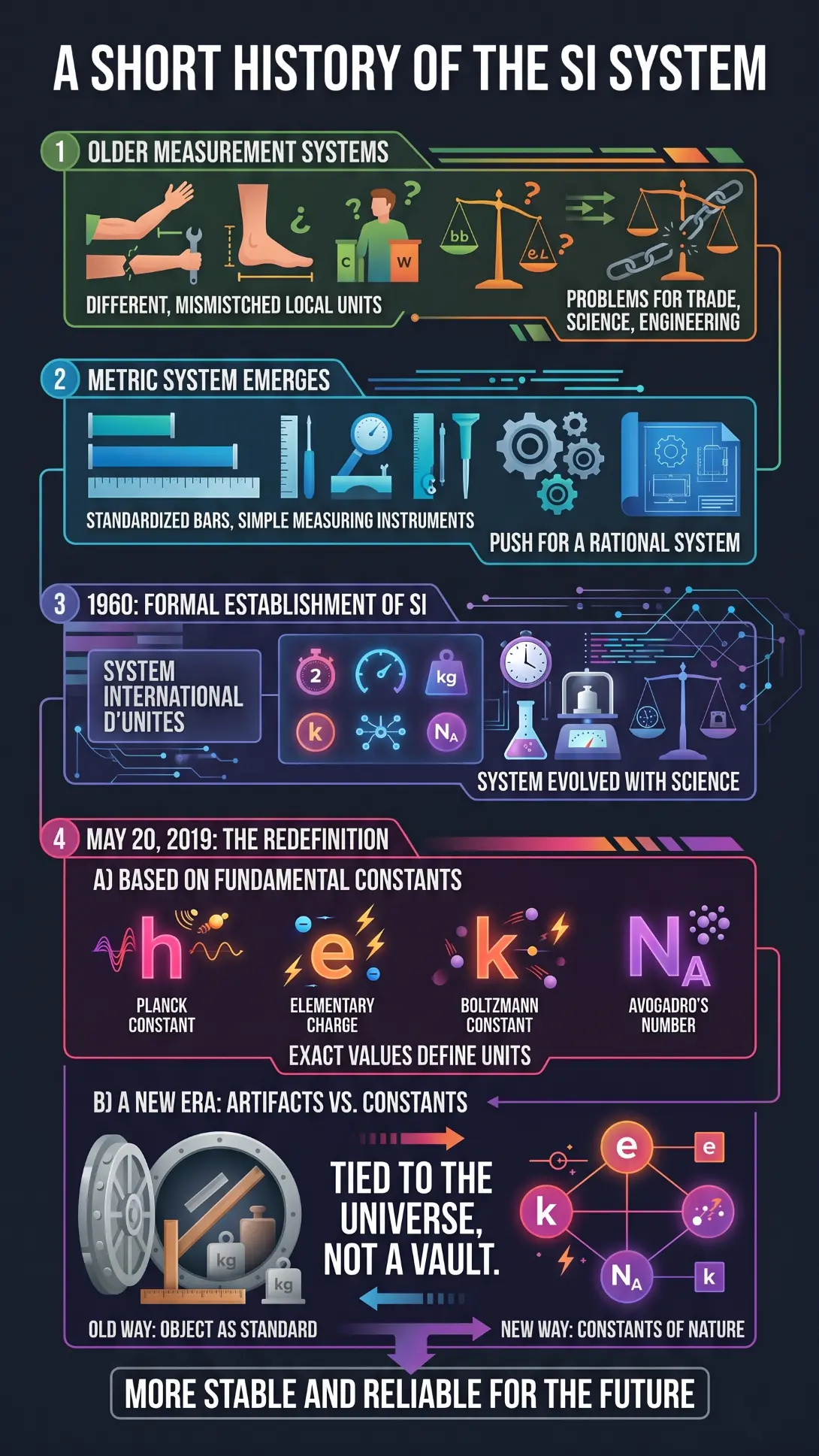
The story of SI began long before the modern system was finalized. For centuries, people used local units based on body parts, tools, or customs. These older systems were practical for small communities, but they were not universal. A foot in one place was not always the same as a foot somewhere else. That created serious problems for trade, science, and engineering. The push for a more rational system led eventually to the metric system, and later to SI.
A major milestone came in 1960, when the International System of Units was formally established. Later, the system evolved as scientific understanding improved. The biggest modern change happened on 20 May 2019, when several SI base units were redefined using exact values of fundamental constants such as the Planck constant, the elementary charge, the Boltzmann constant, and Avogadro’s number. This made the system independent of physical artifacts and much more stable for the future.
That 2019 change is especially important because it marked a shift in how humans define measurement itself. Instead of saying, in effect, “this object is the standard,” the SI now says, “this constant of nature has this exact value, and our unit is defined from that.” It is a subtle idea, but a powerful one. It means the system is tied to the universe, not to a single object locked in a vault.
The Seven SI Base Units
The SI system is built on seven base units. Every other SI unit can be formed from these. These base units measure the most fundamental quantities used in science and daily life.
Table 1. The Seven SI Base Units
| Physical quantity | SI base unit | Symbol | What it measures | Simple example |
|---|---|---|---|---|
| Length | meter | m | Distance or size | The length of a desk |
| Mass | kilogram | kg | Amount of matter, used for mass measurement | A bag of rice |
| Time | second | s | Duration | One minute has 60 seconds |
| Electric current | ampere | A | Flow of electric charge | Current in a phone charger |
| Thermodynamic temperature | kelvin | K | Absolute temperature | Temperature in physics and chemistry |
| Amount of substance | mole | mol | Number of specified particles | Number of atoms in a sample |
| Luminous intensity | candela | cd | Brightness in a given direction | Light from a lamp or LED |
The seven base units are the backbone of the SI system. They are not chosen randomly. Each one represents a quantity that cannot be reduced into a simpler SI quantity. Everything else is built from them.
Understanding Each Base Unit in Simple Language
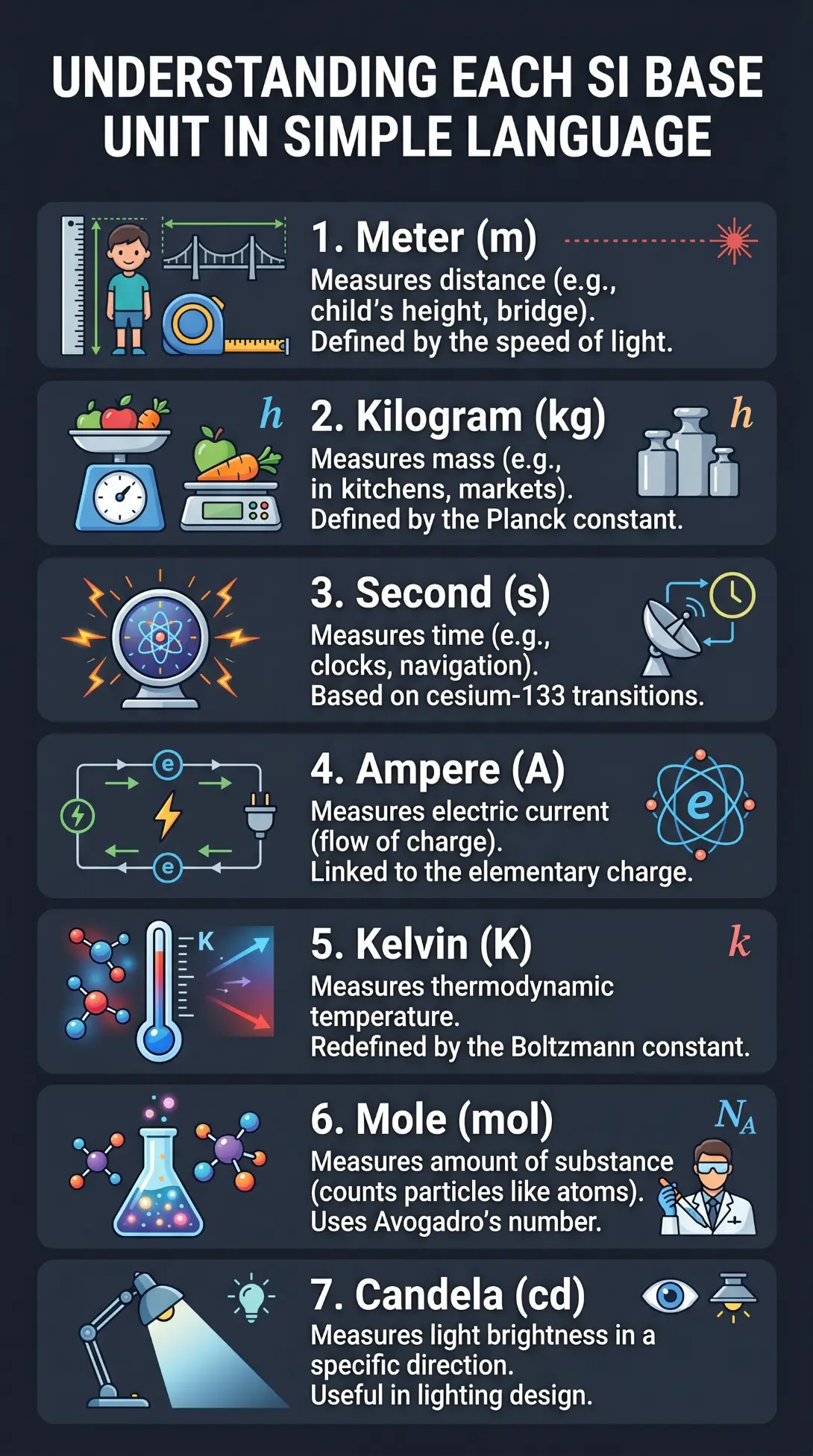
1. Meter, the unit of length
The meter measures distance. It is used for everything from a child’s height to the length of a bridge. In the modern SI, the meter is defined using the speed of light in vacuum, which is fixed exactly. That gives the unit a precise and universal basis.
2. Kilogram, the unit of mass
The kilogram measures mass. It is used in kitchens, markets, factories, and laboratories. Before the 2019 revision, the kilogram was tied to a physical artifact. Today, it is defined through the Planck constant, which makes it much more stable and reproducible.
3. Second, the unit of time
The second is the SI unit of time. It is used everywhere, from clocks and navigation to experiments and computer systems. The second is based on a defined transition in cesium-133, which gives it exceptional precision.
4. Ampere, the unit of electric current
The ampere measures electric current, the flow of charge in a circuit. It is essential in electricity, electronics, power systems, and telecommunications. The modern definition is linked to the fixed numerical value of the elementary charge.
5. Kelvin, the unit of temperature
The kelvin is the SI unit of thermodynamic temperature. It is especially important in physics, chemistry, climate science, and engineering. The redefined kelvin is linked to the Boltzmann constant, which connects temperature with energy at the microscopic level.
6. Mole, the unit of amount of substance
The mole measures amount of substance. It is used in chemistry to count atoms, molecules, ions, and other particles in a practical way. The modern SI definition fixes the value of Avogadro’s number.
7. Candela, the unit of luminous intensity
The candela measures luminous intensity, which is related to how bright a light source appears in a specific direction. It is useful in lighting design, displays, and vision science.
SI Derived Units: Built from the Base Units
Once the seven base units are in place, all the other SI units can be built from them. These are called derived units. Some derived units have special names because they are used so often. Examples include newton, pascal, joule, watt, volt, ohm, hertz, and coulomb.
Table 2. Common SI Derived Units with Special Names
| Quantity | Derived unit | Symbol | Base-unit expression | Example use |
|---|---|---|---|---|
| Force | newton | N | kg·m/s² | Pushing a cart |
| Pressure | pascal | Pa | N/m² | Tire pressure |
| Energy | joule | J | N·m | Food energy, heat |
| Power | watt | W | J/s | Electrical appliances |
| Electric charge | coulomb | C | A·s | Battery and circuit charge |
| Voltage | volt | V | W/A | Battery output |
| Resistance | ohm | Ω | V/A | Resistor value |
| Frequency | hertz | Hz | s⁻¹ | Sound waves, radio signals |
| Capacitance | farad | F | C/V | Capacitors |
| Magnetic flux | weber | Wb | V·s | Magnetism and induction |
| Magnetic flux density | tesla | T | Wb/m² | MRI, magnets |
| Inductance | henry | H | Wb/A | Electrical circuits |
| Luminous flux | lumen | lm | cd·sr | Total light output |
| Illuminance | lux | lx | lm/m² | Room lighting |
These units are part of everyday life, even when people do not notice them. A joule appears on food labels and energy calculations. A watt appears on bulbs and appliances. A pascal appears in engineering and meteorology. The SI system quietly supports a huge amount of modern life.
What Makes the SI System Coherent
One of the best features of SI is that it is coherent. That means derived units are built from base units without extra numerical factors. For example, force is expressed naturally as kg·m/s², not with some complicated conversion constant added in the middle. This makes equations simpler and helps reduce errors in science and engineering.
A coherent system is useful because it lets scientists and engineers move smoothly from one formula to another. When the units fit the equations cleanly, the math becomes easier to check. It also becomes easier to spot mistakes. That is one reason SI has lasted so well and remains the global standard for technical work.
SI Prefixes: Making Very Large and Very Small Numbers Easy
The SI system uses prefixes to show decimal multiples and submultiples. These prefixes make measurements easier to read and write. Instead of writing 0.000001 meter, you can write 1 micrometer. Instead of writing 1,000,000 watt, you can write 1 megawatt. This saves time and avoids clutter.
Table 3. Common SI Prefixes
| Prefix | Symbol | Value | Meaning | Example |
|---|---|---|---|---|
| giga | G | 10⁹ | One billion | 1 GW = one billion watts |
| mega | M | 10⁶ | One million | 1 MW = one million watts |
| kilo | k | 10³ | One thousand | 1 km = 1,000 meters |
| hecto | h | 10² | One hundred | 1 hm = 100 meters |
| deka | da | 10¹ | Ten | 1 dam = 10 meters |
| deci | d | 10⁻¹ | One tenth | 1 dL = 0.1 liter |
| centi | c | 10⁻² | One hundredth | 1 cm = 0.01 meter |
| milli | m | 10⁻³ | One thousandth | 1 mm = 0.001 meter |
| micro | µ | 10⁻⁶ | One millionth | 1 µs = 0.000001 second |
| nano | n | 10⁻⁹ | One billionth | 1 nm = 0.000000001 meter |
| pico | p | 10⁻¹² | One trillionth | 1 pF = 0.000000000001 farad |
These prefixes are not just formal rules. They make communication easier in real life. A doctor might use milligrams for medicine. An engineer might use megawatts for power output. A biologist might use nanometers for cell structures. SI prefixes keep the same measurement family while adjusting the scale.
The 2019 Redefinition of the SI System
The 2019 redefinition was one of the biggest measurement changes in modern history. On 20 May 2019, the SI base units for kilogram, ampere, kelvin, and mole were redefined in terms of exact values of natural constants. The meter, second, and candela were already tied to constants in a stable way.
Table 4. What Changed in 2019
| Base unit | Old style of definition | New style of definition | Why it mattered |
|---|---|---|---|
| kilogram | Linked to a physical artifact | Linked to the Planck constant | Removed dependence on a single object |
| ampere | Based on an electromechanical definition | Linked to the elementary charge | Improved precision and consistency |
| kelvin | Based on water-related fixed points | Linked to the Boltzmann constant | Better for thermodynamics and science |
| mole | Based on amount related to carbon-12 | Linked to Avogadro’s number | Improved conceptual clarity and accuracy |
The old prototype kilogram had served science for decades, but a physical artifact can change slightly over time. It can gain or lose atoms, or otherwise drift in mass in tiny ways. A constant of nature does not have that weakness. That is why the new SI is considered stronger and more future-proof.
This change also fits the modern direction of measurement science. Today, precision is often built through quantum and atomic methods, not by comparing everything to a single object stored in one place. That is one reason the SI is now closely aligned with the most advanced technologies in the world.
How SI Supports Science and Research
Science depends on clean measurement. If the units are unclear, the results are unclear too. That is why SI is the natural choice for laboratories, universities, and research institutes around the world. It gives researchers a shared framework for experiments, calculations, and published data.
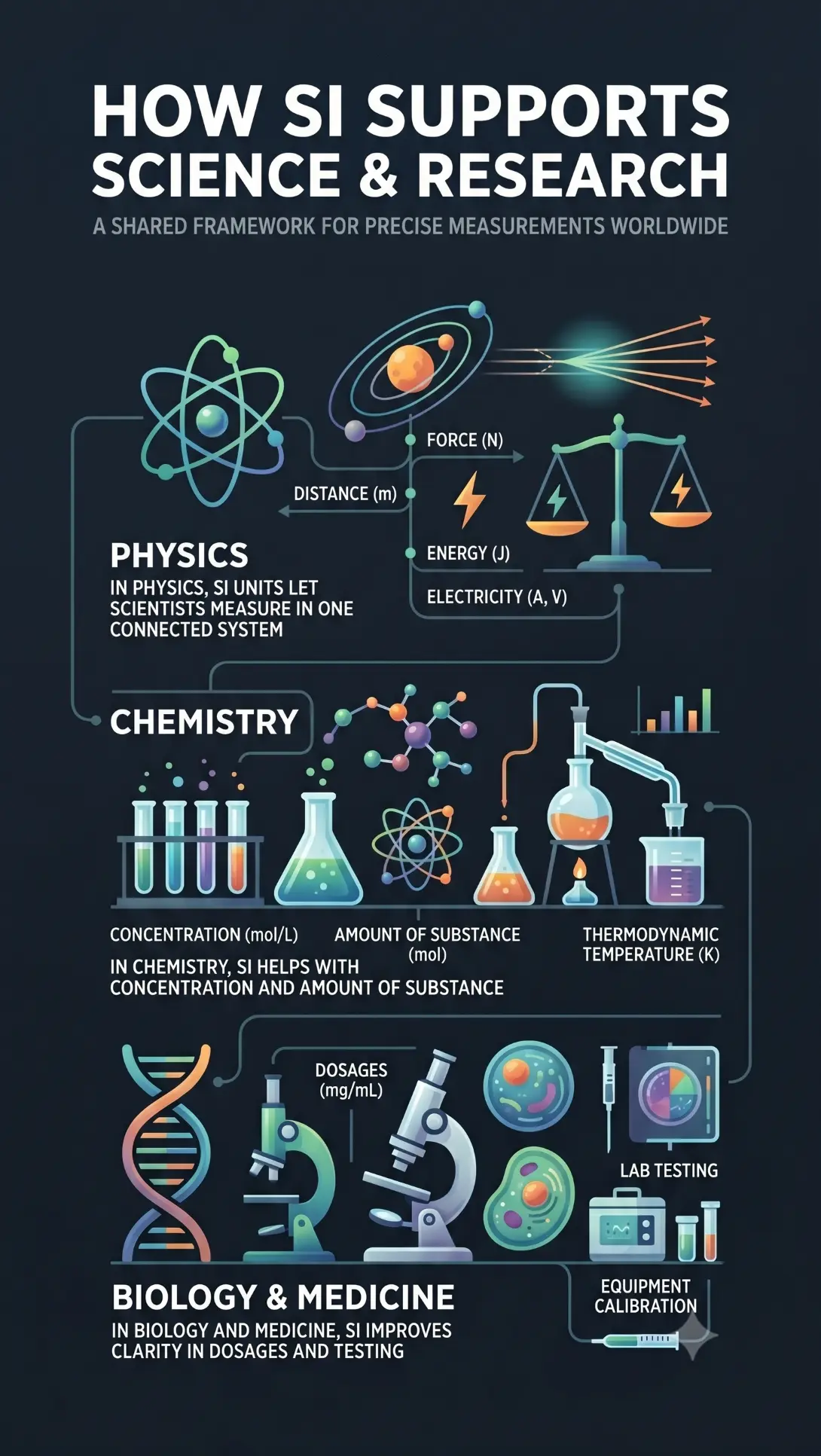
In physics, SI units let scientists measure distance, force, energy, and electricity in one connected system. In chemistry, SI helps with concentration, amount of substance, and thermodynamic temperature. In biology and medicine, SI improves clarity in dosages, lab testing, and equipment calibration. Without a standard system, scientific cooperation would be much more difficult.
How SI Helps in Engineering and Technology
Engineering is built on exact numbers. Bridges, airplanes, chips, motors, batteries, and power grids all depend on reliable measurements. The SI system helps engineers share drawings, specifications, and calculations without confusion. A drawing in SI can be understood across borders with far less risk of error.
SI is also essential in modern technology. Electronics use volts, amperes, ohms, and farads. Mechanical engineering uses newtons, joules, and watts. Communication systems use hertz for frequency. Because the units fit together logically, the system is powerful enough for both small circuits and giant infrastructure projects.
How SI Is Used in Daily Life
Even people who never open a physics book use SI every day. They may buy fruit by the kilogram, measure room size in meters, check time in seconds, or read the temperature in degrees Celsius, which is closely related to the SI unit kelvin. Gasoline, electricity bills, sports timing, weather reports, and home appliances all rely on SI or SI-linked units.
A few simple examples make this easy to see:
- A bottle of water may be labeled 1 liter.
- A phone charger may be rated 20 watts.
- A fan speed may be discussed in revolutions per minute, though SI prefers s⁻¹ or other coherent expressions in technical settings.
- A classroom thermometer may show 25 °C, while science may convert that into 298.15 K when absolute temperature is needed.
SI and the World of Education
Students meet the SI system early in school because it teaches both measurement and logic. The system helps learners understand not only what a unit is, but how units relate to each other. A student who understands SI also starts to understand scale, conversion, and scientific thinking.
Teachers often use SI because it is clean, predictable, and easy to extend. Once students know meter, kilogram, and second, they can move on to newton, joule, and watt without learning a new system each time. That makes SI one of the most teachable measurement systems ever created.
SI in Medicine and Health
Medicine needs exact measurement because small mistakes can have big consequences. SI helps doctors, nurses, pharmacists, and laboratory professionals communicate clearly. Drug mass can be measured in milligrams, fluid volume in milliliters, and physiological quantities in consistent scientific units.
In medical science, the clarity of SI is especially useful in laboratory testing, imaging, and physiological monitoring. When values are standardized, treatment decisions become safer and more reliable. Even a small improvement in measurement consistency can make a real difference in health care.
SI in Trade, Industry, and Global Commerce
A global economy needs shared units. If one supplier measures in one system and another supplier uses a different one, mistakes become expensive. SI reduces that risk in manufacturing, shipping, quality control, and international contracts. It helps businesses describe products in the same language.
Factories use SI to control dimensions, tolerances, heat, pressure, voltage, and performance. Shipping companies use SI for weight and volume. Agricultural markets use SI for mass and area. In each case, the system lowers confusion and supports fair exchange.
Common SI Rules for Writing Units Correctly
Good measurement is not only about the right number. It is also about writing the units correctly. SI has clear rules that help keep writing clean and consistent. Some of the most useful ones are simple but important.
Useful SI writing rules
- Leave a space between the number and the unit, such as 10 kg or 25 m.
- Do not mix up unit symbols with abbreviations.
- Unit symbols are usually not pluralized, so write 5 kg, not 5 kgs.
- Use the correct case, because m means meter while M means mega.
- Use K for kelvin, not °K.
- Use µ for micro when appropriate.
These rules may seem small, but they matter in formal writing, engineering documents, lab notes, and scientific publication. A tiny symbol mistake can change a meaning completely. That is why careful SI writing is a mark of good technical communication.
SI and Common Non-SI Units
Not everything people use in daily life is a pure SI unit. Some units are accepted for use with SI, while others are not. For example, minute, hour, and degree are widely used and familiar. The SI framework still allows practical use of such units in many contexts, especially when they are helpful and well understood.
At the same time, SI encourages clarity. In technical work, it is usually better to use coherent SI units or clear decimal multiples rather than old local units that can cause confusion. That is one reason SI remains so useful in global communication.
Table 5. Examples of SI Use in Real Life
| Area | Typical SI unit | Example | Why SI works well here |
|---|---|---|---|
| School science | m, kg, s, K | Measuring length, mass, time, temperature | Simple and universal |
| Cooking | g, L, mL | Measuring flour, milk, water | Easy scaling for recipes |
| Medicine | mg, mL, K | Drug doses, lab values | Reduces risk of confusion |
| Construction | m, mm, Pa | Building dimensions and pressure | Good for precision |
| Electricity | V, A, Ω, W | Voltage, current, resistance, power | Fits circuit equations |
| Weather | K, m/s, Pa | Temperature, wind speed, air pressure | Useful for forecasting |
| Transport | km, m/s | Distance and speed | Standard across regions |
| Research | mol, J, Hz | Chemistry, energy, frequency | Essential for experiments |
This kind of table shows why SI is so practical. It is not only a theory for scientists. It is a working system used in homes, schools, labs, offices, hospitals, and factories every single day.
Examples That Make SI Easier to Remember
A few examples can make SI feel much more natural.
- A table may be 2 meters long.
- A backpack may weigh 5 kilograms.
- A race may last 12 seconds.
- A room may be 298 K in thermodynamic temperature terms, though people often say 25 °C in daily speech.
- A light bulb may use 60 W of power.
- A phone battery may involve voltage measured in volts and current in amperes.
Those examples show something important. SI is not abstract and distant. It is built into the objects and experiences of normal life. Once people start noticing it, they see it everywhere.
Why SI Replaced Older Measurement Habits
Older measurement systems often depended on local tradition. That worked within a small region, but it became a problem when people needed to trade, travel, or share scientific results. Different places had different foot lengths, pound values, and volume standards. That made comparison difficult.
SI replaced that confusion with a system designed to be universal, decimal, and scientifically consistent. Its units are linked through powers of ten, so converting between prefixes is easy. A kilometer to meter conversion is much simpler than trying to compare unrelated traditional units. That practical simplicity is one reason SI became dominant worldwide.
The Role of Measurement Traceability
One of the deepest strengths of SI is traceability. Traceability means a measurement can be linked back through a documented chain to a recognized standard. In the SI world, that chain ends at the unit definitions and the constants behind them. This helps keep results trustworthy.
This matters a great deal in industries where quality and safety are critical. Whether someone is calibrating a laboratory balance, checking a thermometer, or verifying a pressure gauge, traceability gives confidence that the result is not just approximate, but reliably tied to the same global standard.
The Beauty of SI: Simple, Logical, Universal
The SI system is powerful because it is simple at the top and flexible at the bottom. Seven base units support a huge range of derived units. Prefixes make the system work across tiny and enormous scales. The definitions are tied to universal constants, which gives the whole system stability.
That combination is rare. Many systems are simple but limited, or broad but messy. SI manages to be both practical and deep. It is easy enough for a school student to learn, yet precise enough for advanced scientific research and global technical work.
Frequently Confused SI Points
A lot of people mix up mass and weight. In SI, mass is measured in kilograms, while weight is a force measured in newtons. That difference matters in physics and engineering. A person’s mass stays the same regardless of location, but weight changes with gravity.
Another common confusion involves temperature. The everyday unit degree Celsius is closely related to the SI base unit kelvin, but the kelvin is the official SI unit of thermodynamic temperature. In scientific work, especially where absolute temperature matters, kelvin is the preferred unit.
A third confusion involves symbols and names. For example, m means meter, but M means mega. Small details matter. SI is precise by design, and that precision begins with how units are written.
A Larger View of Why SI Still Wins
The SI system is more than a set of units. It is a common agreement about how the world should measure reality. That shared agreement has huge value. It allows a lab in one country, a hospital in another, and a factory somewhere else to speak the same measurement language without long explanations or conversion confusion.
It also adapts well to progress. Because the definitions are tied to constants of nature, SI can support future technologies without needing to be rebuilt from scratch. That is an elegant solution. It keeps the system stable while leaving room for better measurement methods in the future.
Summary of the SI System
The International SI system is the modern world’s standard for measurement. It uses seven base units, many derived units, and a clear set of prefixes. Its modern form is tied to fundamental constants of nature, which makes it stable, universal, and scientifically strong. It is used in science, medicine, engineering, trade, education, and daily life.
The real power of SI is not just technical. It is human. It helps people understand each other, compare results, avoid mistakes, and build things that work. That is why SI remains one of the most important systems ever created for modern civilization.
Final Thoughts
The SI system may look simple at first glance, but it carries a lot of history, science, and practical value. It connects the classroom to the laboratory, the workshop to the hospital, and the local market to the global economy. It is one of those rare systems that disappears into the background precisely because it works so well.
And that is the real strength of SI. It gives the world a shared measurement language that is clear, stable, and built to last. In a world full of differences, that kind of common ground matters more than most people realize.
Article References and Sources
- The International System of Units (SI)
- The SI Brochure: Defining the International System of Units
- SI Units and Measurement Standards
- NIST Definitions of SI Base Units
- NIST SI Redefinition Overview
- NIST Writing SI Units Guide
- NIST Guide to SI PDF
- BIPM Kilogram Definition PDF
- BIPM Kelvin Definition PDF
- BIPM Official Website
Also, Read these Articles in Detail
- Physics and Its Fundamentals With Good Explanations
- Matter, Motion, and Energy: The Core Ideas of Physics
- What Is Matter? The Physical Substance of the Universe
- What Is Motion? A Guide to Motion in Physics and Daily Life
- What Is Energy? The Invisible Power Behind Everyday Life
- Kinetic Energy Explained in Simple Language
- Potential Energy: Definition, Types, Formula, and Examples
- Thermal Energy: Heat, Temperature, and Transfer
- Mechanical Energy: Definition, Formula, and Examples
- Chemical Energy: Definition, Science, and Examples
- Electrical Energy: Definition, Works, and Why It Matters
- Radiant Energy: Meaning, Sources, Examples, and Uses
- Nuclear Energy: Definition, How It Works, and Why It Matters
- Sound Energy: Definition, Science, and Examples
- Elastic Energy: Definition, Elasticity, and Example
- Geothermal Energy: Clean Electricity, Heating, and Modern Life
- Hydropower Energy: How It Works and Its Importance
- Pumped Hydropower Storage
- Force: Meaning, Types, Formula, and Examples
- Mechanics: Motion, Forces, Energy, and Applications
- Wave: Types, Properties, Motion, and Uses
Frequently Asked Questions
FAQ 1: What is the SI system?
The SI system is the world’s main system of measurement. It is the standard used for science, education, engineering, medicine, trade, and everyday life. The full name is International System of Units, and people often call it the modern metric system. It gives everyone the same way to measure things like length, mass, time, temperature, electric current, amount of substance, and light.
That matters more than it may seem at first. Imagine if one country used one kind of meter, another country used a different kind of kilogram, and scientists everywhere had to keep converting everything by hand. It would be confusing, slow, and full of mistakes. The SI system solves that by creating one common language for measurement.
It is also built in a very logical way. The system starts with seven base units, and every other unit is built from them. That means the whole system stays connected. For example, the newton for force, the joule for energy, and the watt for power all come from the base units. So once you understand the basics, the rest starts to make sense very quickly.
The best thing about SI is that it is simple enough for students and strong enough for advanced science. A child measuring a pencil and a physicist measuring light can both use the same system. That is why the SI system has become so important around the world.
FAQ 2: Why is the SI system important?
The SI system is important because it gives the world a shared measurement standard. Without it, people in different countries would constantly have to translate numbers into local units. That would create errors in science, shipping, medicine, construction, and trade. A shared system keeps communication clear and practical.
In science, the SI system makes results easier to compare. A researcher in one country can measure temperature in kelvin, energy in joules, and force in newtons, and another researcher anywhere else can understand the results immediately. That is a huge advantage when experiments need to be repeated, verified, or shared.
In daily life, the system is just as useful. Food is often sold by the kilogram, drinks by the liter, and electricity is measured in watts and volts. Even when people do not think about it, they use SI ideas all the time. It quietly supports normal life in the background.
It also matters because the modern SI is based on constants of nature. That makes the system stable and future-proof. A physical object can change slightly over time, but a defined constant does not. This makes the whole measurement system more reliable for the long term. And in a world that depends on exact numbers, reliability is everything.
FAQ 3: What are the seven SI base units?
The seven SI base units are the foundation of the entire system. They are meter for length, kilogram for mass, second for time, ampere for electric current, kelvin for thermodynamic temperature, mole for amount of substance, and candela for luminous intensity.
Each base unit measures a basic physical quantity. They are not made from other SI units. Instead, they stand on their own and support the rest of the system. For example, when you combine meter, kilogram, and second, you can build units like newton and joule.
Here is the simple way to remember them:
- meter (m) measures distance
- kilogram (kg) measures mass
- second (s) measures time
- ampere (A) measures electric current
- kelvin (K) measures absolute temperature
- mole (mol) measures amount of substance
- candela (cd) measures luminous intensity
These units may look small on paper, but they are powerful. They support almost every kind of measurement used in modern science and daily life. If you know these seven, you already know the backbone of the SI system.
FAQ 4: What is the meter used for?
The meter is the SI unit of length. It is used to measure how long, wide, tall, or far something is. This could be the length of a table, the height of a building, the width of a road, or the distance between two cities. The meter is one of the most familiar and practical units in the entire system.
In scientific terms, the meter is tied to the speed of light in vacuum, which is a fixed constant. That means the definition is extremely precise. It does not depend on a metal rod or any physical object that might change over time. This makes the unit much more stable than old-style measurement standards.
Everyday examples make the meter easy to understand. A classroom might be about 8 meters long. A person might be about 1.7 meters tall. A football field is much longer, so it is measured in meters or kilometers depending on the context. This flexibility is one of the reasons the SI system works so well.
The meter also connects easily to other units through prefixes. A centimeter is one-hundredth of a meter. A millimeter is one-thousandth of a meter. A kilometer is one thousand meters. This decimal structure makes conversions simple and clean, which is a big advantage over older systems.
FAQ 5: What is the kilogram?
The kilogram is the SI unit of mass. It tells us how much matter an object contains. People often confuse mass with weight, but they are not the same thing. Mass stays the same wherever you go. Weight changes depending on gravity. That is why the SI uses kilogram for mass and newton for force.
The modern kilogram is defined using the Planck constant, not a physical object. This is a major step forward in measurement science. A standard object can change very slightly over time, but a physical constant does not drift in the same way. That gives the kilogram a much stronger scientific foundation.
In daily life, kilograms are easy to understand. A bag of rice may weigh 5 kg. A person might have a mass around 60 kg or 70 kg. A suitcase might be 23 kg. These examples show why the unit is so practical. It is used in homes, markets, factories, hospitals, and laboratories.
The kilogram is also very important in engineering and trade. If products are sold by mass, shipped by weight, or used in formulas, the kilogram makes everything clearer. It is one of the most important SI units because so much of the modern world depends on it.
FAQ 6: What is the second in SI?
The second is the SI unit of time. It is used to measure duration, speed, frequency, and timing in science and daily life. Whether you are timing a race, measuring a chemical reaction, or tracking a signal in electronics, the second is the standard unit.
The SI definition of the second is based on the cesium-133 atom. This makes the unit extremely accurate and stable. Atomic time is far more precise than old methods based on the movement of the sun or the rotation of Earth alone. That precision is essential in modern technology.
In everyday life, seconds are all around us. A stopwatch counts them. A clock uses them. A sports timer depends on them. In science, seconds are even more important because many formulas use time directly. Speed is distance divided by time. Frequency is cycles per second, or hertz. So the second is deeply connected to many other units.
It also helps that SI uses a decimal pattern. A millisecond is one-thousandth of a second. A microsecond is one-millionth of a second. These tiny time units are very important in computing, electronics, and physics. The second may look simple, but it sits at the center of a huge amount of measurement work.
FAQ 7: What is the mole?
The mole is the SI unit of amount of substance. It is used mainly in chemistry, but it also appears in physics, materials science, and biology. The mole helps scientists count very large numbers of tiny particles like atoms, molecules, ions, and electrons in a practical way.
This is useful because atoms are far too small to count one by one in a normal sense. Instead, scientists use the mole to group them. One mole contains exactly Avogadro’s number of particles, which is 6.02214076 × 10²³. That is a huge number, but the mole makes it manageable.
For example, a mole of water molecules contains the same number of molecules as there are grains of sand in an unimaginably large pile. That sounds strange at first, but the mole is simply a counting unit for the microscopic world. It helps connect what we can measure in the lab with what happens at the atomic level.
The mole is especially important in chemistry because reactions depend on the number of particles, not just the mass of a substance. That is why the mole is such a powerful SI unit. It gives scientists a bridge between the tiny world and the measurable world.
FAQ 8: What are derived units?
Derived units are units made by combining the SI base units. They are not separate from the system. Instead, they grow out of the base units using multiplication and division. This is one of the smartest parts of the SI system because it keeps everything organized and logical.
For example, the newton is the derived unit of force. It equals kg·m/s². The joule is the derived unit of energy. It equals N·m. The watt is the derived unit of power. It equals J/s. These units are used constantly in science, engineering, and daily life.
Some derived units have special names because they are used so often. These include pascal, hertz, coulomb, volt, ohm, tesla, and lumen. Each one has a clear relationship with the base units, even if the formula is not obvious at first glance.
The beauty of derived units is that they keep the system coherent. When units fit together cleanly, equations become easier to understand and verify. That is one reason scientists love SI. It reduces clutter and makes the math more natural.
FAQ 9: What are SI prefixes?
SI prefixes are small word parts added to units to show very large or very small values. They help make measurements easier to read. Instead of writing a lot of zeros, people use prefixes like kilo-, milli-, micro-, and mega-. This keeps numbers neat and practical.
Here are a few common examples:
- kilo- means 1,000
- mega- means 1,000,000
- milli- means 0.001
- micro- means 0.000001
- nano- means 0.000000001
So 1 kilometer is 1,000 meters. 1 milligram is one-thousandth of a gram. 1 microsecond is one-millionth of a second. These conversions are easy because SI is built on powers of ten.
Prefixes are used all the time in real life. A phone might store data in gigabytes. A medicine dose might be measured in milligrams. A wire thickness might be measured in micrometers. A power plant might produce megawatts. Once you understand prefixes, SI becomes much easier to use.
They also help when dealing with very large or tiny measurements. Without prefixes, scientific writing would be full of long strings of zeros. That would be awkward and easy to misread. Prefixes solve that problem cleanly.
FAQ 10: Why did the SI system change in 2019?
The SI system changed in 2019 to make the base units even more stable, precise, and future-ready. On 20 May 2019, several units were redefined using exact values of fundamental physical constants. This was a major milestone in measurement science.
The biggest change was to the kilogram, which used to rely on a physical object. That old approach had weaknesses because a physical object can change slightly over time. The new definition uses the Planck constant, which is a constant of nature. Similar improvements were made for the ampere, kelvin, and mole.
This change mattered because it made the SI system independent of a single artifact. Instead of depending on something that can be stored, moved, or altered, the system now depends on constants that are part of the universe itself. That gives measurement a much stronger scientific base.
The change also helped modern research. Today, measurement often depends on quantum physics, atomic science, and advanced instruments. A system built on constants fits that world much better. It is cleaner, more accurate, and more stable over time.
So the 2019 update was not just a technical adjustment. It was a smarter way of defining the world’s shared measurement language. And that is why the SI system continues to matter so much in science, technology, and everyday life.
FAQ 11: How do SI base units and derived units work together?
The SI system works in a very neat way. It starts with seven base units, and then it builds everything else from them. That is where derived units come in. A derived unit is simply a unit made by combining base units through multiplication, division, or both. This is one of the main reasons SI is so organized and easy to use.
Take force as an example. In SI, force is measured in newtons. A newton is not a random unit on its own. It is built from the base units kilogram, meter, and second. In simple form, 1 N = 1 kg·m/s². That means if you know the base units, you can understand the derived unit too. The same idea works for energy, pressure, power, and many other quantities.
This system is powerful because it keeps science connected. You do not need a separate unit for every physical idea. You just combine the base units in a clear way. For example, joule comes from newton multiplied by meter, and watt comes from joule per second. That chain makes the system feel logical instead of chaotic.
And that logic matters in real life. Engineers use derived units when they design machines. Doctors use them when checking pressure or energy. Scientists use them in formulas all the time. Once you understand how the base units support the derived units, the entire SI system becomes much easier to read and much easier to trust.
FAQ 12: What is the difference between mass and weight in SI?
This is one of the most common measurement questions, and it is easy to mix up at first. In SI, mass and weight are not the same thing. Mass is measured in kilograms, while weight is measured in newtons because weight is a force.
Mass tells us how much matter an object contains. It stays the same whether you are on Earth, the Moon, or Mars. A person who has a mass of 60 kg still has a mass of 60 kg anywhere in the universe. Weight, on the other hand, depends on gravity. If gravity is weaker, weight goes down. If gravity is stronger, weight goes up.
That is why a person can weigh less on the Moon even though their mass does not change. The object is still the same, but the force of gravity acting on it is different. In SI language, this is very important because it keeps physical ideas clear. A kilogram is not a force. A newton is.
People often say “I weigh 70 kilograms,” but in strict SI terms, that is not exact. A better way to say it is that the person has a mass of 70 kg. Their weight depends on the local gravitational field and would be measured in newtons. This distinction may seem small, but it is one of those details that makes science precise.
FAQ 13: Why is the kelvin important in science?
The kelvin is the SI unit of thermodynamic temperature, and it plays a very important role in science. It is used in physics, chemistry, astronomy, engineering, and other fields where temperature needs to be measured in an absolute and meaningful way. Unlike everyday temperature scales, kelvin starts from absolute zero, which is the lowest possible thermodynamic temperature.
That makes the kelvin especially useful in calculations. Many scientific formulas use temperature in a direct way, and those formulas work best when the temperature scale begins at zero energy in a logical sense. That is why scientists often use kelvin instead of degrees Celsius in advanced work. The two scales are closely related, but they are not used in exactly the same way.
The kelvin became even more stable after the 2019 SI redefinition. It is now tied to the Boltzmann constant, which connects temperature and energy. That gives the unit a very strong scientific foundation. It is no longer based on an old fixed point that could be interpreted less precisely. It is built on a universal constant.
In everyday life, people often speak in degrees Celsius because that is simpler for weather and daily weather reports. But in science, kelvin is the deeper and more exact unit. It helps explain gas behavior, heat transfer, radiation, chemical reactions, and the behavior of matter at very low temperatures.
FAQ 14: How is the ampere used in everyday life?
The ampere is the SI unit of electric current. It measures how much electric charge flows through a wire or circuit each second. People often see amps written on chargers, batteries, appliances, and electrical equipment, even if they do not always think about what the number means.
In simple terms, current is the movement of electricity. If a device draws more current, it usually needs more charge flowing through it. A phone charger, for example, may provide a certain number of amperes to charge a battery safely and efficiently. A home appliance may use more or less current depending on how much power it needs.
The ampere is also important in engineering and safety. Electric circuits must be designed so that the current stays within safe limits. If too much current flows, wires can overheat, insulation can fail, and devices can break. That is why measurements in amperes matter so much in real-world electrical systems.
In the modern SI system, the ampere is linked to the elementary charge, which is a fixed constant of nature. That makes the unit more exact and more stable than older definitions. So while most people see the ampere as just a number on a label, it is actually a very important scientific unit with a precise place in the SI system.
FAQ 15: What is the role of the candela in SI?
The candela is the SI unit of luminous intensity. It measures how bright a light source appears in a specific direction. This is different from total light output. A light bulb may give off a lot of light overall, but the candela focuses on intensity in a particular direction.
This unit is useful in lighting design, displays, photography, and vision science. For example, the brightness of a lamp, a screen, or a spotlight can be discussed in terms of luminous intensity. That helps designers make lighting more comfortable, effective, and efficient.
The candela also shows that SI is not only about weight, distance, and time. It also covers how humans experience light. That makes the system broader and more useful than many people realize. It includes physical quantities that matter in daily life and in technical work.
Although the candela is not as familiar as the meter or kilogram, it is still a key base unit. It helps standardize light measurement so that people can compare lighting devices fairly and accurately. In a world full of LED lamps, displays, and optical technology, that standard is very valuable.
FAQ 16: Why does the SI system use prefixes like kilo, milli, and micro?
The SI prefixes exist to make measurements easier to write, read, and understand. Without them, scientific and everyday numbers would be full of long strings of zeros. That would be tiring, and it would also increase the chance of mistakes. Prefixes solve that problem neatly.
For example, instead of writing 0.001 meter, SI lets us say 1 millimeter. Instead of writing 1,000 meters, we say 1 kilometer. Instead of writing 0.000001 second, we say 1 microsecond. These are much cleaner and much easier to work with.
Prefixes are also useful because they preserve the structure of SI. You do not need a new unit for every scale. You simply adjust the same unit with the right prefix. That makes conversion much easier. A kilometer and a meter are the same kind of quantity, just on different scales. The same is true for milligrams, megawatts, and nanometers.
In science and technology, this is especially helpful. A computer chip may be measured in nanometers. A medicine dose may be measured in milligrams. A city road may be measured in kilometers. The system stays consistent, even though the size of the object changes a lot.
FAQ 17: What does it mean that the SI system is coherent?
When people say the SI system is coherent, they mean the units fit together in a logical and clean way. In a coherent system, derived units are formed directly from base units without extra numerical factors that complicate formulas. This makes calculations simpler and more natural.
For example, the unit of force, the newton, is exactly kg·m/s². There is no hidden conversion factor in the definition. The unit is built straight from the base units. The same kind of direct structure appears in joules, watts, pascal, and many others. This is what makes SI so elegant.
A coherent system helps reduce confusion in science and engineering. When the units match the equations closely, people can check their work more easily. It becomes simpler to notice when something is wrong. That is very valuable in technical fields where even a small mistake can matter a lot.
And there is another benefit. Coherence makes learning easier. Students do not have to memorize a separate rule for every situation. They can see how units connect and build on each other. That makes the system not just mathematically neat, but also easier to teach and easier to remember.
FAQ 18: How did the 2019 SI redefinition improve the system?
The 2019 SI redefinition made the entire measurement system stronger and more modern. Before this change, some units relied on physical objects or older definitions that were less stable over time. After 20 May 2019, the SI base units were redefined using fixed values of fundamental physical constants.
This was a major improvement because constants of nature do not wear out or drift in the way physical objects can. That means the kilogram, ampere, kelvin, and mole became much more reliable in their definitions. The meter and second were already tied to constants, so the system became even more consistent overall.
The change also helped modern science and technology. Today, precise measurement often depends on atomic and quantum methods. A system based on natural constants fits that world much better than one based on an artifact kept in a special place. It is a more future-ready design.
In simple language, the 2019 update made SI more exact, more stable, and more universal. It reduced dependence on objects and increased dependence on the laws of nature. That is a very smart move for a system meant to serve the whole world.
FAQ 19: Where do people use the SI system the most?
The SI system is used almost everywhere. It is the default measurement system in science, education, medicine, engineering, manufacturing, trade, and many parts of daily life. It is especially important in countries and institutions that need a common, internationally accepted standard.
In schools, SI is taught in basic science and mathematics. In laboratories, researchers use SI units to record accurate results. In hospitals, SI units help describe medicines, tests, and medical measurements. In factories, engineers use SI for dimensions, power, pressure, and quality control. In trade, it helps people buy and sell goods with clear and fair measurements.
It is also used in technology. Electronics use volts, amperes, and ohms. Mechanical systems use newtons and joules. Weather systems use kelvin, pascal, and meters per second. Even sports timing often relies on SI time units.
So the SI system is not trapped in textbooks. It is part of the practical machinery of modern life. It keeps communication easier between countries, industries, and professions. That is one of the main reasons it has become so widely accepted.
FAQ 20: Why is the SI system considered the world’s measurement language?
The SI system is often called the world’s measurement language because it gives people everywhere a shared way to describe physical quantities. Just as language helps people communicate ideas, SI helps people communicate measurements. It turns numbers into something universal.
This matters because measurements are only useful when people understand them the same way. A scientific result, an engineering plan, or a medical dose has to mean the same thing to everyone reading it. SI makes that possible. It removes a huge amount of confusion and makes global communication much smoother.
It is also a strong language because it is logical. The base units support the derived units. The prefixes handle scale. The definitions are tied to constants of nature. Everything fits together. That kind of structure is rare and useful. It means the system can grow with science without falling apart.
And perhaps most importantly, SI is trusted. That trust comes from precision, consistency, and worldwide use. People know that when a number is written in SI, it belongs to a system that is stable and carefully defined. That is why SI is more than a set of units. It is the common measurement language of modern civilization.
