

Temperature is one of the most familiar words in science, yet it touches almost every part of life. We check it in the morning, talk about it in the weather forecast, adjust it while cooking, and worry about it when someone is sick. It shapes how materials behave, how engines run, how food stays safe, and how the planet feels from one season to the next.
In science, temperature is a fundamental physical quantity, and the kelvin is the SI unit used for thermodynamic temperature. On the Celsius scale, water freezes at 0°C and boils at about 100°C, while 0 K is called absolute zero, the lowest possible temperature in the thermodynamic sense.
Table of Contents
What Temperature Really Means
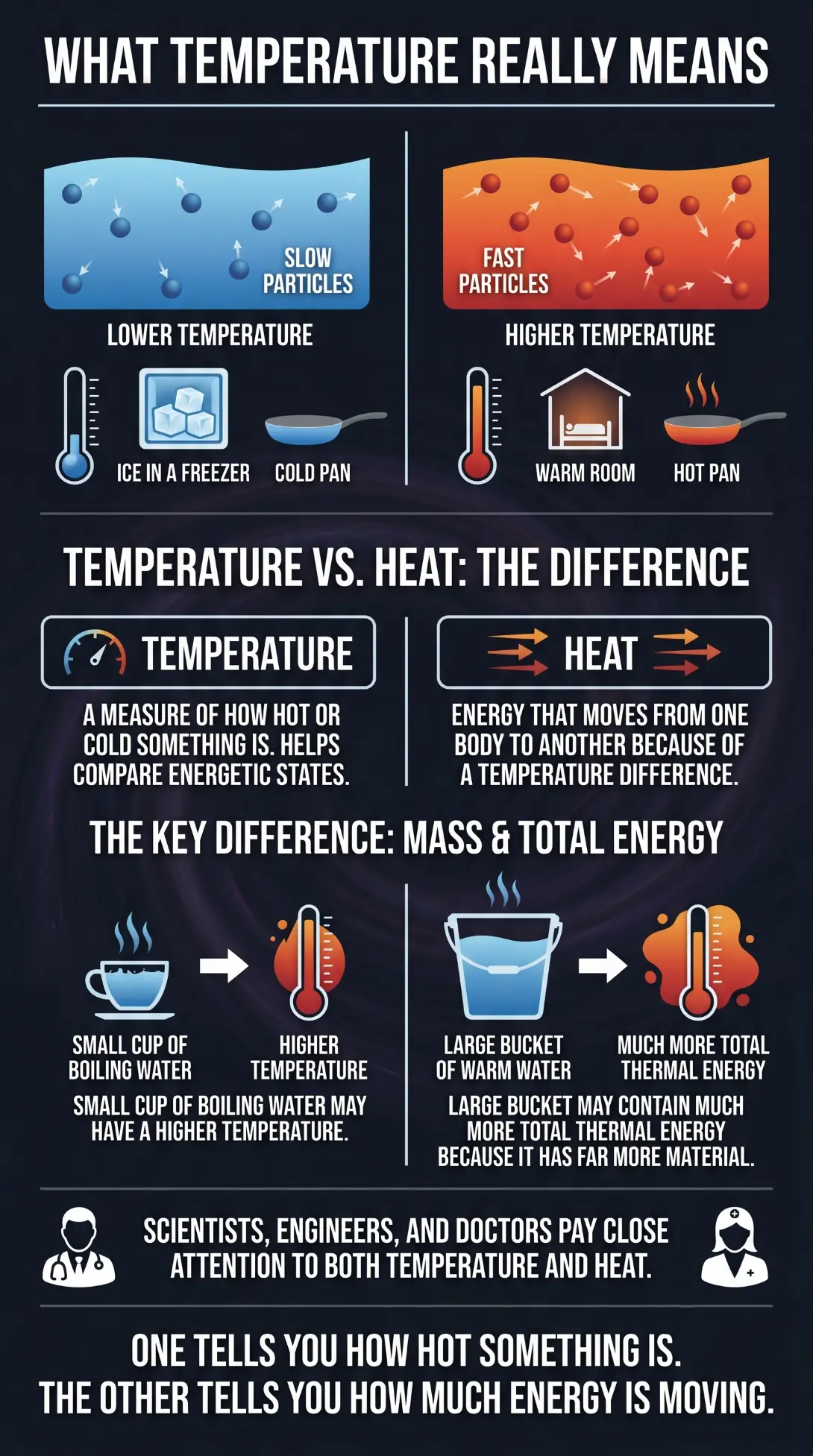
In simple language, temperature tells us how hot or cold something is. In physics, it is linked to the energy of particles inside a substance. When particles move faster, the temperature is usually higher. When they move more slowly, the temperature is lower. That is why a hot pan, a warm room, and ice in a freezer all feel different. Temperature is not the same as heat, though people often use the words interchangeably. Heat is energy that flows from one body to another due to a temperature difference, while temperature is a measure that helps us compare how hot or cold something is.
This difference matters more than many people realize. A small cup of boiling water may have a higher temperature than a large bucket of warm water, but the bucket may contain much more total thermal energy because it has far more material. That is why scientists, engineers, and doctors pay close attention to both temperature and heat. One tells you how hot something is. The other tells you how much energy is moving.
Temperature vs Heat vs Thermal Energy
| Term | What it means | Common unit | Easy example | Why it matters |
|---|---|---|---|---|
| Temperature | A measure related to how energetic the particles in a body are | Kelvin (K), Celsius (°C), Fahrenheit (°F) | A room at 25°C | Helps compare hotness and coldness |
| Heat | Energy is transferred because of a temperature difference | Joule (J) | A hot spoon warming a cool hand | Explains warming and cooling processes |
| Thermal energy | The total internal energy related to particle motion in a substance | Joule (J) | A large pot of warm soup | Shows how much energy the whole object contains |
| Thermodynamic temperature | The absolute temperature used in scientific measurement | Kelvin (K) | 300 K for room conditions | Essential in physics and chemistry |
| Thermal equilibrium | State where two bodies have the same temperature and no net heat flows between them | No special unit | Tea and room air eventually match | Important in weather, engineering, and experiments |
The key idea is simple. Temperature is not about size, and it is not the same as total energy. A tiny object can be much hotter than a large one. A large object can store more total heat even if it feels only lukewarm. That is why the word gets used so often in science, weather, medicine, and everyday conversation.
Why Temperature Is So Important
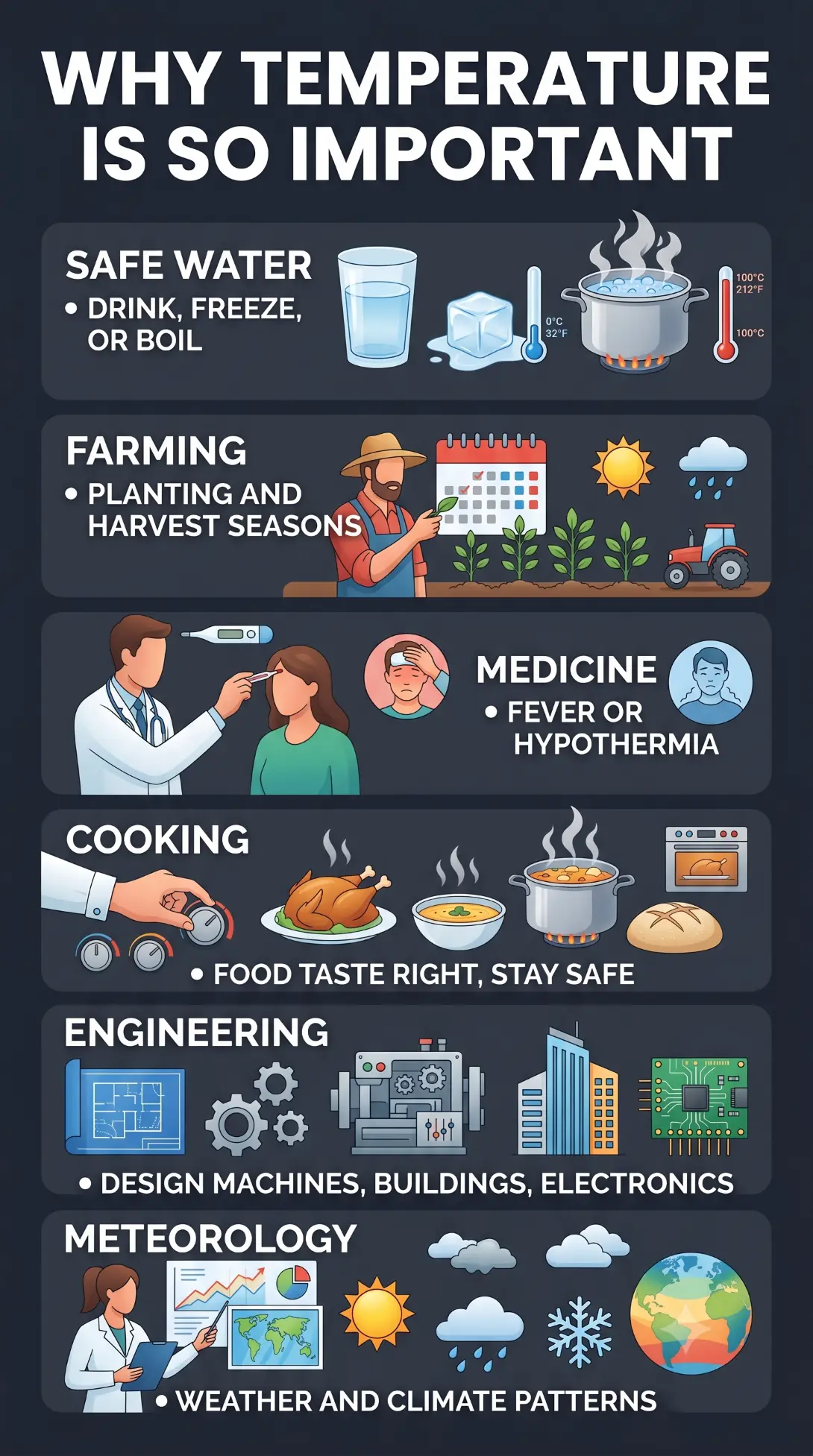
We usually notice temperature only when it becomes uncomfortable. But it quietly affects almost everything around us.
- It tells us whether water is safe to drink, freeze, or boil.
- It helps farmers understand planting and harvest seasons.
- It guides doctors when they check for fever or hypothermia.
- It helps chefs make food taste right and stay safe.
- It helps engineers design machines, buildings, and electronics.
- It helps meteorologists describe weather and climate patterns.
And beyond daily life, temperature is a major idea in physics. It connects to motion, pressure, phase changes, and the behavior of gases. In science, very small differences in temperature can produce big changes in material properties, chemical reactions, and living systems.
The Main Temperature Scales
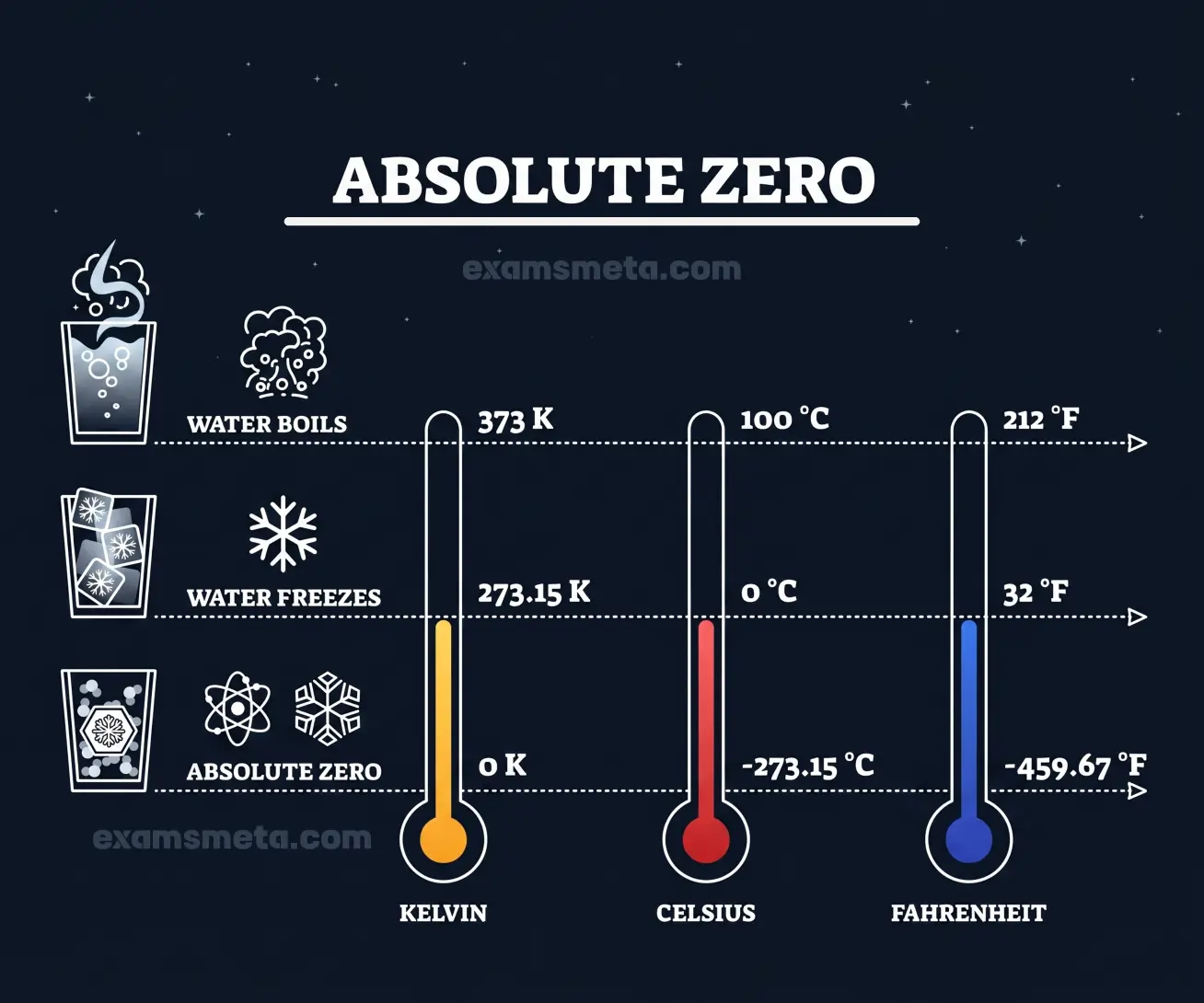
Different parts of the world use different scales, but the three most common ones are Celsius, Fahrenheit, and Kelvin. The kelvin is the SI unit of thermodynamic temperature. The Celsius scale is widely used across the world for daily weather and everyday life. Fahrenheit remains common in some countries, especially for weather and body temperature. The kelvin is used most often in science. One Celsius degree is equal in size to one kelvin, and a change of 1°C corresponds to a change of 1.8°F.
Temperature Scale Overview
| Scale | Symbol | Reference point | Common use | Strength | Example |
|---|---|---|---|---|---|
| Celsius | °C | Water freezes at 0°C, boils at about 100°C | Weather, kitchens, classrooms, labs | Easy for daily life | A pleasant day may be around 25°C |
| Fahrenheit | °F | Water freezes at 32°F, boils at 212°F | Daily weather in some countries, body temperature | Fine detail in familiar human ranges | A warm day may be around 86°F |
| Kelvin | K | 0 K is absolute zero | Physics, chemistry, engineering | Best for scientific formulas | Room temperature is about 300 K |
| Rankine | °R | Absolute scale based on Fahrenheit intervals | Some engineering contexts | Useful in some U.S. technical work | Rare in general use |
Helpful Conversion Formulas
- C = (F – 32) × 5/9
- F = (C × 9/5) + 32
- K = C + 273.15
- C = K – 273.15
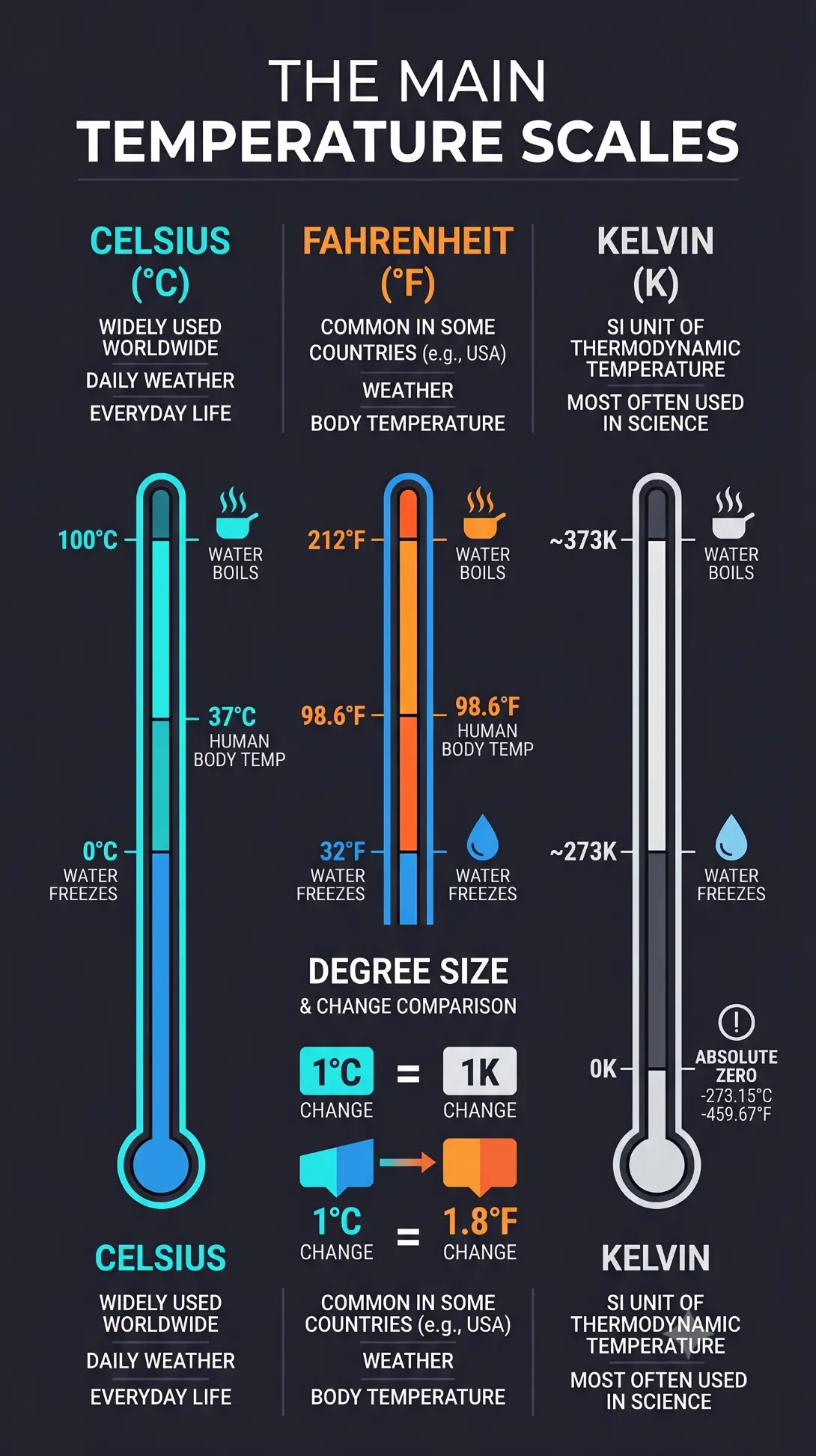
These formulas are standard reference conversions. They also show something important. The temperature interval in Celsius and Kelvin is the same size, even though the zero point is different. In the Celsius scale, water freezes at 0°C. In the Kelvin scale, that same point is 273.15 K.
Quick Reference Table for Common Values
| Situation | Celsius | Fahrenheit | Kelvin |
|---|---|---|---|
| Absolute zero | -273.15°C | -459.67°F | 0 K |
| Very cold freezer range | -18°C | 0°F | 255.15 K |
| Ice melting point | 0°C | 32°F | 273.15 K |
| Cool indoor room | 20°C | 68°F | 293.15 K |
| Warm room | 25°C | 77°F | 298.15 K |
| Boiling point of water | 100°C | 212°F | 373.15 K |
The idea of absolute zero is especially important. It is the lowest possible thermodynamic temperature. NIST notes it as 0 K, which corresponds to -273.15°C and -459.67°F. That gives scientists a fixed reference point for the coldest temperature in theory.
How Temperature Is Measured
Temperature is measured with a thermometer or a digital sensor. In older classrooms, people often picture a glass thermometer with a liquid inside. Today, digital sensors are common in homes, hospitals, factories, weather stations, and laboratories. The basic job is still the same. The device responds to a change in temperature and converts that change into a readable number. NIST and NOAA both emphasize the importance of accurate measurement in science, weather, and data collection.
There are several kinds of temperature measuring tools.
- Liquid-in-glass thermometers, which use the expansion of a liquid
- Digital thermometers, which use electronic sensors
- Infrared thermometers, which measure emitted infrared radiation
- Thermocouples, used in industrial and scientific work
- Resistance temperature detectors, often used where precision matters
- Thermistors, common in electronic devices and medical tools
Each one has a job. A kitchen thermometer may need to be simple and fast. A laboratory sensor may need to be extremely precise. A weather station may need to work outside in changing wind, rain, and sunlight. The right tool depends on the setting.
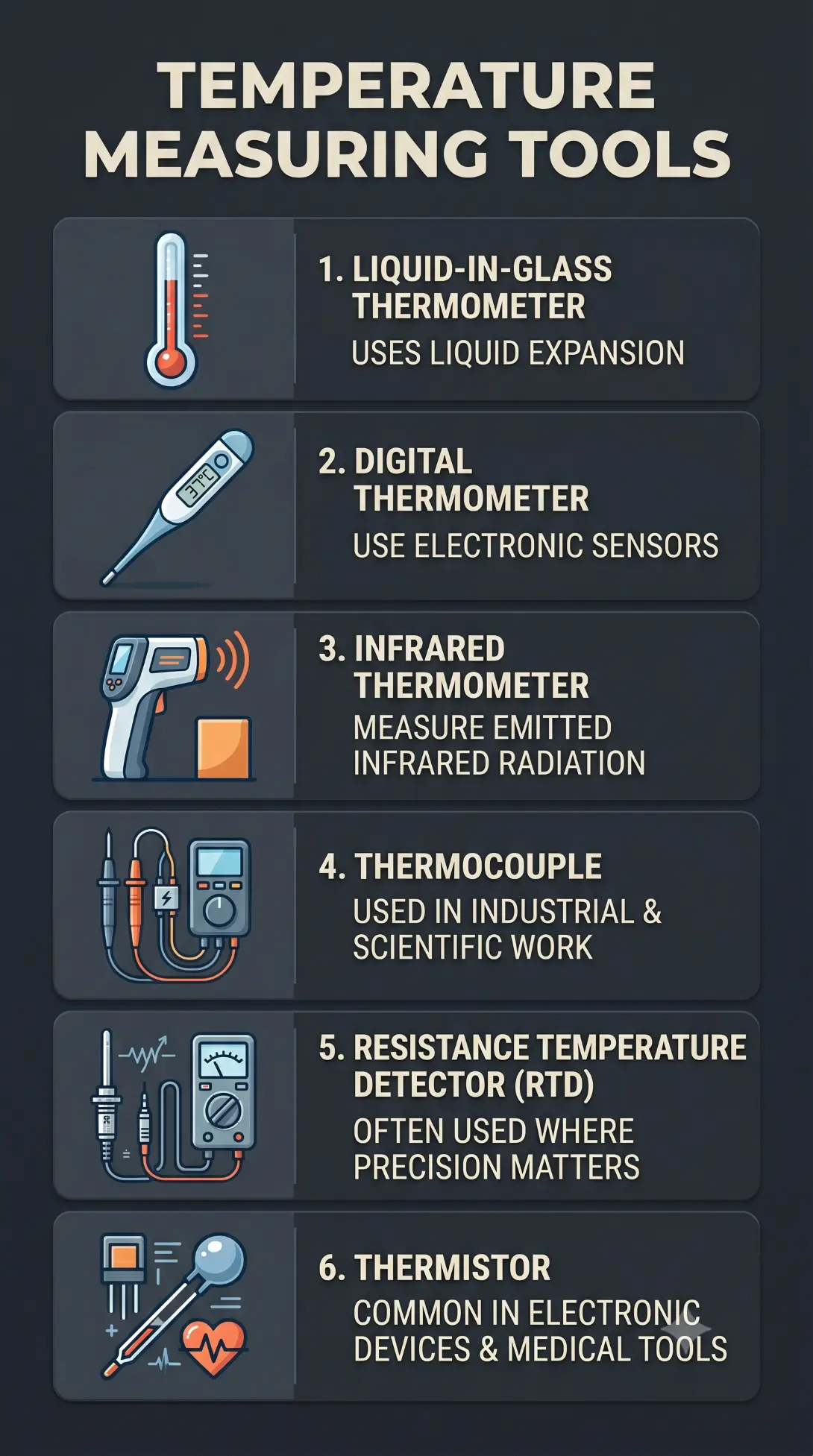
Table of Common Temperature Measuring Tools
| Tool | How it works | Best for | Strength | Limitations |
|---|---|---|---|---|
| Liquid-in-glass thermometer | Liquid expands or contracts with temperature | School labs, basic measurement | Simple and reliable | Fragile, slower response |
| Digital thermometer | An electronic sensor converts temperature to numbers | Home and medical use | Fast and easy to read | Battery dependent |
| Infrared thermometer | Detects radiation from a surface | Cooking, industrial checks, quick scanning | Non-contact, very fast | Surface reading only, not deep internal temperature |
| Thermocouple | Uses voltage created by two metals | Industry, ovens, engines | Wide range, durable | Needs calibration |
| RTD | Electrical resistance changes with temperature | Laboratories, precision systems | High accuracy | More expensive |
| Thermistor | Resistance changes strongly with temperature | Electronics, medical devices | Sensitive and compact | Narrower range |
Why the Kelvin Scale Matters in Science
The Kelvin scale is the cleanest scale for scientific calculations because it starts from absolute zero. That matters in physics and chemistry, especially when scientists study gases, energy transfer, and thermodynamic laws. At very low temperatures, the Kelvin scale avoids the confusion of negative values in formulas where only absolute temperature makes sense. NIST explains that the kelvin is the SI unit of thermodynamic temperature and is defined through a fixed value of the Boltzmann constant.
In simple classroom terms, you can think of Kelvin as the science scale that starts at the lowest possible temperature. Celsius is the everyday scale that most people find easy to understand. Fahrenheit is still useful in places where that system is deeply familiar. All three are useful, but they serve different purposes.
Temperature in Everyday Life
Temperature is not only a scientific idea. It is part of routine life from morning to night.
In the home
- It decides whether tea is comforting or scorching.
- It affects how fast food spoils.
- It changes how comfortable a room feels.
- It influences heating, cooling, and electricity bills.
In the kitchen
- Bread rises differently depending on the room and oven temperature.
- Meat, milk, and leftovers must be kept at safe temperatures.
- Oil behaves differently when it is cold versus hot.
- Chocolate melts, sets, and shines based on temperature control.
In clothing
- People wear lighter fabrics in hot weather.
- They layer clothes in cold weather.
- Materials like wool and cotton feel different because of how they handle body heat.
In travel
- Roads, tires, engines, and batteries all respond to temperature changes.
- Air pressure changes with temperature, which can matter in aircraft and vehicles.
- Snow, ice, rain, and heat all affect travel safety.
Temperature and Weather
When people say, “What’s the temperature today?” they usually mean the air temperature outside. Weather services use temperature as one of the main signs of current conditions. NOAA explains that weather describes short-term atmospheric conditions, while climate describes average weather over a longer time. That means temperature can be talked about in two ways. It can describe what is happening right now, and it can also describe the long-term pattern of a place.
A weather forecast may include:
- High temperature
- Low temperature
- Feels-like temperature
- Humidity
- Wind speed
- Cloud cover
- Rain chance
A hot day can feel even hotter when the air is humid and still. A cool day can feel colder when wind removes body heat quickly. So the number on the thermometer is important, but it does not tell the whole story. That is why weather reports often include more than just the raw temperature.
Weather, Climate, and Ocean Temperature
Temperature also matters far beyond a single town or city. NOAA notes that El Niño and La Niña are climate patterns linked to changes in ocean temperatures in the equatorial Pacific, and those changes can affect weather worldwide. That is a powerful reminder that a temperature shift in one part of the ocean can influence rainfall, storms, and seasonal patterns far away. Climate is not just about land heat. It is also about the oceans and the atmosphere working together.
Temperature and the Human Body
The human body keeps its internal temperature within a narrow range because enzymes, organs, and cells work best when conditions stay stable. Body temperature can vary from person to person and during the day. The NHS notes that normal body temperature is different for everyone and changes during the day, and that a high temperature in adults is usually considered 38°C or above. The NHS also notes that in children, a temperature of 38°C or more is considered a high temperature. A temperature below 35°C is considered hypothermia, which is a medical emergency.
This is why body temperature matters so much in health checks.
A thermometer can help identify:
- Fever
- Hypothermia
- Heat stress
- Possible infection
- Recovery progress
It is also why doctors pay attention to the way the temperature was measured. A reading from the mouth, ear, forehead, or underarm may differ slightly. The body is not a machine with one fixed number every minute of the day. It changes with time, activity, hydration, and illness.
Body Temperature Reference Table
| Condition | Typical meaning | Common reading | What it may suggest |
|---|---|---|---|
| Normal body temperature | Usual range, varies by person | Around 37°C | Healthy baseline for many people |
| High temperature/fever | Body temperature above normal | 38°C or more | Possible infection or illness |
| Hypothermia | Dangerous drop in body temperature | Below 35°C | Medical emergency |
| Heat stress | Body struggling in hot conditions | Varies | Risk of dehydration and overheating |
Temperature is not a diagnosis by itself. But it is a useful clue. A person can look fine and still have an abnormal reading, or feel unwell while the number is only slightly changed. That is why temperature is one piece of a larger health picture.
Temperature in Cooking and Food Safety
In the kitchen, temperature is both a craft and a safety issue. Cooking changes food by altering proteins, starches, fats, and moisture. Some foods need high heat to become safe. Others need lower heat to keep texture, flavor, and nutrition. If the temperature is too low, food may not cook properly. If it is too high, food can dry out, burn, or lose quality.
A few practical examples:
- Baking depends on a steady oven temperature.
- Boiling is used for pasta, eggs, soup, and sanitation.
- Simmering keeps sauces and stews gentle.
- Freezing slows spoilage.
- Refrigeration slows bacterial growth.
Even outside formal food safety rules, most people know the difference between a fridge-cold drink, a warm meal, and a smoking-hot pan. Temperature changes the way food tastes, smells, looks, and feels. It also affects how long food stays fresh.
Temperature in Industry and Technology
Factories, labs, power plants, and data centers all depend on temperature control. Machines can overheat. Chemicals can react differently when heated or cooled. Metals expand when warm and contract when cool. Electronics may fail if they get too hot. Batteries also behave differently at different temperatures.
Industrial and Technical Uses of Temperature
| Area | Why temperature matters | Typical example | Main risk if uncontrolled |
|---|---|---|---|
| Manufacturing | Helps shape metals, plastics, and glass | Heating metal before forming | Weak parts or damaged material |
| Electronics | Prevents overheating in chips and circuits | Cooling a laptop or server | Performance loss or shutdown |
| Energy systems | Supports turbines, boilers, and engines | Steam power generation | Lower efficiency or damage |
| Chemistry | Affects reaction speed and product quality | Controlling a lab experiment | Wrong results or unsafe reactions |
| Construction | Materials expand and contract | Bridges and rail tracks | Cracks, warping, or stress |
| Medicine | Keeps samples and equipment stable | Vaccine storage | Loss of potency |
Temperature control is not a side issue. It is built into the design of modern life. Without it, the machines we rely on would be less safe, less accurate, and less durable.
What Affects Temperature
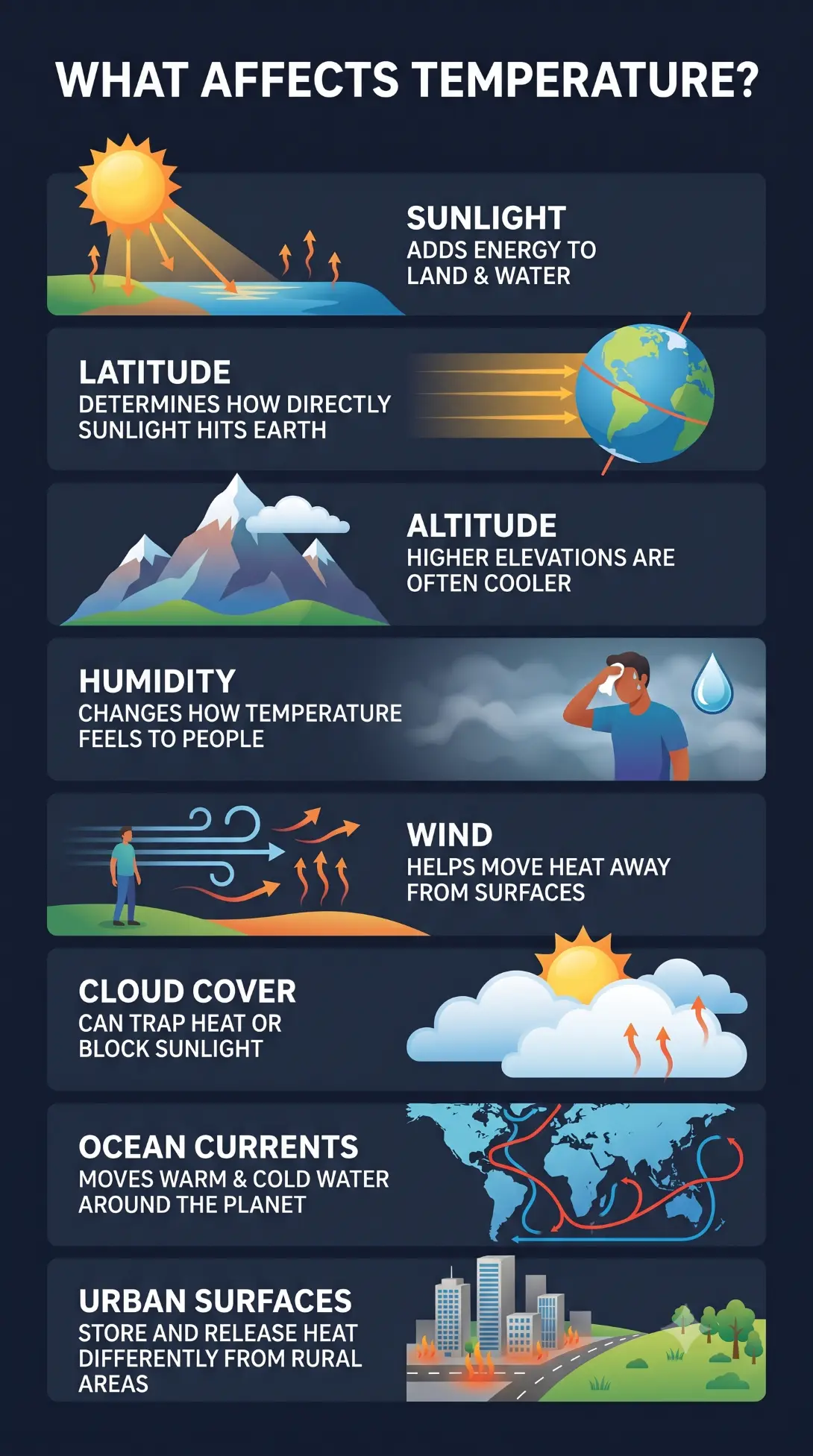
Temperature is influenced by many factors, and they often work together.
- Sunlight, which adds energy to land and water
- Latitude, which affects how directly sunlight hits Earth
- Altitude, since higher places are often cooler
- Humidity, which changes how temperature feels to people
- Wind, which helps move heat away from surfaces and skin
- Cloud cover, which can trap heat or block sunlight
- Ocean currents, which move warm and cold water around the planet
- Urban surfaces, which can store and release heat differently from rural areas
This is why two places at the same latitude can still feel very different. Mountains, coastlines, deserts, forests, and city centers all create their own temperature patterns.
Simple Examples That Make Temperature Easy to Understand
Here are a few everyday examples that help make the idea feel real.
- A metal spoon in a hot cup of tea becomes warm quickly because metal transfers heat well.
- A blanket does not create heat by itself, but it helps keep your body heat from escaping too quickly.
- A cold drink left in a sunny room warms up because energy moves from the warmer air to the cooler drink.
- Ice melts in a warm kitchen because the surrounding environment gives it heat.
- A laptop fan turns on because the internal temperature rises during heavy work.
These examples show that temperature is always part of a bigger exchange. Heat moves. Materials respond. Conditions change. And the result is often something you can feel in your hands.
Common Misconceptions About Temperature
People often hear ideas about temperature that sound true but are not quite right.
Misconception 1: Temperature and heat are the same
They are related, but not the same. Temperature is a measure. Heat is energy in motion.
Misconception 2: A larger object is always hotter
Not necessarily. A large object can contain more total thermal energy, but its temperature may still be lower than that of a smaller object.
Misconception 3: One thermometer reading tells the whole story
Not always. Humidity, wind, surface type, and method of measurement all matter.
Misconception 4: Body temperature is always exactly 37°C
No. It varies from person to person and across the day. The NHS notes that normal body temperature differs and changes during the day.
Temperature and Climate Change
Temperature is one of the clearest signs people notice when the climate changes. Even small shifts in average temperature can affect rainfall, melting ice, crop seasons, drought risk, and heat stress. NOAA provides climate data, weather tools, and information for tracking these changes over time, which is important because climate is about long-term patterns, not just one hot afternoon.
Warming oceans can also affect global weather. That matters because oceans store huge amounts of heat and help move energy around the planet. When ocean temperature patterns change, the atmosphere often responds too. This is one reason temperature is so closely tied to storms, seasons, rainfall, and agriculture.
How to Read Temperature Like a Pro
A lot of people glance at a number and stop there. But there is more to learn from a temperature reading.
Look at:
- The unit, because °C, °F, and K mean different things
- The location, because indoor and outdoor readings can differ
- The time of day, because temperatures change naturally
- The humidity, because it changes how hot or cold it feels
- The trend, because rising or falling readings often matter more than one number
- The context, because a kitchen, hospital, lab, and weather station all use temperature differently
This habit makes the reading more useful. The number matters. The situation matters too.
Temperature in Science Classes and Lab Work
Students often meet temperature early, but the idea becomes deeper over time. In school experiments, temperature helps with:
- Melting and freezing
- Evaporation and condensation
- Gas behavior
- Solution mixing
- Reaction rates
- Thermal expansion
A simple classroom test can show how temperature changes a material. Warm water dissolves sugar faster than cold water. Ice melts faster in a warm room. Air in a balloon expands when heated. These small observations are the doorway to bigger scientific laws.
A Practical Table of Temperature in Daily Life
| Area of life | What temperature controls | Common example | Everyday result |
|---|---|---|---|
| Home comfort | Indoor warmth or coolness | Air conditioner, heater, fan | Better sleep and comfort |
| Weather | Hot days, cold nights, seasonal shifts | Forecast high and low values | Helps with planning travel and clothing |
| Health | Body temperature changes | Thermometer check during illness | Helps spot fever or hypothermia |
| Cooking | Food texture and safety | Oven, stove, freezer | Better taste and safer meals |
| Sports | Body cooling and dehydration risk | Running in hot weather | Better pacing and hydration |
| Industry | Machine reliability | Engine cooling systems | Less wear and fewer failures |
| Science | Reaction and material behavior | Laboratory experiment | Accurate results |
| Agriculture | Growth and harvest timing | Seasonal planting | Better crop yield |
The Human Side of Temperature
Temperature is not only about numbers. It also shapes mood, habits, and comfort. People often remember seasons by how they felt, not by the exact readings. A cold morning can make you move slowly. A hot afternoon can make concentration harder. A mild evening can feel peaceful and easy. That emotional side of temperature is real. It affects how we dress, where we go, what we eat, and how we spend the day.
And that is one reason the topic stays important in every country, every climate, and every age group. It is scientific, yes. But it is also deeply human.
Final Thoughts
Temperature is one of the simplest words in science, but it has a wide reach. It explains why ice melts, why food cooks, why engines need cooling, why we feel hot or cold, and why weather changes from place to place. It helps doctors, scientists, farmers, cooks, engineers, and ordinary people make better decisions every day. It is a number, yes. But it is also a way of understanding the world.
And once you really notice it, you start seeing temperature everywhere. In the steam from a cup of tea. In the chill of early morning air. In the hum of a laptop fan. In a weather forecast. In a thermometer. In the quiet balance that keeps the human body working well. That is what makes temperature such a powerful idea. It is simple to say, but it reaches into almost everything.
Article References and Sources
- NIST: SI Units and Temperature
- NIST: Introduction to the Kelvin
- NOAA: Climate vs. Weather
- NOAA Ocean Service: El Niño and La Niña Facts
- NHS: Fever and High Temperature in Adults
- NCEI: Climate and Weather Data
- NOAA Climate Program
Also, Read these Articles in Detail
- Physics and Its Fundamentals With Good Explanations
- Matter, Motion, and Energy: The Core Ideas of Physics
- What Is Matter? The Physical Substance of the Universe
- What Is Motion? A Guide to Motion in Physics and Daily Life
- What Is Energy? The Invisible Power Behind Everyday Life
- Kinetic Energy Explained in Simple Language
- Potential Energy: Definition, Types, Formula, and Examples
- Thermal Energy: Heat, Temperature, and Transfer
- Mechanical Energy: Definition, Formula, and Examples
- Chemical Energy: Definition, Science, and Examples
- Electrical Energy: Definition, Works, and Why It Matters
- Radiant Energy: Meaning, Sources, Examples, and Uses
- Nuclear Energy: Definition, How It Works, and Why It Matters
- Sound Energy: Definition, Science, and Examples
- Elastic Energy: Definition, Elasticity, and Example
- Geothermal Energy: Clean Electricity, Heating, and Modern Life
- Hydropower Energy: How It Works and Its Importance
- Pumped Hydropower Storage
- Force: Meaning, Types, Formula, and Examples
- Mechanics: Motion, Forces, Energy, and Applications
- Wave: Types, Properties, Motion, and Uses
- The International SI System
Frequently Asked Questions
FAQ 1. What is temperature in simple words?
Temperature is a measure of how hot or cold something is. That sounds simple, and it is, but the idea behind it is powerful. In science, temperature tells us something about the movement of particles inside a substance. When those particles move faster, the temperature is usually higher. When they move more slowly, the temperature is lower.
In daily life, we use temperature all the time without thinking much about it. We check the weather, heat food, notice when water feels warm, and take body temperature when someone is sick. It helps us understand comfort, safety, and even how materials behave. A room at 20°C feels very different from one at 40°C, and that difference changes the way people, plants, machines, and foods respond.
Temperature is also important because it is one of the most basic ideas in physics. It connects to heat, energy, pressure, state changes, and weather patterns. So while the word itself is short, the meaning is wide. It is one of those simple concepts that quietly shapes almost everything around us.
FAQ 2. What is the difference between heat and temperature?
Heat and temperature are related, but they are not the same thing. This is one of the most common misunderstandings, and it matters in science and everyday life.
Temperature tells you how hot or cold something is. It is a measure of the average energy of motion of particles in a body. Heat, on the other hand, is energy that moves from one place to another because of a temperature difference. In other words, temperature is the condition, while heat is the transfer of energy.
A very small cup of boiling water may have a high temperature, but a large pot of warm water may contain more total heat energy because it has much more matter in it. That is why the two terms cannot be used as exact replacements for each other.
You can think of it like this. Temperature is the reading on the thermometer. Heat is the energy flow that happens because something is hotter than something else. That’s why a metal spoon can become warm quickly in tea, or why ice melts when it absorbs heat from the room. The temperature difference creates the movement of heat.
This distinction is especially important in cooking, climate science, engineering, and medicine. If you understand it clearly, a lot of other science becomes easier to follow.
FAQ 3. What are the main temperature scales?
The most common temperature scales are Celsius, Fahrenheit, and Kelvin. Each one is useful in a different way.
Celsius is the scale most people use in daily life around the world. Water freezes at 0°C and boils at about 100°C. It is simple and easy to understand for weather, cooking, and everyday temperature checks.
Fahrenheit is still used in some countries, especially for weather and body temperature. In this scale, water freezes at 32°F and boils at 212°F. It gives more numerical steps between common weather temperatures, which some people find helpful.
Kelvin is the scientific scale. It starts at absolute zero, which is 0 K. This makes it very useful in physics, chemistry, and engineering because it is an absolute scale. Scientists often use Kelvin when they need formulas to work cleanly with thermodynamic calculations.
A useful way to remember them is this. Celsius is the everyday metric scale, Fahrenheit is the familiar scale in some regions, and Kelvin is the scientific absolute scale. All three describe temperature, but they do it in different ways.
FAQ 4. What is absolute zero?
Absolute zero is the lowest possible temperature in the thermodynamic sense. It is 0 K, which is equal to -273.15°C and -459.67°F. At this point, particles have the lowest possible thermal motion allowed by physics.
That does not mean everything suddenly stops in a simple, everyday sense. But it does mean the system has reached the lowest theoretical temperature scale used in science. Because of that, absolute zero is a very important reference point in physics.
Scientists use it to understand how gases, solids, and energy behave at very low temperatures. It also helps define the Kelvin scale, which begins at this point. This is one reason the Kelvin scale is so useful in scientific work. It avoids negative values in many physical formulas and gives a clean foundation for measuring thermal processes.
In simple language, absolute zero is the coldest temperature science can define. It is not just an extreme number. It is a major concept in thermodynamics and one of the most important reference points in temperature measurement.
FAQ 5. How is temperature measured?
Temperature is measured with a thermometer or a temperature sensor. Different tools are used in different settings.
A simple liquid-in-glass thermometer works because a liquid expands when it gets warm and contracts when it gets cold. Many homes and schools used this type for years. Today, digital thermometers are much more common because they are quick, easy to read, and often more convenient.
There are also infrared thermometers, which measure the radiation coming from a surface without touching it. These are useful in cooking, industrial work, and quick health checks. In labs and factories, people may also use thermocouples, thermistors, or resistance temperature detectors for more precise work.
No matter which tool is used, the basic idea is the same. The device senses a temperature change and converts it into a reading. That reading may appear in °C, °F, or K, depending on the situation.
The quality of the reading depends on the tool, the environment, and the way it is used. That is why accurate temperature measurement matters in science, medicine, weather reports, food safety, and industry.
FAQ 6. Why is temperature important in daily life?
Temperature matters in daily life because it affects comfort, health, food, clothing, travel, and work. It is one of those things that quietly controls many parts of the day.
At home, temperature affects how warm or cool a room feels. It changes whether you need a fan, heater, or air conditioner. In the kitchen, it decides whether food cooks properly, stays fresh, or spoils too quickly. In clothing, it helps you choose between light fabrics, warm layers, or rain protection.
Temperature also matters for health. A fever can signal illness, and a low body temperature can be dangerous. In travel, temperature affects road conditions, battery life, tire pressure, engine performance, and safety. In farming, it helps determine when to plant, grow, and harvest crops.
Even emotions can be influenced by temperature. A hot, sticky afternoon feels different from a cool evening breeze. People plan their routines around it every single day, even when they do not notice it directly.
So temperature is not just a science term. It is a practical part of life that shapes how we live, move, eat, rest, and work.
FAQ 7. What is the normal human body temperature?
Normal body temperature is not the same for everyone, and it can change during the day. The common idea of 37°C is only a general reference, not a fixed rule for every person.
A high temperature or fever is usually considered 38°C or above in adults and in children. A temperature below 35°C may indicate hypothermia, which is a medical emergency. But body temperature should always be interpreted with symptoms, age, activity, and measurement method in mind.
For example, body temperature may rise slightly after exercise, during the afternoon, or after eating. It can also vary depending on whether it is taken from the mouth, ear, forehead, or underarm. That is why doctors do not rely on the number alone.
The important thing is to notice patterns. If someone feels weak, shivery, confused, or unusually hot or cold, temperature measurement becomes a useful clue. It is one of the simplest ways to check whether the body is handling its internal balance properly.
So while 37°C is a familiar reference point, the real answer is more flexible. Normal body temperature can vary, and context matters.
FAQ 8. How does temperature affect weather and climate?
Temperature is one of the biggest factors in weather and climate. Weather is the short-term condition of the atmosphere. Climate is the long-term average pattern of weather in a place. Temperature helps describe both.
On a daily level, temperature tells us whether a day is hot, mild, cold, or freezing. It affects how much clothing people wear, how much electricity is used for cooling or heating, and how comfortable outdoor activities feel. It also changes with sunlight, wind, humidity, clouds, altitude, and season.
On a larger scale, temperature helps shape climate zones. Areas near the equator are usually warmer. Places at higher altitudes are often cooler. Oceans store and move heat, which influences regional weather patterns. Climate events like El Niño and La Niña are also linked to changes in ocean temperature, and those changes can affect rainfall, storms, droughts, and seasonal shifts in many parts of the world.
This is why temperature is such a key measurement in meteorology and climate science. One reading tells you what is happening now. A long series of readings tells you how the climate is changing over time.
FAQ 9. Why does temperature matter in cooking and food safety?
Temperature plays a huge role in cooking and food safety. It affects taste, texture, color, and whether food is safe to eat.
When food is cooked at the right temperature, proteins change properly, starches soften, and flavors develop well. Baking, roasting, boiling, frying, and simmering all depend on controlled heat. If the temperature is too low, food may stay raw or unsafe. If it is too high, food can burn, dry out, or lose its quality.
Temperature also matters after cooking. Food left too long in the wrong temperature range can spoil faster because bacteria grow more easily in unsafe conditions. That is why people refrigerate leftovers, freeze some foods, and avoid keeping cooked meals at room temperature for too long.
A cold fridge slows down spoilage. A hot oven cooks food evenly. A thermometer helps check whether meat, soup, or baked dishes have reached the right internal temperature. So temperature is not just about making food taste good. It is also about protecting health.
In everyday life, a safe kitchen depends on good temperature control. That is why cooks, bakers, and food handlers pay close attention to it.
FAQ 10. What are some real-life examples of temperature in action?
There are countless real-life examples of temperature at work.
A cup of tea cools down because it gives heat to the surrounding air. Ice melts in a warm room because the environment transfers heat to it. A spoon placed in hot soup becomes warm because metal carries heat quickly. A laptop heats up when it runs for a long time because its internal parts generate energy and need cooling. A fan makes a room feel cooler because it helps move warm air away from your skin, even though it does not lower the room’s actual temperature by itself.
Weather is another clear example. A summer afternoon may be hot enough to make pavement uncomfortable to walk on. A winter night may be cold enough to freeze water. A mild spring morning may feel perfect for a walk because the temperature is balanced.
In science, temperature changes can affect chemical reactions, material strength, and gas behavior. In medicine, it can show fever or hypothermia. In farming, it can decide what crops survive. In buildings, it can affect energy bills and comfort. In vehicles, it can influence engine performance and battery life.
So temperature is not an abstract idea sitting in a textbook. It is a living part of daily experience. It shapes the physical world in ways people notice every hour of the day, even if they do not always think about it directly.
FAQ 11. Why do different materials feel hot or cold at the same temperature?
Different materials can feel very different even when they are at the same temperature because they transfer heat at different speeds. This is why a metal chair may feel much colder than a wooden chair in the same room. The metal is usually not colder in an actual temperature sense. It just pulls heat away from your skin faster. Wood does that more slowly, so it feels warmer to the touch.
This idea is tied to thermal conductivity, which is a material’s ability to pass heat through itself. Metals usually conduct heat very well, so they quickly take heat from your hand or give heat to your skin. Materials like wood, plastic, rubber, and cloth are usually poorer conductors, so they do not move heat as fast. That is why a metal spoon in hot soup gets hot quickly, but a wooden spoon does not.
So when people say something “feels cold,” they are often talking about how fast it steals heat from the body, not just the actual temperature reading. This is a small detail, but it explains a lot of everyday experience. It is also why winter gloves, oven mitts, and insulated cups work so well. They slow heat transfer and help keep temperature changes under control.
FAQ 12. What is the relationship between temperature and particle motion?
Temperature is closely linked to the motion of particles inside matter. Everything around us is made of tiny particles, even things that look solid and still. These particles are always moving in some way. In a gas, they move freely and fast. In a liquid, they move around one another. In a solid, they vibrate in fixed positions. When the temperature goes up, the motion of those particles usually becomes more energetic.
That does not mean every particle in a substance moves at the same speed. It means the average kinetic energy of the particles is higher at a higher temperature. That is one of the basic scientific ideas behind temperature. The hotter something is, the more active its particles tend to be. The cooler it is, the less active they tend to be.
This connection helps explain many physical changes. For example, when a substance heats up, it may expand because particles push a little farther apart. When it cools down, it may contract. That is why bridges, rails, and buildings need to be designed with temperature changes in mind. It also explains why substances melt, boil, freeze, and condense at different temperatures.
So temperature is not just a number on a device. It is a reflection of how much motion is happening at the microscopic level. That is what gives the concept its real scientific meaning.
FAQ 13. Why does water freeze at 0°C and boil at 100°C?
At normal atmospheric pressure, water freezes at 0°C and boils at 100°C because those are the standard phase-change points on the Celsius scale. These points became useful reference markers because they are easy to reproduce under ordinary conditions. Freezing happens when water molecules lose enough energy to arrange themselves into a solid structure. Boiling happens when water molecules gain enough energy to escape into the air as vapor.
It is important to remember that these values are not magical numbers that never change. They depend on pressure. At higher altitudes, where air pressure is lower, water boils at a lower temperature. In a pressure cooker, where pressure is higher, water boils at a temperature above 100°C. That is why cooking times can change in the mountains or in special kitchen equipment.
This is one of the best examples of how temperature and pressure work together in real life. A simple household fact, like water boiling in a pot, is actually a window into deeper science. It shows how matter responds when energy is added or removed. It also shows why the Celsius scale is so practical. Its reference points are easy to remember and useful in daily life.
FAQ 14. What is the Celsius scale used for?
The Celsius scale is used for measuring temperature in everyday life, education, weather, cooking, and most scientific work outside of absolute-temperature calculations. It is one of the easiest scales for people to understand because its reference points are familiar. 0°C is the freezing point of water, and 100°C is the boiling point of water at standard pressure.
This makes Celsius very practical. A weather report saying 28°C or 12°C gives a clear sense of warmth or cold without needing extra explanation. A cooking recipe can refer to 180°C or 200°C, and most people can quickly understand oven settings. A laboratory experiment can record temperature changes in Celsius and still connect those numbers to the Kelvin scale when needed.
The scale is especially useful because it has a clean relationship with Kelvin. One degree Celsius is the same size as one kelvin. The only difference is the starting point. That makes conversions simple and keeps scientific work consistent. So Celsius is not just a common scale. It is one of the most practical temperature systems in the world.
FAQ 15. What is the Fahrenheit scale, and where is it used?
The Fahrenheit scale is another way of measuring temperature. On this scale, water freezes at 32°F and boils at 212°F. It is still used in some countries, especially for weather forecasts, cooking, and body temperature.
Some people find Fahrenheit helpful because it gives more steps between typical outdoor temperatures. For example, differences like 70°F, 75°F, and 80°F may feel easy to compare. In that sense, the scale can seem very detailed in the range where people spend most of their time. That is one reason it remains familiar in everyday communication in certain places.
But Fahrenheit is not the main scientific scale. In physics and chemistry, Kelvin is usually preferred, and in many parts of the world, Celsius is the standard everyday scale. Still, Fahrenheit remains important because it is widely used in some regions and is part of how many people have learned to think about temperature from childhood.
So the Fahrenheit scale is not outdated. It is simply one of the major ways humans have chosen to describe hot and cold. It continues to be useful wherever it is already part of daily life.
FAQ 16. Why do scientists use Kelvin instead of Celsius in formulas?
Scientists often use Kelvin because it is an absolute scale. That means it starts at absolute zero, the lowest possible thermodynamic temperature. This makes many formulas in physics and chemistry cleaner and more accurate. When scientists work with gas laws, energy calculations, and thermodynamic equations, using an absolute scale avoids problems that can happen with relative scales like Celsius.
The biggest advantage is that Kelvin has no negative numbers in the same way Celsius does in ordinary temperature ranges. A temperature of 300 K immediately means a fixed absolute value, not just a point compared with water’s freezing point. This matters because many scientific equations depend on ratios or direct comparisons of temperature, and those calculations work best when the scale begins at zero energy reference in a thermodynamic sense.
Another reason is consistency. Because one kelvin is the same size as one degree Celsius, scientists can convert easily between the two. A room at 25°C is 298.15 K. That simple conversion helps bridge daily understanding and scientific precision.
So Kelvin is the preferred scientific scale, not because Celsius is wrong, but because Kelvin is better suited to the logic of physical laws. It gives scientists a stable, universal reference point.
FAQ 17. How does temperature affect the human body?
Temperature has a direct effect on the human body because the body works best within a narrow internal range. When body temperature rises too much, the body may struggle with fever, heat exhaustion, or heatstroke. When it drops too much, the body can face hypothermia, which can become dangerous very quickly.
The body uses many natural systems to stay balanced. Sweating helps cool the body. Shivering helps produce heat. Blood vessels can widen or narrow to release or keep warmth. These are all part of thermoregulation, which means keeping internal temperature under control. Without this balance, important body processes would not work properly.
Temperature also affects how people feel and function. A very hot day can make you tired, dehydrated, or irritable. A very cold environment can make your muscles stiff and your hands slow. Even concentration can change when the temperature is uncomfortable. That is why hospitals, homes, offices, and schools often try to keep indoor temperatures in a comfortable range.
So body temperature is not just a medical detail. It is one of the most important signs of how well the human system is holding itself together.
FAQ 18. What role does temperature play in climate change?
Temperature is one of the clearest indicators of climate change because long-term shifts in average temperature can affect almost every part of the planet. When global temperatures rise, it can lead to more heatwaves, stronger droughts in some regions, melting glaciers, sea level rise, changes in rainfall, and pressure on crops and water supplies.
Climate change is not only about warmer days. It is about long-term changes in the entire Earth system. Oceans store huge amounts of heat, and even a small change in ocean temperature can influence weather patterns, storms, and seasonal shifts. That is why scientists pay close attention to temperature records over many years, not just a single hot summer.
Temperature also affects ecosystems. Plants may flower earlier or later. Animals may move to cooler areas. Ice-dependent habitats may shrink. And people living in heat-prone areas may face greater health risks. So temperature is not just a number on a weather map. It is one of the main signals used to understand how the planet is changing.
That is why temperature measurements over time matter so much. They help scientists see patterns, study risks, and understand where the world may be heading.
FAQ 19. How does temperature affect machines and electronics?
Temperature has a strong effect on machines and electronics because most devices work best within a limited operating range. If a machine gets too hot, parts can expand, lubricants can thin out, materials can weaken, and performance can drop. If it gets too cold, some materials can become brittle, batteries can lose efficiency, and moving parts can behave less smoothly.
Electronics are especially sensitive. A computer, phone, or server produces heat while working. If that heat is not managed properly, the device may slow down, freeze, shut off, or wear out faster. That is why fans, heat sinks, cooling systems, and ventilation are so important. They help keep internal temperature under control.
In larger systems, temperature affects engines, power stations, aircraft, and industrial equipment too. Metal parts expand and contract with heat, which is why engineers design for temperature changes from the start. A tiny change in heat can create stress over time if it is ignored.
So temperature control is not a side concern in technology. It is built into the design of reliable machines. Without proper temperature management, modern devices would fail far more often and much sooner.
FAQ 20. Why is temperature important in science and everyday understanding?
Temperature is important because it connects the invisible world of particles with the visible world of daily experience. It helps explain why water freezes, why food cooks, why weather changes, why bodies get fevers, and why machines need cooling. It is one of those ideas that appears simple at first, but becomes more interesting the more you understand it.
In science, temperature is a basic physical quantity used in physics, chemistry, engineering, and environmental studies. It helps describe energy, motion, material behavior, and thermodynamic balance. In everyday life, it helps people choose clothes, plan travel, store food, protect health, and stay comfortable.
What makes temperature especially useful is that it is both practical and universal. Everyone experiences it. Everyone talks about it. And yet it still carries real scientific depth. That combination is rare. It is one reason temperature remains one of the most important concepts in both education and daily living.
So whether you are checking the weather, measuring a fever, cooking dinner, or studying science, temperature is always close by. It is a small word with a very large role.
