

Electricity is one of the most important discoveries in human history, and it shapes modern life in ways many people hardly notice. It powers lights, phones, refrigerators, computers, factories, hospitals, trains, and entire cities. It also exists naturally in the world around us, from static electricity to lightning. In simple terms, electricity is the movement of electric charge, and it is both a basic part of nature and one of the most widely used forms of energy. It is also a secondary energy source, which means it is usually produced by converting other forms of energy first.
What makes electricity so powerful is not just that it can do work. It can work in many different ways. It can produce light, heat, motion, sound, and information processing. That is why electricity sits at the center of daily life and modern industry. Without it, homes would feel very different, businesses would slow down, and many medical and communication systems would stop working the way we expect them to.
Table of Contents
What Electricity Really Is
At a basic level, electricity is the movement of electrons between atoms. Atoms contain a nucleus with protons and neutrons, while electrons move around the nucleus in shells. In many materials, some outer electrons are more loosely held, so they can move from one atom to another. That movement of electrons is what we call electricity. When a large number of electrons move in a coordinated way, they create an electric current.
This is why electricity is often explained with a simple picture of flow. A power source creates a push, electrons move through a circuit, and devices use that energy to do useful work. The idea is simple, but the effects are huge. A tiny movement of charge can run a phone. A larger controlled flow can run a factory. A massive grid can support an entire country.
The Main Scientific Ideas Behind Electricity
Electricity becomes much easier to understand when you learn three core ideas, which are voltage, current, and resistance. These three ideas are tightly connected. Voltage is the electrical push, current is the flow of charge, and resistance is the opposition to that flow. In simple terms, more voltage can push more current through a circuit, while more resistance makes that flow harder. The relationship is often written as Voltage = Current × Resistance, or V = I × R.
Here is a clear way to think about them. Imagine water moving through a pipe. Voltage is like water pressure. Current is the amount of water moving. Resistance is anything that narrows the pipe or slows the flow. Copper has low resistance, which is one reason it is such a useful conductor. This simple comparison is not perfect, but it helps make the idea feel real.
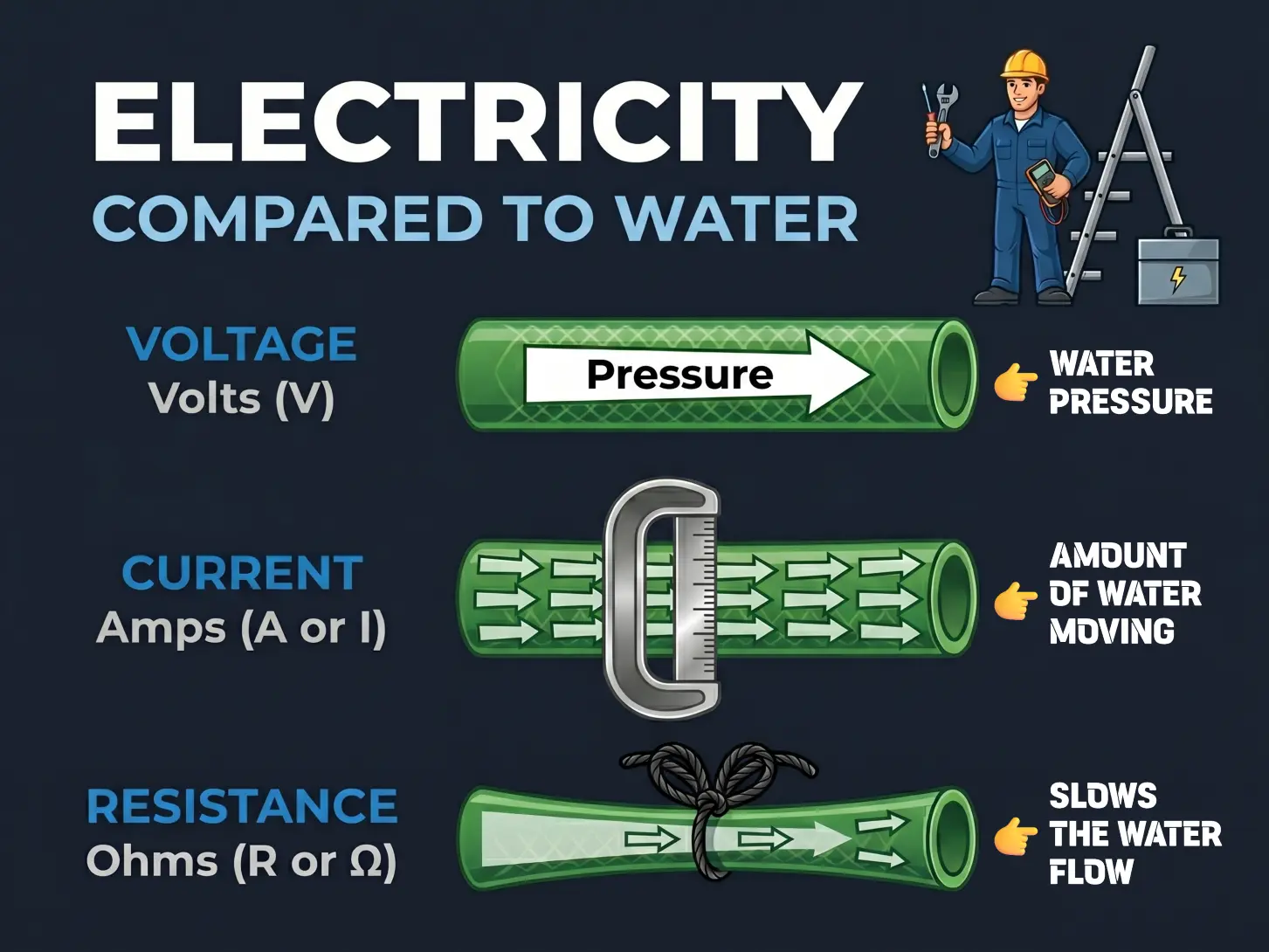
Table 1. Core Electricity Terms
| Term | Simple Meaning | Everyday Example | Common Unit |
|---|---|---|---|
| Electric charge | A basic property of matter that makes electrical effects possible | Static shock after walking on carpet | coulomb (C) |
| Electron | A tiny particle with a negative charge that often carries electricity in solids | Electrons moving through a wire | No special unit |
| Electric current | The rate at which charge flows | Powering a lamp or charger | ampere (A) |
| Voltage | The push that drives charge through a circuit | A battery pushing current through a flashlight | volt (V) |
| Resistance | The opposition to the current flow | A thin wire or heating element slows the current | ohm (Ω) |
| Power | The rate at which electrical energy is used or delivered | A bulb rated at 40 watts | watt (W) |
| Frequency | How often does alternating current change direction | Household AC supply | hertz (Hz) |
| Conductivity | How easily a material allows current to flow | Copper wire carrying electricity | No special unit |
| Grounding | A safety path that helps direct stray electricity away | Safety wiring in homes | No special unit |
The table above summarizes common electrical ideas in plain language. The units shown are part of the SI system, which is the internationally accepted measurement system used in science and technology. The volt, ampere, ohm, and watt are standard electrical units used around the world.
How Electricity Moves
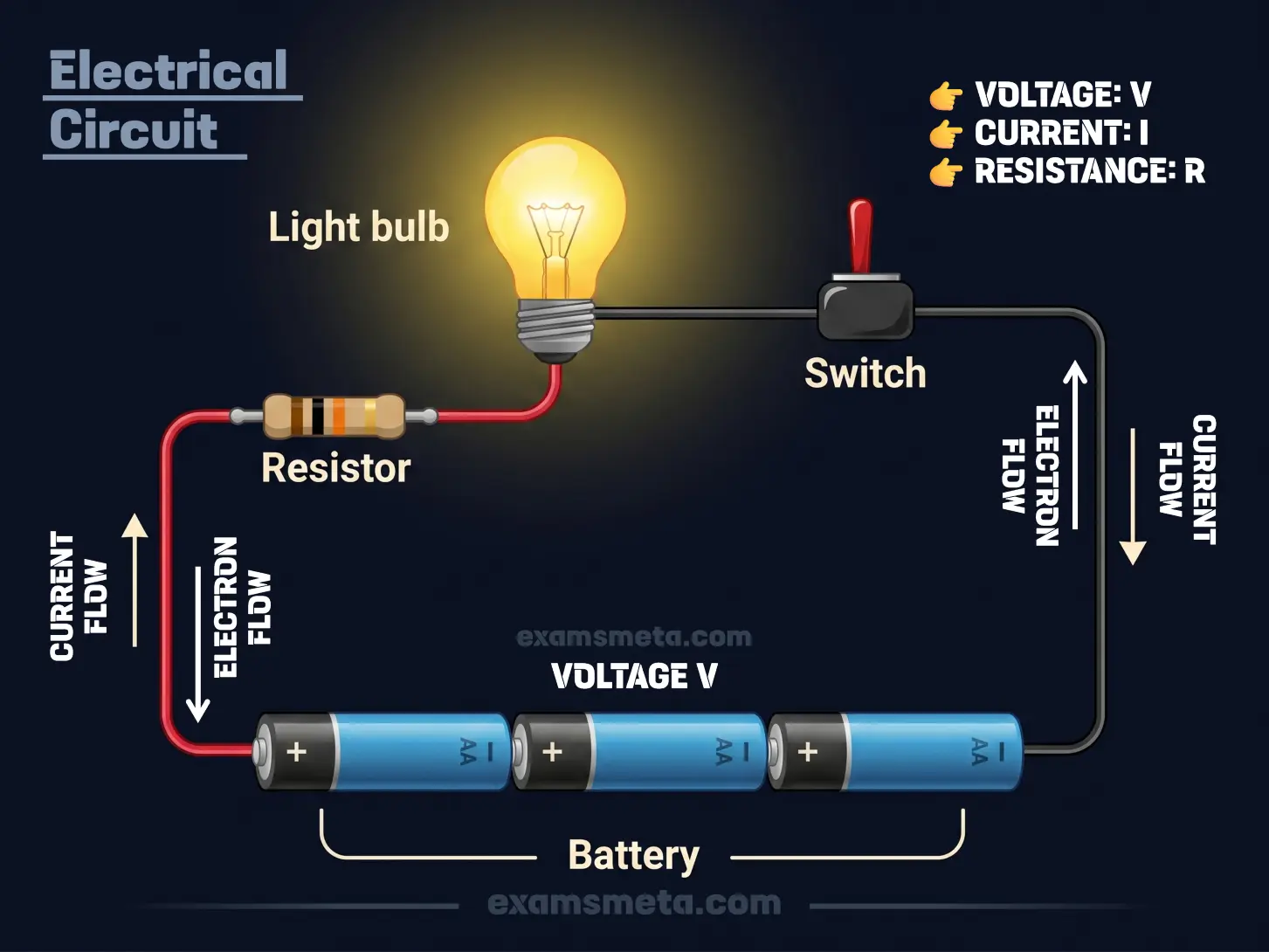
Electricity does not just float randomly in useful machines. It needs a closed path called a circuit. A circuit is a complete loop that allows current to move from a source, through a device, and back to the source. If the loop is broken, the flow stops. That is why a switch can turn a light on or off. It opens or closes the circuit.
There are two important patterns of electrical movement. One is static electricity, which happens when charges build up and stay in one place for a while. The other is current electricity, which is the steady movement of electrons through a conductor. Static electricity can cause a shock when you touch a doorknob after walking on a carpet, while current electricity is what powers most devices in your home.
Static electricity is not just a classroom trick. It happens in nature too. It is the reason your hair may stand up after friction, and it is part of the electrical activity seen in storms. Lightning is one of the most dramatic natural examples of electricity in action.
AC and DC Electricity
One of the most important distinctions in electricity is between alternating current (AC) and direct current (DC). DC flows in one direction. AC changes direction repeatedly. That difference matters because the two types are used in different places and for different purposes.
In the modern power grid, almost all electricity is supplied as AC. This makes long-distance transmission more practical. DC is very useful in batteries, solar cells, and many electronic devices. A battery produces DC, while many power systems convert energy into AC so it can travel across transmission networks and then be used in homes and businesses. When solar panels produce DC, inverters convert it to AC for the grid.
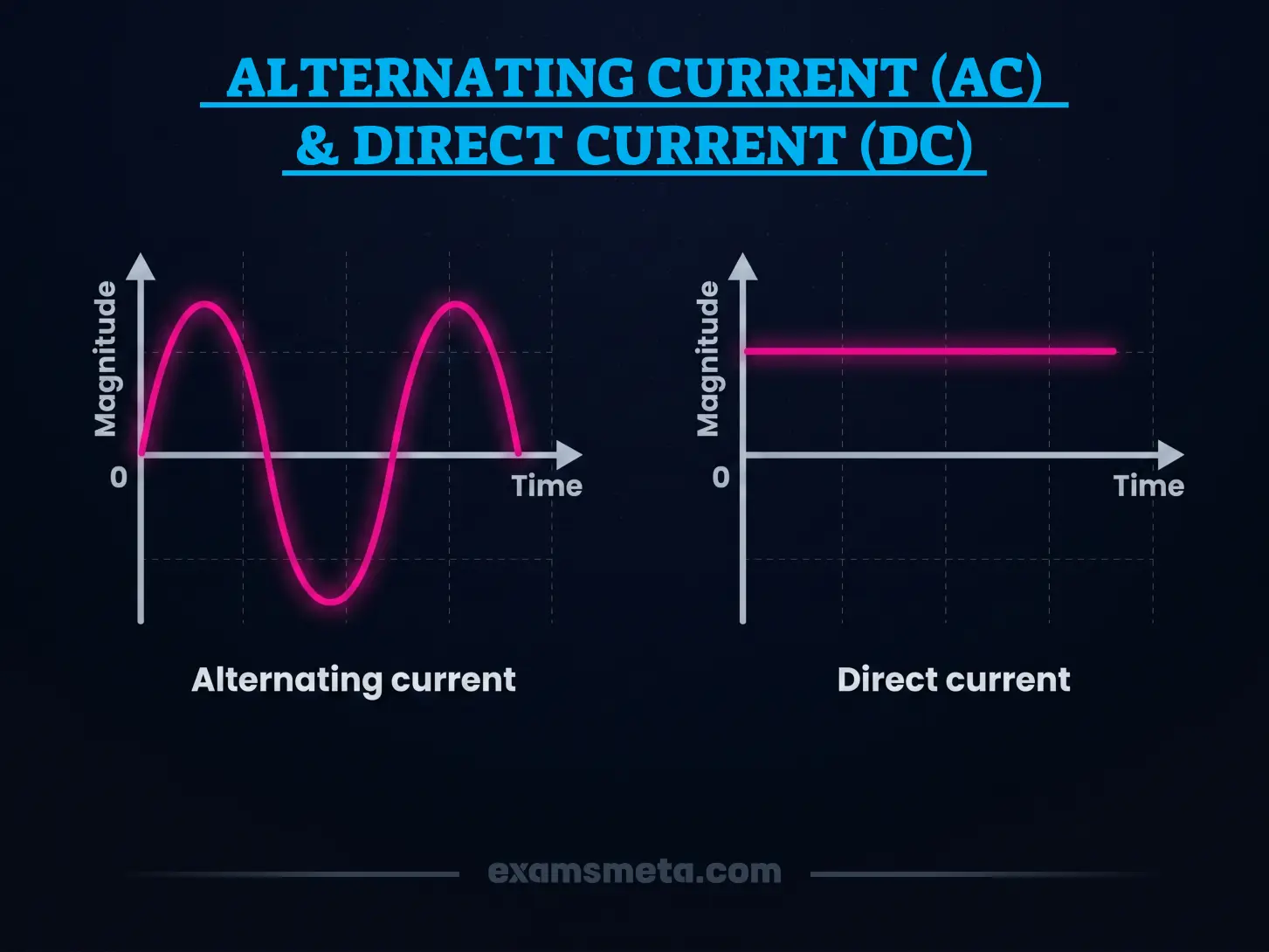
Table 2. AC vs DC
| Feature | AC | DC |
|---|---|---|
| Full name | Alternating current | Direct current |
| Direction of flow | Changes direction repeatedly | Flows in one direction |
| Common sources | Power stations, grid systems, inverters | Batteries, solar cells, many electronics |
| Best known uses | Home electricity, transmission, distribution | Phones, flashlights, laptops, batteries |
| Grid role | Dominant form in power lines and home supply | Often converted to AC before grid use |
| Main advantage | Efficient for large power systems | Simple and stable for many devices |
This difference is one of the reasons the modern energy system is so flexible. The grid can move huge amounts of power using AC, while batteries and solar systems can still support DC devices and then convert power when needed.
How Electricity Is Generated
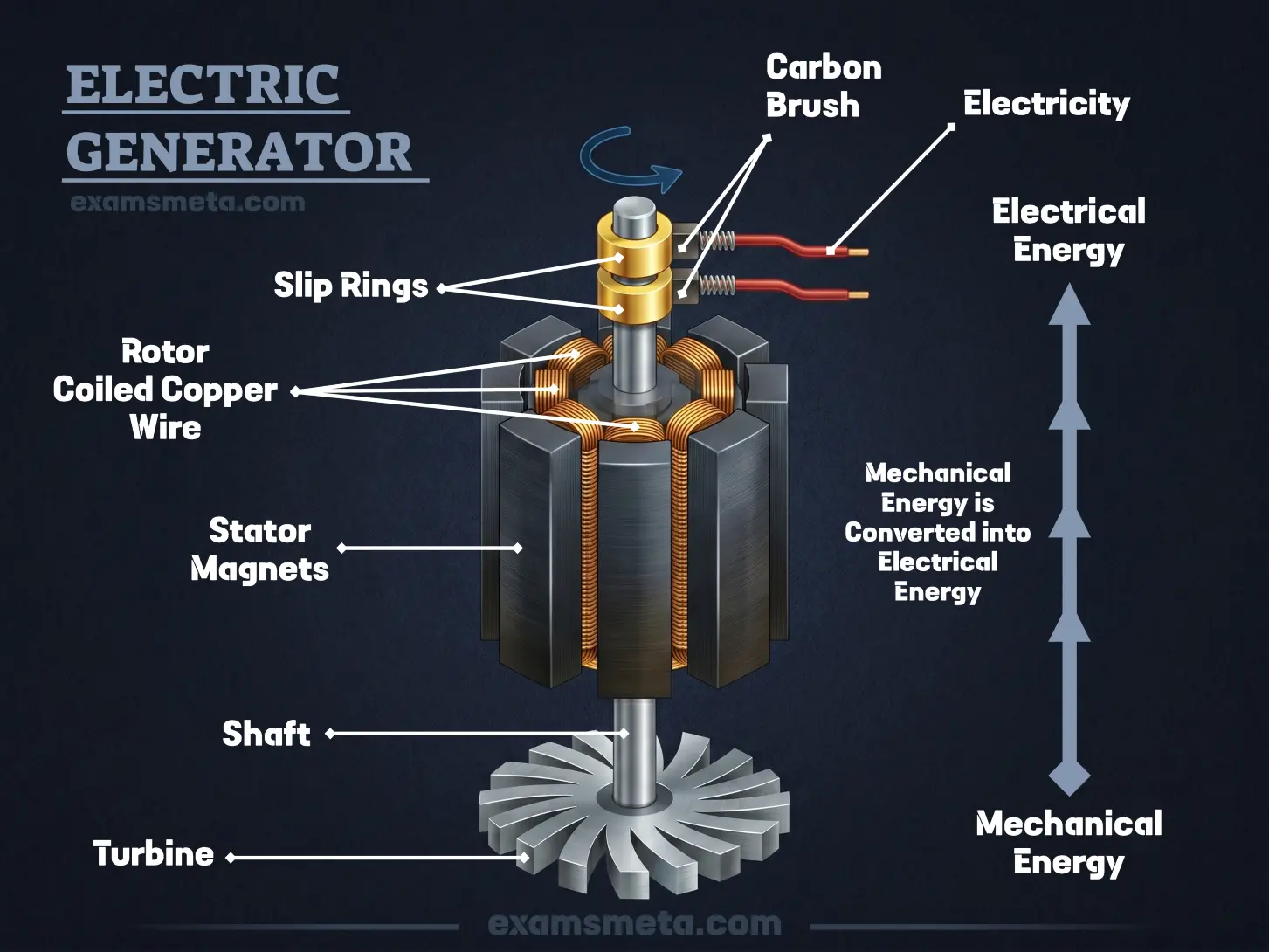
Electricity is usually made by converting another form of energy into electrical energy. In many cases, a generator does this job. A generator converts motion or another energy source into electricity. One of the most important ideas behind electric generation comes from Michael Faraday’s discovery in 1831. He found that moving a magnet inside a coil of wire induces an electric current. That principle still supports much of modern power generation.
Today, electricity can be generated from many sources. These include fossil fuels, nuclear energy, hydropower, wind, solar, biomass, geothermal energy, and other technologies. In many large plants, turbines spin generators. In solar systems, photovoltaic (PV) cells convert sunlight directly into DC electricity, which can then be stored in batteries or converted to AC with an inverter.
Table 3. Major Ways Electricity Is Generated
| Source | How It Produces Electricity | Simple Example | Main Strength |
|---|---|---|---|
| Coal | Heat makes steam that spins turbines | Thermal power plant | Reliable large-scale output |
| Natural gas | Gas turbines or steam systems generate power | Combined-cycle plant | Flexible and fast to start |
| Nuclear energy | Heat from nuclear reactions makes steam | Nuclear power station | High output with low direct emissions |
| Hydropower | Moving water turns turbines | Dam or run-of-river plant | Renewable and steady where water is available |
| Wind | Air movement spins blades and generators | Wind farm | Clean and scalable |
| Solar PV | Sunlight becomes DC electricity in cells | Rooftop solar panel | Quiet and modular |
| Solar thermal | Sun heats a fluid that drives turbines | Concentrated solar plant | Useful in sunny regions |
| Geothermal | Heat from inside the Earth drives power systems | Geothermal station | Stable renewable supply |
| Biomass | Organic material is burned or processed for energy | Agricultural residue plant | Can use waste materials |
Electricity generation is only the first step. The energy still has to travel from the power plant to the person using it. That journey involves careful control, high voltage, lower voltage, and a large network of lines and equipment.
How Electricity Travels to Homes and Businesses
Once electricity is generated, it enters the power grid. The grid is a huge network of transmission lines, distribution lines, substations, and transformers. In the United States, for example, the grid includes thousands of miles of high-voltage lines and millions of miles of low-voltage lines that connect power plants to customers. The same basic idea applies across much of the world, even if the exact system differs by country.
Electricity is sent over long distances at high voltage because that is more efficient and less expensive for transmission. Then transformers reduce the voltage before the electricity reaches homes and businesses. Lower voltage is safer for ordinary use. That is why the electricity on long transmission towers is not the same as the power that arrives at a wall socket.
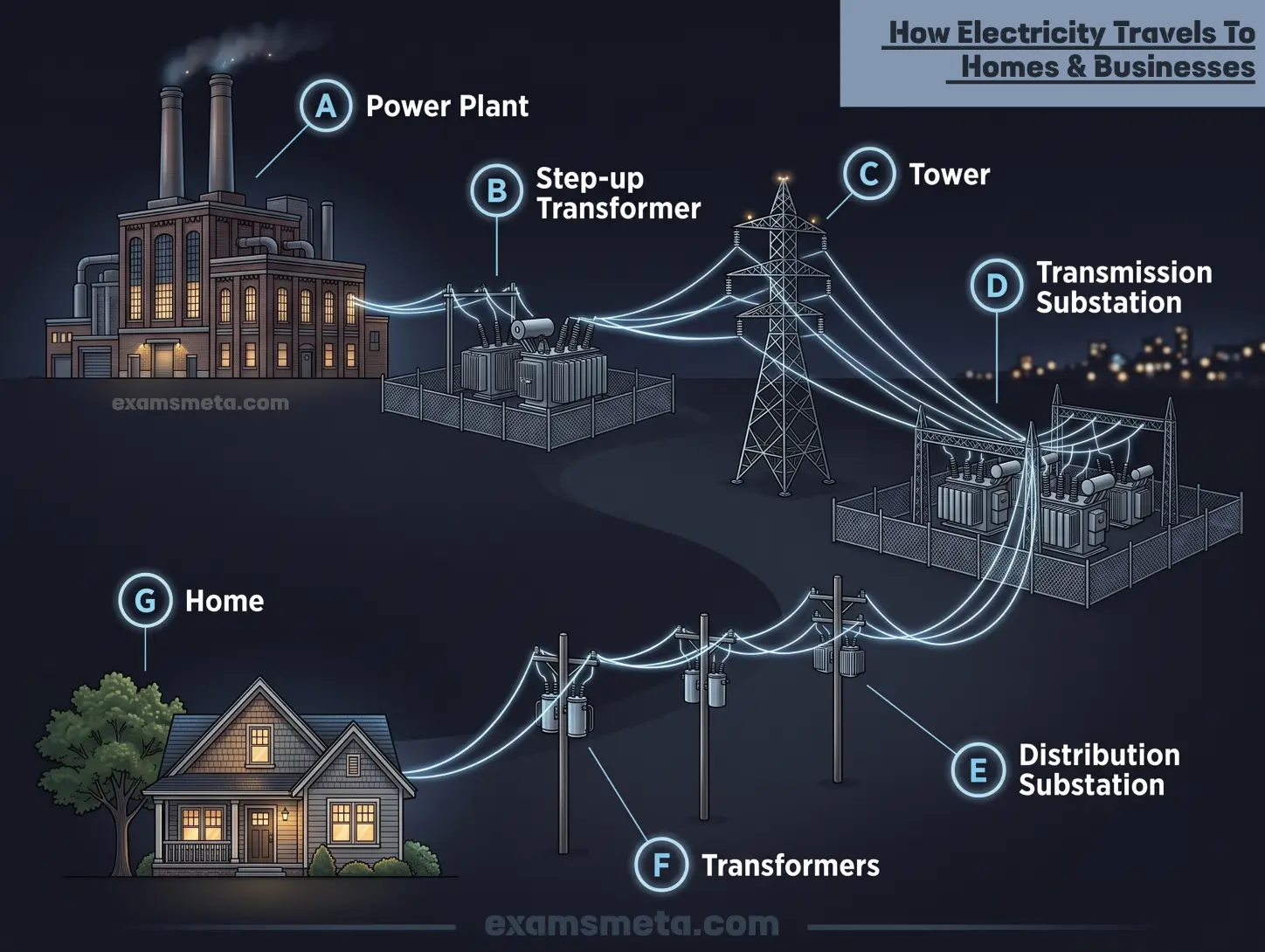
Table 4. The Journey of Electricity
| Stage | What Happens | Why It Matters |
|---|---|---|
| Generation | A power source is converted into electricity | Creates usable electrical energy |
| Step-up transformation | Voltage is increased for long-distance travel | Reduces energy loss during transmission |
| Transmission | Electricity moves through high-voltage lines | Sends power across long distances efficiently |
| Substation control | Voltage is adjusted at substations | Prepares power for local use |
| Distribution | Lower-voltage electricity moves through local lines | Brings electricity into neighborhoods |
| Service connection | Power enters a building | Links the grid to the property |
| Service panel | Electricity is divided into circuits | Sends power safely to rooms and devices |
| End use | Appliances, lights, and machines consume power | Electricity does useful work |
This system is easy to take for granted because it works silently in the background. But it is one of the most complicated and carefully managed systems in modern life. Without transmission and distribution, generation alone would not be enough.
Electricity Inside the Home
Inside a home, electricity enters through a service connection and moves into the service panel. From there, it is distributed to different circuits for lights, outlets, and appliances. Many homes use 120-volt circuits for standard devices, while some larger appliances require 240-volt circuits. The service panel also contains fuses or circuit breakers, which protect the wiring from overloads.
The home electrical system also depends on grounding. Grounding creates a safe path that helps reduce the chance of shock or electrocution if something goes wrong, such as a short circuit or overload. Some homes also use GFCIs and AFCIs, which are extra safety devices. GFCIs help prevent deadly shock by quickly shutting off power when they detect leakage current. AFCIs help protect against dangerous arc faults that can lead to fires.
Older homes can be more vulnerable because worn wiring, poor repairs, and outdated systems can create fire hazards. That is why electrical safety inside the home matters so much. A system does not need to be visible to be important. It just needs to be working correctly.
Useful Home Electricity Points
- The service panel is the central distribution point in a house.
- Circuit breakers can be reset after a problem is fixed, unlike a one-time fuse.
- Grounding adds an important layer of protection.
- GFCIs are especially valuable in areas where water and electricity may be close together.
- AFCIs help reduce fire risk from damaged or stressed wiring.
Why Electricity Matters So Much
Electricity matters because it touches almost every part of modern life. It lights homes, powers medical devices, runs water systems, supports the internet, keeps food cold, and helps schools, offices, and industries function. It also supports transportation, manufacturing, and communication systems that most people rely on every day without stopping to think about them.
A few simple examples show how deeply electricity is woven into everyday life. A fan converts electrical energy into motion. A heater converts electrical energy into heat. A speaker turns electricity into sound. A computer uses electricity to process data. A light bulb uses electricity to produce light. These are all different outcomes, but they all start with controlled electrical energy.
Electricity also supports public health and safety. Hospitals depend on it for equipment, lights, monitoring systems, imaging machines, and emergency care. Water systems depend on it for pumping and treatment. Communication networks depend on it for servers, towers, and devices. A power outage is more than an inconvenience. It can affect daily routines, business, and safety all at once.
Electrical Safety Should Never Be Ignored
Electricity is useful, but it is also dangerous when handled carelessly. OSHA describes electricity as a serious workplace hazard and warns about risks such as electric shock, electrocution, fires, and explosions. Even people who do not work directly with wires or panels can still face electrical hazards in their environment.
Many electrical injuries happen because of avoidable mistakes. Common hazards include contact with power lines, missing ground-fault protection, damaged cords, poor equipment use, and unsafe setups. This is why safe habits matter so much. Electricity is not forgiving when mistakes are made.
Table 5. Practical Electrical Safety Rules
| Safety Rule | Why It Helps | Simple Example |
|---|---|---|
| Keep water away from electricity | Water increases shock risk | Do not use a damaged appliance with wet hands |
| Use grounded outlets and plugs | Helps direct stray current safely | Plug appliances into proper sockets |
| Do not overload circuits | Prevents overheating and fire risk | Avoid too many high-power devices on one line |
| Reset breakers only after fixing the cause | Prevents repeated faults | Unplug appliances before resetting a tripped breaker |
| Use the right fuse or breaker rating | Protects the wiring properly | Never replace a fuse with a higher amperage one |
| Check cords and plugs regularly | Damaged cords can spark or shock | Replace frayed cables |
| Use GFCIs where needed | Reduces severe shock risk | Bathrooms, kitchens, outdoor areas |
| Use AFCIs in homes where required | Helps prevent arc-fault fires | Protection in modern residential circuits |
| Do not touch power lines | High-voltage contact can be fatal | Stay away from downed lines |
| Call a qualified electrician for major work | Ensures safe installation and repair | Panel work and hidden wiring problems |
Good safety habits are not complicated. They are simply consistent. Turn off the power before repairs. Use the right equipment. Keep cords in good condition. Respect high voltage. And never assume that a device is safe just because it looks fine from the outside.
A Closer Look at Measurement in Electricity
Electricity depends on precise measurement, and that is where the SI system becomes important. The International System of Units gives science and technology a shared language. It ensures that a volt means the same thing in one country as it does in another, and that measurements can be compared accurately across laboratories, industries, and power systems.
The electrical units most people hear about are ampere, volt, ohm, watt, and hertz. The ampere measures current, the volt measures electric potential difference, the ohm measures resistance, the watt measures power, and the hertz measures frequency. These are not just technical words. They help people size equipment, design circuits, pay for electricity, and keep systems safe.
Table 6. Common Electrical Units
| Unit | Symbol | What It Measures | Simple Example |
|---|---|---|---|
| Ampere | A | Electric current | How much charge is flowing |
| Volt | V | Electric potential difference | The push moving current |
| Ohm | Ω | Resistance | How strongly something resists flow |
| Watt | W | Power | How fast energy is being used |
| Hertz | Hz | Frequency | How often AC changes direction |
| Coulomb | C | Electric charge | Amount of electric charge |
These measurements help turn electricity from an abstract idea into something engineers can design, electricians can install, and ordinary people can use safely.
Electricity and Modern Technology
Modern technology would not exist in anything like its current form without electricity. Phones depend on it. Computers depend on it. Networks depend on it. Storage systems, sensors, chargers, smart devices, and electric motors all depend on it too. In this sense, electricity is not just one useful energy source among many. It is the language through which much of modern technology operates.
The shift toward solar power, battery storage, electric vehicles, and smart grids makes electricity even more important. Solar panels produce DC, batteries store energy, and inverters and grid systems make the power usable in homes and businesses. At the same time, new grid technologies aim to improve reliability, efficiency, and safety.
Electricity is also central to cleaner energy planning. Since it can be generated from many sources, it can connect older systems and newer systems in one framework. That flexibility is one reason governments, engineers, and communities continue to invest in better electric infrastructure.
A Simple Way to Think About Electricity
If you want one clear mental model, think of electricity as a controlled movement of charge that starts with a source, travels through a circuit, and ends in a device that turns the energy into something useful. A battery makes a flashlight glow. A generator keeps a city running. A solar panel charges a device. A power line delivers energy across long distances. The same basic principle appears in all of them, even though the scale is very different.
And that is what makes electricity so remarkable. It is invisible, but it is everywhere. It is ordinary, but it can be deadly if handled badly. It is scientific, but it is also deeply practical. Most of all, it is one of the great forces that turned the modern world into what it is today.
Final Thoughts
Electricity is more than a subject in science class. It is the backbone of modern civilization. It is in the wall socket, the battery, the power grid, the factory, the hospital, the streetlight, and the phone in your hand. It begins with moving electrons, but its impact reaches far beyond physics. It changes how we live, how we work, and how we connect.
Understanding electricity does not mean memorizing difficult formulas. It means seeing the pattern behind the devices and systems we use every day. Once you understand current, voltage, resistance, AC, DC, generation, transmission, and safety, electricity stops feeling mysterious. It becomes a clear and powerful part of the world we share.
Article References and Sources
- U.S. Energy Information Administration (EIA): The Science of Electricity
- U.S. Energy Information Administration (EIA): Electricity Explained
- Stanford University: Understanding Electricity
- U.S. Energy Information Administration (EIA): How Electricity Is Generated
- U.S. Energy Information Administration (EIA): Electricity in the United States
- U.S. Energy Information Administration (EIA): Solar Photovoltaics and Electricity
- U.S. Energy Information Administration (EIA): Delivery of Electricity to Consumers
- U.S. Department of Energy: The U.S. Electric Grid
- NIST: International System of Units (SI)
- BIPM: The International System of Units (SI)
- Occupational Safety and Health Administration (OSHA): Electrical Safety
- ESFI: Understanding Your Home Electrical System
- National Fire Protection Association (NFPA): Electrical Safety Resources
- Encyclopaedia Britannica: Electric Power
- Encyclopaedia Britannica: Electricity
- National Geographic: Energy and Electricity Resources
- Institute of Electrical and Electronics Engineers (IEEE)
- International Energy Agency (IEA): Electricity Market and Energy Information
Also, Read these Articles in Detail
- Physics and Its Fundamentals With Good Explanations
- Matter, Motion, and Energy: The Core Ideas of Physics
- What Is Matter? The Physical Substance of the Universe
- What Is Motion? A Guide to Motion in Physics and Daily Life
- What Is Energy? The Invisible Power Behind Everyday Life
- Kinetic Energy Explained in Simple Language
- Potential Energy: Definition, Types, Formula, and Examples
- Thermal Energy: Heat, Temperature, and Transfer
- Mechanical Energy: Definition, Formula, and Examples
- Chemical Energy: Definition, Science, and Examples
- Electrical Energy: Definition, Works, and Why It Matters
- Radiant Energy: Meaning, Sources, Examples, and Uses
- Nuclear Energy: Definition, How It Works, and Why It Matters
- Sound Energy: Definition, Science, and Examples
- Elastic Energy: Definition, Elasticity, and Example
- Geothermal Energy: Clean Electricity, Heating, and Modern Life
- Hydropower Energy: How It Works and Its Importance
- Pumped Hydropower Storage
- Force: Meaning, Types, Formula, and Examples
- Mechanics: Motion, Forces, Energy, and Applications
- Wave: Types, Properties, Motion, and Uses
- The International SI System
- Temperature: Meaning, Measurement, Scales, and Examples
Frequently Asked Questions
FAQ 1. What is electricity in simple words?
Electricity is the movement of electric charge, usually carried by electrons. In the simplest sense, it is the energy that comes from moving tiny charged particles through a material. That movement can power a light bulb, charge a phone, run a fan, or keep a refrigerator working. So when people say they use electricity every day, they usually mean they are using electrical energy that has been moved into a device and turned into light, heat, motion, sound, or information.
Electricity is all around us, but we usually notice it only when we use it. It enters our homes through wires, moves through a circuit, and does useful work in a device. A lamp uses it to make light. A heater uses it to make warmth. A computer uses it to process information. That is why electricity feels both invisible and powerful at the same time.
There are also natural forms of electricity. Lightning is one of the best-known examples. Static electricity is another. You may feel static electricity when your hair stands up or when you get a tiny shock after touching a metal object. These examples show that electricity is not just a human invention. It is a natural force that science has learned how to control and use.
Electricity is important because it can be transformed into many useful forms. It can become light, heat, motion, sound, and even digital data. That flexibility is one reason it plays such a huge role in modern life. We do not usually think about it much, but almost every part of daily living depends on it in some way.
FAQ 2. How does electricity actually work?
Electricity works because of the movement of electrons through a path called a circuit. Atoms contain electrons, and in many materials, those electrons can move from one atom to another. When a source such as a battery or generator provides a push, electrons begin to flow. That flow is what we call electric current.
A basic electrical system needs three things. It needs a source of power, a closed circuit, and a load. The source provides the energy. The circuit gives the electrons a complete path. The load is the device that uses the electricity, like a bulb, motor, or speaker. If the circuit is broken, the current stops. That is why a switch can turn a light on or off. It opens or closes the path.
Three related ideas help explain electricity better. Voltage is the push that drives the current. Current is the flow itself. Resistance is whatever slows the flow down. These ideas work together in every electrical system, from a tiny flashlight to a national power grid. If the push is strong and resistance is low, more current can flow. If resistance is high, less current moves through the circuit.
This is why electricity is easier to understand when you think of it as a flow. It is not a substance like water, but the water analogy helps. The voltage is like pressure. The current is like the amount of water moving. The resistance is like a narrow pipe or blockage. Once this is clear, many other electrical ideas become easier to follow.
FAQ 3. What is the difference between AC and DC electricity?
The difference between AC and DC is the direction in which the electric current flows. DC, or direct current, flows in one direction only. AC, or alternating current, changes direction again and again. Both are useful, but they serve different purposes.
DC is common in batteries, phones, laptops, solar cells, and many small electronic devices. A battery gives power in one steady direction, so it naturally produces DC. That makes it ideal for many portable devices and electronics. The current stays stable, which is useful when a device needs predictable power.
AC is used in most power grids and home electrical systems. One reason is that AC is easier to transmit over long distances and can be stepped up or down in voltage with transformers. This makes it more practical for large-scale electricity delivery. Power plants usually produce AC, and it travels through transmission lines before reaching homes and businesses.
Both types are important. You use DC every time you charge or run a battery-powered device. You use AC when you plug appliances into a wall outlet. In many modern systems, electricity moves between the two forms. For example, solar panels produce DC, but an inverter can convert it into AC so it can be used in the home or sent into the grid.
FAQ 4. How is electricity generated?
Electricity is generated by converting another form of energy into electrical energy. That other energy might come from coal, natural gas, nuclear energy, wind, water, sunlight, geothermal heat, or biomass. In most large power plants, the process involves spinning a turbine connected to a generator.
The basic idea behind many generators comes from the movement of a magnet near a wire coil. When this happens, an electric current is created. This principle, known as electromagnetic induction, is the reason generators can turn motion into electricity. It is one of the most important discoveries in the history of electrical science.
Different energy sources create electricity in different ways. A coal plant burns fuel to heat water and make steam. The steam spins a turbine. A wind turbine uses moving air to spin blades. A hydropower plant uses moving water. A solar panel converts sunlight directly into electricity without needing a turbine at all. Each method has its own strengths and limitations.
The main idea is simple. Electricity is usually not created from nothing. It is made by transforming energy from one form into another. That is why electricity is called a secondary energy source. It depends on other energy sources first, and then becomes the final form delivered to people and devices.
FAQ 5. Why is electricity so important in daily life?
Electricity is important because it supports almost everything modern life depends on. It lights homes and streets, powers communication systems, keeps food cold, runs medical equipment, and helps businesses and schools function. Without electricity, many tasks that feel ordinary would suddenly become difficult or impossible.
Think about a normal day. You might wake up to an electric alarm, turn on a light, use a charger, make breakfast with an electric appliance, travel using traffic systems powered by electricity, and work on a computer. Even when you are not thinking about it, electricity is supporting your routine. It is one of those things people often notice only when it stops working.
It also matters for health and safety. Hospitals depend on electricity for life-support systems, monitoring machines, surgical tools, and emergency care. Water systems depend on it for pumping and treatment. Communication networks need it to keep phones, servers, and internet services running. That means electricity is not just convenient. It is essential.
Electricity also makes modern technology possible. Smartphones, computers, televisions, electric vehicles, smart devices, and many household appliances all need electrical power to work. It is hard to imagine the modern world without it. And honestly, many of the things people now consider normal would not exist in the same way without reliable electricity.
FAQ 6. What are the main parts of an electrical circuit?
A basic electrical circuit has a few essential parts. It needs a source, a path, a load, and often a switch. The source provides energy. The path carries the current. The load uses the electricity. The switch controls whether the current flows or not.
The source can be a battery, generator, or power supply. The path is usually made of metal wires because metals, especially copper, are good conductors. The load can be a bulb, motor, heater, speaker, or any other device that uses electricity. The switch simply opens or closes the circuit.
There are also protective parts in many circuits. Fuses and circuit breakers are designed to stop dangerous overloads. If too much current flows, these devices interrupt the circuit before wiring overheats or catches fire. In homes, this protection is a major part of electrical safety.
A circuit only works well when the path is complete. This is why a light bulb does not turn on if the switch is open or a wire is disconnected. Electricity needs a full loop. If that loop is broken, the current stops immediately. That simple rule is one of the most important ideas in all of electricity.
FAQ 7. What are voltage, current, and resistance?
Voltage, current, and resistance are the three ideas people need most when learning electricity. They explain how electricity behaves in a circuit and why some systems work the way they do.
Voltage is the electrical push. It is the force that drives charged particles through a circuit. A battery has voltage because it creates a difference in electrical pressure between its two ends. The bigger the push, the more strongly it can move electrons.
Current is the flow of electric charge. It tells you how many electrons are moving through a circuit over time. If voltage is the push, current is the moving stream. A larger current means more charge is flowing.
Resistance is the opposition to current. Some materials let electricity pass easily, while others slow it down. Copper has low resistance, which is why it is used in wiring. Rubber has high resistance, which is why it can be used as insulation. Resistance protects us in some places and controls current in others.
These three ideas are connected by a simple relationship: Voltage = Current × Resistance. This means that if the voltage goes up, the current can increase, unless the resistance also changes. This one relationship helps explain a huge amount of electrical behavior in homes, machines, and electronic devices.
FAQ 8. How does electricity travel from power plants to homes?
Electricity travels through a large system called the power grid. This grid includes power plants, transmission lines, substations, transformers, and distribution lines. It is a carefully organized network that moves electricity from where it is made to where it is needed.
The journey starts at the power plant or generation source. The electricity is then sent at high voltage through transmission lines. High voltage is used because it allows electricity to travel long distances more efficiently. After that, substations and transformers reduce the voltage so it can safely enter neighborhoods, homes, and businesses.
Once the electricity reaches local distribution lines, it is carried to buildings through service connections. Inside the home, it goes into the service panel, which divides power into different circuits. From there, it reaches outlets, lights, and appliances. Each step in the system has a purpose. The whole process is designed to keep electricity both efficient and safe.
This is why electricity feels instant when you flip a switch, even though it has actually traveled a long way. The grid works so continuously and smoothly that most people never see how much coordination is behind it. But the system is there all the time, quietly doing one of the most important jobs in modern life.
FAQ 9. What are the most important electrical safety rules?
Electrical safety is extremely important because electricity can be harmful if it is handled carelessly. One of the first rules is to keep water away from electricity. Water can increase the risk of shock, which is why wet hands, wet floors, and damaged appliances should never be ignored. Electricity and moisture are not a safe mix.
Another important rule is not to overload circuits. If too many devices are plugged into one outlet or one line, the wiring can overheat. That can lead to a power failure or even a fire. It is also important to use the correct fuses, circuit breakers, and protective devices for each system. These are not optional extras. They are safety tools.
Damaged cords, loose plugs, and exposed wires should never be used. Even small-looking damage can become serious. A cord that seems only slightly worn can still pose a real danger. It is better to replace or repair faulty equipment quickly than to wait for a problem to grow.
And then there is the big rule that should never be ignored. Stay away from power lines, especially if one has fallen. High-voltage electricity can be deadly. If a serious electrical issue appears, it is always better to call a qualified professional. Electricity is useful, but it should always be respected.
FAQ 10. What is the future of electricity?
The future of electricity is closely tied to cleaner energy, smarter grids, and more efficient technology. More countries are using solar, wind, hydropower, battery storage, and electric vehicles. This shift is changing how electricity is produced, stored, and used.
One major change is the growth of renewable energy. Solar panels and wind turbines are becoming more common because they can produce electricity without burning fuel directly. That makes them important in the effort to reduce pollution and dependence on fossil fuels. At the same time, better batteries are helping store electricity for later use, which solves one of the biggest challenges in renewable energy.
Another major change is the development of smart grids. A smart grid uses digital technology to help manage electricity more efficiently. It can improve reliability, detect problems faster, and support new energy sources more easily. This matters because the demand for electricity keeps growing as more devices, buildings, and vehicles depend on it.
The future will also likely bring more electrification. That means systems that once used other energy sources may switch to electricity instead. Heating, transportation, and industry are all moving in that direction in many places. So the future of electricity is not just about making power. It is about reshaping how the world works.
And that is the real story. Electricity has already transformed modern life, and it is still changing. The next phase may be even more important than the last.
FAQ 11. What is static electricity?
Static electricity is a build-up of electric charge on the surface of a material. Unlike regular current electricity, which moves continuously through a wire, static electricity stays in one place until it finds a way to discharge. That is why you might feel a small shock after walking across a carpet and touching a metal door handle. The charge was sitting there quietly, and then suddenly it moved.
This happens because electrons can be transferred from one object to another through friction or contact. Some materials gain electrons more easily, while others lose them more easily. When that happens, one object becomes negatively charged, and the other becomes positively charged. The imbalance creates static electricity. It is a simple idea, but it explains a lot of everyday experiences.
Static electricity is not just something you notice at home. It also appears in nature and in industry. It can make dust cling to surfaces, make clothes stick together after drying, and even affect how some machines work. In factories and laboratories, static charge can be a real problem because it may damage sensitive equipment or create sparks in unsafe places.
And yet, static electricity is also useful in some settings. It helps in photocopiers, laser printers, and air filters. In those systems, electric charge is controlled and used for a practical purpose. So static electricity is not just a small annoyance. It is a real part of electrical science with everyday, scientific, and industrial importance.
FAQ 12. Why do metals conduct electricity so well?
Metals conduct electricity well because their electrons can move more freely than in many other materials. In a metal like copper, the outer electrons are not tightly locked to one atom. They can move through the material with relative ease. That free movement is what allows electric current to pass through a wire.
This is why metals are called conductors. They provide a path that electricity can travel through without too much resistance. The lower the resistance, the easier it is for current to flow. That is also why metals are used in wires, cables, connectors, and many electrical parts. They are practical, reliable, and efficient.
Not all metals are equally good conductors. Silver conducts very well, but it is expensive. Copper is widely used because it offers an excellent balance of conductivity, cost, and durability. Aluminum is also used in some power lines because it is lighter and less expensive, even though it is not as conductive as copper.
Materials like rubber, glass, and plastic do the opposite. They are insulators, which means they do not allow electricity to flow easily. That is useful when we need to protect ourselves from electric shock or keep current in the right place. So the reason metals are used in electricity is simple. Their structure gives electrons room to move.
FAQ 13. What are insulators and why are they important?
Insulators are materials that resist the flow of electricity. They do not allow electrons to move through them easily, which makes them very important in electrical systems. Common insulators include rubber, plastic, glass, ceramic, and dry air. These materials help keep electricity under control.
Their role in safety is huge. A wire may carry electricity inside, but the outer covering is usually made of insulating material to protect people from shock. Without insulation, touching a wire or device could be dangerous. So even though insulators are not the parts that carry the current, they are just as important as the conductors.
Insulators are also used to separate different parts of a circuit. They help prevent unwanted contact between wires, which could cause short circuits, sparks, or damage. In power lines, insulators hold the wires in place while keeping electricity from escaping to poles or towers. That makes them essential for both safety and function.
The best way to think about an insulator is as a protective barrier. It does not stop electricity from flowing everywhere in the system. It simply keeps electricity where it is supposed to be. And in the world of electricity, that kind of control matters a lot.
FAQ 14. What is electric power?
Electric power is the rate at which electrical energy is used or produced. In simple words, it tells us how fast electricity is doing work. A device that uses more power in less time needs a stronger electrical supply. A small device uses less power and often requires less current or lower voltage, depending on its design.
The unit of electric power is the watt. If something is rated at 100 watts, that means it uses electrical energy faster than a 10-watt device. This does not always mean the higher-watt device is better. It just means it consumes energy at a faster rate. A heater may need more power because it produces heat. A small LED lamp may need very little power because it is designed to be efficient.
Power is related to voltage and current. A common formula is Power = Voltage × Current. This helps people understand how much energy a device needs to run. It is also useful when choosing appliances, wiring systems, or batteries. If the power demand is too high for a circuit, the system can become overloaded.
Electric power is one of the most practical ideas in electricity because it connects science with daily life. It helps explain why some devices cost more to run, why some appliances need special outlets, and why energy use matters. It is a small formula with a big impact.
FAQ 15. How do batteries produce electricity?
A battery produces electricity through chemical reactions. Inside the battery, chemicals react in a controlled way and create a difference in electrical charge between two terminals. That difference creates voltage, which pushes electrons through a circuit when the battery is connected to a device.
This is why a battery can power a flashlight, remote control, phone, or toy. The chemical energy inside the battery changes into electrical energy, and then the device changes that electrical energy into light, motion, sound, or another useful form. In other words, the battery is a portable energy source that converts chemistry into electricity.
Different batteries work in different ways, but the basic idea is similar. They contain materials that react at different speeds and produce a steady flow of current. Some batteries are meant to be used once. Others are rechargeable, which means the chemical process can be reversed by plugging the battery into a charger. That is why rechargeable batteries are so common in modern electronics.
Batteries are especially useful because they store electricity in a compact form and make it available when needed. That portability changed the world. Without batteries, many everyday devices would be far less convenient. They are small, but they make a huge difference in modern life.
FAQ 16. Why do power outages happen?
A power outage happens when electricity stops reaching homes, businesses, or other places that normally receive it. The cause can be simple or complicated. Sometimes there is a problem in the local grid, a damaged transformer, or a broken power line. Sometimes the weather is the main reason, especially during storms, high winds, floods, or lightning strikes.
Outages can also happen because of equipment failure, maintenance work, or too much demand on the system. If the grid is carrying more electricity than it can safely handle, parts of it may shut down to protect the rest of the network. That is not ideal, but it can prevent bigger damage. So sometimes an outage is a safety measure, not just a failure.
The impact of an outage depends on how long it lasts and how large the affected area is. A short outage may only be annoying. A longer one can interrupt work, food storage, transportation, water systems, and medical care. That is why utilities and grid operators work hard to restore service quickly and keep systems reliable.
Power outages remind people how deeply life depends on electricity. We often only realize how much we use it when it disappears. A simple blackout can show just how much of daily life is built around a steady flow of power.
FAQ 17. What is a circuit breaker and how does it work?
A circuit breaker is a safety device that protects electrical wiring from damage caused by too much current. If there is an overload, short circuit, or fault, the breaker automatically shuts off the flow of electricity. This helps prevent overheating, fire, and damage to equipment.
The idea is simple. Every circuit has a safe limit. If too many devices are drawing power at once, or if something goes wrong in the wiring, the current can rise too high. The circuit breaker detects this and trips, which means it opens the circuit and stops the electricity. That interruption is not a problem. It is the breaker doing its job.
Circuit breakers are used in homes, offices, and industrial systems. They are better than old-style one-time fuses in many situations because they can be reset after the problem is fixed. That makes them convenient as well as protective. Still, a breaker that trips repeatedly should not be ignored. It usually means something needs attention.
Circuit breakers are one of those things people rarely think about until they are needed. But they are a major reason electrical systems are safer today. They quietly watch over the wiring and respond when the system becomes unsafe.
FAQ 18. Why is electricity measured in volts, amps, and watts?
Electricity is measured in volts, amps, and watts because each of these units tells us something different about how electrical energy behaves. Without these measurements, it would be hard to design systems, compare devices, or keep circuits safe.
Volts measure voltage, which is the push or pressure that drives current through a circuit. Amps measure current, which is the actual flow of electric charge. Watts measure power, which tells us how fast electricity is being used. These three measurements work together. They are like three different views of the same system.
For example, a device may need a certain voltage to work properly. If the voltage is too low, it may not run correctly. If the current is too high for the wiring, the system may overheat. If the wattage is too large, the device may use more energy than expected. Each number has a different meaning, and each one matters.
These units are used every day in home wiring, appliances, electronics, power systems, and energy bills. They help people understand electricity in a clear, measurable way. And because they are standard units, engineers and electricians around the world can speak the same language.
FAQ 19. What are renewable sources of electricity?
Renewable sources of electricity are energy sources that are naturally replenished and can be used again and again. These include solar power, wind power, hydropower, geothermal energy, and biomass. They are important because they provide electricity without depending on fuels that run out quickly.
Solar power uses sunlight, which is available in many places and can be converted directly into electricity by solar panels. Wind power uses moving air to spin turbines. Hydropower uses moving water. Geothermal energy uses heat from inside the Earth. Biomass uses organic material such as plant matter or waste. Each one works in a different way, but all of them can support electricity generation.
People often support renewable energy because it can reduce pollution and lower dependence on fossil fuels. That does not mean renewables are perfect or automatic solutions. They still need good planning, storage, and grid support. But they are a major part of the future of electricity because they give societies more options.
Renewable electricity is especially valuable because it can work alongside other energy systems. It can power homes, factories, schools, and vehicles. And as technology improves, renewable systems are becoming more efficient and more widely available. That makes them a central part of modern energy planning.
FAQ 20. Can electricity be dangerous?
Yes, electricity can be dangerous, and people should always treat it with respect. When electricity passes through the body, it can cause electric shock, burns, muscle damage, heart problems, or even death in severe cases. The danger depends on the amount of current, the path it takes through the body, and how long the exposure lasts.
Electricity is also dangerous because it can start fires. Overloaded circuits, damaged cords, bad connections, and faulty equipment can create heat or sparks. That is why electrical safety devices such as fuses, circuit breakers, ground fault protection, and arc fault protection are so important. They reduce risk before a small problem becomes a serious one.
The risk is not always obvious. A wire can look harmless and still be dangerous. A socket can seem normal and still hide a fault. That is why people should never guess when it comes to electrical problems. If something smells burnt, feels hot, sparks, or keeps tripping a breaker, it should be checked quickly.
At the same time, electricity is not something to fear in everyday life. It is safe when it is properly designed, installed, and used. The key is caution. Respect the rules, use the right equipment, and avoid shortcuts. Electricity is one of the best tools humanity has ever learned to control, but only when it is handled carefully.
