

Electromagnetism is one of the most important ideas in physics, and it quietly shapes a huge part of modern life. It connects electricity and magnetism into one powerful framework. It explains how electric charges create electric fields, how moving charges create magnetic fields, how changing fields influence one another, and how all of this leads to light, radio waves, microwaves, X-rays, and much more. In simple words, electromagnetism is the science of how charged particles behave and how their fields interact with the world around them. It is also one of the four fundamental forces of nature.
This topic matters far beyond the classroom. It helps explain how a magnet sticks to a refrigerator, how a motor spins, how a generator produces electricity, how a transformer changes voltage, how a speaker creates sound, how a cell tower sends signals, and how light travels through space. Without electromagnetism, there would be no modern power grid, no internet signal, no MRI scanner, and no convenient way to charge a phone. That is why electromagnetism is not just a physics chapter. It is one of the invisible engines of civilization.
Table of Contents
What Is Electromagnetism?
Electromagnetism is the study of the relationship between electricity and magnetism. A stationary electric charge produces an electric field. A moving charge, or electric current, produces a magnetic field. A changing magnetic field can produce an electric field, and a changing electric field can produce a magnetic field. These linked effects are the heart of electromagnetism.
This is why the word electromagnetic is so useful. It reminds us that electricity and magnetism are not completely separate ideas. They are closely connected parts of one larger physical reality. In everyday language, people often talk about electricity and magnetism as if they are different worlds. Physics says otherwise. They belong together.
Why Electromagnetism Matters So Much
If you look around your home, school, office, or city, you will find electromagnetism everywhere. It runs through the power lines outside, the circuits inside devices, the motors in fans and washing machines, the speakers in headphones, the chips inside computers, and the signals moving between wireless devices. Even visible light is part of the electromagnetic spectrum. That means the light that lets you read this page is itself an electromagnetic wave.
It is hard to overstate how central this force is. Gravity keeps planets in orbit. Electromagnetism builds atoms, molecules, chemistry, electricity, materials, and technology. In the ordinary world, it is often the reason things work at all.
Video Credit: ScienceClic English
A Simple Human Way to Think About It
Think of electric charge as something that creates influence around itself. If the charge is still, it creates an electric field. If it moves, it creates a magnetic field too. If the field changes, it can produce motion in nearby charges. This back-and-forth relationship is what makes electromagnetism feel so dynamic. It is not a single effect. It is a whole chain of effects.
A useful image is this. Electric fields are often associated with pushes and pulls on charged objects. Magnetic fields are often associated with the forces that appear when charges are moving. Together, they shape the behavior of wires, coils, magnets, and electromagnetic waves.
A Short History of Electromagnetism
The story of electromagnetism is one of the great scientific journeys.
For a long time, people studied electricity and magnetism as separate phenomena. Then in 1820, Hans Christian Ørsted discovered that an electric current could deflect a compass needle. That was a major turning point because it showed a direct link between electricity and magnetism. After that, André-Marie Ampère built on the discovery and studied the force between currents. Later, Michael Faraday showed that changing magnetic fields could induce electric currents. Finally, James Clerk Maxwell gathered the scattered ideas into a grand theory that described electromagnetism with mathematical precision and predicted electromagnetic waves.
Maxwell’s work was a turning point in science. It showed that light itself is an electromagnetic wave. That insight tied together optics, electricity, and magnetism in one elegant system. It also opened the door to radio, television, radar, and wireless communication later on.
The Core Ideas Behind Electromagnetism
The subject can look intimidating at first, but the core ideas are actually very human and very logical.
1. Electric Charge
Electric charge is a basic property of matter. There are two kinds, positive and negative. As charges repel, and opposite charges attract. This is one of the simplest rules in physics, yet it explains an enormous amount of behavior in nature.
2. Electric Field
An electric field is the region around a charged object where another charge would feel a force. If you place a charge nearby, the field tells it which way to move and how strongly it will be pushed or pulled.
3. Magnetic Field
A magnetic field is the region around a magnet or current-carrying wire where magnetic forces act. Magnetic fields are not just about fridge magnets. They are also present around wires, coils, motors, Earth itself, and many other systems.
4. Electric Current
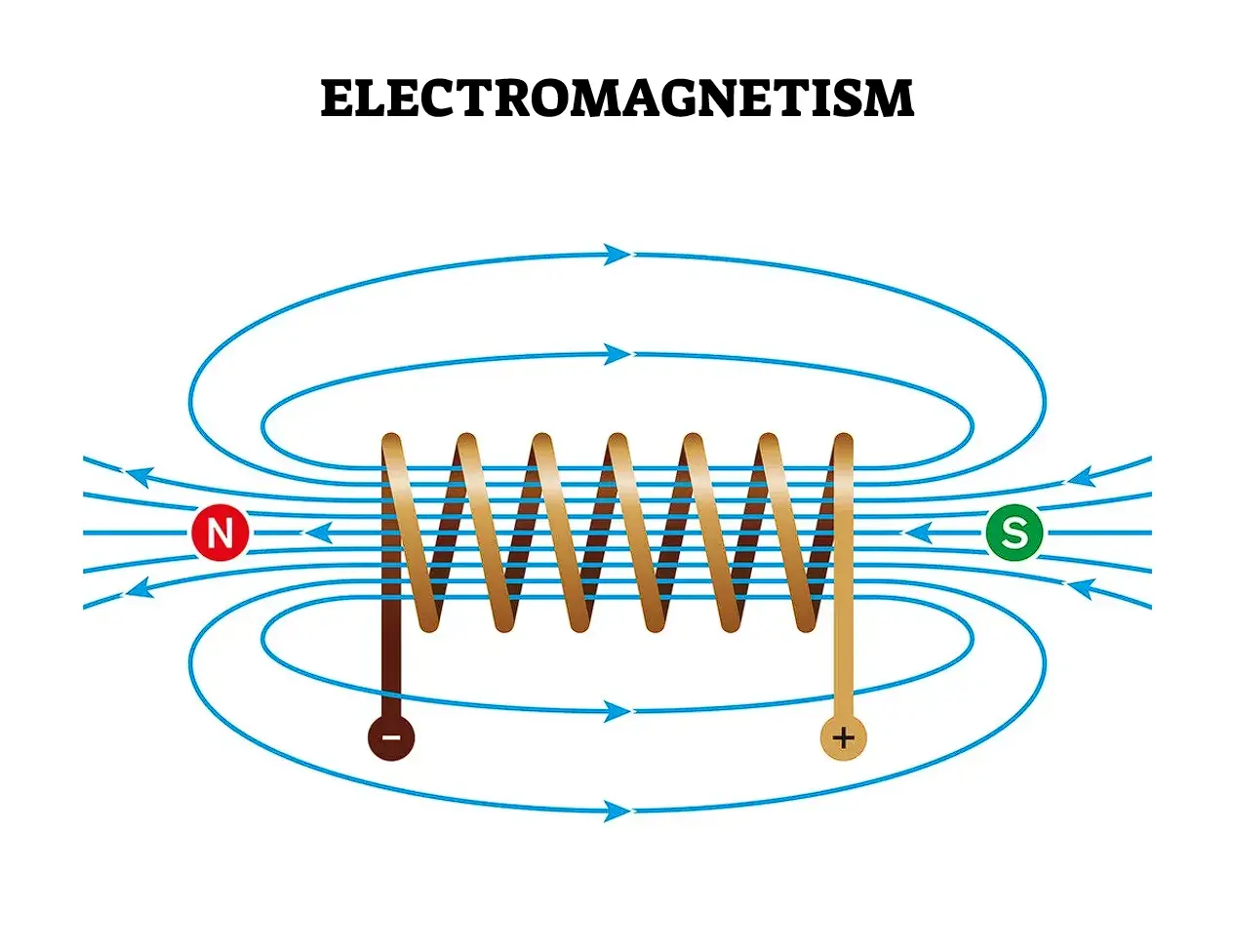
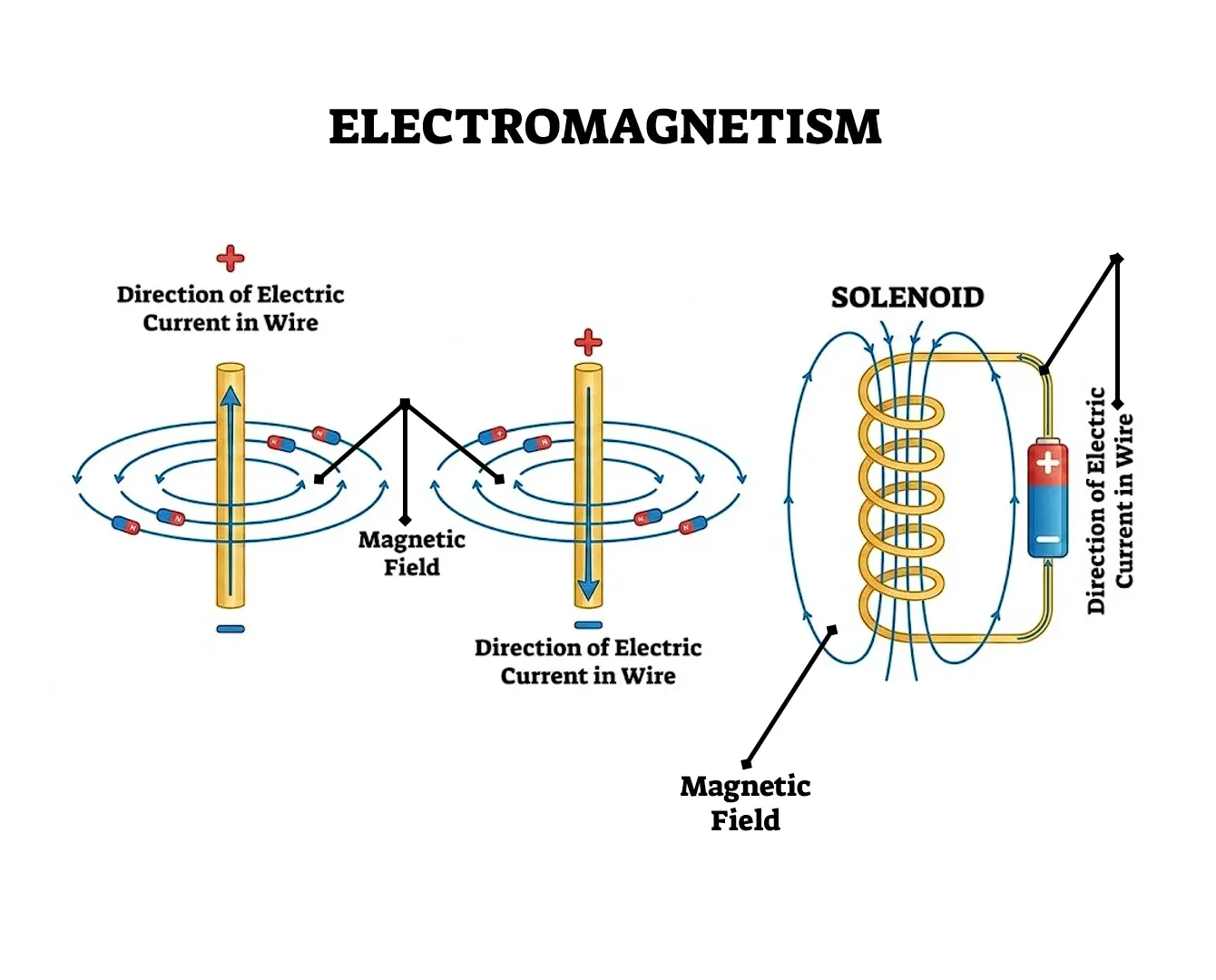
Electric current is the flow of electric charge. In metal wires, this usually means the movement of electrons. When current flows through a wire, it creates a magnetic field around the wire. That simple fact is the basis of electromagnets, motors, and many other devices.
5. Induction
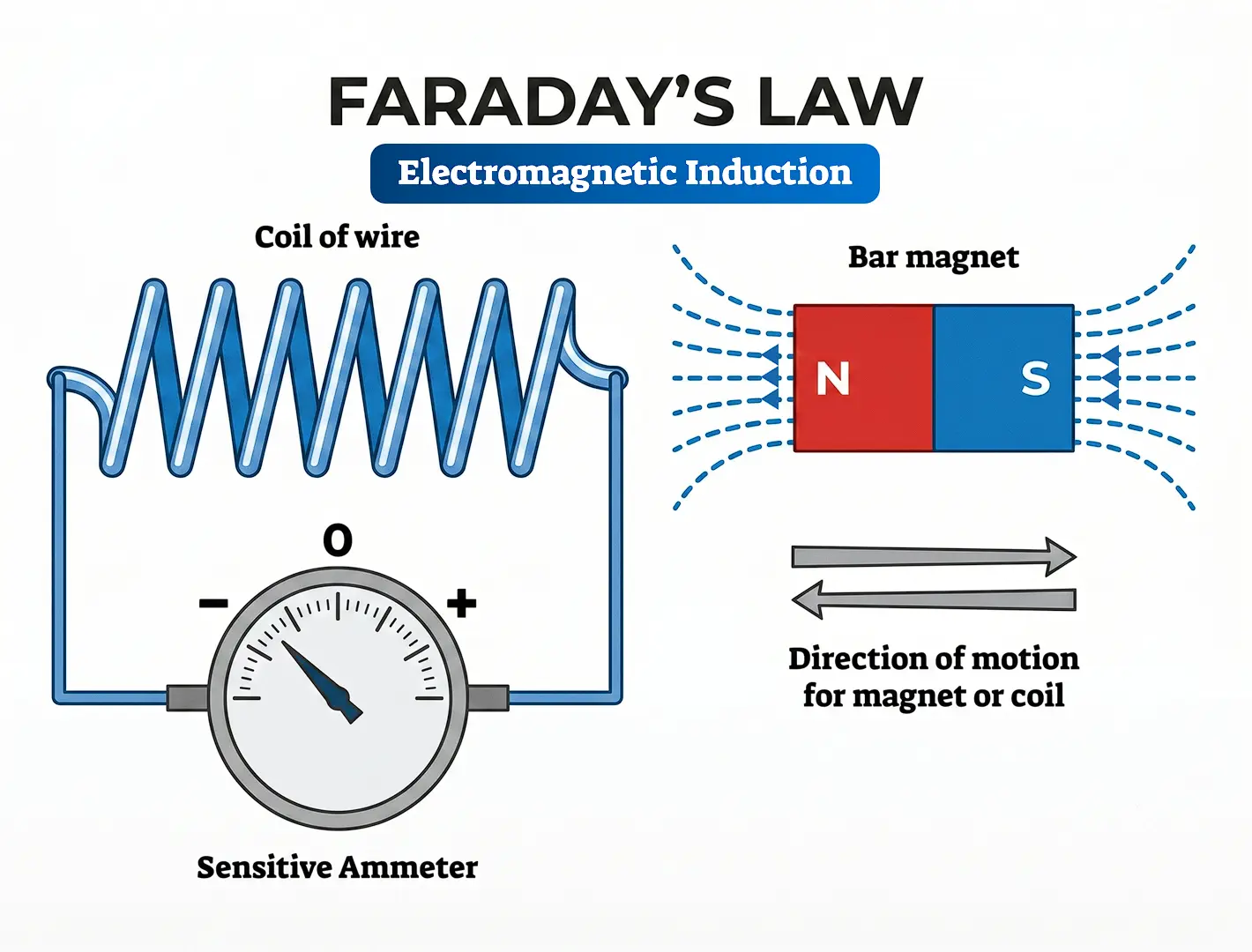
Electromagnetic induction happens when a changing magnetic field produces an electric current. This idea is central to generators, transformers, and many power systems. Faraday’s discovery of induction is one of the landmarks of physics.
6. Electromagnetic Waves
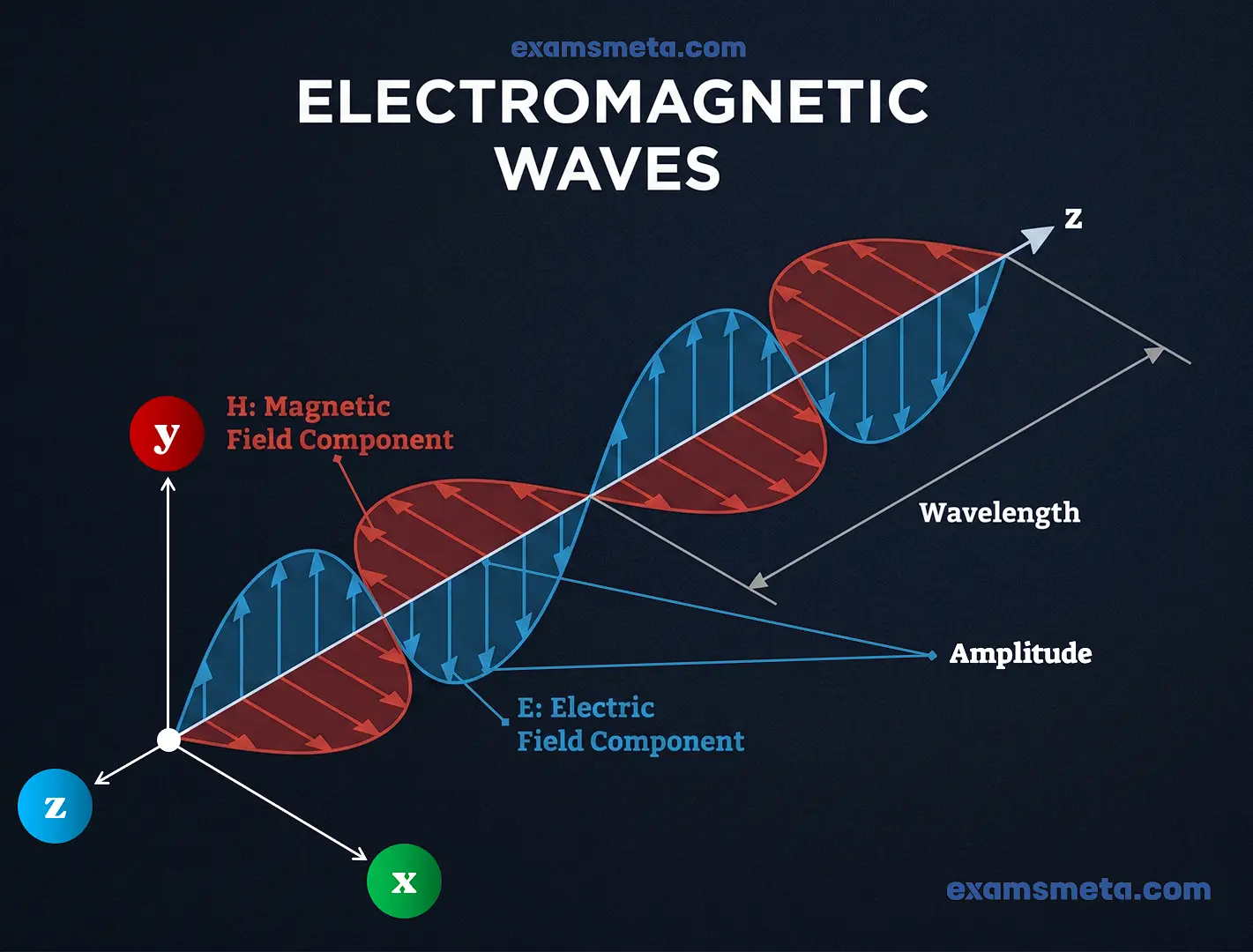
An electromagnetic wave is a travelling disturbance made of linked electric and magnetic fields. These waves do not need air or any material medium. They can travel through space, which is why light from the Sun reaches Earth across the vacuum of space.
The Relationship Between Electricity and Magnetism
The relationship between electricity and magnetism is not a one-way street. It works in both directions.
A moving electric charge creates a magnetic field. A changing magnetic field creates an electric field. This two-way interaction is one of the most beautiful ideas in physics because it shows how one change can trigger another. It is also why electromagnetic waves can keep moving. The changing electric field creates a magnetic field, and the changing magnetic field creates a new electric field, and the cycle continues.
That simple feedback loop explains a lot. It explains radio transmission, wireless signals, and the behavior of light. It also explains why electromagnetism is so deeply connected to communication technology.
Maxwell’s Equations and Why They Matter
Maxwell’s equations are the mathematical heart of classical electromagnetism. They describe how electric fields and magnetic fields are produced and how they change. They are usually presented as four equations, and together they summarize a very large part of electromagnetic theory.
Here is a simple human interpretation of what they do:
- They tell us how electric charges create electric fields
- They tell us that there are no isolated magnetic monopoles in ordinary classical physics
- They show how changing magnetic fields create electric fields
- They show how electric currents and changing electric fields create magnetic fields
Even if the equations look compact, their meaning is huge. They connect static electricity, magnetism, circuits, and waves into one framework. That is rare in science. A small set of equations does a very large amount of work.
Electromagnetic Fields in Everyday Life
People often think of fields as abstract things only physicists care about. But electromagnetic fields are part of daily life.
A lamp works because current flows through a circuit and energy is converted into light and heat. A speaker works because a varying current makes a coil move in a magnetic field, which moves the air and creates sound. A fan motor works because magnetic forces produce rotation. A microwave oven uses electromagnetic waves in a controlled way to heat food. A phone charger uses electromagnetic processes to deliver power efficiently.
And it goes beyond household devices. Modern hospitals depend on electromagnetism too. MRI machines use strong magnetic fields and radio waves to create detailed images of the body. Scientific labs use electromagnetic methods to study matter, structure, and energy. That is why this topic sits at the center of both technology and medicine.
The Electromagnetic Spectrum
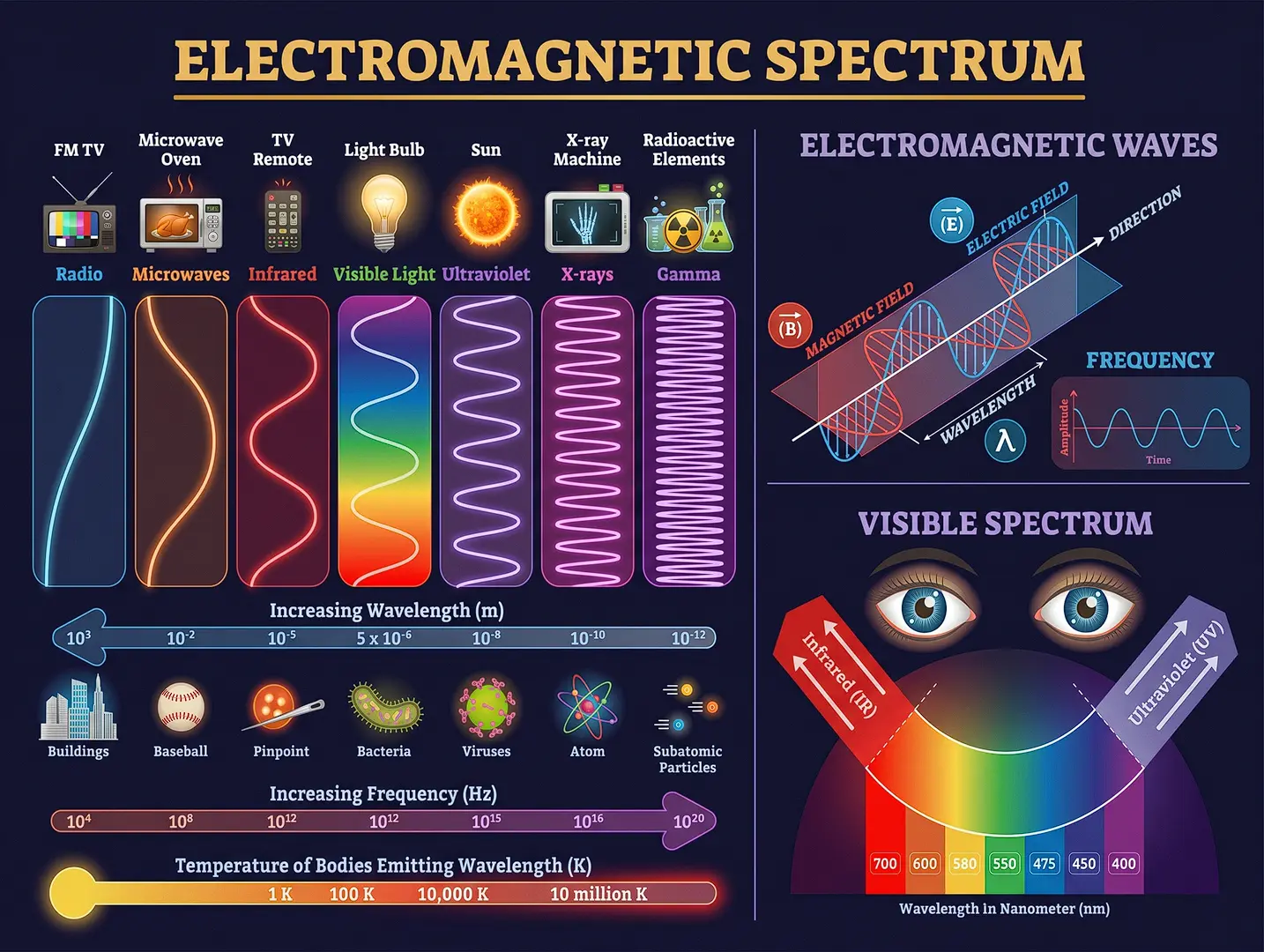
One of the most useful ways to understand electromagnetism is through the electromagnetic spectrum. This spectrum includes all types of electromagnetic waves, sorted by wavelength or frequency. The wave family is broad, but the rules are the same. Only the energy and scale change.
Main Parts of the Electromagnetic Spectrum
| Type of Wave | Typical Wavelength | Common Uses | Key Idea |
|---|---|---|---|
| Radio waves | Very long | Broadcasting, communication, navigation | Carry information over large distances |
| Microwaves | Long to medium | Cooking, radar, wireless communication | Interact strongly with water and communication systems |
| Infrared | Medium to short | Heat sensing, remote controls, thermal imaging | Related to heat radiation |
| Visible light | Very short | Vision, lighting, photography | The part the human eye can detect |
| Ultraviolet | Short | Sterilization, astronomy, tanning | More energetic than visible light |
| X-rays | Very short | Medical imaging, security scanning | Can pass through soft tissue |
| Gamma rays | Extremely short | Nuclear processes, cancer treatment, astrophysics | Highest energy in the spectrum |
The table above shows an important truth. Light is not just what we see with our eyes. It is part of a much larger electromagnetic family. Every section of the spectrum has its own behavior, uses, and risks.
Units Commonly Used in Electromagnetism
Physics needs precise measurement, and electromagnetism depends on that precision. Common SI units include the ampere for current, the coulomb for charge, the volt for electric potential, the ohm for resistance, the tesla for magnetic field strength, and the hertz for frequency. NIST helps maintain measurement standards in these areas, including time and frequency references used in modern technology.
Table of Important Electromagnetic Quantities
| Quantity | Symbol | SI Unit | What It Measures | Simple Example |
|---|---|---|---|---|
| Electric charge | q | coulomb (C) | Amount of electric property | Charge on an electron |
| Electric current | I | ampere (A) | Flow of charge | Current in a wire |
| Voltage | V | volt (V) | Electric potential difference | Battery output |
| Resistance | R | ohm (Ω) | Opposition to the current | A thin wire has more resistance |
| Magnetic field | B | tesla (T) | Strength of the magnetic effect | Field around a magnet |
| Frequency | f | hertz (Hz) | Cycles per second | Radio station frequency |
| Wavelength | λ | meter (m) | Distance between wave peaks | Light wave spacing |
These units matter because electromagnetism is a precise subject. Small changes in field strength or frequency can produce very different outcomes. That is why engineering, telecommunications, and medical imaging all depend on careful measurement.
How Electromagnets Work
An electromagnet is a magnet whose field is created by an electric current. Usually, the wire is wound into a coil, and sometimes an iron core is added to strengthen the field. When current flows, the coil behaves like a magnet. When the current stops, the magnetism weakens or disappears. That makes electromagnets very useful because they can be switched on and off.
Why Electromagnets Are So Useful
- They can be turned on and off instantly
- Their strength can be controlled by changing the current
- Their polarity can be reversed by reversing the current
- They are used in cranes, relays, bells, motors, and medical devices
- They make machines more flexible than permanent magnets alone
An ordinary magnet is useful. But an electromagnet gives you control, and control is what engineering loves most.
Real-World Applications of Electromagnetism
Electromagnetism is not a distant theory. It is everywhere in modern life.
1. Electric Motors
An electric motor converts electrical energy into mechanical motion. It works because magnetic fields push on current-carrying wires. This principle powers fans, pumps, mixers, drills, and many household appliances.
2. Generators
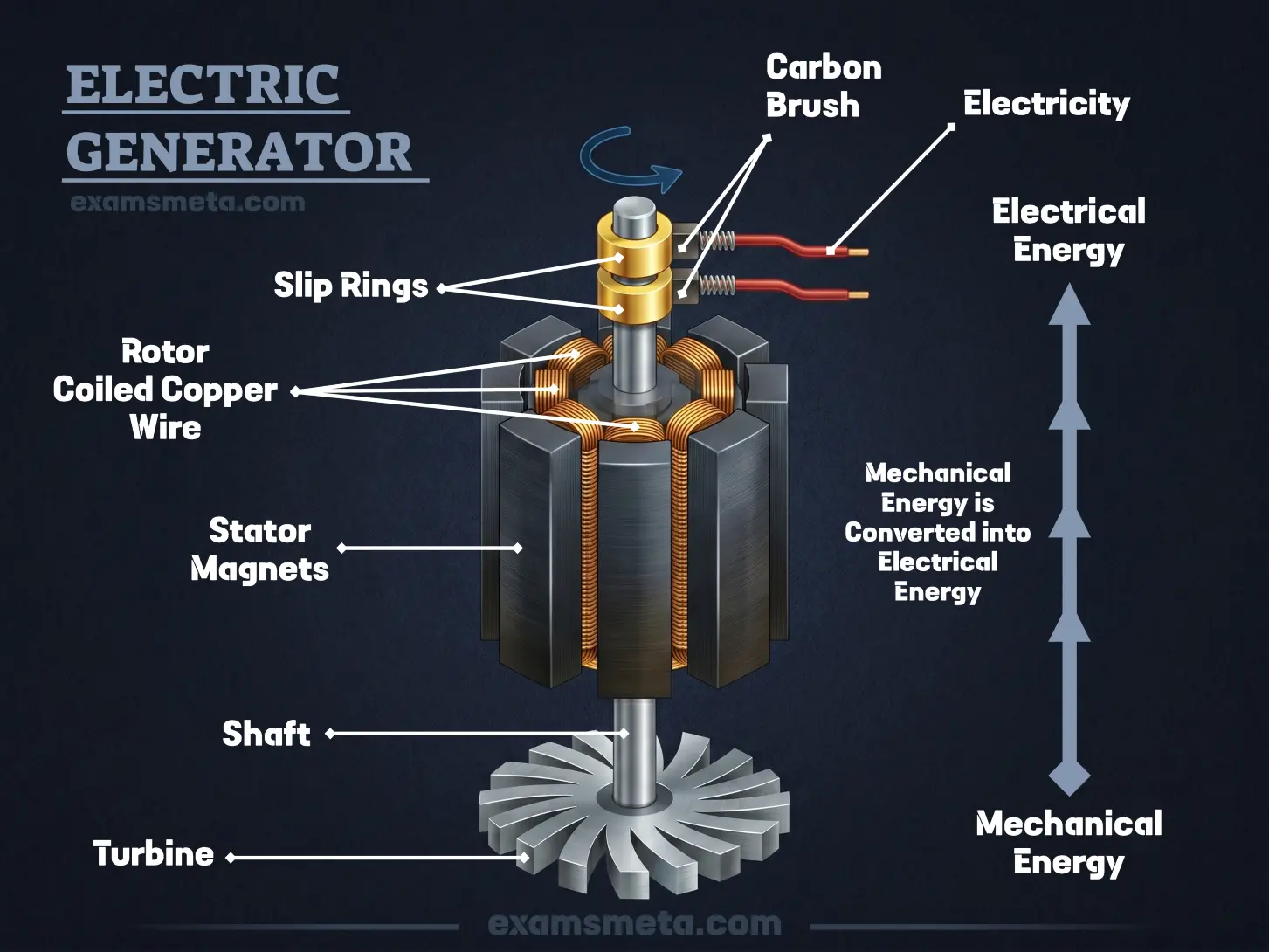
A generator does the reverse. It converts mechanical motion into electrical energy through electromagnetic induction. This is how power stations produce much of the electricity used in the world.
3. Transformers
A transformer uses changing magnetic fields to raise or lower voltage. This is crucial for efficient power transmission. Electricity can be sent over long distances at high voltage and then made safer for homes and businesses.
4. Communication Systems
Radio, television, mobile networks, Wi-Fi, Bluetooth, satellite links, and radar all rely on electromagnetic waves. Without these waves, global communication would not be possible in the way we know it.
5. Medical Technology
MRI, X-ray imaging, and some therapies rely on electromagnetic principles. These tools help doctors see inside the body and make better diagnoses.
6. Everyday Electronics
Computers, chargers, speakers, microphones, hard drives, and circuit boards all depend on electromagnetic behavior at different scales. In many devices, you cannot separate “electronics” from “electromagnetism.” They are deeply connected.
7. Home Appliances
Fans, refrigerators, washing machines, vacuum cleaners, and induction cooktops all use electromagnetic ideas in practical ways. Even when a device seems simple, the physics underneath is often quite rich.
Electromagnetism in Nature
Nature is full of electromagnetic effects.
Earth itself behaves like a giant magnet with a magnetic field that helps protect the planet from charged particles in space. Lightning is an electrical discharge, a dramatic example of charge movement and field interaction. Atoms are held together by electromagnetic attraction between the nucleus and electrons. Chemistry depends on it. Life depends on it.
That last point is important. Electromagnetism is not only about machines. It is also about matter itself. The structure of atoms, the shape of molecules, and the reactions of chemistry all depend on electromagnetic forces. In a very real sense, the visible material world is built on electromagnetic interaction.
Important Properties of Electromagnetic Waves
Electromagnetic waves have several useful properties.
- They can travel through a vacuum
- They move at the speed of light in space
- They carry energy and momentum
- They have frequency, wavelength, and amplitude
- Different wavelengths interact with matter in different ways
The relationship between frequency and wavelength matters a lot. Higher frequency means shorter wavelength and usually higher energy. That is why gamma rays are more energetic than radio waves. This difference is one reason the electromagnetic spectrum is so versatile.
A Closer Look at Frequency and Wavelength
The idea is simple but powerful. A wave with a high number of cycles per second has a high frequency. Since wave speed is fixed in space, a higher frequency means a shorter wavelength. In practical terms, that affects how the wave behaves, what it can penetrate, and how it can be used. NIST’s work on time and frequency standards reflects how important precise frequency measurement is in modern science and technology.
Common Examples of Electromagnetism
Here are some everyday examples that make the idea easier to picture.
- A compass needle aligns with Earth’s magnetic field
- A fridge magnet sticks because of magnetic attraction
- A wire carrying current creates a magnetic field around it
- A doorbell may use an electromagnet to strike a chime
- A generator makes electricity from motion
- A phone signal travels as an electromagnetic wave
- Sunlight reaches Earth as electromagnetic radiation
- An MRI machine uses strong fields and radio waves to scan the body
- A speaker turns electrical signals into sound
These examples show that electromagnetism is not trapped inside a textbook. It lives in the tools people use every single day.
Large Comparison Table of Electromagnetic Devices
| Device | Main Electromagnetic Principle | Input | Output | Typical Use |
|---|---|---|---|---|
| Electric motor | Magnetic force on current | Electricity | Motion | Fans, pumps, tools |
| Generator | Electromagnetic induction | Motion | Electricity | Power plants, dynamos |
| Transformer | Changing magnetic flux | AC electricity | Higher or lower voltage | Power transmission |
| Relay | Electromagnet switching | Small current | Circuit control | Automation, protection |
| Speaker | Current in the magnetic field | Electrical signal | Sound | Music, calls, alerts |
| Microphone | Induced electrical signal | Sound waves | Electricity | Recording, communication |
| MRI scanner | Strong magnetic field and radio waves | RF energy | Body images | Medical imaging |
| Induction cooktop | Induced currents and heat | Electricity | Heat | Cooking |
| Cell tower | Electromagnetic transmission | Electrical power | Wireless signal | Mobile communication |
| Radar system | Reflection of radio waves | Radio wave pulses | Location data | Aviation, weather, defense |
This table makes one thing obvious. Electromagnetism is not a single device or one type of machine. It is a whole toolkit that supports modern life.
Why Electromagnetism Is So Central to Technology
Technology is built on control over energy, signals, and motion. Electromagnetism helps with all three.
It lets us move energy from one place to another through wires and fields. It lets us send information through radio waves and optical signals. It lets us convert energy between electrical and mechanical forms. It lets us sense, measure, scan, and communicate. That is why nearly every major technical system, from power grids to smartphones, depends on it in one way or another.
And there is another reason it matters. Electromagnetism is incredibly scalable. The same basic laws apply to tiny atomic systems and to huge antennas. That makes it one of the most universal parts of physics.
The Role of Electromagnetism in Chemistry and Biology
People often think physics stops at machines, but electromagnetism reaches into chemistry and biology too.
Chemical bonds are electromagnetic in nature. Atoms bond because of the behavior of electrons and electric forces. The shape of molecules, the strength of materials, and the behavior of proteins all depend on electromagnetic interactions. Biology, too, relies on these same forces because life is made from chemistry, and chemistry is governed by electromagnetism.
That is why the subject matters to more than engineers and physicists. It matters to chemists, biologists, doctors, and anyone who wants to understand how the physical world hangs together.
Safety and Electromagnetic Radiation
Not all electromagnetic radiation affects the body in the same way. Lower-energy waves like radio waves and microwaves are used for communication and cooking. Higher-energy waves like ultraviolet, X-rays, and gamma rays can be more biologically damaging because they carry more energy. That is why they must be handled carefully.
It is worth keeping this balanced. Electromagnetic radiation is not automatically dangerous. In fact, most of it is natural and necessary. But different parts of the spectrum serve different purposes, and the higher-energy end needs more care. That is why medical imaging, industrial inspection, and radiation therapy all rely on strict control and proper safety procedures.
A Few Misconceptions About Electromagnetism
Misconception 1: Magnetism and electricity are unrelated
They are deeply related. A current creates a magnetic field, and changing magnetic fields can create an electric current.
Misconception 2: Electromagnetism is only about magnets
Not at all. It includes fields, circuits, waves, light, and much of modern electronics.
Misconception 3: Only big machines use electromagnetism
Actually, even atoms and molecules depend on electromagnetic forces. Chemistry itself is electromagnetic at its heart.
Misconception 4: All electromagnetic waves are the same
They are related, but not identical. Different frequencies and wavelengths behave differently and have different uses.
Why Students Often Find Electromagnetism Hard
Electromagnetism can feel tricky because it mixes invisible fields, moving charges, force directions, and abstract equations. It asks learners to imagine things they cannot see directly. That is not easy. But once the basic ideas become clear, the subject starts to feel logical and even elegant.
A good way to learn it is to move in layers:
- First understand charge
- Then learn electric fields
- Then learn current and magnetism
- Then study induction
- Then connect all of it to waves and applications
That step-by-step method works better than trying to memorize everything at once.
Electromagnetism and Modern Communication
Modern communication is almost impossible to imagine without the electromagnetic theory. Information moves through radio waves, microwaves, optical signals, and other electromagnetic forms. That includes mobile phones, satellite links, Wi-Fi, Bluetooth, GPS, and broadcasting. The invisible wave is often the real messenger.
A text message sent across the world does not travel as a physical object. It travels as a signal encoded in electromagnetic waves. That is one reason this field is so important in the digital age.
Electromagnetism and Power Distribution
Electric power systems depend heavily on electromagnetic principles. Electricity is generated, transmitted, transformed, and delivered through networks that use magnetic fields and induction. Transformers make long-distance power transfer practical. Motors turn electricity into motion. Generators turn motion into electricity. The whole system is a working example of electromagnetism on a national scale.
Without these principles, the modern electrical grid would not be possible in its present form.
A Bigger Table on Everyday Uses
| Area of Life | Example | Electromagnetic Idea at Work | Why It Matters |
|---|---|---|---|
| Home | Fan, fridge, microwave | Motors, induction, waves | Comfort and convenience |
| Transportation | Electric vehicles, rail systems | Motors, magnetic control | Efficient movement |
| Medicine | MRI, X-ray tools | Fields, radiation, imaging | Better diagnosis |
| Communication | Wi-Fi, phone towers | Electromagnetic waves | Fast information exchange |
| Industry | Cranes, relays, sensors | Electromagnets and induction | Automation and control |
| Energy | Power grids, transformers | Voltage conversion | Efficient electricity delivery |
| Science | Spectroscopy, particle control | Field interaction | Research and discovery |
| Daily life | Speakers, chargers, compasses | Currents and magnetic fields | Practical use every day |
This table shows how deeply the subject is woven into ordinary routines. Most people use electromagnetism constantly without thinking about it.
The Beauty of the Subject
There is something quietly beautiful about electromagnetism. It unites opposites. It turns motion into electricity and electricity into motion. It explains how invisible waves can carry music, images, and information across the planet. It shows that light, magnetism, and electrical charge are all part of one large pattern. That kind of unity is rare and satisfying.
Science becomes easier to respect when you see that kind of connection. What looks separate at first often turns out to be linked by a deeper rule. Electromagnetism is one of the best examples of that idea.
Future Directions in Electromagnetism
The basic laws of electromagnetism are well established, but the work around them keeps growing. Researchers continue to improve communications, medical imaging, quantum technologies, energy systems, sensing devices, and materials science. Better control over electromagnetic behavior means better machines, cleaner energy systems, and smarter electronics.
There is also growing interest in fields like metamaterials, wireless power transfer, high-frequency electronics, and quantum devices. These areas build on classical electromagnetism while pushing it into new territory. That makes the subject feel timeless and modern at the same time.
Useful Summary Points
- Electromagnetism connects electricity and magnetism
- A moving charge creates a magnetic field
- A changing magnetic field can create an electric field
- Light is an electromagnetic wave
- Maxwell’s equations organize the theory into a powerful system
- Motors, generators, transformers, and wireless communication all depend on it
- Earth’s magnetic field and chemical bonding also involve electromagnetic effects
- It is one of the deepest reasons modern technology works
Final Thoughts
Electromagnetism is one of those subjects that starts as a physics topic and ends up looking like a foundation of modern civilization. It explains the invisible rules behind motion, signal, light, power, and matter itself. It gives us the language to understand magnets, circuits, waves, and the technologies we use every day. It also reminds us that nature is often more connected than it first appears. Electricity and magnetism are not separate stories. They are one story told in two voices.
And that is what makes the subject so enduring. It is practical, beautiful, and everywhere. It powers homes, devices, medicine, industry, and communication. It helps explain light from the Sun and the behavior of atoms. It sits quietly behind the modern world and keeps it moving. That is a remarkable thing for one branch of physics to do.
Article’s References and Sources
- Encyclopaedia Britannica – Electromagnetism
- Encyclopaedia Britannica – Electromagnetic Field
- Encyclopaedia Britannica – Electromagnet
- Britannica Summary – Electromagnetism
- Britannica – Electromagnetic Waves and Fields
- NIST – Electromagnetic Spectrum and Spectroscopy
- NIST – Ampere and Electrical Standards
- NIST – Time and Frequency Division
- CK-12 – Electromagnetism Lesson
Also, Read these Articles in Detail
- Physics and Its Fundamentals With Good Explanations
- Matter, Motion, and Energy: The Core Ideas of Physics
- What Is Matter? The Physical Substance of the Universe
- What Is Motion? A Guide to Motion in Physics and Daily Life
- What Is Energy? The Invisible Power Behind Everyday Life
- Kinetic Energy Explained in Simple Language
- Potential Energy: Definition, Types, Formula, and Examples
- Thermal Energy: Heat, Temperature, and Transfer
- Mechanical Energy: Definition, Formula, and Examples
- Chemical Energy: Definition, Science, and Examples
- Electrical Energy: Definition, Works, and Why It Matters
- Radiant Energy: Meaning, Sources, Examples, and Uses
- Nuclear Energy: Definition, How It Works, and Why It Matters
- Sound Energy: Definition, Science, and Examples
- Elastic Energy: Definition, Elasticity, and Example
- Geothermal Energy: Clean Electricity, Heating, and Modern Life
- Hydropower Energy: How It Works and Its Importance
- Pumped Hydropower Storage
- Force: Meaning, Types, Formula, and Examples
- Mechanics: Motion, Forces, Energy, and Applications
- Wave: Types, Properties, Motion, and Uses
- The International SI System
- Temperature: Meaning, Measurement, Scales, and Examples
- Electricity: Science, Uses, Safety, and Importance
- Magnetism: Meaning, Types, Properties, and Examples
Frequently Asked Questions
FAQ 1: What is electromagnetism?
Electromagnetism is the branch of physics that studies the relationship between electricity and magnetism. It explains how electric charges create electric fields, how moving charges create magnetic fields, and how changing fields can influence one another. In simple words, it is the science of how electric and magnetic effects work together.
This is a big idea because it connects many things people see every day. A battery pushes current through a circuit. A wire carrying current creates a magnetic field around it. A magnet can move parts inside a machine. A radio wave can carry information across long distances. Even light is part of electromagnetism because it is an electromagnetic wave.
So, when people ask what electromagnetism really is, the best answer is this. It is not just about magnets or electric wires. It is a complete physical system that helps explain circuits, motors, generators, light, wireless communication, and much more. It is one of the foundations of modern science and modern life.
FAQ 2: Why is electromagnetism important in daily life?
Electromagnetism is important in daily life because almost every modern device depends on it in one way or another. When you switch on a light, charge a phone, listen to music through speakers, use Wi-Fi, or ride in an electric vehicle, you are using electromagnetism. It works quietly in the background, but it touches nearly everything.
For example, electric motors use electromagnetic force to create motion. That is why fans, washing machines, pumps, and mixers can work. Generators use electromagnetic induction to produce electricity. That is how much of the world’s power is made. Transformers use electromagnetic effects to change voltage levels, which helps electricity travel efficiently through power lines.
Even communication depends on it. Mobile phones, Bluetooth, radio, television, and satellite signals all use electromagnetic waves. Medical tools also rely on it. MRI machines use magnetic fields and radio waves to scan the body. In short, electromagnetism is not just a school topic. It is a real-life force that supports homes, hospitals, transport, industry, and communication.
FAQ 3: What is the difference between electricity and magnetism?
Electricity and magnetism are closely related, but they are not exactly the same thing. Electricity usually refers to the behavior of electric charges, especially when those charges move as current. Magnetism refers to the force associated with magnets, moving charges, and magnetic fields.
A simple way to understand it is this. A stationary electric charge produces an electric field. A moving charge produces both an electric field and a magnetic field. This means magnetism often appears when electricity is in motion. That is why current flowing through a wire can create a magnetic field around it.
The important point is that these two ideas are linked. They are not separate worlds. In fact, electromagnetism shows that they are two sides of the same larger physical reality. That is why a moving coil in a generator can produce electricity, and why current in a motor can produce motion. Electricity and magnetism work together very closely.
FAQ 4: How does an electromagnet work?
An electromagnet works by using an electric current to create a magnetic field. Usually, a wire is wound into a coil. When current flows through the coil, it produces magnetism. If the coil has an iron core, the magnetic field becomes much stronger. When the current stops, the magnetic effect weakens or disappears.
This is what makes electromagnets so useful. Unlike a permanent magnet, an electromagnet can be turned on and off. Its strength can also be changed by increasing or decreasing the current. The direction of the magnetic field can be reversed by reversing the current.
That flexibility is very practical. Electromagnets are used in cranes to lift scrap metal, in relays to control circuits, in doorbells, in speakers, in motors, and in many industrial machines. They are one of the clearest examples of how electricity can create controlled magnetism for useful work.
FAQ 5: What are Maxwell’s equations in electromagnetism?
Maxwell’s equations are a set of four famous equations that describe how electric fields and magnetic fields behave. They are one of the most important parts of classical physics. In a very compact way, they explain how charges create fields, how fields change, and how electromagnetic waves move through space.
You do not need advanced math to appreciate their meaning. They tell us that electric charges create electric fields. They also tell us that changing magnetic fields create electric fields. And they show that electric currents and changing electric fields create magnetic fields. Together, these rules explain much of electromagnetism, including light, radio waves, and many electrical devices.
What makes these equations so powerful is their unity. Before them, electricity, magnetism, and light were studied as different things. Maxwell’s work showed that they are deeply connected. That insight changed physics forever and made possible a much deeper understanding of waves, fields, and energy.
FAQ 6: Is light part of electromagnetism?
Yes, light is part of electromagnetism. More precisely, light is an electromagnetic wave. That means it is made of linked electric and magnetic fields that move through space together. This wave does not need air or any material medium. It can travel through the vacuum of space, which is why sunlight can reach Earth.
This idea matters a lot. It means the light we see is not separate from other electromagnetic waves. It belongs to the same family as radio waves, microwaves, infrared, ultraviolet, X-rays, and gamma rays. The difference is mainly in frequency and wavelength.
Visible light is the part of the electromagnetic spectrum that human eyes can detect. But the full spectrum is much wider. Some waves are used for communication. Some are used in medicine. Some carry heat. Some are very energetic and require careful handling. So yes, light is electromagnetic, and that is one of the biggest discoveries in physics.
FAQ 7: What is the electromagnetic spectrum?
The electromagnetic spectrum is the full range of all electromagnetic waves, arranged by wavelength or frequency. It includes radio waves, microwaves, infrared, visible light, ultraviolet, X-rays, and gamma rays. These are all related, but each type behaves differently because its wavelength and frequency are different.
At the long-wavelength end, radio waves carry communication signals across long distances. Microwaves are used in cooking, radar, and wireless systems. Infrared is often felt as heat. Visible light is what people can see. Ultraviolet is more energetic and can affect skin and materials. X-rays can pass through soft tissue and are used in imaging. Gamma rays are the most energetic and are linked to nuclear and cosmic processes.
A simple way to think about the spectrum is this. It is one giant family of waves, but each member has its own job. The waves are not separate inventions. They are all different forms of the same electromagnetic phenomenon.
FAQ 8: How are generators and motors related to electromagnetism?
Generators and motors are both built on electromagnetic principles, but they do opposite jobs. A generator turns motion into electricity. A motor turns electricity into motion. Both depend on the interaction between magnetic fields and electric current.
A generator works through electromagnetic induction. When a coil or conductor moves through a magnetic field, or when the magnetic field around it changes, an electric current can be produced. That is why generators are so important in power plants and in many backup power systems.
A motor works the other way. When current flows through a wire or coil inside a magnetic field, forces act on it and cause movement. That movement can spin a fan, drive a pump, or run a machine. This is why motors are everywhere in modern life.
So, even though they do opposite tasks, both devices depend on the same physical laws. That is one of the best examples of how elegant electromagnetism really is.
FAQ 9: What are some real-world examples of electromagnetism?
There are many real-world examples of electromagnetism, and most people use them every single day without thinking about it.
A compass works because Earth has a magnetic field. A fridge magnet sticks because of magnetic attraction. A fan motor turns because of an electromagnetic force. A speaker converts electrical signals into sound using magnetic fields. A doorbell often uses an electromagnet to strike a chime. A phone signal travels through space as an electromagnetic wave. A microwave oven uses electromagnetic waves to heat food. An MRI scanner uses strong magnetic fields and radio waves to create medical images.
There are also examples in nature. Lightning is a dramatic electrical discharge. Earth’s magnetic field protects the planet from some charged particles in space. Atoms and molecules are held together by electromagnetic interactions. Even chemistry depends on it. So electromagnetism is not just in machines. It is built into the structure of the physical world.
FAQ 10: Why is electromagnetism considered one of the fundamental forces of nature?
Electromagnetism is one of the four fundamental forces of nature because it acts at a very basic level and shapes how matter and energy behave. It is responsible for the attraction and repulsion between charges, the behavior of magnets, the structure of atoms, and the formation of chemical bonds. That means it helps hold the material world together.
Without electromagnetism, there would be no stable atoms in the way we know them. There would be no chemistry, no metals, no molecules, and no life as it exists today. It also explains light, which means it plays a role in vision, energy transfer, and communication. In a practical sense, it powers engines, electronics, medical tools, and wireless systems.
What makes this force so remarkable is its reach. It acts across tiny scales inside atoms and across enormous scales in space and technology. It is both invisible and deeply real. That is why physicists treat it as a fundamental force, and why modern civilization depends on it so heavily.
FAQ 11: What is electromagnetic induction?
Electromagnetic induction is the process in which a changing magnetic field produces an electric current in a conductor. This is one of the most important ideas in all of physics because it explains how electricity can be generated from motion. It was made famous by Michael Faraday, whose work changed the way people understood energy and fields.
A simple way to picture it is this. If you move a magnet near a wire coil, or move a coil through a magnetic field, electricity can appear in the wire. The current does not come from nowhere. It comes from the change in the magnetic field around the conductor. That change is the key. If the field stays still, the induction effect is much weaker or may not happen at all.
This idea is behind many useful machines. Generators use induction to produce electrical power. Transformers use induction to change voltage levels. Some cooking systems and wireless technologies also depend on it. So, although the term sounds technical, the idea is very practical. It is one of the main reasons modern power systems work so well.
And that is what makes induction so important. It links movement, magnetism, and electricity in one clean physical rule. That rule powers homes, industries, transport, and communication systems around the world.
FAQ 12: How does a magnetic field form around a current-carrying wire?
When electric current flows through a wire, it creates a magnetic field around that wire. This is one of the simplest and most important discoveries in electromagnetism. The field is not inside the wire alone. It spreads around the wire in circular patterns.
You can think of it like invisible rings surrounding the wire. The direction of the field depends on the direction of the current. If the current changes direction, the magnetic field changes too. This is one reason why electric circuits are closely tied to magnetism.
This effect is the basis of many technologies. A coil of wire with current flowing through it becomes an electromagnet. That is how relays, motors, bells, and many other devices work. The stronger the current, the stronger the magnetic field, although other factors like wire shape and coil turns also matter.
It may seem small at first, but this effect is huge in practice. A current in a wire can move machine parts, switch circuits, and even help generate electricity. That is why this simple relationship sits at the heart of electrical engineering.
FAQ 13: What is the role of electromagnetism in atoms and matter?
Electromagnetism plays a central role in the structure of atoms and matter itself. It helps hold the physical world together at the smallest scales. The attraction between the positively charged nucleus and negatively charged electrons is an electromagnetic effect. Without that force, atoms would not hold their shape in the way they do.
This goes far beyond atoms. The way atoms bond to form molecules is also controlled by electromagnetic behavior. That means chemistry depends on electromagnetism. The softness of some materials, the hardness of others, the way metals conduct electricity, and the way water behaves are all tied to electromagnetic interactions.
This is why the subject is so powerful. It is not only about magnets or wires. It is also about why matter exists in stable forms. It helps explain why solids stay solid, why liquids flow, why light interacts with surfaces, and why living things can function at all.
So, when people say electromagnetism is fundamental, they mean it literally. It is woven into the structure of matter, not just into technology.
FAQ 14: How is electromagnetism used in communication systems?
Electromagnetism is the backbone of modern communication. It allows information to move through electromagnetic waves such as radio waves, microwaves, and light-based signals. These waves can carry sound, data, images, and video across short and long distances.
A mobile phone call, for example, does not travel as a physical object. The voice is converted into a signal and sent through electromagnetic waves. The same is true for Wi-Fi, Bluetooth, radio broadcasting, television transmission, and satellite communication. These systems depend on the fact that electromagnetic waves can travel through air and even through the vacuum of space.
This is one of the biggest reasons electromagnetism matters in the modern world. It makes global communication possible. A message can move from one continent to another in a very short time because the signal is carried by waves that move extremely fast.
And the best part is that the same physical rules apply across many systems. Whether it is a simple radio set or a complex satellite network, the underlying idea is still electromagnetism.
FAQ 15: What is the electromagnetic spectrum used for?
The electromagnetic spectrum is used in many different ways because its waves cover a wide range of frequencies and wavelengths. Each part of the spectrum has its own uses, strengths, and limits.
Radio waves are used for broadcasting, navigation, and wireless communication. Microwaves are used in cooking, radar, and some communication systems. Infrared helps with heat detection, thermal cameras, and remote controls. Visible light is used for vision, lighting, and photography. Ultraviolet is used for sterilization and scientific analysis. X-rays are used in medical imaging. Gamma rays are used in medicine, research, and astrophysics.
This variety makes the spectrum very useful. One family of waves supports many different fields, from medicine to defense to everyday communication. That is why the spectrum is such a central topic in physics and technology.
It is also a reminder that not all electromagnetic waves are alike. They may belong to the same family, but each part behaves differently. That difference is what makes the spectrum so flexible and so important.
FAQ 16: How do transformers use electromagnetism?
A transformer uses electromagnetic induction to change voltage from one level to another. It usually has two coils, called the primary coil and the secondary coil, wrapped around a magnetic core. When alternating current passes through the primary coil, it creates a changing magnetic field. That changing field then induces a current in the secondary coil.
This is a very clever use of electromagnetism because it lets electricity move efficiently through power systems. High voltage is useful for sending electricity over long distances because it reduces energy loss. Then the voltage can be lowered for safe use in homes, schools, offices, and factories.
Transformers are everywhere in the electrical world. They are in power stations, grid networks, chargers, and many electronic systems. People rarely think about them, but without transformers, the modern electricity system would be far less practical.
So, in simple terms, a transformer is a device that uses changing magnetic fields to control voltage. That is a perfect example of electromagnetism at work in everyday infrastructure.
FAQ 17: What are the main properties of electromagnetic waves?
Electromagnetic waves have several important properties that make them unique and useful.
First, they can travel through empty space, which means they do not need air or water or any other medium. That is why light from the Sun can reach Earth. Second, they always move at the speed of light in a vacuum, which is one of the fastest known speeds in nature. Third, they carry energy and momentum, so they can interact with matter in useful ways.
They also have measurable features such as frequency, wavelength, and amplitude. The frequency tells us how often the wave repeats. The wavelength tells us the distance between wave peaks. The amplitude relates to the wave’s strength or intensity.
These properties help explain why different waves are used for different purposes. Long waves are often better for broadcasting. Shorter, more energetic waves can be used for imaging or scientific work. That is why the electromagnetic spectrum has such wide practical value.
And because the waves are so flexible, they can be adapted to many tasks. That is one reason they are so important in communication, medicine, astronomy, and physics.
FAQ 18: How does electromagnetism help in medical science?
Electromagnetism plays a major role in medical science, especially in imaging and treatment. One of the best-known examples is the MRI machine, which uses strong magnetic fields and radio waves to create detailed pictures of the body. This helps doctors look inside the body without surgery.
X-rays are another example. They use high-energy electromagnetic radiation to create images of bones and internal structures. Because different tissues absorb X-rays in different ways, doctors can use them to spot fractures, infections, and other problems.
Electromagnetism also appears in therapy and monitoring. Some medical devices use electrical signals to track heart activity, brain activity, or muscle movement. Others use electromagnetic principles in scanners, sensors, and treatment equipment.
This makes the subject especially valuable in healthcare. It gives doctors tools that are fast, precise, and often non-invasive. That means better diagnosis, better treatment, and better care for patients.
So, even though electromagnetism sounds like a physics idea, it is deeply connected to human health and medicine.
FAQ 19: Why is Earth’s magnetic field important?
Earth’s magnetic field is important because it protects the planet and helps with navigation. It acts like a giant invisible shield around Earth. This shield helps deflect some charged particles from the Sun and space, which is one reason life on Earth is able to survive in a more stable environment.
It also helps in practical ways. Compasses work because they align with Earth’s magnetic field. For centuries, that has helped people travel across land and sea. Even today, magnetic navigation remains useful in many systems.
Earth’s magnetic field is not static. It changes slowly over time, and scientists study these changes carefully. That makes it both a natural shield and an important scientific subject. It affects satellites, communication systems, and space weather as well.
So, Earth’s magnetic field is not just a neat fact. It is a real part of the planet’s protective system and a key feature of navigation and scientific research.
FAQ 20: What makes electromagnetism different from other forces in nature?
Electromagnetism is different from other forces in nature because it acts on electric charge and works over very large ranges. It can attract or repel charged objects, create magnetic effects, and travel in the form of waves. Unlike gravity, which always attracts, electromagnetism can both attract and repel depending on the charges involved.
It is also special because it connects so many things. It explains electricity, magnetism, light, chemical bonding, and much of modern technology. Few forces have such a wide reach. It works at the scale of atoms and molecules, but it also powers giant systems like the electrical grid and global communication networks.
Another difference is that electromagnetism is very visible in technology. You can see its effects in motors, generators, speakers, batteries, and wireless systems. It is hidden, but not abstract in a distant way. It has real-world presence.
That is what makes it so important. It is a fundamental force, but it is also practical, measurable, and deeply connected to everyday life. It shapes both the smallest particles and the biggest systems humans rely on.
